1
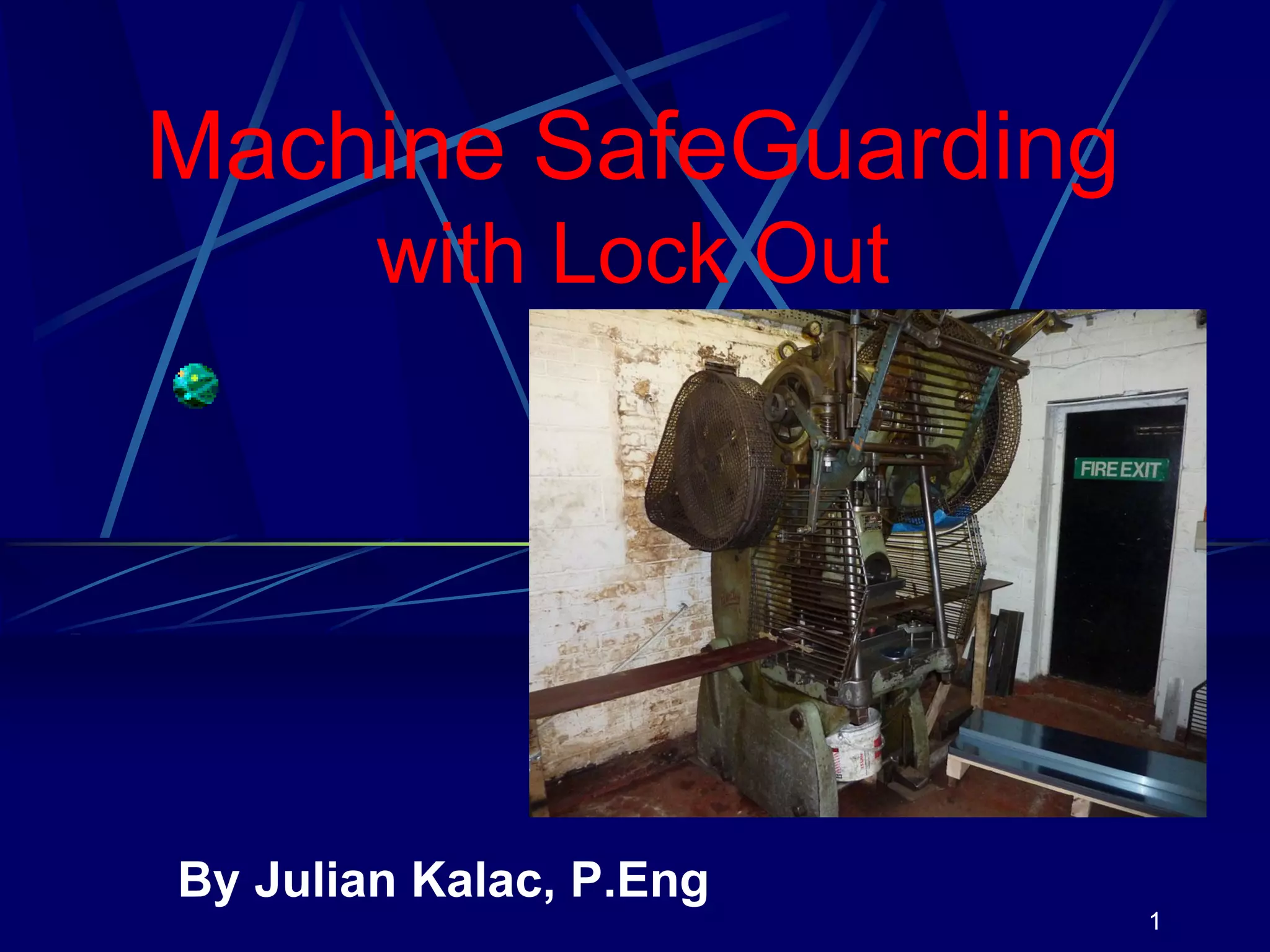
Machine SafeGuarding
with Lock Out
By Julian Kalac, P.Eng
2
3
4
5
6
7
8
9
10
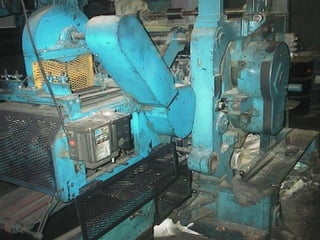
Scenario
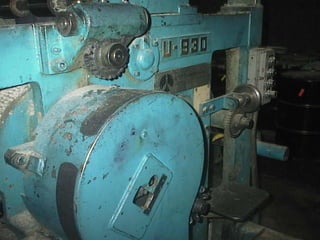
Printing press
42 year old operator with 20 years exp.
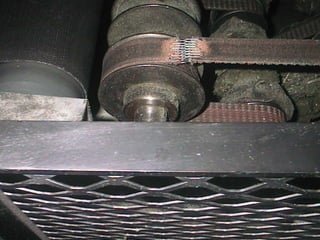
Pinch point – 150psi
Distance from pinch point to safety stop
 8 feet
No guards in place
Operator goes to remove a paper
jam……..
11
12
13
14
15
16
17
Result
Hospitalized for 1 week
Rehabilitation for 4-6 months
Severed tendons & nerves
Laceration to bone
Missing nerves & tendons
Loss of sensation
Loss of range or motion
Finger tips permanently bent
*These are only
The physical problems
18
Any machine part,
function, or process
which may cause injury
must be safeguarded
Rule to Remember
19
20
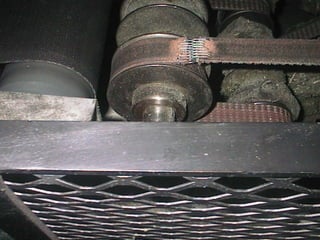
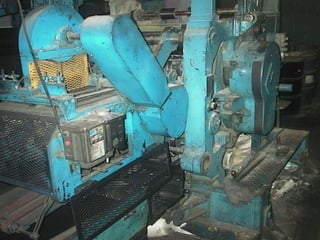
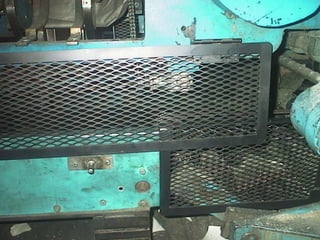
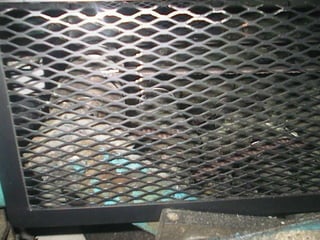
New Guards
for Printing Press
21
22
23
24
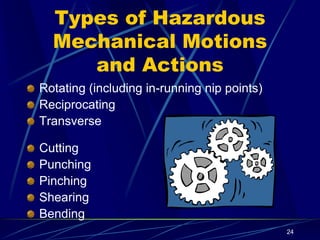
Types of Hazardous
Mechanical Motions
and Actions
Rotating (including in-running nip points)
Reciprocating
Transverse
Cutting
Punching
Pinching
Shearing
Bending
25
Rotating Motion
Common rotating mechanisms
 Collars
 Couplings
 Cams
 Clutches
 Flywheels
 Shaft ends
 Spindles
 Horizontal/vertical shafting
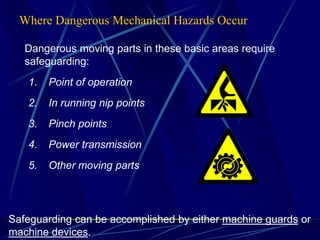
Dangerous moving parts in these basic areas require
safeguarding:
1. Point of operation
2. In running nip points
3. Pinch points
4. Power transmission
5. Other moving parts
Where Dangerous Mechanical Hazards Occur
Safeguarding can be accomplished by either machine guards or
machine devices.
27
Types of Machine Guards
Guards
 Fixed
 Interlocked
 Adjustable
 Self-adjusting
Devices
 Presence sensing
 Photoelectrical (optical)
 Radio frequency (capacitance)
 Electromechanical
28
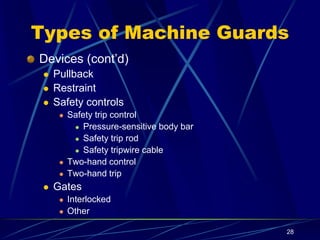
Types of Machine Guards
Devices (cont’d)
 Pullback
 Restraint
 Safety controls
 Safety trip control
 Pressure-sensitive body bar
 Safety trip rod
 Safety tripwire cable
 Two-hand control
 Two-hand trip
 Gates
 Interlocked
 Other
29
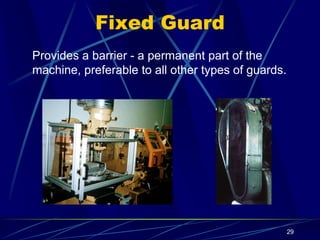
Fixed Guard
Provides a barrier - a permanent part of the
machine, preferable to all other types of guards.
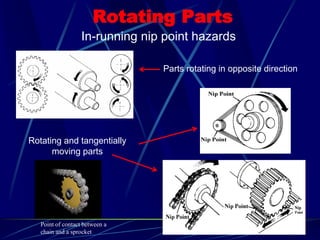
Parts rotating in opposite direction
In-running nip point hazards
Rotating and tangentially
moving parts
Rotating Parts
Point of contact between a
chain and a sprocket
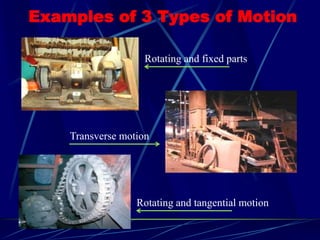
Examples of 3 Types of Motion
Rotating and fixed parts
Transverse motion
Rotating and tangential motion
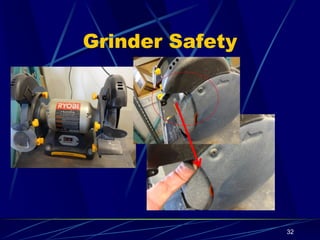
Grinder Safety
32
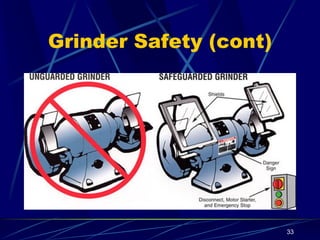
Grinder Safety (cont)
33
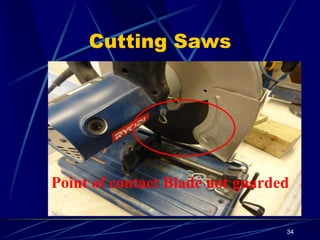
Cutting Saws
34
Point of contact Blade not guarded
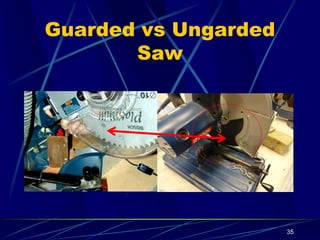
Guarded vs Ungarded
Saw
35
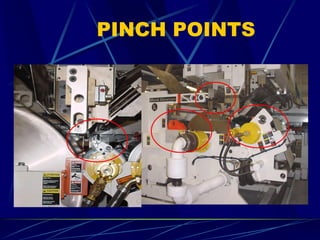
PINCH POINTS
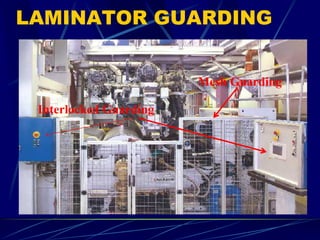
LAMINATOR GUARDING
Interlocked Guarding
Mesh Guarding
38
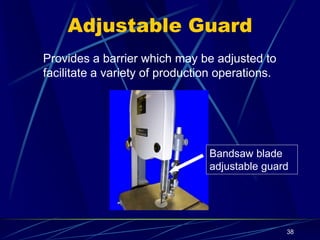
Adjustable Guard
Provides a barrier which may be adjusted to
facilitate a variety of production operations.
Bandsaw blade
adjustable guard
39
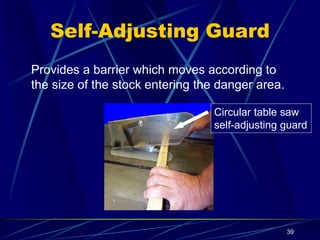
Self-Adjusting Guard
Provides a barrier which moves according to
the size of the stock entering the danger area.
Circular table saw
self-adjusting guard
40
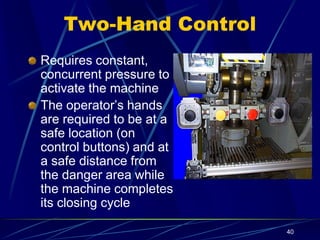
Two-Hand Control
Requires constant,
concurrent pressure to
activate the machine
The operator’s hands
are required to be at a
safe location (on
control buttons) and at
a safe distance from
the danger area while
the machine completes
its closing cycle
41
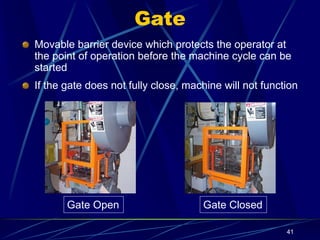
Gate
Movable barrier device which protects the operator at
the point of operation before the machine cycle can be
started
If the gate does not fully close, machine will not function
Gate Open Gate Closed
42
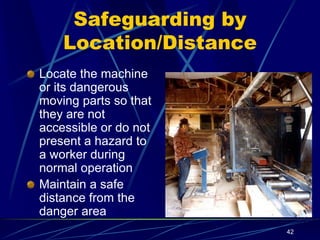
Safeguarding by
Location/Distance
Locate the machine
or its dangerous
moving parts so that
they are not
accessible or do not
present a hazard to
a worker during
normal operation
Maintain a safe
distance from the
danger area
43
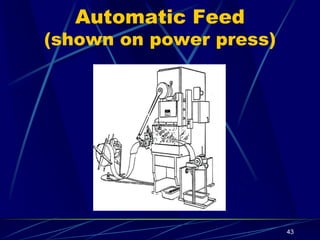
Automatic Feed
(shown on power press)
Transparent
Enclosure
Guard
Stock Feed
Roll
Danger
Area
Completed Work
44
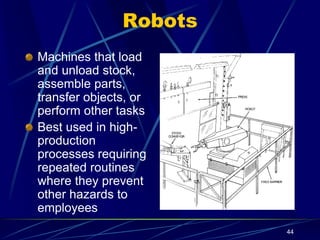
Robots
Machines that load
and unload stock,
assemble parts,
transfer objects, or
perform other tasks
Best used in high-
production
processes requiring
repeated routines
where they prevent
other hazards to
employees
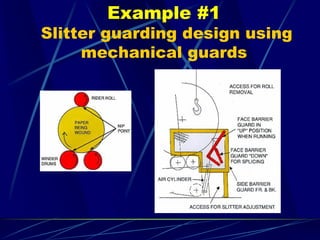
Example #1
Slitter guarding design using
mechanical guards
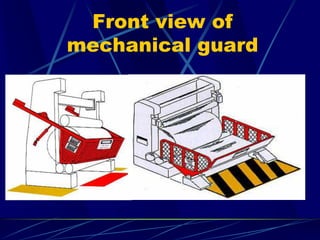
Front view of
mechanical guard
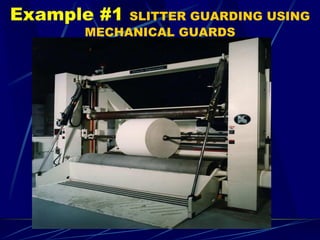
Example #1 SLITTER GUARDING USING
MECHANICAL GUARDS
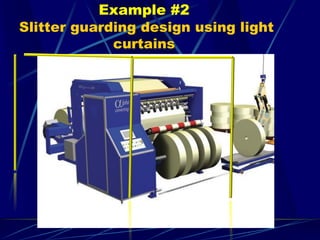
Example #2
Slitter guarding design using light
curtains
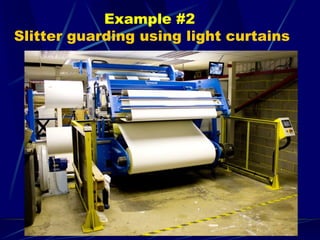
Example #2
Slitter guarding using light curtains
50
51
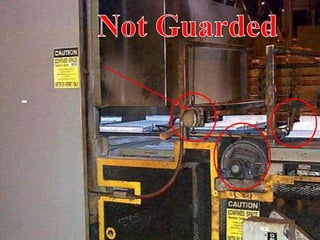
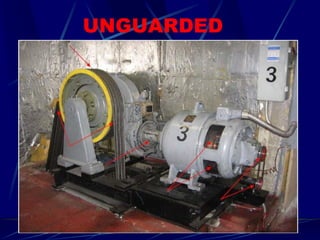
UNGUARDED
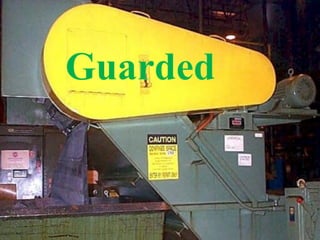
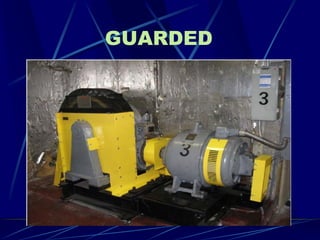
GUARDED
54
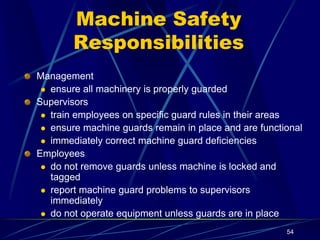
Machine Safety
Responsibilities
Management
 ensure all machinery is properly guarded
Supervisors
 train employees on specific guard rules in their areas
 ensure machine guards remain in place and are functional
 immediately correct machine guard deficiencies
Employees
 do not remove guards unless machine is locked and
tagged
 report machine guard problems to supervisors
immediately
 do not operate equipment unless guards are in place
55
Training Questions
How to use safeguards
Where are guards located
What hazards safeguards are
protecting against
When and how to remove guards
What to do if a guard is missing or
damaged
56
Any machine part,
function, or process
which may cause injury
must be safeguarded
Rule to Remember
57
QUESTIONS???
ADVANCED LOCK
OUT TAG OUT
ZERO ENERGY
By Julian Kalac, P.Eng
58
59
Why Lock out tag out is
important?
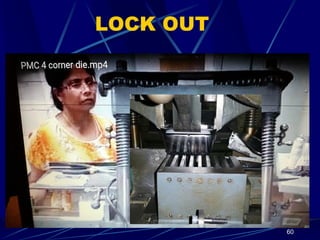
LOCK OUT
60
What is Lock Out Tag Out?
Lockout is defined in the Canadian standard
CSA Z460-05 (R2010) "Control of Hazardous
Energy”
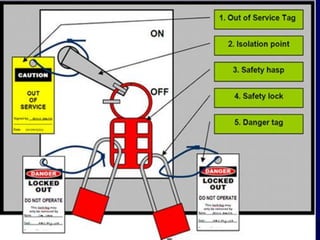
Lockout is the isolation of energy from the
system (a machine/equipment/process) which
physically locks the system in a safe mode
Tag out is the labelling process always used
when lockout is required and includes the
following information:
 Time of application of the lock/tag.
 The name of the authorized person who
attached the tag and lock to the system.
Lock Out Tag Out Procedure
1. Prepare For Shutdown
Everyone in the area must be informed that Lockout/Tagout will be
performed and on which machines.
2. Identify Sources of Hazardous Energy on the
machine/equipment Assess equipment and identify the
hazardous energy sources (figure 1.0), either potential or
kinetic and determine the most effective method to achieve
a “ZERO ENERGY STATE”. Contact Manufacturing
Engineer (Julian Kalac) to help identify system shutdown
procedures.
62
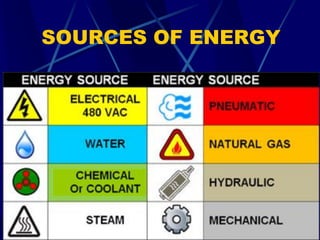
Examples of Types of
Hazardous Energy
Electrical
Hydraulic
Pneumatic
Mechanical potential energy
Gravitational potential energy –
Pressurized gasses
Chemical energy
other
Helping Our Customers Be More Successful . . .
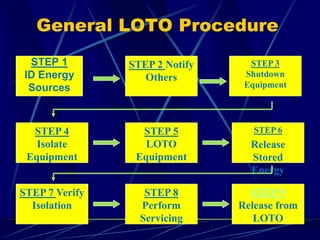
General LOTO Procedure
STEP 1
ID Energy
Sources
STEP 2 Notify
Others
STEP 4
Isolate
Equipment
STEP 5
LOTO
Equipment
STEP 3
Shutdown
Equipment
STEP 6
Release
Stored
Energy
STEP 7 Verify
Isolation
STEP 8
Perform
Servicing
STEP 9
Release from
LOTO
Lock Out Tag Out
Procedure
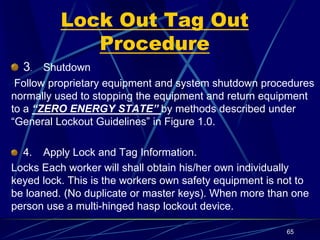
3. Shutdown
Follow proprietary equipment and system shutdown procedures
normally used to stopping the equipment and return equipment
to a “ZERO ENERGY STATE” by methods described under
“General Lockout Guidelines” in Figure 1.0.
4. Apply Lock and Tag Information.
Locks Each worker will shall obtain his/her own individually
keyed lock. This is the workers own safety equipment is not to
be loaned. (No duplicate or master keys). When more than one
person use a multi-hinged hasp lockout device.
65
66
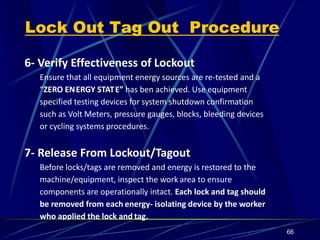
6- Verify Effectiveness of Lockout
Ensure that all equipment energy sources are re-tested and a
“ZERO ENERGY STATE” has ben achieved. Use equipment
specified testing devices for system shutdown confirmation
such as Volt Meters, pressure gauges, blocks, bleeding devices
or cycling systems procedures.
7- Release From Lockout/Tagout
Before locks/tags are removed and energy is restored to the
machine/equipment, inspect the work area to ensure
components are operationally intact. Each lock and tag should
be removed from each energy- isolating device by the worker
who applied the lock and tag.
Lock Out Tag Out Procedure
SOURCES OF ENERGY
67
68
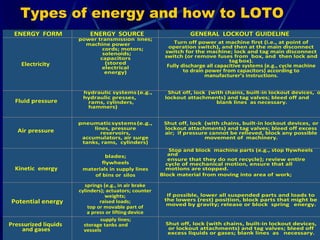
ENERGY FORM ENERGY SOURCE GENERAL LOCKOUT GUIDELINE
Electricity
power transmission lines;
machine power
cords; motors;
solenoids;
capacitors
(stored
electrical
energy)
Turn off power at machine first (i.e., at point of
operation switch), and then at the main disconnect
switch for the machine; lock and tag main disconnect
switch (or remove fuses from box, and then lock and
tag box).
Fully discharge all capacitive systems (e.g., cycle machine
to drain power from capacitors) according to
manufacturer’s instructions.
Fluid pressure
hydraulic systems (e.g.,
hydraulic presses,
rams, cylinders,
hammers)
Shut off, lock (with chains, built-in lockout devices, o
lockout attachments) and tag valves; bleed off and
blank lines as necessary.
Air pressure
pneumaticsystems(e.g.,
lines, pressure
reservoirs,
accumulators, air surge
tanks, rams, cylinders)
Shut off, lock (with chains, built-in lockout devices, or
lockout attachments) and tag valves; bleed off excess
air; if pressure cannot be relieved, block any possible
movement of machinery.
Kinetic energy
blades;
flywheels
materials in supply lines
of bins or silos
Stop and block machine parts (e.g., stop flywheels
and
ensure that they do not recycle); review entire
cycle of mechanical motion, ensure that all
motions are stopped.
Block material from moving into area of work;
Potential energy
springs (e.g., in air brake
cylinders); actuators; counter
weights;
raised loads;
top or movable part of
a press or lifting device
If possible, lower all suspended parts and loads to
the lowers (rest) position, block parts that might be
moved by gravity; release or block spring energy.
Pressurized liquids
and gases
supply lines;
storage tanks and
vessels
Shut off, lock (with chains, built-in lockout devices,
or lockout attachments) and tag valves; bleed off
excess liquids or gases; blank lines as necessary.
Types of energy and how to LOTO
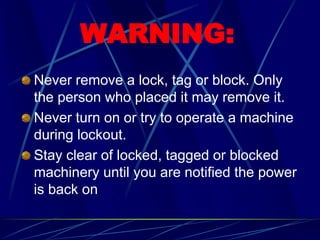
Never remove a lock, tag or block. Only
the person who placed it may remove it.
Never turn on or try to operate a machine
during lockout.
Stay clear of locked, tagged or blocked
machinery until you are notified the power
is back on
WARNING:
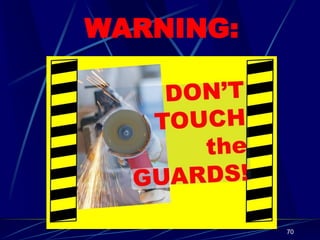
WARNING:
70
71
72

Machine Safeguarding with Lock Out Tag Out

  • 1.
    1 Machine SafeGuarding with LockOut By Julian Kalac, P.Eng
  • 2.
  • 3.
  • 4.
  • 5.
  • 6.
  • 7.
  • 8.
  • 9.
  • 10.
    10 Scenario Printing press 42 yearold operator with 20 years exp. Pinch point – 150psi Distance from pinch point to safety stop  8 feet No guards in place Operator goes to remove a paper jam……..
  • 11.
  • 12.
  • 13.
  • 14.
  • 15.
  • 16.
  • 17.
    17 Result Hospitalized for 1week Rehabilitation for 4-6 months Severed tendons & nerves Laceration to bone Missing nerves & tendons Loss of sensation Loss of range or motion Finger tips permanently bent *These are only The physical problems
  • 18.
    18 Any machine part, function,or process which may cause injury must be safeguarded Rule to Remember
  • 19.
  • 20.
  • 21.
  • 22.
  • 23.
  • 24.
    24 Types of Hazardous MechanicalMotions and Actions Rotating (including in-running nip points) Reciprocating Transverse Cutting Punching Pinching Shearing Bending
  • 25.
    25 Rotating Motion Common rotatingmechanisms  Collars  Couplings  Cams  Clutches  Flywheels  Shaft ends  Spindles  Horizontal/vertical shafting
  • 26.
    Dangerous moving partsin these basic areas require safeguarding: 1. Point of operation 2. In running nip points 3. Pinch points 4. Power transmission 5. Other moving parts Where Dangerous Mechanical Hazards Occur Safeguarding can be accomplished by either machine guards or machine devices.
  • 27.
    27 Types of MachineGuards Guards  Fixed  Interlocked  Adjustable  Self-adjusting Devices  Presence sensing  Photoelectrical (optical)  Radio frequency (capacitance)  Electromechanical
  • 28.
    28 Types of MachineGuards Devices (cont’d)  Pullback  Restraint  Safety controls  Safety trip control  Pressure-sensitive body bar  Safety trip rod  Safety tripwire cable  Two-hand control  Two-hand trip  Gates  Interlocked  Other
  • 29.
    29 Fixed Guard Provides abarrier - a permanent part of the machine, preferable to all other types of guards.
  • 30.
    Parts rotating inopposite direction In-running nip point hazards Rotating and tangentially moving parts Rotating Parts Point of contact between a chain and a sprocket
  • 31.
    Examples of 3Types of Motion Rotating and fixed parts Transverse motion Rotating and tangential motion
  • 32.
  • 33.
  • 34.
    Cutting Saws 34 Point ofcontact Blade not guarded
  • 35.
  • 36.
  • 37.
  • 38.
    38 Adjustable Guard Provides abarrier which may be adjusted to facilitate a variety of production operations. Bandsaw blade adjustable guard
  • 39.
    39 Self-Adjusting Guard Provides abarrier which moves according to the size of the stock entering the danger area. Circular table saw self-adjusting guard
  • 40.
    40 Two-Hand Control Requires constant, concurrentpressure to activate the machine The operator’s hands are required to be at a safe location (on control buttons) and at a safe distance from the danger area while the machine completes its closing cycle
  • 41.
    41 Gate Movable barrier devicewhich protects the operator at the point of operation before the machine cycle can be started If the gate does not fully close, machine will not function Gate Open Gate Closed
  • 42.
    42 Safeguarding by Location/Distance Locate themachine or its dangerous moving parts so that they are not accessible or do not present a hazard to a worker during normal operation Maintain a safe distance from the danger area
  • 43.
    43 Automatic Feed (shown onpower press) Transparent Enclosure Guard Stock Feed Roll Danger Area Completed Work
  • 44.
    44 Robots Machines that load andunload stock, assemble parts, transfer objects, or perform other tasks Best used in high- production processes requiring repeated routines where they prevent other hazards to employees
  • 45.
    Example #1 Slitter guardingdesign using mechanical guards
  • 46.
  • 47.
    Example #1 SLITTERGUARDING USING MECHANICAL GUARDS
  • 48.
    Example #2 Slitter guardingdesign using light curtains
  • 49.
    Example #2 Slitter guardingusing light curtains
  • 50.
  • 51.
  • 52.
  • 53.
  • 54.
    54 Machine Safety Responsibilities Management  ensureall machinery is properly guarded Supervisors  train employees on specific guard rules in their areas  ensure machine guards remain in place and are functional  immediately correct machine guard deficiencies Employees  do not remove guards unless machine is locked and tagged  report machine guard problems to supervisors immediately  do not operate equipment unless guards are in place
  • 55.
    55 Training Questions How touse safeguards Where are guards located What hazards safeguards are protecting against When and how to remove guards What to do if a guard is missing or damaged
  • 56.
    56 Any machine part, function,or process which may cause injury must be safeguarded Rule to Remember
  • 57.
  • 58.
    ADVANCED LOCK OUT TAGOUT ZERO ENERGY By Julian Kalac, P.Eng 58
  • 59.
    59 Why Lock outtag out is important?
  • 60.
  • 61.
    What is LockOut Tag Out? Lockout is defined in the Canadian standard CSA Z460-05 (R2010) "Control of Hazardous Energy” Lockout is the isolation of energy from the system (a machine/equipment/process) which physically locks the system in a safe mode Tag out is the labelling process always used when lockout is required and includes the following information:  Time of application of the lock/tag.  The name of the authorized person who attached the tag and lock to the system.
  • 62.
    Lock Out TagOut Procedure 1. Prepare For Shutdown Everyone in the area must be informed that Lockout/Tagout will be performed and on which machines. 2. Identify Sources of Hazardous Energy on the machine/equipment Assess equipment and identify the hazardous energy sources (figure 1.0), either potential or kinetic and determine the most effective method to achieve a “ZERO ENERGY STATE”. Contact Manufacturing Engineer (Julian Kalac) to help identify system shutdown procedures. 62
  • 63.
    Examples of Typesof Hazardous Energy Electrical Hydraulic Pneumatic Mechanical potential energy Gravitational potential energy – Pressurized gasses Chemical energy other Helping Our Customers Be More Successful . . .
  • 64.
    General LOTO Procedure STEP1 ID Energy Sources STEP 2 Notify Others STEP 4 Isolate Equipment STEP 5 LOTO Equipment STEP 3 Shutdown Equipment STEP 6 Release Stored Energy STEP 7 Verify Isolation STEP 8 Perform Servicing STEP 9 Release from LOTO
  • 65.
    Lock Out TagOut Procedure 3. Shutdown Follow proprietary equipment and system shutdown procedures normally used to stopping the equipment and return equipment to a “ZERO ENERGY STATE” by methods described under “General Lockout Guidelines” in Figure 1.0. 4. Apply Lock and Tag Information. Locks Each worker will shall obtain his/her own individually keyed lock. This is the workers own safety equipment is not to be loaned. (No duplicate or master keys). When more than one person use a multi-hinged hasp lockout device. 65
  • 66.
    66 6- Verify Effectivenessof Lockout Ensure that all equipment energy sources are re-tested and a “ZERO ENERGY STATE” has ben achieved. Use equipment specified testing devices for system shutdown confirmation such as Volt Meters, pressure gauges, blocks, bleeding devices or cycling systems procedures. 7- Release From Lockout/Tagout Before locks/tags are removed and energy is restored to the machine/equipment, inspect the work area to ensure components are operationally intact. Each lock and tag should be removed from each energy- isolating device by the worker who applied the lock and tag. Lock Out Tag Out Procedure
  • 67.
  • 68.
    68 ENERGY FORM ENERGYSOURCE GENERAL LOCKOUT GUIDELINE Electricity power transmission lines; machine power cords; motors; solenoids; capacitors (stored electrical energy) Turn off power at machine first (i.e., at point of operation switch), and then at the main disconnect switch for the machine; lock and tag main disconnect switch (or remove fuses from box, and then lock and tag box). Fully discharge all capacitive systems (e.g., cycle machine to drain power from capacitors) according to manufacturer’s instructions. Fluid pressure hydraulic systems (e.g., hydraulic presses, rams, cylinders, hammers) Shut off, lock (with chains, built-in lockout devices, o lockout attachments) and tag valves; bleed off and blank lines as necessary. Air pressure pneumaticsystems(e.g., lines, pressure reservoirs, accumulators, air surge tanks, rams, cylinders) Shut off, lock (with chains, built-in lockout devices, or lockout attachments) and tag valves; bleed off excess air; if pressure cannot be relieved, block any possible movement of machinery. Kinetic energy blades; flywheels materials in supply lines of bins or silos Stop and block machine parts (e.g., stop flywheels and ensure that they do not recycle); review entire cycle of mechanical motion, ensure that all motions are stopped. Block material from moving into area of work; Potential energy springs (e.g., in air brake cylinders); actuators; counter weights; raised loads; top or movable part of a press or lifting device If possible, lower all suspended parts and loads to the lowers (rest) position, block parts that might be moved by gravity; release or block spring energy. Pressurized liquids and gases supply lines; storage tanks and vessels Shut off, lock (with chains, built-in lockout devices, or lockout attachments) and tag valves; bleed off excess liquids or gases; blank lines as necessary. Types of energy and how to LOTO
  • 69.
    Never remove alock, tag or block. Only the person who placed it may remove it. Never turn on or try to operate a machine during lockout. Stay clear of locked, tagged or blocked machinery until you are notified the power is back on WARNING:
  • 70.
  • 71.
  • 72.