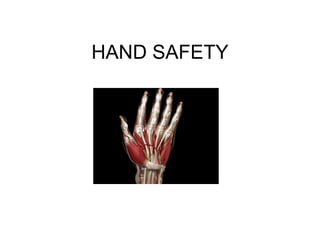
HAND SAFETY
Your hands are your most important tool. Over 16 million people suffer hand injuries per year. Over a quarter million of those are serious & often disabling injuries each year. 25% of all industrial injuries involve the hand.
Facts The most common type of hand injury is a crushing or compression injury. Men are 9 times more likely to receive a hand injury than women. Most hand injuries involve a lack of adequate personal protective equipment.
Fact Each year, more than 115,000 Americans end up in the emergency room as a result of hand-tool-related injuries.
Fact  Some 30,000 persons are injured annually using hammers. 25,000 using standard blade screwdrivers & crescent wrenches.
Common Causes  Use of unprotected or faulty machinery or equipment. Failure to use guards, kill-switches, or to follow appropriate lock-out procedures are among the leading hand hazards.  Wearing jewelry, gloves, or loose-fitting clothing around moving parts can also lead to injury.
Causes Chemicals, corrosives, & other irritating substances can cause burns & skin inflammation unless appropriate hand protection is used.  Improper use or maintenance of the hand tool. Lack of protective gloves or not using the appropriate accessories for the tool.
Typical Injuries Puncture wounds Severed fingers Broken fingers Contusions Temperature extremes Electrical hazards
Guideline’s for Hand Safety  Be alert to potential hand hazards  before  an accident can happen. Be alert to possible unguarded pinch points. Always use guards, shields & other protective devices when appropriate. Do not remove guards.
Guidelines Continued Use brushes to wipe away debris. Inspect equipment & machinery before & after tasks to make sure that it is in good operating condition. Disconnect power & follow established lock-out procedures before repairing or cleaning machinery.
Guidelines Continued Never  wear gloves, jewelry, or loose clothing when working with moving machine parts.  Use the  appropriate personal protective equipment. When wearing gloves, be sure they fit properly & are rated for the specific task you are performing.
NOT ALL GLOVES ARE THE  SAME!!!!!!! Consult your products MSDS or Supervisor for proper glove type.
SELECT PROPER TOOLS Use the right tool for the job Select tools that will keep your wrists straight to avoid repetitive motion/overuse problems.
Take care of your hands.

Hand Safety

  • 1.
  • 2.
    Your hands areyour most important tool. Over 16 million people suffer hand injuries per year. Over a quarter million of those are serious & often disabling injuries each year. 25% of all industrial injuries involve the hand.
  • 3.
    Facts The mostcommon type of hand injury is a crushing or compression injury. Men are 9 times more likely to receive a hand injury than women. Most hand injuries involve a lack of adequate personal protective equipment.
  • 4.
    Fact Each year,more than 115,000 Americans end up in the emergency room as a result of hand-tool-related injuries.
  • 5.
    Fact Some30,000 persons are injured annually using hammers. 25,000 using standard blade screwdrivers & crescent wrenches.
  • 6.
    Common Causes Use of unprotected or faulty machinery or equipment. Failure to use guards, kill-switches, or to follow appropriate lock-out procedures are among the leading hand hazards. Wearing jewelry, gloves, or loose-fitting clothing around moving parts can also lead to injury.
  • 7.
    Causes Chemicals, corrosives,& other irritating substances can cause burns & skin inflammation unless appropriate hand protection is used. Improper use or maintenance of the hand tool. Lack of protective gloves or not using the appropriate accessories for the tool.
  • 8.
    Typical Injuries Puncturewounds Severed fingers Broken fingers Contusions Temperature extremes Electrical hazards
  • 9.
    Guideline’s for HandSafety Be alert to potential hand hazards before an accident can happen. Be alert to possible unguarded pinch points. Always use guards, shields & other protective devices when appropriate. Do not remove guards.
  • 10.
    Guidelines Continued Usebrushes to wipe away debris. Inspect equipment & machinery before & after tasks to make sure that it is in good operating condition. Disconnect power & follow established lock-out procedures before repairing or cleaning machinery.
  • 11.
    Guidelines Continued Never wear gloves, jewelry, or loose clothing when working with moving machine parts. Use the appropriate personal protective equipment. When wearing gloves, be sure they fit properly & are rated for the specific task you are performing.
  • 12.
    NOT ALL GLOVESARE THE SAME!!!!!!! Consult your products MSDS or Supervisor for proper glove type.
  • 13.
    SELECT PROPER TOOLSUse the right tool for the job Select tools that will keep your wrists straight to avoid repetitive motion/overuse problems.
  • 14.
    Take care ofyour hands.