Machine learning
Applications, types and key concepts
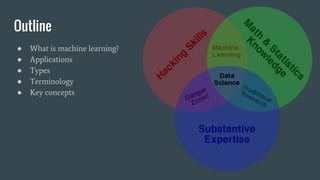
● What is machine learning?
● Applications
● Types
● Terminology
● Key concepts
Outline
Next classes
1. Key concepts
2. A tour of machine learning (linear algebra, probability theory, calculus)
3. Machine learning pipelines (pre-processing, model training, and evaluation in Python and Scala)
4. Machine learning case studies (Python and Scala examples)
a. Sentiment analysis (Natural Language Processing, NLTK)
b. Spam classifier
c. Stock price prediction (regression)
d. Image recognition, deep learning (TensorFlow, keras)
e. Recommendation engine
5. Machine learning at scale (algorithms, linear algebra, probability, Spark MLLib, Vowpal Wabbit, scikit-learn)
Next classes
Key concepts Tour Pipelines Case studies Scale
Concepts ০০০ ০ ০০ ০০ ০০০
Code ০ ০০ ০০০ ০০০ ০০০
Math/stats ০ ০০০ ০ ০ ০০০
What is machine learning?
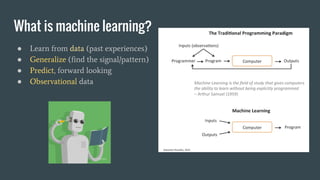
● Learn from data (past experiences)
● Generalize (find the signal/pattern)
● Predict, forward looking
● Observational data
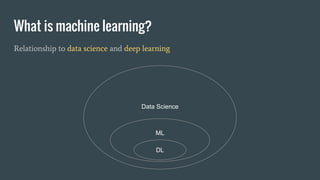
Relationship to data science and deep learning
What is machine learning?
Data Science
ML
DL
Applications
● Autonomous cars
● Siri
● Facial recognition
● People who bought this also bought...
● Spam filters
● Targeted advertising
● ...
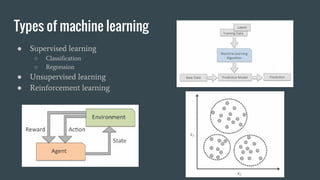
Types of machine learning
● Supervised learning
○ Classification
○ Regression
● Unsupervised learning
● Reinforcement learning
Types of machine learning
Supervised Unsupervised Reinforcement learning
Cancer diagnosis
Stock market prediction
Customer churn
Recommendation engine
Anomaly detection
Dimensionality reduction
Clustering
PageRank
Anomaly detection
Self-driving cars
AlphaGo
(Linear) Regression
● Predict a continuous variable (e.g. price)
● Y=mx+b
● Ordinary Least Squares
● Analytical solution
● Geometric model
(Linear) Regression
● Can use multiple variables
(multi-variate regression)
● Relationships are not always linear
(Linear) Regression example
● Boston housing dataset
● Median value of houses (MV)
vs. average # rooms (RM)
from sklearn.linear_model import LinearRegression
model = LinearRegression()
x, y = housing[['RM']], housing['MV']
model.fit(x, y)
model.score(x, y)
R2=0.48
(Linear) Regression example
● Boston housing dataset
● Median value of houses (MV)
vs. average # rooms (RM),
and industrial zoning proportions (INDUS)
from sklearn.linear_model import LinearRegression
model = LinearRegression()
x, y = housing[['RM', ‘INDUS’]], housing['MV']
model.fit(x, y)
model.score(x, y)
R2=0.53
(Linear) Regression example
● Intuition breaks down in high-dimensions (>3)
● Interpretability goes down
● Real-world data is usually non-linear
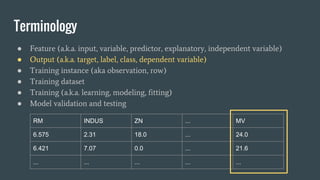
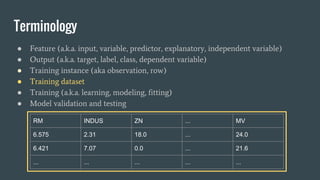
Terminology
● Feature (a.k.a. input, variable, predictor, explanatory, independent variable)
● Output (a.k.a. target, label, class, dependent variable)
● Training instance (aka observation, row)
● Training dataset
● Training (a.k.a. learning, modeling, fitting)
● Model validation and testing
RM INDUS ZN ... MV
6.575 2.31 18.0 ... 24.0
6.421 7.07 0.0 ... 21.6
... ... ... ... ...
Terminology
● Feature (a.k.a. input, variable, predictor, explanatory, independent variable)
● Output (a.k.a. target, label, class, dependent variable)
● Training instance (aka observation, row)
● Training dataset
● Training (a.k.a. learning, modeling, fitting)
● Model validation and testing
RM INDUS ZN ... MV
6.575 2.31 18.0 ... 24.0
6.421 7.07 0.0 ... 21.6
... ... ... ... ...
Terminology
● Feature (a.k.a. input, variable, predictor, explanatory, independent variable)
● Output (a.k.a. target, label, class, dependent variable)
● Training instance (aka observation, row)
● Training dataset
● Training (a.k.a. learning, modeling, fitting)
● Model validation and testing
RM INDUS ZN ... MV
6.575 2.31 18.0 ... 24.0
6.421 7.07 0.0 ... 21.6
... ... ... ... ...
Terminology
● Feature (a.k.a. input, variable, predictor, explanatory, independent variable)
● Output (a.k.a. target, label, class, dependent variable)
● Training instance (aka observation, row)
● Training dataset
● Training (a.k.a. learning, modeling, fitting)
● Model validation and testing
RM INDUS ZN ... MV
6.575 2.31 18.0 ... 24.0
6.421 7.07 0.0 ... 21.6
... ... ... ... ...
Terminology
● Feature (a.k.a. input, variable, predictor, explanatory, independent variable)
● Output (a.k.a. target, label, class, dependent variable)
● Training instance (aka observation, row)
● Training dataset
● Training (a.k.a. learning, modeling, fitting)
● Model validation and testing
RM INDUS ZN ... MV
6.575 2.31 18.0 ... 24.0
6.421 7.07 0.0 ... 21.6
... ... ... ... ...
Terminology
● Feature (a.k.a. input, variable, predictor, explanatory, independent variable)
● Output (a.k.a. target, label, class, dependent variable)
● Training instance (aka observation, row)
● Training dataset
● Training (a.k.a. learning, modeling, fitting)
● Model validation and testing
RM INDUS ZN ... MV
6.575 2.31 18.0 ... 24.0
6.421 7.07 0.0 ... 21.6
... ... ... ... ...
Statistical learning
● The true underlying function is not known
● Usually can’t observe all features (e.g. policy impact, global trends, etc.)
● Most interesting phenomenon are neither deterministic, nor stationary
● No guarantee that a set of variables is predictive of the outcome
Machine learning territory100% deterministic
F=ma
100% stochastic
Coin flip
Classification
● Target variable, qualitative, classes
● Binary classification
Cancer patient
Positive class (class of interest)
Healthy patient
Negative class
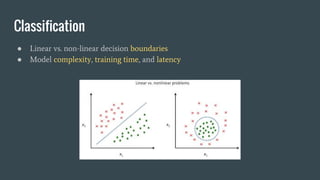
Classification
● Linear vs. non-linear decision boundaries
● Model complexity, training time, and latency
Bias
Cancer patient
Positive class (class of interest)
Healthy patient
Negative class
Bias
Cancer patient
Positive class (class of interest)
Healthy patient
Negative class
Bias
Variance/overfit
● Learning the wrong things, memorizing
● Modeling the noise and not the signal
○ Model 1- if GPA > 3.8 and hours studied>5 then passed
○ Model 2- if student ID != 2 then passed
○ New record: StudentID = 4, Hours Studied = 5.5, GPA = 3.82, passed?
Student ID Hours studied GPA ... Passed
1 10 4.00 Yes
2 0 2.71 No
3 6 3.95 Yes
Bias/variance
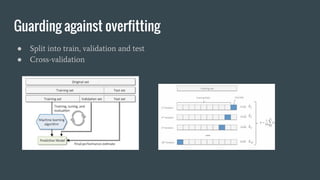
Guarding against overfitting
● Split into train, validation and test
● Cross-validation
Summary
Increasing model complexity generally:
● Increases model fit
● Decreases interpretability
● Increases chance of overfitting
● Increases training time
● Increases model latency
Remember that...
Next class: a tour of machine learning
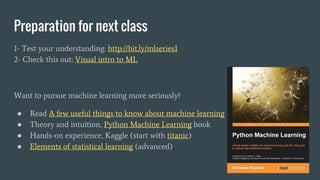
Preparation for next class
1- Test your understanding: http://bit.ly/mlseries1
2- Check this out: Visual intro to ML
Want to pursue machine learning more seriously?
● Read A few useful things to know about machine learning
● Theory and intuition, Python Machine Learning book
● Hands-on experience, Kaggle (start with titanic)
● Elements of statistical learning (advanced)

Machine learning- key concepts

  • 1.
  • 2.
    ● What ismachine learning? ● Applications ● Types ● Terminology ● Key concepts Outline
  • 3.
    Next classes 1. Keyconcepts 2. A tour of machine learning (linear algebra, probability theory, calculus) 3. Machine learning pipelines (pre-processing, model training, and evaluation in Python and Scala) 4. Machine learning case studies (Python and Scala examples) a. Sentiment analysis (Natural Language Processing, NLTK) b. Spam classifier c. Stock price prediction (regression) d. Image recognition, deep learning (TensorFlow, keras) e. Recommendation engine 5. Machine learning at scale (algorithms, linear algebra, probability, Spark MLLib, Vowpal Wabbit, scikit-learn)
  • 4.
    Next classes Key conceptsTour Pipelines Case studies Scale Concepts ০০০ ০ ০০ ০০ ০০০ Code ০ ০০ ০০০ ০০০ ০০০ Math/stats ০ ০০০ ০ ০ ০০০
  • 5.
    What is machinelearning? ● Learn from data (past experiences) ● Generalize (find the signal/pattern) ● Predict, forward looking ● Observational data
  • 6.
    Relationship to datascience and deep learning What is machine learning? Data Science ML DL
  • 7.
    Applications ● Autonomous cars ●Siri ● Facial recognition ● People who bought this also bought... ● Spam filters ● Targeted advertising ● ...
  • 8.
    Types of machinelearning ● Supervised learning ○ Classification ○ Regression ● Unsupervised learning ● Reinforcement learning
  • 9.
    Types of machinelearning Supervised Unsupervised Reinforcement learning Cancer diagnosis Stock market prediction Customer churn Recommendation engine Anomaly detection Dimensionality reduction Clustering PageRank Anomaly detection Self-driving cars AlphaGo
  • 10.
    (Linear) Regression ● Predicta continuous variable (e.g. price) ● Y=mx+b ● Ordinary Least Squares ● Analytical solution ● Geometric model
  • 11.
    (Linear) Regression ● Canuse multiple variables (multi-variate regression) ● Relationships are not always linear
  • 12.
    (Linear) Regression example ●Boston housing dataset ● Median value of houses (MV) vs. average # rooms (RM) from sklearn.linear_model import LinearRegression model = LinearRegression() x, y = housing[['RM']], housing['MV'] model.fit(x, y) model.score(x, y) R2=0.48
  • 13.
    (Linear) Regression example ●Boston housing dataset ● Median value of houses (MV) vs. average # rooms (RM), and industrial zoning proportions (INDUS) from sklearn.linear_model import LinearRegression model = LinearRegression() x, y = housing[['RM', ‘INDUS’]], housing['MV'] model.fit(x, y) model.score(x, y) R2=0.53
  • 14.
    (Linear) Regression example ●Intuition breaks down in high-dimensions (>3) ● Interpretability goes down ● Real-world data is usually non-linear
  • 15.
    Terminology ● Feature (a.k.a.input, variable, predictor, explanatory, independent variable) ● Output (a.k.a. target, label, class, dependent variable) ● Training instance (aka observation, row) ● Training dataset ● Training (a.k.a. learning, modeling, fitting) ● Model validation and testing RM INDUS ZN ... MV 6.575 2.31 18.0 ... 24.0 6.421 7.07 0.0 ... 21.6 ... ... ... ... ...
  • 16.
    Terminology ● Feature (a.k.a.input, variable, predictor, explanatory, independent variable) ● Output (a.k.a. target, label, class, dependent variable) ● Training instance (aka observation, row) ● Training dataset ● Training (a.k.a. learning, modeling, fitting) ● Model validation and testing RM INDUS ZN ... MV 6.575 2.31 18.0 ... 24.0 6.421 7.07 0.0 ... 21.6 ... ... ... ... ...
  • 17.
    Terminology ● Feature (a.k.a.input, variable, predictor, explanatory, independent variable) ● Output (a.k.a. target, label, class, dependent variable) ● Training instance (aka observation, row) ● Training dataset ● Training (a.k.a. learning, modeling, fitting) ● Model validation and testing RM INDUS ZN ... MV 6.575 2.31 18.0 ... 24.0 6.421 7.07 0.0 ... 21.6 ... ... ... ... ...
  • 18.
    Terminology ● Feature (a.k.a.input, variable, predictor, explanatory, independent variable) ● Output (a.k.a. target, label, class, dependent variable) ● Training instance (aka observation, row) ● Training dataset ● Training (a.k.a. learning, modeling, fitting) ● Model validation and testing RM INDUS ZN ... MV 6.575 2.31 18.0 ... 24.0 6.421 7.07 0.0 ... 21.6 ... ... ... ... ...
  • 19.
    Terminology ● Feature (a.k.a.input, variable, predictor, explanatory, independent variable) ● Output (a.k.a. target, label, class, dependent variable) ● Training instance (aka observation, row) ● Training dataset ● Training (a.k.a. learning, modeling, fitting) ● Model validation and testing RM INDUS ZN ... MV 6.575 2.31 18.0 ... 24.0 6.421 7.07 0.0 ... 21.6 ... ... ... ... ...
  • 20.
    Terminology ● Feature (a.k.a.input, variable, predictor, explanatory, independent variable) ● Output (a.k.a. target, label, class, dependent variable) ● Training instance (aka observation, row) ● Training dataset ● Training (a.k.a. learning, modeling, fitting) ● Model validation and testing RM INDUS ZN ... MV 6.575 2.31 18.0 ... 24.0 6.421 7.07 0.0 ... 21.6 ... ... ... ... ...
  • 21.
    Statistical learning ● Thetrue underlying function is not known ● Usually can’t observe all features (e.g. policy impact, global trends, etc.) ● Most interesting phenomenon are neither deterministic, nor stationary ● No guarantee that a set of variables is predictive of the outcome Machine learning territory100% deterministic F=ma 100% stochastic Coin flip
  • 22.
    Classification ● Target variable,qualitative, classes ● Binary classification Cancer patient Positive class (class of interest) Healthy patient Negative class
  • 23.
    Classification ● Linear vs.non-linear decision boundaries ● Model complexity, training time, and latency
  • 24.
    Bias Cancer patient Positive class(class of interest) Healthy patient Negative class
  • 25.
    Bias Cancer patient Positive class(class of interest) Healthy patient Negative class
  • 26.
  • 27.
    Variance/overfit ● Learning thewrong things, memorizing ● Modeling the noise and not the signal ○ Model 1- if GPA > 3.8 and hours studied>5 then passed ○ Model 2- if student ID != 2 then passed ○ New record: StudentID = 4, Hours Studied = 5.5, GPA = 3.82, passed? Student ID Hours studied GPA ... Passed 1 10 4.00 Yes 2 0 2.71 No 3 6 3.95 Yes
  • 28.
  • 29.
    Guarding against overfitting ●Split into train, validation and test ● Cross-validation
  • 30.
    Summary Increasing model complexitygenerally: ● Increases model fit ● Decreases interpretability ● Increases chance of overfitting ● Increases training time ● Increases model latency
  • 31.
  • 32.
    Next class: atour of machine learning
  • 33.
    Preparation for nextclass 1- Test your understanding: http://bit.ly/mlseries1 2- Check this out: Visual intro to ML Want to pursue machine learning more seriously? ● Read A few useful things to know about machine learning ● Theory and intuition, Python Machine Learning book ● Hands-on experience, Kaggle (start with titanic) ● Elements of statistical learning (advanced)