Machine Learning with R
and Tableau
Tableau User Group (TUG)
Greg Armstrong
Blast Analytics & Marketing
garmstrong@blastam.com
TUG | Machine Learning with R and Tableau
Agenda
Machine Learning with R and Tableau
2
1. What is Machine Learning?
2. What is R?
3. Live Examples using Tableau and R
TUG | Machine Learning with R and Tableau
Machine Learning
What is machine learning?
3
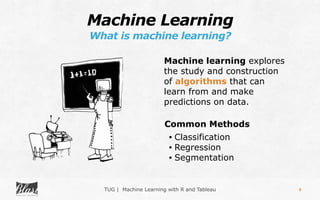
Machine learning explores
the study and construction
of algorithms that can
learn from and make
predictions on data.
• Classification
• Regression
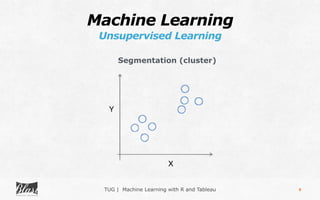
• Segmentation
Common Methods
TUG | Machine Learning with R and Tableau 4
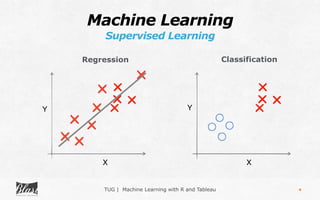
Regression
Machine Learning
Supervised Learning
Classification
X
Y
X
Y
TUG | Machine Learning with R and Tableau 5
Segmentation (cluster)
Machine Learning
Unsupervised Learning
X
Y
TUG | Machine Learning with R and Tableau
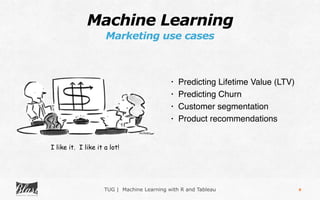
Machine Learning
Marketing use cases
6
• Predicting Lifetime Value (LTV)
• Predicting Churn
• Customer segmentation
• Product recommendations
I like it. I like it a lot!
TUG | Machine Learning with R and Tableau
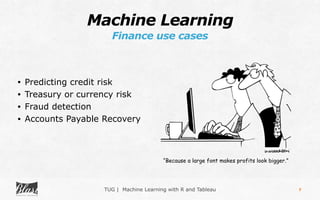
Machine Learning
Finance use cases
7
• Predicting credit risk
• Treasury or currency risk
• Fraud detection
• Accounts Payable Recovery
“Because a large font makes profits look bigger.”
TUG | Machine Learning with R and Tableau
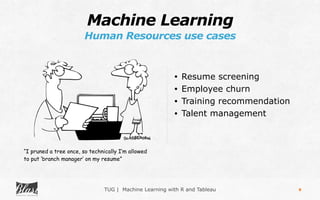
Machine Learning
Human Resources use cases
8
• Resume screening
• Employee churn
• Training recommendation
• Talent management
“I pruned a tree once, so technically I’m allowed
to put ‘branch manager’ on my resume”
TUG | Machine Learning with R and Tableau
Machine Learning
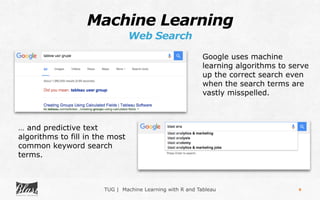
Web Search
9
… and predictive text
algorithms to fill in the most
common keyword search
terms.
Google uses machine
learning algorithms to serve
up the correct search even
when the search terms are
vastly misspelled.
TUG | Machine Learning with R and Tableau
Machine Learning
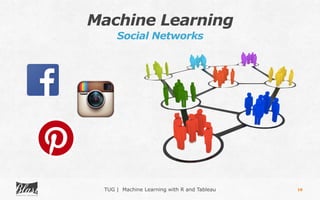
Social Networks
10
TUG | Machine Learning with R and Tableau
Machine Learning
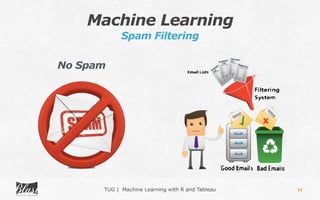
Spam Filtering
11
No Spam
TUG | Machine Learning with R and Tableau
Machine Learning
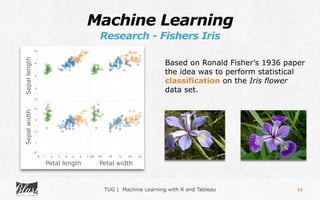
Research - Fishers Iris
12
Based on Ronald Fisher’s 1936 paper
the idea was to perform statistical
classification on the Iris flower
data set.
Petal widthPetal length
SepalwidthSepallength
TUG | Machine Learning with R and Tableau
ahhRRRR!
What is R?
13
• Data manipulation
• Statistical modeling
• Visualization tool
• Open Source
R is a language for statistical analysis and
data visualization.
TUG | Machine Learning with R and Tableau
R Studio, R & Tableau
A brief introduction
14
+
TUG | Machine Learning with R and Tableau
Tableau + R
What did we discover?
15
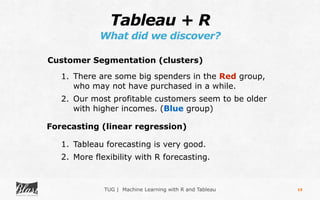
Customer Segmentation (clusters)
1. There are some big spenders in the Red group,
who may not have purchased in a while.
2. Our most profitable customers seem to be older
with higher incomes. (Blue group)
Forecasting (linear regression)
1. Tableau forecasting is very good.
2. More flexibility with R forecasting.
TUG | Machine Learning with R and Tableau
Tableau User Group (TUG)
Machine Learning with R and Tableau
16
Questions?
Thank you!
Phone (888) 252-7866 Email sales@blastam.comWeb www.blastam.com
Roseville Office
6020 West Oaks Blvd, Suite 260
Rocklin, CA 95765
San Francisco Office
625 Second Street, Suite 280
San Francisco, CA 94107
New York Office
261 Madison Ave, 9th Floor
New York, NY 10016
Seattle Office
500 Yale Avenue North
Seattle, WA 98109
Los Angeles Office
7083 Hollywood Boulevard
Los Angeles, CA 90028
TUG | Machine Learning with R and Tableau
Calculated Fields
Tableau Calculated Fields for R
18
SCRIPT_INT("
## Sets the seed
set.seed( .arg7[1])
## Studentizes the variables
day <- ( .arg1 - mean(.arg1) )/ sd(.arg1)
mos <- ( .arg2 - mean(.arg2) )/ sd(.arg2)
dis <- ( .arg3 - mean(.arg3) )/ sd(.arg3)
inc <- ( .arg4 - mean(.arg4) )/ sd(.arg4)
age <- ( .arg5 - mean(.arg5) )/ sd(.arg5)
dat <- cbind(day, mos, dis, inc, age)
day <- .arg6[1]
## Creates the clusters
kmeans(dat, day)$cluster
",
MIN([Days Since Last Order]),
[Months as Customer],
AVG([Discount]),
MAX([Income]),
MAX([Age]),
[clusters],
[seed]
)
K-means cluster for customer segmentation
SCRIPT_STR('hello <- "Hello TUG!"', ATTR([R
Result]))
Pass string to R with a parameter
SCRIPT_INT("as.integer(.arg1 * 2)", [R Variable])
Pass calculation to R based on parameter
SCRIPT_BOOL("
print('******************************************
*********************')
print('the vector sent was')
print(.arg1)
print('with length')
print(length(.arg1))
TRUE
",
SUM([Sales])
)
Print to console R arguments

Machine Learning with R and Tableau

  • 1.
    Machine Learning withR and Tableau Tableau User Group (TUG) Greg Armstrong Blast Analytics & Marketing garmstrong@blastam.com
  • 2.
    TUG | MachineLearning with R and Tableau Agenda Machine Learning with R and Tableau 2 1. What is Machine Learning? 2. What is R? 3. Live Examples using Tableau and R
  • 3.
    TUG | MachineLearning with R and Tableau Machine Learning What is machine learning? 3 Machine learning explores the study and construction of algorithms that can learn from and make predictions on data. • Classification • Regression • Segmentation Common Methods
  • 4.
    TUG | MachineLearning with R and Tableau 4 Regression Machine Learning Supervised Learning Classification X Y X Y
  • 5.
    TUG | MachineLearning with R and Tableau 5 Segmentation (cluster) Machine Learning Unsupervised Learning X Y
  • 6.
    TUG | MachineLearning with R and Tableau Machine Learning Marketing use cases 6 • Predicting Lifetime Value (LTV) • Predicting Churn • Customer segmentation • Product recommendations I like it. I like it a lot!
  • 7.
    TUG | MachineLearning with R and Tableau Machine Learning Finance use cases 7 • Predicting credit risk • Treasury or currency risk • Fraud detection • Accounts Payable Recovery “Because a large font makes profits look bigger.”
  • 8.
    TUG | MachineLearning with R and Tableau Machine Learning Human Resources use cases 8 • Resume screening • Employee churn • Training recommendation • Talent management “I pruned a tree once, so technically I’m allowed to put ‘branch manager’ on my resume”
  • 9.
    TUG | MachineLearning with R and Tableau Machine Learning Web Search 9 … and predictive text algorithms to fill in the most common keyword search terms. Google uses machine learning algorithms to serve up the correct search even when the search terms are vastly misspelled.
  • 10.
    TUG | MachineLearning with R and Tableau Machine Learning Social Networks 10
  • 11.
    TUG | MachineLearning with R and Tableau Machine Learning Spam Filtering 11 No Spam
  • 12.
    TUG | MachineLearning with R and Tableau Machine Learning Research - Fishers Iris 12 Based on Ronald Fisher’s 1936 paper the idea was to perform statistical classification on the Iris flower data set. Petal widthPetal length SepalwidthSepallength
  • 13.
    TUG | MachineLearning with R and Tableau ahhRRRR! What is R? 13 • Data manipulation • Statistical modeling • Visualization tool • Open Source R is a language for statistical analysis and data visualization.
  • 14.
    TUG | MachineLearning with R and Tableau R Studio, R & Tableau A brief introduction 14 +
  • 15.
    TUG | MachineLearning with R and Tableau Tableau + R What did we discover? 15 Customer Segmentation (clusters) 1. There are some big spenders in the Red group, who may not have purchased in a while. 2. Our most profitable customers seem to be older with higher incomes. (Blue group) Forecasting (linear regression) 1. Tableau forecasting is very good. 2. More flexibility with R forecasting.
  • 16.
    TUG | MachineLearning with R and Tableau Tableau User Group (TUG) Machine Learning with R and Tableau 16 Questions? Thank you!
  • 17.
    Phone (888) 252-7866Email sales@blastam.comWeb www.blastam.com Roseville Office 6020 West Oaks Blvd, Suite 260 Rocklin, CA 95765 San Francisco Office 625 Second Street, Suite 280 San Francisco, CA 94107 New York Office 261 Madison Ave, 9th Floor New York, NY 10016 Seattle Office 500 Yale Avenue North Seattle, WA 98109 Los Angeles Office 7083 Hollywood Boulevard Los Angeles, CA 90028
  • 18.
    TUG | MachineLearning with R and Tableau Calculated Fields Tableau Calculated Fields for R 18 SCRIPT_INT(" ## Sets the seed set.seed( .arg7[1]) ## Studentizes the variables day <- ( .arg1 - mean(.arg1) )/ sd(.arg1) mos <- ( .arg2 - mean(.arg2) )/ sd(.arg2) dis <- ( .arg3 - mean(.arg3) )/ sd(.arg3) inc <- ( .arg4 - mean(.arg4) )/ sd(.arg4) age <- ( .arg5 - mean(.arg5) )/ sd(.arg5) dat <- cbind(day, mos, dis, inc, age) day <- .arg6[1] ## Creates the clusters kmeans(dat, day)$cluster ", MIN([Days Since Last Order]), [Months as Customer], AVG([Discount]), MAX([Income]), MAX([Age]), [clusters], [seed] ) K-means cluster for customer segmentation SCRIPT_STR('hello <- "Hello TUG!"', ATTR([R Result])) Pass string to R with a parameter SCRIPT_INT("as.integer(.arg1 * 2)", [R Variable]) Pass calculation to R based on parameter SCRIPT_BOOL(" print('****************************************** *********************') print('the vector sent was') print(.arg1) print('with length') print(length(.arg1)) TRUE ", SUM([Sales]) ) Print to console R arguments