Presenter – Ashish Agrawal
Know your instructor
Ashish Agrawal
MBA-IIM, Indore
Digital Marketing Manager, iQuanti, Inc
He has 8 years of experience in the Information Technology and the Digital
Marketing Industry. He has worked in companies such as Tata Consultancy
Services, Syntel and iQuanti. He is currently working as a Digital Marketing
Manager and handling digital campaigns for Fortune 500 companies.
Course link: www.edureka.co/search-engine-optimization
What will you learn today?
 What is CRO?
 Benefits of CRO
 Why testing is important?
Stages of testing
Types of testing
 Hypothesis Development
Motivation
Relevance
Structure
 Analysis
Course link: www.edureka.co/search-engine-optimization
Subject Concepts (Agenda 1)
Conversion Rate Optimization
Course link: www.edureka.co/search-engine-optimization
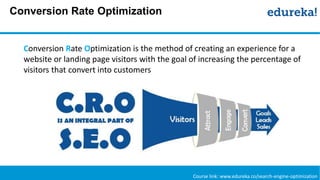
Conversion Rate Optimization is the method of creating an experience for a
website or landing page visitors with the goal of increasing the percentage of
visitors that convert into customers
Course link: www.edureka.co/abc
Course link: www.edureka.co/search-engine-optimization
Benefits of Conversion Rate Optimization
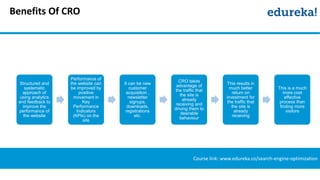
Benefits Of CRO
Course link: www.edureka.co/search-engine-optimization
Structured and
systematic
approach of
using analytics
and feedback to
improve the
performance of
the website
Performance of
the website can
be improved by
positive
movement in
Key
Performance
Indicators
(KPIs) on the
site
It can be new
customer
acquisition ,
newsletter
signups,
downloads,
registrations
etc.
CRO takes
advantage of
the traffic that
the site is
already
receiving and
driving them to
desirable
behaviour
This results in
much better
return on
investment for
the traffic that
the site is
already
receiving
This is a much
more cost
effective
process than
finding more
visitors
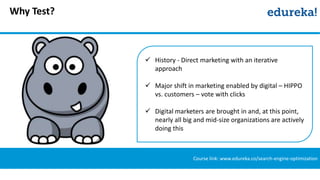
Why Test?
Course link: www.edureka.co/search-engine-optimization
 History - Direct marketing with an iterative
approach
 Major shift in marketing enabled by digital – HIPPO
vs. customers – vote with clicks
 Digital marketers are brought in and, at this point,
nearly all big and mid-size organizations are actively
doing this
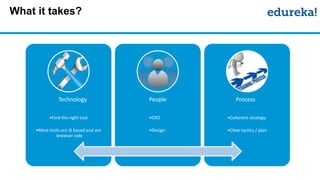
What it takes?
Technology
•Find the right tool
•Most tools are JS based and are
browser-side
People
•CRO
•Design
Process
•Coherent strategy
•Clear tactics / plan
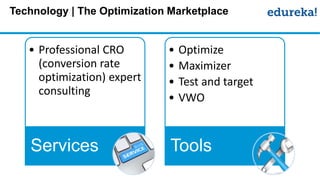
Technology | The Optimization Marketplace
• Professional CRO
(conversion rate
optimization) expert
consulting
Services
• Optimize
• Maximizer
• Test and target
• VWO
Tools
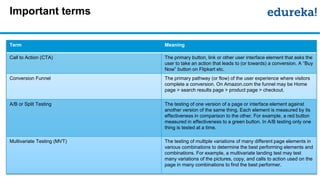
Important terms
Term Meaning
Call to Action (CTA) The primary button, link or other user interface element that asks the
user to take an action that leads to (or towards) a conversion. A “Buy
Now” button on Flipkart etc.
Conversion Funnel The primary pathway (or flow) of the user experience where visitors
complete a conversion. On Amazon.com the funnel may be Home
page > search results page > product page > checkout.
A/B or Split Testing The testing of one version of a page or interface element against
another version of the same thing. Each element is measured by its
effectiveness in comparison to the other. For example, a red button
measured in effectiveness to a green button. In A/B testing only one
thing is tested at a time.
Multivariate Testing (MVT) The testing of multiple variations of many different page elements in
various combinations to determine the best performing elements and
combinations. For example, a multivariate landing test may test
many variations of the pictures, copy, and calls to action used on the
page in many combinations to find the best performer.
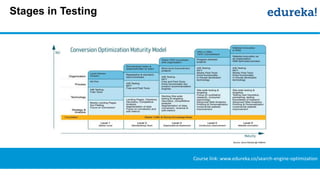
Stages in Testing
Course link: www.edureka.co/search-engine-optimization
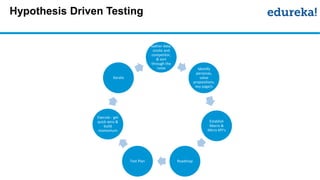
Hypothesis Driven Testing
Gather data,
onsite and
competitor,
& sort
through the
noise Identify
personas,
value
propositions,
key page/s
Establish
Macro &
Micro KPI’s
RoadmapTest Plan
Execute - get
quick wins &
build
momentum
Iterate
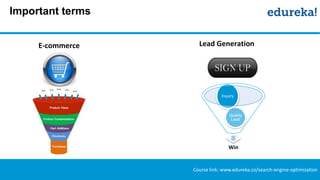
Important terms
Win
Quality
Lead
Inquiry
Course link: www.edureka.co/search-engine-optimization
E-commerce Lead Generation
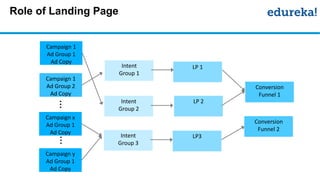
Role of Landing Page
Campaign 1
Ad Group 1
Ad Copy
Campaign 1
Ad Group 2
Ad Copy
Campaign x
Ad Group 1
Ad Copy
Campaign y
Ad Group 1
Ad Copy
……
Intent
Group 1
Intent
Group 2
Intent
Group 3
LP 1
LP 2
LP3
Conversion
Funnel 1
Conversion
Funnel 2
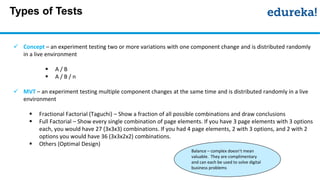
Types of Tests
 Concept – an experiment testing two or more variations with one component change and is distributed randomly
in a live environment
 A / B
 A / B / n
 MVT – an experiment testing multiple component changes at the same time and is distributed randomly in a live
environment
 Fractional Factorial (Taguchi) – Show a fraction of all possible combinations and draw conclusions
 Full Factorial – Show every single combination of page elements. If you have 3 page elements with 3 options
each, you would have 27 (3x3x3) combinations. If you had 4 page elements, 2 with 3 options, and 2 with 2
options you would have 36 (3x3x2x2) combinations.
 Others (Optimal Design)
Balance – complex doesn’t mean
valuable. They are complimentary
and can each be used to solve digital
business problems
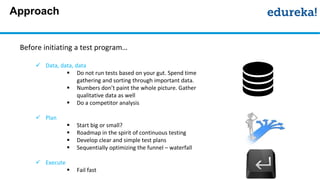
Approach
Before initiating a test program…
 Data, data, data
 Do not run tests based on your gut. Spend time
gathering and sorting through important data.
 Numbers don’t paint the whole picture. Gather
qualitative data as well
 Do a competitor analysis
 Plan
 Start big or small?
 Roadmap in the spirit of continuous testing
 Develop clear and simple test plans
 Sequentially optimizing the funnel – waterfall
 Execute
 Fail fast
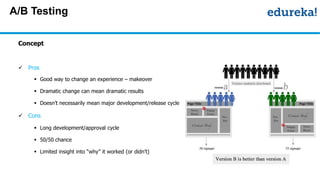
A/B Testing
Concept
 Pros
 Good way to change an experience – makeover
 Dramatic change can mean dramatic results
 Doesn’t necessarily mean major development/release cycle
 Cons
 Long development/approval cycle
 50/50 chance
 Limited insight into “why” it worked (or didn’t)
Multivariate Testing
Multivariate
 Pros
 Easily isolate many small page elements and understand their individual effects on conversion rate
 Measure interaction effects between independent elements to find compound effects
 Follow a more conservative path of incremental conversion rate improvement
 Facilitate interesting statistical analysis of interaction effects
 Cons
 Complexity usually means longer set up and complicated analysis
 MVT requires more traffic to reach statistical significance than A/B/n
 Major layout changes are not possible
 All variations need to work together so that they can be tested simultaneously
 The restrictions of the test setup constrain marketing creativity
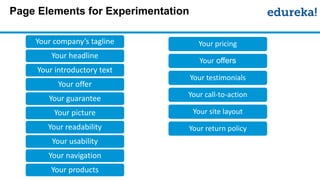
Page Elements for Experimentation
Your company’s tagline
Your headline
Your introductory text
Your offer
Your guarantee
Your picture
Your readability
Your usability
Your navigation
Your products
Your pricing
Your offers
Your testimonials
Your call-to-action
Your site layout
Your return policy
Sample Exercises
 Exercises to develop some solid hypothesis
 What’s the company's positioning?
 Rank the top five points you want to communicate to your visitors
 Consider all the different types of visitors who might view your site and then try to write for them
 For each page try to understand the “visitor intentions”
 Instead of just guessing their intentions, survey them
http://www.iperceptions.com/en/4q
What you say is more important than how
you say it.
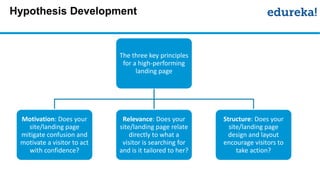
Hypothesis Development
The three key principles
for a high-performing
landing page
Motivation: Does your
site/landing page
mitigate confusion and
motivate a visitor to act
with confidence?
Relevance: Does your
site/landing page relate
directly to what a
visitor is searching for
and is it tailored to her?
Structure: Does your
site/landing page
design and layout
encourage visitors to
take action?
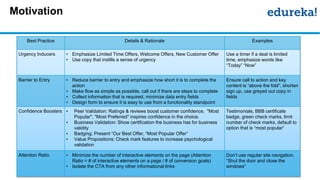
Motivation
Best Practice Details & Rationale Examples
Urgency Inducers • Emphasize Limited Time Offers, Welcome Offers, New Customer Offer
• Use copy that instills a sense of urgency
Use a timer if a deal is limited
time, emphasize words like
“Today” “Now”
Barrier to Entry • Reduce barrier to entry and emphasize how short it is to complete the
action
• Make flow as simple as possible, call out if there are steps to complete
• Collect information that is required, minimize data entry fields
• Design form to ensure it is easy to use from a functionality standpoint
Ensure call to action and key
content is “above the fold”, shorten
sign up, use greyed out copy in
fields
Confidence Boosters • Peer Validation: Ratings & reviews boost customer confidence. "Most
Popular", "Most Preferred" inspires confidence in the choice.
• Business Validation: Show certification the business has for business
validity
• Badging: Present “Our Best Offer, “Most Popular Offer”
• Value Propositions: Check mark features to increase psychological
validation
Testimonials, BBB certificate
badge, green check marks, limit
number of check marks, default to
option that is “most popular”
Attention Ratio • Minimize the number of interactive elements on the page (Attention
Ratio = # of interactive elements on a page / # of conversion goals)
• Isolate the CTA from any other informational links
Don’t use regular site navigation,
“Shut the door and close the
windows”
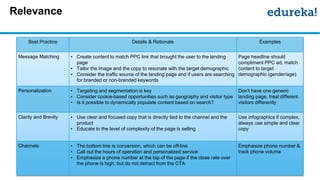
Relevance
Best Practice Details & Rationale Examples
Message Matching • Create content to match PPC link that brought the user to the landing
page
• Tailor the image and the copy to resonate with the target demographic
• Consider the traffic source of the landing page and if users are searching
for branded or non-branded keywords
Page headline should
compliment PPC ad, match
content to target
demographic (gender/age)
Personalization • Targeting and segmentation is key
• Consider cookie-based opportunities such as geography and visitor type
• Is it possible to dynamically populate content based on search?
Don’t have one generic
landing page, treat different
visitors differently
Clarity and Brevity • Use clear and focused copy that is directly tied to the channel and the
product
• Educate to the level of complexity of the page is selling
Use infographics if complex,
always use simple and clear
copy
Channels • The bottom line is conversion, which can be off-line
• Call out the hours of operation and personalized service
• Emphasize a phone number at the top of the page if the close rate over
the phone is high, but do not detract from the CTA
Emphasize phone number &
track phone volume
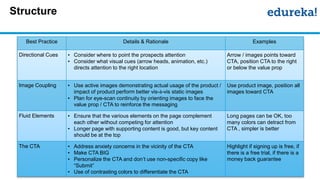
Structure
Best Practice Details & Rationale Examples
Directional Cues • Consider where to point the prospects attention
• Consider what visual cues (arrow heads, animation, etc.)
directs attention to the right location
Arrow / images points toward
CTA, position CTA to the right
or below the value prop
Image Coupling • Use active images demonstrating actual usage of the product /
impact of product perform better vis-à-vis static images
• Plan for eye-scan continuity by orienting images to face the
value prop / CTA to reinforce the messaging
Use product image, position all
images toward CTA
Fluid Elements • Ensure that the various elements on the page complement
each other without competing for attention
• Longer page with supporting content is good, but key content
should be at the top
Long pages can be OK, too
many colors can detract from
CTA , simpler is better
The CTA • Address anxiety concerns in the vicinity of the CTA
• Make CTA BIG
• Personalize the CTA and don’t use non-specific copy like
“Submit”
• Use of contrasting colors to differentiate the CTA
Highlight if signing up is free, if
there is a free trial, if there is a
money back guarantee
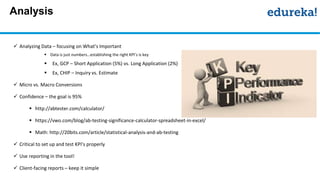
Analysis
 Analyzing Data – focusing on What’s Important
 Data is just numbers…establishing the right KPI’s is key
 Ex, GCP – Short Application (5%) vs. Long Application (2%)
 Ex, CHIP – Inquiry vs. Estimate
 Micro vs. Macro Conversions
 Confidence – the goal is 95%
 http://abtester.com/calculator/
 https://vwo.com/blog/ab-testing-significance-calculator-spreadsheet-in-excel/
 Math: http://20bits.com/article/statistical-analysis-and-ab-testing
 Critical to set up and test KPI’s properly
 Use reporting in the tool!
 Client-facing reports – keep it simple
Never stop testing and your advertising will never
stop improving
- David Ogilvy
Edureka's Search Engine Optimization course:
• Become a SEO Expert by mastering concepts like Keyword Research, On Page and Off Page Optimization,
Site Architecture while working on industry based use cases and projects.
• Online Live Courses: 16 hours
• Assignments: 12 hours
• Project: 12 hours
• Lifetime Access + 24 X 7 Support
Go to www.edureka.co/search-engine-optimization
Batch starts from 10 October Weekend Batch
Timings: 8:30 PM to 10:30 PM
How Edureka course will help you scale up your career
Get Certified in Search Engine Optimization by Edureka
Thank You
Questions/Queries/Feedback
Recording and presentation will be made available to you within 24 hours

Conversion Rate Optmization

  • 1.
  • 2.
    Know your instructor AshishAgrawal MBA-IIM, Indore Digital Marketing Manager, iQuanti, Inc He has 8 years of experience in the Information Technology and the Digital Marketing Industry. He has worked in companies such as Tata Consultancy Services, Syntel and iQuanti. He is currently working as a Digital Marketing Manager and handling digital campaigns for Fortune 500 companies. Course link: www.edureka.co/search-engine-optimization
  • 3.
    What will youlearn today?  What is CRO?  Benefits of CRO  Why testing is important? Stages of testing Types of testing  Hypothesis Development Motivation Relevance Structure  Analysis Course link: www.edureka.co/search-engine-optimization
  • 4.
  • 5.
    Conversion Rate Optimization Courselink: www.edureka.co/search-engine-optimization Conversion Rate Optimization is the method of creating an experience for a website or landing page visitors with the goal of increasing the percentage of visitors that convert into customers
  • 6.
  • 7.
  • 8.
    Benefits of ConversionRate Optimization
  • 9.
    Benefits Of CRO Courselink: www.edureka.co/search-engine-optimization Structured and systematic approach of using analytics and feedback to improve the performance of the website Performance of the website can be improved by positive movement in Key Performance Indicators (KPIs) on the site It can be new customer acquisition , newsletter signups, downloads, registrations etc. CRO takes advantage of the traffic that the site is already receiving and driving them to desirable behaviour This results in much better return on investment for the traffic that the site is already receiving This is a much more cost effective process than finding more visitors
  • 10.
    Why Test? Course link:www.edureka.co/search-engine-optimization  History - Direct marketing with an iterative approach  Major shift in marketing enabled by digital – HIPPO vs. customers – vote with clicks  Digital marketers are brought in and, at this point, nearly all big and mid-size organizations are actively doing this
  • 11.
    What it takes? Technology •Findthe right tool •Most tools are JS based and are browser-side People •CRO •Design Process •Coherent strategy •Clear tactics / plan
  • 12.
    Technology | TheOptimization Marketplace • Professional CRO (conversion rate optimization) expert consulting Services • Optimize • Maximizer • Test and target • VWO Tools
  • 13.
    Important terms Term Meaning Callto Action (CTA) The primary button, link or other user interface element that asks the user to take an action that leads to (or towards) a conversion. A “Buy Now” button on Flipkart etc. Conversion Funnel The primary pathway (or flow) of the user experience where visitors complete a conversion. On Amazon.com the funnel may be Home page > search results page > product page > checkout. A/B or Split Testing The testing of one version of a page or interface element against another version of the same thing. Each element is measured by its effectiveness in comparison to the other. For example, a red button measured in effectiveness to a green button. In A/B testing only one thing is tested at a time. Multivariate Testing (MVT) The testing of multiple variations of many different page elements in various combinations to determine the best performing elements and combinations. For example, a multivariate landing test may test many variations of the pictures, copy, and calls to action used on the page in many combinations to find the best performer.
  • 14.
    Stages in Testing Courselink: www.edureka.co/search-engine-optimization
  • 15.
    Hypothesis Driven Testing Gatherdata, onsite and competitor, & sort through the noise Identify personas, value propositions, key page/s Establish Macro & Micro KPI’s RoadmapTest Plan Execute - get quick wins & build momentum Iterate
  • 16.
    Important terms Win Quality Lead Inquiry Course link:www.edureka.co/search-engine-optimization E-commerce Lead Generation
  • 17.
    Role of LandingPage Campaign 1 Ad Group 1 Ad Copy Campaign 1 Ad Group 2 Ad Copy Campaign x Ad Group 1 Ad Copy Campaign y Ad Group 1 Ad Copy …… Intent Group 1 Intent Group 2 Intent Group 3 LP 1 LP 2 LP3 Conversion Funnel 1 Conversion Funnel 2
  • 18.
    Types of Tests Concept – an experiment testing two or more variations with one component change and is distributed randomly in a live environment  A / B  A / B / n  MVT – an experiment testing multiple component changes at the same time and is distributed randomly in a live environment  Fractional Factorial (Taguchi) – Show a fraction of all possible combinations and draw conclusions  Full Factorial – Show every single combination of page elements. If you have 3 page elements with 3 options each, you would have 27 (3x3x3) combinations. If you had 4 page elements, 2 with 3 options, and 2 with 2 options you would have 36 (3x3x2x2) combinations.  Others (Optimal Design) Balance – complex doesn’t mean valuable. They are complimentary and can each be used to solve digital business problems
  • 19.
    Approach Before initiating atest program…  Data, data, data  Do not run tests based on your gut. Spend time gathering and sorting through important data.  Numbers don’t paint the whole picture. Gather qualitative data as well  Do a competitor analysis  Plan  Start big or small?  Roadmap in the spirit of continuous testing  Develop clear and simple test plans  Sequentially optimizing the funnel – waterfall  Execute  Fail fast
  • 20.
    A/B Testing Concept  Pros Good way to change an experience – makeover  Dramatic change can mean dramatic results  Doesn’t necessarily mean major development/release cycle  Cons  Long development/approval cycle  50/50 chance  Limited insight into “why” it worked (or didn’t)
  • 21.
    Multivariate Testing Multivariate  Pros Easily isolate many small page elements and understand their individual effects on conversion rate  Measure interaction effects between independent elements to find compound effects  Follow a more conservative path of incremental conversion rate improvement  Facilitate interesting statistical analysis of interaction effects  Cons  Complexity usually means longer set up and complicated analysis  MVT requires more traffic to reach statistical significance than A/B/n  Major layout changes are not possible  All variations need to work together so that they can be tested simultaneously  The restrictions of the test setup constrain marketing creativity
  • 22.
    Page Elements forExperimentation Your company’s tagline Your headline Your introductory text Your offer Your guarantee Your picture Your readability Your usability Your navigation Your products Your pricing Your offers Your testimonials Your call-to-action Your site layout Your return policy
  • 23.
    Sample Exercises  Exercisesto develop some solid hypothesis  What’s the company's positioning?  Rank the top five points you want to communicate to your visitors  Consider all the different types of visitors who might view your site and then try to write for them  For each page try to understand the “visitor intentions”  Instead of just guessing their intentions, survey them http://www.iperceptions.com/en/4q What you say is more important than how you say it.
  • 24.
    Hypothesis Development The threekey principles for a high-performing landing page Motivation: Does your site/landing page mitigate confusion and motivate a visitor to act with confidence? Relevance: Does your site/landing page relate directly to what a visitor is searching for and is it tailored to her? Structure: Does your site/landing page design and layout encourage visitors to take action?
  • 25.
    Motivation Best Practice Details& Rationale Examples Urgency Inducers • Emphasize Limited Time Offers, Welcome Offers, New Customer Offer • Use copy that instills a sense of urgency Use a timer if a deal is limited time, emphasize words like “Today” “Now” Barrier to Entry • Reduce barrier to entry and emphasize how short it is to complete the action • Make flow as simple as possible, call out if there are steps to complete • Collect information that is required, minimize data entry fields • Design form to ensure it is easy to use from a functionality standpoint Ensure call to action and key content is “above the fold”, shorten sign up, use greyed out copy in fields Confidence Boosters • Peer Validation: Ratings & reviews boost customer confidence. "Most Popular", "Most Preferred" inspires confidence in the choice. • Business Validation: Show certification the business has for business validity • Badging: Present “Our Best Offer, “Most Popular Offer” • Value Propositions: Check mark features to increase psychological validation Testimonials, BBB certificate badge, green check marks, limit number of check marks, default to option that is “most popular” Attention Ratio • Minimize the number of interactive elements on the page (Attention Ratio = # of interactive elements on a page / # of conversion goals) • Isolate the CTA from any other informational links Don’t use regular site navigation, “Shut the door and close the windows”
  • 26.
    Relevance Best Practice Details& Rationale Examples Message Matching • Create content to match PPC link that brought the user to the landing page • Tailor the image and the copy to resonate with the target demographic • Consider the traffic source of the landing page and if users are searching for branded or non-branded keywords Page headline should compliment PPC ad, match content to target demographic (gender/age) Personalization • Targeting and segmentation is key • Consider cookie-based opportunities such as geography and visitor type • Is it possible to dynamically populate content based on search? Don’t have one generic landing page, treat different visitors differently Clarity and Brevity • Use clear and focused copy that is directly tied to the channel and the product • Educate to the level of complexity of the page is selling Use infographics if complex, always use simple and clear copy Channels • The bottom line is conversion, which can be off-line • Call out the hours of operation and personalized service • Emphasize a phone number at the top of the page if the close rate over the phone is high, but do not detract from the CTA Emphasize phone number & track phone volume
  • 27.
    Structure Best Practice Details& Rationale Examples Directional Cues • Consider where to point the prospects attention • Consider what visual cues (arrow heads, animation, etc.) directs attention to the right location Arrow / images points toward CTA, position CTA to the right or below the value prop Image Coupling • Use active images demonstrating actual usage of the product / impact of product perform better vis-à-vis static images • Plan for eye-scan continuity by orienting images to face the value prop / CTA to reinforce the messaging Use product image, position all images toward CTA Fluid Elements • Ensure that the various elements on the page complement each other without competing for attention • Longer page with supporting content is good, but key content should be at the top Long pages can be OK, too many colors can detract from CTA , simpler is better The CTA • Address anxiety concerns in the vicinity of the CTA • Make CTA BIG • Personalize the CTA and don’t use non-specific copy like “Submit” • Use of contrasting colors to differentiate the CTA Highlight if signing up is free, if there is a free trial, if there is a money back guarantee
  • 28.
    Analysis  Analyzing Data– focusing on What’s Important  Data is just numbers…establishing the right KPI’s is key  Ex, GCP – Short Application (5%) vs. Long Application (2%)  Ex, CHIP – Inquiry vs. Estimate  Micro vs. Macro Conversions  Confidence – the goal is 95%  http://abtester.com/calculator/  https://vwo.com/blog/ab-testing-significance-calculator-spreadsheet-in-excel/  Math: http://20bits.com/article/statistical-analysis-and-ab-testing  Critical to set up and test KPI’s properly  Use reporting in the tool!  Client-facing reports – keep it simple
  • 29.
    Never stop testingand your advertising will never stop improving - David Ogilvy
  • 30.
    Edureka's Search EngineOptimization course: • Become a SEO Expert by mastering concepts like Keyword Research, On Page and Off Page Optimization, Site Architecture while working on industry based use cases and projects. • Online Live Courses: 16 hours • Assignments: 12 hours • Project: 12 hours • Lifetime Access + 24 X 7 Support Go to www.edureka.co/search-engine-optimization Batch starts from 10 October Weekend Batch Timings: 8:30 PM to 10:30 PM How Edureka course will help you scale up your career Get Certified in Search Engine Optimization by Edureka
  • 31.
    Thank You Questions/Queries/Feedback Recording andpresentation will be made available to you within 24 hours