Qu Speaker Series
Explainable AI Workshop
Explaining by Removing: A Unified Framework for Model Explanation
Ian Covert
University of Washington
2020 Copyright QuantUniversity LLC.
Hosted By:
Sri Krishnamurthy, CFA, CAP
sri@quantuniversity.com
www.qu.academy
12/16/2020
Qu.Academy
https://quspeakerseries18.splashthat.com/
2
QuantUniversity
• Boston-based Data Science, Quant
Finance and Machine Learning
training and consulting advisory
• Trained more than 1000 students in
Quantitative methods, Data Science
and Big Data Technologies using
MATLAB, Python and R
• Building a platform for AI
and Machine Learning Exploration
and Experimentation
3
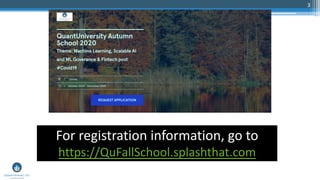
For registration information, go to
https://QuFallSchool.splashthat.com
4
https://Quwinterschool.splashthat.com
5
Next Week
6
7
Demos, slides and video available on QuAcademy
Go to www.qu.academy
7
Explaining by Removing: A Unified
Framework for Model Explanation
Ian Covert
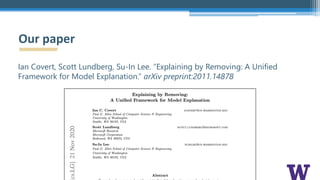
Ian Covert, Scott Lundberg, Su-In Lee. “Explaining by Removing: A Unified
Framework for Model Explanation.” arXiv preprint:2011.14878
Our paper
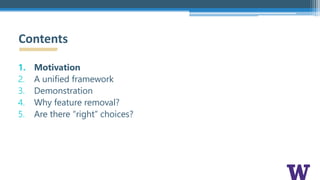
1. Motivation
2. A unified framework
3. Demonstration
4. Why feature removal?
5. Are there “right” choices?
Contents
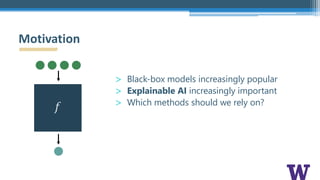
> Black-box models increasingly popular
> Explainable AI increasingly important
> Which methods should we rely on?
Motivation
𝑓
> SHAP, LIME, SAGE, Occlusion, DeepLift, SmoothGrad, Integrated
Gradients, GradCAM, CXPlain, L2X, INVASE, Meaningful
Perturbations, Extremal Perturbations, RISE, TCAV, Guided Backprop,
Excitation Backprop, IME, QII, PredDiff, MIR, Permutation Tests, LRP,
FIDO-CA, Masking Model, Expected Gradients, LossSHAP, Shapley
Effects, MP2-G, Saliency Maps, PDPs, ICEs, TreeSHAP, …
Example methods
> Researchers have made significant progress
> The field is fragmented
> Growing very fast
> Lacking discussion of underlying principles
Is the field in a good place?
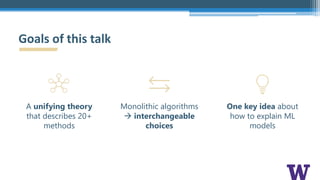
Monolithic algorithms
à interchangeable
choices
Goals of this talk
A unifying theory
that describes 20+
methods
One key idea about
how to explain ML
models
1. Motivation
2. A unified framework
3. Demonstration
4. Why feature removal?
5. Are there “right” choices?
Contents
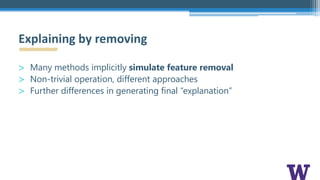
> Many methods implicitly simulate feature removal
> Non-trivial operation, different approaches
> Further differences in generating final “explanation”
Explaining by removing
A simple framework
A simple framework
A simple framework
A simple framework
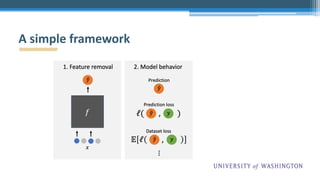
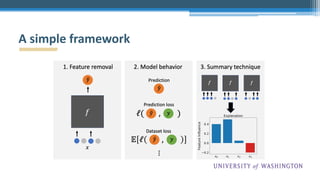
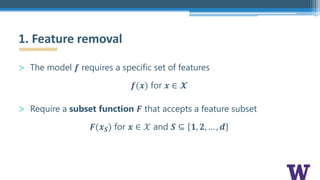
> The model 𝒇 requires a specific set of features
𝒇(𝒙) for 𝒙 ∈ 𝓧
> Require a subset function 𝑭 that accepts a feature subset
𝑭(𝒙 𝑺) for 𝒙 ∈ 𝒳 and 𝑺 ⊆ 𝟏, 𝟐, … , 𝒅
1. Feature removal
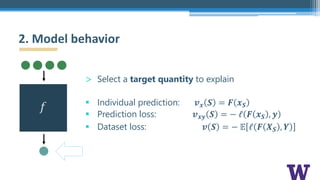
> Select a target quantity to explain
§ Individual prediction: 𝒗 𝒙 𝑺 = 𝑭 𝒙 𝑺
§ Prediction loss: 𝒗 𝒙𝒚 𝑺 = − ℓ 𝑭 𝒙 𝑺 , 𝒚
§ Dataset loss: 𝒗 𝑺 = − 𝔼 ℓ 𝑭 𝑿 𝑺 , 𝒀
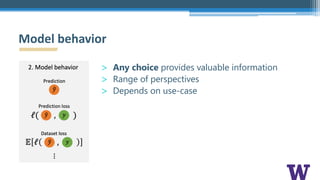
2. Model behavior
𝑓
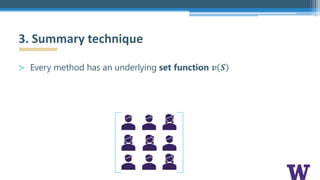
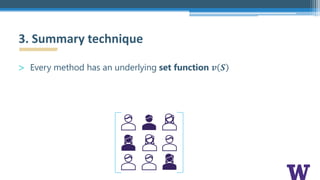
> Every method has an underlying set function 𝒗 𝑺
3. Summary technique
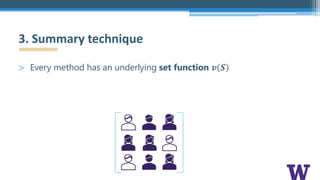
> Every method has an underlying set function 𝒗 𝑺
3. Summary technique
> Every method has an underlying set function 𝒗 𝑺
3. Summary technique
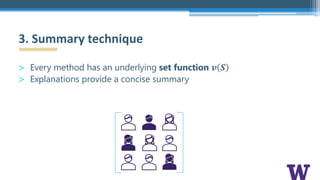
> Every method has an underlying set function 𝒗 𝑺
> Explanations provide a concise summary
3. Summary technique
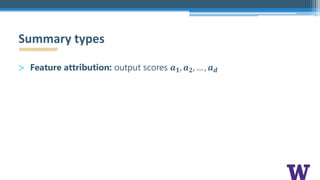
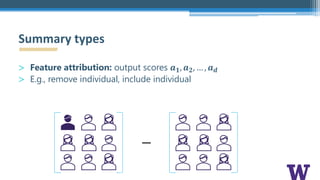
> Feature attribution: output scores 𝒂 𝟏, 𝒂 𝟐, … , 𝒂 𝒅
Summary types
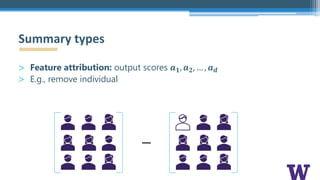
> Feature attribution: output scores 𝒂 𝟏, 𝒂 𝟐, … , 𝒂 𝒅
> E.g., remove individual
Summary types
−
> Feature attribution: output scores 𝒂 𝟏, 𝒂 𝟐, … , 𝒂 𝒅
> E.g., remove individual, include individual
Summary types
−
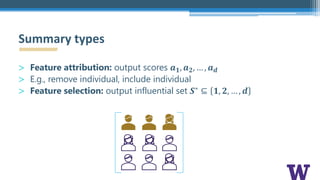
> Feature attribution: output scores 𝒂 𝟏, 𝒂 𝟐, … , 𝒂 𝒅
> E.g., remove individual, include individual
> Feature selection: output influential set 𝑺∗ ⊆ 𝟏, 𝟐, … , 𝒅
Summary types
Example methods
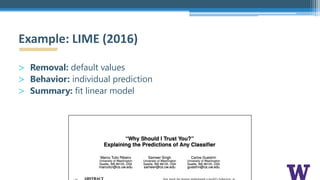
> Removal: default values
> Behavior: individual prediction
> Summary: fit linear model
Example: LIME (2016)
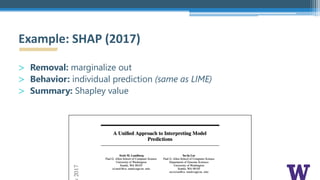
> Removal: marginalize out
> Behavior: individual prediction (same as LIME)
> Summary: Shapley value
Example: SHAP (2017)
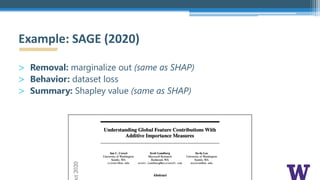
> Removal: marginalize out (same as SHAP)
> Behavior: dataset loss
> Summary: Shapley value (same as SHAP)
Example: SAGE (2020)
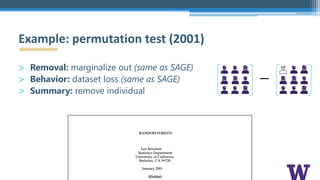
> Removal: marginalize out (same as SAGE)
> Behavior: dataset loss (same as SAGE)
> Summary: remove individual
Example: permutation test (2001)
−
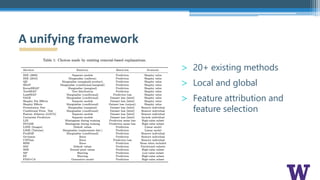
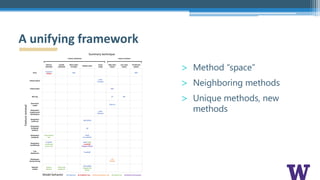
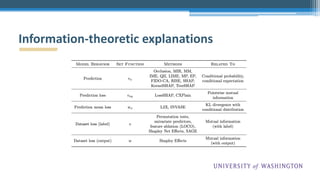
> 20+ existing methods
> Local and global
> Feature attribution and
feature selection
A unifying framework
Remove
individual
Include
individual
Mean when
included
Shapley value
Linear
model
High value
subset
Low value
subset
Partitioned
subsets
Zeros
Occlusion
CXPlain
RISE MM
Default values
LIME
(images)
Extend pixels MIR
Blurring EP MP
Generative
model
FIDO-CA
Marginalize
(replacement
distribution)
LIME
(tabular)
Marginalize
(uniform)
IME (2010)
Marginalize
(marginals
product)
QII
Marginalize
(marginal)
Permutation
test
SHAP
KernelSHAP
Marginalize
(conditional)
PredDiff
Conditional
perm. test
SHAP SAGE
LossSHAP
Shapley Effects
Tree
distribution
TreeSHAP
Missingness
during training
L2X
INVASE
Separate
models
Feature
ablation
Univariate
predictors
IME (2009)
Shapley Net
Effects
Summary technique
Featureremoval
∎ Prediction ∎ Prediction loss ∎ Mean prediction loss ∎ Dataset loss ∎ Dataset loss (output)Model behavior
Feature attribution Feature selection
> Method “space”
> Neighboring methods
> Unique methods, new
methods
1. Motivation
2. A unified framework
3. Demonstration
4. Why feature removal?
5. Are there “right” choices?
Contents
> GitHub: https://github.com/iancovert/removal-explanations
> Simple implementation of many methods
> Focus on interchangeable choices
Demonstration
Summary
> A new class of methods based on feature removal
> Each method is specified by three choices
> Framework offers a great degree of flexibility
Removal-based explanations
1. Is feature removal a smart approach to model explanation?
2. Are there “right” choices for each dimension?
Key questions
1. Motivation
2. A unified framework
3. Demonstration
4. Why feature removal?
5. Are there “right” choices?
Contents
> Intuitive to many research groups
> Feature removal is a form of counterfactual reasoning
> Undo act of observing information (rather than changing what was
observed)
> Removal is anchored in psychology (subtractive counterfactual) and
philosophy (method of difference)
Why feature removal?
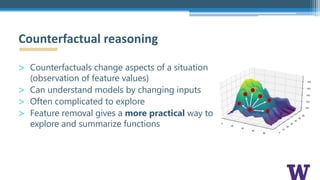
> Counterfactuals change aspects of a situation
(observation of feature values)
> Can understand models by changing inputs
> Often complicated to explore
> Feature removal gives a more practical way to
explore and summarize functions
Counterfactual reasoning
1. Motivation
2. A unified framework
3. Demonstration
4. Why feature removal?
5. Are there “right” choices?
Contents
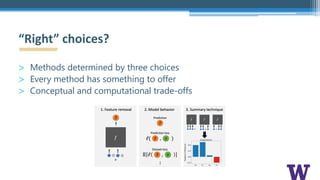
“Right” choices?
> Methods determined by three choices
> Every method has something to offer
> Conceptual and computational trade-offs
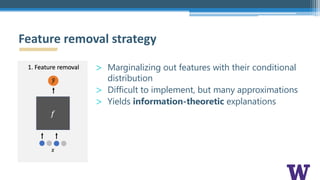
> Marginalizing out features with their conditional
distribution
> Difficult to implement, but many approximations
> Yields information-theoretic explanations
Feature removal strategy
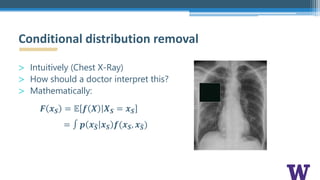
> Intuitively (Chest X-Ray)
> How should a doctor interpret this?
> Mathematically:
𝑭 𝒙 𝑺 = 𝔼 𝒇 𝑿 𝑿 𝑺 = 𝒙 𝑺
= ∫ 𝒑 𝒙(𝑺 𝒙 𝑺 𝒇(𝒙 𝑺, 𝒙(𝑺)
Conditional distribution removal
Information-theoretic explanations
> Any choice provides valuable information
> Range of perspectives
> Depends on use-case
Model behavior
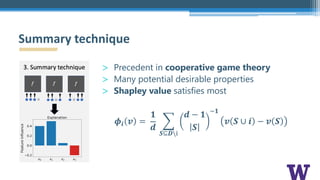
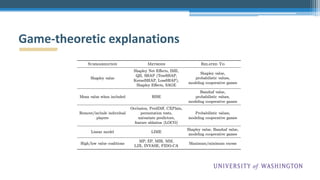
> Precedent in cooperative game theory
> Many potential desirable properties
> Shapley value satisfies most
𝝓𝒊 𝒗 =
𝟏
𝒅
<
𝑺⊆𝑫-
𝒅 − 𝟏
𝑺
.𝟏
𝒗 𝑺 ∪ 𝒊 − 𝒗 𝑺
Summary technique
Game-theoretic explanations
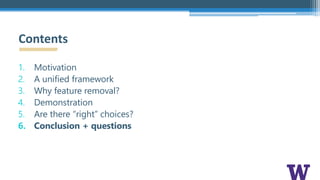
1. Motivation
2. A unified framework
3. Why feature removal?
4. Demonstration
5. Are there “right” choices?
6. Conclusion + questions
Contents
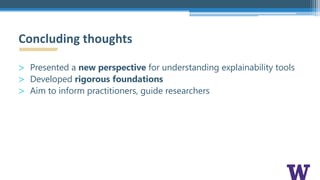
> Presented a new perspective for understanding explainability tools
> Developed rigorous foundations
> Aim to inform practitioners, guide researchers
Concluding thoughts
Questions
56
Instructions for the Lab:
1. Go to https://academy.qusandbox.com/#/register and register using the code:
"QUFALLSCHOOL"
Thank you!
Sri Krishnamurthy, CFA, CAP
Founder and CEO
QuantUniversity LLC.
srikrishnamurthy
www.QuantUniversity.com
Contact
Information, data and drawings embodied in this presentation are strictly a property of QuantUniversity LLC. and shall not be
distributed or used in any other publication without the prior written consent of QuantUniversity LLC.
57

Explainable AI Workshop

  • 1.
    Qu Speaker Series ExplainableAI Workshop Explaining by Removing: A Unified Framework for Model Explanation Ian Covert University of Washington 2020 Copyright QuantUniversity LLC. Hosted By: Sri Krishnamurthy, CFA, CAP sri@quantuniversity.com www.qu.academy 12/16/2020 Qu.Academy https://quspeakerseries18.splashthat.com/
  • 2.
    2 QuantUniversity • Boston-based DataScience, Quant Finance and Machine Learning training and consulting advisory • Trained more than 1000 students in Quantitative methods, Data Science and Big Data Technologies using MATLAB, Python and R • Building a platform for AI and Machine Learning Exploration and Experimentation
  • 3.
    3 For registration information,go to https://QuFallSchool.splashthat.com
  • 4.
  • 5.
  • 6.
  • 7.
    7 Demos, slides andvideo available on QuAcademy Go to www.qu.academy 7
  • 8.
    Explaining by Removing:A Unified Framework for Model Explanation Ian Covert
  • 9.
    Ian Covert, ScottLundberg, Su-In Lee. “Explaining by Removing: A Unified Framework for Model Explanation.” arXiv preprint:2011.14878 Our paper
  • 10.
    1. Motivation 2. Aunified framework 3. Demonstration 4. Why feature removal? 5. Are there “right” choices? Contents
  • 11.
    > Black-box modelsincreasingly popular > Explainable AI increasingly important > Which methods should we rely on? Motivation 𝑓
  • 12.
    > SHAP, LIME,SAGE, Occlusion, DeepLift, SmoothGrad, Integrated Gradients, GradCAM, CXPlain, L2X, INVASE, Meaningful Perturbations, Extremal Perturbations, RISE, TCAV, Guided Backprop, Excitation Backprop, IME, QII, PredDiff, MIR, Permutation Tests, LRP, FIDO-CA, Masking Model, Expected Gradients, LossSHAP, Shapley Effects, MP2-G, Saliency Maps, PDPs, ICEs, TreeSHAP, … Example methods
  • 13.
    > Researchers havemade significant progress > The field is fragmented > Growing very fast > Lacking discussion of underlying principles Is the field in a good place?
  • 14.
    Monolithic algorithms à interchangeable choices Goalsof this talk A unifying theory that describes 20+ methods One key idea about how to explain ML models
  • 15.
    1. Motivation 2. Aunified framework 3. Demonstration 4. Why feature removal? 5. Are there “right” choices? Contents
  • 16.
    > Many methodsimplicitly simulate feature removal > Non-trivial operation, different approaches > Further differences in generating final “explanation” Explaining by removing
  • 17.
  • 18.
  • 19.
  • 20.
  • 21.
    > The model𝒇 requires a specific set of features 𝒇(𝒙) for 𝒙 ∈ 𝓧 > Require a subset function 𝑭 that accepts a feature subset 𝑭(𝒙 𝑺) for 𝒙 ∈ 𝒳 and 𝑺 ⊆ 𝟏, 𝟐, … , 𝒅 1. Feature removal
  • 22.
    > Select atarget quantity to explain § Individual prediction: 𝒗 𝒙 𝑺 = 𝑭 𝒙 𝑺 § Prediction loss: 𝒗 𝒙𝒚 𝑺 = − ℓ 𝑭 𝒙 𝑺 , 𝒚 § Dataset loss: 𝒗 𝑺 = − 𝔼 ℓ 𝑭 𝑿 𝑺 , 𝒀 2. Model behavior 𝑓
  • 23.
    > Every methodhas an underlying set function 𝒗 𝑺 3. Summary technique
  • 24.
    > Every methodhas an underlying set function 𝒗 𝑺 3. Summary technique
  • 25.
    > Every methodhas an underlying set function 𝒗 𝑺 3. Summary technique
  • 26.
    > Every methodhas an underlying set function 𝒗 𝑺 > Explanations provide a concise summary 3. Summary technique
  • 27.
    > Feature attribution:output scores 𝒂 𝟏, 𝒂 𝟐, … , 𝒂 𝒅 Summary types
  • 28.
    > Feature attribution:output scores 𝒂 𝟏, 𝒂 𝟐, … , 𝒂 𝒅 > E.g., remove individual Summary types −
  • 29.
    > Feature attribution:output scores 𝒂 𝟏, 𝒂 𝟐, … , 𝒂 𝒅 > E.g., remove individual, include individual Summary types −
  • 30.
    > Feature attribution:output scores 𝒂 𝟏, 𝒂 𝟐, … , 𝒂 𝒅 > E.g., remove individual, include individual > Feature selection: output influential set 𝑺∗ ⊆ 𝟏, 𝟐, … , 𝒅 Summary types
  • 31.
  • 32.
    > Removal: defaultvalues > Behavior: individual prediction > Summary: fit linear model Example: LIME (2016)
  • 33.
    > Removal: marginalizeout > Behavior: individual prediction (same as LIME) > Summary: Shapley value Example: SHAP (2017)
  • 34.
    > Removal: marginalizeout (same as SHAP) > Behavior: dataset loss > Summary: Shapley value (same as SHAP) Example: SAGE (2020)
  • 35.
    > Removal: marginalizeout (same as SAGE) > Behavior: dataset loss (same as SAGE) > Summary: remove individual Example: permutation test (2001) −
  • 36.
    > 20+ existingmethods > Local and global > Feature attribution and feature selection A unifying framework
  • 37.
    A unifying framework Remove individual Include individual Meanwhen included Shapley value Linear model High value subset Low value subset Partitioned subsets Zeros Occlusion CXPlain RISE MM Default values LIME (images) Extend pixels MIR Blurring EP MP Generative model FIDO-CA Marginalize (replacement distribution) LIME (tabular) Marginalize (uniform) IME (2010) Marginalize (marginals product) QII Marginalize (marginal) Permutation test SHAP KernelSHAP Marginalize (conditional) PredDiff Conditional perm. test SHAP SAGE LossSHAP Shapley Effects Tree distribution TreeSHAP Missingness during training L2X INVASE Separate models Feature ablation Univariate predictors IME (2009) Shapley Net Effects Summary technique Featureremoval ∎ Prediction ∎ Prediction loss ∎ Mean prediction loss ∎ Dataset loss ∎ Dataset loss (output)Model behavior Feature attribution Feature selection > Method “space” > Neighboring methods > Unique methods, new methods
  • 38.
    1. Motivation 2. Aunified framework 3. Demonstration 4. Why feature removal? 5. Are there “right” choices? Contents
  • 39.
    > GitHub: https://github.com/iancovert/removal-explanations >Simple implementation of many methods > Focus on interchangeable choices Demonstration
  • 40.
    Summary > A newclass of methods based on feature removal > Each method is specified by three choices > Framework offers a great degree of flexibility Removal-based explanations
  • 41.
    1. Is featureremoval a smart approach to model explanation? 2. Are there “right” choices for each dimension? Key questions
  • 42.
    1. Motivation 2. Aunified framework 3. Demonstration 4. Why feature removal? 5. Are there “right” choices? Contents
  • 43.
    > Intuitive tomany research groups > Feature removal is a form of counterfactual reasoning > Undo act of observing information (rather than changing what was observed) > Removal is anchored in psychology (subtractive counterfactual) and philosophy (method of difference) Why feature removal?
  • 44.
    > Counterfactuals changeaspects of a situation (observation of feature values) > Can understand models by changing inputs > Often complicated to explore > Feature removal gives a more practical way to explore and summarize functions Counterfactual reasoning
  • 45.
    1. Motivation 2. Aunified framework 3. Demonstration 4. Why feature removal? 5. Are there “right” choices? Contents
  • 46.
    “Right” choices? > Methodsdetermined by three choices > Every method has something to offer > Conceptual and computational trade-offs
  • 47.
    > Marginalizing outfeatures with their conditional distribution > Difficult to implement, but many approximations > Yields information-theoretic explanations Feature removal strategy
  • 48.
    > Intuitively (ChestX-Ray) > How should a doctor interpret this? > Mathematically: 𝑭 𝒙 𝑺 = 𝔼 𝒇 𝑿 𝑿 𝑺 = 𝒙 𝑺 = ∫ 𝒑 𝒙(𝑺 𝒙 𝑺 𝒇(𝒙 𝑺, 𝒙(𝑺) Conditional distribution removal
  • 49.
  • 50.
    > Any choiceprovides valuable information > Range of perspectives > Depends on use-case Model behavior
  • 51.
    > Precedent incooperative game theory > Many potential desirable properties > Shapley value satisfies most 𝝓𝒊 𝒗 = 𝟏 𝒅 < 𝑺⊆𝑫- 𝒅 − 𝟏 𝑺 .𝟏 𝒗 𝑺 ∪ 𝒊 − 𝒗 𝑺 Summary technique
  • 52.
  • 53.
    1. Motivation 2. Aunified framework 3. Why feature removal? 4. Demonstration 5. Are there “right” choices? 6. Conclusion + questions Contents
  • 54.
    > Presented anew perspective for understanding explainability tools > Developed rigorous foundations > Aim to inform practitioners, guide researchers Concluding thoughts
  • 55.
  • 56.
    56 Instructions for theLab: 1. Go to https://academy.qusandbox.com/#/register and register using the code: "QUFALLSCHOOL"
  • 57.
    Thank you! Sri Krishnamurthy,CFA, CAP Founder and CEO QuantUniversity LLC. srikrishnamurthy www.QuantUniversity.com Contact Information, data and drawings embodied in this presentation are strictly a property of QuantUniversity LLC. and shall not be distributed or used in any other publication without the prior written consent of QuantUniversity LLC. 57