




Machine Learning and AI in Finance
An intuitive Introduction
2020 Copyright QuantUniversity LLC.
Presented By:
Sri Krishnamurthy, CFA, CAP
sri@quantuniversity.com
www.quantuniversity.com
2
Speaker bio
• Advisory and Consultancy for Financial
Analytics
• Prior Experience at MathWorks, Citigroup
and Endeca and 25+ financial services and
energy customers.
• Columnist for the Wilmott Magazine
• Author of forthcoming book
“The Model-Driven Enterprise”
• Teaches AI/ML and Fintech Related topics in
the MS and MBA programs at Northeastern
University, Boston
• Reviewer: Journal of Asset Management
Sri Krishnamurthy
Founder and CEO
QuantUniversity
3
QuantUniversity
• Boston-based Data Science, Quant
Finance and Machine Learning
training and consulting advisory
• Trained more than 1000 students in
Quantitative methods, Data Science
and Big Data Technologies using
MATLAB, Python and R
• Building a platform for AI
and Machine Learning Exploration
and Experimentation
1. Key trends in AI, Machine Learning & Fintech
2. An intuitive introduction to AI and ML
3. Case study
▫ Alternative investments: Interest rate predication for Peer-to-Peer
Market places using ML techniques
Agenda
AI and Machine Learning in Finance
Part 1
6
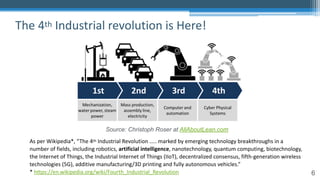
The 4th Industrial revolution is Here!
Source: Christoph Roser at AllAboutLean.com
As per Wikipedia*, “The 4th Industrial Revolution ….. marked by emerging technology breakthroughs in a
number of fields, including robotics, artificial intelligence, nanotechnology, quantum computing, biotechnology,
the Internet of Things, the Industrial Internet of Things (IIoT), decentralized consensus, fifth-generation wireless
technologies (5G), additive manufacturing/3D printing and fully autonomous vehicles.”
* https://en.wikipedia.org/wiki/Fourth_Industrial_Revolution
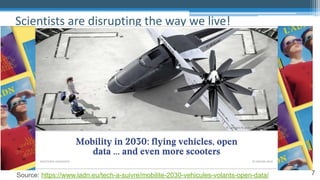
Source: https://www.ladn.eu/tech-a-suivre/mobilite-2030-vehicules-volants-open-data/ 7
Scientists are disrupting the way we live!
8
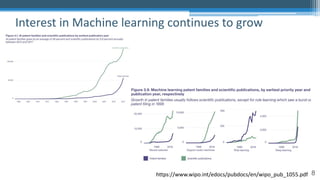
Interest in Machine learning continues to grow
https://www.wipo.int/edocs/pubdocs/en/wipo_pub_1055.pdf
9
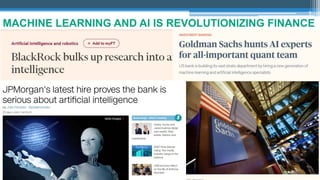
MACHINE LEARNING AND AI IS REVOLUTIONIZING FINANCE
10
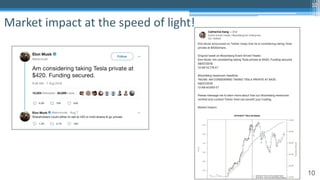
Market impact at the speed of light!
10
11
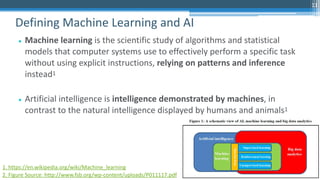
• Machine learning is the scientific study of algorithms and statistical
models that computer systems use to effectively perform a specific task
without using explicit instructions, relying on patterns and inference
instead1
• Artificial intelligence is intelligence demonstrated by machines, in
contrast to the natural intelligence displayed by humans and animals1
Defining Machine Learning and AI
11
1. https://en.wikipedia.org/wiki/Machine_learning
2. Figure Source: http://www.fsb.org/wp-content/uploads/P011117.pdf
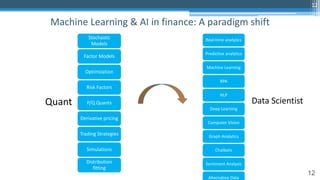
12
Machine Learning & AI in finance: A paradigm shift
12
Stochastic
Models
Factor Models
Optimization
Risk Factors
P/Q Quants
Derivative pricing
Trading Strategies
Simulations
Distribution
fitting
Quant
Real-time analytics
Predictive analytics
Machine Learning
RPA
NLP
Deep Learning
Computer Vision
Graph Analytics
Chatbots
Sentiment Analysis
Alternative Data
Data Scientist
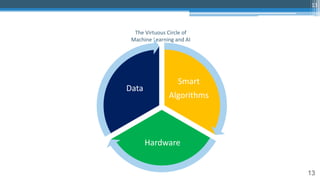
13
The Virtuous Circle of
Machine Learning and AI
13
Smart
Algorithms
Hardware
Data
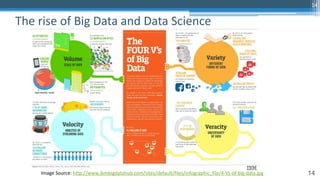
14
The rise of Big Data and Data Science
14
Image Source: http://www.ibmbigdatahub.com/sites/default/files/infographic_file/4-Vs-of-big-data.jpg
15
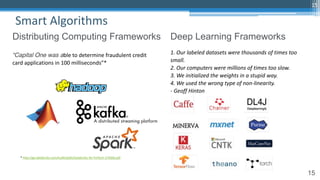
Smart Algorithms
15
Distributing Computing Frameworks Deep Learning Frameworks
1. Our labeled datasets were thousands of times too
small.
2. Our computers were millions of times too slow.
3. We initialized the weights in a stupid way.
4. We used the wrong type of non-linearity.
- Geoff Hinton
“Capital One was able to determine fraudulent credit
card applications in 100 milliseconds”*
* http://go.databricks.com/hubfs/pdfs/Databricks-for-FinTech-170306.pdf
16
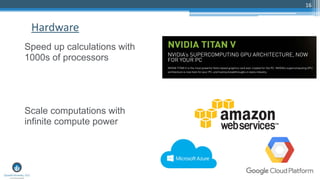
Hardware
Speed up calculations with
1000s of processors
Scale computations with
infinite compute power
17
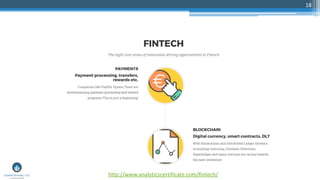
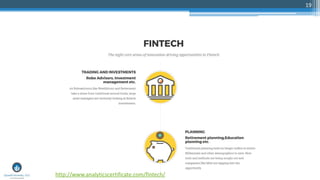
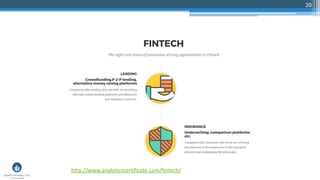
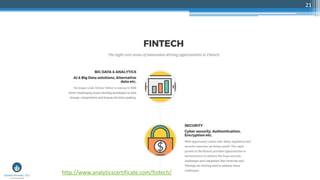
“Financial Technologies or “Fintech” is used to describe
a variety of
innovative business models
and
emerging technologies
that have the potential to transform the financial
services industry ”
Technology drives finance!
https://www.iosco.org/library/pubdocs/pdf/IOSCOPD554.pdf
18
http://www.analyticscertificate.com/fintech/
19
http://www.analyticscertificate.com/fintech/
20
http://www.analyticscertificate.com/fintech/
21
http://www.analyticscertificate.com/fintech/
22
Risk Systems That Read®
• Northfield uses machine learning based analysis of news text
to describe how current conditions in financial markets are
different than usual.
• Typically, over 8000 articles per day containing more than
20,000 “topics” (companies, industries, countries) are
processed.
• The nature and magnitudes of these difference are used to
revise expectations of financial market risks for all global
equities and credit instruments on a daily basis.
24
1. Leveraging large and diverse datasets for
Investment decision making at J.P. Morgan1
2. Improving Quantitative investing at AQR2
3. Using Sandboxes and labs to further innovation in
fintech at Fidelity3
4. Use of AI and ML increasing in ssset management
from idea generation to execution - Wells Fargo4
Additional Use cases
1. https://www.jpmorgan.com/global/cib/research/investment-decisions-using-machine-learning-ai
2. https://www.aqr.com/Learning-Center/Machine-Learning
3. https://www.fidelitylabs.com/
4. https://www08.wellsfargomedia.com/assets/pdf/personal/investing/investment-institute/IG_Machines_Are_Coming_ADA.pdf
25
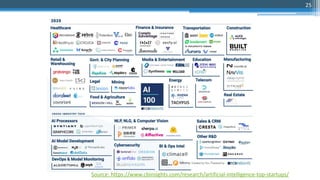
Source: https://www.cbinsights.com/research/artificial-intelligence-top-startups/
26
• Automation to increase
• Digital transformation and move to the cloud finally happening
• Use of Synthetic data to increase
• Edge cases of AI put to truth test!
• Fintechs feeling the pressure to prove themselves!
• Human-in-the-loop AI to regain focus!
The changes have been drastic and sudden! What’s in
store for the industry is yet to be seen!
What does Covid2019 mean to adoption of AI and ML in Financial services?
#Disrupt19
Q&A
Part 2:
An intuitive introduction to AI and ML
29
Let’s get under the hood
29
Source: https://www.pikrepo.com/fcsda/yellow-hot-rod-car-with-hood-open
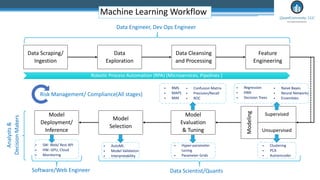
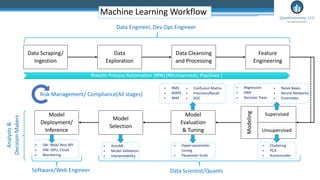
Machine Learning Workflow
Data Scraping/
Ingestion
Data
Exploration
Data Cleansing
and Processing
Feature
Engineering
Model
Evaluation
& Tuning
Model
Selection
Model
Deployment/
Inference
Supervised
Unsupervised
Modeling
Data Engineer, Dev Ops Engineer
Data Scientist/Quants
Software/Web Engineer
• AutoML
• Model Validation
• Interpretability
Robotic Process Automation (RPA) (Microservices, Pipelines )
• SW: Web/ Rest API
• HW: GPU, Cloud
• Monitoring
• Regression
• KNN
• Decision Trees
• Naive Bayes
• Neural Networks
• Ensembles
• Clustering
• PCA
• Autoencoder
• RMS
• MAPS
• MAE
• Confusion Matrix
• Precision/Recall
• ROC
• Hyper-parameter
tuning
• Parameter Grids
Risk Management/ Compliance(All stages)
Analysts
&
Decision
Makers
31
1. Data
2. Goals
3. Machine learning algorithms
4. Process
5. Performance evaluation
Key steps involved
Data
33
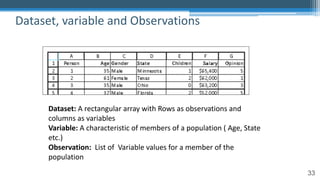
Dataset, variable and Observations
Dataset: A rectangular array with Rows as observations and
columns as variables
Variable: A characteristic of members of a population ( Age, State
etc.)
Observation: List of Variable values for a member of the
population
34
Variables
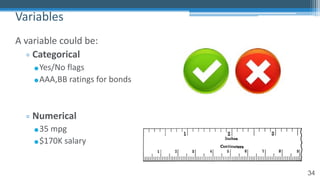
A variable could be:
▫ Categorical
●Yes/No flags
●AAA,BB ratings for bonds
▫ Numerical
●35 mpg
●$170K salary
35
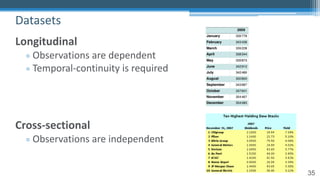
Longitudinal
▫ Observations are dependent
▫ Temporal-continuity is required
Cross-sectional
▫ Observations are independent
Datasets
36
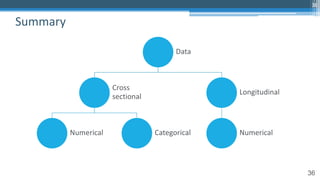
Data
Cross
sectional
Numerical Categorical
Longitudinal
Numerical
Summary
36
Goals
38
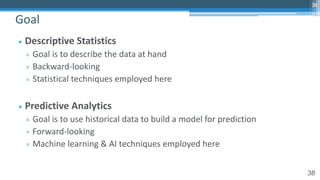
• Descriptive Statistics
▫ Goal is to describe the data at hand
▫ Backward-looking
▫ Statistical techniques employed here
• Predictive Analytics
▫ Goal is to use historical data to build a model for prediction
▫ Forward-looking
▫ Machine learning & AI techniques employed here
Goal
38
39
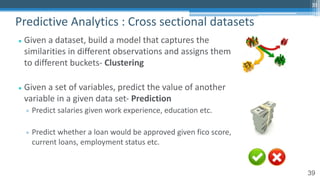
• Given a dataset, build a model that captures the
similarities in different observations and assigns them
to different buckets- Clustering
• Given a set of variables, predict the value of another
variable in a given data set- Prediction
▫ Predict salaries given work experience, education etc.
▫ Predict whether a loan would be approved given fico score,
current loans, employment status etc.
Predictive Analytics : Cross sectional datasets
39
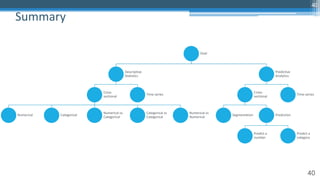
40
Goal
Descriptive
Statistics
Cross
sectional
Numerical Categorical
Numerical vs
Categorical
Categorical vs
Categorical
Numerical vs
Numerical
Time series
Predictive
Analytics
Cross-
sectional
Segmentation Prediction
Predict a
number
Predict a
category
Time-series
Summary
40
Machine Learning algorithms
42
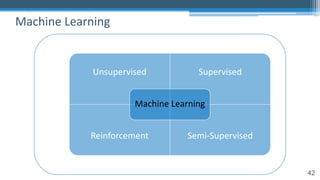
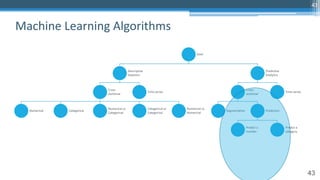
Machine Learning
Unsupervised Supervised
Reinforcement Semi-Supervised
Machine Learning
43
Goal
Descriptive
Statistics
Cross
sectional
Numerical Categorical
Numerical vs
Categorical
Categorical vs
Categorical
Numerical vs
Numerical
Time series
Predictive
Analytics
Cross-
sectional
Segmentation Prediction
Predict a
number
Predict a
category
Time-series
Machine Learning Algorithms
43
44
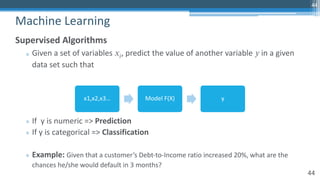
Supervised Algorithms
▫ Given a set of variables , predict the value of another variable in a given
data set such that
▫ If y is numeric => Prediction
▫ If y is categorical => Classification
▫ Example: Given that a customer’s Debt-to-Income ratio increased 20%, what are the
chances he/she would default in 3 months?
𝑥𝑖 𝑦
Machine Learning
44
x1,x2,x3… Model F(X) y
45
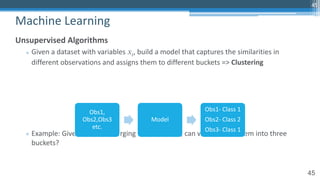
Unsupervised Algorithms
▫ Given a dataset with variables , build a model that captures the similarities in
different observations and assigns them to different buckets => Clustering
▫ Example: Given a list of emerging market stocks, can we segment them into three
buckets?
𝑥𝑖
Machine Learning
45
Obs1,
Obs2,Obs3
etc.
Model
Obs1- Class 1
Obs2- Class 2
Obs3- Class 1
46
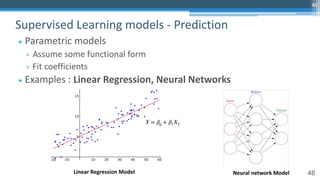
• Parametric models
▫ Assume some functional form
▫ Fit coefficients
• Examples : Linear Regression, Neural Networks
Supervised Learning models - Prediction
46
𝑌 = 𝛽0 + 𝛽1𝑋1
Linear Regression Model Neural network Model
47
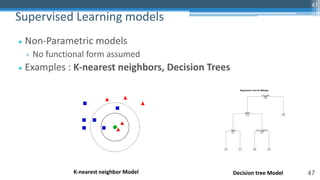
• Non-Parametric models
▫ No functional form assumed
• Examples : K-nearest neighbors, Decision Trees
Supervised Learning models
47
K-nearest neighbor Model Decision tree Model
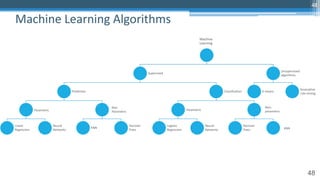
48
Machine
Learning
Supervised
Prediction
Parametric
Linear
Regression
Neural
Networks
Non-
parametric
KNN
Decision
Trees
Classification
Parametric
Logistic
Regression
Neural
Networks
Non
Parametric
Decision
Trees KNN
Unsupervised
algorithms
K-means
Associative
rule mining
Machine Learning Algorithms
48
49
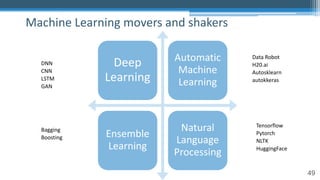
Machine Learning movers and shakers
Deep
Learning
Automatic
Machine
Learning
Ensemble
Learning
Natural
Language
Processing
Data Robot
H20.ai
Autosklearn
autokkeras
Tensorflow
Pytorch
NLTK
HuggingFace
Bagging
Boosting
DNN
CNN
LSTM
GAN
50
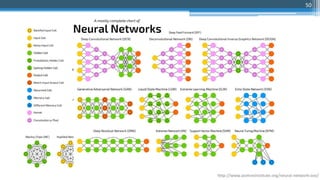
http://www.asimovinstitute.org/neural-network-zoo/
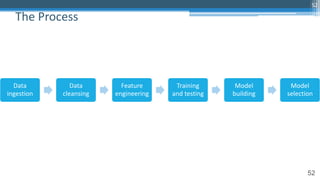
The Process
52
The Process
52
Data
ingestion
Data
cleansing
Feature
engineering
Training
and testing
Model
building
Model
selection
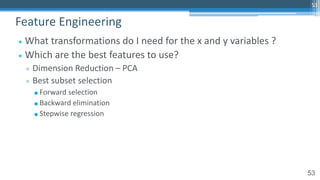
53
• What transformations do I need for the x and y variables ?
• Which are the best features to use?
▫ Dimension Reduction – PCA
▫ Best subset selection
●Forward selection
●Backward elimination
●Stepwise regression
Feature Engineering
53
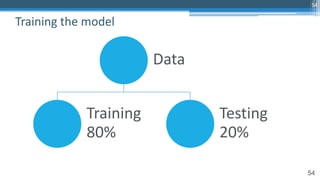
54
Data
Training
80%
Testing
20%
Training the model
54
Performance Evaluation
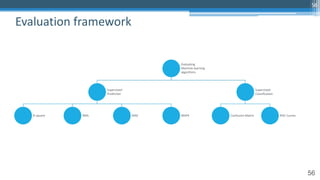
56
Evaluating
Machine learning
algorithms
Supervised -
Prediction
R-square RMS MAE MAPE
Supervised-
Classification
Confusion Matrix ROC Curves
Evaluation framework
56
57
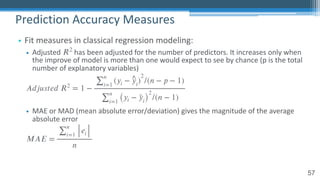
• Fit measures in classical regression modeling:
• Adjusted has been adjusted for the number of predictors. It increases only when
the improve of model is more than one would expect to see by chance (p is the total
number of explanatory variables)
• MAE or MAD (mean absolute error/deviation) gives the magnitude of the average
absolute error
𝑅2
𝐴𝑑𝑗𝑢𝑠𝑡𝑒𝑑 𝑅2
= 1 −
∑
𝑛
𝑖=1
(𝑦𝑖 − ^
𝑦𝑖)
2
/(𝑛 − 𝑝 − 1)
∑
𝑛
𝑖=1 (𝑦𝑖 − ¯
𝑦𝑖)
2
/(𝑛 − 1)
𝑀𝐴𝐸 =
∑
𝑛
𝑖=1
𝑒𝑖
𝑛
Prediction Accuracy Measures
58
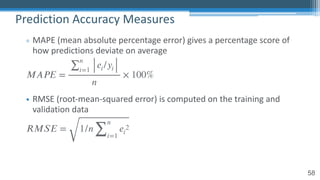
▫ MAPE (mean absolute percentage error) gives a percentage score of
how predictions deviate on average
• RMSE (root-mean-squared error) is computed on the training and
validation data
𝑀𝐴𝑃𝐸 =
∑
𝑛
𝑖=1
𝑒𝑖/𝑦𝑖
𝑛
× 100%
𝑅𝑀𝑆𝐸 = 1/𝑛
∑
𝑛
𝑖=1
𝑒𝑖
2
Prediction Accuracy Measures
59
1. Data
2. Goals
3. Machine learning algorithms
4. Process
5. Performance Evaluation
Recap
Machine Learning Workflow
Data Scraping/
Ingestion
Data
Exploration
Data Cleansing
and Processing
Feature
Engineering
Model
Evaluation
& Tuning
Model
Selection
Model
Deployment/
Inference
Supervised
Unsupervised
Modeling
Data Engineer, Dev Ops Engineer
Data Scientist/Quants
Software/Web Engineer
• AutoML
• Model Validation
• Interpretability
Robotic Process Automation (RPA) (Microservices, Pipelines )
• SW: Web/ Rest API
• HW: GPU, Cloud
• Monitoring
• Regression
• KNN
• Decision Trees
• Naive Bayes
• Neural Networks
• Ensembles
• Clustering
• PCA
• Autoencoder
• RMS
• MAPS
• MAE
• Confusion Matrix
• Precision/Recall
• ROC
• Hyper-parameter
tuning
• Parameter Grids
Risk Management/ Compliance(All stages)
Analysts
&
Decision
Makers
61
62
Challenges in Machine Learning and AI every
Investment professional should know
63
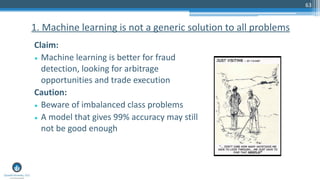
Claim:
• Machine learning is better for fraud
detection, looking for arbitrage
opportunities and trade execution
Caution:
• Beware of imbalanced class problems
• A model that gives 99% accuracy may still
not be good enough
1. Machine learning is not a generic solution to all problems
64
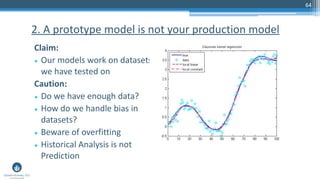
Claim:
• Our models work on datasets
we have tested on
Caution:
• Do we have enough data?
• How do we handle bias in
datasets?
• Beware of overfitting
• Historical Analysis is not
Prediction
2. A prototype model is not your production model
65
AI and Machine Learning in Production
https://www.itnews.com.au/news/hsbc-societe-generale-run-
into-ais-production-problems-477966
Kristy Roth from HSBC:
“It’s been somewhat easy - in a funny way -
to get going using sample data, [but] then
you hit the real problems,” Roth said.
“I think our early track record on PoCs or
pilots hides a little bit the underlying issues.
Matt Davey from Societe Generale:
“We’ve done quite a bit of work with RPA
recently and I have to say we’ve been a bit
disillusioned with that experience,”
“the PoC is the easy bit: it’s how you get that
into production and shift the balance”
66
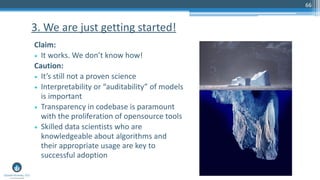
Claim:
• It works. We don’t know how!
Caution:
• It’s still not a proven science
• Interpretability or “auditability” of models
is important
• Transparency in codebase is paramount
with the proliferation of opensource tools
• Skilled data scientists who are
knowledgeable about algorithms and
their appropriate usage are key to
successful adoption
3. We are just getting started!
67
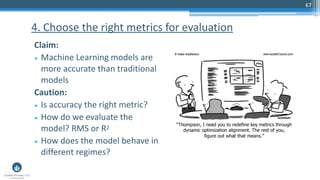
Claim:
• Machine Learning models are
more accurate than traditional
models
Caution:
• Is accuracy the right metric?
• How do we evaluate the
model? RMS or R2
• How does the model behave in
different regimes?
4. Choose the right metrics for evaluation
68
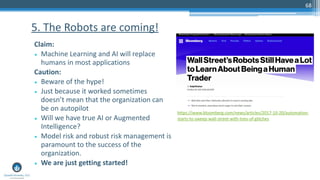
Claim:
• Machine Learning and AI will replace
humans in most applications
Caution:
• Beware of the hype!
• Just because it worked sometimes
doesn’t mean that the organization can
be on autopilot
• Will we have true AI or Augmented
Intelligence?
• Model risk and robust risk management is
paramount to the success of the
organization.
• We are just getting started!
5. The Robots are coming!
https://www.bloomberg.com/news/articles/2017-10-20/automation-
starts-to-sweep-wall-street-with-tons-of-glitches
#Disrupt19
Alternative investments: Interest rate predication for Peer-to-Peer Market places using ML
techniques
Case study
70
1. Case Intro
2. Data Exploration of the Credit risk data set
3. Problem Definition and Machine learning
4. Performance Evaluation
5. Deployment
Case study
71
Credit decisions
Credit-scoring models and techniques assess the risk in
lending to customers.
Typical decisions:
• Grant credit/not to new applicants
• Increasing/Decreasing spending limits
• Increasing/Decreasing lending rates
• What new products can be given to existing applicants ?
72
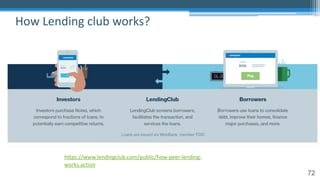
How Lending club works?
https://www.lendingclub.com/public/how-peer-lending-
works.action
73
• How much should I expect as interest?
• Is my borrower credit worthy?
• How much interest would a similar borrower pay?
• What is the repayment and default rate for a similar borrower?
Investor’s big decisions
74
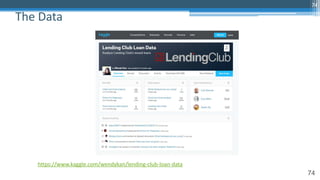
The Data
74
https://www.kaggle.com/wendykan/lending-club-loan-data
75
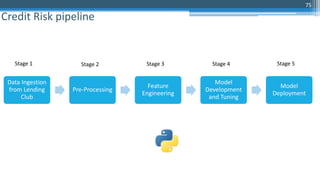
Credit Risk pipeline
Data Ingestion
from Lending
Club
Pre-Processing
Feature
Engineering
Model
Development
and Tuning
Model
Deployment
Stage 1 Stage 2 Stage 3 Stage 4 Stage 5
76
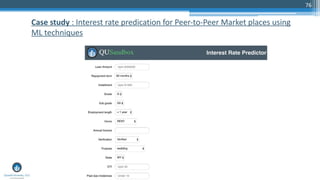
Case study : Interest rate predication for Peer-to-Peer Market places using
ML techniques
https://qusummerschool2021.splashthat.com/
5
• Just Enough Python for Data Science
▫ 3 weeks - June 22nd – July 6th
• ML and AI for Financial Professionals
▫ 9 weeks - July 8th – September 9th
– This course will illustrate the role of machine learning, data science
techniques, and AI in the investment industry.
QuantUniversity Machine Learning and AI Bootcamp
Explore
https://qusummerschool2021.splashthat.com/
6
• Risk & ML Models: Stress, Scenario Testing &
Evaluation
▫ 6 weeks - June 1st – July 6th
• Algo Auditing for ML & AI Models
▫ 6 weeks - June 8th – July 13th
• Model Risk Management for Machine Learning
Models
▫ 7 weeks - June 15th – July 27th
QuantUniversity AI & Risk Management Series
Experience
https://qusummerschool2021.splashthat.com/
Thank you!
Sri Krishnamurthy, CFA, CAP
Founder and CEO
QuantUniversity LLC.
srikrishnamurthy
www.QuantUniversity.com
Contact
Information, data and drawings embodied in this presentation are strictly a property of QuantUniversity LLC. and shall not be
distributed or used in any other publication without the prior written consent of QuantUniversity LLC.
79

Qu for India - QuantUniversity FundRaiser

  • 1.
    Machine Learning andAI in Finance An intuitive Introduction 2020 Copyright QuantUniversity LLC. Presented By: Sri Krishnamurthy, CFA, CAP sri@quantuniversity.com www.quantuniversity.com
  • 2.
    2 Speaker bio • Advisoryand Consultancy for Financial Analytics • Prior Experience at MathWorks, Citigroup and Endeca and 25+ financial services and energy customers. • Columnist for the Wilmott Magazine • Author of forthcoming book “The Model-Driven Enterprise” • Teaches AI/ML and Fintech Related topics in the MS and MBA programs at Northeastern University, Boston • Reviewer: Journal of Asset Management Sri Krishnamurthy Founder and CEO QuantUniversity
  • 3.
    3 QuantUniversity • Boston-based DataScience, Quant Finance and Machine Learning training and consulting advisory • Trained more than 1000 students in Quantitative methods, Data Science and Big Data Technologies using MATLAB, Python and R • Building a platform for AI and Machine Learning Exploration and Experimentation
  • 4.
    1. Key trendsin AI, Machine Learning & Fintech 2. An intuitive introduction to AI and ML 3. Case study ▫ Alternative investments: Interest rate predication for Peer-to-Peer Market places using ML techniques Agenda
  • 5.
    AI and MachineLearning in Finance Part 1
  • 6.
    6 The 4th Industrialrevolution is Here! Source: Christoph Roser at AllAboutLean.com As per Wikipedia*, “The 4th Industrial Revolution ….. marked by emerging technology breakthroughs in a number of fields, including robotics, artificial intelligence, nanotechnology, quantum computing, biotechnology, the Internet of Things, the Industrial Internet of Things (IIoT), decentralized consensus, fifth-generation wireless technologies (5G), additive manufacturing/3D printing and fully autonomous vehicles.” * https://en.wikipedia.org/wiki/Fourth_Industrial_Revolution
  • 7.
  • 8.
    8 Interest in Machinelearning continues to grow https://www.wipo.int/edocs/pubdocs/en/wipo_pub_1055.pdf
  • 9.
    9 MACHINE LEARNING ANDAI IS REVOLUTIONIZING FINANCE
  • 10.
    10 Market impact atthe speed of light! 10
  • 11.
    11 • Machine learningis the scientific study of algorithms and statistical models that computer systems use to effectively perform a specific task without using explicit instructions, relying on patterns and inference instead1 • Artificial intelligence is intelligence demonstrated by machines, in contrast to the natural intelligence displayed by humans and animals1 Defining Machine Learning and AI 11 1. https://en.wikipedia.org/wiki/Machine_learning 2. Figure Source: http://www.fsb.org/wp-content/uploads/P011117.pdf
  • 12.
    12 Machine Learning &AI in finance: A paradigm shift 12 Stochastic Models Factor Models Optimization Risk Factors P/Q Quants Derivative pricing Trading Strategies Simulations Distribution fitting Quant Real-time analytics Predictive analytics Machine Learning RPA NLP Deep Learning Computer Vision Graph Analytics Chatbots Sentiment Analysis Alternative Data Data Scientist
  • 13.
    13 The Virtuous Circleof Machine Learning and AI 13 Smart Algorithms Hardware Data
  • 14.
    14 The rise ofBig Data and Data Science 14 Image Source: http://www.ibmbigdatahub.com/sites/default/files/infographic_file/4-Vs-of-big-data.jpg
  • 15.
    15 Smart Algorithms 15 Distributing ComputingFrameworks Deep Learning Frameworks 1. Our labeled datasets were thousands of times too small. 2. Our computers were millions of times too slow. 3. We initialized the weights in a stupid way. 4. We used the wrong type of non-linearity. - Geoff Hinton “Capital One was able to determine fraudulent credit card applications in 100 milliseconds”* * http://go.databricks.com/hubfs/pdfs/Databricks-for-FinTech-170306.pdf
  • 16.
    16 Hardware Speed up calculationswith 1000s of processors Scale computations with infinite compute power
  • 17.
    17 “Financial Technologies or“Fintech” is used to describe a variety of innovative business models and emerging technologies that have the potential to transform the financial services industry ” Technology drives finance! https://www.iosco.org/library/pubdocs/pdf/IOSCOPD554.pdf
  • 18.
  • 19.
  • 20.
  • 21.
  • 22.
  • 23.
    Risk Systems ThatRead® • Northfield uses machine learning based analysis of news text to describe how current conditions in financial markets are different than usual. • Typically, over 8000 articles per day containing more than 20,000 “topics” (companies, industries, countries) are processed. • The nature and magnitudes of these difference are used to revise expectations of financial market risks for all global equities and credit instruments on a daily basis.
  • 24.
    24 1. Leveraging largeand diverse datasets for Investment decision making at J.P. Morgan1 2. Improving Quantitative investing at AQR2 3. Using Sandboxes and labs to further innovation in fintech at Fidelity3 4. Use of AI and ML increasing in ssset management from idea generation to execution - Wells Fargo4 Additional Use cases 1. https://www.jpmorgan.com/global/cib/research/investment-decisions-using-machine-learning-ai 2. https://www.aqr.com/Learning-Center/Machine-Learning 3. https://www.fidelitylabs.com/ 4. https://www08.wellsfargomedia.com/assets/pdf/personal/investing/investment-institute/IG_Machines_Are_Coming_ADA.pdf
  • 25.
  • 26.
    26 • Automation toincrease • Digital transformation and move to the cloud finally happening • Use of Synthetic data to increase • Edge cases of AI put to truth test! • Fintechs feeling the pressure to prove themselves! • Human-in-the-loop AI to regain focus! The changes have been drastic and sudden! What’s in store for the industry is yet to be seen! What does Covid2019 mean to adoption of AI and ML in Financial services?
  • 27.
  • 28.
    Part 2: An intuitiveintroduction to AI and ML
  • 29.
    29 Let’s get underthe hood 29 Source: https://www.pikrepo.com/fcsda/yellow-hot-rod-car-with-hood-open
  • 30.
    Machine Learning Workflow DataScraping/ Ingestion Data Exploration Data Cleansing and Processing Feature Engineering Model Evaluation & Tuning Model Selection Model Deployment/ Inference Supervised Unsupervised Modeling Data Engineer, Dev Ops Engineer Data Scientist/Quants Software/Web Engineer • AutoML • Model Validation • Interpretability Robotic Process Automation (RPA) (Microservices, Pipelines ) • SW: Web/ Rest API • HW: GPU, Cloud • Monitoring • Regression • KNN • Decision Trees • Naive Bayes • Neural Networks • Ensembles • Clustering • PCA • Autoencoder • RMS • MAPS • MAE • Confusion Matrix • Precision/Recall • ROC • Hyper-parameter tuning • Parameter Grids Risk Management/ Compliance(All stages) Analysts & Decision Makers
  • 31.
    31 1. Data 2. Goals 3.Machine learning algorithms 4. Process 5. Performance evaluation Key steps involved
  • 32.
  • 33.
    33 Dataset, variable andObservations Dataset: A rectangular array with Rows as observations and columns as variables Variable: A characteristic of members of a population ( Age, State etc.) Observation: List of Variable values for a member of the population
  • 34.
    34 Variables A variable couldbe: ▫ Categorical ●Yes/No flags ●AAA,BB ratings for bonds ▫ Numerical ●35 mpg ●$170K salary
  • 35.
    35 Longitudinal ▫ Observations aredependent ▫ Temporal-continuity is required Cross-sectional ▫ Observations are independent Datasets
  • 36.
  • 37.
  • 38.
    38 • Descriptive Statistics ▫Goal is to describe the data at hand ▫ Backward-looking ▫ Statistical techniques employed here • Predictive Analytics ▫ Goal is to use historical data to build a model for prediction ▫ Forward-looking ▫ Machine learning & AI techniques employed here Goal 38
  • 39.
    39 • Given adataset, build a model that captures the similarities in different observations and assigns them to different buckets- Clustering • Given a set of variables, predict the value of another variable in a given data set- Prediction ▫ Predict salaries given work experience, education etc. ▫ Predict whether a loan would be approved given fico score, current loans, employment status etc. Predictive Analytics : Cross sectional datasets 39
  • 40.
    40 Goal Descriptive Statistics Cross sectional Numerical Categorical Numerical vs Categorical Categoricalvs Categorical Numerical vs Numerical Time series Predictive Analytics Cross- sectional Segmentation Prediction Predict a number Predict a category Time-series Summary 40
  • 41.
  • 42.
  • 43.
    43 Goal Descriptive Statistics Cross sectional Numerical Categorical Numerical vs Categorical Categoricalvs Categorical Numerical vs Numerical Time series Predictive Analytics Cross- sectional Segmentation Prediction Predict a number Predict a category Time-series Machine Learning Algorithms 43
  • 44.
    44 Supervised Algorithms ▫ Givena set of variables , predict the value of another variable in a given data set such that ▫ If y is numeric => Prediction ▫ If y is categorical => Classification ▫ Example: Given that a customer’s Debt-to-Income ratio increased 20%, what are the chances he/she would default in 3 months? 𝑥𝑖 𝑦 Machine Learning 44 x1,x2,x3… Model F(X) y
  • 45.
    45 Unsupervised Algorithms ▫ Givena dataset with variables , build a model that captures the similarities in different observations and assigns them to different buckets => Clustering ▫ Example: Given a list of emerging market stocks, can we segment them into three buckets? 𝑥𝑖 Machine Learning 45 Obs1, Obs2,Obs3 etc. Model Obs1- Class 1 Obs2- Class 2 Obs3- Class 1
  • 46.
    46 • Parametric models ▫Assume some functional form ▫ Fit coefficients • Examples : Linear Regression, Neural Networks Supervised Learning models - Prediction 46 𝑌 = 𝛽0 + 𝛽1𝑋1 Linear Regression Model Neural network Model
  • 47.
    47 • Non-Parametric models ▫No functional form assumed • Examples : K-nearest neighbors, Decision Trees Supervised Learning models 47 K-nearest neighbor Model Decision tree Model
  • 48.
  • 49.
    49 Machine Learning moversand shakers Deep Learning Automatic Machine Learning Ensemble Learning Natural Language Processing Data Robot H20.ai Autosklearn autokkeras Tensorflow Pytorch NLTK HuggingFace Bagging Boosting DNN CNN LSTM GAN
  • 50.
  • 51.
  • 52.
  • 53.
    53 • What transformationsdo I need for the x and y variables ? • Which are the best features to use? ▫ Dimension Reduction – PCA ▫ Best subset selection ●Forward selection ●Backward elimination ●Stepwise regression Feature Engineering 53
  • 54.
  • 55.
  • 56.
    56 Evaluating Machine learning algorithms Supervised - Prediction R-squareRMS MAE MAPE Supervised- Classification Confusion Matrix ROC Curves Evaluation framework 56
  • 57.
    57 • Fit measuresin classical regression modeling: • Adjusted has been adjusted for the number of predictors. It increases only when the improve of model is more than one would expect to see by chance (p is the total number of explanatory variables) • MAE or MAD (mean absolute error/deviation) gives the magnitude of the average absolute error 𝑅2 𝐴𝑑𝑗𝑢𝑠𝑡𝑒𝑑 𝑅2 = 1 − ∑ 𝑛 𝑖=1 (𝑦𝑖 − ^ 𝑦𝑖) 2 /(𝑛 − 𝑝 − 1) ∑ 𝑛 𝑖=1 (𝑦𝑖 − ¯ 𝑦𝑖) 2 /(𝑛 − 1) 𝑀𝐴𝐸 = ∑ 𝑛 𝑖=1 𝑒𝑖 𝑛 Prediction Accuracy Measures
  • 58.
    58 ▫ MAPE (meanabsolute percentage error) gives a percentage score of how predictions deviate on average • RMSE (root-mean-squared error) is computed on the training and validation data 𝑀𝐴𝑃𝐸 = ∑ 𝑛 𝑖=1 𝑒𝑖/𝑦𝑖 𝑛 × 100% 𝑅𝑀𝑆𝐸 = 1/𝑛 ∑ 𝑛 𝑖=1 𝑒𝑖 2 Prediction Accuracy Measures
  • 59.
    59 1. Data 2. Goals 3.Machine learning algorithms 4. Process 5. Performance Evaluation Recap
  • 60.
    Machine Learning Workflow DataScraping/ Ingestion Data Exploration Data Cleansing and Processing Feature Engineering Model Evaluation & Tuning Model Selection Model Deployment/ Inference Supervised Unsupervised Modeling Data Engineer, Dev Ops Engineer Data Scientist/Quants Software/Web Engineer • AutoML • Model Validation • Interpretability Robotic Process Automation (RPA) (Microservices, Pipelines ) • SW: Web/ Rest API • HW: GPU, Cloud • Monitoring • Regression • KNN • Decision Trees • Naive Bayes • Neural Networks • Ensembles • Clustering • PCA • Autoencoder • RMS • MAPS • MAE • Confusion Matrix • Precision/Recall • ROC • Hyper-parameter tuning • Parameter Grids Risk Management/ Compliance(All stages) Analysts & Decision Makers
  • 61.
  • 62.
    62 Challenges in MachineLearning and AI every Investment professional should know
  • 63.
    63 Claim: • Machine learningis better for fraud detection, looking for arbitrage opportunities and trade execution Caution: • Beware of imbalanced class problems • A model that gives 99% accuracy may still not be good enough 1. Machine learning is not a generic solution to all problems
  • 64.
    64 Claim: • Our modelswork on datasets we have tested on Caution: • Do we have enough data? • How do we handle bias in datasets? • Beware of overfitting • Historical Analysis is not Prediction 2. A prototype model is not your production model
  • 65.
    65 AI and MachineLearning in Production https://www.itnews.com.au/news/hsbc-societe-generale-run- into-ais-production-problems-477966 Kristy Roth from HSBC: “It’s been somewhat easy - in a funny way - to get going using sample data, [but] then you hit the real problems,” Roth said. “I think our early track record on PoCs or pilots hides a little bit the underlying issues. Matt Davey from Societe Generale: “We’ve done quite a bit of work with RPA recently and I have to say we’ve been a bit disillusioned with that experience,” “the PoC is the easy bit: it’s how you get that into production and shift the balance”
  • 66.
    66 Claim: • It works.We don’t know how! Caution: • It’s still not a proven science • Interpretability or “auditability” of models is important • Transparency in codebase is paramount with the proliferation of opensource tools • Skilled data scientists who are knowledgeable about algorithms and their appropriate usage are key to successful adoption 3. We are just getting started!
  • 67.
    67 Claim: • Machine Learningmodels are more accurate than traditional models Caution: • Is accuracy the right metric? • How do we evaluate the model? RMS or R2 • How does the model behave in different regimes? 4. Choose the right metrics for evaluation
  • 68.
    68 Claim: • Machine Learningand AI will replace humans in most applications Caution: • Beware of the hype! • Just because it worked sometimes doesn’t mean that the organization can be on autopilot • Will we have true AI or Augmented Intelligence? • Model risk and robust risk management is paramount to the success of the organization. • We are just getting started! 5. The Robots are coming! https://www.bloomberg.com/news/articles/2017-10-20/automation- starts-to-sweep-wall-street-with-tons-of-glitches
  • 69.
    #Disrupt19 Alternative investments: Interestrate predication for Peer-to-Peer Market places using ML techniques Case study
  • 70.
    70 1. Case Intro 2.Data Exploration of the Credit risk data set 3. Problem Definition and Machine learning 4. Performance Evaluation 5. Deployment Case study
  • 71.
    71 Credit decisions Credit-scoring modelsand techniques assess the risk in lending to customers. Typical decisions: • Grant credit/not to new applicants • Increasing/Decreasing spending limits • Increasing/Decreasing lending rates • What new products can be given to existing applicants ?
  • 72.
    72 How Lending clubworks? https://www.lendingclub.com/public/how-peer-lending- works.action
  • 73.
    73 • How muchshould I expect as interest? • Is my borrower credit worthy? • How much interest would a similar borrower pay? • What is the repayment and default rate for a similar borrower? Investor’s big decisions
  • 74.
  • 75.
    75 Credit Risk pipeline DataIngestion from Lending Club Pre-Processing Feature Engineering Model Development and Tuning Model Deployment Stage 1 Stage 2 Stage 3 Stage 4 Stage 5
  • 76.
    76 Case study :Interest rate predication for Peer-to-Peer Market places using ML techniques
  • 77.
  • 78.
    5 • Just EnoughPython for Data Science ▫ 3 weeks - June 22nd – July 6th • ML and AI for Financial Professionals ▫ 9 weeks - July 8th – September 9th – This course will illustrate the role of machine learning, data science techniques, and AI in the investment industry. QuantUniversity Machine Learning and AI Bootcamp Explore https://qusummerschool2021.splashthat.com/
  • 79.
    6 • Risk &ML Models: Stress, Scenario Testing & Evaluation ▫ 6 weeks - June 1st – July 6th • Algo Auditing for ML & AI Models ▫ 6 weeks - June 8th – July 13th • Model Risk Management for Machine Learning Models ▫ 7 weeks - June 15th – July 27th QuantUniversity AI & Risk Management Series Experience https://qusummerschool2021.splashthat.com/
  • 80.
    Thank you! Sri Krishnamurthy,CFA, CAP Founder and CEO QuantUniversity LLC. srikrishnamurthy www.QuantUniversity.com Contact Information, data and drawings embodied in this presentation are strictly a property of QuantUniversity LLC. and shall not be distributed or used in any other publication without the prior written consent of QuantUniversity LLC. 79