Psychology of Communications


       Machiavellianism

      Machiavellian’s Motives
                 in
 Organizational Citizenship Behavior

                      by
                Jennifer Becker
                  Dan O’Hair

                   August, 2007
Journal of Applied Communication Research Vol.35
Who is Niccolo Machiavelli?

 Born May 3, 1469
 Died June 21, 1527
 High level Italian
  diplomat
 Most famous as
  author of The Prince
The Prince

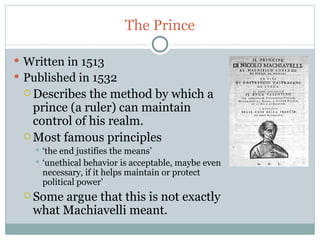
 Written in 1513
 Published in 1532
  Describes  the method by which a
   prince (a ruler) can maintain
   control of his realm.
  Most famous principles
    ‘the end justifies the means’
    ‘unethical behavior is acceptable, maybe even
     necessary, if it helps maintain or protect
     political power’
  Some argue that this is not exactly
   what Machiavelli meant.
The Dark Triad

 Narcissists are driven by one motive: dreams of glory.
  Narcissists flourish when they are facing a difficult challenge,
  they shine when performance under stress counts the most.
  However they have little capacity for empathy and the more
  impaired a person’s ability to consider others, the less healthy
  their narcissism.

 For the Machiavellian the ends justify the means, no matter
  what human pain he may cause. They tend to be cynically
  calculating and arrogant, readily behaving in ways that
  undermine trust and cooperation.

 The hallmarks of the Psychopath’s behavior are deceit and
  reckless disregard for others. The Psychopath also lacks
  empathy and are completely indifferent to the emotional pain
  others may suffer because of his actions.
Machiavellian’s Construct Development

 First Introduced
   1970 by Christie and Geis


 Construct came from research centering on persons
  of power in organizations and authoritarian
  personality

 MACH IV was originally created to measure the
  political personality of leaders in organizations.
Who is a Machiavelli?

 Willingness and ability to manipulate others for
  their own purposes (Christie & Geis, 1970)
 Act without regard to ethical norms


 Skillfully exercise strategies to exploit situations and
  people for their personal benefit (Fehr, Samsom &
  Paulhus, 1992; Grams & Rogers, 1990; O’Hair & Cody, 1987)
 Low ideological commitment- focus on task
  completion rather than long-range ideological
  goals
What motivates a Machiavelli?

   Machs are motivated by self-interest as opposed to
    relational or other interests. They tend to take a
    cool, detached approach to their interpersonal
    interactions.

   Motivated by extrinsic goals (McHoskey, 1999)

   Machs thrive in unstructured environments: they
    are able to exploit situations innovatively to their
    advantage
Machs’ Organization Citizenship Behavior

 Motivated by impression management


 Unlikely to be motivated by pro-social values


 Unlikely to be motivated by organizational concerns


 Selective in engaging OCB: target specific individuals
 or groups
OCB Behavior

 ‘Going above and beyond’ (Katz & Kahn, 1978)
 Cooperative, helpful, goodwill, altruism (Smith, Organ &
 Near, 1983)

 Adapts readily, innovate, transforms working
 environment for the betterment everyone and the
 organization (Williams & Anderson, 1991)
 Members who feel bound to the organization and
 perceive that they personally benefit from the
 organization are more likely to reciprocate their
 goodwill in the form of OCB (Organ, 1988)
Characteristics of High Machs
 Resistant to social influence        Sensitive to information about
 Hides personal convictions well         others
 Changes position in argument           Exploitive, but not viciously so
    readily                              Exploits more if others can’t
   Resistant to confessing               retaliate
   Highly convincing when telling       Not acceptable to appeals for
    the truth                             compliance, cooperation, or
                                          attitude change
   Suspicious of others motives
                                         Never obviously manipulative
   Situationally analytical
   Does not assume reciprocity
                                         Prefers fluid environment
                                         Preferred by peers as leader
   Able to change strategy with
    situation                            Preferred by peers as work
                                          partner
   Says things others want to hear
Characteristics of Low Machs
 Vulnerable to others’ opinion      Believes others “ought to” act in
 Wears conviction on sleeve            certain ways
 Clings to convictions                Becomes locked into single
 Confesses fairly readily              course of action
 Less convincing when telling
                                       Tells it like it is
  the truth                            Sensitive to others’ effort
 Accepts others’ motives as face      May appear unreasonable in
  value                                 negotiations
 Makes gross assumptions about        Reluctant to exploit
  content                              Reacts in socially desirable
 Assumes reciprocity                   ways
                                       Often obviously determined
                                       Seek stable environment
Machiavellians

 Christie and Geis
   Main difference was that High Machs, compared to Low
    Machs, relate to others in a manner that characteristically
    devoid of emotions.
The End of Machs

 Machs behave in ways that potentially damage their
 relationships, and while they may succeed in short-
 term interactions, they seem to fare poorly in long-
 term relationships.

 Extreme Machs remain in one organization (or one
 position within the organization) only as long as they
 are able to exploit and manipulate others.
The End of Machs

 If organizations raise the bar for OCB behavior,
 encouraging OCB that is oriented toward the good of
 not just oneself, but of others as well– Machs may not
 survive.
The Mach IV Scale

       or

Video (1.35 min)

Organizational Behavior: Machiavellianism or The End Justify the Means

  • 1.
    Psychology of Communications Machiavellianism Machiavellian’s Motives in Organizational Citizenship Behavior by Jennifer Becker Dan O’Hair August, 2007 Journal of Applied Communication Research Vol.35
  • 2.
    Who is NiccoloMachiavelli?  Born May 3, 1469  Died June 21, 1527  High level Italian diplomat  Most famous as author of The Prince
  • 3.
    The Prince  Writtenin 1513  Published in 1532  Describes the method by which a prince (a ruler) can maintain control of his realm.  Most famous principles  ‘the end justifies the means’  ‘unethical behavior is acceptable, maybe even necessary, if it helps maintain or protect political power’  Some argue that this is not exactly what Machiavelli meant.
  • 4.
    The Dark Triad Narcissists are driven by one motive: dreams of glory. Narcissists flourish when they are facing a difficult challenge, they shine when performance under stress counts the most. However they have little capacity for empathy and the more impaired a person’s ability to consider others, the less healthy their narcissism.  For the Machiavellian the ends justify the means, no matter what human pain he may cause. They tend to be cynically calculating and arrogant, readily behaving in ways that undermine trust and cooperation.  The hallmarks of the Psychopath’s behavior are deceit and reckless disregard for others. The Psychopath also lacks empathy and are completely indifferent to the emotional pain others may suffer because of his actions.
  • 5.
    Machiavellian’s Construct Development First Introduced  1970 by Christie and Geis  Construct came from research centering on persons of power in organizations and authoritarian personality  MACH IV was originally created to measure the political personality of leaders in organizations.
  • 6.
    Who is aMachiavelli?  Willingness and ability to manipulate others for their own purposes (Christie & Geis, 1970)  Act without regard to ethical norms  Skillfully exercise strategies to exploit situations and people for their personal benefit (Fehr, Samsom & Paulhus, 1992; Grams & Rogers, 1990; O’Hair & Cody, 1987)  Low ideological commitment- focus on task completion rather than long-range ideological goals
  • 7.
    What motivates aMachiavelli?  Machs are motivated by self-interest as opposed to relational or other interests. They tend to take a cool, detached approach to their interpersonal interactions.  Motivated by extrinsic goals (McHoskey, 1999)  Machs thrive in unstructured environments: they are able to exploit situations innovatively to their advantage
  • 8.
    Machs’ Organization CitizenshipBehavior  Motivated by impression management  Unlikely to be motivated by pro-social values  Unlikely to be motivated by organizational concerns  Selective in engaging OCB: target specific individuals or groups
  • 9.
    OCB Behavior  ‘Goingabove and beyond’ (Katz & Kahn, 1978)  Cooperative, helpful, goodwill, altruism (Smith, Organ & Near, 1983)  Adapts readily, innovate, transforms working environment for the betterment everyone and the organization (Williams & Anderson, 1991)  Members who feel bound to the organization and perceive that they personally benefit from the organization are more likely to reciprocate their goodwill in the form of OCB (Organ, 1988)
  • 10.
    Characteristics of HighMachs  Resistant to social influence  Sensitive to information about  Hides personal convictions well others  Changes position in argument  Exploitive, but not viciously so readily  Exploits more if others can’t  Resistant to confessing retaliate  Highly convincing when telling  Not acceptable to appeals for the truth compliance, cooperation, or attitude change  Suspicious of others motives  Never obviously manipulative  Situationally analytical  Does not assume reciprocity  Prefers fluid environment  Preferred by peers as leader  Able to change strategy with situation  Preferred by peers as work partner  Says things others want to hear
  • 11.
    Characteristics of LowMachs  Vulnerable to others’ opinion  Believes others “ought to” act in  Wears conviction on sleeve certain ways  Clings to convictions  Becomes locked into single  Confesses fairly readily course of action  Less convincing when telling  Tells it like it is the truth  Sensitive to others’ effort  Accepts others’ motives as face  May appear unreasonable in value negotiations  Makes gross assumptions about  Reluctant to exploit content  Reacts in socially desirable  Assumes reciprocity ways  Often obviously determined  Seek stable environment
  • 12.
    Machiavellians  Christie andGeis  Main difference was that High Machs, compared to Low Machs, relate to others in a manner that characteristically devoid of emotions.
  • 13.
    The End ofMachs  Machs behave in ways that potentially damage their relationships, and while they may succeed in short- term interactions, they seem to fare poorly in long- term relationships.  Extreme Machs remain in one organization (or one position within the organization) only as long as they are able to exploit and manipulate others.
  • 14.
    The End ofMachs  If organizations raise the bar for OCB behavior, encouraging OCB that is oriented toward the good of not just oneself, but of others as well– Machs may not survive.
  • 15.
    The Mach IVScale or Video (1.35 min)

Editor's Notes

  • #3 Died at 58
  • #5 To varying degrees, all three personality types entail a dark, interpersonally destructive character with tendencies toward grandiosity, emotional callousness, manipulation and dominance. Psychopaths and Machiavellians have high self- esteem, and are charming and fun but psychopaths are also impulsive and cunning. Narcissists are grandiose and have high self esteem, and may also be intellectually gifted. A common theme that underlies The Dark Triad is a preoccupation with dominance and power.  The problem with this preoccupation with power is that it suppresses the development of empathy.  When empathy is not practiced, it diminishes.
  • #7 Someone who is unremorseful A relative lack of affect in interpersonal relationships (lack of empathy for others). A lack of concern with conventional morality (utilitarian rather than moral view) supports remorseless and instrumentalist view of others. A lack of gross psychopathology (instrumentalist rather than rational view of others) unhindered by distortions of reality, able to take a calculated analytical view of others and situations. Low ideological commitment (focus on task completion rather than long-range ideological goals) focus on personal goals instead of caused larger then themselves.
  • #8 Money fame Lack of communicated rules (no restriction to behavior)
  • #10 OCBs are not specific job requirements, therefore not directly rewarded. Organizational concerns are surrounded by a need to help the organization because of pride in the organization and because the organization is seen as central to one’s welfare