Name- Shefali Mohaley
Application number-
e600802be5a711e9b8775f508
553911c
Course Name- Academic
Writing
Banaras Hindu University,
Varanasi
POWER AND POLITICS IN
ORGANIZATIONS: Power
Tactics and Factors
Contributing to Political
Behavior in Organizations
Power and Political behavior are natural
processes in any group or organizations. We
need to know how power is acquired and
exercised if you are to fully understand
organizational behaviour.
POWER refers to the capacity that A has to
influence the behavior of B so B acts in
accordance with As wishes.
Bases of Power: what power holders
control that allow them to manipulate behavior of
others.
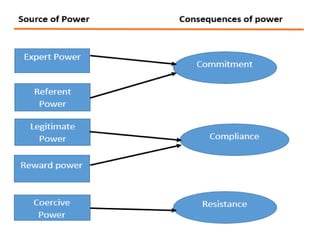
A- Formal: Individuals position in an
organization.
3 types – Coercive power
Reward power
Legitimate power
B- Informal: Personal power comes from
individuals unique characteristics.
2 types – Expert power
Referent power
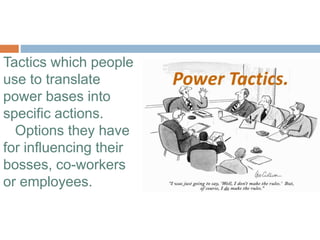
Tactics which people
use to translate
power bases into
specific actions.
Options they have
for influencing their
bosses, co-workers
or employees.
Nine Power Tactics have been
Identified.
ļ‚§ Legitimacy- Relying on your authority
position or saying a request which accords
with organizational policies or rules.
ļ‚§ Rational Persuasion- Presenting logical
arguments and factual evidence to
demonstrate a request is reasonable.
ļ‚§ Inspirational Appeals- Developing
emotional commitment by appealing to
target values, hopes and inspiration or
increasing confidence.
ļ‚§ Consultation- Increasing the targets support
by involving him/her in deciding how will you
accomplish your plan.
ļ‚§ Exchange- Rewarding the target with
benefits or favors in exchange for following a
request.
ļ‚§ Personal Appeals- Asking for compliance
based on friendship and loyalty.
ļ‚§ Pressure- Using warnings, repeated
demands and threats.
ļ‚§ Ingratiation- Using flattery, praise or friendly
behavior prior making a request.
ļ‚§ Coalition – Enlisting aid or support of others to
persuade the target to agree.
Some tactics tend to be more effective than
others.
Rational persuasion, Inspirational appeals and
consultation tend to be most effective when the
audience is highly interested in outcome of
decision process. Pressure tends to backfire and
is least effective.
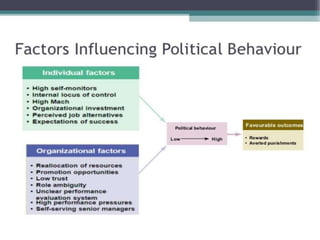
INDIVIDUAL FACTORS
 High Self Monitors- more sensitive to social
cues, exhibit higher level of social conformity
and are skilled in political behavior.
 Internal Locus of Control- attempt to
manipulate situations in their favor, can control
the situations.
 High Machiavelian Personality- will to
manipulate and desire for power.
 Organizational Interest- more the person has
invested in organization and expected
success, more is the influence to pursue
illegitimate means of political behavior.
 Perceived Job Alternatives- more job
alternatives an individual has, or more
influential contacts, the more he/she is to risk
illegitimate political action.
 Expectation of Success- If an individual has
low expectation of success in using illegitimate
means it is unlikely that he/she will attempt to
do so.
ORGANIZATIONAL FACTORS
 Reallocation of Resources- Downsizing leads
to reduction in resources and threatened by this
people engage in political actions.
 Promotion opportunities- Encourages people to
compete for a limited resource and try to positively
influence decision outcomes.
 Low Trust- Less trust within the organization,
higher level of political behavior of illegitimate kind.
 Role Ambiguity- when prescribed behavior is
not clear, and political actions are not part of
formal role, they engage in political activity with
little chance of being visible.
 Unclear performance evaluation system-
when single outcome measure is emphasized
individuals do whatever is necessary to ā€œlook
goodā€ on that measure.
 Zero sum reward practice- treating the
reward pie as fixed, If I Win You Must Lose.
 Democratic Decision making- Sharing
power with others runs directly against some
managers desires.
 High Performance Pressure- more pressure
employees feel, more they engage in politicking.
 Self serving senior managers- when
employees see top management engaging in
politicking a climate is created that supports
politicking.
Acknowlegdement
 I would like to express my special thanks
of gratitude to the University Swayam
cordinator Dr. Ajay Semalty, (H.N.B.
Garhwal University) to give us this
opportunity for doing such a wonderful
course of Academic Writing. It was a very
rich learning experience as PG student.
Thankyou sir.
 I really enjoyed doing this course.
REFERENCES
 https://www.managementstudyguide.com/pow
er-and-politics.htm
 https://hbr.org/1970/05/power-and-politics-in-
organizational-life
 https://www.csus.edu/indiv/s/sablynskic/chapte
r13march2006.htm`

Presentation on

  • 1.
    Name- Shefali Mohaley Applicationnumber- e600802be5a711e9b8775f508 553911c Course Name- Academic Writing Banaras Hindu University, Varanasi
  • 2.
    POWER AND POLITICSIN ORGANIZATIONS: Power Tactics and Factors Contributing to Political Behavior in Organizations
  • 3.
    Power and Politicalbehavior are natural processes in any group or organizations. We need to know how power is acquired and exercised if you are to fully understand organizational behaviour. POWER refers to the capacity that A has to influence the behavior of B so B acts in accordance with As wishes.
  • 4.
    Bases of Power:what power holders control that allow them to manipulate behavior of others. A- Formal: Individuals position in an organization. 3 types – Coercive power Reward power Legitimate power B- Informal: Personal power comes from individuals unique characteristics. 2 types – Expert power Referent power
  • 6.
    Tactics which people useto translate power bases into specific actions. Options they have for influencing their bosses, co-workers or employees.
  • 7.
    Nine Power Tacticshave been Identified. ļ‚§ Legitimacy- Relying on your authority position or saying a request which accords with organizational policies or rules. ļ‚§ Rational Persuasion- Presenting logical arguments and factual evidence to demonstrate a request is reasonable. ļ‚§ Inspirational Appeals- Developing emotional commitment by appealing to target values, hopes and inspiration or increasing confidence.
  • 8.
    ļ‚§ Consultation- Increasingthe targets support by involving him/her in deciding how will you accomplish your plan. ļ‚§ Exchange- Rewarding the target with benefits or favors in exchange for following a request. ļ‚§ Personal Appeals- Asking for compliance based on friendship and loyalty. ļ‚§ Pressure- Using warnings, repeated demands and threats.
  • 9.
    ļ‚§ Ingratiation- Usingflattery, praise or friendly behavior prior making a request. ļ‚§ Coalition – Enlisting aid or support of others to persuade the target to agree. Some tactics tend to be more effective than others. Rational persuasion, Inspirational appeals and consultation tend to be most effective when the audience is highly interested in outcome of decision process. Pressure tends to backfire and is least effective.
  • 11.
    INDIVIDUAL FACTORS  HighSelf Monitors- more sensitive to social cues, exhibit higher level of social conformity and are skilled in political behavior.  Internal Locus of Control- attempt to manipulate situations in their favor, can control the situations.  High Machiavelian Personality- will to manipulate and desire for power.
  • 12.
     Organizational Interest-more the person has invested in organization and expected success, more is the influence to pursue illegitimate means of political behavior.  Perceived Job Alternatives- more job alternatives an individual has, or more influential contacts, the more he/she is to risk illegitimate political action.  Expectation of Success- If an individual has low expectation of success in using illegitimate means it is unlikely that he/she will attempt to do so.
  • 13.
    ORGANIZATIONAL FACTORS  Reallocationof Resources- Downsizing leads to reduction in resources and threatened by this people engage in political actions.  Promotion opportunities- Encourages people to compete for a limited resource and try to positively influence decision outcomes.  Low Trust- Less trust within the organization, higher level of political behavior of illegitimate kind.  Role Ambiguity- when prescribed behavior is not clear, and political actions are not part of formal role, they engage in political activity with little chance of being visible.
  • 14.
     Unclear performanceevaluation system- when single outcome measure is emphasized individuals do whatever is necessary to ā€œlook goodā€ on that measure.  Zero sum reward practice- treating the reward pie as fixed, If I Win You Must Lose.  Democratic Decision making- Sharing power with others runs directly against some managers desires.
  • 15.
     High PerformancePressure- more pressure employees feel, more they engage in politicking.  Self serving senior managers- when employees see top management engaging in politicking a climate is created that supports politicking.
  • 16.
    Acknowlegdement  I wouldlike to express my special thanks of gratitude to the University Swayam cordinator Dr. Ajay Semalty, (H.N.B. Garhwal University) to give us this opportunity for doing such a wonderful course of Academic Writing. It was a very rich learning experience as PG student. Thankyou sir.  I really enjoyed doing this course.
  • 17.