•

the degree to which a leader considers the
needs of team members, their interests, and areas of personal
development when deciding how best to accomplish a task

•

The degree to which a leader
emphasizes organizational efficiency and high productivity when
deciding how best to accomplish a task
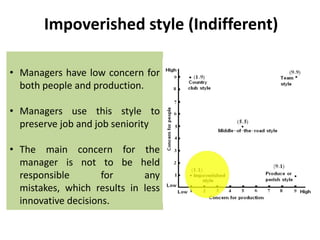
Impoverished style (Indifferent)
• Managers have low concern for
both people and production.
• Managers use this style to
preserve job and job seniority
• The main concern for the
manager is not to be held
responsible
for
any
mistakes, which results in less
innovative decisions.
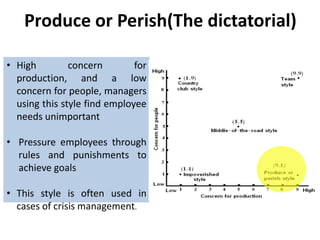
Produce or Perish(The dictatorial)
• High
concern
for
production, and a low
concern for people, managers
using this style find employee
needs unimportant

• Pressure employees through
rules and punishments to
achieve goals
• This style is often used in
cases of crisis management.
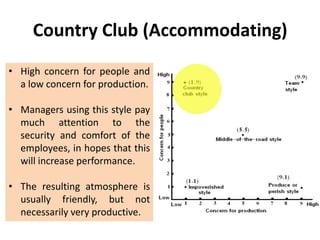
Country Club (Accommodating)
• High concern for people and
a low concern for production.
• Managers using this style pay
much attention to the
security and comfort of the
employees, in hopes that this
will increase performance.
• The resulting atmosphere is
usually friendly, but not
necessarily very productive.
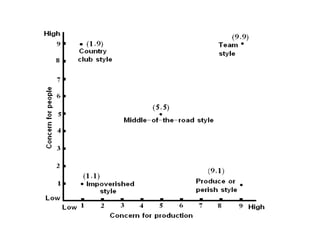
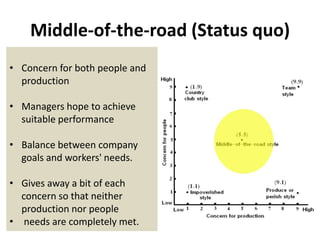
Middle-of-the-road (Status quo)
• Concern for both people and
production
• Managers hope to achieve
suitable performance

• Balance between company
goals and workers' needs.
• Gives away a bit of each
concern so that neither
production nor people
• needs are completely met.
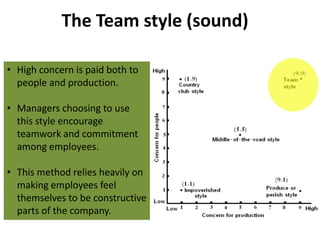
The Team style (sound)
• High concern is paid both to
people and production.
• Managers choosing to use
this style encourage
teamwork and commitment
among employees.
• This method relies heavily on
making employees feel
themselves to be constructive
parts of the company.
• The opportunistic style: Individuals using this style do not have a fixed
location on the grid. They adopt whichever behavior offers the greatest
personal benefit.
• The paternalistic style: Managers using this style praise and support, but
discourage challenges to their thinking.

Merit:
The Managerial or Leadership Grid is used to help managers analyze their
own leadership styles through a technique known as grid training

Demerit:
The model ignores the importance of internal and external limits, matter and
scenario. Also, there are some more aspects of leadership that can be
covered but are not.

Managerial Grid - Blake & Mouton

  • 1.
    • the degree towhich a leader considers the needs of team members, their interests, and areas of personal development when deciding how best to accomplish a task • The degree to which a leader emphasizes organizational efficiency and high productivity when deciding how best to accomplish a task
  • 3.
    Impoverished style (Indifferent) •Managers have low concern for both people and production. • Managers use this style to preserve job and job seniority • The main concern for the manager is not to be held responsible for any mistakes, which results in less innovative decisions.
  • 4.
    Produce or Perish(Thedictatorial) • High concern for production, and a low concern for people, managers using this style find employee needs unimportant • Pressure employees through rules and punishments to achieve goals • This style is often used in cases of crisis management.
  • 5.
    Country Club (Accommodating) •High concern for people and a low concern for production. • Managers using this style pay much attention to the security and comfort of the employees, in hopes that this will increase performance. • The resulting atmosphere is usually friendly, but not necessarily very productive.
  • 6.
    Middle-of-the-road (Status quo) •Concern for both people and production • Managers hope to achieve suitable performance • Balance between company goals and workers' needs. • Gives away a bit of each concern so that neither production nor people • needs are completely met.
  • 7.
    The Team style(sound) • High concern is paid both to people and production. • Managers choosing to use this style encourage teamwork and commitment among employees. • This method relies heavily on making employees feel themselves to be constructive parts of the company.
  • 8.
    • The opportunisticstyle: Individuals using this style do not have a fixed location on the grid. They adopt whichever behavior offers the greatest personal benefit. • The paternalistic style: Managers using this style praise and support, but discourage challenges to their thinking. Merit: The Managerial or Leadership Grid is used to help managers analyze their own leadership styles through a technique known as grid training Demerit: The model ignores the importance of internal and external limits, matter and scenario. Also, there are some more aspects of leadership that can be covered but are not.