Subject- Concrete Technology
By
Mr. Denish Jangid
Assistant Professor
Civil Engineering Department
Topic- M-Sand
Manufactured Sand (M-Sand) for Concrete
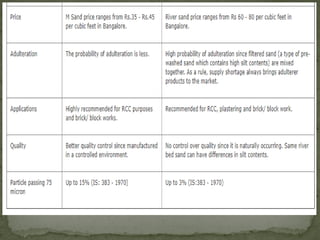
Manufactured sand (M-Sand) is a substitute of
river sand for concrete construction .
Manufactured sand is produced from hard granite
stone by crushing.
The crushed sand is of cubical shape with
grounded edges, washed and graded to as a
construction material. The size of manufactured
sand (M-Sand) is less than 4.75mm.
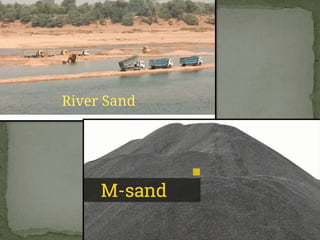
River Sand
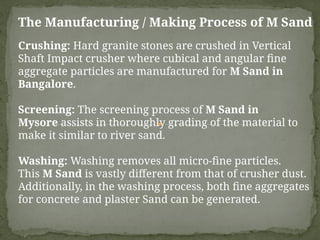
The Manufacturing / Making Process of M Sand
Crushing: Hard granite stones are crushed in Vertical
Shaft Impact crusher where cubical and angular fine
aggregate particles are manufactured for M Sand in
Bangalore.
Screening: The screening process of M Sand in
Mysore assists in thoroughly grading of the material to
make it similar to river sand.
Washing: Washing removes all micro-fine particles.
This M Sand is vastly different from that of crusher dust.
Additionally, in the washing process, both fine aggregates
for concrete and plaster Sand can be generated.
Why Manufactured Sand is Used?
Manufactured sand is an alternative for river sand. Due to
fast growing construction industry, the demand for sand has
increased tremendously, causing deficiency of suitable river
sand in most part of the word.
Due to the depletion of good quality river sand for the use of
construction, the use of manufactured sand has been
increased. Another reason for use of M-Sand is its
availability and transportation cost.
Since manufactured sand can be crushed from hard granite
rocks, it can be readily available at the nearby place,
reducing the cost of transportation from far-off river sand
bed.
Thus, the cost of construction can be
controlled by the use of manufactured sand
as an alternative material for construction.
The other advantage of using M-Sand is, it
can be dust free, the sizes of m-sand can be
controlled easily so that it meets the
required grading for the given construction.
Advantages of Manufactured Sand (M-
Sand)
It is well graded in the required proportion.
It does not contain organic and soluble compound that
affects the setting time and properties of cement, thus the
required strength of concrete can be maintained.
It does not have the presence of impurities such as clay,
dust and silt coatings, increase water requirement as in
the case of river sand which impair bond between cement
paste and aggregate. Thus, increased quality and
durability of concrete.
M-Sand is obtained from specific hard rock (granite) using
the state-of-the-art International technology, thus the
required property of sand is obtained.
M-Sand is cubical in shape and is manufactured
using technology like High Carbon steel hit rock
and then ROCK ON ROCK process which is
synonymous to that of natural process undergoing
in river sand information.
Modern and imported machines are used to
produce M-Sand to ensure required grading zone
for the sand.
Properties of Manufactured Sand for Concrete
Construction
Higher Strength of concrete
The manufactured sand has required gradation
of fines, physical properties such as shape,
smooth surface textures and consistency which
makes it the best sand suitable for construction.
These physical properties of sand provides
greater strength to the concrete by reducing
segregation, bleeding, honeycombing, voids and
capillary.
Thus required grade of sand for the given
purpose helps the concrete fill voids between
coarse aggregates and makes concrete more
compact and dense, thus increasing the strength
Durability of concrete
Since manufactured sand (M-Sand) is processed
from selected quality of granite, it has the
balanced physical and chemical properties for
construction of concrete structures.
This property of M-Sand helps the concrete
structures withstand extreme environmental
conditions and prevents the corrosion of
reinforcement steel by reducing permeability,
moisture ingress, freeze-thaw effect increasing
the durability of concrete structures.
Workability of concrete
Size, shape, texture play an important role in
workability of concrete. With more surface area of
sand, the demand for cement and water increases to
bond the sand with coarse aggregates.
The control over these physical properties of
manufacturing sand make the concrete require less
amount of water and provide higher workable
concrete. The less use of water also helps in
increasing the strength of concrete, less effort for
mixing and placement of concrete, and thus
increases productivity of construction activities at
site.
Less Construction Defects
Construction defects during placement and
post-concreting such as segregation,
bleeding, honeycombing, voids and
capillarity in concrete gets reduced by the
use of M-Sand as it has optimum initial and
final setting time as well as excellent
fineness.
Economy
As discussed above, since usage of M-Sand
has increased durability, higher strength,
reduction in segregation, permeability,
increased workability, decreased post-
concrete defects, it proves to be economical
as a construction material replacing river
sand.
It can also save transportation cost of river
sand in many cases.
Eco-Friendly
Usage of manufactured sand prevents
dredging of river beds to get river sand
which may lead to environmental
disaster like ground water depletion,
water scarcity, threat to the safety of
bridges, dams etc. to make M-Sands more
eco-friendly than river sand.
Quality Tests for M Sand
Adulteration test – Less adulteration.
Workability test – Higher workable concrete
with less water content.
Rebound test –Concrete strength is
excellent.
Slump cone test – Strength of fresh concrete
is higher and the chances of slumping are
lesser.
Different Types Of Manufactured Sand ( M Sand )
Manufactured Sand ( M Sand) for concreting
A) Used as a fine aggregate: This sand is classified as Zone
II, and has granule thickness of 150 microns above 4.75
mm,
This sand is suitable for :
concreting, wall masonry work, block work & much more.
B) Used as an aggregate: Granule thickness of 8 mm –
13 mm, and 13 mm – 21 mm is suitable only for concreting.
Manufactured Sand ( M sand) for plastering
A) Used as a fine aggregate: This Zone III Sand has a
granule thickness of 150 microns above 2.38 mm, and
this sand is suitable for : brickworks, outer & inner
plastering purposes,
ceiling plastering, and much more.
M-Sand final difference between river sand and M sand.pptx

  • 1.
    Subject- Concrete Technology By Mr.Denish Jangid Assistant Professor Civil Engineering Department Topic- M-Sand
  • 2.
    Manufactured Sand (M-Sand)for Concrete Manufactured sand (M-Sand) is a substitute of river sand for concrete construction . Manufactured sand is produced from hard granite stone by crushing. The crushed sand is of cubical shape with grounded edges, washed and graded to as a construction material. The size of manufactured sand (M-Sand) is less than 4.75mm.
  • 4.
  • 7.
    The Manufacturing /Making Process of M Sand Crushing: Hard granite stones are crushed in Vertical Shaft Impact crusher where cubical and angular fine aggregate particles are manufactured for M Sand in Bangalore. Screening: The screening process of M Sand in Mysore assists in thoroughly grading of the material to make it similar to river sand. Washing: Washing removes all micro-fine particles. This M Sand is vastly different from that of crusher dust. Additionally, in the washing process, both fine aggregates for concrete and plaster Sand can be generated.
  • 8.
    Why Manufactured Sandis Used? Manufactured sand is an alternative for river sand. Due to fast growing construction industry, the demand for sand has increased tremendously, causing deficiency of suitable river sand in most part of the word. Due to the depletion of good quality river sand for the use of construction, the use of manufactured sand has been increased. Another reason for use of M-Sand is its availability and transportation cost. Since manufactured sand can be crushed from hard granite rocks, it can be readily available at the nearby place, reducing the cost of transportation from far-off river sand bed.
  • 9.
    Thus, the costof construction can be controlled by the use of manufactured sand as an alternative material for construction. The other advantage of using M-Sand is, it can be dust free, the sizes of m-sand can be controlled easily so that it meets the required grading for the given construction.
  • 10.
    Advantages of ManufacturedSand (M- Sand) It is well graded in the required proportion. It does not contain organic and soluble compound that affects the setting time and properties of cement, thus the required strength of concrete can be maintained. It does not have the presence of impurities such as clay, dust and silt coatings, increase water requirement as in the case of river sand which impair bond between cement paste and aggregate. Thus, increased quality and durability of concrete. M-Sand is obtained from specific hard rock (granite) using the state-of-the-art International technology, thus the required property of sand is obtained.
  • 11.
    M-Sand is cubicalin shape and is manufactured using technology like High Carbon steel hit rock and then ROCK ON ROCK process which is synonymous to that of natural process undergoing in river sand information. Modern and imported machines are used to produce M-Sand to ensure required grading zone for the sand.
  • 12.
    Properties of ManufacturedSand for Concrete Construction Higher Strength of concrete The manufactured sand has required gradation of fines, physical properties such as shape, smooth surface textures and consistency which makes it the best sand suitable for construction. These physical properties of sand provides greater strength to the concrete by reducing segregation, bleeding, honeycombing, voids and capillary. Thus required grade of sand for the given purpose helps the concrete fill voids between coarse aggregates and makes concrete more compact and dense, thus increasing the strength
  • 13.
    Durability of concrete Sincemanufactured sand (M-Sand) is processed from selected quality of granite, it has the balanced physical and chemical properties for construction of concrete structures. This property of M-Sand helps the concrete structures withstand extreme environmental conditions and prevents the corrosion of reinforcement steel by reducing permeability, moisture ingress, freeze-thaw effect increasing the durability of concrete structures.
  • 14.
    Workability of concrete Size,shape, texture play an important role in workability of concrete. With more surface area of sand, the demand for cement and water increases to bond the sand with coarse aggregates. The control over these physical properties of manufacturing sand make the concrete require less amount of water and provide higher workable concrete. The less use of water also helps in increasing the strength of concrete, less effort for mixing and placement of concrete, and thus increases productivity of construction activities at site.
  • 15.
    Less Construction Defects Constructiondefects during placement and post-concreting such as segregation, bleeding, honeycombing, voids and capillarity in concrete gets reduced by the use of M-Sand as it has optimum initial and final setting time as well as excellent fineness.
  • 16.
    Economy As discussed above,since usage of M-Sand has increased durability, higher strength, reduction in segregation, permeability, increased workability, decreased post- concrete defects, it proves to be economical as a construction material replacing river sand. It can also save transportation cost of river sand in many cases.
  • 17.
    Eco-Friendly Usage of manufacturedsand prevents dredging of river beds to get river sand which may lead to environmental disaster like ground water depletion, water scarcity, threat to the safety of bridges, dams etc. to make M-Sands more eco-friendly than river sand.
  • 18.
    Quality Tests forM Sand Adulteration test – Less adulteration. Workability test – Higher workable concrete with less water content. Rebound test –Concrete strength is excellent. Slump cone test – Strength of fresh concrete is higher and the chances of slumping are lesser.
  • 19.
    Different Types OfManufactured Sand ( M Sand ) Manufactured Sand ( M Sand) for concreting A) Used as a fine aggregate: This sand is classified as Zone II, and has granule thickness of 150 microns above 4.75 mm, This sand is suitable for : concreting, wall masonry work, block work & much more. B) Used as an aggregate: Granule thickness of 8 mm – 13 mm, and 13 mm – 21 mm is suitable only for concreting.
  • 20.
    Manufactured Sand (M sand) for plastering A) Used as a fine aggregate: This Zone III Sand has a granule thickness of 150 microns above 2.38 mm, and this sand is suitable for : brickworks, outer & inner plastering purposes, ceiling plastering, and much more.