SUITABILITY OF MANUFACTURED
SAND (M-SAND) AS FINE AGGREGATE
IN CONCRETE
1
PRESENTED BY
RASTHAN SAHAR K.P
S7 C2
ROLL NO: 59
GUIDED BY
Sri. R. SATHEESH CHANDRAN
Professor
Dept. OF CIVIL Engg.
CET
PRESENT RELEVANCE
1. Misconception about M-sand
2. National Green Tribunal has recently banned sand
mining due to Disastrous environmental
consequences
3. Quality of river sand has been reduced due to over
exploitation of the river bed
2
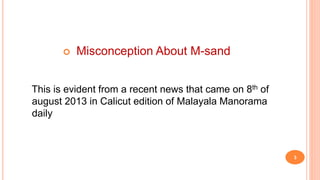
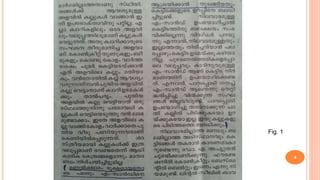
 Misconception About M-sand
This is evident from a recent news that came on 8th of
august 2013 in Calicut edition of Malayala Manorama
daily
3
4
Fig. 1
5
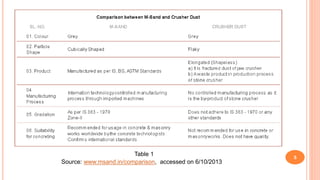
Source: www.msand.in/comparison, accessed on 6/10/2013
Table 1
6
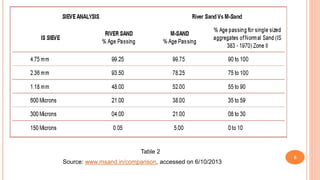
Source: www.msand.in/comparison, accessed on 6/10/2013
Table 2
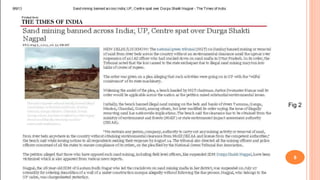
 National Green Tribunal Has Recently Banned Sand
Mining Due To Disastrous Environmental
Consequences
This is evident from a recent news that came on 6th of august
2013 in online edition of TOI
7
8
Fig 2
 Quality Of The River Sand Has Been Reduced Due
To The Over Exploitation Of River Bed
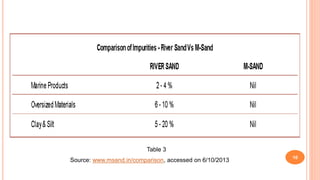
Today the sand available in the river bed is very coarse
and contains a high percentage of silt, clay and other
organic impurities, this will reduce the quality of
concrete.
9
10
Source: www.msand.in/comparison, accessed on 6/10/2013
Table 3
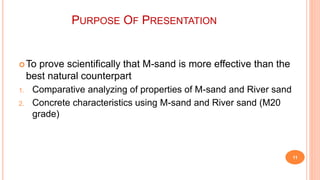
PURPOSE OF PRESENTATION
To prove scientifically that M-sand is more effective than the
best natural counterpart
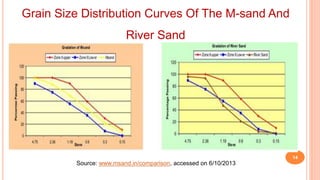
1. Comparative analyzing of properties of M-sand and River sand
2. Concrete characteristics using M-sand and River sand (M20
grade)
11
12
Properties
Type of sand
M-sand River sand
1. Textural composition (% by weight)
Coarse sand (4.75-2.00 mm)
Medium sand (2.00-0.425 mm)
Fine sand (0.425-0.075 mm)
28.1
44.8
27.1
6.6
73.6
19.8
2. Specific gravity 2.63 2.67
3. Bulk density (kN/m3) 15.1 14.5
4. pH 10.11 8.66
5. Chemical composition of M-sand
M-sand contains elements like Si, Al, Ca, Mg, Na, K, Fe, etc.
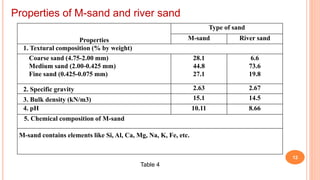
Properties of M-sand and river sand
Table 4
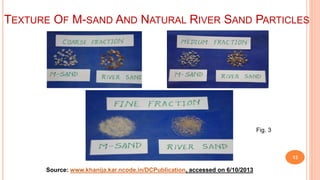
TEXTURE OF M-SAND AND NATURAL RIVER SAND PARTICLES
13
Source: www.khanija.kar.ncode.in/DCPublication, accessed on 6/10/2013
Fig. 3
Grain Size Distribution Curves Of The M-sand And
River Sand
14
Source: www.msand.in/comparison, accessed on 6/10/2013
CONCRETE CHARACTERISTICS USING M-SAND AND
RIVER SAND
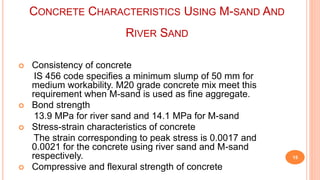
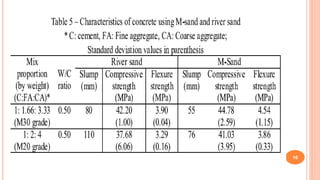
 Consistency of concrete
IS 456 code specifies a minimum slump of 50 mm for
medium workability. M20 grade concrete mix meet this
requirement when M-sand is used as fine aggregate.
 Bond strength
13.9 MPa for river sand and 14.1 MPa for M-sand
 Stress-strain characteristics of concrete
The strain corresponding to peak stress is 0.0017 and
0.0021 for the concrete using river sand and M-sand
respectively.
 Compressive and flexural strength of concrete
15
16
CONCLUSION
17
Manufactured sand is more superior than river sand as
fine aggregate in mortars and concrete
REFERENCES
 ASTM C1072-11 “Standard Test Methods for Measurement of Masonry
Flexural Bond Strength” American Society for Testing Materials.
 BS: 4551 - 1980, "British standard methods of testing mortars, screeds and
plasters", British Standards Institution, U. K.
 IS: 456 – 2000, “Plain and reinforced concrete – code of practice”, Bureau of
Indian Standards, New Delhi, India.
 IS: 383 – 1970 (2002), “ Specification for coarse and fine aggregates from
natural sources for concrete”, Bureau of Indian Standards, New Delhi, India.
 IS: 2116 – 1980 (1998), “Specification for sand for masonry mortars”, Bureau
of Indian Standards, New Delhi, India.
 IS: 2250 – 1981 (2000), "Indian Standard Code of Practice for Preparation
and Use of Masonry Mortars", Bureau of Indian Standards, New Delhi. 18
 IS: 1905 - 1987, "Code of Practice for Structural Use of Un reinforced
Masonry", Bureau of Indian Standards, New Delhi
 IS: 1199 – 1959 (2004), “Methods of sampling and analysis of concrete”
Bureau of Indian Standards, New Delhi, India.
 IS: 516 – 1959 (2004), “Methods of tests for strength of concrete”, Bureau of
Indian Standards, New Delhi, India.
 IS: 2770 (Part I) – 1967 (2002), “Methods of testing bond in reinforced
concrete”, Bureau of Indian Standards, New Delhi, India.
 Venkatarama Reddy, B. V. and Ajay Gupta, Characteristics of cement-soil
mortars, Materials and Structures (RILEM), Vol. 38 (July 2005), No. 280, 639-
650
 www.msand.in
 www.khanija.kar.ncode.in
19
THANK YOU
20

M sand

  • 1.
    SUITABILITY OF MANUFACTURED SAND(M-SAND) AS FINE AGGREGATE IN CONCRETE 1 PRESENTED BY RASTHAN SAHAR K.P S7 C2 ROLL NO: 59 GUIDED BY Sri. R. SATHEESH CHANDRAN Professor Dept. OF CIVIL Engg. CET
  • 2.
    PRESENT RELEVANCE 1. Misconceptionabout M-sand 2. National Green Tribunal has recently banned sand mining due to Disastrous environmental consequences 3. Quality of river sand has been reduced due to over exploitation of the river bed 2
  • 3.
     Misconception AboutM-sand This is evident from a recent news that came on 8th of august 2013 in Calicut edition of Malayala Manorama daily 3
  • 4.
  • 5.
  • 6.
  • 7.
     National GreenTribunal Has Recently Banned Sand Mining Due To Disastrous Environmental Consequences This is evident from a recent news that came on 6th of august 2013 in online edition of TOI 7
  • 8.
  • 9.
     Quality OfThe River Sand Has Been Reduced Due To The Over Exploitation Of River Bed Today the sand available in the river bed is very coarse and contains a high percentage of silt, clay and other organic impurities, this will reduce the quality of concrete. 9
  • 10.
  • 11.
    PURPOSE OF PRESENTATION Toprove scientifically that M-sand is more effective than the best natural counterpart 1. Comparative analyzing of properties of M-sand and River sand 2. Concrete characteristics using M-sand and River sand (M20 grade) 11
  • 12.
    12 Properties Type of sand M-sandRiver sand 1. Textural composition (% by weight) Coarse sand (4.75-2.00 mm) Medium sand (2.00-0.425 mm) Fine sand (0.425-0.075 mm) 28.1 44.8 27.1 6.6 73.6 19.8 2. Specific gravity 2.63 2.67 3. Bulk density (kN/m3) 15.1 14.5 4. pH 10.11 8.66 5. Chemical composition of M-sand M-sand contains elements like Si, Al, Ca, Mg, Na, K, Fe, etc. Properties of M-sand and river sand Table 4
  • 13.
    TEXTURE OF M-SANDAND NATURAL RIVER SAND PARTICLES 13 Source: www.khanija.kar.ncode.in/DCPublication, accessed on 6/10/2013 Fig. 3
  • 14.
    Grain Size DistributionCurves Of The M-sand And River Sand 14 Source: www.msand.in/comparison, accessed on 6/10/2013
  • 15.
    CONCRETE CHARACTERISTICS USINGM-SAND AND RIVER SAND  Consistency of concrete IS 456 code specifies a minimum slump of 50 mm for medium workability. M20 grade concrete mix meet this requirement when M-sand is used as fine aggregate.  Bond strength 13.9 MPa for river sand and 14.1 MPa for M-sand  Stress-strain characteristics of concrete The strain corresponding to peak stress is 0.0017 and 0.0021 for the concrete using river sand and M-sand respectively.  Compressive and flexural strength of concrete 15
  • 16.
  • 17.
    CONCLUSION 17 Manufactured sand ismore superior than river sand as fine aggregate in mortars and concrete
  • 18.
    REFERENCES  ASTM C1072-11“Standard Test Methods for Measurement of Masonry Flexural Bond Strength” American Society for Testing Materials.  BS: 4551 - 1980, "British standard methods of testing mortars, screeds and plasters", British Standards Institution, U. K.  IS: 456 – 2000, “Plain and reinforced concrete – code of practice”, Bureau of Indian Standards, New Delhi, India.  IS: 383 – 1970 (2002), “ Specification for coarse and fine aggregates from natural sources for concrete”, Bureau of Indian Standards, New Delhi, India.  IS: 2116 – 1980 (1998), “Specification for sand for masonry mortars”, Bureau of Indian Standards, New Delhi, India.  IS: 2250 – 1981 (2000), "Indian Standard Code of Practice for Preparation and Use of Masonry Mortars", Bureau of Indian Standards, New Delhi. 18
  • 19.
     IS: 1905- 1987, "Code of Practice for Structural Use of Un reinforced Masonry", Bureau of Indian Standards, New Delhi  IS: 1199 – 1959 (2004), “Methods of sampling and analysis of concrete” Bureau of Indian Standards, New Delhi, India.  IS: 516 – 1959 (2004), “Methods of tests for strength of concrete”, Bureau of Indian Standards, New Delhi, India.  IS: 2770 (Part I) – 1967 (2002), “Methods of testing bond in reinforced concrete”, Bureau of Indian Standards, New Delhi, India.  Venkatarama Reddy, B. V. and Ajay Gupta, Characteristics of cement-soil mortars, Materials and Structures (RILEM), Vol. 38 (July 2005), No. 280, 639- 650  www.msand.in  www.khanija.kar.ncode.in 19
  • 20.