International Research Journal of Engineering and Technology (IRJET) e-ISSN: 2395 -0056
Volume: 04 Issue: 06 | June -2017 www.irjet.net p-ISSN: 2395-0072
© 2017, IRJET | Impact Factor value: 5.181 | ISO 9001:2008 Certified Journal | Page 2272
Study on Concrete by replacing cement by SCBA using 100% M-Sand as
fine aggregate
1Amar R D, 2Shivakumar Gumte, 2Siddarooda, 2Tousif Ladaf, 2Nijroop
1 Assistant Professor, Civil Department, APPA IET, Kalaburagi, Karnataka, India
2 BE Final Year students, Civil Department, APPA IET, Kalaburagi, Karnataka, India
---------------------------------------------------------------------------------***-------------------------------------------------------------------------------
Abstract: A study is conducted to determine the
engineering properties viz. Compressive Strength, split
tensile strength and flexural strength by the replacement
of river sand and partial replacement of ordinary Portland
cement. In recent days the demand for river sand is
increasing due to its lesser availability. Hence the practice
of replacing river sand with M-Sand and partial replacing
of ordinary Portland cement with sugarcane bagasse ash
(SCBA) is taking a tremendous growth. It is also inferred
from the literature that replacement of normal sand with
M-Sand and ordinary Portland cement with SCBA possible
up to some percentage. The concrete are made using
100% replacement of M-Sand and partial replacement
(0%, 5%, 10%, 15%, and 20%) of SCBA, as fine aggregate
and ordinary Portland cement respectively. The standard
specimens of concrete are made for compressive strength,
split tensile strength test, flexural strength test using M30
grade of concrete with 0.45 W/C ratio for 3days, 7days
and, 28days of normal curing. It was found that 0% and
5% gives higher compressive strengths, 15% gives higher
split tensile strength and flexural strength will decrease
due to addition of M sand and SCBA when compared with
conventional concrete. These results compare favorable
with those of conventional concrete. The concrete was
found to be suitable for use as structural members for
buildings and related structures.
Keywords: Natural Sand, M- Sand, Cement, SCBA
1. INTRODUCTION
Concrete is the most widely used construction
material in the world. It is a composite construction
material made primarily with aggregate, cement and
water. The word concrete comes from the Latin word
“concretes” (meaning compact or condensed), the
perfect passive participle of “concrescere”, from “con”-
(together) and “crescere”- (to grow). Concrete solidifies
and hardens after mixing with water and placement due
to a chemical process known as hydration. The water
reacts with the cement, which bonds the other
components together, eventually creating a robust
stone-like material. There are many formulations of
concrete, which provide varied properties and concrete
is the most-used man-made product in the world.
Bagasse is a by-product from sugar industries
which is burnt to generate power required for different
activities in the factory. The burning of bagasse leaves
bagasse ash as a waste, which has a pozzolanic property
that would potentially be used as a cement replacement
material. It has been known that the worldwide total
production of sugarcane is over 1500 million tons.
Sugarcane consists about 30% bagasse whereas the
sugar recovered is about 10%, and the bagasse leaves
about 8% bagasse ash (this figure depend on the quality
and type of the boiler, modern boiler release lower
amount of bagasse ash) as a waste, this disposal of
bagasse ash will be of serious concern. Sugarcane
bagasse ash has recently been tested in some parts of the
world for its use as a cement replacement material. The
bagasse ash was found to improve some properties of
the paste, mortar and concrete including compressive
strength and water tightness in certain replacement
percentages and fineness. The higher silica content in the
bagasse ash was suggested to be the main cause for
these improvements. Although the silicate content may
vary from ash to ash depending on the burning
conditions and other properties of the raw materials
including the soil on which the sugarcane is grown, it has
been reported that the silicate undergoes a pozzolanic
reaction with the hydration products of the cement and
results in a reduction of the free lime in the concrete.
Sand is a vital ingredient in making two most
used construction materials viz. cement concrete and
mortar. Traditionally River sand, which is formed by
natural weathering of rocks over many years, is
preferred as fine aggregate. The economic development
fuelling the growth of infrastructure and housing
generates huge demand for building materials like sand.
The indiscriminate mining of sand from riverbeds is
posing a serious threat to environment such as erosion
of riverbed and banks, triggering landslides, loss of
vegetation on the bank of rivers, lowering the
underground water table etc. Hence, sand mining from
riverbeds is being restricted or banned by the
authorities. Controlling extraction along rivers has
caused the illegal activities to spread into hillside and
farmlands, creating public hazards such as landslide,
deep ponds, and hanging cliffs. This sand extracted from
fields (popularly known as filter sand), in addition to
International Research Journal of Engineering and Technology (IRJET) e-ISSN: 2395 -0056
Volume: 04 Issue: 06 | June -2017 www.irjet.net p-ISSN: 2395-0072
© 2017, IRJET | Impact Factor value: 5.181 | ISO 9001:2008 Certified Journal | Page 2273
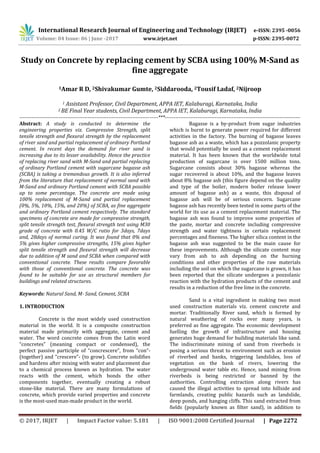
2.4 Sugarcane Bagasse Ash
SCBA was collected from K.P.R Sugar Mills Pvt Ltd, Almel,
TQ Sindagi Dist Vijayapur, Karnataka; The entire
material is made free from impurities & IS sieve of 90
micron.
2.5 Water
Casting and curing of specimens were done with the
potable water that is available in the college premises.
3. PROPERTIES OF MATERIALS
3.1. Cement
Table 3.1.: Physical Properties Of Cement
3.2. SCBA
Table 3.1.1: Physical Properties Of SCBA
S.NO
PROPERTY OF
SCBA
VALUE
1 Fines of SCBA 28%
3 Specific gravity 2.36
3.3. Fine Aggregate
3.3.1 River sand
Table .3.2.1: Properties River sand
S.NO
PROPERTY OF
CEMENT
VALUE
1 Fines of cement 7.16%
2 Grade of cement 43Grade(OPC)
3
Specific gravity of
cement
3.15
4
Initial setting
time
34min
5 Final setting time 550min
6
Normal
consistency
33%
S.NO PROPERTIES VALUE
1 Specific Gravity 2.65
2 Fineness Modulus 2.25
3 Water absorption 1.3%
depleting the fertile top soil, impairs the quality of
concrete / mortar. Manufactured sand, which is obtained
by crushing the rock, is emerging as a viable alternative
to river sand. This material is in use for quite some time
in developed countries. The use of this sand (also called
artificial sand, M-Sand, Robo Sand etc.,) is picking up in
India in major cities. Use of scientifically produced
Manufactured Sand as an alternative to river sand is the
need of the hour and will provide a long term solution to
Indian Construction Industry. Manufactured sand is
crushed fine aggregate produced from a source material
and designed for use in concrete or for other specific
products. Only source materials with suitable strength,
durability and shape characteristics should be used.
Production generally involves crushing, screening and
possibly washing. Separation into discrete fractions,
recombining and blending may be necessary.
2. Materials
2.1 Cement
Ordinary Portland cement, 43Grade conforming to IS:
269 – 1976.Ordinary Portland cement, 43Grade of
Coromandel cement was used for casting all the
Specimens.
2.2 Fine Aggregate
River sand
The river sand is used as a fine aggregate conforming to
the requirements of IS:383. The river sand is washed and
screened, to eliminate deleterious materials and over
size particles.
M sand
Manufactured sand is produced by rock-on-rock or rock-
on metal Vertical Shaft Impactor (VSI) in which the
process that produced alluvial deposits is closely
simulated. manufactured sand shall conform to the
requirements of Zone-II (in most of the cases) as per IS
383-1970 (Reffirmed in 2007) and a particles finer than
75 µm shall not exceed 15 %.we are brought M sand
from M/S ANDRAL INDUSTRIES which is located in
Tavargare near Kalaburgi.
2.3 Coarse Aggregate
Locally available crushed blue granite stones conforming
to graded aggregate of nominal size 12.5 mm as per IS:
383 –
1970.
International Research Journal of Engineering and Technology (IRJET) e-ISSN: 2395 -0056
Volume: 04 Issue: 06 | June -2017 www.irjet.net p-ISSN: 2395-0072
© 2017, IRJET | Impact Factor value: 5.181 | ISO 9001:2008 Certified Journal | Page 2274
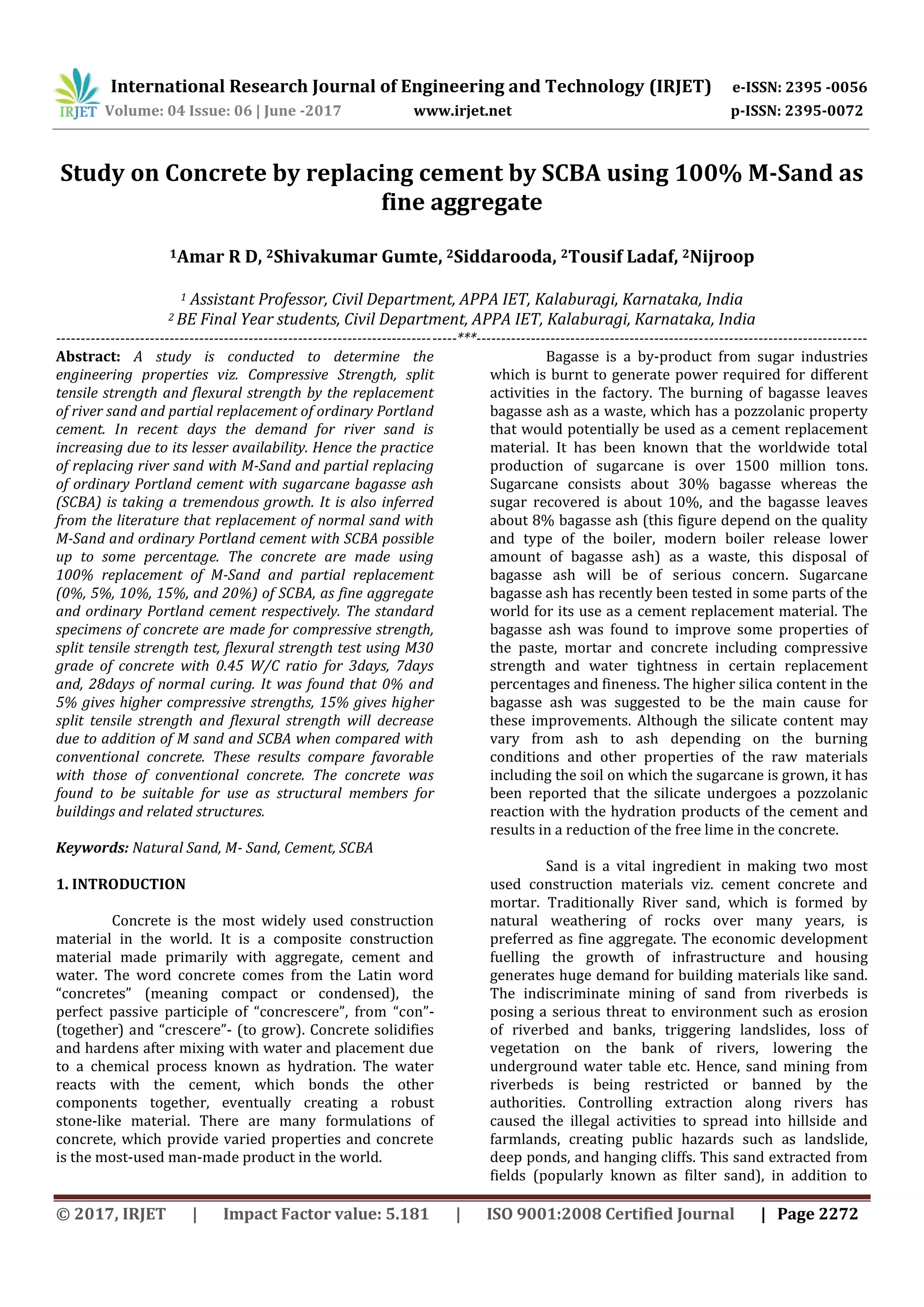
3.3.2 M Sand
Table.3.2.2: Properties Of M Sand
3.4 Coarse Aggregate
Table.3.3: Property of Coarse Aggregate
S.NO PROPERTY VALUES
1 Specific Gravity 2.68
2 Size Of Aggregates 20mm
3 Fineness Modulus 3.1
4 Water absorption 0.8%
5 Impact Test 15.2%
6 Crushing Test 22.5%
4. Results And Discussions
All concrete mixes for M30 grade with M Sand and
different proportion of SCBA were cast and tested under
suitable testing apparatus. The tests like compressive
strength, spite tensile strength and flexural strength
were studied. Their test results and related discussions
are given in tables in detail below
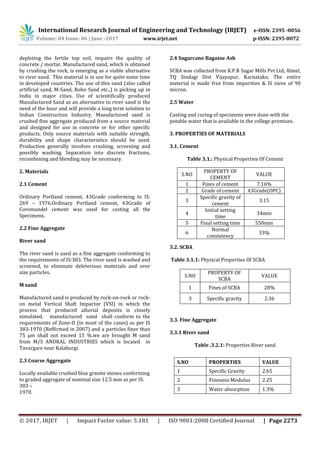
1. Compressive Strength Test:
Tests results and its comparison with controlled mix are
as shown in the below table.
Table-4.1 : Compressive Strength for Cube
Graph 1: Compressive strength of concrete
The compressive strength of cubes with SCBA gives a
higher strength compared to conventional concrete cube.
These strength were increased with increase in SCBA up
to 10 percentage and it will further decreases with
increase in SCBA.
2. Split Tensile Strength Test:
Table-2 Split Tensile Strength for Cylinder
Tests results of tensile strength test and its comparison
with controlled concrete cube are as shown in the below
table.
0
10
20
30
40
50
60
CompressiveStrengthN/mm2
Percentage of SCBA
Compressive Strength of Concrete
3 DAYS
7 DAYS
28 DAYS
S.NO PROPERTIES VALUE
1 Specific Gravity 2.80
2 Fineness Modulus 2.84
3 Water absorption 1.8%
Mix
Percenta
ge of
SCBA
Strength
for
3days
Strengt
h for
7days
Strength
for
28days
1 0% 23.49 32.96 51.78
2 5% 18.84 27.89 43.89
3 10% 19.5 26.67 38.00
4 15% 16.22 26.33 33.58
5 20% 13.89 17.13 27.26
Conventio
nal
- 20.71 26.73 37.47
Mix
Percentage
of SCBA
Strength
for
3days
Strengt
h for
7days
Strength
for
28days
1 0% 1.78 2.29 3.14
2 5% 1.49 2.32 2.48
3 10% 1.57 2.01 2.86
4 15% 1.18 2.32 3.16
5 20% 1.1 1.9 2.178
Conven
tional
- 1.49 1.91 2.35
International Research Journal of Engineering and Technology (IRJET) e-ISSN: 2395 -0056
Volume: 04 Issue: 06 | June -2017 www.irjet.net p-ISSN: 2395-0072
© 2017, IRJET | Impact Factor value: 5.181 | ISO 9001:2008 Certified Journal | Page 2275
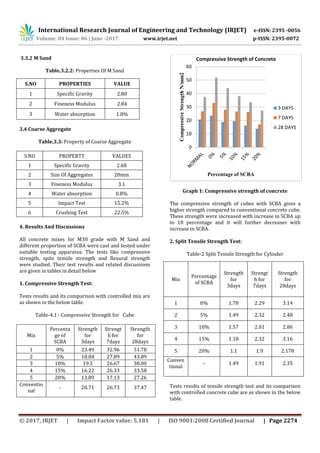
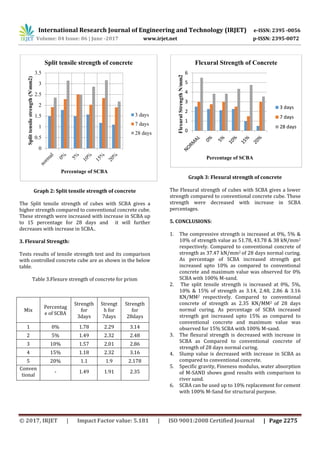
Graph 2: Split tensile strength of concrete
The Split tensile strength of cubes with SCBA gives a
higher strength compared to conventional concrete cube.
These strength were increased with increase in SCBA up
to 15 percentage for 28 days and it will further
decreases with increase in SCBA..
3. Flexural Strength:
Tests results of tensile strength test and its comparison
with controlled concrete cube are as shown in the below
table.
Table 3.Flexure strength of concrete for prism
Graph 3: Flexural strength of concrete
The Flexural strength of cubes with SCBA gives a lower
strength compared to conventional concrete cube. These
strength were decreased with increase in SCBA
percentages.
5. CONCLUSIONS:
1. The compressive strength is increased at 0%, 5% &
10% of strength value as 51.78, 43.78 & 38 kN/mm2
respectively. Compared to conventional concrete of
strength as 37.47 kN/mm2 of 28 days normal curing.
As percentage of SCBA increased strength got
increased upto 10% as compared to conventional
concrete and maximum value was observed for 0%
SCBA with 100% M-sand.
2. The split tensile strength is increased at 0%, 5%,
10% & 15% of strength as 3.14, 2.48, 2.86 & 3.16
KN/MM2 respectively. Compared to conventional
concrete of strength as 2.35 KN/MM2 of 28 days
normal curing. As percentage of SCBA increased
strength got increased upto 15% as compared to
conventional concrete and maximum value was
observed for 15% SCBA with 100% M-sand.
3. The flexural strength is decreased with increase in
SCBA as Compared to conventional concrete of
strength of 28 days normal curing.
4. Slump value is decreased with increase in SCBA as
compared to conventional concrete.
5. Specific gravity, Fineness modulus, water absorption
of M-SAND shows good results with comparison to
river sand.
6. SCBA can be used up to 10% replacement for cement
with 100% M-Sand for structural purpose.
0
0.5
1
1.5
2
2.5
3
3.5
Splittensilestrength(Nmm2)
Percentage of SCBA
Split tensile strength of concrete
3 days
7 days
28 days 0
1
2
3
4
5
6
FlexuralStrengthN/mm2
Percentage of SCBA
Flexural Strength of Concrete
3 days
7 days
28 days
Mix
Percentag
e of SCBA
Strength
for
3days
Strengt
h for
7days
Strength
for
28days
1 0% 1.78 2.29 3.14
2 5% 1.49 2.32 2.48
3 10% 1.57 2.01 2.86
4 15% 1.18 2.32 3.16
5 20% 1.1 1.9 2.178
Conven
tional
- 1.49 1.91 2.35
International Research Journal of Engineering and Technology (IRJET) e-ISSN: 2395 -0056
Volume: 04 Issue: 06 | June -2017 www.irjet.net p-ISSN: 2395-0072
© 2017, IRJET | Impact Factor value: 5.181 | ISO 9001:2008 Certified Journal | Page 2276
REFERENCES
[1] S.Sanjiv Kumar , S.Bharath Kumar , N.Abarak Ali
S.Vijay, S.Prakash Raj ,” EXPERIMENTAL TESTING ON
CONCRETE BY PARTIAL REPLACEMENT OF CEMENT
USING BAGASSE ASH”, International Conference on
Emerging trends in Engineering, Science and Sustainable
Technology (ICETSST-2017)
[2] M. Sachin Raj, D.Subbavarshni, R. Nabendu & D.
Ramesh,” Study on Partial Replacement of Cement in
Concrete with Bagasse Ash and Coir Fibre Journal of
Interdisciplinary Research (IJIR) 2017 Imperial Vol-3,
Issue-3.
[3] Y. Boopathi and J.Doraikkannan,” STUDY On M-SAND
AS A PARTIAL REPLACEMENT OF FINE AGGREGATE IN
CONCRETE” International Journal of Advanced Research
Trends in Engineering and Technology (IJARTET) March
2016 SSN 2394-3777 (Print) 1 ISSN 2394-3785 (Online)
Available online at www.ijartet.com Vol. 3, Special Issue
2.
[4] Bhuvaneshwari M And Tamilarasan S,” Experimental
Studies on the Effect of Bagasse Ash and M-Sand on
Mechanical Behaviour of Concrete” International Journal
of Earth Sciences and Engineering, June 2016, ISSN
0974-5904, Volume 09, No. 03.
[5] Sreelakshmi S, Sruthi KP, Mohammed Munavvir P,
Mashad V,” COPPER SLAG PARTIALLY REPLACES FINE
AGGREGATE IN M 25 CONCRETE: A COMPARATIVE
STUDY OF COMPRESSIVE STRENGTH RESPONSES”
International Journal of Science and Research (IJSR)
November 2016 ISSN (Online): 2319-7064 Index
Copernicus Value (2013): 6.14 | Impact Factor (2015):
6.391 Volume 5 Issue 11.
[6] U.Sridhar, B.Karthick,” INVESTIGATIONS ON
RECYCLED CONCRETE AGGREGATE AND MSAND AS
AGGREGATE REPLACEMENT IN CONCRETE”
International Journal of Engineering Sciences & Research
Technology,March 2015. ISSN: 2277-9655 , Scientific
Journal Impact Factor: 3.449 ,(ISRA), Impact Factor:
2.114.
[7] Shruthi.S, Chandrakala S, G Narayana,”PARTIAL
REPLACEMENT OF CEMENT IN CONCRETE USING
WASTE GLASS POWDER AND M-SAND AS FINE
AGGREGATE” IJRET: International Journal of Research in
Engineering and Technology August-2015, eISSN: 2319-
1163 | pISSN: 2321-7308 Volume: 04 Issue: 08
[8] Dr.M.Vijaya Sekhar Reddy, K.Ashalatha, M.Madhuri,
P.Sumalath,” UTILIZATION OF SUGARCANE BAGASSE
ASH (SCBA) IN CONCRETE BY PARTIAL REPLACEMENT
OF CEMENT” IOSR Journal of Mechanical and Civil
Engineering (IOSR-JMCE) Nov. - Dec. 2015 e-ISSN: 2278-
1684,p-ISSN: 2320-334X, Volume 12, Issue 6 Ver. VI.
BIOGRAPHIES
Siddarooda Donnur,,
BE Final year
student of APPA IET
College Kalaburagi.
Nijroop, BE Final
year student of
APPA IET College
Kalaburagi.
Toushif Ladaf, BE
Final year student of
APPA IET College
Kalaburagi.
Shivakumar Gumte,
BE Final year
student of APPA IET
College Kalaburagi.
Amar R D, Asst Prof
APPA IET College
Kalaburagi.

Study on Concrete by Replacing Cement by SCBA using 100% M-Sand as Fine Aggregate

  • 1.
    International Research Journalof Engineering and Technology (IRJET) e-ISSN: 2395 -0056 Volume: 04 Issue: 06 | June -2017 www.irjet.net p-ISSN: 2395-0072 © 2017, IRJET | Impact Factor value: 5.181 | ISO 9001:2008 Certified Journal | Page 2272 Study on Concrete by replacing cement by SCBA using 100% M-Sand as fine aggregate 1Amar R D, 2Shivakumar Gumte, 2Siddarooda, 2Tousif Ladaf, 2Nijroop 1 Assistant Professor, Civil Department, APPA IET, Kalaburagi, Karnataka, India 2 BE Final Year students, Civil Department, APPA IET, Kalaburagi, Karnataka, India ---------------------------------------------------------------------------------***------------------------------------------------------------------------------- Abstract: A study is conducted to determine the engineering properties viz. Compressive Strength, split tensile strength and flexural strength by the replacement of river sand and partial replacement of ordinary Portland cement. In recent days the demand for river sand is increasing due to its lesser availability. Hence the practice of replacing river sand with M-Sand and partial replacing of ordinary Portland cement with sugarcane bagasse ash (SCBA) is taking a tremendous growth. It is also inferred from the literature that replacement of normal sand with M-Sand and ordinary Portland cement with SCBA possible up to some percentage. The concrete are made using 100% replacement of M-Sand and partial replacement (0%, 5%, 10%, 15%, and 20%) of SCBA, as fine aggregate and ordinary Portland cement respectively. The standard specimens of concrete are made for compressive strength, split tensile strength test, flexural strength test using M30 grade of concrete with 0.45 W/C ratio for 3days, 7days and, 28days of normal curing. It was found that 0% and 5% gives higher compressive strengths, 15% gives higher split tensile strength and flexural strength will decrease due to addition of M sand and SCBA when compared with conventional concrete. These results compare favorable with those of conventional concrete. The concrete was found to be suitable for use as structural members for buildings and related structures. Keywords: Natural Sand, M- Sand, Cement, SCBA 1. INTRODUCTION Concrete is the most widely used construction material in the world. It is a composite construction material made primarily with aggregate, cement and water. The word concrete comes from the Latin word “concretes” (meaning compact or condensed), the perfect passive participle of “concrescere”, from “con”- (together) and “crescere”- (to grow). Concrete solidifies and hardens after mixing with water and placement due to a chemical process known as hydration. The water reacts with the cement, which bonds the other components together, eventually creating a robust stone-like material. There are many formulations of concrete, which provide varied properties and concrete is the most-used man-made product in the world. Bagasse is a by-product from sugar industries which is burnt to generate power required for different activities in the factory. The burning of bagasse leaves bagasse ash as a waste, which has a pozzolanic property that would potentially be used as a cement replacement material. It has been known that the worldwide total production of sugarcane is over 1500 million tons. Sugarcane consists about 30% bagasse whereas the sugar recovered is about 10%, and the bagasse leaves about 8% bagasse ash (this figure depend on the quality and type of the boiler, modern boiler release lower amount of bagasse ash) as a waste, this disposal of bagasse ash will be of serious concern. Sugarcane bagasse ash has recently been tested in some parts of the world for its use as a cement replacement material. The bagasse ash was found to improve some properties of the paste, mortar and concrete including compressive strength and water tightness in certain replacement percentages and fineness. The higher silica content in the bagasse ash was suggested to be the main cause for these improvements. Although the silicate content may vary from ash to ash depending on the burning conditions and other properties of the raw materials including the soil on which the sugarcane is grown, it has been reported that the silicate undergoes a pozzolanic reaction with the hydration products of the cement and results in a reduction of the free lime in the concrete. Sand is a vital ingredient in making two most used construction materials viz. cement concrete and mortar. Traditionally River sand, which is formed by natural weathering of rocks over many years, is preferred as fine aggregate. The economic development fuelling the growth of infrastructure and housing generates huge demand for building materials like sand. The indiscriminate mining of sand from riverbeds is posing a serious threat to environment such as erosion of riverbed and banks, triggering landslides, loss of vegetation on the bank of rivers, lowering the underground water table etc. Hence, sand mining from riverbeds is being restricted or banned by the authorities. Controlling extraction along rivers has caused the illegal activities to spread into hillside and farmlands, creating public hazards such as landslide, deep ponds, and hanging cliffs. This sand extracted from fields (popularly known as filter sand), in addition to
  • 2.
    International Research Journalof Engineering and Technology (IRJET) e-ISSN: 2395 -0056 Volume: 04 Issue: 06 | June -2017 www.irjet.net p-ISSN: 2395-0072 © 2017, IRJET | Impact Factor value: 5.181 | ISO 9001:2008 Certified Journal | Page 2273 2.4 Sugarcane Bagasse Ash SCBA was collected from K.P.R Sugar Mills Pvt Ltd, Almel, TQ Sindagi Dist Vijayapur, Karnataka; The entire material is made free from impurities & IS sieve of 90 micron. 2.5 Water Casting and curing of specimens were done with the potable water that is available in the college premises. 3. PROPERTIES OF MATERIALS 3.1. Cement Table 3.1.: Physical Properties Of Cement 3.2. SCBA Table 3.1.1: Physical Properties Of SCBA S.NO PROPERTY OF SCBA VALUE 1 Fines of SCBA 28% 3 Specific gravity 2.36 3.3. Fine Aggregate 3.3.1 River sand Table .3.2.1: Properties River sand S.NO PROPERTY OF CEMENT VALUE 1 Fines of cement 7.16% 2 Grade of cement 43Grade(OPC) 3 Specific gravity of cement 3.15 4 Initial setting time 34min 5 Final setting time 550min 6 Normal consistency 33% S.NO PROPERTIES VALUE 1 Specific Gravity 2.65 2 Fineness Modulus 2.25 3 Water absorption 1.3% depleting the fertile top soil, impairs the quality of concrete / mortar. Manufactured sand, which is obtained by crushing the rock, is emerging as a viable alternative to river sand. This material is in use for quite some time in developed countries. The use of this sand (also called artificial sand, M-Sand, Robo Sand etc.,) is picking up in India in major cities. Use of scientifically produced Manufactured Sand as an alternative to river sand is the need of the hour and will provide a long term solution to Indian Construction Industry. Manufactured sand is crushed fine aggregate produced from a source material and designed for use in concrete or for other specific products. Only source materials with suitable strength, durability and shape characteristics should be used. Production generally involves crushing, screening and possibly washing. Separation into discrete fractions, recombining and blending may be necessary. 2. Materials 2.1 Cement Ordinary Portland cement, 43Grade conforming to IS: 269 – 1976.Ordinary Portland cement, 43Grade of Coromandel cement was used for casting all the Specimens. 2.2 Fine Aggregate River sand The river sand is used as a fine aggregate conforming to the requirements of IS:383. The river sand is washed and screened, to eliminate deleterious materials and over size particles. M sand Manufactured sand is produced by rock-on-rock or rock- on metal Vertical Shaft Impactor (VSI) in which the process that produced alluvial deposits is closely simulated. manufactured sand shall conform to the requirements of Zone-II (in most of the cases) as per IS 383-1970 (Reffirmed in 2007) and a particles finer than 75 µm shall not exceed 15 %.we are brought M sand from M/S ANDRAL INDUSTRIES which is located in Tavargare near Kalaburgi. 2.3 Coarse Aggregate Locally available crushed blue granite stones conforming to graded aggregate of nominal size 12.5 mm as per IS: 383 – 1970.
  • 3.
    International Research Journalof Engineering and Technology (IRJET) e-ISSN: 2395 -0056 Volume: 04 Issue: 06 | June -2017 www.irjet.net p-ISSN: 2395-0072 © 2017, IRJET | Impact Factor value: 5.181 | ISO 9001:2008 Certified Journal | Page 2274 3.3.2 M Sand Table.3.2.2: Properties Of M Sand 3.4 Coarse Aggregate Table.3.3: Property of Coarse Aggregate S.NO PROPERTY VALUES 1 Specific Gravity 2.68 2 Size Of Aggregates 20mm 3 Fineness Modulus 3.1 4 Water absorption 0.8% 5 Impact Test 15.2% 6 Crushing Test 22.5% 4. Results And Discussions All concrete mixes for M30 grade with M Sand and different proportion of SCBA were cast and tested under suitable testing apparatus. The tests like compressive strength, spite tensile strength and flexural strength were studied. Their test results and related discussions are given in tables in detail below 1. Compressive Strength Test: Tests results and its comparison with controlled mix are as shown in the below table. Table-4.1 : Compressive Strength for Cube Graph 1: Compressive strength of concrete The compressive strength of cubes with SCBA gives a higher strength compared to conventional concrete cube. These strength were increased with increase in SCBA up to 10 percentage and it will further decreases with increase in SCBA. 2. Split Tensile Strength Test: Table-2 Split Tensile Strength for Cylinder Tests results of tensile strength test and its comparison with controlled concrete cube are as shown in the below table. 0 10 20 30 40 50 60 CompressiveStrengthN/mm2 Percentage of SCBA Compressive Strength of Concrete 3 DAYS 7 DAYS 28 DAYS S.NO PROPERTIES VALUE 1 Specific Gravity 2.80 2 Fineness Modulus 2.84 3 Water absorption 1.8% Mix Percenta ge of SCBA Strength for 3days Strengt h for 7days Strength for 28days 1 0% 23.49 32.96 51.78 2 5% 18.84 27.89 43.89 3 10% 19.5 26.67 38.00 4 15% 16.22 26.33 33.58 5 20% 13.89 17.13 27.26 Conventio nal - 20.71 26.73 37.47 Mix Percentage of SCBA Strength for 3days Strengt h for 7days Strength for 28days 1 0% 1.78 2.29 3.14 2 5% 1.49 2.32 2.48 3 10% 1.57 2.01 2.86 4 15% 1.18 2.32 3.16 5 20% 1.1 1.9 2.178 Conven tional - 1.49 1.91 2.35
  • 4.
    International Research Journalof Engineering and Technology (IRJET) e-ISSN: 2395 -0056 Volume: 04 Issue: 06 | June -2017 www.irjet.net p-ISSN: 2395-0072 © 2017, IRJET | Impact Factor value: 5.181 | ISO 9001:2008 Certified Journal | Page 2275 Graph 2: Split tensile strength of concrete The Split tensile strength of cubes with SCBA gives a higher strength compared to conventional concrete cube. These strength were increased with increase in SCBA up to 15 percentage for 28 days and it will further decreases with increase in SCBA.. 3. Flexural Strength: Tests results of tensile strength test and its comparison with controlled concrete cube are as shown in the below table. Table 3.Flexure strength of concrete for prism Graph 3: Flexural strength of concrete The Flexural strength of cubes with SCBA gives a lower strength compared to conventional concrete cube. These strength were decreased with increase in SCBA percentages. 5. CONCLUSIONS: 1. The compressive strength is increased at 0%, 5% & 10% of strength value as 51.78, 43.78 & 38 kN/mm2 respectively. Compared to conventional concrete of strength as 37.47 kN/mm2 of 28 days normal curing. As percentage of SCBA increased strength got increased upto 10% as compared to conventional concrete and maximum value was observed for 0% SCBA with 100% M-sand. 2. The split tensile strength is increased at 0%, 5%, 10% & 15% of strength as 3.14, 2.48, 2.86 & 3.16 KN/MM2 respectively. Compared to conventional concrete of strength as 2.35 KN/MM2 of 28 days normal curing. As percentage of SCBA increased strength got increased upto 15% as compared to conventional concrete and maximum value was observed for 15% SCBA with 100% M-sand. 3. The flexural strength is decreased with increase in SCBA as Compared to conventional concrete of strength of 28 days normal curing. 4. Slump value is decreased with increase in SCBA as compared to conventional concrete. 5. Specific gravity, Fineness modulus, water absorption of M-SAND shows good results with comparison to river sand. 6. SCBA can be used up to 10% replacement for cement with 100% M-Sand for structural purpose. 0 0.5 1 1.5 2 2.5 3 3.5 Splittensilestrength(Nmm2) Percentage of SCBA Split tensile strength of concrete 3 days 7 days 28 days 0 1 2 3 4 5 6 FlexuralStrengthN/mm2 Percentage of SCBA Flexural Strength of Concrete 3 days 7 days 28 days Mix Percentag e of SCBA Strength for 3days Strengt h for 7days Strength for 28days 1 0% 1.78 2.29 3.14 2 5% 1.49 2.32 2.48 3 10% 1.57 2.01 2.86 4 15% 1.18 2.32 3.16 5 20% 1.1 1.9 2.178 Conven tional - 1.49 1.91 2.35
  • 5.
    International Research Journalof Engineering and Technology (IRJET) e-ISSN: 2395 -0056 Volume: 04 Issue: 06 | June -2017 www.irjet.net p-ISSN: 2395-0072 © 2017, IRJET | Impact Factor value: 5.181 | ISO 9001:2008 Certified Journal | Page 2276 REFERENCES [1] S.Sanjiv Kumar , S.Bharath Kumar , N.Abarak Ali S.Vijay, S.Prakash Raj ,” EXPERIMENTAL TESTING ON CONCRETE BY PARTIAL REPLACEMENT OF CEMENT USING BAGASSE ASH”, International Conference on Emerging trends in Engineering, Science and Sustainable Technology (ICETSST-2017) [2] M. Sachin Raj, D.Subbavarshni, R. Nabendu & D. Ramesh,” Study on Partial Replacement of Cement in Concrete with Bagasse Ash and Coir Fibre Journal of Interdisciplinary Research (IJIR) 2017 Imperial Vol-3, Issue-3. [3] Y. Boopathi and J.Doraikkannan,” STUDY On M-SAND AS A PARTIAL REPLACEMENT OF FINE AGGREGATE IN CONCRETE” International Journal of Advanced Research Trends in Engineering and Technology (IJARTET) March 2016 SSN 2394-3777 (Print) 1 ISSN 2394-3785 (Online) Available online at www.ijartet.com Vol. 3, Special Issue 2. [4] Bhuvaneshwari M And Tamilarasan S,” Experimental Studies on the Effect of Bagasse Ash and M-Sand on Mechanical Behaviour of Concrete” International Journal of Earth Sciences and Engineering, June 2016, ISSN 0974-5904, Volume 09, No. 03. [5] Sreelakshmi S, Sruthi KP, Mohammed Munavvir P, Mashad V,” COPPER SLAG PARTIALLY REPLACES FINE AGGREGATE IN M 25 CONCRETE: A COMPARATIVE STUDY OF COMPRESSIVE STRENGTH RESPONSES” International Journal of Science and Research (IJSR) November 2016 ISSN (Online): 2319-7064 Index Copernicus Value (2013): 6.14 | Impact Factor (2015): 6.391 Volume 5 Issue 11. [6] U.Sridhar, B.Karthick,” INVESTIGATIONS ON RECYCLED CONCRETE AGGREGATE AND MSAND AS AGGREGATE REPLACEMENT IN CONCRETE” International Journal of Engineering Sciences & Research Technology,March 2015. ISSN: 2277-9655 , Scientific Journal Impact Factor: 3.449 ,(ISRA), Impact Factor: 2.114. [7] Shruthi.S, Chandrakala S, G Narayana,”PARTIAL REPLACEMENT OF CEMENT IN CONCRETE USING WASTE GLASS POWDER AND M-SAND AS FINE AGGREGATE” IJRET: International Journal of Research in Engineering and Technology August-2015, eISSN: 2319- 1163 | pISSN: 2321-7308 Volume: 04 Issue: 08 [8] Dr.M.Vijaya Sekhar Reddy, K.Ashalatha, M.Madhuri, P.Sumalath,” UTILIZATION OF SUGARCANE BAGASSE ASH (SCBA) IN CONCRETE BY PARTIAL REPLACEMENT OF CEMENT” IOSR Journal of Mechanical and Civil Engineering (IOSR-JMCE) Nov. - Dec. 2015 e-ISSN: 2278- 1684,p-ISSN: 2320-334X, Volume 12, Issue 6 Ver. VI. BIOGRAPHIES Siddarooda Donnur,, BE Final year student of APPA IET College Kalaburagi. Nijroop, BE Final year student of APPA IET College Kalaburagi. Toushif Ladaf, BE Final year student of APPA IET College Kalaburagi. Shivakumar Gumte, BE Final year student of APPA IET College Kalaburagi. Amar R D, Asst Prof APPA IET College Kalaburagi.