TOPIC NAME:
LYOCELL FIBRE
WE ARE TEAM INSPIRATION
Submitted by:
Md. Hasibul Islam Akash (201903017)
Joy Pal (201903018)
Shimul Chandra Sutradhor (201903026)
Shuvo Banik (201903005)
Istiak Ahmed Hasib (201903013)
Submitted to:
Name: Md. Mahbubur Rahman
Designation: Assistant Professor
Department of Textile Engineering
Green University of Bangladesh
Email: mahbub@tex.green.edu.bd
MD. HASIBUL ISLAM AKASH
ID : 201903017
INTRODUCTION
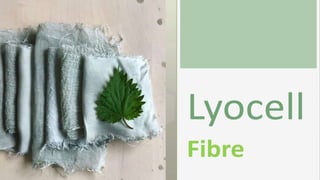
Lyocell (lyo from Greek: lyein = dissolve, cell from cellulose)
It is a man made cellulosic fibres.
Lyocell is a regenerated cellulose fiber made from dissolving pulp
(bleached wood pulp)
First developed at the American Enka Fibers facility in 1972.
Lenzing AG. is the only major producer of lyocell fibres.
Tencel is the brand name of Lyocell.
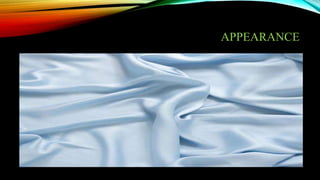
APPEARANCE
PHYSICAL STRUCTURE
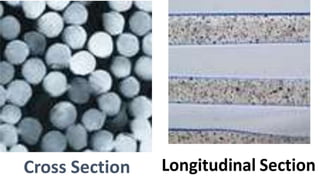
# The physical structure is a more rounded cross section & smoother
longitudinal appearance than rayon.
# Lyocell fiber has a different molecular structure than other regenerated
cellulosic fibres.
# The structure of this fiber is Homogeneous and Dense.
PROPERTIES
# Low elongation at the break due to high crystallinity.
# The tensile strength of lyocell is high in wet and dry conditions.
# The fibers are resistant to wrinkling and bending.
# It also exhibit good drape, thermal resistance and antibacterial.
# Lyoell can take high ironing temps. It will scorch and not melt
JOY PAL
ID: 201903018
RAW MATERIALS (CELLULOSE)
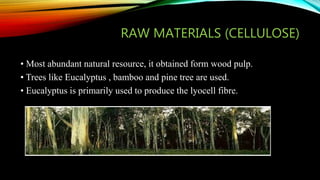
• Most abundant natural resource, it obtained form wood pulp.
• Trees like Eucalyptus , bamboo and pine tree are used.
• Eucalyptus is primarily used to produce the lyocell fibre.
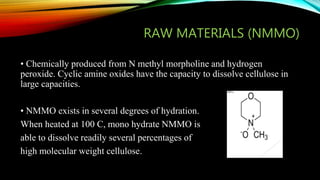
RAW MATERIALS (NMMO)
• Chemically produced from N methyl morpholine and hydrogen
peroxide. Cyclic amine oxides have the capacity to dissolve cellulose in
large capacities.
• NMMO exists in several degrees of hydration.
When heated at 100 C, mono hydrate NMMO is
able to dissolve readily several percentages of
high molecular weight cellulose.
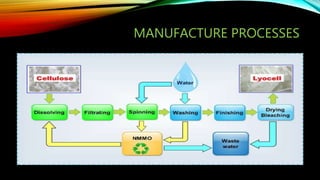
MANUFACTURE PROCESSES
SHUVO BANIK
ID: 201903005
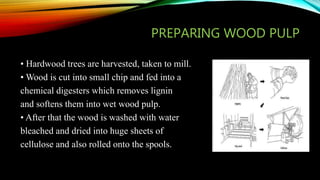
PREPARING WOOD PULP
• Hardwood trees are harvested, taken to mill.
• Wood is cut into small chip and fed into a
chemical digesters which removes lignin
and softens them into wet wood pulp.
• After that the wood is washed with water
bleached and dried into huge sheets of
cellulose and also rolled onto the spools.
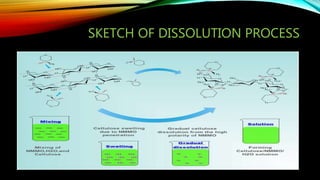
DISSOLUTION
• This step includes the disintegration of the pulp fibers and mixing with
the solvent.
• Cellulose is dissolved in an aqueous system containing NMMO to form
a dope of high viscosity.
• The pulp dissolution for the lyocell process is much simpler than that of
the viscose process.
SKETCH OF DISSOLUTION PROCESS
FILTERING & SPINNING
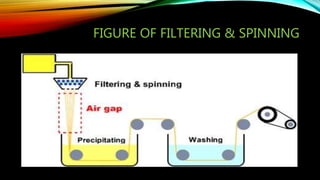
Filtering The formed dope is filtered to remove coarse components. In
comparison, the purification of the viscose process includes ripening,
filtering and degassing.
Spinning: The lyocell process uses the dry jet-wet spinning process. The
dopes in the NMMO/ water system are extruded out from the spinning
nozzle, then into an air gap. The formed filament then immediately enters
a coagulation bath to continue its formation.
FIGURE OF FILTERING & SPINNING
ISTIAK AHMED HASIB
ID: 201903013
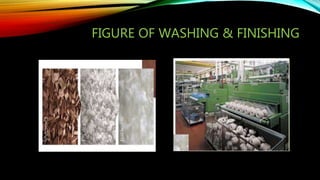
WASHING & FINISHING
Washing: The resulting lyocell fibers are washed and the residual NMMO
is recovered and recycled; while the viscose fibers are also washed for
removal of the residual carbon disulfide.
Finishing: This step involves post-treatment of the fibers, including
bleaching, finishing, and drying. It is the last and also very important steps
in the manufacturer process of lyocell fiber.
FIGURE OF WASHING & FINISHING
BENEFITS
1. High wet and dry strength, it is stronger than Cotton and Wool.
2. Soft, strong, absorbent.
3. Very versatile fabric, dyeable to vibrant colours.
4. Simulates silk, suede, or leather touch.
5. Good drapability and Biodegradable.
6. Fine yarn counts can be spun.
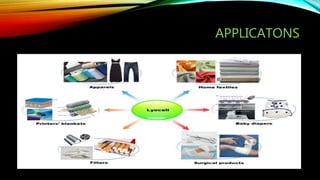
APPLICATONS
SHIMUL CHANDRA SUTRADHOR
ID: 201903026
CHALLENGES
High cost of production and the lack of availability of advanced
technology for manufacturing lyocell fibers.
Additionally, lack of awareness about lyocell fiber is projected to
adversely affect the market in the near future.
The fairly low surface energy of Lyocell fiber makes it difficult for dyes
to bind to it during production.
FUTURE
★ Lyocell Fabric Market" is valued at 513.8 million USD in 2020 is
expected to reach 750.6 million USD by the end of 2026.
★ By any measure, lyocell is a part of the solution for a greener and more
sustainable fashion sector which is needed immediately.
★ With global share holding of only 6.4% and 68.3% by synthetic fibers,
a lot of push is required to its demand so as to replace the synthetic fibres
for a better future.
CONCLUSION
Lyocell fibres are a recent discovery that can be fruitful to the
environment. Comparing its properties with cotton and other fibres,
Lyocell is a great solution to bring a sustainable change in the textile and
fashion industry.
Thanks Everyone

Lyocell fiber presentation slide.pptx

  • 1.
    TOPIC NAME: LYOCELL FIBRE WEARE TEAM INSPIRATION Submitted by: Md. Hasibul Islam Akash (201903017) Joy Pal (201903018) Shimul Chandra Sutradhor (201903026) Shuvo Banik (201903005) Istiak Ahmed Hasib (201903013) Submitted to: Name: Md. Mahbubur Rahman Designation: Assistant Professor Department of Textile Engineering Green University of Bangladesh Email: mahbub@tex.green.edu.bd
  • 2.
    MD. HASIBUL ISLAMAKASH ID : 201903017
  • 4.
    INTRODUCTION Lyocell (lyo fromGreek: lyein = dissolve, cell from cellulose) It is a man made cellulosic fibres. Lyocell is a regenerated cellulose fiber made from dissolving pulp (bleached wood pulp) First developed at the American Enka Fibers facility in 1972. Lenzing AG. is the only major producer of lyocell fibres. Tencel is the brand name of Lyocell.
  • 5.
  • 6.
    PHYSICAL STRUCTURE # Thephysical structure is a more rounded cross section & smoother longitudinal appearance than rayon. # Lyocell fiber has a different molecular structure than other regenerated cellulosic fibres. # The structure of this fiber is Homogeneous and Dense.
  • 8.
    PROPERTIES # Low elongationat the break due to high crystallinity. # The tensile strength of lyocell is high in wet and dry conditions. # The fibers are resistant to wrinkling and bending. # It also exhibit good drape, thermal resistance and antibacterial. # Lyoell can take high ironing temps. It will scorch and not melt
  • 9.
  • 10.
    RAW MATERIALS (CELLULOSE) •Most abundant natural resource, it obtained form wood pulp. • Trees like Eucalyptus , bamboo and pine tree are used. • Eucalyptus is primarily used to produce the lyocell fibre.
  • 11.
    RAW MATERIALS (NMMO) •Chemically produced from N methyl morpholine and hydrogen peroxide. Cyclic amine oxides have the capacity to dissolve cellulose in large capacities. • NMMO exists in several degrees of hydration. When heated at 100 C, mono hydrate NMMO is able to dissolve readily several percentages of high molecular weight cellulose.
  • 12.
  • 13.
  • 14.
    PREPARING WOOD PULP •Hardwood trees are harvested, taken to mill. • Wood is cut into small chip and fed into a chemical digesters which removes lignin and softens them into wet wood pulp. • After that the wood is washed with water bleached and dried into huge sheets of cellulose and also rolled onto the spools.
  • 15.
    DISSOLUTION • This stepincludes the disintegration of the pulp fibers and mixing with the solvent. • Cellulose is dissolved in an aqueous system containing NMMO to form a dope of high viscosity. • The pulp dissolution for the lyocell process is much simpler than that of the viscose process.
  • 16.
  • 17.
    FILTERING & SPINNING FilteringThe formed dope is filtered to remove coarse components. In comparison, the purification of the viscose process includes ripening, filtering and degassing. Spinning: The lyocell process uses the dry jet-wet spinning process. The dopes in the NMMO/ water system are extruded out from the spinning nozzle, then into an air gap. The formed filament then immediately enters a coagulation bath to continue its formation.
  • 18.
  • 19.
  • 20.
    WASHING & FINISHING Washing:The resulting lyocell fibers are washed and the residual NMMO is recovered and recycled; while the viscose fibers are also washed for removal of the residual carbon disulfide. Finishing: This step involves post-treatment of the fibers, including bleaching, finishing, and drying. It is the last and also very important steps in the manufacturer process of lyocell fiber.
  • 21.
    FIGURE OF WASHING& FINISHING
  • 22.
    BENEFITS 1. High wetand dry strength, it is stronger than Cotton and Wool. 2. Soft, strong, absorbent. 3. Very versatile fabric, dyeable to vibrant colours. 4. Simulates silk, suede, or leather touch. 5. Good drapability and Biodegradable. 6. Fine yarn counts can be spun.
  • 23.
  • 24.
  • 25.
    CHALLENGES High cost ofproduction and the lack of availability of advanced technology for manufacturing lyocell fibers. Additionally, lack of awareness about lyocell fiber is projected to adversely affect the market in the near future. The fairly low surface energy of Lyocell fiber makes it difficult for dyes to bind to it during production.
  • 26.
    FUTURE ★ Lyocell FabricMarket" is valued at 513.8 million USD in 2020 is expected to reach 750.6 million USD by the end of 2026. ★ By any measure, lyocell is a part of the solution for a greener and more sustainable fashion sector which is needed immediately. ★ With global share holding of only 6.4% and 68.3% by synthetic fibers, a lot of push is required to its demand so as to replace the synthetic fibres for a better future.
  • 27.
    CONCLUSION Lyocell fibres area recent discovery that can be fruitful to the environment. Comparing its properties with cotton and other fibres, Lyocell is a great solution to bring a sustainable change in the textile and fashion industry.
  • 28.