Dr. Mukesh Bajya
Department of Textile Technology
Course code - TTPC-202
Man made fibre
by
2
Introduction
3
Course outcomes
1. Develop the concept of manmade fibre
2. Understanding various manufacturing process of manmade fibres
3. Understanding structure development and structure property relation
4. Knowledge about common manmade fibres
5. Application or use of manmade fibres
Course contents
4
Introduction to man- made fibres: Definition of made fibres. Brief history of manmade
Fibres. Relative merits and demerits of manmade fibres and natural fibres.
Conversion of polymers into fibres: Basic production systems of the man- made fibre. Melt
spinning, solution dry spinning and solution wet spinning. Factors influencing selection of a
Particular process for fibre formation, Relative merits and demerits of melt, dry and wet
spinning processes, Variables of spinning, Different components of spinning process, i.e.,
extruder, gear pump, filters, manifold, spinning head, quenching chamber, winders.
Different
Quenching/solidification techniques, spinning of staple fibres and filaments. POY, MOY and
FDY. High speed spinning.
5
Melt spinning: Raw material, technology of polymerization and extrusion of polyester,
nylon 6, nylon 66 and polypropylene. Effect of process parameters on structure and
properties of melt spun filament.
Solution dry spinning: Dry spinning of cellulose acetate. Acetylation of cellulose, Dope
Preparation and spinning of cellulose diacetate and triacetate, Dry spinning of acrylic.
Significance and types of co-monomers used during polymerisation of acrylic,
Polymerisation. Dope preparation, extrusion and solidification of filaments. Effect of
process parameters on Structure and properties of solution dry spun filament.
Course contents
6
Solution wet spinning: Process flow diagram and significance of each step for solution wet
spinning of viscose rayon. Chemistry of viscose rayon formation process, Influence of various
additives and temperature of the regeneration bath and their influence on the process and
properties of viscose rayon, Various types of rayons, i.e. high wet modulus, Ten-X, etc.
Introduction about alternative routes of regenerated cellulosic fibre formation, Properties and
use, Wet spinning of acrylic, Different solvents and parameters of regeneration bath for wet
spinning of acrylic, Effect of process parameters on structure and properties of acrylic.
Drawing and heat setting of fibres: Object of drawing. Concept of neck drawing, Effect of
drawing conditions on the structure and properties of fibre. Object of heat setting. Effect of heat
setting parameters on the structure and properties of fibre.
Spin finish: Objective, properties and application of spin finish.
Developments in manmade Fibres: Fundamentals of high performance fibres such as Nomex,
Kevlar, Carbon, Spandex, etc. their properties and applications. Developments in fibres
production such as micro denier, bicomponent, hollow fibres, etc. Sustainability aspects of
Manmade fibres.
Course contents
7
Books Recommended
1. Vaidya A A, “Production of Synthetic Fibres”, 1st Ed., Prentice Hall of India, New
Delhi,1988.
2. “Manufactured Fibre Technology”, 1st Ed. V B Gupta and V K Kothari, 1st Ed.,
Chapmanand Hall, London, 1997.
3. Mark H F, Atlas S M, Cernia E, “Man Made Fibre Science and Technology”, 1st Ed.,Vol.1,
2, 3, Science Publishers, New York, 1967.
4. Macintyre J E, “Synthetic Fibres”, Wood head Fiber Science Series, UK, 2003.
5. “Hand Book of Fibre Chemistry”, Ed. M Lewin and E M Pearce, Mercel Dekker Inc.,
1998.
8
Topic Lectures
Introduction to manmade fibre 4
Conversion of polymer into fibre 6
Melt spinning 8
Solution spinning-Dry 7
Solution spinning -Wet 7
Drawing and heat setting of fibre 3
Spin finish 2
Development in man made fibre 3
Total lectures 40
Course plan
9
Definition of fibre
 A textile fibre is a long thin object with a high ratio of length to thickness. It is
characterized by a high degree of fineness and outstanding flexibility.
 In addition, it should have dimensional and thermal stability and minimum levels of
strength and extensibility consistent with the end use.
 Fibres should also be capable of being converted into yarns and fabrics.
 There are a number of other requirements that a fibre must satisfy, but those noted
above are relatively more significant.
10
Evolution of man-made fibre
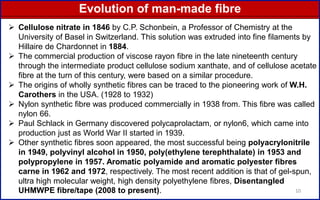
 Cellulose nitrate in 1846 by C.P. Schonbein, a Professor of Chemistry at the
University of Basel in Switzerland. This solution was extruded into fine filaments by
Hillaire de Chardonnet in 1884.
 The commercial production of viscose rayon fibre in the late nineteenth century
through the intermediate product cellulose sodium xanthate, and of cellulose acetate
fibre at the turn of this century, were based on a similar procedure.
 The origins of wholly synthetic fibres can be traced to the pioneering work of W.H.
Carothers in the USA. (1928 to 1932)
 Nylon synthetic fibre was produced commercially in 1938 from. This fibre was called
nylon 66.
 Paul Schlack in Germany discovered polycaprolactam, or nylon6, which came into
production just as World War II started in 1939.
 Other synthetic fibres soon appeared, the most successful being polyacrylonitrile
in 1949, polyvinyl alcohol in 1950, poly(ethylene terephthalate) in 1953 and
polypropylene in 1957. Aromatic polyamide and aromatic polyester fibres
carne in 1962 and 1972, respectively. The most recent addition is that of gel-spun,
ultra high molecular weight, high density polyethylene fibres, Disentangled
UHMWPE fibre/tape (2008 to present).
11
Classification of fibres
12
Classification of fibres based on characteristics (Yang)
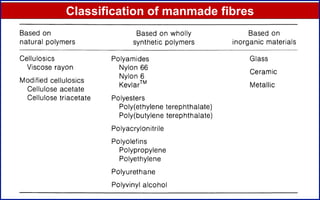
Conventional fibres viscose rayon, cellulose acetate, nylon 66, nylon 6, poly(ethylene
terephthalate), linear polyethylene, isotactic polypropylene and polyvinyl alcohol.
Second generation fibres Yang's classification describes second generation fibres as those
whose properties have been improved as a result of physical modification (textured yarns,
bicomponents) and chemical modification (high molecular weight, flame resistant, antistatic,
easily dyeable, etc.).
High temperature fibres. This category comprises fibres used in many industrial, military and
aerospace applications for extended periods of time at temperatures of 200-400°c. High
temperature fibres include aromatic polyamides and other similar fibres.
High performance fibres The final category comprises those fibres with the necessary
dimensional stability and light weight required for end uses that involve high temperatures,
high tensile or compressive load and hostile environments. The high temperature fibres
considered earlier may thus also be considered as high performance fibres. Aromatic
systems based on polyamides, polyesters, polyimides and heterocyclic polymers come into
this category. Linear ultra high molecular weight polyethylene fibres, carbon fibres, and
inorganic fibres like boron, alumina and silicon carbide all come into this category of fibres.
Glass fibre is not strictly a high performance fibre, but is used for various industrial
applications.
13
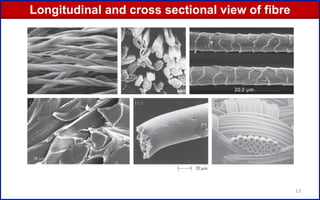
Longitudinal and cross sectional view of fibre
14
Classification of manmade fibres
15
Properties of major textile fibres
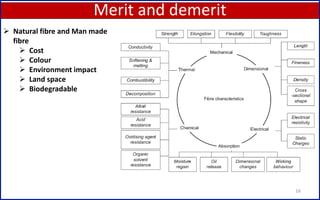
Merit and demerit
16
 Natural fibre and Man made
fibre
 Cost
 Colour
 Environment impact
 Land space
 Biodegradable
Fibre cross section
17
Some common types of fibre cross-section are:
• Round
• Dog-bone shaped
• Trilobal
• Multilobal
• Serrated
• Hollow
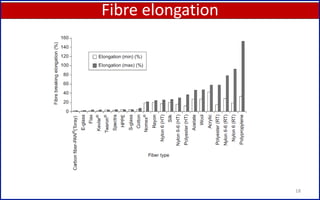
Fibre elongation
18
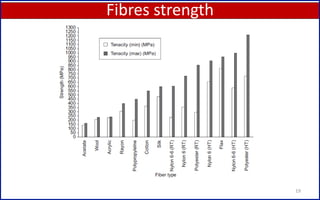
Fibres strength
19
Thermal conductivity of fibres
20
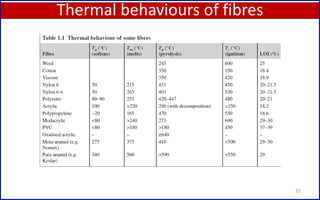
Thermal behaviours of fibres
21
22
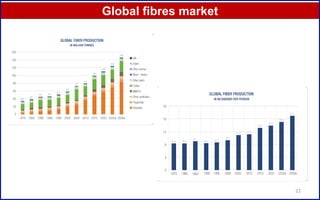
Global fibres market
23
Polymer as fibre, plastic and rubber
 The polymers used as plastics generally have a higher molecular weight than polymers used
as fibres
 Rubbers are required to be very flexible, undergoing large deformation under small stresses
and showing good elastic recovery when unloaded.
Three conditions must be satisfied if a material is to show rubber-like properties.
1. It must be composed of long-chain molecules possessing freely rotating links.
2. The forces between the molecules must be weak, as in a liquid.
3. The molecules must be joined together or crosslinked at certain points along the length.
24
Lightly cross-linked rubber
Un-oriented semi -
crystalline structure
Highly cross-linked polymer
Un-oriented amorphous polymer
25
Fibre morphology
Shish Kebab Gel spun UHMWPE Nylon-6
26
Shish kebab If a dilute polymer solution is agitated by stirring, the elongational flow
field stretches the longest molecules preferentially and around these nuclei lamellar
chain-folded crystals form during cooling; such structures are called shish kebab
The second route to such anisotropic products is through the spinning of a gel and
then drawing the gel-spun filament. The resultant product has a structure composed
predominantly of extended molecules.
The third method of producing oriented products is the conventional melt- or solution-
spinning of flexible chain polymers by extruding a melt or a solution in an elongational
field and then, in a subsequent operation, drawing the spun filament in the solid state;
the resultant morphology is schematically illustrated.
Fibre morphology
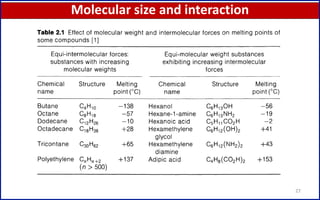
Molecular size and interaction
27
Molecular weight differences between fibres and plastics
28
Nature prefers to design fibres of very high molecular weight. Natural rubber,
which is tapped from a rubber tree, also has extremely high molecular weight.
This has to be reduced by milling before the rubber can be processed.
When a polymer is synthesized for use both by the plastics industry and the
fibre industry, the molecular weight is generally relatively low in the case of
polymer to be used as a fibre. The actual limits of molecular weight are
determined on the basis of property requirements. In the case of polyamides,
which are hydrogen-bonded, a molecular weight of 18 000 g mol-1 is adequate
for fibres for apparel use. For tyre cord, a molecular weight of 24000 gmol-1 or
above is preferred. The same polymer used for moulded products will have a
molecular weight of 75000 g mol-1or so. In the case of polypropylene, where the
intermolecular bonding is of the weak van der Waals type, the fibre-grade
polymer will have a molecular weight of 60000gmol-1 or so, while for
mouldings, the molecular weight may be about 150000 gmol-1.
Viscosity and MW
29
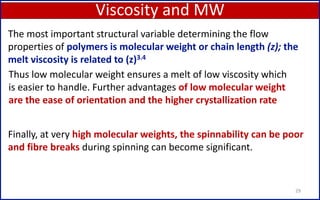
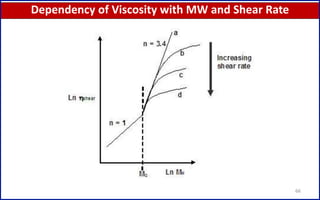
The most important structural variable determining the flow
properties of polymers is molecular weight or chain length (z); the
melt viscosity is related to (z)3.4
Thus low molecular weight ensures a melt of low viscosity which
is easier to handle. Further advantages of low molecular weight
are the ease of orientation and the higher crystallization rate
Finally, at very high molecular weights, the spinnability can be poor
and fibre breaks during spinning can become significant.
Thermal transitions
30
Specific volume-temperature curves for (a) amorphous and (b) semicrystalline
polymer
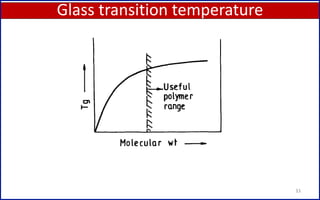
Glass transition temperature
31
transition from the rubber-like state to the glassy state
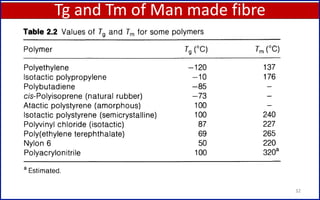
Tg and Tm of Man made fibre
32
Glass transition temperature
33
Polymer and polymerization
34
1. Chemical structure and properties
2. Mol wt. and distribution
3. Defects in linear chain structure
4. Impurities or side reaction products
5. Thermal stability
The performance properties of fibres are determined by the structure of the
fibres, which in turn depends on the processing technique, and chemical
structure and physical properties of polymers. The key properties of polymers
influencing fibre formation and properties are
Types of polymerizations
35
Polymers are macromolecules built up by linking up of
large number of smaller molecules termed as monomers.
Two main routes are used for synthesis of these
macromolecules:
1. Step growth polymerization (or Condensation
polymerization)
2. Chain growth polymerization (also called addition
polymerization)
Step and chain growth polymerization differ in the nature of starting
monomer units and the manner in which polymer molecular size
depends on the extent of conversion.
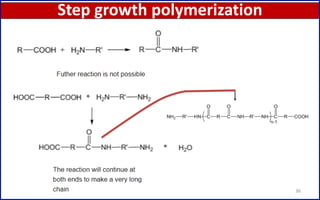
Step growth polymerization
36
Mechanism of polycondensation
37
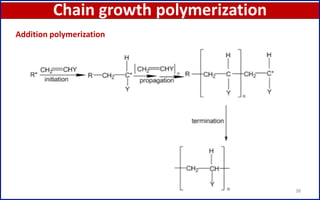
Chain growth polymerization
38
Addition polymerization
Ring opening polymerization
39
Ring opening polymerization
What are the polyamides
40
Polyamides are macromolecules (i.e. polymers) that contain
recurring amide groups (-CO-NH-) as integral parts of the polymer
backbone as shown below in structures
Nylons (i.e. nylon 6, nylon 66, Nylon 11, or others) are polyamides with structural
units derived predominantly from aliphatic monomers. Commercially important
nylons have been obtained by either
(a) polycondensation or (b) ring opening.
What are Nylons?
Polymerization of Nylon-6
41
Ring opening polymerization
Polymerization of Nylon-6
42
Addition polymerization
Polymerization of Nylon-66
43
Condensation polymerization
Factor control the polymerization
44
• Temperature
• Water
• Stabilizer type
Polymerization of Nylon-66
45
Synthesis of modified polyamide
46
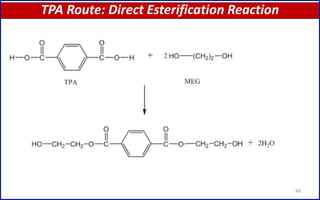
Polyesters
47
DMT route: Ester Interchange (or transesterification) Reaction
TPA Route: Direct Esterification Reaction
48
Polyester
49
Chemical structures of various monomer and compound used in PET
Basic principles of fluid flow in fibre spinning
50
The inspiration and the knowledge needed to develop the spinning techniques used for
fibre manufacture were provided by the spider and the silkworm
From the nature we can understand that extruding thin continuous filaments required the
following conditions
(1) Acquisition of spinnable liquid
(2) Jet formation
(3) Jet hardening
(4) Winding ( fibre in spun state)
(5) Drawing ( to achieve adequate properties as per end uses)
 Polymer in the form of melt or a solution
 Diameter and length of capillaries are in the range of 0.002 to 0.04 cm and lengths either
equal to or three to four times the diameter
 The fluid comes out of the capillary as a thread after applying pressure. It is pulled rapidly
onto a winder as it is attenuated and solidified to a thin filament generally of gradually
reducing cross section, which ultimately acquires a uniform final cross-sectional shape or a
constant diameter (a typical final diameter is 0.002 cm or 20 µm).
 The first spinnable fluids were solutions of cellulose nitrate (celluloid) in a mixture of
alcohol ether solvent, the solidification of the jet being achieved by solvent evaporation.
Fibre spinning methods
51
 The second method of fibre production to be developed was the viscose
process, in which a solution of cellulose was solidified by chemical
coagulation. Polyacrylonitrile that is largely atactic is often spun by this
method.
 The third method arrived with the development of a melt-stable material
(nylon 66) and used jet solidification by freezing it. Poly(ethylene
terephthalate) (PET), nylon 66, nylon 6 and isotactic polypropylene are all spun
by this technique.
 The first, second and third methods referred to above are now well
established techniques and are known as dry-spinning, wet-spinning, and
melt-spinning, respectively. Melt-spinning is the youngest and most
economical of the three processes.
Perquisite of melt spinning
52
1. Melting point of polymer should be below degradation
temperature
2. Thermal stability of the polymer melt is a prerequisite for melt-
spinning.
3. Polymers that do not give a stable melt are sometimes spun by
blending them with volatile or extractable plasticizers before
spinning. However, this method is not as widely used as spinning
from solutions.
Fibre produced by different spinning methods
53
Melt spinning
54
Wet spinning method.
55
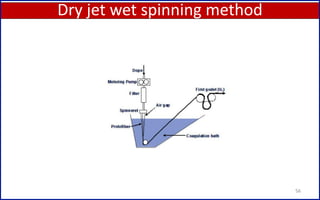
Dry jet wet spinning method
56
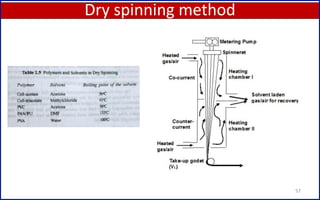
Dry spinning method
57
Fibre spinning methods
58
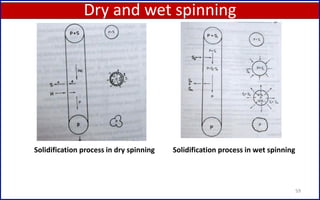
Solidification of the melt thread involves only heat transfer,
Dry-spinning: Heat transfer and one-way mass transfer
Wet-spinning: two-way mass transfer and heat transfer
Dry and wet spinning
59
Solidification process in dry spinning Solidification process in wet spinning
Comparisons
60
Melt spinning
Dry spinning
Wet spinning
Dry jet wet spinning
Different type of geometries of spinneret
61
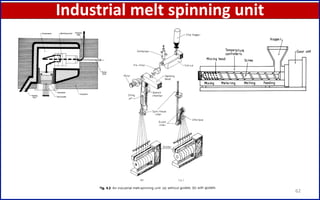
Industrial melt spinning unit
62
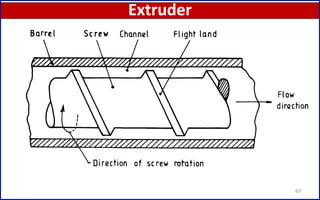
Extruder
63
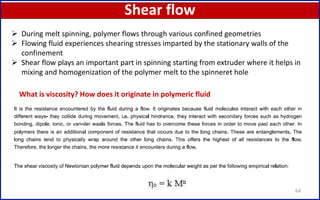
Shear flow
64
 During melt spinning, polymer flows through various confined geometries
 Flowing fluid experiences shearing stresses imparted by the stationary walls of the
confinement
 Shear flow plays an important part in spinning starting from extruder where it helps in
mixing and homogenization of the polymer melt to the spinneret hole
What is viscosity? How does it originate in polymeric fluid
Cont…
65
Other factor on which shear viscosity depends on
 Shear rate
 Time
 Pressure
 Molecular weight distribution
 Molecular branching/pedant group
Dependency of Viscosity with MW and Shear Rate
66
Cont.…
67
What is fibre
68
A fibre or a filament (a continuous form of fibre) is the fundamental unit of textile
materials. It has high strength (tensile, bending, torsional, or compression), high
flexibility (i.e. low moduli), extensibility, and shows recoverability on
deformation. Most of these properties are observed about one principal
direction, which is known as the axis of the fibre. Since all textile structures -one
to three dimensional (yarn, fabric, or braids etc.), are built using this basic
structural unit, these structures also possess such unique properties.
In order to possess such properties, the fibre or filament has a unique micro
structure (morphology) in which majority of the polymer chains are oriented in
the direction of the axis of the fibre. The more oriented the polymer molecules
are in this direction, the better properties the resulting fibre/filament is
considered to have.
How are fibre made
69
What is involved in the process of spinning?
70
In a typical spinning process, polymer melt or solution is
extruded from a fine hole and is elongated by applying a tensile
external force on the extruded portion. As the polymer melt or
solution is pulled, it is cooled or precipitated, respectively, to
form a solid filament. This filament is then usually subjected to
post spinning operations such as drawing, which is
unidirectional stretching in a semi solid form, and heat-setting,
which is crystallization to equilibrium. Other post spinning
processes such as texturing is simply a variation of the drawing
and heat-setting processes to impart curvilinear shape to an
otherwise straight filament. This gives physical bulk to the
filaments. The process of fibre formation is complete only when
both spinning and post spinning operations are carried out.
What is melt spinning?
71
Melt spinning is a process for producing filaments. However, only
those polymers that can be melted without undergoing thermal
degradation can be spun into fibres/filaments using this process.
Some of the typical examples are nylon-6, nylon 66, poly(ethylene
terephthalate) and poly(propylene). Though, melting is the
essential criteria for carrying out melt spinning, it is not the
sufficient condition. There are other requirements that a polymer
should meet before it can be regarded as spinnable. These are
discussed in detail later in this section.
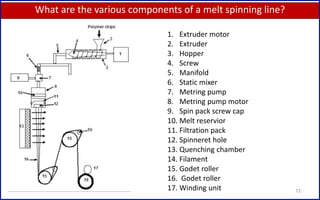
What are the various components of a melt spinning line?
72
1. Extruder motor
2. Extruder
3. Hopper
4. Screw
5. Manifold
6. Static mixer
7. Metring pump
8. Metring pump motor
9. Spin pack screw cap
10. Melt reservior
11. Filtration pack
12. Spinneret hole
13. Quenching chamber
14. Filament
15. Godet roller
16. Godet roller
17. Winding unit
What is an extruder and what does it do?
73
In earlier days, the polymer chips were melted using heating grids, however, now,
extruders have completely replaced other melting arrangements. Even when
polymer is fed to spinning section in melted form directly from a continuous
polymerization line, the extruder is often used as the first device in the spinning
line. This is because an extruder performs multiple functions. Apart from melting
solid polymer chips, an extruder homogenizes the melt by mixing it at various
stages. Homogenization is an important aspect in order to ensure continuous
spinning without any breaks or non-uniformity in the spun yarns.
Extruder compresses the polymer fluid to remove any trapped gasses including
air/nitrogen that is drawn along with the chips as they enter the extruder. It also
helps in metering the flow rate in the spinning line. It is the first control of flow
rate. Finally it acts as a polymer fluid pump and provides the necessary pressure
that is required by the polymer to flow from the extruder to the metering pump.
What is the design of the extruder?
74
Figure shows the schematic diagram of a typical extruder. It has a cooled feeding zone (1)- where the
chips enter the extruder, a melting zone(2)- where chips melt with the heat supplied by the heaters
and the heat generated by the dissipation of the polymeric viscous forces, a compression zone (3)-
where the material is compressed into a smaller volume to push out trapped gasses. This is followed
by a metering zone (4), which is the narrowest part of the extruder channels. Because of its
constricted size, only a limited amount of polymer melt may be dragged through this zone depending
upon the screw rpm. Since the metering zone does not allow the entire material coming to the
compression zone to pass through, the excess polymer is pushed back resulting in continuous mixing.
At the end of the metering zone is the head of the extruder screw, which may have spikes (optional
feature) for further mixing/homogenization (5).
Extruder
75
The design of extruder and its screw may vary considerably depending upon the material
being processed and the principal functions required for processing that material.
The design of the screw, which includes the length to diameter ratio (aspect ratio of 1:25 or
1:40), angle of the flanges, etc. is kept in accordance to the specific heat capacity and
rheological behaviour of the polymer it is meant to process. Higher the amount of heat
required to be transferred to the polymer, longer is the residence time. For example for PP,
since the heat capacity of the polymer is large and the molecular weight is often high, it
needs longer residence time in an extruder to attain lower melt viscosity. A considerable
amount of heat has to be transferred to the polymer to melt it and bring it to the
temperature of spinning. Similarly, if a polymer is to be blended with an additive, the
extruder design should allow effective mixing and homogenization, which is again the
function of the residence time and the shear rate.
The design of the screw also has significant effect on the heat generated during shear melting
of the polymer, and the energy needed for melting the polymer chips is provided by both the
heaters and the mechanical action of the screw.
What is a manifold?
76
• Polymer flows from the extruder to the metering pump and spin packs
through a manifold, which is a simple network of cylindrical pipes.
• Each pipe is connected to one metering pump.
• The manifold is designed in such a way, that polymer takes the same amount of
time from the extruder outlet to any of the metering pump whether it is located
near or far away from the extruder.
• This allows the polymers to have same thermal history, hence the same
rheological properties, at all positions of the spinning.
• The same residence time is achieved by keeping the length and bends of each
pipe same.
• Also, the pressure drop across each pipe is kept same so that the polymer gets
divided equally.
• When the distribution lines are long, at times, static mixers are also
installed inside distribution pipes. These allow shear mixing of polymer
melt within a pipe to keep it homogenized.
What is a static mixer?
77
Static mixer is a network of channels interconnected with each other
like a honey comb web, which takes the polymeric fluid from the
periphery to the centre and that from the centre to the periphery.
Also, in this process it induces shear mixing among the various fluid
elements.
Such mixing becomes necessary because in a pipe flow, fluid travels
in a parabolic velocity profile, which means the fluid velocity is
maximum at the center and is much lower near the pipe walls. This
nonuniform flow profile across the cross-section of the pipe develops
due to the stresses exerted on the fluid by the stationary walls.
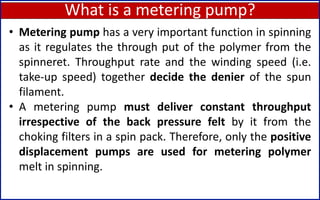
What is a metering pump?
78
• Metering pump has a very important function in spinning
as it regulates the through put of the polymer from the
spinneret. Throughput rate and the winding speed (i.e.
take-up speed) together decide the denier of the spun
filament.
• A metering pump must deliver constant throughput
irrespective of the back pressure felt by it from the
choking filters in a spin pack. Therefore, only the positive
displacement pumps are used for metering polymer
melt in spinning.
Metering pump
79
Mass flow rate = volume between teeth x no. of teeth in a gear x 2x rpm x
density of melt
Metering pump
80
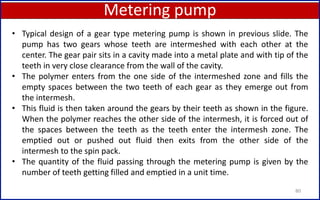
• Typical design of a gear type metering pump is shown in previous slide. The
pump has two gears whose teeth are intermeshed with each other at the
center. The gear pair sits in a cavity made into a metal plate and with tip of the
teeth in very close clearance from the wall of the cavity.
• The polymer enters from the one side of the intermeshed zone and fills the
empty spaces between the two teeth of each gear as they emerge out from
the intermesh.
• This fluid is then taken around the gears by their teeth as shown in the figure.
When the polymer reaches the other side of the intermesh, it is forced out of
the spaces between the teeth as the teeth enter the intermesh zone. The
emptied out or pushed out fluid then exits from the other side of the
intermesh to the spin pack.
• The quantity of the fluid passing through the metering pump is given by the
number of teeth getting filled and emptied in a unit time.
What is a spin pack?
81
Spin pack
82
• Spin pack is the heart of the spinning system ( as shown in Figure). It has a
reservoir of polymeric fluid-that dampens the pulsating effect of the gear
metering pump,
• A filter pack- that removes the solid particles from the melt.
• These may be polymer gels, agglomerated additives, contamination, etc.
Normally a filter is a set of filters containing 3-5 individual filter meshes,
where the first filter is a coarser filter followed by the finer ones. The lowest
filter is the finest of all which makes sure that no particle other than those
desired (such as well dispersed micron sized particles of an additive such
as TiO2, a delustering agent often used in fibres) is pushed through the
spinneret hole. Improper filtration will clog the spinneret hole leading to
a lower throughput and a lower denier of that filament, and eventually,
result in a break of the spinning filament.
Spin pack
83
• It is often believed that if a particle in polymer melt is bigger than 1/10th of the diameter
of the final filament, it will result in a catastrophic break in the filament during spinning
or post spinning operations.
• Not only should the particles of the additives be smaller in size, they should not
agglomerate to form bigger particles. Addition of additives in polymer melt is a
challenging proposition and all care must be taken to properly disperse the additive
particles.
• If the polymer is being recycled, often a large amount of dust particles and gel particles
are present in the melt. In such spinning lines, polymer is either filtered using a
centralized filtration unit (CFU) located just after the extruder or placing additional
filtration medium such as sand inside the spin pack cavity (melt reservoir) before the
filter pack.
• Once the polymer is filtered, it reaches a distributor. Function of the distributor, as the
name suggests is to ensure proper supply of the polymer melt to all spinneret holes. Also,
it makes sure that there is no dead volume and all the polymer coming to the spin pack is
being utilized in spinning.
The spinneret- an important component
84
The most important of all components in the spin-pack is a spinneret plate. It is simply a thick metal plate
with fine holes drilled through them as shown in Figure as shown in previous slide. The hole has larger
diameter towards the inside surface with conical entry. This allows entry of the polymer melt with less
pressure drop. The conical entrance facilitates alignment of the molecules to some extent to enable them
to enter without much force. However, the most important dimension in the spinneret is the length and
diameter of the final cylindrical spinneret (hole). Polymer passes through it in a shear flow and comes out
on the other end as an extruded strand. Spinneret plates for monofilaments have single spinneret hole with
diameter of about 0.5-1 mm, while those for multifilament have several holes with diameters in a range of
0.5-0.05 mm. In case of monofilament spinning, spinneret plate with one hole, spins a single filament which
is wound on a bobbin. The deniers used for such filaments are in excess of 20. However, for multi filament
yarn, the spinneret plate has several holes arranged in a particular fashion and all the extruded filaments
from this spin-pack are wound together on one bobbin to make a multi filament yarn. In a multi-hole
spinneret plate, holes are placed is staggered configuration so as to allow enough separation from each
other and to allow cooling air to be available to all the filaments in the quenching zone. Also, the space
between the various holes allows filaments to spin independently without sticking to each other during
extrudate swell (also known as die swell) phenomena (explained earlier).
The main role of a spinneret is to impart cross sectional shape to the extruded filaments. The cross section
may vary from circular to trilobal, to hexalobal or hollow, etc. Usually it is thought that spinneret is able to
orient polymer chains to make a fibre. It is not true. Spinneret is much bigger than the dimensions of a
polymer chain, and hence, can not induce orientation in coiled polymers.
Design and role of quench chamber
85
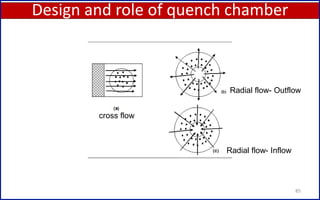
cross flow
Radial flow- Outflow
Radial flow- Inflow
Design of quench chamber
86
• In cross flow the cooling air flows from one side to the other side of the spinneret across
the cross-section of the spinning path ( Figure (a) ). This kind of quench chamber is used
when a limited number of filaments are being spun in a filament yarn. This is because
the filaments at the far end (in the direction of air flow) of the spinneret get air which
has been heated by the filaments at the near end. This problem becomes acute when a
very large number of spinneret holes are used in a staple fibre spinning line for making a
tow. In such cases 10,000 or more holes are normally present in a single spinneret.
• For quenching this large number of filaments, radial flow –either of outflow ( Figure (b) )
or in-flow ( Figure (c) ) type is used. In outflow ( Figure (b) ), the cooling air enters at the
centre of the spinneret and flows out radially while in the in-flow type, the air enters
from the periphery of the spinneret and flows into the centre of the spinning path. This
air then passes to the take up room along with the filament tow. The radial quenching
can accommodate a large number of filaments as more number of spinneret holes can
be arranged in concentric circles. Since filaments get more uniform cooling in radial flow
than in cross flow, the structure and properties of the various filaments are closer to
each other. Fibers with delicate dimensions are also spun in a radial type quench
chamber.
Spin finish applicator
87
Normally the spinning room and the take-up room are separated by a floor and the two
have different atmospheric pressure from each other. The spinning room is at a slightly
higher pressure (by 10 mm H2O) than take-up room. This allows part of the cooling air to
flow along with the delicate freshly spun filaments. The filaments are given a spin finish at
the end of the spinning line (just after the glass transition is reached) by one of the many
techniques- kiss-roll or spray. The finish is normally sprayed onto the filaments in high
speed spinning machines.
The roles of the spin finish are to provide
(i) lubrication- to reduce friction between the yarn and the metallic/ceramic parts of the spinning line
(ii) antistatic property- to allow dissipation of static charge generated due to contact of yarn with the machine parts
and
(iii) cohesion- to keep the filaments of a yarn together, so that unwinding becomes easier from the spun cake.
Lubrication is provided by aliphatic/alkyl molecules, which have very low vander waals attraction among them.
Antistatic properties/cohesion is provided by polar molecules, which have strong hydrogen or ionic bonding and
provide path for charge dissipation.
(iv) Since a spin finish needs both types of molecules, it is generally made by emulsifying alkyl chain molecules with
the help of surfactants in aqueous medium.
(v) A balance of the two ingredients is important to achieve an optimum of all properties needed in a spin finish.
What is a take-up winder
88
The next important device is the take-up winder. Usually, the yarn is not wound
directly on the winder but is passed through a take-up godet, or a set of godet
rollers. This breaks the vertical path of the spinning and allows the winder to be
adjusted comfortably in the available space. Also, in an integrated system, the spun
filaments may be subsequently drawn between the two godets before winding
(also known as in-line spin-draw frames). The spinning speed is decided by the
speed of the first rotating surface the filament comes in contact after the spinning
chamber. This can be the first take-up godet or the take-up winder if the spun
filaments are being directly wound onto the winder without breaking their vertical
path.
Take up winder
89
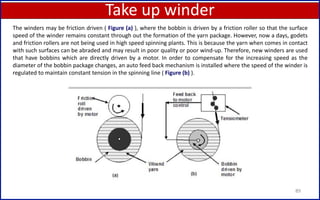
The winders may be friction driven ( Figure (a) ), where the bobbin is driven by a friction roller so that the surface
speed of the winder remains constant through out the formation of the yarn package. However, now a days, godets
and friction rollers are not being used in high speed spinning plants. This is because the yarn when comes in contact
with such surfaces can be abraded and may result in poor quality or poor wind-up. Therefore, new winders are used
that have bobbins which are directly driven by a motor. In order to compensate for the increasing speed as the
diameter of the bobbin package changes, an auto feed back mechanism is installed where the speed of the winder is
regulated to maintain constant tension in the spinning line ( Figure (b) ).
Melt spinning variable
90
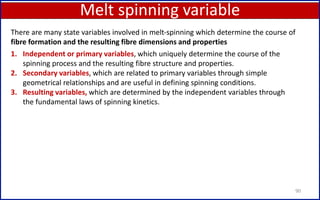
There are many state variables involved in melt-spinning which determine the course of
fibre formation and the resulting fibre dimensions and properties
1. Independent or primary variables, which uniquely determine the course of the
spinning process and the resulting fibre structure and properties.
2. Secondary variables, which are related to primary variables through simple
geometrical relationships and are useful in defining spinning conditions.
3. Resulting variables, which are determined by the independent variables through
the fundamental laws of spinning kinetics.
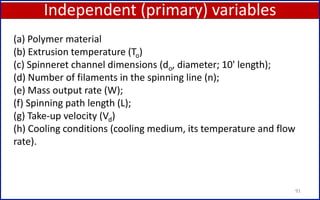
Independent (primary) variables
91
(a) Polymer material
(b) Extrusion temperature (To)
(c) Spinneret channel dimensions (do, diameter; 10' length);
(d) Number of filaments in the spinning line (n);
(e) Mass output rate (W);
(f) Spinning path length (L);
(g) Take-up velocity (Vd)
(h) Cooling conditions (cooling medium, its temperature and flow
rate).
Secondary variables
92
Resulting variables
93
Conditions for spinning without a break
94
95
Numerical
96
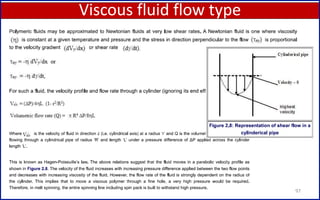
Viscous fluid flow type
97
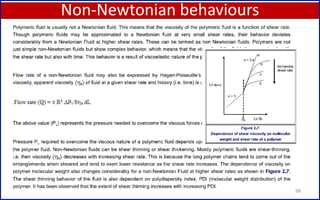
Non-Newtonian behaviours
98
Elastic behaviours
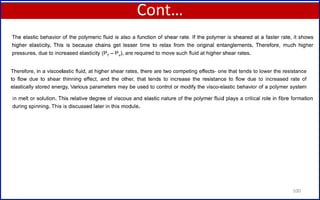
99
Cont…
100
Elongational fluid flow
101
Elongational fluid flow
102
Elongational fluid flow
103
Questions
104
Are all polymer spinnable ?
What is the requirement for spinnability of polymer?
Are all polymer are spinnable
105
What are the necessary requirements of spinnability
106
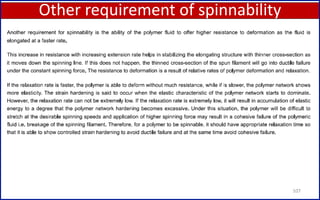
Other requirement of spinnability
107
Melt spinning concepts
108
Melt spinning is a complex process which consists
of serval phenomena. These may be classified as
1.Thermodynamics
2.Rheology or fluid dynamics
3.Mechanical force balance or rate of momentum
balance
4.Heat balance
Thermodynamics
109
Thermodynamics
110
Fluid dynamics
111
What is extruded swell
112
Factor which influence the die swell
113
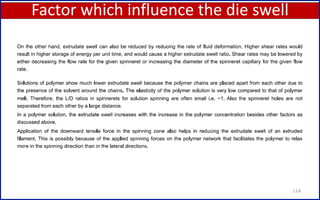
Factor which influence the die swell
114
What is the melt fracture
115
Factor on which melt fracture depends
116
Draw resonance
117
What type of fluid show draw resonance
118
Various drawing mode
119
Various drawing mode
120
Rate of momentum
121
Force balance in the entire filament
122
Force balance
123
Dependence of various force and take velocity
124
Heat balance
125
Heat balance
126
127

Man made fibre presentation from basic to higher level

  • 1.
    Dr. Mukesh Bajya Departmentof Textile Technology Course code - TTPC-202 Man made fibre by
  • 2.
  • 3.
    3 Course outcomes 1. Developthe concept of manmade fibre 2. Understanding various manufacturing process of manmade fibres 3. Understanding structure development and structure property relation 4. Knowledge about common manmade fibres 5. Application or use of manmade fibres
  • 4.
    Course contents 4 Introduction toman- made fibres: Definition of made fibres. Brief history of manmade Fibres. Relative merits and demerits of manmade fibres and natural fibres. Conversion of polymers into fibres: Basic production systems of the man- made fibre. Melt spinning, solution dry spinning and solution wet spinning. Factors influencing selection of a Particular process for fibre formation, Relative merits and demerits of melt, dry and wet spinning processes, Variables of spinning, Different components of spinning process, i.e., extruder, gear pump, filters, manifold, spinning head, quenching chamber, winders. Different Quenching/solidification techniques, spinning of staple fibres and filaments. POY, MOY and FDY. High speed spinning.
  • 5.
    5 Melt spinning: Rawmaterial, technology of polymerization and extrusion of polyester, nylon 6, nylon 66 and polypropylene. Effect of process parameters on structure and properties of melt spun filament. Solution dry spinning: Dry spinning of cellulose acetate. Acetylation of cellulose, Dope Preparation and spinning of cellulose diacetate and triacetate, Dry spinning of acrylic. Significance and types of co-monomers used during polymerisation of acrylic, Polymerisation. Dope preparation, extrusion and solidification of filaments. Effect of process parameters on Structure and properties of solution dry spun filament. Course contents
  • 6.
    6 Solution wet spinning:Process flow diagram and significance of each step for solution wet spinning of viscose rayon. Chemistry of viscose rayon formation process, Influence of various additives and temperature of the regeneration bath and their influence on the process and properties of viscose rayon, Various types of rayons, i.e. high wet modulus, Ten-X, etc. Introduction about alternative routes of regenerated cellulosic fibre formation, Properties and use, Wet spinning of acrylic, Different solvents and parameters of regeneration bath for wet spinning of acrylic, Effect of process parameters on structure and properties of acrylic. Drawing and heat setting of fibres: Object of drawing. Concept of neck drawing, Effect of drawing conditions on the structure and properties of fibre. Object of heat setting. Effect of heat setting parameters on the structure and properties of fibre. Spin finish: Objective, properties and application of spin finish. Developments in manmade Fibres: Fundamentals of high performance fibres such as Nomex, Kevlar, Carbon, Spandex, etc. their properties and applications. Developments in fibres production such as micro denier, bicomponent, hollow fibres, etc. Sustainability aspects of Manmade fibres. Course contents
  • 7.
    7 Books Recommended 1. VaidyaA A, “Production of Synthetic Fibres”, 1st Ed., Prentice Hall of India, New Delhi,1988. 2. “Manufactured Fibre Technology”, 1st Ed. V B Gupta and V K Kothari, 1st Ed., Chapmanand Hall, London, 1997. 3. Mark H F, Atlas S M, Cernia E, “Man Made Fibre Science and Technology”, 1st Ed.,Vol.1, 2, 3, Science Publishers, New York, 1967. 4. Macintyre J E, “Synthetic Fibres”, Wood head Fiber Science Series, UK, 2003. 5. “Hand Book of Fibre Chemistry”, Ed. M Lewin and E M Pearce, Mercel Dekker Inc., 1998.
  • 8.
    8 Topic Lectures Introduction tomanmade fibre 4 Conversion of polymer into fibre 6 Melt spinning 8 Solution spinning-Dry 7 Solution spinning -Wet 7 Drawing and heat setting of fibre 3 Spin finish 2 Development in man made fibre 3 Total lectures 40 Course plan
  • 9.
    9 Definition of fibre A textile fibre is a long thin object with a high ratio of length to thickness. It is characterized by a high degree of fineness and outstanding flexibility.  In addition, it should have dimensional and thermal stability and minimum levels of strength and extensibility consistent with the end use.  Fibres should also be capable of being converted into yarns and fabrics.  There are a number of other requirements that a fibre must satisfy, but those noted above are relatively more significant.
  • 10.
    10 Evolution of man-madefibre  Cellulose nitrate in 1846 by C.P. Schonbein, a Professor of Chemistry at the University of Basel in Switzerland. This solution was extruded into fine filaments by Hillaire de Chardonnet in 1884.  The commercial production of viscose rayon fibre in the late nineteenth century through the intermediate product cellulose sodium xanthate, and of cellulose acetate fibre at the turn of this century, were based on a similar procedure.  The origins of wholly synthetic fibres can be traced to the pioneering work of W.H. Carothers in the USA. (1928 to 1932)  Nylon synthetic fibre was produced commercially in 1938 from. This fibre was called nylon 66.  Paul Schlack in Germany discovered polycaprolactam, or nylon6, which came into production just as World War II started in 1939.  Other synthetic fibres soon appeared, the most successful being polyacrylonitrile in 1949, polyvinyl alcohol in 1950, poly(ethylene terephthalate) in 1953 and polypropylene in 1957. Aromatic polyamide and aromatic polyester fibres carne in 1962 and 1972, respectively. The most recent addition is that of gel-spun, ultra high molecular weight, high density polyethylene fibres, Disentangled UHMWPE fibre/tape (2008 to present).
  • 11.
  • 12.
    12 Classification of fibresbased on characteristics (Yang) Conventional fibres viscose rayon, cellulose acetate, nylon 66, nylon 6, poly(ethylene terephthalate), linear polyethylene, isotactic polypropylene and polyvinyl alcohol. Second generation fibres Yang's classification describes second generation fibres as those whose properties have been improved as a result of physical modification (textured yarns, bicomponents) and chemical modification (high molecular weight, flame resistant, antistatic, easily dyeable, etc.). High temperature fibres. This category comprises fibres used in many industrial, military and aerospace applications for extended periods of time at temperatures of 200-400°c. High temperature fibres include aromatic polyamides and other similar fibres. High performance fibres The final category comprises those fibres with the necessary dimensional stability and light weight required for end uses that involve high temperatures, high tensile or compressive load and hostile environments. The high temperature fibres considered earlier may thus also be considered as high performance fibres. Aromatic systems based on polyamides, polyesters, polyimides and heterocyclic polymers come into this category. Linear ultra high molecular weight polyethylene fibres, carbon fibres, and inorganic fibres like boron, alumina and silicon carbide all come into this category of fibres. Glass fibre is not strictly a high performance fibre, but is used for various industrial applications.
  • 13.
    13 Longitudinal and crosssectional view of fibre
  • 14.
  • 15.
    15 Properties of majortextile fibres
  • 16.
    Merit and demerit 16 Natural fibre and Man made fibre  Cost  Colour  Environment impact  Land space  Biodegradable
  • 17.
    Fibre cross section 17 Somecommon types of fibre cross-section are: • Round • Dog-bone shaped • Trilobal • Multilobal • Serrated • Hollow
  • 18.
  • 19.
  • 20.
  • 21.
  • 22.
  • 23.
    23 Polymer as fibre,plastic and rubber  The polymers used as plastics generally have a higher molecular weight than polymers used as fibres  Rubbers are required to be very flexible, undergoing large deformation under small stresses and showing good elastic recovery when unloaded. Three conditions must be satisfied if a material is to show rubber-like properties. 1. It must be composed of long-chain molecules possessing freely rotating links. 2. The forces between the molecules must be weak, as in a liquid. 3. The molecules must be joined together or crosslinked at certain points along the length.
  • 24.
    24 Lightly cross-linked rubber Un-orientedsemi - crystalline structure Highly cross-linked polymer Un-oriented amorphous polymer
  • 25.
    25 Fibre morphology Shish KebabGel spun UHMWPE Nylon-6
  • 26.
    26 Shish kebab Ifa dilute polymer solution is agitated by stirring, the elongational flow field stretches the longest molecules preferentially and around these nuclei lamellar chain-folded crystals form during cooling; such structures are called shish kebab The second route to such anisotropic products is through the spinning of a gel and then drawing the gel-spun filament. The resultant product has a structure composed predominantly of extended molecules. The third method of producing oriented products is the conventional melt- or solution- spinning of flexible chain polymers by extruding a melt or a solution in an elongational field and then, in a subsequent operation, drawing the spun filament in the solid state; the resultant morphology is schematically illustrated. Fibre morphology
  • 27.
    Molecular size andinteraction 27
  • 28.
    Molecular weight differencesbetween fibres and plastics 28 Nature prefers to design fibres of very high molecular weight. Natural rubber, which is tapped from a rubber tree, also has extremely high molecular weight. This has to be reduced by milling before the rubber can be processed. When a polymer is synthesized for use both by the plastics industry and the fibre industry, the molecular weight is generally relatively low in the case of polymer to be used as a fibre. The actual limits of molecular weight are determined on the basis of property requirements. In the case of polyamides, which are hydrogen-bonded, a molecular weight of 18 000 g mol-1 is adequate for fibres for apparel use. For tyre cord, a molecular weight of 24000 gmol-1 or above is preferred. The same polymer used for moulded products will have a molecular weight of 75000 g mol-1or so. In the case of polypropylene, where the intermolecular bonding is of the weak van der Waals type, the fibre-grade polymer will have a molecular weight of 60000gmol-1 or so, while for mouldings, the molecular weight may be about 150000 gmol-1.
  • 29.
    Viscosity and MW 29 Themost important structural variable determining the flow properties of polymers is molecular weight or chain length (z); the melt viscosity is related to (z)3.4 Thus low molecular weight ensures a melt of low viscosity which is easier to handle. Further advantages of low molecular weight are the ease of orientation and the higher crystallization rate Finally, at very high molecular weights, the spinnability can be poor and fibre breaks during spinning can become significant.
  • 30.
    Thermal transitions 30 Specific volume-temperaturecurves for (a) amorphous and (b) semicrystalline polymer
  • 31.
    Glass transition temperature 31 transitionfrom the rubber-like state to the glassy state
  • 32.
    Tg and Tmof Man made fibre 32
  • 33.
  • 34.
    Polymer and polymerization 34 1.Chemical structure and properties 2. Mol wt. and distribution 3. Defects in linear chain structure 4. Impurities or side reaction products 5. Thermal stability The performance properties of fibres are determined by the structure of the fibres, which in turn depends on the processing technique, and chemical structure and physical properties of polymers. The key properties of polymers influencing fibre formation and properties are
  • 35.
    Types of polymerizations 35 Polymersare macromolecules built up by linking up of large number of smaller molecules termed as monomers. Two main routes are used for synthesis of these macromolecules: 1. Step growth polymerization (or Condensation polymerization) 2. Chain growth polymerization (also called addition polymerization) Step and chain growth polymerization differ in the nature of starting monomer units and the manner in which polymer molecular size depends on the extent of conversion.
  • 36.
  • 37.
  • 38.
  • 39.
  • 40.
    What are thepolyamides 40 Polyamides are macromolecules (i.e. polymers) that contain recurring amide groups (-CO-NH-) as integral parts of the polymer backbone as shown below in structures Nylons (i.e. nylon 6, nylon 66, Nylon 11, or others) are polyamides with structural units derived predominantly from aliphatic monomers. Commercially important nylons have been obtained by either (a) polycondensation or (b) ring opening. What are Nylons?
  • 41.
    Polymerization of Nylon-6 41 Ringopening polymerization
  • 42.
  • 43.
  • 44.
    Factor control thepolymerization 44 • Temperature • Water • Stabilizer type
  • 45.
  • 46.
  • 47.
    Polyesters 47 DMT route: EsterInterchange (or transesterification) Reaction
  • 48.
    TPA Route: DirectEsterification Reaction 48
  • 49.
    Polyester 49 Chemical structures ofvarious monomer and compound used in PET
  • 50.
    Basic principles offluid flow in fibre spinning 50 The inspiration and the knowledge needed to develop the spinning techniques used for fibre manufacture were provided by the spider and the silkworm From the nature we can understand that extruding thin continuous filaments required the following conditions (1) Acquisition of spinnable liquid (2) Jet formation (3) Jet hardening (4) Winding ( fibre in spun state) (5) Drawing ( to achieve adequate properties as per end uses)  Polymer in the form of melt or a solution  Diameter and length of capillaries are in the range of 0.002 to 0.04 cm and lengths either equal to or three to four times the diameter  The fluid comes out of the capillary as a thread after applying pressure. It is pulled rapidly onto a winder as it is attenuated and solidified to a thin filament generally of gradually reducing cross section, which ultimately acquires a uniform final cross-sectional shape or a constant diameter (a typical final diameter is 0.002 cm or 20 µm).  The first spinnable fluids were solutions of cellulose nitrate (celluloid) in a mixture of alcohol ether solvent, the solidification of the jet being achieved by solvent evaporation.
  • 51.
    Fibre spinning methods 51 The second method of fibre production to be developed was the viscose process, in which a solution of cellulose was solidified by chemical coagulation. Polyacrylonitrile that is largely atactic is often spun by this method.  The third method arrived with the development of a melt-stable material (nylon 66) and used jet solidification by freezing it. Poly(ethylene terephthalate) (PET), nylon 66, nylon 6 and isotactic polypropylene are all spun by this technique.  The first, second and third methods referred to above are now well established techniques and are known as dry-spinning, wet-spinning, and melt-spinning, respectively. Melt-spinning is the youngest and most economical of the three processes.
  • 52.
    Perquisite of meltspinning 52 1. Melting point of polymer should be below degradation temperature 2. Thermal stability of the polymer melt is a prerequisite for melt- spinning. 3. Polymers that do not give a stable melt are sometimes spun by blending them with volatile or extractable plasticizers before spinning. However, this method is not as widely used as spinning from solutions.
  • 53.
    Fibre produced bydifferent spinning methods 53
  • 54.
  • 55.
  • 56.
    Dry jet wetspinning method 56
  • 57.
  • 58.
    Fibre spinning methods 58 Solidificationof the melt thread involves only heat transfer, Dry-spinning: Heat transfer and one-way mass transfer Wet-spinning: two-way mass transfer and heat transfer
  • 59.
    Dry and wetspinning 59 Solidification process in dry spinning Solidification process in wet spinning
  • 60.
    Comparisons 60 Melt spinning Dry spinning Wetspinning Dry jet wet spinning
  • 61.
    Different type ofgeometries of spinneret 61
  • 62.
  • 63.
  • 64.
    Shear flow 64  Duringmelt spinning, polymer flows through various confined geometries  Flowing fluid experiences shearing stresses imparted by the stationary walls of the confinement  Shear flow plays an important part in spinning starting from extruder where it helps in mixing and homogenization of the polymer melt to the spinneret hole What is viscosity? How does it originate in polymeric fluid
  • 65.
    Cont… 65 Other factor onwhich shear viscosity depends on  Shear rate  Time  Pressure  Molecular weight distribution  Molecular branching/pedant group
  • 66.
    Dependency of Viscositywith MW and Shear Rate 66
  • 67.
  • 68.
    What is fibre 68 Afibre or a filament (a continuous form of fibre) is the fundamental unit of textile materials. It has high strength (tensile, bending, torsional, or compression), high flexibility (i.e. low moduli), extensibility, and shows recoverability on deformation. Most of these properties are observed about one principal direction, which is known as the axis of the fibre. Since all textile structures -one to three dimensional (yarn, fabric, or braids etc.), are built using this basic structural unit, these structures also possess such unique properties. In order to possess such properties, the fibre or filament has a unique micro structure (morphology) in which majority of the polymer chains are oriented in the direction of the axis of the fibre. The more oriented the polymer molecules are in this direction, the better properties the resulting fibre/filament is considered to have.
  • 69.
  • 70.
    What is involvedin the process of spinning? 70 In a typical spinning process, polymer melt or solution is extruded from a fine hole and is elongated by applying a tensile external force on the extruded portion. As the polymer melt or solution is pulled, it is cooled or precipitated, respectively, to form a solid filament. This filament is then usually subjected to post spinning operations such as drawing, which is unidirectional stretching in a semi solid form, and heat-setting, which is crystallization to equilibrium. Other post spinning processes such as texturing is simply a variation of the drawing and heat-setting processes to impart curvilinear shape to an otherwise straight filament. This gives physical bulk to the filaments. The process of fibre formation is complete only when both spinning and post spinning operations are carried out.
  • 71.
    What is meltspinning? 71 Melt spinning is a process for producing filaments. However, only those polymers that can be melted without undergoing thermal degradation can be spun into fibres/filaments using this process. Some of the typical examples are nylon-6, nylon 66, poly(ethylene terephthalate) and poly(propylene). Though, melting is the essential criteria for carrying out melt spinning, it is not the sufficient condition. There are other requirements that a polymer should meet before it can be regarded as spinnable. These are discussed in detail later in this section.
  • 72.
    What are thevarious components of a melt spinning line? 72 1. Extruder motor 2. Extruder 3. Hopper 4. Screw 5. Manifold 6. Static mixer 7. Metring pump 8. Metring pump motor 9. Spin pack screw cap 10. Melt reservior 11. Filtration pack 12. Spinneret hole 13. Quenching chamber 14. Filament 15. Godet roller 16. Godet roller 17. Winding unit
  • 73.
    What is anextruder and what does it do? 73 In earlier days, the polymer chips were melted using heating grids, however, now, extruders have completely replaced other melting arrangements. Even when polymer is fed to spinning section in melted form directly from a continuous polymerization line, the extruder is often used as the first device in the spinning line. This is because an extruder performs multiple functions. Apart from melting solid polymer chips, an extruder homogenizes the melt by mixing it at various stages. Homogenization is an important aspect in order to ensure continuous spinning without any breaks or non-uniformity in the spun yarns. Extruder compresses the polymer fluid to remove any trapped gasses including air/nitrogen that is drawn along with the chips as they enter the extruder. It also helps in metering the flow rate in the spinning line. It is the first control of flow rate. Finally it acts as a polymer fluid pump and provides the necessary pressure that is required by the polymer to flow from the extruder to the metering pump.
  • 74.
    What is thedesign of the extruder? 74 Figure shows the schematic diagram of a typical extruder. It has a cooled feeding zone (1)- where the chips enter the extruder, a melting zone(2)- where chips melt with the heat supplied by the heaters and the heat generated by the dissipation of the polymeric viscous forces, a compression zone (3)- where the material is compressed into a smaller volume to push out trapped gasses. This is followed by a metering zone (4), which is the narrowest part of the extruder channels. Because of its constricted size, only a limited amount of polymer melt may be dragged through this zone depending upon the screw rpm. Since the metering zone does not allow the entire material coming to the compression zone to pass through, the excess polymer is pushed back resulting in continuous mixing. At the end of the metering zone is the head of the extruder screw, which may have spikes (optional feature) for further mixing/homogenization (5).
  • 75.
    Extruder 75 The design ofextruder and its screw may vary considerably depending upon the material being processed and the principal functions required for processing that material. The design of the screw, which includes the length to diameter ratio (aspect ratio of 1:25 or 1:40), angle of the flanges, etc. is kept in accordance to the specific heat capacity and rheological behaviour of the polymer it is meant to process. Higher the amount of heat required to be transferred to the polymer, longer is the residence time. For example for PP, since the heat capacity of the polymer is large and the molecular weight is often high, it needs longer residence time in an extruder to attain lower melt viscosity. A considerable amount of heat has to be transferred to the polymer to melt it and bring it to the temperature of spinning. Similarly, if a polymer is to be blended with an additive, the extruder design should allow effective mixing and homogenization, which is again the function of the residence time and the shear rate. The design of the screw also has significant effect on the heat generated during shear melting of the polymer, and the energy needed for melting the polymer chips is provided by both the heaters and the mechanical action of the screw.
  • 76.
    What is amanifold? 76 • Polymer flows from the extruder to the metering pump and spin packs through a manifold, which is a simple network of cylindrical pipes. • Each pipe is connected to one metering pump. • The manifold is designed in such a way, that polymer takes the same amount of time from the extruder outlet to any of the metering pump whether it is located near or far away from the extruder. • This allows the polymers to have same thermal history, hence the same rheological properties, at all positions of the spinning. • The same residence time is achieved by keeping the length and bends of each pipe same. • Also, the pressure drop across each pipe is kept same so that the polymer gets divided equally. • When the distribution lines are long, at times, static mixers are also installed inside distribution pipes. These allow shear mixing of polymer melt within a pipe to keep it homogenized.
  • 77.
    What is astatic mixer? 77 Static mixer is a network of channels interconnected with each other like a honey comb web, which takes the polymeric fluid from the periphery to the centre and that from the centre to the periphery. Also, in this process it induces shear mixing among the various fluid elements. Such mixing becomes necessary because in a pipe flow, fluid travels in a parabolic velocity profile, which means the fluid velocity is maximum at the center and is much lower near the pipe walls. This nonuniform flow profile across the cross-section of the pipe develops due to the stresses exerted on the fluid by the stationary walls.
  • 78.
    What is ametering pump? 78 • Metering pump has a very important function in spinning as it regulates the through put of the polymer from the spinneret. Throughput rate and the winding speed (i.e. take-up speed) together decide the denier of the spun filament. • A metering pump must deliver constant throughput irrespective of the back pressure felt by it from the choking filters in a spin pack. Therefore, only the positive displacement pumps are used for metering polymer melt in spinning.
  • 79.
    Metering pump 79 Mass flowrate = volume between teeth x no. of teeth in a gear x 2x rpm x density of melt
  • 80.
    Metering pump 80 • Typicaldesign of a gear type metering pump is shown in previous slide. The pump has two gears whose teeth are intermeshed with each other at the center. The gear pair sits in a cavity made into a metal plate and with tip of the teeth in very close clearance from the wall of the cavity. • The polymer enters from the one side of the intermeshed zone and fills the empty spaces between the two teeth of each gear as they emerge out from the intermesh. • This fluid is then taken around the gears by their teeth as shown in the figure. When the polymer reaches the other side of the intermesh, it is forced out of the spaces between the teeth as the teeth enter the intermesh zone. The emptied out or pushed out fluid then exits from the other side of the intermesh to the spin pack. • The quantity of the fluid passing through the metering pump is given by the number of teeth getting filled and emptied in a unit time.
  • 81.
    What is aspin pack? 81
  • 82.
    Spin pack 82 • Spinpack is the heart of the spinning system ( as shown in Figure). It has a reservoir of polymeric fluid-that dampens the pulsating effect of the gear metering pump, • A filter pack- that removes the solid particles from the melt. • These may be polymer gels, agglomerated additives, contamination, etc. Normally a filter is a set of filters containing 3-5 individual filter meshes, where the first filter is a coarser filter followed by the finer ones. The lowest filter is the finest of all which makes sure that no particle other than those desired (such as well dispersed micron sized particles of an additive such as TiO2, a delustering agent often used in fibres) is pushed through the spinneret hole. Improper filtration will clog the spinneret hole leading to a lower throughput and a lower denier of that filament, and eventually, result in a break of the spinning filament.
  • 83.
    Spin pack 83 • Itis often believed that if a particle in polymer melt is bigger than 1/10th of the diameter of the final filament, it will result in a catastrophic break in the filament during spinning or post spinning operations. • Not only should the particles of the additives be smaller in size, they should not agglomerate to form bigger particles. Addition of additives in polymer melt is a challenging proposition and all care must be taken to properly disperse the additive particles. • If the polymer is being recycled, often a large amount of dust particles and gel particles are present in the melt. In such spinning lines, polymer is either filtered using a centralized filtration unit (CFU) located just after the extruder or placing additional filtration medium such as sand inside the spin pack cavity (melt reservoir) before the filter pack. • Once the polymer is filtered, it reaches a distributor. Function of the distributor, as the name suggests is to ensure proper supply of the polymer melt to all spinneret holes. Also, it makes sure that there is no dead volume and all the polymer coming to the spin pack is being utilized in spinning.
  • 84.
    The spinneret- animportant component 84 The most important of all components in the spin-pack is a spinneret plate. It is simply a thick metal plate with fine holes drilled through them as shown in Figure as shown in previous slide. The hole has larger diameter towards the inside surface with conical entry. This allows entry of the polymer melt with less pressure drop. The conical entrance facilitates alignment of the molecules to some extent to enable them to enter without much force. However, the most important dimension in the spinneret is the length and diameter of the final cylindrical spinneret (hole). Polymer passes through it in a shear flow and comes out on the other end as an extruded strand. Spinneret plates for monofilaments have single spinneret hole with diameter of about 0.5-1 mm, while those for multifilament have several holes with diameters in a range of 0.5-0.05 mm. In case of monofilament spinning, spinneret plate with one hole, spins a single filament which is wound on a bobbin. The deniers used for such filaments are in excess of 20. However, for multi filament yarn, the spinneret plate has several holes arranged in a particular fashion and all the extruded filaments from this spin-pack are wound together on one bobbin to make a multi filament yarn. In a multi-hole spinneret plate, holes are placed is staggered configuration so as to allow enough separation from each other and to allow cooling air to be available to all the filaments in the quenching zone. Also, the space between the various holes allows filaments to spin independently without sticking to each other during extrudate swell (also known as die swell) phenomena (explained earlier). The main role of a spinneret is to impart cross sectional shape to the extruded filaments. The cross section may vary from circular to trilobal, to hexalobal or hollow, etc. Usually it is thought that spinneret is able to orient polymer chains to make a fibre. It is not true. Spinneret is much bigger than the dimensions of a polymer chain, and hence, can not induce orientation in coiled polymers.
  • 85.
    Design and roleof quench chamber 85 cross flow Radial flow- Outflow Radial flow- Inflow
  • 86.
    Design of quenchchamber 86 • In cross flow the cooling air flows from one side to the other side of the spinneret across the cross-section of the spinning path ( Figure (a) ). This kind of quench chamber is used when a limited number of filaments are being spun in a filament yarn. This is because the filaments at the far end (in the direction of air flow) of the spinneret get air which has been heated by the filaments at the near end. This problem becomes acute when a very large number of spinneret holes are used in a staple fibre spinning line for making a tow. In such cases 10,000 or more holes are normally present in a single spinneret. • For quenching this large number of filaments, radial flow –either of outflow ( Figure (b) ) or in-flow ( Figure (c) ) type is used. In outflow ( Figure (b) ), the cooling air enters at the centre of the spinneret and flows out radially while in the in-flow type, the air enters from the periphery of the spinneret and flows into the centre of the spinning path. This air then passes to the take up room along with the filament tow. The radial quenching can accommodate a large number of filaments as more number of spinneret holes can be arranged in concentric circles. Since filaments get more uniform cooling in radial flow than in cross flow, the structure and properties of the various filaments are closer to each other. Fibers with delicate dimensions are also spun in a radial type quench chamber.
  • 87.
    Spin finish applicator 87 Normallythe spinning room and the take-up room are separated by a floor and the two have different atmospheric pressure from each other. The spinning room is at a slightly higher pressure (by 10 mm H2O) than take-up room. This allows part of the cooling air to flow along with the delicate freshly spun filaments. The filaments are given a spin finish at the end of the spinning line (just after the glass transition is reached) by one of the many techniques- kiss-roll or spray. The finish is normally sprayed onto the filaments in high speed spinning machines. The roles of the spin finish are to provide (i) lubrication- to reduce friction between the yarn and the metallic/ceramic parts of the spinning line (ii) antistatic property- to allow dissipation of static charge generated due to contact of yarn with the machine parts and (iii) cohesion- to keep the filaments of a yarn together, so that unwinding becomes easier from the spun cake. Lubrication is provided by aliphatic/alkyl molecules, which have very low vander waals attraction among them. Antistatic properties/cohesion is provided by polar molecules, which have strong hydrogen or ionic bonding and provide path for charge dissipation. (iv) Since a spin finish needs both types of molecules, it is generally made by emulsifying alkyl chain molecules with the help of surfactants in aqueous medium. (v) A balance of the two ingredients is important to achieve an optimum of all properties needed in a spin finish.
  • 88.
    What is atake-up winder 88 The next important device is the take-up winder. Usually, the yarn is not wound directly on the winder but is passed through a take-up godet, or a set of godet rollers. This breaks the vertical path of the spinning and allows the winder to be adjusted comfortably in the available space. Also, in an integrated system, the spun filaments may be subsequently drawn between the two godets before winding (also known as in-line spin-draw frames). The spinning speed is decided by the speed of the first rotating surface the filament comes in contact after the spinning chamber. This can be the first take-up godet or the take-up winder if the spun filaments are being directly wound onto the winder without breaking their vertical path.
  • 89.
    Take up winder 89 Thewinders may be friction driven ( Figure (a) ), where the bobbin is driven by a friction roller so that the surface speed of the winder remains constant through out the formation of the yarn package. However, now a days, godets and friction rollers are not being used in high speed spinning plants. This is because the yarn when comes in contact with such surfaces can be abraded and may result in poor quality or poor wind-up. Therefore, new winders are used that have bobbins which are directly driven by a motor. In order to compensate for the increasing speed as the diameter of the bobbin package changes, an auto feed back mechanism is installed where the speed of the winder is regulated to maintain constant tension in the spinning line ( Figure (b) ).
  • 90.
    Melt spinning variable 90 Thereare many state variables involved in melt-spinning which determine the course of fibre formation and the resulting fibre dimensions and properties 1. Independent or primary variables, which uniquely determine the course of the spinning process and the resulting fibre structure and properties. 2. Secondary variables, which are related to primary variables through simple geometrical relationships and are useful in defining spinning conditions. 3. Resulting variables, which are determined by the independent variables through the fundamental laws of spinning kinetics.
  • 91.
    Independent (primary) variables 91 (a)Polymer material (b) Extrusion temperature (To) (c) Spinneret channel dimensions (do, diameter; 10' length); (d) Number of filaments in the spinning line (n); (e) Mass output rate (W); (f) Spinning path length (L); (g) Take-up velocity (Vd) (h) Cooling conditions (cooling medium, its temperature and flow rate).
  • 92.
  • 93.
  • 94.
    Conditions for spinningwithout a break 94
  • 95.
  • 96.
  • 97.
  • 98.
  • 99.
  • 100.
  • 101.
  • 102.
  • 103.
  • 104.
    Questions 104 Are all polymerspinnable ? What is the requirement for spinnability of polymer?
  • 105.
    Are all polymerare spinnable 105
  • 106.
    What are thenecessary requirements of spinnability 106
  • 107.
    Other requirement ofspinnability 107
  • 108.
    Melt spinning concepts 108 Meltspinning is a complex process which consists of serval phenomena. These may be classified as 1.Thermodynamics 2.Rheology or fluid dynamics 3.Mechanical force balance or rate of momentum balance 4.Heat balance
  • 109.
  • 110.
  • 111.
  • 112.
  • 113.
    Factor which influencethe die swell 113
  • 114.
    Factor which influencethe die swell 114
  • 115.
    What is themelt fracture 115
  • 116.
    Factor on whichmelt fracture depends 116
  • 117.
  • 118.
    What type offluid show draw resonance 118
  • 119.
  • 120.
  • 121.
  • 122.
    Force balance inthe entire filament 122
  • 123.
  • 124.
    Dependence of variousforce and take velocity 124
  • 125.
  • 126.
  • 127.