Plan evaluation: Lung Cancers
Dr. Ashutosh Mukherji
Additional Professor,
Department of Radiotherapy,
Regional Cancer Centre,
and Associate Dean (Research), JIPMER
Target Volumes
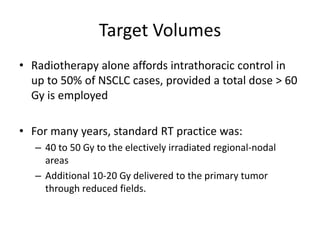
• Radiotherapy alone affords intrathoracic control in
up to 50% of NSCLC cases, provided a total dose > 60
Gy is employed
• For many years, standard RT practice was:
– 40 to 50 Gy to the electively irradiated regional-nodal
areas
– Additional 10-20 Gy delivered to the primary tumor
through reduced fields.
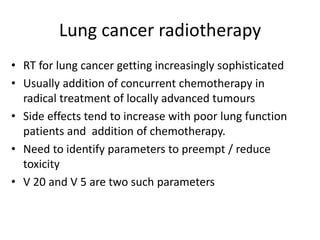
Lung cancer radiotherapy
• RT for lung cancer getting increasingly sophisticated
• Usually addition of concurrent chemotherapy in
radical treatment of locally advanced tumours
• Side effects tend to increase with poor lung function
patients and addition of chemotherapy.
• Need to identify parameters to preempt / reduce
toxicity
• V 20 and V 5 are two such parameters
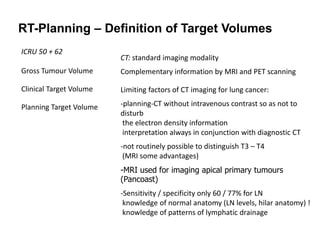
RT-Planning – Definition of Target Volumes
ICRU 50 + 62
Gross Tumour Volume
Clinical Target Volume
Planning Target Volume
CT: standard imaging modality
Complementary information by MRI and PET scanning
Limiting factors of CT imaging for lung cancer:
-planning-CT without intravenous contrast so as not to
disturb
the electron density information
interpretation always in conjunction with diagnostic CT
-not routinely possible to distinguish T3 – T4
(MRI some advantages)
-MRI used for imaging apical primary tumours
(Pancoast)
-Sensitivity / specificity only 60 / 77% for LN
knowledge of normal anatomy (LN levels, hilar anatomy) !
knowledge of patterns of lymphatic drainage
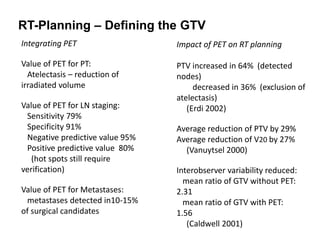
RT-Planning – Defining the GTV
Integrating PET
Value of PET for PT:
Atelectasis – reduction of
irradiated volume
Value of PET for LN staging:
Sensitivity 79%
Specificity 91%
Negative predictive value 95%
Positive predictive value 80%
(hot spots still require
verification)
Value of PET for Metastases:
metastases detected in10-15%
of surgical candidates
Impact of PET on RT planning
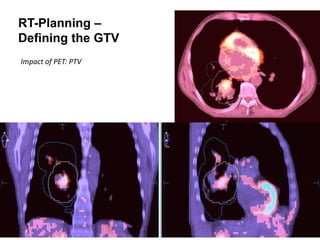
PTV increased in 64% (detected
nodes)
decreased in 36% (exclusion of
atelectasis)
(Erdi 2002)
Average reduction of PTV by 29%
Average reduction of V20 by 27%
(Vanuytsel 2000)
Interobserver variability reduced:
mean ratio of GTV without PET:
2.31
mean ratio of GTV with PET:
1.56
(Caldwell 2001)
RT-Planning –
Defining the GTV
Impact of PET: PTV
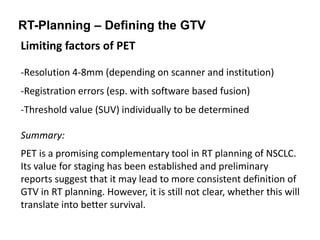
RT-Planning – Defining the GTV
Limiting factors of PET
-Resolution 4-8mm (depending on scanner and institution)
-Registration errors (esp. with software based fusion)
-Threshold value (SUV) individually to be determined
Summary:
PET is a promising complementary tool in RT planning of NSCLC.
Its value for staging has been established and preliminary
reports suggest that it may lead to more consistent definition of
GTV in RT planning. However, it is still not clear, whether this will
translate into better survival.
RT-Planning – Defining the CTV
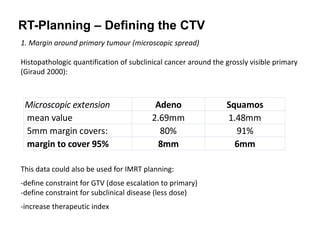
1. Margin around primary tumour (microscopic spread)
Histopathologic quantification of subclinical cancer around the grossly visible primary
(Giraud 2000):
Microscopic extension Adeno Squamos
mean value 2.69mm 1.48mm
5mm margin covers: 80% 91%
margin to cover 95% 8mm 6mm
This data could also be used for IMRT planning:
-define constraint for GTV (dose escalation to primary)
-define constraint for subclinical disease (less dose)
-increase therapeutic index
RT-Planning – Defining the CTV
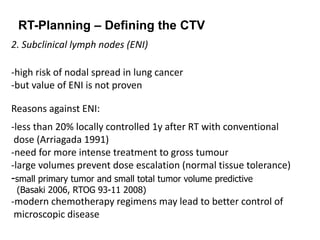
2. Subclinical lymph nodes (ENI)
-high risk of nodal spread in lung cancer
-but value of ENI is not proven
Reasons against ENI:
-less than 20% locally controlled 1y after RT with conventional
dose (Arriagada 1991)
-need for more intense treatment to gross tumour
-large volumes prevent dose escalation (normal tissue tolerance)
-small primary tumor and small total tumor volume predictive
(Basaki 2006, RTOG 93-11 2008)
-modern chemotherapy regimens may lead to better control of
microscopic disease
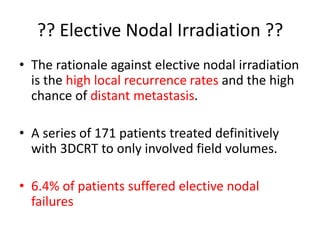
?? Elective Nodal Irradiation ??
• The rationale against elective nodal irradiation
is the high local recurrence rates and the high
chance of distant metastasis.
• A series of 171 patients treated definitively
with 3DCRT to only involved field volumes.
• 6.4% of patients suffered elective nodal
failures
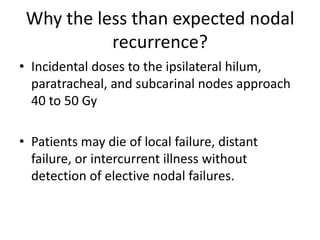
Why the less than expected nodal
recurrence?
• Incidental doses to the ipsilateral hilum,
paratracheal, and subcarinal nodes approach
40 to 50 Gy
• Patients may die of local failure, distant
failure, or intercurrent illness without
detection of elective nodal failures.
RT-Planning – Defining the CTV
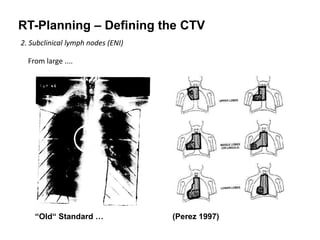
2. Subclinical lymph nodes (ENI)
From large ....
“Old“ Standard … (Perez 1997)
RT-Planning – Defining the CTV
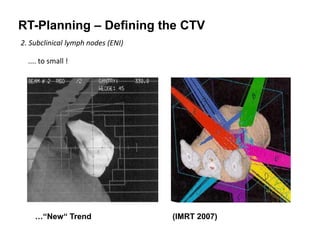
2. Subclinical lymph nodes (ENI)
.... to small !
…“New“ Trend (IMRT 2007)
RT-Planning – Defining the PTV
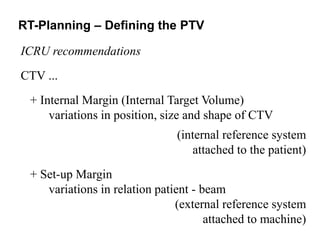
ICRU recommendations
CTV ...
+ Internal Margin (Internal Target Volume)
variations in position, size and shape of CTV
(internal reference system
attached to the patient)
+ Set-up Margin
variations in relation patient - beam
(external reference system
attached to machine)
RT-Planning – Defining the PTV
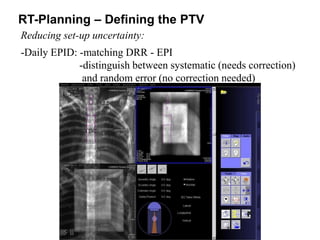
Reducing set-up uncertainty:
-Daily EPID: -matching DRR - EPI
-distinguish between systematic (needs correction)
and random error (no correction needed)
RT-Planning – Defining the PTV
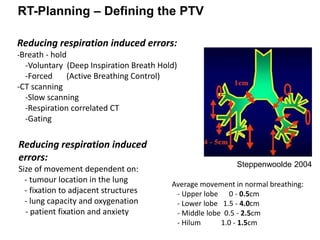
Reducing respiration induced
errors:
Size of movement dependent on:
- tumour location in the lung
- fixation to adjacent structures
- lung capacity and oxygenation
- patient fixation and anxiety
Steppenwoolde 2004
Reducing respiration induced errors:
-Breath - hold
-Voluntary (Deep Inspiration Breath Hold)
-Forced (Active Breathing Control)
-CT scanning
-Slow scanning
-Respiration correlated CT
-Gating
Average movement in normal breathing:
- Upper lobe 0 - 0.5cm
- Lower lobe 1.5 - 4.0cm
- Middle lobe 0.5 - 2.5cm
- Hilum 1.0 - 1.5cm
RT-Planning – Defining the PTV
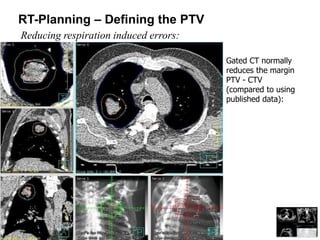
Reducing respiration induced errors:
Gated CT normally
reduces the margin
PTV - CTV
(compared to using
published data):
RT-Planning – Defining the PTV
Drawing PTV in gated planning CT:
-Define GTV/CTV for inspiration and expiration phase
-Give a margin of 0.5 - 1cm in all directions (setup uncertainty)
DON’T use dose escalation and highly conformal techniques
such as IMRT for lung cancer until tumour motion can be taken
into account !
In the meantime ...
-Outline GTV as best as possible
-Construct CTV based on the literature
-Construct PTV based on measured tumour motion and known
setup uncertainty.
ERS 2009
19
The risk of developing radiation pneumonitis-induced
lung toxicity can be estimated by calculating the dose–
volume histogram of the lungs, including V20 and mean
lung dose (MLD)
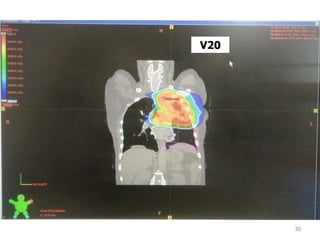
V 20
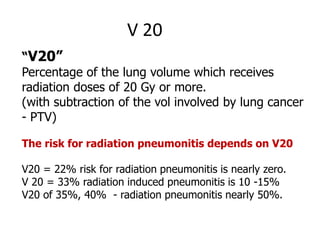
“V20”
Percentage of the lung volume which receives
radiation doses of 20 Gy or more.
(with subtraction of the vol involved by lung cancer
- PTV)
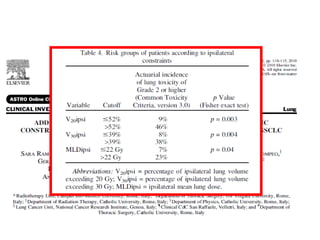
The risk for radiation pneumonitis depends on V20
V20 = 22% risk for radiation pneumonitis is nearly zero.
V 20 = 33% radiation induced pneumonitis is 10 -15%
V20 of 35%, 40% - radiation pneumonitis nearly 50%.
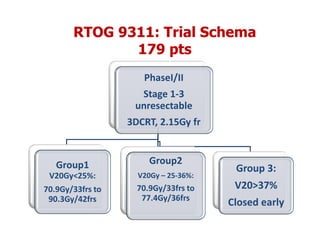
PhaseI/II
Stage 1-3
unresectable
3DCRT, 2.15Gy fr
Group1
V20Gy<25%:
70.9Gy/33frs to
90.3Gy/42frs
Group2
V20Gy – 25-36%:
70.9Gy/33frs to
77.4Gy/36frs
Group 3:
V20>37%
Closed early
RTOG 9311: Trial Schema
179 pts
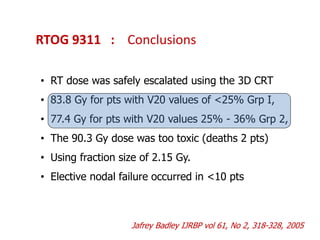
RTOG 9311 : Conclusions
• RT dose was safely escalated using the 3D CRT
• 83.8 Gy for pts with V20 values of <25% Grp I,
• 77.4 Gy for pts with V20 values 25% - 36% Grp 2,
• The 90.3 Gy dose was too toxic (deaths 2 pts)
• Using fraction size of 2.15 Gy.
• Elective nodal failure occurred in <10 pts
Jafrey Badley IJRBP vol 61, No 2, 318-328, 2005
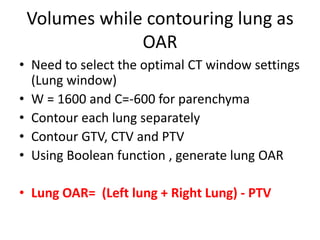
Volumes while contouring lung as
OAR
• Need to select the optimal CT window settings
(Lung window)
• W = 1600 and C=-600 for parenchyma
• Contour each lung separately
• Contour GTV, CTV and PTV
• Using Boolean function , generate lung OAR
• Lung OAR= (Left lung + Right Lung) - PTV
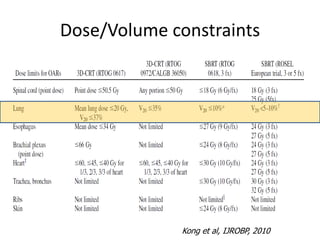
Dose/Volume constraints
Kong et al, IJROBP, 2010
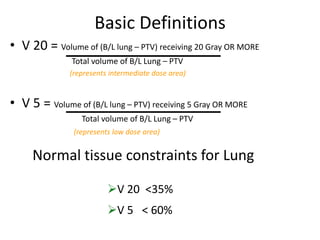
Basic Definitions
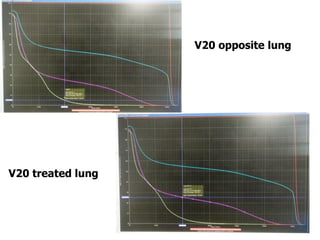
• V 20 = Volume of (B/L lung – PTV) receiving 20 Gray OR MORE
Total volume of B/L Lung – PTV
(represents intermediate dose area)
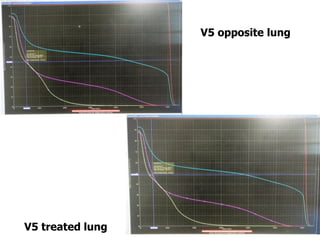
• V 5 = Volume of (B/L lung – PTV) receiving 5 Gray OR MORE
Total volume of B/L Lung – PTV
(represents low dose area)
Normal tissue constraints for Lung
V 20 <35%
V 5 < 60%
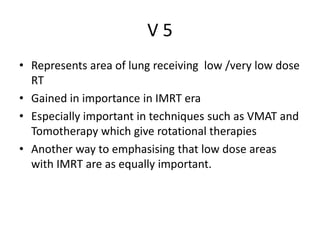
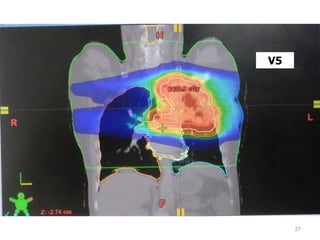
V 5
• Represents area of lung receiving low /very low dose
RT
• Gained in importance in IMRT era
• Especially important in techniques such as VMAT and
Tomotherapy which give rotational therapies
• Another way to emphasising that low dose areas
with IMRT are as equally important.
27
V5
28
V5 opposite lung
V5 treated lung
Seminal Publication – V 20
Graham MV, Purdy JA, Emami B, et al. Clinical dose-
volume histogram analysis for pneumonitis after 3D
treatment for non-smallcell lung cancer (NSCLC).
Int J Radiat Oncol Biol Phys 1999;45:323-329.
30
V20
31
V20 opposite lung
V20 treated lung
Elevated V 20 and V 5
• Truly elevated V 20 and V 5
– Large PTV
– Poor planning
• Spurious elevation of V 20 and V 5
– Lung not contoured properly (portions left out)
– Incorrect window used
– PTV not subtracted out from bilateral lungs
Means to reduce V 20 (3D CRT)
– Need to have a good measure of tumour location and
likely volumes
– Lower lobe tumours likely to have worse dosimetric
parameters
– Need to place appropriate beams(beam angles, number)
– Special arrangements in specific tumour positions
Means to reduce V 20
• Use IMRT instead of 3 DCRT in appropriate cases
• Use of advanced strategies like gating/tracking/breath
hold (it shall decrease the PTV and thereby decrease the
zone that get 20 Gray)
• Use of ABC device
– PTV smaller
– Simulation and treatment in inspiratory position
– Lungs inflated
– Lung volume increases and hence denominator more, V 20
falls
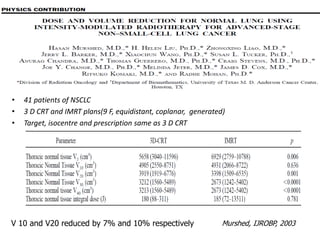
• 41 patients of NSCLC
• 3 D CRT and IMRT plans(9 F, equidistant, coplanar, generated)
• Target, isocentre and prescription same as 3 D CRT
Murshed, IJROBP, 2003V 10 and V20 reduced by 7% and 10% respectively
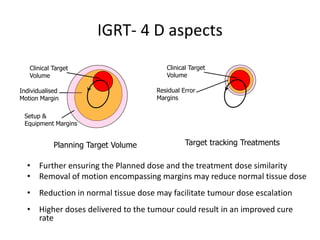
IGRT- 4 D aspects
• Further ensuring the Planned dose and the treatment dose similarity
• Removal of motion encompassing margins may reduce normal tissue dose
• Reduction in normal tissue dose may facilitate tumour dose escalation
• Higher doses delivered to the tumour could result in an improved cure
rate
Individualised
Motion Margin
Setup &
Equipment Margins
Clinical Target
Volume
Planning Target Volume
Residual Error
Margins
Clinical Target
Volume
Target tracking Treatments
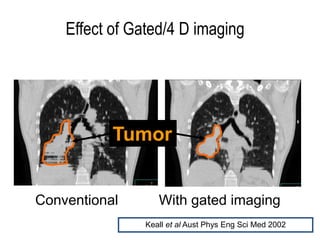
Conventional With gated imaging
Effect of Gated/4 D imaging
Tumor
Keall et al Aust Phys Eng Sci Med 2002
ABC
• Device holds the patients breath in a
particular phase of respiration
• Usually the mDIBH level chosen – 70%to
80% of maximum inspiratory capacity
• Suitable breath hold duration chosen –
commonly 20 to 25 seconds
ABC
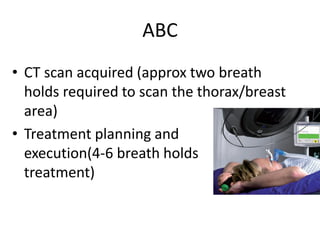
• CT scan acquired (approx two breath
holds required to scan the thorax/breast
area)
• Treatment planning and
execution(4-6 breath holds per
treatment)
ABC outcomes
• 18 NSCLC patients from RMH , UK
• Mean reduction in GTV 25% (p= 0.003).
• Compared with free-breathing, ABC reduced
• V(20) by 13% (p=0.0001)
• V(13) by 12% (p=0.001)
• MLD by 13% (p<0.001)
Brada et al IJROBP 2010
Outcomes of Respiratory Gating
• Twenty patients with CT under assisted breath
hold at normal inspiration, at full expiration
and under free breathing
• 13 of 20 patients had GTVs of <100 cm3
• Benefit of V20 reduction only with small
tumours (volume of GTV < 100 cm3) and
significant tumour motion
Starkschall IJROBP 2004
Caution!
• V20 and V5 could vary from one planning workstation to
another
• Different algorithms may yield variable V 20 and V 5
(Batho, Monte Carlo algorithm)
• Algorithms can be especially important as there is
variation in lung density.
• Algorithms derived directly from Monte Carlo, such as
superposition-convolution and collapsed cone far
superior to algorithms of the past (e.g. the one used in
seminal publication)
Drawbacks of V 20/ V 5
• DVH represents anatomic pulmonary volume, which
does not reflect a variety of confounding factors.
• Not a functional parameter (does not take into
account lung function)
• Several other factors important in radiation
pneumonitis and need to be accounted
(PS,concurrent chemo, smoking, age, ….)
45
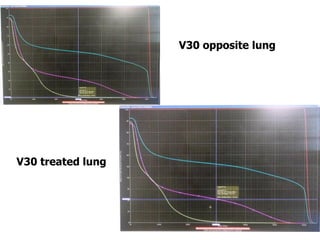
V30 opposite lung
V30 treated lung
46
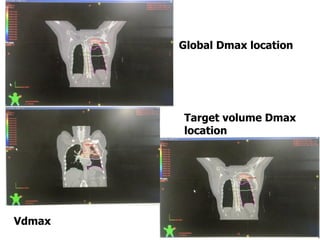
Global Dmax location
Target volume Dmax
location
Vdmax
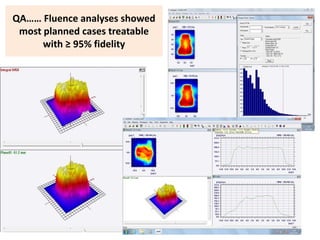
QA…… Fluence analyses showed
most planned cases treatable
with ≥ 95% fidelity
47
Summary / Conclusions
• V 5 and V 20 are important parameters to see and
evaluate during radical radiotherapy of lung cancer
• V30 and VDmax also need to be seen.
• For IMRT plans PTV cover and contouring should take
into account tumour movement
• Be cognizant of the pitfalls of these parameters as
well
• See totality of patient / tumour / dosimetric
parameters and not one or two factors in isolation
Summary planning Recommendations - EORTC
• 3-D radiotherapy planning is essential for ensuring optimal both
target coverage and the sparing of normal tissues.
• 3D margins for the PTV based on institutional random and
systematic errors and tumour movement
• Margins required for microscopic tumour extension in
radiotherapy planning of NSCLC are approximately 5-6 mm.
• Risk of radiation pneumonitis can be estimated from the V20
(volume of both lungs minus the PTV which receives a dose of 20
Gy), and by the mean lung dose.
• Incorporating FDG-PET findings into CT-based planning scan
results in changes to radiotherapy plans in a significant proportion
of patients.
49
THANK YOU
51

Lung plan evaluation

  • 1.
    Plan evaluation: LungCancers Dr. Ashutosh Mukherji Additional Professor, Department of Radiotherapy, Regional Cancer Centre, and Associate Dean (Research), JIPMER
  • 2.
    Target Volumes • Radiotherapyalone affords intrathoracic control in up to 50% of NSCLC cases, provided a total dose > 60 Gy is employed • For many years, standard RT practice was: – 40 to 50 Gy to the electively irradiated regional-nodal areas – Additional 10-20 Gy delivered to the primary tumor through reduced fields.
  • 3.
    Lung cancer radiotherapy •RT for lung cancer getting increasingly sophisticated • Usually addition of concurrent chemotherapy in radical treatment of locally advanced tumours • Side effects tend to increase with poor lung function patients and addition of chemotherapy. • Need to identify parameters to preempt / reduce toxicity • V 20 and V 5 are two such parameters
  • 4.
    RT-Planning – Definitionof Target Volumes ICRU 50 + 62 Gross Tumour Volume Clinical Target Volume Planning Target Volume CT: standard imaging modality Complementary information by MRI and PET scanning Limiting factors of CT imaging for lung cancer: -planning-CT without intravenous contrast so as not to disturb the electron density information interpretation always in conjunction with diagnostic CT -not routinely possible to distinguish T3 – T4 (MRI some advantages) -MRI used for imaging apical primary tumours (Pancoast) -Sensitivity / specificity only 60 / 77% for LN knowledge of normal anatomy (LN levels, hilar anatomy) ! knowledge of patterns of lymphatic drainage
  • 5.
    RT-Planning – Definingthe GTV Integrating PET Value of PET for PT: Atelectasis – reduction of irradiated volume Value of PET for LN staging: Sensitivity 79% Specificity 91% Negative predictive value 95% Positive predictive value 80% (hot spots still require verification) Value of PET for Metastases: metastases detected in10-15% of surgical candidates Impact of PET on RT planning PTV increased in 64% (detected nodes) decreased in 36% (exclusion of atelectasis) (Erdi 2002) Average reduction of PTV by 29% Average reduction of V20 by 27% (Vanuytsel 2000) Interobserver variability reduced: mean ratio of GTV without PET: 2.31 mean ratio of GTV with PET: 1.56 (Caldwell 2001)
  • 6.
    RT-Planning – Defining theGTV Impact of PET: PTV
  • 7.
    RT-Planning – Definingthe GTV Limiting factors of PET -Resolution 4-8mm (depending on scanner and institution) -Registration errors (esp. with software based fusion) -Threshold value (SUV) individually to be determined Summary: PET is a promising complementary tool in RT planning of NSCLC. Its value for staging has been established and preliminary reports suggest that it may lead to more consistent definition of GTV in RT planning. However, it is still not clear, whether this will translate into better survival.
  • 8.
    RT-Planning – Definingthe CTV 1. Margin around primary tumour (microscopic spread) Histopathologic quantification of subclinical cancer around the grossly visible primary (Giraud 2000): Microscopic extension Adeno Squamos mean value 2.69mm 1.48mm 5mm margin covers: 80% 91% margin to cover 95% 8mm 6mm This data could also be used for IMRT planning: -define constraint for GTV (dose escalation to primary) -define constraint for subclinical disease (less dose) -increase therapeutic index
  • 9.
    RT-Planning – Definingthe CTV 2. Subclinical lymph nodes (ENI) -high risk of nodal spread in lung cancer -but value of ENI is not proven Reasons against ENI: -less than 20% locally controlled 1y after RT with conventional dose (Arriagada 1991) -need for more intense treatment to gross tumour -large volumes prevent dose escalation (normal tissue tolerance) -small primary tumor and small total tumor volume predictive (Basaki 2006, RTOG 93-11 2008) -modern chemotherapy regimens may lead to better control of microscopic disease
  • 10.
    ?? Elective NodalIrradiation ?? • The rationale against elective nodal irradiation is the high local recurrence rates and the high chance of distant metastasis. • A series of 171 patients treated definitively with 3DCRT to only involved field volumes. • 6.4% of patients suffered elective nodal failures
  • 11.
    Why the lessthan expected nodal recurrence? • Incidental doses to the ipsilateral hilum, paratracheal, and subcarinal nodes approach 40 to 50 Gy • Patients may die of local failure, distant failure, or intercurrent illness without detection of elective nodal failures.
  • 12.
    RT-Planning – Definingthe CTV 2. Subclinical lymph nodes (ENI) From large .... “Old“ Standard … (Perez 1997)
  • 13.
    RT-Planning – Definingthe CTV 2. Subclinical lymph nodes (ENI) .... to small ! …“New“ Trend (IMRT 2007)
  • 14.
    RT-Planning – Definingthe PTV ICRU recommendations CTV ... + Internal Margin (Internal Target Volume) variations in position, size and shape of CTV (internal reference system attached to the patient) + Set-up Margin variations in relation patient - beam (external reference system attached to machine)
  • 15.
    RT-Planning – Definingthe PTV Reducing set-up uncertainty: -Daily EPID: -matching DRR - EPI -distinguish between systematic (needs correction) and random error (no correction needed)
  • 16.
    RT-Planning – Definingthe PTV Reducing respiration induced errors: Size of movement dependent on: - tumour location in the lung - fixation to adjacent structures - lung capacity and oxygenation - patient fixation and anxiety Steppenwoolde 2004 Reducing respiration induced errors: -Breath - hold -Voluntary (Deep Inspiration Breath Hold) -Forced (Active Breathing Control) -CT scanning -Slow scanning -Respiration correlated CT -Gating Average movement in normal breathing: - Upper lobe 0 - 0.5cm - Lower lobe 1.5 - 4.0cm - Middle lobe 0.5 - 2.5cm - Hilum 1.0 - 1.5cm
  • 17.
    RT-Planning – Definingthe PTV Reducing respiration induced errors: Gated CT normally reduces the margin PTV - CTV (compared to using published data):
  • 18.
    RT-Planning – Definingthe PTV Drawing PTV in gated planning CT: -Define GTV/CTV for inspiration and expiration phase -Give a margin of 0.5 - 1cm in all directions (setup uncertainty) DON’T use dose escalation and highly conformal techniques such as IMRT for lung cancer until tumour motion can be taken into account ! In the meantime ... -Outline GTV as best as possible -Construct CTV based on the literature -Construct PTV based on measured tumour motion and known setup uncertainty.
  • 19.
    ERS 2009 19 The riskof developing radiation pneumonitis-induced lung toxicity can be estimated by calculating the dose– volume histogram of the lungs, including V20 and mean lung dose (MLD)
  • 20.
    V 20 “V20” Percentage ofthe lung volume which receives radiation doses of 20 Gy or more. (with subtraction of the vol involved by lung cancer - PTV) The risk for radiation pneumonitis depends on V20 V20 = 22% risk for radiation pneumonitis is nearly zero. V 20 = 33% radiation induced pneumonitis is 10 -15% V20 of 35%, 40% - radiation pneumonitis nearly 50%.
  • 21.
    PhaseI/II Stage 1-3 unresectable 3DCRT, 2.15Gyfr Group1 V20Gy<25%: 70.9Gy/33frs to 90.3Gy/42frs Group2 V20Gy – 25-36%: 70.9Gy/33frs to 77.4Gy/36frs Group 3: V20>37% Closed early RTOG 9311: Trial Schema 179 pts
  • 22.
    RTOG 9311 :Conclusions • RT dose was safely escalated using the 3D CRT • 83.8 Gy for pts with V20 values of <25% Grp I, • 77.4 Gy for pts with V20 values 25% - 36% Grp 2, • The 90.3 Gy dose was too toxic (deaths 2 pts) • Using fraction size of 2.15 Gy. • Elective nodal failure occurred in <10 pts Jafrey Badley IJRBP vol 61, No 2, 318-328, 2005
  • 23.
    Volumes while contouringlung as OAR • Need to select the optimal CT window settings (Lung window) • W = 1600 and C=-600 for parenchyma • Contour each lung separately • Contour GTV, CTV and PTV • Using Boolean function , generate lung OAR • Lung OAR= (Left lung + Right Lung) - PTV
  • 24.
  • 25.
    Basic Definitions • V20 = Volume of (B/L lung – PTV) receiving 20 Gray OR MORE Total volume of B/L Lung – PTV (represents intermediate dose area) • V 5 = Volume of (B/L lung – PTV) receiving 5 Gray OR MORE Total volume of B/L Lung – PTV (represents low dose area) Normal tissue constraints for Lung V 20 <35% V 5 < 60%
  • 26.
    V 5 • Representsarea of lung receiving low /very low dose RT • Gained in importance in IMRT era • Especially important in techniques such as VMAT and Tomotherapy which give rotational therapies • Another way to emphasising that low dose areas with IMRT are as equally important.
  • 27.
  • 28.
  • 29.
    Seminal Publication –V 20 Graham MV, Purdy JA, Emami B, et al. Clinical dose- volume histogram analysis for pneumonitis after 3D treatment for non-smallcell lung cancer (NSCLC). Int J Radiat Oncol Biol Phys 1999;45:323-329.
  • 30.
  • 31.
  • 32.
    Elevated V 20and V 5 • Truly elevated V 20 and V 5 – Large PTV – Poor planning • Spurious elevation of V 20 and V 5 – Lung not contoured properly (portions left out) – Incorrect window used – PTV not subtracted out from bilateral lungs
  • 33.
    Means to reduceV 20 (3D CRT) – Need to have a good measure of tumour location and likely volumes – Lower lobe tumours likely to have worse dosimetric parameters – Need to place appropriate beams(beam angles, number) – Special arrangements in specific tumour positions
  • 34.
    Means to reduceV 20 • Use IMRT instead of 3 DCRT in appropriate cases • Use of advanced strategies like gating/tracking/breath hold (it shall decrease the PTV and thereby decrease the zone that get 20 Gray) • Use of ABC device – PTV smaller – Simulation and treatment in inspiratory position – Lungs inflated – Lung volume increases and hence denominator more, V 20 falls
  • 36.
    • 41 patientsof NSCLC • 3 D CRT and IMRT plans(9 F, equidistant, coplanar, generated) • Target, isocentre and prescription same as 3 D CRT Murshed, IJROBP, 2003V 10 and V20 reduced by 7% and 10% respectively
  • 37.
    IGRT- 4 Daspects • Further ensuring the Planned dose and the treatment dose similarity • Removal of motion encompassing margins may reduce normal tissue dose • Reduction in normal tissue dose may facilitate tumour dose escalation • Higher doses delivered to the tumour could result in an improved cure rate Individualised Motion Margin Setup & Equipment Margins Clinical Target Volume Planning Target Volume Residual Error Margins Clinical Target Volume Target tracking Treatments
  • 38.
    Conventional With gatedimaging Effect of Gated/4 D imaging Tumor Keall et al Aust Phys Eng Sci Med 2002
  • 39.
    ABC • Device holdsthe patients breath in a particular phase of respiration • Usually the mDIBH level chosen – 70%to 80% of maximum inspiratory capacity • Suitable breath hold duration chosen – commonly 20 to 25 seconds
  • 40.
    ABC • CT scanacquired (approx two breath holds required to scan the thorax/breast area) • Treatment planning and execution(4-6 breath holds per treatment)
  • 41.
    ABC outcomes • 18NSCLC patients from RMH , UK • Mean reduction in GTV 25% (p= 0.003). • Compared with free-breathing, ABC reduced • V(20) by 13% (p=0.0001) • V(13) by 12% (p=0.001) • MLD by 13% (p<0.001) Brada et al IJROBP 2010
  • 42.
    Outcomes of RespiratoryGating • Twenty patients with CT under assisted breath hold at normal inspiration, at full expiration and under free breathing • 13 of 20 patients had GTVs of <100 cm3 • Benefit of V20 reduction only with small tumours (volume of GTV < 100 cm3) and significant tumour motion Starkschall IJROBP 2004
  • 43.
    Caution! • V20 andV5 could vary from one planning workstation to another • Different algorithms may yield variable V 20 and V 5 (Batho, Monte Carlo algorithm) • Algorithms can be especially important as there is variation in lung density. • Algorithms derived directly from Monte Carlo, such as superposition-convolution and collapsed cone far superior to algorithms of the past (e.g. the one used in seminal publication)
  • 44.
    Drawbacks of V20/ V 5 • DVH represents anatomic pulmonary volume, which does not reflect a variety of confounding factors. • Not a functional parameter (does not take into account lung function) • Several other factors important in radiation pneumonitis and need to be accounted (PS,concurrent chemo, smoking, age, ….)
  • 45.
  • 46.
    46 Global Dmax location Targetvolume Dmax location Vdmax
  • 47.
    QA…… Fluence analysesshowed most planned cases treatable with ≥ 95% fidelity 47
  • 48.
    Summary / Conclusions •V 5 and V 20 are important parameters to see and evaluate during radical radiotherapy of lung cancer • V30 and VDmax also need to be seen. • For IMRT plans PTV cover and contouring should take into account tumour movement • Be cognizant of the pitfalls of these parameters as well • See totality of patient / tumour / dosimetric parameters and not one or two factors in isolation
  • 49.
    Summary planning Recommendations- EORTC • 3-D radiotherapy planning is essential for ensuring optimal both target coverage and the sparing of normal tissues. • 3D margins for the PTV based on institutional random and systematic errors and tumour movement • Margins required for microscopic tumour extension in radiotherapy planning of NSCLC are approximately 5-6 mm. • Risk of radiation pneumonitis can be estimated from the V20 (volume of both lungs minus the PTV which receives a dose of 20 Gy), and by the mean lung dose. • Incorporating FDG-PET findings into CT-based planning scan results in changes to radiotherapy plans in a significant proportion of patients. 49
  • 51.