
Chemo-radiation in Rectal cancer: Is
Adjuvant Chemotherapy required
Dr. Ashutosh Mukherji
Additional Professor, Department of Radiation Oncology,
Regional Cancer Centre, JIPMER
Need of Multidisciplinary Approach
• Surgery is the gold standard
• Proven benefits of total mesorectal excision
• Parallel to improvement in surgical technique
adjuvant therapy reduce local recurrence rate
• Dramatic changes in management of rectal cancers.
Multidisciplinary management: Paradigm shift
3
MULTIDISCIPLINARY MANAGEMENT :
WHERE ARE WE GOING?
• Benefits of RT/CRT Vs Burden
• Identify the patients at low risk of local recurrence, and
ideally may not benefit from neo-adjuvant therapy
• Prognostic role of circumferential resection margin (CRM)
• ESMO sub-categorize rectal tumours (favourable,
intermediate ,high risk ) based on MRI finding
(Low risk ?? Benefit )
Adjuvant Therapy: Rectal Cancer
• High rate of local recurrence locally advanced disease. Tumor
fixation is a limitation
• Adjuvant radiotherapy significant increase in loco-regional control
• Sphincter sparing procedure, Organ preservation
• No improvement with DFS,OS and distant metastasis
• Role of adjuvant chemo-radiotherapy was evaluated to improve
treatment outcome .
• Debate is on the ideal modality and sequence of combination
treatment for intermediate stages.
• T3b or less tumours in the upper or middle rectum have low
risk of local failure, if the tumor is > 1mm from the mesorectal
fascia (MRF)
• ESMO guidelines consider primary surgery followed by
adjuvant treatment
• NCCN guidelines favor preoperative chemotherapy or
preoperative combined radiochemotherapy and recommend
adjuvant
6
Preoperative vs Postoperative
approach
o Pre-operative RT
o Tumour downstaging and improve resection,
o Better tolerance
o Higher biologically effective dose intact vascularity.
Evaluation of patients on basis of pathological features
not possible
o Post operative RT
o Hypoxic post surgical bed Chemotherapy and RT less
effective
o Higher morbidity : small bowel, large treatment volume
Selectively treat patients with high risk histopath features
8
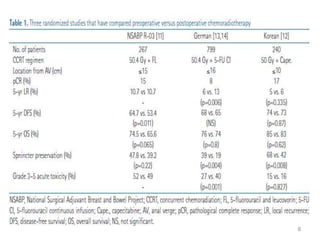
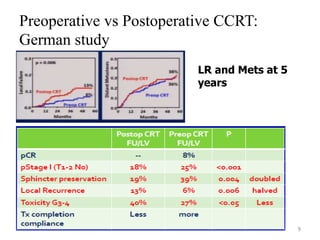
Preoperative vs Postoperative CCRT:
German study
9
LR and Mets at 5
years
10
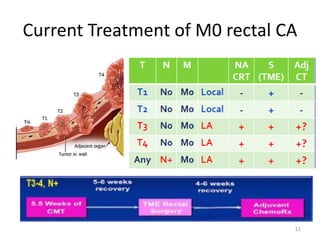
Current Treatment of M0 rectal CA
11
• Aim of adjuvant systemic treatment in rectal cancer to
eradicate sub-clinical tumor micrometastases after
surgery, with or without the use of radiotherapy
• Stage III colon cancer, large RCTs have demonstrated a
reduction in recurrence and improvement of OS with
5-FU plus oxaliplatin (NSABP07, MOSAIC)
• However there is currently no consensus regarding the
optimal treatment for rectal cancer.
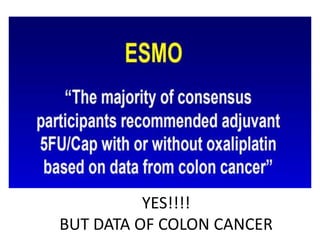
YES!!!!
BUT DATA OF COLON CANCER
Why!!
• Rectal cancers have distinct gene expression profile, fewer BRAF
mutations and less microsatellite instability
• colon and rectum posses distinct embryological origins as well as
anatomical and physiological characteristics.
• more difficult to achieve complete resection of rectal cancers with
circumferential margin involvement compared to colonic cancers
• rectal cancers have a worse prognosis in the early stages of
disease, but longer survival in more advanced stages compared to
colonic tumours of the same stage (more local spread in rectal
cancers, distal mets in colon cancers)
14
• The QUASAR trial (n = 3239, 948 with rectal cancer) found
significantly prolonged overall and disease survival in patients
with stage Ⅱ (node negative) disease.
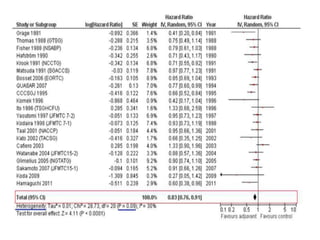
• Cochrane systematic review and meta-analysis (2012) of 21 RCTs
comparing postoperative chemotherapy with observation alone
found significant improvement in both overall (HR = 0.83, 95%CI:
0.76-0.91) and disease-free survival (HR = 0.75, 95%CI: 0.68-0.83)
• 5-FU based postoperative chemotherapy was associated with risk
reduction of 17% and 25% in overall and disease-free survival
respectively
15
• Benefits of chemoradiation for rectal cancer was established
in a number of trials (NSABP R-01, GITSG-7175, NCCTG-
794751, GITSG-7180) in 1980s and early 1990s and is now a
recommended optimal treatment modality.
• only the GITSG-7175 trial compared postoperative
chemotherapy alone vs chemoradiotherapy and found no
significant difference in survival and local recurrence rates
• preoperative with postoperative chemoradiation showed that
patients achieve significantly better local control and have
lower levels of systemic toxicity, although overall survival is
similar in both approaches
16
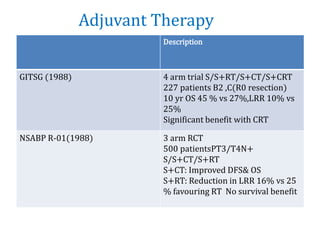
Adjuvant Therapy
Description
GITSG (1988) 4 arm trial S/S+RT/S+CT/S+CRT
227 patients B2 ,C(R0 resection)
10 yr OS 45 % vs 27%,LRR 10% vs
25%
Significant benefit with CRT
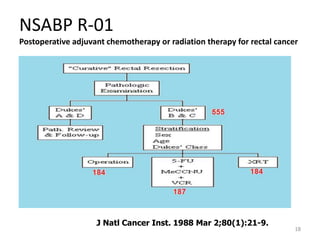
NSABP R-01(1988) 3 arm RCT
500 patientsPT3/T4N+
S/S+CT/S+RT
S+CT: Improved DFS& OS
S+RT: Reduction in LRR 16% vs 25
% favouring RT No survival benefit
NSABP R-01
Postoperative adjuvant chemotherapy or radiation therapy for rectal cancer
18
J Natl Cancer Inst. 1988 Mar 2;80(1):21-9.
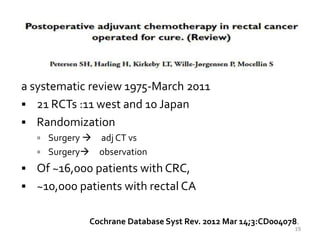
a systematic review 1975-March 2011
 21 RCTs :11 west and 10 Japan
 Randomization
 Surgery  adj CT vs
 Surgery observation
 Of ~16,000 patients with CRC,
 ~10,000 patients with rectal CA
Cochrane Database Syst Rev. 2012 Mar 14;3:CD004078.
19
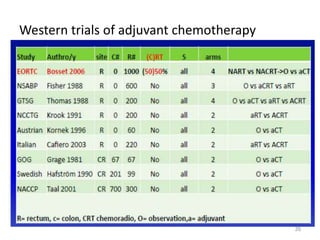
Western trials of adjuvant chemotherapy
20
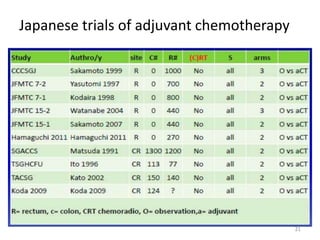
Japanese trials of adjuvant chemotherapy
21
22
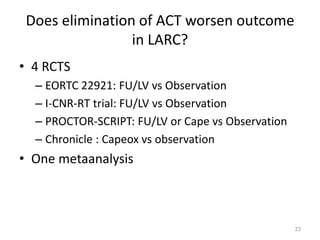
Does elimination of ACT worsen outcome
in LARC?
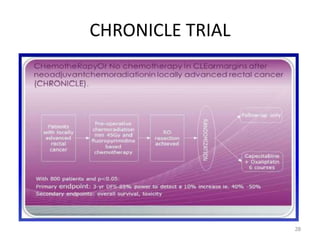
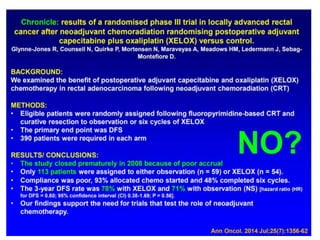
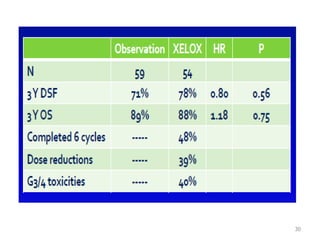
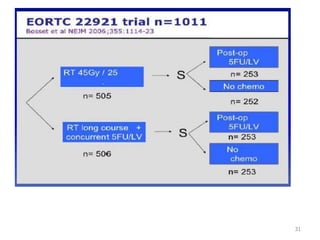
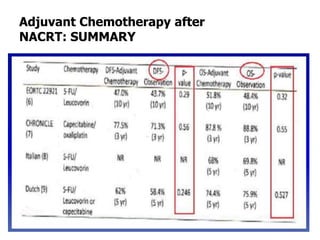
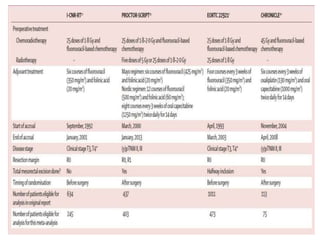
• 4 RCTS
– EORTC 22921: FU/LV vs Observation
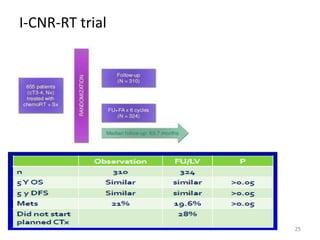
– I-CNR-RT trial: FU/LV vs Observation
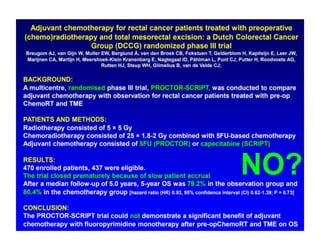
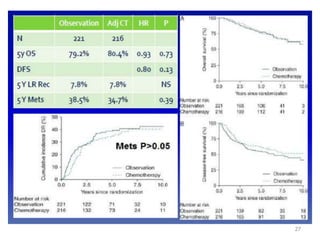
– PROCTOR-SCRIPT: FU/LV or Cape vs Observation
– Chronicle : Capeox vs observation
• One metaanalysis
23
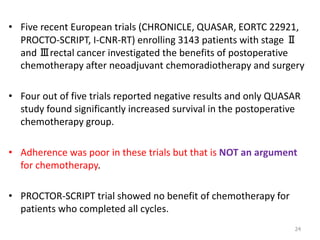
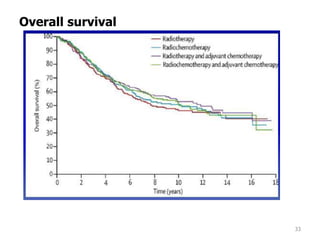
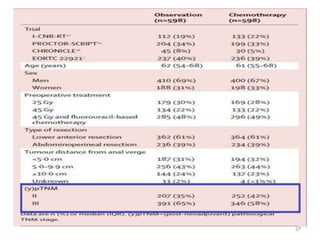
• Five recent European trials (CHRONICLE, QUASAR, EORTC 22921,
PROCTO-SCRIPT, I-CNR-RT) enrolling 3143 patients with stage Ⅱ
and Ⅲrectal cancer investigated the benefits of postoperative
chemotherapy after neoadjuvant chemoradiotherapy and surgery
• Four out of five trials reported negative results and only QUASAR
study found significantly increased survival in the postoperative
chemotherapy group.
• Adherence was poor in these trials but that is NOT an argument
for chemotherapy.
• PROCTOR-SCRIPT trial showed no benefit of chemotherapy for
patients who completed all cycles.
24
I-CNR-RT trial
25
27
CHRONICLE TRIAL
28
30
31
32
33
Overall survival
34
Adjuvant Chemotherapy after
NACRT: SUMMARY
35
36
37
38
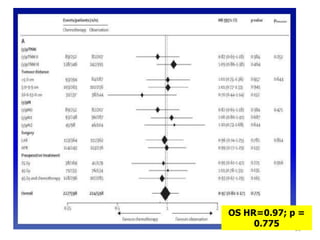
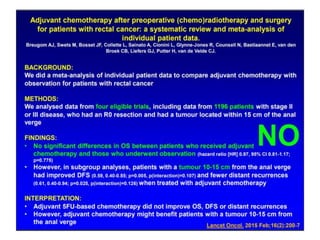
OS HR=0.97; p =
0.775
39
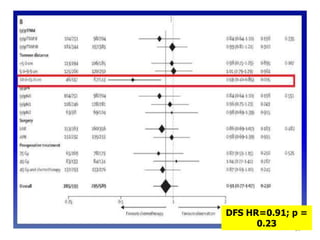
DFS HR=0.91; p =
0.23
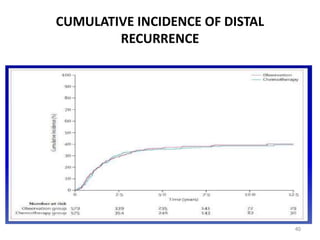
CUMULATIVE INCIDENCE OF DISTAL
RECURRENCE
40
42
St. Gallen’s recommendations
• Cancer-related deaths due to distant metastasis
• ACT reduces the incidence of distant relapse and improves
overall survival.
• Most panelists (83%) recommended against ACT for cN0/ypN0
tumors
• For cN+/ypN0 the panelists opinion on ACT was divided (pro
41%, con 59%)
• Histologically confirmed positive lymph nodes after
neoadjuvant RCT (ypN+), the majority of panelists (77%) voted
in favour of ACT.
44
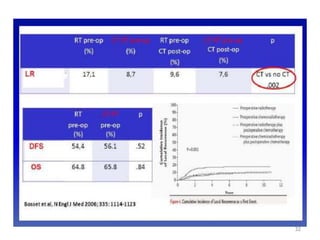
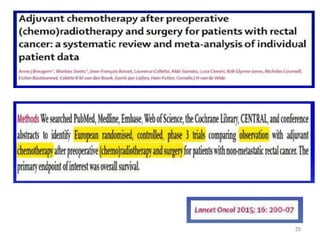
EORTC 22921: FU/LV vs Observation; 10 year
results
• In Lancet oncol- 10-year overall survival was 49·4% for the
preoperative RT group and 50·7%for the preoperative CTRT
group (p=0·91).
• 10-year overall survival was 51·8% for the adjuvant CT group
and 48·4% for the surveillance group (p=0·32)
• This trial does not support the current practice of adjuvant
chemotherapy after preoperative radiotherapy with or
without chemotherapy
45
Conclusion
• Preop RT/Postop CRT improves local control and
survival over surgery alone for locally advanced tumors
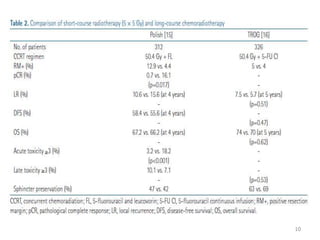
• Recommendation of long-course RCT over short-course
radiotherapy for most clinical situations where
neoadjuvant treatment is indicated, with the exception
of T3a/b N0 tumours where short-course radiotherapy or
even no neoadjuvant therapy were regarded to be an
option
IN LARC (T3-4 or N+) if Preop CRT GIVEN THEN
• Adjuvant CTx is indicated in:
– High rectal tumors (10-15 CM from AV):
• Pathologic stage y-II & y-III
• Regimen: (CapeOx/FOLOFOX in y-III, ?? FU/Cape in y-II)
– Mid or low rectal tumors
• Pathologic stage y-III (i.e. pN+)
• Regimen: CapeOx/FOLOFOX
• High-risk y-II (all pT4 and pT3 + high risk features)
• Regimen: ?? FU/Cape
47
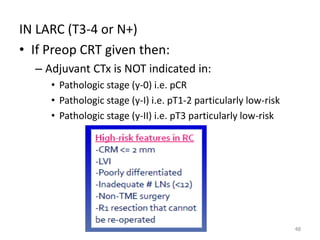
IN LARC (T3-4 or N+)
• If Preop CRT given then:
– Adjuvant CTx is NOT indicated in:
• Pathologic stage (y-0) i.e. pCR
• Pathologic stage (y-I) i.e. pT1-2 particularly low-risk
• Pathologic stage (y-II) i.e. pT3 particularly low-risk
48
• Technology has given us
new tools to hit
targets………. BUT LET US
NOT BECOME LIKE
MASLOW ……….
• THANK YOU

Rectal cancer debate: Chemoradiation

  • 1.
    Chemo-radiation in Rectalcancer: Is Adjuvant Chemotherapy required Dr. Ashutosh Mukherji Additional Professor, Department of Radiation Oncology, Regional Cancer Centre, JIPMER
  • 2.
    Need of MultidisciplinaryApproach • Surgery is the gold standard • Proven benefits of total mesorectal excision • Parallel to improvement in surgical technique adjuvant therapy reduce local recurrence rate • Dramatic changes in management of rectal cancers. Multidisciplinary management: Paradigm shift
  • 3.
  • 4.
    MULTIDISCIPLINARY MANAGEMENT : WHEREARE WE GOING? • Benefits of RT/CRT Vs Burden • Identify the patients at low risk of local recurrence, and ideally may not benefit from neo-adjuvant therapy • Prognostic role of circumferential resection margin (CRM) • ESMO sub-categorize rectal tumours (favourable, intermediate ,high risk ) based on MRI finding (Low risk ?? Benefit )
  • 5.
    Adjuvant Therapy: RectalCancer • High rate of local recurrence locally advanced disease. Tumor fixation is a limitation • Adjuvant radiotherapy significant increase in loco-regional control • Sphincter sparing procedure, Organ preservation • No improvement with DFS,OS and distant metastasis • Role of adjuvant chemo-radiotherapy was evaluated to improve treatment outcome .
  • 6.
    • Debate ison the ideal modality and sequence of combination treatment for intermediate stages. • T3b or less tumours in the upper or middle rectum have low risk of local failure, if the tumor is > 1mm from the mesorectal fascia (MRF) • ESMO guidelines consider primary surgery followed by adjuvant treatment • NCCN guidelines favor preoperative chemotherapy or preoperative combined radiochemotherapy and recommend adjuvant 6
  • 7.
    Preoperative vs Postoperative approach oPre-operative RT o Tumour downstaging and improve resection, o Better tolerance o Higher biologically effective dose intact vascularity. Evaluation of patients on basis of pathological features not possible o Post operative RT o Hypoxic post surgical bed Chemotherapy and RT less effective o Higher morbidity : small bowel, large treatment volume Selectively treat patients with high risk histopath features
  • 8.
  • 9.
    Preoperative vs PostoperativeCCRT: German study 9 LR and Mets at 5 years
  • 10.
  • 11.
    Current Treatment ofM0 rectal CA 11
  • 12.
    • Aim ofadjuvant systemic treatment in rectal cancer to eradicate sub-clinical tumor micrometastases after surgery, with or without the use of radiotherapy • Stage III colon cancer, large RCTs have demonstrated a reduction in recurrence and improvement of OS with 5-FU plus oxaliplatin (NSABP07, MOSAIC) • However there is currently no consensus regarding the optimal treatment for rectal cancer.
  • 13.
    YES!!!! BUT DATA OFCOLON CANCER
  • 14.
    Why!! • Rectal cancershave distinct gene expression profile, fewer BRAF mutations and less microsatellite instability • colon and rectum posses distinct embryological origins as well as anatomical and physiological characteristics. • more difficult to achieve complete resection of rectal cancers with circumferential margin involvement compared to colonic cancers • rectal cancers have a worse prognosis in the early stages of disease, but longer survival in more advanced stages compared to colonic tumours of the same stage (more local spread in rectal cancers, distal mets in colon cancers) 14
  • 15.
    • The QUASARtrial (n = 3239, 948 with rectal cancer) found significantly prolonged overall and disease survival in patients with stage Ⅱ (node negative) disease. • Cochrane systematic review and meta-analysis (2012) of 21 RCTs comparing postoperative chemotherapy with observation alone found significant improvement in both overall (HR = 0.83, 95%CI: 0.76-0.91) and disease-free survival (HR = 0.75, 95%CI: 0.68-0.83) • 5-FU based postoperative chemotherapy was associated with risk reduction of 17% and 25% in overall and disease-free survival respectively 15
  • 16.
    • Benefits ofchemoradiation for rectal cancer was established in a number of trials (NSABP R-01, GITSG-7175, NCCTG- 794751, GITSG-7180) in 1980s and early 1990s and is now a recommended optimal treatment modality. • only the GITSG-7175 trial compared postoperative chemotherapy alone vs chemoradiotherapy and found no significant difference in survival and local recurrence rates • preoperative with postoperative chemoradiation showed that patients achieve significantly better local control and have lower levels of systemic toxicity, although overall survival is similar in both approaches 16
  • 17.
    Adjuvant Therapy Description GITSG (1988)4 arm trial S/S+RT/S+CT/S+CRT 227 patients B2 ,C(R0 resection) 10 yr OS 45 % vs 27%,LRR 10% vs 25% Significant benefit with CRT NSABP R-01(1988) 3 arm RCT 500 patientsPT3/T4N+ S/S+CT/S+RT S+CT: Improved DFS& OS S+RT: Reduction in LRR 16% vs 25 % favouring RT No survival benefit
  • 18.
    NSABP R-01 Postoperative adjuvantchemotherapy or radiation therapy for rectal cancer 18 J Natl Cancer Inst. 1988 Mar 2;80(1):21-9.
  • 19.
    a systematic review1975-March 2011  21 RCTs :11 west and 10 Japan  Randomization  Surgery  adj CT vs  Surgery observation  Of ~16,000 patients with CRC,  ~10,000 patients with rectal CA Cochrane Database Syst Rev. 2012 Mar 14;3:CD004078. 19
  • 20.
    Western trials ofadjuvant chemotherapy 20
  • 21.
    Japanese trials ofadjuvant chemotherapy 21
  • 22.
  • 23.
    Does elimination ofACT worsen outcome in LARC? • 4 RCTS – EORTC 22921: FU/LV vs Observation – I-CNR-RT trial: FU/LV vs Observation – PROCTOR-SCRIPT: FU/LV or Cape vs Observation – Chronicle : Capeox vs observation • One metaanalysis 23
  • 24.
    • Five recentEuropean trials (CHRONICLE, QUASAR, EORTC 22921, PROCTO-SCRIPT, I-CNR-RT) enrolling 3143 patients with stage Ⅱ and Ⅲrectal cancer investigated the benefits of postoperative chemotherapy after neoadjuvant chemoradiotherapy and surgery • Four out of five trials reported negative results and only QUASAR study found significantly increased survival in the postoperative chemotherapy group. • Adherence was poor in these trials but that is NOT an argument for chemotherapy. • PROCTOR-SCRIPT trial showed no benefit of chemotherapy for patients who completed all cycles. 24
  • 25.
  • 27.
  • 28.
  • 30.
  • 31.
  • 32.
  • 33.
  • 34.
  • 35.
  • 36.
  • 37.
  • 38.
  • 39.
  • 40.
    CUMULATIVE INCIDENCE OFDISTAL RECURRENCE 40
  • 42.
  • 44.
    St. Gallen’s recommendations •Cancer-related deaths due to distant metastasis • ACT reduces the incidence of distant relapse and improves overall survival. • Most panelists (83%) recommended against ACT for cN0/ypN0 tumors • For cN+/ypN0 the panelists opinion on ACT was divided (pro 41%, con 59%) • Histologically confirmed positive lymph nodes after neoadjuvant RCT (ypN+), the majority of panelists (77%) voted in favour of ACT. 44
  • 45.
    EORTC 22921: FU/LVvs Observation; 10 year results • In Lancet oncol- 10-year overall survival was 49·4% for the preoperative RT group and 50·7%for the preoperative CTRT group (p=0·91). • 10-year overall survival was 51·8% for the adjuvant CT group and 48·4% for the surveillance group (p=0·32) • This trial does not support the current practice of adjuvant chemotherapy after preoperative radiotherapy with or without chemotherapy 45
  • 46.
    Conclusion • Preop RT/PostopCRT improves local control and survival over surgery alone for locally advanced tumors • Recommendation of long-course RCT over short-course radiotherapy for most clinical situations where neoadjuvant treatment is indicated, with the exception of T3a/b N0 tumours where short-course radiotherapy or even no neoadjuvant therapy were regarded to be an option
  • 47.
    IN LARC (T3-4or N+) if Preop CRT GIVEN THEN • Adjuvant CTx is indicated in: – High rectal tumors (10-15 CM from AV): • Pathologic stage y-II & y-III • Regimen: (CapeOx/FOLOFOX in y-III, ?? FU/Cape in y-II) – Mid or low rectal tumors • Pathologic stage y-III (i.e. pN+) • Regimen: CapeOx/FOLOFOX • High-risk y-II (all pT4 and pT3 + high risk features) • Regimen: ?? FU/Cape 47
  • 48.
    IN LARC (T3-4or N+) • If Preop CRT given then: – Adjuvant CTx is NOT indicated in: • Pathologic stage (y-0) i.e. pCR • Pathologic stage (y-I) i.e. pT1-2 particularly low-risk • Pathologic stage (y-II) i.e. pT3 particularly low-risk 48
  • 49.
    • Technology hasgiven us new tools to hit targets………. BUT LET US NOT BECOME LIKE MASLOW ………. • THANK YOU