Robert Sinha, M.D.
     Radiation Oncologist
  Western Radiation Oncolgy
Dorothy Schneider Cancer Center
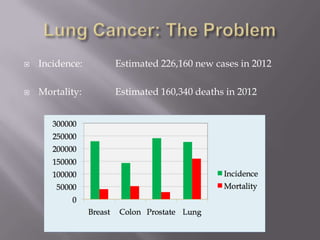
   Incidence:   Estimated 226,160 new cases in 2012

   Mortality:   Estimated 160,340 deaths in 2012
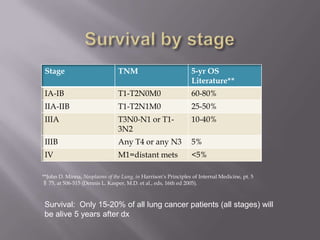
Stage                           TNM                             5-yr OS
                                                                 Literature**
 IA-IB                           T1-T2N0M0                       60-80%
 IIA-IIB                         T1-T2N1M0                       25-50%
 IIIA                            T3N0-N1 or T1-                  10-40%
                                 3N2
 IIIB                            Any T4 or any N3                5%
 IV                              M1=distant mets                 <5%

**John D. Minna, Neoplasms of the Lung, in Harrison’s Principles of Internal Medicine, pt. 5
§ 75, at 506-515 (Dennis L. Kasper, M.D. et al., eds, 16th ed 2005).


Survival: Only 15-20% of all lung cancer patients (all stages) will
be alive 5 years after dx
   Palliation of symptoms for advanced disease
           Brain and bone mets, local symptoms


   Curative Intent in Stage IIIA and IIIB disease
           5 year survival rates of 10 to 30%


   Curative Intent for medically inoperable patients
           Local control with traditional radiotherapy: 25-30%%
           New techniques like SBRT have local control ~ 90%
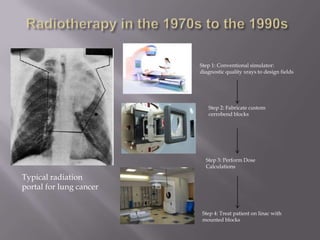
Step 1: Conventional simulator:
                         diagnostic quality xrays to design fields


                            Step 2: Fabricate custom
                            cerrobend blocks


                           Step 3: Perform Dose
                           Calculations

Typical radiation
portal for lung cancer


                          Step 4: Treat patient on linac with
                          mounted blocks
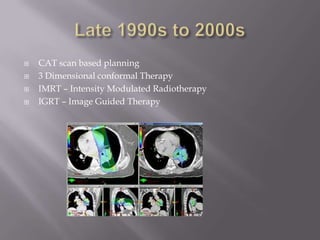
   CAT scan based planning
   3 Dimensional conformal Therapy
   IMRT – Intensity Modulated Radiotherapy
   IGRT – Image Guided Therapy
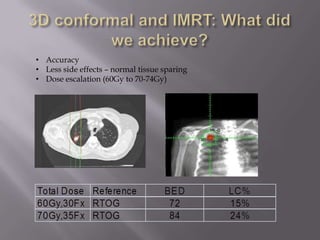
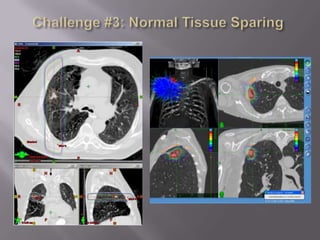
• Accuracy
• Less side effects – normal tissue sparing
• Dose escalation (60Gy to 70-74Gy)
   Target definition
   Target Motion
       Respiratory motion/tracking
   Normal tissue tolerance/Increasing dose
       Conventional XRT limited to 70Gy
   Duration of therapy
       6 to 7 weeks for conventional therapy is difficult for
        medically inoperable patients
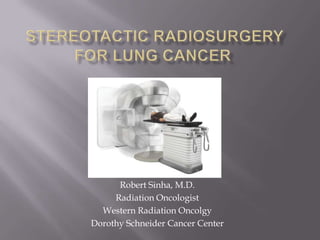
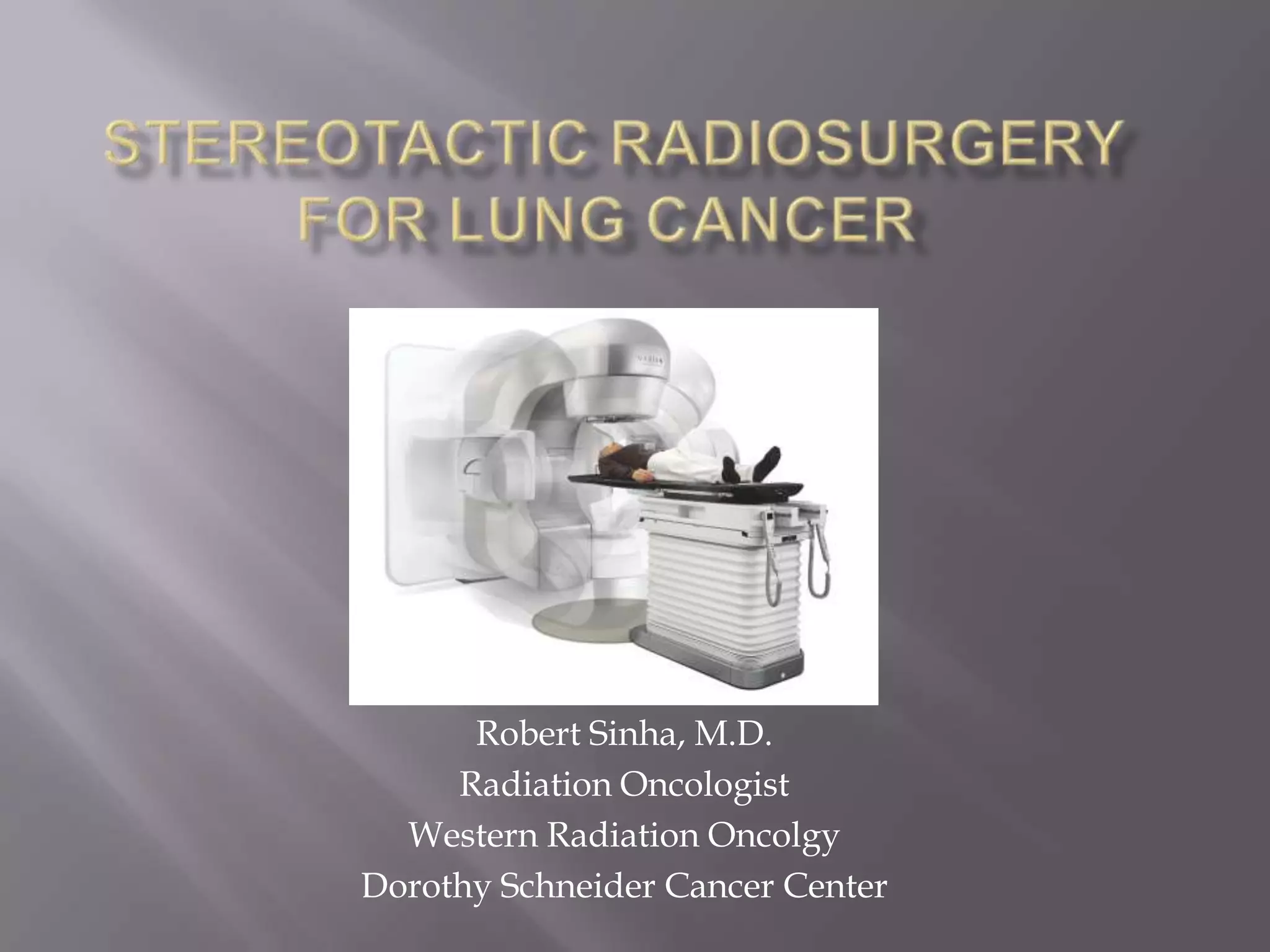
Stereotactic Body Radiosurgery (SBRT):
          The Ultimate “Targeted Therapy”


   Highly focused radiation concentrated on the tumor –
    with sub-millimeter accuracy
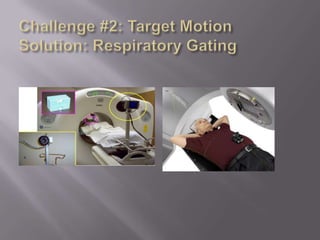
   Continuous tumor tracking – via respiratory gating
   Typically 5 or less treatments– high dose per treatment
   Biologic Equivalent doses greater than 120Gy at 2Gy/fx
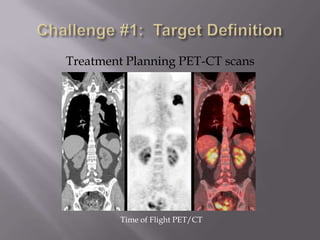
Treatment Planning PET-CT scans


        Time of Flight PET/CT
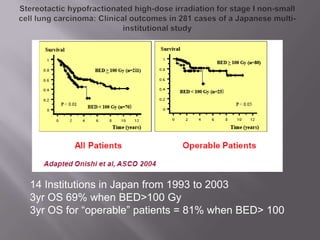
14 Institutions in Japan from 1993 to 2003
3yr OS 69% when BED>100 Gy
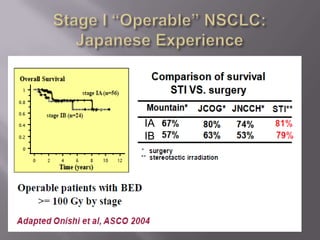
3yr OS for “operable” patients = 81% when BED> 100
IA
IB
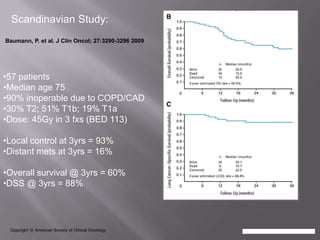
Scandinavian Study:
Baumann, P. et al. J Clin Oncol; 27:3290-3296 2009


•57 patients
•Median age 75
•90% inoperable due to COPD/CAD
•30% T2; 51% T1b; 19% T1a
•Dose: 45Gy in 3 fxs (BED 113)

•Local control at 3yrs = 93%
•Distant mets at 3yrs = 16%

•Overall survival @ 3yrs = 60%
•DSS @ 3yrs = 88%


 Copyright © American Society of Clinical Oncology
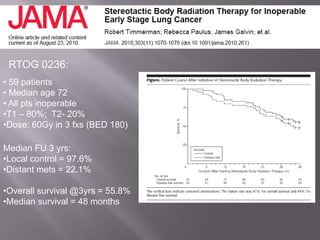
RTOG 0236:
• 59 patients
• Median age 72
• All pts inoperable
•T1 – 80%; T2- 20%
•Dose: 60Gy in 3 fxs (BED 180)

Median FU 3 yrs:
•Local control = 97.6%
•Distant mets = 22.1%

•Overall survival @3yrs = 55.8%
•Median survival = 48 months
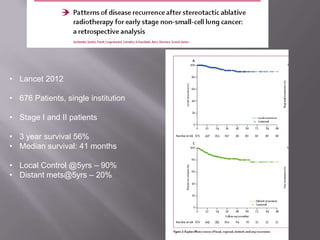
• Lancet 2012

• 676 Patients, single institution

• Stage I and II patients

• 3 year survival 56%
• Median survival: 41 months

• Local Control @5yrs – 90%
• Distant mets@5yrs – 20%
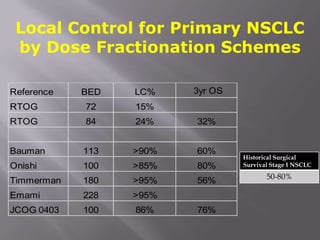
Local Control for Primary NSCLC
 by Dose Fractionation Schemes

Reference   BED   LC%    3yr OS
RTOG        72    15%
RTOG        84    24%    32%


Bauman      113   >90%   60%
                                  Historical Surgical
Onishi      100   >85%   80%      Survival Stage I NSCLC
                                         50-80%
Timmerman   180   >95%   56%
Emami       228   >95%
JCOG 0403   100   86%    76%
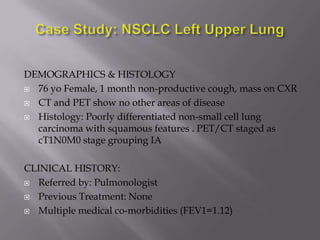
DEMOGRAPHICS & HISTOLOGY
 76 yo Female, 1 month non-productive cough, mass on CXR

 CT and PET show no other areas of disease

 Histology: Poorly differentiated non-small cell lung
  carcinoma with squamous features . PET/CT staged as
  cT1N0M0 stage grouping IA

CLINICAL HISTORY:
 Referred by: Pulmonologist

 Previous Treatment: None

 Multiple medical co-morbidities (FEV1=1.12)
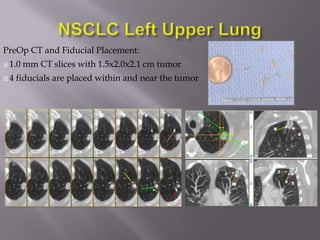
PreOp CT and Fiducial Placement:
 1.0   mm CT slices with 1.5x2.0x2.1 cm tumor
4   fiducials are placed within and near the tumor
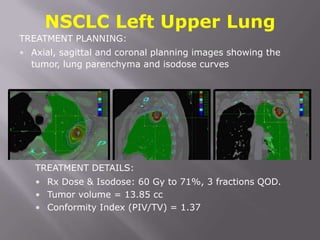
NSCLC Left Upper Lung
TREATMENT PLANNING:
• Axial, sagittal and coronal planning images showing the
  tumor, lung parenchyma and isodose curves


   TREATMENT DETAILS:
   • Rx Dose & Isodose: 60 Gy to 71%, 3 fractions QOD.
   • Tumor volume = 13.85 cc
   • Conformity Index (PIV/TV) = 1.37
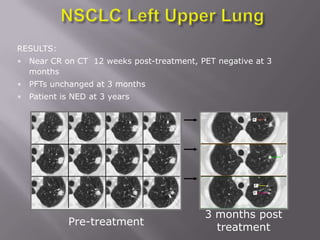
RESULTS:
• Near CR on CT 12 weeks post-treatment, PET negative at 3
  months
• PFTs unchanged at 3 months
• Patient is NED at 3 years


                                          3 months post
            Pre-treatment
                                            treatment
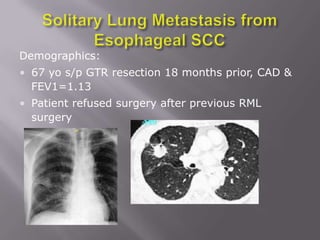
Demographics:
• 67 yo s/p GTR resection 18 months prior, CAD &
  FEV1=1.13
• Patient refused surgery after previous RML
  surgery
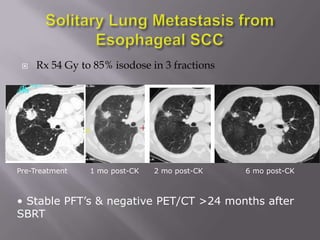
   Rx 54 Gy to 85% isodose in 3 fractions


Pre-Treatment   1 mo post-CK   2 mo post-CK   6 mo post-CK


• Stable PFT’s & negative PET/CT >24 months after
SBRT
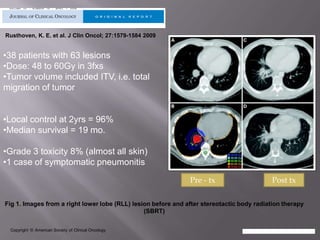
Rusthoven, K. E. et al. J Clin Oncol; 27:1579-1584 2009


•38 patients with 63 lesions
•Dose: 48 to 60Gy in 3fxs
•Tumor volume included ITV, i.e. total
migration of tumor


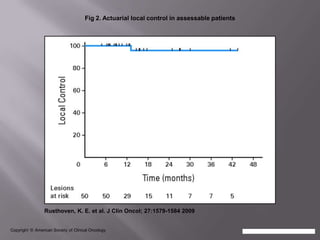
•Local control at 2yrs = 96%
•Median survival = 19 mo.

•Grade 3 toxicity 8% (almost all skin)
•1 case of symptomatic pneumonitis
                                                               Pre - tx                     Post tx

Fig 1. Images from a right lower lobe (RLL) lesion before and after stereotactic body radiation therapy
                                                (SBRT)

 Copyright © American Society of Clinical Oncology
Fig 2. Actuarial local control in assessable patients


                 Rusthoven, K. E. et al. J Clin Oncol; 27:1579-1584 2009


Copyright © American Society of Clinical Oncology
   Systemic therapies are improving, prolonging
    survival
   But, systemic therapy still can’t durably control
    GROSS DISEASE (perhaps never will)
   Residual disease can “re-seed”
   SBRT: A minimally toxic yet potent local
    therapy to consolidate all gross disease
   SBRT is emerging as the new “standard of
    care” for medically inoperable early stage
    NSCLC patients
   Early data suggest that it may also achieve high
    local control and survival rates in operable
    patients
   SBRT is a promising treatment modality for
    patients with oligiometastatic dz to the lung.
   Randomized comparison of Surgery vs SABR
    for operable patients
           ACOSOG Z4099/RTOG 1021 – Wedge vs SABR
           STARS Trial – Lobectomy vs SABR for Stage I


   Can adjuvant systemic therapy improve outcomes for
    early stage inoperable patients?
           CALGB/RTOG – SABR +/- chemo for 2-5cm T1 tumors
Stereotactic Radiosurgery for Lung Cancer

Stereotactic Radiosurgery for Lung Cancer

  • 1.
    Robert Sinha, M.D. Radiation Oncologist Western Radiation Oncolgy Dorothy Schneider Cancer Center
  • 2.
    Incidence: Estimated 226,160 new cases in 2012  Mortality: Estimated 160,340 deaths in 2012
  • 3.
    Stage TNM 5-yr OS Literature** IA-IB T1-T2N0M0 60-80% IIA-IIB T1-T2N1M0 25-50% IIIA T3N0-N1 or T1- 10-40% 3N2 IIIB Any T4 or any N3 5% IV M1=distant mets <5% **John D. Minna, Neoplasms of the Lung, in Harrison’s Principles of Internal Medicine, pt. 5 § 75, at 506-515 (Dennis L. Kasper, M.D. et al., eds, 16th ed 2005). Survival: Only 15-20% of all lung cancer patients (all stages) will be alive 5 years after dx
  • 4.
    Palliation of symptoms for advanced disease  Brain and bone mets, local symptoms  Curative Intent in Stage IIIA and IIIB disease  5 year survival rates of 10 to 30%  Curative Intent for medically inoperable patients  Local control with traditional radiotherapy: 25-30%%  New techniques like SBRT have local control ~ 90%
  • 5.
    Step 1: Conventionalsimulator: diagnostic quality xrays to design fields Step 2: Fabricate custom cerrobend blocks Step 3: Perform Dose Calculations Typical radiation portal for lung cancer Step 4: Treat patient on linac with mounted blocks
  • 6.
    CAT scan based planning  3 Dimensional conformal Therapy  IMRT – Intensity Modulated Radiotherapy  IGRT – Image Guided Therapy
  • 7.
    • Accuracy • Lessside effects – normal tissue sparing • Dose escalation (60Gy to 70-74Gy)
  • 8.
    Target definition  Target Motion  Respiratory motion/tracking  Normal tissue tolerance/Increasing dose  Conventional XRT limited to 70Gy  Duration of therapy  6 to 7 weeks for conventional therapy is difficult for medically inoperable patients
  • 9.
    Stereotactic Body Radiosurgery(SBRT): The Ultimate “Targeted Therapy”  Highly focused radiation concentrated on the tumor – with sub-millimeter accuracy  Continuous tumor tracking – via respiratory gating  Typically 5 or less treatments– high dose per treatment  Biologic Equivalent doses greater than 120Gy at 2Gy/fx
  • 10.
    Treatment Planning PET-CTscans Time of Flight PET/CT
  • 13.
    14 Institutions inJapan from 1993 to 2003 3yr OS 69% when BED>100 Gy 3yr OS for “operable” patients = 81% when BED> 100
  • 14.
  • 15.
    Scandinavian Study: Baumann, P.et al. J Clin Oncol; 27:3290-3296 2009 •57 patients •Median age 75 •90% inoperable due to COPD/CAD •30% T2; 51% T1b; 19% T1a •Dose: 45Gy in 3 fxs (BED 113) •Local control at 3yrs = 93% •Distant mets at 3yrs = 16% •Overall survival @ 3yrs = 60% •DSS @ 3yrs = 88% Copyright © American Society of Clinical Oncology
  • 16.
    RTOG 0236: • 59patients • Median age 72 • All pts inoperable •T1 – 80%; T2- 20% •Dose: 60Gy in 3 fxs (BED 180) Median FU 3 yrs: •Local control = 97.6% •Distant mets = 22.1% •Overall survival @3yrs = 55.8% •Median survival = 48 months
  • 17.
    • Lancet 2012 •676 Patients, single institution • Stage I and II patients • 3 year survival 56% • Median survival: 41 months • Local Control @5yrs – 90% • Distant mets@5yrs – 20%
  • 18.
    Local Control forPrimary NSCLC by Dose Fractionation Schemes Reference BED LC% 3yr OS RTOG 72 15% RTOG 84 24% 32% Bauman 113 >90% 60% Historical Surgical Onishi 100 >85% 80% Survival Stage I NSCLC 50-80% Timmerman 180 >95% 56% Emami 228 >95% JCOG 0403 100 86% 76%
  • 19.
    DEMOGRAPHICS & HISTOLOGY 76 yo Female, 1 month non-productive cough, mass on CXR  CT and PET show no other areas of disease  Histology: Poorly differentiated non-small cell lung carcinoma with squamous features . PET/CT staged as cT1N0M0 stage grouping IA CLINICAL HISTORY:  Referred by: Pulmonologist  Previous Treatment: None  Multiple medical co-morbidities (FEV1=1.12)
  • 20.
    PreOp CT andFiducial Placement:  1.0 mm CT slices with 1.5x2.0x2.1 cm tumor 4 fiducials are placed within and near the tumor
  • 21.
    NSCLC Left UpperLung TREATMENT PLANNING: • Axial, sagittal and coronal planning images showing the tumor, lung parenchyma and isodose curves TREATMENT DETAILS: • Rx Dose & Isodose: 60 Gy to 71%, 3 fractions QOD. • Tumor volume = 13.85 cc • Conformity Index (PIV/TV) = 1.37
  • 22.
    RESULTS: • Near CRon CT 12 weeks post-treatment, PET negative at 3 months • PFTs unchanged at 3 months • Patient is NED at 3 years 3 months post Pre-treatment treatment
  • 23.
    Demographics: • 67 yos/p GTR resection 18 months prior, CAD & FEV1=1.13 • Patient refused surgery after previous RML surgery
  • 24.
    Rx 54 Gy to 85% isodose in 3 fractions Pre-Treatment 1 mo post-CK 2 mo post-CK 6 mo post-CK • Stable PFT’s & negative PET/CT >24 months after SBRT
  • 25.
    Rusthoven, K. E.et al. J Clin Oncol; 27:1579-1584 2009 •38 patients with 63 lesions •Dose: 48 to 60Gy in 3fxs •Tumor volume included ITV, i.e. total migration of tumor •Local control at 2yrs = 96% •Median survival = 19 mo. •Grade 3 toxicity 8% (almost all skin) •1 case of symptomatic pneumonitis Pre - tx Post tx Fig 1. Images from a right lower lobe (RLL) lesion before and after stereotactic body radiation therapy (SBRT) Copyright © American Society of Clinical Oncology
  • 26.
    Fig 2. Actuariallocal control in assessable patients Rusthoven, K. E. et al. J Clin Oncol; 27:1579-1584 2009 Copyright © American Society of Clinical Oncology
  • 27.
    Systemic therapies are improving, prolonging survival  But, systemic therapy still can’t durably control GROSS DISEASE (perhaps never will)  Residual disease can “re-seed”  SBRT: A minimally toxic yet potent local therapy to consolidate all gross disease
  • 28.
    SBRT is emerging as the new “standard of care” for medically inoperable early stage NSCLC patients  Early data suggest that it may also achieve high local control and survival rates in operable patients  SBRT is a promising treatment modality for patients with oligiometastatic dz to the lung.
  • 29.
    Randomized comparison of Surgery vs SABR for operable patients  ACOSOG Z4099/RTOG 1021 – Wedge vs SABR  STARS Trial – Lobectomy vs SABR for Stage I  Can adjuvant systemic therapy improve outcomes for early stage inoperable patients?  CALGB/RTOG – SABR +/- chemo for 2-5cm T1 tumors

Editor's Notes

  • #3 Lung cancer is the leading cause of cancer related mortality in the United States. The overall 5 year survival rate is around 15-20%.
  • #6 Typical radiation dose of 60Gy
  • #10 What is Stereotactic Body Radiotherapy:
  • #15 5 yr survival numbers updated at ASCO 2006, 74% OS for all Stage I operable patients
  • #17 None of the patients received ctx.Staging is old AJCCT1 &lt; 3cmT2 &lt;5cm