Techniques of mask
ventilation
Dr Tess Jose
PG resident
Introduction
• It is a noninvasive technique for airway management
• primary mode of ventilation for an anesthetic of short
duration or/ as a bridge to establish a more definitive airway.
• The use of a face mask :
Pre-oxygenation prior to induction of anaesthesia •
Inhalational induction of anaesthesia
 Bag-mask ventilation (BMV) prior to intubation/resuscitation
 Maintenance of anaesthesia
 Non-invasive ventilation for respiratory failure.
Types of face mask
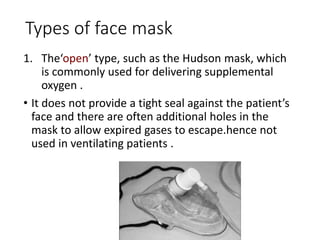
1. The‘open’ type, such as the Hudson mask, which
is commonly used for delivering supplemental
oxygen .
• It does not provide a tight seal against the patient’s
face and there are often additional holes in the
mask to allow expired gases to escape.hence not
used in ventilating patients .
II. Closed facemasks are designed to provide a
complete seal around the patient’s mouth and nose.
• This feature allows safe delivery of volatile agents
and, if required, for the patient to be ventilated
with positive pressure.
• This type of mask is commonly used during
resuscitation and general anaesthesia.
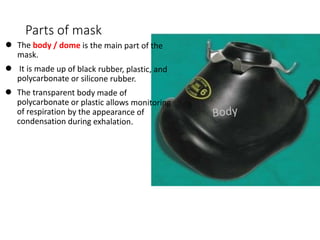
Parts of mask
Parts of mask
Connector / orifice
• The connector or mount or collar is on the top of
the body of mask and on opposite side from the
seal.
• It is thicker than body of the mask and has 22 mm
internal diameter.
harness is attached for hands free ventilation as
obstruction is more likely to occur hencesupervision
is needed.
strap should not be tight as they can cause pressure
on face and it should be released periodical.
Advantages of Disposable Masks
• Transparent hence can observe vomitus, secretions,
blood during anesthesia
• Use of inert plastic prevents risk of allergy
• Avoids the cost of sterilization
• Scented variety of disposable mask is more readily
accepted by patient
Disadvantages of Disposable
Masks
•Material is cheaper and may be of lower quality •
Limited range of designs and sizes available •Sizes
may not equate between manufacturers
• Some masks may have a poor quality seal due to
fixed volume of the air filled cuff
• Poor fit of the mask may cause ulceration on the
areas of face due to high pressure
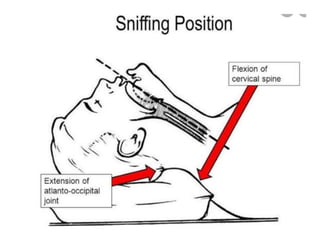
POSITIONING
• When manipulating the airway, correct patient
positioning is very helpful. Relative alignment of
the oral and pharyngeal axes is achieved by having
the patient in the “sniffing” position.
• When cervical spine pathology is suspected, the
head must be kept in a neutral position during all
airway manipulations
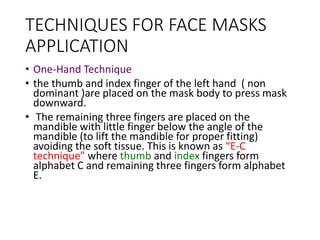
TECHNIQUES FOR FACE MASKS
APPLICATION
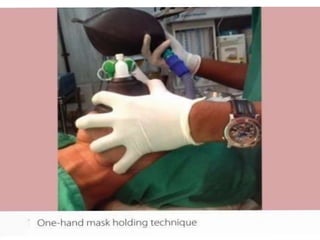
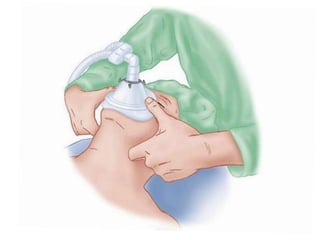
• One-Hand Technique
• the thumb and index finger of the left hand ( non
dominant )are placed on the mask body to press mask
downward.
• The remaining three fingers are placed on the
mandible with little finger below the angle of the
mandible (to lift the mandible for proper fitting)
avoiding the soft tissue. This is known as “E-C
technique” where thumb and index fingers form
alphabet C and remaining three fingers form alphabet
E.
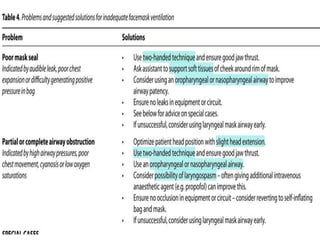
Signs of inadequate facemask
ventilation
Poor chest expansion.
 Absent or quiet breath sounds.
Audible gas leak or inability to generate positive pressure with
bag.
Visible gastric insufflation or audible insufflation with
stethoscope.
Absent or poor end-tidal CO2 trace (if available).
Patient cyanosis or, if available, low oxygen saturation (<92%).
Haemodynamic consequences of hypoxaemia or hypercarbia
(tachycardia, hyper- or hypotension). these are late signs.
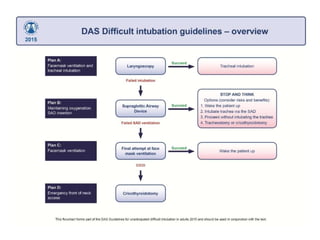
Two-Hands Technique
• It is used for difficult airway.
• two hands may be needed to provide adequate jaw
thrust and to create a mask seal.
• Therefore, an assistant may be needed to squeeze
the bag, or the machine’s ventilator can be used. In
such cases, the thumbs hold the mask down, and
the fingertips or knuckles displace the jaw forward
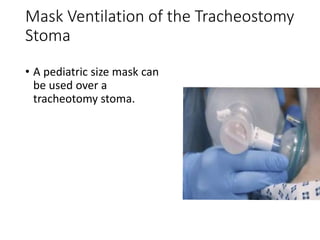
Mask Ventilation of the Tracheostomy
Stoma
• A pediatric size mask can
be used over a
tracheotomy stoma.
Difficult Face Mask Ventilation
• Bearded patient
• applying aqueous gel to the beard underneath the
rim of the face mark or using a large occlusive air-
tight dressing over the beard with a hole cut for the
mouth.
• Sometimes in anticipated difficult intubation, e.g.
higher Mallampati classification, obese patient,
receding mandible,etc.
Complication
Skin Allergy Chemical used for sterilization of reusable masks can cause
allergic reaction or if rubber is a component of a face mask, a serious
reaction can occur in the patient with latex allergy.
Nerve Injury
• Pressure from a mask or mask strap and jaw thrust for a long time may
result in pressure injury to underlying nerves. The mask should be
removed from the face periodically so as to avoid continuous pressure
on one particular area.
• Gastric Inflation
• The chances of gastric inflation are more with masks than with
supraglottic airway device when used for positive pressure ventilation. It
is advisable to use inspiratory pressure below 20 cm H2O
• Eye Injury and Skin Necrosis
• mask holding for long time can cause eyelid
edema, chemosis of the conjunctiva, pressure on
the supraorbital nerve, corneal injury ,blindness
,skin ulceration and necrosis.
• Chemicals used for sterilization of masks can cause
corneal irritation and ulceration.
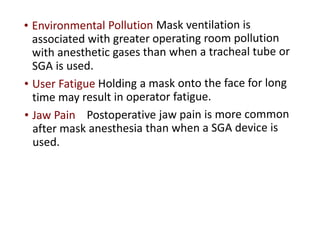
• Cervical Spine Movement
• Mask ventilation moves the cervical spine more
than supraglottic airway (SGA) or tracheal
intubation. This may be of significance in the
patient with an unstable cervical spine injury.
Reference
• Millers anaesthesia 9 E
• Understanding Anesthetic Equipment & Procedures
A Practical Approach.
• Anaesthesia using a facemask Nicholas Boyd and
Anna Negus |Update in Anaesthesia |
www.anaesthesiologists.org
• Morgan and mikhails 6 edition.
Thank you

Techniques of mask ventilation

  • 1.
    Techniques of mask ventilation DrTess Jose PG resident
  • 2.
    Introduction • It isa noninvasive technique for airway management • primary mode of ventilation for an anesthetic of short duration or/ as a bridge to establish a more definitive airway. • The use of a face mask : Pre-oxygenation prior to induction of anaesthesia • Inhalational induction of anaesthesia  Bag-mask ventilation (BMV) prior to intubation/resuscitation  Maintenance of anaesthesia  Non-invasive ventilation for respiratory failure.
  • 3.
    Types of facemask 1. The‘open’ type, such as the Hudson mask, which is commonly used for delivering supplemental oxygen . • It does not provide a tight seal against the patient’s face and there are often additional holes in the mask to allow expired gases to escape.hence not used in ventilating patients .
  • 4.
    II. Closed facemasksare designed to provide a complete seal around the patient’s mouth and nose. • This feature allows safe delivery of volatile agents and, if required, for the patient to be ventilated with positive pressure. • This type of mask is commonly used during resuscitation and general anaesthesia.
  • 5.
  • 6.
  • 8.
    Connector / orifice •The connector or mount or collar is on the top of the body of mask and on opposite side from the seal. • It is thicker than body of the mask and has 22 mm internal diameter.
  • 10.
    harness is attachedfor hands free ventilation as obstruction is more likely to occur hencesupervision is needed. strap should not be tight as they can cause pressure on face and it should be released periodical.
  • 11.
    Advantages of DisposableMasks • Transparent hence can observe vomitus, secretions, blood during anesthesia • Use of inert plastic prevents risk of allergy • Avoids the cost of sterilization • Scented variety of disposable mask is more readily accepted by patient
  • 12.
    Disadvantages of Disposable Masks •Materialis cheaper and may be of lower quality • Limited range of designs and sizes available •Sizes may not equate between manufacturers • Some masks may have a poor quality seal due to fixed volume of the air filled cuff • Poor fit of the mask may cause ulceration on the areas of face due to high pressure
  • 13.
    POSITIONING • When manipulatingthe airway, correct patient positioning is very helpful. Relative alignment of the oral and pharyngeal axes is achieved by having the patient in the “sniffing” position. • When cervical spine pathology is suspected, the head must be kept in a neutral position during all airway manipulations
  • 15.
    TECHNIQUES FOR FACEMASKS APPLICATION • One-Hand Technique • the thumb and index finger of the left hand ( non dominant )are placed on the mask body to press mask downward. • The remaining three fingers are placed on the mandible with little finger below the angle of the mandible (to lift the mandible for proper fitting) avoiding the soft tissue. This is known as “E-C technique” where thumb and index fingers form alphabet C and remaining three fingers form alphabet E.
  • 17.
    Signs of inadequatefacemask ventilation Poor chest expansion.  Absent or quiet breath sounds. Audible gas leak or inability to generate positive pressure with bag. Visible gastric insufflation or audible insufflation with stethoscope. Absent or poor end-tidal CO2 trace (if available). Patient cyanosis or, if available, low oxygen saturation (<92%). Haemodynamic consequences of hypoxaemia or hypercarbia (tachycardia, hyper- or hypotension). these are late signs.
  • 18.
    Two-Hands Technique • Itis used for difficult airway. • two hands may be needed to provide adequate jaw thrust and to create a mask seal. • Therefore, an assistant may be needed to squeeze the bag, or the machine’s ventilator can be used. In such cases, the thumbs hold the mask down, and the fingertips or knuckles displace the jaw forward
  • 20.
    Mask Ventilation ofthe Tracheostomy Stoma • A pediatric size mask can be used over a tracheotomy stoma.
  • 21.
  • 22.
    • Bearded patient •applying aqueous gel to the beard underneath the rim of the face mark or using a large occlusive air- tight dressing over the beard with a hole cut for the mouth. • Sometimes in anticipated difficult intubation, e.g. higher Mallampati classification, obese patient, receding mandible,etc.
  • 25.
    Complication Skin Allergy Chemicalused for sterilization of reusable masks can cause allergic reaction or if rubber is a component of a face mask, a serious reaction can occur in the patient with latex allergy. Nerve Injury • Pressure from a mask or mask strap and jaw thrust for a long time may result in pressure injury to underlying nerves. The mask should be removed from the face periodically so as to avoid continuous pressure on one particular area. • Gastric Inflation • The chances of gastric inflation are more with masks than with supraglottic airway device when used for positive pressure ventilation. It is advisable to use inspiratory pressure below 20 cm H2O
  • 26.
    • Eye Injuryand Skin Necrosis • mask holding for long time can cause eyelid edema, chemosis of the conjunctiva, pressure on the supraorbital nerve, corneal injury ,blindness ,skin ulceration and necrosis. • Chemicals used for sterilization of masks can cause corneal irritation and ulceration. • Cervical Spine Movement • Mask ventilation moves the cervical spine more than supraglottic airway (SGA) or tracheal intubation. This may be of significance in the patient with an unstable cervical spine injury.
  • 28.
    Reference • Millers anaesthesia9 E • Understanding Anesthetic Equipment & Procedures A Practical Approach. • Anaesthesia using a facemask Nicholas Boyd and Anna Negus |Update in Anaesthesia | www.anaesthesiologists.org • Morgan and mikhails 6 edition.
  • 29.