SPINAL
STABILIZATION
-SANDRA SUSAN SAJAN
BACHELOR OF PHYSIOTHERAPY
BRIEF FUNCTIONAL ANATOMY
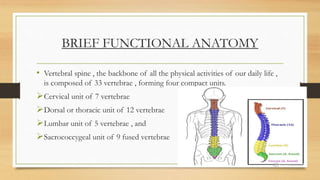
• Vertebral spine , the backbone of all the physical activities of our daily life ,
is composed of 33 vertebrae , forming four compact units.
Cervical unit of 7 vertebrae
Dorsal or thoracic unit of 12 vertebrae
Lumbar unit of 5 vertebrae , and
Sacrococcygeal unit of 9 fused vertebrae
• The units are specially designed to perform the following three functions:
• Free mobility to the neck by the cervical unit , and free mobility of the trunk
by the thoracolumbar unit.
• Stability (static as well as dynamic) to the body’s movement by the thoracic
and sacrococcygeal unit.
• Protection to the soft vital organs by the thoracic unit and to the spinal cord
by the vertebral chain formed by the cervical , dorsal as well as lumbar units.
*SPINAL STABILIZATION*
• Spinal cord stabilization involves surgical stabilization procedures that are used to
treat acute spinal injuries.
• Stabilization of the spinal cord is a surgical procedure in which bone fragments are
removed and the alignment of the vertebrae is restored.
• The degree of stabilization required depends on the severity of the problem and the
assessment done by a Surgeon.
• Spinal stabilization surgery involves inserting instruments such as screws and plates
in back of your spine to stabilize it and facilitate fusion after decompression.
• The spinal stability system consists of three sub-systems : passive spinal column ,
active spinal muscles and neural control unit.
• Spinal stability ensures the muscles in your spine are working in the right way
to properly support and stabilize the spine.
• Spinal stabilization is important if you suffer from chronic neck and back
pain , whether it is acute or chronic , and if you want to remain pain-free.
• Spinal stabilization becomes necessary to treat a number of spine conditions.
*IMPORTANCE OF SPINAL
STABILISATION
Why you would need Spinal Stabilization Surgery
• Spinal stabilization surgery is used to treat the following conditions:
Trauma from an auto or sports –related injury
Trauma due to falling from a high place , resulting in spinal compression , fractures ,
and other conditions
Degenerative conditions such as scoliosis and herniated discs
Spinal fractures from bone loss due to osteoporosis
Spondylolisthesis
Spinal tumors
What happens in Spinal Stabilization Surgery
• Different surgical procedures are used to stabilize your spine . A common surgery
involves instrumentation .
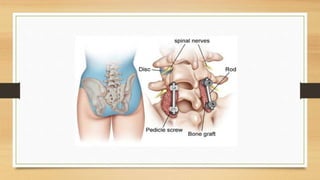
• Your surgeon will use hardware such as facet screws , percutaneous pedicle screws
and spinous process plates to fuse the backbones together .
• Spinal instrumentation is done along with decompression which is a minimally
invasive procedure performed to take pressure off the spinal cord or nerve roots .
Before inserting the hardware , your surgeon will remove the part of the spine that
is pressing on the nerves .
• After this , a fusion is done in which the surgeon puts in irradiated cadaver bone
secured with rods , screws and plates that hold everything together till the time the
patient’s bone and bone graft fuse together.
Minimally Invasive Spine Stabilization Surgery
• Minimally invasive stabilization procedures offer a safe and effective
treatment option for most spinal conditions.
• In the minimally invasive procedure , stabilization of the spine is performed
through a small incision without damaging or cutting the surrounding
muscles .
• A special X-Ray guides the surgeon throughout the procedure . A tabular
dilator is used to access the spine between the muscles . Retractors help keep
the space open during the procedure . Special implants are then placed to
fuse two or more vertebrae together.
How long does it take to recover from Spinal
Stabilization Surgery?
• The pain will subside in four weeks after the procedure . However , there will
be some pain over several months .
• Limited activity is allowed and there should be no lifting , bending ,and
twisting while the bones fuse together .
• Physical Therapy will start in the first week after the surgery with walking
and stretching followed by static stabilization exercises for the next two
months .
• It takes around six months to fully recover from Spinal Stabilization Surgery.
SPINAL STABILIZATION PPT

SPINAL STABILIZATION PPT

  • 1.
  • 2.
    BRIEF FUNCTIONAL ANATOMY •Vertebral spine , the backbone of all the physical activities of our daily life , is composed of 33 vertebrae , forming four compact units. Cervical unit of 7 vertebrae Dorsal or thoracic unit of 12 vertebrae Lumbar unit of 5 vertebrae , and Sacrococcygeal unit of 9 fused vertebrae
  • 3.
    • The unitsare specially designed to perform the following three functions: • Free mobility to the neck by the cervical unit , and free mobility of the trunk by the thoracolumbar unit. • Stability (static as well as dynamic) to the body’s movement by the thoracic and sacrococcygeal unit. • Protection to the soft vital organs by the thoracic unit and to the spinal cord by the vertebral chain formed by the cervical , dorsal as well as lumbar units.
  • 4.
    *SPINAL STABILIZATION* • Spinalcord stabilization involves surgical stabilization procedures that are used to treat acute spinal injuries. • Stabilization of the spinal cord is a surgical procedure in which bone fragments are removed and the alignment of the vertebrae is restored. • The degree of stabilization required depends on the severity of the problem and the assessment done by a Surgeon. • Spinal stabilization surgery involves inserting instruments such as screws and plates in back of your spine to stabilize it and facilitate fusion after decompression. • The spinal stability system consists of three sub-systems : passive spinal column , active spinal muscles and neural control unit.
  • 5.
    • Spinal stabilityensures the muscles in your spine are working in the right way to properly support and stabilize the spine. • Spinal stabilization is important if you suffer from chronic neck and back pain , whether it is acute or chronic , and if you want to remain pain-free. • Spinal stabilization becomes necessary to treat a number of spine conditions. *IMPORTANCE OF SPINAL STABILISATION
  • 6.
    Why you wouldneed Spinal Stabilization Surgery • Spinal stabilization surgery is used to treat the following conditions: Trauma from an auto or sports –related injury Trauma due to falling from a high place , resulting in spinal compression , fractures , and other conditions Degenerative conditions such as scoliosis and herniated discs Spinal fractures from bone loss due to osteoporosis Spondylolisthesis Spinal tumors
  • 7.
    What happens inSpinal Stabilization Surgery • Different surgical procedures are used to stabilize your spine . A common surgery involves instrumentation . • Your surgeon will use hardware such as facet screws , percutaneous pedicle screws and spinous process plates to fuse the backbones together . • Spinal instrumentation is done along with decompression which is a minimally invasive procedure performed to take pressure off the spinal cord or nerve roots . Before inserting the hardware , your surgeon will remove the part of the spine that is pressing on the nerves . • After this , a fusion is done in which the surgeon puts in irradiated cadaver bone secured with rods , screws and plates that hold everything together till the time the patient’s bone and bone graft fuse together.
  • 9.
    Minimally Invasive SpineStabilization Surgery • Minimally invasive stabilization procedures offer a safe and effective treatment option for most spinal conditions. • In the minimally invasive procedure , stabilization of the spine is performed through a small incision without damaging or cutting the surrounding muscles . • A special X-Ray guides the surgeon throughout the procedure . A tabular dilator is used to access the spine between the muscles . Retractors help keep the space open during the procedure . Special implants are then placed to fuse two or more vertebrae together.
  • 10.
    How long doesit take to recover from Spinal Stabilization Surgery? • The pain will subside in four weeks after the procedure . However , there will be some pain over several months . • Limited activity is allowed and there should be no lifting , bending ,and twisting while the bones fuse together . • Physical Therapy will start in the first week after the surgery with walking and stretching followed by static stabilization exercises for the next two months . • It takes around six months to fully recover from Spinal Stabilization Surgery.