


Lululemon
NASDAQ: LULU
Jason A. Moser
1
Retail’s brutal holiday season resulted in
weak top line growth & heavy discounting.
The move to ecommerce continues to
quickly shape the changing retail space.
Lululemon isn’t immune, however new
leadership, expanded product lines and
direct-to-consumer offer a powerful brand
on sale today.
2
The idea
3
What does Lululemon do?
It sells clothes. Plain and simple.
OK seriously, known primarily for its
women’s yoga gear, Lululemon is also
expanding its product line:“We also
continue to broaden our product range
to increasingly appeal to male athletes
and athletic female youth.”
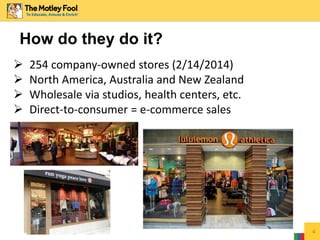
How do they do it?
4
 254 company-owned stores (2/14/2014)
 North America, Australia and New Zealand
 Wholesale via studios, health centers, etc.
 Direct-to-consumer = e-commerce sales
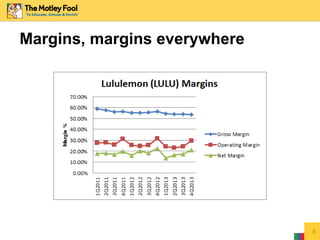
Margins, margins everywhere
5
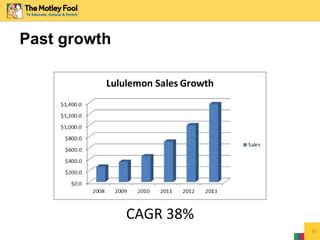
Past growth
6
CAGR 38%
7
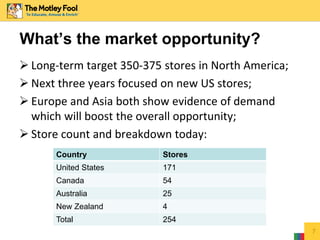
What’s the market opportunity?
 Long-term target 350-375 stores in North America;
 Next three years focused on new US stores;
 Europe and Asia both show evidence of demand
which will boost the overall opportunity;
 Store count and breakdown today:
Country Stores
United States 171
Canada 54
Australia 25
New Zealand 4
Total 254
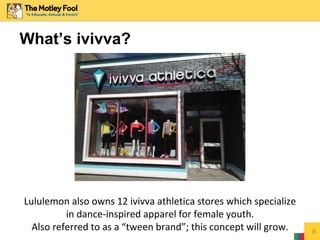
Lululemon also owns 12 ivivva athletica stores which specialize
in dance-inspired apparel for female youth.
Also referred to as a “tween brand”; this concept will grow. 8
What’s ivivva?
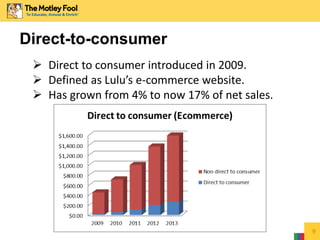
Direct-to-consumer
9
 Direct to consumer introduced in 2009.
 Defined as Lulu’s e-commerce website.
 Has grown from 4% to now 17% of net sales.
Who do they compete with?
10
Anyone and everyone
in the retail clothing industry,
fashion, sports or otherwise.
Management
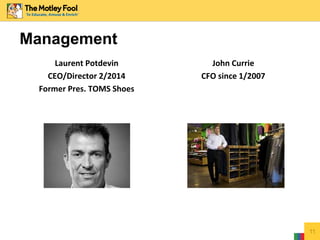
Laurent Potdevin
CEO/Director 2/2014
Former Pres. TOMS Shoes
John Currie
CFO since 1/2007
11
Management
Tara Poseley
CPO 10/2013
Former President Kmart Apparel as
well as 15 year tenure at Gap
Delaney Schweitzer
EVP Retail Ops NA 3/2010
With Lululemon since 2002
12
13
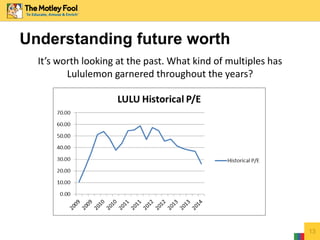
Understanding future worth
It’s worth looking at the past. What kind of multiples has
Lululemon garnered throughout the years?
 Lululemon is a cash flow rich business generating $170 million
in free cash flow for fiscal 2013.
 The company holds $700 million in cash and equivalents on
the balance sheet coupled with zero debt.
 Sales for fiscal 2014 are projected to be in the range of $1.77 -
$1.82 billion, gross margin, low 50% range, EPS $1.80 - $1.90.
 This puts the stock today at 27.5 times full year estimates yet
sales are expected to grow only 13% for fiscal 2014.
 It’s not a screaming bargain by any means, but it’s starting to
look much more attractive now than a year ago.
14
Understanding future worth
15
Lululemon typically carries one of the higher SPSF metrics in the
retail industry with only Tiffany and top-dog Apple ahead of it.
 What are management’s long-term margin goals?
Gross margin – 55%
Operating margin – 25%
Net margin – 20%
 Sales growth of 30%+ is done. Next five years will be 15%.
 Sales for fiscal 2018 of $3.2 billion, net income $640 million.
 Multiple scenarios:
20 - $12.8 billion market cap;
25 - $16 billion market cap;
30 - $19.2 billion market cap
Today’s market cap = $7.5 billion
16
Understanding future worth
 Retail is known for its lack of competitive advantages.
Depending on the brand and leadership here.
 New CEO Potdevin is an unknown, though I’m optimistic.
 Sourcing for Luon (30% of total fabric from one supplier);
 Founder Chip Wilson holds a bit more than 29% of the
company’s outstanding shares.
 While growth in direct-to-consumer is a net positive, it does
present additional tech and distribution challenges.
 ivivva is an additional lever for growth; failure on this front
would hurt.
17
Risks
18
 Founder Chip Wilson is no stranger to controversy. Thankfully
for investors good old Chip decided to step down from the
board.
Risks
“Frankly some women’s bodies just actually don’t work for [wearing
Lululemon pants]… it’s really about the rubbing through the thighs, how
much pressure is there over a period of time, how much they use it,” –
Wilson’s response, when asked by a Bloomberg TV reporter about consumer
complaints related to “pilling” fabric in the yoga pants
“Mediocrity is doing an ‘okay job,’ having a relationship that ‘works,’ being
just ‘a little’ overweight, or having a job that ‘pays the bills.’ … Most people
live in a state of mediocrity. Mediocrity is as close to the bottom as it is the
top.” – Wilson writes in a blog post on Lululemon’s site
“The reason the Japanese liked [my former skateboard brand, ‘Homeless’] was because it had an L in it
and a Japanese marketing firm wouldn’t come up with a brand name with an L in it. L is not in their
vocabulary. It’s a tough pronunciation for them. So I thought, next time I have a company, I’ll make a name
with three Ls and see if I can get three times the money. It’s kind of exotic for them. I was playing with Ls
and I came up with Lululemon. It’s funny to watch them try to say it.” – Wilson in a 2004 interview with
National Post Business Magazine
 Management’s annual cash incentive bonuses are tied to:
operating income (50%), company revenue (10%), gross
margin (30%) and inventory turns (10%). I like this.
 Are the multiple scenarios in “Understanding future worth”
reasonable? If the growth is still in fact there then yes. Under
Armour ($12.2 billion market cap) still trades for 75 times
earnings and Nike ($65 billion market cap) is 25 times
earnings. Both have admittedly larger market opportunities.
 Very encouraged by the website, focus on free-shipping
homes in on exactly what consumers want. More than 13% of
all clothing sales now occur online.
 Are margin targets reasonable? Yes, particularly if Europe and
Asia succeed. 19
Questions/ideas to ponder
 Lululemon was fast out of the gate but the past couple of
years have shown chinks in the armor.
 Leadership changes are not always bad and can sometimes be
very good. I am optimistic in this case given the low bar
Wilson set and Potdevin’s experience.
 Lululemon shares are down over 17% year to date bringing
the stock to a more reasonable valuation considering what I
see as an overall positive picture over the coming five years.
 I’m calling a buy-around of $50 for Lululemon shares today to
outperform the S&P 500 over the next 3-5 years.
20
Bottom line takeaway for investors

Lululemon Deck

  • 1.
  • 2.
    Retail’s brutal holidayseason resulted in weak top line growth & heavy discounting. The move to ecommerce continues to quickly shape the changing retail space. Lululemon isn’t immune, however new leadership, expanded product lines and direct-to-consumer offer a powerful brand on sale today. 2 The idea
  • 3.
    3 What does Lululemondo? It sells clothes. Plain and simple. OK seriously, known primarily for its women’s yoga gear, Lululemon is also expanding its product line:“We also continue to broaden our product range to increasingly appeal to male athletes and athletic female youth.”
  • 4.
    How do theydo it? 4  254 company-owned stores (2/14/2014)  North America, Australia and New Zealand  Wholesale via studios, health centers, etc.  Direct-to-consumer = e-commerce sales
  • 5.
  • 6.
  • 7.
    7 What’s the marketopportunity?  Long-term target 350-375 stores in North America;  Next three years focused on new US stores;  Europe and Asia both show evidence of demand which will boost the overall opportunity;  Store count and breakdown today: Country Stores United States 171 Canada 54 Australia 25 New Zealand 4 Total 254
  • 8.
    Lululemon also owns12 ivivva athletica stores which specialize in dance-inspired apparel for female youth. Also referred to as a “tween brand”; this concept will grow. 8 What’s ivivva?
  • 9.
    Direct-to-consumer 9  Direct toconsumer introduced in 2009.  Defined as Lulu’s e-commerce website.  Has grown from 4% to now 17% of net sales.
  • 10.
    Who do theycompete with? 10 Anyone and everyone in the retail clothing industry, fashion, sports or otherwise.
  • 11.
    Management Laurent Potdevin CEO/Director 2/2014 FormerPres. TOMS Shoes John Currie CFO since 1/2007 11
  • 12.
    Management Tara Poseley CPO 10/2013 FormerPresident Kmart Apparel as well as 15 year tenure at Gap Delaney Schweitzer EVP Retail Ops NA 3/2010 With Lululemon since 2002 12
  • 13.
    13 Understanding future worth It’sworth looking at the past. What kind of multiples has Lululemon garnered throughout the years?
  • 14.
     Lululemon isa cash flow rich business generating $170 million in free cash flow for fiscal 2013.  The company holds $700 million in cash and equivalents on the balance sheet coupled with zero debt.  Sales for fiscal 2014 are projected to be in the range of $1.77 - $1.82 billion, gross margin, low 50% range, EPS $1.80 - $1.90.  This puts the stock today at 27.5 times full year estimates yet sales are expected to grow only 13% for fiscal 2014.  It’s not a screaming bargain by any means, but it’s starting to look much more attractive now than a year ago. 14 Understanding future worth
  • 15.
    Understanding future worth 15 Lululemontypically carries one of the higher SPSF metrics in the retail industry with only Tiffany and top-dog Apple ahead of it.
  • 16.
     What aremanagement’s long-term margin goals? Gross margin – 55% Operating margin – 25% Net margin – 20%  Sales growth of 30%+ is done. Next five years will be 15%.  Sales for fiscal 2018 of $3.2 billion, net income $640 million.  Multiple scenarios: 20 - $12.8 billion market cap; 25 - $16 billion market cap; 30 - $19.2 billion market cap Today’s market cap = $7.5 billion 16 Understanding future worth
  • 17.
     Retail isknown for its lack of competitive advantages. Depending on the brand and leadership here.  New CEO Potdevin is an unknown, though I’m optimistic.  Sourcing for Luon (30% of total fabric from one supplier);  Founder Chip Wilson holds a bit more than 29% of the company’s outstanding shares.  While growth in direct-to-consumer is a net positive, it does present additional tech and distribution challenges.  ivivva is an additional lever for growth; failure on this front would hurt. 17 Risks
  • 18.
    18  Founder ChipWilson is no stranger to controversy. Thankfully for investors good old Chip decided to step down from the board. Risks “Frankly some women’s bodies just actually don’t work for [wearing Lululemon pants]… it’s really about the rubbing through the thighs, how much pressure is there over a period of time, how much they use it,” – Wilson’s response, when asked by a Bloomberg TV reporter about consumer complaints related to “pilling” fabric in the yoga pants “Mediocrity is doing an ‘okay job,’ having a relationship that ‘works,’ being just ‘a little’ overweight, or having a job that ‘pays the bills.’ … Most people live in a state of mediocrity. Mediocrity is as close to the bottom as it is the top.” – Wilson writes in a blog post on Lululemon’s site “The reason the Japanese liked [my former skateboard brand, ‘Homeless’] was because it had an L in it and a Japanese marketing firm wouldn’t come up with a brand name with an L in it. L is not in their vocabulary. It’s a tough pronunciation for them. So I thought, next time I have a company, I’ll make a name with three Ls and see if I can get three times the money. It’s kind of exotic for them. I was playing with Ls and I came up with Lululemon. It’s funny to watch them try to say it.” – Wilson in a 2004 interview with National Post Business Magazine
  • 19.
     Management’s annualcash incentive bonuses are tied to: operating income (50%), company revenue (10%), gross margin (30%) and inventory turns (10%). I like this.  Are the multiple scenarios in “Understanding future worth” reasonable? If the growth is still in fact there then yes. Under Armour ($12.2 billion market cap) still trades for 75 times earnings and Nike ($65 billion market cap) is 25 times earnings. Both have admittedly larger market opportunities.  Very encouraged by the website, focus on free-shipping homes in on exactly what consumers want. More than 13% of all clothing sales now occur online.  Are margin targets reasonable? Yes, particularly if Europe and Asia succeed. 19 Questions/ideas to ponder
  • 20.
     Lululemon wasfast out of the gate but the past couple of years have shown chinks in the armor.  Leadership changes are not always bad and can sometimes be very good. I am optimistic in this case given the low bar Wilson set and Potdevin’s experience.  Lululemon shares are down over 17% year to date bringing the stock to a more reasonable valuation considering what I see as an overall positive picture over the coming five years.  I’m calling a buy-around of $50 for Lululemon shares today to outperform the S&P 500 over the next 3-5 years. 20 Bottom line takeaway for investors