
Brand Audit: Lululemon Athletica
By: Christina Johanson, Joanna Komvopoulos, Shital Kadakia
               Professor O’Meara MBA 6403
                     December 12, 2012
Table Of Contents
Company History ............................................................................................................................................ 4
Brand Offering ................................................................................................................................................. 4
Point of Differentiation ................................................................................................................................. 5
Brand Architecture.......................................................................................................................................... 6
  Product ........................................................................................................................................................... 6
     Product Attributes ................................................................................................................................. 7
Positioning ......................................................................................................................................................... 8
Brand Elements and Promotion ................................................................................................................. 9
Marketing Channels ....................................................................................................................................... 9
  Media Advertising .................................................................................................................................. 10
  Public Relations ....................................................................................................................................... 10
  Consumer Promotions ........................................................................................................................... 10
  Direct & Online Marketing ................................................................................................................. 10
  Event Marketing & Sponsorship ....................................................................................................... 11
  Word of Mouth ......................................................................................................................................... 12
  Other............................................................................................................................................................. 12
Current Market Strategy & Objectives ................................................................................................ 12
  Distribution Channels ............................................................................................................................ 12
  Added Value of Distribution Channels ........................................................................................... 13
  Pricing Strategy........................................................................................................................................ 14
  Price Compared to Competitors......................................................................................................... 14
Brand Performance ...................................................................................................................................... 14
  Growth ......................................................................................................................................................... 14
     Athletic Apparel Market .................................................................................................................. 15
  Profitability and Income ....................................................................................................................... 15
  Brand Value............................................................................................................................................... 16
  Quantitative and Qualitative Surveys .............................................................................................. 16
  Brand Elements ........................................................................................................................................ 16
  Brand Image & Associations .............................................................................................................. 17
  Success of Marketing Efforts.............................................................................................................. 19
  Brand Equity Improvements ............................................................................................................... 21
  Leveraging & Extension Strategies .................................................................................................. 21
     Secondary Associations ................................................................................................................... 22
Conclusions ................................................................................................................................................... 22
Work Cited ..................................................................................................................................................... 23
Appendix 3. Product Circle .................................................................................................................... 27
Appendix 4. Fabric List ............................................................................................................................ 27
Appendix 7. Descriptions of Social Media Marketing Channels ........................................... 30
Appendix 8. Competitor Comparison Pricing ............................................................................... 34
Appendix 9. Direct and Indirect Athletic Apparel Retailers in U.S. .................................... 34
Appendix 10: Profit Margins of Top 10 Apparel Retailers ..................................................... 35
Appendix 11. Survey Questions and Results: ............................................................................... 36
     Survey 1: ............................................................................................................................................... 36
                                                                                                                                                                    2
Survey 2: ............................................................................................................................................... 45
Appendix 12. BCG Growth Share Matrix ......................................................................................... 56
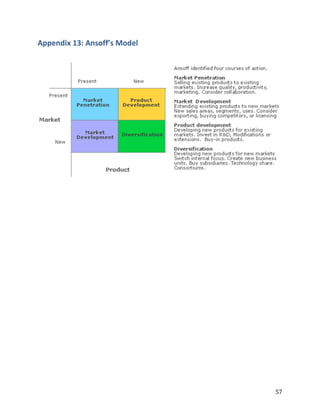
Appendix 13: Ansoff’s Model ................................................................................................................ 57
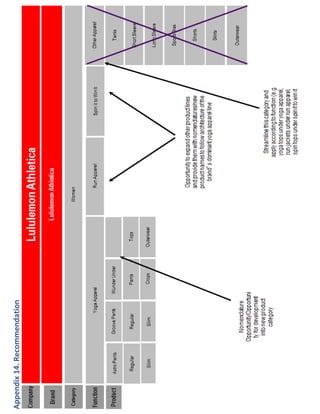
Appendix 14: Recommendation……………………………………...…………………………………. 58
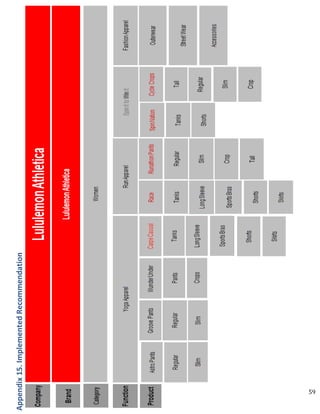
Appendix 15: Implemented Recommendation……………………………………………………. 59


                                                                                                                                                             3
Brand Inventory

Company History
Lululemon Athletica [Lululemon] was
founded by Denis “Chip” Wilson in
1998, after he took a yoga class and was            Figure 1. Brand Word Mark & Logo
swept away by the fitness high, but
disappointed by the ill-fitting cotton clothing people wore. Wilson recognized an
opportunity to change the status quo by using innovative design and athletic fabrics to
create a new offering for customers. Wilson started an underground yoga apparel
movement by offering clothing to instructors and relying on their feedback to grow his
business.1

                                             Lululemon opened its first store location in
                                             Vancouver, Canada in 2000, developing an
                                             environment within the store where
                                             consumers could learn, exchange ideas, and
                                             contribute to a healthy living community
                                             through their love of yoga. The company
                                             soon took this idea of wellness education a
                                             step further, training staff as educators not
                                             only about product performance, but also
                                             health and fitness in general.2 The
  Figure 2. Lululemon Store Exterior, Walnut company has now expanded to over 201
                   Creek, CA                 locations, with stores in the United States,
                                             Australia, and New Zealand and
showrooms in Hong Kong and Great Britain. The company’s huge success led it to go
public in July 20073.4

                                            In the fall of 2009, the company expanded and launched
                                            Ivivva Athletica, a subsidiary that targets a younger
                                            female demographic - girls ages 6-12 years old. Ivivva
                                            Athletica currently has 7 locations, which are located in
                                            Canada and the United States.5


Brand Offering
Since 1998, the company has expanded its product portfolio beyond its original niche
offering to include men’s apparel and products designed specifically for activities such as
1
  our history | lululemon athletica. (n.d.). yoga clothes & running gear for sweaty workouts | lululemon athletica. Retrieved
October 25, 2012, from http://www.lululemon.com/about/history
2
  ibid
3
  Hutchinson, T. H. (2011, January 31). The World's Hottest Retail Stock Has Room to Run - NASDAQ.com. Home - NASDAQ
Community. Retrieved November 18, 2012, from http://community.nasdaq.com/News/2011-02/the-worlds-hottest-retail-
stock.aspx?storyid=55806#.UK0ZzkJ-jPo
4
  "Dennis "Chip" Wilson, founder of Lululemon Athletica, presides over the opening bell". Nasdaq. Retrieved 2012-07-29.
5
  Form 10-Q
                                                                                                                                4
spin and running. However, there continues
                                                   to be a strong focus on high-end yoga
                                                   apparel for female consumers.

                                                  Lululemon does not simply sell fitness
                                                  apparel; it sells an experience and a lifestyle
                                                  that combines high fashion with health and
                                                  wellness in a way that has enabled the
                                                  Lululemon brand to become synonymous
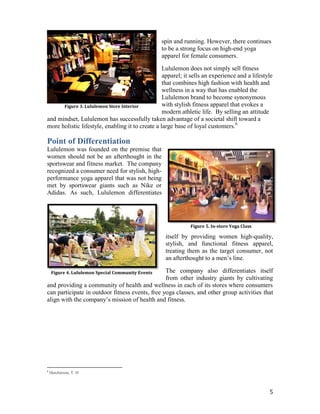
      Figure 3. Lululemon Store Interior          with stylish fitness apparel that evokes a
                                                  modern athletic life. By selling an attitude
and mindset, Lululemon has successfully taken advantage of a societal shift toward a
more holistic lifestyle, enabling it to create a large base of loyal customers.6

Point of Differentiation
Lululemon was founded on the premise that
women should not be an afterthought in the
sportswear and fitness market. The company
recognized a consumer need for stylish, high-
performance yoga apparel that was not being
met by sportswear giants such as Nike or
Adidas. As such, Lululemon differentiates


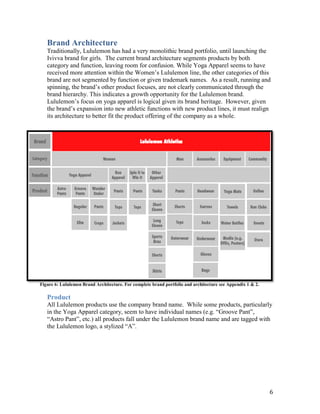
                                                              Figure 5. In-store Yoga Class

                                                    itself by providing women high-quality,
                                                    stylish, and functional fitness apparel,
                                                    treating them as the target consumer, not
                                                    an afterthought to a men’s line.

    Figure 4. Lululemon Special Community Events The company also differentiates itself
                                                 from other industry giants by cultivating
and providing a community of health and wellness in each of its stores where consumers
can participate in outdoor fitness events, free yoga classes, and other group activities that
align with the company’s mission of health and fitness.


6
    Hutchinson, T. H


                                                                                               5
Brand Architecture
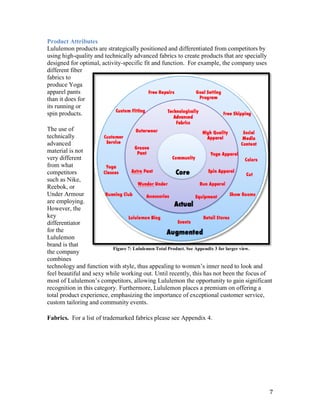
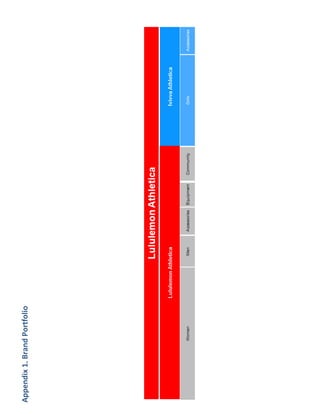
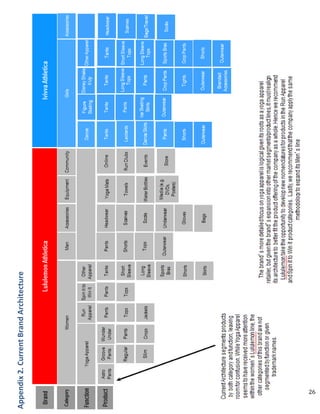
   Traditionally, Lululemon has had a very monolithic brand portfolio, until launching the
   Ivivva brand for girls. The current brand architecture segments products by both
   category and function, leaving room for confusion. While Yoga Apparel seems to have
   received more attention within the Women’s Lululemon line, the other categories of this
   brand are not segmented by function or given trademark names. As a result, running and
   spinning, the brand’s other product focuses, are not clearly communicated through the
   brand hierarchy. This indicates a growth opportunity for the Lululemon brand.
   Lululemon’s focus on yoga apparel is logical given its brand heritage. However, given
   the brand’s expansion into new athletic functions with new product lines, it must realign
   its architecture to better fit the product offering of the company as a whole.


Figure 6: Lululemon Brand Architecture. For complete brand portfolio and architecture see Appendix 1 & 2.

   Product
   All Lululemon products use the company brand name. While some products, particularly
   in the Yoga Apparel category, seem to have individual names (e.g. “Groove Pant”,
   “Astro Pant”, etc.) all products fall under the Lululemon brand name and are tagged with
   the Lululemon logo, a stylized “A”.


                                                                                                            6
Product Attributes
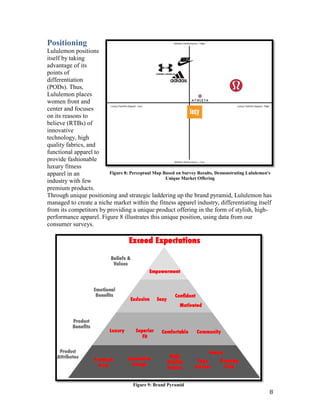
Lululemon products are strategically positioned and differentiated from competitors by
using high-quality and technically advanced fabrics to create products that are specially
designed for optimal, activity-specific fit and function. For example, the company uses
different fiber
fabrics to
produce Yoga
apparel pants
than it does for
its running or
spin products.

The use of
technically
advanced
material is not
very different
from what
competitors
such as Nike,
Reebok, or
Under Armour
are employing.
However, the
key
differentiator
for the
Lululemon
brand is that
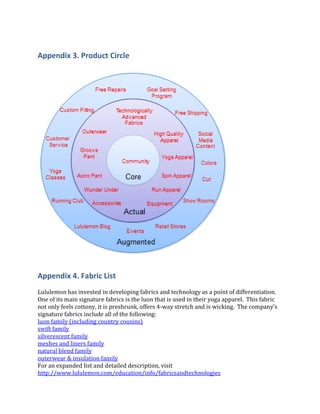
                           Figure 7: Lululemon Total Product. See Appendix 3 for larger view.
the company
combines
technology and function with style, thus appealing to women’s inner need to look and
feel beautiful and sexy while working out. Until recently, this has not been the focus of
most of Lululemon’s competitors, allowing Lululemon the opportunity to gain significant
recognition in this category. Furthermore, Lululemon places a premium on offering a
total product experience, emphasizing the importance of exceptional customer service,
custom tailoring and community events.

Fabrics. For a list of trademarked fabrics please see Appendix 4.


                                                                                            7
Positioning
Lululemon positions
itself by taking
advantage of its
points of
differentiation
(PODs). Thus,
Lululemon places
women front and
center and focuses
on its reasons to
believe (RTBs) of
innovative
technology, high
quality fabrics, and
functional apparel to
provide fashionable
luxury fitness
apparel in an            Figure 8: Perceptual Map Based on Survey Results, Demonstrating Lululemon's
                                                   Unique Market Offering
industry with few
premium products.
Through unique positioning and strategic laddering up the brand pyramid, Lululemon has
managed to create a niche market within the fitness apparel industry, differentiating itself
from its competitors by providing a unique product offering in the form of stylish, high-
performance apparel. Figure 8 illustrates this unique position, using data from our
consumer surveys.


                                      Figure 9: Brand Pyramid
                                                                                                   8
While Lululemon has positioned itself on each rung of its brand pyramid, its focus is on
the top two tiers, beliefs and values and emotional benefits. This allows the brand to
cultivate value based on how the products make consumers feel. This is further
supported by the brand’s elements, mainly the manifesto, which feed into the top two
rungs along with the in-store classes and community events, which help to sell a lifestyle
of empowerment. (see Appendix 5 for Brand Blue Print)

Brand Elements and Promotion
The brand is clearly communicated through its brand
elements. The most distinguishing element is the brand’s
logo, a stylized “A”, which was part of the word mark for
“athletically hip” – a name that the brand ultimately did not
use.7 This logo appears on all of the company’s product
offerings, marketing materials, and communication
elements. The company has built such equity in its logo,
that it is immediately associated with the company name,
allowing consumers to recall the brand in a variety of                                               Figure 10: Lululemon Logo
settings without the need for a category cue.

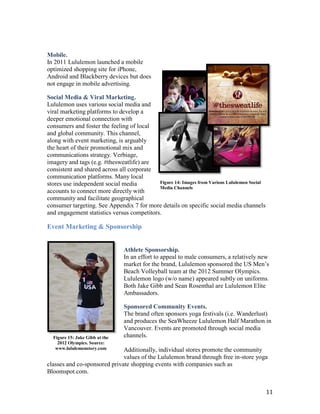
                                   The Lululemon reusable shopping bags have also
                                   become a tremendous brand element for the company.
                                   The red and white bags rarely include the Lululemon
                                   Athletica name. Instead, they are filled with manifestos
                                   and mantras that represent the company and its mission.
                                   These bags have taken an active role in the societal
                                   trend that is Lululemon, as men and women alike, use
                                   the bag in their daily lives for non-shopping reasons.
                                   The bag thus has become a type of status symbol
                                   through which consumers can express their belonging
Figure 11: Lululemon Manifesto, as
         on Reusable Bags          to the Lululemon lifestyle. Furthermore, the ability for
                                   consumers to recognize these reusable bags and recall
that they are Lululemon, without the bag explicitly indicating the brand name, further
supports the strength of Lululemon’s brand awareness and overall equity.

Marketing Channels
    Unlike active wear industry giant Nike, Lululemon Athletica does very little
marketing communication through traditional media channels like TV and print. Instead,
it has focused its efforts on IMC elements that emphasize the personal, emotional
connection customers have with the brand, mostly through interactive and word of mouth
communications. IMC elements in the Lululemon marketing mix include:


7
    our history | lululemon athletica. (n.d.). yoga clothes & running gear for sweaty workouts | lululemon athletica.
                                                                                                                                 9
Media Advertising
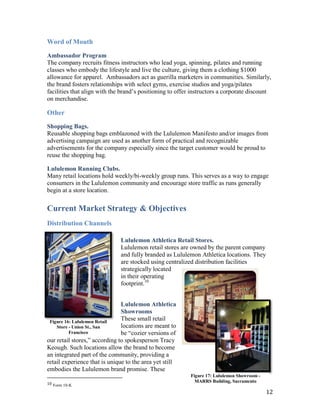
The brand limits resources allocated to traditional media advertising. Select, cheeky print
ads (i.e. 2010 “Say no to camel toe” campaign) run in niche yoga and running
magazines.8

Public Relations
Lululemon’s Public Relations and Sustainability
Communications departments work to make sure
that key efforts and brand messaging are consistent
across communication platforms, including in-store
educators, support and social media. Internal PR
specialists work as evangelists to develop
relationships with bloggers, investors and media
influencers, ensuring positive publicity for the
brand.9

Consumer Promotions
Consumer promotions are limited. The brand does                                          Figure 12: 2010 Lululemon Ad
                                                                                                   Campaign
not promote in-store sales, and has articulated online
discounts as “We Made Too Much” to minimize
damage to the perceived brand value.

Direct & Online Marketing

Lululemon.com.
The website has two goals: to
create an online community and
facilitate the online shopping
experience. Landing page visuals
highlight product and people, not
brand elements. Value-add
content includes product
information, videos, a blog and
(e.g. product demos, yoga classes
and ambassador “chats”) profiles
of all brand ambassadors,
described below.
                                                          Figure 13: Lululemon.com Black Friday Homepage, 11/23/2012
Digital Relationship Marketing
Program.
Customers have the option to sign up for email list, but it is not aggressively marketed on
the consumer landing page, staying true to the visual language of the brand and
improving the consumer landing experience.


8
 Helliker, Kevin. “Lululemon Grows Fast on a Slim Budget”. WSJ, September 13, 2010.
http://online.wsj.com/article/SB10001424052748703960004575481890366935552.html
9
  careers | lululemon athletica. (n.d.). yoga clothes & running gear for sweaty workouts | lululemon athletica. Retrieved October 25,
2012, from http://www.lululemon.com/about/careers
                                                                                                                                    10
Mobile.
In 2011 Lululemon launched a mobile
optimized shopping site for iPhone,
Android and Blackberry devices but does
not engage in mobile advertising.

Social Media & Viral Marketing.
Lululemon uses various social media and
viral marketing platforms to develop a
deeper emotional connection with
consumers and foster the feeling of local
and global community. This channel,
along with event marketing, is arguably
the heart of their promotional mix and
communications strategy. Verbiage,
imagery and tags (e.g. #thesweatlife) are
consistent and shared across all corporate
communication platforms. Many local
stores use independent social media         Figure 14: Images from Various Lululemon Social
                                            Media Channels
accounts to connect more directly with
community and facilitate geographical
consumer targeting. See Appendix 7 for more details on specific social media channels
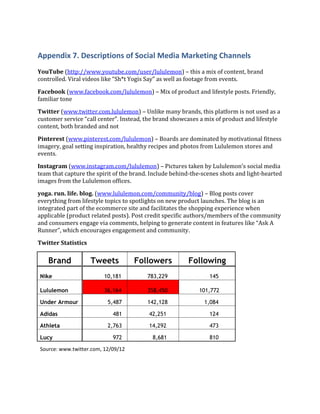
and engagement statistics versus competitors.

Event Marketing & Sponsorship


                                Athlete Sponsorship.
                                In an effort to appeal to male consumers, a relatively new
                                market for the brand, Lululemon sponsored the US Men’s
                                Beach Volleyball team at the 2012 Summer Olympics.
                                Lululemon logo (w/o name) appeared subtly on uniforms.
                                Both Jake Gibb and Sean Rosenthal are Lululemon Elite
                                Ambassadors.

                                Sponsored Community Events.
                                The brand often sponsors yoga festivals (i.e. Wanderlust)
                                and produces the SeaWheeze Lululemon Half Marathon in
                                Vancouver. Events are promoted through social media
  Figure 15: Jake Gibb at the   channels.
    2012 Olympics. Source:
   www.lululemonstory.com     Additionally, individual stores promote the community
                              values of the Lululemon brand through free in-store yoga
classes and co-sponsored private shopping events with companies such as
Bloomspot.com.


                                                                                              11
Word of Mouth

Ambassador Program
The company recruits fitness instructors who lead yoga, spinning, pilates and running
classes who embody the lifestyle and live the culture, giving them a clothing $1000
allowance for apparel. Ambassadors act as guerilla marketers in communities. Similarly,
the brand fosters relationships with select gyms, exercise studios and yoga/pilates
facilities that align with the brand’s positioning to offer instructors a corporate discount
on merchandise.

Other
Shopping Bags.
Reusable shopping bags emblazoned with the Lululemon Manifesto and/or images from
advertising campaign are used as another form of practical and recognizable
advertisements for the company especially since the target customer would be proud to
reuse the shopping bag.

Lululemon Running Clubs.
Many retail locations hold weekly/bi-weekly group runs. This serves as a way to engage
consumers in the Lululemon community and encourage store traffic as runs generally
begin at a store location.

Current Market Strategy & Objectives
Distribution Channels

                              Lululemon Athletica Retail Stores.
                              Lululemon retail stores are owned by the parent company
                              and fully branded as Lululemon Athletica locations. They
                              are stocked using centralized distribution facilities
                              strategically located
                              in their operating
                              footprint.10


                               Lululemon Athletica
                               Showrooms
 Figure 16: Lululemon Retail
                               These small retail
    Store - Union St., San     locations are meant to
          Francisco            be “cozier versions of
our retail stores,” according to spokesperson Tracy
Keough. Such locations allow the brand to become
an integrated part of the community, providing a
retail experience that is unique to the area yet still
embodies the Lululemon brand promise. These
                                                           Figure 17: Lululemon Showroom -
10 Form 10-K
                                                             MARRS Building, Sacramento

                                                                                             12
stores are only open part of the week so that employees can actively engage with the local
community.11

Lululemon.com – See Direct & Online Marketing on Page 9

Lululemon Outlets.
Overstocked items are available at discounted prices at outlet locations. While the
Lululemon logo is used, the full brand name is not visible on store signage.

Certified Partners/Strategic Sales.
Lululemon has a selective strategic sales program through which the brand works with
certified partners to offer its products at yoga studios, gyms and wellness centers
internationally. Partners are generally a strategic fit, serving “high-end” clientele and
aligning with the Lululemon brand image. Examples include Equinox Gyms, The Dailey
Method and Physique 57.

Added Value of Distribution Channels
The primary drawback of this distribution strategy is that it limits both reach and
accessibility. While the brand has grown substantially, opening retail stores in areas that
meet certain demographic and psychographic
segmentation criteria, most stores are
concentrated around metropolitan areas
including San Francisco, Los Angeles, New
York and Chicago. As a relatively young
brand, it is likely that this is part of an early
market growth strategy designed to launch
the company into the mainstream market.

The primary benefit of Lululemon’s
distribution strategy is that it gives the brand
a large degree of control over merchandising
and marketing – ensuring that the brand
message is strong and consistent at all
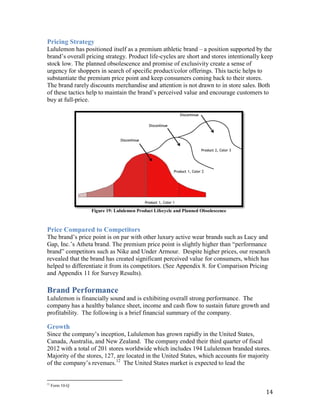
consumer touch points. While certified
distribution locations are not branded, they
too add value to the brand by associating the
Lululemon with “luxury fitness” in the minds
of consumers, thus reinforcing the brand’s
market position. Scarcity of the product may
also support the premium position of the
                                                          Figure 18: The Dailey Method - Vancouver.
brand.                                                        Source: www.thedaileymethod.com


11Kelly Johnson (March 30, 2012). “Yoga gear chain Lululemon coming back to Sacramento.” Sacramento Bee.
Retrieved November 26, 2012 http://www.bizjournals.com/sacramento/blog/kelly-johnson/2012/03/yoga-
gear-chain-lululemon-sacramento.html?page=all
                                                                                                       13
Pricing Strategy
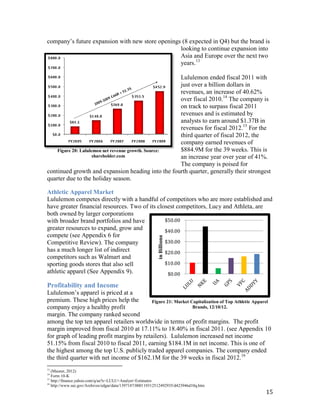
Lululemon has positioned itself as a premium athletic brand – a position supported by the
brand’s overall pricing strategy. Product life-cycles are short and stores intentionally keep
stock low. The planned obsolescence and promise of exclusivity create a sense of
urgency for shoppers in search of specific product/color offerings. This tactic helps to
substantiate the premium price point and keep consumers coming back to their stores.
The brand rarely discounts merchandise and attention is not drawn to in store sales. Both
of these tactics help to maintain the brand’s perceived value and encourage customers to
buy at full-price.


                  Figure 19: Lululemon Product Lifecycle and Planned Obsolescence


Price Compared to Competitors
The brand’s price point is on par with other luxury active wear brands such as Lucy and
Gap, Inc.’s Atheta brand. The premium price point is slightly higher than “performance
brand” competitors such as Nike and Under Armour. Despite higher prices, our research
revealed that the brand has created significant perceived value for consumers, which has
helped to differentiate it from its competitors. (See Appendix 8. for Comparison Pricing
and Appendix 11 for Survey Results).

Brand Performance
Lululemon is financially sound and is exhibiting overall strong performance. The
company has a healthy balance sheet, income and cash flow to sustain future growth and
profitability. The following is a brief financial summary of the company.

Growth
Since the company’s inception, Lululemon has grown rapidly in the United States,
Canada, Australia, and New Zealand. The company ended their third quarter of fiscal
2012 with a total of 201 stores worldwide which includes 194 Lululemon branded stores.
Majority of the stores, 127, are located in the United States, which accounts for majority
of the company’s revenues.12 The United States market is expected to lead the


12
     Form 10-Q
                                                                                          14
company’s future expansion with new store openings (8 expected in Q4) but the brand is
                                                  looking to continue expansion into
                                                  Asia and Europe over the next two
                                                  years.13

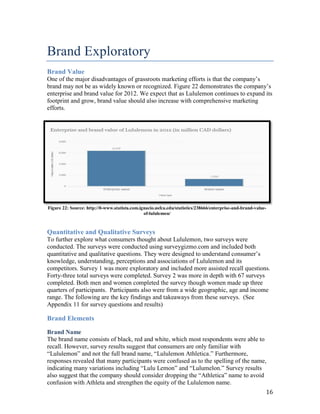
                                                     Lululemon ended fiscal 2011 with
                                                     just over a billion dollars in
                                                     revenues, an increase of 40.62%
                                                     over fiscal 2010.14 The company is
                                                     on track to surpass fiscal 2011
                                                     revenues and is estimated by
                                                     analysts to earn around $1.37B in
                                                     revenues for fiscal 2012.15 For the
                                                     third quarter of fiscal 2012, the
                                                     company earned revenues of
    Figure 20: Lululemon net revenue growth. Source: $884.9M for the 39 weeks. This is
                     shareholder.com                 an increase year over year of 41%.
                                                     The company is poised for
continued growth and expansion heading into the fourth quarter, generally their strongest
quarter due to the holiday season.

Athletic Apparel Market
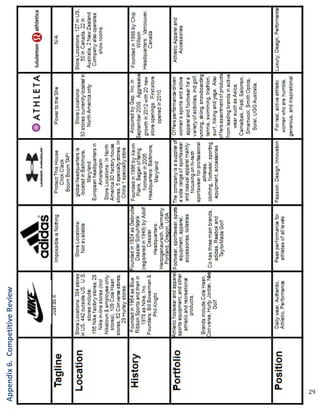
Lululemon competes directly with a handful of competitors who are more established and
have greater financial resources. Two of its closest competitors, Lucy and Athleta, are
both owned by larger corporations
with broader brand portfolios and have          $50.00
greater resources to expand, grow and           $40.00
compete (see Appendix 6 for
                                                          in Billions


Competitive Review). The company                $30.00
has a much longer list of indirect              $20.00
competitors such as Walmart and
sporting goods stores that also sell            $10.00
athletic apparel (See Appendix 9).               $0.00

Profitability and Income
Lululemon’s apparel is priced at a
premium. These high prices help the        Figure 21: Market Capitalization of Top Athletic Apparel
company enjoy a healthy profit                                Brands, 12/10/12.
margin. The company ranked second
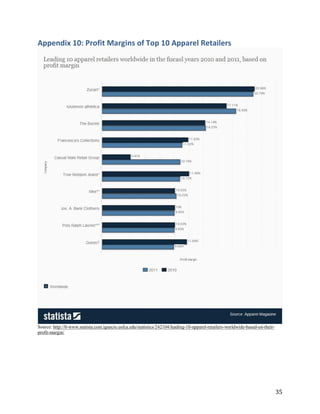
among the top ten apparel retailers worldwide in terms of profit margins. The profit
margin improved from fiscal 2010 at 17.11% to 18.40% in fiscal 2011. (see Appendix 10
for graph of leading profit margins by retailers). Lululemon increased net income
51.15% from fiscal 2010 to fiscal 2011, earning $184.1M in net income. This is one of
the highest among the top U.S. publicly traded apparel companies. The company ended
the third quarter with net income of $162.1M for the 39 weeks in fiscal 2012.16
13
   (Maurer, 2012)
14
   Form 10-K
15
   http://finance.yahoo.com/q/ae?s=LULU+Analyst+Estimates
16
   http://www.sec.gov/Archives/edgar/data/1397187/000119312512492935/d423946d10q.htm
                                                                                                15
Brand Exploratory
Brand Value
One of the major disadvantages of grassroots marketing efforts is that the company’s
brand may not be as widely known or recognized. Figure 22 demonstrates the company’s
enterprise and brand value for 2012. We expect that as Lululemon continues to expand its
footprint and grow, brand value should also increase with comprehensive marketing
efforts.


Figure 22: Source: http://0-www.statista.com.ignacio.usfca.edu/statistics/238666/enterprise-and-brand-value-
                                               of-lululemon/


Quantitative and Qualitative Surveys
To further explore what consumers thought about Lululemon, two surveys were
conducted. The surveys were conducted using surveygizmo.com and included both
quantitative and qualitative questions. They were designed to understand consumer’s
knowledge, understanding, perceptions and associations of Lululemon and its
competitors. Survey 1 was more exploratory and included more assisted recall questions.
Forty-three total surveys were completed. Survey 2 was more in depth with 67 surveys
completed. Both men and women completed the survey though women made up three
quarters of participants. Participants also were from a wide geographic, age and income
range. The following are the key findings and takeaways from these surveys. (See
Appendix 11 for survey questions and results)

Brand Elements

Brand Name
The brand name consists of black, red and white, which most respondents were able to
recall. However, survey results suggest that consumers are only familiar with
“Lululemon” and not the full brand name, “Lululemon Athletica.” Furthermore,
responses revealed that many participants were confused as to the spelling of the name,
indicating many variations including “Lulu Lemon” and “Lulumelon.” Survey results
also suggest that the company should consider dropping the “Athletica” name to avoid
confusion with Athleta and strengthen the equity of the Lululemon name.
                                                                                                           16
Brand recall was much lower for men than for women. When asked to name the top five
brands that came to mind in the athletic apparel category, only 44% of men named
Lululemon. At the same time, three quarters of women surveyed recalled the brand and
for 43% of these respondents
Lululemon was the first brand
named. It is clear the brand
does not resonate with men, a
market which the company has
been trying to attract and grow.

Logo
Survey findings show that the
Lululemon logo is recognized
more than Athleta, Under
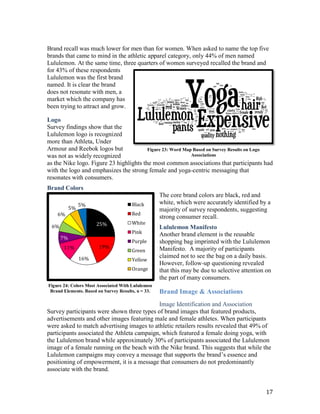
Armour and Reebok logos but              Figure 23: Word Map Based on Survey Results on Logo
was not as widely recognized                                Associations
as the Nike logo. Figure 23 highlights the most common associations that participants had
with the logo and emphasizes the strong female and yoga-centric messaging that
resonates with consumers.
Brand Colors
                                                    The core brand colors are black, red and
                5%                     Black        white, which were accurately identified by a
           5%                                       majority of survey respondents, suggesting
    6%                                 Red
                                                    strong consumer recall.
                      25%              White
 6%                                                 Lululemon Manifesto
                                       Pink         Another brand element is the reusable
      7%
                                       Purple       shopping bag imprinted with the Lululemon
       11%             19%                          Manifesto. A majority of participants
                                       Green
                16%                                 claimed not to see the bag on a daily basis.
                                       Yellow
                                                    However, follow-up questioning revealed
                                       Orange       that this may be due to selective attention on
                                                    the part of many consumers.
Figure 24: Colors Most Associated With Lululemon
 Brand Elements. Based on Survey Results, n = 33.   Brand Image & Associations
                                            Image Identification and Association
Survey participants were shown three types of brand images that featured products,
advertisements and other images featuring male and female athletes. When participants
were asked to match advertising images to athletic retailers results revealed that 49% of
participants associated the Athleta campaign, which featured a female doing yoga, with
the Lululemon brand while approximately 30% of participants associated the Lululemon
image of a female running on the beach with the Nike brand. This suggests that while the
Lululemon campaigns may convey a message that supports the brand’s essence and
positioning of empowerment, it is a message that consumers do not predominantly
associate with the brand.


                                                                                               17
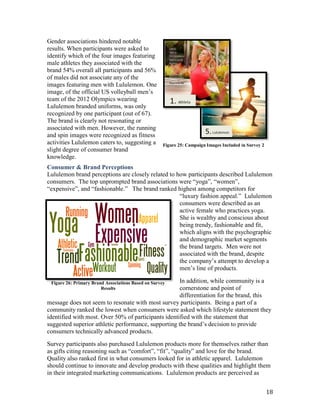
Gender associations hindered notable
results. When participants were asked to
identify which of the four images featuring
male athletes they associated with the
brand 54% overall all participants and 56%
of males did not associate any of the
images featuring men with Lululemon. One
image, of the official US volleyball men’s
team of the 2012 Olympics wearing
Lululemon branded uniforms, was only
recognized by one participant (out of 67).
The brand is clearly not resonating or
associated with men. However, the running
and spin images were recognized as fitness
activities Lululemon caters to, suggesting a         Figure 25: Campaign Images Included in Survey 2
slight degree of consumer brand
knowledge.
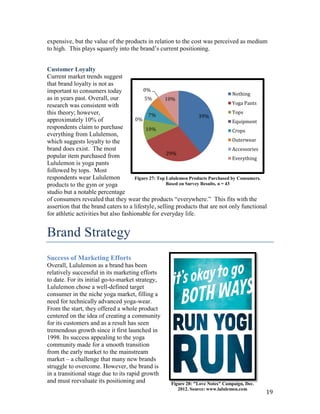
Consumer & Brand Perceptions
Lululemon brand perceptions are closely related to how participants described Lululemon
consumers. The top unprompted brand associations were “yoga”, “women”,
“expensive”, and “fashionable.” The brand ranked highest among competitors for
                                                    “luxury fashion appeal.” Lululemon
                                                    consumers were described as an
                                                    active female who practices yoga.
                                                    She is wealthy and conscious about
                                                    being trendy, fashionable and fit,
                                                    which aligns with the psychographic
                                                    and demographic market segments
                                                    the brand targets. Men were not
                                                    associated with the brand, despite
                                                    the company’s attempt to develop a
                                                    men’s line of products.

                                                     In addition, while community is a
 Figure 26: Primary Brand Associations Based on Survey
                        Results                      cornerstone and point of
                                                     differentiation for the brand, this
message does not seem to resonate with most survey participants. Being a part of a
community ranked the lowest when consumers were asked which lifestyle statement they
identified with most. Over 50% of participants identified with the statement that
suggested superior athletic performance, supporting the brand’s decision to provide
consumers technically advanced products.

Survey participants also purchased Lululemon products more for themselves rather than
as gifts citing reasoning such as “comfort”, “fit”, “quality” and love for the brand.
Quality also ranked first in what consumers looked for in athletic apparel. Lululemon
should continue to innovate and develop products with these qualities and highlight them
in their integrated marketing communications. Lululemon products are perceived as


                                                                                                       18
expensive, but the value of the products in relation to the cost was perceived as medium
to high. This plays squarely into the brand’s current positioning.


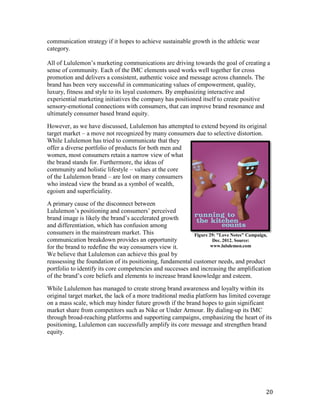
Customer Loyalty
Current market trends suggest
that brand loyalty is not as
important to consumers today              0%
                                                                                     Nothing
as in years past. Overall, our            5%        10%
research was consistent with                                                         Yoga Pants
this theory; however,                                                                Tops
                                            7%                      39%
approximately 10% of                  0%                                             Equipment
respondents claim to purchase              10%                                       Crops
everything from Lululemon,
which suggests loyalty to the                                                        Outerwear
brand does exist. The most                                                           Accessories
                                                     29%
popular item purchased from                                                          Everything
Lululemon is yoga pants
followed by tops. Most
respondents wear Lululemon            Figure 27: Top Lululemon Products Purchased by Consumers.
products to the gym or yoga                          Based on Survey Results, n = 43
studio but a notable percentage
of consumers revealed that they wear the products “everywhere.” This fits with the
assertion that the brand caters to a lifestyle, selling products that are not only functional
for athletic activities but also fashionable for everyday life.


Brand Strategy
Success of Marketing Efforts
Overall, Lululemon as a brand has been
relatively successful in its marketing efforts
to date. For its initial go-to-market strategy,
Lululemon chose a well-defined target
consumer in the niche yoga market, filling a
need for technically advanced yoga-wear.
From the start, they offered a whole product
centered on the idea of creating a community
for its customers and as a result has seen
tremendous growth since it first launched in
1998. Its success appealing to the yoga
community made for a smooth transition
from the early market to the mainstream
market – a challenge that many new brands
struggle to overcome. However, the brand is
in a transitional stage due to its rapid growth
and must reevaluate its positioning and               Figure 28: "Love Notes" Campaign, Dec.
                                                         2012. Source: www.lululemon.com
                                                                                               19
communication strategy if it hopes to achieve sustainable growth in the athletic wear
category.

All of Lululemon’s marketing communications are driving towards the goal of creating a
sense of community. Each of the IMC elements used works well together for cross
promotion and delivers a consistent, authentic voice and message across channels. The
brand has been very successful in communicating values of empowerment, quality,
luxury, fitness and style to its loyal customers. By emphasizing interactive and
experiential marketing initiatives the company has positioned itself to create positive
sensory-emotional connections with consumers, that can improve brand resonance and
ultimately consumer based brand equity.

However, as we have discussed, Lululemon has attempted to extend beyond its original
target market – a move not recognized by many consumers due to selective distortion.
While Lululemon has tried to communicate that they
offer a diverse portfolio of products for both men and
women, most consumers retain a narrow view of what
the brand stands for. Furthermore, the ideas of
community and holistic lifestyle – values at the core
of the Lululemon brand – are lost on many consumers
who instead view the brand as a symbol of wealth,
egoism and superficiality.

A primary cause of the disconnect between
Lululemon’s positioning and consumers’ perceived
brand image is likely the brand’s accelerated growth
and differentiation, which has confusion among
consumers in the mainstream market. This                   Figure 29: "Love Notes" Campaign,
communication breakdown provides an opportunity                     Dec. 2012. Source:
for the brand to redefine the way consumers view it.               www.lululemon.com
We believe that Lululemon can achieve this goal by
reassessing the foundation of its positioning, fundamental customer needs, and product
portfolio to identify its core competencies and successes and increasing the amplification
of the brand’s core beliefs and elements to increase brand knowledge and esteem.

While Lululemon has managed to create strong brand awareness and loyalty within its
original target market, the lack of a more traditional media platform has limited coverage
on a mass scale, which may hinder future growth if the brand hopes to gain significant
market share from competitors such as Nike or Under Armour. By dialing-up its IMC
through broad-reaching platforms and supporting campaigns, emphasizing the heart of its
positioning, Lululemon can successfully amplify its core message and strengthen brand
equity.


                                                                                          20
Brand Equity Improvements
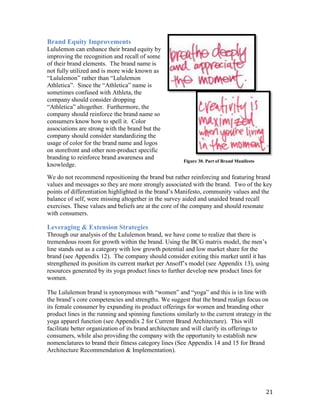
Lululemon can enhance their brand equity by
improving the recognition and recall of some
of their brand elements. The brand name is
not fully utilized and is more wide known as
“Lululemon” rather than “Lululemon
Athletica”. Since the “Athletica” name is
sometimes confused with Athleta, the
company should consider dropping
“Athletica” altogether. Furthermore, the
company should reinforce the brand name so
consumers know how to spell it. Color
associations are strong with the brand but the
company should consider standardizing the
usage of color for the brand name and logos
on storefront and other non-product specific
branding to reinforce brand awareness and
                                                        Figure 30. Part of Brand Manifesto
knowledge.

We do not recommend repositioning the brand but rather reinforcing and featuring brand
values and messages so they are more strongly associated with the brand. Two of the key
points of differentiation highlighted in the brand’s Manifesto, community values and the
balance of self, were missing altogether in the survey aided and unaided brand recall
exercises. These values and beliefs are at the core of the company and should resonate
with consumers.

Leveraging & Extension Strategies
Through our analysis of the Lululemon brand, we have come to realize that there is
tremendous room for growth within the brand. Using the BCG matrix model, the men’s
line stands out as a category with low growth potential and low market share for the
brand (see Appendix 12). The company should consider exiting this market until it has
strengthened its position its current market per Ansoff’s model (see Appendix 13), using
resources generated by its yoga product lines to further develop new product lines for
women.

The Lululemon brand is synonymous with “women” and “yoga” and this is in line with
the brand’s core competencies and strengths. We suggest that the brand realign focus on
its female consumer by expanding its product offerings for women and branding other
product lines in the running and spinning functions similarly to the current strategy in the
yoga apparel function (see Appendix 2 for Current Brand Architecture). This will
facilitate better organization of its brand architecture and will clarify its offerings to
consumers, while also providing the company with the opportunity to establish new
nomenclatures to brand their fitness category lines (See Appendix 14 and 15 for Brand
Architecture Recommendation & Implementation).


                                                                                             21
Secondary Associations
As our qualitative research indicated, Lululemon is not currently extracting the true value
of its Elite Ambassadors, such as the US
Men’s Olympic Beach Volleyball team.
This was a failed secondary association due
to lack of promotion and projection though
the brand’s IMC strategy. We believe that
such campaigns would be more successful if
the brand chose different sports that are more
in line with the heart of the brand’s
positioning rather than a superficial attempt
to extend their brand into men’s wear.

In addition we believe that Lululemon can
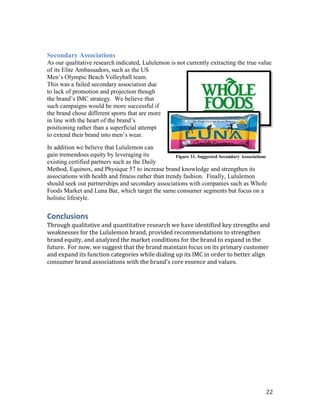
gain tremendous equity by leveraging its             Figure 31. Suggested Secondary Associations
existing certified partners such as the Daily
Method, Equinox, and Physique 57 to increase brand knowledge and strengthen its
associations with health and fitness rather than trendy fashion. Finally, Lululemon
should seek out partnerships and secondary associations with companies such as Whole
Foods Market and Luna Bar, which target the same consumer segments but focus on a
holistic lifestyle.


Conclusions
Through qualitative and quantitative research we have identified key strengths and
weaknesses for the Lululemon brand, provided recommendations to strengthen
brand equity, and analyzed the market conditions for the brand to expand in the
future. For now, we suggest that the brand maintain focus on its primary customer
and expand its function categories while dialing up its IMC in order to better align
consumer brand associations with the brand’s core essence and values.


                                                                                               22
Work Cited
1. http://www.lululemon.com/about/history?mnid=ftr;company_history
2. "Dennis "Chip" Wilson, founder of Lululemon Athletica, presides over the
   opening bell". Nasdaq. Retrieved 2012-07-29.
3. Helliker, Kevin. “Lululemon Grows Fast on a Slim Budget”. WSJ, September
   13, 2010.
   http://online.wsj.com/article/SB100014240527487039600045754818903
   66935552.html
4. http://www.lululemon.com/about/careers/job-details/?jobId=005482
5. Hutchinson, T. H. (2011, January 31). The World's Hottest Retail Stock Has
   Room to Run - NASDAQ.com. Home - NASDAQ Community. Retrieved
   November 18, 2012, from http://community.nasdaq.com/News/2011-
   02/the-worlds-hottest-retail-stock.aspx?storyid=55806#.UK0ZzkJ-jPo
6. Tracy Keough, Lululemon spokesperson.
   http://www.bizjournals.com/sacramento/blog/kelly-
   johnson/2012/03/yoga-gear-chain-lululemon-sacramento.html?page=all
7. Maurer, B. (2012, 12 10). Lululemon perhaps the best buy in retail. Retrieved
   from http://seekingalpha.com/article/1054581-lululemon-perhaps-the-
   best-buy-in-retail
8. Lululemon Athletica Inc. (2012, December 6). Form 10-Q. Retrieved from
   http://sec.gov/Archives/edgar/data/1397187/000119312512492935/d42
   3946d10q.htm
9. Lululemon Athletica Inc. (2012, March 22). Form 10-K. Retrieved from
   http://sec.gov/Archives/edgar/data/1397187/000119312512126444/d27
   7556d10k.htm


                                                                              23
Appendix


           24
Appendix 1. Brand Portfolio
Appendix 2. Current Brand Architecture


              Appendix 2. Current Brand Architecture


   26
Appendix 3. Product Circle


Appendix 4. Fabric List
Lululemon has invested in developing fabrics and technology as a point of differentiation.
One of its main signature fabrics is the luon that is used in their yoga apparel. This fabric
not only feels cottony, it is preshrunk, offers 4-way stretch and is wicking. The company’s
signature fabrics include all of the following:
luon family (including country cousins)
swift family
silverescent family
meshes and liners family
natural blend family
outerwear & insulation family
For an expanded list and detailed description, visit
http://www.lululemon.com/education/info/fabricsandtechnologies
Appendix 5. Brand Blue Print
Appendix 6. Competitive Review


 29
Appendix 7. Descriptions of Social Media Marketing Channels
YouTube (http://www.youtube.com/user/lululemon) – this a mix of content, brand
controlled. Viral videos like “Sh*t Yogis Say” as well as footage from events.

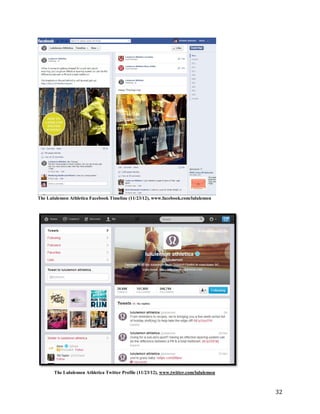
Facebook (www.facebook.com/lululemon) – Mix of product and lifestyle posts. Friendly,
familiar tone

Twitter (www.twitter.com.lululemon) – Unlike many brands, this platform is not used as a
customer service “call center”. Instead, the brand showcases a mix of product and lifestyle
content, both branded and not

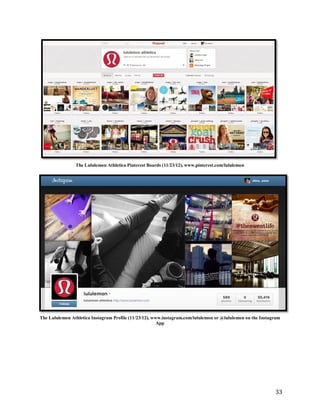
Pinterest (www.pinterest.com/lululemon) – Boards are dominated by motivational fitness
imagery, goal setting inspiration, healthy recipes and photos from Lululemon stores and
events.

Instagram (www.instagram.com/lululemon) – Pictures taken by Lululemon’s social media
team that capture the spirit of the brand. Include behind-the-scenes shots and light-hearted
images from the Lululemon offices.

yoga. run. life. blog. (www.lululemon.com/community/blog) – Blog posts cover
everything from lifestyle topics to spotlights on new product launches. The blog is an
integrated part of the ecommerce site and facilitates the shopping experience when
applicable (product related posts). Post credit specific authors/members of the community
and consumers engage via comments, helping to generate content in features like “Ask A
Runner”, which encourages engagement and community.

Twitter Statistics

    Brand            Tweets         Followers           Following
Nike                     10,181          783,229                145

Lululemon                36,164          358,450            101,772

Under Armour              5,487          142,128              1,084

Adidas                      481           42,251                124

Athleta                   2,763           14,292                473

Lucy                        972            8,681                810

Source: www.twitter.com, 12/09/12
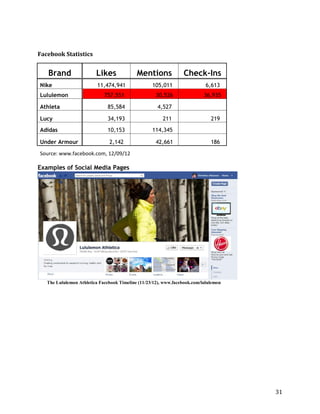
Facebook Statistics


   Brand                 Likes              Mentions             Check-Ins
Nike                      11,474,941               105,011                  6,613
Lululemon                    757,551                 30,526                36,935

Athleta                       85,584                 4,527

Lucy                          34,193                    211                   219
Adidas                        10,153               114,345

Under Armour                   2,142                 42,661                   186
Source: www.facebook.com, 12/09/12

Examples of Social Media Pages


   The Lululemon Athletica Facebook Timeline (11/23/12), www.facebook.com/lululemon


                                                                                      31
The Lululemon Athletica Facebook Timeline (11/23/12), www.facebook.com/lululemon


       The Lululemon Athletica Twitter Profile (11/23/12), www.twitter.com/lululemon


                                                                                       32
The Lululemon Athletica Pinterest Boards (11/23/12), www.pinterest.com/lululemon


The Lululemon Athletica Instagram Profile (11/23/12), www.instagram.com/lululemon or @lululemon on the Instagram
                                                        App


                                                                                                             33
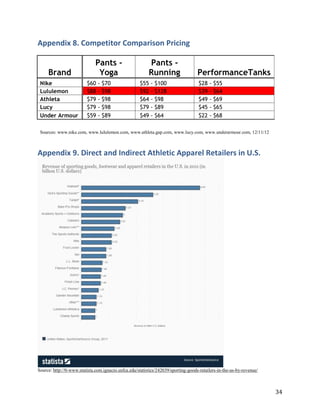
Appendix 8. Competitor Comparison Pricing

                              Pants -                     Pants -
     Brand                     Yoga                       Running                   PerformanceTanks
 Nike                    $60   - $70                 $55   - $100                   $28   - $55
 Lululemon               $88   - $98                 $92   - $128                   $39   - $64
 Athleta                 $79   - $98                 $64   - $98                    $49   - $69
 Lucy                    $79   - $98                 $79   - $89                    $45   - $65
 Under Armour            $59   - $89                 $49   - $64                    $22   - $68

 Sources: www.nike.com, www.lululemon.com, www.athleta.gap.com, www.lucy.com, www.underarmour.com, 12/11/12


Appendix 9. Direct and Indirect Athletic Apparel Retailers in U.S.


Source: http://0-www.statista.com.ignacio.usfca.edu/statistics/242039/sporting-goods-retailers-in-the-us-by-revenue/


                                                                                                                       34
Appendix 10: Profit Margins of Top 10 Apparel Retailers


Source: http://0-www.statista.com.ignacio.usfca.edu/statistics/242104/leading-10-apparel-retailers-worldwide-based-on-their-
profit-margin/


                                                                                                                               35
Appendix 11. Survey Questions and Results:
Survey 1:
Note: This first survey was designed to be exploratory and geared towards obtaining a first
impression of the Lululemon brand and product. It was conducted using an online survey
tool, surveygizmo.com and was sent to our personal network of friends. 43 participants
completed the survey.

Question 1: How familiar are you with the Lululemon brand?
  o I don’t know much about the brand
  o I know the brand name
  o I know the brand name and logo
  o I know everything about the brand (logo, name, products, etc.)
Question 1 Results:
        How familiar are you with the Lululemon
                       brand? n=43
 50%                                          42%
 40%                              35%
 30%
 20%                  14%
           9%
 10%
  0%                                                      responses
       I don't know I know the I know the     I know
       much about brand name brand name     everything
         the brand               and logo    about the
                                               brand

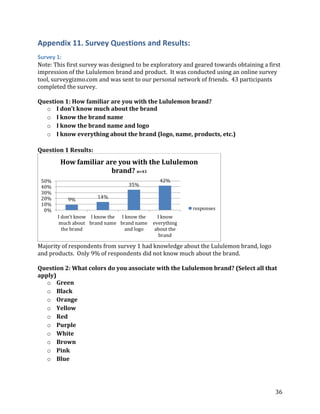
Majority of respondents from survey 1 had knowledge about the Lululemon brand, logo
and products. Only 9% of respondents did not know much about the brand.

Question 2: What colors do you associate with the Lululemon brand? (Select all that
apply)
   o Green
   o Black
   o Orange
   o Yellow
   o Red
   o Purple
   o White
   o Brown
   o Pink
   o Blue


                                                                                         36
Question 2 Results:
           What color respondents at least
            familiar with Lulu brand/logo
          associate w/ Lululemon brand? n=33
              15.2% 15.2%
                                  75.8%                 Black
             18.2%
                                                        Red
           18.2%                                        White
          21.2%                                         Pink
                               48.8%                    Purple
            33.3%      48.5%                            Green
                                                        Yellow


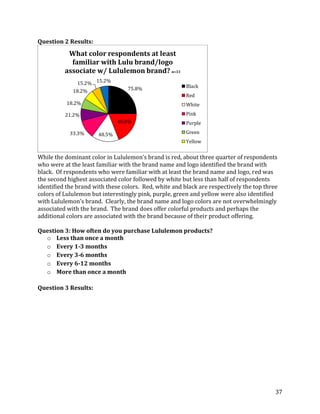
While the dominant color in Lululemon’s brand is red, about three quarter of respondents
who were at the least familiar with the brand name and logo identified the brand with
black. Of respondents who were familiar with at least the brand name and logo, red was
the second highest associated color followed by white but less than half of respondents
identified the brand with these colors. Red, white and black are respectively the top three
colors of Lululemon but interestingly pink, purple, green and yellow were also identified
with Lululemon’s brand. Clearly, the brand name and logo colors are not overwhelmingly
associated with the brand. The brand does offer colorful products and perhaps the
additional colors are associated with the brand because of their product offering.

Question 3: How often do you purchase Lululemon products?
  o Less than once a month
  o Every 1-3 months
  o Every 3-6 months
  o Every 6-12 months
  o More than once a month

Question 3 Results:


                                                                                          37
How often respondents familiar
         with Lulu purchase products n=33
          33.3%                       33.3%
 35.0%
 30.0%
 25.0%             21.2%
 20.0%
 15.0%
 10.0%                       6.1%               6.1%      Response
  5.0%
  0.0%
         Less than Every 1-3 Every 3-6 Every 6- More
          once a months months           12    than one
          month                        months a month

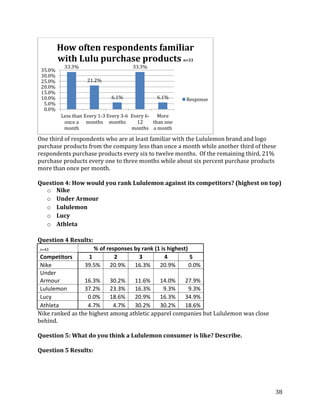
One third of respondents who are at least familiar with the Lululemon brand and logo
purchase products from the company less than once a month while another third of these
respondents purchase products every six to twelve months. Of the remaining third, 21%
purchase products every one to three months while about six percent purchase products
more than once per month.

Question 4: How would you rank Lululemon against its competitors? (highest on top)
  o Nike
  o Under Armour
  o Lululemon
  o Lucy
  o Athleta

Question 4 Results:
n=43                 % of responses by rank (1 is highest)
 Competitors       1         2        3          4         5
 Nike             39.5%    20.9%    16.3%     20.9%        0.0%
 Under
 Armour          16.3%     30.2%   11.6%     14.0%   27.9%
 Lululemon       37.2%     23.3%   16.3%      9.3%    9.3%
 Lucy             0.0%     18.6%   20.9%     16.3%   34.9%
 Athleta          4.7%      4.7%   30.2%     30.2%   18.6%
Nike ranked as the highest among athletic apparel companies but Lululemon was close
behind.

Question 5: What do you think a Lululemon consumer is like? Describe.

Question 5 Results:


                                                                                      38
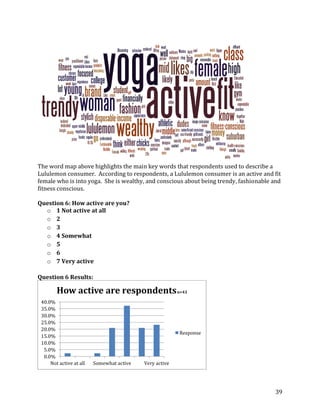
The word map above highlights the main key words that respondents used to describe a
Lululemon consumer. According to respondents, a Lululemon consumer is an active and fit
female who is into yoga. She is wealthy, and conscious about being trendy, fashionable and
fitness conscious.

Question 6: How active are you?
  o 1 Not active at all
  o 2
  o 3
  o 4 Somewhat
  o 5
  o 6
  o 7 Very active

Question 6 Results:

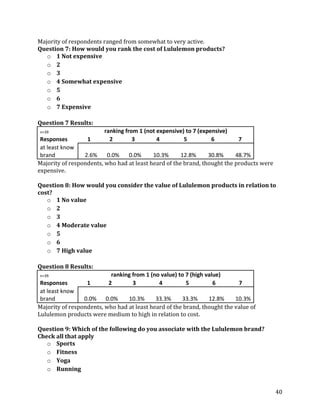
        How active are respondents n=43
 40.0%
 35.0%
 30.0%
 25.0%
 20.0%
                                                         Response
 15.0%
 10.0%
  5.0%
  0.0%
     Not active at all   Somewhat active   Very active


                                                                                       39
Majority of respondents ranged from somewhat to very active.
Question 7: How would you rank the cost of Lululemon products?
   o 1 Not expensive
   o 2
   o 3
   o 4 Somewhat expensive
   o 5
   o 6
   o 7 Expensive

Question 7 Results:
n=39                     ranking from 1 (not expensive) to 7 (expensive)
 Responses        1        2        3        4         5          6        7
 at least know
 brand           2.6%    0.0%    0.0%      10.3%      12.8%     30.8%     48.7%
Majority of respondents, who had at least heard of the brand, thought the products were
expensive.

Question 8: How would you consider the value of Lululemon products in relation to
cost?
   o 1 No value
   o 2
   o 3
   o 4 Moderate value
   o 5
   o 6
   o 7 High value

Question 8 Results:
n=39                       ranking from 1 (no value) to 7 (high value)
 Responses        1       2        3         4          5          6       7
 at least know
 brand           0.0% 0.0%       10.3%      33.3%     33.3%     12.8%     10.3%
Majority of respondents, who had at least heard of the brand, thought the value of
Lululemon products were medium to high in relation to cost.

Question 9: Which of the following do you associate with the Lululemon brand?
Check all that apply
   o Sports
   o Fitness
   o Yoga
   o Running


                                                                                          40
o    Spinning
   o    Men
   o    Women
   o    Active
   o    Gym
   o    Workout
   o    Innovative
   o    Quality
   o    Trend
   o    Athletic
   o    Expensive
   o    Apparel
   o    Performance
   o    Power
   o    Fashionable

Question 9 Results:
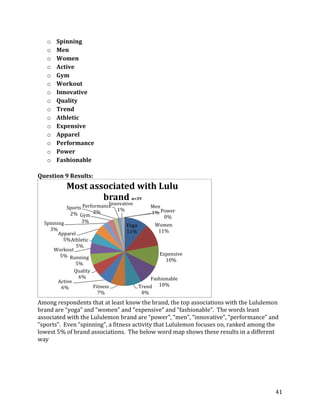
            Most associated with Lulu
                    brand n=39
                            Innovative
           Sports Performance 1%              Men
            2% Gym 2%                         1% Power
                                                  0%
  Spinning       3%
                                   Yoga         Women
    3%                             11%           11%
        Apparel
          5% Athletic
                5%
       Workout
         5% Running                               Expensive
                                                    10%
               5%
               Quality
                 6%                            Fashionable
        Active
         6%            Fitness            Trend 10%
                         7%                8%
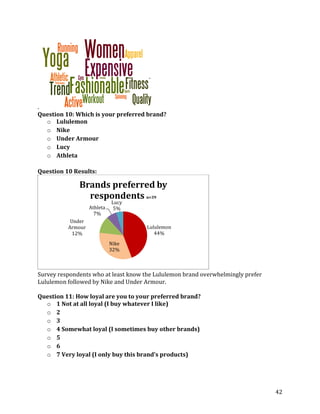
Among respondents that at least know the brand, the top associations with the Lululemon
brand are “yoga” and “women” and “expensive” and “fashionable”. The words least
associated with the Lululemon brand are “power”, “men”, “innovative”, “performance” and
“sports”. Even “spinning”, a fitness activity that Lululemon focuses on, ranked among the
lowest 5% of brand associations. The below word map shows these results in a different
way


                                                                                       41
.
Question 10: Which is your preferred brand?
  o Lululemon
  o Nike
  o Under Armour
  o Lucy
  o Athleta

Question 10 Results:

              Brands preferred by
                respondents n=39
                             Lucy
                   Athleta    5%
                     7%
           Under
          Armour                      Lululemon
            12%                          44%
                             Nike
                             32%


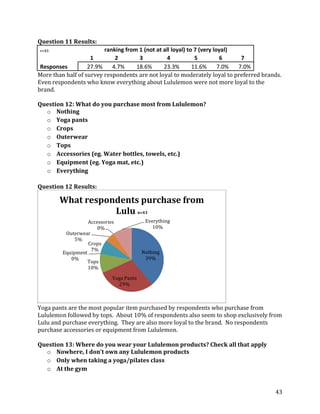
Survey respondents who at least know the Lululemon brand overwhelmingly prefer
Lululemon followed by Nike and Under Armour.

Question 11: How loyal are you to your preferred brand?
  o 1 Not at all loyal (I buy whatever I like)
  o 2
  o 3
  o 4 Somewhat loyal (I sometimes buy other brands)
  o 5
  o 6
  o 7 Very loyal (I only buy this brand’s products)


                                                                                 42
Question 11 Results:
n=43                     ranking from 1 (not at all loyal) to 7 (very loyal)
                    1        2        3           4           5          6    7
 Responses         27.9%    4.7%     18.6%      23.3%        11.6%      7.0% 7.0%
More than half of survey respondents are not loyal to moderately loyal to preferred brands.
Even respondents who know everything about Lululemon were not more loyal to the
brand.

Question 12: What do you purchase most from Lululemon?
  o Nothing
  o Yoga pants
  o Crops
  o Outerwear
  o Tops
  o Accessories (eg. Water bottles, towels, etc.)
  o Equipment (eg. Yoga mat, etc.)
  o Everything

Question 12 Results:

        What respondents purchase from
                   Lulu n=43
                   Accessories             Everything
                       0%                     10%
          Outerwear
              5%
                   Crops
                    7%                    Nothing
         Equipment
            0%                             39%
                   Tops
                   10%
                             Yoga Pants
                               29%


Yoga pants are the most popular item purchased by respondents who purchase from
Lululemon followed by tops. About 10% of respondents also seem to shop exclusively from
Lulu and purchase everything. They are also more loyal to the brand. No respondents
purchase accessories or equipment from Lululemon.

Question 13: Where do you wear your Lululemon products? Check all that apply
  o Nowhere, I don’t own any Lululemon products
  o Only when taking a yoga/pilates class
  o At the gym


                                                                                        43
o Around the house
   o On a casual day
   o Everywhere

Question 13 Results:
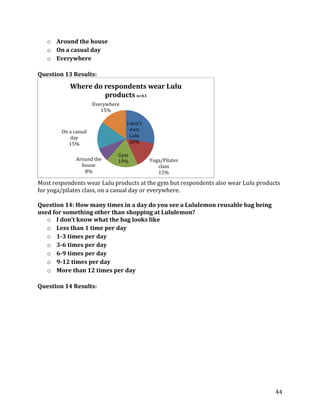
           Where do respondents wear Lulu
                    products n=43
                      Everywhere
                         15%

                                   I don't
        On a casual                  own
           day                      Lulu
           15%                      28%

                               Gym
              Around the       19%           Yoga/Pilates
                house                           class
                 8%                             15%

Most respondents wear Lulu products at the gym but respondents also wear Lulu products
for yoga/pilates class, on a casual day or everywhere.

Question 14: How many times in a day do you see a Lululemon reusable bag being
used for something other than shopping at Lululemon?
   o I don’t know what the bag looks like
   o Less than 1 time per day
   o 1-3 times per day
   o 3-6 times per day
   o 6-9 times per day
   o 9-12 times per day
   o More than 12 times per day

Question 14 Results:


                                                                                    44
How often respondents see Lulu
            shopping 9 to 12 each day
                      bags
                                            >12
                                     0%     0%            don't know
     6 to 9
      7% 3 to 6                                           what the bag
                                                           looks like
            7%                                               23%

                          1 to 3
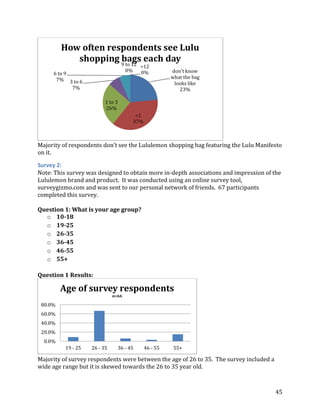
                          26%
                                           <1
                                          37%


Majority of respondents don’t see the Lululemon shopping bag featuring the Lulu Manifesto
on it.

Survey 2:
Note: This survey was designed to obtain more in-depth associations and impression of the
Lululemon brand and product. It was conducted using an online survey tool,
surveygizmo.com and was sent to our personal network of friends. 67 participants
completed this survey.

Question 1: What is your age group?
  o 10-18
  o 19-25
  o 26-35
  o 36-45
  o 46-55
  o 55+

Question 1 Results:

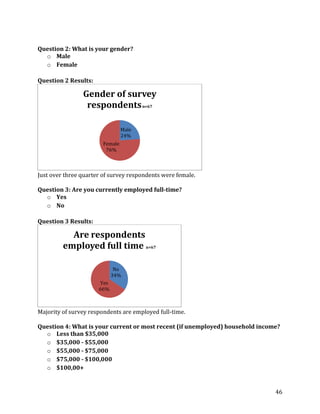
         Age of survey respondents
                              n=66

 80.0%
 60.0%
 40.0%
 20.0%
  0.0%
          19 - 25   26 - 35     36 - 45         46 - 55    55+

Majority of survey respondents were between the age of 26 to 35. The survey included a
wide age range but it is skewed towards the 26 to 35 year old.


                                                                                         45
Question 2: What is your gender?
  o Male
  o Female

Question 2 Results:

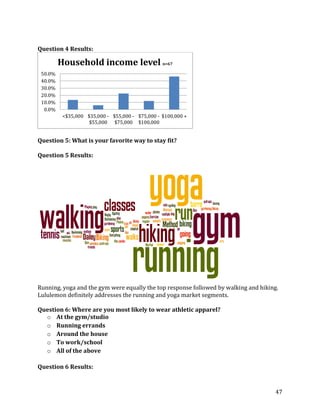
                Gender of survey
                 respondents n=67

                                 Male
                                 24%
                        Female
                         76%


Just over three quarter of survey respondents were female.

Question 3: Are you currently employed full-time?
  o Yes
  o No

Question 3 Results:

           Are respondents
         employed full time n=67

                             No
                            34%
                      Yes
                      66%


Majority of survey respondents are employed full-time.

Question 4: What is your current or most recent (if unemployed) household income?
  o Less than $35,000
  o $35,000 - $55,000
  o $55,000 - $75,000
  o $75,000 - $100,000
  o $100,00+


                                                                               46
Question 4 Results:

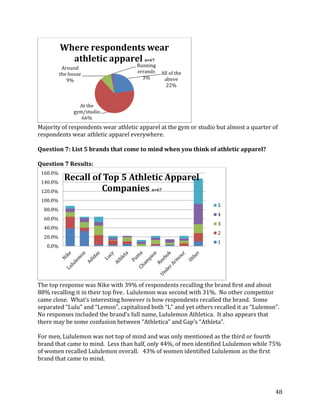
         Household income level n=67
 50.0%
 40.0%
 30.0%
 20.0%
 10.0%
  0.0%
          <$35,000 $35,000 - $55,000 - $75,000 - $100,000 +
                    $55,000 $75,000 $100,000


Question 5: What is your favorite way to stay fit?

Question 5 Results:


Running, yoga and the gym were equally the top response followed by walking and hiking.
Lululemon definitely addresses the running and yoga market segments.

Question 6: Where are you most likely to wear athletic apparel?
  o At the gym/studio
  o Running errands
  o Around the house
  o To work/school
  o All of the above

Question 6 Results:


                                                                                      47
Where respondents wear
            athletic apparel n=67
           Around                    Running
          the house                  errands   All of the
             9%                        3%       above
                                                 22%


                 At the
               gym/studio
                  66%
Majority of respondents wear athletic apparel at the gym or studio but almost a quarter of
respondents wear athletic apparel everywhere.

Question 7: List 5 brands that come to mind when you think of athletic apparel?

Question 7 Results:
 160.0%
 140.0%
            Recall of Top 5 Athletic Apparel
 120.0%              Companies n=67
 100.0%
                                                                   5
  80.0%
                                                                   4
  60.0%
                                                                   3
  40.0%
                                                                   2
  20.0%
                                                                   1
   0.0%


The top response was Nike with 39% of respondents recalling the brand first and about
88% recalling it in their top five. Lululemon was second with 31%. No other competitor
came close. What’s interesting however is how respondents recalled the brand. Some
separated “Lulu” and “Lemon”, capitalized both “L” and yet others recalled it as “Lulemon”.
No responses included the brand’s full name, Lululemon Athletica. It also appears that
there may be some confusion between “Athletica” and Gap’s “Athleta”.

For men, Lululemon was not top of mind and was only mentioned as the third or fourth
brand that came to mind. Less than half, only 44%, of men identified Lululemon while 75%
of women recalled Lululemon overall. 43% of women identified Lululemon as the first
brand that came to mind.


                                                                                         48
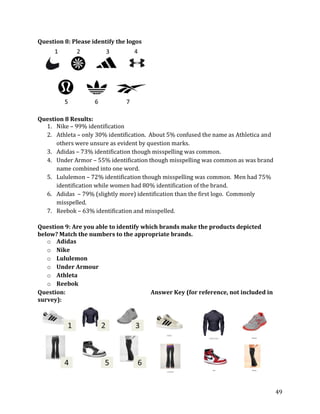
Question 8: Please identify the logos


Question 8 Results:
  1. Nike – 99% identification
  2. Athleta – only 30% identification. About 5% confused the name as Athletica and
      others were unsure as evident by question marks.
  3. Adidas – 73% identification though misspelling was common.
  4. Under Armor – 55% identification though misspelling was common as was brand
      name combined into one word.
  5. Lululemon – 72% identification though misspelling was common. Men had 75%
      identification while women had 80% identification of the brand.
  6. Adidas – 79% (slightly more) identification than the first logo. Commonly
      misspelled.
  7. Reebok – 63% identification and misspelled.

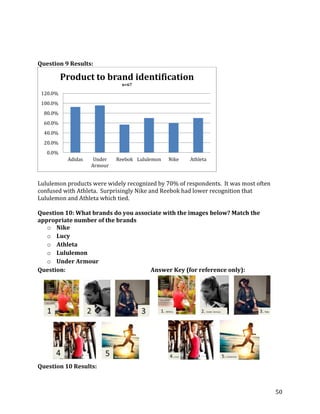
Question 9: Are you able to identify which brands make the products depicted
below? Match the numbers to the appropriate brands.
   o Adidas
   o Nike
   o Lululemon
   o Under Armour
   o Athleta
   o Reebok
Question:                               Answer Key (for reference, not included in
survey):


                                                                                      49
Question 9 Results:

          Product to brand identification
                               n=67

 120.0%
 100.0%
  80.0%
  60.0%
  40.0%
  20.0%
   0.0%
           Adidas    Under   Reebok Lululemon   Nike   Athleta
                    Armour


Lululemon products were widely recognized by 70% of respondents. It was most often
confused with Athleta. Surprisingly Nike and Reebok had lower recognition that
Lululemon and Athleta which tied.

Question 10: What brands do you associate with the images below? Match the
appropriate number of the brands
   o Nike
   o Lucy
   o Athleta
   o Lululemon
   o Under Armour
Question:                            Answer Key (for reference only):


Question 10 Results:


                                                                                     50
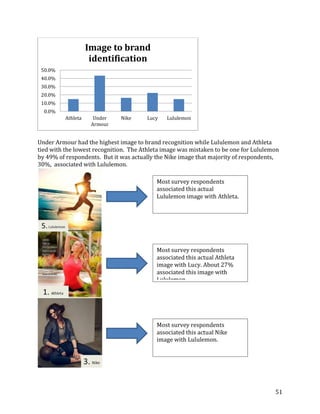
Image to brand
                     identification
 50.0%
 40.0%
 30.0%
 20.0%
 10.0%
  0.0%
          Athleta     Under   Nike     Lucy    Lululemon
                     Armour


Under Armour had the highest image to brand recognition while Lululemon and Athleta
tied with the lowest recognition. The Athleta image was mistaken to be one for Lululemon
by 49% of respondents. But it was actually the Nike image that majority of respondents,
30%, associated with Lululemon.

                                           Most survey respondents
                                           associated this actual
                                           Lululemon image with Athleta.


                                           Most survey respondents
                                           associated this actual Athleta
                                           image with Lucy. About 27%
                                           associated this image with
                                           Lululemon.


                                           Most survey respondents
                                           associated this actual Nike
                                           image with Lululemon.


                                                                                      51
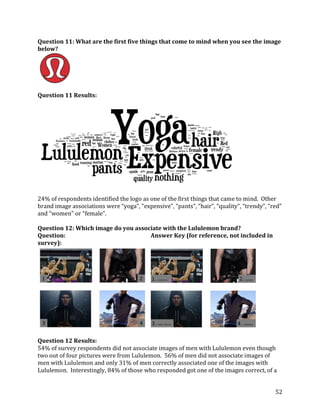
Question 11: What are the first five things that come to mind when you see the image
below?


Question 11 Results:


24% of respondents identified the logo as one of the first things that came to mind. Other
brand image associations were “yoga”, “expensive”, “pants”, “hair”, “quality”, “trendy”, “red”
and “women” or “female”.

Question 12: Which image do you associate with the Lululemon brand?
Question:                            Answer Key (for reference, not included in
survey):


Question 12 Results:
54% of survey respondents did not associate images of men with Lululemon even though
two out of four pictures were from Lululemon. 56% of men did not associate images of
men with Lululemon and only 31% of men correctly associated one of the images with
Lululemon. Interestingly, 84% of those who responded got one of the images correct, of a


                                                                                           52
man running but the second picture, of the Olympic men’s volleyball team that Lululemon
sponsored over the summer had only one respondent associate the brand. It seems that
there may be some awareness of the sports Lululemon caters too since the running and
spin images had the highest associations by respondents.

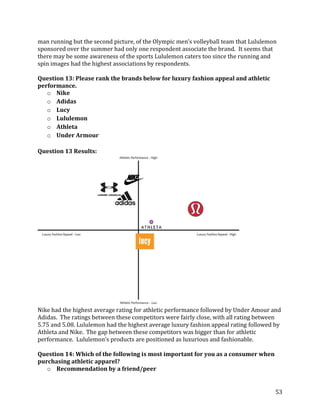
Question 13: Please rank the brands below for luxury fashion appeal and athletic
performance.
   o Nike
   o Adidas
   o Lucy
   o Lululemon
   o Athleta
   o Under Armour

Question 13 Results:


Nike had the highest average rating for athletic performance followed by Under Amour and
Adidas. The ratings between these competitors were fairly close, with all rating between
5.75 and 5.08. Lululemon had the highest average luxury fashion appeal rating followed by
Athleta and Nike. The gap between these competitors was bigger than for athletic
performance. Lululemon’s products are positioned as luxurious and fashionable.

Question 14: Which of the following is most important for you as a consumer when
purchasing athletic apparel?
   o Recommendation by a friend/peer


                                                                                      53
o Advertisement, promotion or sale
   o Celebrity endorsement
   o Quality of materials and design

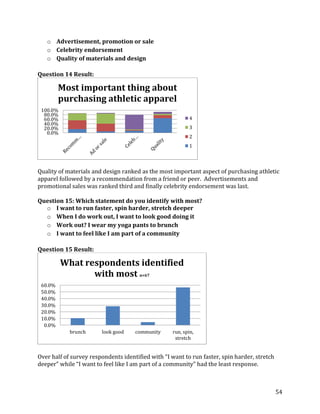
Question 14 Result:

         Most important thing about
         purchasing athletic apparel
 100.0%
  80.0%
  60.0%                                                   4
  40.0%
  20.0%                                                   3
   0.0%
                                                          2
                                                          1


Quality of materials and design ranked as the most important aspect of purchasing athletic
apparel followed by a recommendation from a friend or peer. Advertisements and
promotional sales was ranked third and finally celebrity endorsement was last.

Question 15: Which statement do you identify with most?
  o I want to run faster, spin harder, stretch deeper
  o When I do work out, I want to look good doing it
  o Work out? I wear my yoga pants to brunch
  o I want to feel like I am part of a community

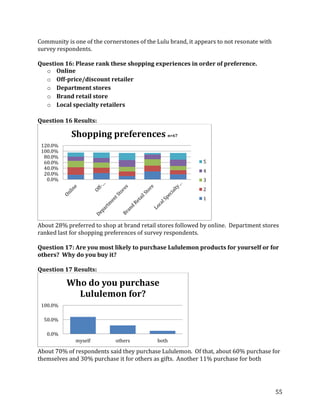
Question 15 Result:

          What respondents identified
                 with most n=67
 60.0%
 50.0%
 40.0%
 30.0%
 20.0%
 10.0%
  0.0%
            brunch      look good    community     run, spin,
                                                    stretch


Over half of survey respondents identified with “I want to run faster, spin harder, stretch
deeper” while “I want to feel like I am part of a community” had the least response.


                                                                                              54
Community is one of the cornerstones of the Lulu brand, it appears to not resonate with
survey respondents.

Question 16: Please rank these shopping experiences in order of preference.
  o Online
  o Off-price/discount retailer
  o Department stores
  o Brand retail store
  o Local specialty retailers

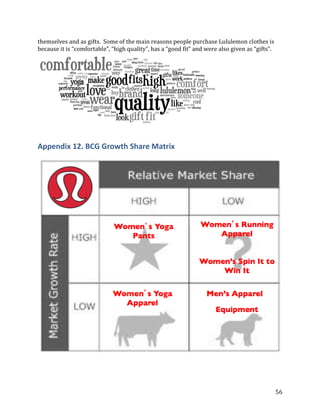
Question 16 Results:

            Shopping preferences n=67
 120.0%
 100.0%
  80.0%
  60.0%                                                      5
  40.0%
                                                             4
  20.0%
   0.0%                                                      3
                                                             2
                                                             1


About 28% preferred to shop at brand retail stores followed by online. Department stores
ranked last for shopping preferences of survey respondents.

Question 17: Are you most likely to purchase Lululemon products for yourself or for
others? Why do you buy it?

Question 17 Results:

          Who do you purchase
            Lululemon for?
 100.0%

  50.0%

   0.0%
              myself        others          both

About 70% of respondents said they purchase Lululemon. Of that, about 60% purchase for
themselves and 30% purchase it for others as gifts. Another 11% purchase for both


                                                                                          55
themselves and as gifts. Some of the main reasons people purchase Lululemon clothes is
because it is “comfortable”, “high quality”, has a “good fit” and were also given as “gifts”.


Appendix 12. BCG Growth Share Matrix


                                                                                                56
Appendix 13: Ansoff’s Model


                              57
Appendix 14. Recommendation
Appendix 15. Implemented Recommendation


   59

Lululemon Brand Audit

  • 1.
    Brand Audit: LululemonAthletica By: Christina Johanson, Joanna Komvopoulos, Shital Kadakia Professor O’Meara MBA 6403 December 12, 2012
  • 2.
    Table Of Contents CompanyHistory ............................................................................................................................................ 4 Brand Offering ................................................................................................................................................. 4 Point of Differentiation ................................................................................................................................. 5 Brand Architecture.......................................................................................................................................... 6 Product ........................................................................................................................................................... 6 Product Attributes ................................................................................................................................. 7 Positioning ......................................................................................................................................................... 8 Brand Elements and Promotion ................................................................................................................. 9 Marketing Channels ....................................................................................................................................... 9 Media Advertising .................................................................................................................................. 10 Public Relations ....................................................................................................................................... 10 Consumer Promotions ........................................................................................................................... 10 Direct & Online Marketing ................................................................................................................. 10 Event Marketing & Sponsorship ....................................................................................................... 11 Word of Mouth ......................................................................................................................................... 12 Other............................................................................................................................................................. 12 Current Market Strategy & Objectives ................................................................................................ 12 Distribution Channels ............................................................................................................................ 12 Added Value of Distribution Channels ........................................................................................... 13 Pricing Strategy........................................................................................................................................ 14 Price Compared to Competitors......................................................................................................... 14 Brand Performance ...................................................................................................................................... 14 Growth ......................................................................................................................................................... 14 Athletic Apparel Market .................................................................................................................. 15 Profitability and Income ....................................................................................................................... 15 Brand Value............................................................................................................................................... 16 Quantitative and Qualitative Surveys .............................................................................................. 16 Brand Elements ........................................................................................................................................ 16 Brand Image & Associations .............................................................................................................. 17 Success of Marketing Efforts.............................................................................................................. 19 Brand Equity Improvements ............................................................................................................... 21 Leveraging & Extension Strategies .................................................................................................. 21 Secondary Associations ................................................................................................................... 22 Conclusions ................................................................................................................................................... 22 Work Cited ..................................................................................................................................................... 23 Appendix 3. Product Circle .................................................................................................................... 27 Appendix 4. Fabric List ............................................................................................................................ 27 Appendix 7. Descriptions of Social Media Marketing Channels ........................................... 30 Appendix 8. Competitor Comparison Pricing ............................................................................... 34 Appendix 9. Direct and Indirect Athletic Apparel Retailers in U.S. .................................... 34 Appendix 10: Profit Margins of Top 10 Apparel Retailers ..................................................... 35 Appendix 11. Survey Questions and Results: ............................................................................... 36 Survey 1: ............................................................................................................................................... 36 2
  • 3.
    Survey 2: ...............................................................................................................................................45 Appendix 12. BCG Growth Share Matrix ......................................................................................... 56 Appendix 13: Ansoff’s Model ................................................................................................................ 57 Appendix 14: Recommendation……………………………………...…………………………………. 58 Appendix 15: Implemented Recommendation……………………………………………………. 59 3
  • 4.
    Brand Inventory Company History LululemonAthletica [Lululemon] was founded by Denis “Chip” Wilson in 1998, after he took a yoga class and was Figure 1. Brand Word Mark & Logo swept away by the fitness high, but disappointed by the ill-fitting cotton clothing people wore. Wilson recognized an opportunity to change the status quo by using innovative design and athletic fabrics to create a new offering for customers. Wilson started an underground yoga apparel movement by offering clothing to instructors and relying on their feedback to grow his business.1 Lululemon opened its first store location in Vancouver, Canada in 2000, developing an environment within the store where consumers could learn, exchange ideas, and contribute to a healthy living community through their love of yoga. The company soon took this idea of wellness education a step further, training staff as educators not only about product performance, but also health and fitness in general.2 The Figure 2. Lululemon Store Exterior, Walnut company has now expanded to over 201 Creek, CA locations, with stores in the United States, Australia, and New Zealand and showrooms in Hong Kong and Great Britain. The company’s huge success led it to go public in July 20073.4 In the fall of 2009, the company expanded and launched Ivivva Athletica, a subsidiary that targets a younger female demographic - girls ages 6-12 years old. Ivivva Athletica currently has 7 locations, which are located in Canada and the United States.5 Brand Offering Since 1998, the company has expanded its product portfolio beyond its original niche offering to include men’s apparel and products designed specifically for activities such as 1 our history | lululemon athletica. (n.d.). yoga clothes & running gear for sweaty workouts | lululemon athletica. Retrieved October 25, 2012, from http://www.lululemon.com/about/history 2 ibid 3 Hutchinson, T. H. (2011, January 31). The World's Hottest Retail Stock Has Room to Run - NASDAQ.com. Home - NASDAQ Community. Retrieved November 18, 2012, from http://community.nasdaq.com/News/2011-02/the-worlds-hottest-retail- stock.aspx?storyid=55806#.UK0ZzkJ-jPo 4 "Dennis "Chip" Wilson, founder of Lululemon Athletica, presides over the opening bell". Nasdaq. Retrieved 2012-07-29. 5 Form 10-Q 4
  • 5.
    spin and running.However, there continues to be a strong focus on high-end yoga apparel for female consumers. Lululemon does not simply sell fitness apparel; it sells an experience and a lifestyle that combines high fashion with health and wellness in a way that has enabled the Lululemon brand to become synonymous Figure 3. Lululemon Store Interior with stylish fitness apparel that evokes a modern athletic life. By selling an attitude and mindset, Lululemon has successfully taken advantage of a societal shift toward a more holistic lifestyle, enabling it to create a large base of loyal customers.6 Point of Differentiation Lululemon was founded on the premise that women should not be an afterthought in the sportswear and fitness market. The company recognized a consumer need for stylish, high- performance yoga apparel that was not being met by sportswear giants such as Nike or Adidas. As such, Lululemon differentiates Figure 5. In-store Yoga Class itself by providing women high-quality, stylish, and functional fitness apparel, treating them as the target consumer, not an afterthought to a men’s line. Figure 4. Lululemon Special Community Events The company also differentiates itself from other industry giants by cultivating and providing a community of health and wellness in each of its stores where consumers can participate in outdoor fitness events, free yoga classes, and other group activities that align with the company’s mission of health and fitness. 6 Hutchinson, T. H 5
  • 6.
    Brand Architecture Traditionally, Lululemon has had a very monolithic brand portfolio, until launching the Ivivva brand for girls. The current brand architecture segments products by both category and function, leaving room for confusion. While Yoga Apparel seems to have received more attention within the Women’s Lululemon line, the other categories of this brand are not segmented by function or given trademark names. As a result, running and spinning, the brand’s other product focuses, are not clearly communicated through the brand hierarchy. This indicates a growth opportunity for the Lululemon brand. Lululemon’s focus on yoga apparel is logical given its brand heritage. However, given the brand’s expansion into new athletic functions with new product lines, it must realign its architecture to better fit the product offering of the company as a whole. Figure 6: Lululemon Brand Architecture. For complete brand portfolio and architecture see Appendix 1 & 2. Product All Lululemon products use the company brand name. While some products, particularly in the Yoga Apparel category, seem to have individual names (e.g. “Groove Pant”, “Astro Pant”, etc.) all products fall under the Lululemon brand name and are tagged with the Lululemon logo, a stylized “A”. 6
  • 7.
    Product Attributes Lululemon productsare strategically positioned and differentiated from competitors by using high-quality and technically advanced fabrics to create products that are specially designed for optimal, activity-specific fit and function. For example, the company uses different fiber fabrics to produce Yoga apparel pants than it does for its running or spin products. The use of technically advanced material is not very different from what competitors such as Nike, Reebok, or Under Armour are employing. However, the key differentiator for the Lululemon brand is that Figure 7: Lululemon Total Product. See Appendix 3 for larger view. the company combines technology and function with style, thus appealing to women’s inner need to look and feel beautiful and sexy while working out. Until recently, this has not been the focus of most of Lululemon’s competitors, allowing Lululemon the opportunity to gain significant recognition in this category. Furthermore, Lululemon places a premium on offering a total product experience, emphasizing the importance of exceptional customer service, custom tailoring and community events. Fabrics. For a list of trademarked fabrics please see Appendix 4. 7
  • 8.
    Positioning Lululemon positions itself bytaking advantage of its points of differentiation (PODs). Thus, Lululemon places women front and center and focuses on its reasons to believe (RTBs) of innovative technology, high quality fabrics, and functional apparel to provide fashionable luxury fitness apparel in an Figure 8: Perceptual Map Based on Survey Results, Demonstrating Lululemon's Unique Market Offering industry with few premium products. Through unique positioning and strategic laddering up the brand pyramid, Lululemon has managed to create a niche market within the fitness apparel industry, differentiating itself from its competitors by providing a unique product offering in the form of stylish, high- performance apparel. Figure 8 illustrates this unique position, using data from our consumer surveys. Figure 9: Brand Pyramid 8
  • 9.
    While Lululemon haspositioned itself on each rung of its brand pyramid, its focus is on the top two tiers, beliefs and values and emotional benefits. This allows the brand to cultivate value based on how the products make consumers feel. This is further supported by the brand’s elements, mainly the manifesto, which feed into the top two rungs along with the in-store classes and community events, which help to sell a lifestyle of empowerment. (see Appendix 5 for Brand Blue Print) Brand Elements and Promotion The brand is clearly communicated through its brand elements. The most distinguishing element is the brand’s logo, a stylized “A”, which was part of the word mark for “athletically hip” – a name that the brand ultimately did not use.7 This logo appears on all of the company’s product offerings, marketing materials, and communication elements. The company has built such equity in its logo, that it is immediately associated with the company name, allowing consumers to recall the brand in a variety of Figure 10: Lululemon Logo settings without the need for a category cue. The Lululemon reusable shopping bags have also become a tremendous brand element for the company. The red and white bags rarely include the Lululemon Athletica name. Instead, they are filled with manifestos and mantras that represent the company and its mission. These bags have taken an active role in the societal trend that is Lululemon, as men and women alike, use the bag in their daily lives for non-shopping reasons. The bag thus has become a type of status symbol through which consumers can express their belonging Figure 11: Lululemon Manifesto, as on Reusable Bags to the Lululemon lifestyle. Furthermore, the ability for consumers to recognize these reusable bags and recall that they are Lululemon, without the bag explicitly indicating the brand name, further supports the strength of Lululemon’s brand awareness and overall equity. Marketing Channels Unlike active wear industry giant Nike, Lululemon Athletica does very little marketing communication through traditional media channels like TV and print. Instead, it has focused its efforts on IMC elements that emphasize the personal, emotional connection customers have with the brand, mostly through interactive and word of mouth communications. IMC elements in the Lululemon marketing mix include: 7 our history | lululemon athletica. (n.d.). yoga clothes & running gear for sweaty workouts | lululemon athletica. 9
  • 10.
    Media Advertising The brandlimits resources allocated to traditional media advertising. Select, cheeky print ads (i.e. 2010 “Say no to camel toe” campaign) run in niche yoga and running magazines.8 Public Relations Lululemon’s Public Relations and Sustainability Communications departments work to make sure that key efforts and brand messaging are consistent across communication platforms, including in-store educators, support and social media. Internal PR specialists work as evangelists to develop relationships with bloggers, investors and media influencers, ensuring positive publicity for the brand.9 Consumer Promotions Consumer promotions are limited. The brand does Figure 12: 2010 Lululemon Ad Campaign not promote in-store sales, and has articulated online discounts as “We Made Too Much” to minimize damage to the perceived brand value. Direct & Online Marketing Lululemon.com. The website has two goals: to create an online community and facilitate the online shopping experience. Landing page visuals highlight product and people, not brand elements. Value-add content includes product information, videos, a blog and (e.g. product demos, yoga classes and ambassador “chats”) profiles of all brand ambassadors, described below. Figure 13: Lululemon.com Black Friday Homepage, 11/23/2012 Digital Relationship Marketing Program. Customers have the option to sign up for email list, but it is not aggressively marketed on the consumer landing page, staying true to the visual language of the brand and improving the consumer landing experience. 8 Helliker, Kevin. “Lululemon Grows Fast on a Slim Budget”. WSJ, September 13, 2010. http://online.wsj.com/article/SB10001424052748703960004575481890366935552.html 9 careers | lululemon athletica. (n.d.). yoga clothes & running gear for sweaty workouts | lululemon athletica. Retrieved October 25, 2012, from http://www.lululemon.com/about/careers 10
  • 11.
    Mobile. In 2011 Lululemonlaunched a mobile optimized shopping site for iPhone, Android and Blackberry devices but does not engage in mobile advertising. Social Media & Viral Marketing. Lululemon uses various social media and viral marketing platforms to develop a deeper emotional connection with consumers and foster the feeling of local and global community. This channel, along with event marketing, is arguably the heart of their promotional mix and communications strategy. Verbiage, imagery and tags (e.g. #thesweatlife) are consistent and shared across all corporate communication platforms. Many local stores use independent social media Figure 14: Images from Various Lululemon Social Media Channels accounts to connect more directly with community and facilitate geographical consumer targeting. See Appendix 7 for more details on specific social media channels and engagement statistics versus competitors. Event Marketing & Sponsorship Athlete Sponsorship. In an effort to appeal to male consumers, a relatively new market for the brand, Lululemon sponsored the US Men’s Beach Volleyball team at the 2012 Summer Olympics. Lululemon logo (w/o name) appeared subtly on uniforms. Both Jake Gibb and Sean Rosenthal are Lululemon Elite Ambassadors. Sponsored Community Events. The brand often sponsors yoga festivals (i.e. Wanderlust) and produces the SeaWheeze Lululemon Half Marathon in Vancouver. Events are promoted through social media Figure 15: Jake Gibb at the channels. 2012 Olympics. Source: www.lululemonstory.com Additionally, individual stores promote the community values of the Lululemon brand through free in-store yoga classes and co-sponsored private shopping events with companies such as Bloomspot.com. 11
  • 12.
    Word of Mouth AmbassadorProgram The company recruits fitness instructors who lead yoga, spinning, pilates and running classes who embody the lifestyle and live the culture, giving them a clothing $1000 allowance for apparel. Ambassadors act as guerilla marketers in communities. Similarly, the brand fosters relationships with select gyms, exercise studios and yoga/pilates facilities that align with the brand’s positioning to offer instructors a corporate discount on merchandise. Other Shopping Bags. Reusable shopping bags emblazoned with the Lululemon Manifesto and/or images from advertising campaign are used as another form of practical and recognizable advertisements for the company especially since the target customer would be proud to reuse the shopping bag. Lululemon Running Clubs. Many retail locations hold weekly/bi-weekly group runs. This serves as a way to engage consumers in the Lululemon community and encourage store traffic as runs generally begin at a store location. Current Market Strategy & Objectives Distribution Channels Lululemon Athletica Retail Stores. Lululemon retail stores are owned by the parent company and fully branded as Lululemon Athletica locations. They are stocked using centralized distribution facilities strategically located in their operating footprint.10 Lululemon Athletica Showrooms Figure 16: Lululemon Retail These small retail Store - Union St., San locations are meant to Francisco be “cozier versions of our retail stores,” according to spokesperson Tracy Keough. Such locations allow the brand to become an integrated part of the community, providing a retail experience that is unique to the area yet still embodies the Lululemon brand promise. These Figure 17: Lululemon Showroom - 10 Form 10-K MARRS Building, Sacramento 12
  • 13.
    stores are onlyopen part of the week so that employees can actively engage with the local community.11 Lululemon.com – See Direct & Online Marketing on Page 9 Lululemon Outlets. Overstocked items are available at discounted prices at outlet locations. While the Lululemon logo is used, the full brand name is not visible on store signage. Certified Partners/Strategic Sales. Lululemon has a selective strategic sales program through which the brand works with certified partners to offer its products at yoga studios, gyms and wellness centers internationally. Partners are generally a strategic fit, serving “high-end” clientele and aligning with the Lululemon brand image. Examples include Equinox Gyms, The Dailey Method and Physique 57. Added Value of Distribution Channels The primary drawback of this distribution strategy is that it limits both reach and accessibility. While the brand has grown substantially, opening retail stores in areas that meet certain demographic and psychographic segmentation criteria, most stores are concentrated around metropolitan areas including San Francisco, Los Angeles, New York and Chicago. As a relatively young brand, it is likely that this is part of an early market growth strategy designed to launch the company into the mainstream market. The primary benefit of Lululemon’s distribution strategy is that it gives the brand a large degree of control over merchandising and marketing – ensuring that the brand message is strong and consistent at all consumer touch points. While certified distribution locations are not branded, they too add value to the brand by associating the Lululemon with “luxury fitness” in the minds of consumers, thus reinforcing the brand’s market position. Scarcity of the product may also support the premium position of the Figure 18: The Dailey Method - Vancouver. brand. Source: www.thedaileymethod.com 11Kelly Johnson (March 30, 2012). “Yoga gear chain Lululemon coming back to Sacramento.” Sacramento Bee. Retrieved November 26, 2012 http://www.bizjournals.com/sacramento/blog/kelly-johnson/2012/03/yoga- gear-chain-lululemon-sacramento.html?page=all 13
  • 14.
    Pricing Strategy Lululemon haspositioned itself as a premium athletic brand – a position supported by the brand’s overall pricing strategy. Product life-cycles are short and stores intentionally keep stock low. The planned obsolescence and promise of exclusivity create a sense of urgency for shoppers in search of specific product/color offerings. This tactic helps to substantiate the premium price point and keep consumers coming back to their stores. The brand rarely discounts merchandise and attention is not drawn to in store sales. Both of these tactics help to maintain the brand’s perceived value and encourage customers to buy at full-price. Figure 19: Lululemon Product Lifecycle and Planned Obsolescence Price Compared to Competitors The brand’s price point is on par with other luxury active wear brands such as Lucy and Gap, Inc.’s Atheta brand. The premium price point is slightly higher than “performance brand” competitors such as Nike and Under Armour. Despite higher prices, our research revealed that the brand has created significant perceived value for consumers, which has helped to differentiate it from its competitors. (See Appendix 8. for Comparison Pricing and Appendix 11 for Survey Results). Brand Performance Lululemon is financially sound and is exhibiting overall strong performance. The company has a healthy balance sheet, income and cash flow to sustain future growth and profitability. The following is a brief financial summary of the company. Growth Since the company’s inception, Lululemon has grown rapidly in the United States, Canada, Australia, and New Zealand. The company ended their third quarter of fiscal 2012 with a total of 201 stores worldwide which includes 194 Lululemon branded stores. Majority of the stores, 127, are located in the United States, which accounts for majority of the company’s revenues.12 The United States market is expected to lead the 12 Form 10-Q 14
  • 15.
    company’s future expansionwith new store openings (8 expected in Q4) but the brand is looking to continue expansion into Asia and Europe over the next two years.13 Lululemon ended fiscal 2011 with just over a billion dollars in revenues, an increase of 40.62% over fiscal 2010.14 The company is on track to surpass fiscal 2011 revenues and is estimated by analysts to earn around $1.37B in revenues for fiscal 2012.15 For the third quarter of fiscal 2012, the company earned revenues of Figure 20: Lululemon net revenue growth. Source: $884.9M for the 39 weeks. This is shareholder.com an increase year over year of 41%. The company is poised for continued growth and expansion heading into the fourth quarter, generally their strongest quarter due to the holiday season. Athletic Apparel Market Lululemon competes directly with a handful of competitors who are more established and have greater financial resources. Two of its closest competitors, Lucy and Athleta, are both owned by larger corporations with broader brand portfolios and have $50.00 greater resources to expand, grow and $40.00 compete (see Appendix 6 for in Billions Competitive Review). The company $30.00 has a much longer list of indirect $20.00 competitors such as Walmart and sporting goods stores that also sell $10.00 athletic apparel (See Appendix 9). $0.00 Profitability and Income Lululemon’s apparel is priced at a premium. These high prices help the Figure 21: Market Capitalization of Top Athletic Apparel company enjoy a healthy profit Brands, 12/10/12. margin. The company ranked second among the top ten apparel retailers worldwide in terms of profit margins. The profit margin improved from fiscal 2010 at 17.11% to 18.40% in fiscal 2011. (see Appendix 10 for graph of leading profit margins by retailers). Lululemon increased net income 51.15% from fiscal 2010 to fiscal 2011, earning $184.1M in net income. This is one of the highest among the top U.S. publicly traded apparel companies. The company ended the third quarter with net income of $162.1M for the 39 weeks in fiscal 2012.16 13 (Maurer, 2012) 14 Form 10-K 15 http://finance.yahoo.com/q/ae?s=LULU+Analyst+Estimates 16 http://www.sec.gov/Archives/edgar/data/1397187/000119312512492935/d423946d10q.htm 15
  • 16.
    Brand Exploratory Brand Value Oneof the major disadvantages of grassroots marketing efforts is that the company’s brand may not be as widely known or recognized. Figure 22 demonstrates the company’s enterprise and brand value for 2012. We expect that as Lululemon continues to expand its footprint and grow, brand value should also increase with comprehensive marketing efforts. Figure 22: Source: http://0-www.statista.com.ignacio.usfca.edu/statistics/238666/enterprise-and-brand-value- of-lululemon/ Quantitative and Qualitative Surveys To further explore what consumers thought about Lululemon, two surveys were conducted. The surveys were conducted using surveygizmo.com and included both quantitative and qualitative questions. They were designed to understand consumer’s knowledge, understanding, perceptions and associations of Lululemon and its competitors. Survey 1 was more exploratory and included more assisted recall questions. Forty-three total surveys were completed. Survey 2 was more in depth with 67 surveys completed. Both men and women completed the survey though women made up three quarters of participants. Participants also were from a wide geographic, age and income range. The following are the key findings and takeaways from these surveys. (See Appendix 11 for survey questions and results) Brand Elements Brand Name The brand name consists of black, red and white, which most respondents were able to recall. However, survey results suggest that consumers are only familiar with “Lululemon” and not the full brand name, “Lululemon Athletica.” Furthermore, responses revealed that many participants were confused as to the spelling of the name, indicating many variations including “Lulu Lemon” and “Lulumelon.” Survey results also suggest that the company should consider dropping the “Athletica” name to avoid confusion with Athleta and strengthen the equity of the Lululemon name. 16
  • 17.
    Brand recall wasmuch lower for men than for women. When asked to name the top five brands that came to mind in the athletic apparel category, only 44% of men named Lululemon. At the same time, three quarters of women surveyed recalled the brand and for 43% of these respondents Lululemon was the first brand named. It is clear the brand does not resonate with men, a market which the company has been trying to attract and grow. Logo Survey findings show that the Lululemon logo is recognized more than Athleta, Under Armour and Reebok logos but Figure 23: Word Map Based on Survey Results on Logo was not as widely recognized Associations as the Nike logo. Figure 23 highlights the most common associations that participants had with the logo and emphasizes the strong female and yoga-centric messaging that resonates with consumers. Brand Colors The core brand colors are black, red and 5% Black white, which were accurately identified by a 5% majority of survey respondents, suggesting 6% Red strong consumer recall. 25% White 6% Lululemon Manifesto Pink Another brand element is the reusable 7% Purple shopping bag imprinted with the Lululemon 11% 19% Manifesto. A majority of participants Green 16% claimed not to see the bag on a daily basis. Yellow However, follow-up questioning revealed Orange that this may be due to selective attention on the part of many consumers. Figure 24: Colors Most Associated With Lululemon Brand Elements. Based on Survey Results, n = 33. Brand Image & Associations Image Identification and Association Survey participants were shown three types of brand images that featured products, advertisements and other images featuring male and female athletes. When participants were asked to match advertising images to athletic retailers results revealed that 49% of participants associated the Athleta campaign, which featured a female doing yoga, with the Lululemon brand while approximately 30% of participants associated the Lululemon image of a female running on the beach with the Nike brand. This suggests that while the Lululemon campaigns may convey a message that supports the brand’s essence and positioning of empowerment, it is a message that consumers do not predominantly associate with the brand. 17
  • 18.
    Gender associations hinderednotable results. When participants were asked to identify which of the four images featuring male athletes they associated with the brand 54% overall all participants and 56% of males did not associate any of the images featuring men with Lululemon. One image, of the official US volleyball men’s team of the 2012 Olympics wearing Lululemon branded uniforms, was only recognized by one participant (out of 67). The brand is clearly not resonating or associated with men. However, the running and spin images were recognized as fitness activities Lululemon caters to, suggesting a Figure 25: Campaign Images Included in Survey 2 slight degree of consumer brand knowledge. Consumer & Brand Perceptions Lululemon brand perceptions are closely related to how participants described Lululemon consumers. The top unprompted brand associations were “yoga”, “women”, “expensive”, and “fashionable.” The brand ranked highest among competitors for “luxury fashion appeal.” Lululemon consumers were described as an active female who practices yoga. She is wealthy and conscious about being trendy, fashionable and fit, which aligns with the psychographic and demographic market segments the brand targets. Men were not associated with the brand, despite the company’s attempt to develop a men’s line of products. In addition, while community is a Figure 26: Primary Brand Associations Based on Survey Results cornerstone and point of differentiation for the brand, this message does not seem to resonate with most survey participants. Being a part of a community ranked the lowest when consumers were asked which lifestyle statement they identified with most. Over 50% of participants identified with the statement that suggested superior athletic performance, supporting the brand’s decision to provide consumers technically advanced products. Survey participants also purchased Lululemon products more for themselves rather than as gifts citing reasoning such as “comfort”, “fit”, “quality” and love for the brand. Quality also ranked first in what consumers looked for in athletic apparel. Lululemon should continue to innovate and develop products with these qualities and highlight them in their integrated marketing communications. Lululemon products are perceived as 18
  • 19.
    expensive, but thevalue of the products in relation to the cost was perceived as medium to high. This plays squarely into the brand’s current positioning. Customer Loyalty Current market trends suggest that brand loyalty is not as important to consumers today 0% Nothing as in years past. Overall, our 5% 10% research was consistent with Yoga Pants this theory; however, Tops 7% 39% approximately 10% of 0% Equipment respondents claim to purchase 10% Crops everything from Lululemon, which suggests loyalty to the Outerwear brand does exist. The most Accessories 29% popular item purchased from Everything Lululemon is yoga pants followed by tops. Most respondents wear Lululemon Figure 27: Top Lululemon Products Purchased by Consumers. products to the gym or yoga Based on Survey Results, n = 43 studio but a notable percentage of consumers revealed that they wear the products “everywhere.” This fits with the assertion that the brand caters to a lifestyle, selling products that are not only functional for athletic activities but also fashionable for everyday life. Brand Strategy Success of Marketing Efforts Overall, Lululemon as a brand has been relatively successful in its marketing efforts to date. For its initial go-to-market strategy, Lululemon chose a well-defined target consumer in the niche yoga market, filling a need for technically advanced yoga-wear. From the start, they offered a whole product centered on the idea of creating a community for its customers and as a result has seen tremendous growth since it first launched in 1998. Its success appealing to the yoga community made for a smooth transition from the early market to the mainstream market – a challenge that many new brands struggle to overcome. However, the brand is in a transitional stage due to its rapid growth and must reevaluate its positioning and Figure 28: "Love Notes" Campaign, Dec. 2012. Source: www.lululemon.com 19
  • 20.
    communication strategy ifit hopes to achieve sustainable growth in the athletic wear category. All of Lululemon’s marketing communications are driving towards the goal of creating a sense of community. Each of the IMC elements used works well together for cross promotion and delivers a consistent, authentic voice and message across channels. The brand has been very successful in communicating values of empowerment, quality, luxury, fitness and style to its loyal customers. By emphasizing interactive and experiential marketing initiatives the company has positioned itself to create positive sensory-emotional connections with consumers, that can improve brand resonance and ultimately consumer based brand equity. However, as we have discussed, Lululemon has attempted to extend beyond its original target market – a move not recognized by many consumers due to selective distortion. While Lululemon has tried to communicate that they offer a diverse portfolio of products for both men and women, most consumers retain a narrow view of what the brand stands for. Furthermore, the ideas of community and holistic lifestyle – values at the core of the Lululemon brand – are lost on many consumers who instead view the brand as a symbol of wealth, egoism and superficiality. A primary cause of the disconnect between Lululemon’s positioning and consumers’ perceived brand image is likely the brand’s accelerated growth and differentiation, which has confusion among consumers in the mainstream market. This Figure 29: "Love Notes" Campaign, communication breakdown provides an opportunity Dec. 2012. Source: for the brand to redefine the way consumers view it. www.lululemon.com We believe that Lululemon can achieve this goal by reassessing the foundation of its positioning, fundamental customer needs, and product portfolio to identify its core competencies and successes and increasing the amplification of the brand’s core beliefs and elements to increase brand knowledge and esteem. While Lululemon has managed to create strong brand awareness and loyalty within its original target market, the lack of a more traditional media platform has limited coverage on a mass scale, which may hinder future growth if the brand hopes to gain significant market share from competitors such as Nike or Under Armour. By dialing-up its IMC through broad-reaching platforms and supporting campaigns, emphasizing the heart of its positioning, Lululemon can successfully amplify its core message and strengthen brand equity. 20
  • 21.
    Brand Equity Improvements Lululemoncan enhance their brand equity by improving the recognition and recall of some of their brand elements. The brand name is not fully utilized and is more wide known as “Lululemon” rather than “Lululemon Athletica”. Since the “Athletica” name is sometimes confused with Athleta, the company should consider dropping “Athletica” altogether. Furthermore, the company should reinforce the brand name so consumers know how to spell it. Color associations are strong with the brand but the company should consider standardizing the usage of color for the brand name and logos on storefront and other non-product specific branding to reinforce brand awareness and Figure 30. Part of Brand Manifesto knowledge. We do not recommend repositioning the brand but rather reinforcing and featuring brand values and messages so they are more strongly associated with the brand. Two of the key points of differentiation highlighted in the brand’s Manifesto, community values and the balance of self, were missing altogether in the survey aided and unaided brand recall exercises. These values and beliefs are at the core of the company and should resonate with consumers. Leveraging & Extension Strategies Through our analysis of the Lululemon brand, we have come to realize that there is tremendous room for growth within the brand. Using the BCG matrix model, the men’s line stands out as a category with low growth potential and low market share for the brand (see Appendix 12). The company should consider exiting this market until it has strengthened its position its current market per Ansoff’s model (see Appendix 13), using resources generated by its yoga product lines to further develop new product lines for women. The Lululemon brand is synonymous with “women” and “yoga” and this is in line with the brand’s core competencies and strengths. We suggest that the brand realign focus on its female consumer by expanding its product offerings for women and branding other product lines in the running and spinning functions similarly to the current strategy in the yoga apparel function (see Appendix 2 for Current Brand Architecture). This will facilitate better organization of its brand architecture and will clarify its offerings to consumers, while also providing the company with the opportunity to establish new nomenclatures to brand their fitness category lines (See Appendix 14 and 15 for Brand Architecture Recommendation & Implementation). 21
  • 22.
    Secondary Associations As ourqualitative research indicated, Lululemon is not currently extracting the true value of its Elite Ambassadors, such as the US Men’s Olympic Beach Volleyball team. This was a failed secondary association due to lack of promotion and projection though the brand’s IMC strategy. We believe that such campaigns would be more successful if the brand chose different sports that are more in line with the heart of the brand’s positioning rather than a superficial attempt to extend their brand into men’s wear. In addition we believe that Lululemon can gain tremendous equity by leveraging its Figure 31. Suggested Secondary Associations existing certified partners such as the Daily Method, Equinox, and Physique 57 to increase brand knowledge and strengthen its associations with health and fitness rather than trendy fashion. Finally, Lululemon should seek out partnerships and secondary associations with companies such as Whole Foods Market and Luna Bar, which target the same consumer segments but focus on a holistic lifestyle. Conclusions Through qualitative and quantitative research we have identified key strengths and weaknesses for the Lululemon brand, provided recommendations to strengthen brand equity, and analyzed the market conditions for the brand to expand in the future. For now, we suggest that the brand maintain focus on its primary customer and expand its function categories while dialing up its IMC in order to better align consumer brand associations with the brand’s core essence and values. 22
  • 23.
    Work Cited 1. http://www.lululemon.com/about/history?mnid=ftr;company_history 2."Dennis "Chip" Wilson, founder of Lululemon Athletica, presides over the opening bell". Nasdaq. Retrieved 2012-07-29. 3. Helliker, Kevin. “Lululemon Grows Fast on a Slim Budget”. WSJ, September 13, 2010. http://online.wsj.com/article/SB100014240527487039600045754818903 66935552.html 4. http://www.lululemon.com/about/careers/job-details/?jobId=005482 5. Hutchinson, T. H. (2011, January 31). The World's Hottest Retail Stock Has Room to Run - NASDAQ.com. Home - NASDAQ Community. Retrieved November 18, 2012, from http://community.nasdaq.com/News/2011- 02/the-worlds-hottest-retail-stock.aspx?storyid=55806#.UK0ZzkJ-jPo 6. Tracy Keough, Lululemon spokesperson. http://www.bizjournals.com/sacramento/blog/kelly- johnson/2012/03/yoga-gear-chain-lululemon-sacramento.html?page=all 7. Maurer, B. (2012, 12 10). Lululemon perhaps the best buy in retail. Retrieved from http://seekingalpha.com/article/1054581-lululemon-perhaps-the- best-buy-in-retail 8. Lululemon Athletica Inc. (2012, December 6). Form 10-Q. Retrieved from http://sec.gov/Archives/edgar/data/1397187/000119312512492935/d42 3946d10q.htm 9. Lululemon Athletica Inc. (2012, March 22). Form 10-K. Retrieved from http://sec.gov/Archives/edgar/data/1397187/000119312512126444/d27 7556d10k.htm 23
  • 24.
  • 25.
  • 26.
    Appendix 2. CurrentBrand Architecture Appendix 2. Current Brand Architecture 26
  • 27.
    Appendix 3. ProductCircle Appendix 4. Fabric List Lululemon has invested in developing fabrics and technology as a point of differentiation. One of its main signature fabrics is the luon that is used in their yoga apparel. This fabric not only feels cottony, it is preshrunk, offers 4-way stretch and is wicking. The company’s signature fabrics include all of the following: luon family (including country cousins) swift family silverescent family meshes and liners family natural blend family outerwear & insulation family For an expanded list and detailed description, visit http://www.lululemon.com/education/info/fabricsandtechnologies
  • 28.
  • 29.
  • 30.
    Appendix 7. Descriptionsof Social Media Marketing Channels YouTube (http://www.youtube.com/user/lululemon) – this a mix of content, brand controlled. Viral videos like “Sh*t Yogis Say” as well as footage from events. Facebook (www.facebook.com/lululemon) – Mix of product and lifestyle posts. Friendly, familiar tone Twitter (www.twitter.com.lululemon) – Unlike many brands, this platform is not used as a customer service “call center”. Instead, the brand showcases a mix of product and lifestyle content, both branded and not Pinterest (www.pinterest.com/lululemon) – Boards are dominated by motivational fitness imagery, goal setting inspiration, healthy recipes and photos from Lululemon stores and events. Instagram (www.instagram.com/lululemon) – Pictures taken by Lululemon’s social media team that capture the spirit of the brand. Include behind-the-scenes shots and light-hearted images from the Lululemon offices. yoga. run. life. blog. (www.lululemon.com/community/blog) – Blog posts cover everything from lifestyle topics to spotlights on new product launches. The blog is an integrated part of the ecommerce site and facilitates the shopping experience when applicable (product related posts). Post credit specific authors/members of the community and consumers engage via comments, helping to generate content in features like “Ask A Runner”, which encourages engagement and community. Twitter Statistics Brand Tweets Followers Following Nike 10,181 783,229 145 Lululemon 36,164 358,450 101,772 Under Armour 5,487 142,128 1,084 Adidas 481 42,251 124 Athleta 2,763 14,292 473 Lucy 972 8,681 810 Source: www.twitter.com, 12/09/12
  • 31.
    Facebook Statistics Brand Likes Mentions Check-Ins Nike 11,474,941 105,011 6,613 Lululemon 757,551 30,526 36,935 Athleta 85,584 4,527 Lucy 34,193 211 219 Adidas 10,153 114,345 Under Armour 2,142 42,661 186 Source: www.facebook.com, 12/09/12 Examples of Social Media Pages The Lululemon Athletica Facebook Timeline (11/23/12), www.facebook.com/lululemon 31
  • 32.
    The Lululemon AthleticaFacebook Timeline (11/23/12), www.facebook.com/lululemon The Lululemon Athletica Twitter Profile (11/23/12), www.twitter.com/lululemon 32
  • 33.
    The Lululemon AthleticaPinterest Boards (11/23/12), www.pinterest.com/lululemon The Lululemon Athletica Instagram Profile (11/23/12), www.instagram.com/lululemon or @lululemon on the Instagram App 33
  • 34.
    Appendix 8. CompetitorComparison Pricing Pants - Pants - Brand Yoga Running PerformanceTanks Nike $60 - $70 $55 - $100 $28 - $55 Lululemon $88 - $98 $92 - $128 $39 - $64 Athleta $79 - $98 $64 - $98 $49 - $69 Lucy $79 - $98 $79 - $89 $45 - $65 Under Armour $59 - $89 $49 - $64 $22 - $68 Sources: www.nike.com, www.lululemon.com, www.athleta.gap.com, www.lucy.com, www.underarmour.com, 12/11/12 Appendix 9. Direct and Indirect Athletic Apparel Retailers in U.S. Source: http://0-www.statista.com.ignacio.usfca.edu/statistics/242039/sporting-goods-retailers-in-the-us-by-revenue/ 34
  • 35.
    Appendix 10: ProfitMargins of Top 10 Apparel Retailers Source: http://0-www.statista.com.ignacio.usfca.edu/statistics/242104/leading-10-apparel-retailers-worldwide-based-on-their- profit-margin/ 35
  • 36.
    Appendix 11. SurveyQuestions and Results: Survey 1: Note: This first survey was designed to be exploratory and geared towards obtaining a first impression of the Lululemon brand and product. It was conducted using an online survey tool, surveygizmo.com and was sent to our personal network of friends. 43 participants completed the survey. Question 1: How familiar are you with the Lululemon brand? o I don’t know much about the brand o I know the brand name o I know the brand name and logo o I know everything about the brand (logo, name, products, etc.) Question 1 Results: How familiar are you with the Lululemon brand? n=43 50% 42% 40% 35% 30% 20% 14% 9% 10% 0% responses I don't know I know the I know the I know much about brand name brand name everything the brand and logo about the brand Majority of respondents from survey 1 had knowledge about the Lululemon brand, logo and products. Only 9% of respondents did not know much about the brand. Question 2: What colors do you associate with the Lululemon brand? (Select all that apply) o Green o Black o Orange o Yellow o Red o Purple o White o Brown o Pink o Blue 36
  • 37.
    Question 2 Results: What color respondents at least familiar with Lulu brand/logo associate w/ Lululemon brand? n=33 15.2% 15.2% 75.8% Black 18.2% Red 18.2% White 21.2% Pink 48.8% Purple 33.3% 48.5% Green Yellow While the dominant color in Lululemon’s brand is red, about three quarter of respondents who were at the least familiar with the brand name and logo identified the brand with black. Of respondents who were familiar with at least the brand name and logo, red was the second highest associated color followed by white but less than half of respondents identified the brand with these colors. Red, white and black are respectively the top three colors of Lululemon but interestingly pink, purple, green and yellow were also identified with Lululemon’s brand. Clearly, the brand name and logo colors are not overwhelmingly associated with the brand. The brand does offer colorful products and perhaps the additional colors are associated with the brand because of their product offering. Question 3: How often do you purchase Lululemon products? o Less than once a month o Every 1-3 months o Every 3-6 months o Every 6-12 months o More than once a month Question 3 Results: 37
  • 38.
    How often respondentsfamiliar with Lulu purchase products n=33 33.3% 33.3% 35.0% 30.0% 25.0% 21.2% 20.0% 15.0% 10.0% 6.1% 6.1% Response 5.0% 0.0% Less than Every 1-3 Every 3-6 Every 6- More once a months months 12 than one month months a month One third of respondents who are at least familiar with the Lululemon brand and logo purchase products from the company less than once a month while another third of these respondents purchase products every six to twelve months. Of the remaining third, 21% purchase products every one to three months while about six percent purchase products more than once per month. Question 4: How would you rank Lululemon against its competitors? (highest on top) o Nike o Under Armour o Lululemon o Lucy o Athleta Question 4 Results: n=43 % of responses by rank (1 is highest) Competitors 1 2 3 4 5 Nike 39.5% 20.9% 16.3% 20.9% 0.0% Under Armour 16.3% 30.2% 11.6% 14.0% 27.9% Lululemon 37.2% 23.3% 16.3% 9.3% 9.3% Lucy 0.0% 18.6% 20.9% 16.3% 34.9% Athleta 4.7% 4.7% 30.2% 30.2% 18.6% Nike ranked as the highest among athletic apparel companies but Lululemon was close behind. Question 5: What do you think a Lululemon consumer is like? Describe. Question 5 Results: 38
  • 39.
    The word mapabove highlights the main key words that respondents used to describe a Lululemon consumer. According to respondents, a Lululemon consumer is an active and fit female who is into yoga. She is wealthy, and conscious about being trendy, fashionable and fitness conscious. Question 6: How active are you? o 1 Not active at all o 2 o 3 o 4 Somewhat o 5 o 6 o 7 Very active Question 6 Results: How active are respondents n=43 40.0% 35.0% 30.0% 25.0% 20.0% Response 15.0% 10.0% 5.0% 0.0% Not active at all Somewhat active Very active 39
  • 40.
    Majority of respondentsranged from somewhat to very active. Question 7: How would you rank the cost of Lululemon products? o 1 Not expensive o 2 o 3 o 4 Somewhat expensive o 5 o 6 o 7 Expensive Question 7 Results: n=39 ranking from 1 (not expensive) to 7 (expensive) Responses 1 2 3 4 5 6 7 at least know brand 2.6% 0.0% 0.0% 10.3% 12.8% 30.8% 48.7% Majority of respondents, who had at least heard of the brand, thought the products were expensive. Question 8: How would you consider the value of Lululemon products in relation to cost? o 1 No value o 2 o 3 o 4 Moderate value o 5 o 6 o 7 High value Question 8 Results: n=39 ranking from 1 (no value) to 7 (high value) Responses 1 2 3 4 5 6 7 at least know brand 0.0% 0.0% 10.3% 33.3% 33.3% 12.8% 10.3% Majority of respondents, who had at least heard of the brand, thought the value of Lululemon products were medium to high in relation to cost. Question 9: Which of the following do you associate with the Lululemon brand? Check all that apply o Sports o Fitness o Yoga o Running 40
  • 41.
    o Spinning o Men o Women o Active o Gym o Workout o Innovative o Quality o Trend o Athletic o Expensive o Apparel o Performance o Power o Fashionable Question 9 Results: Most associated with Lulu brand n=39 Innovative Sports Performance 1% Men 2% Gym 2% 1% Power 0% Spinning 3% Yoga Women 3% 11% 11% Apparel 5% Athletic 5% Workout 5% Running Expensive 10% 5% Quality 6% Fashionable Active 6% Fitness Trend 10% 7% 8% Among respondents that at least know the brand, the top associations with the Lululemon brand are “yoga” and “women” and “expensive” and “fashionable”. The words least associated with the Lululemon brand are “power”, “men”, “innovative”, “performance” and “sports”. Even “spinning”, a fitness activity that Lululemon focuses on, ranked among the lowest 5% of brand associations. The below word map shows these results in a different way 41
  • 42.
    . Question 10: Whichis your preferred brand? o Lululemon o Nike o Under Armour o Lucy o Athleta Question 10 Results: Brands preferred by respondents n=39 Lucy Athleta 5% 7% Under Armour Lululemon 12% 44% Nike 32% Survey respondents who at least know the Lululemon brand overwhelmingly prefer Lululemon followed by Nike and Under Armour. Question 11: How loyal are you to your preferred brand? o 1 Not at all loyal (I buy whatever I like) o 2 o 3 o 4 Somewhat loyal (I sometimes buy other brands) o 5 o 6 o 7 Very loyal (I only buy this brand’s products) 42
  • 43.
    Question 11 Results: n=43 ranking from 1 (not at all loyal) to 7 (very loyal) 1 2 3 4 5 6 7 Responses 27.9% 4.7% 18.6% 23.3% 11.6% 7.0% 7.0% More than half of survey respondents are not loyal to moderately loyal to preferred brands. Even respondents who know everything about Lululemon were not more loyal to the brand. Question 12: What do you purchase most from Lululemon? o Nothing o Yoga pants o Crops o Outerwear o Tops o Accessories (eg. Water bottles, towels, etc.) o Equipment (eg. Yoga mat, etc.) o Everything Question 12 Results: What respondents purchase from Lulu n=43 Accessories Everything 0% 10% Outerwear 5% Crops 7% Nothing Equipment 0% 39% Tops 10% Yoga Pants 29% Yoga pants are the most popular item purchased by respondents who purchase from Lululemon followed by tops. About 10% of respondents also seem to shop exclusively from Lulu and purchase everything. They are also more loyal to the brand. No respondents purchase accessories or equipment from Lululemon. Question 13: Where do you wear your Lululemon products? Check all that apply o Nowhere, I don’t own any Lululemon products o Only when taking a yoga/pilates class o At the gym 43
  • 44.
    o Around thehouse o On a casual day o Everywhere Question 13 Results: Where do respondents wear Lulu products n=43 Everywhere 15% I don't On a casual own day Lulu 15% 28% Gym Around the 19% Yoga/Pilates house class 8% 15% Most respondents wear Lulu products at the gym but respondents also wear Lulu products for yoga/pilates class, on a casual day or everywhere. Question 14: How many times in a day do you see a Lululemon reusable bag being used for something other than shopping at Lululemon? o I don’t know what the bag looks like o Less than 1 time per day o 1-3 times per day o 3-6 times per day o 6-9 times per day o 9-12 times per day o More than 12 times per day Question 14 Results: 44
  • 45.
    How often respondentssee Lulu shopping 9 to 12 each day bags >12 0% 0% don't know 6 to 9 7% 3 to 6 what the bag looks like 7% 23% 1 to 3 26% <1 37% Majority of respondents don’t see the Lululemon shopping bag featuring the Lulu Manifesto on it. Survey 2: Note: This survey was designed to obtain more in-depth associations and impression of the Lululemon brand and product. It was conducted using an online survey tool, surveygizmo.com and was sent to our personal network of friends. 67 participants completed this survey. Question 1: What is your age group? o 10-18 o 19-25 o 26-35 o 36-45 o 46-55 o 55+ Question 1 Results: Age of survey respondents n=66 80.0% 60.0% 40.0% 20.0% 0.0% 19 - 25 26 - 35 36 - 45 46 - 55 55+ Majority of survey respondents were between the age of 26 to 35. The survey included a wide age range but it is skewed towards the 26 to 35 year old. 45
  • 46.
    Question 2: Whatis your gender? o Male o Female Question 2 Results: Gender of survey respondents n=67 Male 24% Female 76% Just over three quarter of survey respondents were female. Question 3: Are you currently employed full-time? o Yes o No Question 3 Results: Are respondents employed full time n=67 No 34% Yes 66% Majority of survey respondents are employed full-time. Question 4: What is your current or most recent (if unemployed) household income? o Less than $35,000 o $35,000 - $55,000 o $55,000 - $75,000 o $75,000 - $100,000 o $100,00+ 46
  • 47.
    Question 4 Results: Household income level n=67 50.0% 40.0% 30.0% 20.0% 10.0% 0.0% <$35,000 $35,000 - $55,000 - $75,000 - $100,000 + $55,000 $75,000 $100,000 Question 5: What is your favorite way to stay fit? Question 5 Results: Running, yoga and the gym were equally the top response followed by walking and hiking. Lululemon definitely addresses the running and yoga market segments. Question 6: Where are you most likely to wear athletic apparel? o At the gym/studio o Running errands o Around the house o To work/school o All of the above Question 6 Results: 47
  • 48.
    Where respondents wear athletic apparel n=67 Around Running the house errands All of the 9% 3% above 22% At the gym/studio 66% Majority of respondents wear athletic apparel at the gym or studio but almost a quarter of respondents wear athletic apparel everywhere. Question 7: List 5 brands that come to mind when you think of athletic apparel? Question 7 Results: 160.0% 140.0% Recall of Top 5 Athletic Apparel 120.0% Companies n=67 100.0% 5 80.0% 4 60.0% 3 40.0% 2 20.0% 1 0.0% The top response was Nike with 39% of respondents recalling the brand first and about 88% recalling it in their top five. Lululemon was second with 31%. No other competitor came close. What’s interesting however is how respondents recalled the brand. Some separated “Lulu” and “Lemon”, capitalized both “L” and yet others recalled it as “Lulemon”. No responses included the brand’s full name, Lululemon Athletica. It also appears that there may be some confusion between “Athletica” and Gap’s “Athleta”. For men, Lululemon was not top of mind and was only mentioned as the third or fourth brand that came to mind. Less than half, only 44%, of men identified Lululemon while 75% of women recalled Lululemon overall. 43% of women identified Lululemon as the first brand that came to mind. 48
  • 49.
    Question 8: Pleaseidentify the logos Question 8 Results: 1. Nike – 99% identification 2. Athleta – only 30% identification. About 5% confused the name as Athletica and others were unsure as evident by question marks. 3. Adidas – 73% identification though misspelling was common. 4. Under Armor – 55% identification though misspelling was common as was brand name combined into one word. 5. Lululemon – 72% identification though misspelling was common. Men had 75% identification while women had 80% identification of the brand. 6. Adidas – 79% (slightly more) identification than the first logo. Commonly misspelled. 7. Reebok – 63% identification and misspelled. Question 9: Are you able to identify which brands make the products depicted below? Match the numbers to the appropriate brands. o Adidas o Nike o Lululemon o Under Armour o Athleta o Reebok Question: Answer Key (for reference, not included in survey): 49
  • 50.
    Question 9 Results: Product to brand identification n=67 120.0% 100.0% 80.0% 60.0% 40.0% 20.0% 0.0% Adidas Under Reebok Lululemon Nike Athleta Armour Lululemon products were widely recognized by 70% of respondents. It was most often confused with Athleta. Surprisingly Nike and Reebok had lower recognition that Lululemon and Athleta which tied. Question 10: What brands do you associate with the images below? Match the appropriate number of the brands o Nike o Lucy o Athleta o Lululemon o Under Armour Question: Answer Key (for reference only): Question 10 Results: 50
  • 51.
    Image to brand identification 50.0% 40.0% 30.0% 20.0% 10.0% 0.0% Athleta Under Nike Lucy Lululemon Armour Under Armour had the highest image to brand recognition while Lululemon and Athleta tied with the lowest recognition. The Athleta image was mistaken to be one for Lululemon by 49% of respondents. But it was actually the Nike image that majority of respondents, 30%, associated with Lululemon. Most survey respondents associated this actual Lululemon image with Athleta. Most survey respondents associated this actual Athleta image with Lucy. About 27% associated this image with Lululemon. Most survey respondents associated this actual Nike image with Lululemon. 51
  • 52.
    Question 11: Whatare the first five things that come to mind when you see the image below? Question 11 Results: 24% of respondents identified the logo as one of the first things that came to mind. Other brand image associations were “yoga”, “expensive”, “pants”, “hair”, “quality”, “trendy”, “red” and “women” or “female”. Question 12: Which image do you associate with the Lululemon brand? Question: Answer Key (for reference, not included in survey): Question 12 Results: 54% of survey respondents did not associate images of men with Lululemon even though two out of four pictures were from Lululemon. 56% of men did not associate images of men with Lululemon and only 31% of men correctly associated one of the images with Lululemon. Interestingly, 84% of those who responded got one of the images correct, of a 52
  • 53.
    man running butthe second picture, of the Olympic men’s volleyball team that Lululemon sponsored over the summer had only one respondent associate the brand. It seems that there may be some awareness of the sports Lululemon caters too since the running and spin images had the highest associations by respondents. Question 13: Please rank the brands below for luxury fashion appeal and athletic performance. o Nike o Adidas o Lucy o Lululemon o Athleta o Under Armour Question 13 Results: Nike had the highest average rating for athletic performance followed by Under Amour and Adidas. The ratings between these competitors were fairly close, with all rating between 5.75 and 5.08. Lululemon had the highest average luxury fashion appeal rating followed by Athleta and Nike. The gap between these competitors was bigger than for athletic performance. Lululemon’s products are positioned as luxurious and fashionable. Question 14: Which of the following is most important for you as a consumer when purchasing athletic apparel? o Recommendation by a friend/peer 53
  • 54.
    o Advertisement, promotionor sale o Celebrity endorsement o Quality of materials and design Question 14 Result: Most important thing about purchasing athletic apparel 100.0% 80.0% 60.0% 4 40.0% 20.0% 3 0.0% 2 1 Quality of materials and design ranked as the most important aspect of purchasing athletic apparel followed by a recommendation from a friend or peer. Advertisements and promotional sales was ranked third and finally celebrity endorsement was last. Question 15: Which statement do you identify with most? o I want to run faster, spin harder, stretch deeper o When I do work out, I want to look good doing it o Work out? I wear my yoga pants to brunch o I want to feel like I am part of a community Question 15 Result: What respondents identified with most n=67 60.0% 50.0% 40.0% 30.0% 20.0% 10.0% 0.0% brunch look good community run, spin, stretch Over half of survey respondents identified with “I want to run faster, spin harder, stretch deeper” while “I want to feel like I am part of a community” had the least response. 54
  • 55.
    Community is oneof the cornerstones of the Lulu brand, it appears to not resonate with survey respondents. Question 16: Please rank these shopping experiences in order of preference. o Online o Off-price/discount retailer o Department stores o Brand retail store o Local specialty retailers Question 16 Results: Shopping preferences n=67 120.0% 100.0% 80.0% 60.0% 5 40.0% 4 20.0% 0.0% 3 2 1 About 28% preferred to shop at brand retail stores followed by online. Department stores ranked last for shopping preferences of survey respondents. Question 17: Are you most likely to purchase Lululemon products for yourself or for others? Why do you buy it? Question 17 Results: Who do you purchase Lululemon for? 100.0% 50.0% 0.0% myself others both About 70% of respondents said they purchase Lululemon. Of that, about 60% purchase for themselves and 30% purchase it for others as gifts. Another 11% purchase for both 55
  • 56.
    themselves and asgifts. Some of the main reasons people purchase Lululemon clothes is because it is “comfortable”, “high quality”, has a “good fit” and were also given as “gifts”. Appendix 12. BCG Growth Share Matrix 56
  • 57.
  • 58.
  • 59.
    Appendix 15. ImplementedRecommendation 59