


NYSE: W 
Jason A. Moser 
1
 Few long-term trends pose the opportunity and 
potential that e-commerce poses today. 
 While a number of companies are making the shift 
from bricks-and-mortar to e-commerce (or some mix 
thereof), those that are built as e-commerce 
companies from the start have a unique advantage 
in claiming their share of the space. 
 Wayfair is one such company that is gaining share in 
a robust and growing market in home goods and 
furnishings. 
2 
The idea
3 
What does Wayfair do? 
Wayfair is an e-commerce platform 
that sells furniture, décor, lighting, 
kitchen, bed and bath, outdoor, home 
improvement, and baby and kids 
products to consumers under the 
Wayfair.com, Joss & Main, AllModern, 
DwellStudio, and Birch Lane brands.
4 
What does Wayfair do?
Market opportunity 
5 
Wayfair’s addressable home goods market (the US 
furniture and home décor markets), was $233 
billion in 2013, according to Euromonitor 
International. It’s pegged to hit $297 billion by 2023. 
In 2013 women represented 70% of Wayfair’s 
customers. There are 63 million women between 
the ages of 35 and 65, Wayfair’s target demo. 
There are an estimated 73-80 million millennials (no 
universal definition); about 25% of the US 
population today. Up-and-coming spenders…how do 
they spend? How do they shop?
A long-term trend 
6 
Source: US Census Bureau
 Management’s case: 
1. Differentiated: Home is shopped differently than 
other retail verticals. 
2. More is better: Home shoppers desire 
uniqueness, which requires vast selection. 
3. Easy does it: Time consuming and inconvenient 
for consumers to shop across brick and mortar 
home retailers. 
4. Compare and contrast: Difficult to browse, value 
shop and price compare. 
5. Logistically speaking: Challenging logistics for 
consumers and retailers. 
7 
Why the home is different
 On management’s points: 
1. True, typically a much more personal purchase that is 
dependent upon individual taste and preference. 
2. True, vast selection is definitely an advantage. 
3. True, it’s much easier to shop online than it is to drive 
across town from store to store. However when it comes 
to furniture is the customer making this leap en masse? 
4. True, to the aforementioned point, shopping, comparing, 
value-seeking much easier online. 
5. True, often bigger-ticket items, often must be delivered, 
inventory management not as easy. 
8 
Is the home different?
 Management’s case: 
1. Service: Customer service is priority number one 
with 30% of employees in CS division. 
2. Experience: Continued investment in mobile and 
personalization offers excellent experience. 
3. Vast: Huge selection with more than 7,000 
suppliers and 7 million products. 
4. Mutual: Wayfair opens up a large customer base 
to a localized supplier base, suppliers benefit. 
5. Direct: Shipping directly from suppliers enhances 
service, saves time, cuts down cost structure. 
9 
Why is Wayfair different?
From the S-1: 
“Net revenue consists primarily of sales 
of product from our sites and through the 
sites of our online retail partners and 
includes related shipping fees. We deduct 
cash discounts, allowances, rewards 
and estimated returns from gross 
revenue to determine net revenue.” 
10 
How do they make money?
Sales 
Orders delivered 
Active customers 
TTM revenue per active customer 
Average order value 
Margins 
11 
Wayfair metrics that matter
12 
Managing sales and margins
13 
The value of growing orders
14 
More customers, more sales
Management 
Niraj Shah 
Co-Founder 
CEO & Co-Chairman 
Steve Conine 
Co-Founder 
CTO & Co-Chairman 
15
Management 
Michael Fleisher 
CFO since 2013 
Former chairman & CEO of Gartner 
James Savarese 
COO since 2014 
Joined Wayfair in 2008 
16
 Going by the numbers presented, Wayfair held 0.4% of its defined market 
share in 2013 ($916 million in sales in a $233 billion market). 
 Initial analyst estimates peg Wayfair sales at $6.4 billion by 2019; CAGR of 
37.5% for that 5 year time frame. Assuming these are optimistic, let’s take 
75% of this estimate…$4.8 billion and 30%. 
 Cut that growth rate in half for 2020-2023, Wayfair sales in 2023 are $8.4 
billion. 
 Based on market estimates of $297 billion this would give Wayfair about 
2.8% market share by 2023. Reasonable? Sure. 
 Stock trades at 1.93X sales today; Amazon trades at 1.75X sales; eBay 
3.75X sales; Google 5.7X sales. Amazon is its most sensible comparable. 
 If Wayfair hits sales of $4.8 billion in 2019, at 1.75X sales we have a 
market cap of $8.4 billion up from $2.14 billion today. 
 But what’s happening to margins along the way? That’s the big question. 
17 
Understanding future worth
 Suppliers: Relationships with suppliers are crucial but easily terminable. 
Any large exodus could prove debilitating to the model. 
 Amazon.com: Tremendously competitive space, not just Amazon either. 
 Sensitivity: No doubt Wayfair and its brands are subject to an 
economically sensitive consumer. 
 Founders: While I’m very encouraged by the co-founders being so 
intimately involved with the business, any infighting or departure of one 
or both would be a red flag. 
 Service: Reliance on suppliers for effective inventory management and/or 
shipping could result in poor customer service. 
 Go long: This is a growth story and a company that will be investing a lot 
in its operations in the coming years. 
 Duality: Dual-class share system places power in the hands of the 
founders. They’re calling the shots, like it or not. 
18 
Risks
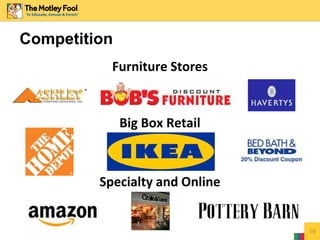
Furniture Stores 
Big Box Retail 
Specialty and Online 
19 
Competition
 E-commerce presents a host of investing opportunities as a 
long-term trend that is still in the very early innings. 
 The first question to ask of any retail play, e-commerce or 
otherwise is: How will it compete with Amazon.com? Could 
this be an Amazon acquisition target? Why? Why not? 
 Founder leadership is a very attractive quality in Wayfair’s 
business, but remember it’s not a thesis. 
 Wayfair’s relationship with its suppliers is an integral part of 
its business model. 
 It’s too early to definitively call Wayfair a buy, however the 
stock’s pullback should put it on the radar for investors who 
are willing to be patient. 
20 
Points of discussion
Remember, investing is all 
about the future. There are 
never any guarantees and you're 
taking a measure of a leap of faith 
every single time. 
21

Wayfair Deck

  • 1.
    NYSE: W JasonA. Moser 1
  • 2.
     Few long-termtrends pose the opportunity and potential that e-commerce poses today.  While a number of companies are making the shift from bricks-and-mortar to e-commerce (or some mix thereof), those that are built as e-commerce companies from the start have a unique advantage in claiming their share of the space.  Wayfair is one such company that is gaining share in a robust and growing market in home goods and furnishings. 2 The idea
  • 3.
    3 What doesWayfair do? Wayfair is an e-commerce platform that sells furniture, décor, lighting, kitchen, bed and bath, outdoor, home improvement, and baby and kids products to consumers under the Wayfair.com, Joss & Main, AllModern, DwellStudio, and Birch Lane brands.
  • 4.
    4 What doesWayfair do?
  • 5.
    Market opportunity 5 Wayfair’s addressable home goods market (the US furniture and home décor markets), was $233 billion in 2013, according to Euromonitor International. It’s pegged to hit $297 billion by 2023. In 2013 women represented 70% of Wayfair’s customers. There are 63 million women between the ages of 35 and 65, Wayfair’s target demo. There are an estimated 73-80 million millennials (no universal definition); about 25% of the US population today. Up-and-coming spenders…how do they spend? How do they shop?
  • 6.
    A long-term trend 6 Source: US Census Bureau
  • 7.
     Management’s case: 1. Differentiated: Home is shopped differently than other retail verticals. 2. More is better: Home shoppers desire uniqueness, which requires vast selection. 3. Easy does it: Time consuming and inconvenient for consumers to shop across brick and mortar home retailers. 4. Compare and contrast: Difficult to browse, value shop and price compare. 5. Logistically speaking: Challenging logistics for consumers and retailers. 7 Why the home is different
  • 8.
     On management’spoints: 1. True, typically a much more personal purchase that is dependent upon individual taste and preference. 2. True, vast selection is definitely an advantage. 3. True, it’s much easier to shop online than it is to drive across town from store to store. However when it comes to furniture is the customer making this leap en masse? 4. True, to the aforementioned point, shopping, comparing, value-seeking much easier online. 5. True, often bigger-ticket items, often must be delivered, inventory management not as easy. 8 Is the home different?
  • 9.
     Management’s case: 1. Service: Customer service is priority number one with 30% of employees in CS division. 2. Experience: Continued investment in mobile and personalization offers excellent experience. 3. Vast: Huge selection with more than 7,000 suppliers and 7 million products. 4. Mutual: Wayfair opens up a large customer base to a localized supplier base, suppliers benefit. 5. Direct: Shipping directly from suppliers enhances service, saves time, cuts down cost structure. 9 Why is Wayfair different?
  • 10.
    From the S-1: “Net revenue consists primarily of sales of product from our sites and through the sites of our online retail partners and includes related shipping fees. We deduct cash discounts, allowances, rewards and estimated returns from gross revenue to determine net revenue.” 10 How do they make money?
  • 11.
    Sales Orders delivered Active customers TTM revenue per active customer Average order value Margins 11 Wayfair metrics that matter
  • 12.
    12 Managing salesand margins
  • 13.
    13 The valueof growing orders
  • 14.
  • 15.
    Management Niraj Shah Co-Founder CEO & Co-Chairman Steve Conine Co-Founder CTO & Co-Chairman 15
  • 16.
    Management Michael Fleisher CFO since 2013 Former chairman & CEO of Gartner James Savarese COO since 2014 Joined Wayfair in 2008 16
  • 17.
     Going bythe numbers presented, Wayfair held 0.4% of its defined market share in 2013 ($916 million in sales in a $233 billion market).  Initial analyst estimates peg Wayfair sales at $6.4 billion by 2019; CAGR of 37.5% for that 5 year time frame. Assuming these are optimistic, let’s take 75% of this estimate…$4.8 billion and 30%.  Cut that growth rate in half for 2020-2023, Wayfair sales in 2023 are $8.4 billion.  Based on market estimates of $297 billion this would give Wayfair about 2.8% market share by 2023. Reasonable? Sure.  Stock trades at 1.93X sales today; Amazon trades at 1.75X sales; eBay 3.75X sales; Google 5.7X sales. Amazon is its most sensible comparable.  If Wayfair hits sales of $4.8 billion in 2019, at 1.75X sales we have a market cap of $8.4 billion up from $2.14 billion today.  But what’s happening to margins along the way? That’s the big question. 17 Understanding future worth
  • 18.
     Suppliers: Relationshipswith suppliers are crucial but easily terminable. Any large exodus could prove debilitating to the model.  Amazon.com: Tremendously competitive space, not just Amazon either.  Sensitivity: No doubt Wayfair and its brands are subject to an economically sensitive consumer.  Founders: While I’m very encouraged by the co-founders being so intimately involved with the business, any infighting or departure of one or both would be a red flag.  Service: Reliance on suppliers for effective inventory management and/or shipping could result in poor customer service.  Go long: This is a growth story and a company that will be investing a lot in its operations in the coming years.  Duality: Dual-class share system places power in the hands of the founders. They’re calling the shots, like it or not. 18 Risks
  • 19.
    Furniture Stores BigBox Retail Specialty and Online 19 Competition
  • 20.
     E-commerce presentsa host of investing opportunities as a long-term trend that is still in the very early innings.  The first question to ask of any retail play, e-commerce or otherwise is: How will it compete with Amazon.com? Could this be an Amazon acquisition target? Why? Why not?  Founder leadership is a very attractive quality in Wayfair’s business, but remember it’s not a thesis.  Wayfair’s relationship with its suppliers is an integral part of its business model.  It’s too early to definitively call Wayfair a buy, however the stock’s pullback should put it on the radar for investors who are willing to be patient. 20 Points of discussion
  • 21.
    Remember, investing isall about the future. There are never any guarantees and you're taking a measure of a leap of faith every single time. 21