Yinan Qi
Samsung Electronics R&D Institute UK, Staines, Middlesex TW18 4QE, UK
5G NR: Key Features and Enhancements
An overview of 5G NR key technical features and enhancements
for massive MIMO, mmWave, etc.
18th September, CW TEC 2018 - The
inevitable automation of Next Generation
Networks
▪ 5G NR Phase I overview: timeline, spectrum and use cases.
▪ Key features and enhancements
▪ Flexibility
o Numerology
o Frame structure
▪ Millimetre wave
o Beam management
o Massive MIMO
o Phase tracking
▪ UE specific design
o Bandwidth part (BWP)
o Reference signal design
▪ 5G NR Phase II overview: SID/WID, enhancements, etc.
Outline
| 2
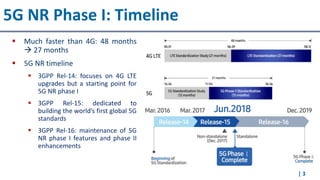
▪ Much faster than 4G: 48 months
→ 27 months
▪ 5G NR timeline
▪ 3GPP Rel-14: focuses on 4G LTE
upgrades but a starting point for
5G NR phase I
▪ 3GPP Rel-15: dedicated to
building the world’s first global 5G
standards
▪ 3GPP Rel-16: maintenance of 5G
NR phase I features and phase II
enhancements
5G NR Phase I: Timeline
| 3
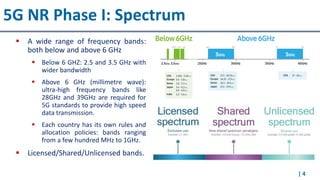
▪ A wide range of frequency bands:
both below and above 6 GHz
▪ Below 6 GHZ: 2.5 and 3.5 GHz with
wider bandwidth
▪ Above 6 GHz (millimetre wave):
ultra-high frequency bands like
28GHz and 39GHz are required for
5G standards to provide high speed
data transmission.
▪ Each country has its own rules and
allocation policies: bands ranging
from a few hundred MHz to 1GHz.
▪ Licensed/Shared/Unlicensed bands.
5G NR Phase I: Spectrum
| 4
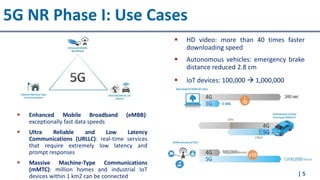
▪ Enhanced Mobile Broadband (eMBB):
exceptionally fast data speeds
▪ Ultra Reliable and Low Latency
Communications (URLLC): real-time services
that require extremely low latency and
prompt responses
▪ Massive Machine-Type Communications
(mMTC): million homes and industrial IoT
devices within 1 km2 can be connected
5G NR Phase I: Use Cases
| 5
▪ HD video: more than 40 times faster
downloading speed
▪ Autonomous vehicles: emergency brake
distance reduced 2.8 cm
▪ IoT devices: 100,000 → 1,000,000
▪ Scalable numerology
▪ Numerology parameters:
▪ Subcarrier Spacing
o 15 kHz to 60 kHz for below 6 GHz
o 60 kHz to 120 kHz for above 6 GHz
o 240 kHz for synchronization
▪ Cyclic Prefix
o 60 kHz can be configured with extended CP
▪ Larger subcarrier spacing for above 6 GHz
▪ Latency: shorter symbol duration
▪ ICI: phase noise
▪ Support multiplexing of different
numerologies
5G NR Flexibility: Numerology
| 6
[kHz]152 = 
f
▪ Length of one radio frame is fixed to 10ms and
the length of 1 subframe is fixed to 1ms.
▪ Different Numerologies will be then translated
in the number of slots per sub-frame: higher
the Subcarrier spacing → higher the number
of slots per sub-Frame.
▪ Slot: 14 OFDM symbols
▪ 15 kHz: 1 slot per subframe
▪ 30 kHz: 2 slots per subframe
▪ 60 kHz: 4 slots per subframe
▪ 120 kHz: 8 slots per subframe
▪ Two slot configurations:
▪ Slot configuration 0: 14 OFDM symbols, applied
to all numerologies
▪ Slot configuration 1: containing 7, 4 or 2 OFDM
symbols, applied only for certain numerologies.
5G NR Flexibility: Frame Structure
| 7
1 Slot, 14 Symbols, Slot duration 1 ms15 kHz
1 Slot, 14 Symbols, Slot duration 0.5
ms
30 kHz
1 Slot, 14 Symbols,
Slot duration 0.25 ms60 kHz
1 Slot, 14
Symbols, Slot
duration 0.125
ms
120 kHz
Subframe (1ms)
▪ High frequency bands: small coverage and low penetration rate.
▪ Beamforming
▪ Strong concentrated signals in one particular direction
▪ Enables mmWave frequencies to travel far with less interference from other signals.
▪ More the antenna elements → sharper the beam shape → concentrated energy.
5G NR Millimetre Wave: Beamforming
| 8
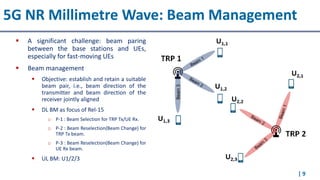
▪ A significant challenge: beam paring
between the base stations and UEs,
especially for fast-moving UEs
▪ Beam management
▪ Objective: establish and retain a suitable
beam pair, i.e., beam direction of the
transmitter and beam direction of the
receiver jointly aligned
▪ DL BM as focus of Rel-15
o P-1 : Beam Selection for TRP Tx/UE Rx.
o P-2 : Beam Reselection(Beam Change) for
TRP Tx beam.
o P-3 : Beam Reselection(Beam Change) for
UE Rx beam.
▪ UL BM: U1/2/3
5G NR Millimetre Wave: Beam Management
| 9
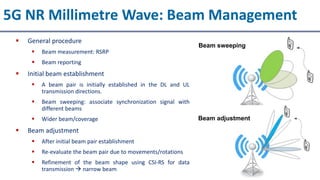
▪ General procedure
▪ Beam measurement: RSRP
▪ Beam reporting
▪ Initial beam establishment
▪ A beam pair is initially established in the DL and UL
transmission directions.
▪ Beam sweeping: associate synchronization signal with
different beams
▪ Wider beam/coverage
▪ Beam adjustment
▪ After initial beam pair establishment
▪ Re-evaluate the beam pair due to movements/rotations
▪ Refinement of the beam shape using CSI-RS for data
transmission → narrow beam
5G NR Millimetre Wave: Beam Management
| 10
Beam sweeping
Beam adjustment
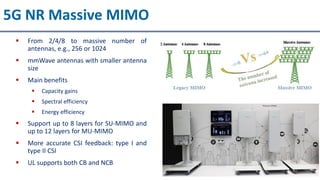
▪ From 2/4/8 to massive number of
antennas, e.g., 256 or 1024
▪ mmWave antennas with smaller antenna
size
▪ Main benefits
▪ Capacity gains
▪ Spectral efficiency
▪ Energy efficiency
▪ Support up to 8 layers for SU-MIMO and
up to 12 layers for MU-MIMO
▪ More accurate CSI feedback: type I and
type II CSI
▪ UL supports both CB and NCB
5G NR Massive MIMO
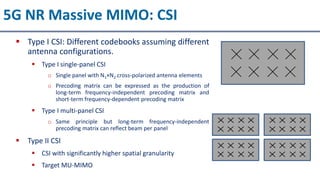
▪ Type I CSI: Different codebooks assuming different
antenna configurations.
▪ Type I single-panel CSI
o Single panel with N1×N2 cross-polarized antenna elements
o Precoding matrix can be expressed as the production of
long-term frequency-independent precoding matrix and
short-term frequency-dependent precoding matrix
▪ Type I multi-panel CSI
o Same principle but long-term frequency-independent
precoding matrix can reflect beam per panel
▪ Type II CSI
▪ CSI with significantly higher spatial granularity
▪ Target MU-MIMO
5G NR Massive MIMO: CSI
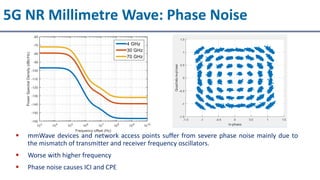
▪ mmWave devices and network access points suffer from severe phase noise mainly due to
the mismatch of transmitter and receiver frequency oscillators.
▪ Worse with higher frequency
▪ Phase noise causes ICI and CPE
5G NR Millimetre Wave: Phase Noise
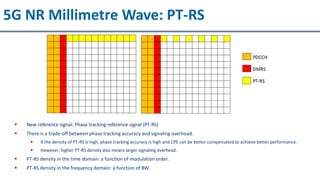
▪ New reference signal: Phase tracking reference signal (PT-RS)
▪ There is a trade-off between phase tracking accuracy and signaling overhead.
▪ If the density of PT-RS is high, phase tracking accuracy is high and CPE can be better compensated to achieve better performance.
▪ However, higher PT-RS density also means larger signaling overhead.
▪ PT-RS density in the time domain: a function of modulation order.
▪ PT-RS density in the frequency domain: a function of BW.
5G NR Millimetre Wave: PT-RS
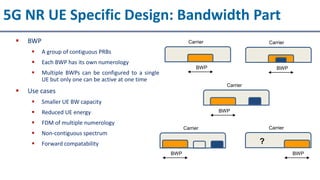
▪ BWP
▪ A group of contiguous PRBs
▪ Each BWP has its own numerology
▪ Multiple BWPs can be configured to a single
UE but only one can be active at one time
▪ Use cases
▪ Smaller UE BW capacity
▪ Reduced UE energy
▪ FDM of multiple numerology
▪ Non-contiguous spectrum
▪ Forward compatability
5G NR UE Specific Design: Bandwidth Part
Carrier
BWP
Carrier
BWP
Carrier
BWP
Carrier
BWP
Carrier
BWP
?
▪ LTE
▪ Synchronization: SS
▪ Demodulation: DMRS
▪ Channel estimation:
o Cell specific RS: always on
o CSI-RS: UE specific RS
o SRS: UL
▪ 5G NR
▪ Synchronization: SS
▪ Demodulation: front-loaded DMRS
▪ Phase tracking
o PT-RS
▪ Channel estimation
o CSI-RS
▪ Fine time and frequency tracking
o TRS: one port CSI-RS
5G NR UE Specific Design: Referene Signals
▪ DMRS
▪ Front loaded
▪ Two different DMRS patterns
▪ Additional DMRS symbols can be configured
▪ CSI-RS
▪ X-port CSI-RS REs span N adjacent/non-adjacent OFDM symbols
▪ Three types of component CSI-RS RE patterns are supported:
o (Y,Z) ∈ {(2,1), (2,2), (4,1)}
o A component CSI-RS RE pattern is defined within a single PRB as Y adjacent REs in the frequency domain and Z
adjacent REs in the time domain
▪ Three types of CDM patterns are supported:
o FD-CDM2, CDM4 (FD2, TD2), CDM8 (FD2, TD4)
5G NR UE Specific Design: Referene Signals
Adjacent/non-adjacent
▪ Enhancements of
phase I
▪ MIMO MIMO
▪ DC and CA
▪ Mobility
▪ 5G NR Phase II
SID/WID
5G NR Phase II
| 18
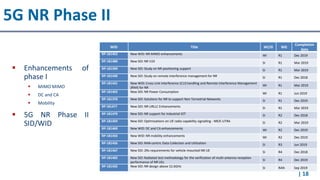
WID Title WI/SI WG
Completion
date
RP-181453 New WID: NR MIMO enhancements WI R1 Dec 2019
RP-181480 New SID: NR V2X SI R1 Mar 2019
RP-181399 New SID: Study on NR positioning support SI R1 Mar 2019
RP-181430 New SID: Study on remote interference management for NR SI R1 Dec 2018
RP-181431 New WID: Cross Link Interference (CLI) handling and Remote Interference Management
(RIM) for NR
WI R1 Mar 2019
RP-181463 New SID: NR Power Consumption WI R1 Jun 2019
RP-181370 New SID: Solutions for NR to support Non Terrestrial Networks SI R1 Dec 2019
RP 181477 New SID: NR URLLC Enhancements SI R1 Mar 2019
RP-181479 New SID: NR support for Industrial IOT SI R2 Dec 2018
RP-181459 New SID: Optimisations on UE radio capability signalling - NR/E-UTRA SI R2 Mar 2019
RP-181469 New WID: DC and CA enhancements WI R2 Dec 2019
RP-181433 New WID: NR mobility enhancements WI R2 Dec 2019
RP-181456 New SID: RAN-centric Data Collection and Utilization SI R3 Jun 2019
RP-181467 New SID: 2Rx requirements for vehicle mounted NR UE SI R4 Dec 2018
RP-181402 New SID: Radiated test methodology for the verification of multi-antenna reception
performance of NR UEs
SI R4 Dec 2019
RP-181435 New SID: NR design above 52.6GHz SI RAN Sep 2019
Thank you for your attention
Questions?

5G NR: Key features and enhancements

  • 1.
    Yinan Qi Samsung ElectronicsR&D Institute UK, Staines, Middlesex TW18 4QE, UK 5G NR: Key Features and Enhancements An overview of 5G NR key technical features and enhancements for massive MIMO, mmWave, etc. 18th September, CW TEC 2018 - The inevitable automation of Next Generation Networks
  • 2.
    ▪ 5G NRPhase I overview: timeline, spectrum and use cases. ▪ Key features and enhancements ▪ Flexibility o Numerology o Frame structure ▪ Millimetre wave o Beam management o Massive MIMO o Phase tracking ▪ UE specific design o Bandwidth part (BWP) o Reference signal design ▪ 5G NR Phase II overview: SID/WID, enhancements, etc. Outline | 2
  • 3.
    ▪ Much fasterthan 4G: 48 months → 27 months ▪ 5G NR timeline ▪ 3GPP Rel-14: focuses on 4G LTE upgrades but a starting point for 5G NR phase I ▪ 3GPP Rel-15: dedicated to building the world’s first global 5G standards ▪ 3GPP Rel-16: maintenance of 5G NR phase I features and phase II enhancements 5G NR Phase I: Timeline | 3
  • 4.
    ▪ A widerange of frequency bands: both below and above 6 GHz ▪ Below 6 GHZ: 2.5 and 3.5 GHz with wider bandwidth ▪ Above 6 GHz (millimetre wave): ultra-high frequency bands like 28GHz and 39GHz are required for 5G standards to provide high speed data transmission. ▪ Each country has its own rules and allocation policies: bands ranging from a few hundred MHz to 1GHz. ▪ Licensed/Shared/Unlicensed bands. 5G NR Phase I: Spectrum | 4
  • 5.
    ▪ Enhanced MobileBroadband (eMBB): exceptionally fast data speeds ▪ Ultra Reliable and Low Latency Communications (URLLC): real-time services that require extremely low latency and prompt responses ▪ Massive Machine-Type Communications (mMTC): million homes and industrial IoT devices within 1 km2 can be connected 5G NR Phase I: Use Cases | 5 ▪ HD video: more than 40 times faster downloading speed ▪ Autonomous vehicles: emergency brake distance reduced 2.8 cm ▪ IoT devices: 100,000 → 1,000,000
  • 6.
    ▪ Scalable numerology ▪Numerology parameters: ▪ Subcarrier Spacing o 15 kHz to 60 kHz for below 6 GHz o 60 kHz to 120 kHz for above 6 GHz o 240 kHz for synchronization ▪ Cyclic Prefix o 60 kHz can be configured with extended CP ▪ Larger subcarrier spacing for above 6 GHz ▪ Latency: shorter symbol duration ▪ ICI: phase noise ▪ Support multiplexing of different numerologies 5G NR Flexibility: Numerology | 6 [kHz]152 =  f
  • 7.
    ▪ Length ofone radio frame is fixed to 10ms and the length of 1 subframe is fixed to 1ms. ▪ Different Numerologies will be then translated in the number of slots per sub-frame: higher the Subcarrier spacing → higher the number of slots per sub-Frame. ▪ Slot: 14 OFDM symbols ▪ 15 kHz: 1 slot per subframe ▪ 30 kHz: 2 slots per subframe ▪ 60 kHz: 4 slots per subframe ▪ 120 kHz: 8 slots per subframe ▪ Two slot configurations: ▪ Slot configuration 0: 14 OFDM symbols, applied to all numerologies ▪ Slot configuration 1: containing 7, 4 or 2 OFDM symbols, applied only for certain numerologies. 5G NR Flexibility: Frame Structure | 7 1 Slot, 14 Symbols, Slot duration 1 ms15 kHz 1 Slot, 14 Symbols, Slot duration 0.5 ms 30 kHz 1 Slot, 14 Symbols, Slot duration 0.25 ms60 kHz 1 Slot, 14 Symbols, Slot duration 0.125 ms 120 kHz Subframe (1ms)
  • 8.
    ▪ High frequencybands: small coverage and low penetration rate. ▪ Beamforming ▪ Strong concentrated signals in one particular direction ▪ Enables mmWave frequencies to travel far with less interference from other signals. ▪ More the antenna elements → sharper the beam shape → concentrated energy. 5G NR Millimetre Wave: Beamforming | 8
  • 9.
    ▪ A significantchallenge: beam paring between the base stations and UEs, especially for fast-moving UEs ▪ Beam management ▪ Objective: establish and retain a suitable beam pair, i.e., beam direction of the transmitter and beam direction of the receiver jointly aligned ▪ DL BM as focus of Rel-15 o P-1 : Beam Selection for TRP Tx/UE Rx. o P-2 : Beam Reselection(Beam Change) for TRP Tx beam. o P-3 : Beam Reselection(Beam Change) for UE Rx beam. ▪ UL BM: U1/2/3 5G NR Millimetre Wave: Beam Management | 9
  • 10.
    ▪ General procedure ▪Beam measurement: RSRP ▪ Beam reporting ▪ Initial beam establishment ▪ A beam pair is initially established in the DL and UL transmission directions. ▪ Beam sweeping: associate synchronization signal with different beams ▪ Wider beam/coverage ▪ Beam adjustment ▪ After initial beam pair establishment ▪ Re-evaluate the beam pair due to movements/rotations ▪ Refinement of the beam shape using CSI-RS for data transmission → narrow beam 5G NR Millimetre Wave: Beam Management | 10 Beam sweeping Beam adjustment
  • 11.
    ▪ From 2/4/8to massive number of antennas, e.g., 256 or 1024 ▪ mmWave antennas with smaller antenna size ▪ Main benefits ▪ Capacity gains ▪ Spectral efficiency ▪ Energy efficiency ▪ Support up to 8 layers for SU-MIMO and up to 12 layers for MU-MIMO ▪ More accurate CSI feedback: type I and type II CSI ▪ UL supports both CB and NCB 5G NR Massive MIMO
  • 12.
    ▪ Type ICSI: Different codebooks assuming different antenna configurations. ▪ Type I single-panel CSI o Single panel with N1×N2 cross-polarized antenna elements o Precoding matrix can be expressed as the production of long-term frequency-independent precoding matrix and short-term frequency-dependent precoding matrix ▪ Type I multi-panel CSI o Same principle but long-term frequency-independent precoding matrix can reflect beam per panel ▪ Type II CSI ▪ CSI with significantly higher spatial granularity ▪ Target MU-MIMO 5G NR Massive MIMO: CSI
  • 13.
    ▪ mmWave devicesand network access points suffer from severe phase noise mainly due to the mismatch of transmitter and receiver frequency oscillators. ▪ Worse with higher frequency ▪ Phase noise causes ICI and CPE 5G NR Millimetre Wave: Phase Noise
  • 14.
    ▪ New referencesignal: Phase tracking reference signal (PT-RS) ▪ There is a trade-off between phase tracking accuracy and signaling overhead. ▪ If the density of PT-RS is high, phase tracking accuracy is high and CPE can be better compensated to achieve better performance. ▪ However, higher PT-RS density also means larger signaling overhead. ▪ PT-RS density in the time domain: a function of modulation order. ▪ PT-RS density in the frequency domain: a function of BW. 5G NR Millimetre Wave: PT-RS
  • 15.
    ▪ BWP ▪ Agroup of contiguous PRBs ▪ Each BWP has its own numerology ▪ Multiple BWPs can be configured to a single UE but only one can be active at one time ▪ Use cases ▪ Smaller UE BW capacity ▪ Reduced UE energy ▪ FDM of multiple numerology ▪ Non-contiguous spectrum ▪ Forward compatability 5G NR UE Specific Design: Bandwidth Part Carrier BWP Carrier BWP Carrier BWP Carrier BWP Carrier BWP ?
  • 16.
    ▪ LTE ▪ Synchronization:SS ▪ Demodulation: DMRS ▪ Channel estimation: o Cell specific RS: always on o CSI-RS: UE specific RS o SRS: UL ▪ 5G NR ▪ Synchronization: SS ▪ Demodulation: front-loaded DMRS ▪ Phase tracking o PT-RS ▪ Channel estimation o CSI-RS ▪ Fine time and frequency tracking o TRS: one port CSI-RS 5G NR UE Specific Design: Referene Signals
  • 17.
    ▪ DMRS ▪ Frontloaded ▪ Two different DMRS patterns ▪ Additional DMRS symbols can be configured ▪ CSI-RS ▪ X-port CSI-RS REs span N adjacent/non-adjacent OFDM symbols ▪ Three types of component CSI-RS RE patterns are supported: o (Y,Z) ∈ {(2,1), (2,2), (4,1)} o A component CSI-RS RE pattern is defined within a single PRB as Y adjacent REs in the frequency domain and Z adjacent REs in the time domain ▪ Three types of CDM patterns are supported: o FD-CDM2, CDM4 (FD2, TD2), CDM8 (FD2, TD4) 5G NR UE Specific Design: Referene Signals Adjacent/non-adjacent
  • 18.
    ▪ Enhancements of phaseI ▪ MIMO MIMO ▪ DC and CA ▪ Mobility ▪ 5G NR Phase II SID/WID 5G NR Phase II | 18 WID Title WI/SI WG Completion date RP-181453 New WID: NR MIMO enhancements WI R1 Dec 2019 RP-181480 New SID: NR V2X SI R1 Mar 2019 RP-181399 New SID: Study on NR positioning support SI R1 Mar 2019 RP-181430 New SID: Study on remote interference management for NR SI R1 Dec 2018 RP-181431 New WID: Cross Link Interference (CLI) handling and Remote Interference Management (RIM) for NR WI R1 Mar 2019 RP-181463 New SID: NR Power Consumption WI R1 Jun 2019 RP-181370 New SID: Solutions for NR to support Non Terrestrial Networks SI R1 Dec 2019 RP 181477 New SID: NR URLLC Enhancements SI R1 Mar 2019 RP-181479 New SID: NR support for Industrial IOT SI R2 Dec 2018 RP-181459 New SID: Optimisations on UE radio capability signalling - NR/E-UTRA SI R2 Mar 2019 RP-181469 New WID: DC and CA enhancements WI R2 Dec 2019 RP-181433 New WID: NR mobility enhancements WI R2 Dec 2019 RP-181456 New SID: RAN-centric Data Collection and Utilization SI R3 Jun 2019 RP-181467 New SID: 2Rx requirements for vehicle mounted NR UE SI R4 Dec 2018 RP-181402 New SID: Radiated test methodology for the verification of multi-antenna reception performance of NR UEs SI R4 Dec 2019 RP-181435 New SID: NR design above 52.6GHz SI RAN Sep 2019
  • 19.
    Thank you foryour attention Questions?