www.rfwireless-world.com 
Basics of LTE System 
© Copyright 2012 All rights reserved. 
Introduction: 
Third-generation (3G) wireless systems, based on W-CDMA, are now being deployed all over 
the world. W-CDMA maintains a mid-term competitive edge by providing high speed packet 
access (HSPA) in both downlink and uplink modes. To ensure the competitiveness of the 3G 
systems into the future, a long term evolution (LTE) of the 3rd Generation Partnership Project 
(3GPP) access technology is being specified in Release 8 and 9 of the 3GPP standard. Release 
10 is being developed as LTE-Advanced. 
The LTE radio transmission and reception specifications are documented in TS 36.101 for the 
UE (User Equipment) and TS 36.104 for the eNB (Evolved Node B). Downlink and uplink 
transmission in LTE are based on the use of multiple access technologies: specifically, 
orthogonal frequency division multiple access (OFDMA) for the downlink, and single-carrier 
frequency division multiple access (SC-FDMA) for the uplink. 
The work on the specifications is ongoing, and many of the technical documents are updated 
quarterly. The latest versions of the 36-series documents can be found at 
http://www.3gpp.org/ftp/specs/archive/36_series/ 
Physical layer is described in TS36.211 and TS36.212 releases. 36.211 mentions physical 
channels and modulation while 36.212 mentions multiplexing and channel coding. 
LTE system parameters and Frame structure: 
Frame Size=10ms 
No. of slots=20. 
No of Slots per Sub frame =2. 
Slot duration=0.5 ms 
Sub frame duration=1 ms 
Basic time unit Ts for BW of 20MHz, 1/15000*2048seconds equal to 32.55ns.
www.rfwireless-world.com 
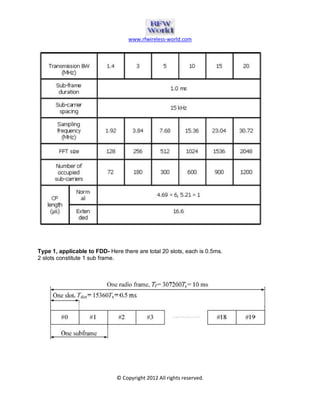
Type 1, applicable to FDD- Here there are total 20 slots, each is 0.5ms. 
2 slots constitute 1 sub frame. 
© Copyright 2012 All rights reserved.
www.rfwireless-world.com 
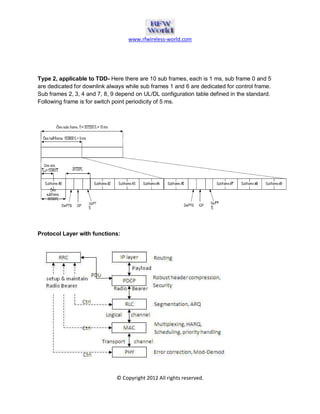
Type 2, applicable to TDD- Here there are 10 sub frames, each is 1 ms, sub frame 0 and 5 
are dedicated for downlink always while sub frames 1 and 6 are dedicated for control frame. 
Sub frames 2, 3, 4 and 7, 8, 9 depend on UL/DL configuration table defined in the standard. 
Following frame is for switch point periodicity of 5 ms. 
Protocol Layer with functions: 
© Copyright 2012 All rights reserved.
www.rfwireless-world.com 
© Copyright 2012 All rights reserved. 
Physical layer: 
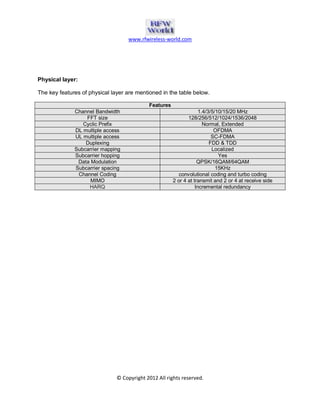
The key features of physical layer are mentioned in the table below. 
Features 
Channel Bandwidth 1.4/3/5/10/15/20 MHz 
FFT size 128/256/512/1024/1536/2048 
Cyclic Prefix Normal, Extended 
DL multiple access OFDMA 
UL multiple access SC-FDMA 
Duplexing FDD & TDD 
Subcarrier mapping Localized 
Subcarrier hopping Yes 
Data Modulation QPSK/16QAM/64QAM 
Subcarrier spacing 15KHz 
Channel Coding convolutional coding and turbo coding 
MIMO 2 or 4 at transmit and 2 or 4 at receive side 
HARQ Incremental redundancy
www.rfwireless-world.com 
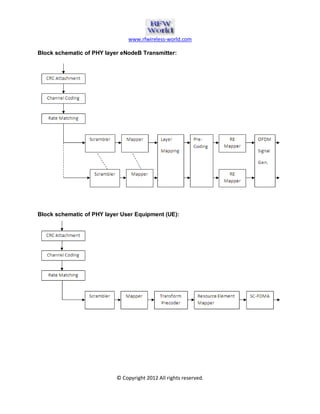
Block schematic of PHY layer eNodeB Transmitter: 
Block schematic of PHY layer User Equipment (UE): 
© Copyright 2012 All rights reserved.
www.rfwireless-world.com 
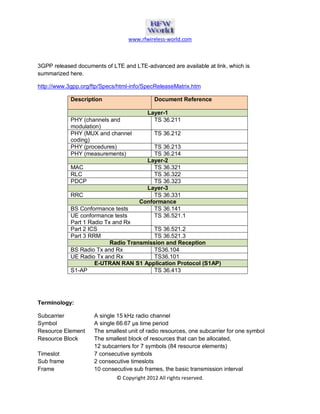
3GPP released documents of LTE and LTE-advanced are available at link, which is 
summarized here. 
http://www.3gpp.org/ftp/Specs/html-info/SpecReleaseMatrix.htm 
Description Document Reference 
Layer-1 
PHY (channels and 
modulation) 
TS 36.211 
PHY (MUX and channel 
coding) 
TS 36.212 
PHY (procedures) TS 36.213 
PHY (measurements) TS 36.214 
Layer-2 
MAC TS 36.321 
RLC TS 36.322 
PDCP TS 36.323 
Layer-3 
RRC TS 36.331 
Conformance 
BS Conformance tests TS 36.141 
UE conformance tests 
Part 1 Radio Tx and Rx 
TS 36.521.1 
Part 2 ICS TS 36.521.2 
Part 3 RRM TS 36.521.3 
Radio Transmission and Reception 
BS Radio Tx and Rx TS36.104 
UE Radio Tx and Rx TS36.101 
E-UTRAN RAN S1 Application Protocol (S1AP) 
S1-AP TS 36.413 
© Copyright 2012 All rights reserved. 
Terminology: 
Subcarrier A single 15 kHz radio channel 
Symbol A single 66.67 μs time period 
Resource Element The smallest unit of radio resources, one subcarrier for one symbol 
Resource Block The smallest block of resources that can be allocated, 
12 subcarriers for 7 symbols (84 resource elements) 
Timeslot 7 consecutive symbols 
Sub frame 2 consecutive timeslots 
Frame 10 consecutive sub frames, the basic transmission interval
www.rfwireless-world.com 
© Copyright 2012 All rights reserved. 
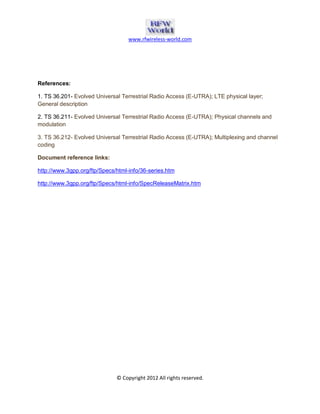
References: 
1. TS 36.201- Evolved Universal Terrestrial Radio Access (E-UTRA); LTE physical layer; 
General description 
2. TS 36.211- Evolved Universal Terrestrial Radio Access (E-UTRA); Physical channels and 
modulation 
3. TS 36.212- Evolved Universal Terrestrial Radio Access (E-UTRA); Multiplexing and channel 
coding 
Document reference links: 
http://www.3gpp.org/ftp/Specs/html-info/36-series.htm 
http://www.3gpp.org/ftp/Specs/html-info/SpecReleaseMatrix.htm

LTE System Basics

  • 1.
    www.rfwireless-world.com Basics ofLTE System © Copyright 2012 All rights reserved. Introduction: Third-generation (3G) wireless systems, based on W-CDMA, are now being deployed all over the world. W-CDMA maintains a mid-term competitive edge by providing high speed packet access (HSPA) in both downlink and uplink modes. To ensure the competitiveness of the 3G systems into the future, a long term evolution (LTE) of the 3rd Generation Partnership Project (3GPP) access technology is being specified in Release 8 and 9 of the 3GPP standard. Release 10 is being developed as LTE-Advanced. The LTE radio transmission and reception specifications are documented in TS 36.101 for the UE (User Equipment) and TS 36.104 for the eNB (Evolved Node B). Downlink and uplink transmission in LTE are based on the use of multiple access technologies: specifically, orthogonal frequency division multiple access (OFDMA) for the downlink, and single-carrier frequency division multiple access (SC-FDMA) for the uplink. The work on the specifications is ongoing, and many of the technical documents are updated quarterly. The latest versions of the 36-series documents can be found at http://www.3gpp.org/ftp/specs/archive/36_series/ Physical layer is described in TS36.211 and TS36.212 releases. 36.211 mentions physical channels and modulation while 36.212 mentions multiplexing and channel coding. LTE system parameters and Frame structure: Frame Size=10ms No. of slots=20. No of Slots per Sub frame =2. Slot duration=0.5 ms Sub frame duration=1 ms Basic time unit Ts for BW of 20MHz, 1/15000*2048seconds equal to 32.55ns.
  • 2.
    www.rfwireless-world.com Type 1,applicable to FDD- Here there are total 20 slots, each is 0.5ms. 2 slots constitute 1 sub frame. © Copyright 2012 All rights reserved.
  • 3.
    www.rfwireless-world.com Type 2,applicable to TDD- Here there are 10 sub frames, each is 1 ms, sub frame 0 and 5 are dedicated for downlink always while sub frames 1 and 6 are dedicated for control frame. Sub frames 2, 3, 4 and 7, 8, 9 depend on UL/DL configuration table defined in the standard. Following frame is for switch point periodicity of 5 ms. Protocol Layer with functions: © Copyright 2012 All rights reserved.
  • 4.
    www.rfwireless-world.com © Copyright2012 All rights reserved. Physical layer: The key features of physical layer are mentioned in the table below. Features Channel Bandwidth 1.4/3/5/10/15/20 MHz FFT size 128/256/512/1024/1536/2048 Cyclic Prefix Normal, Extended DL multiple access OFDMA UL multiple access SC-FDMA Duplexing FDD & TDD Subcarrier mapping Localized Subcarrier hopping Yes Data Modulation QPSK/16QAM/64QAM Subcarrier spacing 15KHz Channel Coding convolutional coding and turbo coding MIMO 2 or 4 at transmit and 2 or 4 at receive side HARQ Incremental redundancy
  • 5.
    www.rfwireless-world.com Block schematicof PHY layer eNodeB Transmitter: Block schematic of PHY layer User Equipment (UE): © Copyright 2012 All rights reserved.
  • 6.
    www.rfwireless-world.com 3GPP releaseddocuments of LTE and LTE-advanced are available at link, which is summarized here. http://www.3gpp.org/ftp/Specs/html-info/SpecReleaseMatrix.htm Description Document Reference Layer-1 PHY (channels and modulation) TS 36.211 PHY (MUX and channel coding) TS 36.212 PHY (procedures) TS 36.213 PHY (measurements) TS 36.214 Layer-2 MAC TS 36.321 RLC TS 36.322 PDCP TS 36.323 Layer-3 RRC TS 36.331 Conformance BS Conformance tests TS 36.141 UE conformance tests Part 1 Radio Tx and Rx TS 36.521.1 Part 2 ICS TS 36.521.2 Part 3 RRM TS 36.521.3 Radio Transmission and Reception BS Radio Tx and Rx TS36.104 UE Radio Tx and Rx TS36.101 E-UTRAN RAN S1 Application Protocol (S1AP) S1-AP TS 36.413 © Copyright 2012 All rights reserved. Terminology: Subcarrier A single 15 kHz radio channel Symbol A single 66.67 μs time period Resource Element The smallest unit of radio resources, one subcarrier for one symbol Resource Block The smallest block of resources that can be allocated, 12 subcarriers for 7 symbols (84 resource elements) Timeslot 7 consecutive symbols Sub frame 2 consecutive timeslots Frame 10 consecutive sub frames, the basic transmission interval
  • 7.
    www.rfwireless-world.com © Copyright2012 All rights reserved. References: 1. TS 36.201- Evolved Universal Terrestrial Radio Access (E-UTRA); LTE physical layer; General description 2. TS 36.211- Evolved Universal Terrestrial Radio Access (E-UTRA); Physical channels and modulation 3. TS 36.212- Evolved Universal Terrestrial Radio Access (E-UTRA); Multiplexing and channel coding Document reference links: http://www.3gpp.org/ftp/Specs/html-info/36-series.htm http://www.3gpp.org/ftp/Specs/html-info/SpecReleaseMatrix.htm