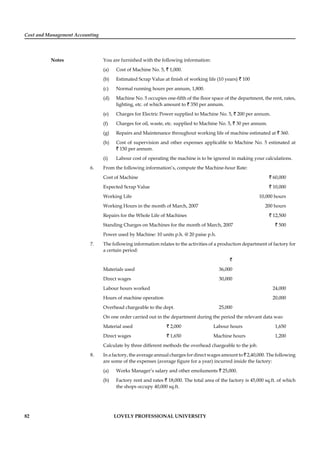
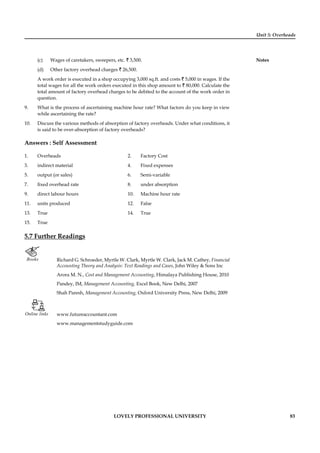
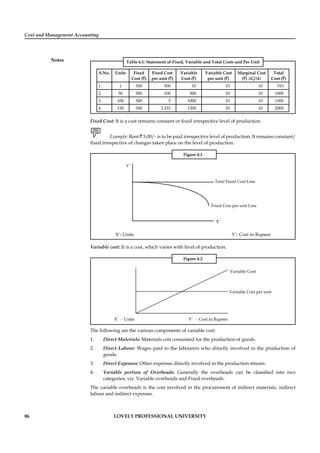
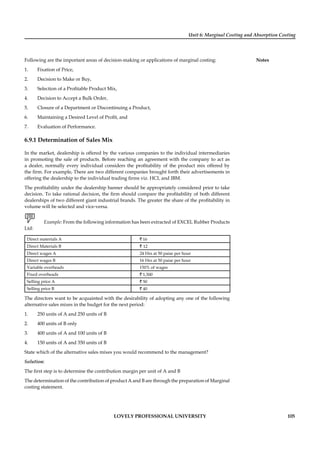
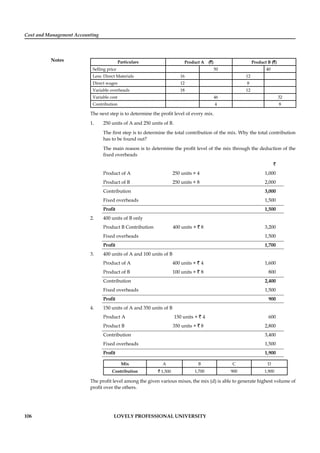
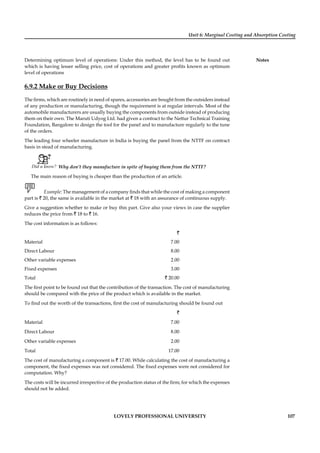
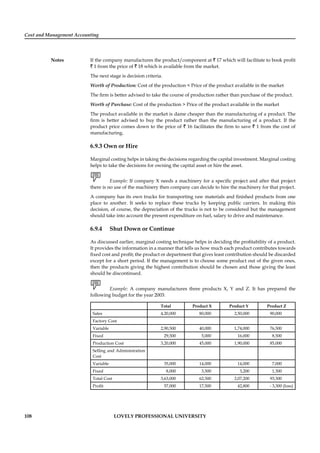
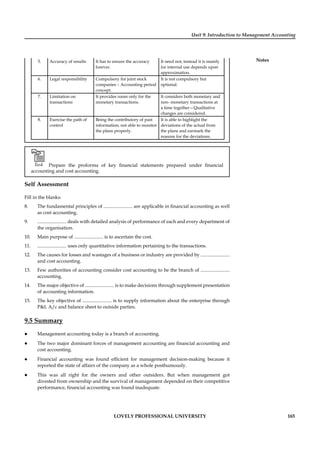
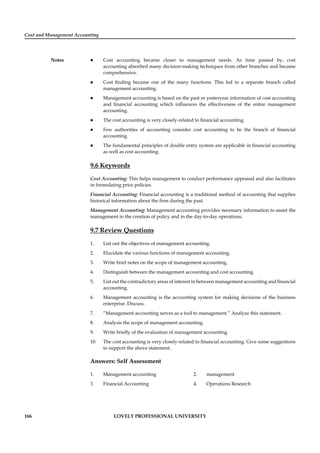
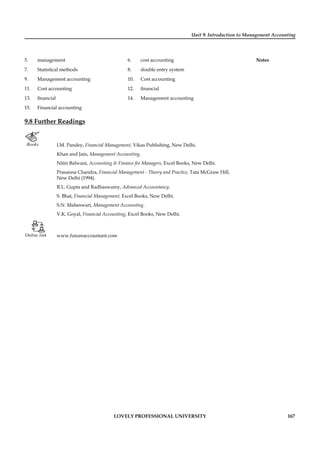
Cost and Management Accounting
DMGT202
COST AND MANAGEMENT
ACCOUNTING
Copyright © 2012 M.P. Pandikumar
All rights reserved
Produced & Printed by
EXCEL BOOKS PRIVATE LIMITED
A-45, Naraina, Phase-I,
New Delhi-110028
for
Lovely Professional University
Phagwara
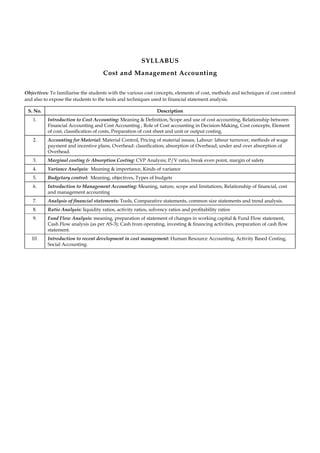
SYLLABUS
Cost and Management Accounting
Objectives: To familiarise the students with the various cost concepts, elements of cost, methods and techniques of cost control
and also to expose the students to the tools and techniques used in financial statement analysis.
S. No. Description
1. Introduction to Cost Accounting: Meaning & Definition, Scope and use of cost accounting, Relationship between
Financial Accounting and Cost Accounting , Role of Cost accounting in Decision-Making, Cost concepts, Element
of cost, classification of costs, Preparation of cost sheet and unit or output costing.
2. Accounting for Material: Material Control, Pricing of material issues, Labour: labour turnover, methods of wage
payment and incentive plans, Overhead: classification; absorption of Overhead; under and over absorption of
Overhead.
3. Marginal costing & Absorption Costing: CVP Analysis; P/V ratio, break even point, margin of safety
4. Variance Analysis: Meaning & importance, Kinds of variance
5. Budgetary control: Meaning, objectives, Types of budgets
6. Introduction to Management Accounting: Meaning, nature, scope and limitations, Relationship of financial, cost
and management accounting
7. Analysis of financial statements: Tools, Comparative statements, common size statements and trend analysis.
8. Ratio Analysis: liquidity ratios, activity ratios, solvency ratios and profitability ratios
9. Fund Flow Analysis: meaning, preparation of statement of changes in working capital & Fund Flow statement,
Cash Flow analysis (as per AS-3): Cash from operating, investing & financing activities, preparation of cash flow
statement.
10. Introduction to recent development in cost management: Human Resource Accounting, Activity Based Costing,
Social Accounting.
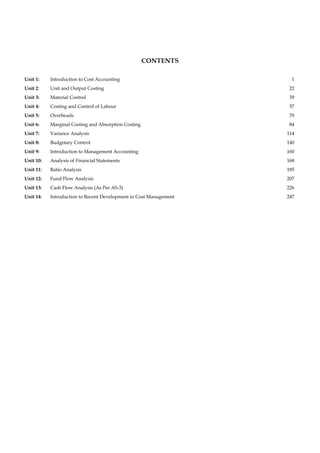
CONTENTS
Unit 1: Introduction to Cost Accounting 1
Unit 2: Unit and Output Costing 22
Unit 3: Material Control 39
Unit 4: Costing and Control of Labour 57
Unit 5: Overheads 70
Unit 6: Marginal Costing and Absorption Costing 84
Unit 7: Variance Analysis 114
Unit 8: Budgetary Control 140
Unit 9: Introduction to Management Accounting 160
Unit 10: Analysis of Financial Statements 168
Unit 11: Ratio Analysis 185
Unit 12: Fund Flow Analysis 207
Unit 13: Cash Flow Analysis (As Per AS-3) 226
Unit 14: Introduction to Recent Development in Cost Management 247
Unit 1: Introduction to Cost Accounting
Notes
LOVELY PROFESSIONAL UNIVERSITY 1
Unit 1: Introduction to Cost Accounting
CONTENTS
Objectives
Introduction
1.1 Meaning and Definition of Cost Accounting
1.2 Scope and Use of Cost Accounting
1.3 Relationship between Financial Accounting and Cost Accounting
1.4 Role of Cost Accounting in Decision Making
1.5 Cost Concepts
1.5.1 Cost Unit
1.5.2 Cost Centre
1.6 Elements of Cost
1.7 Classification of Costs
1.7.1 General Classification
1.7.2 Technical Classification
1.8 Cost Accounting System
1.9 Summary
1.10 Keywords
1.11 Review Questions
1.12 Further Readings
Objectives
After studying this unit, you will be able to:
Explain the meaning and definition of cost accounting
Discuss the scope and uses of cost accounting
Describe the relationship between financial accounting and cost accounting
State the role of cost accounting in decision making
List the elements of cost
Make classification of cost
Describe costing system
Introduction
Cost accounting is a branch of accounting and has been developed due to limitations of financial
accounting. The financial accounting is primarily concerned with record keeping directed
towards the preparation of gross profit account, profit and loss account and balance sheet.
It provides information regarding the gross profit, profit and loss that the business or enterprise
Cost and Management Accounting
Notes
2 LOVELY PROFESSIONAL UNIVERSITY
is making and also its financial position on a particular period. The information concerning the
business or enterprise is helpful to the management to control on business.
The management of every business enterprise is interested to know much more than the usual
information supplied to outsiders. In order to carry out its functions of planning, decision-making
and control, it requires additional cost data. The financial accounts fail, to some extent, to provide
required cost data to management and hence a new system of accounting which could provide
internal report to management was conceived of.
1.1 Meaning and Definition of Cost Accounting
Cost accounting, which is a branch of accounting, has been developed due to limitations of
financial accounts. “Cost accounting is an analytical system of accounting that discloses the cost
per unit of different articles manufactured or jobs done and also the cost at various stages of
completion”.
!
Caution The cost accounting system is not independent of the financial accounts. It merely
represents an elaboration of the basic financial accounting system.
Cost accounting is concerned with the classification, accumulation, control and assignment of
costs. Cost accountant classifies, costs according to patterns of behaviour, activities or processes
to which they relate products to which they attach and other categories, dependent on the types
of measurement desired costs may be accumulated by accounts, jobs processes products or other
business segments. The cost accounting system is directly concerned with control of inventories,
plant assets and funds expanded on functional activities.
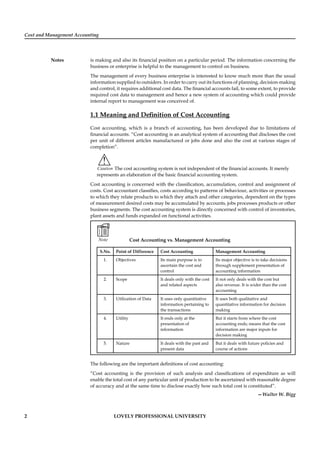
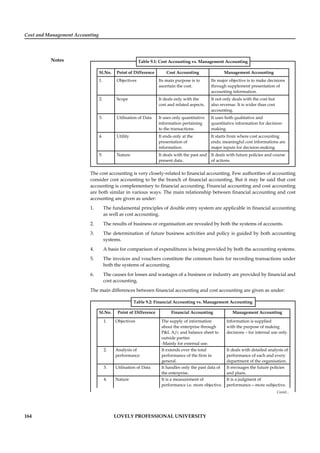
Note Cost Accounting vs. Management Accounting
S.No. Point of Difference Cost Accounting Management Accounting
1. Objectives Its main purpose is to
ascertain the cost and
control
Its major objective is to take decisions
through supplement presentation of
accounting information
2. Scope It deals only with the cost
and related aspects
It not only deals with the cost but
also revenue. It is wider than the cost
accounting
3. Utilization of Data It uses only quantitative
information pertaining to
the transactions
It uses both qualitative and
quantitative information for decision
making
4. Utility It ends only at the
presentation of
information
But it starts from where the cost
accounting ends; means that the cost
information are major inputs for
decision making
5. Nature It deals with the past and
present data
But it deals with future policies and
course of actions
The following are the important definitions of cost accounting:
“Cost accounting is the provision of such analysis and classifications of expenditure as will
enable the total cost of any particular unit of production to be ascertained with reasonable degree
of accuracy and at the same time to disclose exactly how such total cost is constituted”.
—Walter W. Bigg
Unit 1: Introduction to Cost Accounting
Notes
LOVELY PROFESSIONAL UNIVERSITY 3
“Costing is the proper allocation of expenditure whereby reliable cost may be ascertained and
suitably presented to affford guidance to the producers in control of their business”.
—Harold James
“Costing is the classifying, recording and appropriate allocation of expenditure for the
determination of the cost of products or services, and for the presentation of suitably arranged
data for purposes of control and guidance of the management. It includes the ascertainment of
the cost of every order, job, contract, process, service, or unit at as may be appropriate. It deals
with the costs of production, selling and distribution”.
—Harold J. Wheldon
“Cost accounting means the application of principles of accounting in such a manner that the
management is always assured of a detailed recording and analysis of expenditures incurred
in connection with the operation of any business so that it is able to measure performance and
control activities”.
—Jeremiah Lock Wood
Self Assessment
State whether the following statements are true or false:
1. Financial accounting is concerned with the classification, accumulation, control and
assignment of costs.
2. The cost accounting system is directly concerned with control of inventories, plant assets
and funds expanded on functional activities.
3. The cost accounting system is independent of the financial accounts.
1.2 Scope and Use of Cost Accounting
The scope of any subject refers to the various areas of study included in that subject. As regards,
the scope of cost accounting is very wide and includes the following:
1. Technique and Process of Costing: The technique of costing involves two distinct steps,
namely, (a) classification of costs according to various elements, and (b) allocation and
apportionment of the expenses which cannot be directly charged to production. As a
process, costing is concerned with the routine ascertainment of cost with a formal and
selected procedure.
2. Cost Control: Cost control is the guidance and regulation by executive action of the costs
of operating and undertaking. This guidance and regulation is done by the executive who
is responsible for causing the deviation. This process will become clear by enumerating
the steps involved in any technique of cost control. Cost control is exercised through a
variety of techniques such as inventory control, product control, quality control, budgetary
control, standard costing, etc.
3. AscertainmentofCost:Itdealswiththecollectionandanalysisofexpenses,themeasurement
of production at different stages and linking up of production with the expenses. To achieve
the first step, costing has developed different systems such as Historical or Actual Cost,
Estimated Cost and Standard Cost. For achieving the second step, costing has developed
different methods such as single or output costing, job costing, contract costing, etc. Finally,
for achieving the last step costing has developed important techniques such as, Marginal
Costing, Standard Costing, Budgetary Control, Total Absorption Costing and Uniform
Costing.
Cost and Management Accounting
Notes
4 LOVELY PROFESSIONAL UNIVERSITY
4. Cost Audit: The terminology of ICMA, London, defines cost audit, as “the verification of the
correctness of cost accounts and of the adherence to the cost accounting plan”. Cost audit
has a much wider role to play in an industry or organisation than people could imagine.
The aim of cost audit is to highlight the shortcomings inherent in the cost accounting
system.
5. Budgetary Control: According to Heiser, budgetary control can be defined as “an overall
blue print of a comprehensive plan of operations and actions expressed in financial terms”.
According to him, budgeting process involves the preparation of a budget, comparison of
budgeted and actual expenditure and income, planning and coordinating for control, etc.
Self Assessment
Fill in the blanks:
4. ...................... is the guidance and regulation by executive action of the costs of operating
and undertaking.
5. The aim of ...................... is to highlight the shortcomings inherent in the cost accounting
system.
6. ...................... process involves the preparation of a budget, comparison of budgeted and
actual expenditure and income, planning and coordinating for control, etc.
1.3 Relationship between Financial Accounting and Cost Accounting
In a modern system of industrial accounting, there is no independent cost ledger or financial
ledger, but the complete accounting system is amalgamated into one set of double-entry accounts.
In other cases, the figures posted to the cost ledger are reconciled at regular intervals, probably
monthly, with the figures shown in the revenue accounts of the financial ledger.
Whichever system is adopted, the expenditure accounts and the cost accounts are interdependent.
The application of financial and cost accounting to the service of management should be planned
as one coordinated service, and for this purpose should be under common control. Integration
does not, therefore, imply only the amalgamation of two systems or accounts, but it also entails the
amalgamation of the accounting sections, including the cost office, into one unified department.
It is, furthermore, desirable in the interests of the efficiency of the financial division that clerks
shall be given the opportunity of obtaining experience in both financial accounting and cost
accounting; in other words, in records of total expense heading and of breakdowns or analyses.
Differences between Cost Accounts and Financial Accounts
1. Financial accounts deal with all the items of expenses, losses, income and gains in total but
the cost accounts deal with items of cost alone.
2. In financial accounts, items of cost that are dealt with are expressed in totals. Therefore,
such accounts cannot disclose the cost per unit whereas in cost accounts all expenses are
analyzed very carefully and apportioned accordingly. Hence, cost per unit can be very
easily determined.
3. Financial accounts deal with facts alone whereas cost accounts deal with estimates as well
as facts. Therefore, the result of cost accounts does not always tally with financial accounts.
4. Financial accounts cover a long period usually a year, but cost accounts cover comparatively
a short period say a week, fortnight or a month.
5. Cost accounts do not form part of the ordinary process of double entry systems. Whereas
the financial account must be invariably maintained according to double entry system.
Unit 1: Introduction to Cost Accounting
Notes
LOVELY PROFESSIONAL UNIVERSITY 5
6. Financial accounts display results in total profits whereas cost accounts give the results of
each operation.
7. All expenses such as interest on capital, depreciation, etc., are normally charged in
financial accounts, which reveals the true and fair affairs of business in general and cost of
production in particular. In case of cost accounting, where certain expenses are eliminated
or deleted the cost per unit will be generally unfair.
8. Financial accounting will generally present a better picture to the public who can
not understand the intricacies of the maintenance of accounting. Cost accounting, in
particular, is always beneficial from the point of management, rather than from the public
undertaking.
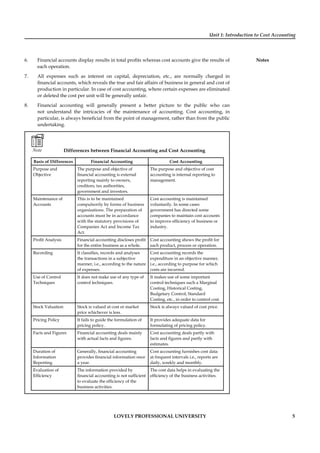
Note Differences between Financial Accounting and Cost Accounting
Basis of Differences Financial Accounting Cost Accounting
Purpose and
Objective
The purpose and objective of
financial accounting is external
reporting mainly to owners,
creditors, tax authorities,
government and investors.
The purpose and objective of cost
accounting is internal reporting to
management.
Maintenance of
Accounts
This is to be maintained
compulsorily by forms of business
organisations. The preparation of
accounts must be in accordance
with the statutory provisions of
Companies Act and Income Tax
Act.
Cost accounting is maintained
voluntarily. In some cases
government has directed some
companies to maintain cost accounts
to improve efficiency of business or
industry.
Profit Analysis Financial accounting discloses profit
for the entire business as a whole.
Cost accounting shows the profit for
each product, process or operation.
Recording It classifies, records and analyses
the transactions in a subjective
manner, i.e., according to the nature
of expenses.
Cost accounting records the
expenditure in an objective manner,
i.e., according to purpose for which
costs are incurred.
Use of Control
Techniques
It does not make use of any type of
control techniques.
It makes use of some important
control techniques such a Marginal
Costing, Historical Costing,
Budgetary Control, Standard
Costing, etc., in order to control cost.
Stock Valuation Stock is valued at cost or market
price whichever is less.
Stock is always valued of cost price.
Pricing Policy It fails to guide the formulation of
pricing policy.
It provides adequate data for
formulating of pricing policy.
Facts and Figures Financial accounting deals mainly
with actual facts and figures.
Cost accounting deals partly with
facts and figures and partly with
estimates.
Duration of
Information
Reporting
Generally, financial accounting
provides financial information once
a year.
Cost accounting furnishes cost data
at frequent intervals i.e., reports are
daily, weekly and monthly.
Evaluation of
Efficiency
The information provided by
financial accounting is not sufficient
to evaluate the efficiency of the
business activities.
The cost data helps in evaluating the
efficiency of the business activities.
Cost and Management Accounting
Notes
6 LOVELY PROFESSIONAL UNIVERSITY
Self Assessment
State whether the following statements are true or false:
7. Financial accounts deal with all the items of expenses, losses, income and gains in total but
the cost accounts deal with items of cost alone.
8. Financial accounts cover a short period usually a week.
9. Cost accounting will generally present a better picture to the public who can not understand
the intricacies of the maintenance of accounting.
1.4 Role of Cost Accounting in Decision Making
The cost accounting plays an important role in the following decisions making:
1. Determination and Analysis of Cost: The main object of cost accountant is to determine
cost per unit or per job or per contract. Thereby the constituents such as prime cost and
overheads that may be fixed, variable, semi-variable can be disclosed, which in turn
evaluate the operating efficiency of each departments.
2. Cost Control and Cost Reduction: Cost control and cost reduction is an important factor
to be considered to know the best result obtained by each department. For this purpose,
the standards are fixed and in case the efficiency of each department is more than the
anticipated standard, the result will be considered as favourable and vice-versa.
3. Planning and Decision-making: This is possible when policies that are framed are properly
implemented. The technique of cost accounting which produces the best result depends
upon the best tools which are in operation by the management, stock holders, consumers
and government.
4. A good system of costing will be of varied benefits to the management:
(a) Profitable and unprofitable activities can be disclosed by taking necessary steps
periodically.
(b) Costing enables a concern to measure the efficiency maintained and prove it.
(c) Costing provides such information upon which estimates and tenders are based.
(d) Costing guides future production policies.
(e) An efficient check is provided on stores and materials.
(f) An efficient check on labour and machines is also possible by providing incentives to
workers.
(g) It helps increase profits.
(h) It enables a periodical determination of profits or losses without resort to stock
taking.
(i) It furnishes reliable data for comparing costs in different periods for different
volumes of output.
(j) The fixation of price cannot be properly done unless proper figures of costs are
available.
(k) The exact cause of increase or decrease in profit or loss can be detected.
Unit 1: Introduction to Cost Accounting
Notes
LOVELY PROFESSIONAL UNIVERSITY 7
Self Assessment
Fill in the blanks:
10. Cost control and ...................... is an important factor to be considered to know the best
result obtained by each department.
11. The technique of ...................... which produces the best result depends upon the best tools
which are in operation by the management, stock holders, consumers and government.
1.5 Cost Concepts
There are some important cost concepts that we must be aware of:
1.5.1 Cost Unit
Cost unit is defined by the ICMA as “a quantitative unit of product or service in relation to which
costs are ascertained”. A cost unit is a device used for the purpose of splitting total cost into smaller
sub-divisions attributable to products or service. A cost unit simply stated is a unit of finished
product, service of these in relation to which cost is ascertained and expressed. The following are
some of the examples of cost units selected from different industries or organisation:
Table 1.1: Cost Units selected from Different Industries
Name of the Industry or Organisation Product Cost Unit
Brick Industry Bricks Per 1,000 bricks
Power Industry Electricity Per kilo-watt hour
Cement Industry Cement Per tonne
Pharmaceutical Industry Tablets Per 1,000 tablets
Sugar Industry Sugar Per tonne
Furniture Industry Table Per table
Hardware Industry Bolts and nuts Per 1,000 pieces
Cotton Textile Industry Yarn Per Kg
Construction Company House Per contract
Transport Companies Service Per passenger mile
Hospital Service Per bed-day
Canteen Service Per meal
1.5.2 Cost Centre
A cost centre refers to a part of a factory for which costs are accumulated separately. In order
to facilitate charging of costs to cost units, it is necessary to divide the factory or industry into
various parts which can be used to accumulate costs for subsequent distribution. Each such part
of a factory or industry is known as cost centre.
Did u know? What is responsibility centre?
Cost centre facilitates fixation of responsibility for every officer-in-charge of part of
department or section. Hence cost centre is also known as responsibility centre.
Cost centre has been defined by ICMA as “a location, person or item of equipment or group of
these in respect of which costs may be ascertained and related to cost units”.
Cost and Management Accounting
Notes
8 LOVELY PROFESSIONAL UNIVERSITY
The main kinds of cost centre are given below:
Operation and process cost centre,
Production and service cost centre, and
Personal and impersonal cost centre
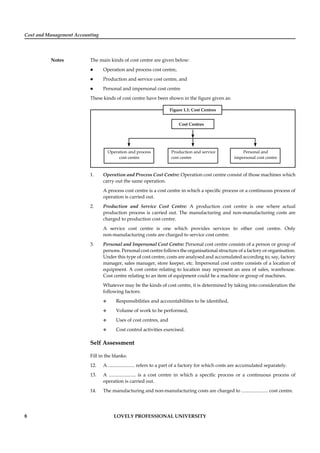
These kinds of cost centre have been shown in the figure given as:
Figure 1.1: Cost Centres
Cost Centres
Operation and process
cost centre
Production and service
cost centre
Personal and
impersonal cost centre
1. Operation and Process Cost Centre: Operation cost centre consist of those machines which
carry out the same operation.
A process cost centre is a cost centre in which a specific process or a continuous process of
operation is carried out.
2. Production and Service Cost Centre: A production cost centre is one where actual
production process is carried out. The manufacturing and non-manufacturing costs are
charged to production cost centre.
A service cost centre is one which provides services to other cost centre. Only
non-manufacturing costs are charged to service cost centre.
3. Personal and Impersonal Cost Centre: Personal cost centre consists of a person or group of
persons. Personal cost centre follows the organisational structure of a factory or organisation.
Under this type of cost centre, costs are analysed and accumulated according to; say, factory
manager, sales manager, store keeper, etc. Impersonal cost centre consists of a location of
equipment. A cost centre relating to location may represent an area of sales, warehouse.
Cost centre relating to an item of equipment could be a machine or group of machines.
Whatever may be the kinds of cost centre, it is determined by taking into consideration the
following factors:
Responsibilities and accountabilities to be identified,
Volume of work to be performed,
Uses of cost centres, and
Cost control activities exercised.
Self Assessment
Fill in the blanks:
12. A ...................... refers to a part of a factory for which costs are accumulated separately.
13. A ...................... is a cost centre in which a specific process or a continuous process of
operation is carried out.
14. The manufacturing and non-manufacturing costs are charged to ...................... cost centre.
Unit 1: Introduction to Cost Accounting
Notes
LOVELY PROFESSIONAL UNIVERSITY 9
1.6 Elements of Cost
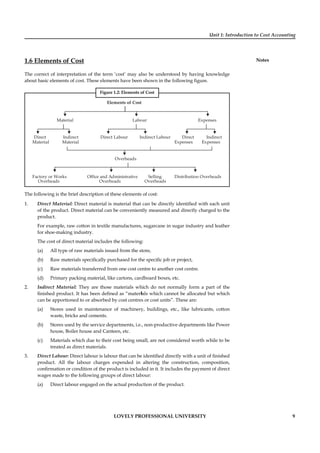
The correct of interpretation of the term ‘cost’ may also be understood by having knowledge
about basic elements of cost. These elements have been shown in the following figure.
Figure 1.2: Elements of Cost
Elements of Cost
Material Labour Expenses
Direct
Material
Indirect
Material
Direct Labour Indirect Labour Direct
Expenses
Indirect
Expenses
Overheads
Factory or Works
Overheads
Office and Administrative
Overheads
Selling
Overheads
Distribution Overheads
The following is the brief description of these elements of cost:
1. Direct Material: Direct material is material that can be directly identified with each unit
of the product. Direct material can be conveniently measured and directly charged to the
product.
For example, raw cotton in textile manufactures, sugarcane in sugar industry and leather
for shoe-making industry.
The cost of direct material includes the following:
(a) All type of raw materials issued from the store,
(b) Raw materials specifically purchased for the specific job or project,
(c) Raw materials transferred from one cost centre to another cost centre.
(d) Primary packing material, like cartons, cardboard boxes, etc.
2. Indirect Material: They are those materials which do not normally form a part of the
finished product. It has been defined as “materials which cannot be allocated but which
can be apportioned to or absorbed by cost centres or cost units”. These are:
(a) Stores used in maintenance of machinery, buildings, etc., like lubricants, cotton
waste, bricks and cements.
(b) Stores used by the service departments, i.e., non-productive departments like Power
house, Boiler house and Canteen, etc.
(c) Materials which due to their cost being small, are not considered worth while to be
treated as direct materials.
3. Direct Labour: Direct labour is labour that can be identified directly with a unit of finished
product. All the labour charges expended in altering the construction, composition,
confirmation or condition of the product is included in it. It includes the payment of direct
wages made to the following groups of direct labour:
(a) Direct labour engaged on the actual production of the product.
Cost and Management Accounting
Notes
10 LOVELY PROFESSIONAL UNIVERSITY
(b) Directlabourengagedinaddingthismanufacturebywayofsupervision,maintenance
and tool setting, etc.
(c) Inspectors, analysts, etc. specially required for such production.
4. Indirect Labour: The wages of that labour which cannot be allocated but which can be
apportioned to or absorbed by, cost centres or cost units is known as indirect labour. In
other words, wages paid to labour which are employed other than or production constitute
indirect labour costs. Examples of indirect labour are: charge hands and supervisors,
maintenance workers, labour employed in service departments, material handling and
internal transport, apprentices, trainees and instructors, factory clerical staff and labour
employed in time and security office, etc.
5. Direct or Chargeable Expenses: They include all expenditures other than direct material and
direct labour that are specifically incurred for a particular product or job. Such expenses
are charged directly to the particular cost account concerned as part of the prime cost.
Examples of direct expenses are: excise duty, royalty, surveyor’s fees, cost of rectifying
defective work, travelling expenses to the job, experimental expenses of projects, expenses
of designing or drawings, repairs and maintenance of plant obtained on hire and hire of
special equipment obtained for a contract.
6. Indirect Expenses: Indirect expenses are expenses which can not be allocated but which can
be apportioned to or absorbed by cost centres or cost units as rent, insurance, municipal
taxes, salary of manager, canteen and welfare expenses, power and fuel, cost of training for
new employees, lighting and heating, telephone expenses, etc.
7. Overheads: Overheads may be defined as the cost of indirect materials, indirect labour and
such other expenses including services as cannot conveniently be charged direct to specific
cost units. Thus, overheads are all expenses other than direct expenses. Overheads may be
divided into following categories:
(a) Factory or works overheads cover all indirect expenditure incurred by the
undertaking from the receipt of the order until its completion is ready for dispatch
either to the customer or to the finished goods store. The overheads also include:
depreciation on plant and machinery, buildings and equipments, insurance charges
on fixed assets, repairs and maintenance of fixed assets, electricity charges, coal and
other fuel charges, rent, rates and taxes of works, etc.
(b) Office and administrative overhead consists of all expenses incurred in the direction,
control and administration of a factory. Examples are the expenses in running
the general office e.g., office rent, light, heat, salaries, salary to secretaries and
accountants, general managers, directors, executives, investigations and experiments
and miscellaneous fixed charges.
(c) Selling overheads comprise the cost of products or distributors of soliciting and
recurring orders for the articles of commodities dealt in and of efforts to find and
retain customers.
It includes sales office expenses, salesmen’s salaries and commission, showroom
expenses, advertisement charges, fancy packing, samples and free gifts, after sales
service expenses and demonstration and technical advice to potential customers.
(d) Distribution overheads comprise all expenditure incurred from the time the product
is completed in the work until it reaches its destination. It includes warehouse rent,
warehouse staff salaries, insurance, expenses on delivery vans and trucks, expenses
on special packing for bulk transport, losses in warehouse stocks and finished goods
damaged in transit and cost of repairing, etc.
Unit 1: Introduction to Cost Accounting
Notes
LOVELY PROFESSIONAL UNIVERSITY 11
Self Assessment
State whether the following statements are true or false:
15. The wages of that labour which cannot be allocated but which can be apportioned to or
absorbed by, cost centres or cost units is known as direct labour.
16. Overheads may be defined as the cost of indirect materials, indirect labour and such other
expenses including services as cannot conveniently be charged direct to specific cost units.
1.7 Classification of Costs
Costs can be classified according to
1. General classification
2. Technical classification
1.7.1 General Classification
Generally, the costs are classified as follows:
Product vs. Period Costs
Product costs include all the costs that are involved in acquiring or making product. For a
manufacturer, they would be the direct materials, direct labor, and manufacturing overhead
used in making its products. Product costs are viewed as “attaching” to units of product as the
goods are purchased or manufactured and they remain attached as the goods go into inventory
awaiting sale. So initially, product costs are assigned to an inventory account on the balance
sheet. When the goods are sold, the costs are released from inventory as expense (typically called
Cost of Goods Sold) and matched against sales revenue.
!
Caution The product costs of direct materials, direct labor, and manufacturing overhead
are also “inventoriable” costs, since these are the necessary costs of manufacturing the
products.
The purpose is to emphasize that product costs are not necessarily treated as expense in the
period in which they are incurred. Rather, as explained above, they are treated as expenses in
the period in which the related products are sold. This means that a product cost such as direct
materials or direct labor might be incurred during one period but not treated as an expense until
a following period when the completed product is sold.
Note Manufacturing overhead is also referred to as factory overhead, indirect
manufacturing costs, and burden.
Period costs are not included as part of the cost of either purchased or manufactured goods and
are usually associated with the selling function of the business or its general administration. As a
result, period costs cannot be assigned to the products or to the cost of inventory. These costs are
expensed on the income statement in the period in which they are incurred, using the usual rules
of accrual accounting that we learn in financial accounting.
Cost and Management Accounting
Notes
12 LOVELY PROFESSIONAL UNIVERSITY
Example: 1. Sales commissions and office rent.
2. Selling and administrative expenses.
The period costs are reported as expenses in the accounting period in which they:
1. best match with revenues,
2. when they expire, or
3. in the current accounting period.
In addition to the selling and general administrative expenses, most interest expense is a period
expense.
Direct vs. Indirect Costs
Direct costs are those costs that can be traced to specific segments of operations.
Direct cost of the product can be classified into the following categories.
1. Direct Material: Direct material which is especially used as a major ingredient for the
production of a product.
Example: (a) The wood is a basic raw material for the wooden furniture. The cost of the
wood procured for the furniture is known direct material cost.
(b) The cotton is a basic raw material for the production of yarn. The cost of procuring the
cotton is known as direct material for the manufacturing of yarn.
2. Direct Labour: Direct labour is the cost of the labour which is directly involved in the
production of either a product or service.
Example: The cost of an employee who is mainly working for the production of a
product/service at the centre, known as direct labour cost.
3. Direct Expenses: Direct expenses which are incurred by the firm with the production of
either a product or service. The excise duty and octroi duty are known as direct expenses
in connection with the production of articles and so on.
Indirect costs are those costs that can not be identified with particular segments.
4. Indirect Material: The material which is spent cannot be measured for a product is known
as indirect material.
Example: The thread which is used for tailoring the shirt cannot be measured or quantified
in specific length as well as ascertained the cost.
5. Indirect Labour: Indirect labour is the cost of the labour incurred by the firm other than the
direct labour cannot be apportioned.
Example: Cost of supervisor, cost of the inspectors and so on.
6. Indirect Expenses: Indirect expenses are the expenses other than that of the direct expenses
in the production of a product. The expenses which are not directly part of the production
process of a product or service known as indirect expenses.
Unit 1: Introduction to Cost Accounting
Notes
LOVELY PROFESSIONAL UNIVERSITY 13
Example: Rent of the factory, salesmen salary and so on.
Common costs are shared by multiple segments.
Example: Manufacturer of chairs, Segments = Plastic chairs (P) & Wood chairs (W)
Manufacturing vs. Non-manufacturing Costs
Manufacturing costs are product costs consisting of Direct Material (DM), Direct Labor (DL) and
Manufacturing Overhead (MOH, OH)
Manufacturing Costs = DM + DL + MOH
Non-manufacturing costs are period costs incurred in selling and administrative activities.
Note MOH = All indirect manufacturing costs, including:
1. Indirect materials
2. Indirect labor — supervision, maintenance, janitorial, etc.
3. Other services — utilities, supplies, rent, insurance, depreciation, taxes, etc. used in
production
4. Anything that is related to production (cafeteria, fitness room, etc.)
1.7.2 Technical Classification
Apart from this classification the costs are also classified into various categories according to the
purpose and requirements of the firm. Some of the most important classifications are as follows:
1. By nature or element or analytical segmentation
2. By functions
3. Direct and indirect cost
4. By variability
5. By controllability
6. By normality
7. By time
8. According to planning and control
9. For managerial decisions
Let us understand each of them one by one.
By Nature or Element or Analytical Segmentation
The costs are classified into three major categories Materials, Labour, and Expenses.
Cost and Management Accounting
Notes
14 LOVELY PROFESSIONAL UNIVERSITY
By Functions
Under this methodology, the costs are classified into various divisions or functions of the
enterprise viz. Production cost, Administration cost, Selling & Distribution cost and so on.
The detailed classification is that total of production cost sub-classified into cost of manufacture,
fabrication or construction.
Example: 1. Costs of manufacture: The cost of materials for packaging, the cost of
electricity and water, the cost of promotion and advertising, etc.
2. Costs of construction: The cost of materials, the cost of equipment, the cost of labour, etc.
(a) Cost of transportation
(b) Cost of management and co-ordination
(c) Depreciation of fixed assets.
And another classification of cost is commercial cost of operations; which is other than the cost of
manufacturing and production.
The major components of commercial costs are known as administrative cost of operations and
selling and distribution cost of operations.
Example: 1. Administrative cost of operations: Expense incurred in controlling and
directing an organization.
2. Selling and distribution cost of operations: Any cost incurred by a producer or wholesaler
or retailer or distributor (as for shipping, etc.)
Direct and Indirect Cost
1. Direct cost: This classification of costs are incurred for the manufacture of a product or
service. They can be conveniently and easily identified.
(a) Material cost for the product manufacture: It includes the direct material for
manufacturing.
Example: For garments factory-cloth is the direct material for ready made garments.
(b) Labour cost for production: Labour cost is the cost of the entire labour who is directly
involved in the production of a product as well as attributable to single product
expenses and so on.
2. Indirect cost: The costs which are incurred for and cannot be easily identified for any single
cost centre or cost unit known as indirect cost.
Indirect material cost, Indirect labour cost and Indirect expenses are the three different
components of the indirect expenses.
(a) Indirect material:
Example: Cost of the thread cannot be conveniently measured for single unit of the
product.
(b) Indirect labour:
Example: Salary paid to the supervisor.
Unit 1: Introduction to Cost Accounting
Notes
LOVELY PROFESSIONAL UNIVERSITY 15
By Variability
The costs are grouped according to the changes taken place in the level of production or
activity.
It may be classified into three categories:
1. Fixed cost: It is cost which do not vary irrespective level of an activity or production.
Example: Rent of the factory, salary to the manager and so on.
2. Variable cost: It is a cost which varies in along with the level of an activity or production
like material consumption and so on.
Example: The fuel for an airline. The cost for it changes with the number of flights and
how long the trips are.
3. Semi variable cost: It is a cost which is fixed up to certain level of an activity. Later it
fluctuates or varies in line with the level of production. It is known in other words as step
cost.
Example: Electricity charges
Labour costs in a factory are semi-variable. The fixed portion is the wage paid to workers for
their regular hours. The variable portion is the overtime pay they receive when they exceed their
regular hours.
By Controllability
The costs are classified into two categories in accordance with controllability, as follows:
1. Controllable costs: Cost which can be controlled through some measures known as
controllable costs. All variable cost are considered to be controllable in segment to some
extent.
2. Uncontrollable costs: Costs which cannot be controlled are known as uncontrollable costs.
All fixed costs are very difficult to control or bring down; they rigid or fixed irrespective to
the level of production.
By Normality
Under this methodology, the costs which are normally incurred at a given level of output in the
conditions in which that level of activity normally attained.
1. Normal cost: It is the cost which is normally incurred at a given level of output in the
conditions in which that level of output is normally achieved.
2. Abnormal cost: It is the cost which is not normally incurred at a given level of output in the
conditions in which that level of output is normally attained.
Normal cost for a defined-benefit pension plan generally represents the portion of the economic
cost of the participant’s anticipated pension benefits allocated to the current plan year.
Abnormal cost maybe unexpected costs incurred, as a result of natural calamities or fire or
accident or such other losses.
Cost and Management Accounting
Notes
16 LOVELY PROFESSIONAL UNIVERSITY
By Time
According to this classification, the costs are classified into historical costs and predetermined
costs:
1. Historical costs: The costs are accumulated or ascertained only after the incurrence known
as past cost or historical costs.
2. Predetermined costs: These costs are determined or estimated in advance to any activity by
considering the past events which are normally affecting the costs.
For Planning and Control
The following are the two major classifications, viz. standard cost and budgetary control:
1. Standard cost: Standard cost is a cost scientifically determined by way of assuming a
particular level of efficiency in utilization of material, labour and indirect expenses.
The prepared standards are compared with the actual performance of the firm in studying
the variances in between them. The variances are studied and analysed through an exclusive
analysis.
2. Budget: A budget is detailed plan of operation for some specific future period. It is an
estimate prepared in advance of the period to which it applies. It acts as a business barometer
as it is complete programme of activities of the business for the period covered.
The control is exercised through continuous comparison of actual results with the budgets. The
ultimate aim of comparing with each other is to either to secure individuals’ action towards the
objective or to provide a basis for revision.
For Managerial Decisions
The major classifications are marginal cost and sunk cost.
Marginal cost is the amount at any given volume of output by which aggregate costs are changed
if the volume of output is decreased or increased by one unit.
Sunk costs are costs that cannot be recovered once they have been incurred.
Example: Marginal Cost: Suppose it costs ` 1000 to produce 100 units and ` 1020 to
produce 101 units. The average cost per unit is ` 10, but the marginal cost of the 101 unit is ` 20.
Sunk Cost: Spending on advertising or researching a product idea.
They can be a barrier to entry. If potential entrants would have to incur similar costs, which
would not be recoverable if the entry failed, they may be scared off.
Task Identify the key statements prepared under financial and cost accounting and
prepare the proforma of all the relevant statements.
Unit 1: Introduction to Cost Accounting
Notes
LOVELY PROFESSIONAL UNIVERSITY 17
Self Assessment
Fill in the blanks:
17. ...................... are not included as part of the cost of either purchased or manufactured
goods and are usually associated with the selling function of the business or its general
administration.
18. ...................... are product costs consisting of Direct Material (DM), Direct Labor (DL) and
Manufacturing Overhead.
19. The major components of ...................... are known as administrative cost of operations and
selling and distribution cost of operations.
20. A ...................... is detailed plan of operation for some specific future period. It is an estimate
prepared in advance of the period to which it applies.
1.8 Cost Accounting System
The primary goal of cost systems is to provide information for decision-making like pricing
products, managing costs, selecting market segments and distribution channels, evaluating
make-buy and outsourcing decisions, establishing transfer prices, evaluation of plant closing
and making capital investment and abandonment decisions, etc.
Designing of Costing Systems
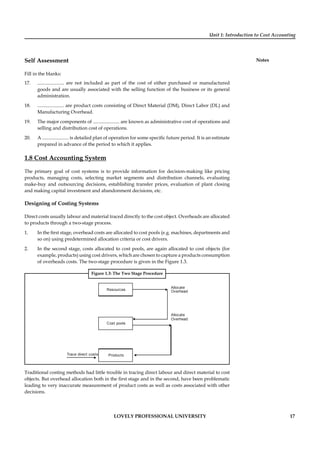
Direct costs usually labour and material traced directly to the cost object. Overheads are allocated
to products through a two-stage process.
1. In the first stage, overhead costs are allocated to cost pools (e.g. machines, departments and
so on) using predetermined allocation criteria or cost drivers.
2. In the second stage, costs allocated to cost pools, are again allocated to cost objects (for
example, products) using cost drivers, which are chosen to capture a products consumption
of overheads costs. The two-stage procedure is given in the Figure 1.3.
Figure 1.3: The Two Stage Procedure
Resources
Cost pools
Products
Allocate
Overhead
Allocate
Overhead
Trace direct costs
Traditional costing methods had little trouble in tracing direct labour and direct material to cost
objects. But overhead allocation both in the first stage and in the second, have been problematic
leading to very inaccurate measurement of product costs as well as costs associated with other
decisions.
Cost and Management Accounting
Notes
18 LOVELY PROFESSIONAL UNIVERSITY
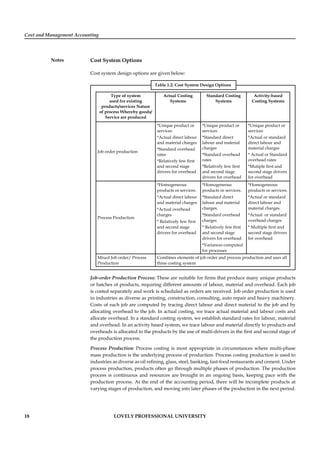
Cost System Options
Cost system design options are given below:
Table 1.2: Cost System Design Options
Type of system
used for existing
products/services Nature
of process Whereby goods/
Service are produced
Actual Costing
Systems
Standard Costing
Systems
Activity-based
Costing Systems
Job order production
*Unique product or
services
*Actual direct labour
and material charges
*Standard overhead
rates
*Relatively few first
and second stage
drivers for overhead
*Unique product or
services
*Standard direct
labour and material
charges
*Standard overhead
rates
*Relatively few first
and second stage
drivers for overhead
*Unique product or
services
*Actual or standard
direct labour and
material charges
* Actual or Standard
overhead rates
*Mutiple first and
second stage drivers
for overhead
Process Production
*Homogeneous
products or services.
*Actual direct labour
and material charges.
*Actual overhead
charges
* Relatively few first
and second stage
drivers for overhead
*Homogeneous
products or services.
*Standard direct
labour and material
charges.
*Standard overhead
charges
* Relatively few first
and second stage
drivers for overhead.
*Variances computed
for processes
*Homogeneous
products or services.
*Actual or standard
direct labour and
material charges.
*Actual or standard
overhead charges
* Multiple first and
second stage drivers
for overhead
Mixed Job order/ Process
Production
Combines elements of job order and process production and uses all
three costing system
Job-order Production Process: These are suitable for firms that produce many unique products
or batches of products, requiring different amounts of labour, material and overhead. Each job
is costed separately and work is scheduled as orders are received. Job order production is used
in industries as diverse as printing, construction, consulting, auto repair and heavy machinery.
Costs of each job are computed by tracing direct labour and direct material to the job and by
allocating overhead to the job. In actual costing, we trace actual material and labour costs and
allocate overhead. In a standard costing system, we establish standard rates for labour, material
and overhead. In an activity based system, we trace labour and material directly to products and
overheads is allocated to the products by the use of multi-drivers in the first and second stage of
the production process.
Process Production: Process costing is most appropriate in circumstances where multi-phase
mass production is the underlying process of production. Process costing production is used to
industries as diverse as oil refining, glass, steel, banking, fast-food restaurants and cement. Under
process production, products often go through multiple phases of production. The production
process is continuous and resources are brought in an ongoing basis, keeping pace with the
production process. At the end of the accounting period, there will be incomplete products at
varying stages of production, and moving into later phases of the production in the next period.
Unit 1: Introduction to Cost Accounting
Notes
LOVELY PROFESSIONAL UNIVERSITY 19
Under process production, costs are divided into two categories: materials and conversion.
Conversion costs include labour and overhead costs. The cost systems produced to cost units
complete and units in progress by calculating the cost per equivalent unit completed during
the period. Then it applies the cost per equivalent completed to units complete and to units in
progress. In process production using standard costing system, standard unit costs are developed
for both direct materials and conversion costs. Variances between standard and actual costs are
derived each period for both material and conversion at the departmental level. The variances
can then be analysed to determine their approximate causes.
Mixed Job-order and Process Production: The processes are used when the production process
has attributes of both job order and process. For example, in the manufacture of certain types of
clothing, the items differ in terms of quality of materials used but the other operations are the
same. In this case, direct materials costs are traced to each article of clothing as under job-order
methods but direct labour and overhead costs are allocated as under process methods.
Self Assessment
Fill in the blanks:
21. The primary goal of cost systems is to provide information for ......................
22. ...................... is used in industries as diverse as printing, construction, consulting, auto
repair and heavy machinery.
23. In a ...................... system, we establish standard rates for labour, material and overhead.
1.9 Summary
Cost denominates the use of resources only in terms of monetary terms.
In brief, cost is nothing but total of all expenses incurred for manufacturing a product or
attributable to given thing.
Costs which cannot be controlled are known as uncontrollable costs.
All fixed costs are very difficult to control or bring down; they rigid or fixed irrespective to
the level of production.
A budget is detailed plan of operation for some specific future period. It is an estimate
prepared in advance of the period to which it applies.
It acts as a business barometer as it is complete programme of activities of the business for
the period covered.
Under costing, the role of unit costing is inevitable tool for the industries not only to identify
the volume of costs incurred at every level but also to determine the rational price on the
commodities in order to withstand among the competitors.
Direct labour is the cost of the labour which is directly involved in the production of either
a product or service.
Indirect expenses are the expenses other than that of the direct expenses in the production
of a product.
The expenses which are not directly part of the production process of a product or service
known as indirect expenses.
Cost and Management Accounting
Notes
20 LOVELY PROFESSIONAL UNIVERSITY
1.10 Keywords
Cost: Expense incurred at the either cost centre or service centre.
Cost Centre: The location at where the cost of the activity is ascertained.
Cost of Production: It is the combination of cost of manufacturing an article or a product and
administrative cost.
Cost of Sales: It is the entire cost of a product.
Cost Sheet: It is a statement prepared for the computation of cost of a product/service.
Direct Cost: cost incurred which can be easily ascertained and measured for a product.
Factory Cost: It is the total cost incurred both direct and indirect at the work spot during the
production of an article.
Indirect Cost: Cost incurred cannot be easily ascertained and measured for a product.
Product Centre: It is the location at where the cost is ascertained through which the product is
passed through.
Profit Centre: It is responsibility centre not only for the cost and revenues but also for profits for
the activity.
1.11 Review Questions
1. The cost accounting system is directly concerned with control of inventories, plant assets
and funds expanded on functional activities. Discuss.
2. Is there any difference between cost accounting and financial accounting?
3. How will you visualize the costs of poor product quality, rework, repair, etc.?
4. Illustrate indirect and direct expenses with the help of suitable examples.
5. Once standard costs are established, what conditions would require the standards to be
revised? Give your opinion.
6. What is cost classification? Classify it, in detail.
7. Illustrate the different types of cots with suitable examples.
8. Briefly write a note on key elements of cost.
9. How will you determine the scope of cost accounting?
10. Critically evaluate the relationship between cost accounting and financial accounting.
11. Process costing is most appropriate in circumstances where multi-phase mass production
is the underlying process of production. Why?
Answers: Self Assessment
1. False 2. True
3. True 4. Cost control
5. cost audit 6. Budgeting
7. True 8. False
9. False 10. cost reduction
Unit 1: Introduction to Cost Accounting
Notes
LOVELY PROFESSIONAL UNIVERSITY 21
11. cost accounting 12. cost centre
13. process cost centre 14. production
15. False 16. True
17. Period costs 18. Manufacturing costs
19. commercial costs 20. budget
21. decision-making 22. Job-order production
23. standard costing
1.12 Further Readings
Books I.M. Pandey, Financial Management, Vikas Publishing, New Delhi.
Khan and Jain, Management Accounting.
Nitin Balwani, Accounting & Finance for Managers, Excel Books, New Delhi.
Prasanna Chandra, Financial Management - Theory and Practice, Tata McGraw Hill,
New Delhi (1994).
R.L. Gupta and Radhaswamy, Advanced Accountancy.
S. Bhat, Financial Management, Excel Books, New Delhi.
S.N. Maheswari, Management Accounting.
V.K. Goyal, Financial Accounting, Excel Books, New Delhi.
Online link www.futureaccountant.com
Cost and Management Accounting
Notes
22 LOVELY PROFESSIONAL UNIVERSITY
Unit 2: Unit and Output Costing
CONTENTS
Objectives
Introduction
2.1 Cost Sheet – Definition
2.2 Direct Cost Classification
2.3 Indirect Cost Classification
2.3.1 Stock of Raw Materials
2.3.2 Stock of Semi-finished Goods
2.3.3 Stock of Finished Goods
2.4 Summary
2.5 Keywords
2.6 Review Questions
2.7 Further Readings
Objectives
After studying this unit, you will be able to:
Make direct and indirect cost classification
Prepare cost sheet
Introduction
Under costing, the role of unit costing is an inevitable tool for the industries not only to identify
the volume of costs incurred at every level but also to determine the rational price on the
commodities in order to withstand among the competitors. The determination of the selling price
is being done through the process of determining the cost of the product. After having finalized
the cost of the product, the profit margin has to be added in order to derive the final selling price
of the product.
Cost sheet is a statement which is prepared periodically to provide detailed cost of a cost unit or
cost centre. A cost sheet not only shows the total cost but also the various components of the total
cost. Period covered by a cost sheet may be a year, a month or a week, etc. Cost sheet serves the
following purposes:
It discloses various elements of cost,
It discloses the per unit cost as well as total cost of production,
It facilitates preparation of tender price, and
It facilitates comparison of total cost.
Unit 2: Unit and Output Costing
Notes
LOVELY PROFESSIONAL UNIVERSITY 23
2.1 Cost Sheet – Definition
“It is a statement of costs incurred at every level of manufacturing a product or service.”
“It is a statement prepared to depict the output of a particular accounting period alongwith break
up of costs.”
Did u know? How to find a total cost of the product or service?
To find the total cost of the product or service, the costs incurred are grouped under various
categories.
Unit or output costing is one of the important objectives of Cost Accounting. For this, it is
essential to classify cost into certain constituents or categories. These are known as elements of
cost. Elements of cost are:
1. Direct Material
2. Direct Labour
3. Direct Expenses, and
4. Factory Overheads
5. Office and Administrative Overheads
6. Selling and Distribution Overheads
!
Caution To find out the unit cost of the product, the statement of cost plays a pivotal role
in determining the cost of production, cost of goods sold, cost of sales and selling price of
the product at every stage.
During the preliminary stage of preparing the cost statement of the product, there are two
things to be borne in our mind at the moment of classification.
1. Direct cost classification
2. Indirect cost classification
Self Assessment
Fill in the blanks:
1. Cost sheet is a statement which is prepared periodically to provide detailed cost of a cost
unit or ...................... .
2. Unit or output costing is one of the important objectives of .......................
2.2 Direct Cost Classification
Under this classification, the direct costs of the product or service are added together to know the
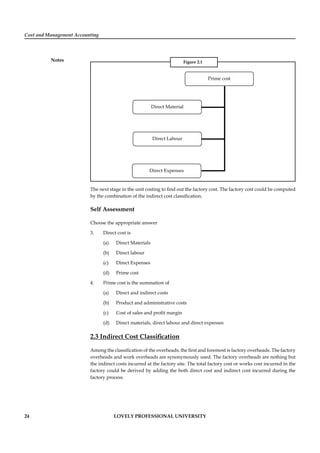
volume of total direct cost. The total volume of direct cost is known as “Prime Cost.”
Direct Materials + Direct Labour + Direct Expenses = Prime cost
Cost and Management Accounting
Notes
24 LOVELY PROFESSIONAL UNIVERSITY
Figure 2.1
Prime cost
Direct Material
Direct Labour
Direct Expenses
The next stage in the unit costing to find out the factory cost. The factory cost could be computed
by the combination of the indirect cost classification.
Self Assessment
Choose the appropriate answer
3. Direct cost is
(a) Direct Materials
(b) Direct labour
(c) Direct Expenses
(d) Prime cost
4. Prime cost is the summation of
(a) Direct and indirect costs
(b) Product and administrative costs
(c) Cost of sales and profit margin
(d) Direct materials, direct labour and direct expenses
2.3 Indirect Cost Classification
Among the classification of the overheads, the first and foremost is factory overheads. The factory
overheads and work overheads are synonymously used. The factory overheads are nothing but
the indirect costs incurred at the factory site. The total factory cost or works cost incurred in the
factory could be derived by adding the both direct cost and indirect cost incurred during the
factory process.
Unit 2: Unit and Output Costing
Notes
LOVELY PROFESSIONAL UNIVERSITY 25
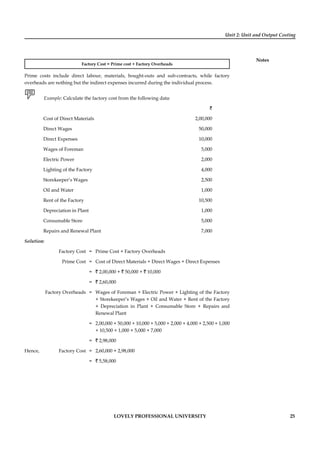
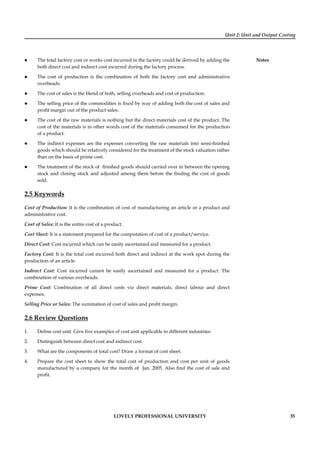
Factory Cost = Prime cost + Factory Overheads
Prime costs include direct labour, materials, bought-outs and sub-contracts, while factory
overheads are nothing but the indirect expenses incurred during the individual process.
Example: Calculate the factory cost from the following data:
`
Cost of Direct Materials 2,00,000
Direct Wages 50,000
Direct Expenses 10,000
Wages of Foreman 5,000
Electric Power 2,000
Lighting of the Factory 4,000
Storekeeper’s Wages 2,500
Oil and Water 1,000
Rent of the Factory 10,500
Depreciation in Plant 1,000
Consumable Store 5,000
Repairs and Renewal Plant 7,000
Solution:
Factory Cost = Prime Cost + Factory Overheads
Prime Cost = Cost of Direct Materials + Direct Wages + Direct Expenses
= ` 2,00,000 + ` 50,000 + ` 10,000
= ` 2,60,000
Factory Overheads = Wages of Foreman + Electric Power + Lighting of the Factory
+ Storekeeper’s Wages + Oil and Water + Rent of the Factory
+ Depreciation in Plant + Consumable Store + Repairs and
Renewal Plant
= 2,00,000 + 50,000 + 10,000 + 5,000 + 2,000 + 4,000 + 2,500 + 1,000
+ 10,500 + 1,000 + 5,000 + 7,000
= ` 2,98,000
Hence, Factory Cost = 2,60,000 + 2,98,000
= ` 5,58,000
Cost and Management Accounting
Notes
26 LOVELY PROFESSIONAL UNIVERSITY
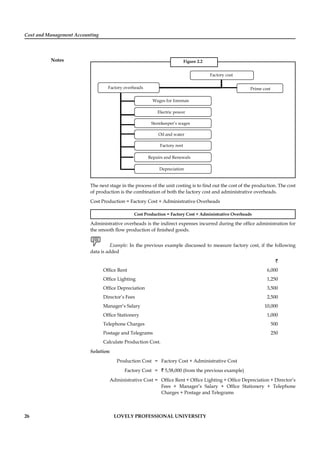
Figure 2.2
Factory cost
Factory overheads Prime cost
Wages for foreman
Electric power
Storekeeper’s wages
Oil and water
Factory rent
Repairs and Renewals
Depreciation
The next stage in the process of the unit costing is to find out the cost of the production. The cost
of production is the combination of both the factory cost and administrative overheads.
Cost Production = Factory Cost + Administrative Overheads
Administrative overheads is the indirect expenses incurred during the office administration for
the smooth flow production of finished goods.
Example: In the previous example discussed to measure factory cost, if the following
data is added
`
Office Rent 6,000
Office Lighting 1,250
Office Depreciation 3,500
Director’s Fees 2,500
Manager’s Salary 10,000
Office Stationery 1,000
Telephone Charges 500
Postage and Telegrams 250
Calculate Production Cost.
Solution:
Production Cost = Factory Cost + Administrative Cost
Factory Cost = ` 5,58,000 (from the previous example)
Administrative Cost = Office Rent + Office Lighting + Office Depreciation + Director’s
Fees + Manager’s Salary + Office Stationery + Telephone
Charges + Postage and Telegrams
Unit 2: Unit and Output Costing
Notes
LOVELY PROFESSIONAL UNIVERSITY 27
= 6,000 + 1,250 + 3,500 + 2,500 + 10,000 + 1,000 + 500 + 250
= ` 25,000
Hence, Production Cost = 5,58,000 + 25,000
= ` 5,83,000
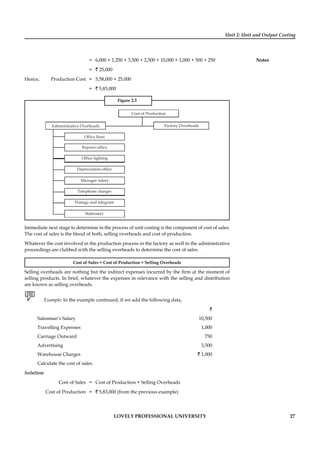
Figure 2.3
Cost of Production
Administrative Overheads Factory Overheads
Office Rent
Repairs-office
Office lighting
Depreciation-office
Manager salary
Telephone charges
Postage and telegram
Stationery
Immediate next stage to determine in the process of unit costing is the component of cost of sales.
The cost of sales is the blend of both, selling overheads and cost of production.
Whatever the cost involved in the production process in the factory as well in the administrative
proceedings are clubbed with the selling overheads to determine the cost of sales.
Cost of Sales = Cost of Production + Selling Overheads
Selling overheads are nothing but the indirect expenses incurred by the firm at the moment of
selling products. In brief, whatever the expenses in relevance with the selling and distribution
are known as selling overheads.
Example: In the example continued, if we add the following data,
`
Salesman’s Salary 10,500
Travelling Expenses 1,000
Carriage Outward 750
Advertising 3,500
Warehouse Charges ` 1,000
Calculate the cost of sales.
Solution:
Cost of Sales = Cost of Production + Selling Overheads
Cost of Production = ` 5,83,000 (from the previous example)
Cost and Management Accounting
Notes
28 LOVELY PROFESSIONAL UNIVERSITY
Selling Overheads = Salesman’s Salary + Travelling Expenses + Carriage Outward +
Advertising + Warehouse Charges
= 10,500 + 1,000 + 750 + 3,500 + 1,000
= ` 16,750
Hence, Cost of Sales = 5,83,000 + 16,750
= ` 5,99,750
Figure 2.4
Selling Overheads
Salesman salary
Carriage outward
Salesmen commission
Travelling expenses
Advertising
Free samples
Warehousing
Delivery charges
Cost of Sales
Cost of Production
The last but most important stage in the unit costing is determining the selling price of the
commodities. The selling price of the commodities is fixed by way of adding both the cost of
sales and profit margin out of the product sales.
Sales = Cost of Sales + Margin of Profit
Example: In the example continued, if we add the profit that can be earned to be ` 48,900.
Calculate the product sales expected.
Solution:
Sales = Cost of Sales + Margin of Profit
= 5,99,750 (from the previous example) + 48,900
= ` 6,48,650
Under the unit costing, the selling price of the product can be determined through the statement
form.
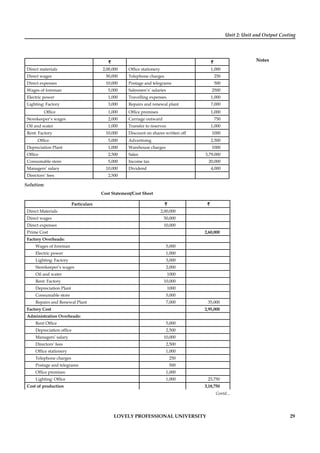
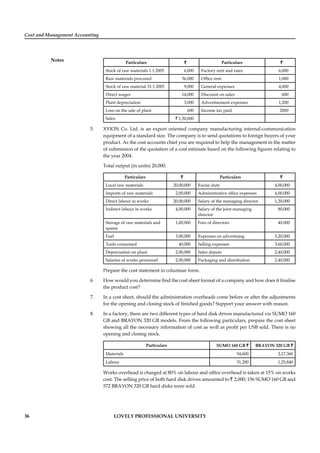
Example: Calculate the prime cost, factory cost, cost of production cost of sales and profit
form the following particulars:
Unit 2: Unit and Output Costing
Notes
LOVELY PROFESSIONAL UNIVERSITY 29
` `
Direct materials 2,00,000 Office stationery 1,000
Direct wages 50,000 Telephone charges 250
Direct expenses 10,000 Postage and telegrams 500
Wages of foreman 5,000 Salesmen’s’ salaries 2500
Electric power 1,000 Travelling expenses 1,000
Lighting: Factory 3,000 Repairs and renewal plant 7,000
Office 1,000 Office premises 1,000
Storekeeper’s wages 2,000 Carriage outward 750
Oil and water 1,000 Transfer to reserves 1,000
Rent: Factory 10,000 Discount on shares written off 1000
Office 5,000 Advertising 2,500
Depreciation Plant 1,000 Warehouse charges 1000
Office 2,500 Sales 3,79,000
Consumable store 5,000 Income tax 20,000
Managers’ salary 10,000 Dividend 4,000
Directors’ fees 2,500
Solution:
Cost Statement/Cost Sheet
Particulars `` ``
Direct Materials 2,00,000
Direct wages 50,000
Direct expenses 10,000
Prime Cost 2,60,000
Factory Overheads:
Wages of foreman 5,000
Electric power 1,000
Lighting: Factory 3,000
Storekeeper’s wages 2,000
Oil and water 1000
Rent: Factory 10,000
Depreciation Plant 1000
Consumable store 5,000
Repairs and Renewal Plant 7,000 35,000
Factory Cost 2,95,000
Administration Overheads:
Rent Office 5,000
Depreciation office 2,500
Managers’ salary 10,000
Directors’ fees 2,500
Office stationery 1,000
Telephone charges 250
Postage and telegrams 500
Office premises 1,000
Lighting: Office 1,000 23,750
Cost of production 3,18,750
Contd...
Cost and Management Accounting
Notes
30 LOVELY PROFESSIONAL UNIVERSITY
Selling and distribution overheads:
Carriage outward 750
Salesmen’s salaries 2500
Travelling expenses 1,000
Advertising 2500
Warehouse charges 1000
7,750
Cost of Sales 3,26,500
Profit 52,500
Sales 3,79,000
The next stage in the preparation of the cost statement is to induct the stock of raw materials,
work in progress and finished goods.
2.3.1 Stock of Raw Materials
The raw materials stock should be taken into consideration for the preparation of the cost sheet.
The cost of the raw materials is nothing but the direct materials cost of the product. The cost of
the materials is in other words cost of the materials consumed for the production of a product.
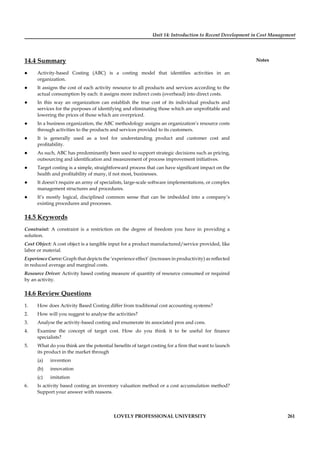
Particulars ``
Opening stock of raw materials XXXXX
(+) Purchases of raw materials XXXXX
(–) Closing stock of raw materials XXXXX
Cost of materials consumed XXXXX
2.3.2 Stock of Semi-finished Goods
The treatment of the stock of semi-finished goods is mainly depending upon the two different
approaches, viz.
1. Prime cost basis, and
2. Factory cost basis.
The factory cost basis is considered to be predominant over the early one due to the consideration
of factory overheads at the moment of semi finished goods treatment. The indirect expenses are
the expenses converting the raw materials into semi-finished goods which should be relatively
considered for the treatment of the stock valuation rather than on the basis of prime cost.
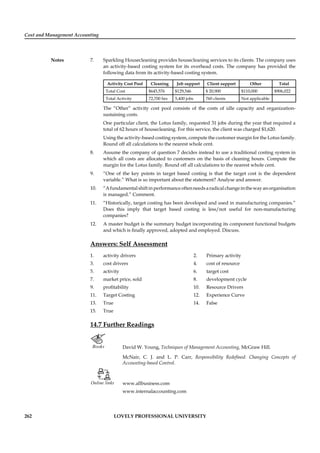
Particulars `
Prime cost XXXXXX
(+) Factory overheads incurred XXXXXX
(+) Opening work in progress XXXXXX
(–) Closing work in progress XXXXXX
Factory cost XXXXXX
2.3.3 Stock of Finished Goods
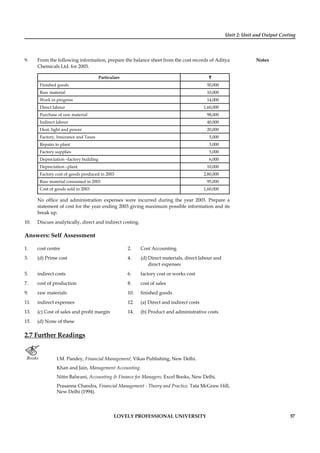
The treatment of the stock of finished goods should carried over in between the opening stock
and closing stock and adjusted among them before the finding the cost of goods sold.
Unit 2: Unit and Output Costing
Notes
LOVELY PROFESSIONAL UNIVERSITY 31
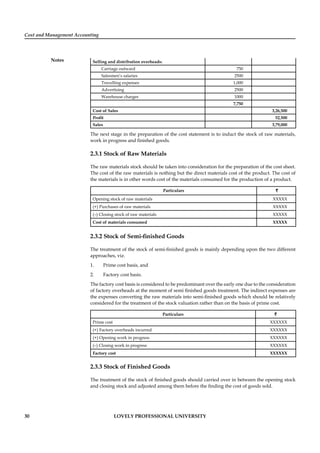
Particulars ``
Cost of production XXXXX
(+) Opening stock of finished goods XXXXX
(–) Closing stock of finished goods XXXXX
Cost of goods sold XXXXX
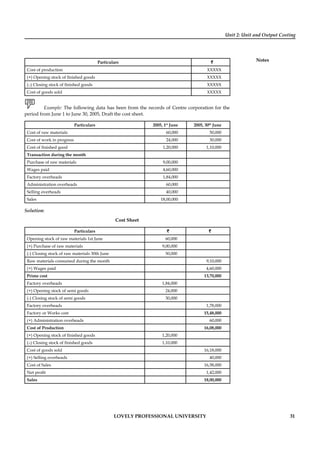
Example: The following data has been from the records of Centre corporation for the
period from June 1 to June 30, 2005, Draft the cost sheet.
Particulars 2005, 1st
June 2005, 30th
June
Cost of raw materials 60,000 50,000
Cost of work in progress 24,000 30,000
Cost of finished good 1,20,000 1,10,000
Transaction during the month
Purchase of raw materials 9,00,000
Wages paid 4,60,000
Factory overheads 1,84,000
Administration overheads 60,000
Selling overheads 40,000
Sales 18,00,000
Solution:
Cost Sheet
Particulars `` ``
Opening stock of raw materials 1st June 60,000
(+) Purchase of raw materials 9,00,000
(-) Closing stock of raw materials 30th June 50,000
Raw materials consumed during the month 9,10,000
(+) Wages paid 4,60,000
Prime cost 13,70,000
Factory overheads 1,84,000
(+) Opening stock of semi goods 24,000
(-) Closing stock of semi goods 30,000
Factory overheads 1,78,000
Factory or Works cost 15,48,000
(+) Administration overheads 60,000
Cost of Production 16,08,000
(+) Opening stock of finished goods 1,20,000
(–) Closing stock of finished goods 1,10,000
Cost of goods sold 16,18,000
(+) Selling overheads 40,000
Cost of Sales 16,58,000
Net profit 1,42,000
Sales 18,00,000
Cost and Management Accounting
Notes
32 LOVELY PROFESSIONAL UNIVERSITY
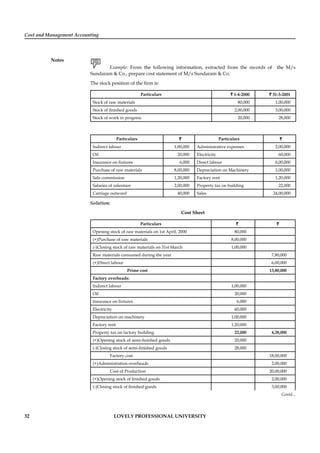
Example: From the following information, extracted from the records of the M/s
Sundaram & Co., prepare cost statement of M/s Sundaram & Co.
The stock position of the firm is:
Particulars ` 1-4-2000 ` 31-3-2001
Stock of raw materials 80,000 1,00,000
Stock of finished goods 2,00,000 3,00,000
Stock of work in progress 20,000 28,000
Particulars `` Particulars ``
Indirect labour 1,00,000 Administrative expenses 2,00,000
Oil 20,000 Electricity 60,000
Insurance on fixtures 6,000 Direct labour 6,00,000
Purchase of raw materials 8,00,000 Depreciation on Machinery 1,00,000
Sale commission 1,20,000 Factory rent 1,20,000
Salaries of salesmen 2,00,000 Property tax on building 22,000
Carriage outward 40,000 Sales 24,00,000
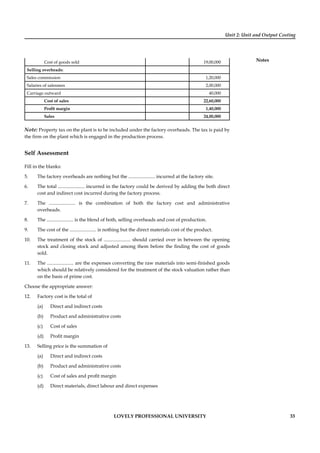
Solution:
Cost Sheet
Particulars `` ``
Opening stock of raw materials on 1st April, 2000 80,000
(+)Purchase of raw materials 8,00,000
(-)Closing stock of raw materials on 31st March 1,00,000
Raw materials consumed during the year 7,80,000
(+)Direct labour 6,00,000
Prime cost 13,80,000
Factory overheads:
Indirect labour 1,00,000
Oil 20,000
Insurance on fixtures 6,000
Electricity 60,000
Depreciation on machinery 1,00,000
Factory rent 1,20,000
Property tax on factory building 22,000 4,28,000
(+)Opening stock of semi-finished goods 20,000
(-)Closing stock of semi-finished goods 28,000
Factory cost 18,00,000
(+)Administration overheads 2,00,000
Cost of Production 20,00,000
(+)Opening stock of finished goods 2,00,000
(-)Closing stock of finished goods 3,00,000
Contd...
Unit 2: Unit and Output Costing
Notes
LOVELY PROFESSIONAL UNIVERSITY 33
Cost of goods sold 19,00,000
Selling overheads:
Sales commission 1,20,000
Salaries of salesmen 2,00,000
Carriage outward 40,000
Cost of sales 22,60,000
Profit margin 1,40,000
Sales 24,00,000
Note: Property tax on the plant is to be included under the factory overheads. The tax is paid by
the firm on the plant which is engaged in the production process.
Self Assessment
Fill in the blanks:
5. The factory overheads are nothing but the ...................... incurred at the factory site.
6. The total ...................... incurred in the factory could be derived by adding the both direct
cost and indirect cost incurred during the factory process.
7. The ...................... is the combination of both the factory cost and administrative
overheads.
8. The ...................... is the blend of both, selling overheads and cost of production.
9. The cost of the ...................... is nothing but the direct materials cost of the product.
10. The treatment of the stock of ...................... should carried over in between the opening
stock and closing stock and adjusted among them before the finding the cost of goods
sold.
11. The ...................... are the expenses converting the raw materials into semi-finished goods
which should be relatively considered for the treatment of the stock valuation rather than
on the basis of prime cost.
Choose the appropriate answer:
12. Factory cost is the total of
(a) Direct and indirect costs
(b) Product and administrative costs
(c) Cost of sales
(d) Profit margin
13. Selling price is the summation of
(a) Direct and indirect costs
(b) Product and administrative costs
(c) Cost of sales and profit margin
(d) Direct materials, direct labour and direct expenses
Cost and Management Accounting
Notes
34 LOVELY PROFESSIONAL UNIVERSITY
14. Production cost is the summation of
(a) Direct and indirect costs
(b) Product and administrative costs
(c) Cost of sales and profit margin
(d) Direct materials, direct labour and direct expenses
15. The statement prepared for the computation of a product/service cost is known as
(a) Standard Costing
(b) Marginal Costing
(c) Prime Costing
(d) None of these
Task Mr Anand provides the following information which is related to the
product of his enterprise for the month of December 2005.
`
Raw materials consumed 30,000
Direct labour charges 18,000
Machine hours worked 1,800
Machine hour rate 10
Administrative overheads 20% on works cost
Selling overheads ` 1 per unit
Units produced 26,400 units
Units sold 25,000 units ` 8 per unit
Draft the cost statement and determine the cost per unit, profit per unit sold and profit
during the period.
2.4 Summary
Cost sheet is a statement which is prepared periodically to provide detailed cost of a cost
unit or cost centre.
A cost sheet not only shows the total cost but also the various components of the total
cost.
During the preliminary stage of preparing the cost statement of the product, there are two
things to be borne in our mind at the moment of classification.
Direct cost classification
Indirect cost classification
Under this classification, the direct costs of the product or service are added together to
know the volume of total direct cost. The total volume of direct cost is known as “Prime
Cost.”
Unit 2: Unit and Output Costing
Notes
LOVELY PROFESSIONAL UNIVERSITY 35
The total factory cost or works cost incurred in the factory could be derived by adding the
both direct cost and indirect cost incurred during the factory process.
The cost of production is the combination of both the factory cost and administrative
overheads.
The cost of sales is the blend of both, selling overheads and cost of production.
The selling price of the commodities is fixed by way of adding both the cost of sales and
profit margin out of the product sales.
The cost of the raw materials is nothing but the direct materials cost of the product. The
cost of the materials is in other words cost of the materials consumed for the production
of a product.
The indirect expenses are the expenses converting the raw materials into semi-finished
goods which should be relatively considered for the treatment of the stock valuation rather
than on the basis of prime cost.
The treatment of the stock of finished goods should carried over in between the opening
stock and closing stock and adjusted among them before the finding the cost of goods
sold.
2.5 Keywords
Cost of Production: It is the combination of cost of manufacturing an article or a product and
administrative cost.
Cost of Sales: It is the entire cost of a product.
Cost Sheet: It is a statement prepared for the computation of cost of a product/service.
Direct Cost: Cost incurred which can be easily ascertained and measured for a product.
Factory Cost: It is the total cost incurred both direct and indirect at the work spot during the
production of an article.
Indirect Cost: Cost incurred cannot be easily ascertained and measured for a product. The
combination of various overheads.
Prime Cost: Combination of all direct costs viz direct materials, direct labour and direct
expenses.
Selling Price or Sales: The summation of cost of sales and profit margin.
2.6 Review Questions
1. Define cost unit. Give five examples of cost unit applicable to different industries.
2. Distinguish between direct cost and indirect cost.
3. What are the components of total cost? Draw a format of cost sheet.
4. Prepare the cost sheet to show the total cost of production and cost per unit of goods
manufactured by a company for the month of Jan. 2005. Also find the cost of sale and
profit.
Cost and Management Accounting
Notes
36 LOVELY PROFESSIONAL UNIVERSITY
Particulars `` Particulars ``
Stock of raw materials 1.1.2005 6,000 Factory rent and rates 6,000
Raw materials procured 56,000 Office rent 1,000
Stock of raw material 31.1.2005 9,000 General expenses 4,000
Direct wages 14,000 Discount on sales 600
Plant depreciation 3,000 Advertisement expenses 1,200
Loss on the sale of plant 600 Income tax paid 2000
Sales ` 1,50,000
5. XYION Co. Ltd. is an export oriented company manufacturing internal-communication
equipment of a standard size. The company is to send quotations to foreign buyers of your
product. As the cost accounts chief you are required to help the management in the matter
of submission of the quotation of a cost estimate based on the following figures relating to
the year 2004.
Total output (in units) 20,000.
Particulars `` Particulars ``
Local raw materials 20,00,000 Excise duty 4,00,000
Imports of raw materials 2,00,000 Administrative office expenses 4,00,000
Direct labour in works 20,00,000 Salary of the managing director 1,20,000
Indirect labour in works 4,00,000 Salary of the joint managing
director
80,000
Storage of raw materials and
spares
1,00,000 Fees of directors 40,000
Fuel 3,00,000 Expenses on advertising 3,20,000
Tools consumed 40,000 Selling expenses 3,60,000
Depreciation on plant 2,00,000 Sales depots 2,40,000
Salaries of works personnel 2,00,000 Packaging and distribution 2,40,000
Prepare the cost statement in columnar form.
6. How would you determine find the cost sheet format of a company and how does it finalise
the product cost?
7. In a cost sheet, should the administration overheads come before or after the adjustments
for the opening and closing stock of finished goods? Support your answer with reason.
8. In a factory, there are two different types of hard disk drives manufactured viz SUMO 160
GB and BRAYON 320 GB models. From the following particulars, prepare the cost sheet
showing all the necessary information of cost as well as profit per USB sold. There is no
opening and closing stock.
Particulars SUMO 160 GB ` BRAYON 320 GB `
Materials 54,600 2,17,360
Labour 31,200 1,25,840
Works overhead is charged at 80% on labour and office overhead is taken at 15% on works
cost. The selling price of both hard disk drives amounted to ` 2,000; 156 SUMO 160 GB and
572 BRAYON 320 GB hard disks were sold.
Unit 2: Unit and Output Costing
Notes
LOVELY PROFESSIONAL UNIVERSITY 37
9. From the following information, prepare the balance sheet from the cost records of Aditya
Chemicals Ltd. for 2003.
Particulars ``
Finished goods 50,000
Raw material 10,000
Work in progress 14,000
Direct labour 1,60,000
Purchase of raw material 98,000
Indirect labour 40,000
Heat, light and power 20,000
Factory, Insurance and Taxes 5,000
Repairs to plant 3,000
Factory supplies 5,000
Depreciation –factory building 6,000
Depreciation –plant 10,000
Factory cost of goods produced in 2003 2,80,000
Raw material consumed in 2003 95,000
Cost of goods sold in 2003 1,60,000
No office and administration expenses were incurred during the year 2003. Prepare a
statement of cost for the year ending 2003 giving maximum possible information and its
break up.
10. Discuss analytically, direct and indirect costing.
Answers: Self Assessment
1. cost centre 2. Cost Accounting
3. (d) Prime cost 4. (d) Direct materials, direct labour and
direct expenses
5. indirect costs 6. factory cost or works cost
7. cost of production 8. cost of sales
9. raw materials 10. finished goods
11. indirect expenses 12. (a) Direct and indirect costs
13. (c) Cost of sales and profit margin 14. (b) Product and administrative costs
15. (d) None of these
2.7 Further Readings
Books I.M. Pandey, Financial Management, Vikas Publishing, New Delhi.
Khan and Jain, Management Accounting.
Nitin Balwani, Accounting & Finance for Managers, Excel Books, New Delhi.
Prasanna Chandra, Financial Management - Theory and Practice, Tata McGraw Hill,
New Delhi (1994).
Cost and Management Accounting
Notes
38 LOVELY PROFESSIONAL UNIVERSITY
R.L. Gupta and Radhaswamy, Advanced Accountancy.
S. Bhat, Financial Management, Excel Books, New Delhi.
S.N. Maheswari, Management Accounting.
V.K. Goyal, Financial Accounting, Excel Books, New Delhi.
Online link www.futureaccountant.com
Unit 3: Material Control
Notes
LOVELY PROFESSIONAL UNIVERSITY 39
Unit 3: Material Control
CONTENTS
Objectives
Introduction
3.1 Meaning and Definition of Material Control
3.2 Methods and Techniques of Material Control
3.2.1 Economic Ordering Quantity
3.2.2 ABC Analysis
3.3 Pricing of Material Issues
3.3.1 First in First out (FIFO)
3.3.2 Last in First out (LIFO)
3.3.3 Highest in First out (HIFO)
3.3.4 Method of Average
3.4 Summary
3.5 Keywords
3.6 Review Questions
3.7 Further Readings
Objectives
After studying this unit, you will be able to:
Explain the meaning and definition of material control
Describe the methods and techniques of material control
Illustrate the pricing of material issues
Introduction
Material is a very important factor of production in a manufacturing organization. It is the first
and the most important element of cost. Materials account for nearly 50-60 per cent of the cost
of production. This fact can be inferred from an analysis of the financial statements of a large
number of organizations.
Uninterrupted supply of materials of acceptable quality and in required quantity as and when
required by the production department is a pre-requisite for carrying out production activities
uninterruptedly, because the non-availability of materials will bring the entire production
activities to a standstill. And, the implications of production stoppage are very well known.
Further, the cost of materials forms a major part of total cost of production and sales as it ranges
from 50-60% depending upon the nature of industries. Besides, this element of cost provides
a number of avenues for cost control such as at the time of purchase, during the process of
manufacturing. Hence, greater emphasis is to be laid on the control of material and material cost
as the success of any company depends, to a greater extent, upon the efficient purchase, storage
and usage of materials.
Cost and Management Accounting
Notes
40 LOVELY PROFESSIONAL UNIVERSITY
3.1 Meaning and Definition of Material Control
The success of any industry or enterprise depends, to a greater extent, upon the successful control
of material. Further, this input provides a number of avenues and wide scope for improvement of
overall performance of the industry. Inventory control, therefore, aims at ensuring the availability
of required quality material in required quantity, at required time or period and place with
minimum cost. Inventory involves investment of money and locking up of precious space which
has alternate uses. It is said that inventory is a necessary evil. As a result, proper control has to
be exercised over it. In controlling inventory, firms or industries use a number of techniques and
models. Inventory control is generally exercised over raw materials and work in progress. The
basic purpose of inventory control is to maintain optimum level of inventory.
The objectives of material control are as follows:
1. Proper estimation of inventory requirements-quantity, quality, specifications of inventory,
etc. This will help the purchase manager to quality and quantity of materials. The purchase
department has to exercise utmost care to procure the quality materials at lower prices.
2. The stores department has also an effective role to play for stock levels. By keeping only the
required quantities of materials, excess employment of capital on materials can be avoided.
Further, it can reduce the loss of materials during the storage period and keep the materials
in good condition.
3. It is the production departments which are capable of extracting the maximum output
from each unit of materials thereby contributing heavily to minimize the loss of materials
during the production period and to maximize the productivity.
Self Assessment
Fill in the blanks:
1. The basic purpose of inventory control is to maintain ...................... .
2. Inventory control is generally exercised over raw materials and ...................... .
3. The purchase department has to exercise utmost care to procure the quality materials at
...................... .
4. By keeping only the required quantities of materials, excess employment of ......................
can be avoided.
3.2 Methods and Techniques of Material Control
There are many methods and techniques of material control, the most important being:
3.2.1 Economic Ordering Quantity
The ordering of materials is usually tagged with three different components of costs viz:
Acquisition cost of materials
Ordering cost of materials and
Carrying cost of materials
The ordering quantity of materials may be either larger or lesser in volume, which carries its own
advantages and disadvantages.
Unit 3: Material Control
Notes
LOVELY PROFESSIONAL UNIVERSITY 41
If the quantity ordered is larger in volume, the following are some of the important advantages:
The bulk purchase order reduces the ordering cost of the materials.
The greater the size of the order leads to reduce the number of the orders in procuring the
materials.
Quantity discounts: The discount can be classified into two categories viz trade discount and
cash discount.
!
Caution What is trade discount?
Trade discount is the discount granted by the supplier to the buyer of materials at the
moment of bulk purchase. This % of discount is greatly possible only during the periods of
greater volume of purchase, which reduces the overall cost of the acquisition.
If the quantity is procured in lesser volume, the following are construed as advantages:
The carrying cost will come down in the case of lesser inventories.
The cost of storage is lesser as far as the lesser quantities of materials.
Loss due to deterioration, obsolescence, wastage will be minimum.
Insurance cost is less due to lesser volume of materials.
Note
The formula to compute EOQ is:
2AO
EconomicOrderingQuantity(EOQ) =
I
A = Annual requirement in units
O = Ordering cost
I = Cost of storing per year or cost of carrying the inventory
Example:
Annual requirement = 20,000 units
Ordering cost = ` 100 per order
Cost per unit = ` 4
Carrying cost = 16%
Determine the EOQ of the firm and finally justify the EOQ
2AO
EconomicOrderingQuantity(EOQ) =
I
2×20,000× 100
=
1 6% on 4
=2,500units
`
`
Cost and Management Accounting
Notes
42 LOVELY PROFESSIONAL UNIVERSITY
The following table illustrates the justification of the EOQ at the level of 2,500 units.
Annual requirement of 20,000 units
Particulars 1 2 3 4 5
Size of the Orders 20,000 10,000 5000 2,500 500
Number of order to placed
Total Annual Need
Size of the order
=
1 2 4 8 40
Average stock =
Size of the order
2
10,000 5,000 2,500 1,250 250
Average stock value =Average stock
× cost per unit `
40,000 20,000 10,000 5,000 1,000
Carrying cost = Average Stock value
× 16% `
6,400 3,200 1,600 800 160
Ordering cost ` 100 200 400 800 4,000
Total cost ` 6,500 3,500 2,000 1,600 4,160
Example: Calculate EOQ
Annual requirement = 1600 units
Cost of materials per unit = ` 40
Cost placing and receiving = ` 50
Annual carrying cost of inventory = 10% on value
=
× ×
= =
2
( )
2 1600 50
200
10% 40
AO
EconomicOrderingQuanitity EOQ
I
EOQ units
on
`
`
Example: Consumption during the year = 600 units
Ordering cost = ` 12 per order
Carrying cost = 20% on price
Price per unit = ` 20
=
× ×
= =
2
( )
2 600 12
60
20% 20
AO
EconomicOrderingQuantity EOQ
I
EOQ units
on
`
`
Task Given the annual consumption of material is 1,800 units, ordering costs are
` 2 per order, price per unit of material is 32 paise and storage costs are 25% per annum of
stock value. Find the economic order quantity.
Unit 3: Material Control
Notes
LOVELY PROFESSIONAL UNIVERSITY 43
3.2.2 ABC Analysis
Normally the materials are classified on the basis of the following covenants viz
Volume and
Value
Based on the following basis, the materials are classified into three categories:
Lesser percentage in volume and Greater percentage in Value – Category A
Greater percentage in volume and Lesser percentage in Value – Category B and
Percentage in volume and Percentage in value are more or less similar – Category C
Example: A store has 4,000 items of consumption and a monthly consumption of
` 20,00,000. 320 items will have a consumption of ` 15,00,000. 500 items will account for ` 4,00,000
and 2,680 items consume material worth ` 1,00,000 only.
Table of Items and Value
Group No. of Items % of Items Value ` % of Value
A 320 8% 15,00,000 75%
B 1000 25% 4,00,000 20%
C 2,680 67% 1,00,000 5%
Total 4,000 100% 20,00,000
The importance of the analysis is exercising the control on the inventory.
Did u know? How is the control of the inventory being exercised?
Group A items are high valued items among the other items of the enterprise,
requiring greater monitoring and controlling.
Group B items are comparatively lesser in value among the three items given next to
the Group A, require less rigid control and monitoring.
Group C items are the major volume of items among the 4000 items of the enterprise
which are least in value, need very little control and monitoring.
Example: The following shows the control of inventory on A, B and C items of the
enterprise:
Group No. of Items Level of Control % of Items Value ` % of Value
A 320 Rigid Control 8% 15,00,000 75%
B 1000 Moderate Control 25% 4,00,000 20%
C 2,680 Very little Control 67% 1,00,000 5%
From the above table, it is obviously seen that the items which have greater percentage (75%) in
the total value require rigid control than any other quantity of materials. The Group C items bear
67% of total consumption amount to 5% of total value of the items procured by the enterprise.
Cost and Management Accounting
Notes
44 LOVELY PROFESSIONAL UNIVERSITY
The unique features of the ABC analysis:
Nature A Group of Items B Group of Items C Group of Items
Level of Control Rigid control Moderate control Very little control
Order frequency Frequency of ordering-
weeks, fortnights
Once in 2 months Once in 6 months
Lead time problem To be cut off drastically To be reduced moderately Lead time problem due
to clerical should be
cut off
Safety stock level Due to greater value least
volume of safety stock is to
be maintained
Due to moderate value-
lesser safety stock is
required
Due to lower value
higher safety stock is
required
System of Purchase Higher value demands
centralized system of
procurement
Moderate value
requires centralized and
decentralized system of
purchase
Lower value needs
decentralized system
of purchase
Supervision By Senior officers By Middle level managers By clerical staff
Advantages
1. It guides the management to exercise the control based on the value of goods to the total
composition.
2. Systematic inventory control can be exercised through this analysis on the basis of value of
the materials. The high value materials of Group A are rigidly controlled which finally led
to lesser investments.
3. Scientific system helps to lessen the storage cost of the inventory.
Self Assessment
State whether the following statements are true or false:
5. As per ABC analysis the A category of inventory includes the inventory of lesser percentage
in volume and Greater percentage in Value.
6. Cash discount is the discount granted by the supplier to the buyer of materials at the
moment of bulk purchase.
7. The bulk purchase order increases the ordering cost of the materials.
8. The greater the size of the order leads to reduce the number of the orders in procuring the
materials.
Task Pennila &Co. is a direct exporter as well as market leader in the domestic market
among acute competition. The firm is expected to have an opening stock of 2000 kg of raw
materials at the rate of ` 4 per kg. The firm should have to price the issue of materials in two
different ways, one for the domestic market and another one for the export order which
was already obtained.
Date Receipts Qty kg Rate per kg ` Issue Qty kg
Jan 6 400
Jan 10 800 4.40
Jan 15 600 4.80.
Jan 20 1000
Contd...
Unit 3: Material Control
Notes
LOVELY PROFESSIONAL UNIVERSITY 45
Jan 21 400
Jan 24 1000 5.20
Jan 25 600
Jan 28 400
1. Which method of stores ledger is most suitable to the domestic market? How are the
issue prices of materials going to penetrate the perfect competition at the domestic
level?
2. Which method is considered to be most suitable for the export of goods? How will
the issue price of materials help the firm to reap greater profits through the export of
goods?
3.3 Pricing of Material Issues
The important operation of the inventory management is inventory valuation through stores
register. Inventory valuation under pricing is being executed through the following various
methodologies:
1. First in First out (FIFO)
2. Last in First out (LIFO)
3. Highest in First out (HIFO)
4. Simple Average Method (SAM)
5. Weighted Average Method (WAM)
6. Base Stock Method
3.3.1 First in First out (FIFO)
The material which is first issued from the earliest consignment on hand and priced at the cost at
which that consignment was placed in stores.
The materials which are received at first to be issued first.
This is the method suitable for the trend of falling prices in the market.
Did u know? Why it is considered as a suitable method for falling prices?
The issues of the materials are made at higher prices against the low price of replacement
of materials. The low price of replacement of materials against the issues is possible only
during the trend of falling prices.
Advantages
It is very simple to understand.
It is issued on the basis of purchases.
The materials are issued at purchase price.
It is most advantageous during the moment of falling prices due to lower cost of replacement
through purchases against the issues.
The closing stock reflects the market price due to recent purchase of materials.
Cost and Management Accounting
Notes
46 LOVELY PROFESSIONAL UNIVERSITY
Disadvantages
There may be the possibility of clerical errors at the moment of maintaining the stock
register due to price fluctuations.
The comparison between the jobs cannot be made possible due to various prices involved.
The materials issued for one job is at earlier prices which do not agree with the materials
issued for another job at later prices. When the price of materials do not agree with each
other, they will not be considered for comparison.
The issue prices do not reflect the market price due to upward price trend. The main reason
is that the issues are only due to earliest consignments.
Example: Prepare stores ledger account on the basis of FIFO.
Jan 1 Opening balance 500 units @ ` 8
Jan 5 Received from vendor 200 units @ ` 8.5
Jan 12 Received from vendor 150 units @ ` 8.20
Jan 20 Received from vendor 300 units @ ` 9
Jan 25 Received from vendor 400 units @ ` 8
Issues of materials were as follows:
Jan 10–400 units Jan 14–200 units Jan 15–100 units
Jan 19–100 units Jan 26–200 units Jan 30–250 units
The first step is to mention the opening balance of materials under the balance side of the stores
ledger account.
The most important step is to issue the materials from the available source of materials in the
hands of the firm. If the available source of materials is available in terms of various price
categories, the issues are to be made from the earliest consignments till the requirement of issue
is to be met. If the issue is not met within the single price band, the next price bands are to be
considered for the fulfillment of the requirements of the issue.
The remaining value of the materials at the end of the transaction is known as value of the closing
stock.
Stores Ledger Account First In First Out (FIFO)
Date Particulars Receipts Issues Balance
Qty. Total
cost `
Unit
cost `
Qty. Total
cost `
Unit
cost `
Qty. Total
cost `
Unit
cost `
Jan 1 Opening
balance
--------------------- ------------------------- 500 8 4,000
Jan 4 Requisition
Slip No
200 8 1,600 300 8 2,400
Jan 5 Receipt No 200 8.50 1,700 ------------------ 300 8 2,400
200 8.50 1,700
Jan 10 Requisition
Slip No
-------------------- 400 300
} 100
8 2,400 100 8.50 850
8.50 850
Jan 12 Receipt No 150 8.20 1,230 -------------------------- 100 8.50 850
150 8.20 1,230
Contd...
Unit 3: Material Control
Notes
LOVELY PROFESSIONAL UNIVERSITY 47
Jan 15 Requisition
slip No
--------------------- 100 8.50 850 150 8.20 1,230
Jan 19 Requisition
slip No
----------------------- 100 8.20 820 50 8.20 410
Jan 20 Receipt No 300 9 2,700 -------------------------- 50 8.20 410
300 9 2,700
Jan 25 Receipt No 400 8 3,200 ------------------------------ 50 8.20 410
300 9 2,700
400 8 3,200
Jan 26 Requisition
No
----------------------
200
} 50
150
8.20 410 150 9 1,350
9 1,350 400 8 3,200
Jan 30 Requisition
No
----------------------
250
}150
100
9 1,350 Closing stock value
8 800 300 8 2,400
3.3.2 Last in First out (LIFO)
Under this method, the issues are made at the price of latest consignment. The current cost of the
jobs/work orders are denominated only in terms of the price of the latest consignment. During
the rising prices, this is considered to be a most suitable method.
Thismethodhelpsthemanagementtoquotecompetitivepricesonthebasisoflatestconsignments.
This method was considered by all the firms in the US as a predominant one over the others in
fixing the price on the commodities competitively during the post Second World War years.
Advantages
It has greater applicability only when the transactions are very minimal and prices are
steady in the environment.
The recent purchase through the latest consignment reflects the current market prices in
the cost of sales of the firm.
The issue of materials through latest consignments are denominated in terms of higher
prices; led to illustrate lesser profits due to higher charge during the production and lessens
the income tax burden.
Disadvantages
Greater possibility for more number of clerical errors.
This method also helps to compare the jobs or works.
There may be a possibility of either overstating or understating the value of the stock in
the balance sheet.
Example: The early Example’s information has been considered for LIFO.
The first step is to highlight the opening balance under the balance column of the store ledger of
LIFO method.
The next step is to enter the receipts if any receipts are made initially.
Cost and Management Accounting
Notes
48 LOVELY PROFESSIONAL UNIVERSITY
The next most important step is to issue the materials out of latest consignments at first. If the
latest consignments do not carry sufficient volume to issue, the next later receipt should be taken
into consideration in addition to the latest consignments.
Finally, whatever the closing balance available at the end of all transactions is known as the value
of the closing stock of the materials.
Stores Ledger Account Last in First out (LIFO)
Date Particulars Receipts Issues Balance
Qty. Total
cost
`
Unit
cost `
Qty. Total
cost `
Unit
cost `
Qty. Total
cost
`
Unit
cost `
Jan 1 Opening
balance
--------------------- ----------------------- 500 8 4,000
Jan 4 Requisition
Slip No
200 8 1,600 300 8 2,400
Jan 5 Receipt No 200 8.50 1,700 ------------------ 300 8 2,400
200 8.50 1,700
Jan 10 Requisition
Slip No
------------------
400
}200
200
8.50 1,700 100 8 800
8 1,600
Jan 12 Receipt No 150 8.20 1,230 ------------------- 100 8 800
150 8.20 1,230
Jan 15 Requisition
slip No
--------------------- 100 8.20 820 100 8 800
50 8.20 410
Jan 19 Requisition
slip No
---------------------
100
}50
50
8.20 410 50 8 400
8 400
Jan 20 Receipt No 300 9 2,700 --------------------- 50 8 400
300 9 2,700
Jan 25 Receipt No 400 8 3,200 ------------------------- 50 8 400
300 9 2,700
400 8 3,200
Jan 26 Requisition
No
-------------------- 200 8 1,600 50 8 400
300 9 2,700
200 8 1,600
Jan 30 Requisition
No
--------------------
250
}200
50
8 1,600 Closing stock value
9 450
300
}250
50
9 2,250
8 400
TOTAL 2,650
3.3.3 Highest in First out (HIFO)
The major underlying assumption of this method is to value the closing stock as minimum as
possible at the end of concluding the stores register. The high priced materials are issued one after
the another, among the various consignment of the materials available in the stores. This method
may not only assist the firm to devalue the stock, but also to price the issue exorbitantly. It leads
to a charge through cost plus contracts. It may be possible for the firm during the monopoly
situations to increase the price of materials.
Unit 3: Material Control
Notes
LOVELY PROFESSIONAL UNIVERSITY 49
Example: The stock of material M/s Murugan & Co. as on January 2004 is 1000 units at
` 2 per unit. The following purchases and issues of this item were made subsequently:
Date Receipts Qty. Units Rate per unit ` Issue Qty Units
Jan 6 400
Jan 10 800 2.20
Jan 15 600 2.40.
Jan 20 1000
Jan 21 400
Jan 24 1000 2.60
Jan 25 600
Jan 28 400
Stores Ledger (Highest In First Out)
Date Particulars Receipts Issues Balance
Qty. Total
cost `
Unit
cost `
Qty. Total cost ` Unit
cost `
Qty. Total
cost `
Unit
cost `
Jan 1 Opening balance --------------------- --------------------- 1000 2 2,000
Jan 6 Requisition Slip
No
------------------------ 400 2 800 600 2 1,200
Jan 10 Receipt No 800 2.20 1,760 ------------------ 600 2 1,200
800 2.20 1,760
Jan 15 Receipt No 600 2.40 1,440 ---------------------- 600 2.40 1,440
800 2.20 1,760
600 2 1,200
Jan 20 Requisition slip No ---------------------
1000}600
400
2.40 1,440 400 2.20 880
2.20 880 600 2 1,200
Jan 21 Requisition slip No ----------------------- 400 2.20 880 600 2 1,200
Jan 24 Receipt No 1000 2.60 2,600 --------------------- 1000 2.60 2,600
600 2 1,200
Jan 25 Requisition No
----------------------------
600 2.60 1,560 400 2.60 1,040
600 2 1,200
Jan 28
Requisition No
------------------------ 400 2.60 1,040 Closing Stock Value
600 2 1,200
The closing stock is priced at ` 2 per Kg which leads to a minimum value of ` 1,200.
3.3.4 Method of Average
In practice, the issue of materials cannot be made from any singular lot purchases. Normally
speaking, the materials are grouped together in categories on the basis of similar characteristics
but not on the basis of purchase price. If the materials are grouped together irrespective of
purchase price, the issues should be done appropriately on the basis of average cost method.
The average cost method is bifurcated as follows:
Simple Average Method
Weighted Average Method
Base Stock Method
Cost and Management Accounting
Notes
50 LOVELY PROFESSIONAL UNIVERSITY
Simple Average Method (SAM)
Under the simple average method, the issues are made only on the basis of simple average price.
Definition: “Simple Average Price”
“A price which is calculated by dividing the total of the prices of materials in the stock from
which the material to be priced could be drawn by the number of prices used in that total”
The following example will help to understand:
Example: A pillow manufacturer purchases raw cotton from three different quantities at
three different prices.
Quantity Kg ` per Kg
10,000 20
20,000 30
30,000 40
As a manufacturer of pillows, he should find out the cost of the raw cotton material at the moment
of issuance to the production centre. The issue price should be computed as follows:
Simple Average Price
+ +
= 1 2 3................... nP P P P
N
P1
= Price of the material purchased at the first instance, P2
, P3
and so on.
N = Number of prices involved
Simple average price
+ +
=
20 30 40
3
` ` `
= ` 30/-
The following transactions took place in respect of a material:
Illustration 1:
Date Receipt of Qty Rate ` Issue of Qty
03-3-2005 200 4.00
10-3-2005 300 4.80
15-3-2005 250
22-3-2005 250 5.20
29-3-2005 200
Stores Ledger Account in Simple Average Method
Date Particulars Receipts Issues Balance
Qty. Total
cost `
Unit
cost `
Qty Total
cost `
Unit cost ` Qty. Unit cost
`
3-3-2005 Receipts 200 4.00 800 ------------------------- 200 800
10-3-2005 Receipts 300 4.80 1,440 500 2,240
15-3-2005 Issue ---------------- 250 4.40* 1,100 250 1,140
22-3-2005 Receipt 250 5.20 1,300 ---------------------------- 500 2,440
29-3-2005 Issue 200 5** 1,000 Closing Stock Value
300 1,440
Unit 3: Material Control
Notes
LOVELY PROFESSIONAL UNIVERSITY 51
The next method is weighted average method to issue the materials from the stores. Why is the
weighted average method considered to be a superior method over the simple average method?
This simple average method does not facilitate the recovery of the cost price of the materials
through the issue price of the material calculated.
From the above cited example, first the cost of the materials is to be computed.
Cost of the materials = (10,000 Kg × ` 20 +20,000 Kg × ` 30 + 30,000 Kg × ` 40)
= ` 2,00,000+ ` 6,00,000 + ` 12,00,000
= ` 20,00,000/-
Recovery through issue under simple average method = 60,000 Kg × ` 30 per Kg = ` 18,00,000
If the issue is made through the simple average method, the cost of materials cannot be recovered
i.e. under recovery
= Cost of the materials- issue price of the material
= ` 20,00,000 – ` 18,00,000 = ` 2,00,000 (Under recovery)
It means that the total issue price is less than that of the cost of the materials by ` 2,00,000.
In order to overcome the above bottleneck which is associated, the method of weighted average
is introduced to replace the early method.
Weighted Average Method (WAM)
Under the weighted average method, the issue price is found out through the appropriate
assignment of weights considered for the determination of weighted average price.
Weighted Average Price
“Weighted average price which is calculated by dividing the total cost of materials in the stock from
which the materials to be priced could be drawn by the total quantity of materials in that stock.”
Weighted average price
+ +
=
+ +
1 1 2 2 3 3
1 2 3
............
......
n n
n
Q P Q P Q P Q P
Q Q Q Q
Q = Quantity of materials
P = Price of the materials
Q = Assigned as weights i.e. volume of the quantities are used weights
The above example is taken for the computation weighted average price
=
× + × + ×
+ +
(10,000 Kg 20 20,000 Kg 30 30,000 Kg 40)
10,000 20,000 30,000
` ` `
= ` 33.33 per Kg
Illustration 2:
Stores Ledger Account in Weighted Average Method
Date Particulars Receipts Issues Balance
Qty. Total
cost `
Unit
cost `
Qty. Total
cost `
Unit
cost `
Qty. Unit cost `
3-3-2005 Receipts 200 4.00 800 ------------------------- 200 800
10-3-2005 Receipts 300 4.80 1,440 500 2,240
15-3-2005 Issue ---------------- 250 4.48* 1,120 250 1,120
22-3-2005 Receipt 250 5.20 1,300 --------------------------- 500 2,420
29-3-2005 Issue 200 4.84** 968 Closing Stock Value
300 1,452
Cost and Management Accounting
Notes
52 LOVELY PROFESSIONAL UNIVERSITY
* 800 1,140
4.48
200 300
+⎛ ⎞
=⎜ ⎟
+⎝ ⎠
`
** 1120 1,300
4.84
250 250
+⎛ ⎞
=⎜ ⎟
+⎝ ⎠
`
How it is considered as a superior method over the early one?
The cost of the materials amounts to ` 20,00,000. The total issue price of the materials is as
follows:
= 60,000 Kg × ` 33.3333 per K.g = ` 19,99,998 approximately equals to the cost of the materials
i.e. ` 20,00,000/-
Advantages
This method is a most rational method in finding out the issue price of the materials.
It never takes into consideration the price fluctuations either during the trend of rising or
falling.
Issue prices mainly depend upon the number of purchases.
Under this method, the issue price is able to recover the cost of the materials.
The issue price reflects or resembles the market price.
Disadvantages
Due to different volumes of materials, clerical errors may arise.
It lost its expression in terms of actual price of materials due to average price.
Base Stock Method
Under this method, the minimum or safety stock of materials is to be stored from the initial lot
of purchase by the enterprise. The ultimate purpose of maintaining the stock in order to meet the
emergency whenever arises. Once the base stock is created out of the first lot of purchase, should
be considered as a fixed volume forwarded from one point of time to another.
It is the only method having the prime objective of issuing the materials to the tune of current
prices. This method normally carries out its operations either with FIFO or LIFO. While applying
the FIFO or LIFO method in the applications of the base stock method it bears the advantages and
disadvantages of the fundamental procedures of earlier two methods.
The basic objective of the method could be met out only with the conjunction of LIFO method.
Illustration 3:
The stock of material Z as on Jan 2004 is 500 units at ` 2 per unit. The following purchases and
issues of this item were made subsequently:
Date Receipts Qty. Units Rate per unit ` Issue Qty Units
Jan 6 200
Jan 10 400 2.20
Jan 15 300 2.40.
Jan 20 500
Jan 21 200
Jan 24 500 2.60
Jan 25 300
Jan 28 200
Unit 3: Material Control
Notes
LOVELY PROFESSIONAL UNIVERSITY 53
Prepare a store ledger account showing how the value of the above issues should be arrived at
under the base stock method when it operates in conjunction with LIFO. Base stock is 200 units.
Stores Ledger Base Stock Method (Last In First Out Model)
Date Particulars Receipts Issues Balance
Qty. Total
cost `
Unit
cost `
Qty. Total
cost `
Unit
cost `
Qty. Total
cost `
Unit
cost `
Jan 1 Opening
balance
--------------------- ------------------------- 500 2 1,000
Jan 6 Requisition
Slip No
------------------------ 200 2 400 300 2 600
Jan 10 Receipt No 400 2.20 880 --------------------- 300 2 600
400 2.20 880
Jan 15 Receipt No 300 2.40 720 ---------------------- 300 2 600
400 2.20 880
300 2.40 720
Jan 20 Requisition
slip No
--------------------- 300 2.40 720 300 2 600
200 2.20 440 200 2.20 440
Jan 21 Requisition
slip No
----------------------- 200 2.20 440 300 2 600
Jan 24 Receipt No 500 2.60 1,300 --------------------- 300 2 600
500 2.60 1,300
Jan 25 Requisition
No ----------------------------
300 2.60 780 300 2 600
200 2.60 520
Jan 28 Requisition
No
------------------------ 200 2.60 520 Closing Stock Value
300 2 600
Self Assessment
Fill in the blanks:
9. The ...................... method helps the management to quote competitive prices on the basis of
latest consignments.
10. Under the weighted average method, the ...................... is found out through the appropriate
assignment of weights considered for the determination of weighted average price.
11. Under ......................, the minimum or safety stock of materials is to be stored from the initial
lot of purchase by the enterprise.
12. This ...................... method does not facilitate the recovery of the cost price of the materials
through the issue price of the material calculated.
13. The major underlying assumption of ...................... method is to value the closing stock as
minimum as possible at the end of concluding the stores register.
14. If the materials are grouped together irrespective of purchase price, the issues should be
done appropriately on the basis of ...................... method.
15. The ...................... of replacement of materials against the issues is possible only during the
trend of falling prices.
Cost and Management Accounting
Notes
54 LOVELY PROFESSIONAL UNIVERSITY
3.4 Summary
Inventory control, therefore, aims at ensuring the availability of required quality material
in required quantity, at required time or period and place with minimum cost.
Inventory involves investment of money and locking up of precious space which has
alternate uses.
Inventory control is generally exercised over raw materials and work in progress.
The basic purpose of inventory control is to maintain optimum level of inventory.
The ordering of materials is usually tagged with three different components of costs viz:
Acquisition cost of materials
Ordering cost of materials and
Carrying cost of materials
A system of classifying materials and supplies according to value is known as A.B.C.
Analysis
The important operation of the inventory management is inventory valuation through
stores register. Inventory valuation under pricing is being executed through the following
various methodologies:
First in First out (FIFO)
Last in First out (LIFO)
Highest in First out (HIFO)
Simple Average Method (SAM)
Weighted Average Method (WAM)
Base Stock Method
3.5 Keywords
ABC Analysis: Analysis of exercising the control on the inventory on the basis of value. Always
Better Control Analysis; A- High control for high value goods; B- Moderate control for lesser
value goods and C- Little control on the least value goods.
Carrying Cost: Cost incurred for carrying the materials from the place of purchase to place of
production centre/profit centre.
E.O.Q: Economic Order Quantity of materials to be ordered/procured.
Inventory: Stock of Raw materials, Stock of Work in Progress, Stock of Finished Goods and Stock
of Spares, but not Stock of Loose tools.
Ordering Cost: Cost incurred at the moment of placing the order of goods or materials,
administration costs, cost of communication and so on.
3.6 Review Questions
1. The basic purpose of material control is to maintain optimum level of inventory. Discuss.
2. Which method is most suitable for perishable commodities? Why? Reason out the suitability
of the model.
Unit 3: Material Control
Notes
LOVELY PROFESSIONAL UNIVERSITY 55
3. Which method is most suitable for precious metals? Why? Explain the reasons.
4. Why does the firm need to install inventory control? Explain the conflicting objectives
among the heterogeneous departments in maintaining the inventory.
5. You are required to suggest an inventory control mechanism for the following:
(a) Stores department of the Ball-bearing Manufacturing Company Ltd.
(b) Retail Medical Stores
(c) Wholesale Automobile Showroom
6. Explain the meaning and applications of the various tools of inventory level under the
inventory management.
7. Critically evaluate the roles of carrying costs and ordering costs on the economic order
quantity.
8. The stock in hand of a material as on 1-9-2002 was 500 units at ` 1 per unit. The following
purchases and issues were subsequently made. Prepare the stores ledger account showing
how the value of the issues would be recorded under (a) FIFO and (b) LIFO method.
Purchased Issued
6-9-2002 100 units @ ` 1.20 9-9-2002 500 units
20-9-2002 700 units @ ` 1.20 22-9-2002 500 units
27-9-2002 400 units @ ` 1.30 30-9-2002 500 units
13-10-2002 1,000 units @ ` 1.40 15-10-2002 500 units
20-10-2002 500 units @ ` 1.50 22-10-2002 500 units
17-11-2002 400 units @ ` 1.60 11-11-2002 500 units
9. A manufacturer buys certain essential spares from outside suppliers at ` 40 per set. Total
annual requirements are 45,000 sets. The annual cost of investment in inventory is 10% and
costs like rent, stationery, insurance, taxes, etc. per unit per year work to ` 1. Cost of placing
an order is ` 5. Calculate the Economic Order Quantity.
10. Find out the Economic order quantity from the following information’s:
Annual usage : 3,000 units; Cost of material per unit: ` 10; Cost of placing and receiving one
order ` 60; and Annual carrying cost per unit: 10% of inventory value.
11. From the following transactions, prepare separately the stores ledger account, using the
FIFO and LIFO methods of pricing:
January 1 Opening Balance 100 units @ ` 5 each.
’’ 5 Received 500 units @ ` 6 each.
’’ 20 Issued 300 units.
February 5 Issued 200 units.
’’ 6 Received 600 units @ ` 5 each.
March 10 Issued 300 units.
’’ 12 Issued 250 units.
12. Select a manufacturing concern and outline a system of materials control for it. Give
specimen of various forms you will require.
Cost and Management Accounting
Notes
56 LOVELY PROFESSIONAL UNIVERSITY
Answers: Self Assessment
1. optimum level of inventory 2. work in progress
3. lower prices 4. capital on materials
5. True 6. False
7. False 8. True
9. LIFO 10. issue price
11. Base Stock method 12. simple average
13. HIFO 14. average cost
15. low price
3.7 Further Readings
Richard G. Schroeder, Myrtle W. Clark, Myrtle W. Clark, Jack M. Cathey, Financial
Accounting Theory and Analysis: Text Readings and Cases, John Wiley & Sons Inc.
Online links www.futureaccountant.com
www.managementstudyguide.com
Unit 4: Costing and Control of Labour
Notes
LOVELY PROFESSIONAL UNIVERSITY 57
Unit 4: Costing and Control of Labour
CONTENTS
Objectives
Introduction
4.1 Labour Turnover
4.1.1 Causes of Labour Turnover
4.1.2 Effects of Labour Turnover
4.2 Idle Time
4.3 Methods of Wages, Payments and Incentive Plans
4.4 Summary
4.5 Keywords
4.6 Review Questions
4.7 Further Readings
Objectives
After studying this unit, you will be able to:
Compute labour turnover
Illustrate the methods of wages payment and incentive plans
Introduction
Labour is the most sensitive element in any manufacturing activity. The performance of labour
has a direct bearing on all other elements of cost too.
Labour may be classified as direct when (a) there is a direct relationship of the labour to a particular
production unit or process, (b) the labour cost is measurable in terms of such production unit or
process, and (c) the labour cost is sufficiently significant in amount and easily identifiable with
particular production unit or process. Indirect labour costs are those costs which are necessary for
production purposes but are not identifiable with a particular production unit. Such costs consist
of (a) labour costs in service departments, such as, purchasing, engineering, time-keeping, etc.
(b) labour cost of certain works of production departments, viz, salaries of foremen, helpers,
clerical assistants, and (c) labour costs connected with general factory services, viz, salaries of
works manager, chief inspector, factory office staff, etc.
Note The classification of indirect labour depends upon the manufacturing methods
and pattern of the organisation and there cannot be any universally acceptable set of
classification for indirect labour.
4.1 Labour Turnover
It denotes the percentage change in the labour force of an organisation. It is a common occurrence
that the workers do change their jobs. Either they leave their jobs for better prospects or better
Cost and Management Accounting
Notes
58 LOVELY PROFESSIONAL UNIVERSITY
environments or they are forced to leave an employment. Such mobility is quite normal and
known as labour turnover.
Cost of labour turnover is treated as an overhead expense and should not be charged direct to
any work order.
1. Labour turnover according to separation method
= Number of employees left during a period/Average number of employees during a
period × 100
2. Labour turnover according to flux method
= Number of addition + seperations during a period/Average number of employees
during a period × 100.
4.1.1 Causes of Labour Turnover
A study into the causes of labour turnover helps the management in proper planning and action
for reducing this rate. The reasons may be divided into two categories:
(a) Avoidable Causes, and
(b) Unavoidable Causes.
(a) Avoidable Causes of Labour Turnover: The various avoidable causes are:
(i) Lower wages being paid in the organisation,
(ii) Lack of planning of higher management,
(iii) Unsatisfactory working conditions in the factory,
(iv) Lack of job satisfaction,
(v) Lack of medical and transport facilities,
(vi) Discrimination between one worker and another worker,
(vii) Bad relationship with supervisors and management,
(viii) Lack of proper adjustment with workers,
(ix) Unauthorized long absence from duty,
(x) Migratory character of Indian industrial workers, and
(xi) Lack of safety measures.
(b) Unavoidable Causes of Labour Turnover: The various unavoidable causes responsible for
labour turnover are:
(i) Death, retirement disablement of the worker,
(ii) Domestic disputes of the workers,
(iii) Illness or accidents making the worker permanently handicapped,
(iv) Discharge due to unsuitability,
(v) Marriage and pregnancy in case of female workers,
(vi) Inefficiency of the workers,
(vii) Other reasons such as lack of housing and transport facilities, and
(viii) Immoral character of worker.
Unit 4: Costing and Control of Labour
Notes
LOVELY PROFESSIONAL UNIVERSITY 59
4.1.2 Effects of Labour Turnover
It results an increase in cost of production due to the following reasons:
1. Cost of replacing workers, i.e., cost of selection,
2. Cost of training for new workers,
3. Loss arising out of defective work and increased wastage in production process,
4. Newly employed workers are likely to mishandle of machines and equipments, and
5. With frequent changes, production planning cannot be properly executed and as a result,
there is loss in production.
Example: The personnel department of an organisation gives you the following
information regarding labour. Calculate labour turnover rate using the various methods of
labour turnover.
Number of workers on the payroll:
At the beginning of the month 2,900
At the end of the month 1,100
During the month, 20 persons quit while 80 persons are discharged. 300 workers are required
during the month. Of these, 50 workers are recruited in the vacancies of those leaving while the
rest were engaged in accordance with an expansion scheme.
Solution:
Average number of workers during the month:
2900 1100
2000
2
+
= =
Labour Turnover Rate by:
1. Separation Method =
Number of separations during a period
Average number of workers during the period
LTR =
20 80
100
2000
+
×
LTR = 5%
2. Flux Method =
Number of separations + Number of replacements
Average number of workers during the period
× 100
LTR =
100 50
100
2000
+
×
LTR = 7.5%
4.2 Idle Time
Usually, there is bound to be some difference between the time booked to different jobs or work
orders and gate time. The difference of this is known as idle time. Idle time is that time for which
the employer pays, but from which he obtains no production. Idle time is of two types:
1. Normal idle time, and
2. Abnormal idle time
Cost and Management Accounting
Notes
60 LOVELY PROFESSIONAL UNIVERSITY
Normal Idle Time
This represents the time wastage that cannot be avoided and, therefore, the employer must bear
the labour cost of this time. Following are some examples of normal idle time:
1. The time taken in going from the factory gate to the department in which the worker is to
work, and then again the time coming from the department to the factory gate at the end of
the day.
2. The time taken in packing up the work for the day.
3. The time which elapses between the completion of the job and the commencement of the
next job.
4. The time taken for personal needs and tea breaks.
5. The time lost when production is interrupted for machine maintenance.
As it is unavoidable cost and as such should be included in cost of production.
Abnormal Idle Time
It is that time wastage which can be avoided if proper precautions are taken. Examples of
abnormal idle time can be cited as below:
1. The time wasted due to breakdown of machinery on account of the inefficiency of the work
engineers.
2. Time wasted on account of the failure of the power supply.
3. The time wasted due to strike or lockouts in the factory.
!
Caution It is a principle of costing that all abnormal expenses and losses should not be
included in costs and as such wages paid for abnormal idle time should not form part of
the cost of production. The wages paid for abnormal idle time should be debited to costing
Profit & Loss Account.
Self Assessment
Fill in the blanks:
1. ...................... denotes the percentage change in the labour force of an organisation.
2. Cost of labour turnover is treated as an ...................... and should not be charged direct to
any work order.
3. ...................... is that time for which the employer pays, but from which he obtains no
production.
4. ...................... represents the time wastage that cannot be avoided and, therefore, the
employer must bear the labour cost of this time.
5. The ...................... includes the time wasted on account of the failure of the power supply.
6. The wages paid for abnormal idle time should be debited to costing ...................... .
7. Labour turnover according to ...................... .
= Number of employees left during a period/Average number of employees during a
period × 100
Unit 4: Costing and Control of Labour
Notes
LOVELY PROFESSIONAL UNIVERSITY 61
4.3 Methods of Wages, Payments and Incentive Plans
Remuneration and incentive systems, according to their characteristics, fall under the following
broad categories:
1. Time rates
2. Piece rates
3. Bonus system
4. Indirect monetary incentives and
5. Non-monetary incentives
Time Rates at Ordinary Levels
Payment is made at a rate on attendance by hour, day, week or a month regardless of output.
Time Rates at High Wages Levels: Under this system, wages are paid at an appreciably higher
rate than the normal wage for the industry and return a much higher stand of performance and
output from the workers are expected.
Graduated Time Rates: This takes the form of wage rate which varies with changes in the local
cost of living index.
Straight Piece Rates: This is a payment of a fixed sum per fixed unit produced without regard
to time taken.
Piece Rates
Piece rates with guaranteed day rates:
A piece rate system with the guaranteed minimum wage may take one of the following forms:
1. Piece work with a guaranteed day rate: If earning according to piece rates is less than the
worker’s time pay, he gets his time pay. If the piece work earning is more, then of course,
he gets more than his time pay.
2. Piece work with a flat cost of living bonus or dearness allowance.
3. A guaranteed rate per hour, day of week worked plus a piece rate payment for output
above a required minimum.
Did u know? What is Differential Piece Rate?
Under such scheme, earnings vary at different stages in the range of output, sometimes
proportionally more, sometimes less, or sometimes in proportion to output, designed to
reward efficient workers with the further object of encouraging less efficient workers or a
trainee to improve.
Premium and Bonus Plan
The object of a premium plan is to increase the production by giving an inducement to the
workers in the form of higher wages for less time worked.
Some of the important premium plans are as follows:
Cost and Management Accounting
Notes
62 LOVELY PROFESSIONAL UNIVERSITY
Halsey Premium Plan
Under this method, standard time for doing each job or operation is fixed and the worker is given
wages for the actual time to be taken to complete the job or operation at the agreed rate per hour,
plus a bonus equal to one half of the time saved. In practice, the bonus may vary from
1
33 %
3
to
2
62 %
3
of the wages of the time saved. Total earnings of the worker will be
TT × HR + ½ × TS × HR
TT = Time Taken
HR = Hourly Rate
TS = Time Saved
Time saved is the difference between Time Allowed (Standard Time) and Time Taken. Normal
wages may be ascertained and bonus may be added to arrive at total earnings.
Rowan Plan
Under this method, the worker is again guaranteed wages at the ordinary rate for the time taken
by him to complete the job or operation. The difference between Halsey plan and Rowan plan is
only in the calculation of the bonus. Bonus under this system will be calculated as:
TS/TA × Time Taken × Hourly Rate
The total earnings will be
TT × HR + [ (TA – TT) / TA] × TT × HR
TT = Time Taken
HR = Hourly Rate
TA = Time Allowed
Alternatively:
Normal wages + Bonus will be total earnings.
Therefore, Normal wages = Time Taken × Hourly Rate
Bonus = (Time Saved / Time allowed) × Normal Wages
Example: From the following particulars, workout the earnings of a worker under:
1. Halsey premium system and
2. Rowan system
Standard time 10 hours
Standard Rate ` 2 per hour
Time Taken 8 hours
Solution:
Halsey Premium System:
Normal wages = Time taken × Hourly Rate
= 8 × 2 = ` 16.00
Bonus 50% of time saved.
1/2 × Time saved × Hourly Rate
Unit 4: Costing and Control of Labour
Notes
LOVELY PROFESSIONAL UNIVERSITY 63
1/2 × 2 × 2 = ` 2.00
Total earnings ` 18.00
Rowan System:
Normal wages = Time taken × Hourly Rate
8 × 2 = ` 16.00
Bonus = Time Saved/Standard Time × Normal Wages
= 2/10 × 16 = ` 3.20
Total earnings ` 19.20
Note: Time saved is 10 hours
Time allowed (standard time) 8 hours
Less: Time taken 2 hours
Example: Calculate the total earnings of worker A and worker B under
1. Halsey plan, and
2. Rowan plan
Time Allowed 24 hours
Hourly Rate 8 per hour
Time taken by A 20 hours
Time taken by B 18 hours
Solution:
Total earnings of worker A
Under Halsey plan
Normal wages TT × HR = 20 x 8 = ` 160
Bonus ½ × TS × HR = ½ × 4 × 8 = ` 16
Total earnings = ` 176
Under Rowan Plan
Normal wages = TT × HR = 20 × 8 = ` 160.00
Bonus TS/TA × Normal wages
4/24 × 160 = ` 26.67
Total earnings = ` 186.67
Total earnings of worker B
Under Halsey Plan:
Normal wages = TT + HR = 18 × 8 = ` 144
Bonus 1/2 × TS × HR = 1/2 × 6 × 8 = ` 24
Total earnings = ` 168
Under Rowan Plan:
Normal wages = TTx HR = 18 × 8 = ` 144
Bonus TS/TA × NW = 6 × 144/24 = ` 36
Total earning = ` 180
Cost and Management Accounting
Notes
64 LOVELY PROFESSIONAL UNIVERSITY
Example:
Time Allowed 20 hours
Time Saved 4 hours
Hourly Rate ` 5 per hour
Calculate total earnings under:
1. Halsey and
2. Rowan Plan
Solution:
Time taken is not given. Hence, it is to be ascertained.
Time Allowed = 20 hours
Less: Time Saved, = 4 hours
Time taken = 16 hours
Total earnings under Halsey Plan:
Normal wages = TT × HR=16 × 5 = ` 80
Bonus 1/2 × TS × HR = 1/2 × 4 × 5 = ` 10
Total earnings = ` 90
Total earnings under Rowan Plan:
Normal wages = TT × HR = 16 × 5 = ` 80
Bonus TS/TA × NW – 4/20 × 80 = ` 16
Total earnings = ` 96
Example: From the following particulars, work out the earnings for the week of a worker
under:
1. Straight Piece Rate
2. Differential Piece Rate
3. Halsey Premium System
4. Rowan System
Number of working hours per week - 48
Wages per hour - ` 3.75
Normal time per piece - 20 minutes
Normal output per week - 120 Pieces
Actual output for the week - 150 Pieces
Differential piece rate - 80% of piece rate
When output is below standard and 12% when above standard.
Solution:
Weekly wages 48 × 3.75 = ` 180.00
Rate per unit = 180/120 = ` 1.50
Unit 4: Costing and Control of Labour
Notes
LOVELY PROFESSIONAL UNIVERSITY 65
1. Straight piece rate:
Actual output x Rate per unit
150 × 1.50= ` 225
2. Different piece rate system:
when output is above standard:
Actual x Rate per unit x (Normal Output/100)
150 × 1.50 × 120/100 = ` 270.
Halsey Premium System:
Time allowed = 150 × 20 minutes = 50 hours
Hours worked = 48 hours
Time saved = 2 hours
Time taken (hours worked) × H.R. + 1/2 × TS × HR
48 × 3.75 + (1/2 × 2 × 3.75)
= 180 + 3.75 = ` 183.75
Rowan Systems:
TT × HR – H ^1 × Normal Wages
48 × 3.75 + (2 × 180)/50
= 180 + 7.2 = 187.2
Example: A worker manufactures 300 articles in a week. He receives guaranteed wages
of 48 hours per week at ` 4 per hour. The estimated time to produce one article is 10 minutes and
under incentive scheme the time allowed is increased by 20%. Calculate the total earnings.
Solution:
1. Piece Rate:
48 hours at ` 4 per hour 192
12 hours at -do- 48
60 total earnings 240
2. Halsey Plan:
Normal wages 48 × 4 192
Bonus 1/2 × TS × HR
1/2 × 12 × 4 24
216
3. Rowan Plan:
Normal wages 192
Bonus TS/TA × NW (2 × 192)/60 38
230
Cost and Management Accounting
Notes
66 LOVELY PROFESSIONAL UNIVERSITY
Note:
One unit is produced in 10 minutes
300 unit is produced in 300 × 10 = 3,000 minutes
i.e., 50 hours
+ 20% increase 10 hours
Time Allowed 60 hours
Time taken 48 hours
Time Saved 12 hours
Example: A worker takes 9 hours to complete a job on daily wages and 6 hours on a
scheme of payment by results. His day rate is 0.75 paise an hour. The cost of material is ` 4.00,
overhead is 150 percent of total direct wages.
Compute the factory cost under: (a) Piece rate, (b) Halsey scheme, and (c) Rowan scheme.
Solution:
Direct wages:
1. Piece rate 75 paise × 6 hours 4.50
2. Halsey
Normal wages (NW) 4.50
Bonus 1/2 × 3 × 0.75 1-12 5.62
3. Rowan
Normal wages 4.50
Bonus -TS/TA × NW 3/9 × 4.50 1.50 6.00
Computation of Factory Cost
Particulars Piece Rate
`
Halsey
`
Rowan
`
Material 4.00 4.00 4.00
Direct wages 4.50 5.62 6.00
Overhead 150% of
Direct wages 6-75 8.43 9.00
Factory Cost 15.25 18.05 19.00
Task The standard time for a job is 60 hours. The hourly rate of guaranteed wages is
` 0.75. Because of the saving in time, a worker gets an hourly wage of ` 0.90 under Rowan
premium bonus system. For the same saving in time, calculate the hourly rate of wages. A
worker will get under Halsey premium bonus system (assuming 40 percent to worker.)
Unit 4: Costing and Control of Labour
Notes
LOVELY PROFESSIONAL UNIVERSITY 67
Self Assessment
State whether the following statements are true or false:
8. Guaranteed Time Rates is a payment of a fixed sum per fixed unit produced without regard
to time taken.
9. Time saved is the difference between Time Allowed (Standard Time) and Time Taken.
10. Normal wages may be ascertained and bonus may be added to arrive at total earnings.
11. The difference between Halsey plan and Rowan plan is only in the calculation of the
bonus.
12. Straight Piece Rates takes the form of wage rate which varies with changes in the local cost
of living index.
Fill in the blanks:
13. Bonus under ........................ will be calculated as: TS/TA × Time Taken × Hourly Rate
14. Total earnings = ........................ + Bonus
15. ........................ = (Time Saved/Time allowed) × Normal Wages
4.4 Summary
Labour may be classified as direct when (a) there is a direct relationship of the labour to
a particular production unit or process (b) the labour cost is measurable in terms of such
production unit or process and (c) the labour cost is sufficiently significant in amount and
easily identifiable with particular production unit or process.
Indirect labour costs are those costs which are necessary for production purposes but are
not identifiable with a particular production unit.
Indirect labour costs consist of (a) labour costs in service departments, such as, purchasing,
engineering, time-keeping, etc. (b) labour cost of certain works of production departments,
viz, salaries of foremen, helpers, clerical assistants, and (c) labour costs connected with general
factory services, viz, salaries of works manager, chief inspector, factory office staff, etc.
Labour turnover denotes the percentage change in the labour force of an organisation. It is
a common occurrence that the workers do change their jobs.
Idle time is that time for which the employer pays, but from which he obtains no production.
Idle time is of two types:
Normal idle time, and
Abnormal idle time
Remuneration and incentive systems, according to their characteristics, fall under the
following broad categories:
Time rates
Piece rates
Bonus system
Indirect monetary incentives and
Non-monetary incentives
Cost and Management Accounting
Notes
68 LOVELY PROFESSIONAL UNIVERSITY
Under Differential Piece Rate scheme, earnings vary at different stages in the range of
output, sometimes proportionally more, sometimes less, or sometimes in proportion to
output, designed to reward efficient workers with the further objective of encouraging less
efficient workers or a trainee to improve.
The object of a premium plan is to increase the production by providing an inducement to
the workers in the form of higher wages for less time worked.
4.5 Keywords
Abnormal Idle Time: It is that time wastage which can be avoided if proper precautions are
taken.
Differential Piece Rate: Under this scheme earnings vary at different stages in the range of
output, sometimes proportionally more, sometimes less, or sometimes in proportion to output,
designed to reward efficient workers with the further object of encouraging less efficient workers
or a trainee to improve.
Idle time: Idle time is that time for which the employer pays, but from which he obtains no
production.
Labour Turnover: It denotes the percentage change in the labour force of an organisation.
Normal Idle Time: This represents the time wastage that cannot be avoided and, therefore, the
employer must bear the labour cost of this time.
4.6 Review Questions
1. Cost of labour turnover is treated as an overhead expense and should not be charged direct
to any work order. Why?
2. Do you think that there is a direct relationship of the labour to a particular production unit
or process?
3. Idle time is that time for which the employer pays, but from which he obtains no production.
Discuss.
4. During one week, workman B produced 200 units. He receives wages for a guaranteed
4 hours week at the rate of ` 1.50 per hour. The estimated time to produce one article is
1/4 hours and under incentive scheme the time allowed is increased by 20 percent. Calculate
the gross wages under each of the following methods of remuneration:
(a) Time rate
(b) Piece work with a guaranteed weekly wage
(c) Halsey plan
(d) Rowan plan.
5. An employee working under a bonus scheme saves 4 hours in a job for which the standard
time is 32 hours. Calculate the rate per hour worked and wages payable for time taken
under the following alternative scheme (award rate is ` 1 per hour).
(a) Employee receives an increase in the hourly rate based on percentage that the time
saved bears to the time set.
(b) A bonus of 10 percent on award rate is payable when standard time (namely, 100%
efficiency) is achieved plus a further bonus of 1% on award rate for each 1% in excess
of 100 percent efficiency.
Unit 4: Costing and Control of Labour
Notes
LOVELY PROFESSIONAL UNIVERSITY 69
6. Critically evaluate the rate system and bonus system of wages payment.
7. Under Time Rate method payment is made at a rate on attendance by hour, day, week or
a month regardless of output. What are the key significance and drawbacks of time rate
method?
8. Do you think idle time can be reduced by implementing some effective strategies?
Discuss.
9. What factors would you take into consideration in introducing an incentive scheme?
10. Discuss the advantages and disadvantages of the piece rate method of payment of wages.
Do you consider that workers remunerated by reference to this method should be required
to maintain time records?
11. Standard time is 24 hours. The hourly rate of guaranteed wage is ` 3. Because of time saved,
a worker Mr. Rajesh gets an effective hourly wage rate of ` 3.75 under Rowan Premium
Plan. For the same saving in time, calculate the effective hourly rate of wages for a worker
Mr. Rajesh under Halsey System.
12. Two workers A and B were given an identical job. The labour cost was estimated at ` 15 per
hour for 32 hours. Overhead are recovered at ` 45 per labour-hour. Material used by both
the workers is valued at ` 1,200 each.
The works cost of production came to ` 2,700 and ` 2,910 respectively for two jobs with
Halsey Plan (50%). Find the time taken by A and B.
Answers: Self Assessment
1. Labour turnover 2. overhead expense
3. Idle time 4. Normal idle time
5. Abnormal idle time 6. Profit & Loss Account
7. separation method 8. False
9. True 10. True
11. True 12. False
13. Rowan Plan 14. Normal wages
15. Bonus
4.7 Further Readings
Books Arora M. N., Cost and Management Accounting, Himalaya Publishing House, 2010
Pandey, IM, Management Accounting, Excel Book, New Delhi, 2007
Richard G. Schroeder, Myrtle W. Clark, Myrtle W. Clark, Jack M. Cathey, Financial
Accounting Theory and Analysis: Text Readings and Cases, John Wiley & Sons Inc.
Shah Paresh, Management Accounting, Oxford University Press, New Delhi, 2009
Online links www.futureaccountant.com
www.managementstudyguide.com
Cost and Management Accounting
Notes
70 LOVELY PROFESSIONAL UNIVERSITY
Unit 5: Overheads
CONTENTS
Objectives
Introduction
5.1 Classification of Overheads
5.2 Absorption of Overheads
5.3 Under and Over Absorption of Overheads
5.3.1 Under Absorption of Overheads
5.3.2 Over Absorption of Overhead
5.4 Summary
5.5 Keywords
5.6 Review Questions
5.7 Further Readings
Objectives
After studying this unit, you will be able to:
Make classification of overheads
Describe the absorption of overheads
Illustrate under and over absorption of overheads
Introduction
Overhead has been defined by the Institute of Cost and Work Accountants, London as “the
aggregate of indirect material cost, indirect wages and indirect expenses”. By indirect, it means
one “which cannot be allocated, but which can be apportioned to or absorbed by cost centre or
cost unit”. Overheads are those indirect costs which cannot be directly related to any product, job
or process, because they cannot be directly attached to production activities. A major part of the
total cost is overheads. The total cost is divided into: Prime Cost, Factory Cost and Administrative
Cost. Overhead comprises of indirect material, indirect labour and indirect expenses.
Blocker has defined the overhead costs as “Operating of a business enterprise which cannot be
traced directly to a particular unit of output”. Overheads are the indirect costs which cannot be
directly allocated to any particular job and production activity or process as they are not capable
of being specifically identified to any particular activity.
5.1 Classification of Overheads
The method to be adopted for classification of overhead depends upon the type and size of the
business,natureofproductorservicerenderedandpolicyofthemanagement.Overheadcostsmay
be classified according to: (1) Functions, (2) Elements, and (3) Behaviour-wise classification.
Unit 5: Overheads
Notes
LOVELY PROFESSIONAL UNIVERSITY 71
Function-wise Classification
This classification is done on the basis of major function of a concern. It, therefore, includes
production overhead, administration overhead and selling and distribution overhead.
Element-wise Classification
This classification is done according to the expenditure and follows the definition of overhead.
Under this method, overhead is broken down into indirect material, indirect labour and indirect
expense.
Behaviour-wise Classification
This classification is done on the basis of variability in relation to production. Based on this
behaviour, the overhead expenses may be classified into three groups:
1. Fixed expenses, that is, expenses that are not affected by changes in output or sales such as
rent, salaries, etc.
2. Variable expenses, that is, expenses that change in the same proportion in which output
(or sales) changes for example, power consumed, indirect materials, insurance in transit,
carriage outwards, etc.
3. Semi-variable expenses, that is, expenses that change in the same proportion to which
output (or sales) changes but not in the same ratio. Depreciation is not doubled if output is
doubled it may be 50% more. Semi-variable expenses are partly fixed and partly variable.
Self Assessment
Fill in the blanks:
1. ...................... are those indirect costs which cannot be directly related to any product, job or
process, because they cannot be directly attached to production activities.
2. The total cost is divided into: Prime Cost, ...................... and Administrative Cost.
3. Overhead comprises of ......................, indirect labour and indirect expenses.
4. ...................... are not affected by changes in output or sales.
5. Variable expenses change in the same proportion in which ...................... changes.
6. ...................... expenses are partly fixed and partly variable.
5.2 Absorption of Overheads
Different methods may be adopted for determination of absorption rates for fixed and variable
overheads. The fixed overhead rate serves as a measure of utilisation of the facilities while the
extent of idle capacity is indicated by under absorption.
The following are the main methods of absorbing factory overheads:
1. Percentage on direct material cost
2. Percentage on direct wages
3. Percentage on prime cost
4. Direct labour hour rate
Cost and Management Accounting
Notes
72 LOVELY PROFESSIONAL UNIVERSITY
5. Machine hour rate
6. Rate per unit of output
1. Percentage on Direct Material Cost: Under this method, the percentage of factory expenses
to material is calculated on the basis of past records and the factory expenses in the current
year are charged to the factory on the jobs according to that percentage. For example, the
factory expenses in the previous year are ` 12,000 on a material of ` 48000. That means the
percentage of factory overhead to direct material is 25%. Therefore, even in the current
year, same percentage will be calculated.
2. Percentage on Direct Wages: Sometimes, on the basis of estimates, the percentage of factory
expenses to direct wages is calculated and jobs are charged according to this percentage.
This method of absorption can be adopted under the following circumstances:
(a) Where production is uniform.
(b) Where labour employed and type of work performed are uniform.
(c) Where, the ratio of skilled and unskilled labour is constant.
(d) Where there are no variations in the rates of pay.
3. Percentage of Prime Cost: It is argued that both materials and labour give rise to overhead
expenses and therefore, both should be taken into consideration in determining the factory
expenses.
4. Direct Labour Rate: This is a scientific method as most of the overhead expenses are related
to the time factor. This method can be applied in those departments or factories where
manual labour is predominant.
The direct labour hour rate is obtained by dividing the total overhead of the department
for a particular period by the total number of direct labour hours of that department for the
same period. Each job is changed at this rate for the number of direct hours spent thereon.
A serious defect of this method is that it fails to take into consideration expenses that are
not dependent on labour hours such as power, depreciation, fire insurance, etc.
5. Machine Hour Rate: Machine hour rate is the cost of running a machine per hour. It is one
of the methods of absorbing factory expenses to production. There are two methods of
computing the machine hour rate. viz.
(a) The ordinary machine hour rate, and
(b) Composite machine hour rate.
Dual Hour Rate: This is the combination of machine hour rate and direct labour rate. It is
adopted in those departments where both manual and machine works are equal.
6. Rate Per Unit of Output: This method is simple and adopted where products of the
same types are manufactured. The rate per unit is obtained by dividing the overheads
by the number of units produced. Each unit is exchanged at this rate for the recovery of
overhead.
Note Factors in Selecting Methods of Overhead Rate for a Factory
1. Adequacy:Theoverheadshouldbesuchthatoverheadsshouldbeequallyapportioned
to the cost centres or cost units. The amount of overhead recovered should also be
equivalent to the amount of overheads incurred.
Contd...
Unit 5: Overheads
Notes
LOVELY PROFESSIONAL UNIVERSITY 73
2. Convenience: The overhead rate should be simple to calculate and easy to understand.
It should be convenient in application. It should not require unnecessary or additional
clerical work.
3. Time Factor: Overhead rate should have some relation to the time taken by various
jobs for completion. Thus, if a job takes twice as much another job, the first job should
be charged twice the amount charged to the second job. It is because of this reason
that direct wages percentage rate is preferred over direct material cost percentage
rate.
4. Manual or Machine Work: The work done by manual labour is to be distinguished
from work done by machines and different overhead rates should be applied for
manual and machine work.
5. Different Overhead Rates: Different overhead rates should be ascertained for
different departments where the nature of work done by one department is different
from the work done by other department or departments.
6. Information: The selection of most appropriate overhead rate depends on the extent
of information available or recorded.
Example: From the budgeted figures of Gwalior Soap Factory:
1. Prepare Normal Overhead Application Rates using the:
(a) Direct Labour Rate Method
(b) Direct Labour Cost Method, and
(c) Machine Hours Rate Method.
Budgeted figures for the year:
Estimated factory overheads ` 58,000
Estimated direct labour hours ` 1,34,600
Estimated direct labour cost ` 97,800
Estimated Machine-hours ` 50,500
2. Prepare a comparative statement of cost showing the result of the application of each of the
above rates of Batch No. 488 from the data given below:
Direct materials consumed ` 42
Direct labour ` 45
Direct labour hours 30
Machine hours 20
Solution:
1. Computation of Normal Overhead Application Rates from the following Methods:
(a) Direct Labour Hour Rate Method:
Estimated Factory Overheads ` 58,000
Estimated Direct Labour Hours 1,34,600
Overhead Application Rate =
58,000
1,34,600
= ` 0.431
Cost and Management Accounting
Notes
74 LOVELY PROFESSIONAL UNIVERSITY
(b) Direct Labour Cost Method:
Estimated Factory Overheads ` 58,000
Estimated Labour Cost ` 97,800
Overhead Application Rate =
58,000
97,800
× 100 = 59.3%
(c) Machine Hour Rate Method:
Estimated Factory Overheads ` 58,000
Estimated Machine Hours ` 50,500
Overhead Application Rate = ` 1.149
2. Comparative Statement of Cost of Batch No. 488
Particulars Direct Labour
Rate Method
Direct Labour
Cost Method
Machine Hour
Rate Method
Direct Materials Consumed 42 42 42
Direct Labour 45 45 45
Prime Cost 87 87 87
Factory Overhead 12.93 26.68 22.98
99.93 113.68 109.98
Example: The production department of a factory furnishes the following information
for the month of June, 2007.
Material ` 54,000
Director Wages ` 45,000
Labour-hours worked 36,000
Hours of machine operation 30,000
Overheads chargeable to the department ` 36,000
For an order executed by the department during the period, the relevant information was as
under:
Material used ` 6,000
Direct wages ` 3,200
Labour hours worked 3,200
Hours of machine operation 2,400
Calculate the overhead charges chargeable to the job by the following methods: (a) Direct
materials cost percentage rate, (b) Labour hour rate, and (c) Machine hour rate.
Solution:
1. Direct Material Cost Percentage Rate:
=
Overhead expenses
Direct material cost
× 100
Unit 5: Overheads
Notes
LOVELY PROFESSIONAL UNIVERSITY 75
=
36,000
54,000
× 100 = 66.67%
Overhead charges @ 66.67% chargeable to the job for which materials used accounted for
` 6,000.
= 6,000 × 66.67
100
= 4,000
2. Labour Hour Rate:
=
Overhead expenses
Direct labour hours
=
36,000
36,000
= ` 1
Overhead for the job @ ` 1 for 3,200 hours
= ` 3,200
3. Machine Hour Rate:
=
Overhead expenses
Machine hours
=
36,000
30,000
= ` 1.20
Overhead for the job @ ` 1.20 for 2,400 hours
= ` 2,880
Example: The following annual expenses are incurred in respect of a machine where
annual labour is almost zero and where the work is done by means of five machines of exactly
similar type and specifications.
`
Rent and rates (Proportioned to the floor space occupied for the shop) 4,830
Depreciation on each machine 500
Repairs and maintenance for five machines 1,000
Power (as per metre) @ ` 1 per 16 units consumed for the shop 3,750
Electric charges for light in the shop 540
Attendant: There are two attendants for the five machines and they are each
paid ` 60 per month
Supervision: There is one supervisor for the five machines whose salary
are ` 250 per month
Sundry supplies, such as lubricants, jute and cotton waste, etc., for the shop 494
Hire-purchase installment payable for the machines (including ` 300 as interest)
The machine uses 10 units of power per hour 1,200
Cost and Management Accounting
Notes
76 LOVELY PROFESSIONAL UNIVERSITY
Solution:
Computation of Machine Hour Rate
Particulars Amount (`)
(A) Standing Charges:
Rent and Rates per machine (` 4,830 ÷ 5 machines) 961
Lighting charges in shop per machine (` 540 ÷ 5) 108
Attendants salary per machine (` 60 × 2 × 12 ÷ 5) 288
Supervision per machine (` 250 × 12 ÷ 5) 600
Sundry supplies per machine (494 ÷ 5) 90
Hire-purchase interest per machine (` 300 ÷ 5) 60
Total Standing Charges 2,116
(B) Hourly Rate for Standing Charges
(` 2,116 ÷ 1,200 hours) = 1.76 1.76
Hourly Machine Expenses:
Depreciation (` 500 ÷ 1,200 hours) 0.42
Repairs and Maintenance (` 200 ÷ 1,200 hours) 0.17
Power (` 750 ÷ 1,200 hours) 0.62
2.97
Note: It is objected to include higher-purchase installment and interest in computing machine-
hour rate, as these are matters of financial nature. Thus, excluding ` 60 towards hire-purchase,
the machine-hour rate would be ` 1.92.
Working notes:
(a) Working hours of the machine have been calculated as under:
` 1 is incurred for consuming 16 units of power.
` 3,750 will have to incur for consuming
(` 3,750 × 16 units) 60,000 units.
But, these 60,000 units are for all the five machines.
Power consumption per machine = 60,000 units ÷ 5 = 12,000 units
Since, machine consumes 10 units per hour
The number of machine-hours worked during the year
= 12,000 units ÷ 10 units per hour
= 1,200 hours.
(b) Hourly rate of power consumption is calculated as follows:
Power consumption per machine during the year
= ` 3,750 ÷ 5 = ` 750.
Hourly power consumption by the machine during the year
= ` 750 ÷ 12,000 hours = ` 0.62
Unit 5: Overheads
Notes
LOVELY PROFESSIONAL UNIVERSITY 77
Example: From the data given below calculate the machine hour rate:
Per Annum (`)
Rent of the department (Space occupied by the Machine /5th of the department) 780
Lighting (number of the men in the department 12, two men are engaged
on this machine) 288
Insurance of the machine 36
Cotton waste, oil, etc., for the machine 60
Salary of foreman (1/4th of the foreman’s time is occupied by this machine) 6,000
The cost of the machine is ` 9,200 and it has an estimated scrap value of ` 200
after 10 years
It is assumed from the past experience:
that the machine will work for ` 1,800 hours per annum.
that it will incur an expenditure of ` 1,125 in respect of repairs and maintenance
during the working life of the machine.
that it consumes 5 units of power per hour at the cost of 16 paise per unit.
that the working life of the machine will be 18,000 hours.
Solution:
Computation of Machine Hour Rate
Particulars Amount (`)
(A) Standing Charges:
Rent of the department (1.5th of ` 780) 156
Lighting (` 288 ÷ 12 men × 2 men) 48
Insurance 36
Cotton waste, oil, etc. 60
Salary of foreman (1/4th of ` 6,000) 1,500
1,800
Total Standing Charges 1.00
Hourly Rate for Standing Charges
(` 1,800 ÷ 1,800 hours) = 1.00
(B) Variable Charges:
Depreciation 0.50(1)
Repairs and Maintenance 0.06(2)
Power (5 units per hour @ ` 0.06 per unit) 0.30
Machine Hour Rate 1.86
Cost and Management Accounting
Notes
78 LOVELY PROFESSIONAL UNIVERSITY
Working notes:
1. Hourly rate of depreciation will be calculated as follows:
Hourly Rate of Dep. =
Cost of machine Scrap value
Hours of working life
−
=
9,200 200
18,000 Hours
−` `
= ` 0.50
2. Hourly Rate of Repair and Maintenance:
=
Cost of repairs and maintenance during the working life
Total life × Yearly normal working hours
=
1,125
10 × 1,800 hours
`
=
1,125
18,000 hours
`
= ` 0.06
Task Marathi Motors manufactures jeeps and trucks. They have furnished the following
particulars for the quarter ended March 31, 2007.
`
Material 2,98,000
Direct wages 42,000
Stores expenses 20,000
Machinery maintenance 4,600
Depreciation 22,300
Staff welfare 12,000
General expenses 30,000
Administration and selling expenses 27,000
Additional information provided by them:
Jeep Truck
1. Production (Numbers) 300 400
2. Materials cost ratio per vehicle 1 2
3. Direct labour ratio 2 3
4. Machine hour ratio 1 2
Calculate the cost per crankshaft, of each vehicle, indicating the basis of apportionment
adopted by you.
Self Assessment
Fill in the blanks:
7. The ...................... serves as a measure of utilisation of the facilities.
8. The extent of idle capacity is indicated by ...................... .
9. The direct labour hour rate is obtained by dividing the total overhead of the department
for a particular period by the total number of ...................... of that department for the same
period.
Unit 5: Overheads
Notes
LOVELY PROFESSIONAL UNIVERSITY 79
10. ......................is the cost of running a machine per hour.
11. The rate per unit is obtained by dividing the overheads by the number of .......................
5.3 Under and Over Absorption of Overheads
The absorption of overheads is based on some pre-determined rates. The actual overheads
incurred may or may not be equal to the overheads absorbed.
Did u know? What are pre-determined rates?
Predetermined overhead rates are those which are established well in advance before
commencement of production. Predetermined overhead rate is computed by dividing the
budgeted overhead expenses by the budgeted base. Predetermination of overhead rates is
of practical use in regard to managerial control over costs. On the basis of predetermined
overhead rates, prompt preparation of cost estimate and quotations as well as fixation of
sales prices is possible. Adoption of predetermined overhead absorption rates is practically
useful in organizations following a budgetary control system.
=
Estimated factory overhead for the budgeted period
Estimated direct material cost of production
× 100
5.3.1 Under Absorption of Overheads
The overheads are under absorbed if the actual overheads incurred are more than the overheads
absorbed.
Did u know? What is actual overhead rate?
Actual overhead rate is determined by dividing the overhead expenses incurred during
the accounting period by the actual quantum of the base selected, such as unit of products,
direct wages, direct material cost, labour hours, or machine hours. The basic principle in
costing is that the recovery of overhead should be made on actual basis, as for as possible,
so that overheads may be directly charged to jobs, processes, operations, or products.
Actual Rate =
Actual overhead expenses incurred during a period
Actual quantity or value of the base for the period
Under absorption of Overheads = Incurred overhead – Absorbed overhead
Example:
Dr. Cr.
Date Particular J/F Amount (`) Date Particular J/F Amount (`)
01. To SLCA a/c 210000 01. By WIP a/c 390000
02. To WLCA a/c 135000 By closing P/L a/c 20000
03. To GLA a/c 65000
410000 410000
Cost and Management Accounting
Notes
80 LOVELY PROFESSIONAL UNIVERSITY
!
Caution The adjustment of under absorbed overhead would result in a loss in the form
of increase in cost where the under absorption is normal and in the form of abnormal loss
where it is abnormal.
5.3.2 Over Absorption of Overhead
The overheads are over absorbed if the actual overheads incurred are less than the overheads
absorbed.
Over-absorbed overhead = Absorbed overhead – Incurred overhead
Example:
Dr. Cr.
Date Particular J/F Amount (`) Date Particular J/F Amount (`)
01. To SLCA a/c 200000 01. By WIP a/c 460000
02. To WLCA a/c 145000 By closing P/L a/c 10000
03. To GLA a/c 65000
04. To Closing P/L
a/c
50000
470000 470000
!
Caution The adjustment of over absorbed overhead would result in a gain in the form of
reduction in cost where the over absorption is normal and in the form of abnormal profit
where it is abnormal.
Self Assessment
State whether the following statements are true or false:
12. The overheads are under absorbed if the actual overheads incurred are less than the
overheads absorbed.
13. Actual overhead rate is determined by dividing the overhead expenses incurred during
the accounting period by the actual quantum of the base selected, such as unit of products,
direct wages, direct material cost, labour hours, or machine hours.
14. Over-absorbed overhead = Absorbed overhead – Incurred overhead
15. Predetermined overhead rate is computed by dividing the budgeted overhead expenses by
the budgeted base.
5.4 Summary
Cost pertaining to a cost centre or cost unit may be broadly, divided into two portions,
direct and indirect.
The indirect portion of the total cost constitutes “the overhead cost which is the aggregate
of indirect material cost, indirect wages and indirect expenses”. Broadly speaking, any
expenditure over and above prime cost is known as ‘overhead.’
Unit 5: Overheads
Notes
LOVELY PROFESSIONAL UNIVERSITY 81
Overhead costs may be classified according to: (1) Functions, (2) Elements, and
(3) Behaviour-wise classification.
The fixed overhead rate serves as a measure of utilisation of the facilities while the extent
of idle capacity is indicated by under absorption.
The following are the main methods of absorbing factory overheads:
Percentage on direct material cost
Percentage on direct wages
Percentage on prime cost
Direct labour hour rate
Machine hour rate
Rate per unit of output
The overheads are under absorbed if the actual overheads incurred are more than the
overheads absorbed.
The overheads are over absorbed if the actual overheads incurred are less than the
overheads absorbed.
5.5 Keywords
Fixed Expenses: Expenses that are not affected by changes in output or sales such as rent, salaries,
etc.
Over Absorption of Overheads: The overheads are over absorbed if the actual overheads incurred
are less than the overheads absorbed.
Overheads: Overheads are those indirect costs which cannot be directly related to any product,
job or process, because they cannot be directly attached to production activities.
Semi-variable Expenses: Expenses that change in the same proportion to which output (or sales)
changes but not in the same ratio. Depreciation is not doubled if output is doubled it may be 50%
more. Semi-variable expenses are partly fixed and partly variable.
Under Absorption of Overheads: The overheads are under absorbed if the actual overheads
incurred are more than the overheads absorbed.
VariableExpenses:Expensesthatchangeinthesameproportioninwhichoutput(orsales)changes
for example, power consumed, indirect materials, insurance in transit, carriage outwards etc.
5.6 Review Questions
1. What are overheads? How are they classified? Discuss in detail with a chart.
2. Define fixed, variable and semi-variable expenses giving examples of each.
3. Name the different methods of ‘absorption of factory overheads’ and explain any two of
them giving the merits and demerits of each.
4. What is Machine Hour Rate method? Explain and describe its areas of application.
5. Calculate Machine-hour Rate for Machine No. 5 which is one of five machines in operation
in a department of a factory.
Cost and Management Accounting
Notes
82 LOVELY PROFESSIONAL UNIVERSITY
You are furnished with the following information:
(a) Cost of Machine No. 5, ` 1,000.
(b) Estimated Scrap Value at finish of working life (10 years) ` 100
(c) Normal running hours per annum, 1,800.
(d) Machine No. 5 occupies one-fifth of the floor space of the department, the rent, rates,
lighting, etc. of which amount to ` 350 per annum.
(e) Charges for Electric Power supplied to Machine No. 5, ` 200 per annum.
(f) Charges for oil, waste, etc. supplied to Machine No. 5, ` 30 per annum.
(g) Repairs and Maintenance throughout working life of machine estimated at ` 360.
(h) Cost of supervision and other expenses applicable to Machine No. 5 estimated at
` 150 per annum.
(i) Labour cost of operating the machine is to be ignored in making your calculations.
6. From the following information’s, compute the Machine-hour Rate:
Cost of Machine ` 60,000
Expected Scrap Value ` 10,000
Working Life 10,000 hours
Working Hours in the month of March, 2007 200 hours
Repairs for the Whole Life of Machines ` 12,500
Standing Charges on Machines for the month of March, 2007 ` 500
Power used by Machine: 10 units p.h. @ 20 paise p.h.
7. The following information relates to the activities of a production department of factory for
a certain period:
`
Materials used 36,000
Direct wages 30,000
Labour hours worked 24,000
Hours of machine operation 20,000
Overhead chargeable to the dept. 25,000
On one order carried out in the department during the period the relevant data was:
Material used ` 2,000 Labour hours 1,650
Direct wages ` 1,650 Machine hours 1,200
Calculate by three different methods the overhead chargeable to the job.
8. In a factory, the average annual charges for direct wages amount to ` 2,40,000. The following
are some of the expenses (average figure for a year) incurred inside the factory:
(a) Works Manager’s salary and other emoluments ` 25,000.
(b) Factory rent and rates ` 18,000. The total area of the factory is 45,000 sq.ft. of which
the shops occupy 40,000 sq.ft.
Unit 5: Overheads
Notes
LOVELY PROFESSIONAL UNIVERSITY 83
(c) Wages of caretakers, sweepers, etc. ` 3,500.
(d) Other factory overhead charges ` 26,500.
A work order is executed in a shop occupying 3,000 sq.ft. and costs ` 5,000 in wages. If the
total wages for all the work orders executed in this shop amount to ` 80,000. Calculate the
total amount of factory overhead charges to be debited to the account of the work order in
question.
9. What is the process of ascertaining machine hour rate? What factors do you keep in view
while ascertaining the rate?
10. Discuss the various methods of absorption of factory overheads. Under what conditions, it
is said to be over-absorption of factory overheads?
Answers : Self Assessment
1. Overheads 2. Factory Cost
3. indirect material 4. Fixed expenses
5. output (or sales) 6. Semi-variable
7. fixed overhead rate 8. under absorption
9. direct labour hours 10. Machine hour rate
11. units produced 12. False
13. True 14. True
15. True
5.7 Further Readings
Books Richard G. Schroeder, Myrtle W. Clark, Myrtle W. Clark, Jack M. Cathey, Financial
Accounting Theory and Analysis: Text Readings and Cases, John Wiley & Sons Inc
Arora M. N., Cost and Management Accounting, Himalaya Publishing House, 2010
Pandey, IM, Management Accounting, Excel Book, New Delhi, 2007
Shah Paresh, Management Accounting, Oxford University Press, New Delhi, 2009
Online links www.futureaccountant.com
www.managementstudyguide.com
Cost and Management Accounting
Notes
84 LOVELY PROFESSIONAL UNIVERSITY
Unit 6: Marginal Costing and Absorption Costing
CONTENTS
Objectives
Introduction
6.1 Meaning and Definition of Marginal Costing
6.2 Contribution
6.2.1 Method of Difference
6.2.2 Method of Coverages
6.3 Absorption Costing
6.3.1 Income Determination under Marginal and Absorption Costing
6.3.2 Absorption Costing and Marginal Costing Compared
6.4 Cost-Volume-Profit (CVP) Analysis
6.5 Profit-Volume (P/V) Ratio
6.6 Break Even Point
6.6.1 Uses of Break-even Analysis
6.6.2 Assumptions of Break-even Analysis
6.6.3 Advantages of Break-even Analysis
6.6.4 Drawbacks of Break-even Analysis (BEA)
6.7 Methods Decisions Involving Alternative Choices
6.7.1 Break Even Chart
6.7.2 Algebraic Method
6.8 Margin of Safety
6.9 Application of Marginal Costing
6.9.1 Determination of Sales Mix
6.9.2 Make or Buy Decisions
6.9.3 Own or Hire
6.9.4 Shut Down or Continue
6.10 Summary
6.11 Keywords
6.12 Review Questions
6.13 Further Readings
Objectives
After studying this unit, you will be able to:
Define marginal and absorption costing
Construct CVP analysis
Compute P/V ratio and Break Even Point (BEP)
Calculate the margin of safety
Illustrate the applications of marginal costing
Unit 6: Marginal Costing and Absorption Costing
Notes
LOVELY PROFESSIONAL UNIVERSITY 85
Introduction
It is one of the premier tools of management not only to take decisions but also to fix an appropriate
price and to assess the level of profitability of the products/services. This is a only costing tool
demarcates the fixed cost from the variable cost of the product/service in order to guide the
firm to know the minimal point of sales to equate the cost of production. It is a tool of analysis
highlighting the relationship in between the cost, volume of sales and profitability of the firm.
According to ICMA, London “Marginal cost is the amount at any given volume of output, by which
aggregate costs are charged, if the volume of output is increased or decreased by one unit.”
6.1 Meaning and Definition of Marginal Costing
According to ICMA, London “Marginal cost is the amount at any given volume of output, by which
aggregate costs are charged, if the volume of output is increased or decreased by one unit.”
Marginal cost is the cost nothing but a change occurred in the total cost due to changes taken
place on the level of production i.e either an increase/decrease by one unit of product.
Example: The firm XYZ Ltd. incurs ` 1000 for the production of 100 units at one level of
operation. By increasing only one unit of product i.e. 101 units, the firm’s total cost of production
amounted ` 1010.
Total cost of production at first instance (C’) = ` 1000
Total cost of production at second instance (C”) = ` 1010
Total number of units during the first instance (U’) = 100
Total number of units during the second instance (U”) = 101
Increase in the level of production and Cost of production:
Change in the level of production in units = U”-U’= U
Change in the total cost of production = C”– C’= C
Marginal Cost =
If the same firm reduces the total volume from 100 units to 99 units, the total cost of production
` 990/-
Decrease in the level of production and cost of production:
Marginal Cost = = ` 10
Did u know? Why marginal cost is called as incremental cost?
From the above example, it is obviously understood that marginal cost is nothing but a
cost which incorporates the incremental changes in the cost of production due to either an
increase or decrease in the level of production by one unit, meant as incremental cost.
Why marginal cost is called in other words as variable cost?
From the following classifications of cost, the inter twined relationship in between the variable
cost and marginal cost is explained as below:
Cost and Management Accounting
Notes
86 LOVELY PROFESSIONAL UNIVERSITY
Table 6.1: Statement of Fixed, Variable and Total Costs and Per Unit
S.No. Units Fixed
Cost (`)
Fixed Cost
per unit (`)
Variable
Cost (`)
Variable Cost
per unit (`)
Marginal Cost
(`) ΔC/ΔU
Total
Cost (`)
1. 1 500 500 10 10 10 510
2. 50 500 100 500 10 10 1000
3. 100 500 5 1000 10 10 1500
4. 150 500 3.333 1500 10 10 2000
Fixed Cost: It is a cost remains constant or fixed irrespective level of production.
Example: Rent ` 5,00/- is to be paid irrespective level of production. It remains constant/
fixed irrespective of changes taken place on the level of production.
Figure 6.1
Y’
Total Fixed Cost Line
Fixed Cost per unit Line
X’
X’- Units Y’- Cost in Rupees
Variable cost: It is a cost, which varies with level of production.
Figure 6.2
Variable Cost
Variable Cost per unit
X’ - Units Y’ - Cost in Rupees
The following are the various components of variable cost:
1. Direct Materials: Materials cost consumed for the production of goods.
2. Direct Labour: Wages paid to the labourers who directly involved in the production of
goods.
3. Direct Expenses: Other expenses directly involved in the production stream.
4. Variable portion of Overheads: Generally the overheads can be classified into two
categories, viz. Variable overheads and Fixed overheads.
The variable overheads is the cost involved in the procurement of indirect materials, indirect
labour and indirect expenses.
Unit 6: Marginal Costing and Absorption Costing
Notes
LOVELY PROFESSIONAL UNIVERSITY 87
Indirect Material – cost of fuel, oil and so on
Indirect Labour: Wages paid to workers for maintenance of the firm.
From the Table 6.1 the marginal cost is equivalent to the variable cost per unit of the various levels
of production. The fixed cost of ` 500 is the cost remains the same at not only irrespective levels
of production but also already absorbed at the initial level of production. The initial absorption
of fixed overhead led the marginal cost to become as variable cost.
Semi-variable cost: Another major classification is semi variable/fixed cost which is a cost
partly fixed/variable to the certain level of production or consumption, e.g., Electricity charges,
telephone charges and so on.
It jointly discards the importance of the fixed cost and the semi- variable cost for analysis while
ascertaining the marginal cost.
Marginal Costing is defined as “the ascertainment of marginal cost and of the effect on profit of
changes in volume or type of output by differentiating between fixed and variable costs.”
In marginal costing, the change in the level of cost of operation is equivalent to variable cost due
to fixed cost component which is fixed irrespective level of outputs.
Self Assessment
Fill in the blanks:
1. ...................... is the cost nothing but a change occurred in the total cost due to changes taken
place on the level of production.
2. The ...................... is the cost involved in the procurement of indirect materials, indirect
labour and indirect expenses.
3. The initial absorption of ...................... led the marginal cost to become as variable cost.
6.2 Contribution
The costs are classified into two categories viz. fixed and variable cost. Variable cost per unit is
considered as marginal cost of the product. Fixed costs are charged against contribution of the
transaction. Selling price of the product = marginal cost + contribution.
Figure 6.3
Contribution
Method of Difference
Sales - Variable Cost
Method of Meeting
Fixed cost + Profit
Marginal costing profitability statement as follows:
Sales xxxx
Variable Cost xxxx
Contribution xxxx
Fixed Cost xxxx
Profit xxxx
Cost and Management Accounting
Notes
88 LOVELY PROFESSIONAL UNIVERSITY
Example: Sales ` 100,000, variable cost ` 25,000/- and fixed cost ` 20,000 find out the
contribution and profit.
`
Sales 1,00,000
Variable Cost 50,000
Contribution 50,000
Fixed Cost 20,000
Profit 30,000
6.2.1 Method of Difference
Under this method, the contribution can be computed through finding the differences in between
Sales and Variable Cost i.e. Contribution = Sales – Variable Cost = ` 1,00,000 – 50,000 = ` 50,000
6.2.2 Method of Coverages
In this method, the contribution is equated with the summation of Fixed cost and Profit i.e.
Contribution = Fixed Cost + Profit = ` 20000 + 30000 = ` 50,000.
Figure 6.4
Marginal Costing(MC)
Cost Volume Profit Analysis (CVP)
Break Even Point Analysis (BEP)
6.3 Absorption Costing
Absorption costing technique is also known by other names as “Full costing” or “Traditional
costing”. According to this technique, all costs are recognised or identified with the products
manufactured. Both fixed and variable costs of each product manufactured are taken into account
to ascertain the total cost.
The absorption costing tells as to how much fixed cost is absorbed besides the variable cost by
each product manufactured. According to this technique, while the variable costs are directly
charged to each unit of the goods produced, the fixed costs are distributed to each category of
product manufactured by the same firm. In absorption costing, “Fixed cost” will also be taken
into account in ascertaining the profit on sale.
Unit 6: Marginal Costing and Absorption Costing
Notes
LOVELY PROFESSIONAL UNIVERSITY 89
!
Caution This technique is called traditional costing, as this system of costing emerged from
the beginning of the factory stage. In this technique, “fixed cost” refers to the closing stock of
material held by the firm. These are charged against the sales later, as a part of the goods sold.
6.3.1 Income Determination under Marginal and Absorption Costing
Under marginal costing, only factory overheads costs that tend to vary with volume are charged
to product cost in addition to prime cost. While evaluating inventory only direct materials, direct
labour and variable factory overheads are included and are considered as product costs. Fixed
factory overheads under direct or marginal costing are not included in inventory. It is treated as
a period cost and charged against revenue when incurred. Under absorption costing, sometimes
called full or conventional costing, all manufacturing costs, both fixed and variable are charged
to product costs. Thus, absorption costing is “a principle whereby fixed as well as variable costs
are allotted to cost units”. It means a system under which cost per unit includes fixed expenses,
especially fixed production overheads in addition to the variable cost.
The following format gives an idea as to how income is arrived at in marginal costing techniques.
Absorption Costing ` Marginal Costing `
Sales Revenue Sales Revenue
Less: Manufacturing
expenses (both fixed and variable)
Less: All variable
costs (both production and non-production)
Gross profit. ... Contribution
Less: Non-production Less: All fixed
costs (both fixed and variable) ... costs (both production and non-production)
PBT PBT
Less: Tax Provision Less: Tax Provision ...
Net Income Net Income
6.3.2 Absorption Costing and Marginal Costing Compared
Since the closing stocks do not have any element of fixed costs, profit shown by marginal costing
technique may be different from that shown by absorption costing. When the entire stock is
sold, there is no inventory i.e., neither there is opening nor closing stock, the profit revealed by
both the methods will be same. But when sales and production are out of balance, difference
in net profit is reported. When absorption costing is applied, the fixed manufacturing costs are
shifted from one year to another year as a part of the inventory cost i.e. stock. If a company
produces more than it sells in a given period, not all of the current manufacturing overheads
will be deducted from sales i.e., closing stock will include a portion of fixed overheads. In other
words, in absorption costing, inventory will be valued at a higher figure; therefore, profit will be
more as revealed by absorption costing than marginal costing. Hence, profits will not necessarily
increase with an increase in sale value. The position will be reverse, in case a company produces
less than it sells in a given period. Thus, marginal costing can produce a net profit figure which is
similar than or greater than or equal to the net profit as shown under absorption costing.
Cost and Management Accounting
Notes
90 LOVELY PROFESSIONAL UNIVERSITY
Note Difference between Absorption Costing and Marginal Costing
Absorption Costing Marginal Costing
(i) Fixed production overheads are charged
to the product to be subsequently
released as a part of goods sold i.e., it is
included in cost per unit.
(i) Fixed production costs are regarded as period
cost and are charged to revenue along with the
selling and administration expenses, i.e., they are
not included while computing cost per unit.
(ii) Profit is the difference between sales
and cost of goods sold.
(ii) Profit in marginal costing is ascertained by
establishing the total contribution and then
deducting there from the total fixed expenses.
Contribution is the excess of sales over variable
cost.
(iii) Costs are seldom classified into
variable and fixed. Although such
a classification is possible, it fails
to establish a cost-volume profit
relationship.
(iii) Cost-volume profit relationship is an integral
part of marginal costing studies. Costs have to
be classified into fixed costs and variable costs.
(iv) If inventories increase during a
period, this method will reveal more
profit than marginal costing. When
inventories decrease, less profits are
reported because under this method
closing stock is valued at higher
figures. Since inventories are valued at
total cost, a portion of fixed overheads
are also included in inventories.
(iv) If inventories increase during a period, this
method generally reports less income than
absorption costing; but when inventories
decrease, this method reports more net income.
The difference in the net income is due to
difference in accounting for fixed manufacturing
costs as compared to inventory valuation.
(v) Arbitrary apportionment of fixed costs
may result in under or over recovery
of overheads.
(v) Since fixed costs are excluded, there is no question
of arbitrary apportionment of fixed overheads
and thus under or over absorption of overheads.
Example: The following figures are extracted from the books of KSBS Ltd. Find out profit
by using marginal costing and absorption costing. Is there any variations in the results obtained
under the two methods is given below?
The basic production data are:
Normal volume of production = 19,500 units per period
Sale price – ` 4 per unit
Variable cost – ` 2 per unit
Fixed cost – ` 1 per unit
Total fixed cost = ` 19,500 (` 1 × 19,500 units, normal)
Selling and distribution costs have been omitted. The opening and closing stocks consist of both
finished gods and equivalent units of work-in-progress.
Other Information
Period 1 Period II Period III Period IV Total
Opening stock units — — 4,500 1,500 —
Production units 19,500 22,500 18,000 22,500 82,500
Sales units 19,500 18,000 21,000 24,000 82,500
Closing stock units — 4,500 1,500 — —
Unit 6: Marginal Costing and Absorption Costing
Notes
LOVELY PROFESSIONAL UNIVERSITY 91
Solution:
Marginal Costing Method
Period 1 Period II Period III Period IV Total
` ` ` ` `
Sales 78,000 72,000 84,000 96,000 3,30,000
Direct cost:
Opening stock @ ` 2 per unit — — 9,000 3,000 —
Variable cost:
@ ` 2 per unit 39,000 45,000 36,000 45,000 1,65,000
Closing stock:
@ ` 2 per unit — 9,000 3,000 — —
Cost of goods sold 39,000 36,000 42,000 48,000 1,65,000
Contribution 39,000 36,000 42,000 48,000 1,65,000
Fixed cost 19,500 19,500 19,500 19,500 78,000
Profit 19,500 16,500 22,500 28,500 87,000
Absorption Costing Method
Sales 78,000 72,000 84,000 96,000 3,30,000
Opening stock @ ` 3 per unit — -— 13,500 4,500 —
Cost of production @ ` 3 per unit 58,500 67,500 54,000 67,500 2,47,500
Less: Cost of closing stock @ ` 3 per unit — 13,500 4,500 — —
Cost of sales (actual) 58,500 54,000 63,000 72,000 2,47,500
Less: Over-absorbed fixed cost 3,000 3,000 6,000
Add: Under-absorbed fixed cost — 1,500 — 1,500
Profit 19,500 21,000 19,500 27,000 87,000
Self Assessment
State whether the following statements are true or false:
4. Selling price of the product = marginal cost - contribution.
5. Absorption costing technique is also known by full costing.
6. Fixed factory overheads under absorption costing are not included in inventory.
6.4 Cost-Volume-Profit (CVP) Analysis
The Cost-Volume-Profit (CVP) analysis helps management in finding out the relationship of
costs and revenues to profit. The aim of an undertaking is to earn profit. Profit depends upon
a large number of factors, the most important of which are the costs of the manufacturer and
the volume of sales effected. Both these factors are interdependent – volume of sales depends
upon the volume of production, which in turn is related to costs. Cost again is the result of the
operation of a number of varying factors such as:
1. Volume of production,
2. Product mix,
Cost and Management Accounting
Notes
92 LOVELY PROFESSIONAL UNIVERSITY
3. Internal efficiency,
4. Methods of production,
5. Size of plant, etc.
Of all these, volume is perhaps the largest single factor which influences costs which can basically
be divided into fixed costs and variable costs. Volume changes in a business are a frequent
occurrence, often necessitated by outside factors over which management has no control and as
costs do not always vary in proportion to changes in levels of output, management control of the
factors of volume presents a peculiar problem.
As profits are affected by the interplay of costs and volume, the management must have, at
its disposal, an analysis that can allow for a reasonably accurate presentation of the effect of
a change in any of these factors which would have no profit performance. Cost-volume-profit
analysis furnishes a picture of the profit at various levels of activity. This enables management
to distinguish between the effect of sales volume fluctuations and the results of price or cost
changes upon profits. This analysis helps in understanding the behaviour of profits in relation to
output and sales.
Fixed costs would be the same for any designated period regardless of the volume of output
accomplished during the period (provided the output is within the present limits of capacity).
These costs are prescribed by contract or are incurred in order to ensure the existence of an
operating organisation. Their inflexibility is maintained within the framework of a given
combination of resources and within each capacity stage such costs remain fixed regardless of
the changes in the volume of actual production. As fixed costs do not change with production,
the amount per unit declines as output rises.
Absorption or full costing system seeks to allocate fixed costs to products. It creates the problem
of apportionment and allocation of such costs to various products. By their very nature, fixed
costs have little relation to the volume of production.
Variable costs are related to the activity itself. The amount per unit remains the same. These costs
expand or contract as the activity rises or falls. Within a given time span, distinction has to be
drawn between costs that are free of ups and downs of production and those that vary directly
with these changes.
Study of behaviour of costs and CVP relationship needs proper definition of volume or activity.
Volume is usually expressed in terms of sales capacity expressed as a percentage of maximum
sales, volume of sales, unit of sales, etc. Production capacity is expressed as a percentage of
maximum production, production in revenue of physical terms, direct labour hours or machine
hours.
Analysis of cost-volume-profit involves consideration of the interplay of the following factors:
1. Volume of sales
2. Selling price
3. Product mix of sales
4. Variable cost per unit
5. Total fixed costs
The relationship between two or more of these factors may be (a) presented in the form of reports
and statements, (b) shown in charts or graphs, or (c) established in the form of mathematical
deduction.
Unit 6: Marginal Costing and Absorption Costing
Notes
LOVELY PROFESSIONAL UNIVERSITY 93
Note Objectives of Cost-Volume-Profit Analysis
The objectives of cost-volume-profit analysis are given below:
1. In order to forecast profit accurately, it is essential to know the relationship between
profits and costs on the one hand and volume on the other.
2. Cost-volume-profit analysis is useful in setting up flexible budgets which indicate
costs at various levels of activity.
3. Cost-volume-profit analysis is of assistance in performance evaluation for the
purpose of control. For reviewing profits achieved and costs incurred, the effects on
cost of changes in volume are required to be evaluated.
4. Pricing plays an important part in stabilising and fixing up volume. Analysis of cost-
volume-profit relationship may assist in formulating price policies to suit particular
circumstances by projecting the effect which different price structures have on costs
and profits.
5. Aspredeterminedoverheadratesarerelatedtoaselectedvolumeofproduction,study
of cost-volume relationship is necessary in order to know the amount of overhead
costs which could be charged to product costs at various levels of operation.
6.5 Profit-Volume (P/V) Ratio
The ratio or percentage of contribution margin to sales is known as P/V ratio. This ratio is known
as marginal income ratio, contribution to sales ratio or variable profit ratio. P/V ratio, usually
expressed as a percentage, is the rate at which profits increase with the increase in volume. The
formulae for P/V ratio are:
P/V ratio = Marginal contribution/Sales
Or
Sales value - Variable cost/Sales value
Or
1 - Variable cost/Sales value
Or
Fixed cost + Profit/Sales value
Or
Change in profits/Contributions/Changes
!
Caution All the above formulae mean the same thing.
A comparison for P/V ratios of different products can be made to find out which product is more
profitable. Higher the P/V ratio more will be the profit and lower the P/V ratio, lesser will be the
profit. P/V ratio can be improved by:
1. Increasing the selling price per unit.
2. Reducing direct and variable costs by effectively utilising men, machines and materials.
3. Switching the product to more profitable terms by showing a higher P/V ratio.
Cost and Management Accounting
Notes
94 LOVELY PROFESSIONAL UNIVERSITY
Self Assessment
Fill in the blanks:
7. Profit depends upon a large number of factors, the most important of which are the costs
of the manufacturer and the ...................... effected.
8. The Cost-Volume-Profit (CVP) analysis helps management in finding out the relationship
of ...................... to profit.
9. Cost-volume-profit analysis furnishes a picture of the ...................... at various levels of
activity.
10. The ratio or percentage of contribution margin to sales is known as ...................... .
6.6 Break Even Point
Break even analysis examines the relationship between the total revenue, total costs and total
profits of the firm at various levels of output. It is used to determine the sales volume required for
the firm to break even and the total profits and losses at other sales level. Break even analysis is a
method, as said by Dominick Salnatore, of revenue and total cost functions of the firm. According
to Martz, Curry and Frank, a break even analysis indicates at what level cost and revenue are in
equilibrium.
In case of break even analysis, the break even point is of particular importance. Break even point
is that volume of sales where the firm breaks even i.e., the total costs equal total revenue. It is,
therefore, a point where losses cease to occur while profits have not yet begun. That is, it is the
point of zero profit.
The conclusion that can be drawn from the above example is that sales volume of 5000 units will
be the accurate point at which the manufacturing unit would not make any loss or profit.
–
Fixed Costs
BEP =
Selling price Variable costs per unit
–
Fixed Costs 10,000
For Example,=
Selling price 5 per unit Variable costs 3 per unit
`
` `
–
10,000
Therefore, BEP = = 5,000 units.
5 3
`
6.6.1 Uses of Break-even Analysis
Break even analysis is a very generalised approach for dealing with a wide variety of questions
associated with profit planning and forecasting. Some of the important practical applications of
break even analysis are:
1. What happens to overall profitability when a new product is introduced?
2. What level of sales is needed to cover all costs and earn, say, ` 1,00,000 profit or a 12% rate
of return?
3. What happens to revenues and costs if the price of one of a company’s product is hanged?
4. What happens to overall profitability if a company purchases new capital equipment or
incurs higher or lower fixed or variable costs?
5. Between two alternative investments, which one offers the greater margin of profit
(safety)?
Unit 6: Marginal Costing and Absorption Costing
Notes
LOVELY PROFESSIONAL UNIVERSITY 95
6. What are the revenue and cost implications of changing the process of production?
7. Should one make, buy or lease capital equipment?
6.6.2 Assumptions of Break-even Analysis
The break even analysis is based on certain assumptions, namely:
1. All costs are either perfectly variable or absolutely fixed over the entire period of production
but this assumption does not hold good in practice.
2. The volume of production and the volume of sales are equal; but in reality they differ.
3. Allrevenueisperfectlyvariablewiththephysicalvolumeofproductionandthisassumption
is not valid.
4. The assumption of stable product mix is unrealistic.
6.6.3 Advantages of Break-even Analysis
The main advantages of using break even analysis in managerial decision making can be the
following:
1. It helps in determining the optimum level of output below which it would not be profitable
for a firm to produce.
2. It helps in determining the target capacity for a firm to get the benefit of minimum unit cost
of production.
3. With the help of the break even analysis, the firm can determine minimum cost for a given
level of output.
4. It helps the firms in deciding which products are to be produced and which are to be
bought by the firm.
5. Plant expansion or contraction decisions are often based on the break even analysis of the
perceived situation.
6. Impact of changes in prices and costs on profits of the firm can also be analysed with the
help of break even technique.
7. Sometimes a management has to take decisions regarding dropping or adding a product to
the product line. The break even analysis comes very handy in such situations.
8. It evaluates the percentage financial yield from a project and thereby helps in the choice
between various alternative projects.
9. The break even analysis can be used in finding the selling price which would prove most
profitable for the firm.
10. By finding out the break even point, the break even analysis helps in establishing the point
wherefrom the firm can start payment of dividend to its shareholders.
6.6.4 Drawbacks of Break-even Analysis (BEA)
This analysis will be useful only in situations relatively stable and slow moving rather than
volatile and erratic ones. In conditions when proper managerial accounting techniques and
procedures are maintained, the BEA will be useful. In a particular period costs are affected not
by the output of that period but due to past output or a preparation for future output. As such
the BEA cannot pin down that cost is the result of output of a particular period. It is difficult
to deal with selling costs under the framework of BEA because changes in selling costs are a
cause to bring out changes in output and not the result of output sales. In the real world, perfect
Cost and Management Accounting
Notes
96 LOVELY PROFESSIONAL UNIVERSITY
competition is very rare and as such it is necessary to make calculations at different time periods.
The relationship between cost, revenue and volume (output) is realistic only over narrow ranges
of output and for long ranges. If too many products and too many plants are grouped together
in a productive process, the BEA cannot identify which is good or which is bad, since all are
grouped together. The BEA assumes that profits are the result of output but ignores that other
factors like technological changes, improved management and variations in the proportions of
fixed factors are also possible for profits. In spite of these, BEA is an important tool in decision
making.
Example: From the following information relating to quick standards Ltd., you are
required to find out (i) PV ratio, (ii) break even point, (iii) calculate the volume of sales to earn
profit of ` 6,000/-
Total Fixed Costs ` 4,500
Total Variable Cost ` 7,500
Total Sales ` 15,000
Solution:
First step to find out the Contribution volume
Sales ` 15,000
Variable Cost ` 7,500
Contribution ` 7,500
Fixed Cost ` 4,500
Profit ` 3,000
1. Second step to determine the PV ratio
PV ratio =
Contribution 7,500
100 100 50%
Sales 15,000
× = × =
Third step to find out the Break even sales
2. Break even sales =
Fixed cost 4,500
9,000
PV ratio 50%
= =
3. Margin of safety can be found out in two ways
(a) Margin of Safety = Actual sales – Break even sales
= ` 15,000 – ` 9,000 = ` 6,000
(b) Margin of Safety =
3,000Profit
6,000
PV ratio 50%
= =
`
`
4. Sales required to earn profit = ` 6,000/-
To determine the sales volume to earn desired level of profit.
Self Assessment
Fill in the blanks:
11. Break even analysis helps in determining the ...................... of output below which it would
not be profitable for a firm to produce.
12. Break even point is the point of ...................... .
Unit 6: Marginal Costing and Absorption Costing
Notes
LOVELY PROFESSIONAL UNIVERSITY 97
6.7 Methods Decisions Involving Alternative Choices
The break even analysis can be performed by the following two methods:
1. Break Even Charts
2. Algebraic Method.
6.7.1 Break Even Chart
The difference between Price and Average Variable Cost (P – AVC) is defined as ‘profit
contribution’. That is, revenue on the sale of a unit of output after variable costs are covered
represents a contribution toward profit. At low rates of output, the firm may be losing money
because fixed costs have not yet been covered by the profit contribution. Thus, at these low rates
of output, profit contribution is used to cover fixed costs. After fixed costs are covered, the firm
will be earning a profit.
A manager may want to know the output rate necessary to cover all fixed costs and to earn a
“required” profit of R. Assume that both price and variable cost per unit of output (AVC) are
constant. Profit is equal to total revenue (P.Q.) less the sum of Total Variable Costs (Q.TVC) and
fixed costs. Thus
ΠR
= PQ – [(Q. AVC) + FC]
ΠR
= TR – TC
The break even chart shows the extent of profit or loss to the firm at different levels of activity.
A break even chart may be defined as an analysis in graphic form of the relationship of production
and sales to profit. The Break even analysis utilises a break even chart in which the Total Revenue
(TR) and the Total Cost (TC) curves are represented by straight lines, as in Figure 6.5.
Figure 6.5
`
In the figure total revenues and total costs are plotted on the vertical axis whereas output or sales
per time period are plotted on the horizontal axis. The slope of the TR curve refers to the constant
price at which the firm can sell its output. The TC curve indicates Total Fixed Costs (TFC) (The
vertical intercept) and a constant average variable cost (the slope of the TC curve). This is often
the case for many firms for small changes in output or sales. The firm breaks even (with TR=TC)
at Q1
(point B in the figure) and incurs losses at smaller outputs while earnings profits at higher
levels of output.
Both the Total Cost (TC) and Total Revenue (TR) curves are shown as linear. TR curve is linear as
it is assumed that the price is given, irrespective of the output level. Linearity of TC curve results
from the assumption of constant variable costs.
Cost and Management Accounting
Notes
98 LOVELY PROFESSIONAL UNIVERSITY
If the assumptions of constant price and average variable cost are relaxed, break even analysis
can still be applied, although the key relationship (total revenue and total cost) will not be linear
functions of output. Non-linear total revenue and cost functions are shown in Figure 6.6. The
cost function is conventional in the sense that at first costs increase but less than in proportion to
output and then increase more than in proportion to output. There are two break even points – L
and M. Note that profit which is the vertical distance between the total revenue and total cost
functions, is maximised at output rate Q*.
Of the two break even points, only the first, corresponding to output rate Q1
is relevant. When a
firm begins production, management usually expects to incur losses. But it is important to know
at what output rate the firm will go from a loss to a profit situation. In Figure 6.6 the firm would
want to get to the break even output rate Q1
as soon as possible and then of course, move to the
profit maximising rate Q*. However, the firm would not expand production beyond Q* because
this would result in a reduction of profit.
Figure 6.6
0 Q1 Q* Q2
Revenue
Cost
Rate of
Output(Q)
Loss
Profit
D
M
TC
L
TFC
Total revenue
Contribution Margin
In the short run, where many of the firms costs are fixed, businessmen are often interested in
determining the contribution additional sales make towards fixed costs and profits. Contribution
analysis provides this information. Total contribution profit is defined as the difference between
total revenues and total variable costs, which equals price less average variable cost on a per unit
basis. Figure 6.7 highlights the meaning of contribution profit. Total contribution profit, it can be
seen, is also equal to total net profit plus total fixed costs.
Figure 6.7
0 Q*
Revenue
& Cost
Output(Q)
Loss
TR
TC
TVC
Fixed cost
Variable cost
Break-even
point
Profit
D
Net Profit Total Contribution
Profit (TCP)
A
Unit 6: Marginal Costing and Absorption Costing
Notes
LOVELY PROFESSIONAL UNIVERSITY 99
Contribution profit analysis provides a useful format for examining a variety of price and output
decisions.
As it is clear from Figure 6.7 Total Contribution Profit (TCP) = Total Revenue (TR) – Total Variable
Cost (TVC)
= Total Net Profit (TNP) + Total Fixed Cost (TFC)
Therefore, if TNP = 0 then, TCP = TFC. This occurs at break even point. From the above equation
it is also clear that
TR = TCP + TVC
= (TNP + TFC) + TVC
Total Contribution Profit (TCP)
= TR – TVC
= Net Profit + Fixed Cost
Example: From the following figures, ascertain the break-even sales and also show the
computation by means of a graph.
`
Sales 20,00,000
Fixed Costs 5,00,000
Variable costs 12,00,000
Solution:
Total Contribution: `
Sales 20,00,000
Variable Cost 12,00,000
Contribution 8,00,000
As percentage of sales or P/V ratio = ` 8,00,000/`20,00,000 × 100 = 40%
Alternatively: (Fixed Cost + Profit)/Sales × 100
(` 5,00,000 + ` 3,00,000/` 20,00,000) × 100 = 40%
Break-even sales:
Fixed Costs/P/V Ratio i.e., ` 5,00,000 × 100/40 = ` 12,50,000
Proof: Variable Costs:
60% of ` 12,50,000 7,50,000
Fixed Costs 5,00,000
Total Cost 12,50,000
Total costs equal sales; hence there is neither profit nor loss.
Points plotted:
Break-even Chart
Sales Variable Costs Fixed Costs Total Cost
` ` (60% of sales) ` `
0 0 5,00,000 5,00,000 (C1)
15,00,000 9,00,000 5,00,000 14,00,000 (C2)
Cost and Management Accounting
Notes
100 LOVELY PROFESSIONAL UNIVERSITY
15
10
5
0
5 10 12.5 15 20 25
X
BEP
Total
Cost
Total
Sales Profit
C2
S2
Y
C1
Loss
S1
Sales ( in lakhs)`
Cost(inlakhs)`
Profit-Volume Chart: (At zero sale loss is ` 5 lakh: at ` 20,00,000 sales, profits is ` 3 lakh (P2). Draw
a line to join there two points. The break-even sale is at the point where it meets the X-axis).
5
10
0
5
10
P1
5 10 12.5 15 20
X
BEP
P2
Sales ( in lakhs)`
Y
Loss(inlakhs)`Profit(inlakhs)`
6.7.2 Algebraic Method
Break even analysis can also be performed algebraically, as follows. Total revenue is equal to the
selling price (P) per unit times the quantity of output or sales (Q). That is
TR = (P). (Q)
Total costs equal total fixed costs plus Total Variable Costs (TVC). Since TVC is equal to the
Average (per unit) Variable Cost (AVC) times the quantity of output or sales, we have
TC = TFC + TVC
or, TC = TFC + (AVC). (Q)
Setting total revenue equal to total costs and substituting QB (the break even output) for Q, we
have
TR = TC
(P). (QB
) = TFC + (AVC). (QB
)
Or, TFC = P. (QB
) – (AVC) (QB
)
Unit 6: Marginal Costing and Absorption Costing
Notes
LOVELY PROFESSIONAL UNIVERSITY 101
TFC = QB
. (P – AVC)
OB (the break even output ) =
–
TFC
(P AVC)
=
TFC
ACM
The denominator in the above equation (i.e., P – AVC) is called the contribution margin per unit
(ACM) because it represents the portion of the selling price that can be applied to cover the fixed
costs of the firm and to provide for profits.
Task Break even sales `1,60,000
Sales for the year 1987 ` 2,00,000
Profit for the year 1987 ` 12,000
Calculate:
1. Profit or loss on a sale value of ` 3,00,000.
2. During 1988, it is expected that selling price will be reduced by 10%. What should be
the sale if the company desires to earn the same amount of profit as in 1987?
Self Assessment
State whether the following statements are true or false:
13. The difference between Price and Average Variable Cost is defined as ‘break even point’.
14. The break even chart shows the extent of profit or loss to the firm at different levels of
activity.
15. Contribution profit analysis provides a useful format for examining a variety of price and
output decisions.
6.8 Margin of Safety
Margin of safety is the difference between the actual sales and sales at break-even point. Sales
beyond break-even volume brings in profits. Such sales represent a margin of safety. It is
important that there should be a reasonable margin of safety to run the operations of the company
in profitable position. A low margin of safety usually indicates high fixed costs. A margin of
safety provides strength and stability to a concern. The margin of safety is an important measure,
especially in times of receding sales, to know the real position to operate without incurring losses
and to take steps to increase the margin of safety to improve the profitability. The margin of
safety is calculated by using the following formulae:
Margin of safety = Actual sales – Break-even Sales
=
Profit
P/V ratio
or =
Profit × Selling Price per Unit
Selling Price per Unit – Variable Cost Per Unit
Margin of safety as % of total sales
=
Margin of Safety
Total sales
× 100
Cost and Management Accounting
Notes
102 LOVELY PROFESSIONAL UNIVERSITY
It is important that there should be reasonable margin of safety, otherwise, a reduced level of
activity may prove disastrous. The soundness of a business is gauged by the size of the margin of
safety. A low margin of safety usually indicates high fixed overheads so that profits are not made
until there is a high level of activity to absorb fixed costs.
!
Caution A high margin of safety shows that break-even point is much below the actual
sales, so that even if there is a fall in sales, there will still be a point. A low margin of
safety is accompanied by high fixed costs, so action is called for reducing the fixed costs or
increasing sales volume.
The margin of safety may be improved by taking the following steps:
1. Lowering fixed costs.
2. Lowering variable costs so as to improve marginal contribution.
3. Increasing volume of sales, if there is unused capacity.
4. Increasing the selling price, if market conditions permit.
5. Changing the product mix as to improve contribution.
Example: KSBS Ltd. furnishes the following information of its Product M.
(`)
Production (units) Present 10,000 Proposed 10,000
Selling price p.u. 50 40
Variable cost p.u. 30 30
Fixed cost p.a. 60,000 60,000
Calculate the P.V. ratio, break-even point and margin of safety.
Solution:
Particulars Present Proposed
Contribution p.u. `` 20 ` 10
P.V. ratio (contribution p.u./selling price p.u.) × 100 40% 25%
Break-even point (units) (fixed cost/contribution p.u.) 3,000 6,000
Margin of safety (units) (actual sales - break-even units) 7,000 4,000
Break-even units as % to total production 30% 60%
Margin of safety as % to total production 70% 40%
Interpretation: The reduction in selling price from ` 50 to ` 40 per unit maintaining the same level
of production, variable cost and fixed cost results in the following:
1. The reduction selling price has reduced the contribution per unit and since the P.V. ratio is
the function of contribution to sales, it also has decreased from 40% to 25%.
2. The break-even units have increased from 3,000 to 6,000 units due to lower contribution
per unit available to meet the total fixed costs.
3. The higher the break-even point means the lower the margin of safety and lower
profitability.
Thus, the lowering of selling price has resulted in increase of break-even point and lowering the
margin of safety and P/V ratio. The fixed cost, variable cost and selling price have a direct impact
on profit. Change in any of these variables means a change in profit.
Unit 6: Marginal Costing and Absorption Costing
Notes
LOVELY PROFESSIONAL UNIVERSITY 103
Example: From the following data, calculate:
1. Number of units to be sold to earn a profit, ` 2,40,000
2. Sales to earn a profit, ` 2,40,000
Selling price per unit ` 80
Variable selling cost per unit ` 6
Variable manufacturing cost per unit ` 44
Fixed factory overheads ` 3,20,000
Fixed Selling cost ` 40,000
3. To find out the number of units to be sold to earn a profit of ` 2,40,000
Solution:
Before preparing the statement of profit, the following should be computed:
1. Total Variable cost per unit = Variable selling cost per unit
+
Variable manufacturing cost per unit
= ` 6 + ` 44 = ` 50
2. Total fixed cost = Fixed factory overhead
+
Fixed selling cost
= ` 3,20,000 + ` 40,000
= ` 3,60,000
Profit Statement
Sales ` 80
Variable Cost ` 50
Contribution ` 30
Fixed cost ` 3,60,000
Desired level Profit ` 2,40,000
Contribution per unit of ` 30 should be equated to summation of fixed cost ` 3,60,000 and desired
level of profit ` 2,40,000.
The contribution can be found among the early classification method of coverage/meeting i.e.
Fixed cost + Desired level of profit.
Total Contribution at the desired level of profit ` 2,40,000
= ` 3,60,000 + ` 2,40,000 = ` 6,00,000
The next step is to find out the number of units to earn the desired level of profit.
Cost and Management Accounting
Notes
104 LOVELY PROFESSIONAL UNIVERSITY
Total contribution = Contribution margin per unit Number of units
Total contribution
Number of units =
Contribution margin per unit
Total Contribution (Fixed + Desired Level of profit)
Contribution marg
×
=
in per unit
6,00,000
20,000 units
30
= =
`
`
Sales volume at the desired level of profit ` 2,40,000
According to the method of coverage, in finding out the total volume of contribution at the
desired level of profit
= fixed cost + Desired level of profit
The next step is to find out the volume of sales in rupees at the desired level of profit.
= Number of units × selling price per unit
Number of units
Contribution (Fixed + Desired level of profit)
Contribution margin per unit
Fixed cost + Desired level of profit
selling price per unit
Contribution Margin per unit
=
= ×
The next step is to find out the PV ratio
Margin
100
30
100 37.5%
80
Contribution
Sales
= ×
= × =
`
`
The last step is to find out the volume of sales in rupees.
6,00,000
16,00,000
37.5%
= =
`
`
Self Assessment
Fill in the blanks:
16. Margin of safety is the difference between the actual sales and sales at .................. .
17. Sales beyond break-even volume bring in ................... .
18. A low margin of safety usually indicates high .................. .
6.9 Application of Marginal Costing
Marginal cost helps management to make decision involving consideration of cost and revenue.
Basically, marginal costing furnishes information regarding additional costs to be incurred if an
additional activity is to be taken up or the saving in costs which may be expected if an activity is
given up. This can be compared with the benefit expected from the proposed course of action and
thus the management will be able to take the appropriate decision.
Unit 6: Marginal Costing and Absorption Costing
Notes
LOVELY PROFESSIONAL UNIVERSITY 105
Following are the important areas of decision-making or applications of marginal costing:
1. Fixation of Price,
2. Decision to Make or Buy,
3. Selection of a Profitable Product Mix,
4. Decision to Accept a Bulk Order,
5. Closure of a Department or Discontinuing a Product,
6. Maintaining a Desired Level of Profit, and
7. Evaluation of Performance.
6.9.1 Determination of Sales Mix
In the market, dealership is offered by the various companies to the individual intermediaries
in promoting the sale of products. Before reaching an agreement with the company to act as
a dealer, normally every individual considers the profitability of the product mix offered by
the firm. For example, There are two different companies brought forth their advertisements in
offering the dealership to the individual trading firms viz. HCL and IBM.
The profitability under the dealership banner should be appropriately considered prior to take
decision. To take rational decision, the firm should compare the profitability of both different
dealerships of two different giant industrial brands. The greater the share of the profitability in
volume will be selected and vice-versa.
Example: From the following information has been extracted of EXCEL Rubber Products
Ltd:
Direct materials A ` 16
Direct Materials B ` 12
Direct wages A 24 Hrs at 50 paise per hour
Direct wages B 16 Hrs at 50 paise per hour
Variable overheads 150% of wages
Fixed overheads ` 1,500
Selling price A ` 50
Selling price B ` 40
The directors want to be acquainted with the desirability of adopting any one of the following
alternative sales mixes in the budget for the next period:
1. 250 units of A and 250 units of B
2. 400 units of B only
3. 400 units of A and 100 units of B
4. 150 units of A and 350 units of B
State which of the alternative sales mixes you would recommend to the management?
Solution:
The first step is to determine the contribution margin per unit of A and B
The determination of the contribution of product A and B are through the preparation of Marginal
costing statement.
Cost and Management Accounting
Notes
106 LOVELY PROFESSIONAL UNIVERSITY
Particulars Product A (`) Product B (`)
Selling price 50 40
Less: Direct Materials 16 12
Direct wages 12 8
Variable overheads 18 12
Variable cost 46 32
Contribution 4 8
The next step is to determine the profit level of every mix.
1. 250 units of A and 250 units of B.
The first step is to determine the total contribution of the mix. Why the total contribution
has to be found out?
The main reason is to determine the profit level of the mix through the deduction of the
fixed overheads
`
Product of A 250 units × 4 1,000
Product of B 250 units × 8 2,000
Contribution 3,000
Fixed overheads 1,500
Profit 1,500
2. 400 units of B only
Product B Contribution 400 units × ` 8 3,200
Fixed overheads 1,500
Profit 1,700
3. 400 units of A and 100 units of B
Product of A 400 units × ` 4 1,600
Product of B 100 units × ` 8 800
Contribution 2,400
Fixed overheads 1,500
Profit 900
4. 150 units of A and 350 units of B
Product A 150 units × ` 4 600
Product B 350 units × ` 8 2,800
Contribution 3,400
Fixed overheads 1,500
Profit 1,900
Mix A B C D
Contribution ` 1,500 1,700 900 1,900
The profit level among the given various mixes, the mix (d) is able to generate highest volume of
profit over the others.
Unit 6: Marginal Costing and Absorption Costing
Notes
LOVELY PROFESSIONAL UNIVERSITY 107
Determining optimum level of operations: Under this method, the level has to be found out
which is having lesser selling price, cost of operations and greater profits known as optimum
level of operations
6.9.2 Make or Buy Decisions
The firms, which are routinely in need of spares, accessories are bought from the outsiders instead
of any production or manufacturing, though the requirement is at regular intervals. Most of the
automobile manufacturers are usually buying the components from outside instead of producing
them on their own. The Maruti Udyog Ltd. had given a contract to the Nettur Technical Training
Foundation, Bangalore to design the tool for the panel and to manufacture regularly to the tune
of the orders.
The leading four wheeler manufacture in India is buying the panel from the NTTF on contract
basis in stead of manufacturing.
Did u know? Why don’t they manufacture in spite of buying them from the NTTF?
The main reason of buying is cheaper than the production of an article.
Example: The management of a company finds that while the cost of making a component
part is ` 20, the same is available in the market at ` 18 with an assurance of continuous supply.
Give a suggestion whether to make or buy this part. Give also your views in case the supplier
reduces the price from ` 18 to ` 16.
The cost information is as follows:
`
Material 7.00
Direct Labour 8.00
Other variable expenses 2.00
Fixed expenses 3.00
Total ` 20.00
The first point to be found out that the contribution of the transaction. The cost of manufacturing
should be compared with the price of the product which is available in the market.
To find out the worth of the transactions, first the cost of manufacturing should be found out
`
Material 7.00
Direct Labour 8.00
Other variable expenses 2.00
Total 17.00
The cost of manufacturing a component is ` 17.00. While calculating the cost of manufacturing a
component, the fixed expenses was not considered. The fixed expenses were not considered for
computation. Why?
The costs will be incurred irrespective of the production status of the firm; for which the expenses
should not be added.
Cost and Management Accounting
Notes
108 LOVELY PROFESSIONAL UNIVERSITY
If the company manufactures the product/component at ` 17 which will facilitate to book profit
` 1 from the price of ` 18 which is available from the market.
The next stage is decision criteria.
Worth of Production: Cost of the production < Price of the product available in the market
The firm is better advised to take the course of production rather than purchase of the product.
Worth of Purchase: Cost of the production > Price of the product available in the market
The product available in the market is dame cheaper than the manufacturing of a product. The
firm is better advised to buy the product rather than the manufacturing of a product. If the
product price comes down to the price of ` 16 facilitates the firm to save ` 1 from the cost of
manufacturing.
6.9.3 Own or Hire
Marginal costing helps in taking the decisions regarding the capital investment. Marginal costing
helps to take the decisions for owning the capital asset or hire the asset.
Example: If company X needs a machinery for a specific project and after that project
there is no use of the machinery then company can decide to hire the machinery for that project.
A company has its own trucks for transporting raw materials and finished products from one
place to another. It seeks to replace these trucks by keeping public carriers. In making this
decision, of course, the depreciation of the trucks is not to be considered but the management
should take into account the present expenditure on fuel, salary to drive and maintenance.
6.9.4 Shut Down or Continue
As discussed earlier, marginal costing technique helps in deciding the profitability of a product.
It provides the information in a manner that tells us how much each product contributes towards
fixed cost and profit; the product or department that gives least contribution should be discarded
except for a short period. If the management is to choose some product out of the given ones,
then the products giving the highest contribution should be chosen and those giving the least
should be discontinued.
Example: A company manufactures three products X, Y and Z. It has prepared the
following budget for the year 2003:
Total Product X Product Y Product Z
Sales 4,20,000 80,000 2,50,000 90,000
Factory Cost
Variable 2,90,500 40,000 1,74,000 76,500
Fixed 29,500 5,000 16,000 8,500
Production Cost 3,20,000 45,000 1,90,000 85,000
Selling and Administration
Cost
Variable 35,000 14,000 14,000 7,000
Fixed 8,000 3,500 3,200 1,300
Total Cost 3,63,000 62,500 2,07,200 93,300
Profit 57,000 17,500 42,800 - 3,300 (loss)
Unit 6: Marginal Costing and Absorption Costing
Notes
LOVELY PROFESSIONAL UNIVERSITY 109
On the basis of above information, we understand that the company management is thinking
to discontinue with the production of product Z which has shown loss. The management seeks
your expert opinion on the issue before they take a final decision. You are required to comment
on the relative profitability of the products.
Solution:
The information contained in the budget may be rearranged in the form of a marginal cost
statement as shown below:
Marginal Cost Statement
Particulars Total Product X Product Y Product Z
Sales 4,20,000 80,000 2,50,000 90,000
Variable Costs:
Factory Cost 2,90,500 40,000 1,74,000 76,500
Selling and Admn. Cost 35,000 14,000 14,000 7,000
Total Marginal Cost 3,25,500 54,000 1,88,000 83,500
Contribution 94,500 26,000 62,000 6,500
Fixed Costs 37,500 8,500 19,200 9,800
Profit 57,000 17,500 42,800 -3,300 (loss)
Profit-Volume Ratio 22.5% 32.5% 24.8% 7.2%
Profit-Volume (P/V) ratio is the ratio of contribution to sales. It is expressed in terms of
percentage. After preparing the above statement and analysis, we can make the following
recommendations:
As discussed in the marginal cost statement, the contribution of product Z is ` 6,500 which goes
toward the recovery of fixed cost of ` 9,800. If the production of product Z is discontinued, the
company will lose the marginal contribution of ` 6,500 while it will have to incur the fixed cost of
` 9,800. The total profit of ` 57,000 will be reduced to ` 50,500 (57,000 - 6,500). Thus, it is advisable
that the production of Z should not be discontinued. As regards the relative profitability, product
X is more profitable than Y and Z as the P/V ratio in this case is highest. The production and sales
of product X should, therefore, be encouraged.
Self Assessment
Fill in the blanks:
19. Marginal cost helps management to make decision involving consideration of
.........................
20. A decision involves the act of choice and the ...................... chosen out of the available
alternatives.
21. Marginal costing furnishes information regarding ...................... to be incurred if an
additional activity is to be taken up or the saving in costs which may be expected if an
activity is given up.
22. Inthemarket,dealershipisofferedbythevariouscompaniestotheindividualintermediaries
in promoting the ...................... of products.
23. The firms, which are routinely in need of spares, accessories are bought from the outsiders
instead of any ......................, though the requirement is at regular intervals.
24. Under sales mix, the level has to be found out which is having lesser selling price, cost of
operations and greater profits known as ...................... of operations.
Cost and Management Accounting
Notes
110 LOVELY PROFESSIONAL UNIVERSITY
6.10 Summary
Marginal costing is one of the important tools of management not only to take decision, but
also to fix an appropriate price and to assess the level of profitability.
Marginal cost is nothing, but a change occurred in the total cost due to small change in the
quantity produced.
Absorption costing technique is also known by other names as “Full costing” or “Traditional
costing”.
The cost-volume-profit analysis is a tool to show the relationship between various
ingredients of profit planning.
The ratio or percentage of contribution margin to sales is known as P/V ratio.
The crucial step in this analysis is the determination of break-even point.
BEP is defined as the sales level at which the total revenue equals total cost.
Margin of safety is the difference between the actual sales and sales at break-even point.
Sales beyond break-even volume brings in profits.
6.11 Keywords
BEP (Units): It is the level of units at which the firm neither incurs a loss nor earns profit.
BEP (Volume): It is the level of sales in Rupees at which the firm neither incurs a loss nor earns
profit.
Contribution: It is an amount of balance available after the deduction of variable cost from the
sales.
Fixed Cost: It is a cost which is fixed or remains the same for irrespective level of production.
Marginal Cost: Change occurred in the cost of operations due to change in the level of
production.
PV Ratio: Profit volume ration which is nothing but the ratio in between the contribution and
sales.
Variable Cost: It varies along with the level of production.
6.12 Review Questions
1. SV Ltd. a multi-product company, furnishes you the following data relating to the year
2000:
Particulars First half of the year Second half of the year
Sales ` 45,000 ` 50,000
Total cost ` 40,000 ` 43,000
Assuming that there is no change in prices and variable costs that the fixed expenses are
incurred equally in the two half year periods calculate for the year 1979.
Calculate:
(a) PV ration
(b) Fixed expenses
Unit 6: Marginal Costing and Absorption Costing
Notes
LOVELY PROFESSIONAL UNIVERSITY 111
(c) Break even sales
(d) Margin of safety
2. Analyse the important of the following in relation to break-even analysis:
(a) Break-even point
(b) Margin of safety
(c) Profit volume ratio
3. Illustrate the graphic approach of BEP analysis.
4. Examine the concept of the profit volume ratio.
5. A ball pen manufacturer has developed a new ball pen with unique features. His design
development executive has suggested three possible retail prices viz ` 15 for super star;
` 10 for deluxe and ` 7.50 for economy model. His marketing manager opines that the
wholesalers and retailers have to be given at least 30% discount.
The estimated fixed cost would be around ` 70,000 and variable cost per unit would be
` 3.50.
Calculate break even point for each model of the ball pen.
6. The PV ratio of a firm dealing precision instrument is 50% and the margin of safety is 40%.
You are required to work out the B.E.P and the net profit if sales volume is ` 50,00,000.
7. The annual profit plan of ABC Ltd. is given in the following table. From the data given in
the table, calculate the breakeven point in units.
Annual profit plan of ABC Ltd.
Particulars Fixed cost ` Variable cost ` Total `
Budgeted sales (2,00,000 ` 21 each) . ` 42,00,000
Direct labour 8,00,000
Direct material 9,00,000
Factory overheads 6,00,000 2,00,000
Administrative expenses 5,00,000 1,00,000
Distribution expenses 3,00,000 2,00,000
Total 14,00,000 22,00,000 36,00,000
Budgeted profit 6,00,000
Capacity of production 2,50,000 units
8. Explain the relevance of adopting CVP concept in business operations.
9. How do Income statements prepared under marginal and absorption costing differ?
10. Taking suitable data construct a simple break even chart and show the break even point,
angle of incidence and margin of safety on the chart.
11. Does the marginal costing concept violate the generally accepted accounting principles?
Discuss.
12. Company manufacturing electric motors at a price of ` 6,900 each, made up as under:
Cost in `
Direct material 3,200
Direct wages 400
Cost and Management Accounting
Notes
112 LOVELY PROFESSIONAL UNIVERSITY
Variable overheads 1,000
Fixed overheads 200
Depreciation 200
Variable selling overheads 100
Royalty 200
Profit 1,000
Central excise duty 600
Total 6,900
(a) A foreign buyer has offered to buy 200 such motors at ` 5,000 each. As a cost
accountant of the company would you advise acceptance of the offer?
(b) What should the company quote for a motor to be purchased by a company under
the same management if it would be at cost.
(Ans. (a) Accept it because incremental profit is ` 40,000 and (b) ` 5,200)
13. The management of a company finds that while the cost of making a component part is
` 10, the same is available in the market at ` 9 with an assurance of continuous supply.
Give a suggestion whether to make or buy this part. Also give your views in case the
supplier reduces the price from ` 9 to ` 8.
The cost information is as follows:
`
Material 3.50
Direct labour 4.00
Other variable expenses 1.00
Fixed expenses 1.50
Total 10.00
Answers: Self Assessment
1. Marginal cost 2. variable overhead
3. fixed overhead 4. False
5. True 6. False
7. volume of sales 8. costs and revenues
9. profit 10. P/V ratio
11. optimum level 12. zero profit
13. False 14. True
15. True 16. break-even point
17. profits 18. fixed costs
19. cost and revenue 20. alternative
21. additional costs 22. sale
23. production or manufacturing 24. optimum level
Unit 6: Marginal Costing and Absorption Costing
Notes
LOVELY PROFESSIONAL UNIVERSITY 113
6.13 Further Readings
Books B.M. Lall Nigam and I.C. Jain, Cost Accounting, Prentice-Hall of India (P) Ltd.
Hilton, Maher and Selto, Cost Management, 2nd Edition, Tata McGraw-Hill
Publishing Company Ltd.
M.N. Arora, Cost and Management Accounting, 8th Edition, Vikas Publishing House
(P) Ltd.
M.P. Pandikumar, Management Accounting, Excel Books.
Online links www.allbusiness.com
www.internalaccounting.com
Cost and Management Accounting
Notes
114 LOVELY PROFESSIONAL UNIVERSITY
Unit 7: Variance Analysis
CONTENTS
Objectives
Introduction
7.1 Meaning and Importance of Variance Analysis
7.2 Kinds of Variances
7.2.1 Material Variances
7.2.2 Labour Variances
7.2.3 Overhead Variances
7.2.4 Sales Variances
7.3 Summary
7.4 Keywords
7.5 Review Questions
7.6 Further Readings
Objectives
After studying this unit, you will be able to:
Explain the meaning and importance of variance analysis
Illustrate the kinds of variances
Introduction
In standard costing, variance means the difference between the standard cost and the actual cost.
Variances of different cost items provide the key to cost control. They indicate whether and to what
extent standards set have been achieved. This enables management to correct adverse tendencies.
The terminology of ICMA London, defines variance as, “Difference between a standard cost and
the comparable actual cost incurred during a period.” Variance for each element of cost should
be ascertained regularly. If the actual cost is less than the standard cost, it is termed as ‘favourable
variance. On the other hand, if the actual cost is more than the standard cost, it is known as
‘adverse’ or ‘unfavourable variance.’
1. Computation of individual variances, and
2. Determination of the cause(s) of each variance.
7.1 Meaning and Importance of Variance Analysis
The term “Variance” means deviation, difference and so on. The variance in accordance with
standard costing is meant as the difference/deviation in between two different costs viz standard
cost and actual cost. According to ICWA, London defines the variance as “deviation in between
the standard cost and comparable actual cost incurred during the period.”
The variance of the specific element of cost should be periodically checked. The variance is
classified into two categories.
Unit 7: Variance Analysis
Notes
LOVELY PROFESSIONAL UNIVERSITY 115
Figure 7.1: Classification of Variance
The variance can be classified into two categories, based on controllability viz. controllable and
uncontrollable variance.
Figure 7.2: Classifications of Variances on the Bases of Controllability
The purpose of standard costing is to correct the variance, which is in between standard cost and
actual cost.
Self Assessment
Fill in the blanks:
1. If the actual cost is more than the standard cost, it is known as ..................... variance.
2. If the actual cost is less than the standard cost, it is termed as ..................... .
3. The purpose of ..................... is to correct the variance, which is in between standard cost
and actual cost.
4. Variance means the difference between the ..................... and the actual cost.
5. Variances of different cost items provide the key to ..................... .
Cost and Management Accounting
Notes
116 LOVELY PROFESSIONAL UNIVERSITY
7.2 Kinds of Variances
There are two types of variances viz. cost variance and revenue variance.
Cost Variance: Cost variance can be further classified into three categories:
1. Material Cost Variance
2. Labour Cost Variance
3. Overhead Variance
Revenue Variance:
1. Sales Variance: Apart from the above classified types, there is a general way of studying
variances. Let us discuss every variance in detail in the remaining units.
7.2.1 Material Variances
Material Cost Variance (MCV)
The name of the variance is self-explanatory, means that the difference in between the standard
cost of materials and Actual cost of materials. The material cost variance is in between the
standard material cost for actual production in units and actual cost.
Material cost variance can be computed into two different ways:
1. Direct Method: It is a method simply studies the deviation in between the two different cost
of materials without giving any emphasis for other factors of influence viz. the quantity of
materials and price of a material. Under the direct method, the comparison is in between
the standard cost of materials which is the planned cost of materials before commencement,
scientifically developed by considering the all other factors of influence and the actual cost
of materials, which is actually incurred during the production.
Did u know? Why standard cost is to be tuned to the level of actual cost?
The main aim of computing the standard cost for actual output is that the standard cost
developed is not to the tune of actual production in units, instead it is available in terms of
per unit of a product/for overall production e.g. for a year. To have leveled comparison in
between the standard cost has to be designed to the tune of Actual cost.
Material cost variance = Standard cost of materials for actual output — Actual cost of raw
materials
= (SQAO × SP) – (AQ×AP)
2. Indirect Method: It is a method which computes the material cost variance by considering
two important variances viz. material price variance and material usage variance. Under
this method material cost variance is calculated through the summation of the variances
viz. price and usage of materials.
Material Cost Variance = Material Price Variance (MPV) + Material Usage Variance
Example: To manufacture one unit of product, the requirement is 2 Kgs of material @ ` 2
per Kg. Actual output is 400 units Actual quantity of materials used is 850 kgs ` 1.80 find out the
material cost variance.
Unit 7: Variance Analysis
Notes
LOVELY PROFESSIONAL UNIVERSITY 117
Solution:
First step is to find out the standard quantity for actual output
Standard quantity of raw materials = 2 Kg
Actual Production = 400 units
To have leveled comparison, the Standard quantity of materials for actual output to computed;
then only the variance intend to encircle will be meaningful or vice versa.
The computation of SQAO should be computed at first:
For the production of one unit of product 2 Kg of raw material was planned and finalized prior
to the commencement of production process. The actual production of the firm during the cycle
is 400 units. What would be the requirement of the firm in manufacturing 400 units to the tune of
planned quantity of materials per unit 2 Kg? This is the standard quantity of materials for actual
output computed for an effective comparison with the actual quantity of materials consumed by
the firm in manufacturing the 400 units.
SQAO = 400 × 2Kg = 800 Kg
SP = Standard Price = ` 2 per Kg
AQ = Actual Quantity = 850 Kgs
AP = Actual Price = ` 1.80
Material cost variance = (SQAO × SP) – (AQ × AP)
= (800 Kg × ` 2) – (850 Kg × ` 1.8)
= ` 1600 – ` 1530
= ` 70 (F)
The material cost variance of the above problem is favourable due to lesser actual cost over the
standard cost of materials.
Material Price Variance
It is very simple to understand that the name of the variance is self-explanatory in explaining
the meaning of the variance. It is a variance in between two different prices viz. the standard
price and actual price of raw materials. The difference should be expressed only in terms of the
actual usage of materials. The ultimate of aim of expressing this variance in the lights of actual
usage of materials is to identify the deviation of the price changes in line with the purchase of
raw materials.
Material Price Variance = (SP – AP) AQ
From the earlier illustration, the material price variance is as follows
Standard price = ` 2 per unit
Actual price = ` 1.80 per unit
Actual quantity of materials consumed = 850 Kg
Material price variance = 850 Kg (2.00 – 1.80)
Material price variance = `170 (F)
Decision Criterion: If the resultant is positive, it means that the planned price which was
scientifically developed is more than the actual price. In precise terms, the price fluctuations in
the market are well with in the planned price. If it is within the standard, quantified as favourable
Cost and Management Accounting
Notes
118 LOVELY PROFESSIONAL UNIVERSITY
for a firm. If not, otherwise, the excessive/exorbitant cost of purchase of raw material more than
the standard is unfavourable/adverse for the firm, the reason is the firm has paid more on the
cost towards the purchase of materials than the planned one.
Material Usage or Quantity Variance
The variance/deviation is in between the standard quantity of materials and the actual quantity of
materials consumed. The found variance in Kg of raw materials should be expressed in monetary
values i.e in terms of Rupees, through the multiplication with the standard price. The ultimate
aim of expressing the variance in terms of standard price is the price, which is totally free from
market fluctuations i.e. supply and demand factors of the market.
Materials Usage Variance = Standard Price × (Standard quantity of materials for actual output –
Actual quantity of materials used)
Example: (Output more than one unit)
Standard quantity of raw materials required to produce one unit of X was 10 kgs @ ` 6 per Kg.
Actual units produced during that period was 500 units. Actual quantity of materials was 5500
Kgs @ ` 5.5 Kg. Calculate the material cost, price and usage variance.
Solution:
From the above problem, it came to understand that the actual production of a firm is more than
a unit i.e. 500 units.
Standard quantity of raw materials for actual output has to be computed to the tune of actual
production 500 units
Standard quantity of raw materials foe actual output = Standard Quantity of Materials × Acutal
Production
For One unit of out put the standard quantity of raw material is 10 Kg
For 500 units of actual production, how much would be the standard quantity of raw materials?
SQAO = 10 Kg × 500 Units = 5000 Kg, Standard Price = ` 6 Kg
AQ = 5500 Kgs, Actual Price = ` 5.5 Kg
Material Cost Variance = SQAO × SP – AQ × AP
= (5000 Kg × ` 6) – (5500 Kg × ` 5.5)
= ( ` 30000) – ( ` 30250) = (` 250) )(A)
Material Price Variance = (SP – AP) × AQ
= (` 6 – ` 5.5) × 5500 = ` 2750(F)
Material Usage Variance = (SQAO – AQ) × SP
= (5000 – 5500)× ` 6 = ` 3000 (A)
Verification: The indirect method of computing the material cost variance facilitates to verify the
answer computed under the material variances.
MCV = MPV + MUV
` 250 (A) = ` 2750 (F) + ` 3000 (A)
L.H.S = R.H.S
Unit 7: Variance Analysis
Notes
LOVELY PROFESSIONAL UNIVERSITY 119
Task If the closing stock of raw materials is given, how the material variance can be
computed?
Standard quantity of materials = 5000 Kgs @ ` 5 per Kg
Actual quantity of materials purchased = 5500 Kgs @ ` 6 per Kg
Closing stock of raw materials = 300 Kgs
Material Mix Variance
This kind of variance arises only due to the mixture of various raw materials to produce and to
get an output. Normally, the process of production involves more than two materials to get the
output. For example the firm mixes the raw materials of A& B at the ratio of 3:2. The mixture is
called Material Mix.
The above mentioned ratio is being changed by the firm for actual production in producing a unit
of product as 4:1.
The change in the material mix due to various reasons, those are following:
1. In adequate supply of raw materials
2. Price factor of a material
3. Introduction of a new system of production due to expansion
4. Substitution of a material due better quality and cheaper price than the existing material in
current system of procurement.
This material mix variance is highly applicable in the following industries that chemicals,
fertilizers, pharmaceuticals, consumables, etc.
The variance should be computed in between two different materials viz. Standard quantity of
materials and Actual quantity of materials.
Actual quantity of materials is the volume of materials registered the change in the usage of raw
materials mixture but the standard quantity of raw materials is totally free from the change of
mixture in the raw materials.
While studying the variance, the factors of comparison should be weighed equally with each
other. For instance, the standard quantity of material should not be a rational factor of comparison
with actual.
!
Caution Why must the standard quantity of raw material be revised?
In order to have an appropriate comparison, the standard has to be revised.
Theearlyestimatedstandardisthemeasurenotconsideredtherealityduringtheproduction
process due to changes occurred in the procurement of raw materials. While comparing the
standard with actual, the earlier is not at par with later in terms of realities. To incorporate
the realities, the standards are tuned towards the actual; makes the comparison meaningful
in studying the variance among the both.
When the total standard quantity of materials is equivalent to Actual quantity of materials: From
the below example, the ultimate aim of revising the standard is explained as follows:
Cost and Management Accounting
Notes
120 LOVELY PROFESSIONAL UNIVERSITY
Example: Before the commencement of production process, the standard mix of materials
for the production of one unit of output included two different mixture of quantities of material
viz. A&B amounted 70 tons and 30 tons respectively; which formed the 70% and 30% in the
production of a unit of out put with the current system of material procurement.
Due to shortage of material A, the firm is required to redesign the material procurement system
to have an uninterrupted flow of production of one unit of product. In order to meet out the
shortage of raw material A, the firm should replace the shortage only against the adequate supply
of material B from the market. The firm should restructure the procurement system of material
as follows i.e. 60% of material A and 40% material B. The restructurisation is done only on the
actual but not on the standard. While studying the variance analysis in between the quantity of
materials, standard of 70% of A and 30% of B should be tuned towards the actual 60% of A and
40% of B procured during the process.
Standard Quantity of Materials Actual Quantity of Materials
Material A 70 tons Material A 60 tons
Material B 30 tons Material B 40 tons
Revised standard quantity of material
Actual Material = Standard quantity of Material A/B × Total Quantity
Total Quantity of Standard Material
For A = 70/100 × 100 = 70 tons
For B = 30/100 × 100 = 30 tons
Revised Quantity of Material
Revised quantity of Material A = 70 Tons
Revised quantity of Material B = 30 Tons
From the above, if the total quantity of standard materials is equivalent to actual quantity
of materials, the revised quantity of materials will be as same as the standard quantity of
materials.
When the total standard quantity of materials is not equivalent to total actual quantity of materials
consumed: If the Standard quantity of materials of X and Y are 60 tons and 40 tons respectively.
The actual quantity of materials 90 tons and 60 tons. The total standard quantity of materials and
actual quantity of materials amounted 100 tons and 150 tons respectively.
The revised standard mix of materials of X and Y are as follows:
X =
60
100
× 150 = 90 tons
Y =
40
100
× 150 = 60 tons
Material Mix Variance = Standard Price (Revised Standard Quantity – Actual Quantity)
From the early discussions, it is clearly understood that the revised standard mix of materials will
be the same only during the moment at which the total actual and standard quantity of materials
are equivalent to each other and vice versa.
Example: From the following information, calculate the materials mix variance
Materials Standard Actuals
A 200 Units @ ` 12 160 Units @ ` 13
B 100 Units @ ` 10 140 Units @ ` 10
Unit 7: Variance Analysis
Notes
LOVELY PROFESSIONAL UNIVERSITY 121
Due to shortage of material, it was decided to reduce the consumption of A by 15% and increase
that of material B by 30%.
The above problem does not have any difference in between the total actual quantity and standard
quantity of materials. In both the cases the total quantity of materials are equivalent to 300 units.
If both are equivalent to each other, the standard mix would be the revised standard mix of the
materials.
Solution:
Revised Standard Mix:
Material A
200
300
= × 300 Units = 200 units
Material B =
100
300
× 300 Units = 100 units
Afterfindingouttherevisedstandardmixofthematerials,thechangesontheconsumptionshould
be incorporated due to the shortage of materials to the tune of actual quantity of materials.
For material A, there is reduction in the actual consumption in the quantity of materials amounted
15%.
For material B, there is spurt increase in the consumption of material B due to fill up the shortage
of material A i.e 30% increase on material B.
Final Revised standard Mix of Material A : 200 units – 15% of 200 units = 170 units
B : 100 units + 30% of 100 units = 130 units
Material Mix Variance
Material Mix Variance = Standard Price (Revised Standard Quantity – Actual Quantity)
MMV Material A = ` 12 (170 units – 160 units) = ` 120 Favourable
MMV Material B = ` 10 (130 units – 140 units) = ` 100 Adverse
Total Material Mix Variance = ` 20 Favourable
Notes
The material mix variance is one of the components of material usage variance.
Material Sub-usage Variance
This is the variance in between standard quantity and revised standard quantity of materials
denominated in terms of standard price. The purpose of studying the difference in between
these two is to analyse the amount of deviation of the standard against the revised standard in
line with the actual fluctuation in the quantity of materials consumption during the production
process. It is the only variance highlights the difference in between the early set standard and the
redesigned standard in terms of actual quantity of materials for meaningful comparison.
Material Sub-usage Variance = Standard Cost per unit (Standard Quantity – Revised Standard
Quantity).
If the total actual quantity of materials consumption in units is equivalent to the total standard
quantity of materials, nullifies the material sub-usage variance in between the standard quantity
of materials and revised standard quantity of materials. It means that the standard quantity of
Cost and Management Accounting
Notes
122 LOVELY PROFESSIONAL UNIVERSITY
materials of the mix will be the revised standard quantity of materials. If both are equivalent to
each other, the variance is equivalent to zero in terms of standard price/cost per unit.
Example: Find out the material sub-usage variance from the following:
Materials Standard Materials Actuals
A 60 Kgs @ ` 10 A 70Kgs @ ` 10
B 40 Kgs @ ` 12 B 50Kgs @ ` 14
100 120
Solution:
Revised Standard quantity of Materials:
A :
60kgs
100kgs
× 120 Kgs = 72 Kgs
B :
40kgs
100kgs
× 120 Kgs = 48 Kgs
Material Sub-usage Variance = Standard Price/Cost per unit (Standard Production for Actual
Output – Revised Standard Quantity)
Material A = ` 10 (60 Kgs – 72 Kgs) = ` 120 (Adverse)
Material B = ` 12 (40 Kgs – 48 Kgs) = ` 96 (Adverse)
Material Sub-usage Variance = ` 216 (Adverse)
From the above example, it is obviously understood that the early set standard is less than the
revised standard quantity of materials due to change in the materials mix consumption i.e.
unexpectedly to replace one material with the another due to shortage any one of the materials in
the mix. The greater the revised standard quantity of materials means that greater the volatility
in the actual consumption of materials. If the variance is adverse, means that the standard which
was initially set for comparison has not incorporated the fluctuations in the actual; being less
than the revised standard which is an index of actual.
This material sub-usage variance is one of the components of the materials usage variance.
Material Usage Variance = Material Sub-usage Variance + Material Mix Variance
Material Yield Variance
It is one of the components of the material usage variance which arises only due to the deviation
in between the standard yield determined and the actual yield accrued. This variance highlights
either the abnormal loss of materials or saving of materials. This variance plays most important
role in the process industries, to assess the loss/wastage of materials. If the actual loss of
materials is different from the standard loss of materials will result the variance in two different
situations.
When the standard and actual do not differ from each other:
In this case, the yield variance is calculated as follows:
Yield Variance = Standard Rate/Cost per unit (Actual Yield – Standard Yield)
Standard Rate has to be calculated from the following:
Standard Rate =
–
Standard cost of Standard Mix
Net Standard Output (Gross Standard Output Standard Loss)
Unit 7: Variance Analysis
Notes
LOVELY PROFESSIONAL UNIVERSITY 123
When the actual mix differs from the standard mix: In the second case, standard mix has to
be tuned to the requirement of actual mix, which is revised standard mix, realistic in sense for
meaningful comparison, to highlight the deviation in between two different yields viz. actual
yield and revised standard yield. The standard rate has to be calculated only for the revised
standard mix of materials.
Standard Rate =
–
Standard Costof RevisedStandardMix
Net StandardMix/Output(GrossStandardOutput StandardLoss)
Calculate Material Yield Variance
Example: The total standard mix is equivalent to total actual mix
Particulars Standard Actual
Qty in Kg Price Qty in Kg Price
Material A 90 6 60 5
Material B 60 8 90 9
150 150
Normal loss is allowed 10% Actual output 130 units.
Revised standard output has to be computed. In this problem, the total mixes are equivalent
to each other, but, the normal loss is a loss 10% expected on the normal output. Though, this
problem does not have the difference between the mixes, the revised standard mix should have
to be computed to register the expected loss (normal loss) on the standard output.
Revised standard mix = Standard Mix – Normal Loss (Expected Loss)
= 150 Kgs – 10% on 150 Kgs = 135 Kgs
The next step is to find out the standard rate/price
Standard Price per unit
–
StandardCost/Priceof StandardMix
Net Standard Mix/Output (GrossStandardOutput StandardLoss)
( ) ( )× ×90 kgs 6 60 kgs 8 540 + 480 1020
135 135 135
+
= =
` ` ` `
= ` 7.55/-
Material Yield Variance = Standard Price (Actual Yield – Revised Standard Yield)
= ` 7.55 (130 Units – 135 Units) = ` 7.55 (–5 Units)
= ` 37.55 (Adverse)
7.2.2 Labour Variances
Labour Variance is known in other words as Labour Cost Variance. The cost of the labour is usually
denominated by the wages paid/incurred during the production. Labour Variance Analysis, is
studying the deviation in between the actual cost of the labour incurred and standard/budgeted
cost of the labour. This is another most important cost variance, next to material cost variance,
which considers the rate of the wage per hour for the computation of the total standard cost of
labour and actual cost of labour like price of the materials per kg.
Cost and Management Accounting
Notes
124 LOVELY PROFESSIONAL UNIVERSITY
Labour Cost Variance
Labour cost variance is the tool studies the deviation in between the total standard cost of the
labour and actual cost of labour. The actual labour cost may vary due to many reasons from the
planned i.e standard.
Causes for the Variance:
1. The hourly rate of the labour may vary due to demand and supply of the labour force.
2. The hourly rate of the labour may vary due to nature of the labour required i.e. Skilled/
Semi-Skilled/Unskilled. The rate differs from one category to another due to efficiency of
the labours.
3. The Labour cost variance is in relevance with the time component of the job. The time
required to complete the job may vary due to too many reasons; more specifically time
wastage results in the production.
The following is the structure of the labour cost variance, which will illustrate the various
components of the labour variance.
Figure 7.3: Structure of Labour Cost Variance
Labour Cost Variance
Labour Rate Variance
Labour Mix Variance Labour Idle Time Variance Labour Yield Variance
Labour Efficiency Variance
Labour Cost Variance = Standard Cost of the Labour* – Actual Cost of Labour**
*Standard Cost of the Labour = Standard Hours for Actual Output × Standard Hour Wage Rate
**Actual Cost of the Labour = Actual Hours taken for production × Actual Hour Wage Rate
Labour Rate or Wage Pay Variance
This is the variance, resultant, due to the change in the wage rate. The Labour rate variance
is the difference between standard wage rate, which already determined and the actual wage
rate incurred during the production. The variance should be denominated in terms of the actual
hours of production.
Did u know? Why is the expression in terms of the actual hours?
The actual hours taken is into consideration only for reality, that is the time moments
consumed by the production process. This expression facilitates to understand the
excessive/lesser amount spent on the labour, which depicts, how much was over/under
spent by the firm for the payment of wages than the planned during the production.
The causes of labour wage rate or pay variance:
1. It is due to changes occurred in the structure of basic wages.
2. The ratio of the labour mix is varied due to the nature of the order. Undertaken by the
firm to meet the needs of the consumers. The special order from the buyer may require
Unit 7: Variance Analysis
Notes
LOVELY PROFESSIONAL UNIVERSITY 125
the goldsmith to take more special care in the design of an ornament than the regular or
routine design. This leads to involvement of more amount of skilled labour, which finally
escalates/increases the cost of the labour.
3. To fulfill the immediate and excessive orders of the consumers which are to be supplied to
their requirements leads to greater payment of wages through over time charges; which is
normally greater than the regular wage rate.
4. This variance mainly occurs in the industry, which is connected with seasonal business.
This variance mainly plays pivotal role in the industries of soft drinks, fans, refrigerator,
fertilizer, crackers and so on.
The Labour Rate Variance (LRV) = Actual hours taken (Standard Rate – Actual Rate)
Labour Efficiency Variance
The efficiency of the labour is denominated only in actual hours for actual output, which should
be less than the standard hours expected to perform during the job. The labour efficiency variance
is the deviation in between two standard hours for actual output and actual hours taken for
actual output. The expression of variance in terms of hours should be expressed in terms of wage
rate, i.e. standard wage rate.
Why the expression should be in the standard wage rate?
The aim of expressing Efficiency variance in terms of standard wage is to express them in
monetary units and should be free from the demand and supply forces of the labour force which
directly has an impact on the basic labour wage rate
Labour Efficiency Variance = Standard Rate (Standard Hours for Actual Output – Actual Hours
for Actual Output)
What are causes of this variance?
1. Due to poor working conditions, the efficiency of the working force to complete the job is
coming down.
2. Quality of maintenance of the machinery is facilitating the working force to maintain the
efficiency.
3. Frequent change in the quality of materials may lead change in the hours required to
complete the work.
4. Poor personnel relations of the workers.
Idle Time Variance
The wages which are paid for unproductive hours to the labourers are known as idle time.
The idle time may be classified into two categories:
1. Normal idle time
2. Abnormal idle time
What is normal idle time?
This idle time is known as authorised idle time, which can be understood in other words as
unavoidable idle time. Normally the worker is paid for that time during which he does not
produce anything.
Cost and Management Accounting
Notes
126 LOVELY PROFESSIONAL UNIVERSITY
Time taken by the employees to change the dress.
Time take by the employees to ease themselves during the hours of production i.e going to the
toilet for easing and for refreshment going to the canteen.
The employees are paid during the above-enlisted occasions at when they do not produce
anything.
In between two different shifts, the production of finished goods do not normally take place due
to change over the control from one employee to another.
What is meant by abnormal idle time?
This is known as avoidable idle time; during which the workers are paid for nil production. This
type of idle time could be slashed down or downsized through an effective planning. This idle
time is the resultant of too many ineffective schedules, e.g. inadequate supply of raw materials,
power shortage/failure, breakdown of machinery and so on. The aforementioned could be
easily sorted out through proper planning and scheduling; which will automatically reduce the
unproductive time of labour force. Whatever the payment of wages to the working force during
the idle time are to be considered as adverse. It means that the firm makes the payment of wages
to the labourers/working force without any production/productivity.
Idle Time Variance = Idle hours × Standard Rate (Always “A”)
Labour Mix Variance
This variance arises due to deviations in between the actual mixture of labour force for the job
and standard mixture of labour force planned to complete the job. The mixture of work force
is considered to be most important for completion. Normally, the mixture is in tri colours viz.
Skilled, Semi-Skilled and Unskilled. The standards are prepared by considering the requirements
of the job to be completed. For completing the job, 5 skilled, 3 semi-skilled and 2 unskilled
employees are required. Due to non-availability of skilled labour force, the firm is required to
carry out the operations without any lacuna through the induction of more semi-skilled labour
force. The actual composition of the labour force is 2 skilled, 6 semi-skilled and 2 unskilled which
finally led to labour mix variance.
Reasons for the labour mix variance:
1. Absenteeism
2. Labour turnover
3. Non-availability of required labour force from the business environment.
The above critical factors directly influence the efficiency of the labour force.
Labour Mix Variance = Standard Rate (Revised Standard Hours – Actual Hours)
Standard hours for the job were determined for the Standard mixture of labour force but these
hours are not denominated to the tune of actual hours taken by the actual mixture of labours
force. To study the variance in between them, the standard hours should be in line with the
actual. The standard hours which are converted to the tune of actual hours is known as Revised
standard hours considered to be level platform for an effective comparison.
Labour Mix Variance = Standard Rate (Revised Standard Hours – Actual Hours)
Labour Sub-efficiency Variance
It is one of the components of the labour efficiency variance.
Labour Sub-efficiency Variance = Standard Rate (Standard Hours for Actual Output – Revised
Standard Hours)
Unit 7: Variance Analysis
Notes
LOVELY PROFESSIONAL UNIVERSITY 127
Labour Yield Variance
It is considered to be as one of the components of labour efficiency variance. This is a variance in
between two different outputs of the enterprise viz. standard output for actual hours and actual
output.
This is a variance facilitates to study the deviation in between two different levels i.e. how many
number of outputs would be produced during the actual hours and how many number of actual
outputs were produced during the actual hours.
Labour Yield Variance = Standard Cost per unit (Actual Output – Standard Output in Actual
Hours)
OR
= Standard Cost per unit (Actual Yield in Units – Standard Yield in
Actual Hours)
If Actual output or Actual yield in units is greater than the standard yield in actual hours, it
means that the firm’s actual production in units is greater than the standard estimates nothing
but favourable to the business enterprise.
Example: The standard and actual data of a manufacturing concern are given:
Standard time 2,000 Hrs
Standard rate per hour ` 2
Actual time taken 1,900 Hrs
Actual wages paid per hour ` 2.50
Calculate labour variances.
Solution:
First step is to compute the labour cost variance
= (Standard Hrs for Actual Output × Standard Rate) – (Actual Hours × Actual Rate)
= (2,000 Hrs × ` 2) – (1,900 Hrs × ` 2.50)
= ` 4,000 – ` 4,750
= ` 750 (Adverse)
The next step is to find out the labour rate variance
= Actual Hours (Standard Rate – Actual Rate)
= 1,900 Hours (2 – 2.50) = ` 950 (Adverse)
The next variance is to be found out the labour efficiency variance
= Standard Rate (Standard Hours for Actual Output – Acutal Hours)
= ` 2.00 (2,000 – 1,900) = ` 200 (Favourable)
Verification
Labour Cost Variance = Labour Rate Variance + Labour Efficiency Variance
750 (Adverse) = ` 950 (Adverse) + ` 200 (Favourable)
750 (Adverse) = ` 750 (Adverse)
Cost and Management Accounting
Notes
128 LOVELY PROFESSIONAL UNIVERSITY
7.2.3 Overhead Variances
The following figure explains the classification of overhead variance:
Figure 7.4: Classification of Overhead Variance
Overhead Variance
Fixed Overhead Variance
Calendar Variance Capacity Variance Efficiency Variance
Variable Overhead Variance
Variable Overhead
Expenditure Variance
Variable Overhead
Efficiency Variance
In general, the overhead variance is defined is as the variance in between standard cost of
overhead estimated for the actual output and actual cost of overhead really incurred.
With reference to absorption overheads, the variance occurs only during either over or under
absorption of overheads.
Under absorption of overheads means that the standard cost of the overhead is more than that of
the incurred actual overhead. In brief, it is a favourable situation as far as the firm concerned and
vice versa in the case of over absorption of overheads.
1. Variable overhead cost variance: It is the variance or deviation in between the standard
variable overhead for actual production of units and Actual overhead incurred
= Standard variable overhead rate per unit × Actual output – Actual variable
overheads incurred
2. Variable overhead expenditure variance: This is the variance in between the two different
rates of variable overheads viz. standard rate and actual rate; denominated in terms of
Actual hours taken consumed by the firm.
= Actual Hours (Standard Rate – Actual Rate)
3. Variable overhead efficiency variance: It is another variance which is in between the
standard hours for actual output and actual hours consumed during the production;
denominated in terms of standard rate.
= Standard Rate (Standard Hours for Actual Output – Actual Hours)
4. Fixed overhead cost variance: The most important variance is overhead cost variance
= Standard Overhead Cost for Actual Output – Actual Overheads
The second important variance is Budgeted or Expenditure variance
= Budgeted Overheads – Actual Overheads
What is the difference in between the budgeted figures and standards?
Budgeted figures are not adjusted to the actual but the standards could be adjusted or
tuned towards the actual.
The next important variance is overhead volume variance:
(a) If the standard overhead rate per unit is given
= Standard Rate per Unit (Actual Production – Budgeted Production)
Unit 7: Variance Analysis
Notes
LOVELY PROFESSIONAL UNIVERSITY 129
(b) If the standard overhead rate per hour is given
= Standard Rate per Hour (Standard Hours for Actual Production – Budgeted
Production)
The next important variance is overhead efficiency variance:
(a) If the standard rate per unit is given
= Standard Overhead Rate per Unit (Actual Production – Standard Production in
Actual Hours)
(b) If the standard rate per hour is given
= Standard Overhead Rate per Hour (Actual Hours – Standard Hours for Actual
Production)
The last as well as most important variance:
(a) If the standard rate per unit is given
= Standard Rate per Unit (Standard Production – Actual Production)
(b) When standard rate per hour is given
= Standard Rate per Unit (Actual Hours – Budgeted Hours of Production)
Example: Standard hours = 6 per unit
Standard cost = ` 4 per hour
Actual hours taken = 640 hours
Actual production = 100 units
Actual overheads = ` 2,500
The first step is to determine the variable overhead cost variance
= Standard Variable Overhead Cost – Actual Variable Overhead Incurred
The next step is to find out the standard variable overhead cost for actual production
= Standard Hours per Unit × Standard Cost × Actual Production
= 6 per unit × ` 4 per hour × 100 units = ` 2,400
The next step is to determine the variance
= ` 2,400 – ` 2,500 = ` 100 (Adverse)
The next one is Expenditure variance
= Actual Hours (Standard Rate – Actual Rate)
The first step is to determine the actual hourly rate of the variable overheads
= Actual Hourly Rate of Variable Overheads =
Total Actual Overheads
Actual Hours Taken
=
2,500
3.91
640 Hours
=
`
`
= 640 Hours (` 4 per unit – ` 3.9 per unit) = ` 64 (Favourable)
The next variance is to find out that variable overhead efficiency variance
= Standard Rate (Standard Hours for Actual Output – Actual Hours)
Cost and Management Accounting
Notes
130 LOVELY PROFESSIONAL UNIVERSITY
The next step is to find out the standard hours for actual output
= Standard Hours × Actual Output = 6 hours per unit × 100 Units = 600 Hours
= ` 4 (600 Hours – 640 Hours) = ` 160 (Adverse)
Example: Budgeted hours for month of Mar. 2004, 180 units
Standard rate of article produced per hour 50 units
Budgeted fixed overheads ` 2,700
Actual production March 2004; 9,200 units
Actual hours for production 175 hours
Actual fixed overheads ` 2,800
Calculate overhead cost variance, overhead budget variance, overhead volume variance,
overhead efficiency variance and overhead capacity variance.
Solution:
The first one to determine the overhead cost variance
= Standard Overhead Cost – Actual Overhead Cost
The standard overhead cost is to be found out
Standard overhead cost for actual production has to be computed from the below given
formula
= Standard Rate per Unit × Actual Production in Units
First step is to determine the standard rate per unit =
×
Budgeted Fixed Overheads
Budgeted Hours Standard Rate of Article Produced per hour
=
×
2,700
.3 paise
180 50
=
`
The next one is to find out the overhead cost
= 9,200 units × .30 paise = ` 2,760
Overhead Cost Variance = ` 2,760 – ` 2,800 = ` 40 (Adverse)
Overhead Budget Variance = Budgeted Overhead – Actual Overhead
= ` 2,700 – ` 2,800 = ` 100 (Adverse)
Overhead Volume Variance = Standard Overhead – Budgeted Overhead
= ` 2,760 – ` 2,700 = ` 60 (Favourable)
The overhead efficiency variance could be calculated in two different ways.
The efficiency is expressed in terms of hours and units. If the firm is able to produce the goods
or articles in lesser hours of duration, known as more efficient in time management than the
standard.
Likewise, the efficiency could be denominated in terms of units of production. If the actual
production is more than that of the standard production in units, the firm is favourable in position
in producing the articles than the standard.
Overhead Efficiency Variance = (Actual Production in Units – Standard Production in
Units) × Standard Rate
= (9,200 units – 8,750 units) .30 = 450 units .30 = 135 (Favourable)
Unit 7: Variance Analysis
Notes
LOVELY PROFESSIONAL UNIVERSITY 131
7.2.4 Sales Variances
Sales variances is the only component accompanied the profit volume variance of the business
transaction. The sales variances are computed and analysed in order to study the effect of sales
value and facilitates the sales manager to easily understand the various sales efforts taken by the
team.
The sales variance can be classified into various categories. They are as follows:
Figure 7.5: Classification of Sales Variance
Sales Variance
Sales Value
Variance
Sales Price
Variance
Sales Volume
Variance
Sales Mix Variance Sales Sub-usage
Variance
Sales Values Variance
The name of the variance is self explanatory in explaining the meaning of the variance, that is
difference in between the actual value of sales and standard value of sales.
The causes/influences of sales value variance are many more and some of them highlighted for
easy understanding about overall picture.
1. The fluctuation in the selling price may lead to variance with the standard selling price —
Selling Price Variance.
2. The fluctuation in the actual volume of sales may be due to various factors, mainly the
preference of the buyers over the standard/budgeted volume of sales — Sales Volume
Variance.
3. Actual mix of various varieties may differ from the standard mix, which leads — Sales mix
variance
4. Revised standard sales quantity may be varied from the budgeted sales quantity — Sales
quantity/Sub-usage variance
Sales Value Variance = Actual Value of Sales – Standard Value of Sales
The decision criterion is that more the actual sales volume leads to greater and better the position
of the firm than the budgeted sales volume, which leads to favourable position for the firm and
vice versa.
Sales Price Variance
It is one of the components as well as influences of the sales variances. It is the variance in between
two different prices viz. actual price and standard price of the products.
The variance can be computed as follows:
Sales Price Variance = Actual Quantity sold (Actual Price – Standard Price)
The price variance should be finally expressed in terms of the actual number of goods sold. The
main aim of expressing them in actual quantity of goods sold is to express the variance in terms
of actual performance in units.
Cost and Management Accounting
Notes
132 LOVELY PROFESSIONAL UNIVERSITY
The price variation may be due to many reasons:
1. The price variance may be due to changes taken place in the structure of competition. The
nature of competition changes due to market potential for example monopoly to duopoly;
duopoly to perfect competition and so on; leads to change in the structure of pricing in
order to retain the consumer base in line with the business.
2. The price variance may be due to two courses of action, which are as follows:
(a) Cost effectiveness strategy, and (b) Distinctiveness Strategy.
Sales Volume Variance
It is one of the elements of sales variance, which is in between the actual sales quantity and
budgeted sales quantity. The variance is normally expressed in terms of price i.e. standard price.
The purpose of expressing the variance in terms of standard price is that price which is free from
market forces.
Sales Volume Variance = Standard Price (Actual Quantity of Sale – Standard Quantity of Sales)
The sales volume variance can be divided into two different streams that sales mix variance and
sales quantity variance/sub-usage variance.
Sales Mix Variance
It is the difference in between the actual sales and standard sales mix. This variance will arise
only due to change in the proportion of goods sold. This is a most important variance usually
computed/calculated, at the moment, the firm which deals more than one commodity.
If both, the standard and actual mixes are equivalent to each other, there will not be any mix
variance in between the above mentioned.
If the mixes are totally different from each other, the sales mix variance is to be computed, through
the development of revised standard mix of quantities with reference to actual quantities sold,
then only the comparison will be meaningful to study the variances occurred in between above
mentioned. The sales mix variance is expressed in between two different quantities and finally
should be denominated in terms of standard price. The reason for the expression in terms of
standard price is the price which is totally free from the demand and supply forces of the market.
Sales Mix Variance = Standard Price (Actual Quantity – Revised Standard Quantity)
Sale Sub-usage Variance
It is another component of usage variance, which expresses the deviation in between the revised
standard quantity to the tune of actual quantities sold and the early set standard quantities
expected to sell.
This variance also elucidates the differences of the above mentioned only in terms of standard
price, which is the ideal indicator free from the market forces i.e free from fluctuation.
Sales Sub-usage Variance = Standard Price (Revised Standard Quantity – Standard Quantity).
Example:
Product Budgeted Actual
Qty Price (`) Qty Price (`)
A 400 30 500 31
B 200 25 100 24
Calculate the various types of sales variances.
Unit 7: Variance Analysis
Notes
LOVELY PROFESSIONAL UNIVERSITY 133
Solution:
Sales Value Variance:
Sales value variance = Actual Sales – Standard Sales
First step is to find out the Actual Sales
Actual Sales = Actual Quantity × Actual Price
Actual Sales (A) = 500 × ` 31= ` 15,500
Actual Sales (B) = 100 × ` 24 = ` 2,400
Next step is to find out the standard quantity of sales
Standard Quantity of Sales = Standard Quantity × Standard Sales
Standard Sales (A) = 400 × ` 30 = ` 12,000
Standard Sales (B) = 200 × ` 25 = ` 5,000
Sales Value Variance (A) = ` 15,500 – ` 12,000 = ` 3,500 (Favourable)
Sales Value Variance (B) = ` 2,400 – ` 5,000 = ` 2,600 (Adverse)
Total Sales Value Variance = ` 900 (Favourable)
Sales Price Variance:
Sales Price Variance = (Actual Price – Standard Price) Actual Quantity
Sales Price Variance (A) = 500 ( ` 31 – ` 30) = ` 500 (Favourable)
(B) = 100 (` 24 – ` 25) = `100 (Adverse)
= ` 400 (Favourable)
Sales Volume Variance:
Sales Volume Variance = Standard Price (Actual Quantity – Standard Quantity)
Sales Volume Variance (A) = ` 30 (500 – 400) = ` 3,000 (Favorable)
(B) = ` 25 (100 – 200) = ` 2,500 (Adverse)
= ` 500 (Favourable)
Sales Mix Variance:
Sales Mix Variance = Standard Price (Actual Quantity – Revised Standard Quantity)
First step in the process of computing the sales mix variance is the Revised standard quantity. As
far as this problem concerned, sales mix variance would not arise due to equivalent mixes dealt
in the problem viz. standard (budgeted) mix and actual mix amounted 600 each.
Though it is having equal volumes, revised standard quantity can be computed
Revised Standard Quantity = ×
Standard Quantity
Total Actual Quantity
Total Standard Quantity
RSQ for A = ×
400
600 400
600
=
RSQ for B = ×
200
600 200
600
=
Cost and Management Accounting
Notes
134 LOVELY PROFESSIONAL UNIVERSITY
Sales Mix Variance (A) = ` 30 ( 500 – 400) = ` 3,000 (Favourable)
(B) = ` 25 ( 100 – 200) = ` 2,500 (Adverse)
= ` 500 (Favourable)
From the above calculations, what is obviously understood?
If the mixes are equivalent to each other, the sales volume variance is equivalent to the sales mix
variance. It means that, there would not be a sales mix variance
Sales Sub-usage Variance:
Sales Sub-usage Variance = Standard Price (Revised Standard Quantity – Actual
Quantity)
Sales Sub Usage Variance (A) = ` 30 (400 – 400)= 0
(B) = ` 25 (200 – 200) = 0
0
There is no sub-usage variance.
Verification:
1. Sales Value Variance = Sales Price Variance + Sales Volume Variance
900(F) = 400(F) + 500(F)
2. Sales Volume Variance = Sales Mix Variance + Sales Sub-usage Variance
500(F) = 500(F) + 0
Self Assessment
Choose the correct answer:
6. Variance is identified in between
(a) Standard and budgeted figures
(b) Standard and actual figures
(c) Budgeted figures and actual
(d) None of the above
7. Variance is/are
(a) Cost variance
(b) Revenue variance
(c) Expense variance
(d) Both (a) & (b)
8. Cost variance is classified into
(a) Material variance
(b) Labour variance
(c) Expense variance
(d) (a), (b) & (c)
Unit 7: Variance Analysis
Notes
LOVELY PROFESSIONAL UNIVERSITY 135
9. Variance analysis is for
(a) Cost planning
(b) Cost control
(c) Identification of variance and control deviations
(d) None of the above
10. When the revised standard mix of the materials will not vary with the standard mix of the
materials ?
(a) Both standard and actual mix of materials are different
(b) Standard mix of materials are greater than the actual mix of materials
(c) Both are equivalent to each other
(d) None of the above
11. Why labour efficiency variance is denominated in terms of standard rate?
(a) Actual rate is not a measure
(b) Standard rate is free from the demand and supply of labour force
(c) Actual measure is a measure of demand and supply of labour force
(d) None of the above
12. Sales value variance is mainly due to
(a) Price variance
(b) Quantity variance
(c) Mix variance
(d) (a) (b) & (c)
13. Variance is tool of standard costing in determining the deviations of the enterprise from the
early
(a) Estimates
(b) Budgets
(c) Costs
(d) Prices
14. The direct labour total variance is the difference between what the output should have cost
and what it did cost, in terms of
(a) Cash
(b) Labour
(c) Material
(d) None of these
15. The selling price variance is a measure of the effect on expected
(a) Price
(b) Profit
(c) Labour
(d) None of these
Cost and Management Accounting
Notes
136 LOVELY PROFESSIONAL UNIVERSITY
7.3 Summary
There are two type of variances viz. cost variance and revenue variance.
Cost variance can be further classified into three categories: (a) Material Cost Variance,
(b) Labour Cost Variance, (c) Overhead Variance.
Revenue Variance includes Sales Variance.
The material cost variance is in between the standard material cost for actual production
in units and actual cost.
Material price variance is a variance in between two different prices viz. the standard price
and actual price of raw materials.
Materials Usage Variance = Standard Price × (Standard quantity of materials for actual
output – Actual quantity of materials used)
Material Sub-usage Variance = Standard Cost per unit (Standard Quantity – Revised
Standard Quantity).
Material yield variance is one of the components of the material usage variance which
arises only due to the deviation in between the standard yield determined and the actual
yield accrued.
Labour Variance Analysis, is studying the deviation in between the actual cost of the labour
incurred and standard/budgeted cost of the labour.
The overhead variance is defined is as the variance in between standard cost of overhead
estimated for the actual output and actual cost of overhead really incurred.
Sales variances is the only component accompanied the profit volume variance of the
business transaction. The sales variances are computed and analysed in order to study the
effect of sales value and facilitates the sales manager to easily understand the various sales
efforts taken by the team.
7.4 Keywords
Cost variance: Identifying the deviations in between the actual cost and standard cost which was
already determined.
Favourable Cost Variance: It is due to greater standard cost over the actual cost.
Favourable Revenue Variance: It is due to greater actual revenue than the standards.
Revenue Variance: Identifying the deviations in between the actual revenue and early determined
standard revenue.
Standard: It is a predetermined or estimate figure calculated by considering the ideal conditions
of the work environment.
Unfavourable Cost Variance: It is due to greater actual cost than the determined standard cost.
Unfavourable Revenue Variance: It is an outcome due to greater standard sales than the actual
sales.
Variance: It is tool of standard costing in determining the deviations of the enterprise from the
early estimates.
Unit 7: Variance Analysis
Notes
LOVELY PROFESSIONAL UNIVERSITY 137
7.5 Review Questions
1. Elucidate the various kinds of variances.
2. Write elaborately on the cost variance and their causes.
3. From the data given below, find out the material mix variance.
Consumption of 100 units of product.
Raw Material Standard Actual
A 40 units @ ` 50 per unit 50 units @ ` 50 per unit
B 60 units @ ` 40 per unit 60 units @ ` 45 per unit
4. From the following data, calculate materials yield variance.
Actual Standard Actual
Qty in Kg Price Qty in Kg Price
Material A 200 units ` 12 160 units ` 13
Material B 100 units ` 10 140 units ` 10
300 units 300 units
Standard loss allowed is 10% of input. Actual output is 275 units.
5. From the following, find out the material yield variance.
Actual Standard Actual
Qty in Kg Price Qty in Kg Price
Material A 60 units ` 3,000 300 units ` 15,300
Material B 40 units ` 1,200 200 units ` 5,600
Standard loss allowed is 10% of input and standard rate of scrap realization is ` 6 per unit.
Actual output is 440 units.
6. Find out the various labour variances from the following data:
Standard hours per unit = 20 Hours
Standard rate per unit = ` 5
Actual Production = 1000 units
Actual time taken = 20,400 Hours
Actual Rate paid = ` 4.80
7. From the following information calculate the labour variances:
Standard Actual
Number of men employed 100 90
Output in units 2,500 2,400
Number of working days in a month 20 18
Average wages per man per month ` 200 ` 198
8. A gang of workers normally consists of 30 men, 15 women and 10 boys. They are paid at
standard hourly rates as under:
Men ` 80
Women ` 60
Boys ` 40
Cost and Management Accounting
Notes
138 LOVELY PROFESSIONAL UNIVERSITY
In a normal working week of 40 hours, the gang is expected to produce 2,000 units of
output.
During the week ended 31st Dec. 2004, the gang consisted of 40 men 10 women and 5 boys.
The actual wages paid were @ ` 70, ` 65 and ` 30 respectively 4 hours were lost due to
abnormal idle time and 1,600 were produced.
Calculate: (a) Labour cost variance (b) Wage variance (c) Labour efficiency variance
(d) Gang composition variance (e) Labour idle time variance.
9. Calculate various overhead variances.
Items Budget Actual
No. of working days 20 22
Man hours per day 8,000 8,400
Output per man hour in units 1 .9
Overhead cost ` 1,60,000 ` 1,68,000
10. Maris Ltd. has furnished the following information for the month of July 1979.
Budget Actual
Output (Units) 30,000 32,500
Hours 30,000 33,000
Fixed overheads ` 45,000 ` 50,000
Variable overheads ` 60,000 ` 68,000
Working days 25 26
Calculate the variances:
(a) Total overhead variances
(b) Fixed overhead variances
(c) Variable overhead variances.
11. Vision Ltd. furnishes the following information relation to budgeted sales and actual sales
for June 1988.
Product Budgeted Actual
Qty Price (`) Qty Price (`)
A 1200 15 880 18
B 800 20 880 20
C 2000 40 2640 38
Calculate sales variance.
Answers: Self Assessment
1. ‘adverse’ or unfavourable 2. favourable variance
3. standard costing 4. standard cost
5. cost control 6. (b)
7. (d) 8. (d)
9. (c) 10. (c)
Unit 7: Variance Analysis
Notes
LOVELY PROFESSIONAL UNIVERSITY 139
11. (c) 12. (d)
13. (a) 14. (b)
15. (b)
7.6 Further Readings
Books B.M. Lall Nigam and I.C. Jain, Cost Accounting, Prentice-Hall of India (P) Ltd.
Hilton, Maher and Selto, Cost Management, 2nd Edition, Tata McGraw-Hill
Publishing Company Ltd.
M.N. Arora, Cost and Management Accounting, 8th Edition, Vikas Publishing House
(P) Ltd.
M.P. Pandikumar, Management Accounting, Excel Books.
Online links www.authorstream.com
www.allinterview.com
Cost and Management Accounting
Notes
140 LOVELY PROFESSIONAL UNIVERSITY
Unit 8: Budgetary Control
CONTENTS
Objectives
Introduction
8.1 Meaning of Budgetary Control
8.2 Objectives of Budgetary Control
8.3 Types of Budgets
8.3.1 Production Budget
8.3.2 Materials/Purchase Budget
8.3.3 Sales Budget
8.3.4 Sales Overhead Budget
8.3.5 Cash Budget
8.4 Classification of the Budget in accordance with the Flexibility
8.4.1 Fixed Budget
8.4.2 Flexible Budget
8.5 Zero-base Budgeting (ZBB)
8.5.1 Steps involved Zero-base Budgeting
8.5.2 Benefits of Zero-base Budgeting
8.5.3 Criticism of Zero-based Budgeting
8.6 Summary
8.7 Keywords
8.8 Review Questions
8.9 Further Readings
Objectives
After studying this unit, you will be able to:
Explain the meaning of budgetary control
Describe the objectives of budgetary control
Construct the different types of budgets
Introduction
Budget is an estimate prepared for definite future period either in terms of financial or
non-financial terms. Budget is prepared for any course of action or business or state or Nation, as
a whole. The budget is usually expressed in terms of total volume.
According to ICMA, England, a budget is as follows “a financial and or quantitative statement
prepared and approved prior to a defined period of time, of the policy to be pursed during the
period for the purpose of attaining a given objective.”
Unit 8: Budgetary Control
Notes
LOVELY PROFESSIONAL UNIVERSITY 141
It is in other words as “detailed plan of action of the business for a definite period of time.” It is
a statement of financial affairs/quantitative terms of an activity for a defined period, to achieve
the enlisted objectives.
Did u know? What is budgeting?
Budgeting is the course involved in the preparation of budget of an activity.
8.1 Meaning of Budgetary Control
Budgetary control contains two different processes one is the preparation of the budget and
another one is the control of the prepared budget.
According to J. Batty, “Budgetary control is a system which uses budgets as a means of planning
and controlling all aspects of producing and/or selling commodities and services.”
According to ICMA, England, a budgetary control is, “the establishment of budgets relating to
the responsibilities of executives to the requirements of a policy and the continuous comparison
of actual with budgeted results, either to secure by individual action the objectives of that policy
or to provide a basis for its revision”.
Figure 8.1: Steps Involved in Budgetary Control
Preparation of the Budget for definite future
Actual performance has to be recorded
Comparison in between the actual and budget figures
Corrective steps Deviations in between Actual & Budget
Revision of the budget
8.2 Objectives of Budgetary Control
The following are the key objectives of budgetary control:
1. To use different levels of management in a co-operative endeavour for achievement of the
objectives of the firm.
2. To facilitate centralised control with delegated authority and responsibility.
3. To achieve maximum profitability by planning income and expenditure through optimum
use of the available resources.
4. To ensure adequate working capital in other resources for efficient operation of business.
5. To reduce losses and wastes to the minimum.
6. To bring out clearly where effort is needed to remedy the situation.
7. To see that the firm is not deflected from marching towards its long-term objectives without
being overwhelmed by emergencies.
8. Various activities like production, sales, purchase of materials, etc., are co-ordinated with
the help of budgetary control.
9. To define the goal of the enterprise.
Cost and Management Accounting
Notes
142 LOVELY PROFESSIONAL UNIVERSITY
Self Assessment
Fill in the blanks:
1. Budget is a statement of ....................... .
2. ....................... contains two different processes one is the preparation of the budget and
another one is the control of the prepared budget.
3. Budget is an estimate prepared for definite ....................... period.
4. Budgetary control facilitates centralised control with ....................... authority and
responsibility.
5. The budget is usually expressed in terms of ....................... .
8.3 Types of Budgets
On functional basis, the budgets can be classified into three categories.
Figure 8.2: Classification of Budgets
Time
Long-term
Medium-term
Short-term
Budgets
Flexibility
Fixed Budget
Flexible BudgetProduction Budget
Material Budget
Labour Budget
Manufacturing overhead budget
Selling overheads budget
Cash budget
Sales Budget
Functions
8.3.1 Production Budget
The preparation of the production budget is mainly dependent on the sales budget. The
production budget is a statement of goods, how much should be produced. It may be in terms of
quantities, Kilograms in monetary terms and so on.
Did u know?What is the purpose of the production budget?
The ultimate aim of the production budget is to find out the volume of production to be
made during the year based on the sale volume. The production and sales volume should
go hand-in-hand with each other, otherwise the firm would require to face the acute
problem on holding unnecessary excessive stock or inadequate stock to meet the needs of
the buyers in time; which will disrepute in the supply of goods in time to them as already
agreed upon.
Unit 8: Budgetary Control
Notes
LOVELY PROFESSIONAL UNIVERSITY 143
Units to be produced = Budgeted Sales + Closing Stock – Opening Stock
The methodology of production budget includes three different components, viz. sales, closing
stock and opening stock. Sales has to be added with the stock of the year at the end and to be
deducted the opening stock.
Why sales has to be given paramount importance in the preparation of production budget?
The major sales of the business enterprise is being regularly made out of only through the current
year production.
Why the closing stock has to be added?
The purpose of the closing stock to be added is that it is a stock at end of the year-end out of the
current year production.
Why the opening stock has to be deducted?
The aim of deducting the opening stock is that the stock at the beginning is the stock out of the
yester or previous year production.
If sales is normally equivalent to the entire year of production, the firm need not to concentrate
on the volume of opening stock and closing stock. It means that, what ever produced during the
year is equivalent to current year sales. If the entire production is sold out, there won’t be closing
stock at the end of the year and opening stock i.e. subsequent years.
If Current year production is equivalent to current year sales
Current year production Current year sales
=
Internal environment Demand and Supply
Resultant: No closing stock and opening stock for the subsequent years. This situation may not
be possible at always
Why it is not possible at always?
The production volume is connected to the internal environment of the firm, which can be
maintained through a systematic approach, but the sales cannot be easily administered by the
firm which is being highly influenced by the demand and supply factors of the goods.
If the current year production is not equivalent to the current year sales
Figure 8.3: Flow of goods from Production of one Period to Another
Opening Stock Current year sales Closing Stock
Current year production (units)Yester year production (units)
Why the closing stock arises in the business?
The closing stock is stock due to the excessive production over the sales volume. The reasons for
excessive production are as follows:
1. Ineffective study of market potential through market research leads to the expression of
excessive demand from the market, which signals the production department to produce
to the tune of MR conducted.
2. Due to price fluctuations in the market may affect the volume of sales.
Cost and Management Accounting
Notes
144 LOVELY PROFESSIONAL UNIVERSITY
3. Due to meet the future demand.
4. The excessive production due to the cheaper availability of raw materials, which leads to
greater amount of closing stock. If the storage cost is more than the hike takes place on the
cost of raw materials leads to abnormal storage of the stock.
The above diagram clearly illustrates that the emergence of the opening stock and closing stock
during the year out of sales and production volume of the enterprise.
Example: Prepare a production budget for three months ending March 31, 2006 for a
factory manufacturing four different articles on the basis of the following information:
Type of the Product Estimated Stock on
Jan 1, 2006 Units
Estimated sales during
Jan-Mar, 2006 Units
Desired Closing Stock on
Mar 31, 2006 Units
AA 2000 10,000 5,000
BB 3000 15,000 4,000
CC 4000 13,000 3,000
DD 5000 12,000 2,000
Solution:
Production Budget for three months ending March 31, 2006
Particulars AA
Units
BB
Units
CC
Units
DD
Units
Estimated Sales 10,000 15,000 13,000 12,000
Add: Desired closing stock 5,000 4,000 3,000 2,000
15,000 19,000 16,000 14,000
Less: Opening Stock 2,000 3,000 4,000 5,000
Estimated Production 13,000 16,000 12,000 9,000
Task Mr. X Co. Ltd. manufactures two different products X and Y. X forecast of the
number of units to be sold in first seven months of the year is given below:
Months Product X Product Y
Jan. 1,000 2,800
Feb. 1,200 2,800
Mar. 1,600 2,400
Apr 2,000 2,000
May 2,400 1,600
June 2,400 1,600
July 2,000 1,800
It is expected that (a) there will be no work in progress at the end of every month,
(b) finished units equal to half the sales for the next month will be in stock at the end of each
month (including the previous December).
Contd...
Unit 8: Budgetary Control
Notes
LOVELY PROFESSIONAL UNIVERSITY 145
Budgeted production and production costs for the whole year are as follows:
Production in Units Product X Product Y
22,000 24,000
Per unit (`) Direct Material 10.00 15.00
Direct Labour 5.00 10.00
Total factory overhead apportioned 88,000 72,000
8.3.2 Materials/Purchase Budget
This budget takes place only after identifying the number of finished products expected to
produce to the tune of production budget, in meeting the needs and demands of the customers
and consumers during the season.
In order to produce to the tune of production budget to meet the market demands, the raw
materials for the production should be maintained sufficient to supply them without any
interruption. To have uninterrupted flow of production, the firm should go for the immediate
procurement of raw materials through the multiplication of raw material required to produce for
a single product with number of units expected to produce.
!
Caution Why the stock of raw materials is deducted from the expected volume of
materials procured for production to the tune of production budget?
If there is any existing stock of raw materials, i.e. opening stock of raw materials available
from the yester seasons or years should be deducted from the volume of materials required
for production to be ordered and placed. The remaining volume should be the volume to
be ordered for production.
Example: The sales manager of the MR Ltd. reports that next year he anticipates to sell
50,000 units of a particular product.
The production manager consults the storekeeper and casts his figures as follows:
Two kinds of raw materials A and B are required for manufacturing the product. Each unit
of the product requires 2 units of A and 3 units of B. The estimated opening balances at the
commencement of the next year are:
Finished product : 10,000 units
Raw Materials A : 12,000 units Raw Materials B : 15,000 units
The desirable closing balances at the end of the next year are
Finished products : 14,000 units
Raw materials A : 13,000 units Raw materials B : 1,000 units
Prepare production budget and materials purchase budget for the next year:
Solution:
The first step is to prepare the production budget. To identify the volume of materials required
for production by considering the production budget and the closing stock of materials of A and
B respectively.
Why the closing stock of raw materials has to be added with estimated consumption? The
purpose of adding the closing stock of raw materials is to anticipate the future demand of them,
Cost and Management Accounting
Notes
146 LOVELY PROFESSIONAL UNIVERSITY
due to market influence; which warrants the firm to go for placement of order not only taking
into consideration of expected consumption of raw materials but also the closing stock of raw
materials to be maintained at the end of the season, in order to facilitate to have uninterrupted
flow of production.
Why the opening stock of raw materials has to be deducted?
The opening stock of raw materials, which is available in the firm, should be considered for the
placement of order of raw materials. The materials to be ordered should be other than that of the
materials available in the firm.
Production Budget (Units)
Estimated Sales 50,000
Add: Desired Closing stock 14,000
Less: Opening Stock 64,000
10,000
Estimated Production 54,000
Materials Procurement or Purchase Budget (Units)
Material A Material B
Estimated Consumption
For A 2 units × 54,000 1,08,000
For B 3 units × 54,000 1,62,000
Add: Closing Stock 13,000 16,000
1,21,000 1,78,000
Less: Opening Stock 12,000 15,000
Estimated Purchases 1,09,000 1,63,000
8.3.3 Sales Budget
Sales Budget is an estimate of anticipation of sales in the near future prepared by the responsible
person for the sale of a product by considering the various factors of influence. Sales budget is
usually prepared in terms of quantity and value. The following factors are normally considered
for the preparation of sales budget of a firm:
1. Last sales figures
2. Estimates of the salesmen who is frequently operating in the market, known much greater
than any body in the market
3. Capacity of the plant and machinery to produce
4. Funds availability
5. Availability of raw materials to the tune of demand in the respective time period
6. Changes in the taste and preferences of the customer or consumer
7. Changers in the competition structure — Monopoly to Perfect competition — Previously
BSNL was known as DOT as a monopoly in the market in affording the services till early
2000. Then later, the changes taken place in the market environment i.e. competition due
to invasion of new entrants like Reliance, Hutch, Bharti tele ventures and so on; warrants
careful preparation of sales budget of number of telephone connection expected to sell.
Unit 8: Budgetary Control
Notes
LOVELY PROFESSIONAL UNIVERSITY 147
Example: Reynolds Pvt. Ltd. manufactures two brands of pen Light & Elite. The sales
department of the company has three departments in different regions of the country.
The sales budgets for the year ending 31st Dec, 2006 Light department I=3,00,000; department
II=5,62,500; department III=1,80,000: Elite–department I=4,00,000; department II=6,00,000;
department III=20,000.
Sales prices are ` 3 and ` 1.20 in all departments. It is estimated that by forced sales promotion
the sales of Elite in department I will increase by 1,75,000. It is also expected that by increasing
production and arranging extensive advertisement, department III will be enabled to increase the
sale of Elite by 50,000.
It is recognized that the estimated sales by department II represent and unsatisfactory target. It is
agreed to increase both estimates by 20%.
Prepare a sales budget for the year 2006.
Solution:
Sales budget should be prepared to the tune of various influences of forthcoming seasons’ sales.
The expected increase or decrease in the sales volume should be incorporated at the time of
preparing the sales budget from the yester periods sale figures.
1. There is no change in the volume of existing sales of the department of I Light; the existing
sales of the department I of the Light should be retained as it is for the computation of the
budgeted figures, but there is a change expected to occur in the existing volume of sales
of the department I of the Elite. The change expected amounted to increase 1,75,000 units
in addition to the volume of existing sales i.e. the total volume of sales is equivalent to
4,00,000 units of existing volume of sales + 1,75,000 units expectation of increase= 5,75,000
units for Elite Department I.
2. In the II department of both Light & Elite expected to have an increase on the volume of
existing sales amounted is 20% i.e. 20% increase on the Department II of Light 5,62,500
units amounted 6,75,000 units and similarly in the case of Department II of Elite 6,00,000
units amounted 7,20,000 units.
3. In the III department of Light does not have any change in the volume of existing sales,
it means that 1,80,000 units has to be retained as it is in the computation of the budgeted
figure but in the case of Elite, department III expected to have an increase in the volume of
sales which amounted 20,000 units i.e. 70,000 units.
Sales Budget for the Year 2006
Selling Price Light `` 3 Elite `` 1.20 Total
Quantity ` Quantity ` `
Department I 3,00,000 9,00,000 5,75,000 6,90,000 15,90,000
Department II 6,75,000 20,25,000 7,20,000 8,64,000 28,89,000
Department III 1,80,000 5,40,000 70,000 84,000 6,24,000
11,55,000 4,65,000 13,65,000 16,38,000 51,03,000
8.3.4 Sales Overhead Budget
It is one of the important subfunctional budgets, prepared by the sales manager who is
responsible for the sales volume of the enterprise to increase through various devices/tools of
sales promotion.
Cost and Management Accounting
Notes
148 LOVELY PROFESSIONAL UNIVERSITY
The sales overhead can be classified into two categories viz fixed sales overhead and variable
sales overhead.
Did u know? What is meant by the Fixed Sales Overhead?
Fixed sales overhead is the expenses incurred for promoting the sales, which remains the
same or fixed irrespective of the volume of the sales.
Example: 1. Salaries to Sales Department
2. Salaries to the Administrative Staff
3. Salary to Salesmen
Variable sales overhead is the expenses incurred for the promotion of the sales, which is varying
along with the volume of sales of the firm.
Example: 1. Sales commission
2. Agents commission
3. Carriage outward expenses.
The sales overhead budget is the statement of estimates of the various sales promotional expenses
not only based on the early/yester period sales promotional expenses but also on the sales of
previous years.
Example: The following expenses were extracted from the books of M/s Sudhir & Sons,
to prepare the sales overhead budget for the year 2006:
`
Advertisement on
Radio 2,000
Television 12,000
Salary to
Sales Administrative Staff 20,000
Sales force 15,000
Expenses of the sales department
Rent of the building 5,000
Carriage outward 5% on sales
Commission at sales 2%
Agents’ commission 6.5%
The sales during the period were estimated as follows:
` 80,000 including Agents Sales ` 8,000
` 1,00,000 including Agents Sales ` 10,500
Solution:
The most important step is to find out the variable portion of the sales overhead of M/s Sudhir
& Sons.
Unit 8: Budgetary Control
Notes
LOVELY PROFESSIONAL UNIVERSITY 149
1. The calculation of salesmen’s commission is on the basis of the sales volume generated
by the salesmen force. The total sales volume consists of two different parts viz. Sales
contributed by the sales force and another one is contribution of the agents. To find out the
sales volume of the sales man, the portion of the agents’ sales volume should be deducted
from the total sales volume.
Sales Force’s/Men’s Volume = Total Sales Volume – Agent’s Sales Volume
Similarly, the agents’ sales volume can be computed.
2. From the early step, the amount of commission is to be computed from the volume of
sales.
3. Carriage outward should be computed on the volume of sales.
Sales Overhead Budget for the Year 2006
Estimated Sales ` 80,000 Level ` 1,00,000 Level
Fixed Overhead
Advertisement on Radio 2,000 2,000
Advertisement on TV 12,000 12,000
Salary to Sales Admin. Staff 20,000 20,000
Salary to Sales force 15,000 15,000
Expenses of the sales dept – Rent 5,000 5,000
Total Sales Fixed Overhead (A) 54,000 54,000
Variable Overhead
Salesmen’s Commission 2% 1,440 10,290
Agents’ Commission 6.5% 520 682.5
Carriage outward 5% 4,000 5,000
Total Variable Overhead (B) 5,960 5682.5
Total Sales overhead(A+B) 59,960 59682.5
8.3.5 Cash Budget
Cash budget is nothing but an estimation of cash receipts and cash payments for specified period.
It is prepared by the head of the accounts department, i.e. chief accounts officer.
The utility of the cash budget is as follows:
1. To meet the revenue and capital expenditures with adequate funds.
2. It should highlight the additional requirement cash whenever the need arises.
3. Keeping of excessive funds available in the business firm would not fetch any return to the
enterprise but this estimate of future cash needs and resources will guide the firm to plan
for an effective investment out of the surplus funds estimated; enhances the wealth of the
investors through proper investment planning out of the future funds available.
Cash budget can be prepared in three different ways:
1. Receipts and payments method
2. Adjusted profit and loss account
3. Balance Sheet Method
Cash receipts can be classified into various categories.
Cost and Management Accounting
Notes
150 LOVELY PROFESSIONAL UNIVERSITY
Figure 8.4: Classification of Cash Receipts
Cash Receipt
Sale Debtors Bills receivable Dividends Sale of Investments
Other Incomes
Cash payments are as follows:
Figure 8.5: Classification of Cash Payments
Cash Payments
Materials bought Salary paid
Other payments
Purchase of Assets
Rent paid
Example: From the estimates of income and expenditure, prepare cash budget for the
months from April to June.
Month Sales
(`)
Purchases
(`)
Wages
(`)
Office Exp.
(`)
Selling Exp.
(`)
Feb. 1,20,000 80,000 8,000 5,000 3,600
Mar. 1,24,000 76,000 8,400 5,600 4,000
Apr. 1,30,000 78,000 8,800 5,400 4,400
May 1,22,000 72,000 9,000 5,600 4,200
June 1,20,000 76,000 9,000 5,200 3,800
1. Plant worth ` 20,000 purchase in June 25% payable immediately and the remaining in two
equal instalments in the subsequent months.
2. Advance payment of tax payable in Jan. and April ` 6,000
3. Period of credit allowed:
(a) By suppliers 2 months
(b) To customers 1 month
4. Dividend payable ` 10,000 in the month of June.
5. Delay in payment of wages and office expenses 1 month and selling expenses ½ month.
Expected cash balance on 1st April is ` 40,000.
Solution:
1. Plant worth ` 20,000 purchased, payable immediately is 25% i.e. ` 5,000 should be paid
in the month of June. The remaining cost of the machine has to be paid in the subsequent
months, after June. The payments whatever are expected to make after June is not relevant
as far as the budget preparation concerned.
Unit 8: Budgetary Control
Notes
LOVELY PROFESSIONAL UNIVERSITY 151
2. Delay in the payment of wages and office expenses is only one month. It means wages and
office expenses of Feb. month are paid in the next month, March.
Selling expenses from the above coloured boxes, it is obviously understood that during
the months of April, May and June; the following will be stream of payment of selling
expenses.
April = ` 2,000 of Mar. (Previous Month) and ` 2,200 of April (Current month) = ` 4,200
May = ` 2,200 of April (Previous Month) and ` 2,100 of May (Current month) = ` 4,300
June = ` 2,100 of May (Previous Month) and ` 1,900 of June (Current month) = ` 4,000
3. Selling expenses is having the delay of ½ month, which means 50% of the selling expenses
is paid only in the current month and the remaining 50% is paid in the next
Particulars Feb. Mar. April May June
Selling Expenses 3,600 4,000 4,400 4,200 3,800
Payment 50% in the current month 1,800 2,000 2,200 2,100 1,900
Delay 50% will be paid in the
subsequent month
1,800 2,000 2,200 2,100 1,900
Every month 50% of the selling expenses of the current month and 50% of the previous
month selling expenses are paid together; the above coloured boxes depict the payment of
50% of the current selling expenses along with 50% expenses of previous month.
Cash Budget for the Periods (April and June)
Particulars April
(`)
May
(`)
June
(`)
Opening Cash Balance 40,000 59,800 95,300
Cash Receipts
Sales 1,24,000 1,30,000 1,22,000
Total Receipts (A) 1,64,000 1,89,800 2,17,300
Payments
Plant Purchased ---------- ---------- 5,000
Tax payable 6,000 --------- --------
Purchases 80,000 76,000 78,000
Dividend payable --------- --------- 10,000
Wages 8,400 8,800 9,000
Office expenses 5,600 5,400 5,600
Selling expenses 4,200 4,300 4,000
Total Payments (B) 1,04,200 94,500 1,11,600
Balance (A-B) 59,800 95,300 1,05,700
Self Assessment
Fill in the blanks:
6. The preparation of the production budget is mainly dependent on the ........................
budget.
7. The production volume is connected to the ........................ environment of the firm.
8. ........................ budget takes place only after identifying the number of finished products
expected to produce to the tune of production budget.
Cost and Management Accounting
Notes
152 LOVELY PROFESSIONAL UNIVERSITY
9. ........................ Budget is one of the important sub functional budgets, prepared by the sales
manager.
10. Cost control contains two different processes one is the ........................ of the budget and
another one is the ........................ of the prepared budget.
11. ........................ overhead is the expense incurred for the promotion of the sales.
8.4 Classification of the Budget in accordance with the Flexibility
8.4.1 Fixed Budget
It is a budget known as constant budget, never registers the changes in the preparation of a
budget, being prepared for irrespective level of output or production. This budget is mainly
meant for the fixed overheads of the firm which are constant in volume irrespective level of
production. The ultimate utility of the budget is to control the cost as a cost controlling measure,
but the fixed budget is meaningless in having comparison with the actual performance.
8.4.2 Flexible Budget
Flexible budget is prepared for any level of production as an estimate of statement of all expenses
i.e. the expenses are classified into three categories viz. variable, semi-variable and fixed expenses.
The structure of the budget for any output is only to the tune of the actual performance achieved.
This is the budget facilitates not only to have comparison in between various levels of production
but also to identify the level of lowest production cost.
Note Utilities of the flexible budget:
1. This budget is most useful tool of analysis in studying the sales at when the
circumstances are not warranting to predict.
2. It is mostly suited to the seasonal business, where the sales volume is getting differed
from one period to another due to changes taken place in the taste and preferences of
the buyers.
3. The production is being done on the basis of demand of the products in the market.
The demand of the products is studied only through demand forecasting. The flexible
budget is more applicable in the case of products, which are greatly finding difficult
to forecast the demand.
4. The budget is prepared only during the time of acute shortage of resources of
production viz. Men, Material and so on.
Example: Draft a flexible budget for overhead expenses on the basis of following
information and determine the overhead rates at 70%, 80% and 90% plant capacity.
Particulars 70% capacity 80% capacity (`) 90% capacity
Variable Overheads
Indirect Labour ----------------- 24,000 -----------------
Stores including spares ----------------- 8,000 ----------------
Semi-variable overheads
Power 30% fixed ,70% variable 40,000 -----------------
Contd...
Unit 8: Budgetary Control
Notes
LOVELY PROFESSIONAL UNIVERSITY 153
Repairs and maintenance
80% fixed and 20% variable ----------------- 4,000 ----------------
Fixed Overheads
Depreciation ----------------- 22,000 -----------------
Insurance ----------------- 6,000 -----------------
Salaries ----------------- 20,000 -----------------
Total overheads ----------------- 1,24,000 -----------------
Flexible Budget for the Period
Particulars 70% capacity 80% capacity 90% capacity
Variable overheads
Indirect labour 21,000 24,000 27,000
Stores including spares 7,000 8,000 9,000
Semi-variable Expenses - Power* Fixed 30%
**Variable 70% 8,000 8,000 8,000
28,000 32,000 36,000
Repairs and maintenance
***Fixed 80% 3,200 3,200 3,200
****Variable 20% 700 800 900
Fixed Overheads
Depreciation 22,000 22,000 22,000
Insurance 6,000 6,000 6,000
Salaries 20,000 20,000 20,000
Total Overheads 1,15,900 1,24,000 1,32,100
Master Budget
Immediately after the completion of functional or departmental level budgets, the major
responsibility of the budget officer is to consolidate the various budgets together, which is
detailed report of all operations of the firm for a definite period.
Self Assessment
State whether the following statements are true or false:
12. Fixed budget is a budget known as constant budget.
13. Fixed budget is most useful tool of analysis in studying the sales at when the circumstances
are not warranting to predict.
14. Flexible budget is prepared for any level of production as an estimate of statement of all
expenses
8.5 Zero-base Budgeting (ZBB)
Zero-basebudgetingisoneoftherenownedmanagerialtool,developedintheyear1962inAmerica
by the Former President Jimmy Carter. The name suggests, it is commencing from the scratch,
which never incorporates the methodology of the other types of budgeting in determining the
estimates. The Zero base budgeting considers the current year as a new year for the preparation
of the budget but the yester period is not considered for consideration. The future activities are
forecasted through the zero base budgeting in accordance with the future activities.
Cost and Management Accounting
Notes
154 LOVELY PROFESSIONAL UNIVERSITY
Peter A Pyher “A planning and budgeting process which requires each manager to justify his
entire budget request in detail from scratch (Hence zero base) and shifts the burden of proof
to each manger to justify why he should spend money at all. The approach requires that all
activities be analysed in “decision packages” which are evaluated by systematic analysis and
ranked in order of importance.”
This type of budgeting requires the manager to reason out the aim of spending, but in the case
of traditional budgeting is unlike, which are never emphasize the reasons of spending in terms
of expenses.
Note Traditional Budgeting vs. Zero-base Budgeting
Basis of Difference Traditional Budgeting Zero-base Budgeting
Emphasis It is accounting oriented; emphasis on
“How Much”
It is more decision oriented;
emphasis on “Why”
Approach It is monitoring towards the
expenditures
It is towards the achievement of
objectives
Focus To study the changes in the
expenditures
To study the cost benefit analysis
Communication It operates only Vertical
communication
It operates in both directions
horizontally and vertically
Method It is based on the extrapolation i.e from
the yester figures future projections are
carried out
Its decision package is totally
based on the cost benefit analysis.
8.5.1 Steps involved Zero-base Budgeting
1. The very first step is to prepare the Zero-base Budgeting is to enlist the objectives.
2. The extent of application should be decided in the next phase of the ZBB.
3. The next important stage is to prioritize the activities.
4. The Most important step involved in the process of ABB is cost benefit analysis.
5. The final step is to select, approve the decision packages and finalise the budget.
8.5.2 Benefits of Zero-base Budgeting
1. It acts as guide for the management to allocate the resources more accurately depends
upon the priority for an effective implementation.
2. It enhances capability of the managers who prepares the budget for future action.
3. It paves way for optimum utilization of resources available.
4. It is a technique of utilitarian of the resources with reference to the activity involved.
5. It is dome shaped only towards the achievement of organizational goals.
8.5.3 Criticism of Zero-based Budgeting
1. Non-financial matters cannot be considered for the cost and benefit analysis.
2. Difficulties involved in the process of ranking of the decision packages.
3. It needs more time span for preparation and cost of operations is more and more.
Unit 8: Budgetary Control
Notes
LOVELY PROFESSIONAL UNIVERSITY 155
Self Assessment
Fill in the blanks:
15. The ..................... considers the current year as a new year for the preparation of the
budget.
16. The very first step is to prepare the Zero-base Budgeting is to enlist the ..................... .
8.6 Summary
Budget is an estimate prepared for definite future period either in terms of financial or
non-financial terms.
Cost control contains two different processes one is the preparation of the budget and
another one is the control of the prepared budget.
The production budget is a statement of goods, how much should be produced.
The ultimate aim of the production budget is to find out the volume of production to be
made during the year based on the sale volume.
Sales Budget is an estimate of anticipation of sales in the near future prepared by
the responsible person for the sale of a product by considering the various factors of
influence.
The expected increase or decrease in the sales volume should be incorporated at the time
of preparing the sales budget from the yester periods sale figures.
Cash budget is nothing but an estimation of cash receipts and cash payments for specified
period. It is prepared by the head of the accounts department, i.e. Chief Accounts Officer.
Constant budget is mainly meant for the fixed overheads of the firm, which are constant in
volume irrespective level of production.
Zero-base budgeting is one of the renowned managerial tools, developed in the year 1962
in America by the Former President Jimmy Carter.
The Zero-base budgeting considers the current year as a new year for the preparation of the
budget but the yester period is not considered for consideration.
The future activities are forecasted through the zero base budgeting in accordance with the
future activities.
8.7 Keywords
Budget: A financial statement prepared for specified activity for future periods.
Budgeting: Activity of preparing the budget is known as budgeting.
Budget Control: Quantitative controlling technique to assess the performance of the
organization.
Cash Budget: It is a statement prepared by the organization to identify the future needs and
receipts of cash from the yester activities.
Flexible Budget: It is a financial statement prepared on the basis of principle of flexibility to identify
the cost of the unknown level of production from the existing level of operational capacity.
Cost and Management Accounting
Notes
156 LOVELY PROFESSIONAL UNIVERSITY
8.8 Review Questions
1. From the following figures extracted from the books of KPZ Ltd., Prepare raw materials
procurement budget on cost:
Particulars A B C D E F
Estimated stock on Jan. 1 16,000 6,000 24,000 2,000 14,000 28,000
Estimated stock on Jan. 31 20,000 8,000 28,000 4,000 16,000 32,000
Estimated consumption 1,20,000 44,000 1,32,000 36,000 88,000 1,72,000
Standard price per unit 25 p .10p .50p .30p .40p .50p
2. Sankaran Bros sell two products A and B, which are manufactured in one plant. During the
year 2006, the firm plans to sell the following quantities of each product.
Product April-June July-September October- December January-March
Product A 90,000 2,50,000 3,00,000 80,000
Product B 80,000 75,000 60,000 90,000
Each of these two products is sold on a seasonal basis Sankaran Bros, plan to sell product
A through out the year at price of ` 10 a unit and product B at a price of ` 20 per unit.
A study of the past experiences reveals that Sankaran bros has lost about 3% of its billed
revenue each year because of returns (constituting 2% of loss if revenue allowances and
bad debts 1% loss).
Prepare a sales budget incorporating the above information.
3. Gopi & Co. Ltd. produces two products, Alpha and Beta. There are two sales divisions viz.
North and South. Budgeted sales of the year ended 31st December 2004 were as follows.
Division Products Units Price per unit (`)
North Alpha 25,000 10
Beta 15,000 5
South Alpha 24,000 10
Beta 30,000 5
Actual sales for the period were
Product North South
Alpha 28,000 units @ ` 10 each 25,000 units @ ` 10 each
Beta 18,000 units @ ` 5 each 33,000 units @ ` 5 each
On the basis of assessments of the salesmen the following are the observations of sales
division for the year ending 31st December 2005:
North Alpha budgeted increase of 40% on 2004 budget
Beta budgeted increase of 10% on 2004 budget
South Alpha budgeted increase of 12% on 2004 budget
Beta budgeted increase of 15% on 2004 budget
It was further decided that because of the increased sales campaign in North an additional
sales of 5,000 units of product will result.
Prepare the sales budget for 2005 (a) zonewise (b) productwise.
Unit 8: Budgetary Control
Notes
LOVELY PROFESSIONAL UNIVERSITY 157
4. From the following information prepare a cash budget for the months of June and July.
Month Credit Sales
(`)
Credit Purchase
(`)
Manufacturing
(`)
Selling Overheads
(`)
April 80,000 60,000 2,000 3,000
May 84,000 64,000 2,400 2,800
June 90,000 66,000 2,600 2,800
July 84,000 64,000 2,000 2,600
Additional Information:
(a) Advance tax of ` 4,000 payable in June and in December 2004.
(b) Credit period allowed to debtors is two months.
(c) Credit period allowed by the vendors or suppliers.
(d) Delay in the payment of other expenses one month.
(e) Opening balance of cash on 1st June is estimated as ` 20,000.
5. The expenses for budgeted production of 10,000 units in a factory are furnished below:
Particulars Per unit
Material 70
Labour 25
Variable overheads 20
Fixed overheads (1,00,000) 10
Variable expenses (Direct) 5
Selling expenses (10% fixed) 13
Distribution expenses (20% fixed) 7
Administration expenses (` 50,000) 5
Total cost per unit 155
Prepare a budget for production of:
(a) 8,000 units
(b) 6,000 units
(c) Calculate the cost per unit at both levels.
Assume that administration expenses are fixed for all level of production.
6. From the following information relating to 2003 and conditions expected to prevail in 2004,
prepare a budget for 2004:
State the assumption you have made, 2003 actuals
Sales 1,00,000 (40,000 units)
Raw materials 53,000
Wages 11,000
Variable overheads 16,000
Fixed overheads 2004 prospects 10,000
Sales 1,50,000 (60,000 units)
Raw Materials 5 per cent price increase
Cost and Management Accounting
Notes
158 LOVELY PROFESSIONAL UNIVERSITY
Wages 10 per cent increase in wage rates
5 per cent increase in productivity
Additional plant One lathe ` 25,000
One drill ` 12,000
7. “Budgetary control is a system which uses budgets as a means of planning and controlling
all aspects of producing and/or selling commodities and services.” Comment.
8. If the current year production is not equivalent to the current year sales, why does the
closing stock arise in the business?
9. What do you think are the causes behind an unfavorable fixed overhead budget variance?
10. Victoria Kite Company, a small Melbourne firm that sells kites on the web wants a master
budget for the next three months, beginning January 1, 2005. It desires an ending minimum
cash balance of $5,000 each month. Sales are forecasted at an average wholesale selling
price of $8 per kite. In January 1, Victoria Kite is beginning Just-In-Time (JIT) deliveries
from suppliers, which means that purchases equal expected sales.
On January 1, purchases will cease until inventory reaches $6,000, after which time
purchases will equal sales. Merchandise costs average $4 per kite. Purchases during any
given month are paid in full during the following month. All sales are on credit, payable
within 30 days, but experience has shown that 60% of current sales are collected in the
current month, 30% in the next month, and 10% in the month thereafter. Bad debts are
negligible.
Monthly operating expenses are as follows:
Wages and Salaries $15,000
Insurance Expired 125
Depreciation 250
Miscellaneous 2,500
Rent 250/Month + 10% of Quarterly
Sales over $10,000
Cash dividends of $1,500 are to be paid quarterly, beginning January 15, and are declared
on the fifteenth of the previous month. All operating expenses are paid as incurred, except
insurance, depreciation and rent. Rent of $250 is paid at the beginning of each month, and
the additional 10% of sales is paid quarterly on the tenth of the month following the end of
the quarter. The next settlement is due January 10. The company plans to buy some new
fixtures for $3,000 cash in March.
Money can be borrowed and repaid in multiples of $500 at an interest rate of 10% per annum.
Management wants to minimize borrowing and repay rapidly. Interest is computed and
paid when the principal is repai(d) Assume that borrowing occurs at the beginning, and
repayments at the end of he months in question. Money is never borrowed at the beginning
and repaid at the end of the same month. Compute the interest to the nearest dollar.
Assets as on Dec. 31, 2004; Liabilities as on Dec. 31, 2004
Cash $5,000; Accounts Payable (Merchandise) $35,550
Accounts Receivable 12,500; Dividends Payable 1,500
Inventory* 39,050; Rent Payable 7,800
Unexpired Insurance 1,500
Unit 8: Budgetary Control
Notes
LOVELY PROFESSIONAL UNIVERSITY 159
Fixed assets, net 12,500
* November 30 inventory balance = $16,000
Recent and Forecasted sales:
October = $38,000, December = $25,000, February = $75,000, April = $45,000
November = 25,000, January = 62,000, March = 38,000
Prepare a master budget including a budgeting income statement, balance sheet, statement
of cash receipts and disbursements, and supporting schedules for the months January
through March 2005.
11. In the above question, analyse if and why there is a need for a bank loan and what operating
sources provides the cash for the repayment of the bank loan?
Answers: Self Assessment
1. quantitative 2. Budgetary control
3. future 4. delegated
5. total volume 6. sales
7. internal 8. Materials/Purchase
9. Sales Overhead 10. preparation, control
11. Variable sales 12. True
13. False 14. True
15. Zero-base budgeting 16. objectives
8.9 Further Readings
Books B.M. Lall Nigam and I.C. Jain, Cost Accounting, Prentice-Hall of India (P) Ltd.
Hilton, Maher and Selto, Cost Management, 2nd Edition, Tata McGraw-Hill
Publishing Company Ltd.
M.N. Arora, Cost and Management Accounting, 8th Edition, Vikas Publishing House
(P) Ltd.
M.P. Pandikumar, Management Accounting, Excel Books.
Online links www.authorstream.com
www.allinterview.com
Cost and Management Accounting
Notes
160 LOVELY PROFESSIONAL UNIVERSITY
Unit 9: Introduction to Management Accounting
CONTENTS
Objectives
Introduction
9.1 Meaning of Management Accounting
9.2 Nature and Scope of Management Accounting
9.3 Limitations of Management Accounting
9.4 Relationship of Financial, Cost and Management Accounting
9.5 Summary
9.6 Keywords
9.7 Review Questions
9.8 Further Readings
Objectives
After studying this unit, you will be able to:
Explain the meaning of management accounting
Describe the nature and scope of management accounting
State the limitations of management accounting
Discuss the relationship of financial, cost and management accounting
Introduction
Management accounting as a new branch of accounting is of recent origin. Financial accounting
recorded business transactions on double-entry basis and helped ascertainment of profit or loss
for the given period and valuation of stock of assets and liabilities on a given date. Financial
accountingenabledtheconcernwiththeliabilitiesandsafeguardtheassetsentrustedandtherefore
was also known as custodial or stewardship accounting. Basically meant for consumption of
owners, creditors, statutory authorities, the reporting was for a concern as a whole.
Management accounting is the accounting system for making decisions of the business enterprise.
Management accounting furnishes the necessary information to assist the business enterprise to
make rational decisions through the development of policies and procedures in order to meet the
day to day commitments of the enterprise.
9.1 Meaning of Management Accounting
The term ‘Management Accounting’ refers to accounting for the management. Management
accounting provides necessary information to assist the management in the creation of policy
and in the day-to-day operations. It enables the management to discharge all its functions, i.e.,
planning, organization, staffing, direction and control efficiently with the help of accounting
information.
Unit 9: Introduction to Management Accounting
Notes
LOVELY PROFESSIONAL UNIVERSITY 161
Definitions
The following are some definitions of management accounting:
“Management accounting is concerned with accounting information that is useful to
management.”
—R.N. Anthony
“Management accounting is the presentation of accounting information in such a way as to assist
management in the creation of policy and in the day-to-day operations of an undertaking.”
—Anglo American Council of Productivity
“The phase of accounting that is concerned with providing information to Managers for the use
of planning and controlling operations and for use in decision-making.”
—Ray K. Harrison
“Any form of accounting which enables a business to be conducted more efficiently.”
—Institute of Chartered Accountants, England
“Managementaccountingistheidentification,measurement,accumulation,analysis,preparation,
interpretation and communication of information that assists the executive in fulfilling
organizational objectives.” —C.T. Horngren
“The application of accounting and statistical techniques to the specific purpose of producing and
interpreting information designed to assist management in its function of promoting maximum
efficiency and in envisaging, formulating and co-ordinating future plans and subsequently in
measuring their execution.”
—Association of Certified Accountants
“Management accounting is concerned with accounting information which is useful to
management.” —Robert Anthony
“Management accounting is the presentation of accounting information in such a way to assist
management in creation of policy and in the day-to-day operation of the undertaking.”
—Anglo American Productivity Report
“More intimate merger of the two older professions of management and accounting means for
their satisfaction.” —Smith
“Information generated by accountants for managers.” —Anonymous
In sum, we can say by going through these definitions, that management accounting by the use
of various techniques provides information useful for planning and controlling the progress of
an organization towards its goals efficiently.
!
Caution The accountants generate the information for the use of management.
Self Assessment
Fill in the blanks:
1. ....................... provides necessary information to assist the management in the creation of
policy and in the day-to-day operations.
2. The accountants generate the information for the use of ....................... .
Cost and Management Accounting
Notes
162 LOVELY PROFESSIONAL UNIVERSITY
9.2 Nature and Scope of Management Accounting
The scope of management accounting is broader which draws concept and applications from
various disciplines. The two major dominant forces of management accounting are financial
accounting and cost accounting.
1. Financial Accounting: It is a traditional method of accounting that supplies historical
information about the firm during the past. Whatever information extracted is being utilized
for the constructive future policies and financial forecasting of the firm. For example, from
the yesteryear financial statements, the firm could plan the volume of sales, volume of
purchases, size of the debtors, creditors, stock of the firm, cash required by the firm on
everyday to meet financial commitments and so on.
2. Cost Accounting: It is another important process of accounting which affords the cost
information of either product or service of the firm and analyses and interprets them
through various tools viz marginal costing, standard costing, process costing, unit costing,
batch costing and so on, for the formulation of policies and assist the firm to carry out the
operations of the undertaking.
3. Statistical Methods: It is another component of management accounting which plays a
pivotal role in presentation of information through charts, diagrams etc. by the various
departments.
4. Operations Research: It is an inevitable tool complementing the management accounting
in deriving rational decisions through decision tree analysis and so on.
Functions of Management Accounting
Extraction of Data From the financial statements
Modification of DataClassification, Modification,
Compilation of Data
Analysis and Interpretation of Data Decisions are made
Communication of Results
Management Accounting
Information system
Facilitation of Control Through the comparison of
actual and standard
Utilisation of qualitative information
Credit policy, changes in fashion are taken as
the base for decisions
Unit 9: Introduction to Management Accounting
Notes
LOVELY PROFESSIONAL UNIVERSITY 163
9.3 Limitations of Management Accounting
The following are the key limitations of management accounting:
1. It is based on the past or yesteryear information of cost accounting and financial accounting
which influences the effectiveness of the entire management accounting.
2. Though broader in scope, which paves way for inaccuracy of results.
3. It is nascent in stage, which leads to a lot of confusion among the decision makers while
interpreting the information.
4. The installation of a system leads to opposition among the working people due to different
rules, regulations, procedures and so on.
5. Management accounting is considered as a tool of management in making decisions; made
only by the management but not by the management accountant.
Self Assessment
Fill in the blanks:
3. ........................ is a traditional method of accounting that supplies historical information
about the firm during the past.
4. ........................ is an inevitable tool complementing the management accounting in deriving
rational decisions through decision tree analysis and so on.
5. Management accounting is considered as a tool of management in making decisions; made
only by the ........................ .
6. The two major dominant forces of management accounting are financial accounting and
........................ .
7. ........................ is another component of management accounting which plays a pivotal role
in presentation of information through charts, diagrams etc. by the various departments.
9.4 Relationship of Financial, Cost and Management Accounting
The ICMA, London, defines management accounting as “the application of professional
knowledge and skill in the preparation and presentation of accounting information in such a way
as to assist management in the formulation of various policies and in the planning and control of
the operation of the undertaking”.
The American Accounting Association, committee on management accounting, defines
management accounting as “the application of appropriate techniques and concepts in processing
the historical and projected economic data of an entity to assist management in establishing a
plan for reasonable economic objectives and in the making of rational decisions with a view
towards achieving these objectives”.
Though some number of differences can be identified between cost accounting and management
accounting, the line of difference is very thin. Because, cost accounting, at present, comprises of
some of the advanced techniques and systems of costing such as budgetary control, marginal
costing, standard costing, etc. and therefore, it tends to conform to management accounting.
Consequently, not much difference can be found between the two. The main differences between
cost accounting and management accounting are given as under:
Cost and Management Accounting
Notes
164 LOVELY PROFESSIONAL UNIVERSITY
Table 9.1: Cost Accounting vs. Management Accounting
Sl.No. Point of Difference Cost Accounting Management Accounting
1. Objectives Its main purpose is to
ascertain the cost.
Its major objective is to make decisions
through supplement presentation of
accounting information.
2. Scope It deals only with the
cost and related aspects.
It not only deals with the cost but
also revenue. It is wider than cost
accounting.
3. Utilisation of Data It uses only quantitative
information pertaining
to the transactions.
It uses both qualitative and
quantitative information for decision-
making.
4. Utility It ends only at the
presentation of
information.
It starts from where cost accounting
ends; meaningful cost informations are
major inputs for decision-making.
5. Nature It deals with the past and
present data.
It deals with future policies and course
of actions.
The cost accounting is very closely-related to financial accounting. Few authorities of accounting
consider cost accounting to be the branch of financial accounting. But it may be said that cost
accounting is complementary to financial accounting. Financial accounting and cost accounting
are both similar in various ways. The main relationship between financial accounting and cost
accounting are given as under:
1. The fundamental principles of double entry system are applicable in financial accounting
as well as cost accounting.
2. The results of business or organisation are revealed by both the systems of accounts.
3. The determination of future business activities and policy is guided by both accounting
systems.
4. A basis for comparison of expenditures is being provided by both the accounting systems.
5. The invoices and vouchers constitute the common basis for recording transactions under
both the systems of accounting.
6. The causes for losses and wastages of a business or industry are provided by financial and
cost accounting.
The main differences between financial accounting and cost accounting are given as under:
Table 9.2: Financial Accounting vs. Management Accounting
Sl.No. Point of Difference Financial Accounting Management Accounting
1. Objectives The supply of information
about the enterprise through
P&L A/c and balance sheet to
outside parties
-Mainly for external use.
Information is supplied
with the purpose of making
decisions – for internal use only.
2. Analysis of
performance
It extends over the total
performance of the firm in
general.
It deals with detailed analysis of
performance of each and every
department of the organisation.
3. Utilisation of Data It handles only the past data of
the enterprise.
It envisages the future policies
and plans.
4. Nature It is a measurement of
performance i.e. more objective.
It is a judgment of
performance—more subjective.
Contd...
Unit 9: Introduction to Management Accounting
Notes
LOVELY PROFESSIONAL UNIVERSITY 165
5. Accuracy of results It has to ensure the accuracy
forever.
It need not, instead it is mainly
for internal use depends upon
approximation.
6. Legal responsibility Compulsory for joint stock
companies – Accounting period
concept.
It is not compulsory but
optional.
7. Limitation on
transactions
It provides room only for the
monetary transactions.
It considers both monetary and
non- monetary transactions at
a time together—Qualitative
changes are considered.
8. Exercise the path of
control
Being the contributory of past
information; not able to monitor
the plans properly.
It is able to highlight the
deviations of the actual from
the plans and earmark the
reasons for the deviations.
Task Prepare the proforma of key financial statements prepared under financial
accounting and cost accounting.
Self Assessment
Fill in the blanks:
8. The fundamental principles of ........................ are applicable in financial accounting as well
as cost accounting.
9. ........................ deals with detailed analysis of performance of each and every department of
the organisation.
10. Main purpose of ........................ is to ascertain the cost.
11. ........................ uses only quantitative information pertaining to the transactions.
12. The causes for losses and wastages of a business or industry are provided by ........................
and cost accounting.
13. Few authorities of accounting consider cost accounting to be the branch of ........................
accounting.
14. The major objective of ........................ is to make decisions through supplement presentation
of accounting information.
15. The key objective of ........................ is to supply information about the enterprise through
P&L A/c and balance sheet to outside parties.
9.5 Summary
Management accounting today is a branch of accounting.
The two major dominant forces of management accounting are financial accounting and
cost accounting.
Financial accounting was found efficient for management decision-making because it
reported the state of affairs of the company as a whole posthumously.
This was all right for the owners and other outsiders. But when management got
divested from ownership and the survival of management depended on their competitive
performance, financial accounting was found inadequate.
Cost and Management Accounting
Notes
166 LOVELY PROFESSIONAL UNIVERSITY
Cost accounting became closer to management needs. As time passed by, cost
accounting absorbed many decision-making techniques from other branches and became
comprehensive.
Cost finding became one of the many functions. This led to a separate branch called
management accounting.
Management accounting is based on the past or yesteryear information of cost accounting
and financial accounting which influences the effectiveness of the entire management
accounting.
The cost accounting is very closely-related to financial accounting.
Few authorities of accounting consider cost accounting to be the branch of financial
accounting.
The fundamental principles of double entry system are applicable in financial accounting
as well as cost accounting.
9.6 Keywords
Cost Accounting: This helps management to conduct performance appraisal and also facilitates
in formulating price policies.
Financial Accounting: Financial accounting is a traditional method of accounting that supplies
historical information about the firm during the past.
Management Accounting: Management accounting provides necessary information to assist the
management in the creation of policy and in the day-to-day operations.
9.7 Review Questions
1. List out the objectives of management accounting.
2. Elucidate the various functions of management accounting.
3. Write brief notes on the scope of management accounting.
4. Distinguish between the management accounting and cost accounting.
5. List out the contradictory areas of interest in between management accounting and financial
accounting.
6. Management accounting is the accounting system for making decisions of the business
enterprise. Discuss.
7. “Management accounting serves as a tool to management.” Analyze this statement.
8. Analysis the scope of management accounting.
9. Write briefly of the evaluation of management accounting.
10. The cost accounting is very closely-related to financial accounting. Give some suggestions
to support the above statement.
Answers: Self Assessment
1. Management accounting 2. management
3. Financial Accounting 4. Operations Research
Unit 9: Introduction to Management Accounting
Notes
LOVELY PROFESSIONAL UNIVERSITY 167
5. management 6. cost accounting
7. Statistical methods 8. double entry system
9. Management accounting 10. Cost accounting
11. Cost accounting 12. financial
13. financial 14. Management accounting
15. Financial accounting
9.8 Further Readings
Books I.M. Pandey, Financial Management, Vikas Publishing, New Delhi.
Khan and Jain, Management Accounting.
Nitin Balwani, Accounting & Finance for Managers, Excel Books, New Delhi.
Prasanna Chandra, Financial Management - Theory and Practice, Tata McGraw Hill,
New Delhi (1994).
R.L. Gupta and Radhaswamy, Advanced Accountancy.
S. Bhat, Financial Management, Excel Books, New Delhi.
S.N. Maheswari, Management Accounting.
V.K. Goyal, Financial Accounting, Excel Books, New Delhi.
Online links www.futureaccountant.com
Cost and Management Accounting
Notes
168 LOVELY PROFESSIONAL UNIVERSITY
Unit 10: Analysis of Financial Statements
CONTENTS
Objectives
Introduction
10.1 Meaning and Concept of Financial Statement Analysis
10.2 Tools for Analysis and Interpretation of Financial Statement
10.3 Comparative Statements
10.3.1 Comparative Balance Sheet
10.3.2 Comparative (Income) Financial Statement Analysis
10.4 Common-size Statements
10.5 Trend Analysis
10.6 Summary
10.7 Keywords
10.8 Review Questions
10.9 Further Readings
Objectives
After studying this unit, you will be able to:
Describe the tools of financial statement analysis
Prepare comparative financial statements
Construct common size statements
Illustrate trend analysis
Introduction
Financial statement analysis is the process of examining relationships among financial statement
elements and making comparisons with relevant information. It is a valuable tool used by
investors and creditors, financial analysts, and others in their decision-making processes related
to stocks, bonds, and other financial instruments. The goal in analyzing financial statements is to
assess past performance and current financial position and to make predictions about the future
performance of a company. Investors who buy stock are primarily interested in a company’s
profitability and their prospects for earning a return on their investment by receiving dividends
and/or increasing the market value of their stock holdings. Creditors and investors who buy debt
securities, such as bonds, are more interested in liquidity and solvency: the company’s short-
and long-run ability to pay its debts. Financial analysts, who frequently specialize in following
certain industries, routinely assess the profitability, liquidity, and solvency of companies in order
to make recommendations about the purchase or sale of securities, such as stocks and bonds.
10.1 Meaning and Concept of Financial Statement Analysis
Analysts can obtain useful information by comparing a company’s most recent financial
statements with its results in previous years and with the results of other companies in the same
Unit 10: Analysis of Financial Statements
Notes
LOVELY PROFESSIONAL UNIVERSITY 169
industry. Three primary types of financial statement analysis are commonly known as horizontal
analysis, vertical analysis, and ratio analysis.
Horizontal Analysis
When an analyst compares financial information for two or more years for a single company,
the process is referred to as horizontal analysis, since the analyst is reading across the page to
compare any single line item, such as sales revenues.
Vertical Analysis
When using vertical analysis, the analyst calculates each item on a single financial statement as
a percentage of a total. The term vertical analysis applies because each year’s figures are listed
vertically on a financial statement. The total used by the analyst on the income statement is net
sales revenue, while on the balance sheet it is total assets.
Ratio Analysis
Ratio analysis enables the analyst to compare items on a single financial statement or to examine
the relationships between items on two financial statements. After calculating ratios for each
year’s financial data, the analyst can then examine trends for the company across years. Since
ratios adjust for size, using this analytical tool facilitates inter-company as well as intra-company
comparisons.
Notes The entire financial statement analysis can be classified into various categories:
Comparative financial statements
Common size financial statements
Trend percentages
Fund flow statements
Cash flow statements and
Ratio analysis
Self Assessment
Fill in the blanks:
1. When an analyst compares financial information for two or more years for a single
company, the process is referred to as ........................ analysis.
2. ........................ enables the analyst to compare items on a single financial statement or to
examine the relationships between items on two financial statements.
3. When using ........................, the analyst calculates each item on a single financial statement
as a percentage of a total.
10.2 Tools for Analysis and Interpretation of Financial Statement
In assessing the significance of various financial data, experts engage in ratio analyses, the process
of determining and evaluating financial ratios. A financial ratio is a relationship that indicates
something about a company’s activities, such as the ratio between the company’s current assets,
Cost and Management Accounting
Notes
170 LOVELY PROFESSIONAL UNIVERSITY
current liabilities or between its accounts receivable and its annual sales. The basic sources for
these ratios are the company’s financial statements that contain figures on assets, liabilities,
profits, or losses. Financial ratios are only meaningful when compared with other information.
Since they are most often compared with industry data, ratios help an individual understand a
company’s performance relative to that of competitors; they are often used to trace performance
over time.
Ratio analysis can reveal much about a company and its operations. However, there are several
points to keep in mind about ratios. First, financial statement ratios are “flags” indicating areas of
strength or weakness. One or even several ratios might be misleading, but when combined with
other knowledge of a company’s management and economic circumstances, ratio analysis can
tell much about a corporation. Second, there is no single correct value for a ratio. The observation
that the value of a particular ratio is too high, too low, or just right depends on the perspective of
the analyst and on the company’s competitive strategy. Third, a ratio is meaningful only when
it is compared with some standard, such as an industry trend, ratio trend, a ratio trend for the
specific company being analyzed, or a stated management objective.
In trend analysis, financial ratios are compared over time, typically years. Year-to-year
comparisons can highlight trends, pointing to the need for action. Trend analysis works best
with five years of data.
The second type of ratio analysis, cross-sectional analysis, compares the ratios of two or more
companies in similar lines of business. One of the most popular forms of cross-sectional analysis
compares a company’s financial ratios to industry ratio averages.
Your report containing the analysis of the financial statements is broken down into the various
ratio categories:
1. Predictor Ratios indicate the potential for growth or failure.
2. Profitability Ratios which use margin analysis and show the return on sales and capital
employed.
3. Asset Management Ratios which use turnover measures to show how efficient a company
is in its operations and use of assets.
4. Liquidity Ratios which give a picture of a company’s short-term financial situation or
solvency.
5. Debt Management Ratios which show the extent that debt is used in a company’s capital
structure.
Notes 1. Tools employed in the horizontal analysis are Comparative statements and
Trend percentages.
2. Tools employed in the vertical analysis are Common-size financial statements and
financial ratios.
Self Assessment
Fill in the blanks:
4. In trend analysis, ....................... are compared over time, typically years.
5. Financial ....................... are only meaningful when compared with other information.
6. Tools employed in the ....................... analysis are Common-size financial statements and
financial ratios.
Unit 10: Analysis of Financial Statements
Notes
LOVELY PROFESSIONAL UNIVERSITY 171
10.3 Comparative Statements
Comparative statements are the financial statements which follow a consistent format but which
cover different periods of time. Comparative statements are very useful for spotting trends.
Objectives of Comparative Financial Statements
1. Changes taken place in the financial performance are taken into consideration for further
analysis.
2. To reveal qualitative information about the firm in terms of solvency, liquidity profitability
and so on are extracted from the analysis of financial statements.
3. With reference to yester financial data of the enterprise, the firm is facilitated to undergo
for the preparation of forecasting and planning.
The major part of financial statement analysis is mainly focused on the comparative analysis.
10.3.1 Comparative Balance Sheet
The first and foremost important step is to have the following information and should take
preparatory steps:
1. While preparing the comparative statement of balance sheet, the particulars for the financial
factors are required.
2. The second most important for the preparation of the comparative balance sheet is yester
financial data extracted from the balance sheet or balance sheets.
3. The next most important requirement to have an effective comparison with the yester
financial data is current year information extracted from the balance sheet or balance sheet
of the firms.
4. After having been procured the financial data pertaining to various time periods are ready
for comparison; to determine or identify the level of increase or decrease taken place in the
financial position of the firms.
5. To determine the level of increase or decrease in financial position, the percentage analysis
to carried out in between them.
Example: From the following information, prepare comparative Balance Sheet of X Ltd.
Particulars 31st Mar, 2004 31st Mar, 2005
Equit share capital 50,00,000 50,00,000
Fixed assets 60,00,000 72,00,000
Reserves and surpluses 10,00,000 12,00,000
Investments 10,00,000 10,00,000
Long-term loans 30,00,000 30,00,000
Current assets 30,00,000 21,00,000
Current liabilities 10,00,000 11,00,000
Solution:
As the first step, we have to segregate the available information into two different categories, viz.
Assets and Liabilities.
Cost and Management Accounting
Notes
172 LOVELY PROFESSIONAL UNIVERSITY
*N.C = No change in the position during the two years
Particulars 2004 (`) 2005 (`) Absolute
Change (`)
% Increase % Decrease
Fixed Assets 60,00,000 72,00,000 12,00,000 20 -
Investments 10,00,000 10,00,000 N.C - -
Current assets 30,00,000 21,00,000 (9,00,000) 30
Total Assets 1,00,00,000 1,03,00,000 3,00,000 3 -
Equity share capital 50,00,000 50,00,000 N.C - -
Reserves and surpluses 10,00,000 12,00,000 2,00,000 20 -
Long-term loans 30,00,000 30,00,000 N.C - -
Current liabilities 10,00,000 11,00,000 1,00,000 10 -
Total Liabilities 1,00,00,000 1,03,00,000 3,00,000 3 -
From the above table, the following are basic inferences:
1. The fixed assets volume got increased 20% from the year 2004 to 2005, amounted
` 12,00,000.
2. ` 9,00,000 worth of current assets decrease from the year 2004 to 2005 recorded 30%.
3. The total volume of assets recorded 3% increase from the year 2004 to 2005.
4. It obviously understood that 20% increase taken place on the reserves and surpluses.
5. It clearly evidenced that the current liabilities of the firm increased 10% from the year 2004
to 2005.
6. The firm has not recorded any changes in the investments, equity share capital and
long-term loans.
10.3.2 Comparative (Income) Financial Statement Analysis
This analysis is being carried out in between the income statements of the various accounting
durations of the firm, with other firms in the industry and with the industrial average.
This will facilitate the firm to know about the stature of itself regarding the financial performance.
It facilitates to understand about the changes pertaining to various financial data which closely
relevantly connected with the financial performance:
1. Change in the gross sales
2. Change in the net sales
3. Change in gross profit and net profit
4. Change in operating profit
5. Change in operating expenses
6. Change in the volume of non-operating income
7. Change in the non operating expenses.
The ultimate purpose of the comparative (income) financial statement analysis is as follows:
1. To study the income earning and expenditure spending pattern of the firm for two or more
years.
2. To identify the changing pattern of the income and expenditure of the firms.
Unit 10: Analysis of Financial Statements
Notes
LOVELY PROFESSIONAL UNIVERSITY 173
3. The preparatory steps for the preparation of the comparative financial statement (income)
analysis
The first and foremost important step is to have the following information and should take
preparatory steps:
1. While preparing the comparative statement of Profit & Loss Account, the particulars for
the financial factors are required.
2. The second most important for the preparation of the comparative Profit & Loss account is
yester financial data extracted from the Profit and Loss A/c or Profit and Loss Accounts.
3. The next most important requirement to have an effective comparison with the yester
financial data is current year information extracted from the balance sheet of the firm or of
the other firms.
4. After having been procured the financial data pertaining to various time periods are ready
for comparison; to determine or identify the level of increase or decrease taken place in the
operating financial performance of the firms.
5. To determine the level of increase or decrease in financial performance, the percentage
analysis to be carried out in between them.
Example: Prepare the comparative income statement from the following:
Particulars 2004 (` ) 2005 (` )
Sales 2,00,000 2,50,000
(–) Cost of goods sold 1,00,000 1,30,000
1,00,000 1,20,000
(–) Operating expenses 10,000 10,000
Net profit 90,000 1,10,000
Solution:
Particulars 2004 (`) 2005 (`) Absolute
Change (`)
% Increase % Decrease
Sales 2,00,000 2,50,000 50,000 25 -
(–) Cost of goods sold 1,00,000 1,30,000 30,000 30 -
1,00,000 1,20,000 20,000 20 -
(–) Operating expenses 10,000 10,000 N.C - -
Net profit 90,000 1,10,000 20,000 22.22
From the above table, the following inferences can be had:
1. The firm has registered 25% increase in sales from the year 2004 to 2005.
2. Cost of goods sold raised 30% from the year 2004 to 2005.
3. There is no change in the level of operating expenses.
4. The firm has got 22.22% increase in the level of net profits from the year 2004 to 2005.
Self Assessment
Choose the appropriate answer
7. Financial statement analysis is to
(i) Inter firm comparison
Cost and Management Accounting
Notes
174 LOVELY PROFESSIONAL UNIVERSITY
(ii) Intra firm comparison
(iii) Industrial average comparison
(iv) (i), (ii) & (iii)
8. Comparative financial statement analysis is into
(i) Comparison of income and position statements
(ii) Common size statements
(iii) Trend percentage analysis
(iv) (i), (ii) & (iii)
9. Main objectives of the financial statements analysis is
(i) To study the changes in the financial performance
(ii) To study the liquidity, solvency of the firm
(iii) To undergo financial planning based upon the yester financial performance
(iv) (i), (ii) & (iii)
State whether the following statements are true or false:
10. Comparability between enterprises is more difficult to obtain than comparability within a
single enterprise.
11. Computation of ratios for an accounting period is a form of horizontal analysis.
12. Generally, the last concern of a financial analyst is a firm’s liquidity.
10.4 Common-size Statements
The next important tool of financial statement analysis is a common size statement analysis which
known as predominant tool in intra firm analysis in studying the share of each component.
The components are translated into percentage for analysis and interpretations. For profit and
loss account, Net sales is considered as a base for the computation of a share of each financial
factor available .
!
Caution ForBalancesheet,totalvolumeofassetsandliabilitiesaretakenintoconsideration
for the computation of a share of each financial factor available under the heading of assets
and liabilities.
Example: Prepare the common size statement analysis for the firm ABC Ltd.
Liabilities 2000 (`) 2001 (`) Assets 2000 (`) 2001 (`)
Share capital 2,00,000 3,00,000 Fixed assets 2,25,000 4,00,000
Reserves and surpluses 1,00,000 2,00,000 Stock 1,29,000 2,00,000
Bank overdraft 60,000 2,00,000 Quick assets 46,000 2,00,000
Quick liabilities 40,000 1,00,000
4,00,000 8,00,000 4,00,000 8,00,000
Solution:
Common size statement analysis of the Balance sheet of the firm ABC Ltd.
Unit 10: Analysis of Financial Statements
Notes
LOVELY PROFESSIONAL UNIVERSITY 175
Particulars Amount % of Balance sheet total
Assets 2000 (`) 2001 (`) 2000 2001
Fixed assets 2,25,000 4,00,000 56.25 50
Stock 1,29,000 2,00,000 32.25 25
Quick assets 46,000 2,00,000 11.5 25
4,00,000 8,00,000 100 100
Liabilities
Share capital 2,00,000 3,00,000 50 37.5
Reserves and surpluses 1,00,000 2,00,000 25 25
Bank overdraft 60,000 2,00,000 15 25
Quick liabilities 40,000 1,00,000 10 12.5
4,00,000 8,00,000 100 100
The above illustration highlights the share of every component in the balance sheet out of the
total volume of assets and liabilities.
This will certainly facilitate the firm to easily understand not only the share of every component
but also facilitates to have a meaningful and relevant comparison with various time horizons.
Self Assessment
State whether the following statements are true or false:
13. Common size financial statements are a widely used vertical analysis technique.
14. A common-size income statement usually shows each revenue or expense item as a
percentage of net sales.
10.5 Trend Analysis
The next important tool of analysis is trend percentage which plays significant role in analyzing
the financial stature of the enterprise through base years’ performance ratio computation. This
not only reveals the trend movement of the financial performance of the enterprise but also
highlights the strengths and weaknesses of the enterprise.
The following ratio is being used to compute the trend percentage
=
Current year
100
Base year
×
This trend ratio is being computed for every component for many numbers of years which not
only facilitates comparison but also guides the firm to understand the trend path of the firm.
In the analysis of financial information, trend analysis is the presentation of amounts as a
percentage of a base year.
Example: If I want to see the trend of a company’s revenues, net income, and number of
clients during the years 2001 through 2007, trend analysis will present 2001 as the base year and
the 2001 amounts will be restated to be 100. The amounts for the years 2002 through 2007 will be
presented as the percentages of the 2001 amounts.
In other words, each year’s amounts will be divided by the 2001 amounts and the resulting
percentage will be presented. If revenues for the years 2001 through 2007 might have been
Cost and Management Accounting
Notes
176 LOVELY PROFESSIONAL UNIVERSITY
` 31,691,000; ` 40,930,000; ` 50,704,00; ` 63,891,000; ` 79,341,000; ` 101,154,000; ` 120,200,000.
These revenue amounts will be restated to be 100, 129, 160, 202, 250, 319, and 379.
From this trend analysis we can see that revenues in 2007 were 379% of the 2001 revenues, net
income in 2007 was 467% of the 2001 net income, and the number of clients in 2007 was 317% of
the number in 2001.
Let’s assume that the net income amounts divided by the 2001 amount ended up as 100, 147, 206,
253, 343, 467, and 423. The number of clients when divided by the base year amount are 100, 122,
149, 184, 229, 277, and 317.
Example: In the following example, 2005 has been taken as a base year for the calculation
of the sales trend. According to the trend shown below, determine whether the company has
made an overall growth or not.
Trend Percentages
2009 2008 2007 2006 2005
Historical Data
Inventory $ 12,309 $12,202 $12,102 $11,973 $11,743
Property & equipment 74,422 78,938 64,203 65,239 68,450
Current liabilities 27,945 30,347 27,670 28,259 26,737
Sales 129,000 97,000 95,000 87,000 81,000
Cost of goods sold 70,950 59,740 48,100 47,200 45,500
Operating expenses 42,600 38,055 32,990 29,690 27,050
Net income (loss) 8,130 (1,400) 7,869 5,093 3,812
Trend Percentages
Inventory 104.8 103.9 103.1 102.0 100.0
Property & equipment 108.7 115.3 93.8 95.3 100.0
Current liabilities 104.5 113.5 103.5 105.7 100.0
Sales 159.3 119.8 117.3 107.4 100.0
Cost of goods sold 155.9 131.3 105.7 103.7 100.0
Operating expenses 157.5 140.7 122.0 109.8 100.0
Net income (loss) 213.3 (36.7) 206.4 133.6 100.0
Solution:
We have to remember that the base year trend percentage is always 100.0%. A trend percentage
of less than 100.0% means the balance has decreased below the base year level in that particular
year. A trend percentage greater than 100.0% means the balance in that year has increased over
the base year. A negative trend percentage represents a negative number.
Also, if the base year is zero or negative, the trend percentage calculated will not be meaningful.
In this example, the sales have increased 59.3% over the five-year period while the cost of goods
sold has increased only 55.9% and the operating expenses have increased only 57.5%. The trends
look different if evaluated after four years. At the end of 2008, the sales had increased almost 20%,
but the cost of goods sold had increased 31%, and the operating expenses had increased almost
41%. These 2008 trend percentages reflect an unfavorable impact on net income because costs
increased at a faster rate than sales. On an overall basis, the trend percentages for net income
appear to be higher because the base year amount is much smaller than the other balances.
Using the restated amounts from trend analysis makes it much easier to see how effective and
efficient the company has been during the recent years. Trends may be categorized as:
Unit 10: Analysis of Financial Statements
Notes
LOVELY PROFESSIONAL UNIVERSITY 177
1. Short-term trends capture rapidly emerging trends.
2. Mid-term trends capture trends developing in between.
3. Long-term trends capture trends developing over long periods.
Trend analysis is also advantageous for (short-term) sales forecasting, growth rates, growth
percentages, trend significance, trending types, and so on. Use of trend analysis includes:
1. Sales trend analysis – revenue and volume analysis.
2. Product sales trend analysis.
3. Market trend analysis.
4. Equity (share) price trend analysis.
5. Accounting trend analysis.
6. Work force recruit forecasting.
7. Healthcare fraud detection and so on.
Timely identification of newly emerging trends is very important to businesses. Trend analysis
can also include the monitoring of a company’s financial ratios over a period of many years.
Self Assessment
Fill in the blanks:
15. In the analysis of financial information, trend analysis is the presentation of amounts as a
......................... of a base year.
16. Trend analysis can also include the monitoring of a company’s ..................... over a period
of many years.
Task In financial statement analysis, what is the basic objective of observing trends in
data and ratios? Suggest some other standards of comparison.
Case Study Evaluation of Ford on the basis of Accounting Trends
T
he success of Ford Motor Company, as well as other corporations, can be measured
by analyzing the two most important goals of management, maintaining adequate
liquidity and achieving satisfactory profitability. Liquidity can be defined as having
enough money on hand to pay bills when they are due and to take care of unexpected
needs for cash, while profitability refers to the ability of business to earn a satisfactory
income. To enable investors and creditors to analyze these goals, Ford Motor Company
distributes annual financial statements. With these financial statements, liquidity of Ford
Motor Company is measured by analyzing factors such as working capitol, current ratio,
quick ratio, receivable turnover, average days’ sales uncollected, inventory turnover and
average days’ inventory on hand; whereas profitability analyzes the profit margin, asset
turnover, return on assets, debt to equity, and return on equity factors.
Contd...
Cost and Management Accounting
Notes
178 LOVELY PROFESSIONAL UNIVERSITY
Liquidity
Working Capital
Ford Motor Company’s working capital fluctuated significantly in the years 1991-1995. This
phenomenon is directly attributable to the fact that Financial Services current assets and
current liabilities are not included in the total company current asset and current liability
accounts. For example, the fluctuation from 1994 ($1.4 billion) to 1995 (-$1.5 billion) of
$2.5 billion would suggest that Ford would be unable to pay liabilities during the current
period. However, examination of the Financial Services side of the business reveals that
surpluses of $13.6 billion existed in both 1994 and 1995, convincingly mitigating the figures
indicating negative working capital.
Current Ratio & Quick Ratio
The current ratio in the years 1991-1995 has remained stable, fluctuating between 0.9
and 1.1. The quick ratio has also remained stable, fluctuating between 0.5 and 0.6. The
larger fluctuation in the current ratio versus the quick ratio is caused by inventories being
included in the asset side of the equation. Although inventories were significantly higher in
both 1994 and 1995, current liabilities were also higher. In addition, marketable securities
decreased substantially in 1994 and 1995. These factors resulted in the stability of both the
current ratio and quick ratio.
Receivable Turnover & Average Days’ Sales Uncollected
An examination of trends in Ford Motor Company’s receivable turnover and average days’
sales uncollected ratios reveal positive indicators of Ford’s liquidity position. The receivable
turnover, a function of net sales and average accounts receivable, has nearly doubled in the
years 1993-1995 versus 1991-1992. This trend indicates an extensive increase of net sales in
relation to accounts receivable. Receivables were relatively higher in 1994 than in any other
of the five years, affecting the ratio for both 1994 and 1995. However, net sales increased
30% in 1994 and 34% in 1995 over the average net sales of 1991-1993. The average days’
sales uncollected ratio has decreased significantly over the same period, from 16.9 days in
1991 to 9.7 days in 1995. The substantial decrease in average days’ sales uncollected ratio
coupled with the near doubling of the receivable turnover ratio is a reflection of Ford’s
strong sales and effective credit policies in years 1993-1995.
Inventory Turnover & Average Days’ Inventory on Hand
An examination of trends in the inventory turnover and average days’ inventory on hand
ratios also reveal positive indicators of Ford’s liquidity position. Inventory turnover, a
function of cost of goods sold and inventories, has remained stable between 14.0 and 16.0
times from 1992-1995. The average ratio over these four years (15.1 times) is 40% higher than
that of 1991. The average days’ inventory on hand, a derivative of the inventory turnover,
has conversely decreased to stable level fluctuating between 23.5 and 26.0 days in the years
1992-1995. The operating cycle of Ford Motor Company has decreased significantly as the
table below indicates.
1991 1992 1993 1994 1995
Days: 50.8 29.0 33.8 31.1 34.3
Profitability
Profit Margin
Profit margin, which is net income divided by net sales, is a measure of how many dollars
of net income is produced by each dollar of sales. Ford Motor Company had a substantial 4
year rise in profit margin. Using horizontal analysis, the profit margin increased 98% from
Contd...
Unit 10: Analysis of Financial Statements
Notes
LOVELY PROFESSIONAL UNIVERSITY 179
1991 to 1992, 566% from 1992 to 1993 and then 79% from 1993 to 1994. Although the profit
margin from 1994 to 1995 decreased 26%, that is more than acceptable when you look at
the substantial increases in the past few years. In the first year, Ford had a profit margin
of -3.1%. That means for every dollar of sales, Ford lost $3.10. This is obviously not a good
position to be in. During 1991 and then carried over into 1992, it cost Ford more money to
make sales than it did when it recorded the income for those sales. They realized at this
time it was important for them to keep things such as selling and administrative expenses
lower, as well as the cost of sales, which included their production, manufacturing, and
warehousing costs. By following a plan more complex than I can describe here, Ford
steadily increased it’s sales while it lowered it’s expenses and it’s cost of sales. This directly
increased Ford’s profit margin at a substantial rate within the next three years.
Asset Turnover
Asset turnover involves Ford’s net sales divided by their average total assets. This ratio
demonstrates the efficiency of assets used in producing sales. A company like Ford Motor
Company has an enormous amount of assets. Computers to heavy equipment to buildings.
All of those assets, plus many more, are all taken into consideration when figuring asset
turnover. For example, Ford would like to know that if it decides to purchase 20 new
computer-aided engineering stations for a cost of about $2,400,000, they would like to see a
higher asset turnover to give them the proof that the investment is being used at maximum
efficiency. Ford’s asset turnover steadily increased in incremental amounts between the
years of 1991-1995, but on average it was about .43 for the entire 5 year period. Using trend
analysis to understand this ratio would give you a pretty good idea that the asset turnover
of Ford Motor Company is stable. Trend analysis would give you an index number for
1992 of 100, while the index number for 1995 would be 112. These index numbers would
result in a slightly positive but relatively straight line across the page. As a prospective
investor this would probably cause you to investigate more deeply as to why Ford can’t
more efficiently use their assets to produce sales. As a current stockholder, this trend
over the past five years may give you some comfort because of the incremental increases
(at least it isn’t going down).
Return on Assets
Return on assets is a very good profitability ratio. It is comprehensive when compared
to profit margin and asset turnover. Return on assets overcomes the deficiency of profit
margin by relating the assets necessary to produce income and it overcomes the deficiency
of asset turnover by taking into account the amount of income produced. Mathematically,
return on assets is equal to net income divided by average total assets, or more simply put,
profit margin times asset turnover. Ford can improve it’s overall profitability by increasing
it’s profit margin, the asset turnover, or both. Looking at the numbers, it was actually
Ford’s increase in profit margin that really gave it the boost it needed to raise the return on
assets from the black to the red. A steady increase in return on assets from -1.3% in 1991 to
an acceptable 2.2% in 1994 is a good sign to investors. This steady climb of 169% resulted
in an overall increase in the earning power of Ford Motor Company. Ford’s increase in
profitability shows satisfactory earning power which results in investors continuing to
provide capital to it.
Debt to Equity
The debt to equity ratio shows the portion of the company financed by creditors in
comparisontothatfinancedbythestockholders.Itistotalliabilitiesdividedbystockholder’s
equity. Ford’s debt to equity ratio is relatively high. When measuring profitability, a high
debt to equity ratio means the company has high debt and must earn more profit to protect
the payment of interest to it’s creditors. This high debt to equity ratio would also interest
Contd...
Cost and Management Accounting
Notes
180 LOVELY PROFESSIONAL UNIVERSITY
stockholders because it shows what part of the business is financed through borrowing or
in other words, is debt financed. Of the five years we analyzed, the lowest debt to equity
ratio was during 1991 (6.65) and the highest was in 1993 (11.71). In comparison to return
on assets, a higher creditor financed year such as 1991 did not have an positive effect on
profitability. It seemed that through increased borrowing in 1993, a higher debt to equity
ratio was produced, but overall profitability also went up. Debt to equity is only one part
in a full profitability analysis. The only real information that the debt to equity ratio can
produce is it can show how much expansion is possible through the borrowing of long-
term funds; basically it show’s a company’s long-term solvency. A higher debt to equity
ratio essentially means that the company will be able to borrow less money. The company
must rely more on stockholder investment. Ford was able to lower it’s borrowing of funds
from 1993 through 1994 and into 1995, while still effectively increasing it’s profit margin
and return on assets. This means Ford was able to use stockholder’s investments to increase
it’s profitability rather than borrow the funds to do it.
Return on Equity
Return on equity is the ratio of net income divided by the average stockholder’s equity. This
ratio is of great interest to stockholders because it shows how much they have earned on
their investment in the business. In the years of 1991 and 1992, stockholders lost money on
their investment in Ford Motor Company. No one likes to lose money, even if it is a couple
of cents on the dollar. A major stockholder could incur quite a loss because of this. In the
next three years, return on equity was on the positive side, the peak being in 1994 when
stockholders earned about 28% on every dollar invested. Quite a good return considering
some investors are happy with a steady 8% return. Considering the previous years, the
return on equity for Ford seems to be positive. Common knowledge dictates that most
companies experience a downturn every now and then. Ford’s investors are able to remain
invested in the company because it’s overall 5 year return on equity is high enough to give
investors the high returns they seek. A return on equity consistently above 16% with a few
negative years mixed in is certainly lucrative enough to maintain a strong profitability
measurement and project a positive image to the investors of Ford Motor Company.
Conclusion
Although Ford Motor Company is one of the largest companies in the world, we can
still attribute accounting trends to some of the key events in Ford’s history. In 1990, Ford
acquired Jaguar Cars, Ltd. Jaguar was a company suffering terrible loses due to poor
quality, and lack of sales. Jaguar has been in the black since Ford purchased them until
1994. It is important to note that Ford’s net income trend from 1991 to 1995 illustrates this.
In 1992, the Ford Taurus became the number one selling car in the United States, which
helped increase 1992 net earnings, and in 1994 the Ford Falcon was the top selling car in
Australia, helping maintain the trend of increasing net income. It is important to note that
Ford’s net income has increased from 1991 to 1994, and then decreased in 1995. There are
several possible causes for this change in the trend. In 1995, Ford acquired 20% equity in a
major Chinese truck manufacturer, and launched several new vehicles; including the Ford
Contour, Ford Mondeo, Mercury Mystique, Ford F-150, and Ford Taurus. These additional
investments and expenses help explain the decrease in net income in 1995. Overall, the
company has done well, and with reorganization in 1996 to decrease spending and increase
efficiency, Ford is striving for future periods of growth.
Questions
1. What do you see as the main cause behind the result of trend analysis at Ford?
2. “Ford was able to use stockholder’s investments to increase it’s profitability rather
than borrow the funds to do it”. Justify the statement on the basis of the case.
Source: www.ghostpapers.com
Unit 10: Analysis of Financial Statements
Notes
LOVELY PROFESSIONAL UNIVERSITY 181
10.6 Summary
Financial statement analysis can be explained as a method used by interested parties
such as investors, creditors, and management to evaluate the past, current, and projected
conditions and performance of the firm.
Under the financial statement analysis, the information available are grouped together in
order to cull out the meaningful relationship which is already available among them; for
interpretation and analysis.
Three primary types of financial statement analysis are commonly known as horizontal
analysis, vertical analysis, and ratio analysis.
To reveal qualitative information about the firm in terms of solvency, liquidity, profitability,
etc., are extracted from the analysis of financial statements.
Comparative (income) financial statement analysis is being carried out in between the
income statements of the various accounting durations of the firm, with other firms in the
industry and with the industrial average.
After having been procured the financial data pertaining to various time periods are ready
for comparison; to determine or identify the level of increase or decrease taken place in the
operating financial performance of the firms.
Trend analysis involves calculating each year’s financial statement balances as percentages
of the first year, also known as the base year. When expressed as percentages, the base
year figures are always 100 percent, and percentage changes from the base year can be
determined.
10.7 Keywords
Assets: Assets are economic resources owned by business or company.
Balance Sheet: A balance sheet or statement of financial position is a summary of a person’s or
organization’s balances.
Comparative Statements: Comparative statements are the financial statements which follow a
consistent format but which cover different periods of time. Comparative statements are very
useful for spotting trends.
Financial Statement: A written report which quantitatively describes the financial health of a
company.
Trend Analysis: In trend analysis, financial ratios are compared over time, typically years.
10.8 Review Questions
1. From the following information, prepare a comparative income statement:
Particulars 2001 (`) 2002 (`)
Sales 10,00,000 8,00,000
Cost of goods sold 6,00,000 4,00,000
Administration Expenses 2,00,000 1,40,000
Other Income 40,000 20,000
Income tax 1,20,000 1,40,000
Cost and Management Accounting
Notes
182 LOVELY PROFESSIONAL UNIVERSITY
2. From the following table, prepare the common size statement analysis:
Particulars 2000 (`) 2001 (`)
Sales 20,00,000 24,00,000
Miscellaneous Income 20,000 16,000
20,20,000 24,16,000
Materials consumed 11,00,000 12,96,000
Wages 3,00,000 4,08,000
Factory expenses 2,00,000 2,16,000
Office expenses 90,000 1,00,000
Interest 1,00,000 1,20,000
Depreciation 1,40,000 1,50,000
Profit 90,000 1,26,000
20,20,000 24,16,000
3. A company has owner’s equity of ` 1,00,000. It has supplied the following accounting
ratios:
Current Debt to Total Debt = 0.40
Total Debt to Owner’s Equity = 0.60
Fixed Assets to Owner’s Equity = 0.60
Total Assets Turnover = 2 times
Inventory Turnover = 8 times
With the information given above, you are required to prepare a summarised Balance
Sheet of the company.
4. How is an available-for-sale investment recorded on the financial statements?
5. Comment on the following statements:
(a) An increase in money sales should always be viewed favorably.
(b) The influence of price-level changes cannot be detected by using a comparative
statement.
(c) An expansion of plant, property, and equipment should be financed by sales of
capital stock.
(d) Intangible assets should be eliminated when the balance sheet is reconstructed for
analytical purposes.
(e) An increase in liabilities should be viewed with alarm.
6. Is the trend of total liabilities of significance in analyzing the financial condition of a
business? If so, what other trends should be used in connection therewith?
7. Write a report in which you list and discuss favorable and unfavorable financial and
operating tendencies
8. Analysis shows that Zodiac Corporation incurred the following five-year gross margin and
cost histories in serving customer number 128.
Year 1 Year 2 Year 3 Year 4 Year 5
Gross Margin 602,000 638,000 636,000 652,000 670,000
Cost of engineering changes 6,600 12,120 7,000 7,200 80,250
Special packaging 66,200 73,360 82,600 78,100 80,400
Unit 10: Analysis of Financial Statements
Notes
LOVELY PROFESSIONAL UNIVERSITY 183
Prepare a trend analysis (in terms of percentage of gross margin) for these two customer
relate costs.
9. What different conclusions might the management draw about the behavior of the two
costs in question 8?
10. Which is the better analysis horizontal or vertical and why? Which is better between vertical
or horizontal ratio and why?
11. The comparative balance sheet of Oak and Tile Flooring Co. for June 30, 2008 and 2007, is
as follows:
June 30, 2008 June 30, 2007
Cash $24,700 $23,500
Accounts receivable (net) 101,600 92,300
Inventories 146,300 142,100
Investments 0 0
Land 145,000 0
Equipment 215,000 175,500
Accumulated depreciation (48,600) (41,300)
$594,000 $442,100
Liabilities and Stockholders Equity
Accounts payable (merchandise creditors) $100,900 $95,200
Accrued expenses (operating expenses) 15,000 13,200
Dividends payable 12,500 10,000
Common stock, $1 par 56,000 50,000
Paid-in capital in excess of par-common stock 220,000 100,000
Retained earnings 189,600 173,700
$594,000 $442,100
The following additional information was taken from the records of Oak and Tile Flooring
Co:
(a) Equipment and land were acquired for cash.
(b) There were no disposals of equipment during the year.
(c) The investments were sold for $45,000 cash.
(d) The common stock was issued for cash.
(e) There was a $65,900 credit to retain earnings for net income.
(f) There was a $50,000 debit to Retained Earnings for cash dividends declared.
Prepare a statement of cash flow, using the indirect method of presenting cash flows from
operating activates.
12. Where is a contract with a customer reported on the balance sheet and why?
Answers: Self Assessment
1. horizontal 2. Ratio analysis
3. vertical analysis 4. financial ratios
5. ratios 6. vertical
Cost and Management Accounting
Notes
184 LOVELY PROFESSIONAL UNIVERSITY
7. (iv) 8. (iv)
9. (iv) 10. True
11. True 12. False
13. True 14. True
15. percentage 16. financial ratios
10.9 Further Readings
Books Khan and Jain, Management Accounting.
M. Pandey, Financial Management, Vikas Publishing, New Delhi.
Nitin Balwani, Accounting & Finance for Managers, Excel Books, New Delhi.
Prasanna Chandra, Financial Management — Theory and Practice, Tata McGraw
Hill, New Delhi (1994).
R.L. Gupta and Radhaswamy, Advanced Accountancy.
S. Bhat, Financial Management, Excel Books, New Delhi.
S.N. Maheswari, Management Accounting.
V.K. Goyal, Financial Accounting, Excel Books, New Delhi.
Online link www.managementstudyguide.com
Unit 11: Ratio Analysis
Notes
LOVELY PROFESSIONAL UNIVERSITY 185
Unit 11: Ratio Analysis
CONTENTS
Objectives
Introduction
11.1 Definition
11.2 Classification of Ratios
11.2.1 On the basis of Financial Statements
11.2.2 On the basis of Functions
11.3 Liquidity Ratios
11.3.1 Current Assets Ratio
11.3.2 Acid Test Ratio
11.3.3 Super Quick Assets Ratio
11.4 Turnover Ratios
11.4.1 Stock Turnover Ratio
11.4.2 Debtors Turnover Ratio
11.4.3 Creditors Turnover Ratio
11.5 Solvency Ratios
11.5.1 Debt-equity Ratio
11.5.2 Proprietary Ratio
11.5.3 Fixed Assets Ratio
11.5.4 Coverage Ratios
11.6 Profitability Ratios
11.6.1 Gross Profit Ratio
11.6.2 Net Profit Ratio
11.6.3 Operating Profit Ratio
11.6.4 Return on Assets Ratio
11.6.5 Return on Capital Employed
11.7 Summary
11.8 Keywords
11.9 Review Questions
11.10 Further Readings
Objectives
After studying this unit, you will be able to:
Define Ration analysis
Make classification of ratios
Compute the key ratios on the basis of liquidity, activity, solvency and profitability
Cost and Management Accounting
Notes
186 LOVELY PROFESSIONAL UNIVERSITY
Introduction
The ratio analysis is one of the important tools of financial statement analysis to study the financial
stature of the business fleeces, corporate houses and so on.
According to J. Batty, “The term accounting ratio is used to describe significant relationships
which exist between figures shown in a balance sheet, in a profit and loss account, in a budgetary
control system or in any other part of the accounting organization”.
Financialstatementscontainsubstantialinformation(figures)relatingtoprofitorlossandfinancial
position of the business. If these items in financial statements are considered independently it
may or may not be of much use. To make a meaningful reading of financial statements, these
items found in financial statements have to be compared with one another. Ratio analysis, as
a technique or analysis of financial statement uses this method of comparing the various items
found in financial statements.
11.1 Definition
According to J. Betty, “The term accounting is used to describe relationships significantly which
exist in between figures shown in a balance sheet, Profit & Loss A/c, Trading A/c, Budgetary
control system or in any part of the accounting organization.”
Figure 11.1: Structure of Ratios
According to Myers “Study of relationship among the various financial factors of the
enterprise”.
Did u know? What is meant by the accounting ratio?
The accounting ratios are computed on the basis available accounting information
extracted from the financial statements which are not in a position to reveal the status of
the enterprise.
The accounting ratios are applied to study the relationship in between the quantitative
information available and to take decision on the financial performance of the firm.
To understand the methodology of expressing the ratios, various expressions of ratios are
highlighted in the Figure 11.1.
Note Purposes of the Ratio Analysis:
1. To study the short-term solvency of the firm — liquidity of the firm
2. To study the long-term solvency of the firm — leverage position of the firm
Contd...
Unit 11: Ratio Analysis
Notes
LOVELY PROFESSIONAL UNIVERSITY 187
3. To interpret the profitability of the firm — Profit earning capacity of the firm
4. To identify the operating efficiency of the firm — turnover of the ratios.
11.2 Classification of Ratios
The accounting ratios are classified into various categories, viz.:
1. On the basis of financial statements
2. On the basis of functions
11.2.1 On the basis of Financial Statements
1. Income Statement Ratios: These ratios are computed from the statements of Trading, Profit
& Loss account of the enterprise. Some of the major ratios are as following GP ratio, NP
ratio, Expenses Ratio and so on.
2. Balance Sheet or Positional Statement Ratios: These types of ratios are calculated from the
balance sheet of the enterprise which normally reveals the financial status of the position
i.e. short-term, long-term financial position, share of the owners on the total assets of the
enterprise and so on.
3. Inter Statement or Composite Mixture of Ratios: Theses ratios are calculated by extracting
the accounting information from the both financial statements, in order to identify stock
turnover ration, debtor turnover ratio, return on capital employed and so on.
11.2.2 On the basis of Functions
1. On the basis of solvency position of the firms: Short-term and long-term solvency position
of the firms.
2. On the basis of profitability of the firms: The profitability of the firms are studied on the
basis of the total capital employed, total asset employed and so on.
3. On the basis of effectiveness of the firms: The effectiveness is studied through the turnover
ratios — Stock turnover ratio, Debtor turnover ratio and so on.
4. Capital structure ratios: The capital structure position are analysed through leverage
ratios as well as coverage ratios.
Self Assessment
Fill in the blanks:
1. Ratio analysis, as a technique or analysis of ..................... uses this method of comparing the
various items found in financial statements.
2. The accounting ratios are applied to study the relationship in between the .....................
information available and to take decision on the financial performance of the firm.
3. The ..................... position are analysed through leverage ratios as well as coverage ratios.
4. The ..................... of the firms are studied on the basis of the total capital employed, total
asset employed and so on.
Cost and Management Accounting
Notes
188 LOVELY PROFESSIONAL UNIVERSITY
11.3 Liquidity Ratios
To study the short-term solvency or liquidity of the firm, the following are various ratios:
1. Current Assets Ratio
2. Acid Test Ratio or Quick Assets Ratio
3. Super Quick Assets Ratio
11.3.1 Current Assets Ratio
It is one of the important accounting ratios to find out the ability of the business fleeces to meet
out the short financial commitment. This is the ratio establishes the relationship in between the
current assets and current liabilities.
Did u know? What is meant by current assets and current liabilities?
Current assets are nothing but available in the form of cash, equivalent to cash or easily
convertible in to cash.
Current liabilities are nothing but short-term financial resources or payable in short span
of time within a year.
Current Assets
Current Ratio =
Current Liabilities
Example: Company XYZ has current assets worth of ` 5 lac, while the liabilities amount
to ` 3 lac. What is the current ratio of the firm?
Solution:
Current Assets
Current Ratio =
Current Liabilities
Current Ratio = 5/3 = 1.666 (approx)
Figure 11.2: Elements of Current Ratio
Prepaid Expenses
Outstanding Incomes
Outstanding Expenses
Pre-received Incomes
Provision for Taxation
Bills Payable
Trade Creditors
Bank Overdraft
Unit 11: Ratio Analysis
Notes
LOVELY PROFESSIONAL UNIVERSITY 189
!
Caution Standard norm of the current ratio:
The ideal norm is 2:1; which means that every one rupee of current liability is appropriately
covered by two rupees of current assets.
High ratio leads to greater the volume of current assets more than the specified norm denotes
that the firm possesses excessive current assets than the requirement portrays idle funds invested
in the current assets.
A big limitation of current ratio is that under this ratio, the current assets are equally weighed
against each other to match the current liabilities. One rupee of cash is equally weighed at par with
the one rupee of closing stock, but the closing stock and prepaid expenses cannot be immediately
realized like cash and marketable securities.
11.3.2 Acid Test Ratio
It is a ratio expresses the relationship in between the quick assets and current liabilities. This ratio
is to replace the bottleneck associated with the current ratio. It considers only the liquid assets
which can be easily translated into cash to meet out the financial commitments.
Acid Test Ratio (Quick Assets Ratio) =
Liquid Assets
Current Liabilities
Liquid Asset = Current Assets – (Closing Stock + Prepaid Expenses)
Example: A company has a closing stock of ` 30,000 while its prepaid expenses are
` 5000. What will be its quick assets ratio if the current assets are worth ` 50000 while current
liabilities are worth ` 15000?
Solution:
Liquid Asset = Current Assets – (Closing Stock + Prepaid Expenses)
= 50000 – (30000 + 5000)
= 15000
Quick Assets Ratio =
Liquid Assets
Current Liabilities
= 15000/15000 = 1:1
Figure 11.3: Quick/Liquid Asset Ratio
Quick/Liquid Assets Ratio
Current Liabilities
Bank Overdraft
Trade Creditors
Provision for Taxation
Outstanding Expenses
Pre-received Incomes
Cost and Management Accounting
Notes
190 LOVELY PROFESSIONAL UNIVERSITY
!
Caution Standard norm of the ratio:
The ideal norm is 1:1 which means that one rupee of current liabilities is matched with one
rupee of quick assets.
11.3.3 Super Quick Assets Ratio
It is the ratio which establishes the relationship in between the super quick assets and quick
liabilities of the firm.
The super quick assets are nothing but the current assets which can be more easily converted into
cash to meet out the quick liabilities.
The super quick liabilities are the current liabilities should have to be met out at faster pace
within shorter span in duration.
Super Quick Assets = Cash + Marketable Securities
Super Quick Liabilities = Current Liabilities — Bank Overdraft
Super Quick Assets Ratio =
Super Quick Assets
Super Quick Liabilities
!
Caution Standard norm of the ratio:
Higher the ratio, better is the position of the firm.
Example: From the following calculate current ratio:
(`)
Current Assets:
Cash in Hand 4,00,000
Sundry Debtors 1,60,000
Stock 2,40,000
Current Liabilities:
Sundry Creditors 3,00,000
Bills Payable 1,00,000
Solution:
Current Ratio =
Current Assets
Current Liabilities
=
8,00,000
4,00,000
`
`
= 2
Self Assessment
Fill in the blanks:
5. Current assets ratio establishes the relationship in between the ...................... and current
liabilities.
Unit 11: Ratio Analysis
Notes
LOVELY PROFESSIONAL UNIVERSITY 191
6. Liquid Asset = Current Assets – (...................... + Prepaid Expenses)
7. The ...................... are nothing but the current assets which can be more easily converted
into cash to meet out the quick liabilities.
11.4 Turnover Ratios
It highlights the relationship in between the sales and various assets. The ratio indicates that the
rate of speed which is taken by the firm for converting the assets into sales.
11.4.1 Stock Turnover Ratio
The ratio expresses the speed of converting the stock into sales. In other words, how fast the
stock is being converted into sales in a year. The greater the ratio of conversion leads to lesser the
number of days/weeks/months required to convert the stock into sales.
Stock Turnover Ratio =
Cost of Goods Sold Sales
or
Average Stock Closing Stock
!
Caution Standard norm of the ratio:
Higher the ratio is better the firm in converting the stock into sales and vice versa.
The next step is to find out the number of days or weeks or months taken or consumed by
the firm to convert the stock into sales volume.
Stock Velocity =
365 days /52 weeks /12 months
Stock Turnover Ratio
!
Caution Standard norm of the ratio:
Lower the duration is better the position of the firm in converting the stock into sales and
vice versa.
Example: The cost of goods sold is ` 500,000. The opening stock is ` 40,000 and the
closing stock is ` 60,000 (at cost). Calculate inventory turnover ratio.
Solution:
Average Stock =
Opening Stock + Closing Stock 40,000 60,000
50,000
2 2
+
= =
Stock Turnover Ratio =
Cost of Goods Sold 5,00,000
10 : 1
Average stock 50,000
= =
11.4.2 Debtors Turnover Ratio
This ratio exhibits the speed of the collection process of the firm in collecting the overdues amount
from the debtors and against Bills receivables. The speediness is being computed through debtors
velocity from the ratio of Debtors Turnover Ratio.
Debtors Turnover Ratio =
Net Credit Sales Net Credit Sales
or
Average Debtors Debtor + Bills Receivable
Cost and Management Accounting
Notes
192 LOVELY PROFESSIONAL UNIVERSITY
!
Caution Standard norm of the ratio:
Higher the ratio is better the position of the firm in collecting the overdue means the
effectiveness of the collection department and vice versa.
Debtors velocity: This is an extension of the earlier ratio to denote the effectiveness of the
collection department in terms of duration.
Debtors Velocity =
365 days /52 weeks /12 months
Debtor Turnover Ratio
!
Caution Standard norm of the ratio:
Lesser the duration shows greater the effectiveness in collecting the dues which means that
the collection department takes only minimum period for collection and vice versa.
Example: Sundaram & Co. Sells goods on cash as well as credit basis. The following
particulars are extracted from the books of accounts for the calendar 2005:
Particulars ``
Total Gross sales 2,00,000
Cash Sales (included in above) 40,000
Sales Returns 14,000
Total Debtors 18,000
Bills Receivable 4,000
Provision for Doubtful Debts 2,000
Total Creditors 20,000
Calculate average collection period.
Solution: To find out the average collection period, first debtors turnover ratio has to computed
Debtors Turnover Ratio =
Net Credit Sales
Bills Receivable + Debtors
Net Credit Sales = Gross Sales – Cash Sales – Sales Return
= 2,00,000 – 40,000 – 14,000 = 1,46,000
Debtor Turnover Ratio = =
1,46,000
6.64 times
4,000 + 18,000
Debtors Velocity = =
365 days 365 days
Debtors Turnover Ratio 6.64 times
= 55 days
11.4.3 Creditors Turnover Ratio
It shows effectiveness of the firm in making use of credit period allowed by the creditors during
the moment of credit purchase.
Creditors Turnover Ratio =
Credit Purchase Credit Purchase
or
Average Creditors Bills Payable + Sundry Creditors
Unit 11: Ratio Analysis
Notes
LOVELY PROFESSIONAL UNIVERSITY 193
!
Caution Standard norm of the ratio:
Lesser the ratio is better the position of the firm in liquidity management means enjoying
the more credit period from the creditors and vice versa.
Creditors Velocity =
365 days /52 weeks /12 months
Creditors Turnover Ratio
!
Caution Standard norm of the ratio:
Greater the duration is better the liquidity management of the firm in availing the credit
period of the creditors and vice versa.
Example: Find out the value of creditors from the following:
Sales ` 1,00,000 Opening stock ` 10,000
Gross profit on sales 10% Closing stock ` 20,000
Creditors velocity 73 days Bills payable ` 16,000
Note: All purchases are credit purchases
Solution: To find out the volume of purchases, the formula of cost of goods sold should be taken
into consideration.
Cost of goods sold = Opening Stock + Purchases – Closing Stock
= 10,000 + Purchases – .20,000
Cost of goods sold = Sales – Gross Profit
= 1,00,000 – 10% on 1,00,000 = 90,000
The next step is to apply the found value in the early equation
Purchases = 90,000 – 10,000 + 20,000 = 1,00,000
To find out the value creditors, the creditor velocity and creditors turnover ratio:
Creditors Velocity =
365 days
Creditors Turnover Ratio
Creditors Turnover Ratio =
Credit Purchases
Bills Payable + Sundry Creditors
=
1,00,000
16,000 + Sundry Creditors
The next step is to find out the sundry creditors, the reversal process to be adopted
73 days =
365 days
Creditors Turnover Ratio
Creditors Turnover Ratio =
365 days
73 days
= 5 times
The next step is to substitute the found value in the equation of creditors turnover ratio
16,000+ Sundry creditors =
1,00,000
5
`
Sundry Creditors = 20,000 – 16,000 = 4,000
Cost and Management Accounting
Notes
194 LOVELY PROFESSIONAL UNIVERSITY
Task From the following particulars, prepare Trading, Profit & Loss account and a
balance sheet.
Current ratio -3
Liquid ratio -1.8
Bank overdraft - ` 20,000
Working capital - ` 2,40,000
Debtors velocity -1 month; Gross profit ratio -20%
Proprietary ratio (Fixed assets/shareholders’ fund) -.9
Reserves and surpluses -.25 of share capital
Opening stock - ` 1,20,000; 8% Debentures -` 3,60,000
Long term investments -` 2,00,000
Stock turnover ratio -10 times
Creditors velocity -1/2 month
Net profit to share capital -20%
Self Assessment
State whether the following statements are true or false:
8. The stock turnover ratio expresses the speed of converting the stock into cash.
9. Higher the duration shows greater the effectiveness in collecting the dues.
10. Greater the duration is better the liquidity management of the firm in availing the credit
period of the creditors and vice versa.
11.5 Solvency Ratios
Solvency ratios indicates company’s ability to meet its long-term liabilities. Therefore, these
ratios are also called long-term solvency ratios. The long-term liability of a company comprises of
debentures, long-term loans, unpaid installment on hire-purchase, and long-term creditors. The
long-term creditors take interest in those ratios which highlight the long-term financial position
of the company so that they may ensure regarding the repayment of their principal amount on
maturity as well as regular interest on their dues. For this purpose the following solvency ratio
are calculated:
11.5.1 Debt-equity Ratio
It is the ratio expresses the relationship between the ownership funds and the outsiders’ funds.
It is more specifically highlighted that an expression of relationship in between the debt and
shareholders’ funds. The debt-equity ratio can be obviously understood into two different
forms:
1. Long-term debt-equity ratio
2. Total debt-equity ratio
Let us understand each of them one by one.
Unit 11: Ratio Analysis
Notes
LOVELY PROFESSIONAL UNIVERSITY 195
Long-term Debt-equity Ratio
It is a ratio expressing the relationship in between the outsiders’ contribution through debt
financial resource and shareholders’ contribution through equity share capital, preference share
capital and past accumulated profits. It reveals the cover or cushion enjoyed by the firm due to
the owners’ contribution over the outsiders’ contribution.
Debt-equity Ratio =
Debt (Long-term Debt = Debentures/Term Loans)
Net Worth/Equity (Shareholders' Fund)
Example: The long-term debt of company ABC is ` 3 crores and the networth of the
company is ` 5 crores. What is the long-term debt-equity ratio of ABC?
Solution:
Long-term debt-equity Ratio =
Debt
Net Worth
= 3/5 = .6
Higher ratio indicates the riskier financial status of the firm which means that the firm has been
financed by the greater outsiders’ fund rather than that of the owners’ fund contribution and
vice versa.
!
Caution Standard norm of the Debt-Equity Ratio:
The ideal norm is 1:2 which means that every one rupee of debt finance is covered by two
rupees of shareholders’ fund.
The firm should have a minimum of 50% margin of safety in meeting the long-term financial
commitments. If the ratio exceeds the specification, the interest of the firm will be ruined by the
outsiders’ during the moment at when they are unable to make the payment of interest in time as
per the terms of agreement reached earlier. During the moment of liquidation, the greater ratio
may facilitate the creditors to recover the amount due lesser holding held by the owners.
Total Debt-equity Ratio
The ultimate purpose of the ratio is to express the relationship total volume of debt irrespective
of nature and shareholders’ funds. If the owners’ contribution is lesser in volume in general
irrespective of its nature leads to worse situation in recovering the amount of outsiders’
contribution during the moment of liquidation.
Total Debt-equity Ratio =
Short-term Debt + Long-term Debt
Equity (Shareholders' Fund)
Example: The long-term debt of company ABC is ` 3 crores and the networth of the
company is ` 5 crores. If the company has a short term debt of ` 1 crore, what is the total debt-
equity ratio of ABC?
Solution:
Total Debt-equity Ratio =
Short-term Debt + Long-term Debt
Equity(Shareholders' Fund)
=
1+3
5
= 4:5
11.5.2 Proprietary Ratio
The ratio illustrates the relationship in between the owners’ contribution and the total volume of
assets. In simple words, how much funds are contributed by the owners in financing the assets
Cost and Management Accounting
Notes
196 LOVELY PROFESSIONAL UNIVERSITY
of the firm. Greater the ratio means that greater contribution made by the owners’ in financing
the assets.
Proprietary Ratio =
Owners' Funds or Equity or Shareholders' Funds
Total Assets
!
Caution Standard Norm of the ratio:
Higher the ratio, better is the position
Higher ratio is better position for the firm as well as safety to the creditors.
Example: The net worth of company ABC is ` 30 crores and the total assets are worth
` 10 crores. What is the proprietary ratio of the firm?
Solution:
Proprietary Ratio =
Owners' Funds or Equity or Shareholders' Funds
Total assets
= =
30
3 : 1
10
The ratio shows that the firm is in quite a good financial position.
11.5.3 Fixed Assets Ratio
The ratio establishes the relationship in between the fixed assets and long-term source of funds.
Whatever the source of long-term funds raised should be used for the acquisition of long-term
assets; it means that the total volume of fixed assets should be equivalent to the volume of long-
term funds, i.e. the ratio should be equal to 1.
Fixed Assets Ratio =
Shareholders' Funds + Outsiders' Funds
Net Fixed Assets
If the ratio is lesser than one means that the firm made use of the short-term fund for the acquisition
of long-term assets. If the ratio is greater than one means that the acquired fixed assets are lesser
in quantum than that of the long-term funds raised for the purpose. In other words, the firm
makes use of the excessive funds for the built of current assets.
!
Caution Standard norm of the ratio:
The ideal norm of the ratio is 1:1, which means that the long-term funds raised are utilised
for the acquisition of long-term assets of the enterprise.
It facilitates to understand obviously about the over capitalization or under capitalization of the
assets of the enterprise.
Example: The networth of company ABC is ` 30 crores and the net fixed assets are worth
` 100 crores. If the outsider’s funds are worth ` 70 crores, what is the fixed assets ratio of the
firm?
Solution:
Fixed Assets Ratio =
Shareholders' Funds + Outsiders' Funds
Net Fixed Assets
= = =
30 +70 100
1 : 1
100 100
Since the ratio is 1:1, it shows that the firm raises the long term funds utilises them only for the
acquisition of long term assets of the enterprise.
Unit 11: Ratio Analysis
Notes
LOVELY PROFESSIONAL UNIVERSITY 197
11.5.4 Coverage Ratios
These ratios are computed to know the solvency of the firm in making the periodical payment
of interest and preference dividends. The interest and preference dividends are to be paid
irrespective of the earnings available in the hands of the firm. In other words, these are known as
fixed commitment charge of the firm.
Interest Coverage Ratio
The firms are expected to make the payment of interest on the amount of borrowings without
fail. This ratio facilitates the prospective lender to study the strength of the enterprise in making
the payment of interest regularly out of the total income. To study the capacity in making the
payment of interest is known as interest coverage ratio or debt service coverage ratio.
The ability or capacity is analysed only on the basis of Earnings Before Interest and Taxes (EBIT)
available in the hands of the firms.
Greater the ratio means that better the capacity of the firm in making the payment of interest as
well as greater the safety and vice versa.
Interest Coverage Ratio =
Earnings before Interest and Taxes
Interest
Lesser the times the ratio means that meager the cushion of the firm which may lead to affect the
solvency position of the firm in making payment of interest regularly.
Example: Mr Ashmit Ahuja had an earning of ` 3,00,000 before he paid the interests
and taxes. What will be the interest coverage ratio if he pays ` 30,000 as an interest? What will it
mean?
Solution:
Interest Coverage Ratio = = =
Earnings before Interest and Taxes 3,00,000
10 : 1
Interest 30,000
Since the interest coverage ratio is substantially high, it means that Mr. Ahuja has quite a good
capacity in making the payment of interest and has a high safety.
Dividend Coverage Ratio
It illustrates the firms’ ability in making the payment of preference dividend out of the earnings
available in the hands of the firm after the payment of taxation. Greater the size of the profits after
taxation, greater is the cushion for the payment of preference dividend and vice versa.
The preference dividends are to be paid without fail irrespective of the profits available in the
hands of the firm after the taxation.
Dividend Coverage Ratio =
Earnings after Taxation
Preference Dividend
Example: Hindustan Manufacturers have to make a preference dividend of ` 60,000.
The earnings after taxation is ` 3,00,000. What will be the Dividend coverage ratio? What does it
mean?
Solution:
Dividend Coverage Ratio = = =
Earnings After Taxation 3,00,000
5 : 1
Preference Dividend 60,000
Cost and Management Accounting
Notes
198 LOVELY PROFESSIONAL UNIVERSITY
Since the value of the dividend coverage ratio is quite high, the company has a strong cushion for
the payment of preference dividend.
Self Assessment
Choose the right answer
11. Solvency position of the firm studied and interpreted through
(a) Short-term solvency ratios (b) Long-term solvency ratios
(c) Coverage ratios (d) (a), (b) & (c)
12. Efficiency and effectiveness of the firm is studied through
(a) Liquidity ratios (b) Leverage ratios
(c) Turnover ratios (d) Profitability ratios
13. Standard norm of the Debt to Capital
(a) 1:2 (b) 1:1
(c) 2:1 (d) 1:5
11.6 Profitability Ratios
These ratios are measurement of the profitability of the firms in various angles, viz.:
1. On sales
2. On investments
3. On capital employed and so on
While discussing the measure of profitability of the firm, the profits are normally classified into
various categories:
1. Gross Profit
2. Net Profit
3. Operating Profit Ratio
4. Return on Assets Ratio
5. Return on Capital Employed
All profitability ratios are normally expressed only in terms of (%). The return is normally
expressed only in terms of percentage which warrants the expression of this ratio to be also in
percentage.
11.6.1 Gross Profit Ratio
The ratio elucidates the relationship in between the gross profit and sales volume.
It facilitates to study the profit earning capacity of the firm out of the manufacturing or trading
operations.
Gross Profit Ratio =
Gross Profit
×100
Sales
Example: Om enterprises has earned a gross profit of ` 6,00,000 in the first quarter.
Calculate the gross profit ratio if the corresponding sales amounted to a value of ` 30,00,000.
What does it imply?
Unit 11: Ratio Analysis
Notes
LOVELY PROFESSIONAL UNIVERSITY 199
Solution:
Gross Profit Ratio = ×
Gross Profit
100
Sales
= × =
6,00,000
100 20 : 1
30,00,000
The ratio implies that the firm has earned good profits out of sales in the first quarter.
!
Caution Standard norm of the ratio:
Higher the ratio means that the firm has greater cushion in meeting the needs of preference
dividend payment against Earnings After Taxation (EAT) and vice versa.
11.6.2 Net Profit Ratio
The ratio expresses the relationship in between the net profit and sales volume. It facilitates to
portray the overall operating efficiency of the firm. The net profit ratio is an indicator of over all
earning capacity of the firm in terms of return out of sales volume.
Net Profit Ratio =
Net Profit
×100
Sales
Example: Om enterprises has earned a net profit of ` 3,00,000 in the first quarter. Calculate
the net profit ratio if the corresponding sales amounted to a value of ` 30,00,000. What does it
imply?
Solution:
Net Profit Ratio = × = × =
Net Profit 30,000
100 100 1 : 1
Sales 30,00,000
The ratio shows that the company is running on a no profit - no loss state.
!
Caution Standard Norm of the Ratio:
Higher the ratio, the better the position of the firm is, which means that the firm earns
greater profits out of the sales and vice versa.
11.6.3 Operating Profit Ratio
The operating ratio is establishing the relationship in between the cost of goods sold and operating
expenses with the total sales volume.
Operating Ratio =
Cost of Goods Sold + Operating Expenses
×100
Net Sales
Example: The cost of goods sold by Mangamal operators is ` 2,000. What will be the
operating ratio of the firm if the operating expenses are ` 50,000 and net sales is that of ` 5,00,000?
What does it mean?
Solution:
Operating Ratio =
+
× = =
Cost of goods sold + Operating expenses 2,000 50,000
100 1 : 2
Net sales 5,00,000
Since the ratio is quite low, this means that the firm is in quite favourable position and thus has
a high margin of operating profit.
Cost and Management Accounting
Notes
200 LOVELY PROFESSIONAL UNIVERSITY
!
Caution Standard norm of the ratio:
Lower the ratio, the more favourable and better the firm’s position is, which highlights the
percentage of absorption, cost of goods sold and operating expenses out of sales and vice
versa. The lower ratio leads to a higher margin of operating profit.
11.6.4 Return on Assets Ratio
This ratio portrays the relationship in between the earnings and total assets employed in the
business enterprise. It highlights the effective utilization of the assets of the firm through the
determination of return on total assets employed.
Return on Assets = ×
Net Profit After Taxes
100
Average Total Assets
Example: If one company has an income of ` 1 crore and total assets of ` 10,00,000, what
will be the return on assets if net profit after taxes is ` 5,00,000?
Solution:
Return on Assets = × = × =
Net Profit After Taxes 5,00,000
100 100 50%
Average Total Assets 1,00,0000
!
Caution Standard norm of the ratio:
Higher the ratio illustrates that the firm has greater effectiveness in the utilization of assets,
means greater profits reaped by the total assets and vice versa.
11.6.5 Return on Capital Employed
The ratio illustrates that how much return is earned in the form of Net profit after taxes out of the
total capital employed. The capital employed is nothing but the combination of both non current
liabilities and owners’ equity. The ratio expresses the relationship in between the total earnings
after taxation and the total volume of capital employed.
Return on Total Capital Employed = ×
Net Profit After Taxes
100
Total Capital Employed
!
Caution Standard norm of the ratio:
Higher the ratio is better the utilization of the long term funds raised under the capital
structure means that greater profits are earned out of the total capital employed.
Example: In the previous example, if the total capital employed is worth ` 25,00,000,
what is the return on total capital employed?
Solution:
Return on Total Capital Employed = × = × =
Net Profit After Taxes 5,00,000
100 100 20%
Total Capital Employed 25,00,000
Unit 11: Ratio Analysis
Notes
LOVELY PROFESSIONAL UNIVERSITY 201
Solved Examples
Example 1: Sundaram & Co. sells goods on cash as well as credit basis. The following
particulars are extracted from the books of accounts for the calendar year 2005:
Particulars ``
Total Gross sales 2,00,000
Cash sales (included in above) 40,000
Sales returns 14,000
Total Debtors 18,000
Bills receivable 4,000
Provision for doubtful debts 2,000
Total creditors 20,000
Calculate the average collection period.
To find out the average collection period, first the debtors’ turnover ratio has to be computed
Debtor’s turnover ratio = Net credit sales
Bills receivable + Debtors
Net credit sales = Gross sales - cash sales - sales return
= ` 2,00,000 - ` 40,000 - ` 14,000 = ` 1,46,000
Debtor turnover ratio =
1,46,000
4,000 + 18,000
`
` `
= 6.64 times
Debtor’s velocity =
365 days
Debtors turnover ratio
=
365 days
6.64 times
= 55 days
Example 2: Determine the value of the closing stock from the following details:
Sales ` 8,00,000
Gross profit 10% on sales
Stock velocity 4 times
Closing stock was ` 10,000 in excess of opening stock.
To find out the closing stock, stock turnover ratio is to be taken for consideration.
Stock turnover ratio =
Cost of goods sold
Average stock
Cost of goods sold = Sales-Gross profit
= ` 8,00,000-10% on ` 8,00,000
= ` 8,00,000-80,000 = ` 7,20,000
4 times =
7,20,000
Average stock
`
Average stock = ` 1,80,000
Cost and Management Accounting
Notes
202 LOVELY PROFESSIONAL UNIVERSITY
Opening stock + Closing stock
2
= ` 1,80,000
Now, the closing stock value only is to be computed which is excess of ` 10,000 over opening
stock.
Closing stock = Opening stock + ` 10,000 ...(2)
Substitute the found value of closing stock (2) in the equation (1)
Opening stock + Opening stock + ` 10,000 = ` 3,60,000
2 Opening stock = ` 3,50,000
Opening stock =
3,50,000
2
`
= ` 1,75,000
Closing stock = ` 1,75,000 + ` 10,000 = ` 1,85,000
Example 3: Find out the value of creditors from the following:
Sales ` 1,00,000 Opening stock ` 10,000
Gross profit on Sales 10% Closing stock ` 20,000
Creditors velocity 73 days Bills payable ` 16,000
All purchases are credit purchases.
To find out the volume of purchases, the formula of cost of goods sold should be taken into
consideration.
Cost of goods sold = Opening stock + Purchases - Closing stock
X = ` 10,000 + Y - ` 20,000
Cost of goods sold = Sales - Gross profit
= ` 1,00,000-10% on ` 1,00,000
= ` 90,000
The next step is to apply the found value in the early equation.
Purchases = ` 90,000 - ` 10,000 + ` 20,000
= ` 1,00,000
To find out the value of creditors, the creditor velocity and creditors turnover ratio-
Creditors velocity =
365 days
Creditors turnover ratio
Creditors turnover ratio =
Credit purchases
Bills payable + Sundry creditors
=
1,00,000
16,000 + Sundry creditors
`
`
The next step is to find out the sundry creditors; the reversal process is to be adopted.
73 days =
365 days
Creditors turnover ratio
Creditors turnover ratio =
365 days
73 days
= 5 times
Unit 11: Ratio Analysis
Notes
LOVELY PROFESSIONAL UNIVERSITY 203
The next step is to substitute the found value in the equation of creditors turnover ratio.
` 16,000 + Sundry creditors=
1,00,000
5
`
Sundry creditors = ` 20,000 - ` 16,000 = ` 4,000
Self Assessment
Fill in the blanks:
14. The net profit ratio is an indicator of over all ...................... of the firm in terms of return out
of sales volume.
15. The operating ratio is establishing the relationship in between the ...................... and
operating expenses with the total sales volume.
16. The ...................... is nothing but the combination of both non current liabilities and owners’
equity.
11.7 Summary
Ratio analysis is one of the important tools of financial statement analysis to study the
financial structure of the business fleeces.
Financial ratio analysis is the calculation and comparison of ratios which are derived from
the information in a company’s financial statements.
The level and historical trends of these ratios can be used to make inferences about a
company’s financial condition, its operations and attractiveness as an investment.
Financial ratios are calculated from one or more pieces of information from a company’s
financial statements.
A ratio gains utility by comparison to other data and standards.
Ratios are classified as liquidity, leverage, profitability, activity, integrated and growth
ratio.
Although financial ratio analysis is well-developed and the actual ratios are well-known,
practicing financial analysts often develop their own measures for particular industries
and even individual companies.
Analysts often differ drastically in their conclusions from the same ratio analysis.
11.8 Keywords
Balance Sheet or Positional Statement Ratios: These type of ratios are calculated from the
balance sheet of the enterprise which normally reveals the financial status of the position i.e.
short-term, long-term financial position, Share of the owners on the total assets of the enterprise
and so on.
Capital Structure Ratios: The capital structure position are analysed through leverage ratios as
well as coverage ratios.
Current Assets: Current assets are in the form of cash, equivalent to cash or easily convertible
into cash.
Current Liabilities: Current liabilities are short-term financial resources or payable in short span
of time within a year.
Income Statement Ratios: These ratios are computed from the statements of Trading, Profit &
Loss account of the enterprise.
Cost and Management Accounting
Notes
204 LOVELY PROFESSIONAL UNIVERSITY
11.9 Review Questions
1. Is the firm satisfies the standard norm of the current asset ratio and liquid assets ratio?
M/s Shanmuga & Co
Balance sheet as on dated 31st Mar, 2005
Liabilities ` Assets `
Share capital 42,000 Fixed Assets Net 34,000
Reserve 3,000 Stock 12,400
Annual Profit 5,000 Debtors 6,400
Bank overdraft 4,000 Cash 13,200
Sundry creditors 12,000
66,000 66,000
2. Liquid Assets ` 65,000; Stock ` 20,000; Pre-paid expenses ` 5,000; Working capital ` 60,000.
Calculate current assets ratio and liquid assets ratio.
3. The current ratio of Bicon Ltd. is 4.5:1 and liquidity ratio is 3:1 stock is ` 6,00,000. Find out
the current liabilities.
4. From the following information, prepare a balance sheet show the workings
`
(a) Working capital 75,000
(b) Reserves and surplus 1,00,000
(c) Bank overdraft 60,000
(d) Current ratio 1.75
(e) Liquid Ratio 1.15
(f) Fixed assets to proprietors’ fund .75
(g) Long term liabilities Nil
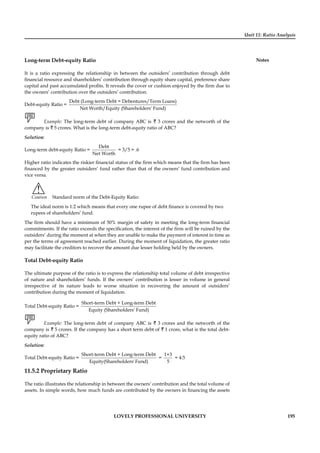
(B.Com Madras, April 1980)
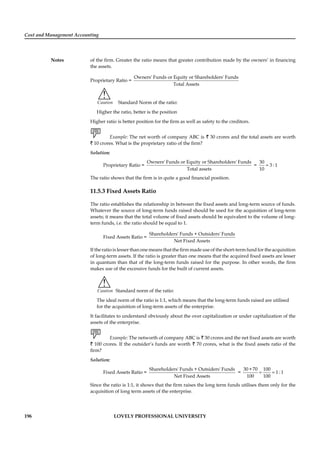
5. Debtors velocity 3 months
Creditors velocity 2 months
Stock velocity 8 times
Capital turnover ratio 2.5 times
Fixed assets turnover ratio 8 times
Gross profit turnover ratio 25%
Gross profit in a year amounts to ` 1,60,000 .There is no long term loan or overdraft .
Reserves and surplus amount to ` 56,000. Liquid assets are ` 1,94,666. Closing stock of the
year is ` 4,000 more than the opening stock Bill receivable amount to ` 10,000 and bills
payable to ` 4,000
(a) Find out
(i) Sales
(ii) Closing stock
Unit 11: Ratio Analysis
Notes
LOVELY PROFESSIONAL UNIVERSITY 205
(iii) Sundry debtors
(iv) Fixed assets
(v) Sundry creditors
(vi) Proprietors’ fund.
(b) Draft the balance sheet with as many as details as possible.
6. You have been hired as an analyst for Mellon Bank and your team is working on an
independent assessment of Daffy Duck Food In(c) (DDF In(c)) DDF In(c) is a firm that
specializes in the production of freshly imported farm products from France. Your assistant
has provided you with the following data for Flipper Inc. and their industry.
Ratio 2001 2002 2003 2005-Industry Average
Long-term debt 0.45 0.40 0.35 0.35
Inventory Turnover 62.65 42.42 32.25 53.25
Depreciation/Total Assets 0.25 0.014 0.018 0.015
Days’ sales in receivables 113 98 94 130.25
Debt to Equity 0.75 0.85 0.90 0.88
Profit Margin 0.082 0.07 0.06 0.075
Total Asset Turnover 0.54 0.65 0.70 0.40
Quick Ratio 1.028 1.03 1.029 1.031
Current Ratio 1.33 1.21 1.15 1.25
Times Interest Earned 0.9 4.375 4.45 4.65
Equity Multiplier 1.75 1.85 1.90 1.88
In the annual report to the shareholders, the CEO of Flipper Inc wrote, “2003 was a good
year for the firm with respect to our ability to meet our short-term obligations. We had
higher liquidity largely due to an increase in highly liquid current assets (cash, account
receivables and short-term marketable securities).” Is the CEO correct? Explain and use
only relevant information in your analysis.
7. In the above question, what will you say when you are asked to provide the shareholders
with an assessment of the firm’s solvency and leverage. Be as complete as possible given
the above information, but do not use any irrelevant information.
8. Firm A has a Return on Equity (ROE) equal to 24%, while firm B has an ROE of 15% during
the same year. Both firms have a total debt ratio (D/V) equal to 0.8. Firm A has an asset
turnover ratio of 0.9, while firm B has an asset turnover ratio equal to 0.4. What can we
analyse about the relationship between both the firms?
9. If a firm has ` 1,00,000 in inventories, a current ratio equal to 1.2, and a quick ratio equal to
1.1, what is the firm’s Net Working Capital?
10. What can you say about the asset management of the firm discussed in question 6?
Be as complete as possible given the above information, but do not use any irrelevant
information.
11. The data summarised in the table below show the performance of two firms A and B, over
five years.
Cost and Management Accounting
Notes
206 LOVELY PROFESSIONAL UNIVERSITY
(a) Using the information in the table explain the comparative attractiveness of the two
firms to a potential investor.
(b) Why is it important that potential investors should be aware of the ratio of ordinary
share capital to other forms of long-term finance?
Answers: Self Assessment
1. financial statement 2. quantitative
3. capital structure 4. profitability
5. current assets 6. Closing Stock
7. super quick assets 8. False
9. False 10. True
11. (d) 12. (d)
13. (c) 14. earning capacity
15. cost of goods sold 16. capital employed
11.10 Further Readings
Books B.M. Lall Nigam and I.C. Jain, Cost Accounting, Prentice-Hall of India (P) Ltd.
Hilton, Maher and Selto, Cost Management, 2nd Edition, Tata McGraw-Hill
Publishing Company Ltd.
M.N. Arora, Cost and Management Accounting, 8th Edition, Vikas Publishing House
(P) Ltd.
M.P. Pandikumar, Management Accounting, Excel Books.
Online links www.authorstream.com
www.allinterview.com
Unit 12: Fund Flow Analysis
Notes
LOVELY PROFESSIONAL UNIVERSITY 207
Unit 12: Fund Flow Analysis
CONTENTS
Objectives
Introduction
12.1 Meaning of Fund Flow Statement
12.2 Preparation of Statement of Changes in Working Capital
12.3 Preparing Funds from Operations
12.3.1 Net Profit Method
12.3.2 Sales Method
12.4 Preparing Fund Flow Statement
12.5 Summary
12.6 Keywords
12.7 Review Questions
12.8 Further Readings
Objectives
After studying this unit, you will be able to:
Explain the meaning of fund flow analysis
Illustrate the preparation of statement of changes in working capital
Prepare fund flow statement
Introduction
Every business establishment usually prepares the balance sheet at the end of the fiscal year
which highlights the financial position of the yester years. It is subject to change in the volume
of the business not only illustrates the financial structure but also expresses the value of the
applications in the liabilities side and assets side respectively. Normally, Balance sheet reveals
the status of the firm only at the end of the year, not at the beginning of the year. It never discloses
the changes in between the value position of the firm at two different time periods/dates.
The method of portraying the changes on the volume of financial position is the analysis of fund
flow statement.
12.1 Meaning of Fund Flow Statement
In a narrow sense, the term fund means cash, and the fund flow statement depicts the cash
receipts and cash disbursements/payments. It highlights the changes in the cash receipts and
payments as a cash flow statement in addition to the cash balances, i.e. opening cash balance and
closing cash balance. Contrary to the earlier, the fund means working capital, i.e. the differences
between the current assets and current liabilities.
The term flow denotes the change. Flow of funds means the change in funds or in working capital.
The change on the working capital leads to the net changes taken place on the working capital,
Cost and Management Accounting
Notes
208 LOVELY PROFESSIONAL UNIVERSITY
i.e. especially due to either increase or decrease in the working capital. Some of the transactions
may lead to increase or decrease the volume of working capital. Some other transactions register
neither an increase nor decrease in the volume of working capital.
According to Foulke, “A statement of source and application of funds is a technical device
designed to analyse the changes to the financial condition of a business enterprise in between
two dates.”
Various facets of fund flow statement are as follows:
1. Statement of sources and application of funds
2. Statement changes in financial position
3. Analysis of working capital changes and
4. Movement of funds statement
5. Depreciation charged on assets
6. Appropriation of profits to reserves
7. Payment of interim dividends
8. Payment and appropriations in relation to provisions for taxation/dividends where they
are treated as non-current liabilities.
Fund flow statement has following objectives:
1. It pinpoints the mobilization of resources and the further utilization of resources.
2. It highlights the financing of the general expansion of the business firms.
3. It exemplifies the utilization of debt finance in the structure of financing.
4. It portrays the relationship between the financing, investments, liquidity and dividend
decision of the firm during the given point of time.
Note Steps in the Preparation of Fund Flow Statement
1. First and foremost step is to prepare the statement of changes in working capital, i.e.
to identify the flow of fund/movement of fund through the detection of changes in
the volume of working capital.
2. Second step is the preparation of Non-current A/c items-Changes in the volume of
Non-current A/cs have to be prepared only in order to quantify the flow fund i.e.
either sources or application of fund.
3. Third step is the preparation Adjusted Profit & Loss A/c, which already elaborately
discussed in the early part of the unit.
4. Last step is the preparation of fund flow statement.
Self Assessment
Fill in the blanks:
1. The fund flow statement depicts the ........................ receipts and cash disbursements/
payments.
2. Fund flow means a study of ........................ .
Unit 12: Fund Flow Analysis
Notes
LOVELY PROFESSIONAL UNIVERSITY 209
12.2 Preparation of Statement of Changes in Working Capital
The ultimate purpose of preparing the schedule of changes in the working capital illustrates the
changes in the volume of net working capital which envisages either sources or application of
fund. The schedule of changes is focused as follows:
Increase in Current Assets Increase in Working Capital
Decrease in Current Assets Decrease in Working Capital
Increase in Current Liabilities Decrease in Working Capital
Decrease in Current Liabilities Increase in Working Capital
Particulars Previous
Year
Current
Year
Increase in
Working
Capital (+)
Decrease
in Working
Capital (-)
(A) Current Assets:
Cash in Hand
Cash at Bank
Marketable Securities
Bills Receivable
Sundry Debtors
Closing Stock
Prepaid Expenses
(B) Current Liabilities:
Creditors
Bills Payable
Outstanding expenses
Pre received Income
Provision for doubtful and bad debts
Net Working Capital(A-B)
Increase/Decrease Working Capital
Example: From the following details prepare a statement showing changes in working
capital during 2005.
Balance Sheet of Pioneer Ltd
as on 31st December
Liabilities 2004 (`) 2005 (`) Assets 2004 (`) 2005 (`)
Share capital 5,00,000 6,00,000 Fixed assets 10,00,000 11,20,000
Reserves 1,50,000 1,80,000 Less: Depreciation 3,70,000 4,60,000
Profit and Loss A/c 40,000 65,000 6,30,000 6,60,000
Debentures 3,00,000 2,50,000 Stock 2,40,000 3,70,000
Creditors for goods 1,70,000 1,60,000 Book Debts 2,50,000 2,30,000
Provision for tax 60,000 80,000 Cash in hand 80,000 60,000
Preliminary expenses 20,000 15,000
12,20,000 13,35,000 12,20,000 13,35,000
Cost and Management Accounting
Notes
210 LOVELY PROFESSIONAL UNIVERSITY
Solution:
Schedule of Changes in Working Capital
2004 2005 Increase in
Working Capital
Decrease in
Working Capital
Current Asset:
Stock 2,40,000 3,70,000 1,30,000 —
Book debts 2,50,000 2,30,000 — 20,000
Cash in hand 80,000 60,000 — 20,000
5,70,000 6,60,000 1,30,000 40,000
Current liabilities:
Creditors for goods 1,70,000 1,60,000 10,000 —
Working capital 4,00,000 5,00,000 1,40,000 40,000
Increase in working capital 1,00,000 — — 1,00,000
5,00,000 5,00,000 1,40,000 1,40,000
Self Assessment
State whether the following statements are true or false:
3. Normally, working capital means current assets.
4. Increase in current assets means increase in working capital.
5. Purchase of plant and machinery ` 10 lakh through the issue of 1 Lakh shares at ` 10 per
share; affect the non-current asset and current liabilities accounts.
6. XYZ Ltd. has made a credit purchase of ` 1 lakh worth of goods led to ` 1 lakh worth
of additional stock of tradable goods for the enterprise, leads to increase in the working
capital.
12.3 Preparing Funds from Operations
The following are the key methods of preparing fund from operations:
Net Profit Method
Sales Method
Figure 12.1 Methods of Funds from Operations
Method of Fund from
Operations
Net Profit Method
Add: Non-operating Expenses
Less: Non-operating Incomes
Sales Method
Less: Payments (Application)
!
Caution The first method is widely used method by all in determining the volume of
Fund from Operations (FFO).
Unit 12: Fund Flow Analysis
Notes
LOVELY PROFESSIONAL UNIVERSITY 211
12.3.1 Net Profit Method
Under the Net Profit Method, fund flow from operations can be computed. Under this method,
fund from operations can be determined in two different ways The first method is through the
statement format
Net Profit from the Profit & Loss A/c xxxxx
Add:
(A) Non-funding Expenses:
Loss on Sale of Fixed Assets xxxx
Loss on Sale of Long-term Investments xxxx
Loss on Redemption Debentures/Preference Shares xxxx
Discount on Debentures/Share xxxx
(B) Non-operating Expenses:
Depreciation of Fixed Assets xxxx
(C) Intangible Assets:
Amortization of Goodwill xxxx
Amortization of Patent xxxx
Amortization of Trade Mark xxxx
(D) Fictitious Assets:
Writing off Preliminary Expense xxxx
Writing off Discount on Shares/Debentures xxxx
(E) Profit Appropriation:
Transfer to General Reserve xxxx
Less:
(F) Non-funding Profits:
Profit on Sale of Fixed Assets xxxx
Profit on Sale of Long-term Investments xxxx
Profit on Redemption Debentures/Preference Shares xxxx
(G) Non-operating Incomes:
Dividend Received xxxx
Interest Received xxxx
Rent Received xxxx
Fund From Operations/Fund Lost in Operations xxxxx
The second method of determining the fund from operations under the first classification is the
Accounting Statement Format
Adjusted Profit & Loss A/c
Dr Cr
To Depreciation xxxx By Opening Balance Profit xxxx
To Goodwill Written off xxxx By Profit on Sale of Fixed Assets xxxx
To Patent Written off xxxx By Profit on Sale of Investments xxxx
To Loss on Sale of Fixed Asset xxxx By Profit on Redemption of Liability xxxx
To Loss on Sale of Investment xxxx By Transfer from General Reserve xxxx
To Loss on Redemption of Liability xxxx By Balancing Figure fund from Operations
(FFO)
xxxx
Contd...
Cost and Management Accounting
Notes
212 LOVELY PROFESSIONAL UNIVERSITY
To Preliminary Expenses off xxxx
To Proposed Dividend xxxx
To Transfer to General Reserve xxxx
To Current Year Provision for Taxation xxxx
To Current Year Provision for Depreciation xxxx
To Balancing Figure
(Fund Lost in Operations) xxxx
12.3.2 Sales Method
Under this method, the following is the statement format is used to arrive fund flow from
operations.
Sources:
Sales xxxxx
Stock at the end xxxxx
Less:
Application:
Stock at Opening xxxx
Net Purchases(Purchase-Returns) xxxx
Wages xxxx
Salaries xxxx
Telephone expenses xxxx
Electricity charges xxxx
Office stationery expenses xxxx
Other operating cash expenses xxxx
Fund from Operations xxxx
Example: From the following details calculate funds from operations:
`
Salaries 10,000
Rent 6,000
Refund of Tax 6,000
Profit on Sale of Building 10,000
Depreciation on Plant 10,000
Provision for Taxation 8,000
Loss on Sale of Plant 4,000
Closing Balance of Profit & Loss A/c 1,20,000
Opening Balance on Profit & Loss A/c 50,000
Discount on Issue of Debentures 4,000
Unit 12: Fund Flow Analysis
Notes
LOVELY PROFESSIONAL UNIVERSITY 213
Provision for Bad Debts 2,000
Transfer to General Reserve 2,000
Preliminary Expenses written off 6,000
Goodwill written off 4,000
Dividend Received 10,000
Proposed Dividend 12,000
Solution:
Calculation of Fund From Operation
First Method
Closing Balance of Profit & Loss A/c 1,20,000
Less: Opening Balance 50,000
Balance Forward 70,000
Add: Non-fund/Non-operating Charges
Depreciation on Plant 10,000
Provision for Taxation 8,000
Loss on Sale of Plant 4,000
Discount on Issue of Debentures 4,000
Provision for Bad Debts 2,000
Transfer to General Reserve 2,000
Preliminary Expenses off 6,000
Goodwill Written off 4,000
Proposed Dividend 12,000
1,22,000
Less: Refund of Tax 6,000
Profit on Sale of Building 10,000
Dividend Received 10,000
Fund from Operations 96,000
Second Method:
Adjusted Profit & Loss A/c
To Depreciation on Plant 10,000 By Opening Balance b/d 50,000
To Provision for Taxation 8,000 By Profit on Sale of Building 10,000
To Loss on Sale of Plant 4,000 By Dividend Received 10,000
To Discount on issue of debentures 4,000 By Refund of Tax 6,000
To Provision for bad debts 2,000 By Balancing Figure 96,000
To Transfer to general reserve 2,000 Fund from Operations
To Preliminary expenses off 6,000
To Goodwill written off 4,000
Contd...
Cost and Management Accounting
Notes
214 LOVELY PROFESSIONAL UNIVERSITY
To Proposed Dividend 12,000
To Closing Profit c/d 1,20,000
1,72,000 1,72,000
Task Discuss any non-current account transactions affecting the fund position of a firm
of your choice.
Self Assessment
Choose the appropriate answer
7. Adjusted profit and loss account is prepared for
(a) Determining the fund from operations
(b) Determining the fund lost in operations
(c) Either (a) or (b)
(d) None of the above
8. Fund flow statement is categorized into two parts
(a) Fund inflow and Fund outflow
(b) Cash inflow and Cash outflow
(c) Sources and Applications
(d) None of the above
9. Fund from operations is
(a) Sources of the firm
(b) Applications of the firm
(c) Neither sources nor applications
(d) None of the above
12.4 Preparing Fund Flow Statement
The next step is to prepare the fund flow statement. The proforma of the fund flow statement:
Sources of Funds Uses of Funds
Funds from Business Operation
Non-trading Incomes
Sale of Non-current Assets
Sale of Long-term Investments
Issue of Shares
Acceptance of Deposits
Long-term Borrowings
Decrease in Working Capital
Funds Lost in Operations
Redemption of Preference Share Capital
Repayment of Loans
Purchase of Long-term Investments
Purchase of Fixed Assets
Payment of Taxes
Payment of Dividends
Drawings
Loss of Cash
Increase in Working Capital
Unit 12: Fund Flow Analysis
Notes
LOVELY PROFESSIONAL UNIVERSITY 215
Example: From the following relating to Panasonic Ltd., prepare funds flow statement.
Balance Sheet of Panasonic Ltd.
as on 31st December
Liabilities 2004 (`) 2005 (`) Assets 2004 (`) 2005 (`)
Share capital 6,00,000 8,00,000 Fixed assets 3,80,000 4,20,000
Reserves 2,00,000 1,00,000 Accounts receivable 2,10,000 3,00,000
Retained earnings 60,000 1,20,000 Stock 3,00,000 3,90,000
Accounts payable 90,000 2,70,000 Cash 60,000 1,80,000
9,50,000 12,90,000 9,50,000 12,90,000
Additional Information:
1. The company issued bonus shares for ` 1,00,000 and for cash ` 1,00,000.
2. Depreciation written off during the year ` 30,000.
Solution:
The first step is prepare the statement of changes in working capital
Schedule of Changes in Working Capital
2004 2005 Increase in
Working Capital
Decrease in
Working Capital
Current Asset:
Cash 60,000 1,80,000 1,20,000 —
Stock in trade 3,00,000 3,90,000 90,000 —
Accounts receivable 2,10,000 3,00,000 90,000 —
5,70,000 8,70,000
Current Liabilities:
Accounts payable 90,000 2,70,000 1,80,000
Working capital 4,80,000 6,00,000 3,00,000 1,80,000
Increase in working capital 1,20,000 1,20,000
6,00,000 6,00,000 3,00,000 3,00,000
The next step is to prepare the non-current account.
First non-current asset account should have to be prepared.
Dr Fixed Assets A/c Cr
Particulars `` Particulars ``
To Balance b/d 3,80,000 By Depreciation (Adjusted Profit &
Loss A/c )
30,000
To Cash (Purchase) Balancing fig. 70,000 By Balance c/d 4,20,000
4,50,000 4,50,000
Cost and Management Accounting
Notes
216 LOVELY PROFESSIONAL UNIVERSITY
The next non-current account is that non-current liability which is nothing but Share capital
Dr Share Capital A/c Cr
Particulars `` Particulars ``
To Balance c/d 8,00,000 By Cash (Issue of shares) 1,00,000
By General reserve 1,00,000
By Balance b/d 6,00,000
8,00,000 8,00,000
And another non-current account is to be prepared that general reserve account.
Dr General Reserve A/c Cr
Particulars `` Particulars ``
To Share capital 1,00,000 By Balance b/d 2,00,000
To Balance c/d 1,00,000
2,00,000 2,00,000
The next step is to prepare the Adjusted Profit & Loss A/c.
Dr Adjusted Profit & Loss A/c Cr
Particulars `` Particulars ``
To (Fixed Assets ) By Balance b/d (Retained Earnings) 60,000
depreciation 30,000
To Balance c/d 1,20,000 By Fund from operation Balancing fig.. 90,000
1,50,000 1,50,000
The next step is to prepare the fund flow statement of the enterprise.
Fund Flow Statement
Sources `` Applications ``
Issue of Shares 1,00,000 Purchase of Land 70,000
Funds from operation 90,000 Increase in working capital 1,20,000
1,90,000 1,90,000
Example: Balance sheets of M/s Black and White as on 1-1-2006 and 31-12-2006 were as
follows:
Balance sheet
Liabilities 1-1-2006 ` 31-12-2006 ` Assets 1-1-2006 ` 31-12-2006 `
Creditors 40,000 44,000 Cash 10,000 7,000
Mrs. Whites’ Loan 25,000 - Debtors 30,000 50,000
Loan from P.N. Bank 40,000 50,000 Stock 35,000 25,000
Capital 1,25,000 1,53,000 Machinery 80,000 55,000
Land 40,000 50,000
Building 35,000 60,000
2,30,000 2,47,000 2,30,000 2,47,000
Unit 12: Fund Flow Analysis
Notes
LOVELY PROFESSIONAL UNIVERSITY 217
Additional Information:
During the year, machine costing ` 10,000 (accumulated depreciation ` 3,000) was sold for
` 5,000. The provision for depreciation against machinery as on 1-1-2006 was ` 25,000 and on
31-12-2006 ` 40,000. Net profit for the year 2006 amounted to ` 45,000. You are required to
prepare funds flow statement. (M.Com MKU, April 1980).
The very first step is to prepare the statement of changes in working capital.
Changes in working capital between the various current assets and current liabilities are as
follows:
Current assets:
Cash
Debtors
Stock
Current liabilities:
Sundry creditors
Statement of changes in working capital
1-1-2006 ` 31-12-2006 ` Increase in
Working capital
Decrease in
Working capital
Current Asset:
Cash 10,000 7,000 ----------- 3,000
Debtors 30,000 50,000 20,000 ----------
Stock 35,000 25,000 --------- 10,000
75,000 82,000
Current Liability:
Sundry creditors 40,000 44,000 ----------- 4,000
Working capital 35,000 38,000 20,000 17,000
Increase in working capital 3,000 3,000
38,000 38,000 20,000 20,000
The next step is to determine the cost of the machinery before the charge of depreciation i.e. to
find out the Gross value of the assets. In other, words, original cost of the assets to be found out
at the moment of purchase.
1-1-2006 31-12-2006
Written down value of the machinery extracted from the
balance sheet as on dated
` 80,000 ` 55,000
Add: Accumulated depreciation or
Provision for depreciation 25,000 40,000
Original Cost of Machinery 1,05,000 95,000
The ultimate aim is to find out the original cost of the machinery for the preparation of the
machinery account.
Before preparing the Machinery account, the worth of the sale transaction of the machinery
should be found out.
Cost and Management Accounting
Notes
218 LOVELY PROFESSIONAL UNIVERSITY
Original cost of the Machinery ` 10,000
(-) Depreciation ` 3,000
Machinery worth for sale ` 7,000
(-) Machinery sold ` 5,000
Loss on sale of the portion of the machinery sold ` 2,000
The entry for the loss on sale of machinery sold
Loss on sale a/c Dr ` 2,000
To Machinery a/c ` 2,000
The next entry is for the adjusted profit and loss account.
Adjusted Profit & Loss A/c Dr ` 2,000
To Loss on sale a/c ` 2,000
Dr Machinery A/c Cr
Particulars `` Particulars ``
To Balance B/d 1,05,000 By Cash (Sales) 5,000
By Provision for Depreciation 3,000
By loss on sale(Adjusted profit and
loss account)
2,000
By Balance c/d 95,000
1,05,000 1,05,000
The next one is the provision for depreciation account or accumulated depreciation account.
Dr Provision for Depreciation A/c Cr
Particulars `` Particulars ``
To Machinery A/c 3,000 By Balance B/d 25,000
To Balance c/d 40,000 By depreciation provided during the
current year
18,000
43,000 43,000
The next non-current liability account to be prepared is that capital account.
In the additional information net profit for the year 2006 ` 45,000 is given.
Net profit is transferred to capital account.
Why the net profit is transferred to capital account?
Income earned in the form of net profit should be added to the capital account.
Net profit A/c Dr ` 45,000
To Capital A/c ` 45,000
Dr Capital A/c Cr
Particulars ` Particulars `
To Drawings (Balancing fig.) 17,000 By Balance B/d 1,25,000
To Balance c/d 1,53,000 By Net profit 45,000
1,70,000 1,70,000
Unit 12: Fund Flow Analysis
Notes
LOVELY PROFESSIONAL UNIVERSITY 219
At the end of the year, the total volume of the capital should be equivalent to ` 1,70,000 but it
amounts ` 1,53,000. It is only due to the personal drawings of the owner of the enterprise.
The next non-current liability account is loan from P.N.B Bank.
The closing volume of the loan is more than the opening balance of loan; it means that the
firm has recently borrowed an amount of ` 10,000 in addition to opening balance of the loan
borrowings.
While borrowing, what happens in the firm?
Debit what comes in - Cash resources are coming inside the business.
Credit the giver/liabilities - Register the name of the banker who is nothing but the giver of the
loan.
Dr Loan P.N. Bank A/c Cr
Particulars ` Particulars `
By Balance B/d 40,000
To Balance c/d 50,000 By Cash (Balancing fig) 10,000
50,000 50,000
The next non-current liability is Mr.White’s loan amount of ` 25,000.
The opening balance of the loan amount is greater than the closing balance which amounted to
` 25,000; it means that the initial loan amount was paid during the year.
Dr Mr. White’s A/c Cr
Particulars ` Particulars `
To Cash (Loan paid) 25,000 By Balance B/d 25,000
To Balance c/d -----------
25,000 25,000
While repaying the loan amount, what happens in the firm?
The name of the party that receives the amount of loan repayment should be mentioned.
Debit the receiver - Cash resources are going out of the firm during the moment of making the
repayment of the loan. Credit what goes out of the firm.
The closing balances of the land and building are greater than the opening balances: this means
that additional land and building was procured by the firm for its future prospects.
The purchase of the land & building leads to applications -outflow of fund
The next step is to prepare the Adjusted Profit & Loss Account.
Adjusted Profit & Loss Account
Particulars ` Particulars `
To Machinery (Loss on sale) 2,000 By Balance B/d -----------
To Provision for Depreciation 18,000 By fund from operations 65,000
To Balance c/d (Net profit) 45,000
65,000 65,000
The next step is to prepare the fund flow statement.
Cost and Management Accounting
Notes
220 LOVELY PROFESSIONAL UNIVERSITY
Fund Flow Statement
Sources `` Applications ``
Sale of machinery 5,000 Purchase of land 10,000
Loan from P.N.Bank 10,000 Purchase of Building 25,000
Fund from operation 65,000 Drawings 17,000
Repayment of Mr. White Loan 25,000
Increase in working capital 3,000
80,000 80,000
Self Assessment
Choose the appropriate answer
10. The meaning of the “To cash ( Tax paid)” entry posted in the Provision for taxation account
is
(a) Last year taxation is paid through the current year provision
(b) Current year taxation is paid through the current year provision
(c) Last year tax is paid through the last year taxation
(d) Current year taxation is paid through the last year provision
11. Profit on sale of the fixed assets are considered to be
(a) Resource to the enterprise
(b) Non-operating income
(c) Application of the enterprise
(d) None of the above
12. The treatment of current year depreciation with the closing balance of profit in determining
the fund from operations
(a) To be added
(b) To be multiplied
(c) To be deducted
(d) To be divided
13. The redemption bank term loan leads to change in the
(a) Non-current liability account and current asset account
(b) Current asset account and current liabilities account
(c) Non-current asset account and current liabilities account
(d) Non-current asset account and current liabilities account
14. Flow of funds means the change in
(a) funds
(b) working capital
(c) either
(d) both
Unit 12: Fund Flow Analysis
Notes
LOVELY PROFESSIONAL UNIVERSITY 221
15. Which of the following is not an objectives fund-flow analysis?
(a) It pinpoints the mobilization of resources and the further utilization of resources
(b) It highlights the financing of the general expansion of the business firms
(c) It exemplifies the utilization of debt finance in the structure of financing
(d) None of these.
16. Which of the following is not a source of fund?
(a) Purchase of Long-term Investments
(b) Acceptance of deposits
(c) Sale of Non-current Assets
(d) Decrease in Working Capital
12.5 Summary
Fund flow statements summarize a firm’s inflow and outflow of funds.
Simply put, it tells investors where funds have come from and where funds have gone.
The statements are often used to determine whether companies efficiently source and
utilize funds available to them.
Fund flow statements are prepared by taking the balance sheets for two dates representing
the coverage period.
The increases and decreases must then be calculated for each item. Finally, the changes are
classified under four categories: (1) Long-term sources, (2) Long-term uses, (3) Short-term
sources, and (4) Short-term uses.
It is also important to zero out the non-fund based adjustments in order to capture only the
changes that are accompanies by flow of funds.
However, income accrued but received and expenses incurred but not received reckoned
in the profit and loss statement should not be excluded from the profit figure for the fund
flow statement.
Fund flow statements can be used to identify a variety of problems in the way a company
operates.
Meanwhile, a company that is using long-term money to finance short-term investments
may not be efficiently utilizing its capital.
12.6 Keywords
Current Assets: Assets which are in the form of cash, equivalent to cash or easily convertible into
cash.
Current Liabilities: Short-term financial resources of the firm.
Decrease in Working Capital: Decrease in Net working capital i.e. Excess of current liabilities
over the current assets – Resources side of the fund flow.
Flow: Flow means changes occurred in between two different time periods.
Fund: Fund means working capital.
Cost and Management Accounting
Notes
222 LOVELY PROFESSIONAL UNIVERSITY
Fund from Operations: Income generated from only operations.
Fund Lost in Operations: Loss incurred in the operations.
Increase in Working Capital: Increase in Net working capital i.e. Excess of current assets over the
current liabilities- Applications side of the fund flow.
Non-current Assets: Long-term assets.
Non-current Liabilities: Long-term financial resources.
Statement of changes in Working Capital: Enlisting the changes taken place in between the
current assets and current liabilities of two different time horizons.
12.7 Review Questions
1. From the following two balance sheet as at December 31, 2004 and 2005. Prepare the
statement of sources and uses of funds.
2004 (`) 2005 (`) 2004 (`) 2005 (`)
Liabilities
Share capital 80,000 90,000
Trade creditors 20,000 46,000
Profit & Loss a/c 4,60,000 5,00,000
Assets
Cash 60,000 94,000
Debtors 2,40,000 2,30,000
Stock in trade 1,60,000 1,80,000
Land 1,00,000 1,32,000
5,60,000 6,36,000 5,60,000 6,36,000
2. Balance sheets of M/s Black and White as on 1-1-2006 and 31-12-2006 were as follows:
Balance Sheet
Liabilities 1-1-2006
(`)
31-12-2006
(`)
Assets 1-1-2006
(`)
31-12-2006
(`)
Creditors 40,000 44,000 Cash 10,000 7,000
Mrs.Whites’Loan 25,000 - Debtors 30,000 50,000
Loan from P.N.Bank 40,000 50,000 Stock 35,000 25,000
Captial 1,25,000 1,53,000 Machinery 80,000 55,000
Land 40,000 50,000
Building 35,000 60,000
2,30,000 2,47,000 2,30,000 2,47,000
Additional Information:
(a) During the year machine costing ` 10,000 (accumulated depreciation ` 3,000) was
sold for ` 5,000.
(b) The provision for depreciation against machinery as on 1-1-2006 was ` 25,000 and on
31-12-2006 ` 40,000.
(c) Net profit for the year 2006 amounted to ` 45,000.
You are required to prepare funds flow statement.
Unit 12: Fund Flow Analysis
Notes
LOVELY PROFESSIONAL UNIVERSITY 223
3. Discuss the various methods of determining the fund from/lost (in) operations.
4. Explain the process of preparing the statement of changes in working capital.
5. Draft the pro forma of the Fund Flow Statement.
6. From the following balance sheets of A Ltd. on 31st Dec. 2008 and 2009, you are required
to prepare Fund flow statement. The following are additional information has also been
given
(a) Depreciation charged on plant was ` 4,000 and on building ` 4,000
(b) Provision for taxation of ` 19,000 was made during the year 2009.
(c) Interim Dividend of ` 8,000 was paid during the year 2009.
Balance Sheet
Liabilities 2008 (`) 2009 (`) Assets 2008 (`) 2009 (`)
Share capital 1,00,000 1,00,000 Good will 12,000 12,000
General Reserve 14,000 18,000 Building 40,000 36,000
Profit & Loss A/c 16,000 13,000 Plant 37,000 36,000
Sundry creditors 8,000 5,400 Investments 10,000 11,000
Bills payable 1,200 800 Stock 30,000 23,400
Provision for taxation 16,000 18,000 Bill receivable 2,000 3,200
Provision for doubtful
debts
400 600 Debtors 18,000 19,000
Cash 6,600 15,200
1,55,600 1,55,800 1,55,600 1,55,800
7. Prepare schedule of changes in Working Capital and Funds Flow Statement from the
following Balance Sheets as on December 31, 2008.
Liabilities 2008
(`)
2009
(`)
Assets 2008
(`)
2009
(`)
Capital 10,000 10,000 Cash 5,600 5,400
Profit & Loss A/c 5,200 15,400 Debtors 3,400 6,600
Long-term Loan 6,000 8,000 Stock 5,400 9,200
Short-term Loan 2,400 2,400 Long-term
Investments
7,000 12,000
Creditors 3,600 3,600 Plant 10,600 9,600
Outstanding Wages 1,400 800 Prepaid
Insurance
400 800
Income Tax
Provision
3,800 3,400
32,400 43,600 32,400 43,600
Plant was sold at its book value, i.e., ` 1,000
8. From the following Balance Sheets, prepare a Schedule of changes in Working Capital and
Funds Flow Statement:
Cost and Management Accounting
Notes
224 LOVELY PROFESSIONAL UNIVERSITY
Liabilities 31.12.07
(`)
31.12.08
(`)
Assets 31.1 2.07
(`)
31.12.08
Capital 4,80,000 5,10,000 Cash at Bank 24,000 54,000
Profit & Loss a/c 8,50,000 10,50,000 Debtors 9,90,000 11,90,000
Creditors 54,000 30,000 Stock 54,000 42,000
Mortgage Loans 28,000 1,00,000 Land 2,00,000 2,00,000
Plant 1,44,000 2,04,000
14,12,000 16,90,000 14,12,000 16,90,0
9. The following is the abstract of balance sheet of Software securities Ltd. for the year 2005
and 2006
Liabilities 2005
(`)
2006
(`)
Assets 2005
(`)
2006
(`)
Provision for
depreciation
108000 396000 Land 26000 81000
Retained earning 244800 370800 Building 60000 360000
9% Debenture 270000 198000 Accumulated
depreciation on building
19800 37800
Account payable 72000 41400 Equipment 122400 347400
Expense payable 0 18000 Accumulated
depreciation on
Equipment
18000 50400
Stock in hand 10800 97200
Account receivable 36000 122400
Cash in hand 66600 97200
Preliminary expenses 10800 7200
The income statement of Software Securities Ltd. is as under
Sales 1602000
less cost of sale 837000
less operating exp. 397800
less interest exp. 21600
loss on sale of equipments 3600
126000
Net income before tax 342000
Provision of tax 117000
Net Income after tax 225000
Additional information:
(a) Operating expenses include depreciation of ` 59400 and charges from preliminary
expenses of ` 3600.
(b) Land was sold at its book value.
(c) Cash dividend paid for the year 2006 amounted to ` 27000 and fully paid bonus
shares were given in the ratio of 2 shares for every 3 shares hel(d).
(d) Interest expenses was paid in cash.
Unit 12: Fund Flow Analysis
Notes
LOVELY PROFESSIONAL UNIVERSITY 225
(e) Equipment with a cost of ` 298800 was purchased for cash .Equipment with a cost of
` 73800 (book value ` 64800) was sold for ` 61200.
(f) Debenture for ` 18000 were redeemed for cash and for ` 54000 were redeemed by
converting into equity shares at par value.
(g) Equity shares of ` 162000 were issued for cash at par.
(h) Income tax paid during the year amounted to ` 117000.
Prepare the fund flow statement with both the methods.
10. “Fund flow statements can be used to identify a variety of problems in the way a company
operates.” Illustrate the statement by the help of suitable examples.
Answers: Self Assessment
1. cash 2. working capital change
3. False 4. True
5. False 6. False
7. (c) 8. (a)
9. (a) 10. (a)
11. (b) 12. (a)
13. (a) 14. (d)
15. (d) 16. (a)
12.8 Further Readings
Books B.M. Lall Nigam and I.C. Jain, Cost Accounting, Prentice-Hall of India (P) Ltd.
Hilton, Maher and Selto, Cost Management, 2nd Edition, Tata McGraw-Hill
Publishing Company Ltd.
M.N. Arora, Cost and Management Accounting, 8th Edition, Vikas Publishing House
(P) Ltd.
M.P. Pandikumar, Management Accounting, Excel Books.
Online links www.authorstream.com
www.allinterview.com
Cost and Management Accounting
Notes
226 LOVELY PROFESSIONAL UNIVERSITY
Unit 13: Cash Flow Analysis (As Per AS-3)
CONTENTS
Objectives
Introduction
13.1 Meaning of Cash Flow Statement
13.2 Classification of Cash Flow
13.2.1 Cash Flow from Operating Activities
13.2.2 Cash Flow from Investing Activities
13.2.3 Cash Flow from Financing Activities
13.3 Preparation of Cash Flow Statement
13.4 Summary
13.5 Keywords
13.6 Review Questions
13.7 Further Readings
Objectives
After studying this unit, you will be able to:
Explain the meaning of cash flow statement
Compute the cash flow form operating, investing and financing activity
Prepare cash flow statement as per AS-3
Introduction
Cash is considered one of the vital sources of the firm to meet day to day financial commitments.
The cash is considered to be as most important source of life blood of the business. The day to
day financial commitments are met out only out of the available resources. The cash resources are
availed through two different types of receipts viz. sales, dividends, interests known as regular
receipts and sale of assets, investments known as irregular receipts of the business enterprise.
To have smooth flow of business enterprise, it should have ample cash resources for its operations.
The availability of cash resources is mainly depending on the cash inflows of the enterprises. The
smoothness in operations of the enterprise is obtained through an appropriate matching of cash
inflows and cash outflows.
To have smoothness in the operations of the enterprise, the firm should have an appropriate
volume of cash resources at speedier rate as well as more than the financial commitments of
the firm. This smoothness could be attained by way of an appropriate planning analysis on the
cash resources of the firm. The meaningful analysis is only possible through cash flow statement
analysis which facilitates the firm to identify the possible sources of cash as well as the expenses
and expenditures of the firm.
13.1 Meaning of Cash Flow Statement
The cash flow statement is being prepared on the basis of extracted information of historical
records of the enterprise. Cash flow statements can be prepared for a year, for six months, for
Unit 13: Cash Flow Analysis (As Per AS-3)
Notes
LOVELY PROFESSIONAL UNIVERSITY 227
quarterly and even for monthly. The cash includes not only means that cash in hand but also
cash at bank.
The following are the main motives of preparing the cash flow statement:
1. To identify the causes for the cash balance changes in between two different time periods,
with the help of corresponding two different balance sheets.
2. To enlist the factors of influence on the reduction of cash balance as well as to indicate the
reasons though the profit is earned during the year and vice versa.
Utility of Cash Flow Statement
1. To identify the reasons for the reduction or increase in the cash balances irrespective level
of the profits earned by the firm.
2. It facilitates the management to maintain an appropriate level of cash resources.
3. It guides the management to take futuristic decisions on the prospective demands and
supply of cash resources through projected cash flows.
(a) How much cash resources are required?
(b) How much cash requirements could be internally settled?
(c) How much cash resources are to be raised through external sources?
(d) Which types of instruments are going to be floated for raising the required
resources?
4. It helps the management to understand its capacity at the moment of borrowing for any
further capital budgeting decisions.
5. Itpaveswayforscientificcashmanagementforthefirmthroughmaintenanceofappropriate
cash levels, i.e. optimum level cash of resources.
6. It avoids in holding excessive or inadequate cash resources through proper planning of
cash resources.
7. It moots control through identification of variations occurred in the cash expenses and
expenditures.
Table 13.1: Cash Flow Statement vs Fund Flow Statement
Cash Flow Statement Fund Flow Statement
Cash inflow and outflow are only considered Increase or decrease in the working capital is registered
Causes & changes of cash position Causes & changes of working capital position
Considers only most liquid assets pertaining to cash
resource; which fosters only for very short span of
planning
Considers in general i.e. current assets; the duration of the
liquidity of the current assets are longer in gestation than
the liquid assets; which paves way for long span of
planning
Opening and closing balances of cash resources are
considered for the preparation
Increase or decrease of working capital is considered but
not the opening and closing balance for preparation
The flow in the statement means real cash flow The flow in the statement need not be real cash flow
Self Assessment
Fill in the blanks:
1. The cash flow statement is being prepared on the basis of extracted information of
...................... of the enterprise.
Cost and Management Accounting
Notes
228 LOVELY PROFESSIONAL UNIVERSITY
2. The ...................... are availed through two different types of receipts viz. sales, dividends,
interests known as regular receipts and sale of assets, investments known as irregular
receipts of the business enterprise.
3. The cash includes not only means that cash in hand but also ...................... .
13.2 Classification of Cash Flow
As per AS-3 (revised) the cash flow statement is prepared in a manner reporting the cash flows
into following categories:
13.2.1 Cash Flow from Operating Activities
Cash flows from operating activities are earned from the principal revenue - producing activities
of an enterprise. Through these activities the net profit or loss of the business is also determined.
Examples of such a flow from operating activities are given in AS-3 (revised) as follows:
1. Cash receipts from the sale of goods and rendering of services;
2. Cash receipts from royalties, fees, commissions and other revenue;
3. Cash payments to suppliers for goods and services;
4. Cash payments to and on behalf of employees;
5. Cash receipts and cash payments of an insurance enterprise for premiums and claims,
annuities and other policy benefits;
6. Cash payments or refunds of income taxes unless they can be specifically identified with
financing and investing activities, and
7. Cash receipts and payments relating to future contracts, forward contracts, option contracts
and swap contracts when the contracts are held for dealing or trading purposes.
!
Caution Some transactions, such as the sale of an item of plant, may give rise to a gain or
loss which is included in the determination of net profit or loss. However, the cash flows
relating to such transactions are cash flows from investing activities.
Figure 13.1: Diagrammatic Presentation of Cash Flows from Operating Activities
Cash Flows
Cash Inflows
Cash Outflows
Cash Sales Receipts Receipts Refund of Receipts
from from Tax from
Debtors Royalties Future
Fees, Commission Contracts
and Others
Cash Payment Payment Payment Payment
Purchases of of of of
Salaries Tax Contracts Creditors
Unit 13: Cash Flow Analysis (As Per AS-3)
Notes
LOVELY PROFESSIONAL UNIVERSITY 229
13.2.2 Cash Flow from Investing Activities
Investing activities of an enterprise include the purchase of fixed assets (as plant and machinery,
land and buildings, furniture and fixtures) with an intention to generate the future incomes.
On account of being an important activity, a separate disclosure of the cash flows from these
activities is made. Examples of cash flows arising from investing activities are in AS-3 (revised)
as follows:
1. Cash payments of acquired fixed assets (including intangibles). These payments include
those relating to capitalized research and development costs and self-constructed fixed
assets;
2. Cash receipts from disposal of fixed assets (including intangibles);
3. Cash payments to acquired shares, warrants or debt instruments of other enterprises and
interests in joint ventures (other than payments for those instruments considered to be cash
equivalents and those held for dealing or trading purposes);
4. Cash receipts from disposal of shares, warrants or debt instruments of other enterprises
and interests in joint ventures (other than receipts from those instruments considered to be
cash equivalents and those held for dealing or trading purposes);
5. Cash advances and loans made to third parties (other than advances and loans made by a
financial enterprise);
6. Cash receipts from the repayment of advances and loans made to third parties (other than
advances and loans of a financial enterprise);
7. Cash payments for future contracts, forward contracts, option contracts and swap contracts
except when the contracts are held for dealing or trading purposes, or the payments are
classified as financing activities; and
8. Cash receipts from future contracts, forward contracts, option contracts and swap contracts
except when the contracts are held for dealing or trading purposes, or the receipts are
classified as financing activities.
Did u know? When a contract is accounted for as a hedge of an identifiable position, the
cash flows of the contract are classified in the same manner as the cash flows of the position
being hedged.
Figure 13.2: Diagrammatic Presentation of Cash Flow from Investing Activities
Cash Flow
Cash Inflow Cash Outflow
Disposal Disposal Receipts Receipts
of Fixed of Shares of Repayment from Future
Assets & Warrants of Advances Contracts
& Loans
Purchase of Purchase of Advances & Payment to
Fixed Assets Shares, Loans to Future
Warrants Third Parties Contracts
Cost and Management Accounting
Notes
230 LOVELY PROFESSIONAL UNIVERSITY
13.2.3 Cash Flow from Financing Activities
Under financial activities those activities are included which are relating to the size and
composition of capital (equity and preferences) and borrowing or loans. As per AS-3 (revised), the
separate disclosure of cash flows arising from financing activities is important because it is useful
in predicting claims on future cash flows by providers of funds (both capital and borrowings) to
the enterprise. Examples of cash flows arising from financing activities are:
1. Cash proceeds from issuing shares or other similar instruments;
2. Cash proceeds from issuing debentures, loans, notes, bonds and other short or long-term
borrowings; and
3. Cash repayments of amounts borrowed.
Figure 13.3: Diagrammatic Presentation of Cash Flow from Financing Activities
Cash Flow
Cash Inflow Cash Outflow
Issue of Shares Issue of Debentures Raising of
(equity & preference long-term loans
loan, bonds, etc.)
Redemption of Repayment of Payment of Payment of
preferencesh ares loans interest dividend sand bonds
Note Treatment of Other Items
Besides the above cash flow activities AS-3 (revised) also give the dealing of the some other
items. These other items are as follows:
1. Foreign Currency Cash Flow: Unrealized gain or loss on account of change in the
foreign exchange rate is not treated as cash flow. But the effect of change of foreign
exchange on the cash and cash equivalents held in a foreign currency is recorded in
the cash flow statement to reconcile the cash and cash equivalents at the beginning
and at the end of the period. This amount is not adjusted with operating, investing
and financing activities but it is shown separately.
2. Extra-ordinary Items: Cash flow arising from the extra-ordinary item is shown in
the cash flow statement after classifying it into operating, investing and financing
activities. This is done so that ordinary users may understand them easily. For
example, loss by fire in store is compensated by insurance company. It will be treated
as cash flow from operating activities.
3. Interest and Dividends: If a financial enterprise is receiving interest and dividend
then such a cash flow arising from interest and dividend will be considered into
operating activities. If interest and dividend are received by other enterprise, such
a cash flow arising from interest and dividend will be considered into investing
activities and if interest and dividend is paid, such a cash flow arising from interest
Contd...
Unit 13: Cash Flow Analysis (As Per AS-3)
Notes
LOVELY PROFESSIONAL UNIVERSITY 231
and dividend is considered into financing activities. This cash flow arising from
interest and dividend paid or received is disclosed separately.
4. Taxes on Income: If no adverse information is given relating to taxes paid on incomes,
cash flow arising from the taxes paid as income is classified in operating activities.
If taxes are paid on such income which is relating to finance, such a cash flow will be
classified into financial activities.
5. Non-cash Transactions: The non-cash transactions are not recorded in cash flow
statement because they do not have a direct impact on the current cash flow while
they affect the capital and assets as purchase of fixed assets by the issue of shares or
debentures. In AS-3 (revised) examples of non-cash transactions are mentioned as
below:
(a) The acquisition of assets by assuming directly related liabilities,
(b) The acquisition of an enterprise by means of issue of shares, and
(c) The conversion of debt to equity
6. Balances of Foreign Branches: In some situations, the balance of cash and cash
equivalent held with foreign branches are not available due to foreign exchange
control or other legal restrictions. So the management should use that amount which
can be measured in cash and cash equivalent.
Self Assessment
Fill in the blanks:
4. Cash flows from ..................... activities are earned from the principal revenue - producing
activities of an enterprise.
5. ..................... activities of an enterprise include the purchase of fixed assets.
6. Cash proceeds from issuing shares or other similar instruments are the examples of cash
flow from ..................... activities.
7. The ..................... are not recorded in cash flow statement because they do not have a direct
impact on the current cash flow while they affect the capital and assets as purchase of fixed
assets by the issue of shares or debentures.
8. Cash flow arising from the ..................... is shown in the cash flow statement after classifying
it into operating, investing and financing activities.
13.3 Preparation of Cash Flow Statement
Cash flow statement provides information about the cash receipts and payments of an enterprises
for a given period. It provides important information that supplements the profit and loss account
and balance sheet.
The statement of cash flows is required to be reported by Accounting Standard-3 (Revised ) issued
by the Institute of Chartered Accountants of India in March 1997 Which replaces the ‘Changes in
Financial Position’ as per AS-3.
There are certain changes in the preparation of cash flow statement from the previous methods
as a result of the introduction of AS-3 (Revised).
Cost and Management Accounting
Notes
232 LOVELY PROFESSIONAL UNIVERSITY
AS-3 (Revised) is mandatory in nature in respect of accounting periods commencing on or after
1-4-2001 for the following:
1. Enterprises whose equity or debt securities are listed on a recognised stock exchange in
India, and enterprises that are in the process of issuing equity or debt securities that will
be listed on a recognised stock exchange in India as evidenced by the board of directors’
resolution in this regard.
2. All other commercial, industrial and business reporting enterprises, whose turnover for
the accounting period exceeds ` 50 crores.
There are two methods of converting net profit into net cash flows from operating activities:
(i) Direct method, and
(ii) Indirect method.
Direct Method
Under direct method, cash receipts from operating revenues and cash payments for operating
expenses are arranged and presented in the cash flow statement. The difference between cash
receipts and cash payments is the net cash flow from operating activities. It is in effect a cash
basis profit & loss account. In this case, each cash transaction is analysed separately and the total
cash receipts and payments for the period are determined. The summarised data for revenue
and expenses can be obtained from the financial statements and additional information. We may
convert accrual basis of revenue and expenses to equivalent cash receipts and payments. Make
sure that a uniform procedure is adopted for converting accrual base items to cash base items.
The following are some examples of usual cash receipts and cash payments resulting from
operating activities:
1. Cash sales of goods and services;
2. Cash collected from debtors (customers);
3. Cash receipts of interest or dividends;
4. Cash receipts of royalties, fees, commission and other revenues;
5. Cash payments to suppliers (creditors);
6. Cash payments for various operating expenses, i.e., rent, rates, power, etc.
7. Cash payments for wages and salaries to employees;
8. Cash payments for income tax, etc.
Indirect Method
In this method, the net profit (loss) is used as the base and converted to net cash provided by
(used in) operating activities. The indirect method adjusts net profit for items that affected net
profit but did not affect cash. Non-cash and non-operating charges in the profit & loss account are
added back to the net profit, while non-cash and non-operating credits are deducted to calculate
operating profit before working capital changes. It is a partial conversion of accrual basis profit
to cash basis profit. Necessary adjustment are made for increase/decrease in current assets and
current liabilities to obtain net cash from operating activities.
Unit 13: Cash Flow Analysis (As Per AS-3)
Notes
LOVELY PROFESSIONAL UNIVERSITY 233
Format of Cash Flow Statement
1. Cash Flow Statement (Direct Method)
Cash Flow Statement (Direct Method)
(`)
Cash Flows from Operating Activities
Cash receipts from customers (xxx)
Cash paid to suppliers and employees xxx
Cash generated from operations (xxx)
Income-tax paid xxx
Cash flow before extraordinary items xxx
Proceeds from earthquake disaster settlement, etc. xxx
Net cash flow from operating activities (a) xxx
Cash flows from Investing Activities
Purchase of fixed assets (xxx)
Proceeds from sale of equipment xxx
Interest received xxx
Dividend received xxx
Net cash flow from investing activities xxx
Cash flows from Financing Activities
Proceeds from issuance of share capital xxx
Proceeds from long-term borrowings xxx
Repayments of long-term borrowings (xxx)
Interest paid (xxx)
Dividend paid (xxx)
Net Cash flow from financing activities (b) xxx
Net increase (decrease) in cash and cash equivalents during the period (a-b+c) xxx
Cash and cash equivalents at beginning of period xxx
Cash and cash equivalents at end of period xxx
2. Cash flow statement (Indirect method)
Cash flow Statement (Indirect Method) (Accounting Standard-3 (Revised)
Particulars (`)
Cash flow from Operating activities
Net profit before tax and extraordinary items xxx
Adjustments for:
-Depreciation xxx
-Foreign exchange xxx
-Investments xxx
Contd...
Cost and Management Accounting
Notes
234 LOVELY PROFESSIONAL UNIVERSITY
-Gain or loss on sale of fixed assets (xxx)
-Interest/dividend xxx
Operating Profit Before Working Capital Changes xxx
Adjustment for:
-Trade and other receivables xxx
-Inventories (xxx)
-Trade payables xxx
Cash Generated from Operations xxx
-Interest paid (xxx)
-Direct taxes (xxx)
Cash before Extraordinary Items xxx
Deferred revenue xxx
Net cashflow from operating activities (a) xxx
Cashflow from Investing activities
Purchase of fixed assets (xxx)
Sale of fixed assets xxx
Sale of investments xxx
Purchase of investments (xxx)
Interest received xxx
Dividend received xxx
Loans to subsidiaries xxx
Net cashflow from investing activities (b) xxx
Cashflow from Financing Activities
Proceeds from issue of share capital xxx
Proceeds from long term borrowings xxx
Repayment to finance/lease liabilities (xxx)
Dividend paid (xxx)
Net cashflow from financing activities (c) xxx
Net Increase (decrease) in cash and cash equivalents during the period (a+b+c) xxx
Cash and cash equivalents at the beginning of the year xxx
Cash and cash equivalents at the end of the year xxx
Note As per the amendment of Clause 32 of the Listing Agreement of SEBI, 1995, all
the listed companies have to prepare and publish their Cash Flow Statement as per the
above formats with their annual financial statements in the reports. SEBI recommends the
indirect method to prepare the cash flow statement.
Unit 13: Cash Flow Analysis (As Per AS-3)
Notes
LOVELY PROFESSIONAL UNIVERSITY 235
Example: From the information as contained in the income statement and the balance
sheet of SLV Ltd., you are required to prepare a cash flow statement using (i) Direct Method and
(ii) Indirect Method.
1. Income Statement and Reconciliation of Earnings for the year ended 31.3.2007
Particulars `
Net Sales 25,20,000
Less: Cost of sales 19,80,000
Depreciation 60,000
Salaries and wages 2,40,000
Operating expenses 80,000
Provision for taxation 88.000 24.48,000
Net operating profit 72,000
Non-recurring income:
Profit on sale of equipment 12.000
84,000
Retained earnings (balance in profit & loss account
brought forward)
1,51,800
2,35,800
Dividend declared and paid during the year 72,000
Profit & Loss account balance as on 31.3.2007 1.63,800
2. Comparative Balance Sheets
Particulars 31.3.2006
`
31.3.2007
`
Fixed assets
Land 48,000 96,000
Building and equipments 3,60,000 5,76,000
Current assets
Cash 60,000 72,000
Debtors 1,68,000 1,86,000
Stock 2,64,000 96,000
Advances 7,800 9,000
9,07,800 10,35,000
Capital 3,60,000 4,44,000
Surplus in profit & loss A/c 1,51,800 1,63,800
Sundry creditors 2,40,000 2.34,000
Outstanding expenses 24,000 48,000
Income tax payable 12,000 13,200
Accumulated depreciation on building and equipments 1,20,000 1,32,000
9,07,800 10,35,000
Cost and Management Accounting
Notes
236 LOVELY PROFESSIONAL UNIVERSITY
Cost of equipment sold was ` 72,000.
Solution:
Direct Method
SLV Limited
Cash Flow Statement for the year ended 31.3.2007
Particulars ` `
Cash Flows from Operating Activities:
Cash receipts from customers 25,02,000
Cash paid to suppliers and employees 21,15,200
Cash generated from operations 3,86,800
Income tax paid (86,800)
Net Cash from Operating Activities 3,00,000
Cash Flows from Investing Activities:
Purchase of land (48,000)
Purchase of building and equipment (2,88,000)
Sale of equipment 36,000
Net Cash used in Investing Activities (3,00,000)
Cash Flows from Financing Activities:
Issue of share capital 84,000
Dividend paid (72,000)
Net Cash from Financing Activities 12,000
Net Increase in Cash and Cash Equivalents 12,000
Cash and Cash Equivalents at the beginning 60,000
Cash and Cash Equivalents at the end 72,000
Working Notes
(i) Cash receipts from customers:
Sales revenue 25,20,000
Add: Debtors at the beginning 1,68,000
26,88,000
Less: Debtors at the end 1,86,000
25,02,000
(ii) Cash paid to suppliers and employees:
Cost of goods sold 19,80,000
Add: Operating expenses 80,000
Salaries and wages 2,40,000
23,00,000
Add: Creditors at the beginning 2,40,000
Stock at the end 96,000
Advances at the end 9,000
Contd...
Unit 13: Cash Flow Analysis (As Per AS-3)
Notes
LOVELY PROFESSIONAL UNIVERSITY 237
Outstanding expenses at the beginning 24,000 3,69,000
26,69,000
Less: Creditors at the end 2,34,000
Stock at the beginning 2,64,000
Advances at the beginning 7,800
Outstanding expenses at the end 48,000 5,53,800
21,15,200
(iii) Income tax paid:
Tax payable at the beginning 12,000
Add: Provision for taxation 88,000
1,00,000
Less: Tax payable at the end 13,200
Tax paid during the year 86,800
(iv) Accumulated depreciation written off on equipments (sold)
Accumulated depreciation at the beginning 1,20,000
Add: Depreciation for the year 60,000
1,80,000
Less: Accumulated depreciation at the end 1,32,000
48.000
(v) Sale price of equipment:
Cost price 72,000
Less: Accumulated depreciation 48,000
24,000
Add: Profit on sale 12,000
36,000
(vi) Purchase of building and equipments:
Balance at the beginning 3,60,000
Less: Cost of equipment sold 72,000
Balance 2,88,000
Balance at the end 5,76,000
Purchased during the year 2,88.000
Indirect Method
SLV Limited
Cash Flow Statement for the year ended 31.3.2007
Particulars Dr. Cr.
Cash Flows from Operating Activities: ` `
Net profit before taxation and extra-ordinary item 1,60,000
Adjustments for:
Depreciation 60,000
Operating profit before working capital changes 2,20,000
Contd...
Cost and Management Accounting
Notes
238 LOVELY PROFESSIONAL UNIVERSITY
Increase in debtors (18,000)
Decrease in stock 1,68,000
Increase in advances (1,200)
Decrease in creditors (6,000)
Increase in outstanding expenses 24,000
Cash generated from operation 3,86,800
Income tax paid (86,800)
Net Cash from Operating Activities 3,00,000
Cash Flows from Investing Activities:
Purchase of land (48,000)
Purchase of building and equipments (2,88,000)
Sale of equipment 36,000
Net Cash Used in Investing Activities (3,00,000)
Cash Flows from Financing Activities:
Issue of share capital 84,000
Dividend paid (72.000)
Net Cash from Financing Activities 12,000
Net Increase in Cash and Cash Equivalents 12,000
Cash and Cash Equivalents at the beginning 60,000
Cash and Cash Equivalents at the end 72.000
Example: From the following balance sheets of Sudhir Ltd., for the year ended 31st
March, 2006 and 2007, prepare a cash flow statement.
Particulars 31.3.2006
`
31.3.2007
`
Assets
Property 2,00,000 2,50,000
Plant and machinery 4,00,000 4,50,000
Less: Depreciation 1.40.000 2,60,000 1.50.000 3,00,000
Loans to subsidiary Co. — 15,000
Share in subsidiary Co. 20,000 20,000
Stock in trade 1,40,000 1,50,000
Debtors 1,00,000 1,50,000
Bank 35,000 1,57,000
7,55,000 10,42,000
Liabilities
Equity Share of ` 20 each 3,00,000 4,00,000
Share premium — 10,000
Profit & Loss appropriation A/c 1,00,000 1,00,000
Profit for the year — 2,00,000
6% Debentures 1,50,000 1,00,000
Profit on Redemption of Debentures — 2,000
Sundry creditors 1,40,000 1,10,000
Provision for taxation 50,000 1,00,000
Proposed dividend 15,000 20,000
7,55,000 10,42,000
Unit 13: Cash Flow Analysis (As Per AS-3)
Notes
LOVELY PROFESSIONAL UNIVERSITY 239
Additional Information:
During the year, plant costing ` 50,000 was sold for ` 10,000. Accumulated depreciation on this
plant was ` 30,000. Loss on sale of plant was charged to profit & Loss account. Income-tax paid
during the year was ` 60,000.
Solution:
Sudhir Limited
Cash Flow Statement for the year ended 31.3.2007
Cash Flows from Operating Activities
Particulars `
Net profit before tax and extraordinary items 2,00,000
Adjustments for:
Depreciation 40,000
Provision for taxation 1,10,000
Proposed dividend 20,000
Loss on sale of machinery 10,000
Operating profit before working capital changes 3,80,000
Adjustments for:
Increase in debtors (50,000)
Increase in stock-in-trade (10,000)
Decrease in creditors (30,000)
Cash generated from operations 2,90,000
Tax paid (60,000)
Net cash from operating activities 2.30,000
Cash flows from investing activities
Purchase of property (50,000)
Sale of plant 10,000
Purchase of machinery (1,00,000)
Loans to subsidiaries (15,000)
Net cash used in Investing activities (1,55,000)
Cash flows from financing activities
Issue of equity share capital at premium 1,10,000
Redemption of debentures (48,000)
Dividends paid 115,000)
Net cash from financing activities 47,000
Net increase in cash and cash equivalents
(` 2,30,000 - ` 1,55,000 + 47,000) 1,22,000
Cash and cash equivalents at the beginning of the year 35,000
Cash and cash equivalents at the end of the year 1.57,000
Cost and Management Accounting
Notes
240 LOVELY PROFESSIONAL UNIVERSITY
Working Notes:
Property Account
Dr. Cr.
Particulars ` Particulars `
To Balance b/d 2,00,000 By Balance c/d 2,50,000
To Bank (purchases)
(balancing figure) 50,000
2,50,000 2,50,000
Plant & Machinery Account
Particulars ` Particulars `
To Balance b/d 4,00,000 By Bank (plant sold) 10,000
To Bank (purchases) 1,00,000 By Accumulated depreciation 30,000
(balancing figure) (on plant sold)
By Loss on plant sold 10,000
By Balance c/d 4,50,000
5,00,000 5,00,000
Accumulated Depreciation Account
Particulars ` Particulars `
To Plant & machinery A/c 30,000 By Balance b/d 1,40,000
(on plant sold) By Dep. for the year 40,000
To Balance c/d 1,50,000 (balancing figure)
1,80,000 1,80,000
Loans to Subsidiary Account
Particulars ` Particulars `
To Bank (balancing figure) 15,000 By Balance c/d (closing) 15,000
15,000 15,000
Equity Share Capital Account
Particulars ` Particulars `
To Balance c/d 4,00,000 By Balance b/d 3,00,000
By Bank (balancing figure) 1,00,000
4,00,000 4,00,000
Share Premium Account
Particulars ` Particulars `
To Balance c/d 10,000 By Bank (balancing figure) 10,000
10,000 10,000
Unit 13: Cash Flow Analysis (As Per AS-3)
Notes
LOVELY PROFESSIONAL UNIVERSITY 241
Debentures Account
Particulars ` Particulars `
To Bank (balancing figure) 48,000 By Balance b/d 1,50,000
To Profit on redemption A/c 2,000
To Balance c/d 1,00,000
1,50,000 1,50,000
Profit on Redemption Account
Particulars ` Particulars `
To Balance c/d 2,000 By 6% Debentures A/c 2,000
2,000 2,000
Provision for Taxation
Particulars ` Particulars `
To Bank (tax paid) 60,000 By Balance b/d 50,000
To Balance c/d 1.00,000 By Transfer from P & L A/c 1,10,000
1,60,000 1,60,000
Proposed Dividend
Particulars ` Particulars `
To Bank (dividends paid) 15,000 By Balance b/d 15,000
To Balance c/d 20.000 By Transfer from P & L A/c 20,000
35,000 35,000
Task Illustrate the impact of the changes taken place on the current assets and current
liabilities to the tune of cash flows determination of the firm.
Self Assessment
Choose the appropriate answer
9. Cash position at the opening and closing comprises of
(a) Cash in hand
(b) Cash at bank
(c) Both cash in hand and at bank
(d) None of the above.
10. Cash flow analysis superior than the fund flow analysis due to
(a) Shorter span of cash resources are considered
(b) Real cash flows only taken into consideration
(c) Opening and closing cash balances are only considered
(d) (a), (b) & (c).
Cost and Management Accounting
Notes
242 LOVELY PROFESSIONAL UNIVERSITY
11. Sale of the plant and machinery falls under the category of
(a) Non-current asset sale – cash in flow
(b) Current asset sale – cash out flow
(c) Non-current asset sale – cash out flow
(d) None of the above.
12. Which of the following cannot be included in financing cash flows?
(a) Payments of dividends
(b) Repayment of debt principal
(c) Sale or repurchase of the company’s stock
(d) Proceeds from issuing shares.
13. Which of the following cannot be included in cash outflows?
(a) Operating and capital outlays
(b) Family living expenses
(c) Loan payments
(d) None of these.
14. Which of the following is not a part to the Statement of Cash Flows (or Cash Flow
Statement)?
(a) Operating Activities
(b) Investors’ Activities
(c) Financing Activities
(d) Supplemental Activities.
15. Which of the following is not included under operating activities?
(a) Receipts from income
(b) Payment for a new investment
(c) Payment for expenses and employees
(d) Funding of debtors.
16. Which of the following is included under cash outflows?
(a) Buying new assets
(b) Money the business borrows
(c) Proceeds from selling an investment
(d) None of these.
17. Which of the following is not judged about by the cash flow statements?
(a) Profitability
(b) Financial condition
(c) Financial management
(d) Movement of fund
Unit 13: Cash Flow Analysis (As Per AS-3)
Notes
LOVELY PROFESSIONAL UNIVERSITY 243
13.4 Summary
Cash flow statement indicates sources of cash inflows and transactions of cash outflows
prepared for a period.
It is an important tool of financial analysis and is mandatory for all the listed companies.
The cash flow statement indicates inflow and outflow in terms of three components:
(1) Operating, (2) Financing, and (3) Investment activities.
Cash inflows include sale of assets or investments, and raising of financial resources.
Cash outflows include purchase lo assets or investments and redemption of financial
resources.
There are two methods of converting net profit into net cash flows from operating
activities:
Direct method, and
Indirect method.
13.5 Keywords
Cash: It includes cash in hand and demand deposits with bank.
Cash Equivalents: Refer short-term risk free highly liquid investment
Cash Flow Statement: The statement which indicates the flow (movement) of cash during a
period.
Flow of Cash: It means the change in cash. It also includes the inflow and outflow of cash.
13.6 Review Questions
1. The comparative balance sheets of M/s Ram Brothers for the two years were as follows:
Liabilities Mar, 31 Assets Mar, 31
2004 2005 2004 2005
Capital 3,00,000 3,50,000 Land &Building 2,20,000 3,00,000
Loan from Bank 3,20,000 2,00,000 Machinery 4,00,000 2,80,000
Creditors 1,80,000 2,00,000 Stock 1,00,000 90.000
Bills payable 1,00,000 80,000 Debtors 1,40,000 1,60,000
Loan from SBI 50,000 Cash 40,000 50,000
9,00,000 8,80,000 9,00,000 8,80,000
Additional Information:
(a) Net profit for the year 2005 amounted to ` 1,20,000.
(b) During the year a machine costing ` 50,000 (accumulated depreciation ` 20,000) was
sold for ` 26,000. The provision for depreciation against machinery as on 31 Mar.,
2004 was ` 1,00,000 and 31st Mar., 2005 ` 1,70,000.
You are required to prepare a cash flow statement.
Cost and Management Accounting
Notes
244 LOVELY PROFESSIONAL UNIVERSITY
2. Draw the proforma of the Adjusted profit and loss account.
3. Data Ltd., supplies you the following balance on 31st Mar 2005 and 2006.
Liabilities 2005 2006 Assets 2005 2006
Share capital 1,40,000 1,48,000 Bank balance 18,000 15,600
Bonds 24,000 12,000 Accounts Receivable 29,800 35,400
Accounts payable 20,720 23,680 Inventories 98,400 85,400
Provision for debts 1,400 1,600 Land 40,000 60,000
Reserves and Surpluses 20,080 21,120 Good will 20,000 10,000
2,06,200 2,06,400 2,06,200 2,06,400
Additional Information:
(a) Dividends amounting to ` 7,000 were paid during the year 2006.
(b) Land was purchased for ` 20,000.
(c) ` 10,000 were written off on good will during the year.
(d) Bonds of ` 12,000 were paid during the course of the year.
You are required to prepare a cash flow statement.
4. Since everything has some utility, analyse the cash flow statement analysis and explain its
various utilities.
5. Discuss the procedure of determining cash provided by operating activities. Give suitable
example to illustrate your answer.
6. The following is the abstract of balance sheet of Software securities ltd for the year 2005 and
2006.
Liabilities 2005
(`)
2006
(`)
Assets 2005
(`)
2006
(`)
Provision for
depreciation
108000 396000 Land 26000 81000
Retained earning 244800 370800 Building 60000 360000
9% Debenture 270000 198000 Accumulated
depreciation on building
19800 37800
Account payable 72000 41400 Equipment 122400 347400
Expense payable 0 18000 Accumulated
depreciation on
Equipment
18000 50400
Stock in hand 10800 97200
Account receivable 36000 122400
Cash in hand 66600 97200
Preliminary expenses 10800 720
The income statement of Software Securities Ltd. is as under
Sales 1602000
less cost of sale 837000
less operating exp. 397800
less interest exp. 21600
Contd...
Unit 13: Cash Flow Analysis (As Per AS-3)
Notes
LOVELY PROFESSIONAL UNIVERSITY 245
loss on sale of equipments 3600
126000
Net income before tax 342000
Provision of tax 117000
Net Income after tax 225000
Additional Information:
(a) Operating expenses include depreciation of ` 59400 and charges from preliminary
expenses of ` 3600.
(b) Land was sold at its book value.
(c) Cash dividend paid for the year 2006 amounted to ` 27000 and fully paid bonus
shares were given in the ratio of 2 shares for every 3 shares held.
(d) Interest expenses was paid in cash.
(e) Equipment with a cost of ` 298800 was purchased for cash .Equipment with a cost of
` 73800 (book value ` 64800) was sold for ` 61200.
(f) Debenture for ` 18000 were redeemed for cash and for ` 54000 were redeemed by
converting into equity shares at par value.
(g) Equity shares of ` 162000 were issued for cash at par.
(h) Income tax paid during the year amounted to ` 117000.
Prepare the cash flow statement with both the methods.
7. Determine which of the following are added back to [or subtracted from, as appropriate]
the net income figure (which is found on the Income Statement) to arrive at cash flows from
operations.
(a) Depreciation
(b) Deferred tax
(c) Amortization
(d) Any gains or losses associated with the sale of a non-current asset.
Support your answers with elaborative reasoning.
8. Assume that you are thinking of purchasing a new machine that will allow you to offer a
new product to your customers. The machine will cost ` 100,000 to purchase and install,
and after five years (when you plan to sell it) the machine will be worth about ` 10,000.
Your facility has plenty of room, so you won’t have any additional rental costs for space,
and you can piggyback advertising for the new product on to your existing advertising
budget. You will, however, have to pay for insurance, personal property taxes, and a part-
time employee to operate the machinery (these items are included in your fixed costs which
will total ` 12,000 in the first year). Also, there will be costs for materials, supplies, and
electricity that will vary depending on the volume of production. These variable costs will
amount to about 60 percent of the sales revenues. Develop a projected cash flow statement
for the project.
9. Think of the possible errors that might be committed while developing the cash flow
statements and suggest ways to prevent such mistakes beforehand.
10. Show by example how to prepare a cash flow statement using a balance sheet.
Cost and Management Accounting
Notes
246 LOVELY PROFESSIONAL UNIVERSITY
11. Unlike the balance sheet and the income statement, the cash flow statement is not based on
accruals accounting, why?
12. For each of the following items, indicate which part (out of Operating, Investing, Financing
and Supplemental) will be affected and why.
(a) Depreciation Expense
(b) Proceeds from the sale of equipment used in the business.
(c) The Loss on the Sale of Equipment
(d) Declaration and payment of dividends on company’s stock
(e) Gain on the Sale of Automobile formerly used in the business.
Answers: Self Assessment
1. historical records 2. cash resources
3. cash at bank 4. operating
5. Investing 6. financing
7. non-cash transactions 8. extra-ordinary item
9. (c) 10. (b)
11. (a) 12. (c)
13. (d) 14. (b)
15. (b) 16. (a)
17. (d)
13.7 Further Readings
Books B.M. Lall Nigam and I.C. Jain, Cost Accounting, Prentice-Hall of India (P) Ltd.
Hilton, Maher and Selto, Cost Management, 2nd Edition, Tata McGraw-Hill
Publishing Company Ltd.
M. N. Arora, Cost and Management Accounting, 8th Edition, Vikas Publishing
House (P) Ltd.
M. P. Pandikumar, Management Accounting, Excel Books.
Online links www.authorstream.com
www.allinterview.com
Unit 14: Introduction to Recent Development in Cost Management
Notes
LOVELY PROFESSIONAL UNIVERSITY 247
Unit 14: Introduction to Recent Development in
Cost Management
CONTENTS
Objectives
Introduction
14.1 Activity based Costing
14.1.1 Important Factors of Selecting the Cost Drivers
14.1.2 Objectives of ABC
14.1.3 Process of Calculating ABC
14.2 Target Costing
14.2.1 The Basic Process
14.2.2 When are Costs Set?
14.2.3 Tools and Techniques
14.2.4 First, Price
14.2.5 Then, Cost
14.2.6 Finding Paths to the Targets
14.2.7 Maintaining Cost
14.3 Master Budget
14.4 Summary
14.5 Keywords
14.6 Review Questions
14.7 Further Readings
Objectives
After studying this unit, you will be able to:
Define activity based costing
Describe target costing
Discuss the preparation of master budget
Introduction
Activity based Costing (ABC) is an accounting technique that allows an organization to determine
the actual cost associated with each product and service produced by the organization without
regard to the organizational structure. It is developed to provide more-accurate ways of assigning
the costs of indirect and support resources to activities, bushiness processes, products, services,
and customers. ABC systems recognize that many organizational resources are required not for
physical production of units of product but to provide a broad array of support activities that
enable a variety of products and services to be produced for a diverse group of customers. The
goal of ABC is not to allocate common costs to products. The goal is to measure and then price
out all the resources used for activities that support the production and delivery of products and
services to customers.
Cost and Management Accounting
Notes
248 LOVELY PROFESSIONAL UNIVERSITY
14.1 Activity based Costing
Activity-based costing is defined as follows: “It is a technique which involves identification of
cost with each cost-driving activity and making it the basis for apportionment/assignment of
costs over different cost objects/jobs/products/ customers/services.”
Figure 14.1
Cost of the Product
Cost Driver
The concept of activity-based costing was evolved on the following set of assumptions:
The cost has to be assigned to the individual activity: How the cost can be assigned to the
individual activity? The cost of any activity is determined on the basis of the volume of
consumption of resources. The identification or determination of the volume of resources
consumed is only for the determination of the cost of an activity, which is known as
resource-driver.
In ABC, the cost is assigned to activity but in the traditional cost system cost is classified
and apportioned on the basis of functions of the enterprise viz Factory, Administrative,
Selling & Distribution and so on.
The second important assumption is the assignment of cost to cost objects: How can the cost
be assigned to cost object? Before understanding the methodology of the cost assignment,
every one should know about the meaning of the terminology of cost object. It is defined as
an item for which the cost measurement is required for the product, job and customer.
The assignment of cost to cost object only on the basis of activity drivers clearly determines the
real consumption of the activity.
The activity cost of any object is subject to the number of activities involved. The activity
cost of mounting the circuit board of the small transistor involves placing the circuit board
appropriately, fitting the screws, checking the quality of mounting and finally checking the
process of working.
Figure 14.2
Cost Driver
Resource Driver Activity Driver
+
Theabove-enlistedactivityrequireslabourerstocarryoutprocessofmounting,whicharenormally
denominated in terms of labour hours. The speciality of ABC is the number of hours consumed
by the labourers and the cost involvement of every activity at every level, but the traditional
costing system gives only in the form of direct labour hours without any information.
Unit 14: Introduction to Recent Development in Cost Management
Notes
LOVELY PROFESSIONAL UNIVERSITY 249
The ABC not only enlists the number of activities but also classifies them into two categories viz
primary activity and secondary activity.
Primary activity is an activity which directly charges to cost object, which could be classified into
two different categories, in accordance with the nature of business viz Product and Service.
Figure 14.3
Primary Activity
Manufacturing Service
Unit Activity
Batch Activity
Product Activity
Unit Activity
Batch Activity
Service Activity
Example: Letusdiscussthemanufacturingactivitywithanexampleofcar-manufacturing
unit.
The following unit activity explains the important activities of the car-manufacturing unit and
their activity drivers.
Figure 14.4
Unit Activity
Planning, Dyeing
Electrical Wiring, Assembly
Machine Hours
Direct Labour Hrs
ThenextimportantclassificationisBatchActivity.Itismostsuitableinthecaseofpharmaceuticals,
cement, peripherals, watch industry, etc.
Figure 14.5
Batch Activity
Moving materials on the
conveyor belt
Quality check
Number of Movers
Moves per hour
Number of products
Time per inspection
Cost and Management Accounting
Notes
250 LOVELY PROFESSIONAL UNIVERSITY
Another classification is product activity. This activity is totally different from the yester
classifications, which plays a pivotal role in the industry in catering the needs and demands of
the customers and consumers. Product activity is predominantly used by the car, truck, 3-wheeler
manufacturing companies. The products are produced only to the tune of taste and preferences
of the consumers.
Now we can concentrate on the service industry. It could be discussed with the help of insurance,
share broking industry in order to know about the primary activities in detail.
Figure 14.6
Processing the application to
the tune of prospective policy
holders
Unit Activity
Processing the application to the
tune of risk category
of the investors, by portfolio
managers
Number of application
per policy
Number of applications per
hour
Number of application per
investment
Number of applications per hour
Batch activity is being carried out in the service industry as follows:
Figure 14.7
Batch Activity
Each type of insurance policy
applications are accumulated and
processed
Number of batches per
policy, per month
Service activity is being carried out in the insurance, banking industries as follows:
Figure 14.8
Service Industry
Designing a structure of
premium
Designing a structure of
EMI
Per policy per hrs
Per category per hrs
The next segment is nothing but the secondary activity to the cost object. The secondary activity
may be classified into two general categories viz support activities of the core activities and
non-support activities. The human resource department is the only department which mainly
extends support to the core activities of manufacturing i.e. primary activity.
Some of the support activities never go in line with the primary activities of the business firm.
Did u know? What are the non-support activities?
The activities of the office of the corporate entities are to maintain the relationship with the
investors and with the legal framework, known as non-support activities.
Unit 14: Introduction to Recent Development in Cost Management
Notes
LOVELY PROFESSIONAL UNIVERSITY 251
14.1.1 Important Factors of Selecting the Cost Drivers
The following are the important factors:
Degree of Correlation: The degree of correlation between the consumption of activity and
consumption of cost drivers shows the trend of the cost assignment in the context of cost drivers.
If the firm requires regular inspection of the quality standard of the products during the
production for every batch, the number of inspections per hour and per shift will be subject to
the previously mentioned norms. If the number of inspection is more and more in line with the
volume of production, it means the firm has a positive high correlation between the cost of the
activity and cost object.
Trade off in between Cost and Accuracy: Undoubtedly, ABC is the only system able to extend
the business intelligence for the firms’ survival over the other combatants with the help of more
amount of accurate costs for every level of activities, but they are very expensive in the process
of implementation as well as in maintenance.
Effects in the Behaviour of ABC Analysts: It not only influences the decisions of the firm which
are taken by the ABC analysts but also their behaviour.
The third most important assumption is information about the activities. It only helps to determine
the quality customers who generate greater profitability to the firm.
Now the entire structure of assumptions of ABC are over. ABC is considered to be predominant
tool of analysis in the manufacturing firm. Why? The following are reasons:
1. Dominance of Overheads: Nowadays, due to cutthroat competition, every firm is expected
to meet the needs and demands through value addition at cheaper cost. These objectives are
mutually contradictory. Normally, the process of value addition warrants more and more
research and development cost requiring the firm to charge higher price for the absorption
of overheads. But the cost cutting is aimed at bringing down the cost on one side as well
as to supply the products/services at lower price to attract the buyers through the pricing
strategy. This is the only reason for greater volume of overheads over the direct costs.
2. Different kinds of Product Range: Due to acute competition, every firm is required to meet
the varied needs and demands of the ultimate consumer. To supply the car to the tune
of the consumer preference, the car has to be painted accordingly. It involves some more
activities than the routine supply of a car. It requires the firm to price the value addition
appropriately through an appropriate pricing which neither overcharges the customer nor
undercharges the firm.
3. Varied Overhead rate for Divergent Products: Different products use different overheads
wherever they incur according to various needs and demands of the market.
4. Consumption of Overheads driven by an Activity not by Volume: The consumption of
overheads is not driven by the volume of output but by the number of activities which are
involved in the process.
14.1.2 Objectives of ABC
1. To establish the linkage between the amount of cost and the cost drivers, which are nothing
but resource and activity drivers.
2. To determine the cost of every activity and finally to find out the cost of the product or
service.
3. To apportion the overheads in accordance with the activities involved in the process only
in order to ascertain the accurate cost.
4. To evade the bottlenecks of the traditional cost system through the destruction of charging
the overheads on the functional basis.
Cost and Management Accounting
Notes
252 LOVELY PROFESSIONAL UNIVERSITY
If the firm wants to introduce Activity-Based Costing system in practice, it must know the various
areas through which it could benefit out of the business intelligence. The areas of decision-making
are as follows:
Pricing Strategy: To fix the reasonable as well as competitive price not only to attract the buyers
but also to earn handsome profit margin out of the activity.
Make or Buy decisions and outsourcing: The firm should identify the right mode of supplying
the goods to the customers either through production or purchase; which is the best alternative
to yield profit.
This is being effectively applied by the automobile industry. The demand of the accessories and
spare parts are normally met through this method of costing to identify the proper way of supply
at right cost without axing the profit margin. It is being calculated through the study of nature
and number of activities involved.
Transfer Pricing
Nowadays, most firms process the materials not only for their production process to produce
finished goods, but also to fulfill the industrial demands of many firms through the supply of
work in progress materials.
Molasses, a residue of the sugar-manufacturing process, is considered a new material by farmers,
who use it to enhance the soil’s fertility once in two years. Though not a finished product, it
is considered as a by-product during the process of manufacturing of sugar. The sugar
manufacturing firms are expected to fix appropriate prices during the sale of molasses. It should
be neither overpriced nor underpriced by using scientific determination of price i.e. ABC which
slashes the cost of production.
The cost of the molasses is normally determined through an effective study of activities involved
in the process of production. During the early days, the method of computing the cost for the
work in progress was only on the basis of traditional cost system which mainly erred in the
process of apportionment of overheads.
Capital Budgeting Decisions: It is one of the most important tools of analysis to study the worth of
the long-term investments. The capital investment decisions are irreversible decisions which play
vital role to determine the profitability of the firms. In modern business, every firm is required
to study the long-term investment decisions only in the context of proposed cost drivers and
activity drivers for the manufacture of a product. The selection of the best investment proposal
among the available purely depends upon the earning potential over the cost drivers.
Accepting foreign orders: Foreign orders are normally accepted by considering the worth of
manufacturing. The worth of manufacturing is how best the firm makes use of the fixed cost
of operations. This is being studied through the comparison between the installed capacity and
capacity utilized. If the capacity of utilization is less than that of installed capacity, the firm could
think of for accepting the additional or foreign orders. This could be better analysed through
Activity-Based Costing.
Plant close decisions: The plant close decision is normally by all the firms by considering the cost
of resources and activity drivers involved in the process of manufacturing. The following examples
will certainly help us to understand the intricacies faced by the firm not only in the manufacturing
but also in the service industries. Let us discuss with an example from the service industry.
Example: The coach division of TV Sundaram Iyengar & Sons Ltd. Madurai, wound up
its operations due to the dominance of the cost of the resource drivers. The major resource for
the coach division is skilled labour in order to meet the expectations of customers, bus owners,
fleet owners and so on. The greater demand for skilled labour led to a hike in its costs. To fill
the absence of skilled labourers, the firm was supposed to carry out the operations, for which
outsourcing was preferred, not considering the quality of unskilled and semi-skilled labourers,
leading to consumption of more hours by them. This finally led to increase in the cost of resource
Unit 14: Introduction to Recent Development in Cost Management
Notes
LOVELY PROFESSIONAL UNIVERSITY 253
drivers as well as activity drivers. The management of TVS & Sons Ltd., decided to close the plant
in Madurai division due to above discussed and later desired to rejuvenate the coach division of
Trichy at Viralimalai to meet the market demands at reasonable cost.
Segmentation of new products: The firm should meet the needs and demands of the various
classes of people through a wide range of products. The segmentation of the products should
be appropriately done only by studying the cost of resource and activity drivers, for meeting
the needs and demands of specific class of buyers. The ABC is the proper tool for the firm to
introduce new products to cater the demands of various classes of people.
14.1.3 Process of Calculating ABC
The next important stage is to understand the process of calculation under ABC.
Figure 14.9
+
Total cost of the activity
Activity Cost Driver
Resources Consumed
x
Activity Cost Driver Rate
Identification and Classification of the activities of the firm
Primary Activities Secondary Activities
Establish the relationship in between the Overheads and Resources and Activity Drivers
Overheads related to support and
Primary Activities
To determine the pools of the cost of
activities
Apportion the cost of support activities
on the basis of primary activities
Determine the activity cost pools
Total cost of the activity drivers
To determine the activity cost driver rate
To assign costs to the cost objects
Cost and Management Accounting
Notes
254 LOVELY PROFESSIONAL UNIVERSITY
Example: This could be understood from the following example M/S Zenith & Co.
Identification of Activities
Purchase of Materials Production of Goods Testing of Goods Recreation and
Refreshment
Classification of Activities
Primary Activities Secondary Activity
Identification of Overheads
Salary to the manager
and staff members,
Processing costs
:- Advertisement,
Inviting the tenders,
cost of communication
of approval of orders
Fuel, Oil, Gas,
Electricity
Maintenance, salary
of engineering dept.,
Depreciation of the
plant, rent, foreman
and so on
Salary of Testing staff &
Engineers, Depreciation
on testing devices, Cost
of chemical products for
testing, electricity, etc.,
Cost of coffee/tea/
cold drinks/ snacks,
breakfast, lunch, dinner,
recreation expenses:
salary to the recreation
staff, maintenance of
carom board, snooker
board, subscription
for daily, weekly,
fortnightly and monthly
journals and magazines
` 45,000 ` 25,000 ` 20,000 ` 25,000
Apportionment of support activity overheads
Recreation and refreshment expenses are to be apportioned to the primary activities only on the basis of
number of employees in each activity
` 10,000 ` 10,000 ` 5,000 (` 25,000)
Total Activity cost pool
` 55,000 ` 35,000 ` 25,000
Determination of Activity Drivers
Number of Purchase
Orders
Hours of Production Number of Units
5,000 Orders 3,500 Hrs 12,500 Units
Calculation of Activity cost driver rate =
Pool of Activity Cost
Activity Driver
Total Cost of Purchase
Number of Orders
` 11 per order
Total Cost of
Production
Hr. of Production
` 10 per Hr
Total cost of Testing
No of units
` 2 per Unit
Cost Assignment
Job No: 134 requires 40 purchase orders and 40 Hrs of production, 100 units are finally produced and all
are individually tested. The total overhead cost is as follows:
Purchase order cost : 40 Orders x ` 11 per order = ` 440
Production cost : 40 Hrs x ` 10 per Hr = ` 400
Testing costs : 50 units x ` 2 per unit = ` 100
` 940
Unit 14: Introduction to Recent Development in Cost Management
Notes
LOVELY PROFESSIONAL UNIVERSITY 255
From the above table, the activity-based costing is obviously understood, It means that the charge
of overhead is calculated on the basis of appropriate resources consumption, but the traditional
cost system determines the cost on the basis of overhead recovery rate.
Self Assessment
Fill in the blanks:
1. The assignment of cost to cost object only on the basis of ...................... clearly determines
the real consumption of the activity.
2. ...................... is an activity which directly charges to cost object, which could be classified
into two different categories, in accordance with the nature of business.
3. The selection of the best investment proposal among the available purely depends upon
the earning potential over the ...................... .
4. The segmentation of the products should be appropriately done only by studying the
...................... and activity drivers, for meeting the needs and demands of specific class of
buyers.
5. The degree of correlation between the consumption of ...................... and consumption of
cost drivers shows the trend of the cost assignment in the context of cost drivers.
14.2 Target Costing
Target Costing is a disciplined process that uses data and information in a logical series of
steps to determine and achieve a target cost for the product. In addition, the price and cost are
for specified product functionality, which is determined from understanding the needs of the
customer and the willingness of the customer to pay for each function.
Another interesting aspect of Target Costing is its inherent recognition that there are important
variables in the process that are essentially beyond the control of the design group or even the
company.
Example: The selling price is determined by the marketplace – the global collection of
customers, competitors and the general economic conditions at the time the product is being
sold.
The desired profit is another variable that is beyond the control of the design organization. It may
be set at the corporate level. It is influenced by the expectation of the stockholders and the financial
markets. And, the desired profit is benchmarked against others in the same industry and against
all businesses. In this complicated environment, it is the role of Target Costing to balance these
external variables and help develop a product at a cost that is within the constraints imposed. In
short, traditional approaches, such as simple “cost-plus” is a recipe for market failure, and giving
the customers more than they are willing to pay for is a recipe for insolvency.
Cost and Management Accounting
Notes
256 LOVELY PROFESSIONAL UNIVERSITY
14.2.1 The Basic Process
The Figure 14.10 shows at a high level the basic stages in the Target-Costing process:
Figure 14.10: Target Costing Process
Define the
Product
Set the
Target
Achieve
the Target
Maintain
Competitive
Cost
"Define"
"Set"
"Achieve"
The stages are market-driven:
Stage 1: Define the Product: answers the fundamental questions of
“What are you selling?”
“To whom?”
“What do they want it to do?”
Stage 2: Set the Target: addresses the issue of
“What will they pay for it?”
“What should it cost to produce?”
Stage 3: Achieve the Target: is concerned with
“How can we get there?”
“ Are we getting there?”
Stage 4: Maintain Competitive Cost: deals with
“How can we stay ahead?”
One of the key points is that the target cost is the dependent variable. The market-based price
must be determined first, then the desired profitability. Finally, the Target Cost is simply the
Price minus the Profit. This may seem elementary, but many firms still fall into the trap of first
determining the cost of their design, adding a profit margin and letting the sum be the price.
14.2.2 When are Costs Set?
Target Costing recognizes that the costs of a product are established very early in the development
cycle. We have seen that by the time a product reaches the manufacturing stage – where traditional
cost-reduction takes place – most of the costs are “locked in”, and it is quite difficult to find
substantial cost improvements. In fact, much of the cost of a product is determined in the early
stages of defining the product concept and determining the customer requirements - well before
the detailed design is started. Target Costing should begin at the very beginning of the so-called
Unit 14: Introduction to Recent Development in Cost Management
Notes
LOVELY PROFESSIONAL UNIVERSITY 257
“fuzzy front end” of the product-realization process. That is when it is most important to get the
product and its functional architecture right the first time. We have found a strong correlation
between the cost savings obtained and how early in the product-realization cycle Target Costing
was initiated. The moral: start early!
14.2.3 Tools and Techniques
Target Costing is a largely quantitative process. There are many tools and techniques that can be
used. Some examples used in the various Target-Costing steps include:
Define the Product: Conjoint Analysis, Quality Function Deployment, Market Analysis,
Competitor Analysis, Product Roadmapping, Market-Feature Tables.
Set the Target: Conjoint Analysis, Experience Curves, Price Roadmapping, Competitive
Intelligence, Reverse Engineering.
Achieve the Target: Value Engineering & Analysis, Component Roadmapping, Cost Analysis
Tools, ABC Practices, Simulation Tools, Supply-Chain Analysis.
Maintain Competitive Cost: Cost-Reduction Methodology.
Mapping the Product to the Market: While it is not as quantitative as some of the other tools,
we have found the Market-Feature Table to be a simple but powerful way to focus on customer
needs. A depiction is shown below, for one market segments.
Table 14.1
MARKET SEGMENTS
Market 1
(# of customers)
Market 2
(# of customers)
Market 3
(# of customers)
Premium:
Further additional
features desired by some
customers will to pay a
premium price
Feature L
Feature M
…
(2,000)
…
…
…
(200)
…
(20)
Step-up:
Additional features
desired to some
customers who are
willing to pay a higher
price
Feature H
Feature I
Feature J
…
(200,000)
…
…
…
…
(20,000)
…
…
…
…
(2,000)
Basic:
Features desired by all
customers, that they are
all willing to pay for.
Feature A
Feature B
Feature C
Feature D
…
(2,000,000)
…
…
…
…
…
(200,000)
…
…
…
…
…
(20,000)
Target costing generally
is focused here.
The idea is to map the features desired by different market segments onto a single page. This
forces you to concentrate on the really important features or functionalities at a high level. The
Market for the potential product is divided into “natural” market segments. These distinctions
may be by geographic region, by customer’s type of business, by consumer-government-business,
by relative customer affluence, etc. Then the features desired by each market segment are divided
into three categories:
Basic: features desired by all customers in the segment, that they are all willing to pay for.
Step-up: additional or optional features desired by some customers in the segment who are
willing to pay a higher price to get them.
Premium: further optional features that a few customers want, and that carry a premium price.
The size of the market in each category is also listed, in terms of number of potential units that
can be sold, or by potential revenues.
Cost and Management Accounting
Notes
258 LOVELY PROFESSIONAL UNIVERSITY
It is very important to separate the optional features from the basic ones, because if you make
an optional feature – that only some customers want – part of the basic product, you will either
force all customers in that segment to pay for it, or you will be giving it away. It is also important
to establish – and achieve – the target cost for the basic product, because that is where most
of the sales or revenues will be and so that is where you have to capture market share while
remaining profitable. Finally, we contend that a Market-Feature Table should play as great a role
in determining the architecture of a product as do physical and engineering considerations.
14.2.4 First, Price
Once you have established the high-level product requirements, the next step is to establish the
market price for the time at which the product is going to be sold. We have found that Experience
Curves (sometimes called Learning Curves) are very helpful. In this approach, the historical market
price of the product is plotted as a function, not of calendar time, but of the industry’s cumulative
sales of the product. On a log-log plot, the result is usually a straight line that is a very reliable
predictor of prices for some time into the future. Note that often you should not always use the
quantities of the product as the “sales”, but some key parameter that represents the functionality
that the customer is really buying and which is really driving the industry’s experience. For
example, in the famous “Moore Curve” showing the decrease in price of semiconductor memory,
the price per bit of memory is plotted against the cumulative bits that have been sold. (It is not a
plot of price per memory chip vs. the cumulative number of chips – the customers are really buying
memory bits, not packaged ICs.) If the product were cellular telephone network equipment, you
would plot the price of the equipment divided by the number of subscribers that it can serve vs.
the cumulative number of cell-phone subscribers in the world.
There are other ways to help triangulate on likely prices. Conjoint Analysis is quite quantitative,
and it gives insights about customers’ willingness to pay for various specific features and
capabilities. Other methods include gleaning information from bids and proposals, competitor’s
prices, reverse engineering, comparable technologies or products that do similar things, analyst’s
reports, and so on.
14.2.5 Then, Cost
When you have determined the price for the time when the product will be sold, you can set
the target cost. It is important to first decide how much of the company’s cost elements to
include. Traditionally, people have looked only at cost of goods sold (COGS), the cost of the raw
materials and purchased subsystems that go into a product plus the “conversion costs” (labor
and manufacturing overheads). In that case, you only need to know the healthy gross margin
rate required by the company in order to calculate the target cost ( = Price * [100% - G.M.%]).
However, we have found it better to try to capture as much of the company’s costs as possible
(e.g.: engineering, installation, transportation, tariffs & duties, R&D, marketing & sales, taxes,
etc.) If you use the company’s required net margin then you can establish a full-stream target
cost. The benefit is that, as ways to reach the target cost are explored, it is possible that design
and other choices can significantly reduce costs that lie beyond the area of COGS. It goes without
saying that Activity-Based Costing (ABC), if the company uses it, makes this cost decomposition
more meaningful and effective.
Once you have set the overall target cost, the next step is to set cost targets for each of the
components, subsystems and elements that go into making up the set of full-stream costs that
are being included. We have found that Value Engineering is a valuable tool to assist in this step.
Space does not permit a detailed explanation here. But the basic concept is to create a matrix that
relates different product features to the various elements that make up the product. The cells of
the matrix are filled with the extent (percent) to which each of the elements contributes to each
feature. Then, knowing the relative importance (to the customers) of each feature, and applying
some matrix multiplication it is possible to get a suggestion of the cost target for each product
Unit 14: Introduction to Recent Development in Cost Management
Notes
LOVELY PROFESSIONAL UNIVERSITY 259
element. Comparing those costs with current or projected costs (again, ABC helps substantially)
you can discover which elements need the most attention in cost-reduction efforts – based on an
understanding of their relative importance to the customer.
Example: If 35% of the value to the customer is derived from a single feature, this feature
is allocated 35% of the cost of the product. Actual mapping of the product features to product
cost if a bit more complicated in practice but this is the basic point.
14.2.6 Finding Paths to the Targets
At this point, you have a clear idea of what the customers want and what they are willing to pay,
a target for the price, and cost targets for the significant elements that are part of the product’s
cost structure. Frequently it becomes evident that the cost of the product will be too high to
sustain a healthy profit. In that case it is necessary to find ways to take cost out of the product
without sacrificing capability or quality.
In such case, a cross-functional team approach is best. It is best to use individuals from all
the stakeholder organizations – product management, marketing, sales, engineering, design,
manufacturing, installation, etc. It is also very beneficial to include subject-matter experts from
outside the organizations directly involved in the specific product – they bring fresh ideas and
outlooks to the table. Such individuals could even come from suppliers. Once the business
needs and target-setting has been laid out before the team, we recommend that it use proper
brainstorming techniques to generate cost-reducing ideas. We also recommend that sub-teams,
each focused on a specific major product element, have separate brainstorming sessions.
At this point, for fairly complex products, we find that we typically have 100-150 cost-reducing
ideas. Then the sub-teams must evaluate the ideas – that is, eliminate redundant and clearly
infeasible ones, determine the cost impact of the remainder, and estimate how much incremental
effort (if any) it will take to implement them. This usually takes a few weeks. At the end of the
evaluation phase, the teams should report to the management their target-cost goals, the ideas to
close the cost gaps, and the plan to implement the ideas.
14.2.7 Maintaining Cost
Through the rest of the product-development phase the cross-functional teams are responsible for
implementing the cost-reduction ideas, and seeing that the product stays within its cost targets.
It is especially important to resist “feature creep” – the temptation to add incremental features to
the product. It is one thing if a customer wants a new feature and is willing to pay for it. But if it
is deemed necessary to add a feature without increasing the price, then the team has to accept the
challenge of finding further cost reductions in order to still achieve the target cost.
Task Analyse your most favourite products in the FMCG industry. What do you think
is the better way to go for their accounting and why?
Self Assessment
Fill in the blanks:
6. When you have determined the price for the time when the product will be sold, you can
set the ....................... .
7. Once you have established the high-level product requirements, the next step is to establish
the ....................... for the time at which the product is going to be ....................... .
Cost and Management Accounting
Notes
260 LOVELY PROFESSIONAL UNIVERSITY
8. Target Costing recognizes that the costs of a product are established very early in the
....................... .
9. Cost Object ....................... is utilized to identify money losing customers.
10. ....................... provide the link between the expenditures of an organization and the
Activities performed within the organization.
11. ....................... is a simple, straightforward process that can have significant impact on the
health and profitability businesses.
12. ....................... is the graph that depicts the increases in productivity as reflected in reduced
average and marginal costs.
14.3 Master Budget
Masterbudgetisaconsolidatedsummaryofthevariousfunctionalbudgets.Amasterbudgetisthe
summary budget incorporating its component functional budgets and which is finally approved,
adopted and employed. It is the culmination of the preparation of all other budgets like the sales
budget, production budget, purchase budget, etc. It reality, it consists of the budgeted profit &
loss account, the balance sheet and the budgeted funds flow statement. The actual composition
of the master budget depends upon the size and nature of the business. Still, all master budgets
represent the firm’s overall plan for the budget period.
The master budget can be split into two major pans: (1) The Operating Budget, and (2) Financial
Budget. All revenue aspects are included in the operating budget and all capital aspects are
included in the financial budget. The financial budget is based on the operating budget and the
balance sheet at the beginning of the financial year.
In the master budget, costs are classified and summarised by types of expenses as well as
by departments. This information extends the range of usefulness of the master budget. It is
considered as the best mode of understanding the company’s micro-economic position relating
to the forthcoming budget period. Master budget is not merely a compendium of theoretical
calculations. The figures that it contains, are the reflection of the actual intentions of the company
relating to different areas for the forthcoming budget period.
Objectives of Master Budget
1. The master budget is prepared by the budget committee on the basis of co-ordinated
functional budgets and becomes the target of the company during the budget period when
it is finally approved.
2. This budget acts as the company’s individualized key to successful financial planning and
control.
3. It provides the basis of computing the effect of any changes in any phase of operations, such
as sales volume, product mix, prices, labour costs, material costs or change in facilities.
4. It segregates income, costs and profits by areas of responsibility. Master budget presents all
this information to the depth appropriate for the top management action.
Note: The detail discussion on master budget is given under Unit 8.
Self Assessment
State whether the following statements are true or false:
13. Master budget is a consolidated summary of the various functional budgets.
14. All capital aspects are included in the operating budget.
15. In the master budget, costs are classified and summarised by types of expenses as well as
by departments.
Unit 14: Introduction to Recent Development in Cost Management
Notes
LOVELY PROFESSIONAL UNIVERSITY 261
14.4 Summary
Activity-based Costing (ABC) is a costing model that identifies activities in an
organization.
It assigns the cost of each activity resource to all products and services according to the
actual consumption by each: it assigns more indirect costs (overhead) into direct costs.
In this way an organization can establish the true cost of its individual products and
services for the purposes of identifying and eliminating those which are unprofitable and
lowering the prices of those which are overpriced.
In a business organization, the ABC methodology assigns an organization’s resource costs
through activities to the products and services provided to its customers.
It is generally used as a tool for understanding product and customer cost and
profitability.
As such, ABC has predominantly been used to support strategic decisions such as pricing,
outsourcing and identification and measurement of process improvement initiatives.
Target costing is a simple, straightforward process that can have significant impact on the
health and profitability of many, if not most, businesses.
It doesn’t require an army of specialists, large-scale software implementations, or complex
management structures and procedures.
It’s mostly logical, disciplined common sense that can be imbedded into a company’s
existing procedures and processes.
14.5 Keywords
Constraint: A constraint is a restriction on the degree of freedom you have in providing a
solution.
Cost Object: A cost object is a tangible input for a product manufactured/service provided, like
labor or material.
Experience Curve: Graph that depicts the ‘experience effect’ (increases in productivity) as reflected
in reduced average and marginal costs.
Resource Driver: Activity based costing measure of quantity of resource consumed or required
by an activity.
14.6 Review Questions
1. How does Activity Based Costing differ from traditional cost accounting systems?
2. How will you suggest to analyse the activities?
3. Analyse the activity-based costing and enumerate its associated pros and cons.
4. Examine the concept of target cost. How do you think it to be useful for finance
specialists?
5. What do you think are the potential benefits of target costing for a firm that want to launch
its product in the market through
(a) invention
(b) innovation
(c) imitation
6. Is activity based costing an inventory valuation method or a cost accumulation method?
Support your answer with reasons.
Cost and Management Accounting
Notes
262 LOVELY PROFESSIONAL UNIVERSITY
7. Sparkling Housecleaning provides housecleaning services to its clients. The company uses
an activity-based costing system for its overhead costs. The company has provided the
following data from its activity-based costing system.
Activity Cost Pool Cleaning Job support Client support Other Total
Total Cost $645,576 $129,546 $ 20,900 $110,000 $906,022
Total Activity 72,700 hrs 5,400 jobs 760 clients Not applicable
The “Other” activity cost pool consists of the costs of idle capacity and organization-
sustaining costs.
One particular client, the Lotus family, requested 31 jobs during the year that required a
total of 62 hours of housecleaning. For this service, the client was charged $1,620.
Using the activity-based costing system, compute the customer margin for the Lotus family.
Round off all calculations to the nearest whole cent.
8. Assume the company of question 7 decides instead to use a traditional costing system in
which all costs are allocated to customers on the basis of cleaning hours. Compute the
margin for the Lotus family. Round off all calculations to the nearest whole cent.
9. “One of the key points in target based costing is that the target cost is the dependent
variable.” What is so important about the statement? Analyse and answer.
10. “Afundamentalshiftinperformanceoftenneedsaradicalchangeinthewayanorganisation
is managed.” Comment.
11. “Historically, target costing has been developed and used in manufacturing companies.”
Does this imply that target based costing is less/not useful for non-manufacturing
companies?
12. A master budget is the summary budget incorporating its component functional budgets
and which is finally approved, adopted and employed. Discuss.
Answers: Self Assessment
1. activity drivers 2. Primary activity
3. cost drivers 4. cost of resource
5. activity 6. target cost
7. market price, sold 8. development cycle
9. profitability 10. Resource Drivers
11. Target Costing 12. Experience Curve
13. True 14. False
15. True
14.7 Further Readings
Books David W. Young, Techniques of Management Accounting, McGraw Hill.
McNair, C. J. and L. P. Carr, Responsibility Redefined: Changing Concepts of
Accounting-based Control.
Online links www.allbusiness.com
www.internalaccounting.com
Jalandhar-Delhi G.T. Road (NH-1)
Phagwara, Punjab (India)-144411
For Enquiry: +91-1824-300360
Fax.: +91-1824-506111
Email: odl@lpu.co.in
LOVELY PROFESSIONAL UNIVERSITY

Lpu Text -cost and management_accounting

  • 1.
    Cost and ManagementAccounting DMGT202
  • 2.
  • 3.
    Copyright © 2012M.P. Pandikumar All rights reserved Produced & Printed by EXCEL BOOKS PRIVATE LIMITED A-45, Naraina, Phase-I, New Delhi-110028 for Lovely Professional University Phagwara
  • 4.
    SYLLABUS Cost and ManagementAccounting Objectives: To familiarise the students with the various cost concepts, elements of cost, methods and techniques of cost control and also to expose the students to the tools and techniques used in financial statement analysis. S. No. Description 1. Introduction to Cost Accounting: Meaning & Definition, Scope and use of cost accounting, Relationship between Financial Accounting and Cost Accounting , Role of Cost accounting in Decision-Making, Cost concepts, Element of cost, classification of costs, Preparation of cost sheet and unit or output costing. 2. Accounting for Material: Material Control, Pricing of material issues, Labour: labour turnover, methods of wage payment and incentive plans, Overhead: classification; absorption of Overhead; under and over absorption of Overhead. 3. Marginal costing & Absorption Costing: CVP Analysis; P/V ratio, break even point, margin of safety 4. Variance Analysis: Meaning & importance, Kinds of variance 5. Budgetary control: Meaning, objectives, Types of budgets 6. Introduction to Management Accounting: Meaning, nature, scope and limitations, Relationship of financial, cost and management accounting 7. Analysis of financial statements: Tools, Comparative statements, common size statements and trend analysis. 8. Ratio Analysis: liquidity ratios, activity ratios, solvency ratios and profitability ratios 9. Fund Flow Analysis: meaning, preparation of statement of changes in working capital & Fund Flow statement, Cash Flow analysis (as per AS-3): Cash from operating, investing & financing activities, preparation of cash flow statement. 10. Introduction to recent development in cost management: Human Resource Accounting, Activity Based Costing, Social Accounting.
  • 5.
    CONTENTS Unit 1: Introductionto Cost Accounting 1 Unit 2: Unit and Output Costing 22 Unit 3: Material Control 39 Unit 4: Costing and Control of Labour 57 Unit 5: Overheads 70 Unit 6: Marginal Costing and Absorption Costing 84 Unit 7: Variance Analysis 114 Unit 8: Budgetary Control 140 Unit 9: Introduction to Management Accounting 160 Unit 10: Analysis of Financial Statements 168 Unit 11: Ratio Analysis 185 Unit 12: Fund Flow Analysis 207 Unit 13: Cash Flow Analysis (As Per AS-3) 226 Unit 14: Introduction to Recent Development in Cost Management 247
  • 7.
    Unit 1: Introductionto Cost Accounting Notes LOVELY PROFESSIONAL UNIVERSITY 1 Unit 1: Introduction to Cost Accounting CONTENTS Objectives Introduction 1.1 Meaning and Definition of Cost Accounting 1.2 Scope and Use of Cost Accounting 1.3 Relationship between Financial Accounting and Cost Accounting 1.4 Role of Cost Accounting in Decision Making 1.5 Cost Concepts 1.5.1 Cost Unit 1.5.2 Cost Centre 1.6 Elements of Cost 1.7 Classification of Costs 1.7.1 General Classification 1.7.2 Technical Classification 1.8 Cost Accounting System 1.9 Summary 1.10 Keywords 1.11 Review Questions 1.12 Further Readings Objectives After studying this unit, you will be able to: Explain the meaning and definition of cost accounting Discuss the scope and uses of cost accounting Describe the relationship between financial accounting and cost accounting State the role of cost accounting in decision making List the elements of cost Make classification of cost Describe costing system Introduction Cost accounting is a branch of accounting and has been developed due to limitations of financial accounting. The financial accounting is primarily concerned with record keeping directed towards the preparation of gross profit account, profit and loss account and balance sheet. It provides information regarding the gross profit, profit and loss that the business or enterprise
  • 8.
    Cost and ManagementAccounting Notes 2 LOVELY PROFESSIONAL UNIVERSITY is making and also its financial position on a particular period. The information concerning the business or enterprise is helpful to the management to control on business. The management of every business enterprise is interested to know much more than the usual information supplied to outsiders. In order to carry out its functions of planning, decision-making and control, it requires additional cost data. The financial accounts fail, to some extent, to provide required cost data to management and hence a new system of accounting which could provide internal report to management was conceived of. 1.1 Meaning and Definition of Cost Accounting Cost accounting, which is a branch of accounting, has been developed due to limitations of financial accounts. “Cost accounting is an analytical system of accounting that discloses the cost per unit of different articles manufactured or jobs done and also the cost at various stages of completion”. ! Caution The cost accounting system is not independent of the financial accounts. It merely represents an elaboration of the basic financial accounting system. Cost accounting is concerned with the classification, accumulation, control and assignment of costs. Cost accountant classifies, costs according to patterns of behaviour, activities or processes to which they relate products to which they attach and other categories, dependent on the types of measurement desired costs may be accumulated by accounts, jobs processes products or other business segments. The cost accounting system is directly concerned with control of inventories, plant assets and funds expanded on functional activities. Note Cost Accounting vs. Management Accounting S.No. Point of Difference Cost Accounting Management Accounting 1. Objectives Its main purpose is to ascertain the cost and control Its major objective is to take decisions through supplement presentation of accounting information 2. Scope It deals only with the cost and related aspects It not only deals with the cost but also revenue. It is wider than the cost accounting 3. Utilization of Data It uses only quantitative information pertaining to the transactions It uses both qualitative and quantitative information for decision making 4. Utility It ends only at the presentation of information But it starts from where the cost accounting ends; means that the cost information are major inputs for decision making 5. Nature It deals with the past and present data But it deals with future policies and course of actions The following are the important definitions of cost accounting: “Cost accounting is the provision of such analysis and classifications of expenditure as will enable the total cost of any particular unit of production to be ascertained with reasonable degree of accuracy and at the same time to disclose exactly how such total cost is constituted”. —Walter W. Bigg
  • 9.
    Unit 1: Introductionto Cost Accounting Notes LOVELY PROFESSIONAL UNIVERSITY 3 “Costing is the proper allocation of expenditure whereby reliable cost may be ascertained and suitably presented to affford guidance to the producers in control of their business”. —Harold James “Costing is the classifying, recording and appropriate allocation of expenditure for the determination of the cost of products or services, and for the presentation of suitably arranged data for purposes of control and guidance of the management. It includes the ascertainment of the cost of every order, job, contract, process, service, or unit at as may be appropriate. It deals with the costs of production, selling and distribution”. —Harold J. Wheldon “Cost accounting means the application of principles of accounting in such a manner that the management is always assured of a detailed recording and analysis of expenditures incurred in connection with the operation of any business so that it is able to measure performance and control activities”. —Jeremiah Lock Wood Self Assessment State whether the following statements are true or false: 1. Financial accounting is concerned with the classification, accumulation, control and assignment of costs. 2. The cost accounting system is directly concerned with control of inventories, plant assets and funds expanded on functional activities. 3. The cost accounting system is independent of the financial accounts. 1.2 Scope and Use of Cost Accounting The scope of any subject refers to the various areas of study included in that subject. As regards, the scope of cost accounting is very wide and includes the following: 1. Technique and Process of Costing: The technique of costing involves two distinct steps, namely, (a) classification of costs according to various elements, and (b) allocation and apportionment of the expenses which cannot be directly charged to production. As a process, costing is concerned with the routine ascertainment of cost with a formal and selected procedure. 2. Cost Control: Cost control is the guidance and regulation by executive action of the costs of operating and undertaking. This guidance and regulation is done by the executive who is responsible for causing the deviation. This process will become clear by enumerating the steps involved in any technique of cost control. Cost control is exercised through a variety of techniques such as inventory control, product control, quality control, budgetary control, standard costing, etc. 3. AscertainmentofCost:Itdealswiththecollectionandanalysisofexpenses,themeasurement of production at different stages and linking up of production with the expenses. To achieve the first step, costing has developed different systems such as Historical or Actual Cost, Estimated Cost and Standard Cost. For achieving the second step, costing has developed different methods such as single or output costing, job costing, contract costing, etc. Finally, for achieving the last step costing has developed important techniques such as, Marginal Costing, Standard Costing, Budgetary Control, Total Absorption Costing and Uniform Costing.
  • 10.
    Cost and ManagementAccounting Notes 4 LOVELY PROFESSIONAL UNIVERSITY 4. Cost Audit: The terminology of ICMA, London, defines cost audit, as “the verification of the correctness of cost accounts and of the adherence to the cost accounting plan”. Cost audit has a much wider role to play in an industry or organisation than people could imagine. The aim of cost audit is to highlight the shortcomings inherent in the cost accounting system. 5. Budgetary Control: According to Heiser, budgetary control can be defined as “an overall blue print of a comprehensive plan of operations and actions expressed in financial terms”. According to him, budgeting process involves the preparation of a budget, comparison of budgeted and actual expenditure and income, planning and coordinating for control, etc. Self Assessment Fill in the blanks: 4. ...................... is the guidance and regulation by executive action of the costs of operating and undertaking. 5. The aim of ...................... is to highlight the shortcomings inherent in the cost accounting system. 6. ...................... process involves the preparation of a budget, comparison of budgeted and actual expenditure and income, planning and coordinating for control, etc. 1.3 Relationship between Financial Accounting and Cost Accounting In a modern system of industrial accounting, there is no independent cost ledger or financial ledger, but the complete accounting system is amalgamated into one set of double-entry accounts. In other cases, the figures posted to the cost ledger are reconciled at regular intervals, probably monthly, with the figures shown in the revenue accounts of the financial ledger. Whichever system is adopted, the expenditure accounts and the cost accounts are interdependent. The application of financial and cost accounting to the service of management should be planned as one coordinated service, and for this purpose should be under common control. Integration does not, therefore, imply only the amalgamation of two systems or accounts, but it also entails the amalgamation of the accounting sections, including the cost office, into one unified department. It is, furthermore, desirable in the interests of the efficiency of the financial division that clerks shall be given the opportunity of obtaining experience in both financial accounting and cost accounting; in other words, in records of total expense heading and of breakdowns or analyses. Differences between Cost Accounts and Financial Accounts 1. Financial accounts deal with all the items of expenses, losses, income and gains in total but the cost accounts deal with items of cost alone. 2. In financial accounts, items of cost that are dealt with are expressed in totals. Therefore, such accounts cannot disclose the cost per unit whereas in cost accounts all expenses are analyzed very carefully and apportioned accordingly. Hence, cost per unit can be very easily determined. 3. Financial accounts deal with facts alone whereas cost accounts deal with estimates as well as facts. Therefore, the result of cost accounts does not always tally with financial accounts. 4. Financial accounts cover a long period usually a year, but cost accounts cover comparatively a short period say a week, fortnight or a month. 5. Cost accounts do not form part of the ordinary process of double entry systems. Whereas the financial account must be invariably maintained according to double entry system.
  • 11.
    Unit 1: Introductionto Cost Accounting Notes LOVELY PROFESSIONAL UNIVERSITY 5 6. Financial accounts display results in total profits whereas cost accounts give the results of each operation. 7. All expenses such as interest on capital, depreciation, etc., are normally charged in financial accounts, which reveals the true and fair affairs of business in general and cost of production in particular. In case of cost accounting, where certain expenses are eliminated or deleted the cost per unit will be generally unfair. 8. Financial accounting will generally present a better picture to the public who can not understand the intricacies of the maintenance of accounting. Cost accounting, in particular, is always beneficial from the point of management, rather than from the public undertaking. Note Differences between Financial Accounting and Cost Accounting Basis of Differences Financial Accounting Cost Accounting Purpose and Objective The purpose and objective of financial accounting is external reporting mainly to owners, creditors, tax authorities, government and investors. The purpose and objective of cost accounting is internal reporting to management. Maintenance of Accounts This is to be maintained compulsorily by forms of business organisations. The preparation of accounts must be in accordance with the statutory provisions of Companies Act and Income Tax Act. Cost accounting is maintained voluntarily. In some cases government has directed some companies to maintain cost accounts to improve efficiency of business or industry. Profit Analysis Financial accounting discloses profit for the entire business as a whole. Cost accounting shows the profit for each product, process or operation. Recording It classifies, records and analyses the transactions in a subjective manner, i.e., according to the nature of expenses. Cost accounting records the expenditure in an objective manner, i.e., according to purpose for which costs are incurred. Use of Control Techniques It does not make use of any type of control techniques. It makes use of some important control techniques such a Marginal Costing, Historical Costing, Budgetary Control, Standard Costing, etc., in order to control cost. Stock Valuation Stock is valued at cost or market price whichever is less. Stock is always valued of cost price. Pricing Policy It fails to guide the formulation of pricing policy. It provides adequate data for formulating of pricing policy. Facts and Figures Financial accounting deals mainly with actual facts and figures. Cost accounting deals partly with facts and figures and partly with estimates. Duration of Information Reporting Generally, financial accounting provides financial information once a year. Cost accounting furnishes cost data at frequent intervals i.e., reports are daily, weekly and monthly. Evaluation of Efficiency The information provided by financial accounting is not sufficient to evaluate the efficiency of the business activities. The cost data helps in evaluating the efficiency of the business activities.
  • 12.
    Cost and ManagementAccounting Notes 6 LOVELY PROFESSIONAL UNIVERSITY Self Assessment State whether the following statements are true or false: 7. Financial accounts deal with all the items of expenses, losses, income and gains in total but the cost accounts deal with items of cost alone. 8. Financial accounts cover a short period usually a week. 9. Cost accounting will generally present a better picture to the public who can not understand the intricacies of the maintenance of accounting. 1.4 Role of Cost Accounting in Decision Making The cost accounting plays an important role in the following decisions making: 1. Determination and Analysis of Cost: The main object of cost accountant is to determine cost per unit or per job or per contract. Thereby the constituents such as prime cost and overheads that may be fixed, variable, semi-variable can be disclosed, which in turn evaluate the operating efficiency of each departments. 2. Cost Control and Cost Reduction: Cost control and cost reduction is an important factor to be considered to know the best result obtained by each department. For this purpose, the standards are fixed and in case the efficiency of each department is more than the anticipated standard, the result will be considered as favourable and vice-versa. 3. Planning and Decision-making: This is possible when policies that are framed are properly implemented. The technique of cost accounting which produces the best result depends upon the best tools which are in operation by the management, stock holders, consumers and government. 4. A good system of costing will be of varied benefits to the management: (a) Profitable and unprofitable activities can be disclosed by taking necessary steps periodically. (b) Costing enables a concern to measure the efficiency maintained and prove it. (c) Costing provides such information upon which estimates and tenders are based. (d) Costing guides future production policies. (e) An efficient check is provided on stores and materials. (f) An efficient check on labour and machines is also possible by providing incentives to workers. (g) It helps increase profits. (h) It enables a periodical determination of profits or losses without resort to stock taking. (i) It furnishes reliable data for comparing costs in different periods for different volumes of output. (j) The fixation of price cannot be properly done unless proper figures of costs are available. (k) The exact cause of increase or decrease in profit or loss can be detected.
  • 13.
    Unit 1: Introductionto Cost Accounting Notes LOVELY PROFESSIONAL UNIVERSITY 7 Self Assessment Fill in the blanks: 10. Cost control and ...................... is an important factor to be considered to know the best result obtained by each department. 11. The technique of ...................... which produces the best result depends upon the best tools which are in operation by the management, stock holders, consumers and government. 1.5 Cost Concepts There are some important cost concepts that we must be aware of: 1.5.1 Cost Unit Cost unit is defined by the ICMA as “a quantitative unit of product or service in relation to which costs are ascertained”. A cost unit is a device used for the purpose of splitting total cost into smaller sub-divisions attributable to products or service. A cost unit simply stated is a unit of finished product, service of these in relation to which cost is ascertained and expressed. The following are some of the examples of cost units selected from different industries or organisation: Table 1.1: Cost Units selected from Different Industries Name of the Industry or Organisation Product Cost Unit Brick Industry Bricks Per 1,000 bricks Power Industry Electricity Per kilo-watt hour Cement Industry Cement Per tonne Pharmaceutical Industry Tablets Per 1,000 tablets Sugar Industry Sugar Per tonne Furniture Industry Table Per table Hardware Industry Bolts and nuts Per 1,000 pieces Cotton Textile Industry Yarn Per Kg Construction Company House Per contract Transport Companies Service Per passenger mile Hospital Service Per bed-day Canteen Service Per meal 1.5.2 Cost Centre A cost centre refers to a part of a factory for which costs are accumulated separately. In order to facilitate charging of costs to cost units, it is necessary to divide the factory or industry into various parts which can be used to accumulate costs for subsequent distribution. Each such part of a factory or industry is known as cost centre. Did u know? What is responsibility centre? Cost centre facilitates fixation of responsibility for every officer-in-charge of part of department or section. Hence cost centre is also known as responsibility centre. Cost centre has been defined by ICMA as “a location, person or item of equipment or group of these in respect of which costs may be ascertained and related to cost units”.
  • 14.
    Cost and ManagementAccounting Notes 8 LOVELY PROFESSIONAL UNIVERSITY The main kinds of cost centre are given below: Operation and process cost centre, Production and service cost centre, and Personal and impersonal cost centre These kinds of cost centre have been shown in the figure given as: Figure 1.1: Cost Centres Cost Centres Operation and process cost centre Production and service cost centre Personal and impersonal cost centre 1. Operation and Process Cost Centre: Operation cost centre consist of those machines which carry out the same operation. A process cost centre is a cost centre in which a specific process or a continuous process of operation is carried out. 2. Production and Service Cost Centre: A production cost centre is one where actual production process is carried out. The manufacturing and non-manufacturing costs are charged to production cost centre. A service cost centre is one which provides services to other cost centre. Only non-manufacturing costs are charged to service cost centre. 3. Personal and Impersonal Cost Centre: Personal cost centre consists of a person or group of persons. Personal cost centre follows the organisational structure of a factory or organisation. Under this type of cost centre, costs are analysed and accumulated according to; say, factory manager, sales manager, store keeper, etc. Impersonal cost centre consists of a location of equipment. A cost centre relating to location may represent an area of sales, warehouse. Cost centre relating to an item of equipment could be a machine or group of machines. Whatever may be the kinds of cost centre, it is determined by taking into consideration the following factors: Responsibilities and accountabilities to be identified, Volume of work to be performed, Uses of cost centres, and Cost control activities exercised. Self Assessment Fill in the blanks: 12. A ...................... refers to a part of a factory for which costs are accumulated separately. 13. A ...................... is a cost centre in which a specific process or a continuous process of operation is carried out. 14. The manufacturing and non-manufacturing costs are charged to ...................... cost centre.
  • 15.
    Unit 1: Introductionto Cost Accounting Notes LOVELY PROFESSIONAL UNIVERSITY 9 1.6 Elements of Cost The correct of interpretation of the term ‘cost’ may also be understood by having knowledge about basic elements of cost. These elements have been shown in the following figure. Figure 1.2: Elements of Cost Elements of Cost Material Labour Expenses Direct Material Indirect Material Direct Labour Indirect Labour Direct Expenses Indirect Expenses Overheads Factory or Works Overheads Office and Administrative Overheads Selling Overheads Distribution Overheads The following is the brief description of these elements of cost: 1. Direct Material: Direct material is material that can be directly identified with each unit of the product. Direct material can be conveniently measured and directly charged to the product. For example, raw cotton in textile manufactures, sugarcane in sugar industry and leather for shoe-making industry. The cost of direct material includes the following: (a) All type of raw materials issued from the store, (b) Raw materials specifically purchased for the specific job or project, (c) Raw materials transferred from one cost centre to another cost centre. (d) Primary packing material, like cartons, cardboard boxes, etc. 2. Indirect Material: They are those materials which do not normally form a part of the finished product. It has been defined as “materials which cannot be allocated but which can be apportioned to or absorbed by cost centres or cost units”. These are: (a) Stores used in maintenance of machinery, buildings, etc., like lubricants, cotton waste, bricks and cements. (b) Stores used by the service departments, i.e., non-productive departments like Power house, Boiler house and Canteen, etc. (c) Materials which due to their cost being small, are not considered worth while to be treated as direct materials. 3. Direct Labour: Direct labour is labour that can be identified directly with a unit of finished product. All the labour charges expended in altering the construction, composition, confirmation or condition of the product is included in it. It includes the payment of direct wages made to the following groups of direct labour: (a) Direct labour engaged on the actual production of the product.
  • 16.
    Cost and ManagementAccounting Notes 10 LOVELY PROFESSIONAL UNIVERSITY (b) Directlabourengagedinaddingthismanufacturebywayofsupervision,maintenance and tool setting, etc. (c) Inspectors, analysts, etc. specially required for such production. 4. Indirect Labour: The wages of that labour which cannot be allocated but which can be apportioned to or absorbed by, cost centres or cost units is known as indirect labour. In other words, wages paid to labour which are employed other than or production constitute indirect labour costs. Examples of indirect labour are: charge hands and supervisors, maintenance workers, labour employed in service departments, material handling and internal transport, apprentices, trainees and instructors, factory clerical staff and labour employed in time and security office, etc. 5. Direct or Chargeable Expenses: They include all expenditures other than direct material and direct labour that are specifically incurred for a particular product or job. Such expenses are charged directly to the particular cost account concerned as part of the prime cost. Examples of direct expenses are: excise duty, royalty, surveyor’s fees, cost of rectifying defective work, travelling expenses to the job, experimental expenses of projects, expenses of designing or drawings, repairs and maintenance of plant obtained on hire and hire of special equipment obtained for a contract. 6. Indirect Expenses: Indirect expenses are expenses which can not be allocated but which can be apportioned to or absorbed by cost centres or cost units as rent, insurance, municipal taxes, salary of manager, canteen and welfare expenses, power and fuel, cost of training for new employees, lighting and heating, telephone expenses, etc. 7. Overheads: Overheads may be defined as the cost of indirect materials, indirect labour and such other expenses including services as cannot conveniently be charged direct to specific cost units. Thus, overheads are all expenses other than direct expenses. Overheads may be divided into following categories: (a) Factory or works overheads cover all indirect expenditure incurred by the undertaking from the receipt of the order until its completion is ready for dispatch either to the customer or to the finished goods store. The overheads also include: depreciation on plant and machinery, buildings and equipments, insurance charges on fixed assets, repairs and maintenance of fixed assets, electricity charges, coal and other fuel charges, rent, rates and taxes of works, etc. (b) Office and administrative overhead consists of all expenses incurred in the direction, control and administration of a factory. Examples are the expenses in running the general office e.g., office rent, light, heat, salaries, salary to secretaries and accountants, general managers, directors, executives, investigations and experiments and miscellaneous fixed charges. (c) Selling overheads comprise the cost of products or distributors of soliciting and recurring orders for the articles of commodities dealt in and of efforts to find and retain customers. It includes sales office expenses, salesmen’s salaries and commission, showroom expenses, advertisement charges, fancy packing, samples and free gifts, after sales service expenses and demonstration and technical advice to potential customers. (d) Distribution overheads comprise all expenditure incurred from the time the product is completed in the work until it reaches its destination. It includes warehouse rent, warehouse staff salaries, insurance, expenses on delivery vans and trucks, expenses on special packing for bulk transport, losses in warehouse stocks and finished goods damaged in transit and cost of repairing, etc.
  • 17.
    Unit 1: Introductionto Cost Accounting Notes LOVELY PROFESSIONAL UNIVERSITY 11 Self Assessment State whether the following statements are true or false: 15. The wages of that labour which cannot be allocated but which can be apportioned to or absorbed by, cost centres or cost units is known as direct labour. 16. Overheads may be defined as the cost of indirect materials, indirect labour and such other expenses including services as cannot conveniently be charged direct to specific cost units. 1.7 Classification of Costs Costs can be classified according to 1. General classification 2. Technical classification 1.7.1 General Classification Generally, the costs are classified as follows: Product vs. Period Costs Product costs include all the costs that are involved in acquiring or making product. For a manufacturer, they would be the direct materials, direct labor, and manufacturing overhead used in making its products. Product costs are viewed as “attaching” to units of product as the goods are purchased or manufactured and they remain attached as the goods go into inventory awaiting sale. So initially, product costs are assigned to an inventory account on the balance sheet. When the goods are sold, the costs are released from inventory as expense (typically called Cost of Goods Sold) and matched against sales revenue. ! Caution The product costs of direct materials, direct labor, and manufacturing overhead are also “inventoriable” costs, since these are the necessary costs of manufacturing the products. The purpose is to emphasize that product costs are not necessarily treated as expense in the period in which they are incurred. Rather, as explained above, they are treated as expenses in the period in which the related products are sold. This means that a product cost such as direct materials or direct labor might be incurred during one period but not treated as an expense until a following period when the completed product is sold. Note Manufacturing overhead is also referred to as factory overhead, indirect manufacturing costs, and burden. Period costs are not included as part of the cost of either purchased or manufactured goods and are usually associated with the selling function of the business or its general administration. As a result, period costs cannot be assigned to the products or to the cost of inventory. These costs are expensed on the income statement in the period in which they are incurred, using the usual rules of accrual accounting that we learn in financial accounting.
  • 18.
    Cost and ManagementAccounting Notes 12 LOVELY PROFESSIONAL UNIVERSITY Example: 1. Sales commissions and office rent. 2. Selling and administrative expenses. The period costs are reported as expenses in the accounting period in which they: 1. best match with revenues, 2. when they expire, or 3. in the current accounting period. In addition to the selling and general administrative expenses, most interest expense is a period expense. Direct vs. Indirect Costs Direct costs are those costs that can be traced to specific segments of operations. Direct cost of the product can be classified into the following categories. 1. Direct Material: Direct material which is especially used as a major ingredient for the production of a product. Example: (a) The wood is a basic raw material for the wooden furniture. The cost of the wood procured for the furniture is known direct material cost. (b) The cotton is a basic raw material for the production of yarn. The cost of procuring the cotton is known as direct material for the manufacturing of yarn. 2. Direct Labour: Direct labour is the cost of the labour which is directly involved in the production of either a product or service. Example: The cost of an employee who is mainly working for the production of a product/service at the centre, known as direct labour cost. 3. Direct Expenses: Direct expenses which are incurred by the firm with the production of either a product or service. The excise duty and octroi duty are known as direct expenses in connection with the production of articles and so on. Indirect costs are those costs that can not be identified with particular segments. 4. Indirect Material: The material which is spent cannot be measured for a product is known as indirect material. Example: The thread which is used for tailoring the shirt cannot be measured or quantified in specific length as well as ascertained the cost. 5. Indirect Labour: Indirect labour is the cost of the labour incurred by the firm other than the direct labour cannot be apportioned. Example: Cost of supervisor, cost of the inspectors and so on. 6. Indirect Expenses: Indirect expenses are the expenses other than that of the direct expenses in the production of a product. The expenses which are not directly part of the production process of a product or service known as indirect expenses.
  • 19.
    Unit 1: Introductionto Cost Accounting Notes LOVELY PROFESSIONAL UNIVERSITY 13 Example: Rent of the factory, salesmen salary and so on. Common costs are shared by multiple segments. Example: Manufacturer of chairs, Segments = Plastic chairs (P) & Wood chairs (W) Manufacturing vs. Non-manufacturing Costs Manufacturing costs are product costs consisting of Direct Material (DM), Direct Labor (DL) and Manufacturing Overhead (MOH, OH) Manufacturing Costs = DM + DL + MOH Non-manufacturing costs are period costs incurred in selling and administrative activities. Note MOH = All indirect manufacturing costs, including: 1. Indirect materials 2. Indirect labor — supervision, maintenance, janitorial, etc. 3. Other services — utilities, supplies, rent, insurance, depreciation, taxes, etc. used in production 4. Anything that is related to production (cafeteria, fitness room, etc.) 1.7.2 Technical Classification Apart from this classification the costs are also classified into various categories according to the purpose and requirements of the firm. Some of the most important classifications are as follows: 1. By nature or element or analytical segmentation 2. By functions 3. Direct and indirect cost 4. By variability 5. By controllability 6. By normality 7. By time 8. According to planning and control 9. For managerial decisions Let us understand each of them one by one. By Nature or Element or Analytical Segmentation The costs are classified into three major categories Materials, Labour, and Expenses.
  • 20.
    Cost and ManagementAccounting Notes 14 LOVELY PROFESSIONAL UNIVERSITY By Functions Under this methodology, the costs are classified into various divisions or functions of the enterprise viz. Production cost, Administration cost, Selling & Distribution cost and so on. The detailed classification is that total of production cost sub-classified into cost of manufacture, fabrication or construction. Example: 1. Costs of manufacture: The cost of materials for packaging, the cost of electricity and water, the cost of promotion and advertising, etc. 2. Costs of construction: The cost of materials, the cost of equipment, the cost of labour, etc. (a) Cost of transportation (b) Cost of management and co-ordination (c) Depreciation of fixed assets. And another classification of cost is commercial cost of operations; which is other than the cost of manufacturing and production. The major components of commercial costs are known as administrative cost of operations and selling and distribution cost of operations. Example: 1. Administrative cost of operations: Expense incurred in controlling and directing an organization. 2. Selling and distribution cost of operations: Any cost incurred by a producer or wholesaler or retailer or distributor (as for shipping, etc.) Direct and Indirect Cost 1. Direct cost: This classification of costs are incurred for the manufacture of a product or service. They can be conveniently and easily identified. (a) Material cost for the product manufacture: It includes the direct material for manufacturing. Example: For garments factory-cloth is the direct material for ready made garments. (b) Labour cost for production: Labour cost is the cost of the entire labour who is directly involved in the production of a product as well as attributable to single product expenses and so on. 2. Indirect cost: The costs which are incurred for and cannot be easily identified for any single cost centre or cost unit known as indirect cost. Indirect material cost, Indirect labour cost and Indirect expenses are the three different components of the indirect expenses. (a) Indirect material: Example: Cost of the thread cannot be conveniently measured for single unit of the product. (b) Indirect labour: Example: Salary paid to the supervisor.
  • 21.
    Unit 1: Introductionto Cost Accounting Notes LOVELY PROFESSIONAL UNIVERSITY 15 By Variability The costs are grouped according to the changes taken place in the level of production or activity. It may be classified into three categories: 1. Fixed cost: It is cost which do not vary irrespective level of an activity or production. Example: Rent of the factory, salary to the manager and so on. 2. Variable cost: It is a cost which varies in along with the level of an activity or production like material consumption and so on. Example: The fuel for an airline. The cost for it changes with the number of flights and how long the trips are. 3. Semi variable cost: It is a cost which is fixed up to certain level of an activity. Later it fluctuates or varies in line with the level of production. It is known in other words as step cost. Example: Electricity charges Labour costs in a factory are semi-variable. The fixed portion is the wage paid to workers for their regular hours. The variable portion is the overtime pay they receive when they exceed their regular hours. By Controllability The costs are classified into two categories in accordance with controllability, as follows: 1. Controllable costs: Cost which can be controlled through some measures known as controllable costs. All variable cost are considered to be controllable in segment to some extent. 2. Uncontrollable costs: Costs which cannot be controlled are known as uncontrollable costs. All fixed costs are very difficult to control or bring down; they rigid or fixed irrespective to the level of production. By Normality Under this methodology, the costs which are normally incurred at a given level of output in the conditions in which that level of activity normally attained. 1. Normal cost: It is the cost which is normally incurred at a given level of output in the conditions in which that level of output is normally achieved. 2. Abnormal cost: It is the cost which is not normally incurred at a given level of output in the conditions in which that level of output is normally attained. Normal cost for a defined-benefit pension plan generally represents the portion of the economic cost of the participant’s anticipated pension benefits allocated to the current plan year. Abnormal cost maybe unexpected costs incurred, as a result of natural calamities or fire or accident or such other losses.
  • 22.
    Cost and ManagementAccounting Notes 16 LOVELY PROFESSIONAL UNIVERSITY By Time According to this classification, the costs are classified into historical costs and predetermined costs: 1. Historical costs: The costs are accumulated or ascertained only after the incurrence known as past cost or historical costs. 2. Predetermined costs: These costs are determined or estimated in advance to any activity by considering the past events which are normally affecting the costs. For Planning and Control The following are the two major classifications, viz. standard cost and budgetary control: 1. Standard cost: Standard cost is a cost scientifically determined by way of assuming a particular level of efficiency in utilization of material, labour and indirect expenses. The prepared standards are compared with the actual performance of the firm in studying the variances in between them. The variances are studied and analysed through an exclusive analysis. 2. Budget: A budget is detailed plan of operation for some specific future period. It is an estimate prepared in advance of the period to which it applies. It acts as a business barometer as it is complete programme of activities of the business for the period covered. The control is exercised through continuous comparison of actual results with the budgets. The ultimate aim of comparing with each other is to either to secure individuals’ action towards the objective or to provide a basis for revision. For Managerial Decisions The major classifications are marginal cost and sunk cost. Marginal cost is the amount at any given volume of output by which aggregate costs are changed if the volume of output is decreased or increased by one unit. Sunk costs are costs that cannot be recovered once they have been incurred. Example: Marginal Cost: Suppose it costs ` 1000 to produce 100 units and ` 1020 to produce 101 units. The average cost per unit is ` 10, but the marginal cost of the 101 unit is ` 20. Sunk Cost: Spending on advertising or researching a product idea. They can be a barrier to entry. If potential entrants would have to incur similar costs, which would not be recoverable if the entry failed, they may be scared off. Task Identify the key statements prepared under financial and cost accounting and prepare the proforma of all the relevant statements.
  • 23.
    Unit 1: Introductionto Cost Accounting Notes LOVELY PROFESSIONAL UNIVERSITY 17 Self Assessment Fill in the blanks: 17. ...................... are not included as part of the cost of either purchased or manufactured goods and are usually associated with the selling function of the business or its general administration. 18. ...................... are product costs consisting of Direct Material (DM), Direct Labor (DL) and Manufacturing Overhead. 19. The major components of ...................... are known as administrative cost of operations and selling and distribution cost of operations. 20. A ...................... is detailed plan of operation for some specific future period. It is an estimate prepared in advance of the period to which it applies. 1.8 Cost Accounting System The primary goal of cost systems is to provide information for decision-making like pricing products, managing costs, selecting market segments and distribution channels, evaluating make-buy and outsourcing decisions, establishing transfer prices, evaluation of plant closing and making capital investment and abandonment decisions, etc. Designing of Costing Systems Direct costs usually labour and material traced directly to the cost object. Overheads are allocated to products through a two-stage process. 1. In the first stage, overhead costs are allocated to cost pools (e.g. machines, departments and so on) using predetermined allocation criteria or cost drivers. 2. In the second stage, costs allocated to cost pools, are again allocated to cost objects (for example, products) using cost drivers, which are chosen to capture a products consumption of overheads costs. The two-stage procedure is given in the Figure 1.3. Figure 1.3: The Two Stage Procedure Resources Cost pools Products Allocate Overhead Allocate Overhead Trace direct costs Traditional costing methods had little trouble in tracing direct labour and direct material to cost objects. But overhead allocation both in the first stage and in the second, have been problematic leading to very inaccurate measurement of product costs as well as costs associated with other decisions.
  • 24.
    Cost and ManagementAccounting Notes 18 LOVELY PROFESSIONAL UNIVERSITY Cost System Options Cost system design options are given below: Table 1.2: Cost System Design Options Type of system used for existing products/services Nature of process Whereby goods/ Service are produced Actual Costing Systems Standard Costing Systems Activity-based Costing Systems Job order production *Unique product or services *Actual direct labour and material charges *Standard overhead rates *Relatively few first and second stage drivers for overhead *Unique product or services *Standard direct labour and material charges *Standard overhead rates *Relatively few first and second stage drivers for overhead *Unique product or services *Actual or standard direct labour and material charges * Actual or Standard overhead rates *Mutiple first and second stage drivers for overhead Process Production *Homogeneous products or services. *Actual direct labour and material charges. *Actual overhead charges * Relatively few first and second stage drivers for overhead *Homogeneous products or services. *Standard direct labour and material charges. *Standard overhead charges * Relatively few first and second stage drivers for overhead. *Variances computed for processes *Homogeneous products or services. *Actual or standard direct labour and material charges. *Actual or standard overhead charges * Multiple first and second stage drivers for overhead Mixed Job order/ Process Production Combines elements of job order and process production and uses all three costing system Job-order Production Process: These are suitable for firms that produce many unique products or batches of products, requiring different amounts of labour, material and overhead. Each job is costed separately and work is scheduled as orders are received. Job order production is used in industries as diverse as printing, construction, consulting, auto repair and heavy machinery. Costs of each job are computed by tracing direct labour and direct material to the job and by allocating overhead to the job. In actual costing, we trace actual material and labour costs and allocate overhead. In a standard costing system, we establish standard rates for labour, material and overhead. In an activity based system, we trace labour and material directly to products and overheads is allocated to the products by the use of multi-drivers in the first and second stage of the production process. Process Production: Process costing is most appropriate in circumstances where multi-phase mass production is the underlying process of production. Process costing production is used to industries as diverse as oil refining, glass, steel, banking, fast-food restaurants and cement. Under process production, products often go through multiple phases of production. The production process is continuous and resources are brought in an ongoing basis, keeping pace with the production process. At the end of the accounting period, there will be incomplete products at varying stages of production, and moving into later phases of the production in the next period.
  • 25.
    Unit 1: Introductionto Cost Accounting Notes LOVELY PROFESSIONAL UNIVERSITY 19 Under process production, costs are divided into two categories: materials and conversion. Conversion costs include labour and overhead costs. The cost systems produced to cost units complete and units in progress by calculating the cost per equivalent unit completed during the period. Then it applies the cost per equivalent completed to units complete and to units in progress. In process production using standard costing system, standard unit costs are developed for both direct materials and conversion costs. Variances between standard and actual costs are derived each period for both material and conversion at the departmental level. The variances can then be analysed to determine their approximate causes. Mixed Job-order and Process Production: The processes are used when the production process has attributes of both job order and process. For example, in the manufacture of certain types of clothing, the items differ in terms of quality of materials used but the other operations are the same. In this case, direct materials costs are traced to each article of clothing as under job-order methods but direct labour and overhead costs are allocated as under process methods. Self Assessment Fill in the blanks: 21. The primary goal of cost systems is to provide information for ...................... 22. ...................... is used in industries as diverse as printing, construction, consulting, auto repair and heavy machinery. 23. In a ...................... system, we establish standard rates for labour, material and overhead. 1.9 Summary Cost denominates the use of resources only in terms of monetary terms. In brief, cost is nothing but total of all expenses incurred for manufacturing a product or attributable to given thing. Costs which cannot be controlled are known as uncontrollable costs. All fixed costs are very difficult to control or bring down; they rigid or fixed irrespective to the level of production. A budget is detailed plan of operation for some specific future period. It is an estimate prepared in advance of the period to which it applies. It acts as a business barometer as it is complete programme of activities of the business for the period covered. Under costing, the role of unit costing is inevitable tool for the industries not only to identify the volume of costs incurred at every level but also to determine the rational price on the commodities in order to withstand among the competitors. Direct labour is the cost of the labour which is directly involved in the production of either a product or service. Indirect expenses are the expenses other than that of the direct expenses in the production of a product. The expenses which are not directly part of the production process of a product or service known as indirect expenses.
  • 26.
    Cost and ManagementAccounting Notes 20 LOVELY PROFESSIONAL UNIVERSITY 1.10 Keywords Cost: Expense incurred at the either cost centre or service centre. Cost Centre: The location at where the cost of the activity is ascertained. Cost of Production: It is the combination of cost of manufacturing an article or a product and administrative cost. Cost of Sales: It is the entire cost of a product. Cost Sheet: It is a statement prepared for the computation of cost of a product/service. Direct Cost: cost incurred which can be easily ascertained and measured for a product. Factory Cost: It is the total cost incurred both direct and indirect at the work spot during the production of an article. Indirect Cost: Cost incurred cannot be easily ascertained and measured for a product. Product Centre: It is the location at where the cost is ascertained through which the product is passed through. Profit Centre: It is responsibility centre not only for the cost and revenues but also for profits for the activity. 1.11 Review Questions 1. The cost accounting system is directly concerned with control of inventories, plant assets and funds expanded on functional activities. Discuss. 2. Is there any difference between cost accounting and financial accounting? 3. How will you visualize the costs of poor product quality, rework, repair, etc.? 4. Illustrate indirect and direct expenses with the help of suitable examples. 5. Once standard costs are established, what conditions would require the standards to be revised? Give your opinion. 6. What is cost classification? Classify it, in detail. 7. Illustrate the different types of cots with suitable examples. 8. Briefly write a note on key elements of cost. 9. How will you determine the scope of cost accounting? 10. Critically evaluate the relationship between cost accounting and financial accounting. 11. Process costing is most appropriate in circumstances where multi-phase mass production is the underlying process of production. Why? Answers: Self Assessment 1. False 2. True 3. True 4. Cost control 5. cost audit 6. Budgeting 7. True 8. False 9. False 10. cost reduction
  • 27.
    Unit 1: Introductionto Cost Accounting Notes LOVELY PROFESSIONAL UNIVERSITY 21 11. cost accounting 12. cost centre 13. process cost centre 14. production 15. False 16. True 17. Period costs 18. Manufacturing costs 19. commercial costs 20. budget 21. decision-making 22. Job-order production 23. standard costing 1.12 Further Readings Books I.M. Pandey, Financial Management, Vikas Publishing, New Delhi. Khan and Jain, Management Accounting. Nitin Balwani, Accounting & Finance for Managers, Excel Books, New Delhi. Prasanna Chandra, Financial Management - Theory and Practice, Tata McGraw Hill, New Delhi (1994). R.L. Gupta and Radhaswamy, Advanced Accountancy. S. Bhat, Financial Management, Excel Books, New Delhi. S.N. Maheswari, Management Accounting. V.K. Goyal, Financial Accounting, Excel Books, New Delhi. Online link www.futureaccountant.com
  • 28.
    Cost and ManagementAccounting Notes 22 LOVELY PROFESSIONAL UNIVERSITY Unit 2: Unit and Output Costing CONTENTS Objectives Introduction 2.1 Cost Sheet – Definition 2.2 Direct Cost Classification 2.3 Indirect Cost Classification 2.3.1 Stock of Raw Materials 2.3.2 Stock of Semi-finished Goods 2.3.3 Stock of Finished Goods 2.4 Summary 2.5 Keywords 2.6 Review Questions 2.7 Further Readings Objectives After studying this unit, you will be able to: Make direct and indirect cost classification Prepare cost sheet Introduction Under costing, the role of unit costing is an inevitable tool for the industries not only to identify the volume of costs incurred at every level but also to determine the rational price on the commodities in order to withstand among the competitors. The determination of the selling price is being done through the process of determining the cost of the product. After having finalized the cost of the product, the profit margin has to be added in order to derive the final selling price of the product. Cost sheet is a statement which is prepared periodically to provide detailed cost of a cost unit or cost centre. A cost sheet not only shows the total cost but also the various components of the total cost. Period covered by a cost sheet may be a year, a month or a week, etc. Cost sheet serves the following purposes: It discloses various elements of cost, It discloses the per unit cost as well as total cost of production, It facilitates preparation of tender price, and It facilitates comparison of total cost.
  • 29.
    Unit 2: Unitand Output Costing Notes LOVELY PROFESSIONAL UNIVERSITY 23 2.1 Cost Sheet – Definition “It is a statement of costs incurred at every level of manufacturing a product or service.” “It is a statement prepared to depict the output of a particular accounting period alongwith break up of costs.” Did u know? How to find a total cost of the product or service? To find the total cost of the product or service, the costs incurred are grouped under various categories. Unit or output costing is one of the important objectives of Cost Accounting. For this, it is essential to classify cost into certain constituents or categories. These are known as elements of cost. Elements of cost are: 1. Direct Material 2. Direct Labour 3. Direct Expenses, and 4. Factory Overheads 5. Office and Administrative Overheads 6. Selling and Distribution Overheads ! Caution To find out the unit cost of the product, the statement of cost plays a pivotal role in determining the cost of production, cost of goods sold, cost of sales and selling price of the product at every stage. During the preliminary stage of preparing the cost statement of the product, there are two things to be borne in our mind at the moment of classification. 1. Direct cost classification 2. Indirect cost classification Self Assessment Fill in the blanks: 1. Cost sheet is a statement which is prepared periodically to provide detailed cost of a cost unit or ...................... . 2. Unit or output costing is one of the important objectives of ....................... 2.2 Direct Cost Classification Under this classification, the direct costs of the product or service are added together to know the volume of total direct cost. The total volume of direct cost is known as “Prime Cost.” Direct Materials + Direct Labour + Direct Expenses = Prime cost
  • 30.
    Cost and ManagementAccounting Notes 24 LOVELY PROFESSIONAL UNIVERSITY Figure 2.1 Prime cost Direct Material Direct Labour Direct Expenses The next stage in the unit costing to find out the factory cost. The factory cost could be computed by the combination of the indirect cost classification. Self Assessment Choose the appropriate answer 3. Direct cost is (a) Direct Materials (b) Direct labour (c) Direct Expenses (d) Prime cost 4. Prime cost is the summation of (a) Direct and indirect costs (b) Product and administrative costs (c) Cost of sales and profit margin (d) Direct materials, direct labour and direct expenses 2.3 Indirect Cost Classification Among the classification of the overheads, the first and foremost is factory overheads. The factory overheads and work overheads are synonymously used. The factory overheads are nothing but the indirect costs incurred at the factory site. The total factory cost or works cost incurred in the factory could be derived by adding the both direct cost and indirect cost incurred during the factory process.
  • 31.
    Unit 2: Unitand Output Costing Notes LOVELY PROFESSIONAL UNIVERSITY 25 Factory Cost = Prime cost + Factory Overheads Prime costs include direct labour, materials, bought-outs and sub-contracts, while factory overheads are nothing but the indirect expenses incurred during the individual process. Example: Calculate the factory cost from the following data: ` Cost of Direct Materials 2,00,000 Direct Wages 50,000 Direct Expenses 10,000 Wages of Foreman 5,000 Electric Power 2,000 Lighting of the Factory 4,000 Storekeeper’s Wages 2,500 Oil and Water 1,000 Rent of the Factory 10,500 Depreciation in Plant 1,000 Consumable Store 5,000 Repairs and Renewal Plant 7,000 Solution: Factory Cost = Prime Cost + Factory Overheads Prime Cost = Cost of Direct Materials + Direct Wages + Direct Expenses = ` 2,00,000 + ` 50,000 + ` 10,000 = ` 2,60,000 Factory Overheads = Wages of Foreman + Electric Power + Lighting of the Factory + Storekeeper’s Wages + Oil and Water + Rent of the Factory + Depreciation in Plant + Consumable Store + Repairs and Renewal Plant = 2,00,000 + 50,000 + 10,000 + 5,000 + 2,000 + 4,000 + 2,500 + 1,000 + 10,500 + 1,000 + 5,000 + 7,000 = ` 2,98,000 Hence, Factory Cost = 2,60,000 + 2,98,000 = ` 5,58,000
  • 32.
    Cost and ManagementAccounting Notes 26 LOVELY PROFESSIONAL UNIVERSITY Figure 2.2 Factory cost Factory overheads Prime cost Wages for foreman Electric power Storekeeper’s wages Oil and water Factory rent Repairs and Renewals Depreciation The next stage in the process of the unit costing is to find out the cost of the production. The cost of production is the combination of both the factory cost and administrative overheads. Cost Production = Factory Cost + Administrative Overheads Cost Production = Factory Cost + Administrative Overheads Administrative overheads is the indirect expenses incurred during the office administration for the smooth flow production of finished goods. Example: In the previous example discussed to measure factory cost, if the following data is added ` Office Rent 6,000 Office Lighting 1,250 Office Depreciation 3,500 Director’s Fees 2,500 Manager’s Salary 10,000 Office Stationery 1,000 Telephone Charges 500 Postage and Telegrams 250 Calculate Production Cost. Solution: Production Cost = Factory Cost + Administrative Cost Factory Cost = ` 5,58,000 (from the previous example) Administrative Cost = Office Rent + Office Lighting + Office Depreciation + Director’s Fees + Manager’s Salary + Office Stationery + Telephone Charges + Postage and Telegrams
  • 33.
    Unit 2: Unitand Output Costing Notes LOVELY PROFESSIONAL UNIVERSITY 27 = 6,000 + 1,250 + 3,500 + 2,500 + 10,000 + 1,000 + 500 + 250 = ` 25,000 Hence, Production Cost = 5,58,000 + 25,000 = ` 5,83,000 Figure 2.3 Cost of Production Administrative Overheads Factory Overheads Office Rent Repairs-office Office lighting Depreciation-office Manager salary Telephone charges Postage and telegram Stationery Immediate next stage to determine in the process of unit costing is the component of cost of sales. The cost of sales is the blend of both, selling overheads and cost of production. Whatever the cost involved in the production process in the factory as well in the administrative proceedings are clubbed with the selling overheads to determine the cost of sales. Cost of Sales = Cost of Production + Selling Overheads Selling overheads are nothing but the indirect expenses incurred by the firm at the moment of selling products. In brief, whatever the expenses in relevance with the selling and distribution are known as selling overheads. Example: In the example continued, if we add the following data, ` Salesman’s Salary 10,500 Travelling Expenses 1,000 Carriage Outward 750 Advertising 3,500 Warehouse Charges ` 1,000 Calculate the cost of sales. Solution: Cost of Sales = Cost of Production + Selling Overheads Cost of Production = ` 5,83,000 (from the previous example)
  • 34.
    Cost and ManagementAccounting Notes 28 LOVELY PROFESSIONAL UNIVERSITY Selling Overheads = Salesman’s Salary + Travelling Expenses + Carriage Outward + Advertising + Warehouse Charges = 10,500 + 1,000 + 750 + 3,500 + 1,000 = ` 16,750 Hence, Cost of Sales = 5,83,000 + 16,750 = ` 5,99,750 Figure 2.4 Selling Overheads Salesman salary Carriage outward Salesmen commission Travelling expenses Advertising Free samples Warehousing Delivery charges Cost of Sales Cost of Production The last but most important stage in the unit costing is determining the selling price of the commodities. The selling price of the commodities is fixed by way of adding both the cost of sales and profit margin out of the product sales. Sales = Cost of Sales + Margin of Profit Example: In the example continued, if we add the profit that can be earned to be ` 48,900. Calculate the product sales expected. Solution: Sales = Cost of Sales + Margin of Profit = 5,99,750 (from the previous example) + 48,900 = ` 6,48,650 Under the unit costing, the selling price of the product can be determined through the statement form. Example: Calculate the prime cost, factory cost, cost of production cost of sales and profit form the following particulars:
  • 35.
    Unit 2: Unitand Output Costing Notes LOVELY PROFESSIONAL UNIVERSITY 29 ` ` Direct materials 2,00,000 Office stationery 1,000 Direct wages 50,000 Telephone charges 250 Direct expenses 10,000 Postage and telegrams 500 Wages of foreman 5,000 Salesmen’s’ salaries 2500 Electric power 1,000 Travelling expenses 1,000 Lighting: Factory 3,000 Repairs and renewal plant 7,000 Office 1,000 Office premises 1,000 Storekeeper’s wages 2,000 Carriage outward 750 Oil and water 1,000 Transfer to reserves 1,000 Rent: Factory 10,000 Discount on shares written off 1000 Office 5,000 Advertising 2,500 Depreciation Plant 1,000 Warehouse charges 1000 Office 2,500 Sales 3,79,000 Consumable store 5,000 Income tax 20,000 Managers’ salary 10,000 Dividend 4,000 Directors’ fees 2,500 Solution: Cost Statement/Cost Sheet Particulars `` `` Direct Materials 2,00,000 Direct wages 50,000 Direct expenses 10,000 Prime Cost 2,60,000 Factory Overheads: Wages of foreman 5,000 Electric power 1,000 Lighting: Factory 3,000 Storekeeper’s wages 2,000 Oil and water 1000 Rent: Factory 10,000 Depreciation Plant 1000 Consumable store 5,000 Repairs and Renewal Plant 7,000 35,000 Factory Cost 2,95,000 Administration Overheads: Rent Office 5,000 Depreciation office 2,500 Managers’ salary 10,000 Directors’ fees 2,500 Office stationery 1,000 Telephone charges 250 Postage and telegrams 500 Office premises 1,000 Lighting: Office 1,000 23,750 Cost of production 3,18,750 Contd...
  • 36.
    Cost and ManagementAccounting Notes 30 LOVELY PROFESSIONAL UNIVERSITY Selling and distribution overheads: Carriage outward 750 Salesmen’s salaries 2500 Travelling expenses 1,000 Advertising 2500 Warehouse charges 1000 7,750 Cost of Sales 3,26,500 Profit 52,500 Sales 3,79,000 The next stage in the preparation of the cost statement is to induct the stock of raw materials, work in progress and finished goods. 2.3.1 Stock of Raw Materials The raw materials stock should be taken into consideration for the preparation of the cost sheet. The cost of the raw materials is nothing but the direct materials cost of the product. The cost of the materials is in other words cost of the materials consumed for the production of a product. Particulars `` Opening stock of raw materials XXXXX (+) Purchases of raw materials XXXXX (–) Closing stock of raw materials XXXXX Cost of materials consumed XXXXX 2.3.2 Stock of Semi-finished Goods The treatment of the stock of semi-finished goods is mainly depending upon the two different approaches, viz. 1. Prime cost basis, and 2. Factory cost basis. The factory cost basis is considered to be predominant over the early one due to the consideration of factory overheads at the moment of semi finished goods treatment. The indirect expenses are the expenses converting the raw materials into semi-finished goods which should be relatively considered for the treatment of the stock valuation rather than on the basis of prime cost. Particulars ` Prime cost XXXXXX (+) Factory overheads incurred XXXXXX (+) Opening work in progress XXXXXX (–) Closing work in progress XXXXXX Factory cost XXXXXX 2.3.3 Stock of Finished Goods The treatment of the stock of finished goods should carried over in between the opening stock and closing stock and adjusted among them before the finding the cost of goods sold.
  • 37.
    Unit 2: Unitand Output Costing Notes LOVELY PROFESSIONAL UNIVERSITY 31 Particulars `` Cost of production XXXXX (+) Opening stock of finished goods XXXXX (–) Closing stock of finished goods XXXXX Cost of goods sold XXXXX Example: The following data has been from the records of Centre corporation for the period from June 1 to June 30, 2005, Draft the cost sheet. Particulars 2005, 1st June 2005, 30th June Cost of raw materials 60,000 50,000 Cost of work in progress 24,000 30,000 Cost of finished good 1,20,000 1,10,000 Transaction during the month Purchase of raw materials 9,00,000 Wages paid 4,60,000 Factory overheads 1,84,000 Administration overheads 60,000 Selling overheads 40,000 Sales 18,00,000 Solution: Cost Sheet Particulars `` `` Opening stock of raw materials 1st June 60,000 (+) Purchase of raw materials 9,00,000 (-) Closing stock of raw materials 30th June 50,000 Raw materials consumed during the month 9,10,000 (+) Wages paid 4,60,000 Prime cost 13,70,000 Factory overheads 1,84,000 (+) Opening stock of semi goods 24,000 (-) Closing stock of semi goods 30,000 Factory overheads 1,78,000 Factory or Works cost 15,48,000 (+) Administration overheads 60,000 Cost of Production 16,08,000 (+) Opening stock of finished goods 1,20,000 (–) Closing stock of finished goods 1,10,000 Cost of goods sold 16,18,000 (+) Selling overheads 40,000 Cost of Sales 16,58,000 Net profit 1,42,000 Sales 18,00,000
  • 38.
    Cost and ManagementAccounting Notes 32 LOVELY PROFESSIONAL UNIVERSITY Example: From the following information, extracted from the records of the M/s Sundaram & Co., prepare cost statement of M/s Sundaram & Co. The stock position of the firm is: Particulars ` 1-4-2000 ` 31-3-2001 Stock of raw materials 80,000 1,00,000 Stock of finished goods 2,00,000 3,00,000 Stock of work in progress 20,000 28,000 Particulars `` Particulars `` Indirect labour 1,00,000 Administrative expenses 2,00,000 Oil 20,000 Electricity 60,000 Insurance on fixtures 6,000 Direct labour 6,00,000 Purchase of raw materials 8,00,000 Depreciation on Machinery 1,00,000 Sale commission 1,20,000 Factory rent 1,20,000 Salaries of salesmen 2,00,000 Property tax on building 22,000 Carriage outward 40,000 Sales 24,00,000 Solution: Cost Sheet Particulars `` `` Opening stock of raw materials on 1st April, 2000 80,000 (+)Purchase of raw materials 8,00,000 (-)Closing stock of raw materials on 31st March 1,00,000 Raw materials consumed during the year 7,80,000 (+)Direct labour 6,00,000 Prime cost 13,80,000 Factory overheads: Indirect labour 1,00,000 Oil 20,000 Insurance on fixtures 6,000 Electricity 60,000 Depreciation on machinery 1,00,000 Factory rent 1,20,000 Property tax on factory building 22,000 4,28,000 (+)Opening stock of semi-finished goods 20,000 (-)Closing stock of semi-finished goods 28,000 Factory cost 18,00,000 (+)Administration overheads 2,00,000 Cost of Production 20,00,000 (+)Opening stock of finished goods 2,00,000 (-)Closing stock of finished goods 3,00,000 Contd...
  • 39.
    Unit 2: Unitand Output Costing Notes LOVELY PROFESSIONAL UNIVERSITY 33 Cost of goods sold 19,00,000 Selling overheads: Sales commission 1,20,000 Salaries of salesmen 2,00,000 Carriage outward 40,000 Cost of sales 22,60,000 Profit margin 1,40,000 Sales 24,00,000 Note: Property tax on the plant is to be included under the factory overheads. The tax is paid by the firm on the plant which is engaged in the production process. Self Assessment Fill in the blanks: 5. The factory overheads are nothing but the ...................... incurred at the factory site. 6. The total ...................... incurred in the factory could be derived by adding the both direct cost and indirect cost incurred during the factory process. 7. The ...................... is the combination of both the factory cost and administrative overheads. 8. The ...................... is the blend of both, selling overheads and cost of production. 9. The cost of the ...................... is nothing but the direct materials cost of the product. 10. The treatment of the stock of ...................... should carried over in between the opening stock and closing stock and adjusted among them before the finding the cost of goods sold. 11. The ...................... are the expenses converting the raw materials into semi-finished goods which should be relatively considered for the treatment of the stock valuation rather than on the basis of prime cost. Choose the appropriate answer: 12. Factory cost is the total of (a) Direct and indirect costs (b) Product and administrative costs (c) Cost of sales (d) Profit margin 13. Selling price is the summation of (a) Direct and indirect costs (b) Product and administrative costs (c) Cost of sales and profit margin (d) Direct materials, direct labour and direct expenses
  • 40.
    Cost and ManagementAccounting Notes 34 LOVELY PROFESSIONAL UNIVERSITY 14. Production cost is the summation of (a) Direct and indirect costs (b) Product and administrative costs (c) Cost of sales and profit margin (d) Direct materials, direct labour and direct expenses 15. The statement prepared for the computation of a product/service cost is known as (a) Standard Costing (b) Marginal Costing (c) Prime Costing (d) None of these Task Mr Anand provides the following information which is related to the product of his enterprise for the month of December 2005. ` Raw materials consumed 30,000 Direct labour charges 18,000 Machine hours worked 1,800 Machine hour rate 10 Administrative overheads 20% on works cost Selling overheads ` 1 per unit Units produced 26,400 units Units sold 25,000 units ` 8 per unit Draft the cost statement and determine the cost per unit, profit per unit sold and profit during the period. 2.4 Summary Cost sheet is a statement which is prepared periodically to provide detailed cost of a cost unit or cost centre. A cost sheet not only shows the total cost but also the various components of the total cost. During the preliminary stage of preparing the cost statement of the product, there are two things to be borne in our mind at the moment of classification. Direct cost classification Indirect cost classification Under this classification, the direct costs of the product or service are added together to know the volume of total direct cost. The total volume of direct cost is known as “Prime Cost.”
  • 41.
    Unit 2: Unitand Output Costing Notes LOVELY PROFESSIONAL UNIVERSITY 35 The total factory cost or works cost incurred in the factory could be derived by adding the both direct cost and indirect cost incurred during the factory process. The cost of production is the combination of both the factory cost and administrative overheads. The cost of sales is the blend of both, selling overheads and cost of production. The selling price of the commodities is fixed by way of adding both the cost of sales and profit margin out of the product sales. The cost of the raw materials is nothing but the direct materials cost of the product. The cost of the materials is in other words cost of the materials consumed for the production of a product. The indirect expenses are the expenses converting the raw materials into semi-finished goods which should be relatively considered for the treatment of the stock valuation rather than on the basis of prime cost. The treatment of the stock of finished goods should carried over in between the opening stock and closing stock and adjusted among them before the finding the cost of goods sold. 2.5 Keywords Cost of Production: It is the combination of cost of manufacturing an article or a product and administrative cost. Cost of Sales: It is the entire cost of a product. Cost Sheet: It is a statement prepared for the computation of cost of a product/service. Direct Cost: Cost incurred which can be easily ascertained and measured for a product. Factory Cost: It is the total cost incurred both direct and indirect at the work spot during the production of an article. Indirect Cost: Cost incurred cannot be easily ascertained and measured for a product. The combination of various overheads. Prime Cost: Combination of all direct costs viz direct materials, direct labour and direct expenses. Selling Price or Sales: The summation of cost of sales and profit margin. 2.6 Review Questions 1. Define cost unit. Give five examples of cost unit applicable to different industries. 2. Distinguish between direct cost and indirect cost. 3. What are the components of total cost? Draw a format of cost sheet. 4. Prepare the cost sheet to show the total cost of production and cost per unit of goods manufactured by a company for the month of Jan. 2005. Also find the cost of sale and profit.
  • 42.
    Cost and ManagementAccounting Notes 36 LOVELY PROFESSIONAL UNIVERSITY Particulars `` Particulars `` Stock of raw materials 1.1.2005 6,000 Factory rent and rates 6,000 Raw materials procured 56,000 Office rent 1,000 Stock of raw material 31.1.2005 9,000 General expenses 4,000 Direct wages 14,000 Discount on sales 600 Plant depreciation 3,000 Advertisement expenses 1,200 Loss on the sale of plant 600 Income tax paid 2000 Sales ` 1,50,000 5. XYION Co. Ltd. is an export oriented company manufacturing internal-communication equipment of a standard size. The company is to send quotations to foreign buyers of your product. As the cost accounts chief you are required to help the management in the matter of submission of the quotation of a cost estimate based on the following figures relating to the year 2004. Total output (in units) 20,000. Particulars `` Particulars `` Local raw materials 20,00,000 Excise duty 4,00,000 Imports of raw materials 2,00,000 Administrative office expenses 4,00,000 Direct labour in works 20,00,000 Salary of the managing director 1,20,000 Indirect labour in works 4,00,000 Salary of the joint managing director 80,000 Storage of raw materials and spares 1,00,000 Fees of directors 40,000 Fuel 3,00,000 Expenses on advertising 3,20,000 Tools consumed 40,000 Selling expenses 3,60,000 Depreciation on plant 2,00,000 Sales depots 2,40,000 Salaries of works personnel 2,00,000 Packaging and distribution 2,40,000 Prepare the cost statement in columnar form. 6. How would you determine find the cost sheet format of a company and how does it finalise the product cost? 7. In a cost sheet, should the administration overheads come before or after the adjustments for the opening and closing stock of finished goods? Support your answer with reason. 8. In a factory, there are two different types of hard disk drives manufactured viz SUMO 160 GB and BRAYON 320 GB models. From the following particulars, prepare the cost sheet showing all the necessary information of cost as well as profit per USB sold. There is no opening and closing stock. Particulars SUMO 160 GB ` BRAYON 320 GB ` Materials 54,600 2,17,360 Labour 31,200 1,25,840 Works overhead is charged at 80% on labour and office overhead is taken at 15% on works cost. The selling price of both hard disk drives amounted to ` 2,000; 156 SUMO 160 GB and 572 BRAYON 320 GB hard disks were sold.
  • 43.
    Unit 2: Unitand Output Costing Notes LOVELY PROFESSIONAL UNIVERSITY 37 9. From the following information, prepare the balance sheet from the cost records of Aditya Chemicals Ltd. for 2003. Particulars `` Finished goods 50,000 Raw material 10,000 Work in progress 14,000 Direct labour 1,60,000 Purchase of raw material 98,000 Indirect labour 40,000 Heat, light and power 20,000 Factory, Insurance and Taxes 5,000 Repairs to plant 3,000 Factory supplies 5,000 Depreciation –factory building 6,000 Depreciation –plant 10,000 Factory cost of goods produced in 2003 2,80,000 Raw material consumed in 2003 95,000 Cost of goods sold in 2003 1,60,000 No office and administration expenses were incurred during the year 2003. Prepare a statement of cost for the year ending 2003 giving maximum possible information and its break up. 10. Discuss analytically, direct and indirect costing. Answers: Self Assessment 1. cost centre 2. Cost Accounting 3. (d) Prime cost 4. (d) Direct materials, direct labour and direct expenses 5. indirect costs 6. factory cost or works cost 7. cost of production 8. cost of sales 9. raw materials 10. finished goods 11. indirect expenses 12. (a) Direct and indirect costs 13. (c) Cost of sales and profit margin 14. (b) Product and administrative costs 15. (d) None of these 2.7 Further Readings Books I.M. Pandey, Financial Management, Vikas Publishing, New Delhi. Khan and Jain, Management Accounting. Nitin Balwani, Accounting & Finance for Managers, Excel Books, New Delhi. Prasanna Chandra, Financial Management - Theory and Practice, Tata McGraw Hill, New Delhi (1994).
  • 44.
    Cost and ManagementAccounting Notes 38 LOVELY PROFESSIONAL UNIVERSITY R.L. Gupta and Radhaswamy, Advanced Accountancy. S. Bhat, Financial Management, Excel Books, New Delhi. S.N. Maheswari, Management Accounting. V.K. Goyal, Financial Accounting, Excel Books, New Delhi. Online link www.futureaccountant.com
  • 45.
    Unit 3: MaterialControl Notes LOVELY PROFESSIONAL UNIVERSITY 39 Unit 3: Material Control CONTENTS Objectives Introduction 3.1 Meaning and Definition of Material Control 3.2 Methods and Techniques of Material Control 3.2.1 Economic Ordering Quantity 3.2.2 ABC Analysis 3.3 Pricing of Material Issues 3.3.1 First in First out (FIFO) 3.3.2 Last in First out (LIFO) 3.3.3 Highest in First out (HIFO) 3.3.4 Method of Average 3.4 Summary 3.5 Keywords 3.6 Review Questions 3.7 Further Readings Objectives After studying this unit, you will be able to: Explain the meaning and definition of material control Describe the methods and techniques of material control Illustrate the pricing of material issues Introduction Material is a very important factor of production in a manufacturing organization. It is the first and the most important element of cost. Materials account for nearly 50-60 per cent of the cost of production. This fact can be inferred from an analysis of the financial statements of a large number of organizations. Uninterrupted supply of materials of acceptable quality and in required quantity as and when required by the production department is a pre-requisite for carrying out production activities uninterruptedly, because the non-availability of materials will bring the entire production activities to a standstill. And, the implications of production stoppage are very well known. Further, the cost of materials forms a major part of total cost of production and sales as it ranges from 50-60% depending upon the nature of industries. Besides, this element of cost provides a number of avenues for cost control such as at the time of purchase, during the process of manufacturing. Hence, greater emphasis is to be laid on the control of material and material cost as the success of any company depends, to a greater extent, upon the efficient purchase, storage and usage of materials.
  • 46.
    Cost and ManagementAccounting Notes 40 LOVELY PROFESSIONAL UNIVERSITY 3.1 Meaning and Definition of Material Control The success of any industry or enterprise depends, to a greater extent, upon the successful control of material. Further, this input provides a number of avenues and wide scope for improvement of overall performance of the industry. Inventory control, therefore, aims at ensuring the availability of required quality material in required quantity, at required time or period and place with minimum cost. Inventory involves investment of money and locking up of precious space which has alternate uses. It is said that inventory is a necessary evil. As a result, proper control has to be exercised over it. In controlling inventory, firms or industries use a number of techniques and models. Inventory control is generally exercised over raw materials and work in progress. The basic purpose of inventory control is to maintain optimum level of inventory. The objectives of material control are as follows: 1. Proper estimation of inventory requirements-quantity, quality, specifications of inventory, etc. This will help the purchase manager to quality and quantity of materials. The purchase department has to exercise utmost care to procure the quality materials at lower prices. 2. The stores department has also an effective role to play for stock levels. By keeping only the required quantities of materials, excess employment of capital on materials can be avoided. Further, it can reduce the loss of materials during the storage period and keep the materials in good condition. 3. It is the production departments which are capable of extracting the maximum output from each unit of materials thereby contributing heavily to minimize the loss of materials during the production period and to maximize the productivity. Self Assessment Fill in the blanks: 1. The basic purpose of inventory control is to maintain ...................... . 2. Inventory control is generally exercised over raw materials and ...................... . 3. The purchase department has to exercise utmost care to procure the quality materials at ...................... . 4. By keeping only the required quantities of materials, excess employment of ...................... can be avoided. 3.2 Methods and Techniques of Material Control There are many methods and techniques of material control, the most important being: 3.2.1 Economic Ordering Quantity The ordering of materials is usually tagged with three different components of costs viz: Acquisition cost of materials Ordering cost of materials and Carrying cost of materials The ordering quantity of materials may be either larger or lesser in volume, which carries its own advantages and disadvantages.
  • 47.
    Unit 3: MaterialControl Notes LOVELY PROFESSIONAL UNIVERSITY 41 If the quantity ordered is larger in volume, the following are some of the important advantages: The bulk purchase order reduces the ordering cost of the materials. The greater the size of the order leads to reduce the number of the orders in procuring the materials. Quantity discounts: The discount can be classified into two categories viz trade discount and cash discount. ! Caution What is trade discount? Trade discount is the discount granted by the supplier to the buyer of materials at the moment of bulk purchase. This % of discount is greatly possible only during the periods of greater volume of purchase, which reduces the overall cost of the acquisition. If the quantity is procured in lesser volume, the following are construed as advantages: The carrying cost will come down in the case of lesser inventories. The cost of storage is lesser as far as the lesser quantities of materials. Loss due to deterioration, obsolescence, wastage will be minimum. Insurance cost is less due to lesser volume of materials. Note The formula to compute EOQ is: 2AO EconomicOrderingQuantity(EOQ) = I A = Annual requirement in units O = Ordering cost I = Cost of storing per year or cost of carrying the inventory Example: Annual requirement = 20,000 units Ordering cost = ` 100 per order Cost per unit = ` 4 Carrying cost = 16% Determine the EOQ of the firm and finally justify the EOQ 2AO EconomicOrderingQuantity(EOQ) = I 2×20,000× 100 = 1 6% on 4 =2,500units ` `
  • 48.
    Cost and ManagementAccounting Notes 42 LOVELY PROFESSIONAL UNIVERSITY The following table illustrates the justification of the EOQ at the level of 2,500 units. Annual requirement of 20,000 units Particulars 1 2 3 4 5 Size of the Orders 20,000 10,000 5000 2,500 500 Number of order to placed Total Annual Need Size of the order = 1 2 4 8 40 Average stock = Size of the order 2 10,000 5,000 2,500 1,250 250 Average stock value =Average stock × cost per unit ` 40,000 20,000 10,000 5,000 1,000 Carrying cost = Average Stock value × 16% ` 6,400 3,200 1,600 800 160 Ordering cost ` 100 200 400 800 4,000 Total cost ` 6,500 3,500 2,000 1,600 4,160 Example: Calculate EOQ Annual requirement = 1600 units Cost of materials per unit = ` 40 Cost placing and receiving = ` 50 Annual carrying cost of inventory = 10% on value = × × = = 2 ( ) 2 1600 50 200 10% 40 AO EconomicOrderingQuanitity EOQ I EOQ units on ` ` Example: Consumption during the year = 600 units Ordering cost = ` 12 per order Carrying cost = 20% on price Price per unit = ` 20 = × × = = 2 ( ) 2 600 12 60 20% 20 AO EconomicOrderingQuantity EOQ I EOQ units on ` ` Task Given the annual consumption of material is 1,800 units, ordering costs are ` 2 per order, price per unit of material is 32 paise and storage costs are 25% per annum of stock value. Find the economic order quantity.
  • 49.
    Unit 3: MaterialControl Notes LOVELY PROFESSIONAL UNIVERSITY 43 3.2.2 ABC Analysis Normally the materials are classified on the basis of the following covenants viz Volume and Value Based on the following basis, the materials are classified into three categories: Lesser percentage in volume and Greater percentage in Value – Category A Greater percentage in volume and Lesser percentage in Value – Category B and Percentage in volume and Percentage in value are more or less similar – Category C Example: A store has 4,000 items of consumption and a monthly consumption of ` 20,00,000. 320 items will have a consumption of ` 15,00,000. 500 items will account for ` 4,00,000 and 2,680 items consume material worth ` 1,00,000 only. Table of Items and Value Group No. of Items % of Items Value ` % of Value A 320 8% 15,00,000 75% B 1000 25% 4,00,000 20% C 2,680 67% 1,00,000 5% Total 4,000 100% 20,00,000 The importance of the analysis is exercising the control on the inventory. Did u know? How is the control of the inventory being exercised? Group A items are high valued items among the other items of the enterprise, requiring greater monitoring and controlling. Group B items are comparatively lesser in value among the three items given next to the Group A, require less rigid control and monitoring. Group C items are the major volume of items among the 4000 items of the enterprise which are least in value, need very little control and monitoring. Example: The following shows the control of inventory on A, B and C items of the enterprise: Group No. of Items Level of Control % of Items Value ` % of Value A 320 Rigid Control 8% 15,00,000 75% B 1000 Moderate Control 25% 4,00,000 20% C 2,680 Very little Control 67% 1,00,000 5% From the above table, it is obviously seen that the items which have greater percentage (75%) in the total value require rigid control than any other quantity of materials. The Group C items bear 67% of total consumption amount to 5% of total value of the items procured by the enterprise.
  • 50.
    Cost and ManagementAccounting Notes 44 LOVELY PROFESSIONAL UNIVERSITY The unique features of the ABC analysis: Nature A Group of Items B Group of Items C Group of Items Level of Control Rigid control Moderate control Very little control Order frequency Frequency of ordering- weeks, fortnights Once in 2 months Once in 6 months Lead time problem To be cut off drastically To be reduced moderately Lead time problem due to clerical should be cut off Safety stock level Due to greater value least volume of safety stock is to be maintained Due to moderate value- lesser safety stock is required Due to lower value higher safety stock is required System of Purchase Higher value demands centralized system of procurement Moderate value requires centralized and decentralized system of purchase Lower value needs decentralized system of purchase Supervision By Senior officers By Middle level managers By clerical staff Advantages 1. It guides the management to exercise the control based on the value of goods to the total composition. 2. Systematic inventory control can be exercised through this analysis on the basis of value of the materials. The high value materials of Group A are rigidly controlled which finally led to lesser investments. 3. Scientific system helps to lessen the storage cost of the inventory. Self Assessment State whether the following statements are true or false: 5. As per ABC analysis the A category of inventory includes the inventory of lesser percentage in volume and Greater percentage in Value. 6. Cash discount is the discount granted by the supplier to the buyer of materials at the moment of bulk purchase. 7. The bulk purchase order increases the ordering cost of the materials. 8. The greater the size of the order leads to reduce the number of the orders in procuring the materials. Task Pennila &Co. is a direct exporter as well as market leader in the domestic market among acute competition. The firm is expected to have an opening stock of 2000 kg of raw materials at the rate of ` 4 per kg. The firm should have to price the issue of materials in two different ways, one for the domestic market and another one for the export order which was already obtained. Date Receipts Qty kg Rate per kg ` Issue Qty kg Jan 6 400 Jan 10 800 4.40 Jan 15 600 4.80. Jan 20 1000 Contd...
  • 51.
    Unit 3: MaterialControl Notes LOVELY PROFESSIONAL UNIVERSITY 45 Jan 21 400 Jan 24 1000 5.20 Jan 25 600 Jan 28 400 1. Which method of stores ledger is most suitable to the domestic market? How are the issue prices of materials going to penetrate the perfect competition at the domestic level? 2. Which method is considered to be most suitable for the export of goods? How will the issue price of materials help the firm to reap greater profits through the export of goods? 3.3 Pricing of Material Issues The important operation of the inventory management is inventory valuation through stores register. Inventory valuation under pricing is being executed through the following various methodologies: 1. First in First out (FIFO) 2. Last in First out (LIFO) 3. Highest in First out (HIFO) 4. Simple Average Method (SAM) 5. Weighted Average Method (WAM) 6. Base Stock Method 3.3.1 First in First out (FIFO) The material which is first issued from the earliest consignment on hand and priced at the cost at which that consignment was placed in stores. The materials which are received at first to be issued first. This is the method suitable for the trend of falling prices in the market. Did u know? Why it is considered as a suitable method for falling prices? The issues of the materials are made at higher prices against the low price of replacement of materials. The low price of replacement of materials against the issues is possible only during the trend of falling prices. Advantages It is very simple to understand. It is issued on the basis of purchases. The materials are issued at purchase price. It is most advantageous during the moment of falling prices due to lower cost of replacement through purchases against the issues. The closing stock reflects the market price due to recent purchase of materials.
  • 52.
    Cost and ManagementAccounting Notes 46 LOVELY PROFESSIONAL UNIVERSITY Disadvantages There may be the possibility of clerical errors at the moment of maintaining the stock register due to price fluctuations. The comparison between the jobs cannot be made possible due to various prices involved. The materials issued for one job is at earlier prices which do not agree with the materials issued for another job at later prices. When the price of materials do not agree with each other, they will not be considered for comparison. The issue prices do not reflect the market price due to upward price trend. The main reason is that the issues are only due to earliest consignments. Example: Prepare stores ledger account on the basis of FIFO. Jan 1 Opening balance 500 units @ ` 8 Jan 5 Received from vendor 200 units @ ` 8.5 Jan 12 Received from vendor 150 units @ ` 8.20 Jan 20 Received from vendor 300 units @ ` 9 Jan 25 Received from vendor 400 units @ ` 8 Issues of materials were as follows: Jan 10–400 units Jan 14–200 units Jan 15–100 units Jan 19–100 units Jan 26–200 units Jan 30–250 units The first step is to mention the opening balance of materials under the balance side of the stores ledger account. The most important step is to issue the materials from the available source of materials in the hands of the firm. If the available source of materials is available in terms of various price categories, the issues are to be made from the earliest consignments till the requirement of issue is to be met. If the issue is not met within the single price band, the next price bands are to be considered for the fulfillment of the requirements of the issue. The remaining value of the materials at the end of the transaction is known as value of the closing stock. Stores Ledger Account First In First Out (FIFO) Date Particulars Receipts Issues Balance Qty. Total cost ` Unit cost ` Qty. Total cost ` Unit cost ` Qty. Total cost ` Unit cost ` Jan 1 Opening balance --------------------- ------------------------- 500 8 4,000 Jan 4 Requisition Slip No 200 8 1,600 300 8 2,400 Jan 5 Receipt No 200 8.50 1,700 ------------------ 300 8 2,400 200 8.50 1,700 Jan 10 Requisition Slip No -------------------- 400 300 } 100 8 2,400 100 8.50 850 8.50 850 Jan 12 Receipt No 150 8.20 1,230 -------------------------- 100 8.50 850 150 8.20 1,230 Contd...
  • 53.
    Unit 3: MaterialControl Notes LOVELY PROFESSIONAL UNIVERSITY 47 Jan 15 Requisition slip No --------------------- 100 8.50 850 150 8.20 1,230 Jan 19 Requisition slip No ----------------------- 100 8.20 820 50 8.20 410 Jan 20 Receipt No 300 9 2,700 -------------------------- 50 8.20 410 300 9 2,700 Jan 25 Receipt No 400 8 3,200 ------------------------------ 50 8.20 410 300 9 2,700 400 8 3,200 Jan 26 Requisition No ---------------------- 200 } 50 150 8.20 410 150 9 1,350 9 1,350 400 8 3,200 Jan 30 Requisition No ---------------------- 250 }150 100 9 1,350 Closing stock value 8 800 300 8 2,400 3.3.2 Last in First out (LIFO) Under this method, the issues are made at the price of latest consignment. The current cost of the jobs/work orders are denominated only in terms of the price of the latest consignment. During the rising prices, this is considered to be a most suitable method. Thismethodhelpsthemanagementtoquotecompetitivepricesonthebasisoflatestconsignments. This method was considered by all the firms in the US as a predominant one over the others in fixing the price on the commodities competitively during the post Second World War years. Advantages It has greater applicability only when the transactions are very minimal and prices are steady in the environment. The recent purchase through the latest consignment reflects the current market prices in the cost of sales of the firm. The issue of materials through latest consignments are denominated in terms of higher prices; led to illustrate lesser profits due to higher charge during the production and lessens the income tax burden. Disadvantages Greater possibility for more number of clerical errors. This method also helps to compare the jobs or works. There may be a possibility of either overstating or understating the value of the stock in the balance sheet. Example: The early Example’s information has been considered for LIFO. The first step is to highlight the opening balance under the balance column of the store ledger of LIFO method. The next step is to enter the receipts if any receipts are made initially.
  • 54.
    Cost and ManagementAccounting Notes 48 LOVELY PROFESSIONAL UNIVERSITY The next most important step is to issue the materials out of latest consignments at first. If the latest consignments do not carry sufficient volume to issue, the next later receipt should be taken into consideration in addition to the latest consignments. Finally, whatever the closing balance available at the end of all transactions is known as the value of the closing stock of the materials. Stores Ledger Account Last in First out (LIFO) Date Particulars Receipts Issues Balance Qty. Total cost ` Unit cost ` Qty. Total cost ` Unit cost ` Qty. Total cost ` Unit cost ` Jan 1 Opening balance --------------------- ----------------------- 500 8 4,000 Jan 4 Requisition Slip No 200 8 1,600 300 8 2,400 Jan 5 Receipt No 200 8.50 1,700 ------------------ 300 8 2,400 200 8.50 1,700 Jan 10 Requisition Slip No ------------------ 400 }200 200 8.50 1,700 100 8 800 8 1,600 Jan 12 Receipt No 150 8.20 1,230 ------------------- 100 8 800 150 8.20 1,230 Jan 15 Requisition slip No --------------------- 100 8.20 820 100 8 800 50 8.20 410 Jan 19 Requisition slip No --------------------- 100 }50 50 8.20 410 50 8 400 8 400 Jan 20 Receipt No 300 9 2,700 --------------------- 50 8 400 300 9 2,700 Jan 25 Receipt No 400 8 3,200 ------------------------- 50 8 400 300 9 2,700 400 8 3,200 Jan 26 Requisition No -------------------- 200 8 1,600 50 8 400 300 9 2,700 200 8 1,600 Jan 30 Requisition No -------------------- 250 }200 50 8 1,600 Closing stock value 9 450 300 }250 50 9 2,250 8 400 TOTAL 2,650 3.3.3 Highest in First out (HIFO) The major underlying assumption of this method is to value the closing stock as minimum as possible at the end of concluding the stores register. The high priced materials are issued one after the another, among the various consignment of the materials available in the stores. This method may not only assist the firm to devalue the stock, but also to price the issue exorbitantly. It leads to a charge through cost plus contracts. It may be possible for the firm during the monopoly situations to increase the price of materials.
  • 55.
    Unit 3: MaterialControl Notes LOVELY PROFESSIONAL UNIVERSITY 49 Example: The stock of material M/s Murugan & Co. as on January 2004 is 1000 units at ` 2 per unit. The following purchases and issues of this item were made subsequently: Date Receipts Qty. Units Rate per unit ` Issue Qty Units Jan 6 400 Jan 10 800 2.20 Jan 15 600 2.40. Jan 20 1000 Jan 21 400 Jan 24 1000 2.60 Jan 25 600 Jan 28 400 Stores Ledger (Highest In First Out) Date Particulars Receipts Issues Balance Qty. Total cost ` Unit cost ` Qty. Total cost ` Unit cost ` Qty. Total cost ` Unit cost ` Jan 1 Opening balance --------------------- --------------------- 1000 2 2,000 Jan 6 Requisition Slip No ------------------------ 400 2 800 600 2 1,200 Jan 10 Receipt No 800 2.20 1,760 ------------------ 600 2 1,200 800 2.20 1,760 Jan 15 Receipt No 600 2.40 1,440 ---------------------- 600 2.40 1,440 800 2.20 1,760 600 2 1,200 Jan 20 Requisition slip No --------------------- 1000}600 400 2.40 1,440 400 2.20 880 2.20 880 600 2 1,200 Jan 21 Requisition slip No ----------------------- 400 2.20 880 600 2 1,200 Jan 24 Receipt No 1000 2.60 2,600 --------------------- 1000 2.60 2,600 600 2 1,200 Jan 25 Requisition No ---------------------------- 600 2.60 1,560 400 2.60 1,040 600 2 1,200 Jan 28 Requisition No ------------------------ 400 2.60 1,040 Closing Stock Value 600 2 1,200 The closing stock is priced at ` 2 per Kg which leads to a minimum value of ` 1,200. 3.3.4 Method of Average In practice, the issue of materials cannot be made from any singular lot purchases. Normally speaking, the materials are grouped together in categories on the basis of similar characteristics but not on the basis of purchase price. If the materials are grouped together irrespective of purchase price, the issues should be done appropriately on the basis of average cost method. The average cost method is bifurcated as follows: Simple Average Method Weighted Average Method Base Stock Method
  • 56.
    Cost and ManagementAccounting Notes 50 LOVELY PROFESSIONAL UNIVERSITY Simple Average Method (SAM) Under the simple average method, the issues are made only on the basis of simple average price. Definition: “Simple Average Price” “A price which is calculated by dividing the total of the prices of materials in the stock from which the material to be priced could be drawn by the number of prices used in that total” The following example will help to understand: Example: A pillow manufacturer purchases raw cotton from three different quantities at three different prices. Quantity Kg ` per Kg 10,000 20 20,000 30 30,000 40 As a manufacturer of pillows, he should find out the cost of the raw cotton material at the moment of issuance to the production centre. The issue price should be computed as follows: Simple Average Price + + = 1 2 3................... nP P P P N P1 = Price of the material purchased at the first instance, P2 , P3 and so on. N = Number of prices involved Simple average price + + = 20 30 40 3 ` ` ` = ` 30/- The following transactions took place in respect of a material: Illustration 1: Date Receipt of Qty Rate ` Issue of Qty 03-3-2005 200 4.00 10-3-2005 300 4.80 15-3-2005 250 22-3-2005 250 5.20 29-3-2005 200 Stores Ledger Account in Simple Average Method Date Particulars Receipts Issues Balance Qty. Total cost ` Unit cost ` Qty Total cost ` Unit cost ` Qty. Unit cost ` 3-3-2005 Receipts 200 4.00 800 ------------------------- 200 800 10-3-2005 Receipts 300 4.80 1,440 500 2,240 15-3-2005 Issue ---------------- 250 4.40* 1,100 250 1,140 22-3-2005 Receipt 250 5.20 1,300 ---------------------------- 500 2,440 29-3-2005 Issue 200 5** 1,000 Closing Stock Value 300 1,440
  • 57.
    Unit 3: MaterialControl Notes LOVELY PROFESSIONAL UNIVERSITY 51 The next method is weighted average method to issue the materials from the stores. Why is the weighted average method considered to be a superior method over the simple average method? This simple average method does not facilitate the recovery of the cost price of the materials through the issue price of the material calculated. From the above cited example, first the cost of the materials is to be computed. Cost of the materials = (10,000 Kg × ` 20 +20,000 Kg × ` 30 + 30,000 Kg × ` 40) = ` 2,00,000+ ` 6,00,000 + ` 12,00,000 = ` 20,00,000/- Recovery through issue under simple average method = 60,000 Kg × ` 30 per Kg = ` 18,00,000 If the issue is made through the simple average method, the cost of materials cannot be recovered i.e. under recovery = Cost of the materials- issue price of the material = ` 20,00,000 – ` 18,00,000 = ` 2,00,000 (Under recovery) It means that the total issue price is less than that of the cost of the materials by ` 2,00,000. In order to overcome the above bottleneck which is associated, the method of weighted average is introduced to replace the early method. Weighted Average Method (WAM) Under the weighted average method, the issue price is found out through the appropriate assignment of weights considered for the determination of weighted average price. Weighted Average Price “Weighted average price which is calculated by dividing the total cost of materials in the stock from which the materials to be priced could be drawn by the total quantity of materials in that stock.” Weighted average price + + = + + 1 1 2 2 3 3 1 2 3 ............ ...... n n n Q P Q P Q P Q P Q Q Q Q Q = Quantity of materials P = Price of the materials Q = Assigned as weights i.e. volume of the quantities are used weights The above example is taken for the computation weighted average price = × + × + × + + (10,000 Kg 20 20,000 Kg 30 30,000 Kg 40) 10,000 20,000 30,000 ` ` ` = ` 33.33 per Kg Illustration 2: Stores Ledger Account in Weighted Average Method Date Particulars Receipts Issues Balance Qty. Total cost ` Unit cost ` Qty. Total cost ` Unit cost ` Qty. Unit cost ` 3-3-2005 Receipts 200 4.00 800 ------------------------- 200 800 10-3-2005 Receipts 300 4.80 1,440 500 2,240 15-3-2005 Issue ---------------- 250 4.48* 1,120 250 1,120 22-3-2005 Receipt 250 5.20 1,300 --------------------------- 500 2,420 29-3-2005 Issue 200 4.84** 968 Closing Stock Value 300 1,452
  • 58.
    Cost and ManagementAccounting Notes 52 LOVELY PROFESSIONAL UNIVERSITY * 800 1,140 4.48 200 300 +⎛ ⎞ =⎜ ⎟ +⎝ ⎠ ` ** 1120 1,300 4.84 250 250 +⎛ ⎞ =⎜ ⎟ +⎝ ⎠ ` How it is considered as a superior method over the early one? The cost of the materials amounts to ` 20,00,000. The total issue price of the materials is as follows: = 60,000 Kg × ` 33.3333 per K.g = ` 19,99,998 approximately equals to the cost of the materials i.e. ` 20,00,000/- Advantages This method is a most rational method in finding out the issue price of the materials. It never takes into consideration the price fluctuations either during the trend of rising or falling. Issue prices mainly depend upon the number of purchases. Under this method, the issue price is able to recover the cost of the materials. The issue price reflects or resembles the market price. Disadvantages Due to different volumes of materials, clerical errors may arise. It lost its expression in terms of actual price of materials due to average price. Base Stock Method Under this method, the minimum or safety stock of materials is to be stored from the initial lot of purchase by the enterprise. The ultimate purpose of maintaining the stock in order to meet the emergency whenever arises. Once the base stock is created out of the first lot of purchase, should be considered as a fixed volume forwarded from one point of time to another. It is the only method having the prime objective of issuing the materials to the tune of current prices. This method normally carries out its operations either with FIFO or LIFO. While applying the FIFO or LIFO method in the applications of the base stock method it bears the advantages and disadvantages of the fundamental procedures of earlier two methods. The basic objective of the method could be met out only with the conjunction of LIFO method. Illustration 3: The stock of material Z as on Jan 2004 is 500 units at ` 2 per unit. The following purchases and issues of this item were made subsequently: Date Receipts Qty. Units Rate per unit ` Issue Qty Units Jan 6 200 Jan 10 400 2.20 Jan 15 300 2.40. Jan 20 500 Jan 21 200 Jan 24 500 2.60 Jan 25 300 Jan 28 200
  • 59.
    Unit 3: MaterialControl Notes LOVELY PROFESSIONAL UNIVERSITY 53 Prepare a store ledger account showing how the value of the above issues should be arrived at under the base stock method when it operates in conjunction with LIFO. Base stock is 200 units. Stores Ledger Base Stock Method (Last In First Out Model) Date Particulars Receipts Issues Balance Qty. Total cost ` Unit cost ` Qty. Total cost ` Unit cost ` Qty. Total cost ` Unit cost ` Jan 1 Opening balance --------------------- ------------------------- 500 2 1,000 Jan 6 Requisition Slip No ------------------------ 200 2 400 300 2 600 Jan 10 Receipt No 400 2.20 880 --------------------- 300 2 600 400 2.20 880 Jan 15 Receipt No 300 2.40 720 ---------------------- 300 2 600 400 2.20 880 300 2.40 720 Jan 20 Requisition slip No --------------------- 300 2.40 720 300 2 600 200 2.20 440 200 2.20 440 Jan 21 Requisition slip No ----------------------- 200 2.20 440 300 2 600 Jan 24 Receipt No 500 2.60 1,300 --------------------- 300 2 600 500 2.60 1,300 Jan 25 Requisition No ---------------------------- 300 2.60 780 300 2 600 200 2.60 520 Jan 28 Requisition No ------------------------ 200 2.60 520 Closing Stock Value 300 2 600 Self Assessment Fill in the blanks: 9. The ...................... method helps the management to quote competitive prices on the basis of latest consignments. 10. Under the weighted average method, the ...................... is found out through the appropriate assignment of weights considered for the determination of weighted average price. 11. Under ......................, the minimum or safety stock of materials is to be stored from the initial lot of purchase by the enterprise. 12. This ...................... method does not facilitate the recovery of the cost price of the materials through the issue price of the material calculated. 13. The major underlying assumption of ...................... method is to value the closing stock as minimum as possible at the end of concluding the stores register. 14. If the materials are grouped together irrespective of purchase price, the issues should be done appropriately on the basis of ...................... method. 15. The ...................... of replacement of materials against the issues is possible only during the trend of falling prices.
  • 60.
    Cost and ManagementAccounting Notes 54 LOVELY PROFESSIONAL UNIVERSITY 3.4 Summary Inventory control, therefore, aims at ensuring the availability of required quality material in required quantity, at required time or period and place with minimum cost. Inventory involves investment of money and locking up of precious space which has alternate uses. Inventory control is generally exercised over raw materials and work in progress. The basic purpose of inventory control is to maintain optimum level of inventory. The ordering of materials is usually tagged with three different components of costs viz: Acquisition cost of materials Ordering cost of materials and Carrying cost of materials A system of classifying materials and supplies according to value is known as A.B.C. Analysis The important operation of the inventory management is inventory valuation through stores register. Inventory valuation under pricing is being executed through the following various methodologies: First in First out (FIFO) Last in First out (LIFO) Highest in First out (HIFO) Simple Average Method (SAM) Weighted Average Method (WAM) Base Stock Method 3.5 Keywords ABC Analysis: Analysis of exercising the control on the inventory on the basis of value. Always Better Control Analysis; A- High control for high value goods; B- Moderate control for lesser value goods and C- Little control on the least value goods. Carrying Cost: Cost incurred for carrying the materials from the place of purchase to place of production centre/profit centre. E.O.Q: Economic Order Quantity of materials to be ordered/procured. Inventory: Stock of Raw materials, Stock of Work in Progress, Stock of Finished Goods and Stock of Spares, but not Stock of Loose tools. Ordering Cost: Cost incurred at the moment of placing the order of goods or materials, administration costs, cost of communication and so on. 3.6 Review Questions 1. The basic purpose of material control is to maintain optimum level of inventory. Discuss. 2. Which method is most suitable for perishable commodities? Why? Reason out the suitability of the model.
  • 61.
    Unit 3: MaterialControl Notes LOVELY PROFESSIONAL UNIVERSITY 55 3. Which method is most suitable for precious metals? Why? Explain the reasons. 4. Why does the firm need to install inventory control? Explain the conflicting objectives among the heterogeneous departments in maintaining the inventory. 5. You are required to suggest an inventory control mechanism for the following: (a) Stores department of the Ball-bearing Manufacturing Company Ltd. (b) Retail Medical Stores (c) Wholesale Automobile Showroom 6. Explain the meaning and applications of the various tools of inventory level under the inventory management. 7. Critically evaluate the roles of carrying costs and ordering costs on the economic order quantity. 8. The stock in hand of a material as on 1-9-2002 was 500 units at ` 1 per unit. The following purchases and issues were subsequently made. Prepare the stores ledger account showing how the value of the issues would be recorded under (a) FIFO and (b) LIFO method. Purchased Issued 6-9-2002 100 units @ ` 1.20 9-9-2002 500 units 20-9-2002 700 units @ ` 1.20 22-9-2002 500 units 27-9-2002 400 units @ ` 1.30 30-9-2002 500 units 13-10-2002 1,000 units @ ` 1.40 15-10-2002 500 units 20-10-2002 500 units @ ` 1.50 22-10-2002 500 units 17-11-2002 400 units @ ` 1.60 11-11-2002 500 units 9. A manufacturer buys certain essential spares from outside suppliers at ` 40 per set. Total annual requirements are 45,000 sets. The annual cost of investment in inventory is 10% and costs like rent, stationery, insurance, taxes, etc. per unit per year work to ` 1. Cost of placing an order is ` 5. Calculate the Economic Order Quantity. 10. Find out the Economic order quantity from the following information’s: Annual usage : 3,000 units; Cost of material per unit: ` 10; Cost of placing and receiving one order ` 60; and Annual carrying cost per unit: 10% of inventory value. 11. From the following transactions, prepare separately the stores ledger account, using the FIFO and LIFO methods of pricing: January 1 Opening Balance 100 units @ ` 5 each. ’’ 5 Received 500 units @ ` 6 each. ’’ 20 Issued 300 units. February 5 Issued 200 units. ’’ 6 Received 600 units @ ` 5 each. March 10 Issued 300 units. ’’ 12 Issued 250 units. 12. Select a manufacturing concern and outline a system of materials control for it. Give specimen of various forms you will require.
  • 62.
    Cost and ManagementAccounting Notes 56 LOVELY PROFESSIONAL UNIVERSITY Answers: Self Assessment 1. optimum level of inventory 2. work in progress 3. lower prices 4. capital on materials 5. True 6. False 7. False 8. True 9. LIFO 10. issue price 11. Base Stock method 12. simple average 13. HIFO 14. average cost 15. low price 3.7 Further Readings Richard G. Schroeder, Myrtle W. Clark, Myrtle W. Clark, Jack M. Cathey, Financial Accounting Theory and Analysis: Text Readings and Cases, John Wiley & Sons Inc. Online links www.futureaccountant.com www.managementstudyguide.com
  • 63.
    Unit 4: Costingand Control of Labour Notes LOVELY PROFESSIONAL UNIVERSITY 57 Unit 4: Costing and Control of Labour CONTENTS Objectives Introduction 4.1 Labour Turnover 4.1.1 Causes of Labour Turnover 4.1.2 Effects of Labour Turnover 4.2 Idle Time 4.3 Methods of Wages, Payments and Incentive Plans 4.4 Summary 4.5 Keywords 4.6 Review Questions 4.7 Further Readings Objectives After studying this unit, you will be able to: Compute labour turnover Illustrate the methods of wages payment and incentive plans Introduction Labour is the most sensitive element in any manufacturing activity. The performance of labour has a direct bearing on all other elements of cost too. Labour may be classified as direct when (a) there is a direct relationship of the labour to a particular production unit or process, (b) the labour cost is measurable in terms of such production unit or process, and (c) the labour cost is sufficiently significant in amount and easily identifiable with particular production unit or process. Indirect labour costs are those costs which are necessary for production purposes but are not identifiable with a particular production unit. Such costs consist of (a) labour costs in service departments, such as, purchasing, engineering, time-keeping, etc. (b) labour cost of certain works of production departments, viz, salaries of foremen, helpers, clerical assistants, and (c) labour costs connected with general factory services, viz, salaries of works manager, chief inspector, factory office staff, etc. Note The classification of indirect labour depends upon the manufacturing methods and pattern of the organisation and there cannot be any universally acceptable set of classification for indirect labour. 4.1 Labour Turnover It denotes the percentage change in the labour force of an organisation. It is a common occurrence that the workers do change their jobs. Either they leave their jobs for better prospects or better
  • 64.
    Cost and ManagementAccounting Notes 58 LOVELY PROFESSIONAL UNIVERSITY environments or they are forced to leave an employment. Such mobility is quite normal and known as labour turnover. Cost of labour turnover is treated as an overhead expense and should not be charged direct to any work order. 1. Labour turnover according to separation method = Number of employees left during a period/Average number of employees during a period × 100 2. Labour turnover according to flux method = Number of addition + seperations during a period/Average number of employees during a period × 100. 4.1.1 Causes of Labour Turnover A study into the causes of labour turnover helps the management in proper planning and action for reducing this rate. The reasons may be divided into two categories: (a) Avoidable Causes, and (b) Unavoidable Causes. (a) Avoidable Causes of Labour Turnover: The various avoidable causes are: (i) Lower wages being paid in the organisation, (ii) Lack of planning of higher management, (iii) Unsatisfactory working conditions in the factory, (iv) Lack of job satisfaction, (v) Lack of medical and transport facilities, (vi) Discrimination between one worker and another worker, (vii) Bad relationship with supervisors and management, (viii) Lack of proper adjustment with workers, (ix) Unauthorized long absence from duty, (x) Migratory character of Indian industrial workers, and (xi) Lack of safety measures. (b) Unavoidable Causes of Labour Turnover: The various unavoidable causes responsible for labour turnover are: (i) Death, retirement disablement of the worker, (ii) Domestic disputes of the workers, (iii) Illness or accidents making the worker permanently handicapped, (iv) Discharge due to unsuitability, (v) Marriage and pregnancy in case of female workers, (vi) Inefficiency of the workers, (vii) Other reasons such as lack of housing and transport facilities, and (viii) Immoral character of worker.
  • 65.
    Unit 4: Costingand Control of Labour Notes LOVELY PROFESSIONAL UNIVERSITY 59 4.1.2 Effects of Labour Turnover It results an increase in cost of production due to the following reasons: 1. Cost of replacing workers, i.e., cost of selection, 2. Cost of training for new workers, 3. Loss arising out of defective work and increased wastage in production process, 4. Newly employed workers are likely to mishandle of machines and equipments, and 5. With frequent changes, production planning cannot be properly executed and as a result, there is loss in production. Example: The personnel department of an organisation gives you the following information regarding labour. Calculate labour turnover rate using the various methods of labour turnover. Number of workers on the payroll: At the beginning of the month 2,900 At the end of the month 1,100 During the month, 20 persons quit while 80 persons are discharged. 300 workers are required during the month. Of these, 50 workers are recruited in the vacancies of those leaving while the rest were engaged in accordance with an expansion scheme. Solution: Average number of workers during the month: 2900 1100 2000 2 + = = Labour Turnover Rate by: 1. Separation Method = Number of separations during a period Average number of workers during the period LTR = 20 80 100 2000 + × LTR = 5% 2. Flux Method = Number of separations + Number of replacements Average number of workers during the period × 100 LTR = 100 50 100 2000 + × LTR = 7.5% 4.2 Idle Time Usually, there is bound to be some difference between the time booked to different jobs or work orders and gate time. The difference of this is known as idle time. Idle time is that time for which the employer pays, but from which he obtains no production. Idle time is of two types: 1. Normal idle time, and 2. Abnormal idle time
  • 66.
    Cost and ManagementAccounting Notes 60 LOVELY PROFESSIONAL UNIVERSITY Normal Idle Time This represents the time wastage that cannot be avoided and, therefore, the employer must bear the labour cost of this time. Following are some examples of normal idle time: 1. The time taken in going from the factory gate to the department in which the worker is to work, and then again the time coming from the department to the factory gate at the end of the day. 2. The time taken in packing up the work for the day. 3. The time which elapses between the completion of the job and the commencement of the next job. 4. The time taken for personal needs and tea breaks. 5. The time lost when production is interrupted for machine maintenance. As it is unavoidable cost and as such should be included in cost of production. Abnormal Idle Time It is that time wastage which can be avoided if proper precautions are taken. Examples of abnormal idle time can be cited as below: 1. The time wasted due to breakdown of machinery on account of the inefficiency of the work engineers. 2. Time wasted on account of the failure of the power supply. 3. The time wasted due to strike or lockouts in the factory. ! Caution It is a principle of costing that all abnormal expenses and losses should not be included in costs and as such wages paid for abnormal idle time should not form part of the cost of production. The wages paid for abnormal idle time should be debited to costing Profit & Loss Account. Self Assessment Fill in the blanks: 1. ...................... denotes the percentage change in the labour force of an organisation. 2. Cost of labour turnover is treated as an ...................... and should not be charged direct to any work order. 3. ...................... is that time for which the employer pays, but from which he obtains no production. 4. ...................... represents the time wastage that cannot be avoided and, therefore, the employer must bear the labour cost of this time. 5. The ...................... includes the time wasted on account of the failure of the power supply. 6. The wages paid for abnormal idle time should be debited to costing ...................... . 7. Labour turnover according to ...................... . = Number of employees left during a period/Average number of employees during a period × 100
  • 67.
    Unit 4: Costingand Control of Labour Notes LOVELY PROFESSIONAL UNIVERSITY 61 4.3 Methods of Wages, Payments and Incentive Plans Remuneration and incentive systems, according to their characteristics, fall under the following broad categories: 1. Time rates 2. Piece rates 3. Bonus system 4. Indirect monetary incentives and 5. Non-monetary incentives Time Rates at Ordinary Levels Payment is made at a rate on attendance by hour, day, week or a month regardless of output. Time Rates at High Wages Levels: Under this system, wages are paid at an appreciably higher rate than the normal wage for the industry and return a much higher stand of performance and output from the workers are expected. Graduated Time Rates: This takes the form of wage rate which varies with changes in the local cost of living index. Straight Piece Rates: This is a payment of a fixed sum per fixed unit produced without regard to time taken. Piece Rates Piece rates with guaranteed day rates: A piece rate system with the guaranteed minimum wage may take one of the following forms: 1. Piece work with a guaranteed day rate: If earning according to piece rates is less than the worker’s time pay, he gets his time pay. If the piece work earning is more, then of course, he gets more than his time pay. 2. Piece work with a flat cost of living bonus or dearness allowance. 3. A guaranteed rate per hour, day of week worked plus a piece rate payment for output above a required minimum. Did u know? What is Differential Piece Rate? Under such scheme, earnings vary at different stages in the range of output, sometimes proportionally more, sometimes less, or sometimes in proportion to output, designed to reward efficient workers with the further object of encouraging less efficient workers or a trainee to improve. Premium and Bonus Plan The object of a premium plan is to increase the production by giving an inducement to the workers in the form of higher wages for less time worked. Some of the important premium plans are as follows:
  • 68.
    Cost and ManagementAccounting Notes 62 LOVELY PROFESSIONAL UNIVERSITY Halsey Premium Plan Under this method, standard time for doing each job or operation is fixed and the worker is given wages for the actual time to be taken to complete the job or operation at the agreed rate per hour, plus a bonus equal to one half of the time saved. In practice, the bonus may vary from 1 33 % 3 to 2 62 % 3 of the wages of the time saved. Total earnings of the worker will be TT × HR + ½ × TS × HR TT = Time Taken HR = Hourly Rate TS = Time Saved Time saved is the difference between Time Allowed (Standard Time) and Time Taken. Normal wages may be ascertained and bonus may be added to arrive at total earnings. Rowan Plan Under this method, the worker is again guaranteed wages at the ordinary rate for the time taken by him to complete the job or operation. The difference between Halsey plan and Rowan plan is only in the calculation of the bonus. Bonus under this system will be calculated as: TS/TA × Time Taken × Hourly Rate The total earnings will be TT × HR + [ (TA – TT) / TA] × TT × HR TT = Time Taken HR = Hourly Rate TA = Time Allowed Alternatively: Normal wages + Bonus will be total earnings. Therefore, Normal wages = Time Taken × Hourly Rate Bonus = (Time Saved / Time allowed) × Normal Wages Example: From the following particulars, workout the earnings of a worker under: 1. Halsey premium system and 2. Rowan system Standard time 10 hours Standard Rate ` 2 per hour Time Taken 8 hours Solution: Halsey Premium System: Normal wages = Time taken × Hourly Rate = 8 × 2 = ` 16.00 Bonus 50% of time saved. 1/2 × Time saved × Hourly Rate
  • 69.
    Unit 4: Costingand Control of Labour Notes LOVELY PROFESSIONAL UNIVERSITY 63 1/2 × 2 × 2 = ` 2.00 Total earnings ` 18.00 Rowan System: Normal wages = Time taken × Hourly Rate 8 × 2 = ` 16.00 Bonus = Time Saved/Standard Time × Normal Wages = 2/10 × 16 = ` 3.20 Total earnings ` 19.20 Note: Time saved is 10 hours Time allowed (standard time) 8 hours Less: Time taken 2 hours Example: Calculate the total earnings of worker A and worker B under 1. Halsey plan, and 2. Rowan plan Time Allowed 24 hours Hourly Rate 8 per hour Time taken by A 20 hours Time taken by B 18 hours Solution: Total earnings of worker A Under Halsey plan Normal wages TT × HR = 20 x 8 = ` 160 Bonus ½ × TS × HR = ½ × 4 × 8 = ` 16 Total earnings = ` 176 Under Rowan Plan Normal wages = TT × HR = 20 × 8 = ` 160.00 Bonus TS/TA × Normal wages 4/24 × 160 = ` 26.67 Total earnings = ` 186.67 Total earnings of worker B Under Halsey Plan: Normal wages = TT + HR = 18 × 8 = ` 144 Bonus 1/2 × TS × HR = 1/2 × 6 × 8 = ` 24 Total earnings = ` 168 Under Rowan Plan: Normal wages = TTx HR = 18 × 8 = ` 144 Bonus TS/TA × NW = 6 × 144/24 = ` 36 Total earning = ` 180
  • 70.
    Cost and ManagementAccounting Notes 64 LOVELY PROFESSIONAL UNIVERSITY Example: Time Allowed 20 hours Time Saved 4 hours Hourly Rate ` 5 per hour Calculate total earnings under: 1. Halsey and 2. Rowan Plan Solution: Time taken is not given. Hence, it is to be ascertained. Time Allowed = 20 hours Less: Time Saved, = 4 hours Time taken = 16 hours Total earnings under Halsey Plan: Normal wages = TT × HR=16 × 5 = ` 80 Bonus 1/2 × TS × HR = 1/2 × 4 × 5 = ` 10 Total earnings = ` 90 Total earnings under Rowan Plan: Normal wages = TT × HR = 16 × 5 = ` 80 Bonus TS/TA × NW – 4/20 × 80 = ` 16 Total earnings = ` 96 Example: From the following particulars, work out the earnings for the week of a worker under: 1. Straight Piece Rate 2. Differential Piece Rate 3. Halsey Premium System 4. Rowan System Number of working hours per week - 48 Wages per hour - ` 3.75 Normal time per piece - 20 minutes Normal output per week - 120 Pieces Actual output for the week - 150 Pieces Differential piece rate - 80% of piece rate When output is below standard and 12% when above standard. Solution: Weekly wages 48 × 3.75 = ` 180.00 Rate per unit = 180/120 = ` 1.50
  • 71.
    Unit 4: Costingand Control of Labour Notes LOVELY PROFESSIONAL UNIVERSITY 65 1. Straight piece rate: Actual output x Rate per unit 150 × 1.50= ` 225 2. Different piece rate system: when output is above standard: Actual x Rate per unit x (Normal Output/100) 150 × 1.50 × 120/100 = ` 270. Halsey Premium System: Time allowed = 150 × 20 minutes = 50 hours Hours worked = 48 hours Time saved = 2 hours Time taken (hours worked) × H.R. + 1/2 × TS × HR 48 × 3.75 + (1/2 × 2 × 3.75) = 180 + 3.75 = ` 183.75 Rowan Systems: TT × HR – H ^1 × Normal Wages 48 × 3.75 + (2 × 180)/50 = 180 + 7.2 = 187.2 Example: A worker manufactures 300 articles in a week. He receives guaranteed wages of 48 hours per week at ` 4 per hour. The estimated time to produce one article is 10 minutes and under incentive scheme the time allowed is increased by 20%. Calculate the total earnings. Solution: 1. Piece Rate: 48 hours at ` 4 per hour 192 12 hours at -do- 48 60 total earnings 240 2. Halsey Plan: Normal wages 48 × 4 192 Bonus 1/2 × TS × HR 1/2 × 12 × 4 24 216 3. Rowan Plan: Normal wages 192 Bonus TS/TA × NW (2 × 192)/60 38 230
  • 72.
    Cost and ManagementAccounting Notes 66 LOVELY PROFESSIONAL UNIVERSITY Note: One unit is produced in 10 minutes 300 unit is produced in 300 × 10 = 3,000 minutes i.e., 50 hours + 20% increase 10 hours Time Allowed 60 hours Time taken 48 hours Time Saved 12 hours Example: A worker takes 9 hours to complete a job on daily wages and 6 hours on a scheme of payment by results. His day rate is 0.75 paise an hour. The cost of material is ` 4.00, overhead is 150 percent of total direct wages. Compute the factory cost under: (a) Piece rate, (b) Halsey scheme, and (c) Rowan scheme. Solution: Direct wages: 1. Piece rate 75 paise × 6 hours 4.50 2. Halsey Normal wages (NW) 4.50 Bonus 1/2 × 3 × 0.75 1-12 5.62 3. Rowan Normal wages 4.50 Bonus -TS/TA × NW 3/9 × 4.50 1.50 6.00 Computation of Factory Cost Particulars Piece Rate ` Halsey ` Rowan ` Material 4.00 4.00 4.00 Direct wages 4.50 5.62 6.00 Overhead 150% of Direct wages 6-75 8.43 9.00 Factory Cost 15.25 18.05 19.00 Task The standard time for a job is 60 hours. The hourly rate of guaranteed wages is ` 0.75. Because of the saving in time, a worker gets an hourly wage of ` 0.90 under Rowan premium bonus system. For the same saving in time, calculate the hourly rate of wages. A worker will get under Halsey premium bonus system (assuming 40 percent to worker.)
  • 73.
    Unit 4: Costingand Control of Labour Notes LOVELY PROFESSIONAL UNIVERSITY 67 Self Assessment State whether the following statements are true or false: 8. Guaranteed Time Rates is a payment of a fixed sum per fixed unit produced without regard to time taken. 9. Time saved is the difference between Time Allowed (Standard Time) and Time Taken. 10. Normal wages may be ascertained and bonus may be added to arrive at total earnings. 11. The difference between Halsey plan and Rowan plan is only in the calculation of the bonus. 12. Straight Piece Rates takes the form of wage rate which varies with changes in the local cost of living index. Fill in the blanks: 13. Bonus under ........................ will be calculated as: TS/TA × Time Taken × Hourly Rate 14. Total earnings = ........................ + Bonus 15. ........................ = (Time Saved/Time allowed) × Normal Wages 4.4 Summary Labour may be classified as direct when (a) there is a direct relationship of the labour to a particular production unit or process (b) the labour cost is measurable in terms of such production unit or process and (c) the labour cost is sufficiently significant in amount and easily identifiable with particular production unit or process. Indirect labour costs are those costs which are necessary for production purposes but are not identifiable with a particular production unit. Indirect labour costs consist of (a) labour costs in service departments, such as, purchasing, engineering, time-keeping, etc. (b) labour cost of certain works of production departments, viz, salaries of foremen, helpers, clerical assistants, and (c) labour costs connected with general factory services, viz, salaries of works manager, chief inspector, factory office staff, etc. Labour turnover denotes the percentage change in the labour force of an organisation. It is a common occurrence that the workers do change their jobs. Idle time is that time for which the employer pays, but from which he obtains no production. Idle time is of two types: Normal idle time, and Abnormal idle time Remuneration and incentive systems, according to their characteristics, fall under the following broad categories: Time rates Piece rates Bonus system Indirect monetary incentives and Non-monetary incentives
  • 74.
    Cost and ManagementAccounting Notes 68 LOVELY PROFESSIONAL UNIVERSITY Under Differential Piece Rate scheme, earnings vary at different stages in the range of output, sometimes proportionally more, sometimes less, or sometimes in proportion to output, designed to reward efficient workers with the further objective of encouraging less efficient workers or a trainee to improve. The object of a premium plan is to increase the production by providing an inducement to the workers in the form of higher wages for less time worked. 4.5 Keywords Abnormal Idle Time: It is that time wastage which can be avoided if proper precautions are taken. Differential Piece Rate: Under this scheme earnings vary at different stages in the range of output, sometimes proportionally more, sometimes less, or sometimes in proportion to output, designed to reward efficient workers with the further object of encouraging less efficient workers or a trainee to improve. Idle time: Idle time is that time for which the employer pays, but from which he obtains no production. Labour Turnover: It denotes the percentage change in the labour force of an organisation. Normal Idle Time: This represents the time wastage that cannot be avoided and, therefore, the employer must bear the labour cost of this time. 4.6 Review Questions 1. Cost of labour turnover is treated as an overhead expense and should not be charged direct to any work order. Why? 2. Do you think that there is a direct relationship of the labour to a particular production unit or process? 3. Idle time is that time for which the employer pays, but from which he obtains no production. Discuss. 4. During one week, workman B produced 200 units. He receives wages for a guaranteed 4 hours week at the rate of ` 1.50 per hour. The estimated time to produce one article is 1/4 hours and under incentive scheme the time allowed is increased by 20 percent. Calculate the gross wages under each of the following methods of remuneration: (a) Time rate (b) Piece work with a guaranteed weekly wage (c) Halsey plan (d) Rowan plan. 5. An employee working under a bonus scheme saves 4 hours in a job for which the standard time is 32 hours. Calculate the rate per hour worked and wages payable for time taken under the following alternative scheme (award rate is ` 1 per hour). (a) Employee receives an increase in the hourly rate based on percentage that the time saved bears to the time set. (b) A bonus of 10 percent on award rate is payable when standard time (namely, 100% efficiency) is achieved plus a further bonus of 1% on award rate for each 1% in excess of 100 percent efficiency.
  • 75.
    Unit 4: Costingand Control of Labour Notes LOVELY PROFESSIONAL UNIVERSITY 69 6. Critically evaluate the rate system and bonus system of wages payment. 7. Under Time Rate method payment is made at a rate on attendance by hour, day, week or a month regardless of output. What are the key significance and drawbacks of time rate method? 8. Do you think idle time can be reduced by implementing some effective strategies? Discuss. 9. What factors would you take into consideration in introducing an incentive scheme? 10. Discuss the advantages and disadvantages of the piece rate method of payment of wages. Do you consider that workers remunerated by reference to this method should be required to maintain time records? 11. Standard time is 24 hours. The hourly rate of guaranteed wage is ` 3. Because of time saved, a worker Mr. Rajesh gets an effective hourly wage rate of ` 3.75 under Rowan Premium Plan. For the same saving in time, calculate the effective hourly rate of wages for a worker Mr. Rajesh under Halsey System. 12. Two workers A and B were given an identical job. The labour cost was estimated at ` 15 per hour for 32 hours. Overhead are recovered at ` 45 per labour-hour. Material used by both the workers is valued at ` 1,200 each. The works cost of production came to ` 2,700 and ` 2,910 respectively for two jobs with Halsey Plan (50%). Find the time taken by A and B. Answers: Self Assessment 1. Labour turnover 2. overhead expense 3. Idle time 4. Normal idle time 5. Abnormal idle time 6. Profit & Loss Account 7. separation method 8. False 9. True 10. True 11. True 12. False 13. Rowan Plan 14. Normal wages 15. Bonus 4.7 Further Readings Books Arora M. N., Cost and Management Accounting, Himalaya Publishing House, 2010 Pandey, IM, Management Accounting, Excel Book, New Delhi, 2007 Richard G. Schroeder, Myrtle W. Clark, Myrtle W. Clark, Jack M. Cathey, Financial Accounting Theory and Analysis: Text Readings and Cases, John Wiley & Sons Inc. Shah Paresh, Management Accounting, Oxford University Press, New Delhi, 2009 Online links www.futureaccountant.com www.managementstudyguide.com
  • 76.
    Cost and ManagementAccounting Notes 70 LOVELY PROFESSIONAL UNIVERSITY Unit 5: Overheads CONTENTS Objectives Introduction 5.1 Classification of Overheads 5.2 Absorption of Overheads 5.3 Under and Over Absorption of Overheads 5.3.1 Under Absorption of Overheads 5.3.2 Over Absorption of Overhead 5.4 Summary 5.5 Keywords 5.6 Review Questions 5.7 Further Readings Objectives After studying this unit, you will be able to: Make classification of overheads Describe the absorption of overheads Illustrate under and over absorption of overheads Introduction Overhead has been defined by the Institute of Cost and Work Accountants, London as “the aggregate of indirect material cost, indirect wages and indirect expenses”. By indirect, it means one “which cannot be allocated, but which can be apportioned to or absorbed by cost centre or cost unit”. Overheads are those indirect costs which cannot be directly related to any product, job or process, because they cannot be directly attached to production activities. A major part of the total cost is overheads. The total cost is divided into: Prime Cost, Factory Cost and Administrative Cost. Overhead comprises of indirect material, indirect labour and indirect expenses. Blocker has defined the overhead costs as “Operating of a business enterprise which cannot be traced directly to a particular unit of output”. Overheads are the indirect costs which cannot be directly allocated to any particular job and production activity or process as they are not capable of being specifically identified to any particular activity. 5.1 Classification of Overheads The method to be adopted for classification of overhead depends upon the type and size of the business,natureofproductorservicerenderedandpolicyofthemanagement.Overheadcostsmay be classified according to: (1) Functions, (2) Elements, and (3) Behaviour-wise classification.
  • 77.
    Unit 5: Overheads Notes LOVELYPROFESSIONAL UNIVERSITY 71 Function-wise Classification This classification is done on the basis of major function of a concern. It, therefore, includes production overhead, administration overhead and selling and distribution overhead. Element-wise Classification This classification is done according to the expenditure and follows the definition of overhead. Under this method, overhead is broken down into indirect material, indirect labour and indirect expense. Behaviour-wise Classification This classification is done on the basis of variability in relation to production. Based on this behaviour, the overhead expenses may be classified into three groups: 1. Fixed expenses, that is, expenses that are not affected by changes in output or sales such as rent, salaries, etc. 2. Variable expenses, that is, expenses that change in the same proportion in which output (or sales) changes for example, power consumed, indirect materials, insurance in transit, carriage outwards, etc. 3. Semi-variable expenses, that is, expenses that change in the same proportion to which output (or sales) changes but not in the same ratio. Depreciation is not doubled if output is doubled it may be 50% more. Semi-variable expenses are partly fixed and partly variable. Self Assessment Fill in the blanks: 1. ...................... are those indirect costs which cannot be directly related to any product, job or process, because they cannot be directly attached to production activities. 2. The total cost is divided into: Prime Cost, ...................... and Administrative Cost. 3. Overhead comprises of ......................, indirect labour and indirect expenses. 4. ...................... are not affected by changes in output or sales. 5. Variable expenses change in the same proportion in which ...................... changes. 6. ...................... expenses are partly fixed and partly variable. 5.2 Absorption of Overheads Different methods may be adopted for determination of absorption rates for fixed and variable overheads. The fixed overhead rate serves as a measure of utilisation of the facilities while the extent of idle capacity is indicated by under absorption. The following are the main methods of absorbing factory overheads: 1. Percentage on direct material cost 2. Percentage on direct wages 3. Percentage on prime cost 4. Direct labour hour rate
  • 78.
    Cost and ManagementAccounting Notes 72 LOVELY PROFESSIONAL UNIVERSITY 5. Machine hour rate 6. Rate per unit of output 1. Percentage on Direct Material Cost: Under this method, the percentage of factory expenses to material is calculated on the basis of past records and the factory expenses in the current year are charged to the factory on the jobs according to that percentage. For example, the factory expenses in the previous year are ` 12,000 on a material of ` 48000. That means the percentage of factory overhead to direct material is 25%. Therefore, even in the current year, same percentage will be calculated. 2. Percentage on Direct Wages: Sometimes, on the basis of estimates, the percentage of factory expenses to direct wages is calculated and jobs are charged according to this percentage. This method of absorption can be adopted under the following circumstances: (a) Where production is uniform. (b) Where labour employed and type of work performed are uniform. (c) Where, the ratio of skilled and unskilled labour is constant. (d) Where there are no variations in the rates of pay. 3. Percentage of Prime Cost: It is argued that both materials and labour give rise to overhead expenses and therefore, both should be taken into consideration in determining the factory expenses. 4. Direct Labour Rate: This is a scientific method as most of the overhead expenses are related to the time factor. This method can be applied in those departments or factories where manual labour is predominant. The direct labour hour rate is obtained by dividing the total overhead of the department for a particular period by the total number of direct labour hours of that department for the same period. Each job is changed at this rate for the number of direct hours spent thereon. A serious defect of this method is that it fails to take into consideration expenses that are not dependent on labour hours such as power, depreciation, fire insurance, etc. 5. Machine Hour Rate: Machine hour rate is the cost of running a machine per hour. It is one of the methods of absorbing factory expenses to production. There are two methods of computing the machine hour rate. viz. (a) The ordinary machine hour rate, and (b) Composite machine hour rate. Dual Hour Rate: This is the combination of machine hour rate and direct labour rate. It is adopted in those departments where both manual and machine works are equal. 6. Rate Per Unit of Output: This method is simple and adopted where products of the same types are manufactured. The rate per unit is obtained by dividing the overheads by the number of units produced. Each unit is exchanged at this rate for the recovery of overhead. Note Factors in Selecting Methods of Overhead Rate for a Factory 1. Adequacy:Theoverheadshouldbesuchthatoverheadsshouldbeequallyapportioned to the cost centres or cost units. The amount of overhead recovered should also be equivalent to the amount of overheads incurred. Contd...
  • 79.
    Unit 5: Overheads Notes LOVELYPROFESSIONAL UNIVERSITY 73 2. Convenience: The overhead rate should be simple to calculate and easy to understand. It should be convenient in application. It should not require unnecessary or additional clerical work. 3. Time Factor: Overhead rate should have some relation to the time taken by various jobs for completion. Thus, if a job takes twice as much another job, the first job should be charged twice the amount charged to the second job. It is because of this reason that direct wages percentage rate is preferred over direct material cost percentage rate. 4. Manual or Machine Work: The work done by manual labour is to be distinguished from work done by machines and different overhead rates should be applied for manual and machine work. 5. Different Overhead Rates: Different overhead rates should be ascertained for different departments where the nature of work done by one department is different from the work done by other department or departments. 6. Information: The selection of most appropriate overhead rate depends on the extent of information available or recorded. Example: From the budgeted figures of Gwalior Soap Factory: 1. Prepare Normal Overhead Application Rates using the: (a) Direct Labour Rate Method (b) Direct Labour Cost Method, and (c) Machine Hours Rate Method. Budgeted figures for the year: Estimated factory overheads ` 58,000 Estimated direct labour hours ` 1,34,600 Estimated direct labour cost ` 97,800 Estimated Machine-hours ` 50,500 2. Prepare a comparative statement of cost showing the result of the application of each of the above rates of Batch No. 488 from the data given below: Direct materials consumed ` 42 Direct labour ` 45 Direct labour hours 30 Machine hours 20 Solution: 1. Computation of Normal Overhead Application Rates from the following Methods: (a) Direct Labour Hour Rate Method: Estimated Factory Overheads ` 58,000 Estimated Direct Labour Hours 1,34,600 Overhead Application Rate = 58,000 1,34,600 = ` 0.431
  • 80.
    Cost and ManagementAccounting Notes 74 LOVELY PROFESSIONAL UNIVERSITY (b) Direct Labour Cost Method: Estimated Factory Overheads ` 58,000 Estimated Labour Cost ` 97,800 Overhead Application Rate = 58,000 97,800 × 100 = 59.3% (c) Machine Hour Rate Method: Estimated Factory Overheads ` 58,000 Estimated Machine Hours ` 50,500 Overhead Application Rate = ` 1.149 2. Comparative Statement of Cost of Batch No. 488 Particulars Direct Labour Rate Method Direct Labour Cost Method Machine Hour Rate Method Direct Materials Consumed 42 42 42 Direct Labour 45 45 45 Prime Cost 87 87 87 Factory Overhead 12.93 26.68 22.98 99.93 113.68 109.98 Example: The production department of a factory furnishes the following information for the month of June, 2007. Material ` 54,000 Director Wages ` 45,000 Labour-hours worked 36,000 Hours of machine operation 30,000 Overheads chargeable to the department ` 36,000 For an order executed by the department during the period, the relevant information was as under: Material used ` 6,000 Direct wages ` 3,200 Labour hours worked 3,200 Hours of machine operation 2,400 Calculate the overhead charges chargeable to the job by the following methods: (a) Direct materials cost percentage rate, (b) Labour hour rate, and (c) Machine hour rate. Solution: 1. Direct Material Cost Percentage Rate: = Overhead expenses Direct material cost × 100
  • 81.
    Unit 5: Overheads Notes LOVELYPROFESSIONAL UNIVERSITY 75 = 36,000 54,000 × 100 = 66.67% Overhead charges @ 66.67% chargeable to the job for which materials used accounted for ` 6,000. = 6,000 × 66.67 100 = 4,000 2. Labour Hour Rate: = Overhead expenses Direct labour hours = 36,000 36,000 = ` 1 Overhead for the job @ ` 1 for 3,200 hours = ` 3,200 3. Machine Hour Rate: = Overhead expenses Machine hours = 36,000 30,000 = ` 1.20 Overhead for the job @ ` 1.20 for 2,400 hours = ` 2,880 Example: The following annual expenses are incurred in respect of a machine where annual labour is almost zero and where the work is done by means of five machines of exactly similar type and specifications. ` Rent and rates (Proportioned to the floor space occupied for the shop) 4,830 Depreciation on each machine 500 Repairs and maintenance for five machines 1,000 Power (as per metre) @ ` 1 per 16 units consumed for the shop 3,750 Electric charges for light in the shop 540 Attendant: There are two attendants for the five machines and they are each paid ` 60 per month Supervision: There is one supervisor for the five machines whose salary are ` 250 per month Sundry supplies, such as lubricants, jute and cotton waste, etc., for the shop 494 Hire-purchase installment payable for the machines (including ` 300 as interest) The machine uses 10 units of power per hour 1,200
  • 82.
    Cost and ManagementAccounting Notes 76 LOVELY PROFESSIONAL UNIVERSITY Solution: Computation of Machine Hour Rate Particulars Amount (`) (A) Standing Charges: Rent and Rates per machine (` 4,830 ÷ 5 machines) 961 Lighting charges in shop per machine (` 540 ÷ 5) 108 Attendants salary per machine (` 60 × 2 × 12 ÷ 5) 288 Supervision per machine (` 250 × 12 ÷ 5) 600 Sundry supplies per machine (494 ÷ 5) 90 Hire-purchase interest per machine (` 300 ÷ 5) 60 Total Standing Charges 2,116 (B) Hourly Rate for Standing Charges (` 2,116 ÷ 1,200 hours) = 1.76 1.76 Hourly Machine Expenses: Depreciation (` 500 ÷ 1,200 hours) 0.42 Repairs and Maintenance (` 200 ÷ 1,200 hours) 0.17 Power (` 750 ÷ 1,200 hours) 0.62 2.97 Note: It is objected to include higher-purchase installment and interest in computing machine- hour rate, as these are matters of financial nature. Thus, excluding ` 60 towards hire-purchase, the machine-hour rate would be ` 1.92. Working notes: (a) Working hours of the machine have been calculated as under: ` 1 is incurred for consuming 16 units of power. ` 3,750 will have to incur for consuming (` 3,750 × 16 units) 60,000 units. But, these 60,000 units are for all the five machines. Power consumption per machine = 60,000 units ÷ 5 = 12,000 units Since, machine consumes 10 units per hour The number of machine-hours worked during the year = 12,000 units ÷ 10 units per hour = 1,200 hours. (b) Hourly rate of power consumption is calculated as follows: Power consumption per machine during the year = ` 3,750 ÷ 5 = ` 750. Hourly power consumption by the machine during the year = ` 750 ÷ 12,000 hours = ` 0.62
  • 83.
    Unit 5: Overheads Notes LOVELYPROFESSIONAL UNIVERSITY 77 Example: From the data given below calculate the machine hour rate: Per Annum (`) Rent of the department (Space occupied by the Machine /5th of the department) 780 Lighting (number of the men in the department 12, two men are engaged on this machine) 288 Insurance of the machine 36 Cotton waste, oil, etc., for the machine 60 Salary of foreman (1/4th of the foreman’s time is occupied by this machine) 6,000 The cost of the machine is ` 9,200 and it has an estimated scrap value of ` 200 after 10 years It is assumed from the past experience: that the machine will work for ` 1,800 hours per annum. that it will incur an expenditure of ` 1,125 in respect of repairs and maintenance during the working life of the machine. that it consumes 5 units of power per hour at the cost of 16 paise per unit. that the working life of the machine will be 18,000 hours. Solution: Computation of Machine Hour Rate Particulars Amount (`) (A) Standing Charges: Rent of the department (1.5th of ` 780) 156 Lighting (` 288 ÷ 12 men × 2 men) 48 Insurance 36 Cotton waste, oil, etc. 60 Salary of foreman (1/4th of ` 6,000) 1,500 1,800 Total Standing Charges 1.00 Hourly Rate for Standing Charges (` 1,800 ÷ 1,800 hours) = 1.00 (B) Variable Charges: Depreciation 0.50(1) Repairs and Maintenance 0.06(2) Power (5 units per hour @ ` 0.06 per unit) 0.30 Machine Hour Rate 1.86
  • 84.
    Cost and ManagementAccounting Notes 78 LOVELY PROFESSIONAL UNIVERSITY Working notes: 1. Hourly rate of depreciation will be calculated as follows: Hourly Rate of Dep. = Cost of machine Scrap value Hours of working life − = 9,200 200 18,000 Hours −` ` = ` 0.50 2. Hourly Rate of Repair and Maintenance: = Cost of repairs and maintenance during the working life Total life × Yearly normal working hours = 1,125 10 × 1,800 hours ` = 1,125 18,000 hours ` = ` 0.06 Task Marathi Motors manufactures jeeps and trucks. They have furnished the following particulars for the quarter ended March 31, 2007. ` Material 2,98,000 Direct wages 42,000 Stores expenses 20,000 Machinery maintenance 4,600 Depreciation 22,300 Staff welfare 12,000 General expenses 30,000 Administration and selling expenses 27,000 Additional information provided by them: Jeep Truck 1. Production (Numbers) 300 400 2. Materials cost ratio per vehicle 1 2 3. Direct labour ratio 2 3 4. Machine hour ratio 1 2 Calculate the cost per crankshaft, of each vehicle, indicating the basis of apportionment adopted by you. Self Assessment Fill in the blanks: 7. The ...................... serves as a measure of utilisation of the facilities. 8. The extent of idle capacity is indicated by ...................... . 9. The direct labour hour rate is obtained by dividing the total overhead of the department for a particular period by the total number of ...................... of that department for the same period.
  • 85.
    Unit 5: Overheads Notes LOVELYPROFESSIONAL UNIVERSITY 79 10. ......................is the cost of running a machine per hour. 11. The rate per unit is obtained by dividing the overheads by the number of ....................... 5.3 Under and Over Absorption of Overheads The absorption of overheads is based on some pre-determined rates. The actual overheads incurred may or may not be equal to the overheads absorbed. Did u know? What are pre-determined rates? Predetermined overhead rates are those which are established well in advance before commencement of production. Predetermined overhead rate is computed by dividing the budgeted overhead expenses by the budgeted base. Predetermination of overhead rates is of practical use in regard to managerial control over costs. On the basis of predetermined overhead rates, prompt preparation of cost estimate and quotations as well as fixation of sales prices is possible. Adoption of predetermined overhead absorption rates is practically useful in organizations following a budgetary control system. = Estimated factory overhead for the budgeted period Estimated direct material cost of production × 100 5.3.1 Under Absorption of Overheads The overheads are under absorbed if the actual overheads incurred are more than the overheads absorbed. Did u know? What is actual overhead rate? Actual overhead rate is determined by dividing the overhead expenses incurred during the accounting period by the actual quantum of the base selected, such as unit of products, direct wages, direct material cost, labour hours, or machine hours. The basic principle in costing is that the recovery of overhead should be made on actual basis, as for as possible, so that overheads may be directly charged to jobs, processes, operations, or products. Actual Rate = Actual overhead expenses incurred during a period Actual quantity or value of the base for the period Under absorption of Overheads = Incurred overhead – Absorbed overhead Example: Dr. Cr. Date Particular J/F Amount (`) Date Particular J/F Amount (`) 01. To SLCA a/c 210000 01. By WIP a/c 390000 02. To WLCA a/c 135000 By closing P/L a/c 20000 03. To GLA a/c 65000 410000 410000
  • 86.
    Cost and ManagementAccounting Notes 80 LOVELY PROFESSIONAL UNIVERSITY ! Caution The adjustment of under absorbed overhead would result in a loss in the form of increase in cost where the under absorption is normal and in the form of abnormal loss where it is abnormal. 5.3.2 Over Absorption of Overhead The overheads are over absorbed if the actual overheads incurred are less than the overheads absorbed. Over-absorbed overhead = Absorbed overhead – Incurred overhead Example: Dr. Cr. Date Particular J/F Amount (`) Date Particular J/F Amount (`) 01. To SLCA a/c 200000 01. By WIP a/c 460000 02. To WLCA a/c 145000 By closing P/L a/c 10000 03. To GLA a/c 65000 04. To Closing P/L a/c 50000 470000 470000 ! Caution The adjustment of over absorbed overhead would result in a gain in the form of reduction in cost where the over absorption is normal and in the form of abnormal profit where it is abnormal. Self Assessment State whether the following statements are true or false: 12. The overheads are under absorbed if the actual overheads incurred are less than the overheads absorbed. 13. Actual overhead rate is determined by dividing the overhead expenses incurred during the accounting period by the actual quantum of the base selected, such as unit of products, direct wages, direct material cost, labour hours, or machine hours. 14. Over-absorbed overhead = Absorbed overhead – Incurred overhead 15. Predetermined overhead rate is computed by dividing the budgeted overhead expenses by the budgeted base. 5.4 Summary Cost pertaining to a cost centre or cost unit may be broadly, divided into two portions, direct and indirect. The indirect portion of the total cost constitutes “the overhead cost which is the aggregate of indirect material cost, indirect wages and indirect expenses”. Broadly speaking, any expenditure over and above prime cost is known as ‘overhead.’
  • 87.
    Unit 5: Overheads Notes LOVELYPROFESSIONAL UNIVERSITY 81 Overhead costs may be classified according to: (1) Functions, (2) Elements, and (3) Behaviour-wise classification. The fixed overhead rate serves as a measure of utilisation of the facilities while the extent of idle capacity is indicated by under absorption. The following are the main methods of absorbing factory overheads: Percentage on direct material cost Percentage on direct wages Percentage on prime cost Direct labour hour rate Machine hour rate Rate per unit of output The overheads are under absorbed if the actual overheads incurred are more than the overheads absorbed. The overheads are over absorbed if the actual overheads incurred are less than the overheads absorbed. 5.5 Keywords Fixed Expenses: Expenses that are not affected by changes in output or sales such as rent, salaries, etc. Over Absorption of Overheads: The overheads are over absorbed if the actual overheads incurred are less than the overheads absorbed. Overheads: Overheads are those indirect costs which cannot be directly related to any product, job or process, because they cannot be directly attached to production activities. Semi-variable Expenses: Expenses that change in the same proportion to which output (or sales) changes but not in the same ratio. Depreciation is not doubled if output is doubled it may be 50% more. Semi-variable expenses are partly fixed and partly variable. Under Absorption of Overheads: The overheads are under absorbed if the actual overheads incurred are more than the overheads absorbed. VariableExpenses:Expensesthatchangeinthesameproportioninwhichoutput(orsales)changes for example, power consumed, indirect materials, insurance in transit, carriage outwards etc. 5.6 Review Questions 1. What are overheads? How are they classified? Discuss in detail with a chart. 2. Define fixed, variable and semi-variable expenses giving examples of each. 3. Name the different methods of ‘absorption of factory overheads’ and explain any two of them giving the merits and demerits of each. 4. What is Machine Hour Rate method? Explain and describe its areas of application. 5. Calculate Machine-hour Rate for Machine No. 5 which is one of five machines in operation in a department of a factory.
  • 88.
    Cost and ManagementAccounting Notes 82 LOVELY PROFESSIONAL UNIVERSITY You are furnished with the following information: (a) Cost of Machine No. 5, ` 1,000. (b) Estimated Scrap Value at finish of working life (10 years) ` 100 (c) Normal running hours per annum, 1,800. (d) Machine No. 5 occupies one-fifth of the floor space of the department, the rent, rates, lighting, etc. of which amount to ` 350 per annum. (e) Charges for Electric Power supplied to Machine No. 5, ` 200 per annum. (f) Charges for oil, waste, etc. supplied to Machine No. 5, ` 30 per annum. (g) Repairs and Maintenance throughout working life of machine estimated at ` 360. (h) Cost of supervision and other expenses applicable to Machine No. 5 estimated at ` 150 per annum. (i) Labour cost of operating the machine is to be ignored in making your calculations. 6. From the following information’s, compute the Machine-hour Rate: Cost of Machine ` 60,000 Expected Scrap Value ` 10,000 Working Life 10,000 hours Working Hours in the month of March, 2007 200 hours Repairs for the Whole Life of Machines ` 12,500 Standing Charges on Machines for the month of March, 2007 ` 500 Power used by Machine: 10 units p.h. @ 20 paise p.h. 7. The following information relates to the activities of a production department of factory for a certain period: ` Materials used 36,000 Direct wages 30,000 Labour hours worked 24,000 Hours of machine operation 20,000 Overhead chargeable to the dept. 25,000 On one order carried out in the department during the period the relevant data was: Material used ` 2,000 Labour hours 1,650 Direct wages ` 1,650 Machine hours 1,200 Calculate by three different methods the overhead chargeable to the job. 8. In a factory, the average annual charges for direct wages amount to ` 2,40,000. The following are some of the expenses (average figure for a year) incurred inside the factory: (a) Works Manager’s salary and other emoluments ` 25,000. (b) Factory rent and rates ` 18,000. The total area of the factory is 45,000 sq.ft. of which the shops occupy 40,000 sq.ft.
  • 89.
    Unit 5: Overheads Notes LOVELYPROFESSIONAL UNIVERSITY 83 (c) Wages of caretakers, sweepers, etc. ` 3,500. (d) Other factory overhead charges ` 26,500. A work order is executed in a shop occupying 3,000 sq.ft. and costs ` 5,000 in wages. If the total wages for all the work orders executed in this shop amount to ` 80,000. Calculate the total amount of factory overhead charges to be debited to the account of the work order in question. 9. What is the process of ascertaining machine hour rate? What factors do you keep in view while ascertaining the rate? 10. Discuss the various methods of absorption of factory overheads. Under what conditions, it is said to be over-absorption of factory overheads? Answers : Self Assessment 1. Overheads 2. Factory Cost 3. indirect material 4. Fixed expenses 5. output (or sales) 6. Semi-variable 7. fixed overhead rate 8. under absorption 9. direct labour hours 10. Machine hour rate 11. units produced 12. False 13. True 14. True 15. True 5.7 Further Readings Books Richard G. Schroeder, Myrtle W. Clark, Myrtle W. Clark, Jack M. Cathey, Financial Accounting Theory and Analysis: Text Readings and Cases, John Wiley & Sons Inc Arora M. N., Cost and Management Accounting, Himalaya Publishing House, 2010 Pandey, IM, Management Accounting, Excel Book, New Delhi, 2007 Shah Paresh, Management Accounting, Oxford University Press, New Delhi, 2009 Online links www.futureaccountant.com www.managementstudyguide.com
  • 90.
    Cost and ManagementAccounting Notes 84 LOVELY PROFESSIONAL UNIVERSITY Unit 6: Marginal Costing and Absorption Costing CONTENTS Objectives Introduction 6.1 Meaning and Definition of Marginal Costing 6.2 Contribution 6.2.1 Method of Difference 6.2.2 Method of Coverages 6.3 Absorption Costing 6.3.1 Income Determination under Marginal and Absorption Costing 6.3.2 Absorption Costing and Marginal Costing Compared 6.4 Cost-Volume-Profit (CVP) Analysis 6.5 Profit-Volume (P/V) Ratio 6.6 Break Even Point 6.6.1 Uses of Break-even Analysis 6.6.2 Assumptions of Break-even Analysis 6.6.3 Advantages of Break-even Analysis 6.6.4 Drawbacks of Break-even Analysis (BEA) 6.7 Methods Decisions Involving Alternative Choices 6.7.1 Break Even Chart 6.7.2 Algebraic Method 6.8 Margin of Safety 6.9 Application of Marginal Costing 6.9.1 Determination of Sales Mix 6.9.2 Make or Buy Decisions 6.9.3 Own or Hire 6.9.4 Shut Down or Continue 6.10 Summary 6.11 Keywords 6.12 Review Questions 6.13 Further Readings Objectives After studying this unit, you will be able to: Define marginal and absorption costing Construct CVP analysis Compute P/V ratio and Break Even Point (BEP) Calculate the margin of safety Illustrate the applications of marginal costing
  • 91.
    Unit 6: MarginalCosting and Absorption Costing Notes LOVELY PROFESSIONAL UNIVERSITY 85 Introduction It is one of the premier tools of management not only to take decisions but also to fix an appropriate price and to assess the level of profitability of the products/services. This is a only costing tool demarcates the fixed cost from the variable cost of the product/service in order to guide the firm to know the minimal point of sales to equate the cost of production. It is a tool of analysis highlighting the relationship in between the cost, volume of sales and profitability of the firm. According to ICMA, London “Marginal cost is the amount at any given volume of output, by which aggregate costs are charged, if the volume of output is increased or decreased by one unit.” 6.1 Meaning and Definition of Marginal Costing According to ICMA, London “Marginal cost is the amount at any given volume of output, by which aggregate costs are charged, if the volume of output is increased or decreased by one unit.” Marginal cost is the cost nothing but a change occurred in the total cost due to changes taken place on the level of production i.e either an increase/decrease by one unit of product. Example: The firm XYZ Ltd. incurs ` 1000 for the production of 100 units at one level of operation. By increasing only one unit of product i.e. 101 units, the firm’s total cost of production amounted ` 1010. Total cost of production at first instance (C’) = ` 1000 Total cost of production at second instance (C”) = ` 1010 Total number of units during the first instance (U’) = 100 Total number of units during the second instance (U”) = 101 Increase in the level of production and Cost of production: Change in the level of production in units = U”-U’= U Change in the total cost of production = C”– C’= C Marginal Cost = If the same firm reduces the total volume from 100 units to 99 units, the total cost of production ` 990/- Decrease in the level of production and cost of production: Marginal Cost = = ` 10 Did u know? Why marginal cost is called as incremental cost? From the above example, it is obviously understood that marginal cost is nothing but a cost which incorporates the incremental changes in the cost of production due to either an increase or decrease in the level of production by one unit, meant as incremental cost. Why marginal cost is called in other words as variable cost? From the following classifications of cost, the inter twined relationship in between the variable cost and marginal cost is explained as below:
  • 92.
    Cost and ManagementAccounting Notes 86 LOVELY PROFESSIONAL UNIVERSITY Table 6.1: Statement of Fixed, Variable and Total Costs and Per Unit S.No. Units Fixed Cost (`) Fixed Cost per unit (`) Variable Cost (`) Variable Cost per unit (`) Marginal Cost (`) ΔC/ΔU Total Cost (`) 1. 1 500 500 10 10 10 510 2. 50 500 100 500 10 10 1000 3. 100 500 5 1000 10 10 1500 4. 150 500 3.333 1500 10 10 2000 Fixed Cost: It is a cost remains constant or fixed irrespective level of production. Example: Rent ` 5,00/- is to be paid irrespective level of production. It remains constant/ fixed irrespective of changes taken place on the level of production. Figure 6.1 Y’ Total Fixed Cost Line Fixed Cost per unit Line X’ X’- Units Y’- Cost in Rupees Variable cost: It is a cost, which varies with level of production. Figure 6.2 Variable Cost Variable Cost per unit X’ - Units Y’ - Cost in Rupees The following are the various components of variable cost: 1. Direct Materials: Materials cost consumed for the production of goods. 2. Direct Labour: Wages paid to the labourers who directly involved in the production of goods. 3. Direct Expenses: Other expenses directly involved in the production stream. 4. Variable portion of Overheads: Generally the overheads can be classified into two categories, viz. Variable overheads and Fixed overheads. The variable overheads is the cost involved in the procurement of indirect materials, indirect labour and indirect expenses.
  • 93.
    Unit 6: MarginalCosting and Absorption Costing Notes LOVELY PROFESSIONAL UNIVERSITY 87 Indirect Material – cost of fuel, oil and so on Indirect Labour: Wages paid to workers for maintenance of the firm. From the Table 6.1 the marginal cost is equivalent to the variable cost per unit of the various levels of production. The fixed cost of ` 500 is the cost remains the same at not only irrespective levels of production but also already absorbed at the initial level of production. The initial absorption of fixed overhead led the marginal cost to become as variable cost. Semi-variable cost: Another major classification is semi variable/fixed cost which is a cost partly fixed/variable to the certain level of production or consumption, e.g., Electricity charges, telephone charges and so on. It jointly discards the importance of the fixed cost and the semi- variable cost for analysis while ascertaining the marginal cost. Marginal Costing is defined as “the ascertainment of marginal cost and of the effect on profit of changes in volume or type of output by differentiating between fixed and variable costs.” In marginal costing, the change in the level of cost of operation is equivalent to variable cost due to fixed cost component which is fixed irrespective level of outputs. Self Assessment Fill in the blanks: 1. ...................... is the cost nothing but a change occurred in the total cost due to changes taken place on the level of production. 2. The ...................... is the cost involved in the procurement of indirect materials, indirect labour and indirect expenses. 3. The initial absorption of ...................... led the marginal cost to become as variable cost. 6.2 Contribution The costs are classified into two categories viz. fixed and variable cost. Variable cost per unit is considered as marginal cost of the product. Fixed costs are charged against contribution of the transaction. Selling price of the product = marginal cost + contribution. Figure 6.3 Contribution Method of Difference Sales - Variable Cost Method of Meeting Fixed cost + Profit Marginal costing profitability statement as follows: Sales xxxx Variable Cost xxxx Contribution xxxx Fixed Cost xxxx Profit xxxx
  • 94.
    Cost and ManagementAccounting Notes 88 LOVELY PROFESSIONAL UNIVERSITY Example: Sales ` 100,000, variable cost ` 25,000/- and fixed cost ` 20,000 find out the contribution and profit. ` Sales 1,00,000 Variable Cost 50,000 Contribution 50,000 Fixed Cost 20,000 Profit 30,000 6.2.1 Method of Difference Under this method, the contribution can be computed through finding the differences in between Sales and Variable Cost i.e. Contribution = Sales – Variable Cost = ` 1,00,000 – 50,000 = ` 50,000 6.2.2 Method of Coverages In this method, the contribution is equated with the summation of Fixed cost and Profit i.e. Contribution = Fixed Cost + Profit = ` 20000 + 30000 = ` 50,000. Figure 6.4 Marginal Costing(MC) Cost Volume Profit Analysis (CVP) Break Even Point Analysis (BEP) 6.3 Absorption Costing Absorption costing technique is also known by other names as “Full costing” or “Traditional costing”. According to this technique, all costs are recognised or identified with the products manufactured. Both fixed and variable costs of each product manufactured are taken into account to ascertain the total cost. The absorption costing tells as to how much fixed cost is absorbed besides the variable cost by each product manufactured. According to this technique, while the variable costs are directly charged to each unit of the goods produced, the fixed costs are distributed to each category of product manufactured by the same firm. In absorption costing, “Fixed cost” will also be taken into account in ascertaining the profit on sale.
  • 95.
    Unit 6: MarginalCosting and Absorption Costing Notes LOVELY PROFESSIONAL UNIVERSITY 89 ! Caution This technique is called traditional costing, as this system of costing emerged from the beginning of the factory stage. In this technique, “fixed cost” refers to the closing stock of material held by the firm. These are charged against the sales later, as a part of the goods sold. 6.3.1 Income Determination under Marginal and Absorption Costing Under marginal costing, only factory overheads costs that tend to vary with volume are charged to product cost in addition to prime cost. While evaluating inventory only direct materials, direct labour and variable factory overheads are included and are considered as product costs. Fixed factory overheads under direct or marginal costing are not included in inventory. It is treated as a period cost and charged against revenue when incurred. Under absorption costing, sometimes called full or conventional costing, all manufacturing costs, both fixed and variable are charged to product costs. Thus, absorption costing is “a principle whereby fixed as well as variable costs are allotted to cost units”. It means a system under which cost per unit includes fixed expenses, especially fixed production overheads in addition to the variable cost. The following format gives an idea as to how income is arrived at in marginal costing techniques. Absorption Costing ` Marginal Costing ` Sales Revenue Sales Revenue Less: Manufacturing expenses (both fixed and variable) Less: All variable costs (both production and non-production) Gross profit. ... Contribution Less: Non-production Less: All fixed costs (both fixed and variable) ... costs (both production and non-production) PBT PBT Less: Tax Provision Less: Tax Provision ... Net Income Net Income 6.3.2 Absorption Costing and Marginal Costing Compared Since the closing stocks do not have any element of fixed costs, profit shown by marginal costing technique may be different from that shown by absorption costing. When the entire stock is sold, there is no inventory i.e., neither there is opening nor closing stock, the profit revealed by both the methods will be same. But when sales and production are out of balance, difference in net profit is reported. When absorption costing is applied, the fixed manufacturing costs are shifted from one year to another year as a part of the inventory cost i.e. stock. If a company produces more than it sells in a given period, not all of the current manufacturing overheads will be deducted from sales i.e., closing stock will include a portion of fixed overheads. In other words, in absorption costing, inventory will be valued at a higher figure; therefore, profit will be more as revealed by absorption costing than marginal costing. Hence, profits will not necessarily increase with an increase in sale value. The position will be reverse, in case a company produces less than it sells in a given period. Thus, marginal costing can produce a net profit figure which is similar than or greater than or equal to the net profit as shown under absorption costing.
  • 96.
    Cost and ManagementAccounting Notes 90 LOVELY PROFESSIONAL UNIVERSITY Note Difference between Absorption Costing and Marginal Costing Absorption Costing Marginal Costing (i) Fixed production overheads are charged to the product to be subsequently released as a part of goods sold i.e., it is included in cost per unit. (i) Fixed production costs are regarded as period cost and are charged to revenue along with the selling and administration expenses, i.e., they are not included while computing cost per unit. (ii) Profit is the difference between sales and cost of goods sold. (ii) Profit in marginal costing is ascertained by establishing the total contribution and then deducting there from the total fixed expenses. Contribution is the excess of sales over variable cost. (iii) Costs are seldom classified into variable and fixed. Although such a classification is possible, it fails to establish a cost-volume profit relationship. (iii) Cost-volume profit relationship is an integral part of marginal costing studies. Costs have to be classified into fixed costs and variable costs. (iv) If inventories increase during a period, this method will reveal more profit than marginal costing. When inventories decrease, less profits are reported because under this method closing stock is valued at higher figures. Since inventories are valued at total cost, a portion of fixed overheads are also included in inventories. (iv) If inventories increase during a period, this method generally reports less income than absorption costing; but when inventories decrease, this method reports more net income. The difference in the net income is due to difference in accounting for fixed manufacturing costs as compared to inventory valuation. (v) Arbitrary apportionment of fixed costs may result in under or over recovery of overheads. (v) Since fixed costs are excluded, there is no question of arbitrary apportionment of fixed overheads and thus under or over absorption of overheads. Example: The following figures are extracted from the books of KSBS Ltd. Find out profit by using marginal costing and absorption costing. Is there any variations in the results obtained under the two methods is given below? The basic production data are: Normal volume of production = 19,500 units per period Sale price – ` 4 per unit Variable cost – ` 2 per unit Fixed cost – ` 1 per unit Total fixed cost = ` 19,500 (` 1 × 19,500 units, normal) Selling and distribution costs have been omitted. The opening and closing stocks consist of both finished gods and equivalent units of work-in-progress. Other Information Period 1 Period II Period III Period IV Total Opening stock units — — 4,500 1,500 — Production units 19,500 22,500 18,000 22,500 82,500 Sales units 19,500 18,000 21,000 24,000 82,500 Closing stock units — 4,500 1,500 — —
  • 97.
    Unit 6: MarginalCosting and Absorption Costing Notes LOVELY PROFESSIONAL UNIVERSITY 91 Solution: Marginal Costing Method Period 1 Period II Period III Period IV Total ` ` ` ` ` Sales 78,000 72,000 84,000 96,000 3,30,000 Direct cost: Opening stock @ ` 2 per unit — — 9,000 3,000 — Variable cost: @ ` 2 per unit 39,000 45,000 36,000 45,000 1,65,000 Closing stock: @ ` 2 per unit — 9,000 3,000 — — Cost of goods sold 39,000 36,000 42,000 48,000 1,65,000 Contribution 39,000 36,000 42,000 48,000 1,65,000 Fixed cost 19,500 19,500 19,500 19,500 78,000 Profit 19,500 16,500 22,500 28,500 87,000 Absorption Costing Method Sales 78,000 72,000 84,000 96,000 3,30,000 Opening stock @ ` 3 per unit — -— 13,500 4,500 — Cost of production @ ` 3 per unit 58,500 67,500 54,000 67,500 2,47,500 Less: Cost of closing stock @ ` 3 per unit — 13,500 4,500 — — Cost of sales (actual) 58,500 54,000 63,000 72,000 2,47,500 Less: Over-absorbed fixed cost 3,000 3,000 6,000 Add: Under-absorbed fixed cost — 1,500 — 1,500 Profit 19,500 21,000 19,500 27,000 87,000 Self Assessment State whether the following statements are true or false: 4. Selling price of the product = marginal cost - contribution. 5. Absorption costing technique is also known by full costing. 6. Fixed factory overheads under absorption costing are not included in inventory. 6.4 Cost-Volume-Profit (CVP) Analysis The Cost-Volume-Profit (CVP) analysis helps management in finding out the relationship of costs and revenues to profit. The aim of an undertaking is to earn profit. Profit depends upon a large number of factors, the most important of which are the costs of the manufacturer and the volume of sales effected. Both these factors are interdependent – volume of sales depends upon the volume of production, which in turn is related to costs. Cost again is the result of the operation of a number of varying factors such as: 1. Volume of production, 2. Product mix,
  • 98.
    Cost and ManagementAccounting Notes 92 LOVELY PROFESSIONAL UNIVERSITY 3. Internal efficiency, 4. Methods of production, 5. Size of plant, etc. Of all these, volume is perhaps the largest single factor which influences costs which can basically be divided into fixed costs and variable costs. Volume changes in a business are a frequent occurrence, often necessitated by outside factors over which management has no control and as costs do not always vary in proportion to changes in levels of output, management control of the factors of volume presents a peculiar problem. As profits are affected by the interplay of costs and volume, the management must have, at its disposal, an analysis that can allow for a reasonably accurate presentation of the effect of a change in any of these factors which would have no profit performance. Cost-volume-profit analysis furnishes a picture of the profit at various levels of activity. This enables management to distinguish between the effect of sales volume fluctuations and the results of price or cost changes upon profits. This analysis helps in understanding the behaviour of profits in relation to output and sales. Fixed costs would be the same for any designated period regardless of the volume of output accomplished during the period (provided the output is within the present limits of capacity). These costs are prescribed by contract or are incurred in order to ensure the existence of an operating organisation. Their inflexibility is maintained within the framework of a given combination of resources and within each capacity stage such costs remain fixed regardless of the changes in the volume of actual production. As fixed costs do not change with production, the amount per unit declines as output rises. Absorption or full costing system seeks to allocate fixed costs to products. It creates the problem of apportionment and allocation of such costs to various products. By their very nature, fixed costs have little relation to the volume of production. Variable costs are related to the activity itself. The amount per unit remains the same. These costs expand or contract as the activity rises or falls. Within a given time span, distinction has to be drawn between costs that are free of ups and downs of production and those that vary directly with these changes. Study of behaviour of costs and CVP relationship needs proper definition of volume or activity. Volume is usually expressed in terms of sales capacity expressed as a percentage of maximum sales, volume of sales, unit of sales, etc. Production capacity is expressed as a percentage of maximum production, production in revenue of physical terms, direct labour hours or machine hours. Analysis of cost-volume-profit involves consideration of the interplay of the following factors: 1. Volume of sales 2. Selling price 3. Product mix of sales 4. Variable cost per unit 5. Total fixed costs The relationship between two or more of these factors may be (a) presented in the form of reports and statements, (b) shown in charts or graphs, or (c) established in the form of mathematical deduction.
  • 99.
    Unit 6: MarginalCosting and Absorption Costing Notes LOVELY PROFESSIONAL UNIVERSITY 93 Note Objectives of Cost-Volume-Profit Analysis The objectives of cost-volume-profit analysis are given below: 1. In order to forecast profit accurately, it is essential to know the relationship between profits and costs on the one hand and volume on the other. 2. Cost-volume-profit analysis is useful in setting up flexible budgets which indicate costs at various levels of activity. 3. Cost-volume-profit analysis is of assistance in performance evaluation for the purpose of control. For reviewing profits achieved and costs incurred, the effects on cost of changes in volume are required to be evaluated. 4. Pricing plays an important part in stabilising and fixing up volume. Analysis of cost- volume-profit relationship may assist in formulating price policies to suit particular circumstances by projecting the effect which different price structures have on costs and profits. 5. Aspredeterminedoverheadratesarerelatedtoaselectedvolumeofproduction,study of cost-volume relationship is necessary in order to know the amount of overhead costs which could be charged to product costs at various levels of operation. 6.5 Profit-Volume (P/V) Ratio The ratio or percentage of contribution margin to sales is known as P/V ratio. This ratio is known as marginal income ratio, contribution to sales ratio or variable profit ratio. P/V ratio, usually expressed as a percentage, is the rate at which profits increase with the increase in volume. The formulae for P/V ratio are: P/V ratio = Marginal contribution/Sales Or Sales value - Variable cost/Sales value Or 1 - Variable cost/Sales value Or Fixed cost + Profit/Sales value Or Change in profits/Contributions/Changes ! Caution All the above formulae mean the same thing. A comparison for P/V ratios of different products can be made to find out which product is more profitable. Higher the P/V ratio more will be the profit and lower the P/V ratio, lesser will be the profit. P/V ratio can be improved by: 1. Increasing the selling price per unit. 2. Reducing direct and variable costs by effectively utilising men, machines and materials. 3. Switching the product to more profitable terms by showing a higher P/V ratio.
  • 100.
    Cost and ManagementAccounting Notes 94 LOVELY PROFESSIONAL UNIVERSITY Self Assessment Fill in the blanks: 7. Profit depends upon a large number of factors, the most important of which are the costs of the manufacturer and the ...................... effected. 8. The Cost-Volume-Profit (CVP) analysis helps management in finding out the relationship of ...................... to profit. 9. Cost-volume-profit analysis furnishes a picture of the ...................... at various levels of activity. 10. The ratio or percentage of contribution margin to sales is known as ...................... . 6.6 Break Even Point Break even analysis examines the relationship between the total revenue, total costs and total profits of the firm at various levels of output. It is used to determine the sales volume required for the firm to break even and the total profits and losses at other sales level. Break even analysis is a method, as said by Dominick Salnatore, of revenue and total cost functions of the firm. According to Martz, Curry and Frank, a break even analysis indicates at what level cost and revenue are in equilibrium. In case of break even analysis, the break even point is of particular importance. Break even point is that volume of sales where the firm breaks even i.e., the total costs equal total revenue. It is, therefore, a point where losses cease to occur while profits have not yet begun. That is, it is the point of zero profit. The conclusion that can be drawn from the above example is that sales volume of 5000 units will be the accurate point at which the manufacturing unit would not make any loss or profit. – Fixed Costs BEP = Selling price Variable costs per unit – Fixed Costs 10,000 For Example,= Selling price 5 per unit Variable costs 3 per unit ` ` ` – 10,000 Therefore, BEP = = 5,000 units. 5 3 ` 6.6.1 Uses of Break-even Analysis Break even analysis is a very generalised approach for dealing with a wide variety of questions associated with profit planning and forecasting. Some of the important practical applications of break even analysis are: 1. What happens to overall profitability when a new product is introduced? 2. What level of sales is needed to cover all costs and earn, say, ` 1,00,000 profit or a 12% rate of return? 3. What happens to revenues and costs if the price of one of a company’s product is hanged? 4. What happens to overall profitability if a company purchases new capital equipment or incurs higher or lower fixed or variable costs? 5. Between two alternative investments, which one offers the greater margin of profit (safety)?
  • 101.
    Unit 6: MarginalCosting and Absorption Costing Notes LOVELY PROFESSIONAL UNIVERSITY 95 6. What are the revenue and cost implications of changing the process of production? 7. Should one make, buy or lease capital equipment? 6.6.2 Assumptions of Break-even Analysis The break even analysis is based on certain assumptions, namely: 1. All costs are either perfectly variable or absolutely fixed over the entire period of production but this assumption does not hold good in practice. 2. The volume of production and the volume of sales are equal; but in reality they differ. 3. Allrevenueisperfectlyvariablewiththephysicalvolumeofproductionandthisassumption is not valid. 4. The assumption of stable product mix is unrealistic. 6.6.3 Advantages of Break-even Analysis The main advantages of using break even analysis in managerial decision making can be the following: 1. It helps in determining the optimum level of output below which it would not be profitable for a firm to produce. 2. It helps in determining the target capacity for a firm to get the benefit of minimum unit cost of production. 3. With the help of the break even analysis, the firm can determine minimum cost for a given level of output. 4. It helps the firms in deciding which products are to be produced and which are to be bought by the firm. 5. Plant expansion or contraction decisions are often based on the break even analysis of the perceived situation. 6. Impact of changes in prices and costs on profits of the firm can also be analysed with the help of break even technique. 7. Sometimes a management has to take decisions regarding dropping or adding a product to the product line. The break even analysis comes very handy in such situations. 8. It evaluates the percentage financial yield from a project and thereby helps in the choice between various alternative projects. 9. The break even analysis can be used in finding the selling price which would prove most profitable for the firm. 10. By finding out the break even point, the break even analysis helps in establishing the point wherefrom the firm can start payment of dividend to its shareholders. 6.6.4 Drawbacks of Break-even Analysis (BEA) This analysis will be useful only in situations relatively stable and slow moving rather than volatile and erratic ones. In conditions when proper managerial accounting techniques and procedures are maintained, the BEA will be useful. In a particular period costs are affected not by the output of that period but due to past output or a preparation for future output. As such the BEA cannot pin down that cost is the result of output of a particular period. It is difficult to deal with selling costs under the framework of BEA because changes in selling costs are a cause to bring out changes in output and not the result of output sales. In the real world, perfect
  • 102.
    Cost and ManagementAccounting Notes 96 LOVELY PROFESSIONAL UNIVERSITY competition is very rare and as such it is necessary to make calculations at different time periods. The relationship between cost, revenue and volume (output) is realistic only over narrow ranges of output and for long ranges. If too many products and too many plants are grouped together in a productive process, the BEA cannot identify which is good or which is bad, since all are grouped together. The BEA assumes that profits are the result of output but ignores that other factors like technological changes, improved management and variations in the proportions of fixed factors are also possible for profits. In spite of these, BEA is an important tool in decision making. Example: From the following information relating to quick standards Ltd., you are required to find out (i) PV ratio, (ii) break even point, (iii) calculate the volume of sales to earn profit of ` 6,000/- Total Fixed Costs ` 4,500 Total Variable Cost ` 7,500 Total Sales ` 15,000 Solution: First step to find out the Contribution volume Sales ` 15,000 Variable Cost ` 7,500 Contribution ` 7,500 Fixed Cost ` 4,500 Profit ` 3,000 1. Second step to determine the PV ratio PV ratio = Contribution 7,500 100 100 50% Sales 15,000 × = × = Third step to find out the Break even sales 2. Break even sales = Fixed cost 4,500 9,000 PV ratio 50% = = 3. Margin of safety can be found out in two ways (a) Margin of Safety = Actual sales – Break even sales = ` 15,000 – ` 9,000 = ` 6,000 (b) Margin of Safety = 3,000Profit 6,000 PV ratio 50% = = ` ` 4. Sales required to earn profit = ` 6,000/- To determine the sales volume to earn desired level of profit. Self Assessment Fill in the blanks: 11. Break even analysis helps in determining the ...................... of output below which it would not be profitable for a firm to produce. 12. Break even point is the point of ...................... .
  • 103.
    Unit 6: MarginalCosting and Absorption Costing Notes LOVELY PROFESSIONAL UNIVERSITY 97 6.7 Methods Decisions Involving Alternative Choices The break even analysis can be performed by the following two methods: 1. Break Even Charts 2. Algebraic Method. 6.7.1 Break Even Chart The difference between Price and Average Variable Cost (P – AVC) is defined as ‘profit contribution’. That is, revenue on the sale of a unit of output after variable costs are covered represents a contribution toward profit. At low rates of output, the firm may be losing money because fixed costs have not yet been covered by the profit contribution. Thus, at these low rates of output, profit contribution is used to cover fixed costs. After fixed costs are covered, the firm will be earning a profit. A manager may want to know the output rate necessary to cover all fixed costs and to earn a “required” profit of R. Assume that both price and variable cost per unit of output (AVC) are constant. Profit is equal to total revenue (P.Q.) less the sum of Total Variable Costs (Q.TVC) and fixed costs. Thus ΠR = PQ – [(Q. AVC) + FC] ΠR = TR – TC The break even chart shows the extent of profit or loss to the firm at different levels of activity. A break even chart may be defined as an analysis in graphic form of the relationship of production and sales to profit. The Break even analysis utilises a break even chart in which the Total Revenue (TR) and the Total Cost (TC) curves are represented by straight lines, as in Figure 6.5. Figure 6.5 ` In the figure total revenues and total costs are plotted on the vertical axis whereas output or sales per time period are plotted on the horizontal axis. The slope of the TR curve refers to the constant price at which the firm can sell its output. The TC curve indicates Total Fixed Costs (TFC) (The vertical intercept) and a constant average variable cost (the slope of the TC curve). This is often the case for many firms for small changes in output or sales. The firm breaks even (with TR=TC) at Q1 (point B in the figure) and incurs losses at smaller outputs while earnings profits at higher levels of output. Both the Total Cost (TC) and Total Revenue (TR) curves are shown as linear. TR curve is linear as it is assumed that the price is given, irrespective of the output level. Linearity of TC curve results from the assumption of constant variable costs.
  • 104.
    Cost and ManagementAccounting Notes 98 LOVELY PROFESSIONAL UNIVERSITY If the assumptions of constant price and average variable cost are relaxed, break even analysis can still be applied, although the key relationship (total revenue and total cost) will not be linear functions of output. Non-linear total revenue and cost functions are shown in Figure 6.6. The cost function is conventional in the sense that at first costs increase but less than in proportion to output and then increase more than in proportion to output. There are two break even points – L and M. Note that profit which is the vertical distance between the total revenue and total cost functions, is maximised at output rate Q*. Of the two break even points, only the first, corresponding to output rate Q1 is relevant. When a firm begins production, management usually expects to incur losses. But it is important to know at what output rate the firm will go from a loss to a profit situation. In Figure 6.6 the firm would want to get to the break even output rate Q1 as soon as possible and then of course, move to the profit maximising rate Q*. However, the firm would not expand production beyond Q* because this would result in a reduction of profit. Figure 6.6 0 Q1 Q* Q2 Revenue Cost Rate of Output(Q) Loss Profit D M TC L TFC Total revenue Contribution Margin In the short run, where many of the firms costs are fixed, businessmen are often interested in determining the contribution additional sales make towards fixed costs and profits. Contribution analysis provides this information. Total contribution profit is defined as the difference between total revenues and total variable costs, which equals price less average variable cost on a per unit basis. Figure 6.7 highlights the meaning of contribution profit. Total contribution profit, it can be seen, is also equal to total net profit plus total fixed costs. Figure 6.7 0 Q* Revenue & Cost Output(Q) Loss TR TC TVC Fixed cost Variable cost Break-even point Profit D Net Profit Total Contribution Profit (TCP) A
  • 105.
    Unit 6: MarginalCosting and Absorption Costing Notes LOVELY PROFESSIONAL UNIVERSITY 99 Contribution profit analysis provides a useful format for examining a variety of price and output decisions. As it is clear from Figure 6.7 Total Contribution Profit (TCP) = Total Revenue (TR) – Total Variable Cost (TVC) = Total Net Profit (TNP) + Total Fixed Cost (TFC) Therefore, if TNP = 0 then, TCP = TFC. This occurs at break even point. From the above equation it is also clear that TR = TCP + TVC = (TNP + TFC) + TVC Total Contribution Profit (TCP) = TR – TVC = Net Profit + Fixed Cost Example: From the following figures, ascertain the break-even sales and also show the computation by means of a graph. ` Sales 20,00,000 Fixed Costs 5,00,000 Variable costs 12,00,000 Solution: Total Contribution: ` Sales 20,00,000 Variable Cost 12,00,000 Contribution 8,00,000 As percentage of sales or P/V ratio = ` 8,00,000/`20,00,000 × 100 = 40% Alternatively: (Fixed Cost + Profit)/Sales × 100 (` 5,00,000 + ` 3,00,000/` 20,00,000) × 100 = 40% Break-even sales: Fixed Costs/P/V Ratio i.e., ` 5,00,000 × 100/40 = ` 12,50,000 Proof: Variable Costs: 60% of ` 12,50,000 7,50,000 Fixed Costs 5,00,000 Total Cost 12,50,000 Total costs equal sales; hence there is neither profit nor loss. Points plotted: Break-even Chart Sales Variable Costs Fixed Costs Total Cost ` ` (60% of sales) ` ` 0 0 5,00,000 5,00,000 (C1) 15,00,000 9,00,000 5,00,000 14,00,000 (C2)
  • 106.
    Cost and ManagementAccounting Notes 100 LOVELY PROFESSIONAL UNIVERSITY 15 10 5 0 5 10 12.5 15 20 25 X BEP Total Cost Total Sales Profit C2 S2 Y C1 Loss S1 Sales ( in lakhs)` Cost(inlakhs)` Profit-Volume Chart: (At zero sale loss is ` 5 lakh: at ` 20,00,000 sales, profits is ` 3 lakh (P2). Draw a line to join there two points. The break-even sale is at the point where it meets the X-axis). 5 10 0 5 10 P1 5 10 12.5 15 20 X BEP P2 Sales ( in lakhs)` Y Loss(inlakhs)`Profit(inlakhs)` 6.7.2 Algebraic Method Break even analysis can also be performed algebraically, as follows. Total revenue is equal to the selling price (P) per unit times the quantity of output or sales (Q). That is TR = (P). (Q) Total costs equal total fixed costs plus Total Variable Costs (TVC). Since TVC is equal to the Average (per unit) Variable Cost (AVC) times the quantity of output or sales, we have TC = TFC + TVC or, TC = TFC + (AVC). (Q) Setting total revenue equal to total costs and substituting QB (the break even output) for Q, we have TR = TC (P). (QB ) = TFC + (AVC). (QB ) Or, TFC = P. (QB ) – (AVC) (QB )
  • 107.
    Unit 6: MarginalCosting and Absorption Costing Notes LOVELY PROFESSIONAL UNIVERSITY 101 TFC = QB . (P – AVC) OB (the break even output ) = – TFC (P AVC) = TFC ACM The denominator in the above equation (i.e., P – AVC) is called the contribution margin per unit (ACM) because it represents the portion of the selling price that can be applied to cover the fixed costs of the firm and to provide for profits. Task Break even sales `1,60,000 Sales for the year 1987 ` 2,00,000 Profit for the year 1987 ` 12,000 Calculate: 1. Profit or loss on a sale value of ` 3,00,000. 2. During 1988, it is expected that selling price will be reduced by 10%. What should be the sale if the company desires to earn the same amount of profit as in 1987? Self Assessment State whether the following statements are true or false: 13. The difference between Price and Average Variable Cost is defined as ‘break even point’. 14. The break even chart shows the extent of profit or loss to the firm at different levels of activity. 15. Contribution profit analysis provides a useful format for examining a variety of price and output decisions. 6.8 Margin of Safety Margin of safety is the difference between the actual sales and sales at break-even point. Sales beyond break-even volume brings in profits. Such sales represent a margin of safety. It is important that there should be a reasonable margin of safety to run the operations of the company in profitable position. A low margin of safety usually indicates high fixed costs. A margin of safety provides strength and stability to a concern. The margin of safety is an important measure, especially in times of receding sales, to know the real position to operate without incurring losses and to take steps to increase the margin of safety to improve the profitability. The margin of safety is calculated by using the following formulae: Margin of safety = Actual sales – Break-even Sales = Profit P/V ratio or = Profit × Selling Price per Unit Selling Price per Unit – Variable Cost Per Unit Margin of safety as % of total sales = Margin of Safety Total sales × 100
  • 108.
    Cost and ManagementAccounting Notes 102 LOVELY PROFESSIONAL UNIVERSITY It is important that there should be reasonable margin of safety, otherwise, a reduced level of activity may prove disastrous. The soundness of a business is gauged by the size of the margin of safety. A low margin of safety usually indicates high fixed overheads so that profits are not made until there is a high level of activity to absorb fixed costs. ! Caution A high margin of safety shows that break-even point is much below the actual sales, so that even if there is a fall in sales, there will still be a point. A low margin of safety is accompanied by high fixed costs, so action is called for reducing the fixed costs or increasing sales volume. The margin of safety may be improved by taking the following steps: 1. Lowering fixed costs. 2. Lowering variable costs so as to improve marginal contribution. 3. Increasing volume of sales, if there is unused capacity. 4. Increasing the selling price, if market conditions permit. 5. Changing the product mix as to improve contribution. Example: KSBS Ltd. furnishes the following information of its Product M. (`) Production (units) Present 10,000 Proposed 10,000 Selling price p.u. 50 40 Variable cost p.u. 30 30 Fixed cost p.a. 60,000 60,000 Calculate the P.V. ratio, break-even point and margin of safety. Solution: Particulars Present Proposed Contribution p.u. `` 20 ` 10 P.V. ratio (contribution p.u./selling price p.u.) × 100 40% 25% Break-even point (units) (fixed cost/contribution p.u.) 3,000 6,000 Margin of safety (units) (actual sales - break-even units) 7,000 4,000 Break-even units as % to total production 30% 60% Margin of safety as % to total production 70% 40% Interpretation: The reduction in selling price from ` 50 to ` 40 per unit maintaining the same level of production, variable cost and fixed cost results in the following: 1. The reduction selling price has reduced the contribution per unit and since the P.V. ratio is the function of contribution to sales, it also has decreased from 40% to 25%. 2. The break-even units have increased from 3,000 to 6,000 units due to lower contribution per unit available to meet the total fixed costs. 3. The higher the break-even point means the lower the margin of safety and lower profitability. Thus, the lowering of selling price has resulted in increase of break-even point and lowering the margin of safety and P/V ratio. The fixed cost, variable cost and selling price have a direct impact on profit. Change in any of these variables means a change in profit.
  • 109.
    Unit 6: MarginalCosting and Absorption Costing Notes LOVELY PROFESSIONAL UNIVERSITY 103 Example: From the following data, calculate: 1. Number of units to be sold to earn a profit, ` 2,40,000 2. Sales to earn a profit, ` 2,40,000 Selling price per unit ` 80 Variable selling cost per unit ` 6 Variable manufacturing cost per unit ` 44 Fixed factory overheads ` 3,20,000 Fixed Selling cost ` 40,000 3. To find out the number of units to be sold to earn a profit of ` 2,40,000 Solution: Before preparing the statement of profit, the following should be computed: 1. Total Variable cost per unit = Variable selling cost per unit + Variable manufacturing cost per unit = ` 6 + ` 44 = ` 50 2. Total fixed cost = Fixed factory overhead + Fixed selling cost = ` 3,20,000 + ` 40,000 = ` 3,60,000 Profit Statement Sales ` 80 Variable Cost ` 50 Contribution ` 30 Fixed cost ` 3,60,000 Desired level Profit ` 2,40,000 Contribution per unit of ` 30 should be equated to summation of fixed cost ` 3,60,000 and desired level of profit ` 2,40,000. The contribution can be found among the early classification method of coverage/meeting i.e. Fixed cost + Desired level of profit. Total Contribution at the desired level of profit ` 2,40,000 = ` 3,60,000 + ` 2,40,000 = ` 6,00,000 The next step is to find out the number of units to earn the desired level of profit.
  • 110.
    Cost and ManagementAccounting Notes 104 LOVELY PROFESSIONAL UNIVERSITY Total contribution = Contribution margin per unit Number of units Total contribution Number of units = Contribution margin per unit Total Contribution (Fixed + Desired Level of profit) Contribution marg × = in per unit 6,00,000 20,000 units 30 = = ` ` Sales volume at the desired level of profit ` 2,40,000 According to the method of coverage, in finding out the total volume of contribution at the desired level of profit = fixed cost + Desired level of profit The next step is to find out the volume of sales in rupees at the desired level of profit. = Number of units × selling price per unit Number of units Contribution (Fixed + Desired level of profit) Contribution margin per unit Fixed cost + Desired level of profit selling price per unit Contribution Margin per unit = = × The next step is to find out the PV ratio Margin 100 30 100 37.5% 80 Contribution Sales = × = × = ` ` The last step is to find out the volume of sales in rupees. 6,00,000 16,00,000 37.5% = = ` ` Self Assessment Fill in the blanks: 16. Margin of safety is the difference between the actual sales and sales at .................. . 17. Sales beyond break-even volume bring in ................... . 18. A low margin of safety usually indicates high .................. . 6.9 Application of Marginal Costing Marginal cost helps management to make decision involving consideration of cost and revenue. Basically, marginal costing furnishes information regarding additional costs to be incurred if an additional activity is to be taken up or the saving in costs which may be expected if an activity is given up. This can be compared with the benefit expected from the proposed course of action and thus the management will be able to take the appropriate decision.
  • 111.
    Unit 6: MarginalCosting and Absorption Costing Notes LOVELY PROFESSIONAL UNIVERSITY 105 Following are the important areas of decision-making or applications of marginal costing: 1. Fixation of Price, 2. Decision to Make or Buy, 3. Selection of a Profitable Product Mix, 4. Decision to Accept a Bulk Order, 5. Closure of a Department or Discontinuing a Product, 6. Maintaining a Desired Level of Profit, and 7. Evaluation of Performance. 6.9.1 Determination of Sales Mix In the market, dealership is offered by the various companies to the individual intermediaries in promoting the sale of products. Before reaching an agreement with the company to act as a dealer, normally every individual considers the profitability of the product mix offered by the firm. For example, There are two different companies brought forth their advertisements in offering the dealership to the individual trading firms viz. HCL and IBM. The profitability under the dealership banner should be appropriately considered prior to take decision. To take rational decision, the firm should compare the profitability of both different dealerships of two different giant industrial brands. The greater the share of the profitability in volume will be selected and vice-versa. Example: From the following information has been extracted of EXCEL Rubber Products Ltd: Direct materials A ` 16 Direct Materials B ` 12 Direct wages A 24 Hrs at 50 paise per hour Direct wages B 16 Hrs at 50 paise per hour Variable overheads 150% of wages Fixed overheads ` 1,500 Selling price A ` 50 Selling price B ` 40 The directors want to be acquainted with the desirability of adopting any one of the following alternative sales mixes in the budget for the next period: 1. 250 units of A and 250 units of B 2. 400 units of B only 3. 400 units of A and 100 units of B 4. 150 units of A and 350 units of B State which of the alternative sales mixes you would recommend to the management? Solution: The first step is to determine the contribution margin per unit of A and B The determination of the contribution of product A and B are through the preparation of Marginal costing statement.
  • 112.
    Cost and ManagementAccounting Notes 106 LOVELY PROFESSIONAL UNIVERSITY Particulars Product A (`) Product B (`) Selling price 50 40 Less: Direct Materials 16 12 Direct wages 12 8 Variable overheads 18 12 Variable cost 46 32 Contribution 4 8 The next step is to determine the profit level of every mix. 1. 250 units of A and 250 units of B. The first step is to determine the total contribution of the mix. Why the total contribution has to be found out? The main reason is to determine the profit level of the mix through the deduction of the fixed overheads ` Product of A 250 units × 4 1,000 Product of B 250 units × 8 2,000 Contribution 3,000 Fixed overheads 1,500 Profit 1,500 2. 400 units of B only Product B Contribution 400 units × ` 8 3,200 Fixed overheads 1,500 Profit 1,700 3. 400 units of A and 100 units of B Product of A 400 units × ` 4 1,600 Product of B 100 units × ` 8 800 Contribution 2,400 Fixed overheads 1,500 Profit 900 4. 150 units of A and 350 units of B Product A 150 units × ` 4 600 Product B 350 units × ` 8 2,800 Contribution 3,400 Fixed overheads 1,500 Profit 1,900 Mix A B C D Contribution ` 1,500 1,700 900 1,900 The profit level among the given various mixes, the mix (d) is able to generate highest volume of profit over the others.
  • 113.
    Unit 6: MarginalCosting and Absorption Costing Notes LOVELY PROFESSIONAL UNIVERSITY 107 Determining optimum level of operations: Under this method, the level has to be found out which is having lesser selling price, cost of operations and greater profits known as optimum level of operations 6.9.2 Make or Buy Decisions The firms, which are routinely in need of spares, accessories are bought from the outsiders instead of any production or manufacturing, though the requirement is at regular intervals. Most of the automobile manufacturers are usually buying the components from outside instead of producing them on their own. The Maruti Udyog Ltd. had given a contract to the Nettur Technical Training Foundation, Bangalore to design the tool for the panel and to manufacture regularly to the tune of the orders. The leading four wheeler manufacture in India is buying the panel from the NTTF on contract basis in stead of manufacturing. Did u know? Why don’t they manufacture in spite of buying them from the NTTF? The main reason of buying is cheaper than the production of an article. Example: The management of a company finds that while the cost of making a component part is ` 20, the same is available in the market at ` 18 with an assurance of continuous supply. Give a suggestion whether to make or buy this part. Give also your views in case the supplier reduces the price from ` 18 to ` 16. The cost information is as follows: ` Material 7.00 Direct Labour 8.00 Other variable expenses 2.00 Fixed expenses 3.00 Total ` 20.00 The first point to be found out that the contribution of the transaction. The cost of manufacturing should be compared with the price of the product which is available in the market. To find out the worth of the transactions, first the cost of manufacturing should be found out ` Material 7.00 Direct Labour 8.00 Other variable expenses 2.00 Total 17.00 The cost of manufacturing a component is ` 17.00. While calculating the cost of manufacturing a component, the fixed expenses was not considered. The fixed expenses were not considered for computation. Why? The costs will be incurred irrespective of the production status of the firm; for which the expenses should not be added.
  • 114.
    Cost and ManagementAccounting Notes 108 LOVELY PROFESSIONAL UNIVERSITY If the company manufactures the product/component at ` 17 which will facilitate to book profit ` 1 from the price of ` 18 which is available from the market. The next stage is decision criteria. Worth of Production: Cost of the production < Price of the product available in the market The firm is better advised to take the course of production rather than purchase of the product. Worth of Purchase: Cost of the production > Price of the product available in the market The product available in the market is dame cheaper than the manufacturing of a product. The firm is better advised to buy the product rather than the manufacturing of a product. If the product price comes down to the price of ` 16 facilitates the firm to save ` 1 from the cost of manufacturing. 6.9.3 Own or Hire Marginal costing helps in taking the decisions regarding the capital investment. Marginal costing helps to take the decisions for owning the capital asset or hire the asset. Example: If company X needs a machinery for a specific project and after that project there is no use of the machinery then company can decide to hire the machinery for that project. A company has its own trucks for transporting raw materials and finished products from one place to another. It seeks to replace these trucks by keeping public carriers. In making this decision, of course, the depreciation of the trucks is not to be considered but the management should take into account the present expenditure on fuel, salary to drive and maintenance. 6.9.4 Shut Down or Continue As discussed earlier, marginal costing technique helps in deciding the profitability of a product. It provides the information in a manner that tells us how much each product contributes towards fixed cost and profit; the product or department that gives least contribution should be discarded except for a short period. If the management is to choose some product out of the given ones, then the products giving the highest contribution should be chosen and those giving the least should be discontinued. Example: A company manufactures three products X, Y and Z. It has prepared the following budget for the year 2003: Total Product X Product Y Product Z Sales 4,20,000 80,000 2,50,000 90,000 Factory Cost Variable 2,90,500 40,000 1,74,000 76,500 Fixed 29,500 5,000 16,000 8,500 Production Cost 3,20,000 45,000 1,90,000 85,000 Selling and Administration Cost Variable 35,000 14,000 14,000 7,000 Fixed 8,000 3,500 3,200 1,300 Total Cost 3,63,000 62,500 2,07,200 93,300 Profit 57,000 17,500 42,800 - 3,300 (loss)
  • 115.
    Unit 6: MarginalCosting and Absorption Costing Notes LOVELY PROFESSIONAL UNIVERSITY 109 On the basis of above information, we understand that the company management is thinking to discontinue with the production of product Z which has shown loss. The management seeks your expert opinion on the issue before they take a final decision. You are required to comment on the relative profitability of the products. Solution: The information contained in the budget may be rearranged in the form of a marginal cost statement as shown below: Marginal Cost Statement Particulars Total Product X Product Y Product Z Sales 4,20,000 80,000 2,50,000 90,000 Variable Costs: Factory Cost 2,90,500 40,000 1,74,000 76,500 Selling and Admn. Cost 35,000 14,000 14,000 7,000 Total Marginal Cost 3,25,500 54,000 1,88,000 83,500 Contribution 94,500 26,000 62,000 6,500 Fixed Costs 37,500 8,500 19,200 9,800 Profit 57,000 17,500 42,800 -3,300 (loss) Profit-Volume Ratio 22.5% 32.5% 24.8% 7.2% Profit-Volume (P/V) ratio is the ratio of contribution to sales. It is expressed in terms of percentage. After preparing the above statement and analysis, we can make the following recommendations: As discussed in the marginal cost statement, the contribution of product Z is ` 6,500 which goes toward the recovery of fixed cost of ` 9,800. If the production of product Z is discontinued, the company will lose the marginal contribution of ` 6,500 while it will have to incur the fixed cost of ` 9,800. The total profit of ` 57,000 will be reduced to ` 50,500 (57,000 - 6,500). Thus, it is advisable that the production of Z should not be discontinued. As regards the relative profitability, product X is more profitable than Y and Z as the P/V ratio in this case is highest. The production and sales of product X should, therefore, be encouraged. Self Assessment Fill in the blanks: 19. Marginal cost helps management to make decision involving consideration of ......................... 20. A decision involves the act of choice and the ...................... chosen out of the available alternatives. 21. Marginal costing furnishes information regarding ...................... to be incurred if an additional activity is to be taken up or the saving in costs which may be expected if an activity is given up. 22. Inthemarket,dealershipisofferedbythevariouscompaniestotheindividualintermediaries in promoting the ...................... of products. 23. The firms, which are routinely in need of spares, accessories are bought from the outsiders instead of any ......................, though the requirement is at regular intervals. 24. Under sales mix, the level has to be found out which is having lesser selling price, cost of operations and greater profits known as ...................... of operations.
  • 116.
    Cost and ManagementAccounting Notes 110 LOVELY PROFESSIONAL UNIVERSITY 6.10 Summary Marginal costing is one of the important tools of management not only to take decision, but also to fix an appropriate price and to assess the level of profitability. Marginal cost is nothing, but a change occurred in the total cost due to small change in the quantity produced. Absorption costing technique is also known by other names as “Full costing” or “Traditional costing”. The cost-volume-profit analysis is a tool to show the relationship between various ingredients of profit planning. The ratio or percentage of contribution margin to sales is known as P/V ratio. The crucial step in this analysis is the determination of break-even point. BEP is defined as the sales level at which the total revenue equals total cost. Margin of safety is the difference between the actual sales and sales at break-even point. Sales beyond break-even volume brings in profits. 6.11 Keywords BEP (Units): It is the level of units at which the firm neither incurs a loss nor earns profit. BEP (Volume): It is the level of sales in Rupees at which the firm neither incurs a loss nor earns profit. Contribution: It is an amount of balance available after the deduction of variable cost from the sales. Fixed Cost: It is a cost which is fixed or remains the same for irrespective level of production. Marginal Cost: Change occurred in the cost of operations due to change in the level of production. PV Ratio: Profit volume ration which is nothing but the ratio in between the contribution and sales. Variable Cost: It varies along with the level of production. 6.12 Review Questions 1. SV Ltd. a multi-product company, furnishes you the following data relating to the year 2000: Particulars First half of the year Second half of the year Sales ` 45,000 ` 50,000 Total cost ` 40,000 ` 43,000 Assuming that there is no change in prices and variable costs that the fixed expenses are incurred equally in the two half year periods calculate for the year 1979. Calculate: (a) PV ration (b) Fixed expenses
  • 117.
    Unit 6: MarginalCosting and Absorption Costing Notes LOVELY PROFESSIONAL UNIVERSITY 111 (c) Break even sales (d) Margin of safety 2. Analyse the important of the following in relation to break-even analysis: (a) Break-even point (b) Margin of safety (c) Profit volume ratio 3. Illustrate the graphic approach of BEP analysis. 4. Examine the concept of the profit volume ratio. 5. A ball pen manufacturer has developed a new ball pen with unique features. His design development executive has suggested three possible retail prices viz ` 15 for super star; ` 10 for deluxe and ` 7.50 for economy model. His marketing manager opines that the wholesalers and retailers have to be given at least 30% discount. The estimated fixed cost would be around ` 70,000 and variable cost per unit would be ` 3.50. Calculate break even point for each model of the ball pen. 6. The PV ratio of a firm dealing precision instrument is 50% and the margin of safety is 40%. You are required to work out the B.E.P and the net profit if sales volume is ` 50,00,000. 7. The annual profit plan of ABC Ltd. is given in the following table. From the data given in the table, calculate the breakeven point in units. Annual profit plan of ABC Ltd. Particulars Fixed cost ` Variable cost ` Total ` Budgeted sales (2,00,000 ` 21 each) . ` 42,00,000 Direct labour 8,00,000 Direct material 9,00,000 Factory overheads 6,00,000 2,00,000 Administrative expenses 5,00,000 1,00,000 Distribution expenses 3,00,000 2,00,000 Total 14,00,000 22,00,000 36,00,000 Budgeted profit 6,00,000 Capacity of production 2,50,000 units 8. Explain the relevance of adopting CVP concept in business operations. 9. How do Income statements prepared under marginal and absorption costing differ? 10. Taking suitable data construct a simple break even chart and show the break even point, angle of incidence and margin of safety on the chart. 11. Does the marginal costing concept violate the generally accepted accounting principles? Discuss. 12. Company manufacturing electric motors at a price of ` 6,900 each, made up as under: Cost in ` Direct material 3,200 Direct wages 400
  • 118.
    Cost and ManagementAccounting Notes 112 LOVELY PROFESSIONAL UNIVERSITY Variable overheads 1,000 Fixed overheads 200 Depreciation 200 Variable selling overheads 100 Royalty 200 Profit 1,000 Central excise duty 600 Total 6,900 (a) A foreign buyer has offered to buy 200 such motors at ` 5,000 each. As a cost accountant of the company would you advise acceptance of the offer? (b) What should the company quote for a motor to be purchased by a company under the same management if it would be at cost. (Ans. (a) Accept it because incremental profit is ` 40,000 and (b) ` 5,200) 13. The management of a company finds that while the cost of making a component part is ` 10, the same is available in the market at ` 9 with an assurance of continuous supply. Give a suggestion whether to make or buy this part. Also give your views in case the supplier reduces the price from ` 9 to ` 8. The cost information is as follows: ` Material 3.50 Direct labour 4.00 Other variable expenses 1.00 Fixed expenses 1.50 Total 10.00 Answers: Self Assessment 1. Marginal cost 2. variable overhead 3. fixed overhead 4. False 5. True 6. False 7. volume of sales 8. costs and revenues 9. profit 10. P/V ratio 11. optimum level 12. zero profit 13. False 14. True 15. True 16. break-even point 17. profits 18. fixed costs 19. cost and revenue 20. alternative 21. additional costs 22. sale 23. production or manufacturing 24. optimum level
  • 119.
    Unit 6: MarginalCosting and Absorption Costing Notes LOVELY PROFESSIONAL UNIVERSITY 113 6.13 Further Readings Books B.M. Lall Nigam and I.C. Jain, Cost Accounting, Prentice-Hall of India (P) Ltd. Hilton, Maher and Selto, Cost Management, 2nd Edition, Tata McGraw-Hill Publishing Company Ltd. M.N. Arora, Cost and Management Accounting, 8th Edition, Vikas Publishing House (P) Ltd. M.P. Pandikumar, Management Accounting, Excel Books. Online links www.allbusiness.com www.internalaccounting.com
  • 120.
    Cost and ManagementAccounting Notes 114 LOVELY PROFESSIONAL UNIVERSITY Unit 7: Variance Analysis CONTENTS Objectives Introduction 7.1 Meaning and Importance of Variance Analysis 7.2 Kinds of Variances 7.2.1 Material Variances 7.2.2 Labour Variances 7.2.3 Overhead Variances 7.2.4 Sales Variances 7.3 Summary 7.4 Keywords 7.5 Review Questions 7.6 Further Readings Objectives After studying this unit, you will be able to: Explain the meaning and importance of variance analysis Illustrate the kinds of variances Introduction In standard costing, variance means the difference between the standard cost and the actual cost. Variances of different cost items provide the key to cost control. They indicate whether and to what extent standards set have been achieved. This enables management to correct adverse tendencies. The terminology of ICMA London, defines variance as, “Difference between a standard cost and the comparable actual cost incurred during a period.” Variance for each element of cost should be ascertained regularly. If the actual cost is less than the standard cost, it is termed as ‘favourable variance. On the other hand, if the actual cost is more than the standard cost, it is known as ‘adverse’ or ‘unfavourable variance.’ 1. Computation of individual variances, and 2. Determination of the cause(s) of each variance. 7.1 Meaning and Importance of Variance Analysis The term “Variance” means deviation, difference and so on. The variance in accordance with standard costing is meant as the difference/deviation in between two different costs viz standard cost and actual cost. According to ICWA, London defines the variance as “deviation in between the standard cost and comparable actual cost incurred during the period.” The variance of the specific element of cost should be periodically checked. The variance is classified into two categories.
  • 121.
    Unit 7: VarianceAnalysis Notes LOVELY PROFESSIONAL UNIVERSITY 115 Figure 7.1: Classification of Variance The variance can be classified into two categories, based on controllability viz. controllable and uncontrollable variance. Figure 7.2: Classifications of Variances on the Bases of Controllability The purpose of standard costing is to correct the variance, which is in between standard cost and actual cost. Self Assessment Fill in the blanks: 1. If the actual cost is more than the standard cost, it is known as ..................... variance. 2. If the actual cost is less than the standard cost, it is termed as ..................... . 3. The purpose of ..................... is to correct the variance, which is in between standard cost and actual cost. 4. Variance means the difference between the ..................... and the actual cost. 5. Variances of different cost items provide the key to ..................... .
  • 122.
    Cost and ManagementAccounting Notes 116 LOVELY PROFESSIONAL UNIVERSITY 7.2 Kinds of Variances There are two types of variances viz. cost variance and revenue variance. Cost Variance: Cost variance can be further classified into three categories: 1. Material Cost Variance 2. Labour Cost Variance 3. Overhead Variance Revenue Variance: 1. Sales Variance: Apart from the above classified types, there is a general way of studying variances. Let us discuss every variance in detail in the remaining units. 7.2.1 Material Variances Material Cost Variance (MCV) The name of the variance is self-explanatory, means that the difference in between the standard cost of materials and Actual cost of materials. The material cost variance is in between the standard material cost for actual production in units and actual cost. Material cost variance can be computed into two different ways: 1. Direct Method: It is a method simply studies the deviation in between the two different cost of materials without giving any emphasis for other factors of influence viz. the quantity of materials and price of a material. Under the direct method, the comparison is in between the standard cost of materials which is the planned cost of materials before commencement, scientifically developed by considering the all other factors of influence and the actual cost of materials, which is actually incurred during the production. Did u know? Why standard cost is to be tuned to the level of actual cost? The main aim of computing the standard cost for actual output is that the standard cost developed is not to the tune of actual production in units, instead it is available in terms of per unit of a product/for overall production e.g. for a year. To have leveled comparison in between the standard cost has to be designed to the tune of Actual cost. Material cost variance = Standard cost of materials for actual output — Actual cost of raw materials = (SQAO × SP) – (AQ×AP) 2. Indirect Method: It is a method which computes the material cost variance by considering two important variances viz. material price variance and material usage variance. Under this method material cost variance is calculated through the summation of the variances viz. price and usage of materials. Material Cost Variance = Material Price Variance (MPV) + Material Usage Variance Example: To manufacture one unit of product, the requirement is 2 Kgs of material @ ` 2 per Kg. Actual output is 400 units Actual quantity of materials used is 850 kgs ` 1.80 find out the material cost variance.
  • 123.
    Unit 7: VarianceAnalysis Notes LOVELY PROFESSIONAL UNIVERSITY 117 Solution: First step is to find out the standard quantity for actual output Standard quantity of raw materials = 2 Kg Actual Production = 400 units To have leveled comparison, the Standard quantity of materials for actual output to computed; then only the variance intend to encircle will be meaningful or vice versa. The computation of SQAO should be computed at first: For the production of one unit of product 2 Kg of raw material was planned and finalized prior to the commencement of production process. The actual production of the firm during the cycle is 400 units. What would be the requirement of the firm in manufacturing 400 units to the tune of planned quantity of materials per unit 2 Kg? This is the standard quantity of materials for actual output computed for an effective comparison with the actual quantity of materials consumed by the firm in manufacturing the 400 units. SQAO = 400 × 2Kg = 800 Kg SP = Standard Price = ` 2 per Kg AQ = Actual Quantity = 850 Kgs AP = Actual Price = ` 1.80 Material cost variance = (SQAO × SP) – (AQ × AP) = (800 Kg × ` 2) – (850 Kg × ` 1.8) = ` 1600 – ` 1530 = ` 70 (F) The material cost variance of the above problem is favourable due to lesser actual cost over the standard cost of materials. Material Price Variance It is very simple to understand that the name of the variance is self-explanatory in explaining the meaning of the variance. It is a variance in between two different prices viz. the standard price and actual price of raw materials. The difference should be expressed only in terms of the actual usage of materials. The ultimate of aim of expressing this variance in the lights of actual usage of materials is to identify the deviation of the price changes in line with the purchase of raw materials. Material Price Variance = (SP – AP) AQ From the earlier illustration, the material price variance is as follows Standard price = ` 2 per unit Actual price = ` 1.80 per unit Actual quantity of materials consumed = 850 Kg Material price variance = 850 Kg (2.00 – 1.80) Material price variance = `170 (F) Decision Criterion: If the resultant is positive, it means that the planned price which was scientifically developed is more than the actual price. In precise terms, the price fluctuations in the market are well with in the planned price. If it is within the standard, quantified as favourable
  • 124.
    Cost and ManagementAccounting Notes 118 LOVELY PROFESSIONAL UNIVERSITY for a firm. If not, otherwise, the excessive/exorbitant cost of purchase of raw material more than the standard is unfavourable/adverse for the firm, the reason is the firm has paid more on the cost towards the purchase of materials than the planned one. Material Usage or Quantity Variance The variance/deviation is in between the standard quantity of materials and the actual quantity of materials consumed. The found variance in Kg of raw materials should be expressed in monetary values i.e in terms of Rupees, through the multiplication with the standard price. The ultimate aim of expressing the variance in terms of standard price is the price, which is totally free from market fluctuations i.e. supply and demand factors of the market. Materials Usage Variance = Standard Price × (Standard quantity of materials for actual output – Actual quantity of materials used) Example: (Output more than one unit) Standard quantity of raw materials required to produce one unit of X was 10 kgs @ ` 6 per Kg. Actual units produced during that period was 500 units. Actual quantity of materials was 5500 Kgs @ ` 5.5 Kg. Calculate the material cost, price and usage variance. Solution: From the above problem, it came to understand that the actual production of a firm is more than a unit i.e. 500 units. Standard quantity of raw materials for actual output has to be computed to the tune of actual production 500 units Standard quantity of raw materials foe actual output = Standard Quantity of Materials × Acutal Production For One unit of out put the standard quantity of raw material is 10 Kg For 500 units of actual production, how much would be the standard quantity of raw materials? SQAO = 10 Kg × 500 Units = 5000 Kg, Standard Price = ` 6 Kg AQ = 5500 Kgs, Actual Price = ` 5.5 Kg Material Cost Variance = SQAO × SP – AQ × AP = (5000 Kg × ` 6) – (5500 Kg × ` 5.5) = ( ` 30000) – ( ` 30250) = (` 250) )(A) Material Price Variance = (SP – AP) × AQ = (` 6 – ` 5.5) × 5500 = ` 2750(F) Material Usage Variance = (SQAO – AQ) × SP = (5000 – 5500)× ` 6 = ` 3000 (A) Verification: The indirect method of computing the material cost variance facilitates to verify the answer computed under the material variances. MCV = MPV + MUV ` 250 (A) = ` 2750 (F) + ` 3000 (A) L.H.S = R.H.S
  • 125.
    Unit 7: VarianceAnalysis Notes LOVELY PROFESSIONAL UNIVERSITY 119 Task If the closing stock of raw materials is given, how the material variance can be computed? Standard quantity of materials = 5000 Kgs @ ` 5 per Kg Actual quantity of materials purchased = 5500 Kgs @ ` 6 per Kg Closing stock of raw materials = 300 Kgs Material Mix Variance This kind of variance arises only due to the mixture of various raw materials to produce and to get an output. Normally, the process of production involves more than two materials to get the output. For example the firm mixes the raw materials of A& B at the ratio of 3:2. The mixture is called Material Mix. The above mentioned ratio is being changed by the firm for actual production in producing a unit of product as 4:1. The change in the material mix due to various reasons, those are following: 1. In adequate supply of raw materials 2. Price factor of a material 3. Introduction of a new system of production due to expansion 4. Substitution of a material due better quality and cheaper price than the existing material in current system of procurement. This material mix variance is highly applicable in the following industries that chemicals, fertilizers, pharmaceuticals, consumables, etc. The variance should be computed in between two different materials viz. Standard quantity of materials and Actual quantity of materials. Actual quantity of materials is the volume of materials registered the change in the usage of raw materials mixture but the standard quantity of raw materials is totally free from the change of mixture in the raw materials. While studying the variance, the factors of comparison should be weighed equally with each other. For instance, the standard quantity of material should not be a rational factor of comparison with actual. ! Caution Why must the standard quantity of raw material be revised? In order to have an appropriate comparison, the standard has to be revised. Theearlyestimatedstandardisthemeasurenotconsideredtherealityduringtheproduction process due to changes occurred in the procurement of raw materials. While comparing the standard with actual, the earlier is not at par with later in terms of realities. To incorporate the realities, the standards are tuned towards the actual; makes the comparison meaningful in studying the variance among the both. When the total standard quantity of materials is equivalent to Actual quantity of materials: From the below example, the ultimate aim of revising the standard is explained as follows:
  • 126.
    Cost and ManagementAccounting Notes 120 LOVELY PROFESSIONAL UNIVERSITY Example: Before the commencement of production process, the standard mix of materials for the production of one unit of output included two different mixture of quantities of material viz. A&B amounted 70 tons and 30 tons respectively; which formed the 70% and 30% in the production of a unit of out put with the current system of material procurement. Due to shortage of material A, the firm is required to redesign the material procurement system to have an uninterrupted flow of production of one unit of product. In order to meet out the shortage of raw material A, the firm should replace the shortage only against the adequate supply of material B from the market. The firm should restructure the procurement system of material as follows i.e. 60% of material A and 40% material B. The restructurisation is done only on the actual but not on the standard. While studying the variance analysis in between the quantity of materials, standard of 70% of A and 30% of B should be tuned towards the actual 60% of A and 40% of B procured during the process. Standard Quantity of Materials Actual Quantity of Materials Material A 70 tons Material A 60 tons Material B 30 tons Material B 40 tons Revised standard quantity of material Actual Material = Standard quantity of Material A/B × Total Quantity Total Quantity of Standard Material For A = 70/100 × 100 = 70 tons For B = 30/100 × 100 = 30 tons Revised Quantity of Material Revised quantity of Material A = 70 Tons Revised quantity of Material B = 30 Tons From the above, if the total quantity of standard materials is equivalent to actual quantity of materials, the revised quantity of materials will be as same as the standard quantity of materials. When the total standard quantity of materials is not equivalent to total actual quantity of materials consumed: If the Standard quantity of materials of X and Y are 60 tons and 40 tons respectively. The actual quantity of materials 90 tons and 60 tons. The total standard quantity of materials and actual quantity of materials amounted 100 tons and 150 tons respectively. The revised standard mix of materials of X and Y are as follows: X = 60 100 × 150 = 90 tons Y = 40 100 × 150 = 60 tons Material Mix Variance = Standard Price (Revised Standard Quantity – Actual Quantity) From the early discussions, it is clearly understood that the revised standard mix of materials will be the same only during the moment at which the total actual and standard quantity of materials are equivalent to each other and vice versa. Example: From the following information, calculate the materials mix variance Materials Standard Actuals A 200 Units @ ` 12 160 Units @ ` 13 B 100 Units @ ` 10 140 Units @ ` 10
  • 127.
    Unit 7: VarianceAnalysis Notes LOVELY PROFESSIONAL UNIVERSITY 121 Due to shortage of material, it was decided to reduce the consumption of A by 15% and increase that of material B by 30%. The above problem does not have any difference in between the total actual quantity and standard quantity of materials. In both the cases the total quantity of materials are equivalent to 300 units. If both are equivalent to each other, the standard mix would be the revised standard mix of the materials. Solution: Revised Standard Mix: Material A 200 300 = × 300 Units = 200 units Material B = 100 300 × 300 Units = 100 units Afterfindingouttherevisedstandardmixofthematerials,thechangesontheconsumptionshould be incorporated due to the shortage of materials to the tune of actual quantity of materials. For material A, there is reduction in the actual consumption in the quantity of materials amounted 15%. For material B, there is spurt increase in the consumption of material B due to fill up the shortage of material A i.e 30% increase on material B. Final Revised standard Mix of Material A : 200 units – 15% of 200 units = 170 units B : 100 units + 30% of 100 units = 130 units Material Mix Variance Material Mix Variance = Standard Price (Revised Standard Quantity – Actual Quantity) MMV Material A = ` 12 (170 units – 160 units) = ` 120 Favourable MMV Material B = ` 10 (130 units – 140 units) = ` 100 Adverse Total Material Mix Variance = ` 20 Favourable Notes The material mix variance is one of the components of material usage variance. Material Sub-usage Variance This is the variance in between standard quantity and revised standard quantity of materials denominated in terms of standard price. The purpose of studying the difference in between these two is to analyse the amount of deviation of the standard against the revised standard in line with the actual fluctuation in the quantity of materials consumption during the production process. It is the only variance highlights the difference in between the early set standard and the redesigned standard in terms of actual quantity of materials for meaningful comparison. Material Sub-usage Variance = Standard Cost per unit (Standard Quantity – Revised Standard Quantity). If the total actual quantity of materials consumption in units is equivalent to the total standard quantity of materials, nullifies the material sub-usage variance in between the standard quantity of materials and revised standard quantity of materials. It means that the standard quantity of
  • 128.
    Cost and ManagementAccounting Notes 122 LOVELY PROFESSIONAL UNIVERSITY materials of the mix will be the revised standard quantity of materials. If both are equivalent to each other, the variance is equivalent to zero in terms of standard price/cost per unit. Example: Find out the material sub-usage variance from the following: Materials Standard Materials Actuals A 60 Kgs @ ` 10 A 70Kgs @ ` 10 B 40 Kgs @ ` 12 B 50Kgs @ ` 14 100 120 Solution: Revised Standard quantity of Materials: A : 60kgs 100kgs × 120 Kgs = 72 Kgs B : 40kgs 100kgs × 120 Kgs = 48 Kgs Material Sub-usage Variance = Standard Price/Cost per unit (Standard Production for Actual Output – Revised Standard Quantity) Material A = ` 10 (60 Kgs – 72 Kgs) = ` 120 (Adverse) Material B = ` 12 (40 Kgs – 48 Kgs) = ` 96 (Adverse) Material Sub-usage Variance = ` 216 (Adverse) From the above example, it is obviously understood that the early set standard is less than the revised standard quantity of materials due to change in the materials mix consumption i.e. unexpectedly to replace one material with the another due to shortage any one of the materials in the mix. The greater the revised standard quantity of materials means that greater the volatility in the actual consumption of materials. If the variance is adverse, means that the standard which was initially set for comparison has not incorporated the fluctuations in the actual; being less than the revised standard which is an index of actual. This material sub-usage variance is one of the components of the materials usage variance. Material Usage Variance = Material Sub-usage Variance + Material Mix Variance Material Yield Variance It is one of the components of the material usage variance which arises only due to the deviation in between the standard yield determined and the actual yield accrued. This variance highlights either the abnormal loss of materials or saving of materials. This variance plays most important role in the process industries, to assess the loss/wastage of materials. If the actual loss of materials is different from the standard loss of materials will result the variance in two different situations. When the standard and actual do not differ from each other: In this case, the yield variance is calculated as follows: Yield Variance = Standard Rate/Cost per unit (Actual Yield – Standard Yield) Standard Rate has to be calculated from the following: Standard Rate = – Standard cost of Standard Mix Net Standard Output (Gross Standard Output Standard Loss)
  • 129.
    Unit 7: VarianceAnalysis Notes LOVELY PROFESSIONAL UNIVERSITY 123 When the actual mix differs from the standard mix: In the second case, standard mix has to be tuned to the requirement of actual mix, which is revised standard mix, realistic in sense for meaningful comparison, to highlight the deviation in between two different yields viz. actual yield and revised standard yield. The standard rate has to be calculated only for the revised standard mix of materials. Standard Rate = – Standard Costof RevisedStandardMix Net StandardMix/Output(GrossStandardOutput StandardLoss) Calculate Material Yield Variance Example: The total standard mix is equivalent to total actual mix Particulars Standard Actual Qty in Kg Price Qty in Kg Price Material A 90 6 60 5 Material B 60 8 90 9 150 150 Normal loss is allowed 10% Actual output 130 units. Revised standard output has to be computed. In this problem, the total mixes are equivalent to each other, but, the normal loss is a loss 10% expected on the normal output. Though, this problem does not have the difference between the mixes, the revised standard mix should have to be computed to register the expected loss (normal loss) on the standard output. Revised standard mix = Standard Mix – Normal Loss (Expected Loss) = 150 Kgs – 10% on 150 Kgs = 135 Kgs The next step is to find out the standard rate/price Standard Price per unit – StandardCost/Priceof StandardMix Net Standard Mix/Output (GrossStandardOutput StandardLoss) ( ) ( )× ×90 kgs 6 60 kgs 8 540 + 480 1020 135 135 135 + = = ` ` ` ` = ` 7.55/- Material Yield Variance = Standard Price (Actual Yield – Revised Standard Yield) = ` 7.55 (130 Units – 135 Units) = ` 7.55 (–5 Units) = ` 37.55 (Adverse) 7.2.2 Labour Variances Labour Variance is known in other words as Labour Cost Variance. The cost of the labour is usually denominated by the wages paid/incurred during the production. Labour Variance Analysis, is studying the deviation in between the actual cost of the labour incurred and standard/budgeted cost of the labour. This is another most important cost variance, next to material cost variance, which considers the rate of the wage per hour for the computation of the total standard cost of labour and actual cost of labour like price of the materials per kg.
  • 130.
    Cost and ManagementAccounting Notes 124 LOVELY PROFESSIONAL UNIVERSITY Labour Cost Variance Labour cost variance is the tool studies the deviation in between the total standard cost of the labour and actual cost of labour. The actual labour cost may vary due to many reasons from the planned i.e standard. Causes for the Variance: 1. The hourly rate of the labour may vary due to demand and supply of the labour force. 2. The hourly rate of the labour may vary due to nature of the labour required i.e. Skilled/ Semi-Skilled/Unskilled. The rate differs from one category to another due to efficiency of the labours. 3. The Labour cost variance is in relevance with the time component of the job. The time required to complete the job may vary due to too many reasons; more specifically time wastage results in the production. The following is the structure of the labour cost variance, which will illustrate the various components of the labour variance. Figure 7.3: Structure of Labour Cost Variance Labour Cost Variance Labour Rate Variance Labour Mix Variance Labour Idle Time Variance Labour Yield Variance Labour Efficiency Variance Labour Cost Variance = Standard Cost of the Labour* – Actual Cost of Labour** *Standard Cost of the Labour = Standard Hours for Actual Output × Standard Hour Wage Rate **Actual Cost of the Labour = Actual Hours taken for production × Actual Hour Wage Rate Labour Rate or Wage Pay Variance This is the variance, resultant, due to the change in the wage rate. The Labour rate variance is the difference between standard wage rate, which already determined and the actual wage rate incurred during the production. The variance should be denominated in terms of the actual hours of production. Did u know? Why is the expression in terms of the actual hours? The actual hours taken is into consideration only for reality, that is the time moments consumed by the production process. This expression facilitates to understand the excessive/lesser amount spent on the labour, which depicts, how much was over/under spent by the firm for the payment of wages than the planned during the production. The causes of labour wage rate or pay variance: 1. It is due to changes occurred in the structure of basic wages. 2. The ratio of the labour mix is varied due to the nature of the order. Undertaken by the firm to meet the needs of the consumers. The special order from the buyer may require
  • 131.
    Unit 7: VarianceAnalysis Notes LOVELY PROFESSIONAL UNIVERSITY 125 the goldsmith to take more special care in the design of an ornament than the regular or routine design. This leads to involvement of more amount of skilled labour, which finally escalates/increases the cost of the labour. 3. To fulfill the immediate and excessive orders of the consumers which are to be supplied to their requirements leads to greater payment of wages through over time charges; which is normally greater than the regular wage rate. 4. This variance mainly occurs in the industry, which is connected with seasonal business. This variance mainly plays pivotal role in the industries of soft drinks, fans, refrigerator, fertilizer, crackers and so on. The Labour Rate Variance (LRV) = Actual hours taken (Standard Rate – Actual Rate) Labour Efficiency Variance The efficiency of the labour is denominated only in actual hours for actual output, which should be less than the standard hours expected to perform during the job. The labour efficiency variance is the deviation in between two standard hours for actual output and actual hours taken for actual output. The expression of variance in terms of hours should be expressed in terms of wage rate, i.e. standard wage rate. Why the expression should be in the standard wage rate? The aim of expressing Efficiency variance in terms of standard wage is to express them in monetary units and should be free from the demand and supply forces of the labour force which directly has an impact on the basic labour wage rate Labour Efficiency Variance = Standard Rate (Standard Hours for Actual Output – Actual Hours for Actual Output) What are causes of this variance? 1. Due to poor working conditions, the efficiency of the working force to complete the job is coming down. 2. Quality of maintenance of the machinery is facilitating the working force to maintain the efficiency. 3. Frequent change in the quality of materials may lead change in the hours required to complete the work. 4. Poor personnel relations of the workers. Idle Time Variance The wages which are paid for unproductive hours to the labourers are known as idle time. The idle time may be classified into two categories: 1. Normal idle time 2. Abnormal idle time What is normal idle time? This idle time is known as authorised idle time, which can be understood in other words as unavoidable idle time. Normally the worker is paid for that time during which he does not produce anything.
  • 132.
    Cost and ManagementAccounting Notes 126 LOVELY PROFESSIONAL UNIVERSITY Time taken by the employees to change the dress. Time take by the employees to ease themselves during the hours of production i.e going to the toilet for easing and for refreshment going to the canteen. The employees are paid during the above-enlisted occasions at when they do not produce anything. In between two different shifts, the production of finished goods do not normally take place due to change over the control from one employee to another. What is meant by abnormal idle time? This is known as avoidable idle time; during which the workers are paid for nil production. This type of idle time could be slashed down or downsized through an effective planning. This idle time is the resultant of too many ineffective schedules, e.g. inadequate supply of raw materials, power shortage/failure, breakdown of machinery and so on. The aforementioned could be easily sorted out through proper planning and scheduling; which will automatically reduce the unproductive time of labour force. Whatever the payment of wages to the working force during the idle time are to be considered as adverse. It means that the firm makes the payment of wages to the labourers/working force without any production/productivity. Idle Time Variance = Idle hours × Standard Rate (Always “A”) Labour Mix Variance This variance arises due to deviations in between the actual mixture of labour force for the job and standard mixture of labour force planned to complete the job. The mixture of work force is considered to be most important for completion. Normally, the mixture is in tri colours viz. Skilled, Semi-Skilled and Unskilled. The standards are prepared by considering the requirements of the job to be completed. For completing the job, 5 skilled, 3 semi-skilled and 2 unskilled employees are required. Due to non-availability of skilled labour force, the firm is required to carry out the operations without any lacuna through the induction of more semi-skilled labour force. The actual composition of the labour force is 2 skilled, 6 semi-skilled and 2 unskilled which finally led to labour mix variance. Reasons for the labour mix variance: 1. Absenteeism 2. Labour turnover 3. Non-availability of required labour force from the business environment. The above critical factors directly influence the efficiency of the labour force. Labour Mix Variance = Standard Rate (Revised Standard Hours – Actual Hours) Standard hours for the job were determined for the Standard mixture of labour force but these hours are not denominated to the tune of actual hours taken by the actual mixture of labours force. To study the variance in between them, the standard hours should be in line with the actual. The standard hours which are converted to the tune of actual hours is known as Revised standard hours considered to be level platform for an effective comparison. Labour Mix Variance = Standard Rate (Revised Standard Hours – Actual Hours) Labour Sub-efficiency Variance It is one of the components of the labour efficiency variance. Labour Sub-efficiency Variance = Standard Rate (Standard Hours for Actual Output – Revised Standard Hours)
  • 133.
    Unit 7: VarianceAnalysis Notes LOVELY PROFESSIONAL UNIVERSITY 127 Labour Yield Variance It is considered to be as one of the components of labour efficiency variance. This is a variance in between two different outputs of the enterprise viz. standard output for actual hours and actual output. This is a variance facilitates to study the deviation in between two different levels i.e. how many number of outputs would be produced during the actual hours and how many number of actual outputs were produced during the actual hours. Labour Yield Variance = Standard Cost per unit (Actual Output – Standard Output in Actual Hours) OR = Standard Cost per unit (Actual Yield in Units – Standard Yield in Actual Hours) If Actual output or Actual yield in units is greater than the standard yield in actual hours, it means that the firm’s actual production in units is greater than the standard estimates nothing but favourable to the business enterprise. Example: The standard and actual data of a manufacturing concern are given: Standard time 2,000 Hrs Standard rate per hour ` 2 Actual time taken 1,900 Hrs Actual wages paid per hour ` 2.50 Calculate labour variances. Solution: First step is to compute the labour cost variance = (Standard Hrs for Actual Output × Standard Rate) – (Actual Hours × Actual Rate) = (2,000 Hrs × ` 2) – (1,900 Hrs × ` 2.50) = ` 4,000 – ` 4,750 = ` 750 (Adverse) The next step is to find out the labour rate variance = Actual Hours (Standard Rate – Actual Rate) = 1,900 Hours (2 – 2.50) = ` 950 (Adverse) The next variance is to be found out the labour efficiency variance = Standard Rate (Standard Hours for Actual Output – Acutal Hours) = ` 2.00 (2,000 – 1,900) = ` 200 (Favourable) Verification Labour Cost Variance = Labour Rate Variance + Labour Efficiency Variance 750 (Adverse) = ` 950 (Adverse) + ` 200 (Favourable) 750 (Adverse) = ` 750 (Adverse)
  • 134.
    Cost and ManagementAccounting Notes 128 LOVELY PROFESSIONAL UNIVERSITY 7.2.3 Overhead Variances The following figure explains the classification of overhead variance: Figure 7.4: Classification of Overhead Variance Overhead Variance Fixed Overhead Variance Calendar Variance Capacity Variance Efficiency Variance Variable Overhead Variance Variable Overhead Expenditure Variance Variable Overhead Efficiency Variance In general, the overhead variance is defined is as the variance in between standard cost of overhead estimated for the actual output and actual cost of overhead really incurred. With reference to absorption overheads, the variance occurs only during either over or under absorption of overheads. Under absorption of overheads means that the standard cost of the overhead is more than that of the incurred actual overhead. In brief, it is a favourable situation as far as the firm concerned and vice versa in the case of over absorption of overheads. 1. Variable overhead cost variance: It is the variance or deviation in between the standard variable overhead for actual production of units and Actual overhead incurred = Standard variable overhead rate per unit × Actual output – Actual variable overheads incurred 2. Variable overhead expenditure variance: This is the variance in between the two different rates of variable overheads viz. standard rate and actual rate; denominated in terms of Actual hours taken consumed by the firm. = Actual Hours (Standard Rate – Actual Rate) 3. Variable overhead efficiency variance: It is another variance which is in between the standard hours for actual output and actual hours consumed during the production; denominated in terms of standard rate. = Standard Rate (Standard Hours for Actual Output – Actual Hours) 4. Fixed overhead cost variance: The most important variance is overhead cost variance = Standard Overhead Cost for Actual Output – Actual Overheads The second important variance is Budgeted or Expenditure variance = Budgeted Overheads – Actual Overheads What is the difference in between the budgeted figures and standards? Budgeted figures are not adjusted to the actual but the standards could be adjusted or tuned towards the actual. The next important variance is overhead volume variance: (a) If the standard overhead rate per unit is given = Standard Rate per Unit (Actual Production – Budgeted Production)
  • 135.
    Unit 7: VarianceAnalysis Notes LOVELY PROFESSIONAL UNIVERSITY 129 (b) If the standard overhead rate per hour is given = Standard Rate per Hour (Standard Hours for Actual Production – Budgeted Production) The next important variance is overhead efficiency variance: (a) If the standard rate per unit is given = Standard Overhead Rate per Unit (Actual Production – Standard Production in Actual Hours) (b) If the standard rate per hour is given = Standard Overhead Rate per Hour (Actual Hours – Standard Hours for Actual Production) The last as well as most important variance: (a) If the standard rate per unit is given = Standard Rate per Unit (Standard Production – Actual Production) (b) When standard rate per hour is given = Standard Rate per Unit (Actual Hours – Budgeted Hours of Production) Example: Standard hours = 6 per unit Standard cost = ` 4 per hour Actual hours taken = 640 hours Actual production = 100 units Actual overheads = ` 2,500 The first step is to determine the variable overhead cost variance = Standard Variable Overhead Cost – Actual Variable Overhead Incurred The next step is to find out the standard variable overhead cost for actual production = Standard Hours per Unit × Standard Cost × Actual Production = 6 per unit × ` 4 per hour × 100 units = ` 2,400 The next step is to determine the variance = ` 2,400 – ` 2,500 = ` 100 (Adverse) The next one is Expenditure variance = Actual Hours (Standard Rate – Actual Rate) The first step is to determine the actual hourly rate of the variable overheads = Actual Hourly Rate of Variable Overheads = Total Actual Overheads Actual Hours Taken = 2,500 3.91 640 Hours = ` ` = 640 Hours (` 4 per unit – ` 3.9 per unit) = ` 64 (Favourable) The next variance is to find out that variable overhead efficiency variance = Standard Rate (Standard Hours for Actual Output – Actual Hours)
  • 136.
    Cost and ManagementAccounting Notes 130 LOVELY PROFESSIONAL UNIVERSITY The next step is to find out the standard hours for actual output = Standard Hours × Actual Output = 6 hours per unit × 100 Units = 600 Hours = ` 4 (600 Hours – 640 Hours) = ` 160 (Adverse) Example: Budgeted hours for month of Mar. 2004, 180 units Standard rate of article produced per hour 50 units Budgeted fixed overheads ` 2,700 Actual production March 2004; 9,200 units Actual hours for production 175 hours Actual fixed overheads ` 2,800 Calculate overhead cost variance, overhead budget variance, overhead volume variance, overhead efficiency variance and overhead capacity variance. Solution: The first one to determine the overhead cost variance = Standard Overhead Cost – Actual Overhead Cost The standard overhead cost is to be found out Standard overhead cost for actual production has to be computed from the below given formula = Standard Rate per Unit × Actual Production in Units First step is to determine the standard rate per unit = × Budgeted Fixed Overheads Budgeted Hours Standard Rate of Article Produced per hour = × 2,700 .3 paise 180 50 = ` The next one is to find out the overhead cost = 9,200 units × .30 paise = ` 2,760 Overhead Cost Variance = ` 2,760 – ` 2,800 = ` 40 (Adverse) Overhead Budget Variance = Budgeted Overhead – Actual Overhead = ` 2,700 – ` 2,800 = ` 100 (Adverse) Overhead Volume Variance = Standard Overhead – Budgeted Overhead = ` 2,760 – ` 2,700 = ` 60 (Favourable) The overhead efficiency variance could be calculated in two different ways. The efficiency is expressed in terms of hours and units. If the firm is able to produce the goods or articles in lesser hours of duration, known as more efficient in time management than the standard. Likewise, the efficiency could be denominated in terms of units of production. If the actual production is more than that of the standard production in units, the firm is favourable in position in producing the articles than the standard. Overhead Efficiency Variance = (Actual Production in Units – Standard Production in Units) × Standard Rate = (9,200 units – 8,750 units) .30 = 450 units .30 = 135 (Favourable)
  • 137.
    Unit 7: VarianceAnalysis Notes LOVELY PROFESSIONAL UNIVERSITY 131 7.2.4 Sales Variances Sales variances is the only component accompanied the profit volume variance of the business transaction. The sales variances are computed and analysed in order to study the effect of sales value and facilitates the sales manager to easily understand the various sales efforts taken by the team. The sales variance can be classified into various categories. They are as follows: Figure 7.5: Classification of Sales Variance Sales Variance Sales Value Variance Sales Price Variance Sales Volume Variance Sales Mix Variance Sales Sub-usage Variance Sales Values Variance The name of the variance is self explanatory in explaining the meaning of the variance, that is difference in between the actual value of sales and standard value of sales. The causes/influences of sales value variance are many more and some of them highlighted for easy understanding about overall picture. 1. The fluctuation in the selling price may lead to variance with the standard selling price — Selling Price Variance. 2. The fluctuation in the actual volume of sales may be due to various factors, mainly the preference of the buyers over the standard/budgeted volume of sales — Sales Volume Variance. 3. Actual mix of various varieties may differ from the standard mix, which leads — Sales mix variance 4. Revised standard sales quantity may be varied from the budgeted sales quantity — Sales quantity/Sub-usage variance Sales Value Variance = Actual Value of Sales – Standard Value of Sales The decision criterion is that more the actual sales volume leads to greater and better the position of the firm than the budgeted sales volume, which leads to favourable position for the firm and vice versa. Sales Price Variance It is one of the components as well as influences of the sales variances. It is the variance in between two different prices viz. actual price and standard price of the products. The variance can be computed as follows: Sales Price Variance = Actual Quantity sold (Actual Price – Standard Price) The price variance should be finally expressed in terms of the actual number of goods sold. The main aim of expressing them in actual quantity of goods sold is to express the variance in terms of actual performance in units.
  • 138.
    Cost and ManagementAccounting Notes 132 LOVELY PROFESSIONAL UNIVERSITY The price variation may be due to many reasons: 1. The price variance may be due to changes taken place in the structure of competition. The nature of competition changes due to market potential for example monopoly to duopoly; duopoly to perfect competition and so on; leads to change in the structure of pricing in order to retain the consumer base in line with the business. 2. The price variance may be due to two courses of action, which are as follows: (a) Cost effectiveness strategy, and (b) Distinctiveness Strategy. Sales Volume Variance It is one of the elements of sales variance, which is in between the actual sales quantity and budgeted sales quantity. The variance is normally expressed in terms of price i.e. standard price. The purpose of expressing the variance in terms of standard price is that price which is free from market forces. Sales Volume Variance = Standard Price (Actual Quantity of Sale – Standard Quantity of Sales) The sales volume variance can be divided into two different streams that sales mix variance and sales quantity variance/sub-usage variance. Sales Mix Variance It is the difference in between the actual sales and standard sales mix. This variance will arise only due to change in the proportion of goods sold. This is a most important variance usually computed/calculated, at the moment, the firm which deals more than one commodity. If both, the standard and actual mixes are equivalent to each other, there will not be any mix variance in between the above mentioned. If the mixes are totally different from each other, the sales mix variance is to be computed, through the development of revised standard mix of quantities with reference to actual quantities sold, then only the comparison will be meaningful to study the variances occurred in between above mentioned. The sales mix variance is expressed in between two different quantities and finally should be denominated in terms of standard price. The reason for the expression in terms of standard price is the price which is totally free from the demand and supply forces of the market. Sales Mix Variance = Standard Price (Actual Quantity – Revised Standard Quantity) Sale Sub-usage Variance It is another component of usage variance, which expresses the deviation in between the revised standard quantity to the tune of actual quantities sold and the early set standard quantities expected to sell. This variance also elucidates the differences of the above mentioned only in terms of standard price, which is the ideal indicator free from the market forces i.e free from fluctuation. Sales Sub-usage Variance = Standard Price (Revised Standard Quantity – Standard Quantity). Example: Product Budgeted Actual Qty Price (`) Qty Price (`) A 400 30 500 31 B 200 25 100 24 Calculate the various types of sales variances.
  • 139.
    Unit 7: VarianceAnalysis Notes LOVELY PROFESSIONAL UNIVERSITY 133 Solution: Sales Value Variance: Sales value variance = Actual Sales – Standard Sales First step is to find out the Actual Sales Actual Sales = Actual Quantity × Actual Price Actual Sales (A) = 500 × ` 31= ` 15,500 Actual Sales (B) = 100 × ` 24 = ` 2,400 Next step is to find out the standard quantity of sales Standard Quantity of Sales = Standard Quantity × Standard Sales Standard Sales (A) = 400 × ` 30 = ` 12,000 Standard Sales (B) = 200 × ` 25 = ` 5,000 Sales Value Variance (A) = ` 15,500 – ` 12,000 = ` 3,500 (Favourable) Sales Value Variance (B) = ` 2,400 – ` 5,000 = ` 2,600 (Adverse) Total Sales Value Variance = ` 900 (Favourable) Sales Price Variance: Sales Price Variance = (Actual Price – Standard Price) Actual Quantity Sales Price Variance (A) = 500 ( ` 31 – ` 30) = ` 500 (Favourable) (B) = 100 (` 24 – ` 25) = `100 (Adverse) = ` 400 (Favourable) Sales Volume Variance: Sales Volume Variance = Standard Price (Actual Quantity – Standard Quantity) Sales Volume Variance (A) = ` 30 (500 – 400) = ` 3,000 (Favorable) (B) = ` 25 (100 – 200) = ` 2,500 (Adverse) = ` 500 (Favourable) Sales Mix Variance: Sales Mix Variance = Standard Price (Actual Quantity – Revised Standard Quantity) First step in the process of computing the sales mix variance is the Revised standard quantity. As far as this problem concerned, sales mix variance would not arise due to equivalent mixes dealt in the problem viz. standard (budgeted) mix and actual mix amounted 600 each. Though it is having equal volumes, revised standard quantity can be computed Revised Standard Quantity = × Standard Quantity Total Actual Quantity Total Standard Quantity RSQ for A = × 400 600 400 600 = RSQ for B = × 200 600 200 600 =
  • 140.
    Cost and ManagementAccounting Notes 134 LOVELY PROFESSIONAL UNIVERSITY Sales Mix Variance (A) = ` 30 ( 500 – 400) = ` 3,000 (Favourable) (B) = ` 25 ( 100 – 200) = ` 2,500 (Adverse) = ` 500 (Favourable) From the above calculations, what is obviously understood? If the mixes are equivalent to each other, the sales volume variance is equivalent to the sales mix variance. It means that, there would not be a sales mix variance Sales Sub-usage Variance: Sales Sub-usage Variance = Standard Price (Revised Standard Quantity – Actual Quantity) Sales Sub Usage Variance (A) = ` 30 (400 – 400)= 0 (B) = ` 25 (200 – 200) = 0 0 There is no sub-usage variance. Verification: 1. Sales Value Variance = Sales Price Variance + Sales Volume Variance 900(F) = 400(F) + 500(F) 2. Sales Volume Variance = Sales Mix Variance + Sales Sub-usage Variance 500(F) = 500(F) + 0 Self Assessment Choose the correct answer: 6. Variance is identified in between (a) Standard and budgeted figures (b) Standard and actual figures (c) Budgeted figures and actual (d) None of the above 7. Variance is/are (a) Cost variance (b) Revenue variance (c) Expense variance (d) Both (a) & (b) 8. Cost variance is classified into (a) Material variance (b) Labour variance (c) Expense variance (d) (a), (b) & (c)
  • 141.
    Unit 7: VarianceAnalysis Notes LOVELY PROFESSIONAL UNIVERSITY 135 9. Variance analysis is for (a) Cost planning (b) Cost control (c) Identification of variance and control deviations (d) None of the above 10. When the revised standard mix of the materials will not vary with the standard mix of the materials ? (a) Both standard and actual mix of materials are different (b) Standard mix of materials are greater than the actual mix of materials (c) Both are equivalent to each other (d) None of the above 11. Why labour efficiency variance is denominated in terms of standard rate? (a) Actual rate is not a measure (b) Standard rate is free from the demand and supply of labour force (c) Actual measure is a measure of demand and supply of labour force (d) None of the above 12. Sales value variance is mainly due to (a) Price variance (b) Quantity variance (c) Mix variance (d) (a) (b) & (c) 13. Variance is tool of standard costing in determining the deviations of the enterprise from the early (a) Estimates (b) Budgets (c) Costs (d) Prices 14. The direct labour total variance is the difference between what the output should have cost and what it did cost, in terms of (a) Cash (b) Labour (c) Material (d) None of these 15. The selling price variance is a measure of the effect on expected (a) Price (b) Profit (c) Labour (d) None of these
  • 142.
    Cost and ManagementAccounting Notes 136 LOVELY PROFESSIONAL UNIVERSITY 7.3 Summary There are two type of variances viz. cost variance and revenue variance. Cost variance can be further classified into three categories: (a) Material Cost Variance, (b) Labour Cost Variance, (c) Overhead Variance. Revenue Variance includes Sales Variance. The material cost variance is in between the standard material cost for actual production in units and actual cost. Material price variance is a variance in between two different prices viz. the standard price and actual price of raw materials. Materials Usage Variance = Standard Price × (Standard quantity of materials for actual output – Actual quantity of materials used) Material Sub-usage Variance = Standard Cost per unit (Standard Quantity – Revised Standard Quantity). Material yield variance is one of the components of the material usage variance which arises only due to the deviation in between the standard yield determined and the actual yield accrued. Labour Variance Analysis, is studying the deviation in between the actual cost of the labour incurred and standard/budgeted cost of the labour. The overhead variance is defined is as the variance in between standard cost of overhead estimated for the actual output and actual cost of overhead really incurred. Sales variances is the only component accompanied the profit volume variance of the business transaction. The sales variances are computed and analysed in order to study the effect of sales value and facilitates the sales manager to easily understand the various sales efforts taken by the team. 7.4 Keywords Cost variance: Identifying the deviations in between the actual cost and standard cost which was already determined. Favourable Cost Variance: It is due to greater standard cost over the actual cost. Favourable Revenue Variance: It is due to greater actual revenue than the standards. Revenue Variance: Identifying the deviations in between the actual revenue and early determined standard revenue. Standard: It is a predetermined or estimate figure calculated by considering the ideal conditions of the work environment. Unfavourable Cost Variance: It is due to greater actual cost than the determined standard cost. Unfavourable Revenue Variance: It is an outcome due to greater standard sales than the actual sales. Variance: It is tool of standard costing in determining the deviations of the enterprise from the early estimates.
  • 143.
    Unit 7: VarianceAnalysis Notes LOVELY PROFESSIONAL UNIVERSITY 137 7.5 Review Questions 1. Elucidate the various kinds of variances. 2. Write elaborately on the cost variance and their causes. 3. From the data given below, find out the material mix variance. Consumption of 100 units of product. Raw Material Standard Actual A 40 units @ ` 50 per unit 50 units @ ` 50 per unit B 60 units @ ` 40 per unit 60 units @ ` 45 per unit 4. From the following data, calculate materials yield variance. Actual Standard Actual Qty in Kg Price Qty in Kg Price Material A 200 units ` 12 160 units ` 13 Material B 100 units ` 10 140 units ` 10 300 units 300 units Standard loss allowed is 10% of input. Actual output is 275 units. 5. From the following, find out the material yield variance. Actual Standard Actual Qty in Kg Price Qty in Kg Price Material A 60 units ` 3,000 300 units ` 15,300 Material B 40 units ` 1,200 200 units ` 5,600 Standard loss allowed is 10% of input and standard rate of scrap realization is ` 6 per unit. Actual output is 440 units. 6. Find out the various labour variances from the following data: Standard hours per unit = 20 Hours Standard rate per unit = ` 5 Actual Production = 1000 units Actual time taken = 20,400 Hours Actual Rate paid = ` 4.80 7. From the following information calculate the labour variances: Standard Actual Number of men employed 100 90 Output in units 2,500 2,400 Number of working days in a month 20 18 Average wages per man per month ` 200 ` 198 8. A gang of workers normally consists of 30 men, 15 women and 10 boys. They are paid at standard hourly rates as under: Men ` 80 Women ` 60 Boys ` 40
  • 144.
    Cost and ManagementAccounting Notes 138 LOVELY PROFESSIONAL UNIVERSITY In a normal working week of 40 hours, the gang is expected to produce 2,000 units of output. During the week ended 31st Dec. 2004, the gang consisted of 40 men 10 women and 5 boys. The actual wages paid were @ ` 70, ` 65 and ` 30 respectively 4 hours were lost due to abnormal idle time and 1,600 were produced. Calculate: (a) Labour cost variance (b) Wage variance (c) Labour efficiency variance (d) Gang composition variance (e) Labour idle time variance. 9. Calculate various overhead variances. Items Budget Actual No. of working days 20 22 Man hours per day 8,000 8,400 Output per man hour in units 1 .9 Overhead cost ` 1,60,000 ` 1,68,000 10. Maris Ltd. has furnished the following information for the month of July 1979. Budget Actual Output (Units) 30,000 32,500 Hours 30,000 33,000 Fixed overheads ` 45,000 ` 50,000 Variable overheads ` 60,000 ` 68,000 Working days 25 26 Calculate the variances: (a) Total overhead variances (b) Fixed overhead variances (c) Variable overhead variances. 11. Vision Ltd. furnishes the following information relation to budgeted sales and actual sales for June 1988. Product Budgeted Actual Qty Price (`) Qty Price (`) A 1200 15 880 18 B 800 20 880 20 C 2000 40 2640 38 Calculate sales variance. Answers: Self Assessment 1. ‘adverse’ or unfavourable 2. favourable variance 3. standard costing 4. standard cost 5. cost control 6. (b) 7. (d) 8. (d) 9. (c) 10. (c)
  • 145.
    Unit 7: VarianceAnalysis Notes LOVELY PROFESSIONAL UNIVERSITY 139 11. (c) 12. (d) 13. (a) 14. (b) 15. (b) 7.6 Further Readings Books B.M. Lall Nigam and I.C. Jain, Cost Accounting, Prentice-Hall of India (P) Ltd. Hilton, Maher and Selto, Cost Management, 2nd Edition, Tata McGraw-Hill Publishing Company Ltd. M.N. Arora, Cost and Management Accounting, 8th Edition, Vikas Publishing House (P) Ltd. M.P. Pandikumar, Management Accounting, Excel Books. Online links www.authorstream.com www.allinterview.com
  • 146.
    Cost and ManagementAccounting Notes 140 LOVELY PROFESSIONAL UNIVERSITY Unit 8: Budgetary Control CONTENTS Objectives Introduction 8.1 Meaning of Budgetary Control 8.2 Objectives of Budgetary Control 8.3 Types of Budgets 8.3.1 Production Budget 8.3.2 Materials/Purchase Budget 8.3.3 Sales Budget 8.3.4 Sales Overhead Budget 8.3.5 Cash Budget 8.4 Classification of the Budget in accordance with the Flexibility 8.4.1 Fixed Budget 8.4.2 Flexible Budget 8.5 Zero-base Budgeting (ZBB) 8.5.1 Steps involved Zero-base Budgeting 8.5.2 Benefits of Zero-base Budgeting 8.5.3 Criticism of Zero-based Budgeting 8.6 Summary 8.7 Keywords 8.8 Review Questions 8.9 Further Readings Objectives After studying this unit, you will be able to: Explain the meaning of budgetary control Describe the objectives of budgetary control Construct the different types of budgets Introduction Budget is an estimate prepared for definite future period either in terms of financial or non-financial terms. Budget is prepared for any course of action or business or state or Nation, as a whole. The budget is usually expressed in terms of total volume. According to ICMA, England, a budget is as follows “a financial and or quantitative statement prepared and approved prior to a defined period of time, of the policy to be pursed during the period for the purpose of attaining a given objective.”
  • 147.
    Unit 8: BudgetaryControl Notes LOVELY PROFESSIONAL UNIVERSITY 141 It is in other words as “detailed plan of action of the business for a definite period of time.” It is a statement of financial affairs/quantitative terms of an activity for a defined period, to achieve the enlisted objectives. Did u know? What is budgeting? Budgeting is the course involved in the preparation of budget of an activity. 8.1 Meaning of Budgetary Control Budgetary control contains two different processes one is the preparation of the budget and another one is the control of the prepared budget. According to J. Batty, “Budgetary control is a system which uses budgets as a means of planning and controlling all aspects of producing and/or selling commodities and services.” According to ICMA, England, a budgetary control is, “the establishment of budgets relating to the responsibilities of executives to the requirements of a policy and the continuous comparison of actual with budgeted results, either to secure by individual action the objectives of that policy or to provide a basis for its revision”. Figure 8.1: Steps Involved in Budgetary Control Preparation of the Budget for definite future Actual performance has to be recorded Comparison in between the actual and budget figures Corrective steps Deviations in between Actual & Budget Revision of the budget 8.2 Objectives of Budgetary Control The following are the key objectives of budgetary control: 1. To use different levels of management in a co-operative endeavour for achievement of the objectives of the firm. 2. To facilitate centralised control with delegated authority and responsibility. 3. To achieve maximum profitability by planning income and expenditure through optimum use of the available resources. 4. To ensure adequate working capital in other resources for efficient operation of business. 5. To reduce losses and wastes to the minimum. 6. To bring out clearly where effort is needed to remedy the situation. 7. To see that the firm is not deflected from marching towards its long-term objectives without being overwhelmed by emergencies. 8. Various activities like production, sales, purchase of materials, etc., are co-ordinated with the help of budgetary control. 9. To define the goal of the enterprise.
  • 148.
    Cost and ManagementAccounting Notes 142 LOVELY PROFESSIONAL UNIVERSITY Self Assessment Fill in the blanks: 1. Budget is a statement of ....................... . 2. ....................... contains two different processes one is the preparation of the budget and another one is the control of the prepared budget. 3. Budget is an estimate prepared for definite ....................... period. 4. Budgetary control facilitates centralised control with ....................... authority and responsibility. 5. The budget is usually expressed in terms of ....................... . 8.3 Types of Budgets On functional basis, the budgets can be classified into three categories. Figure 8.2: Classification of Budgets Time Long-term Medium-term Short-term Budgets Flexibility Fixed Budget Flexible BudgetProduction Budget Material Budget Labour Budget Manufacturing overhead budget Selling overheads budget Cash budget Sales Budget Functions 8.3.1 Production Budget The preparation of the production budget is mainly dependent on the sales budget. The production budget is a statement of goods, how much should be produced. It may be in terms of quantities, Kilograms in monetary terms and so on. Did u know?What is the purpose of the production budget? The ultimate aim of the production budget is to find out the volume of production to be made during the year based on the sale volume. The production and sales volume should go hand-in-hand with each other, otherwise the firm would require to face the acute problem on holding unnecessary excessive stock or inadequate stock to meet the needs of the buyers in time; which will disrepute in the supply of goods in time to them as already agreed upon.
  • 149.
    Unit 8: BudgetaryControl Notes LOVELY PROFESSIONAL UNIVERSITY 143 Units to be produced = Budgeted Sales + Closing Stock – Opening Stock The methodology of production budget includes three different components, viz. sales, closing stock and opening stock. Sales has to be added with the stock of the year at the end and to be deducted the opening stock. Why sales has to be given paramount importance in the preparation of production budget? The major sales of the business enterprise is being regularly made out of only through the current year production. Why the closing stock has to be added? The purpose of the closing stock to be added is that it is a stock at end of the year-end out of the current year production. Why the opening stock has to be deducted? The aim of deducting the opening stock is that the stock at the beginning is the stock out of the yester or previous year production. If sales is normally equivalent to the entire year of production, the firm need not to concentrate on the volume of opening stock and closing stock. It means that, what ever produced during the year is equivalent to current year sales. If the entire production is sold out, there won’t be closing stock at the end of the year and opening stock i.e. subsequent years. If Current year production is equivalent to current year sales Current year production Current year sales = Internal environment Demand and Supply Resultant: No closing stock and opening stock for the subsequent years. This situation may not be possible at always Why it is not possible at always? The production volume is connected to the internal environment of the firm, which can be maintained through a systematic approach, but the sales cannot be easily administered by the firm which is being highly influenced by the demand and supply factors of the goods. If the current year production is not equivalent to the current year sales Figure 8.3: Flow of goods from Production of one Period to Another Opening Stock Current year sales Closing Stock Current year production (units)Yester year production (units) Why the closing stock arises in the business? The closing stock is stock due to the excessive production over the sales volume. The reasons for excessive production are as follows: 1. Ineffective study of market potential through market research leads to the expression of excessive demand from the market, which signals the production department to produce to the tune of MR conducted. 2. Due to price fluctuations in the market may affect the volume of sales.
  • 150.
    Cost and ManagementAccounting Notes 144 LOVELY PROFESSIONAL UNIVERSITY 3. Due to meet the future demand. 4. The excessive production due to the cheaper availability of raw materials, which leads to greater amount of closing stock. If the storage cost is more than the hike takes place on the cost of raw materials leads to abnormal storage of the stock. The above diagram clearly illustrates that the emergence of the opening stock and closing stock during the year out of sales and production volume of the enterprise. Example: Prepare a production budget for three months ending March 31, 2006 for a factory manufacturing four different articles on the basis of the following information: Type of the Product Estimated Stock on Jan 1, 2006 Units Estimated sales during Jan-Mar, 2006 Units Desired Closing Stock on Mar 31, 2006 Units AA 2000 10,000 5,000 BB 3000 15,000 4,000 CC 4000 13,000 3,000 DD 5000 12,000 2,000 Solution: Production Budget for three months ending March 31, 2006 Particulars AA Units BB Units CC Units DD Units Estimated Sales 10,000 15,000 13,000 12,000 Add: Desired closing stock 5,000 4,000 3,000 2,000 15,000 19,000 16,000 14,000 Less: Opening Stock 2,000 3,000 4,000 5,000 Estimated Production 13,000 16,000 12,000 9,000 Task Mr. X Co. Ltd. manufactures two different products X and Y. X forecast of the number of units to be sold in first seven months of the year is given below: Months Product X Product Y Jan. 1,000 2,800 Feb. 1,200 2,800 Mar. 1,600 2,400 Apr 2,000 2,000 May 2,400 1,600 June 2,400 1,600 July 2,000 1,800 It is expected that (a) there will be no work in progress at the end of every month, (b) finished units equal to half the sales for the next month will be in stock at the end of each month (including the previous December). Contd...
  • 151.
    Unit 8: BudgetaryControl Notes LOVELY PROFESSIONAL UNIVERSITY 145 Budgeted production and production costs for the whole year are as follows: Production in Units Product X Product Y 22,000 24,000 Per unit (`) Direct Material 10.00 15.00 Direct Labour 5.00 10.00 Total factory overhead apportioned 88,000 72,000 8.3.2 Materials/Purchase Budget This budget takes place only after identifying the number of finished products expected to produce to the tune of production budget, in meeting the needs and demands of the customers and consumers during the season. In order to produce to the tune of production budget to meet the market demands, the raw materials for the production should be maintained sufficient to supply them without any interruption. To have uninterrupted flow of production, the firm should go for the immediate procurement of raw materials through the multiplication of raw material required to produce for a single product with number of units expected to produce. ! Caution Why the stock of raw materials is deducted from the expected volume of materials procured for production to the tune of production budget? If there is any existing stock of raw materials, i.e. opening stock of raw materials available from the yester seasons or years should be deducted from the volume of materials required for production to be ordered and placed. The remaining volume should be the volume to be ordered for production. Example: The sales manager of the MR Ltd. reports that next year he anticipates to sell 50,000 units of a particular product. The production manager consults the storekeeper and casts his figures as follows: Two kinds of raw materials A and B are required for manufacturing the product. Each unit of the product requires 2 units of A and 3 units of B. The estimated opening balances at the commencement of the next year are: Finished product : 10,000 units Raw Materials A : 12,000 units Raw Materials B : 15,000 units The desirable closing balances at the end of the next year are Finished products : 14,000 units Raw materials A : 13,000 units Raw materials B : 1,000 units Prepare production budget and materials purchase budget for the next year: Solution: The first step is to prepare the production budget. To identify the volume of materials required for production by considering the production budget and the closing stock of materials of A and B respectively. Why the closing stock of raw materials has to be added with estimated consumption? The purpose of adding the closing stock of raw materials is to anticipate the future demand of them,
  • 152.
    Cost and ManagementAccounting Notes 146 LOVELY PROFESSIONAL UNIVERSITY due to market influence; which warrants the firm to go for placement of order not only taking into consideration of expected consumption of raw materials but also the closing stock of raw materials to be maintained at the end of the season, in order to facilitate to have uninterrupted flow of production. Why the opening stock of raw materials has to be deducted? The opening stock of raw materials, which is available in the firm, should be considered for the placement of order of raw materials. The materials to be ordered should be other than that of the materials available in the firm. Production Budget (Units) Estimated Sales 50,000 Add: Desired Closing stock 14,000 Less: Opening Stock 64,000 10,000 Estimated Production 54,000 Materials Procurement or Purchase Budget (Units) Material A Material B Estimated Consumption For A 2 units × 54,000 1,08,000 For B 3 units × 54,000 1,62,000 Add: Closing Stock 13,000 16,000 1,21,000 1,78,000 Less: Opening Stock 12,000 15,000 Estimated Purchases 1,09,000 1,63,000 8.3.3 Sales Budget Sales Budget is an estimate of anticipation of sales in the near future prepared by the responsible person for the sale of a product by considering the various factors of influence. Sales budget is usually prepared in terms of quantity and value. The following factors are normally considered for the preparation of sales budget of a firm: 1. Last sales figures 2. Estimates of the salesmen who is frequently operating in the market, known much greater than any body in the market 3. Capacity of the plant and machinery to produce 4. Funds availability 5. Availability of raw materials to the tune of demand in the respective time period 6. Changes in the taste and preferences of the customer or consumer 7. Changers in the competition structure — Monopoly to Perfect competition — Previously BSNL was known as DOT as a monopoly in the market in affording the services till early 2000. Then later, the changes taken place in the market environment i.e. competition due to invasion of new entrants like Reliance, Hutch, Bharti tele ventures and so on; warrants careful preparation of sales budget of number of telephone connection expected to sell.
  • 153.
    Unit 8: BudgetaryControl Notes LOVELY PROFESSIONAL UNIVERSITY 147 Example: Reynolds Pvt. Ltd. manufactures two brands of pen Light & Elite. The sales department of the company has three departments in different regions of the country. The sales budgets for the year ending 31st Dec, 2006 Light department I=3,00,000; department II=5,62,500; department III=1,80,000: Elite–department I=4,00,000; department II=6,00,000; department III=20,000. Sales prices are ` 3 and ` 1.20 in all departments. It is estimated that by forced sales promotion the sales of Elite in department I will increase by 1,75,000. It is also expected that by increasing production and arranging extensive advertisement, department III will be enabled to increase the sale of Elite by 50,000. It is recognized that the estimated sales by department II represent and unsatisfactory target. It is agreed to increase both estimates by 20%. Prepare a sales budget for the year 2006. Solution: Sales budget should be prepared to the tune of various influences of forthcoming seasons’ sales. The expected increase or decrease in the sales volume should be incorporated at the time of preparing the sales budget from the yester periods sale figures. 1. There is no change in the volume of existing sales of the department of I Light; the existing sales of the department I of the Light should be retained as it is for the computation of the budgeted figures, but there is a change expected to occur in the existing volume of sales of the department I of the Elite. The change expected amounted to increase 1,75,000 units in addition to the volume of existing sales i.e. the total volume of sales is equivalent to 4,00,000 units of existing volume of sales + 1,75,000 units expectation of increase= 5,75,000 units for Elite Department I. 2. In the II department of both Light & Elite expected to have an increase on the volume of existing sales amounted is 20% i.e. 20% increase on the Department II of Light 5,62,500 units amounted 6,75,000 units and similarly in the case of Department II of Elite 6,00,000 units amounted 7,20,000 units. 3. In the III department of Light does not have any change in the volume of existing sales, it means that 1,80,000 units has to be retained as it is in the computation of the budgeted figure but in the case of Elite, department III expected to have an increase in the volume of sales which amounted 20,000 units i.e. 70,000 units. Sales Budget for the Year 2006 Selling Price Light `` 3 Elite `` 1.20 Total Quantity ` Quantity ` ` Department I 3,00,000 9,00,000 5,75,000 6,90,000 15,90,000 Department II 6,75,000 20,25,000 7,20,000 8,64,000 28,89,000 Department III 1,80,000 5,40,000 70,000 84,000 6,24,000 11,55,000 4,65,000 13,65,000 16,38,000 51,03,000 8.3.4 Sales Overhead Budget It is one of the important subfunctional budgets, prepared by the sales manager who is responsible for the sales volume of the enterprise to increase through various devices/tools of sales promotion.
  • 154.
    Cost and ManagementAccounting Notes 148 LOVELY PROFESSIONAL UNIVERSITY The sales overhead can be classified into two categories viz fixed sales overhead and variable sales overhead. Did u know? What is meant by the Fixed Sales Overhead? Fixed sales overhead is the expenses incurred for promoting the sales, which remains the same or fixed irrespective of the volume of the sales. Example: 1. Salaries to Sales Department 2. Salaries to the Administrative Staff 3. Salary to Salesmen Variable sales overhead is the expenses incurred for the promotion of the sales, which is varying along with the volume of sales of the firm. Example: 1. Sales commission 2. Agents commission 3. Carriage outward expenses. The sales overhead budget is the statement of estimates of the various sales promotional expenses not only based on the early/yester period sales promotional expenses but also on the sales of previous years. Example: The following expenses were extracted from the books of M/s Sudhir & Sons, to prepare the sales overhead budget for the year 2006: ` Advertisement on Radio 2,000 Television 12,000 Salary to Sales Administrative Staff 20,000 Sales force 15,000 Expenses of the sales department Rent of the building 5,000 Carriage outward 5% on sales Commission at sales 2% Agents’ commission 6.5% The sales during the period were estimated as follows: ` 80,000 including Agents Sales ` 8,000 ` 1,00,000 including Agents Sales ` 10,500 Solution: The most important step is to find out the variable portion of the sales overhead of M/s Sudhir & Sons.
  • 155.
    Unit 8: BudgetaryControl Notes LOVELY PROFESSIONAL UNIVERSITY 149 1. The calculation of salesmen’s commission is on the basis of the sales volume generated by the salesmen force. The total sales volume consists of two different parts viz. Sales contributed by the sales force and another one is contribution of the agents. To find out the sales volume of the sales man, the portion of the agents’ sales volume should be deducted from the total sales volume. Sales Force’s/Men’s Volume = Total Sales Volume – Agent’s Sales Volume Similarly, the agents’ sales volume can be computed. 2. From the early step, the amount of commission is to be computed from the volume of sales. 3. Carriage outward should be computed on the volume of sales. Sales Overhead Budget for the Year 2006 Estimated Sales ` 80,000 Level ` 1,00,000 Level Fixed Overhead Advertisement on Radio 2,000 2,000 Advertisement on TV 12,000 12,000 Salary to Sales Admin. Staff 20,000 20,000 Salary to Sales force 15,000 15,000 Expenses of the sales dept – Rent 5,000 5,000 Total Sales Fixed Overhead (A) 54,000 54,000 Variable Overhead Salesmen’s Commission 2% 1,440 10,290 Agents’ Commission 6.5% 520 682.5 Carriage outward 5% 4,000 5,000 Total Variable Overhead (B) 5,960 5682.5 Total Sales overhead(A+B) 59,960 59682.5 8.3.5 Cash Budget Cash budget is nothing but an estimation of cash receipts and cash payments for specified period. It is prepared by the head of the accounts department, i.e. chief accounts officer. The utility of the cash budget is as follows: 1. To meet the revenue and capital expenditures with adequate funds. 2. It should highlight the additional requirement cash whenever the need arises. 3. Keeping of excessive funds available in the business firm would not fetch any return to the enterprise but this estimate of future cash needs and resources will guide the firm to plan for an effective investment out of the surplus funds estimated; enhances the wealth of the investors through proper investment planning out of the future funds available. Cash budget can be prepared in three different ways: 1. Receipts and payments method 2. Adjusted profit and loss account 3. Balance Sheet Method Cash receipts can be classified into various categories.
  • 156.
    Cost and ManagementAccounting Notes 150 LOVELY PROFESSIONAL UNIVERSITY Figure 8.4: Classification of Cash Receipts Cash Receipt Sale Debtors Bills receivable Dividends Sale of Investments Other Incomes Cash payments are as follows: Figure 8.5: Classification of Cash Payments Cash Payments Materials bought Salary paid Other payments Purchase of Assets Rent paid Example: From the estimates of income and expenditure, prepare cash budget for the months from April to June. Month Sales (`) Purchases (`) Wages (`) Office Exp. (`) Selling Exp. (`) Feb. 1,20,000 80,000 8,000 5,000 3,600 Mar. 1,24,000 76,000 8,400 5,600 4,000 Apr. 1,30,000 78,000 8,800 5,400 4,400 May 1,22,000 72,000 9,000 5,600 4,200 June 1,20,000 76,000 9,000 5,200 3,800 1. Plant worth ` 20,000 purchase in June 25% payable immediately and the remaining in two equal instalments in the subsequent months. 2. Advance payment of tax payable in Jan. and April ` 6,000 3. Period of credit allowed: (a) By suppliers 2 months (b) To customers 1 month 4. Dividend payable ` 10,000 in the month of June. 5. Delay in payment of wages and office expenses 1 month and selling expenses ½ month. Expected cash balance on 1st April is ` 40,000. Solution: 1. Plant worth ` 20,000 purchased, payable immediately is 25% i.e. ` 5,000 should be paid in the month of June. The remaining cost of the machine has to be paid in the subsequent months, after June. The payments whatever are expected to make after June is not relevant as far as the budget preparation concerned.
  • 157.
    Unit 8: BudgetaryControl Notes LOVELY PROFESSIONAL UNIVERSITY 151 2. Delay in the payment of wages and office expenses is only one month. It means wages and office expenses of Feb. month are paid in the next month, March. Selling expenses from the above coloured boxes, it is obviously understood that during the months of April, May and June; the following will be stream of payment of selling expenses. April = ` 2,000 of Mar. (Previous Month) and ` 2,200 of April (Current month) = ` 4,200 May = ` 2,200 of April (Previous Month) and ` 2,100 of May (Current month) = ` 4,300 June = ` 2,100 of May (Previous Month) and ` 1,900 of June (Current month) = ` 4,000 3. Selling expenses is having the delay of ½ month, which means 50% of the selling expenses is paid only in the current month and the remaining 50% is paid in the next Particulars Feb. Mar. April May June Selling Expenses 3,600 4,000 4,400 4,200 3,800 Payment 50% in the current month 1,800 2,000 2,200 2,100 1,900 Delay 50% will be paid in the subsequent month 1,800 2,000 2,200 2,100 1,900 Every month 50% of the selling expenses of the current month and 50% of the previous month selling expenses are paid together; the above coloured boxes depict the payment of 50% of the current selling expenses along with 50% expenses of previous month. Cash Budget for the Periods (April and June) Particulars April (`) May (`) June (`) Opening Cash Balance 40,000 59,800 95,300 Cash Receipts Sales 1,24,000 1,30,000 1,22,000 Total Receipts (A) 1,64,000 1,89,800 2,17,300 Payments Plant Purchased ---------- ---------- 5,000 Tax payable 6,000 --------- -------- Purchases 80,000 76,000 78,000 Dividend payable --------- --------- 10,000 Wages 8,400 8,800 9,000 Office expenses 5,600 5,400 5,600 Selling expenses 4,200 4,300 4,000 Total Payments (B) 1,04,200 94,500 1,11,600 Balance (A-B) 59,800 95,300 1,05,700 Self Assessment Fill in the blanks: 6. The preparation of the production budget is mainly dependent on the ........................ budget. 7. The production volume is connected to the ........................ environment of the firm. 8. ........................ budget takes place only after identifying the number of finished products expected to produce to the tune of production budget.
  • 158.
    Cost and ManagementAccounting Notes 152 LOVELY PROFESSIONAL UNIVERSITY 9. ........................ Budget is one of the important sub functional budgets, prepared by the sales manager. 10. Cost control contains two different processes one is the ........................ of the budget and another one is the ........................ of the prepared budget. 11. ........................ overhead is the expense incurred for the promotion of the sales. 8.4 Classification of the Budget in accordance with the Flexibility 8.4.1 Fixed Budget It is a budget known as constant budget, never registers the changes in the preparation of a budget, being prepared for irrespective level of output or production. This budget is mainly meant for the fixed overheads of the firm which are constant in volume irrespective level of production. The ultimate utility of the budget is to control the cost as a cost controlling measure, but the fixed budget is meaningless in having comparison with the actual performance. 8.4.2 Flexible Budget Flexible budget is prepared for any level of production as an estimate of statement of all expenses i.e. the expenses are classified into three categories viz. variable, semi-variable and fixed expenses. The structure of the budget for any output is only to the tune of the actual performance achieved. This is the budget facilitates not only to have comparison in between various levels of production but also to identify the level of lowest production cost. Note Utilities of the flexible budget: 1. This budget is most useful tool of analysis in studying the sales at when the circumstances are not warranting to predict. 2. It is mostly suited to the seasonal business, where the sales volume is getting differed from one period to another due to changes taken place in the taste and preferences of the buyers. 3. The production is being done on the basis of demand of the products in the market. The demand of the products is studied only through demand forecasting. The flexible budget is more applicable in the case of products, which are greatly finding difficult to forecast the demand. 4. The budget is prepared only during the time of acute shortage of resources of production viz. Men, Material and so on. Example: Draft a flexible budget for overhead expenses on the basis of following information and determine the overhead rates at 70%, 80% and 90% plant capacity. Particulars 70% capacity 80% capacity (`) 90% capacity Variable Overheads Indirect Labour ----------------- 24,000 ----------------- Stores including spares ----------------- 8,000 ---------------- Semi-variable overheads Power 30% fixed ,70% variable 40,000 ----------------- Contd...
  • 159.
    Unit 8: BudgetaryControl Notes LOVELY PROFESSIONAL UNIVERSITY 153 Repairs and maintenance 80% fixed and 20% variable ----------------- 4,000 ---------------- Fixed Overheads Depreciation ----------------- 22,000 ----------------- Insurance ----------------- 6,000 ----------------- Salaries ----------------- 20,000 ----------------- Total overheads ----------------- 1,24,000 ----------------- Flexible Budget for the Period Particulars 70% capacity 80% capacity 90% capacity Variable overheads Indirect labour 21,000 24,000 27,000 Stores including spares 7,000 8,000 9,000 Semi-variable Expenses - Power* Fixed 30% **Variable 70% 8,000 8,000 8,000 28,000 32,000 36,000 Repairs and maintenance ***Fixed 80% 3,200 3,200 3,200 ****Variable 20% 700 800 900 Fixed Overheads Depreciation 22,000 22,000 22,000 Insurance 6,000 6,000 6,000 Salaries 20,000 20,000 20,000 Total Overheads 1,15,900 1,24,000 1,32,100 Master Budget Immediately after the completion of functional or departmental level budgets, the major responsibility of the budget officer is to consolidate the various budgets together, which is detailed report of all operations of the firm for a definite period. Self Assessment State whether the following statements are true or false: 12. Fixed budget is a budget known as constant budget. 13. Fixed budget is most useful tool of analysis in studying the sales at when the circumstances are not warranting to predict. 14. Flexible budget is prepared for any level of production as an estimate of statement of all expenses 8.5 Zero-base Budgeting (ZBB) Zero-basebudgetingisoneoftherenownedmanagerialtool,developedintheyear1962inAmerica by the Former President Jimmy Carter. The name suggests, it is commencing from the scratch, which never incorporates the methodology of the other types of budgeting in determining the estimates. The Zero base budgeting considers the current year as a new year for the preparation of the budget but the yester period is not considered for consideration. The future activities are forecasted through the zero base budgeting in accordance with the future activities.
  • 160.
    Cost and ManagementAccounting Notes 154 LOVELY PROFESSIONAL UNIVERSITY Peter A Pyher “A planning and budgeting process which requires each manager to justify his entire budget request in detail from scratch (Hence zero base) and shifts the burden of proof to each manger to justify why he should spend money at all. The approach requires that all activities be analysed in “decision packages” which are evaluated by systematic analysis and ranked in order of importance.” This type of budgeting requires the manager to reason out the aim of spending, but in the case of traditional budgeting is unlike, which are never emphasize the reasons of spending in terms of expenses. Note Traditional Budgeting vs. Zero-base Budgeting Basis of Difference Traditional Budgeting Zero-base Budgeting Emphasis It is accounting oriented; emphasis on “How Much” It is more decision oriented; emphasis on “Why” Approach It is monitoring towards the expenditures It is towards the achievement of objectives Focus To study the changes in the expenditures To study the cost benefit analysis Communication It operates only Vertical communication It operates in both directions horizontally and vertically Method It is based on the extrapolation i.e from the yester figures future projections are carried out Its decision package is totally based on the cost benefit analysis. 8.5.1 Steps involved Zero-base Budgeting 1. The very first step is to prepare the Zero-base Budgeting is to enlist the objectives. 2. The extent of application should be decided in the next phase of the ZBB. 3. The next important stage is to prioritize the activities. 4. The Most important step involved in the process of ABB is cost benefit analysis. 5. The final step is to select, approve the decision packages and finalise the budget. 8.5.2 Benefits of Zero-base Budgeting 1. It acts as guide for the management to allocate the resources more accurately depends upon the priority for an effective implementation. 2. It enhances capability of the managers who prepares the budget for future action. 3. It paves way for optimum utilization of resources available. 4. It is a technique of utilitarian of the resources with reference to the activity involved. 5. It is dome shaped only towards the achievement of organizational goals. 8.5.3 Criticism of Zero-based Budgeting 1. Non-financial matters cannot be considered for the cost and benefit analysis. 2. Difficulties involved in the process of ranking of the decision packages. 3. It needs more time span for preparation and cost of operations is more and more.
  • 161.
    Unit 8: BudgetaryControl Notes LOVELY PROFESSIONAL UNIVERSITY 155 Self Assessment Fill in the blanks: 15. The ..................... considers the current year as a new year for the preparation of the budget. 16. The very first step is to prepare the Zero-base Budgeting is to enlist the ..................... . 8.6 Summary Budget is an estimate prepared for definite future period either in terms of financial or non-financial terms. Cost control contains two different processes one is the preparation of the budget and another one is the control of the prepared budget. The production budget is a statement of goods, how much should be produced. The ultimate aim of the production budget is to find out the volume of production to be made during the year based on the sale volume. Sales Budget is an estimate of anticipation of sales in the near future prepared by the responsible person for the sale of a product by considering the various factors of influence. The expected increase or decrease in the sales volume should be incorporated at the time of preparing the sales budget from the yester periods sale figures. Cash budget is nothing but an estimation of cash receipts and cash payments for specified period. It is prepared by the head of the accounts department, i.e. Chief Accounts Officer. Constant budget is mainly meant for the fixed overheads of the firm, which are constant in volume irrespective level of production. Zero-base budgeting is one of the renowned managerial tools, developed in the year 1962 in America by the Former President Jimmy Carter. The Zero-base budgeting considers the current year as a new year for the preparation of the budget but the yester period is not considered for consideration. The future activities are forecasted through the zero base budgeting in accordance with the future activities. 8.7 Keywords Budget: A financial statement prepared for specified activity for future periods. Budgeting: Activity of preparing the budget is known as budgeting. Budget Control: Quantitative controlling technique to assess the performance of the organization. Cash Budget: It is a statement prepared by the organization to identify the future needs and receipts of cash from the yester activities. Flexible Budget: It is a financial statement prepared on the basis of principle of flexibility to identify the cost of the unknown level of production from the existing level of operational capacity.
  • 162.
    Cost and ManagementAccounting Notes 156 LOVELY PROFESSIONAL UNIVERSITY 8.8 Review Questions 1. From the following figures extracted from the books of KPZ Ltd., Prepare raw materials procurement budget on cost: Particulars A B C D E F Estimated stock on Jan. 1 16,000 6,000 24,000 2,000 14,000 28,000 Estimated stock on Jan. 31 20,000 8,000 28,000 4,000 16,000 32,000 Estimated consumption 1,20,000 44,000 1,32,000 36,000 88,000 1,72,000 Standard price per unit 25 p .10p .50p .30p .40p .50p 2. Sankaran Bros sell two products A and B, which are manufactured in one plant. During the year 2006, the firm plans to sell the following quantities of each product. Product April-June July-September October- December January-March Product A 90,000 2,50,000 3,00,000 80,000 Product B 80,000 75,000 60,000 90,000 Each of these two products is sold on a seasonal basis Sankaran Bros, plan to sell product A through out the year at price of ` 10 a unit and product B at a price of ` 20 per unit. A study of the past experiences reveals that Sankaran bros has lost about 3% of its billed revenue each year because of returns (constituting 2% of loss if revenue allowances and bad debts 1% loss). Prepare a sales budget incorporating the above information. 3. Gopi & Co. Ltd. produces two products, Alpha and Beta. There are two sales divisions viz. North and South. Budgeted sales of the year ended 31st December 2004 were as follows. Division Products Units Price per unit (`) North Alpha 25,000 10 Beta 15,000 5 South Alpha 24,000 10 Beta 30,000 5 Actual sales for the period were Product North South Alpha 28,000 units @ ` 10 each 25,000 units @ ` 10 each Beta 18,000 units @ ` 5 each 33,000 units @ ` 5 each On the basis of assessments of the salesmen the following are the observations of sales division for the year ending 31st December 2005: North Alpha budgeted increase of 40% on 2004 budget Beta budgeted increase of 10% on 2004 budget South Alpha budgeted increase of 12% on 2004 budget Beta budgeted increase of 15% on 2004 budget It was further decided that because of the increased sales campaign in North an additional sales of 5,000 units of product will result. Prepare the sales budget for 2005 (a) zonewise (b) productwise.
  • 163.
    Unit 8: BudgetaryControl Notes LOVELY PROFESSIONAL UNIVERSITY 157 4. From the following information prepare a cash budget for the months of June and July. Month Credit Sales (`) Credit Purchase (`) Manufacturing (`) Selling Overheads (`) April 80,000 60,000 2,000 3,000 May 84,000 64,000 2,400 2,800 June 90,000 66,000 2,600 2,800 July 84,000 64,000 2,000 2,600 Additional Information: (a) Advance tax of ` 4,000 payable in June and in December 2004. (b) Credit period allowed to debtors is two months. (c) Credit period allowed by the vendors or suppliers. (d) Delay in the payment of other expenses one month. (e) Opening balance of cash on 1st June is estimated as ` 20,000. 5. The expenses for budgeted production of 10,000 units in a factory are furnished below: Particulars Per unit Material 70 Labour 25 Variable overheads 20 Fixed overheads (1,00,000) 10 Variable expenses (Direct) 5 Selling expenses (10% fixed) 13 Distribution expenses (20% fixed) 7 Administration expenses (` 50,000) 5 Total cost per unit 155 Prepare a budget for production of: (a) 8,000 units (b) 6,000 units (c) Calculate the cost per unit at both levels. Assume that administration expenses are fixed for all level of production. 6. From the following information relating to 2003 and conditions expected to prevail in 2004, prepare a budget for 2004: State the assumption you have made, 2003 actuals Sales 1,00,000 (40,000 units) Raw materials 53,000 Wages 11,000 Variable overheads 16,000 Fixed overheads 2004 prospects 10,000 Sales 1,50,000 (60,000 units) Raw Materials 5 per cent price increase
  • 164.
    Cost and ManagementAccounting Notes 158 LOVELY PROFESSIONAL UNIVERSITY Wages 10 per cent increase in wage rates 5 per cent increase in productivity Additional plant One lathe ` 25,000 One drill ` 12,000 7. “Budgetary control is a system which uses budgets as a means of planning and controlling all aspects of producing and/or selling commodities and services.” Comment. 8. If the current year production is not equivalent to the current year sales, why does the closing stock arise in the business? 9. What do you think are the causes behind an unfavorable fixed overhead budget variance? 10. Victoria Kite Company, a small Melbourne firm that sells kites on the web wants a master budget for the next three months, beginning January 1, 2005. It desires an ending minimum cash balance of $5,000 each month. Sales are forecasted at an average wholesale selling price of $8 per kite. In January 1, Victoria Kite is beginning Just-In-Time (JIT) deliveries from suppliers, which means that purchases equal expected sales. On January 1, purchases will cease until inventory reaches $6,000, after which time purchases will equal sales. Merchandise costs average $4 per kite. Purchases during any given month are paid in full during the following month. All sales are on credit, payable within 30 days, but experience has shown that 60% of current sales are collected in the current month, 30% in the next month, and 10% in the month thereafter. Bad debts are negligible. Monthly operating expenses are as follows: Wages and Salaries $15,000 Insurance Expired 125 Depreciation 250 Miscellaneous 2,500 Rent 250/Month + 10% of Quarterly Sales over $10,000 Cash dividends of $1,500 are to be paid quarterly, beginning January 15, and are declared on the fifteenth of the previous month. All operating expenses are paid as incurred, except insurance, depreciation and rent. Rent of $250 is paid at the beginning of each month, and the additional 10% of sales is paid quarterly on the tenth of the month following the end of the quarter. The next settlement is due January 10. The company plans to buy some new fixtures for $3,000 cash in March. Money can be borrowed and repaid in multiples of $500 at an interest rate of 10% per annum. Management wants to minimize borrowing and repay rapidly. Interest is computed and paid when the principal is repai(d) Assume that borrowing occurs at the beginning, and repayments at the end of he months in question. Money is never borrowed at the beginning and repaid at the end of the same month. Compute the interest to the nearest dollar. Assets as on Dec. 31, 2004; Liabilities as on Dec. 31, 2004 Cash $5,000; Accounts Payable (Merchandise) $35,550 Accounts Receivable 12,500; Dividends Payable 1,500 Inventory* 39,050; Rent Payable 7,800 Unexpired Insurance 1,500
  • 165.
    Unit 8: BudgetaryControl Notes LOVELY PROFESSIONAL UNIVERSITY 159 Fixed assets, net 12,500 * November 30 inventory balance = $16,000 Recent and Forecasted sales: October = $38,000, December = $25,000, February = $75,000, April = $45,000 November = 25,000, January = 62,000, March = 38,000 Prepare a master budget including a budgeting income statement, balance sheet, statement of cash receipts and disbursements, and supporting schedules for the months January through March 2005. 11. In the above question, analyse if and why there is a need for a bank loan and what operating sources provides the cash for the repayment of the bank loan? Answers: Self Assessment 1. quantitative 2. Budgetary control 3. future 4. delegated 5. total volume 6. sales 7. internal 8. Materials/Purchase 9. Sales Overhead 10. preparation, control 11. Variable sales 12. True 13. False 14. True 15. Zero-base budgeting 16. objectives 8.9 Further Readings Books B.M. Lall Nigam and I.C. Jain, Cost Accounting, Prentice-Hall of India (P) Ltd. Hilton, Maher and Selto, Cost Management, 2nd Edition, Tata McGraw-Hill Publishing Company Ltd. M.N. Arora, Cost and Management Accounting, 8th Edition, Vikas Publishing House (P) Ltd. M.P. Pandikumar, Management Accounting, Excel Books. Online links www.authorstream.com www.allinterview.com
  • 166.
    Cost and ManagementAccounting Notes 160 LOVELY PROFESSIONAL UNIVERSITY Unit 9: Introduction to Management Accounting CONTENTS Objectives Introduction 9.1 Meaning of Management Accounting 9.2 Nature and Scope of Management Accounting 9.3 Limitations of Management Accounting 9.4 Relationship of Financial, Cost and Management Accounting 9.5 Summary 9.6 Keywords 9.7 Review Questions 9.8 Further Readings Objectives After studying this unit, you will be able to: Explain the meaning of management accounting Describe the nature and scope of management accounting State the limitations of management accounting Discuss the relationship of financial, cost and management accounting Introduction Management accounting as a new branch of accounting is of recent origin. Financial accounting recorded business transactions on double-entry basis and helped ascertainment of profit or loss for the given period and valuation of stock of assets and liabilities on a given date. Financial accountingenabledtheconcernwiththeliabilitiesandsafeguardtheassetsentrustedandtherefore was also known as custodial or stewardship accounting. Basically meant for consumption of owners, creditors, statutory authorities, the reporting was for a concern as a whole. Management accounting is the accounting system for making decisions of the business enterprise. Management accounting furnishes the necessary information to assist the business enterprise to make rational decisions through the development of policies and procedures in order to meet the day to day commitments of the enterprise. 9.1 Meaning of Management Accounting The term ‘Management Accounting’ refers to accounting for the management. Management accounting provides necessary information to assist the management in the creation of policy and in the day-to-day operations. It enables the management to discharge all its functions, i.e., planning, organization, staffing, direction and control efficiently with the help of accounting information.
  • 167.
    Unit 9: Introductionto Management Accounting Notes LOVELY PROFESSIONAL UNIVERSITY 161 Definitions The following are some definitions of management accounting: “Management accounting is concerned with accounting information that is useful to management.” —R.N. Anthony “Management accounting is the presentation of accounting information in such a way as to assist management in the creation of policy and in the day-to-day operations of an undertaking.” —Anglo American Council of Productivity “The phase of accounting that is concerned with providing information to Managers for the use of planning and controlling operations and for use in decision-making.” —Ray K. Harrison “Any form of accounting which enables a business to be conducted more efficiently.” —Institute of Chartered Accountants, England “Managementaccountingistheidentification,measurement,accumulation,analysis,preparation, interpretation and communication of information that assists the executive in fulfilling organizational objectives.” —C.T. Horngren “The application of accounting and statistical techniques to the specific purpose of producing and interpreting information designed to assist management in its function of promoting maximum efficiency and in envisaging, formulating and co-ordinating future plans and subsequently in measuring their execution.” —Association of Certified Accountants “Management accounting is concerned with accounting information which is useful to management.” —Robert Anthony “Management accounting is the presentation of accounting information in such a way to assist management in creation of policy and in the day-to-day operation of the undertaking.” —Anglo American Productivity Report “More intimate merger of the two older professions of management and accounting means for their satisfaction.” —Smith “Information generated by accountants for managers.” —Anonymous In sum, we can say by going through these definitions, that management accounting by the use of various techniques provides information useful for planning and controlling the progress of an organization towards its goals efficiently. ! Caution The accountants generate the information for the use of management. Self Assessment Fill in the blanks: 1. ....................... provides necessary information to assist the management in the creation of policy and in the day-to-day operations. 2. The accountants generate the information for the use of ....................... .
  • 168.
    Cost and ManagementAccounting Notes 162 LOVELY PROFESSIONAL UNIVERSITY 9.2 Nature and Scope of Management Accounting The scope of management accounting is broader which draws concept and applications from various disciplines. The two major dominant forces of management accounting are financial accounting and cost accounting. 1. Financial Accounting: It is a traditional method of accounting that supplies historical information about the firm during the past. Whatever information extracted is being utilized for the constructive future policies and financial forecasting of the firm. For example, from the yesteryear financial statements, the firm could plan the volume of sales, volume of purchases, size of the debtors, creditors, stock of the firm, cash required by the firm on everyday to meet financial commitments and so on. 2. Cost Accounting: It is another important process of accounting which affords the cost information of either product or service of the firm and analyses and interprets them through various tools viz marginal costing, standard costing, process costing, unit costing, batch costing and so on, for the formulation of policies and assist the firm to carry out the operations of the undertaking. 3. Statistical Methods: It is another component of management accounting which plays a pivotal role in presentation of information through charts, diagrams etc. by the various departments. 4. Operations Research: It is an inevitable tool complementing the management accounting in deriving rational decisions through decision tree analysis and so on. Functions of Management Accounting Extraction of Data From the financial statements Modification of DataClassification, Modification, Compilation of Data Analysis and Interpretation of Data Decisions are made Communication of Results Management Accounting Information system Facilitation of Control Through the comparison of actual and standard Utilisation of qualitative information Credit policy, changes in fashion are taken as the base for decisions
  • 169.
    Unit 9: Introductionto Management Accounting Notes LOVELY PROFESSIONAL UNIVERSITY 163 9.3 Limitations of Management Accounting The following are the key limitations of management accounting: 1. It is based on the past or yesteryear information of cost accounting and financial accounting which influences the effectiveness of the entire management accounting. 2. Though broader in scope, which paves way for inaccuracy of results. 3. It is nascent in stage, which leads to a lot of confusion among the decision makers while interpreting the information. 4. The installation of a system leads to opposition among the working people due to different rules, regulations, procedures and so on. 5. Management accounting is considered as a tool of management in making decisions; made only by the management but not by the management accountant. Self Assessment Fill in the blanks: 3. ........................ is a traditional method of accounting that supplies historical information about the firm during the past. 4. ........................ is an inevitable tool complementing the management accounting in deriving rational decisions through decision tree analysis and so on. 5. Management accounting is considered as a tool of management in making decisions; made only by the ........................ . 6. The two major dominant forces of management accounting are financial accounting and ........................ . 7. ........................ is another component of management accounting which plays a pivotal role in presentation of information through charts, diagrams etc. by the various departments. 9.4 Relationship of Financial, Cost and Management Accounting The ICMA, London, defines management accounting as “the application of professional knowledge and skill in the preparation and presentation of accounting information in such a way as to assist management in the formulation of various policies and in the planning and control of the operation of the undertaking”. The American Accounting Association, committee on management accounting, defines management accounting as “the application of appropriate techniques and concepts in processing the historical and projected economic data of an entity to assist management in establishing a plan for reasonable economic objectives and in the making of rational decisions with a view towards achieving these objectives”. Though some number of differences can be identified between cost accounting and management accounting, the line of difference is very thin. Because, cost accounting, at present, comprises of some of the advanced techniques and systems of costing such as budgetary control, marginal costing, standard costing, etc. and therefore, it tends to conform to management accounting. Consequently, not much difference can be found between the two. The main differences between cost accounting and management accounting are given as under:
  • 170.
    Cost and ManagementAccounting Notes 164 LOVELY PROFESSIONAL UNIVERSITY Table 9.1: Cost Accounting vs. Management Accounting Sl.No. Point of Difference Cost Accounting Management Accounting 1. Objectives Its main purpose is to ascertain the cost. Its major objective is to make decisions through supplement presentation of accounting information. 2. Scope It deals only with the cost and related aspects. It not only deals with the cost but also revenue. It is wider than cost accounting. 3. Utilisation of Data It uses only quantitative information pertaining to the transactions. It uses both qualitative and quantitative information for decision- making. 4. Utility It ends only at the presentation of information. It starts from where cost accounting ends; meaningful cost informations are major inputs for decision-making. 5. Nature It deals with the past and present data. It deals with future policies and course of actions. The cost accounting is very closely-related to financial accounting. Few authorities of accounting consider cost accounting to be the branch of financial accounting. But it may be said that cost accounting is complementary to financial accounting. Financial accounting and cost accounting are both similar in various ways. The main relationship between financial accounting and cost accounting are given as under: 1. The fundamental principles of double entry system are applicable in financial accounting as well as cost accounting. 2. The results of business or organisation are revealed by both the systems of accounts. 3. The determination of future business activities and policy is guided by both accounting systems. 4. A basis for comparison of expenditures is being provided by both the accounting systems. 5. The invoices and vouchers constitute the common basis for recording transactions under both the systems of accounting. 6. The causes for losses and wastages of a business or industry are provided by financial and cost accounting. The main differences between financial accounting and cost accounting are given as under: Table 9.2: Financial Accounting vs. Management Accounting Sl.No. Point of Difference Financial Accounting Management Accounting 1. Objectives The supply of information about the enterprise through P&L A/c and balance sheet to outside parties -Mainly for external use. Information is supplied with the purpose of making decisions – for internal use only. 2. Analysis of performance It extends over the total performance of the firm in general. It deals with detailed analysis of performance of each and every department of the organisation. 3. Utilisation of Data It handles only the past data of the enterprise. It envisages the future policies and plans. 4. Nature It is a measurement of performance i.e. more objective. It is a judgment of performance—more subjective. Contd...
  • 171.
    Unit 9: Introductionto Management Accounting Notes LOVELY PROFESSIONAL UNIVERSITY 165 5. Accuracy of results It has to ensure the accuracy forever. It need not, instead it is mainly for internal use depends upon approximation. 6. Legal responsibility Compulsory for joint stock companies – Accounting period concept. It is not compulsory but optional. 7. Limitation on transactions It provides room only for the monetary transactions. It considers both monetary and non- monetary transactions at a time together—Qualitative changes are considered. 8. Exercise the path of control Being the contributory of past information; not able to monitor the plans properly. It is able to highlight the deviations of the actual from the plans and earmark the reasons for the deviations. Task Prepare the proforma of key financial statements prepared under financial accounting and cost accounting. Self Assessment Fill in the blanks: 8. The fundamental principles of ........................ are applicable in financial accounting as well as cost accounting. 9. ........................ deals with detailed analysis of performance of each and every department of the organisation. 10. Main purpose of ........................ is to ascertain the cost. 11. ........................ uses only quantitative information pertaining to the transactions. 12. The causes for losses and wastages of a business or industry are provided by ........................ and cost accounting. 13. Few authorities of accounting consider cost accounting to be the branch of ........................ accounting. 14. The major objective of ........................ is to make decisions through supplement presentation of accounting information. 15. The key objective of ........................ is to supply information about the enterprise through P&L A/c and balance sheet to outside parties. 9.5 Summary Management accounting today is a branch of accounting. The two major dominant forces of management accounting are financial accounting and cost accounting. Financial accounting was found efficient for management decision-making because it reported the state of affairs of the company as a whole posthumously. This was all right for the owners and other outsiders. But when management got divested from ownership and the survival of management depended on their competitive performance, financial accounting was found inadequate.
  • 172.
    Cost and ManagementAccounting Notes 166 LOVELY PROFESSIONAL UNIVERSITY Cost accounting became closer to management needs. As time passed by, cost accounting absorbed many decision-making techniques from other branches and became comprehensive. Cost finding became one of the many functions. This led to a separate branch called management accounting. Management accounting is based on the past or yesteryear information of cost accounting and financial accounting which influences the effectiveness of the entire management accounting. The cost accounting is very closely-related to financial accounting. Few authorities of accounting consider cost accounting to be the branch of financial accounting. The fundamental principles of double entry system are applicable in financial accounting as well as cost accounting. 9.6 Keywords Cost Accounting: This helps management to conduct performance appraisal and also facilitates in formulating price policies. Financial Accounting: Financial accounting is a traditional method of accounting that supplies historical information about the firm during the past. Management Accounting: Management accounting provides necessary information to assist the management in the creation of policy and in the day-to-day operations. 9.7 Review Questions 1. List out the objectives of management accounting. 2. Elucidate the various functions of management accounting. 3. Write brief notes on the scope of management accounting. 4. Distinguish between the management accounting and cost accounting. 5. List out the contradictory areas of interest in between management accounting and financial accounting. 6. Management accounting is the accounting system for making decisions of the business enterprise. Discuss. 7. “Management accounting serves as a tool to management.” Analyze this statement. 8. Analysis the scope of management accounting. 9. Write briefly of the evaluation of management accounting. 10. The cost accounting is very closely-related to financial accounting. Give some suggestions to support the above statement. Answers: Self Assessment 1. Management accounting 2. management 3. Financial Accounting 4. Operations Research
  • 173.
    Unit 9: Introductionto Management Accounting Notes LOVELY PROFESSIONAL UNIVERSITY 167 5. management 6. cost accounting 7. Statistical methods 8. double entry system 9. Management accounting 10. Cost accounting 11. Cost accounting 12. financial 13. financial 14. Management accounting 15. Financial accounting 9.8 Further Readings Books I.M. Pandey, Financial Management, Vikas Publishing, New Delhi. Khan and Jain, Management Accounting. Nitin Balwani, Accounting & Finance for Managers, Excel Books, New Delhi. Prasanna Chandra, Financial Management - Theory and Practice, Tata McGraw Hill, New Delhi (1994). R.L. Gupta and Radhaswamy, Advanced Accountancy. S. Bhat, Financial Management, Excel Books, New Delhi. S.N. Maheswari, Management Accounting. V.K. Goyal, Financial Accounting, Excel Books, New Delhi. Online links www.futureaccountant.com
  • 174.
    Cost and ManagementAccounting Notes 168 LOVELY PROFESSIONAL UNIVERSITY Unit 10: Analysis of Financial Statements CONTENTS Objectives Introduction 10.1 Meaning and Concept of Financial Statement Analysis 10.2 Tools for Analysis and Interpretation of Financial Statement 10.3 Comparative Statements 10.3.1 Comparative Balance Sheet 10.3.2 Comparative (Income) Financial Statement Analysis 10.4 Common-size Statements 10.5 Trend Analysis 10.6 Summary 10.7 Keywords 10.8 Review Questions 10.9 Further Readings Objectives After studying this unit, you will be able to: Describe the tools of financial statement analysis Prepare comparative financial statements Construct common size statements Illustrate trend analysis Introduction Financial statement analysis is the process of examining relationships among financial statement elements and making comparisons with relevant information. It is a valuable tool used by investors and creditors, financial analysts, and others in their decision-making processes related to stocks, bonds, and other financial instruments. The goal in analyzing financial statements is to assess past performance and current financial position and to make predictions about the future performance of a company. Investors who buy stock are primarily interested in a company’s profitability and their prospects for earning a return on their investment by receiving dividends and/or increasing the market value of their stock holdings. Creditors and investors who buy debt securities, such as bonds, are more interested in liquidity and solvency: the company’s short- and long-run ability to pay its debts. Financial analysts, who frequently specialize in following certain industries, routinely assess the profitability, liquidity, and solvency of companies in order to make recommendations about the purchase or sale of securities, such as stocks and bonds. 10.1 Meaning and Concept of Financial Statement Analysis Analysts can obtain useful information by comparing a company’s most recent financial statements with its results in previous years and with the results of other companies in the same
  • 175.
    Unit 10: Analysisof Financial Statements Notes LOVELY PROFESSIONAL UNIVERSITY 169 industry. Three primary types of financial statement analysis are commonly known as horizontal analysis, vertical analysis, and ratio analysis. Horizontal Analysis When an analyst compares financial information for two or more years for a single company, the process is referred to as horizontal analysis, since the analyst is reading across the page to compare any single line item, such as sales revenues. Vertical Analysis When using vertical analysis, the analyst calculates each item on a single financial statement as a percentage of a total. The term vertical analysis applies because each year’s figures are listed vertically on a financial statement. The total used by the analyst on the income statement is net sales revenue, while on the balance sheet it is total assets. Ratio Analysis Ratio analysis enables the analyst to compare items on a single financial statement or to examine the relationships between items on two financial statements. After calculating ratios for each year’s financial data, the analyst can then examine trends for the company across years. Since ratios adjust for size, using this analytical tool facilitates inter-company as well as intra-company comparisons. Notes The entire financial statement analysis can be classified into various categories: Comparative financial statements Common size financial statements Trend percentages Fund flow statements Cash flow statements and Ratio analysis Self Assessment Fill in the blanks: 1. When an analyst compares financial information for two or more years for a single company, the process is referred to as ........................ analysis. 2. ........................ enables the analyst to compare items on a single financial statement or to examine the relationships between items on two financial statements. 3. When using ........................, the analyst calculates each item on a single financial statement as a percentage of a total. 10.2 Tools for Analysis and Interpretation of Financial Statement In assessing the significance of various financial data, experts engage in ratio analyses, the process of determining and evaluating financial ratios. A financial ratio is a relationship that indicates something about a company’s activities, such as the ratio between the company’s current assets,
  • 176.
    Cost and ManagementAccounting Notes 170 LOVELY PROFESSIONAL UNIVERSITY current liabilities or between its accounts receivable and its annual sales. The basic sources for these ratios are the company’s financial statements that contain figures on assets, liabilities, profits, or losses. Financial ratios are only meaningful when compared with other information. Since they are most often compared with industry data, ratios help an individual understand a company’s performance relative to that of competitors; they are often used to trace performance over time. Ratio analysis can reveal much about a company and its operations. However, there are several points to keep in mind about ratios. First, financial statement ratios are “flags” indicating areas of strength or weakness. One or even several ratios might be misleading, but when combined with other knowledge of a company’s management and economic circumstances, ratio analysis can tell much about a corporation. Second, there is no single correct value for a ratio. The observation that the value of a particular ratio is too high, too low, or just right depends on the perspective of the analyst and on the company’s competitive strategy. Third, a ratio is meaningful only when it is compared with some standard, such as an industry trend, ratio trend, a ratio trend for the specific company being analyzed, or a stated management objective. In trend analysis, financial ratios are compared over time, typically years. Year-to-year comparisons can highlight trends, pointing to the need for action. Trend analysis works best with five years of data. The second type of ratio analysis, cross-sectional analysis, compares the ratios of two or more companies in similar lines of business. One of the most popular forms of cross-sectional analysis compares a company’s financial ratios to industry ratio averages. Your report containing the analysis of the financial statements is broken down into the various ratio categories: 1. Predictor Ratios indicate the potential for growth or failure. 2. Profitability Ratios which use margin analysis and show the return on sales and capital employed. 3. Asset Management Ratios which use turnover measures to show how efficient a company is in its operations and use of assets. 4. Liquidity Ratios which give a picture of a company’s short-term financial situation or solvency. 5. Debt Management Ratios which show the extent that debt is used in a company’s capital structure. Notes 1. Tools employed in the horizontal analysis are Comparative statements and Trend percentages. 2. Tools employed in the vertical analysis are Common-size financial statements and financial ratios. Self Assessment Fill in the blanks: 4. In trend analysis, ....................... are compared over time, typically years. 5. Financial ....................... are only meaningful when compared with other information. 6. Tools employed in the ....................... analysis are Common-size financial statements and financial ratios.
  • 177.
    Unit 10: Analysisof Financial Statements Notes LOVELY PROFESSIONAL UNIVERSITY 171 10.3 Comparative Statements Comparative statements are the financial statements which follow a consistent format but which cover different periods of time. Comparative statements are very useful for spotting trends. Objectives of Comparative Financial Statements 1. Changes taken place in the financial performance are taken into consideration for further analysis. 2. To reveal qualitative information about the firm in terms of solvency, liquidity profitability and so on are extracted from the analysis of financial statements. 3. With reference to yester financial data of the enterprise, the firm is facilitated to undergo for the preparation of forecasting and planning. The major part of financial statement analysis is mainly focused on the comparative analysis. 10.3.1 Comparative Balance Sheet The first and foremost important step is to have the following information and should take preparatory steps: 1. While preparing the comparative statement of balance sheet, the particulars for the financial factors are required. 2. The second most important for the preparation of the comparative balance sheet is yester financial data extracted from the balance sheet or balance sheets. 3. The next most important requirement to have an effective comparison with the yester financial data is current year information extracted from the balance sheet or balance sheet of the firms. 4. After having been procured the financial data pertaining to various time periods are ready for comparison; to determine or identify the level of increase or decrease taken place in the financial position of the firms. 5. To determine the level of increase or decrease in financial position, the percentage analysis to carried out in between them. Example: From the following information, prepare comparative Balance Sheet of X Ltd. Particulars 31st Mar, 2004 31st Mar, 2005 Equit share capital 50,00,000 50,00,000 Fixed assets 60,00,000 72,00,000 Reserves and surpluses 10,00,000 12,00,000 Investments 10,00,000 10,00,000 Long-term loans 30,00,000 30,00,000 Current assets 30,00,000 21,00,000 Current liabilities 10,00,000 11,00,000 Solution: As the first step, we have to segregate the available information into two different categories, viz. Assets and Liabilities.
  • 178.
    Cost and ManagementAccounting Notes 172 LOVELY PROFESSIONAL UNIVERSITY *N.C = No change in the position during the two years Particulars 2004 (`) 2005 (`) Absolute Change (`) % Increase % Decrease Fixed Assets 60,00,000 72,00,000 12,00,000 20 - Investments 10,00,000 10,00,000 N.C - - Current assets 30,00,000 21,00,000 (9,00,000) 30 Total Assets 1,00,00,000 1,03,00,000 3,00,000 3 - Equity share capital 50,00,000 50,00,000 N.C - - Reserves and surpluses 10,00,000 12,00,000 2,00,000 20 - Long-term loans 30,00,000 30,00,000 N.C - - Current liabilities 10,00,000 11,00,000 1,00,000 10 - Total Liabilities 1,00,00,000 1,03,00,000 3,00,000 3 - From the above table, the following are basic inferences: 1. The fixed assets volume got increased 20% from the year 2004 to 2005, amounted ` 12,00,000. 2. ` 9,00,000 worth of current assets decrease from the year 2004 to 2005 recorded 30%. 3. The total volume of assets recorded 3% increase from the year 2004 to 2005. 4. It obviously understood that 20% increase taken place on the reserves and surpluses. 5. It clearly evidenced that the current liabilities of the firm increased 10% from the year 2004 to 2005. 6. The firm has not recorded any changes in the investments, equity share capital and long-term loans. 10.3.2 Comparative (Income) Financial Statement Analysis This analysis is being carried out in between the income statements of the various accounting durations of the firm, with other firms in the industry and with the industrial average. This will facilitate the firm to know about the stature of itself regarding the financial performance. It facilitates to understand about the changes pertaining to various financial data which closely relevantly connected with the financial performance: 1. Change in the gross sales 2. Change in the net sales 3. Change in gross profit and net profit 4. Change in operating profit 5. Change in operating expenses 6. Change in the volume of non-operating income 7. Change in the non operating expenses. The ultimate purpose of the comparative (income) financial statement analysis is as follows: 1. To study the income earning and expenditure spending pattern of the firm for two or more years. 2. To identify the changing pattern of the income and expenditure of the firms.
  • 179.
    Unit 10: Analysisof Financial Statements Notes LOVELY PROFESSIONAL UNIVERSITY 173 3. The preparatory steps for the preparation of the comparative financial statement (income) analysis The first and foremost important step is to have the following information and should take preparatory steps: 1. While preparing the comparative statement of Profit & Loss Account, the particulars for the financial factors are required. 2. The second most important for the preparation of the comparative Profit & Loss account is yester financial data extracted from the Profit and Loss A/c or Profit and Loss Accounts. 3. The next most important requirement to have an effective comparison with the yester financial data is current year information extracted from the balance sheet of the firm or of the other firms. 4. After having been procured the financial data pertaining to various time periods are ready for comparison; to determine or identify the level of increase or decrease taken place in the operating financial performance of the firms. 5. To determine the level of increase or decrease in financial performance, the percentage analysis to be carried out in between them. Example: Prepare the comparative income statement from the following: Particulars 2004 (` ) 2005 (` ) Sales 2,00,000 2,50,000 (–) Cost of goods sold 1,00,000 1,30,000 1,00,000 1,20,000 (–) Operating expenses 10,000 10,000 Net profit 90,000 1,10,000 Solution: Particulars 2004 (`) 2005 (`) Absolute Change (`) % Increase % Decrease Sales 2,00,000 2,50,000 50,000 25 - (–) Cost of goods sold 1,00,000 1,30,000 30,000 30 - 1,00,000 1,20,000 20,000 20 - (–) Operating expenses 10,000 10,000 N.C - - Net profit 90,000 1,10,000 20,000 22.22 From the above table, the following inferences can be had: 1. The firm has registered 25% increase in sales from the year 2004 to 2005. 2. Cost of goods sold raised 30% from the year 2004 to 2005. 3. There is no change in the level of operating expenses. 4. The firm has got 22.22% increase in the level of net profits from the year 2004 to 2005. Self Assessment Choose the appropriate answer 7. Financial statement analysis is to (i) Inter firm comparison
  • 180.
    Cost and ManagementAccounting Notes 174 LOVELY PROFESSIONAL UNIVERSITY (ii) Intra firm comparison (iii) Industrial average comparison (iv) (i), (ii) & (iii) 8. Comparative financial statement analysis is into (i) Comparison of income and position statements (ii) Common size statements (iii) Trend percentage analysis (iv) (i), (ii) & (iii) 9. Main objectives of the financial statements analysis is (i) To study the changes in the financial performance (ii) To study the liquidity, solvency of the firm (iii) To undergo financial planning based upon the yester financial performance (iv) (i), (ii) & (iii) State whether the following statements are true or false: 10. Comparability between enterprises is more difficult to obtain than comparability within a single enterprise. 11. Computation of ratios for an accounting period is a form of horizontal analysis. 12. Generally, the last concern of a financial analyst is a firm’s liquidity. 10.4 Common-size Statements The next important tool of financial statement analysis is a common size statement analysis which known as predominant tool in intra firm analysis in studying the share of each component. The components are translated into percentage for analysis and interpretations. For profit and loss account, Net sales is considered as a base for the computation of a share of each financial factor available . ! Caution ForBalancesheet,totalvolumeofassetsandliabilitiesaretakenintoconsideration for the computation of a share of each financial factor available under the heading of assets and liabilities. Example: Prepare the common size statement analysis for the firm ABC Ltd. Liabilities 2000 (`) 2001 (`) Assets 2000 (`) 2001 (`) Share capital 2,00,000 3,00,000 Fixed assets 2,25,000 4,00,000 Reserves and surpluses 1,00,000 2,00,000 Stock 1,29,000 2,00,000 Bank overdraft 60,000 2,00,000 Quick assets 46,000 2,00,000 Quick liabilities 40,000 1,00,000 4,00,000 8,00,000 4,00,000 8,00,000 Solution: Common size statement analysis of the Balance sheet of the firm ABC Ltd.
  • 181.
    Unit 10: Analysisof Financial Statements Notes LOVELY PROFESSIONAL UNIVERSITY 175 Particulars Amount % of Balance sheet total Assets 2000 (`) 2001 (`) 2000 2001 Fixed assets 2,25,000 4,00,000 56.25 50 Stock 1,29,000 2,00,000 32.25 25 Quick assets 46,000 2,00,000 11.5 25 4,00,000 8,00,000 100 100 Liabilities Share capital 2,00,000 3,00,000 50 37.5 Reserves and surpluses 1,00,000 2,00,000 25 25 Bank overdraft 60,000 2,00,000 15 25 Quick liabilities 40,000 1,00,000 10 12.5 4,00,000 8,00,000 100 100 The above illustration highlights the share of every component in the balance sheet out of the total volume of assets and liabilities. This will certainly facilitate the firm to easily understand not only the share of every component but also facilitates to have a meaningful and relevant comparison with various time horizons. Self Assessment State whether the following statements are true or false: 13. Common size financial statements are a widely used vertical analysis technique. 14. A common-size income statement usually shows each revenue or expense item as a percentage of net sales. 10.5 Trend Analysis The next important tool of analysis is trend percentage which plays significant role in analyzing the financial stature of the enterprise through base years’ performance ratio computation. This not only reveals the trend movement of the financial performance of the enterprise but also highlights the strengths and weaknesses of the enterprise. The following ratio is being used to compute the trend percentage = Current year 100 Base year × This trend ratio is being computed for every component for many numbers of years which not only facilitates comparison but also guides the firm to understand the trend path of the firm. In the analysis of financial information, trend analysis is the presentation of amounts as a percentage of a base year. Example: If I want to see the trend of a company’s revenues, net income, and number of clients during the years 2001 through 2007, trend analysis will present 2001 as the base year and the 2001 amounts will be restated to be 100. The amounts for the years 2002 through 2007 will be presented as the percentages of the 2001 amounts. In other words, each year’s amounts will be divided by the 2001 amounts and the resulting percentage will be presented. If revenues for the years 2001 through 2007 might have been
  • 182.
    Cost and ManagementAccounting Notes 176 LOVELY PROFESSIONAL UNIVERSITY ` 31,691,000; ` 40,930,000; ` 50,704,00; ` 63,891,000; ` 79,341,000; ` 101,154,000; ` 120,200,000. These revenue amounts will be restated to be 100, 129, 160, 202, 250, 319, and 379. From this trend analysis we can see that revenues in 2007 were 379% of the 2001 revenues, net income in 2007 was 467% of the 2001 net income, and the number of clients in 2007 was 317% of the number in 2001. Let’s assume that the net income amounts divided by the 2001 amount ended up as 100, 147, 206, 253, 343, 467, and 423. The number of clients when divided by the base year amount are 100, 122, 149, 184, 229, 277, and 317. Example: In the following example, 2005 has been taken as a base year for the calculation of the sales trend. According to the trend shown below, determine whether the company has made an overall growth or not. Trend Percentages 2009 2008 2007 2006 2005 Historical Data Inventory $ 12,309 $12,202 $12,102 $11,973 $11,743 Property & equipment 74,422 78,938 64,203 65,239 68,450 Current liabilities 27,945 30,347 27,670 28,259 26,737 Sales 129,000 97,000 95,000 87,000 81,000 Cost of goods sold 70,950 59,740 48,100 47,200 45,500 Operating expenses 42,600 38,055 32,990 29,690 27,050 Net income (loss) 8,130 (1,400) 7,869 5,093 3,812 Trend Percentages Inventory 104.8 103.9 103.1 102.0 100.0 Property & equipment 108.7 115.3 93.8 95.3 100.0 Current liabilities 104.5 113.5 103.5 105.7 100.0 Sales 159.3 119.8 117.3 107.4 100.0 Cost of goods sold 155.9 131.3 105.7 103.7 100.0 Operating expenses 157.5 140.7 122.0 109.8 100.0 Net income (loss) 213.3 (36.7) 206.4 133.6 100.0 Solution: We have to remember that the base year trend percentage is always 100.0%. A trend percentage of less than 100.0% means the balance has decreased below the base year level in that particular year. A trend percentage greater than 100.0% means the balance in that year has increased over the base year. A negative trend percentage represents a negative number. Also, if the base year is zero or negative, the trend percentage calculated will not be meaningful. In this example, the sales have increased 59.3% over the five-year period while the cost of goods sold has increased only 55.9% and the operating expenses have increased only 57.5%. The trends look different if evaluated after four years. At the end of 2008, the sales had increased almost 20%, but the cost of goods sold had increased 31%, and the operating expenses had increased almost 41%. These 2008 trend percentages reflect an unfavorable impact on net income because costs increased at a faster rate than sales. On an overall basis, the trend percentages for net income appear to be higher because the base year amount is much smaller than the other balances. Using the restated amounts from trend analysis makes it much easier to see how effective and efficient the company has been during the recent years. Trends may be categorized as:
  • 183.
    Unit 10: Analysisof Financial Statements Notes LOVELY PROFESSIONAL UNIVERSITY 177 1. Short-term trends capture rapidly emerging trends. 2. Mid-term trends capture trends developing in between. 3. Long-term trends capture trends developing over long periods. Trend analysis is also advantageous for (short-term) sales forecasting, growth rates, growth percentages, trend significance, trending types, and so on. Use of trend analysis includes: 1. Sales trend analysis – revenue and volume analysis. 2. Product sales trend analysis. 3. Market trend analysis. 4. Equity (share) price trend analysis. 5. Accounting trend analysis. 6. Work force recruit forecasting. 7. Healthcare fraud detection and so on. Timely identification of newly emerging trends is very important to businesses. Trend analysis can also include the monitoring of a company’s financial ratios over a period of many years. Self Assessment Fill in the blanks: 15. In the analysis of financial information, trend analysis is the presentation of amounts as a ......................... of a base year. 16. Trend analysis can also include the monitoring of a company’s ..................... over a period of many years. Task In financial statement analysis, what is the basic objective of observing trends in data and ratios? Suggest some other standards of comparison. Case Study Evaluation of Ford on the basis of Accounting Trends T he success of Ford Motor Company, as well as other corporations, can be measured by analyzing the two most important goals of management, maintaining adequate liquidity and achieving satisfactory profitability. Liquidity can be defined as having enough money on hand to pay bills when they are due and to take care of unexpected needs for cash, while profitability refers to the ability of business to earn a satisfactory income. To enable investors and creditors to analyze these goals, Ford Motor Company distributes annual financial statements. With these financial statements, liquidity of Ford Motor Company is measured by analyzing factors such as working capitol, current ratio, quick ratio, receivable turnover, average days’ sales uncollected, inventory turnover and average days’ inventory on hand; whereas profitability analyzes the profit margin, asset turnover, return on assets, debt to equity, and return on equity factors. Contd...
  • 184.
    Cost and ManagementAccounting Notes 178 LOVELY PROFESSIONAL UNIVERSITY Liquidity Working Capital Ford Motor Company’s working capital fluctuated significantly in the years 1991-1995. This phenomenon is directly attributable to the fact that Financial Services current assets and current liabilities are not included in the total company current asset and current liability accounts. For example, the fluctuation from 1994 ($1.4 billion) to 1995 (-$1.5 billion) of $2.5 billion would suggest that Ford would be unable to pay liabilities during the current period. However, examination of the Financial Services side of the business reveals that surpluses of $13.6 billion existed in both 1994 and 1995, convincingly mitigating the figures indicating negative working capital. Current Ratio & Quick Ratio The current ratio in the years 1991-1995 has remained stable, fluctuating between 0.9 and 1.1. The quick ratio has also remained stable, fluctuating between 0.5 and 0.6. The larger fluctuation in the current ratio versus the quick ratio is caused by inventories being included in the asset side of the equation. Although inventories were significantly higher in both 1994 and 1995, current liabilities were also higher. In addition, marketable securities decreased substantially in 1994 and 1995. These factors resulted in the stability of both the current ratio and quick ratio. Receivable Turnover & Average Days’ Sales Uncollected An examination of trends in Ford Motor Company’s receivable turnover and average days’ sales uncollected ratios reveal positive indicators of Ford’s liquidity position. The receivable turnover, a function of net sales and average accounts receivable, has nearly doubled in the years 1993-1995 versus 1991-1992. This trend indicates an extensive increase of net sales in relation to accounts receivable. Receivables were relatively higher in 1994 than in any other of the five years, affecting the ratio for both 1994 and 1995. However, net sales increased 30% in 1994 and 34% in 1995 over the average net sales of 1991-1993. The average days’ sales uncollected ratio has decreased significantly over the same period, from 16.9 days in 1991 to 9.7 days in 1995. The substantial decrease in average days’ sales uncollected ratio coupled with the near doubling of the receivable turnover ratio is a reflection of Ford’s strong sales and effective credit policies in years 1993-1995. Inventory Turnover & Average Days’ Inventory on Hand An examination of trends in the inventory turnover and average days’ inventory on hand ratios also reveal positive indicators of Ford’s liquidity position. Inventory turnover, a function of cost of goods sold and inventories, has remained stable between 14.0 and 16.0 times from 1992-1995. The average ratio over these four years (15.1 times) is 40% higher than that of 1991. The average days’ inventory on hand, a derivative of the inventory turnover, has conversely decreased to stable level fluctuating between 23.5 and 26.0 days in the years 1992-1995. The operating cycle of Ford Motor Company has decreased significantly as the table below indicates. 1991 1992 1993 1994 1995 Days: 50.8 29.0 33.8 31.1 34.3 Profitability Profit Margin Profit margin, which is net income divided by net sales, is a measure of how many dollars of net income is produced by each dollar of sales. Ford Motor Company had a substantial 4 year rise in profit margin. Using horizontal analysis, the profit margin increased 98% from Contd...
  • 185.
    Unit 10: Analysisof Financial Statements Notes LOVELY PROFESSIONAL UNIVERSITY 179 1991 to 1992, 566% from 1992 to 1993 and then 79% from 1993 to 1994. Although the profit margin from 1994 to 1995 decreased 26%, that is more than acceptable when you look at the substantial increases in the past few years. In the first year, Ford had a profit margin of -3.1%. That means for every dollar of sales, Ford lost $3.10. This is obviously not a good position to be in. During 1991 and then carried over into 1992, it cost Ford more money to make sales than it did when it recorded the income for those sales. They realized at this time it was important for them to keep things such as selling and administrative expenses lower, as well as the cost of sales, which included their production, manufacturing, and warehousing costs. By following a plan more complex than I can describe here, Ford steadily increased it’s sales while it lowered it’s expenses and it’s cost of sales. This directly increased Ford’s profit margin at a substantial rate within the next three years. Asset Turnover Asset turnover involves Ford’s net sales divided by their average total assets. This ratio demonstrates the efficiency of assets used in producing sales. A company like Ford Motor Company has an enormous amount of assets. Computers to heavy equipment to buildings. All of those assets, plus many more, are all taken into consideration when figuring asset turnover. For example, Ford would like to know that if it decides to purchase 20 new computer-aided engineering stations for a cost of about $2,400,000, they would like to see a higher asset turnover to give them the proof that the investment is being used at maximum efficiency. Ford’s asset turnover steadily increased in incremental amounts between the years of 1991-1995, but on average it was about .43 for the entire 5 year period. Using trend analysis to understand this ratio would give you a pretty good idea that the asset turnover of Ford Motor Company is stable. Trend analysis would give you an index number for 1992 of 100, while the index number for 1995 would be 112. These index numbers would result in a slightly positive but relatively straight line across the page. As a prospective investor this would probably cause you to investigate more deeply as to why Ford can’t more efficiently use their assets to produce sales. As a current stockholder, this trend over the past five years may give you some comfort because of the incremental increases (at least it isn’t going down). Return on Assets Return on assets is a very good profitability ratio. It is comprehensive when compared to profit margin and asset turnover. Return on assets overcomes the deficiency of profit margin by relating the assets necessary to produce income and it overcomes the deficiency of asset turnover by taking into account the amount of income produced. Mathematically, return on assets is equal to net income divided by average total assets, or more simply put, profit margin times asset turnover. Ford can improve it’s overall profitability by increasing it’s profit margin, the asset turnover, or both. Looking at the numbers, it was actually Ford’s increase in profit margin that really gave it the boost it needed to raise the return on assets from the black to the red. A steady increase in return on assets from -1.3% in 1991 to an acceptable 2.2% in 1994 is a good sign to investors. This steady climb of 169% resulted in an overall increase in the earning power of Ford Motor Company. Ford’s increase in profitability shows satisfactory earning power which results in investors continuing to provide capital to it. Debt to Equity The debt to equity ratio shows the portion of the company financed by creditors in comparisontothatfinancedbythestockholders.Itistotalliabilitiesdividedbystockholder’s equity. Ford’s debt to equity ratio is relatively high. When measuring profitability, a high debt to equity ratio means the company has high debt and must earn more profit to protect the payment of interest to it’s creditors. This high debt to equity ratio would also interest Contd...
  • 186.
    Cost and ManagementAccounting Notes 180 LOVELY PROFESSIONAL UNIVERSITY stockholders because it shows what part of the business is financed through borrowing or in other words, is debt financed. Of the five years we analyzed, the lowest debt to equity ratio was during 1991 (6.65) and the highest was in 1993 (11.71). In comparison to return on assets, a higher creditor financed year such as 1991 did not have an positive effect on profitability. It seemed that through increased borrowing in 1993, a higher debt to equity ratio was produced, but overall profitability also went up. Debt to equity is only one part in a full profitability analysis. The only real information that the debt to equity ratio can produce is it can show how much expansion is possible through the borrowing of long- term funds; basically it show’s a company’s long-term solvency. A higher debt to equity ratio essentially means that the company will be able to borrow less money. The company must rely more on stockholder investment. Ford was able to lower it’s borrowing of funds from 1993 through 1994 and into 1995, while still effectively increasing it’s profit margin and return on assets. This means Ford was able to use stockholder’s investments to increase it’s profitability rather than borrow the funds to do it. Return on Equity Return on equity is the ratio of net income divided by the average stockholder’s equity. This ratio is of great interest to stockholders because it shows how much they have earned on their investment in the business. In the years of 1991 and 1992, stockholders lost money on their investment in Ford Motor Company. No one likes to lose money, even if it is a couple of cents on the dollar. A major stockholder could incur quite a loss because of this. In the next three years, return on equity was on the positive side, the peak being in 1994 when stockholders earned about 28% on every dollar invested. Quite a good return considering some investors are happy with a steady 8% return. Considering the previous years, the return on equity for Ford seems to be positive. Common knowledge dictates that most companies experience a downturn every now and then. Ford’s investors are able to remain invested in the company because it’s overall 5 year return on equity is high enough to give investors the high returns they seek. A return on equity consistently above 16% with a few negative years mixed in is certainly lucrative enough to maintain a strong profitability measurement and project a positive image to the investors of Ford Motor Company. Conclusion Although Ford Motor Company is one of the largest companies in the world, we can still attribute accounting trends to some of the key events in Ford’s history. In 1990, Ford acquired Jaguar Cars, Ltd. Jaguar was a company suffering terrible loses due to poor quality, and lack of sales. Jaguar has been in the black since Ford purchased them until 1994. It is important to note that Ford’s net income trend from 1991 to 1995 illustrates this. In 1992, the Ford Taurus became the number one selling car in the United States, which helped increase 1992 net earnings, and in 1994 the Ford Falcon was the top selling car in Australia, helping maintain the trend of increasing net income. It is important to note that Ford’s net income has increased from 1991 to 1994, and then decreased in 1995. There are several possible causes for this change in the trend. In 1995, Ford acquired 20% equity in a major Chinese truck manufacturer, and launched several new vehicles; including the Ford Contour, Ford Mondeo, Mercury Mystique, Ford F-150, and Ford Taurus. These additional investments and expenses help explain the decrease in net income in 1995. Overall, the company has done well, and with reorganization in 1996 to decrease spending and increase efficiency, Ford is striving for future periods of growth. Questions 1. What do you see as the main cause behind the result of trend analysis at Ford? 2. “Ford was able to use stockholder’s investments to increase it’s profitability rather than borrow the funds to do it”. Justify the statement on the basis of the case. Source: www.ghostpapers.com
  • 187.
    Unit 10: Analysisof Financial Statements Notes LOVELY PROFESSIONAL UNIVERSITY 181 10.6 Summary Financial statement analysis can be explained as a method used by interested parties such as investors, creditors, and management to evaluate the past, current, and projected conditions and performance of the firm. Under the financial statement analysis, the information available are grouped together in order to cull out the meaningful relationship which is already available among them; for interpretation and analysis. Three primary types of financial statement analysis are commonly known as horizontal analysis, vertical analysis, and ratio analysis. To reveal qualitative information about the firm in terms of solvency, liquidity, profitability, etc., are extracted from the analysis of financial statements. Comparative (income) financial statement analysis is being carried out in between the income statements of the various accounting durations of the firm, with other firms in the industry and with the industrial average. After having been procured the financial data pertaining to various time periods are ready for comparison; to determine or identify the level of increase or decrease taken place in the operating financial performance of the firms. Trend analysis involves calculating each year’s financial statement balances as percentages of the first year, also known as the base year. When expressed as percentages, the base year figures are always 100 percent, and percentage changes from the base year can be determined. 10.7 Keywords Assets: Assets are economic resources owned by business or company. Balance Sheet: A balance sheet or statement of financial position is a summary of a person’s or organization’s balances. Comparative Statements: Comparative statements are the financial statements which follow a consistent format but which cover different periods of time. Comparative statements are very useful for spotting trends. Financial Statement: A written report which quantitatively describes the financial health of a company. Trend Analysis: In trend analysis, financial ratios are compared over time, typically years. 10.8 Review Questions 1. From the following information, prepare a comparative income statement: Particulars 2001 (`) 2002 (`) Sales 10,00,000 8,00,000 Cost of goods sold 6,00,000 4,00,000 Administration Expenses 2,00,000 1,40,000 Other Income 40,000 20,000 Income tax 1,20,000 1,40,000
  • 188.
    Cost and ManagementAccounting Notes 182 LOVELY PROFESSIONAL UNIVERSITY 2. From the following table, prepare the common size statement analysis: Particulars 2000 (`) 2001 (`) Sales 20,00,000 24,00,000 Miscellaneous Income 20,000 16,000 20,20,000 24,16,000 Materials consumed 11,00,000 12,96,000 Wages 3,00,000 4,08,000 Factory expenses 2,00,000 2,16,000 Office expenses 90,000 1,00,000 Interest 1,00,000 1,20,000 Depreciation 1,40,000 1,50,000 Profit 90,000 1,26,000 20,20,000 24,16,000 3. A company has owner’s equity of ` 1,00,000. It has supplied the following accounting ratios: Current Debt to Total Debt = 0.40 Total Debt to Owner’s Equity = 0.60 Fixed Assets to Owner’s Equity = 0.60 Total Assets Turnover = 2 times Inventory Turnover = 8 times With the information given above, you are required to prepare a summarised Balance Sheet of the company. 4. How is an available-for-sale investment recorded on the financial statements? 5. Comment on the following statements: (a) An increase in money sales should always be viewed favorably. (b) The influence of price-level changes cannot be detected by using a comparative statement. (c) An expansion of plant, property, and equipment should be financed by sales of capital stock. (d) Intangible assets should be eliminated when the balance sheet is reconstructed for analytical purposes. (e) An increase in liabilities should be viewed with alarm. 6. Is the trend of total liabilities of significance in analyzing the financial condition of a business? If so, what other trends should be used in connection therewith? 7. Write a report in which you list and discuss favorable and unfavorable financial and operating tendencies 8. Analysis shows that Zodiac Corporation incurred the following five-year gross margin and cost histories in serving customer number 128. Year 1 Year 2 Year 3 Year 4 Year 5 Gross Margin 602,000 638,000 636,000 652,000 670,000 Cost of engineering changes 6,600 12,120 7,000 7,200 80,250 Special packaging 66,200 73,360 82,600 78,100 80,400
  • 189.
    Unit 10: Analysisof Financial Statements Notes LOVELY PROFESSIONAL UNIVERSITY 183 Prepare a trend analysis (in terms of percentage of gross margin) for these two customer relate costs. 9. What different conclusions might the management draw about the behavior of the two costs in question 8? 10. Which is the better analysis horizontal or vertical and why? Which is better between vertical or horizontal ratio and why? 11. The comparative balance sheet of Oak and Tile Flooring Co. for June 30, 2008 and 2007, is as follows: June 30, 2008 June 30, 2007 Cash $24,700 $23,500 Accounts receivable (net) 101,600 92,300 Inventories 146,300 142,100 Investments 0 0 Land 145,000 0 Equipment 215,000 175,500 Accumulated depreciation (48,600) (41,300) $594,000 $442,100 Liabilities and Stockholders Equity Accounts payable (merchandise creditors) $100,900 $95,200 Accrued expenses (operating expenses) 15,000 13,200 Dividends payable 12,500 10,000 Common stock, $1 par 56,000 50,000 Paid-in capital in excess of par-common stock 220,000 100,000 Retained earnings 189,600 173,700 $594,000 $442,100 The following additional information was taken from the records of Oak and Tile Flooring Co: (a) Equipment and land were acquired for cash. (b) There were no disposals of equipment during the year. (c) The investments were sold for $45,000 cash. (d) The common stock was issued for cash. (e) There was a $65,900 credit to retain earnings for net income. (f) There was a $50,000 debit to Retained Earnings for cash dividends declared. Prepare a statement of cash flow, using the indirect method of presenting cash flows from operating activates. 12. Where is a contract with a customer reported on the balance sheet and why? Answers: Self Assessment 1. horizontal 2. Ratio analysis 3. vertical analysis 4. financial ratios 5. ratios 6. vertical
  • 190.
    Cost and ManagementAccounting Notes 184 LOVELY PROFESSIONAL UNIVERSITY 7. (iv) 8. (iv) 9. (iv) 10. True 11. True 12. False 13. True 14. True 15. percentage 16. financial ratios 10.9 Further Readings Books Khan and Jain, Management Accounting. M. Pandey, Financial Management, Vikas Publishing, New Delhi. Nitin Balwani, Accounting & Finance for Managers, Excel Books, New Delhi. Prasanna Chandra, Financial Management — Theory and Practice, Tata McGraw Hill, New Delhi (1994). R.L. Gupta and Radhaswamy, Advanced Accountancy. S. Bhat, Financial Management, Excel Books, New Delhi. S.N. Maheswari, Management Accounting. V.K. Goyal, Financial Accounting, Excel Books, New Delhi. Online link www.managementstudyguide.com
  • 191.
    Unit 11: RatioAnalysis Notes LOVELY PROFESSIONAL UNIVERSITY 185 Unit 11: Ratio Analysis CONTENTS Objectives Introduction 11.1 Definition 11.2 Classification of Ratios 11.2.1 On the basis of Financial Statements 11.2.2 On the basis of Functions 11.3 Liquidity Ratios 11.3.1 Current Assets Ratio 11.3.2 Acid Test Ratio 11.3.3 Super Quick Assets Ratio 11.4 Turnover Ratios 11.4.1 Stock Turnover Ratio 11.4.2 Debtors Turnover Ratio 11.4.3 Creditors Turnover Ratio 11.5 Solvency Ratios 11.5.1 Debt-equity Ratio 11.5.2 Proprietary Ratio 11.5.3 Fixed Assets Ratio 11.5.4 Coverage Ratios 11.6 Profitability Ratios 11.6.1 Gross Profit Ratio 11.6.2 Net Profit Ratio 11.6.3 Operating Profit Ratio 11.6.4 Return on Assets Ratio 11.6.5 Return on Capital Employed 11.7 Summary 11.8 Keywords 11.9 Review Questions 11.10 Further Readings Objectives After studying this unit, you will be able to: Define Ration analysis Make classification of ratios Compute the key ratios on the basis of liquidity, activity, solvency and profitability
  • 192.
    Cost and ManagementAccounting Notes 186 LOVELY PROFESSIONAL UNIVERSITY Introduction The ratio analysis is one of the important tools of financial statement analysis to study the financial stature of the business fleeces, corporate houses and so on. According to J. Batty, “The term accounting ratio is used to describe significant relationships which exist between figures shown in a balance sheet, in a profit and loss account, in a budgetary control system or in any other part of the accounting organization”. Financialstatementscontainsubstantialinformation(figures)relatingtoprofitorlossandfinancial position of the business. If these items in financial statements are considered independently it may or may not be of much use. To make a meaningful reading of financial statements, these items found in financial statements have to be compared with one another. Ratio analysis, as a technique or analysis of financial statement uses this method of comparing the various items found in financial statements. 11.1 Definition According to J. Betty, “The term accounting is used to describe relationships significantly which exist in between figures shown in a balance sheet, Profit & Loss A/c, Trading A/c, Budgetary control system or in any part of the accounting organization.” Figure 11.1: Structure of Ratios According to Myers “Study of relationship among the various financial factors of the enterprise”. Did u know? What is meant by the accounting ratio? The accounting ratios are computed on the basis available accounting information extracted from the financial statements which are not in a position to reveal the status of the enterprise. The accounting ratios are applied to study the relationship in between the quantitative information available and to take decision on the financial performance of the firm. To understand the methodology of expressing the ratios, various expressions of ratios are highlighted in the Figure 11.1. Note Purposes of the Ratio Analysis: 1. To study the short-term solvency of the firm — liquidity of the firm 2. To study the long-term solvency of the firm — leverage position of the firm Contd...
  • 193.
    Unit 11: RatioAnalysis Notes LOVELY PROFESSIONAL UNIVERSITY 187 3. To interpret the profitability of the firm — Profit earning capacity of the firm 4. To identify the operating efficiency of the firm — turnover of the ratios. 11.2 Classification of Ratios The accounting ratios are classified into various categories, viz.: 1. On the basis of financial statements 2. On the basis of functions 11.2.1 On the basis of Financial Statements 1. Income Statement Ratios: These ratios are computed from the statements of Trading, Profit & Loss account of the enterprise. Some of the major ratios are as following GP ratio, NP ratio, Expenses Ratio and so on. 2. Balance Sheet or Positional Statement Ratios: These types of ratios are calculated from the balance sheet of the enterprise which normally reveals the financial status of the position i.e. short-term, long-term financial position, share of the owners on the total assets of the enterprise and so on. 3. Inter Statement or Composite Mixture of Ratios: Theses ratios are calculated by extracting the accounting information from the both financial statements, in order to identify stock turnover ration, debtor turnover ratio, return on capital employed and so on. 11.2.2 On the basis of Functions 1. On the basis of solvency position of the firms: Short-term and long-term solvency position of the firms. 2. On the basis of profitability of the firms: The profitability of the firms are studied on the basis of the total capital employed, total asset employed and so on. 3. On the basis of effectiveness of the firms: The effectiveness is studied through the turnover ratios — Stock turnover ratio, Debtor turnover ratio and so on. 4. Capital structure ratios: The capital structure position are analysed through leverage ratios as well as coverage ratios. Self Assessment Fill in the blanks: 1. Ratio analysis, as a technique or analysis of ..................... uses this method of comparing the various items found in financial statements. 2. The accounting ratios are applied to study the relationship in between the ..................... information available and to take decision on the financial performance of the firm. 3. The ..................... position are analysed through leverage ratios as well as coverage ratios. 4. The ..................... of the firms are studied on the basis of the total capital employed, total asset employed and so on.
  • 194.
    Cost and ManagementAccounting Notes 188 LOVELY PROFESSIONAL UNIVERSITY 11.3 Liquidity Ratios To study the short-term solvency or liquidity of the firm, the following are various ratios: 1. Current Assets Ratio 2. Acid Test Ratio or Quick Assets Ratio 3. Super Quick Assets Ratio 11.3.1 Current Assets Ratio It is one of the important accounting ratios to find out the ability of the business fleeces to meet out the short financial commitment. This is the ratio establishes the relationship in between the current assets and current liabilities. Did u know? What is meant by current assets and current liabilities? Current assets are nothing but available in the form of cash, equivalent to cash or easily convertible in to cash. Current liabilities are nothing but short-term financial resources or payable in short span of time within a year. Current Assets Current Ratio = Current Liabilities Example: Company XYZ has current assets worth of ` 5 lac, while the liabilities amount to ` 3 lac. What is the current ratio of the firm? Solution: Current Assets Current Ratio = Current Liabilities Current Ratio = 5/3 = 1.666 (approx) Figure 11.2: Elements of Current Ratio Prepaid Expenses Outstanding Incomes Outstanding Expenses Pre-received Incomes Provision for Taxation Bills Payable Trade Creditors Bank Overdraft
  • 195.
    Unit 11: RatioAnalysis Notes LOVELY PROFESSIONAL UNIVERSITY 189 ! Caution Standard norm of the current ratio: The ideal norm is 2:1; which means that every one rupee of current liability is appropriately covered by two rupees of current assets. High ratio leads to greater the volume of current assets more than the specified norm denotes that the firm possesses excessive current assets than the requirement portrays idle funds invested in the current assets. A big limitation of current ratio is that under this ratio, the current assets are equally weighed against each other to match the current liabilities. One rupee of cash is equally weighed at par with the one rupee of closing stock, but the closing stock and prepaid expenses cannot be immediately realized like cash and marketable securities. 11.3.2 Acid Test Ratio It is a ratio expresses the relationship in between the quick assets and current liabilities. This ratio is to replace the bottleneck associated with the current ratio. It considers only the liquid assets which can be easily translated into cash to meet out the financial commitments. Acid Test Ratio (Quick Assets Ratio) = Liquid Assets Current Liabilities Liquid Asset = Current Assets – (Closing Stock + Prepaid Expenses) Example: A company has a closing stock of ` 30,000 while its prepaid expenses are ` 5000. What will be its quick assets ratio if the current assets are worth ` 50000 while current liabilities are worth ` 15000? Solution: Liquid Asset = Current Assets – (Closing Stock + Prepaid Expenses) = 50000 – (30000 + 5000) = 15000 Quick Assets Ratio = Liquid Assets Current Liabilities = 15000/15000 = 1:1 Figure 11.3: Quick/Liquid Asset Ratio Quick/Liquid Assets Ratio Current Liabilities Bank Overdraft Trade Creditors Provision for Taxation Outstanding Expenses Pre-received Incomes
  • 196.
    Cost and ManagementAccounting Notes 190 LOVELY PROFESSIONAL UNIVERSITY ! Caution Standard norm of the ratio: The ideal norm is 1:1 which means that one rupee of current liabilities is matched with one rupee of quick assets. 11.3.3 Super Quick Assets Ratio It is the ratio which establishes the relationship in between the super quick assets and quick liabilities of the firm. The super quick assets are nothing but the current assets which can be more easily converted into cash to meet out the quick liabilities. The super quick liabilities are the current liabilities should have to be met out at faster pace within shorter span in duration. Super Quick Assets = Cash + Marketable Securities Super Quick Liabilities = Current Liabilities — Bank Overdraft Super Quick Assets Ratio = Super Quick Assets Super Quick Liabilities ! Caution Standard norm of the ratio: Higher the ratio, better is the position of the firm. Example: From the following calculate current ratio: (`) Current Assets: Cash in Hand 4,00,000 Sundry Debtors 1,60,000 Stock 2,40,000 Current Liabilities: Sundry Creditors 3,00,000 Bills Payable 1,00,000 Solution: Current Ratio = Current Assets Current Liabilities = 8,00,000 4,00,000 ` ` = 2 Self Assessment Fill in the blanks: 5. Current assets ratio establishes the relationship in between the ...................... and current liabilities.
  • 197.
    Unit 11: RatioAnalysis Notes LOVELY PROFESSIONAL UNIVERSITY 191 6. Liquid Asset = Current Assets – (...................... + Prepaid Expenses) 7. The ...................... are nothing but the current assets which can be more easily converted into cash to meet out the quick liabilities. 11.4 Turnover Ratios It highlights the relationship in between the sales and various assets. The ratio indicates that the rate of speed which is taken by the firm for converting the assets into sales. 11.4.1 Stock Turnover Ratio The ratio expresses the speed of converting the stock into sales. In other words, how fast the stock is being converted into sales in a year. The greater the ratio of conversion leads to lesser the number of days/weeks/months required to convert the stock into sales. Stock Turnover Ratio = Cost of Goods Sold Sales or Average Stock Closing Stock ! Caution Standard norm of the ratio: Higher the ratio is better the firm in converting the stock into sales and vice versa. The next step is to find out the number of days or weeks or months taken or consumed by the firm to convert the stock into sales volume. Stock Velocity = 365 days /52 weeks /12 months Stock Turnover Ratio ! Caution Standard norm of the ratio: Lower the duration is better the position of the firm in converting the stock into sales and vice versa. Example: The cost of goods sold is ` 500,000. The opening stock is ` 40,000 and the closing stock is ` 60,000 (at cost). Calculate inventory turnover ratio. Solution: Average Stock = Opening Stock + Closing Stock 40,000 60,000 50,000 2 2 + = = Stock Turnover Ratio = Cost of Goods Sold 5,00,000 10 : 1 Average stock 50,000 = = 11.4.2 Debtors Turnover Ratio This ratio exhibits the speed of the collection process of the firm in collecting the overdues amount from the debtors and against Bills receivables. The speediness is being computed through debtors velocity from the ratio of Debtors Turnover Ratio. Debtors Turnover Ratio = Net Credit Sales Net Credit Sales or Average Debtors Debtor + Bills Receivable
  • 198.
    Cost and ManagementAccounting Notes 192 LOVELY PROFESSIONAL UNIVERSITY ! Caution Standard norm of the ratio: Higher the ratio is better the position of the firm in collecting the overdue means the effectiveness of the collection department and vice versa. Debtors velocity: This is an extension of the earlier ratio to denote the effectiveness of the collection department in terms of duration. Debtors Velocity = 365 days /52 weeks /12 months Debtor Turnover Ratio ! Caution Standard norm of the ratio: Lesser the duration shows greater the effectiveness in collecting the dues which means that the collection department takes only minimum period for collection and vice versa. Example: Sundaram & Co. Sells goods on cash as well as credit basis. The following particulars are extracted from the books of accounts for the calendar 2005: Particulars `` Total Gross sales 2,00,000 Cash Sales (included in above) 40,000 Sales Returns 14,000 Total Debtors 18,000 Bills Receivable 4,000 Provision for Doubtful Debts 2,000 Total Creditors 20,000 Calculate average collection period. Solution: To find out the average collection period, first debtors turnover ratio has to computed Debtors Turnover Ratio = Net Credit Sales Bills Receivable + Debtors Net Credit Sales = Gross Sales – Cash Sales – Sales Return = 2,00,000 – 40,000 – 14,000 = 1,46,000 Debtor Turnover Ratio = = 1,46,000 6.64 times 4,000 + 18,000 Debtors Velocity = = 365 days 365 days Debtors Turnover Ratio 6.64 times = 55 days 11.4.3 Creditors Turnover Ratio It shows effectiveness of the firm in making use of credit period allowed by the creditors during the moment of credit purchase. Creditors Turnover Ratio = Credit Purchase Credit Purchase or Average Creditors Bills Payable + Sundry Creditors
  • 199.
    Unit 11: RatioAnalysis Notes LOVELY PROFESSIONAL UNIVERSITY 193 ! Caution Standard norm of the ratio: Lesser the ratio is better the position of the firm in liquidity management means enjoying the more credit period from the creditors and vice versa. Creditors Velocity = 365 days /52 weeks /12 months Creditors Turnover Ratio ! Caution Standard norm of the ratio: Greater the duration is better the liquidity management of the firm in availing the credit period of the creditors and vice versa. Example: Find out the value of creditors from the following: Sales ` 1,00,000 Opening stock ` 10,000 Gross profit on sales 10% Closing stock ` 20,000 Creditors velocity 73 days Bills payable ` 16,000 Note: All purchases are credit purchases Solution: To find out the volume of purchases, the formula of cost of goods sold should be taken into consideration. Cost of goods sold = Opening Stock + Purchases – Closing Stock = 10,000 + Purchases – .20,000 Cost of goods sold = Sales – Gross Profit = 1,00,000 – 10% on 1,00,000 = 90,000 The next step is to apply the found value in the early equation Purchases = 90,000 – 10,000 + 20,000 = 1,00,000 To find out the value creditors, the creditor velocity and creditors turnover ratio: Creditors Velocity = 365 days Creditors Turnover Ratio Creditors Turnover Ratio = Credit Purchases Bills Payable + Sundry Creditors = 1,00,000 16,000 + Sundry Creditors The next step is to find out the sundry creditors, the reversal process to be adopted 73 days = 365 days Creditors Turnover Ratio Creditors Turnover Ratio = 365 days 73 days = 5 times The next step is to substitute the found value in the equation of creditors turnover ratio 16,000+ Sundry creditors = 1,00,000 5 ` Sundry Creditors = 20,000 – 16,000 = 4,000
  • 200.
    Cost and ManagementAccounting Notes 194 LOVELY PROFESSIONAL UNIVERSITY Task From the following particulars, prepare Trading, Profit & Loss account and a balance sheet. Current ratio -3 Liquid ratio -1.8 Bank overdraft - ` 20,000 Working capital - ` 2,40,000 Debtors velocity -1 month; Gross profit ratio -20% Proprietary ratio (Fixed assets/shareholders’ fund) -.9 Reserves and surpluses -.25 of share capital Opening stock - ` 1,20,000; 8% Debentures -` 3,60,000 Long term investments -` 2,00,000 Stock turnover ratio -10 times Creditors velocity -1/2 month Net profit to share capital -20% Self Assessment State whether the following statements are true or false: 8. The stock turnover ratio expresses the speed of converting the stock into cash. 9. Higher the duration shows greater the effectiveness in collecting the dues. 10. Greater the duration is better the liquidity management of the firm in availing the credit period of the creditors and vice versa. 11.5 Solvency Ratios Solvency ratios indicates company’s ability to meet its long-term liabilities. Therefore, these ratios are also called long-term solvency ratios. The long-term liability of a company comprises of debentures, long-term loans, unpaid installment on hire-purchase, and long-term creditors. The long-term creditors take interest in those ratios which highlight the long-term financial position of the company so that they may ensure regarding the repayment of their principal amount on maturity as well as regular interest on their dues. For this purpose the following solvency ratio are calculated: 11.5.1 Debt-equity Ratio It is the ratio expresses the relationship between the ownership funds and the outsiders’ funds. It is more specifically highlighted that an expression of relationship in between the debt and shareholders’ funds. The debt-equity ratio can be obviously understood into two different forms: 1. Long-term debt-equity ratio 2. Total debt-equity ratio Let us understand each of them one by one.
  • 201.
    Unit 11: RatioAnalysis Notes LOVELY PROFESSIONAL UNIVERSITY 195 Long-term Debt-equity Ratio It is a ratio expressing the relationship in between the outsiders’ contribution through debt financial resource and shareholders’ contribution through equity share capital, preference share capital and past accumulated profits. It reveals the cover or cushion enjoyed by the firm due to the owners’ contribution over the outsiders’ contribution. Debt-equity Ratio = Debt (Long-term Debt = Debentures/Term Loans) Net Worth/Equity (Shareholders' Fund) Example: The long-term debt of company ABC is ` 3 crores and the networth of the company is ` 5 crores. What is the long-term debt-equity ratio of ABC? Solution: Long-term debt-equity Ratio = Debt Net Worth = 3/5 = .6 Higher ratio indicates the riskier financial status of the firm which means that the firm has been financed by the greater outsiders’ fund rather than that of the owners’ fund contribution and vice versa. ! Caution Standard norm of the Debt-Equity Ratio: The ideal norm is 1:2 which means that every one rupee of debt finance is covered by two rupees of shareholders’ fund. The firm should have a minimum of 50% margin of safety in meeting the long-term financial commitments. If the ratio exceeds the specification, the interest of the firm will be ruined by the outsiders’ during the moment at when they are unable to make the payment of interest in time as per the terms of agreement reached earlier. During the moment of liquidation, the greater ratio may facilitate the creditors to recover the amount due lesser holding held by the owners. Total Debt-equity Ratio The ultimate purpose of the ratio is to express the relationship total volume of debt irrespective of nature and shareholders’ funds. If the owners’ contribution is lesser in volume in general irrespective of its nature leads to worse situation in recovering the amount of outsiders’ contribution during the moment of liquidation. Total Debt-equity Ratio = Short-term Debt + Long-term Debt Equity (Shareholders' Fund) Example: The long-term debt of company ABC is ` 3 crores and the networth of the company is ` 5 crores. If the company has a short term debt of ` 1 crore, what is the total debt- equity ratio of ABC? Solution: Total Debt-equity Ratio = Short-term Debt + Long-term Debt Equity(Shareholders' Fund) = 1+3 5 = 4:5 11.5.2 Proprietary Ratio The ratio illustrates the relationship in between the owners’ contribution and the total volume of assets. In simple words, how much funds are contributed by the owners in financing the assets
  • 202.
    Cost and ManagementAccounting Notes 196 LOVELY PROFESSIONAL UNIVERSITY of the firm. Greater the ratio means that greater contribution made by the owners’ in financing the assets. Proprietary Ratio = Owners' Funds or Equity or Shareholders' Funds Total Assets ! Caution Standard Norm of the ratio: Higher the ratio, better is the position Higher ratio is better position for the firm as well as safety to the creditors. Example: The net worth of company ABC is ` 30 crores and the total assets are worth ` 10 crores. What is the proprietary ratio of the firm? Solution: Proprietary Ratio = Owners' Funds or Equity or Shareholders' Funds Total assets = = 30 3 : 1 10 The ratio shows that the firm is in quite a good financial position. 11.5.3 Fixed Assets Ratio The ratio establishes the relationship in between the fixed assets and long-term source of funds. Whatever the source of long-term funds raised should be used for the acquisition of long-term assets; it means that the total volume of fixed assets should be equivalent to the volume of long- term funds, i.e. the ratio should be equal to 1. Fixed Assets Ratio = Shareholders' Funds + Outsiders' Funds Net Fixed Assets If the ratio is lesser than one means that the firm made use of the short-term fund for the acquisition of long-term assets. If the ratio is greater than one means that the acquired fixed assets are lesser in quantum than that of the long-term funds raised for the purpose. In other words, the firm makes use of the excessive funds for the built of current assets. ! Caution Standard norm of the ratio: The ideal norm of the ratio is 1:1, which means that the long-term funds raised are utilised for the acquisition of long-term assets of the enterprise. It facilitates to understand obviously about the over capitalization or under capitalization of the assets of the enterprise. Example: The networth of company ABC is ` 30 crores and the net fixed assets are worth ` 100 crores. If the outsider’s funds are worth ` 70 crores, what is the fixed assets ratio of the firm? Solution: Fixed Assets Ratio = Shareholders' Funds + Outsiders' Funds Net Fixed Assets = = = 30 +70 100 1 : 1 100 100 Since the ratio is 1:1, it shows that the firm raises the long term funds utilises them only for the acquisition of long term assets of the enterprise.
  • 203.
    Unit 11: RatioAnalysis Notes LOVELY PROFESSIONAL UNIVERSITY 197 11.5.4 Coverage Ratios These ratios are computed to know the solvency of the firm in making the periodical payment of interest and preference dividends. The interest and preference dividends are to be paid irrespective of the earnings available in the hands of the firm. In other words, these are known as fixed commitment charge of the firm. Interest Coverage Ratio The firms are expected to make the payment of interest on the amount of borrowings without fail. This ratio facilitates the prospective lender to study the strength of the enterprise in making the payment of interest regularly out of the total income. To study the capacity in making the payment of interest is known as interest coverage ratio or debt service coverage ratio. The ability or capacity is analysed only on the basis of Earnings Before Interest and Taxes (EBIT) available in the hands of the firms. Greater the ratio means that better the capacity of the firm in making the payment of interest as well as greater the safety and vice versa. Interest Coverage Ratio = Earnings before Interest and Taxes Interest Lesser the times the ratio means that meager the cushion of the firm which may lead to affect the solvency position of the firm in making payment of interest regularly. Example: Mr Ashmit Ahuja had an earning of ` 3,00,000 before he paid the interests and taxes. What will be the interest coverage ratio if he pays ` 30,000 as an interest? What will it mean? Solution: Interest Coverage Ratio = = = Earnings before Interest and Taxes 3,00,000 10 : 1 Interest 30,000 Since the interest coverage ratio is substantially high, it means that Mr. Ahuja has quite a good capacity in making the payment of interest and has a high safety. Dividend Coverage Ratio It illustrates the firms’ ability in making the payment of preference dividend out of the earnings available in the hands of the firm after the payment of taxation. Greater the size of the profits after taxation, greater is the cushion for the payment of preference dividend and vice versa. The preference dividends are to be paid without fail irrespective of the profits available in the hands of the firm after the taxation. Dividend Coverage Ratio = Earnings after Taxation Preference Dividend Example: Hindustan Manufacturers have to make a preference dividend of ` 60,000. The earnings after taxation is ` 3,00,000. What will be the Dividend coverage ratio? What does it mean? Solution: Dividend Coverage Ratio = = = Earnings After Taxation 3,00,000 5 : 1 Preference Dividend 60,000
  • 204.
    Cost and ManagementAccounting Notes 198 LOVELY PROFESSIONAL UNIVERSITY Since the value of the dividend coverage ratio is quite high, the company has a strong cushion for the payment of preference dividend. Self Assessment Choose the right answer 11. Solvency position of the firm studied and interpreted through (a) Short-term solvency ratios (b) Long-term solvency ratios (c) Coverage ratios (d) (a), (b) & (c) 12. Efficiency and effectiveness of the firm is studied through (a) Liquidity ratios (b) Leverage ratios (c) Turnover ratios (d) Profitability ratios 13. Standard norm of the Debt to Capital (a) 1:2 (b) 1:1 (c) 2:1 (d) 1:5 11.6 Profitability Ratios These ratios are measurement of the profitability of the firms in various angles, viz.: 1. On sales 2. On investments 3. On capital employed and so on While discussing the measure of profitability of the firm, the profits are normally classified into various categories: 1. Gross Profit 2. Net Profit 3. Operating Profit Ratio 4. Return on Assets Ratio 5. Return on Capital Employed All profitability ratios are normally expressed only in terms of (%). The return is normally expressed only in terms of percentage which warrants the expression of this ratio to be also in percentage. 11.6.1 Gross Profit Ratio The ratio elucidates the relationship in between the gross profit and sales volume. It facilitates to study the profit earning capacity of the firm out of the manufacturing or trading operations. Gross Profit Ratio = Gross Profit ×100 Sales Example: Om enterprises has earned a gross profit of ` 6,00,000 in the first quarter. Calculate the gross profit ratio if the corresponding sales amounted to a value of ` 30,00,000. What does it imply?
  • 205.
    Unit 11: RatioAnalysis Notes LOVELY PROFESSIONAL UNIVERSITY 199 Solution: Gross Profit Ratio = × Gross Profit 100 Sales = × = 6,00,000 100 20 : 1 30,00,000 The ratio implies that the firm has earned good profits out of sales in the first quarter. ! Caution Standard norm of the ratio: Higher the ratio means that the firm has greater cushion in meeting the needs of preference dividend payment against Earnings After Taxation (EAT) and vice versa. 11.6.2 Net Profit Ratio The ratio expresses the relationship in between the net profit and sales volume. It facilitates to portray the overall operating efficiency of the firm. The net profit ratio is an indicator of over all earning capacity of the firm in terms of return out of sales volume. Net Profit Ratio = Net Profit ×100 Sales Example: Om enterprises has earned a net profit of ` 3,00,000 in the first quarter. Calculate the net profit ratio if the corresponding sales amounted to a value of ` 30,00,000. What does it imply? Solution: Net Profit Ratio = × = × = Net Profit 30,000 100 100 1 : 1 Sales 30,00,000 The ratio shows that the company is running on a no profit - no loss state. ! Caution Standard Norm of the Ratio: Higher the ratio, the better the position of the firm is, which means that the firm earns greater profits out of the sales and vice versa. 11.6.3 Operating Profit Ratio The operating ratio is establishing the relationship in between the cost of goods sold and operating expenses with the total sales volume. Operating Ratio = Cost of Goods Sold + Operating Expenses ×100 Net Sales Example: The cost of goods sold by Mangamal operators is ` 2,000. What will be the operating ratio of the firm if the operating expenses are ` 50,000 and net sales is that of ` 5,00,000? What does it mean? Solution: Operating Ratio = + × = = Cost of goods sold + Operating expenses 2,000 50,000 100 1 : 2 Net sales 5,00,000 Since the ratio is quite low, this means that the firm is in quite favourable position and thus has a high margin of operating profit.
  • 206.
    Cost and ManagementAccounting Notes 200 LOVELY PROFESSIONAL UNIVERSITY ! Caution Standard norm of the ratio: Lower the ratio, the more favourable and better the firm’s position is, which highlights the percentage of absorption, cost of goods sold and operating expenses out of sales and vice versa. The lower ratio leads to a higher margin of operating profit. 11.6.4 Return on Assets Ratio This ratio portrays the relationship in between the earnings and total assets employed in the business enterprise. It highlights the effective utilization of the assets of the firm through the determination of return on total assets employed. Return on Assets = × Net Profit After Taxes 100 Average Total Assets Example: If one company has an income of ` 1 crore and total assets of ` 10,00,000, what will be the return on assets if net profit after taxes is ` 5,00,000? Solution: Return on Assets = × = × = Net Profit After Taxes 5,00,000 100 100 50% Average Total Assets 1,00,0000 ! Caution Standard norm of the ratio: Higher the ratio illustrates that the firm has greater effectiveness in the utilization of assets, means greater profits reaped by the total assets and vice versa. 11.6.5 Return on Capital Employed The ratio illustrates that how much return is earned in the form of Net profit after taxes out of the total capital employed. The capital employed is nothing but the combination of both non current liabilities and owners’ equity. The ratio expresses the relationship in between the total earnings after taxation and the total volume of capital employed. Return on Total Capital Employed = × Net Profit After Taxes 100 Total Capital Employed ! Caution Standard norm of the ratio: Higher the ratio is better the utilization of the long term funds raised under the capital structure means that greater profits are earned out of the total capital employed. Example: In the previous example, if the total capital employed is worth ` 25,00,000, what is the return on total capital employed? Solution: Return on Total Capital Employed = × = × = Net Profit After Taxes 5,00,000 100 100 20% Total Capital Employed 25,00,000
  • 207.
    Unit 11: RatioAnalysis Notes LOVELY PROFESSIONAL UNIVERSITY 201 Solved Examples Example 1: Sundaram & Co. sells goods on cash as well as credit basis. The following particulars are extracted from the books of accounts for the calendar year 2005: Particulars `` Total Gross sales 2,00,000 Cash sales (included in above) 40,000 Sales returns 14,000 Total Debtors 18,000 Bills receivable 4,000 Provision for doubtful debts 2,000 Total creditors 20,000 Calculate the average collection period. To find out the average collection period, first the debtors’ turnover ratio has to be computed Debtor’s turnover ratio = Net credit sales Bills receivable + Debtors Net credit sales = Gross sales - cash sales - sales return = ` 2,00,000 - ` 40,000 - ` 14,000 = ` 1,46,000 Debtor turnover ratio = 1,46,000 4,000 + 18,000 ` ` ` = 6.64 times Debtor’s velocity = 365 days Debtors turnover ratio = 365 days 6.64 times = 55 days Example 2: Determine the value of the closing stock from the following details: Sales ` 8,00,000 Gross profit 10% on sales Stock velocity 4 times Closing stock was ` 10,000 in excess of opening stock. To find out the closing stock, stock turnover ratio is to be taken for consideration. Stock turnover ratio = Cost of goods sold Average stock Cost of goods sold = Sales-Gross profit = ` 8,00,000-10% on ` 8,00,000 = ` 8,00,000-80,000 = ` 7,20,000 4 times = 7,20,000 Average stock ` Average stock = ` 1,80,000
  • 208.
    Cost and ManagementAccounting Notes 202 LOVELY PROFESSIONAL UNIVERSITY Opening stock + Closing stock 2 = ` 1,80,000 Now, the closing stock value only is to be computed which is excess of ` 10,000 over opening stock. Closing stock = Opening stock + ` 10,000 ...(2) Substitute the found value of closing stock (2) in the equation (1) Opening stock + Opening stock + ` 10,000 = ` 3,60,000 2 Opening stock = ` 3,50,000 Opening stock = 3,50,000 2 ` = ` 1,75,000 Closing stock = ` 1,75,000 + ` 10,000 = ` 1,85,000 Example 3: Find out the value of creditors from the following: Sales ` 1,00,000 Opening stock ` 10,000 Gross profit on Sales 10% Closing stock ` 20,000 Creditors velocity 73 days Bills payable ` 16,000 All purchases are credit purchases. To find out the volume of purchases, the formula of cost of goods sold should be taken into consideration. Cost of goods sold = Opening stock + Purchases - Closing stock X = ` 10,000 + Y - ` 20,000 Cost of goods sold = Sales - Gross profit = ` 1,00,000-10% on ` 1,00,000 = ` 90,000 The next step is to apply the found value in the early equation. Purchases = ` 90,000 - ` 10,000 + ` 20,000 = ` 1,00,000 To find out the value of creditors, the creditor velocity and creditors turnover ratio- Creditors velocity = 365 days Creditors turnover ratio Creditors turnover ratio = Credit purchases Bills payable + Sundry creditors = 1,00,000 16,000 + Sundry creditors ` ` The next step is to find out the sundry creditors; the reversal process is to be adopted. 73 days = 365 days Creditors turnover ratio Creditors turnover ratio = 365 days 73 days = 5 times
  • 209.
    Unit 11: RatioAnalysis Notes LOVELY PROFESSIONAL UNIVERSITY 203 The next step is to substitute the found value in the equation of creditors turnover ratio. ` 16,000 + Sundry creditors= 1,00,000 5 ` Sundry creditors = ` 20,000 - ` 16,000 = ` 4,000 Self Assessment Fill in the blanks: 14. The net profit ratio is an indicator of over all ...................... of the firm in terms of return out of sales volume. 15. The operating ratio is establishing the relationship in between the ...................... and operating expenses with the total sales volume. 16. The ...................... is nothing but the combination of both non current liabilities and owners’ equity. 11.7 Summary Ratio analysis is one of the important tools of financial statement analysis to study the financial structure of the business fleeces. Financial ratio analysis is the calculation and comparison of ratios which are derived from the information in a company’s financial statements. The level and historical trends of these ratios can be used to make inferences about a company’s financial condition, its operations and attractiveness as an investment. Financial ratios are calculated from one or more pieces of information from a company’s financial statements. A ratio gains utility by comparison to other data and standards. Ratios are classified as liquidity, leverage, profitability, activity, integrated and growth ratio. Although financial ratio analysis is well-developed and the actual ratios are well-known, practicing financial analysts often develop their own measures for particular industries and even individual companies. Analysts often differ drastically in their conclusions from the same ratio analysis. 11.8 Keywords Balance Sheet or Positional Statement Ratios: These type of ratios are calculated from the balance sheet of the enterprise which normally reveals the financial status of the position i.e. short-term, long-term financial position, Share of the owners on the total assets of the enterprise and so on. Capital Structure Ratios: The capital structure position are analysed through leverage ratios as well as coverage ratios. Current Assets: Current assets are in the form of cash, equivalent to cash or easily convertible into cash. Current Liabilities: Current liabilities are short-term financial resources or payable in short span of time within a year. Income Statement Ratios: These ratios are computed from the statements of Trading, Profit & Loss account of the enterprise.
  • 210.
    Cost and ManagementAccounting Notes 204 LOVELY PROFESSIONAL UNIVERSITY 11.9 Review Questions 1. Is the firm satisfies the standard norm of the current asset ratio and liquid assets ratio? M/s Shanmuga & Co Balance sheet as on dated 31st Mar, 2005 Liabilities ` Assets ` Share capital 42,000 Fixed Assets Net 34,000 Reserve 3,000 Stock 12,400 Annual Profit 5,000 Debtors 6,400 Bank overdraft 4,000 Cash 13,200 Sundry creditors 12,000 66,000 66,000 2. Liquid Assets ` 65,000; Stock ` 20,000; Pre-paid expenses ` 5,000; Working capital ` 60,000. Calculate current assets ratio and liquid assets ratio. 3. The current ratio of Bicon Ltd. is 4.5:1 and liquidity ratio is 3:1 stock is ` 6,00,000. Find out the current liabilities. 4. From the following information, prepare a balance sheet show the workings ` (a) Working capital 75,000 (b) Reserves and surplus 1,00,000 (c) Bank overdraft 60,000 (d) Current ratio 1.75 (e) Liquid Ratio 1.15 (f) Fixed assets to proprietors’ fund .75 (g) Long term liabilities Nil (B.Com Madras, April 1980) 5. Debtors velocity 3 months Creditors velocity 2 months Stock velocity 8 times Capital turnover ratio 2.5 times Fixed assets turnover ratio 8 times Gross profit turnover ratio 25% Gross profit in a year amounts to ` 1,60,000 .There is no long term loan or overdraft . Reserves and surplus amount to ` 56,000. Liquid assets are ` 1,94,666. Closing stock of the year is ` 4,000 more than the opening stock Bill receivable amount to ` 10,000 and bills payable to ` 4,000 (a) Find out (i) Sales (ii) Closing stock
  • 211.
    Unit 11: RatioAnalysis Notes LOVELY PROFESSIONAL UNIVERSITY 205 (iii) Sundry debtors (iv) Fixed assets (v) Sundry creditors (vi) Proprietors’ fund. (b) Draft the balance sheet with as many as details as possible. 6. You have been hired as an analyst for Mellon Bank and your team is working on an independent assessment of Daffy Duck Food In(c) (DDF In(c)) DDF In(c) is a firm that specializes in the production of freshly imported farm products from France. Your assistant has provided you with the following data for Flipper Inc. and their industry. Ratio 2001 2002 2003 2005-Industry Average Long-term debt 0.45 0.40 0.35 0.35 Inventory Turnover 62.65 42.42 32.25 53.25 Depreciation/Total Assets 0.25 0.014 0.018 0.015 Days’ sales in receivables 113 98 94 130.25 Debt to Equity 0.75 0.85 0.90 0.88 Profit Margin 0.082 0.07 0.06 0.075 Total Asset Turnover 0.54 0.65 0.70 0.40 Quick Ratio 1.028 1.03 1.029 1.031 Current Ratio 1.33 1.21 1.15 1.25 Times Interest Earned 0.9 4.375 4.45 4.65 Equity Multiplier 1.75 1.85 1.90 1.88 In the annual report to the shareholders, the CEO of Flipper Inc wrote, “2003 was a good year for the firm with respect to our ability to meet our short-term obligations. We had higher liquidity largely due to an increase in highly liquid current assets (cash, account receivables and short-term marketable securities).” Is the CEO correct? Explain and use only relevant information in your analysis. 7. In the above question, what will you say when you are asked to provide the shareholders with an assessment of the firm’s solvency and leverage. Be as complete as possible given the above information, but do not use any irrelevant information. 8. Firm A has a Return on Equity (ROE) equal to 24%, while firm B has an ROE of 15% during the same year. Both firms have a total debt ratio (D/V) equal to 0.8. Firm A has an asset turnover ratio of 0.9, while firm B has an asset turnover ratio equal to 0.4. What can we analyse about the relationship between both the firms? 9. If a firm has ` 1,00,000 in inventories, a current ratio equal to 1.2, and a quick ratio equal to 1.1, what is the firm’s Net Working Capital? 10. What can you say about the asset management of the firm discussed in question 6? Be as complete as possible given the above information, but do not use any irrelevant information. 11. The data summarised in the table below show the performance of two firms A and B, over five years.
  • 212.
    Cost and ManagementAccounting Notes 206 LOVELY PROFESSIONAL UNIVERSITY (a) Using the information in the table explain the comparative attractiveness of the two firms to a potential investor. (b) Why is it important that potential investors should be aware of the ratio of ordinary share capital to other forms of long-term finance? Answers: Self Assessment 1. financial statement 2. quantitative 3. capital structure 4. profitability 5. current assets 6. Closing Stock 7. super quick assets 8. False 9. False 10. True 11. (d) 12. (d) 13. (c) 14. earning capacity 15. cost of goods sold 16. capital employed 11.10 Further Readings Books B.M. Lall Nigam and I.C. Jain, Cost Accounting, Prentice-Hall of India (P) Ltd. Hilton, Maher and Selto, Cost Management, 2nd Edition, Tata McGraw-Hill Publishing Company Ltd. M.N. Arora, Cost and Management Accounting, 8th Edition, Vikas Publishing House (P) Ltd. M.P. Pandikumar, Management Accounting, Excel Books. Online links www.authorstream.com www.allinterview.com
  • 213.
    Unit 12: FundFlow Analysis Notes LOVELY PROFESSIONAL UNIVERSITY 207 Unit 12: Fund Flow Analysis CONTENTS Objectives Introduction 12.1 Meaning of Fund Flow Statement 12.2 Preparation of Statement of Changes in Working Capital 12.3 Preparing Funds from Operations 12.3.1 Net Profit Method 12.3.2 Sales Method 12.4 Preparing Fund Flow Statement 12.5 Summary 12.6 Keywords 12.7 Review Questions 12.8 Further Readings Objectives After studying this unit, you will be able to: Explain the meaning of fund flow analysis Illustrate the preparation of statement of changes in working capital Prepare fund flow statement Introduction Every business establishment usually prepares the balance sheet at the end of the fiscal year which highlights the financial position of the yester years. It is subject to change in the volume of the business not only illustrates the financial structure but also expresses the value of the applications in the liabilities side and assets side respectively. Normally, Balance sheet reveals the status of the firm only at the end of the year, not at the beginning of the year. It never discloses the changes in between the value position of the firm at two different time periods/dates. The method of portraying the changes on the volume of financial position is the analysis of fund flow statement. 12.1 Meaning of Fund Flow Statement In a narrow sense, the term fund means cash, and the fund flow statement depicts the cash receipts and cash disbursements/payments. It highlights the changes in the cash receipts and payments as a cash flow statement in addition to the cash balances, i.e. opening cash balance and closing cash balance. Contrary to the earlier, the fund means working capital, i.e. the differences between the current assets and current liabilities. The term flow denotes the change. Flow of funds means the change in funds or in working capital. The change on the working capital leads to the net changes taken place on the working capital,
  • 214.
    Cost and ManagementAccounting Notes 208 LOVELY PROFESSIONAL UNIVERSITY i.e. especially due to either increase or decrease in the working capital. Some of the transactions may lead to increase or decrease the volume of working capital. Some other transactions register neither an increase nor decrease in the volume of working capital. According to Foulke, “A statement of source and application of funds is a technical device designed to analyse the changes to the financial condition of a business enterprise in between two dates.” Various facets of fund flow statement are as follows: 1. Statement of sources and application of funds 2. Statement changes in financial position 3. Analysis of working capital changes and 4. Movement of funds statement 5. Depreciation charged on assets 6. Appropriation of profits to reserves 7. Payment of interim dividends 8. Payment and appropriations in relation to provisions for taxation/dividends where they are treated as non-current liabilities. Fund flow statement has following objectives: 1. It pinpoints the mobilization of resources and the further utilization of resources. 2. It highlights the financing of the general expansion of the business firms. 3. It exemplifies the utilization of debt finance in the structure of financing. 4. It portrays the relationship between the financing, investments, liquidity and dividend decision of the firm during the given point of time. Note Steps in the Preparation of Fund Flow Statement 1. First and foremost step is to prepare the statement of changes in working capital, i.e. to identify the flow of fund/movement of fund through the detection of changes in the volume of working capital. 2. Second step is the preparation of Non-current A/c items-Changes in the volume of Non-current A/cs have to be prepared only in order to quantify the flow fund i.e. either sources or application of fund. 3. Third step is the preparation Adjusted Profit & Loss A/c, which already elaborately discussed in the early part of the unit. 4. Last step is the preparation of fund flow statement. Self Assessment Fill in the blanks: 1. The fund flow statement depicts the ........................ receipts and cash disbursements/ payments. 2. Fund flow means a study of ........................ .
  • 215.
    Unit 12: FundFlow Analysis Notes LOVELY PROFESSIONAL UNIVERSITY 209 12.2 Preparation of Statement of Changes in Working Capital The ultimate purpose of preparing the schedule of changes in the working capital illustrates the changes in the volume of net working capital which envisages either sources or application of fund. The schedule of changes is focused as follows: Increase in Current Assets Increase in Working Capital Decrease in Current Assets Decrease in Working Capital Increase in Current Liabilities Decrease in Working Capital Decrease in Current Liabilities Increase in Working Capital Particulars Previous Year Current Year Increase in Working Capital (+) Decrease in Working Capital (-) (A) Current Assets: Cash in Hand Cash at Bank Marketable Securities Bills Receivable Sundry Debtors Closing Stock Prepaid Expenses (B) Current Liabilities: Creditors Bills Payable Outstanding expenses Pre received Income Provision for doubtful and bad debts Net Working Capital(A-B) Increase/Decrease Working Capital Example: From the following details prepare a statement showing changes in working capital during 2005. Balance Sheet of Pioneer Ltd as on 31st December Liabilities 2004 (`) 2005 (`) Assets 2004 (`) 2005 (`) Share capital 5,00,000 6,00,000 Fixed assets 10,00,000 11,20,000 Reserves 1,50,000 1,80,000 Less: Depreciation 3,70,000 4,60,000 Profit and Loss A/c 40,000 65,000 6,30,000 6,60,000 Debentures 3,00,000 2,50,000 Stock 2,40,000 3,70,000 Creditors for goods 1,70,000 1,60,000 Book Debts 2,50,000 2,30,000 Provision for tax 60,000 80,000 Cash in hand 80,000 60,000 Preliminary expenses 20,000 15,000 12,20,000 13,35,000 12,20,000 13,35,000
  • 216.
    Cost and ManagementAccounting Notes 210 LOVELY PROFESSIONAL UNIVERSITY Solution: Schedule of Changes in Working Capital 2004 2005 Increase in Working Capital Decrease in Working Capital Current Asset: Stock 2,40,000 3,70,000 1,30,000 — Book debts 2,50,000 2,30,000 — 20,000 Cash in hand 80,000 60,000 — 20,000 5,70,000 6,60,000 1,30,000 40,000 Current liabilities: Creditors for goods 1,70,000 1,60,000 10,000 — Working capital 4,00,000 5,00,000 1,40,000 40,000 Increase in working capital 1,00,000 — — 1,00,000 5,00,000 5,00,000 1,40,000 1,40,000 Self Assessment State whether the following statements are true or false: 3. Normally, working capital means current assets. 4. Increase in current assets means increase in working capital. 5. Purchase of plant and machinery ` 10 lakh through the issue of 1 Lakh shares at ` 10 per share; affect the non-current asset and current liabilities accounts. 6. XYZ Ltd. has made a credit purchase of ` 1 lakh worth of goods led to ` 1 lakh worth of additional stock of tradable goods for the enterprise, leads to increase in the working capital. 12.3 Preparing Funds from Operations The following are the key methods of preparing fund from operations: Net Profit Method Sales Method Figure 12.1 Methods of Funds from Operations Method of Fund from Operations Net Profit Method Add: Non-operating Expenses Less: Non-operating Incomes Sales Method Less: Payments (Application) ! Caution The first method is widely used method by all in determining the volume of Fund from Operations (FFO).
  • 217.
    Unit 12: FundFlow Analysis Notes LOVELY PROFESSIONAL UNIVERSITY 211 12.3.1 Net Profit Method Under the Net Profit Method, fund flow from operations can be computed. Under this method, fund from operations can be determined in two different ways The first method is through the statement format Net Profit from the Profit & Loss A/c xxxxx Add: (A) Non-funding Expenses: Loss on Sale of Fixed Assets xxxx Loss on Sale of Long-term Investments xxxx Loss on Redemption Debentures/Preference Shares xxxx Discount on Debentures/Share xxxx (B) Non-operating Expenses: Depreciation of Fixed Assets xxxx (C) Intangible Assets: Amortization of Goodwill xxxx Amortization of Patent xxxx Amortization of Trade Mark xxxx (D) Fictitious Assets: Writing off Preliminary Expense xxxx Writing off Discount on Shares/Debentures xxxx (E) Profit Appropriation: Transfer to General Reserve xxxx Less: (F) Non-funding Profits: Profit on Sale of Fixed Assets xxxx Profit on Sale of Long-term Investments xxxx Profit on Redemption Debentures/Preference Shares xxxx (G) Non-operating Incomes: Dividend Received xxxx Interest Received xxxx Rent Received xxxx Fund From Operations/Fund Lost in Operations xxxxx The second method of determining the fund from operations under the first classification is the Accounting Statement Format Adjusted Profit & Loss A/c Dr Cr To Depreciation xxxx By Opening Balance Profit xxxx To Goodwill Written off xxxx By Profit on Sale of Fixed Assets xxxx To Patent Written off xxxx By Profit on Sale of Investments xxxx To Loss on Sale of Fixed Asset xxxx By Profit on Redemption of Liability xxxx To Loss on Sale of Investment xxxx By Transfer from General Reserve xxxx To Loss on Redemption of Liability xxxx By Balancing Figure fund from Operations (FFO) xxxx Contd...
  • 218.
    Cost and ManagementAccounting Notes 212 LOVELY PROFESSIONAL UNIVERSITY To Preliminary Expenses off xxxx To Proposed Dividend xxxx To Transfer to General Reserve xxxx To Current Year Provision for Taxation xxxx To Current Year Provision for Depreciation xxxx To Balancing Figure (Fund Lost in Operations) xxxx 12.3.2 Sales Method Under this method, the following is the statement format is used to arrive fund flow from operations. Sources: Sales xxxxx Stock at the end xxxxx Less: Application: Stock at Opening xxxx Net Purchases(Purchase-Returns) xxxx Wages xxxx Salaries xxxx Telephone expenses xxxx Electricity charges xxxx Office stationery expenses xxxx Other operating cash expenses xxxx Fund from Operations xxxx Example: From the following details calculate funds from operations: ` Salaries 10,000 Rent 6,000 Refund of Tax 6,000 Profit on Sale of Building 10,000 Depreciation on Plant 10,000 Provision for Taxation 8,000 Loss on Sale of Plant 4,000 Closing Balance of Profit & Loss A/c 1,20,000 Opening Balance on Profit & Loss A/c 50,000 Discount on Issue of Debentures 4,000
  • 219.
    Unit 12: FundFlow Analysis Notes LOVELY PROFESSIONAL UNIVERSITY 213 Provision for Bad Debts 2,000 Transfer to General Reserve 2,000 Preliminary Expenses written off 6,000 Goodwill written off 4,000 Dividend Received 10,000 Proposed Dividend 12,000 Solution: Calculation of Fund From Operation First Method Closing Balance of Profit & Loss A/c 1,20,000 Less: Opening Balance 50,000 Balance Forward 70,000 Add: Non-fund/Non-operating Charges Depreciation on Plant 10,000 Provision for Taxation 8,000 Loss on Sale of Plant 4,000 Discount on Issue of Debentures 4,000 Provision for Bad Debts 2,000 Transfer to General Reserve 2,000 Preliminary Expenses off 6,000 Goodwill Written off 4,000 Proposed Dividend 12,000 1,22,000 Less: Refund of Tax 6,000 Profit on Sale of Building 10,000 Dividend Received 10,000 Fund from Operations 96,000 Second Method: Adjusted Profit & Loss A/c To Depreciation on Plant 10,000 By Opening Balance b/d 50,000 To Provision for Taxation 8,000 By Profit on Sale of Building 10,000 To Loss on Sale of Plant 4,000 By Dividend Received 10,000 To Discount on issue of debentures 4,000 By Refund of Tax 6,000 To Provision for bad debts 2,000 By Balancing Figure 96,000 To Transfer to general reserve 2,000 Fund from Operations To Preliminary expenses off 6,000 To Goodwill written off 4,000 Contd...
  • 220.
    Cost and ManagementAccounting Notes 214 LOVELY PROFESSIONAL UNIVERSITY To Proposed Dividend 12,000 To Closing Profit c/d 1,20,000 1,72,000 1,72,000 Task Discuss any non-current account transactions affecting the fund position of a firm of your choice. Self Assessment Choose the appropriate answer 7. Adjusted profit and loss account is prepared for (a) Determining the fund from operations (b) Determining the fund lost in operations (c) Either (a) or (b) (d) None of the above 8. Fund flow statement is categorized into two parts (a) Fund inflow and Fund outflow (b) Cash inflow and Cash outflow (c) Sources and Applications (d) None of the above 9. Fund from operations is (a) Sources of the firm (b) Applications of the firm (c) Neither sources nor applications (d) None of the above 12.4 Preparing Fund Flow Statement The next step is to prepare the fund flow statement. The proforma of the fund flow statement: Sources of Funds Uses of Funds Funds from Business Operation Non-trading Incomes Sale of Non-current Assets Sale of Long-term Investments Issue of Shares Acceptance of Deposits Long-term Borrowings Decrease in Working Capital Funds Lost in Operations Redemption of Preference Share Capital Repayment of Loans Purchase of Long-term Investments Purchase of Fixed Assets Payment of Taxes Payment of Dividends Drawings Loss of Cash Increase in Working Capital
  • 221.
    Unit 12: FundFlow Analysis Notes LOVELY PROFESSIONAL UNIVERSITY 215 Example: From the following relating to Panasonic Ltd., prepare funds flow statement. Balance Sheet of Panasonic Ltd. as on 31st December Liabilities 2004 (`) 2005 (`) Assets 2004 (`) 2005 (`) Share capital 6,00,000 8,00,000 Fixed assets 3,80,000 4,20,000 Reserves 2,00,000 1,00,000 Accounts receivable 2,10,000 3,00,000 Retained earnings 60,000 1,20,000 Stock 3,00,000 3,90,000 Accounts payable 90,000 2,70,000 Cash 60,000 1,80,000 9,50,000 12,90,000 9,50,000 12,90,000 Additional Information: 1. The company issued bonus shares for ` 1,00,000 and for cash ` 1,00,000. 2. Depreciation written off during the year ` 30,000. Solution: The first step is prepare the statement of changes in working capital Schedule of Changes in Working Capital 2004 2005 Increase in Working Capital Decrease in Working Capital Current Asset: Cash 60,000 1,80,000 1,20,000 — Stock in trade 3,00,000 3,90,000 90,000 — Accounts receivable 2,10,000 3,00,000 90,000 — 5,70,000 8,70,000 Current Liabilities: Accounts payable 90,000 2,70,000 1,80,000 Working capital 4,80,000 6,00,000 3,00,000 1,80,000 Increase in working capital 1,20,000 1,20,000 6,00,000 6,00,000 3,00,000 3,00,000 The next step is to prepare the non-current account. First non-current asset account should have to be prepared. Dr Fixed Assets A/c Cr Particulars `` Particulars `` To Balance b/d 3,80,000 By Depreciation (Adjusted Profit & Loss A/c ) 30,000 To Cash (Purchase) Balancing fig. 70,000 By Balance c/d 4,20,000 4,50,000 4,50,000
  • 222.
    Cost and ManagementAccounting Notes 216 LOVELY PROFESSIONAL UNIVERSITY The next non-current account is that non-current liability which is nothing but Share capital Dr Share Capital A/c Cr Particulars `` Particulars `` To Balance c/d 8,00,000 By Cash (Issue of shares) 1,00,000 By General reserve 1,00,000 By Balance b/d 6,00,000 8,00,000 8,00,000 And another non-current account is to be prepared that general reserve account. Dr General Reserve A/c Cr Particulars `` Particulars `` To Share capital 1,00,000 By Balance b/d 2,00,000 To Balance c/d 1,00,000 2,00,000 2,00,000 The next step is to prepare the Adjusted Profit & Loss A/c. Dr Adjusted Profit & Loss A/c Cr Particulars `` Particulars `` To (Fixed Assets ) By Balance b/d (Retained Earnings) 60,000 depreciation 30,000 To Balance c/d 1,20,000 By Fund from operation Balancing fig.. 90,000 1,50,000 1,50,000 The next step is to prepare the fund flow statement of the enterprise. Fund Flow Statement Sources `` Applications `` Issue of Shares 1,00,000 Purchase of Land 70,000 Funds from operation 90,000 Increase in working capital 1,20,000 1,90,000 1,90,000 Example: Balance sheets of M/s Black and White as on 1-1-2006 and 31-12-2006 were as follows: Balance sheet Liabilities 1-1-2006 ` 31-12-2006 ` Assets 1-1-2006 ` 31-12-2006 ` Creditors 40,000 44,000 Cash 10,000 7,000 Mrs. Whites’ Loan 25,000 - Debtors 30,000 50,000 Loan from P.N. Bank 40,000 50,000 Stock 35,000 25,000 Capital 1,25,000 1,53,000 Machinery 80,000 55,000 Land 40,000 50,000 Building 35,000 60,000 2,30,000 2,47,000 2,30,000 2,47,000
  • 223.
    Unit 12: FundFlow Analysis Notes LOVELY PROFESSIONAL UNIVERSITY 217 Additional Information: During the year, machine costing ` 10,000 (accumulated depreciation ` 3,000) was sold for ` 5,000. The provision for depreciation against machinery as on 1-1-2006 was ` 25,000 and on 31-12-2006 ` 40,000. Net profit for the year 2006 amounted to ` 45,000. You are required to prepare funds flow statement. (M.Com MKU, April 1980). The very first step is to prepare the statement of changes in working capital. Changes in working capital between the various current assets and current liabilities are as follows: Current assets: Cash Debtors Stock Current liabilities: Sundry creditors Statement of changes in working capital 1-1-2006 ` 31-12-2006 ` Increase in Working capital Decrease in Working capital Current Asset: Cash 10,000 7,000 ----------- 3,000 Debtors 30,000 50,000 20,000 ---------- Stock 35,000 25,000 --------- 10,000 75,000 82,000 Current Liability: Sundry creditors 40,000 44,000 ----------- 4,000 Working capital 35,000 38,000 20,000 17,000 Increase in working capital 3,000 3,000 38,000 38,000 20,000 20,000 The next step is to determine the cost of the machinery before the charge of depreciation i.e. to find out the Gross value of the assets. In other, words, original cost of the assets to be found out at the moment of purchase. 1-1-2006 31-12-2006 Written down value of the machinery extracted from the balance sheet as on dated ` 80,000 ` 55,000 Add: Accumulated depreciation or Provision for depreciation 25,000 40,000 Original Cost of Machinery 1,05,000 95,000 The ultimate aim is to find out the original cost of the machinery for the preparation of the machinery account. Before preparing the Machinery account, the worth of the sale transaction of the machinery should be found out.
  • 224.
    Cost and ManagementAccounting Notes 218 LOVELY PROFESSIONAL UNIVERSITY Original cost of the Machinery ` 10,000 (-) Depreciation ` 3,000 Machinery worth for sale ` 7,000 (-) Machinery sold ` 5,000 Loss on sale of the portion of the machinery sold ` 2,000 The entry for the loss on sale of machinery sold Loss on sale a/c Dr ` 2,000 To Machinery a/c ` 2,000 The next entry is for the adjusted profit and loss account. Adjusted Profit & Loss A/c Dr ` 2,000 To Loss on sale a/c ` 2,000 Dr Machinery A/c Cr Particulars `` Particulars `` To Balance B/d 1,05,000 By Cash (Sales) 5,000 By Provision for Depreciation 3,000 By loss on sale(Adjusted profit and loss account) 2,000 By Balance c/d 95,000 1,05,000 1,05,000 The next one is the provision for depreciation account or accumulated depreciation account. Dr Provision for Depreciation A/c Cr Particulars `` Particulars `` To Machinery A/c 3,000 By Balance B/d 25,000 To Balance c/d 40,000 By depreciation provided during the current year 18,000 43,000 43,000 The next non-current liability account to be prepared is that capital account. In the additional information net profit for the year 2006 ` 45,000 is given. Net profit is transferred to capital account. Why the net profit is transferred to capital account? Income earned in the form of net profit should be added to the capital account. Net profit A/c Dr ` 45,000 To Capital A/c ` 45,000 Dr Capital A/c Cr Particulars ` Particulars ` To Drawings (Balancing fig.) 17,000 By Balance B/d 1,25,000 To Balance c/d 1,53,000 By Net profit 45,000 1,70,000 1,70,000
  • 225.
    Unit 12: FundFlow Analysis Notes LOVELY PROFESSIONAL UNIVERSITY 219 At the end of the year, the total volume of the capital should be equivalent to ` 1,70,000 but it amounts ` 1,53,000. It is only due to the personal drawings of the owner of the enterprise. The next non-current liability account is loan from P.N.B Bank. The closing volume of the loan is more than the opening balance of loan; it means that the firm has recently borrowed an amount of ` 10,000 in addition to opening balance of the loan borrowings. While borrowing, what happens in the firm? Debit what comes in - Cash resources are coming inside the business. Credit the giver/liabilities - Register the name of the banker who is nothing but the giver of the loan. Dr Loan P.N. Bank A/c Cr Particulars ` Particulars ` By Balance B/d 40,000 To Balance c/d 50,000 By Cash (Balancing fig) 10,000 50,000 50,000 The next non-current liability is Mr.White’s loan amount of ` 25,000. The opening balance of the loan amount is greater than the closing balance which amounted to ` 25,000; it means that the initial loan amount was paid during the year. Dr Mr. White’s A/c Cr Particulars ` Particulars ` To Cash (Loan paid) 25,000 By Balance B/d 25,000 To Balance c/d ----------- 25,000 25,000 While repaying the loan amount, what happens in the firm? The name of the party that receives the amount of loan repayment should be mentioned. Debit the receiver - Cash resources are going out of the firm during the moment of making the repayment of the loan. Credit what goes out of the firm. The closing balances of the land and building are greater than the opening balances: this means that additional land and building was procured by the firm for its future prospects. The purchase of the land & building leads to applications -outflow of fund The next step is to prepare the Adjusted Profit & Loss Account. Adjusted Profit & Loss Account Particulars ` Particulars ` To Machinery (Loss on sale) 2,000 By Balance B/d ----------- To Provision for Depreciation 18,000 By fund from operations 65,000 To Balance c/d (Net profit) 45,000 65,000 65,000 The next step is to prepare the fund flow statement.
  • 226.
    Cost and ManagementAccounting Notes 220 LOVELY PROFESSIONAL UNIVERSITY Fund Flow Statement Sources `` Applications `` Sale of machinery 5,000 Purchase of land 10,000 Loan from P.N.Bank 10,000 Purchase of Building 25,000 Fund from operation 65,000 Drawings 17,000 Repayment of Mr. White Loan 25,000 Increase in working capital 3,000 80,000 80,000 Self Assessment Choose the appropriate answer 10. The meaning of the “To cash ( Tax paid)” entry posted in the Provision for taxation account is (a) Last year taxation is paid through the current year provision (b) Current year taxation is paid through the current year provision (c) Last year tax is paid through the last year taxation (d) Current year taxation is paid through the last year provision 11. Profit on sale of the fixed assets are considered to be (a) Resource to the enterprise (b) Non-operating income (c) Application of the enterprise (d) None of the above 12. The treatment of current year depreciation with the closing balance of profit in determining the fund from operations (a) To be added (b) To be multiplied (c) To be deducted (d) To be divided 13. The redemption bank term loan leads to change in the (a) Non-current liability account and current asset account (b) Current asset account and current liabilities account (c) Non-current asset account and current liabilities account (d) Non-current asset account and current liabilities account 14. Flow of funds means the change in (a) funds (b) working capital (c) either (d) both
  • 227.
    Unit 12: FundFlow Analysis Notes LOVELY PROFESSIONAL UNIVERSITY 221 15. Which of the following is not an objectives fund-flow analysis? (a) It pinpoints the mobilization of resources and the further utilization of resources (b) It highlights the financing of the general expansion of the business firms (c) It exemplifies the utilization of debt finance in the structure of financing (d) None of these. 16. Which of the following is not a source of fund? (a) Purchase of Long-term Investments (b) Acceptance of deposits (c) Sale of Non-current Assets (d) Decrease in Working Capital 12.5 Summary Fund flow statements summarize a firm’s inflow and outflow of funds. Simply put, it tells investors where funds have come from and where funds have gone. The statements are often used to determine whether companies efficiently source and utilize funds available to them. Fund flow statements are prepared by taking the balance sheets for two dates representing the coverage period. The increases and decreases must then be calculated for each item. Finally, the changes are classified under four categories: (1) Long-term sources, (2) Long-term uses, (3) Short-term sources, and (4) Short-term uses. It is also important to zero out the non-fund based adjustments in order to capture only the changes that are accompanies by flow of funds. However, income accrued but received and expenses incurred but not received reckoned in the profit and loss statement should not be excluded from the profit figure for the fund flow statement. Fund flow statements can be used to identify a variety of problems in the way a company operates. Meanwhile, a company that is using long-term money to finance short-term investments may not be efficiently utilizing its capital. 12.6 Keywords Current Assets: Assets which are in the form of cash, equivalent to cash or easily convertible into cash. Current Liabilities: Short-term financial resources of the firm. Decrease in Working Capital: Decrease in Net working capital i.e. Excess of current liabilities over the current assets – Resources side of the fund flow. Flow: Flow means changes occurred in between two different time periods. Fund: Fund means working capital.
  • 228.
    Cost and ManagementAccounting Notes 222 LOVELY PROFESSIONAL UNIVERSITY Fund from Operations: Income generated from only operations. Fund Lost in Operations: Loss incurred in the operations. Increase in Working Capital: Increase in Net working capital i.e. Excess of current assets over the current liabilities- Applications side of the fund flow. Non-current Assets: Long-term assets. Non-current Liabilities: Long-term financial resources. Statement of changes in Working Capital: Enlisting the changes taken place in between the current assets and current liabilities of two different time horizons. 12.7 Review Questions 1. From the following two balance sheet as at December 31, 2004 and 2005. Prepare the statement of sources and uses of funds. 2004 (`) 2005 (`) 2004 (`) 2005 (`) Liabilities Share capital 80,000 90,000 Trade creditors 20,000 46,000 Profit & Loss a/c 4,60,000 5,00,000 Assets Cash 60,000 94,000 Debtors 2,40,000 2,30,000 Stock in trade 1,60,000 1,80,000 Land 1,00,000 1,32,000 5,60,000 6,36,000 5,60,000 6,36,000 2. Balance sheets of M/s Black and White as on 1-1-2006 and 31-12-2006 were as follows: Balance Sheet Liabilities 1-1-2006 (`) 31-12-2006 (`) Assets 1-1-2006 (`) 31-12-2006 (`) Creditors 40,000 44,000 Cash 10,000 7,000 Mrs.Whites’Loan 25,000 - Debtors 30,000 50,000 Loan from P.N.Bank 40,000 50,000 Stock 35,000 25,000 Captial 1,25,000 1,53,000 Machinery 80,000 55,000 Land 40,000 50,000 Building 35,000 60,000 2,30,000 2,47,000 2,30,000 2,47,000 Additional Information: (a) During the year machine costing ` 10,000 (accumulated depreciation ` 3,000) was sold for ` 5,000. (b) The provision for depreciation against machinery as on 1-1-2006 was ` 25,000 and on 31-12-2006 ` 40,000. (c) Net profit for the year 2006 amounted to ` 45,000. You are required to prepare funds flow statement.
  • 229.
    Unit 12: FundFlow Analysis Notes LOVELY PROFESSIONAL UNIVERSITY 223 3. Discuss the various methods of determining the fund from/lost (in) operations. 4. Explain the process of preparing the statement of changes in working capital. 5. Draft the pro forma of the Fund Flow Statement. 6. From the following balance sheets of A Ltd. on 31st Dec. 2008 and 2009, you are required to prepare Fund flow statement. The following are additional information has also been given (a) Depreciation charged on plant was ` 4,000 and on building ` 4,000 (b) Provision for taxation of ` 19,000 was made during the year 2009. (c) Interim Dividend of ` 8,000 was paid during the year 2009. Balance Sheet Liabilities 2008 (`) 2009 (`) Assets 2008 (`) 2009 (`) Share capital 1,00,000 1,00,000 Good will 12,000 12,000 General Reserve 14,000 18,000 Building 40,000 36,000 Profit & Loss A/c 16,000 13,000 Plant 37,000 36,000 Sundry creditors 8,000 5,400 Investments 10,000 11,000 Bills payable 1,200 800 Stock 30,000 23,400 Provision for taxation 16,000 18,000 Bill receivable 2,000 3,200 Provision for doubtful debts 400 600 Debtors 18,000 19,000 Cash 6,600 15,200 1,55,600 1,55,800 1,55,600 1,55,800 7. Prepare schedule of changes in Working Capital and Funds Flow Statement from the following Balance Sheets as on December 31, 2008. Liabilities 2008 (`) 2009 (`) Assets 2008 (`) 2009 (`) Capital 10,000 10,000 Cash 5,600 5,400 Profit & Loss A/c 5,200 15,400 Debtors 3,400 6,600 Long-term Loan 6,000 8,000 Stock 5,400 9,200 Short-term Loan 2,400 2,400 Long-term Investments 7,000 12,000 Creditors 3,600 3,600 Plant 10,600 9,600 Outstanding Wages 1,400 800 Prepaid Insurance 400 800 Income Tax Provision 3,800 3,400 32,400 43,600 32,400 43,600 Plant was sold at its book value, i.e., ` 1,000 8. From the following Balance Sheets, prepare a Schedule of changes in Working Capital and Funds Flow Statement:
  • 230.
    Cost and ManagementAccounting Notes 224 LOVELY PROFESSIONAL UNIVERSITY Liabilities 31.12.07 (`) 31.12.08 (`) Assets 31.1 2.07 (`) 31.12.08 Capital 4,80,000 5,10,000 Cash at Bank 24,000 54,000 Profit & Loss a/c 8,50,000 10,50,000 Debtors 9,90,000 11,90,000 Creditors 54,000 30,000 Stock 54,000 42,000 Mortgage Loans 28,000 1,00,000 Land 2,00,000 2,00,000 Plant 1,44,000 2,04,000 14,12,000 16,90,000 14,12,000 16,90,0 9. The following is the abstract of balance sheet of Software securities Ltd. for the year 2005 and 2006 Liabilities 2005 (`) 2006 (`) Assets 2005 (`) 2006 (`) Provision for depreciation 108000 396000 Land 26000 81000 Retained earning 244800 370800 Building 60000 360000 9% Debenture 270000 198000 Accumulated depreciation on building 19800 37800 Account payable 72000 41400 Equipment 122400 347400 Expense payable 0 18000 Accumulated depreciation on Equipment 18000 50400 Stock in hand 10800 97200 Account receivable 36000 122400 Cash in hand 66600 97200 Preliminary expenses 10800 7200 The income statement of Software Securities Ltd. is as under Sales 1602000 less cost of sale 837000 less operating exp. 397800 less interest exp. 21600 loss on sale of equipments 3600 126000 Net income before tax 342000 Provision of tax 117000 Net Income after tax 225000 Additional information: (a) Operating expenses include depreciation of ` 59400 and charges from preliminary expenses of ` 3600. (b) Land was sold at its book value. (c) Cash dividend paid for the year 2006 amounted to ` 27000 and fully paid bonus shares were given in the ratio of 2 shares for every 3 shares hel(d). (d) Interest expenses was paid in cash.
  • 231.
    Unit 12: FundFlow Analysis Notes LOVELY PROFESSIONAL UNIVERSITY 225 (e) Equipment with a cost of ` 298800 was purchased for cash .Equipment with a cost of ` 73800 (book value ` 64800) was sold for ` 61200. (f) Debenture for ` 18000 were redeemed for cash and for ` 54000 were redeemed by converting into equity shares at par value. (g) Equity shares of ` 162000 were issued for cash at par. (h) Income tax paid during the year amounted to ` 117000. Prepare the fund flow statement with both the methods. 10. “Fund flow statements can be used to identify a variety of problems in the way a company operates.” Illustrate the statement by the help of suitable examples. Answers: Self Assessment 1. cash 2. working capital change 3. False 4. True 5. False 6. False 7. (c) 8. (a) 9. (a) 10. (a) 11. (b) 12. (a) 13. (a) 14. (d) 15. (d) 16. (a) 12.8 Further Readings Books B.M. Lall Nigam and I.C. Jain, Cost Accounting, Prentice-Hall of India (P) Ltd. Hilton, Maher and Selto, Cost Management, 2nd Edition, Tata McGraw-Hill Publishing Company Ltd. M.N. Arora, Cost and Management Accounting, 8th Edition, Vikas Publishing House (P) Ltd. M.P. Pandikumar, Management Accounting, Excel Books. Online links www.authorstream.com www.allinterview.com
  • 232.
    Cost and ManagementAccounting Notes 226 LOVELY PROFESSIONAL UNIVERSITY Unit 13: Cash Flow Analysis (As Per AS-3) CONTENTS Objectives Introduction 13.1 Meaning of Cash Flow Statement 13.2 Classification of Cash Flow 13.2.1 Cash Flow from Operating Activities 13.2.2 Cash Flow from Investing Activities 13.2.3 Cash Flow from Financing Activities 13.3 Preparation of Cash Flow Statement 13.4 Summary 13.5 Keywords 13.6 Review Questions 13.7 Further Readings Objectives After studying this unit, you will be able to: Explain the meaning of cash flow statement Compute the cash flow form operating, investing and financing activity Prepare cash flow statement as per AS-3 Introduction Cash is considered one of the vital sources of the firm to meet day to day financial commitments. The cash is considered to be as most important source of life blood of the business. The day to day financial commitments are met out only out of the available resources. The cash resources are availed through two different types of receipts viz. sales, dividends, interests known as regular receipts and sale of assets, investments known as irregular receipts of the business enterprise. To have smooth flow of business enterprise, it should have ample cash resources for its operations. The availability of cash resources is mainly depending on the cash inflows of the enterprises. The smoothness in operations of the enterprise is obtained through an appropriate matching of cash inflows and cash outflows. To have smoothness in the operations of the enterprise, the firm should have an appropriate volume of cash resources at speedier rate as well as more than the financial commitments of the firm. This smoothness could be attained by way of an appropriate planning analysis on the cash resources of the firm. The meaningful analysis is only possible through cash flow statement analysis which facilitates the firm to identify the possible sources of cash as well as the expenses and expenditures of the firm. 13.1 Meaning of Cash Flow Statement The cash flow statement is being prepared on the basis of extracted information of historical records of the enterprise. Cash flow statements can be prepared for a year, for six months, for
  • 233.
    Unit 13: CashFlow Analysis (As Per AS-3) Notes LOVELY PROFESSIONAL UNIVERSITY 227 quarterly and even for monthly. The cash includes not only means that cash in hand but also cash at bank. The following are the main motives of preparing the cash flow statement: 1. To identify the causes for the cash balance changes in between two different time periods, with the help of corresponding two different balance sheets. 2. To enlist the factors of influence on the reduction of cash balance as well as to indicate the reasons though the profit is earned during the year and vice versa. Utility of Cash Flow Statement 1. To identify the reasons for the reduction or increase in the cash balances irrespective level of the profits earned by the firm. 2. It facilitates the management to maintain an appropriate level of cash resources. 3. It guides the management to take futuristic decisions on the prospective demands and supply of cash resources through projected cash flows. (a) How much cash resources are required? (b) How much cash requirements could be internally settled? (c) How much cash resources are to be raised through external sources? (d) Which types of instruments are going to be floated for raising the required resources? 4. It helps the management to understand its capacity at the moment of borrowing for any further capital budgeting decisions. 5. Itpaveswayforscientificcashmanagementforthefirmthroughmaintenanceofappropriate cash levels, i.e. optimum level cash of resources. 6. It avoids in holding excessive or inadequate cash resources through proper planning of cash resources. 7. It moots control through identification of variations occurred in the cash expenses and expenditures. Table 13.1: Cash Flow Statement vs Fund Flow Statement Cash Flow Statement Fund Flow Statement Cash inflow and outflow are only considered Increase or decrease in the working capital is registered Causes & changes of cash position Causes & changes of working capital position Considers only most liquid assets pertaining to cash resource; which fosters only for very short span of planning Considers in general i.e. current assets; the duration of the liquidity of the current assets are longer in gestation than the liquid assets; which paves way for long span of planning Opening and closing balances of cash resources are considered for the preparation Increase or decrease of working capital is considered but not the opening and closing balance for preparation The flow in the statement means real cash flow The flow in the statement need not be real cash flow Self Assessment Fill in the blanks: 1. The cash flow statement is being prepared on the basis of extracted information of ...................... of the enterprise.
  • 234.
    Cost and ManagementAccounting Notes 228 LOVELY PROFESSIONAL UNIVERSITY 2. The ...................... are availed through two different types of receipts viz. sales, dividends, interests known as regular receipts and sale of assets, investments known as irregular receipts of the business enterprise. 3. The cash includes not only means that cash in hand but also ...................... . 13.2 Classification of Cash Flow As per AS-3 (revised) the cash flow statement is prepared in a manner reporting the cash flows into following categories: 13.2.1 Cash Flow from Operating Activities Cash flows from operating activities are earned from the principal revenue - producing activities of an enterprise. Through these activities the net profit or loss of the business is also determined. Examples of such a flow from operating activities are given in AS-3 (revised) as follows: 1. Cash receipts from the sale of goods and rendering of services; 2. Cash receipts from royalties, fees, commissions and other revenue; 3. Cash payments to suppliers for goods and services; 4. Cash payments to and on behalf of employees; 5. Cash receipts and cash payments of an insurance enterprise for premiums and claims, annuities and other policy benefits; 6. Cash payments or refunds of income taxes unless they can be specifically identified with financing and investing activities, and 7. Cash receipts and payments relating to future contracts, forward contracts, option contracts and swap contracts when the contracts are held for dealing or trading purposes. ! Caution Some transactions, such as the sale of an item of plant, may give rise to a gain or loss which is included in the determination of net profit or loss. However, the cash flows relating to such transactions are cash flows from investing activities. Figure 13.1: Diagrammatic Presentation of Cash Flows from Operating Activities Cash Flows Cash Inflows Cash Outflows Cash Sales Receipts Receipts Refund of Receipts from from Tax from Debtors Royalties Future Fees, Commission Contracts and Others Cash Payment Payment Payment Payment Purchases of of of of Salaries Tax Contracts Creditors
  • 235.
    Unit 13: CashFlow Analysis (As Per AS-3) Notes LOVELY PROFESSIONAL UNIVERSITY 229 13.2.2 Cash Flow from Investing Activities Investing activities of an enterprise include the purchase of fixed assets (as plant and machinery, land and buildings, furniture and fixtures) with an intention to generate the future incomes. On account of being an important activity, a separate disclosure of the cash flows from these activities is made. Examples of cash flows arising from investing activities are in AS-3 (revised) as follows: 1. Cash payments of acquired fixed assets (including intangibles). These payments include those relating to capitalized research and development costs and self-constructed fixed assets; 2. Cash receipts from disposal of fixed assets (including intangibles); 3. Cash payments to acquired shares, warrants or debt instruments of other enterprises and interests in joint ventures (other than payments for those instruments considered to be cash equivalents and those held for dealing or trading purposes); 4. Cash receipts from disposal of shares, warrants or debt instruments of other enterprises and interests in joint ventures (other than receipts from those instruments considered to be cash equivalents and those held for dealing or trading purposes); 5. Cash advances and loans made to third parties (other than advances and loans made by a financial enterprise); 6. Cash receipts from the repayment of advances and loans made to third parties (other than advances and loans of a financial enterprise); 7. Cash payments for future contracts, forward contracts, option contracts and swap contracts except when the contracts are held for dealing or trading purposes, or the payments are classified as financing activities; and 8. Cash receipts from future contracts, forward contracts, option contracts and swap contracts except when the contracts are held for dealing or trading purposes, or the receipts are classified as financing activities. Did u know? When a contract is accounted for as a hedge of an identifiable position, the cash flows of the contract are classified in the same manner as the cash flows of the position being hedged. Figure 13.2: Diagrammatic Presentation of Cash Flow from Investing Activities Cash Flow Cash Inflow Cash Outflow Disposal Disposal Receipts Receipts of Fixed of Shares of Repayment from Future Assets & Warrants of Advances Contracts & Loans Purchase of Purchase of Advances & Payment to Fixed Assets Shares, Loans to Future Warrants Third Parties Contracts
  • 236.
    Cost and ManagementAccounting Notes 230 LOVELY PROFESSIONAL UNIVERSITY 13.2.3 Cash Flow from Financing Activities Under financial activities those activities are included which are relating to the size and composition of capital (equity and preferences) and borrowing or loans. As per AS-3 (revised), the separate disclosure of cash flows arising from financing activities is important because it is useful in predicting claims on future cash flows by providers of funds (both capital and borrowings) to the enterprise. Examples of cash flows arising from financing activities are: 1. Cash proceeds from issuing shares or other similar instruments; 2. Cash proceeds from issuing debentures, loans, notes, bonds and other short or long-term borrowings; and 3. Cash repayments of amounts borrowed. Figure 13.3: Diagrammatic Presentation of Cash Flow from Financing Activities Cash Flow Cash Inflow Cash Outflow Issue of Shares Issue of Debentures Raising of (equity & preference long-term loans loan, bonds, etc.) Redemption of Repayment of Payment of Payment of preferencesh ares loans interest dividend sand bonds Note Treatment of Other Items Besides the above cash flow activities AS-3 (revised) also give the dealing of the some other items. These other items are as follows: 1. Foreign Currency Cash Flow: Unrealized gain or loss on account of change in the foreign exchange rate is not treated as cash flow. But the effect of change of foreign exchange on the cash and cash equivalents held in a foreign currency is recorded in the cash flow statement to reconcile the cash and cash equivalents at the beginning and at the end of the period. This amount is not adjusted with operating, investing and financing activities but it is shown separately. 2. Extra-ordinary Items: Cash flow arising from the extra-ordinary item is shown in the cash flow statement after classifying it into operating, investing and financing activities. This is done so that ordinary users may understand them easily. For example, loss by fire in store is compensated by insurance company. It will be treated as cash flow from operating activities. 3. Interest and Dividends: If a financial enterprise is receiving interest and dividend then such a cash flow arising from interest and dividend will be considered into operating activities. If interest and dividend are received by other enterprise, such a cash flow arising from interest and dividend will be considered into investing activities and if interest and dividend is paid, such a cash flow arising from interest Contd...
  • 237.
    Unit 13: CashFlow Analysis (As Per AS-3) Notes LOVELY PROFESSIONAL UNIVERSITY 231 and dividend is considered into financing activities. This cash flow arising from interest and dividend paid or received is disclosed separately. 4. Taxes on Income: If no adverse information is given relating to taxes paid on incomes, cash flow arising from the taxes paid as income is classified in operating activities. If taxes are paid on such income which is relating to finance, such a cash flow will be classified into financial activities. 5. Non-cash Transactions: The non-cash transactions are not recorded in cash flow statement because they do not have a direct impact on the current cash flow while they affect the capital and assets as purchase of fixed assets by the issue of shares or debentures. In AS-3 (revised) examples of non-cash transactions are mentioned as below: (a) The acquisition of assets by assuming directly related liabilities, (b) The acquisition of an enterprise by means of issue of shares, and (c) The conversion of debt to equity 6. Balances of Foreign Branches: In some situations, the balance of cash and cash equivalent held with foreign branches are not available due to foreign exchange control or other legal restrictions. So the management should use that amount which can be measured in cash and cash equivalent. Self Assessment Fill in the blanks: 4. Cash flows from ..................... activities are earned from the principal revenue - producing activities of an enterprise. 5. ..................... activities of an enterprise include the purchase of fixed assets. 6. Cash proceeds from issuing shares or other similar instruments are the examples of cash flow from ..................... activities. 7. The ..................... are not recorded in cash flow statement because they do not have a direct impact on the current cash flow while they affect the capital and assets as purchase of fixed assets by the issue of shares or debentures. 8. Cash flow arising from the ..................... is shown in the cash flow statement after classifying it into operating, investing and financing activities. 13.3 Preparation of Cash Flow Statement Cash flow statement provides information about the cash receipts and payments of an enterprises for a given period. It provides important information that supplements the profit and loss account and balance sheet. The statement of cash flows is required to be reported by Accounting Standard-3 (Revised ) issued by the Institute of Chartered Accountants of India in March 1997 Which replaces the ‘Changes in Financial Position’ as per AS-3. There are certain changes in the preparation of cash flow statement from the previous methods as a result of the introduction of AS-3 (Revised).
  • 238.
    Cost and ManagementAccounting Notes 232 LOVELY PROFESSIONAL UNIVERSITY AS-3 (Revised) is mandatory in nature in respect of accounting periods commencing on or after 1-4-2001 for the following: 1. Enterprises whose equity or debt securities are listed on a recognised stock exchange in India, and enterprises that are in the process of issuing equity or debt securities that will be listed on a recognised stock exchange in India as evidenced by the board of directors’ resolution in this regard. 2. All other commercial, industrial and business reporting enterprises, whose turnover for the accounting period exceeds ` 50 crores. There are two methods of converting net profit into net cash flows from operating activities: (i) Direct method, and (ii) Indirect method. Direct Method Under direct method, cash receipts from operating revenues and cash payments for operating expenses are arranged and presented in the cash flow statement. The difference between cash receipts and cash payments is the net cash flow from operating activities. It is in effect a cash basis profit & loss account. In this case, each cash transaction is analysed separately and the total cash receipts and payments for the period are determined. The summarised data for revenue and expenses can be obtained from the financial statements and additional information. We may convert accrual basis of revenue and expenses to equivalent cash receipts and payments. Make sure that a uniform procedure is adopted for converting accrual base items to cash base items. The following are some examples of usual cash receipts and cash payments resulting from operating activities: 1. Cash sales of goods and services; 2. Cash collected from debtors (customers); 3. Cash receipts of interest or dividends; 4. Cash receipts of royalties, fees, commission and other revenues; 5. Cash payments to suppliers (creditors); 6. Cash payments for various operating expenses, i.e., rent, rates, power, etc. 7. Cash payments for wages and salaries to employees; 8. Cash payments for income tax, etc. Indirect Method In this method, the net profit (loss) is used as the base and converted to net cash provided by (used in) operating activities. The indirect method adjusts net profit for items that affected net profit but did not affect cash. Non-cash and non-operating charges in the profit & loss account are added back to the net profit, while non-cash and non-operating credits are deducted to calculate operating profit before working capital changes. It is a partial conversion of accrual basis profit to cash basis profit. Necessary adjustment are made for increase/decrease in current assets and current liabilities to obtain net cash from operating activities.
  • 239.
    Unit 13: CashFlow Analysis (As Per AS-3) Notes LOVELY PROFESSIONAL UNIVERSITY 233 Format of Cash Flow Statement 1. Cash Flow Statement (Direct Method) Cash Flow Statement (Direct Method) (`) Cash Flows from Operating Activities Cash receipts from customers (xxx) Cash paid to suppliers and employees xxx Cash generated from operations (xxx) Income-tax paid xxx Cash flow before extraordinary items xxx Proceeds from earthquake disaster settlement, etc. xxx Net cash flow from operating activities (a) xxx Cash flows from Investing Activities Purchase of fixed assets (xxx) Proceeds from sale of equipment xxx Interest received xxx Dividend received xxx Net cash flow from investing activities xxx Cash flows from Financing Activities Proceeds from issuance of share capital xxx Proceeds from long-term borrowings xxx Repayments of long-term borrowings (xxx) Interest paid (xxx) Dividend paid (xxx) Net Cash flow from financing activities (b) xxx Net increase (decrease) in cash and cash equivalents during the period (a-b+c) xxx Cash and cash equivalents at beginning of period xxx Cash and cash equivalents at end of period xxx 2. Cash flow statement (Indirect method) Cash flow Statement (Indirect Method) (Accounting Standard-3 (Revised) Particulars (`) Cash flow from Operating activities Net profit before tax and extraordinary items xxx Adjustments for: -Depreciation xxx -Foreign exchange xxx -Investments xxx Contd...
  • 240.
    Cost and ManagementAccounting Notes 234 LOVELY PROFESSIONAL UNIVERSITY -Gain or loss on sale of fixed assets (xxx) -Interest/dividend xxx Operating Profit Before Working Capital Changes xxx Adjustment for: -Trade and other receivables xxx -Inventories (xxx) -Trade payables xxx Cash Generated from Operations xxx -Interest paid (xxx) -Direct taxes (xxx) Cash before Extraordinary Items xxx Deferred revenue xxx Net cashflow from operating activities (a) xxx Cashflow from Investing activities Purchase of fixed assets (xxx) Sale of fixed assets xxx Sale of investments xxx Purchase of investments (xxx) Interest received xxx Dividend received xxx Loans to subsidiaries xxx Net cashflow from investing activities (b) xxx Cashflow from Financing Activities Proceeds from issue of share capital xxx Proceeds from long term borrowings xxx Repayment to finance/lease liabilities (xxx) Dividend paid (xxx) Net cashflow from financing activities (c) xxx Net Increase (decrease) in cash and cash equivalents during the period (a+b+c) xxx Cash and cash equivalents at the beginning of the year xxx Cash and cash equivalents at the end of the year xxx Note As per the amendment of Clause 32 of the Listing Agreement of SEBI, 1995, all the listed companies have to prepare and publish their Cash Flow Statement as per the above formats with their annual financial statements in the reports. SEBI recommends the indirect method to prepare the cash flow statement.
  • 241.
    Unit 13: CashFlow Analysis (As Per AS-3) Notes LOVELY PROFESSIONAL UNIVERSITY 235 Example: From the information as contained in the income statement and the balance sheet of SLV Ltd., you are required to prepare a cash flow statement using (i) Direct Method and (ii) Indirect Method. 1. Income Statement and Reconciliation of Earnings for the year ended 31.3.2007 Particulars ` Net Sales 25,20,000 Less: Cost of sales 19,80,000 Depreciation 60,000 Salaries and wages 2,40,000 Operating expenses 80,000 Provision for taxation 88.000 24.48,000 Net operating profit 72,000 Non-recurring income: Profit on sale of equipment 12.000 84,000 Retained earnings (balance in profit & loss account brought forward) 1,51,800 2,35,800 Dividend declared and paid during the year 72,000 Profit & Loss account balance as on 31.3.2007 1.63,800 2. Comparative Balance Sheets Particulars 31.3.2006 ` 31.3.2007 ` Fixed assets Land 48,000 96,000 Building and equipments 3,60,000 5,76,000 Current assets Cash 60,000 72,000 Debtors 1,68,000 1,86,000 Stock 2,64,000 96,000 Advances 7,800 9,000 9,07,800 10,35,000 Capital 3,60,000 4,44,000 Surplus in profit & loss A/c 1,51,800 1,63,800 Sundry creditors 2,40,000 2.34,000 Outstanding expenses 24,000 48,000 Income tax payable 12,000 13,200 Accumulated depreciation on building and equipments 1,20,000 1,32,000 9,07,800 10,35,000
  • 242.
    Cost and ManagementAccounting Notes 236 LOVELY PROFESSIONAL UNIVERSITY Cost of equipment sold was ` 72,000. Solution: Direct Method SLV Limited Cash Flow Statement for the year ended 31.3.2007 Particulars ` ` Cash Flows from Operating Activities: Cash receipts from customers 25,02,000 Cash paid to suppliers and employees 21,15,200 Cash generated from operations 3,86,800 Income tax paid (86,800) Net Cash from Operating Activities 3,00,000 Cash Flows from Investing Activities: Purchase of land (48,000) Purchase of building and equipment (2,88,000) Sale of equipment 36,000 Net Cash used in Investing Activities (3,00,000) Cash Flows from Financing Activities: Issue of share capital 84,000 Dividend paid (72,000) Net Cash from Financing Activities 12,000 Net Increase in Cash and Cash Equivalents 12,000 Cash and Cash Equivalents at the beginning 60,000 Cash and Cash Equivalents at the end 72,000 Working Notes (i) Cash receipts from customers: Sales revenue 25,20,000 Add: Debtors at the beginning 1,68,000 26,88,000 Less: Debtors at the end 1,86,000 25,02,000 (ii) Cash paid to suppliers and employees: Cost of goods sold 19,80,000 Add: Operating expenses 80,000 Salaries and wages 2,40,000 23,00,000 Add: Creditors at the beginning 2,40,000 Stock at the end 96,000 Advances at the end 9,000 Contd...
  • 243.
    Unit 13: CashFlow Analysis (As Per AS-3) Notes LOVELY PROFESSIONAL UNIVERSITY 237 Outstanding expenses at the beginning 24,000 3,69,000 26,69,000 Less: Creditors at the end 2,34,000 Stock at the beginning 2,64,000 Advances at the beginning 7,800 Outstanding expenses at the end 48,000 5,53,800 21,15,200 (iii) Income tax paid: Tax payable at the beginning 12,000 Add: Provision for taxation 88,000 1,00,000 Less: Tax payable at the end 13,200 Tax paid during the year 86,800 (iv) Accumulated depreciation written off on equipments (sold) Accumulated depreciation at the beginning 1,20,000 Add: Depreciation for the year 60,000 1,80,000 Less: Accumulated depreciation at the end 1,32,000 48.000 (v) Sale price of equipment: Cost price 72,000 Less: Accumulated depreciation 48,000 24,000 Add: Profit on sale 12,000 36,000 (vi) Purchase of building and equipments: Balance at the beginning 3,60,000 Less: Cost of equipment sold 72,000 Balance 2,88,000 Balance at the end 5,76,000 Purchased during the year 2,88.000 Indirect Method SLV Limited Cash Flow Statement for the year ended 31.3.2007 Particulars Dr. Cr. Cash Flows from Operating Activities: ` ` Net profit before taxation and extra-ordinary item 1,60,000 Adjustments for: Depreciation 60,000 Operating profit before working capital changes 2,20,000 Contd...
  • 244.
    Cost and ManagementAccounting Notes 238 LOVELY PROFESSIONAL UNIVERSITY Increase in debtors (18,000) Decrease in stock 1,68,000 Increase in advances (1,200) Decrease in creditors (6,000) Increase in outstanding expenses 24,000 Cash generated from operation 3,86,800 Income tax paid (86,800) Net Cash from Operating Activities 3,00,000 Cash Flows from Investing Activities: Purchase of land (48,000) Purchase of building and equipments (2,88,000) Sale of equipment 36,000 Net Cash Used in Investing Activities (3,00,000) Cash Flows from Financing Activities: Issue of share capital 84,000 Dividend paid (72.000) Net Cash from Financing Activities 12,000 Net Increase in Cash and Cash Equivalents 12,000 Cash and Cash Equivalents at the beginning 60,000 Cash and Cash Equivalents at the end 72.000 Example: From the following balance sheets of Sudhir Ltd., for the year ended 31st March, 2006 and 2007, prepare a cash flow statement. Particulars 31.3.2006 ` 31.3.2007 ` Assets Property 2,00,000 2,50,000 Plant and machinery 4,00,000 4,50,000 Less: Depreciation 1.40.000 2,60,000 1.50.000 3,00,000 Loans to subsidiary Co. — 15,000 Share in subsidiary Co. 20,000 20,000 Stock in trade 1,40,000 1,50,000 Debtors 1,00,000 1,50,000 Bank 35,000 1,57,000 7,55,000 10,42,000 Liabilities Equity Share of ` 20 each 3,00,000 4,00,000 Share premium — 10,000 Profit & Loss appropriation A/c 1,00,000 1,00,000 Profit for the year — 2,00,000 6% Debentures 1,50,000 1,00,000 Profit on Redemption of Debentures — 2,000 Sundry creditors 1,40,000 1,10,000 Provision for taxation 50,000 1,00,000 Proposed dividend 15,000 20,000 7,55,000 10,42,000
  • 245.
    Unit 13: CashFlow Analysis (As Per AS-3) Notes LOVELY PROFESSIONAL UNIVERSITY 239 Additional Information: During the year, plant costing ` 50,000 was sold for ` 10,000. Accumulated depreciation on this plant was ` 30,000. Loss on sale of plant was charged to profit & Loss account. Income-tax paid during the year was ` 60,000. Solution: Sudhir Limited Cash Flow Statement for the year ended 31.3.2007 Cash Flows from Operating Activities Particulars ` Net profit before tax and extraordinary items 2,00,000 Adjustments for: Depreciation 40,000 Provision for taxation 1,10,000 Proposed dividend 20,000 Loss on sale of machinery 10,000 Operating profit before working capital changes 3,80,000 Adjustments for: Increase in debtors (50,000) Increase in stock-in-trade (10,000) Decrease in creditors (30,000) Cash generated from operations 2,90,000 Tax paid (60,000) Net cash from operating activities 2.30,000 Cash flows from investing activities Purchase of property (50,000) Sale of plant 10,000 Purchase of machinery (1,00,000) Loans to subsidiaries (15,000) Net cash used in Investing activities (1,55,000) Cash flows from financing activities Issue of equity share capital at premium 1,10,000 Redemption of debentures (48,000) Dividends paid 115,000) Net cash from financing activities 47,000 Net increase in cash and cash equivalents (` 2,30,000 - ` 1,55,000 + 47,000) 1,22,000 Cash and cash equivalents at the beginning of the year 35,000 Cash and cash equivalents at the end of the year 1.57,000
  • 246.
    Cost and ManagementAccounting Notes 240 LOVELY PROFESSIONAL UNIVERSITY Working Notes: Property Account Dr. Cr. Particulars ` Particulars ` To Balance b/d 2,00,000 By Balance c/d 2,50,000 To Bank (purchases) (balancing figure) 50,000 2,50,000 2,50,000 Plant & Machinery Account Particulars ` Particulars ` To Balance b/d 4,00,000 By Bank (plant sold) 10,000 To Bank (purchases) 1,00,000 By Accumulated depreciation 30,000 (balancing figure) (on plant sold) By Loss on plant sold 10,000 By Balance c/d 4,50,000 5,00,000 5,00,000 Accumulated Depreciation Account Particulars ` Particulars ` To Plant & machinery A/c 30,000 By Balance b/d 1,40,000 (on plant sold) By Dep. for the year 40,000 To Balance c/d 1,50,000 (balancing figure) 1,80,000 1,80,000 Loans to Subsidiary Account Particulars ` Particulars ` To Bank (balancing figure) 15,000 By Balance c/d (closing) 15,000 15,000 15,000 Equity Share Capital Account Particulars ` Particulars ` To Balance c/d 4,00,000 By Balance b/d 3,00,000 By Bank (balancing figure) 1,00,000 4,00,000 4,00,000 Share Premium Account Particulars ` Particulars ` To Balance c/d 10,000 By Bank (balancing figure) 10,000 10,000 10,000
  • 247.
    Unit 13: CashFlow Analysis (As Per AS-3) Notes LOVELY PROFESSIONAL UNIVERSITY 241 Debentures Account Particulars ` Particulars ` To Bank (balancing figure) 48,000 By Balance b/d 1,50,000 To Profit on redemption A/c 2,000 To Balance c/d 1,00,000 1,50,000 1,50,000 Profit on Redemption Account Particulars ` Particulars ` To Balance c/d 2,000 By 6% Debentures A/c 2,000 2,000 2,000 Provision for Taxation Particulars ` Particulars ` To Bank (tax paid) 60,000 By Balance b/d 50,000 To Balance c/d 1.00,000 By Transfer from P & L A/c 1,10,000 1,60,000 1,60,000 Proposed Dividend Particulars ` Particulars ` To Bank (dividends paid) 15,000 By Balance b/d 15,000 To Balance c/d 20.000 By Transfer from P & L A/c 20,000 35,000 35,000 Task Illustrate the impact of the changes taken place on the current assets and current liabilities to the tune of cash flows determination of the firm. Self Assessment Choose the appropriate answer 9. Cash position at the opening and closing comprises of (a) Cash in hand (b) Cash at bank (c) Both cash in hand and at bank (d) None of the above. 10. Cash flow analysis superior than the fund flow analysis due to (a) Shorter span of cash resources are considered (b) Real cash flows only taken into consideration (c) Opening and closing cash balances are only considered (d) (a), (b) & (c).
  • 248.
    Cost and ManagementAccounting Notes 242 LOVELY PROFESSIONAL UNIVERSITY 11. Sale of the plant and machinery falls under the category of (a) Non-current asset sale – cash in flow (b) Current asset sale – cash out flow (c) Non-current asset sale – cash out flow (d) None of the above. 12. Which of the following cannot be included in financing cash flows? (a) Payments of dividends (b) Repayment of debt principal (c) Sale or repurchase of the company’s stock (d) Proceeds from issuing shares. 13. Which of the following cannot be included in cash outflows? (a) Operating and capital outlays (b) Family living expenses (c) Loan payments (d) None of these. 14. Which of the following is not a part to the Statement of Cash Flows (or Cash Flow Statement)? (a) Operating Activities (b) Investors’ Activities (c) Financing Activities (d) Supplemental Activities. 15. Which of the following is not included under operating activities? (a) Receipts from income (b) Payment for a new investment (c) Payment for expenses and employees (d) Funding of debtors. 16. Which of the following is included under cash outflows? (a) Buying new assets (b) Money the business borrows (c) Proceeds from selling an investment (d) None of these. 17. Which of the following is not judged about by the cash flow statements? (a) Profitability (b) Financial condition (c) Financial management (d) Movement of fund
  • 249.
    Unit 13: CashFlow Analysis (As Per AS-3) Notes LOVELY PROFESSIONAL UNIVERSITY 243 13.4 Summary Cash flow statement indicates sources of cash inflows and transactions of cash outflows prepared for a period. It is an important tool of financial analysis and is mandatory for all the listed companies. The cash flow statement indicates inflow and outflow in terms of three components: (1) Operating, (2) Financing, and (3) Investment activities. Cash inflows include sale of assets or investments, and raising of financial resources. Cash outflows include purchase lo assets or investments and redemption of financial resources. There are two methods of converting net profit into net cash flows from operating activities: Direct method, and Indirect method. 13.5 Keywords Cash: It includes cash in hand and demand deposits with bank. Cash Equivalents: Refer short-term risk free highly liquid investment Cash Flow Statement: The statement which indicates the flow (movement) of cash during a period. Flow of Cash: It means the change in cash. It also includes the inflow and outflow of cash. 13.6 Review Questions 1. The comparative balance sheets of M/s Ram Brothers for the two years were as follows: Liabilities Mar, 31 Assets Mar, 31 2004 2005 2004 2005 Capital 3,00,000 3,50,000 Land &Building 2,20,000 3,00,000 Loan from Bank 3,20,000 2,00,000 Machinery 4,00,000 2,80,000 Creditors 1,80,000 2,00,000 Stock 1,00,000 90.000 Bills payable 1,00,000 80,000 Debtors 1,40,000 1,60,000 Loan from SBI 50,000 Cash 40,000 50,000 9,00,000 8,80,000 9,00,000 8,80,000 Additional Information: (a) Net profit for the year 2005 amounted to ` 1,20,000. (b) During the year a machine costing ` 50,000 (accumulated depreciation ` 20,000) was sold for ` 26,000. The provision for depreciation against machinery as on 31 Mar., 2004 was ` 1,00,000 and 31st Mar., 2005 ` 1,70,000. You are required to prepare a cash flow statement.
  • 250.
    Cost and ManagementAccounting Notes 244 LOVELY PROFESSIONAL UNIVERSITY 2. Draw the proforma of the Adjusted profit and loss account. 3. Data Ltd., supplies you the following balance on 31st Mar 2005 and 2006. Liabilities 2005 2006 Assets 2005 2006 Share capital 1,40,000 1,48,000 Bank balance 18,000 15,600 Bonds 24,000 12,000 Accounts Receivable 29,800 35,400 Accounts payable 20,720 23,680 Inventories 98,400 85,400 Provision for debts 1,400 1,600 Land 40,000 60,000 Reserves and Surpluses 20,080 21,120 Good will 20,000 10,000 2,06,200 2,06,400 2,06,200 2,06,400 Additional Information: (a) Dividends amounting to ` 7,000 were paid during the year 2006. (b) Land was purchased for ` 20,000. (c) ` 10,000 were written off on good will during the year. (d) Bonds of ` 12,000 were paid during the course of the year. You are required to prepare a cash flow statement. 4. Since everything has some utility, analyse the cash flow statement analysis and explain its various utilities. 5. Discuss the procedure of determining cash provided by operating activities. Give suitable example to illustrate your answer. 6. The following is the abstract of balance sheet of Software securities ltd for the year 2005 and 2006. Liabilities 2005 (`) 2006 (`) Assets 2005 (`) 2006 (`) Provision for depreciation 108000 396000 Land 26000 81000 Retained earning 244800 370800 Building 60000 360000 9% Debenture 270000 198000 Accumulated depreciation on building 19800 37800 Account payable 72000 41400 Equipment 122400 347400 Expense payable 0 18000 Accumulated depreciation on Equipment 18000 50400 Stock in hand 10800 97200 Account receivable 36000 122400 Cash in hand 66600 97200 Preliminary expenses 10800 720 The income statement of Software Securities Ltd. is as under Sales 1602000 less cost of sale 837000 less operating exp. 397800 less interest exp. 21600 Contd...
  • 251.
    Unit 13: CashFlow Analysis (As Per AS-3) Notes LOVELY PROFESSIONAL UNIVERSITY 245 loss on sale of equipments 3600 126000 Net income before tax 342000 Provision of tax 117000 Net Income after tax 225000 Additional Information: (a) Operating expenses include depreciation of ` 59400 and charges from preliminary expenses of ` 3600. (b) Land was sold at its book value. (c) Cash dividend paid for the year 2006 amounted to ` 27000 and fully paid bonus shares were given in the ratio of 2 shares for every 3 shares held. (d) Interest expenses was paid in cash. (e) Equipment with a cost of ` 298800 was purchased for cash .Equipment with a cost of ` 73800 (book value ` 64800) was sold for ` 61200. (f) Debenture for ` 18000 were redeemed for cash and for ` 54000 were redeemed by converting into equity shares at par value. (g) Equity shares of ` 162000 were issued for cash at par. (h) Income tax paid during the year amounted to ` 117000. Prepare the cash flow statement with both the methods. 7. Determine which of the following are added back to [or subtracted from, as appropriate] the net income figure (which is found on the Income Statement) to arrive at cash flows from operations. (a) Depreciation (b) Deferred tax (c) Amortization (d) Any gains or losses associated with the sale of a non-current asset. Support your answers with elaborative reasoning. 8. Assume that you are thinking of purchasing a new machine that will allow you to offer a new product to your customers. The machine will cost ` 100,000 to purchase and install, and after five years (when you plan to sell it) the machine will be worth about ` 10,000. Your facility has plenty of room, so you won’t have any additional rental costs for space, and you can piggyback advertising for the new product on to your existing advertising budget. You will, however, have to pay for insurance, personal property taxes, and a part- time employee to operate the machinery (these items are included in your fixed costs which will total ` 12,000 in the first year). Also, there will be costs for materials, supplies, and electricity that will vary depending on the volume of production. These variable costs will amount to about 60 percent of the sales revenues. Develop a projected cash flow statement for the project. 9. Think of the possible errors that might be committed while developing the cash flow statements and suggest ways to prevent such mistakes beforehand. 10. Show by example how to prepare a cash flow statement using a balance sheet.
  • 252.
    Cost and ManagementAccounting Notes 246 LOVELY PROFESSIONAL UNIVERSITY 11. Unlike the balance sheet and the income statement, the cash flow statement is not based on accruals accounting, why? 12. For each of the following items, indicate which part (out of Operating, Investing, Financing and Supplemental) will be affected and why. (a) Depreciation Expense (b) Proceeds from the sale of equipment used in the business. (c) The Loss on the Sale of Equipment (d) Declaration and payment of dividends on company’s stock (e) Gain on the Sale of Automobile formerly used in the business. Answers: Self Assessment 1. historical records 2. cash resources 3. cash at bank 4. operating 5. Investing 6. financing 7. non-cash transactions 8. extra-ordinary item 9. (c) 10. (b) 11. (a) 12. (c) 13. (d) 14. (b) 15. (b) 16. (a) 17. (d) 13.7 Further Readings Books B.M. Lall Nigam and I.C. Jain, Cost Accounting, Prentice-Hall of India (P) Ltd. Hilton, Maher and Selto, Cost Management, 2nd Edition, Tata McGraw-Hill Publishing Company Ltd. M. N. Arora, Cost and Management Accounting, 8th Edition, Vikas Publishing House (P) Ltd. M. P. Pandikumar, Management Accounting, Excel Books. Online links www.authorstream.com www.allinterview.com
  • 253.
    Unit 14: Introductionto Recent Development in Cost Management Notes LOVELY PROFESSIONAL UNIVERSITY 247 Unit 14: Introduction to Recent Development in Cost Management CONTENTS Objectives Introduction 14.1 Activity based Costing 14.1.1 Important Factors of Selecting the Cost Drivers 14.1.2 Objectives of ABC 14.1.3 Process of Calculating ABC 14.2 Target Costing 14.2.1 The Basic Process 14.2.2 When are Costs Set? 14.2.3 Tools and Techniques 14.2.4 First, Price 14.2.5 Then, Cost 14.2.6 Finding Paths to the Targets 14.2.7 Maintaining Cost 14.3 Master Budget 14.4 Summary 14.5 Keywords 14.6 Review Questions 14.7 Further Readings Objectives After studying this unit, you will be able to: Define activity based costing Describe target costing Discuss the preparation of master budget Introduction Activity based Costing (ABC) is an accounting technique that allows an organization to determine the actual cost associated with each product and service produced by the organization without regard to the organizational structure. It is developed to provide more-accurate ways of assigning the costs of indirect and support resources to activities, bushiness processes, products, services, and customers. ABC systems recognize that many organizational resources are required not for physical production of units of product but to provide a broad array of support activities that enable a variety of products and services to be produced for a diverse group of customers. The goal of ABC is not to allocate common costs to products. The goal is to measure and then price out all the resources used for activities that support the production and delivery of products and services to customers.
  • 254.
    Cost and ManagementAccounting Notes 248 LOVELY PROFESSIONAL UNIVERSITY 14.1 Activity based Costing Activity-based costing is defined as follows: “It is a technique which involves identification of cost with each cost-driving activity and making it the basis for apportionment/assignment of costs over different cost objects/jobs/products/ customers/services.” Figure 14.1 Cost of the Product Cost Driver The concept of activity-based costing was evolved on the following set of assumptions: The cost has to be assigned to the individual activity: How the cost can be assigned to the individual activity? The cost of any activity is determined on the basis of the volume of consumption of resources. The identification or determination of the volume of resources consumed is only for the determination of the cost of an activity, which is known as resource-driver. In ABC, the cost is assigned to activity but in the traditional cost system cost is classified and apportioned on the basis of functions of the enterprise viz Factory, Administrative, Selling & Distribution and so on. The second important assumption is the assignment of cost to cost objects: How can the cost be assigned to cost object? Before understanding the methodology of the cost assignment, every one should know about the meaning of the terminology of cost object. It is defined as an item for which the cost measurement is required for the product, job and customer. The assignment of cost to cost object only on the basis of activity drivers clearly determines the real consumption of the activity. The activity cost of any object is subject to the number of activities involved. The activity cost of mounting the circuit board of the small transistor involves placing the circuit board appropriately, fitting the screws, checking the quality of mounting and finally checking the process of working. Figure 14.2 Cost Driver Resource Driver Activity Driver + Theabove-enlistedactivityrequireslabourerstocarryoutprocessofmounting,whicharenormally denominated in terms of labour hours. The speciality of ABC is the number of hours consumed by the labourers and the cost involvement of every activity at every level, but the traditional costing system gives only in the form of direct labour hours without any information.
  • 255.
    Unit 14: Introductionto Recent Development in Cost Management Notes LOVELY PROFESSIONAL UNIVERSITY 249 The ABC not only enlists the number of activities but also classifies them into two categories viz primary activity and secondary activity. Primary activity is an activity which directly charges to cost object, which could be classified into two different categories, in accordance with the nature of business viz Product and Service. Figure 14.3 Primary Activity Manufacturing Service Unit Activity Batch Activity Product Activity Unit Activity Batch Activity Service Activity Example: Letusdiscussthemanufacturingactivitywithanexampleofcar-manufacturing unit. The following unit activity explains the important activities of the car-manufacturing unit and their activity drivers. Figure 14.4 Unit Activity Planning, Dyeing Electrical Wiring, Assembly Machine Hours Direct Labour Hrs ThenextimportantclassificationisBatchActivity.Itismostsuitableinthecaseofpharmaceuticals, cement, peripherals, watch industry, etc. Figure 14.5 Batch Activity Moving materials on the conveyor belt Quality check Number of Movers Moves per hour Number of products Time per inspection
  • 256.
    Cost and ManagementAccounting Notes 250 LOVELY PROFESSIONAL UNIVERSITY Another classification is product activity. This activity is totally different from the yester classifications, which plays a pivotal role in the industry in catering the needs and demands of the customers and consumers. Product activity is predominantly used by the car, truck, 3-wheeler manufacturing companies. The products are produced only to the tune of taste and preferences of the consumers. Now we can concentrate on the service industry. It could be discussed with the help of insurance, share broking industry in order to know about the primary activities in detail. Figure 14.6 Processing the application to the tune of prospective policy holders Unit Activity Processing the application to the tune of risk category of the investors, by portfolio managers Number of application per policy Number of applications per hour Number of application per investment Number of applications per hour Batch activity is being carried out in the service industry as follows: Figure 14.7 Batch Activity Each type of insurance policy applications are accumulated and processed Number of batches per policy, per month Service activity is being carried out in the insurance, banking industries as follows: Figure 14.8 Service Industry Designing a structure of premium Designing a structure of EMI Per policy per hrs Per category per hrs The next segment is nothing but the secondary activity to the cost object. The secondary activity may be classified into two general categories viz support activities of the core activities and non-support activities. The human resource department is the only department which mainly extends support to the core activities of manufacturing i.e. primary activity. Some of the support activities never go in line with the primary activities of the business firm. Did u know? What are the non-support activities? The activities of the office of the corporate entities are to maintain the relationship with the investors and with the legal framework, known as non-support activities.
  • 257.
    Unit 14: Introductionto Recent Development in Cost Management Notes LOVELY PROFESSIONAL UNIVERSITY 251 14.1.1 Important Factors of Selecting the Cost Drivers The following are the important factors: Degree of Correlation: The degree of correlation between the consumption of activity and consumption of cost drivers shows the trend of the cost assignment in the context of cost drivers. If the firm requires regular inspection of the quality standard of the products during the production for every batch, the number of inspections per hour and per shift will be subject to the previously mentioned norms. If the number of inspection is more and more in line with the volume of production, it means the firm has a positive high correlation between the cost of the activity and cost object. Trade off in between Cost and Accuracy: Undoubtedly, ABC is the only system able to extend the business intelligence for the firms’ survival over the other combatants with the help of more amount of accurate costs for every level of activities, but they are very expensive in the process of implementation as well as in maintenance. Effects in the Behaviour of ABC Analysts: It not only influences the decisions of the firm which are taken by the ABC analysts but also their behaviour. The third most important assumption is information about the activities. It only helps to determine the quality customers who generate greater profitability to the firm. Now the entire structure of assumptions of ABC are over. ABC is considered to be predominant tool of analysis in the manufacturing firm. Why? The following are reasons: 1. Dominance of Overheads: Nowadays, due to cutthroat competition, every firm is expected to meet the needs and demands through value addition at cheaper cost. These objectives are mutually contradictory. Normally, the process of value addition warrants more and more research and development cost requiring the firm to charge higher price for the absorption of overheads. But the cost cutting is aimed at bringing down the cost on one side as well as to supply the products/services at lower price to attract the buyers through the pricing strategy. This is the only reason for greater volume of overheads over the direct costs. 2. Different kinds of Product Range: Due to acute competition, every firm is required to meet the varied needs and demands of the ultimate consumer. To supply the car to the tune of the consumer preference, the car has to be painted accordingly. It involves some more activities than the routine supply of a car. It requires the firm to price the value addition appropriately through an appropriate pricing which neither overcharges the customer nor undercharges the firm. 3. Varied Overhead rate for Divergent Products: Different products use different overheads wherever they incur according to various needs and demands of the market. 4. Consumption of Overheads driven by an Activity not by Volume: The consumption of overheads is not driven by the volume of output but by the number of activities which are involved in the process. 14.1.2 Objectives of ABC 1. To establish the linkage between the amount of cost and the cost drivers, which are nothing but resource and activity drivers. 2. To determine the cost of every activity and finally to find out the cost of the product or service. 3. To apportion the overheads in accordance with the activities involved in the process only in order to ascertain the accurate cost. 4. To evade the bottlenecks of the traditional cost system through the destruction of charging the overheads on the functional basis.
  • 258.
    Cost and ManagementAccounting Notes 252 LOVELY PROFESSIONAL UNIVERSITY If the firm wants to introduce Activity-Based Costing system in practice, it must know the various areas through which it could benefit out of the business intelligence. The areas of decision-making are as follows: Pricing Strategy: To fix the reasonable as well as competitive price not only to attract the buyers but also to earn handsome profit margin out of the activity. Make or Buy decisions and outsourcing: The firm should identify the right mode of supplying the goods to the customers either through production or purchase; which is the best alternative to yield profit. This is being effectively applied by the automobile industry. The demand of the accessories and spare parts are normally met through this method of costing to identify the proper way of supply at right cost without axing the profit margin. It is being calculated through the study of nature and number of activities involved. Transfer Pricing Nowadays, most firms process the materials not only for their production process to produce finished goods, but also to fulfill the industrial demands of many firms through the supply of work in progress materials. Molasses, a residue of the sugar-manufacturing process, is considered a new material by farmers, who use it to enhance the soil’s fertility once in two years. Though not a finished product, it is considered as a by-product during the process of manufacturing of sugar. The sugar manufacturing firms are expected to fix appropriate prices during the sale of molasses. It should be neither overpriced nor underpriced by using scientific determination of price i.e. ABC which slashes the cost of production. The cost of the molasses is normally determined through an effective study of activities involved in the process of production. During the early days, the method of computing the cost for the work in progress was only on the basis of traditional cost system which mainly erred in the process of apportionment of overheads. Capital Budgeting Decisions: It is one of the most important tools of analysis to study the worth of the long-term investments. The capital investment decisions are irreversible decisions which play vital role to determine the profitability of the firms. In modern business, every firm is required to study the long-term investment decisions only in the context of proposed cost drivers and activity drivers for the manufacture of a product. The selection of the best investment proposal among the available purely depends upon the earning potential over the cost drivers. Accepting foreign orders: Foreign orders are normally accepted by considering the worth of manufacturing. The worth of manufacturing is how best the firm makes use of the fixed cost of operations. This is being studied through the comparison between the installed capacity and capacity utilized. If the capacity of utilization is less than that of installed capacity, the firm could think of for accepting the additional or foreign orders. This could be better analysed through Activity-Based Costing. Plant close decisions: The plant close decision is normally by all the firms by considering the cost of resources and activity drivers involved in the process of manufacturing. The following examples will certainly help us to understand the intricacies faced by the firm not only in the manufacturing but also in the service industries. Let us discuss with an example from the service industry. Example: The coach division of TV Sundaram Iyengar & Sons Ltd. Madurai, wound up its operations due to the dominance of the cost of the resource drivers. The major resource for the coach division is skilled labour in order to meet the expectations of customers, bus owners, fleet owners and so on. The greater demand for skilled labour led to a hike in its costs. To fill the absence of skilled labourers, the firm was supposed to carry out the operations, for which outsourcing was preferred, not considering the quality of unskilled and semi-skilled labourers, leading to consumption of more hours by them. This finally led to increase in the cost of resource
  • 259.
    Unit 14: Introductionto Recent Development in Cost Management Notes LOVELY PROFESSIONAL UNIVERSITY 253 drivers as well as activity drivers. The management of TVS & Sons Ltd., decided to close the plant in Madurai division due to above discussed and later desired to rejuvenate the coach division of Trichy at Viralimalai to meet the market demands at reasonable cost. Segmentation of new products: The firm should meet the needs and demands of the various classes of people through a wide range of products. The segmentation of the products should be appropriately done only by studying the cost of resource and activity drivers, for meeting the needs and demands of specific class of buyers. The ABC is the proper tool for the firm to introduce new products to cater the demands of various classes of people. 14.1.3 Process of Calculating ABC The next important stage is to understand the process of calculation under ABC. Figure 14.9 + Total cost of the activity Activity Cost Driver Resources Consumed x Activity Cost Driver Rate Identification and Classification of the activities of the firm Primary Activities Secondary Activities Establish the relationship in between the Overheads and Resources and Activity Drivers Overheads related to support and Primary Activities To determine the pools of the cost of activities Apportion the cost of support activities on the basis of primary activities Determine the activity cost pools Total cost of the activity drivers To determine the activity cost driver rate To assign costs to the cost objects
  • 260.
    Cost and ManagementAccounting Notes 254 LOVELY PROFESSIONAL UNIVERSITY Example: This could be understood from the following example M/S Zenith & Co. Identification of Activities Purchase of Materials Production of Goods Testing of Goods Recreation and Refreshment Classification of Activities Primary Activities Secondary Activity Identification of Overheads Salary to the manager and staff members, Processing costs :- Advertisement, Inviting the tenders, cost of communication of approval of orders Fuel, Oil, Gas, Electricity Maintenance, salary of engineering dept., Depreciation of the plant, rent, foreman and so on Salary of Testing staff & Engineers, Depreciation on testing devices, Cost of chemical products for testing, electricity, etc., Cost of coffee/tea/ cold drinks/ snacks, breakfast, lunch, dinner, recreation expenses: salary to the recreation staff, maintenance of carom board, snooker board, subscription for daily, weekly, fortnightly and monthly journals and magazines ` 45,000 ` 25,000 ` 20,000 ` 25,000 Apportionment of support activity overheads Recreation and refreshment expenses are to be apportioned to the primary activities only on the basis of number of employees in each activity ` 10,000 ` 10,000 ` 5,000 (` 25,000) Total Activity cost pool ` 55,000 ` 35,000 ` 25,000 Determination of Activity Drivers Number of Purchase Orders Hours of Production Number of Units 5,000 Orders 3,500 Hrs 12,500 Units Calculation of Activity cost driver rate = Pool of Activity Cost Activity Driver Total Cost of Purchase Number of Orders ` 11 per order Total Cost of Production Hr. of Production ` 10 per Hr Total cost of Testing No of units ` 2 per Unit Cost Assignment Job No: 134 requires 40 purchase orders and 40 Hrs of production, 100 units are finally produced and all are individually tested. The total overhead cost is as follows: Purchase order cost : 40 Orders x ` 11 per order = ` 440 Production cost : 40 Hrs x ` 10 per Hr = ` 400 Testing costs : 50 units x ` 2 per unit = ` 100 ` 940
  • 261.
    Unit 14: Introductionto Recent Development in Cost Management Notes LOVELY PROFESSIONAL UNIVERSITY 255 From the above table, the activity-based costing is obviously understood, It means that the charge of overhead is calculated on the basis of appropriate resources consumption, but the traditional cost system determines the cost on the basis of overhead recovery rate. Self Assessment Fill in the blanks: 1. The assignment of cost to cost object only on the basis of ...................... clearly determines the real consumption of the activity. 2. ...................... is an activity which directly charges to cost object, which could be classified into two different categories, in accordance with the nature of business. 3. The selection of the best investment proposal among the available purely depends upon the earning potential over the ...................... . 4. The segmentation of the products should be appropriately done only by studying the ...................... and activity drivers, for meeting the needs and demands of specific class of buyers. 5. The degree of correlation between the consumption of ...................... and consumption of cost drivers shows the trend of the cost assignment in the context of cost drivers. 14.2 Target Costing Target Costing is a disciplined process that uses data and information in a logical series of steps to determine and achieve a target cost for the product. In addition, the price and cost are for specified product functionality, which is determined from understanding the needs of the customer and the willingness of the customer to pay for each function. Another interesting aspect of Target Costing is its inherent recognition that there are important variables in the process that are essentially beyond the control of the design group or even the company. Example: The selling price is determined by the marketplace – the global collection of customers, competitors and the general economic conditions at the time the product is being sold. The desired profit is another variable that is beyond the control of the design organization. It may be set at the corporate level. It is influenced by the expectation of the stockholders and the financial markets. And, the desired profit is benchmarked against others in the same industry and against all businesses. In this complicated environment, it is the role of Target Costing to balance these external variables and help develop a product at a cost that is within the constraints imposed. In short, traditional approaches, such as simple “cost-plus” is a recipe for market failure, and giving the customers more than they are willing to pay for is a recipe for insolvency.
  • 262.
    Cost and ManagementAccounting Notes 256 LOVELY PROFESSIONAL UNIVERSITY 14.2.1 The Basic Process The Figure 14.10 shows at a high level the basic stages in the Target-Costing process: Figure 14.10: Target Costing Process Define the Product Set the Target Achieve the Target Maintain Competitive Cost "Define" "Set" "Achieve" The stages are market-driven: Stage 1: Define the Product: answers the fundamental questions of “What are you selling?” “To whom?” “What do they want it to do?” Stage 2: Set the Target: addresses the issue of “What will they pay for it?” “What should it cost to produce?” Stage 3: Achieve the Target: is concerned with “How can we get there?” “ Are we getting there?” Stage 4: Maintain Competitive Cost: deals with “How can we stay ahead?” One of the key points is that the target cost is the dependent variable. The market-based price must be determined first, then the desired profitability. Finally, the Target Cost is simply the Price minus the Profit. This may seem elementary, but many firms still fall into the trap of first determining the cost of their design, adding a profit margin and letting the sum be the price. 14.2.2 When are Costs Set? Target Costing recognizes that the costs of a product are established very early in the development cycle. We have seen that by the time a product reaches the manufacturing stage – where traditional cost-reduction takes place – most of the costs are “locked in”, and it is quite difficult to find substantial cost improvements. In fact, much of the cost of a product is determined in the early stages of defining the product concept and determining the customer requirements - well before the detailed design is started. Target Costing should begin at the very beginning of the so-called
  • 263.
    Unit 14: Introductionto Recent Development in Cost Management Notes LOVELY PROFESSIONAL UNIVERSITY 257 “fuzzy front end” of the product-realization process. That is when it is most important to get the product and its functional architecture right the first time. We have found a strong correlation between the cost savings obtained and how early in the product-realization cycle Target Costing was initiated. The moral: start early! 14.2.3 Tools and Techniques Target Costing is a largely quantitative process. There are many tools and techniques that can be used. Some examples used in the various Target-Costing steps include: Define the Product: Conjoint Analysis, Quality Function Deployment, Market Analysis, Competitor Analysis, Product Roadmapping, Market-Feature Tables. Set the Target: Conjoint Analysis, Experience Curves, Price Roadmapping, Competitive Intelligence, Reverse Engineering. Achieve the Target: Value Engineering & Analysis, Component Roadmapping, Cost Analysis Tools, ABC Practices, Simulation Tools, Supply-Chain Analysis. Maintain Competitive Cost: Cost-Reduction Methodology. Mapping the Product to the Market: While it is not as quantitative as some of the other tools, we have found the Market-Feature Table to be a simple but powerful way to focus on customer needs. A depiction is shown below, for one market segments. Table 14.1 MARKET SEGMENTS Market 1 (# of customers) Market 2 (# of customers) Market 3 (# of customers) Premium: Further additional features desired by some customers will to pay a premium price Feature L Feature M … (2,000) … … … (200) … (20) Step-up: Additional features desired to some customers who are willing to pay a higher price Feature H Feature I Feature J … (200,000) … … … … (20,000) … … … … (2,000) Basic: Features desired by all customers, that they are all willing to pay for. Feature A Feature B Feature C Feature D … (2,000,000) … … … … … (200,000) … … … … … (20,000) Target costing generally is focused here. The idea is to map the features desired by different market segments onto a single page. This forces you to concentrate on the really important features or functionalities at a high level. The Market for the potential product is divided into “natural” market segments. These distinctions may be by geographic region, by customer’s type of business, by consumer-government-business, by relative customer affluence, etc. Then the features desired by each market segment are divided into three categories: Basic: features desired by all customers in the segment, that they are all willing to pay for. Step-up: additional or optional features desired by some customers in the segment who are willing to pay a higher price to get them. Premium: further optional features that a few customers want, and that carry a premium price. The size of the market in each category is also listed, in terms of number of potential units that can be sold, or by potential revenues.
  • 264.
    Cost and ManagementAccounting Notes 258 LOVELY PROFESSIONAL UNIVERSITY It is very important to separate the optional features from the basic ones, because if you make an optional feature – that only some customers want – part of the basic product, you will either force all customers in that segment to pay for it, or you will be giving it away. It is also important to establish – and achieve – the target cost for the basic product, because that is where most of the sales or revenues will be and so that is where you have to capture market share while remaining profitable. Finally, we contend that a Market-Feature Table should play as great a role in determining the architecture of a product as do physical and engineering considerations. 14.2.4 First, Price Once you have established the high-level product requirements, the next step is to establish the market price for the time at which the product is going to be sold. We have found that Experience Curves (sometimes called Learning Curves) are very helpful. In this approach, the historical market price of the product is plotted as a function, not of calendar time, but of the industry’s cumulative sales of the product. On a log-log plot, the result is usually a straight line that is a very reliable predictor of prices for some time into the future. Note that often you should not always use the quantities of the product as the “sales”, but some key parameter that represents the functionality that the customer is really buying and which is really driving the industry’s experience. For example, in the famous “Moore Curve” showing the decrease in price of semiconductor memory, the price per bit of memory is plotted against the cumulative bits that have been sold. (It is not a plot of price per memory chip vs. the cumulative number of chips – the customers are really buying memory bits, not packaged ICs.) If the product were cellular telephone network equipment, you would plot the price of the equipment divided by the number of subscribers that it can serve vs. the cumulative number of cell-phone subscribers in the world. There are other ways to help triangulate on likely prices. Conjoint Analysis is quite quantitative, and it gives insights about customers’ willingness to pay for various specific features and capabilities. Other methods include gleaning information from bids and proposals, competitor’s prices, reverse engineering, comparable technologies or products that do similar things, analyst’s reports, and so on. 14.2.5 Then, Cost When you have determined the price for the time when the product will be sold, you can set the target cost. It is important to first decide how much of the company’s cost elements to include. Traditionally, people have looked only at cost of goods sold (COGS), the cost of the raw materials and purchased subsystems that go into a product plus the “conversion costs” (labor and manufacturing overheads). In that case, you only need to know the healthy gross margin rate required by the company in order to calculate the target cost ( = Price * [100% - G.M.%]). However, we have found it better to try to capture as much of the company’s costs as possible (e.g.: engineering, installation, transportation, tariffs & duties, R&D, marketing & sales, taxes, etc.) If you use the company’s required net margin then you can establish a full-stream target cost. The benefit is that, as ways to reach the target cost are explored, it is possible that design and other choices can significantly reduce costs that lie beyond the area of COGS. It goes without saying that Activity-Based Costing (ABC), if the company uses it, makes this cost decomposition more meaningful and effective. Once you have set the overall target cost, the next step is to set cost targets for each of the components, subsystems and elements that go into making up the set of full-stream costs that are being included. We have found that Value Engineering is a valuable tool to assist in this step. Space does not permit a detailed explanation here. But the basic concept is to create a matrix that relates different product features to the various elements that make up the product. The cells of the matrix are filled with the extent (percent) to which each of the elements contributes to each feature. Then, knowing the relative importance (to the customers) of each feature, and applying some matrix multiplication it is possible to get a suggestion of the cost target for each product
  • 265.
    Unit 14: Introductionto Recent Development in Cost Management Notes LOVELY PROFESSIONAL UNIVERSITY 259 element. Comparing those costs with current or projected costs (again, ABC helps substantially) you can discover which elements need the most attention in cost-reduction efforts – based on an understanding of their relative importance to the customer. Example: If 35% of the value to the customer is derived from a single feature, this feature is allocated 35% of the cost of the product. Actual mapping of the product features to product cost if a bit more complicated in practice but this is the basic point. 14.2.6 Finding Paths to the Targets At this point, you have a clear idea of what the customers want and what they are willing to pay, a target for the price, and cost targets for the significant elements that are part of the product’s cost structure. Frequently it becomes evident that the cost of the product will be too high to sustain a healthy profit. In that case it is necessary to find ways to take cost out of the product without sacrificing capability or quality. In such case, a cross-functional team approach is best. It is best to use individuals from all the stakeholder organizations – product management, marketing, sales, engineering, design, manufacturing, installation, etc. It is also very beneficial to include subject-matter experts from outside the organizations directly involved in the specific product – they bring fresh ideas and outlooks to the table. Such individuals could even come from suppliers. Once the business needs and target-setting has been laid out before the team, we recommend that it use proper brainstorming techniques to generate cost-reducing ideas. We also recommend that sub-teams, each focused on a specific major product element, have separate brainstorming sessions. At this point, for fairly complex products, we find that we typically have 100-150 cost-reducing ideas. Then the sub-teams must evaluate the ideas – that is, eliminate redundant and clearly infeasible ones, determine the cost impact of the remainder, and estimate how much incremental effort (if any) it will take to implement them. This usually takes a few weeks. At the end of the evaluation phase, the teams should report to the management their target-cost goals, the ideas to close the cost gaps, and the plan to implement the ideas. 14.2.7 Maintaining Cost Through the rest of the product-development phase the cross-functional teams are responsible for implementing the cost-reduction ideas, and seeing that the product stays within its cost targets. It is especially important to resist “feature creep” – the temptation to add incremental features to the product. It is one thing if a customer wants a new feature and is willing to pay for it. But if it is deemed necessary to add a feature without increasing the price, then the team has to accept the challenge of finding further cost reductions in order to still achieve the target cost. Task Analyse your most favourite products in the FMCG industry. What do you think is the better way to go for their accounting and why? Self Assessment Fill in the blanks: 6. When you have determined the price for the time when the product will be sold, you can set the ....................... . 7. Once you have established the high-level product requirements, the next step is to establish the ....................... for the time at which the product is going to be ....................... .
  • 266.
    Cost and ManagementAccounting Notes 260 LOVELY PROFESSIONAL UNIVERSITY 8. Target Costing recognizes that the costs of a product are established very early in the ....................... . 9. Cost Object ....................... is utilized to identify money losing customers. 10. ....................... provide the link between the expenditures of an organization and the Activities performed within the organization. 11. ....................... is a simple, straightforward process that can have significant impact on the health and profitability businesses. 12. ....................... is the graph that depicts the increases in productivity as reflected in reduced average and marginal costs. 14.3 Master Budget Masterbudgetisaconsolidatedsummaryofthevariousfunctionalbudgets.Amasterbudgetisthe summary budget incorporating its component functional budgets and which is finally approved, adopted and employed. It is the culmination of the preparation of all other budgets like the sales budget, production budget, purchase budget, etc. It reality, it consists of the budgeted profit & loss account, the balance sheet and the budgeted funds flow statement. The actual composition of the master budget depends upon the size and nature of the business. Still, all master budgets represent the firm’s overall plan for the budget period. The master budget can be split into two major pans: (1) The Operating Budget, and (2) Financial Budget. All revenue aspects are included in the operating budget and all capital aspects are included in the financial budget. The financial budget is based on the operating budget and the balance sheet at the beginning of the financial year. In the master budget, costs are classified and summarised by types of expenses as well as by departments. This information extends the range of usefulness of the master budget. It is considered as the best mode of understanding the company’s micro-economic position relating to the forthcoming budget period. Master budget is not merely a compendium of theoretical calculations. The figures that it contains, are the reflection of the actual intentions of the company relating to different areas for the forthcoming budget period. Objectives of Master Budget 1. The master budget is prepared by the budget committee on the basis of co-ordinated functional budgets and becomes the target of the company during the budget period when it is finally approved. 2. This budget acts as the company’s individualized key to successful financial planning and control. 3. It provides the basis of computing the effect of any changes in any phase of operations, such as sales volume, product mix, prices, labour costs, material costs or change in facilities. 4. It segregates income, costs and profits by areas of responsibility. Master budget presents all this information to the depth appropriate for the top management action. Note: The detail discussion on master budget is given under Unit 8. Self Assessment State whether the following statements are true or false: 13. Master budget is a consolidated summary of the various functional budgets. 14. All capital aspects are included in the operating budget. 15. In the master budget, costs are classified and summarised by types of expenses as well as by departments.
  • 267.
    Unit 14: Introductionto Recent Development in Cost Management Notes LOVELY PROFESSIONAL UNIVERSITY 261 14.4 Summary Activity-based Costing (ABC) is a costing model that identifies activities in an organization. It assigns the cost of each activity resource to all products and services according to the actual consumption by each: it assigns more indirect costs (overhead) into direct costs. In this way an organization can establish the true cost of its individual products and services for the purposes of identifying and eliminating those which are unprofitable and lowering the prices of those which are overpriced. In a business organization, the ABC methodology assigns an organization’s resource costs through activities to the products and services provided to its customers. It is generally used as a tool for understanding product and customer cost and profitability. As such, ABC has predominantly been used to support strategic decisions such as pricing, outsourcing and identification and measurement of process improvement initiatives. Target costing is a simple, straightforward process that can have significant impact on the health and profitability of many, if not most, businesses. It doesn’t require an army of specialists, large-scale software implementations, or complex management structures and procedures. It’s mostly logical, disciplined common sense that can be imbedded into a company’s existing procedures and processes. 14.5 Keywords Constraint: A constraint is a restriction on the degree of freedom you have in providing a solution. Cost Object: A cost object is a tangible input for a product manufactured/service provided, like labor or material. Experience Curve: Graph that depicts the ‘experience effect’ (increases in productivity) as reflected in reduced average and marginal costs. Resource Driver: Activity based costing measure of quantity of resource consumed or required by an activity. 14.6 Review Questions 1. How does Activity Based Costing differ from traditional cost accounting systems? 2. How will you suggest to analyse the activities? 3. Analyse the activity-based costing and enumerate its associated pros and cons. 4. Examine the concept of target cost. How do you think it to be useful for finance specialists? 5. What do you think are the potential benefits of target costing for a firm that want to launch its product in the market through (a) invention (b) innovation (c) imitation 6. Is activity based costing an inventory valuation method or a cost accumulation method? Support your answer with reasons.
  • 268.
    Cost and ManagementAccounting Notes 262 LOVELY PROFESSIONAL UNIVERSITY 7. Sparkling Housecleaning provides housecleaning services to its clients. The company uses an activity-based costing system for its overhead costs. The company has provided the following data from its activity-based costing system. Activity Cost Pool Cleaning Job support Client support Other Total Total Cost $645,576 $129,546 $ 20,900 $110,000 $906,022 Total Activity 72,700 hrs 5,400 jobs 760 clients Not applicable The “Other” activity cost pool consists of the costs of idle capacity and organization- sustaining costs. One particular client, the Lotus family, requested 31 jobs during the year that required a total of 62 hours of housecleaning. For this service, the client was charged $1,620. Using the activity-based costing system, compute the customer margin for the Lotus family. Round off all calculations to the nearest whole cent. 8. Assume the company of question 7 decides instead to use a traditional costing system in which all costs are allocated to customers on the basis of cleaning hours. Compute the margin for the Lotus family. Round off all calculations to the nearest whole cent. 9. “One of the key points in target based costing is that the target cost is the dependent variable.” What is so important about the statement? Analyse and answer. 10. “Afundamentalshiftinperformanceoftenneedsaradicalchangeinthewayanorganisation is managed.” Comment. 11. “Historically, target costing has been developed and used in manufacturing companies.” Does this imply that target based costing is less/not useful for non-manufacturing companies? 12. A master budget is the summary budget incorporating its component functional budgets and which is finally approved, adopted and employed. Discuss. Answers: Self Assessment 1. activity drivers 2. Primary activity 3. cost drivers 4. cost of resource 5. activity 6. target cost 7. market price, sold 8. development cycle 9. profitability 10. Resource Drivers 11. Target Costing 12. Experience Curve 13. True 14. False 15. True 14.7 Further Readings Books David W. Young, Techniques of Management Accounting, McGraw Hill. McNair, C. J. and L. P. Carr, Responsibility Redefined: Changing Concepts of Accounting-based Control. Online links www.allbusiness.com www.internalaccounting.com
  • 269.
    Jalandhar-Delhi G.T. Road(NH-1) Phagwara, Punjab (India)-144411 For Enquiry: +91-1824-300360 Fax.: +91-1824-506111 Email: odl@lpu.co.in LOVELY PROFESSIONAL UNIVERSITY