Definition
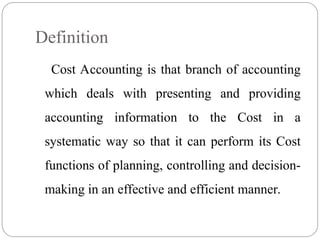
Cost Accounting isthat branch of accounting
which deals with presenting and providing
accounting information to the Cost in a
systematic way so that it can perform its Cost
functions of planning, controlling and decision-
making in an effective and efficient manner.
3.
Definition
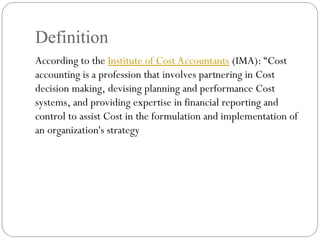
According to theInstitute of Cost Accountants (IMA): “Cost
accounting is a profession that involves partnering in Cost
decision making, devising planning and performance Cost
systems, and providing expertise in financial reporting and
control to assist Cost in the formulation and implementation of
an organization's strategy
4.
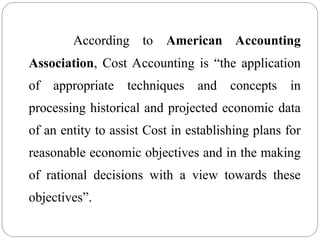
According to AmericanAccounting
Association, Cost Accounting is “the application
of appropriate techniques and concepts in
processing historical and projected economic data
of an entity to assist Cost in establishing plans for
reasonable economic objectives and in the making
of rational decisions with a view towards these
objectives”.
5.
Nature of CostAccounting
Analysis & Interpretation of data
Future-oriented
Serves as a yardstick
6.
Scope of CostAccounting
Financial Accounting: Financial Accounting provides
historical information useful for future planning and financial
forecasting
Cost Accounting: It provides various techniques of costing
which are used in the process of planning and decision-making.
Forecasting and budgeting: Cost Accounting exercises the
tool of forecasting and budgeting in the process of planning,
controlling and decision-making
Tax accounting and tax planning: the analysis of implication
of tax provisions on future projects comes under Cost
accounting.
7.
Contd..
Internal Control& Audit: Cost Accounting highly depends
on internal control system existing in the organization to
identify the weaker sections of the organization.
Cost Control Procedures: include inventory control, cost
control, budgetary control, variance analysis etc.
Financial Analysis and Interpretation: Various financial
analysis techniques such as Ratio Analysis, Fund Flow
Analysis, Trend analysis are used to analyze and interpret
financial data.
8.
Contd…
Reporting toCost: The Cost Accountant is required to
submit reports to the Cost as per their requirements.
Office Services: Cost Accountant is expected to maintain
and control office routines and procedures like filing,
copying, communicating, data processing etc.
Statistical Tools: Various statistical tools like graphs,
charts, diagrams are used in the process of planning,
controlling and decision-making.
9.
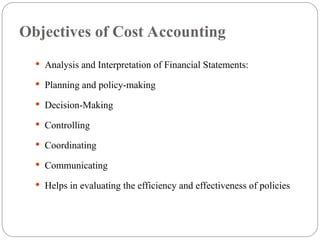
Objectives of CostAccounting
Analysis and Interpretation of Financial Statements:
Planning and policy-making
Decision-Making
Controlling
Coordinating
Communicating
Helps in evaluating the efficiency and effectiveness of policies
10.
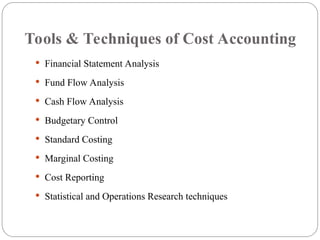
Tools & Techniquesof Cost Accounting
Financial Statement Analysis
Fund Flow Analysis
Cash Flow Analysis
Budgetary Control
Standard Costing
Marginal Costing
Cost Reporting
Statistical and Operations Research techniques
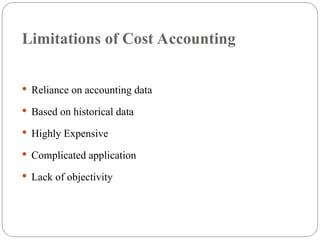
Limitations of CostAccounting
Reliance on accounting data
Based on historical data
Highly Expensive
Complicated application
Lack of objectivity
13.
Limitations of financialaccounting
It doesn’t provide timely information.
Ignores important non-monetary information.
It doesn’t provide detailed analysis.
It doesn't disclose the present value of the
business.
It leads to window dressing.
14.
Difference between financial
accounting& Cost accounting
Purpose/ Objective
Periodicity of reporting
Regulation & Standardization
Type of information
Legal Compulsion
Precision
Audit
15.
Costing is "thetechnique and process of ascertaining
costs". It means finding cost by any process or
technique. It consists of principles & rules which are
used for determining the cost of products
manufactured or services provided.
Costing
16.
Cost accounting isdefined as the process of
determining the cost of some particular products or
services which begins with the recording of income
and expenditure and ends with the preparation of
periodical statements and reports for ascertaining and
controlling costs.
Cost Accounting
17.
Cost accountancy hasbeen defined as "the
application of costing and cost accounting principles,
methods and techniques to the science, art and practice
of cost control and the ascertainment of profitability.
Cost Accountancy
18.
Determination ofselling price
Controlling cost
Providing information for decision-making
Ascertainment of cost & profit of individualized basis
Implementing a system of cost control
Facilitates reliability
To organize cost reduction programmes
Objectives of Cost Accounting
19.
The literal meaningof cost is the amount paid or required in
payment for a purchase or for the production or upkeep of
something. It is the amount of resources given up in
exchange for some goods or services.
Cost is generally measured in monetary terms.
Cost is always ascertained with reference to some object
such as material, labor, job, process etc.
Cost - Meaning
20.
Cost control:It is an act of controlling or regulating the
cost within the standards laid down, through the application
of various management tools & techniques such as standard
costing, budgetary control etc.
Cost reduction: It is concerned with achieving real &
permanent reduction on the unit cost of goods or services
rendered without impairing their quality or suitability.
Terminologies
21.
Cost audit:It involves checking up the arithmetical accuracy
of cost accounts & verifying whether the principles laid down
have been followed or not.
Cost unit: It is unit of product, service or a combination of
them in relation to which costs are ascertained & expressed.
For e.g. in steel & cement industry cost unit is ‘tonne’ while in
transportation services the unit may be passenger-km.
22.
Cost Centre:It is defined as a location, person or item of
equipment for which costs may be ascertained & used for the
purpose of control. A cost centre is charged with all the costs
that relate to it e.g. if cost centre is a machine, it will be
charged with the costs of installation, power, depreciation etc.
Cost Object: It may be defined anything for which the cost
can be measured separately. It may be a product, service,
activity or process etc.
23.
Cost Driver:It is a factor that influences cost. A change in the
cost driver will led to a change in the total cost of a related cost
object. Examples of cost drivers are: number of units
produced, number of customers served, number of
advertisements, number of sales personnel, number of products
produced etc. Any change made in any of the cost drivers will
cause a change in the total cost.
24.
Role of costaccountant
Cost accountants play a crucial role in organizations by focusing
on the financial aspects of production, operations, and overall
business activities. Their primary responsibility is to manage
and analyze costs associated with the production of goods or
services. Here are some key roles and responsibilities of cost
accountants:
25.
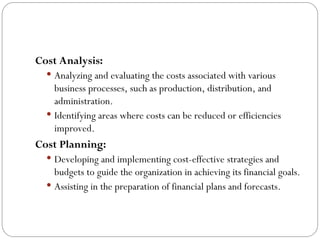
Cost Analysis:
Analyzingand evaluating the costs associated with various
business processes, such as production, distribution, and
administration.
Identifying areas where costs can be reduced or efficiencies
improved.
Cost Planning:
Developing and implementing cost-effective strategies and
budgets to guide the organization in achieving its financial goals.
Assisting in the preparation of financial plans and forecasts.
26.
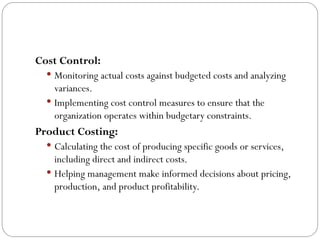
Cost Control:
Monitoringactual costs against budgeted costs and analyzing
variances.
Implementing cost control measures to ensure that the
organization operates within budgetary constraints.
Product Costing:
Calculating the cost of producing specific goods or services,
including direct and indirect costs.
Helping management make informed decisions about pricing,
production, and product profitability.
27.
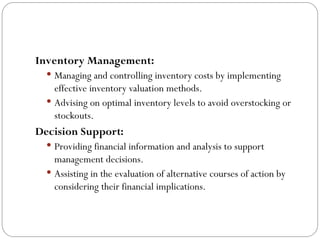
Inventory Management:
Managingand controlling inventory costs by implementing
effective inventory valuation methods.
Advising on optimal inventory levels to avoid overstocking or
stockouts.
Decision Support:
Providing financial information and analysis to support
management decisions.
Assisting in the evaluation of alternative courses of action by
considering their financial implications.
28.
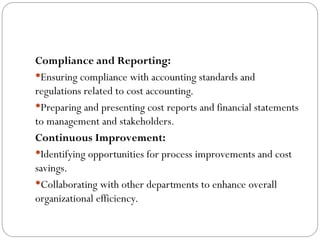
Compliance and Reporting:
Ensuringcompliance with accounting standards and
regulations related to cost accounting.
Preparing and presenting cost reports and financial statements
to management and stakeholders.
Continuous Improvement:
Identifying opportunities for process improvements and cost
savings.
Collaborating with other departments to enhance overall
organizational efficiency.
29.
Benchmarking:
Comparing theorganization's performance and costs with
industry benchmarks to identify areas for improvement.
Technology Integration:
Utilizing cost accounting software and information systems to
streamline processes and enhance accuracy in cost calculations.