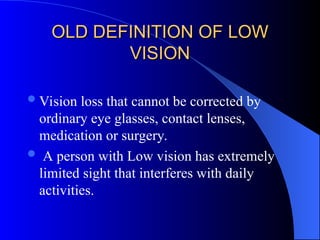
OLD DEFINITION OFLOW
OLD DEFINITION OF LOW
VISION
VISION
Vision loss that cannot be corrected by
ordinary eye glasses, contact lenses,
medication or surgery.
A person with Low vision has extremely
limited sight that interferes with daily
activities.
2.
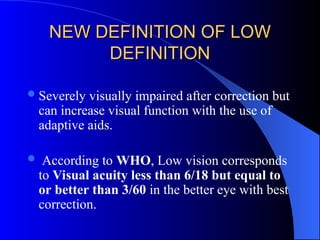
NEW DEFINITION OFLOW
NEW DEFINITION OF LOW
DEFINITION
DEFINITION
Severely visually impaired after correction but
can increase visual function with the use of
adaptive aids.
According to WHO, Low vision corresponds
to Visual acuity less than 6/18 but equal to
or better than 3/60 in the better eye with best
correction.
3.
When ordinary eyeglasses, contact lens or
intraocular lens implant cannot provide
sharp sight , an individual is said to have
Low vision.
4.
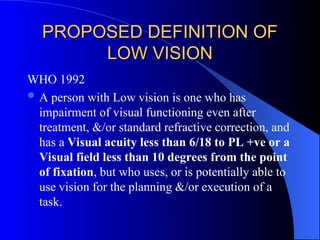
PROPOSED DEFINITION OF
PROPOSEDDEFINITION OF
LOW VISION
LOW VISION
WHO 1992
A person with Low vision is one who has
impairment of visual functioning even after
treatment, &/or standard refractive correction, and
has a Visual acuity less than 6/18 to PL +ve or a
Visual field less than 10 degrees from the point
of fixation, but who uses, or is potentially able to
use vision for the planning &/or execution of a
task.
5.
Lecture - I
Lecture- I
Magnitude
Definition
Classification
Terminologies
Three classes of Vision Loss
Causes
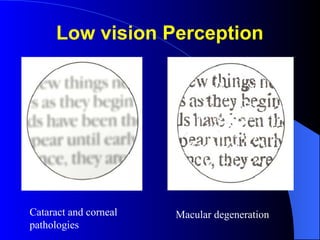
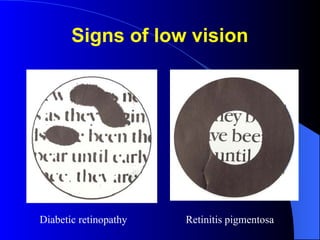
Signs of Low Vision
6.
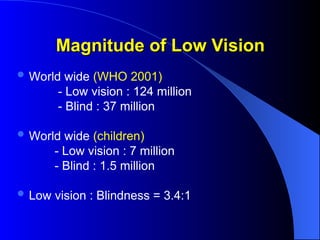
Magnitude of LowVision
Magnitude of Low Vision
World wide (WHO 2001)
- Low vision : 124 million
- Blind : 37 million
World wide (children)
- Low vision : 7 million
- Blind : 1.5 million
Low vision : Blindness = 3.4:1
7.
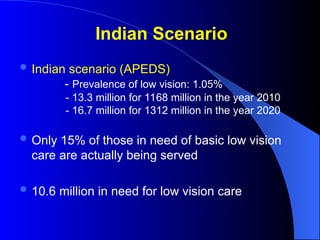
Indian Scenario
Indianscenario (APEDS)
- Prevalence of low vision: 1.05%
- 13.3 million for 1168 million in the year 2010
- 16.7 million for 1312 million in the year 2020
Only 15% of those in need of basic low vision
care are actually being served
10.6 million in need for low vision care
8.
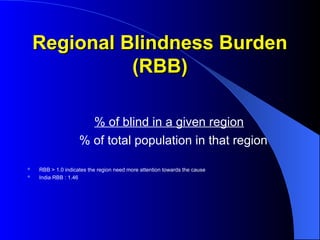
Regional Blindness Burden
RegionalBlindness Burden
(RBB)
(RBB)
% of blind in a given region
% of total population in that region
RBB > 1.0 indicates the region need more attention towards the cause
India RBB : 1.46
9.
Age Blindness Burden(ABB)
AgeBlindness Burden(ABB)
% of blind in a given age group
% of total population in that age group
ABB >1.00 is significant
Developing countries : 45 – 59, > 60
10.
Need for lowvision care
THE RIGHT TO SIGHT
WHO global initiative for the
elimination of avoidable blindness
through Vision 2020 program has
prioritized low vision care
Global Initiative for the elimination of avoidable blindness. Geneva: WHO; 1997
11.
Need for lowvision care
Only 3% of visually impaired children in
developing countries have access to basic low
vision care
50% of the visually impaired children in
special schools are low vision
Low vision has enormous social & economic
consequences in terms of productivity losses
and dependency
12.
Lack of professionaland community
awareness
Lack of good quality low vision training
programs
Very little emphasis on low vision care in
existing eye care programs
Major Challenges in delivery of low
vision care in developing world
13.
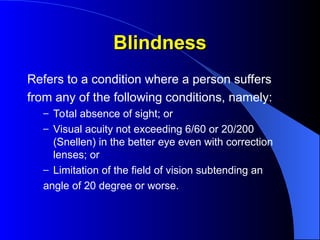
Blindness
Blindness
Refers to acondition where a person suffers
from any of the following conditions, namely:
– Total absence of sight; or
– Visual acuity not exceeding 6/60 or 20/200
(Snellen) in the better eye even with correction
lenses; or
– Limitation of the field of vision subtending an
angle of 20 degree or worse.
14.
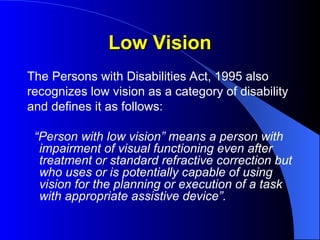
Low Vision
Low Vision
ThePersons with Disabilities Act, 1995 also
recognizes low vision as a category of disability
and defines it as follows:
“Person with low vision” means a person with
impairment of visual functioning even after
treatment or standard refractive correction but
who uses or is potentially capable of using
vision for the planning or execution of a task
with appropriate assistive device”.
15.
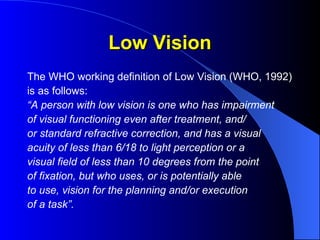
Low Vision
Low Vision
TheWHO working definition of Low Vision (WHO, 1992)
is as follows:
“A person with low vision is one who has impairment
of visual functioning even after treatment, and/
or standard refractive correction, and has a visual
acuity of less than 6/18 to light perception or a
visual field of less than 10 degrees from the point
of fixation, but who uses, or is potentially able
to use, vision for the planning and/or execution
of a task”.
16.
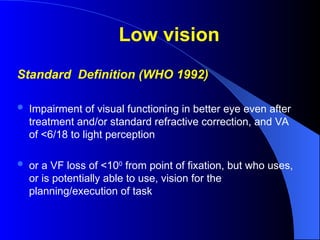
Low vision
Standard Definition(WHO 1992)
Impairment of visual functioning in better eye even after
treatment and/or standard refractive correction, and VA
of <6/18 to light perception
or a VF loss of <100
from point of fixation, but who uses,
or is potentially able to use, vision for the
planning/execution of task
17.
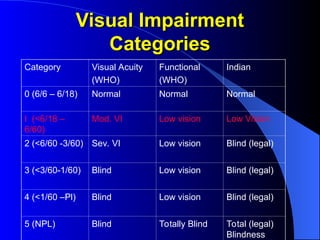
Visual Impairment
Visual Impairment
Categories
Categories
CategoryVisual Acuity
(WHO)
Functional
(WHO)
Indian
0 (6/6 – 6/18) Normal Normal Normal
I (<6/18 –
6/60)
Mod. VI Low vision Low Vision
2 (<6/60 -3/60) Sev. VI Low vision Blind (legal)
3 (<3/60-1/60) Blind Low vision Blind (legal)
4 (<1/60 –Pl) Blind Low vision Blind (legal)
5 (NPL) Blind Totally Blind Total (legal)
Blindness
18.
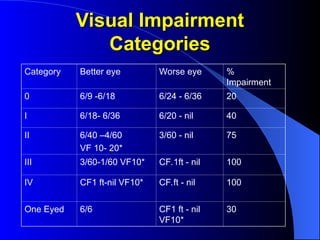
Visual Impairment
Visual Impairment
Categories
Categories
CategoryBetter eye Worse eye %
Impairment
0 6/9 -6/18 6/24 - 6/36 20
I 6/18- 6/36 6/20 - nil 40
II 6/40 –4/60
VF 10- 20*
3/60 - nil 75
III 3/60-1/60 VF10* CF.1ft - nil 100
IV CF1 ft-nil VF10* CF.ft - nil 100
One Eyed 6/6 CF1 ft - nil
VF10*
30
19.
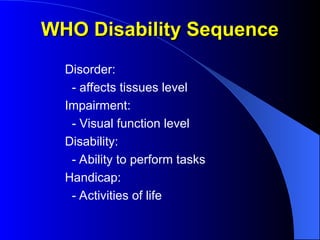
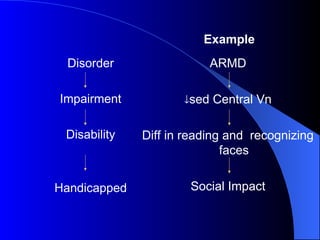
WHO Disability Sequence
WHODisability Sequence
Disorder:
- affects tissues level
Impairment:
- Visual function level
Disability:
- Ability to perform tasks
Handicap:
- Activities of life
20.
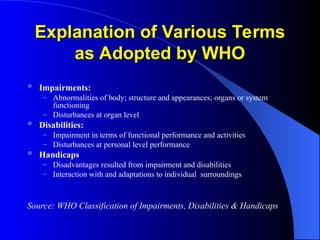
Explanation of VariousTerms
Explanation of Various Terms
as Adopted by WHO
as Adopted by WHO
Impairments:
– Abnormalities of body; structure and appearances; organs or system
functioning
– Disturbances at organ level
Disabilities:
– Impairment in terms of functional performance and activities
– Disturbances at personal level performance
Handicaps
– Disadvantages resulted from impairment and disabilities
– Interaction with and adaptations to individual surroundings
Source: WHO Classification of Impairments, Disabilities & Handicaps
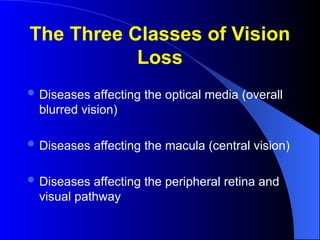
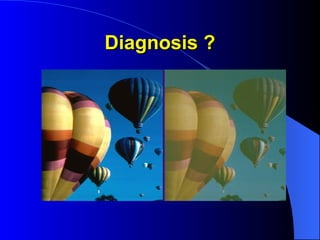
Diseases affectingthe optical media (overall
blurred vision)
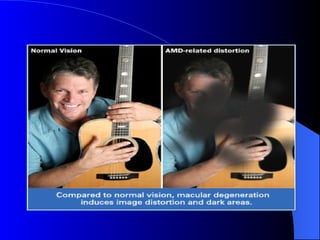
Diseases affecting the macula (central vision)
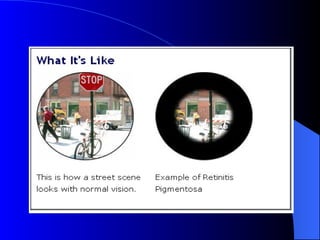
Diseases affecting the peripheral retina and
visual pathway
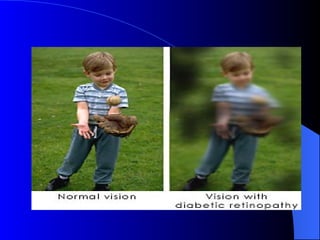
The Three Classes of Vision
Loss
23.
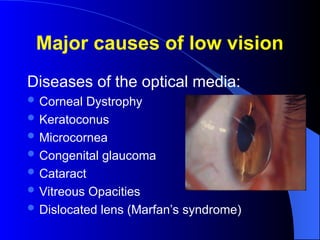
Major causes oflow vision
Diseases of the optical media:
Corneal Dystrophy
Keratoconus
Microcornea
Congenital glaucoma
Cataract
Vitreous Opacities
Dislocated lens (Marfan’s syndrome)
24.
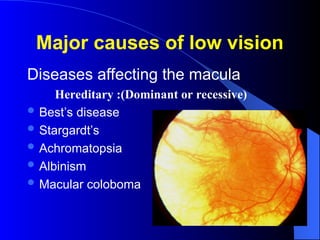
Major causes oflow vision
Diseases affecting the macula
Hereditary :(Dominant or recessive)
Best’s disease
Stargardt’s
Achromatopsia
Albinism
Macular coloboma
25.
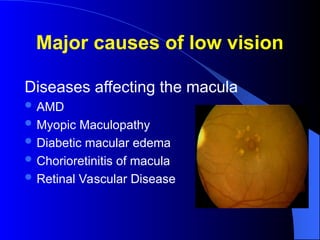
Major causes oflow vision
Diseases affecting the macula
AMD
Myopic Maculopathy
Diabetic macular edema
Chorioretinitis of macula
Retinal Vascular Disease
26.
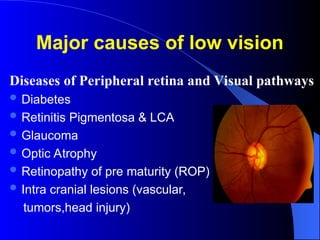
Major causes oflow vision
Diseases of Peripheral retina and Visual pathways
Diabetes
Retinitis Pigmentosa & LCA
Glaucoma
Optic Atrophy
Retinopathy of pre maturity (ROP)
Intra cranial lesions (vascular,
tumors,head injury)
REFERENCES
REFERENCES
1. Light househand book on Vision Impairment & Vision
Rehabilitation by Barbara Silverstone et al., 2000
2. Low Vision Care by Edwin. B. Mehr & Allen. N. Freid,
1975
3.Clinical Low Vision by Eleanor. E. Faye, 1976
34.
3. Dandona R,Dandona L, et al. Design of a population
based study of visual impairment in India: the Andhra
Pradesh Eye Disease Study. Indian J Ophthmol 1997;
45:251-7
4. Moderate visual impairment in India : the Andhra
Pradesh Eye Disease Study [APEDS]. British J
Ophthalmol 2002;86:373-377
35.
5. Dandona L,Dandona R, Srinivas M, et al.
Blindness in the Indian State of Andhra Pradesh,
Invest Ophthalmol Vis Sci 2001;42:908-16
6. Dandona L, Dandona R, Naduvilath TJ, et al. Burden of
Moderate visual impairment in an urban population in
southern India. Ophthalmology 1999;106:497-504
7. Highlights of Ophthalmol, No.12, Vol 21, 1993
36.
8. Kalkivayi V,Naduvilath TJ, et al. Visual Impairment in
School Children in Southern India. Indian J Ophthalmol
1997;45:129-134
9. Weih L, Van Newkirk MR, McCarty C A, et al. Age
Specific causes of bilateral visual impairment. Arch
Ophthalmol 2000;118:264-9
10. Low Vision and Rehabilitation, Ophthalmology Clinics of
North America, A. Colenbrander & D.C.Fletcher;
Vol.7,June 1994
Indian Scenario –School
Indian Scenario – School
children
children
Best corrected Visual
Acuity in the better eye
6/5, 6/6, 6/9 : 99.2%
6/12, 6/18 : 0.6%
6/24, 6/36 : 0.2%
< or = 6/60 : 0%
Best corrected Visual
Acuity in the worse eye
6/5, 6/6, 6/9 : 98.5%
6/12, 6/18 : 0.8%
6/24, 6/36 : 0.5%
6/60 : 0.05%
< 6/60 : 0.1%
*
[n = 3987]
40.
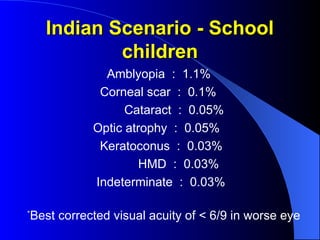
Indian Scenario -School
Indian Scenario - School
children
children
Amblyopia : 1.1%
Corneal scar : 0.1%
Cataract : 0.05%
Optic atrophy : 0.05%
Keratoconus : 0.03%
HMD : 0.03%
Indeterminate : 0.03%
*
Best corrected visual acuity of < 6/9 in worse eye
41.
Distribution according to
Distributionaccording to
age
age
No.of blind
[In million]
% of total
blind
population
Prevalence
[in %]
ABB
0-14 1.43 3.8 0.08 0.12
15-44 2.47 6.5 0.1 0.14
45-49 12 31.7 1.9 2.68
Developed 2.45 6.5 1.2 1.68
Developing 19.55 51.5 6.8 9.51
Total 37.9
![3. Dandona R, Dandona L, et al. Design of a population
based study of visual impairment in India: the Andhra
Pradesh Eye Disease Study. Indian J Ophthmol 1997;
45:251-7
4. Moderate visual impairment in India : the Andhra
Pradesh Eye Disease Study [APEDS]. British J
Ophthalmol 2002;86:373-377](https://image.slidesharecdn.com/lva-250309023114-4d8fe778/85/Low-vision-aids-Ophthalmology-Optometry-34-320.jpg)
![Indian Scenario – School
Indian Scenario – School
children
children
Best corrected Visual
Acuity in the better eye
6/5, 6/6, 6/9 : 99.2%
6/12, 6/18 : 0.6%
6/24, 6/36 : 0.2%
< or = 6/60 : 0%
Best corrected Visual
Acuity in the worse eye
6/5, 6/6, 6/9 : 98.5%
6/12, 6/18 : 0.8%
6/24, 6/36 : 0.5%
6/60 : 0.05%
< 6/60 : 0.1%
*
[n = 3987]](https://image.slidesharecdn.com/lva-250309023114-4d8fe778/85/Low-vision-aids-Ophthalmology-Optometry-39-320.jpg)
![Distribution according to
Distribution according to
age
age
No.of blind
[In million]
% of total
blind
population
Prevalence
[in %]
ABB
0-14 1.43 3.8 0.08 0.12
15-44 2.47 6.5 0.1 0.14
45-49 12 31.7 1.9 2.68
Developed 2.45 6.5 1.2 1.68
Developing 19.55 51.5 6.8 9.51
Total 37.9](https://image.slidesharecdn.com/lva-250309023114-4d8fe778/85/Low-vision-aids-Ophthalmology-Optometry-41-320.jpg)