MOHAMED GAMAL ABOU ELYAZEED
ASSISTANT LECTURER OF PHYSICAL
THERAPY FOR WOMEN’S HEALTH
SOUTH VALLEY UNIVERSITY
WORKSHOP 24-12-2020
ESSENTIALS OF ELECTROTHERAPY
IN PHYSICALTHERAPY PRACTICE
- ELECTRICITY IS A RESULT OF THE
MOVEMENT OF ELECTRONS.
- Electricity is the force created by an
imbalance in the number of electrons at
two points
1. Negative pole an area of high electron
concentration (Cathode)
2. Positive pole and area of low electron
concentration (Anode)
Different electrotherapy modalities
Types of electric currents:
1. Direct current (DC)-
Is a continuous unidirectional flow of
Charged particles with duration of at least 1 second.
• Because one electrode is always positive and
one is always negative, there is an accumulation
of charge. This accumulation of charge is called chemical or Polarity effect.
• DC has a strong chemical effect on tissues and can be delivered continuously to
promote absorption of medication through the skin ( Iontophoresis ).
2. Alternating current (AC)-
Is an uninterrupted bidirectional flow of charged particles changing direction at
least once a second.
• AC can also be delivered in an interrupted
form, sometimes referred to as Bursts.
3. Pulsed current-
Is the unidirectional (like DC) or bidirectional (like AC) flow of charged particles
periodically ceasing for less than 1 second before the next electrical event.
Different pulse shapes
Number of pulses
Waveform selection:
• The symmetrical biphasic waveform is cited as
most comfortable waveform.
• The biphasic waveforms were most preferred.
• Asymmetrical balanced biphasic may be a better for small muscles.
• Monophasic and symmetrical biphasic waveforms were found to generate
muscle contractions with greater torque than polyphasic waveforms and they
were also less fatiguing.
• Monophasic waveforms are most appropriate for wound healing.
ELECTRICAL
CURRENTS
ACCORDING
TO
FREQUENCY
1-Low Frequency Currents
• Current with frequency from 1-1000 Hz.
• Low frequency currents can stimulate
both sensory and motor nerves, with the best effect from 1-100 Hz.
• Examples: Direct current (DC), faradic current (FC), Diadynamic
current (DD), High voltage pulsed stimulation (HVPS), transcutaneous
electrical nerve stimulation (TENS).
2-Medium Frequency Currents
• Current with frequency from 1000 to 10000Hz
• Can only stimulate sensory and motor nerves too after modulation
• Examples: Interferential current (IF) or Russian current (RC).
3-High frequency currents
• Current with frequency > 10000Hz
• At this frequency, the current has no direct effect on sensory and motor nerve.
• Examples: Pulsed Short-wave Diathermy (PSWD) or Ultrasound (US).
Mechanical waves
such as:
• Ultrasound
• Extracorporeal
Shockwave
Electrical stimulation
currents such as:​
• Faradic current
• TENS
• Diadynamic
• HVPGC
• Interferential (IFC)
• Russian Current
Electromagnetic
waves such as:​​
• Infrared (IR) ​​
• Ultraviolet (UV)
• Pulsed Shortwave
• Microwave
Visible light such as:
• LASER ​​
• Light therapy
(Bioptron)
Special units such as:​​​
•Biofeedback
•Intermittent compression
Subsensory No nerve fiber activation
No sensory awareness
Sensory
Non noxious paresthesias
Tingling, prickling, or pins and needles
Cutaneous A-beta nerve fiber activation
Motor
Strong paresthesias
Muscle contraction
A-alpha nerve fiber activation
Noxious
Strong, uncomfortable paresthesias
Strong muscle contraction
Sharp or burning pain sensation
A-delta and C fiber activation
Levels of Electrical Stimulation
Types of Electrodes
1.Metal Plate Electrodes - early version, limited sizes, required wet
sponge conduction medium, difficult to be secured
2.Carbon - Impregnated Rubber Electrodes - degrade
over time and become non-uniform with "hot spots", many
shapes and sizes, rinse and dry after each use and replaced
every 12 months to ensure conductivity.
3.Self-Adhering or Single use Electrodes - flexible
conductors, convenient application, no strapping or taping to
keep in place, used most frequently these days.
➢ Monopolar Technique
•Active electrode over target area (Smaller)
•Dispersive electrode another remote site (Larger)
•Used with wounds, iontophoresis, Edema.
➢ Bipolar Technique
•Two active electrodes placed over target area (Equal in size)
•Used for muscle weakness, Neuromuscular facilitation and spasms.
➢ Quadripolar Technique
•Two electrodes from two separate stimulating channels positioned
so, the currents intersect as criss-cross Interferential Current.
Techniques
Electrotherapy Modalities
Used Mainly for Pain Relief
1- Transcutaneous Electrical Nerve Stimulation (TENS)
2- Interferential Current (IFC)
3- Diadynamic Current
Gate Control Theory
TRANSCUTANEOUS
ELECTRICAL NERVE
STIMULATION
(TENS)
- It is Simple, non-invasive
analgesia causing modality
- For pain- acute, chronic
(non malignant)
- For palliative care of
malignant conditions
Pulse wave form
Monophasic, Symmetric
biphasic, Asymmetric biphasic
Pulse amplitude (adjustable) 1-50 mA
Pulse duration (often fixed) 50- 1000 microseconds
Frequency 1- 200 Hz
Pulse patterns Continuous, Burst
Channels Single or double channels
Typical features of TENS​
High TENS( Conventional ) Low TENS (Acupuncture) Brief Intense TENS
Pulse amplitude (Intensity)
• Low (Sensory)
• Increase intensity to produce a
strong but comfortable
tingling sensation
• High (motor)
• Increase intensity to produce a strong
but comfortable muscle twitch
• High (Noxious)
• Increase intensity to
produce an uncomfortable
tingling sensation
Pulse Frequency (Hz) High (60 -100 Hz) Low (1-5 Hz)
High
(approximately 100 Hz)
Pulse Duration (micro sec) 60 – 100 150 - 300 200 – 1000
Electrode placement
Site of pain or over main nerve
bundle
proximal to pain
Over muscle or motor point
• Site of pain or over main
nerve bundle proximal to
pain
• Motor, trigger or
acupuncture points.
Treatment duration
As needed (30 minutes to 24
hours)
15-30 minutes Less than 15 minutes
Onset of relief <10 minutes 20- 40 minutes < 15 minutes
Mechanism of pain relief
• Stimulate large diameter
A-Beta afferent nerve fibers
• (Gate control theory)
•Stimulate both small cutaneous
A-Delta afferent and motor nerve
fibers
• (Endogenous-Opioid
mechanism)
•Stimulation
of small cutaneous A-Delta
afferent nerve fibers
INTERFERENTIAL
CURRENT
(IFC)
- It is a medium frequency
alternating currents, the
amplitude of which is
modulated at low frequency
for different therapeutic
purposes.
• Two channels (and four electrodes) are used to deliver IFC:
1. One channel has a set frequency, which is called the carrier
frequency e.g. 4000 Hz.
2. The other channel has an adjustable frequency
(e.g. 3900), which is used to produce a beat frequency
(e.g. 100Hz), the difference between the two frequencies.
There are two types of vectors, static and dynamic.
1. A static vector does not move but stays centered where the
currents cross (treats localized pain)
2. A dynamic vector moves throughout the treatment field
between the four electrodes. This is done by altering the beat
frequency (by changing the second current’s frequency), a
feature known as sweep or scan (treat poorly defined pain).
. Duration of treatment: 20-30 min.
DIADYNAMIC
CURRENT
- It is an electronic modulation of
symmetrical biphasic sinusoidal
waveform with pulse duration of 6-10
msec.
- Intensity of the currents should be
increased, gradually with total time
of 10-12 min. & 3 min. For single
application.
Characteristics Indication
MF (Fixe mono-phase)
Eliminates the second half of each AC
cycle.
• Frequency (50Hz).
It is used for treatment of:
1- pain without muscle
spasm
2- Connective tissue trauma (Ligament
sprains)
3- Phantom pain
DF (Fixed di-phase)
Duplicate the second half of eachAC
cycle
• Frequency (100Hz).
- It is used for:
1- the initial treatment and
before application of other
currents
2- Used to Improved circulation
CP (Short periods)
Equal phases of DF and MF,
alternating without interval pauses.
It is used for treatment of traumatic
pain.
LP (Long periods)
It includes 10-sec phase of MF,
followed by 5-sec phase of DF, in which
peak intensity is varied with a frequency
to rise and then fall.
-It is used for treatment of
neuropathic pain.
-It has a long-lasting analgesic effect.
Types of Diadynamic current
Electrotherapy Modalities
Used Mainly for Tissue Healing
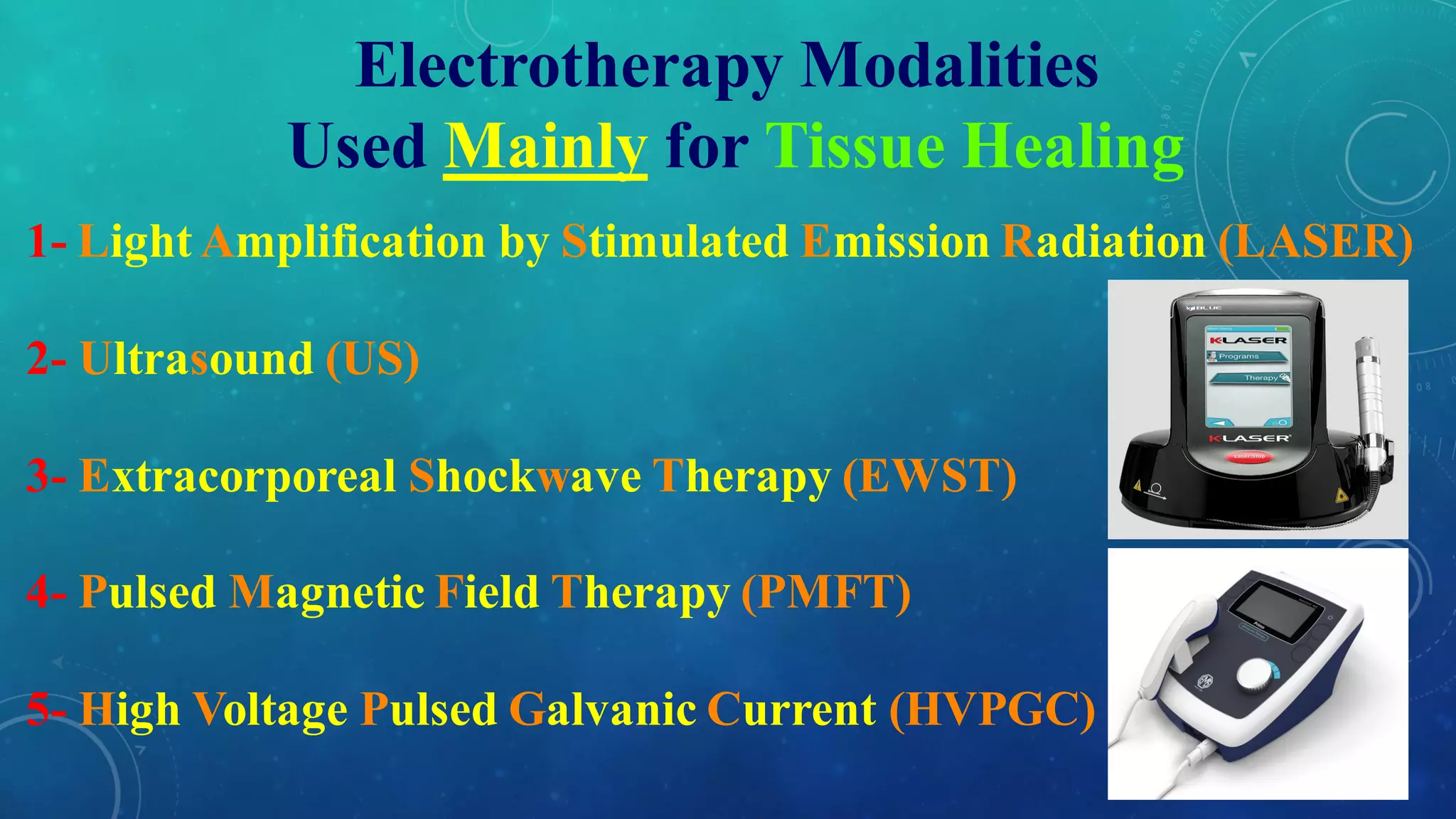
1- Light Amplification by Stimulated Emission Radiation (LASER)
2- Ultrasound (US)
3- Extracorporeal Shockwave Therapy (EWST)
4- Pulsed Magnetic Field Therapy (PMFT)
5- High Voltage Pulsed Galvanic Current (HVPGC)
LIGHT AMPLIFICATION
BY STIMULATED
EMISSION RADIATION
(LASER)
- It is a device that transforms electromagnetic energy
of various frequencies, in or near the range of
visible light, into beam of monochromatic radiation.
- Mainly used for acceleration of healing & relieve of pain.
- The power of LLLT used in physical therapy is very
small. The maximal output of the devices is <500 mW.
Classification of Laser:
According to the type of lasing medium:
a. Gas lasers: Use gas as a lasing medium. Helium and
helium-neon (HeNe) are the most common gas lasers.
b. Diode or semiconductor lasers: Use semiconductors as the lasing
medium. E.g. Aluminum gallium arsenide (AlGaAs) laser.
c. Dye lasers: Use large-molecule organic dyes in a liquid solution as the
lasing medium.
d. Solid-state lasers: Use various minerals as their lasing medium.
Examples are the ruby and neodymium: yttriumaluminum garnet (Yag)
lasers.
- The body’s response to laser application is specific to the laser’s wavelength.
A laser of one specific wavelength will cause a certain tissue reaction, whereas
a laser of another wavelength will cause a different reaction or no reaction at all.
- Laser penetration is a function of its
wavelength and power.The near- to mid-infrared
spectrum (1000–1350 nm) appears to penetrate deepest.
- Therapeutic laser-tissue interaction is essentially athermic. The main type of
reaction with tissue during laser therapy is photochemical through interaction
with photoreceptors ( Chromophores).
- Chromophores may be enzymes, a membrane molecule, or any other cellular
or extracellular substances as melanin or haemoglobin, thereby producing a
stimulation of cell activity.
1. Wavelength :
-Helium neon laser 632 nm for superficial penetration (0.5-2 cm)
-Gallium arsenide laser 905 nm for deep penetration (2-10 cm)
2. Frequency from : 200 Hz to 10,000 Hz
- For healing less than 1000HZ and for pain relief more than 1000HZ
3. Power output :
The power output of the machine is expressed usually in milliwatts
Power is from 2 mw to 500 mw to vary the energy.
Parameters of Laser
4. Total Energy :
- This is given in joules (J)
- It is expressed the energy of irradiation for the total treatment
J = 1 W× sec
Ex: a 30 mW device applied for 1 min.
0.03×60 = 1.8 J
5. Energy density :
- It’s the best method of specifying dosage and is given in joules per unit
area (J/cm2)
- ENERGY DENSITY per TREATMENT SESSION should generally fall in
the range of 0.1 - 12.0 J/cm2 though there are some recommendations which go
up to 30 J/cm2.
6. Mode :
- Pulsed in acute conditions and continuous in chronic.
- Pulse ratio is 10%, 20% up to 100%.
- Helium neon laser equipment are
continuous mode.
- Gallium arsenide laser equipment
are pulsed mode.
➢ Delivery technique :
I- Contact technique.
II- Non-contact technique.
6 -10 J/cm2 Wound infection
2-5 J/cm2 Wound healing
10 J/cm2 Hypertrophic scar
2-3 J/cm2
Acute muscle
strain and ligament sprain
4-6 J/cm2
Chronic muscle strain and
ligamentsprain
2- 6 J/cm2 Pain
2-4 J/cm2 inflammation
2-5 J/cm2 Osteoarthritis
2-5 J/cm2 Open nerve regeneration
2 J/cm2 Closed nerve regeneration
2-6 J/cm2 Fracture
ULTRASONIC
THERAPY
(US)
- US is high-frequency mechanical waves
delivered using acoustic energy.
- Therapeutic ultrasound frequency is
beyond audible sound and is typically
applied at either 1 or 3 MHz.
- More dense connective tissues, such as
ligaments and tendons, absorb US better than
less dense tissues such as muscle and fat.
Characteristics of the ultrasound wave and treatment parameters
1. Frequency (F) -
Number of vibratory oscillations (cycles) / sec (Hertz -Hz).
The most common frequencies utilized are 1 MHz and 3 MHz.
• There is an inverse relationship between frequency and depth of penetration
(Higher frequencies of ultrasound penetrate less deep).
- 3 MHz frequency used to treat tissues at superficial depths
(1 cm to 2 cm) as exposed tendons and ligaments.
- 1 MHz frequency used to treat tissues at deep depths
(> 2 cm up to 6 cm ) as muscles and fascia.
Tissue State
Intensity required at the lesion
(W/cm2)
Acute 0.1 - 0.5
Sub-Acute 0.5 – 1
Chronic 1 - 1.5
2. Intensity (I) -
• Spatial Peak Intensity (SPI) - highest intensity within beam
• Spatial Average Intensity (SAI) - related to each machine
- normal SAI = 0.25 - 2 watts / cm 2
- maximal SAI = 3 watts / cm 2
• BNR = SPI/SAI, Many US units have BNRs between 5 and 6, although
better units have BNRs of about 2 to 3 (The lower the BNR the more even
the distribution of sound energy).
3. Mode -
A. Continuous Wave - no interruption of beam: best for maximum heat
buildup to produce thermal effect in chronic injuries.
B. Pulsed Wave - intermittent “on-off” beam modulation builds up less heat
in tissues to produce mechanical effect in acute injuries.
4. Duty Cycle-
• The percentage of “on” time of ultrasound output
• Duty Cycle = duration of pulse (on time) x 100
pulse period ( on time + off time)
• For example, if an ultrasound unit was programmed to have equalled “on”
and “off” periods, this would mean that there would be output for half the
time. The duty factor could be expressed either 50% or a ratio of 1:1.
EXTRACORPOREAL
SHOCKWAVE
THERAPY
(ESWT)
- ESWT is defined as a noninvasive
treatment that involves delivery of shock
waves in a sequence of biphasic, high-
energy acoustic pulses that generate
transient pressure disturbance and
propagate rapidly in three-dimensional space.
Shockwave Characteristics
1. Positive Peak pressure (between 35-120 megapascals
(MPa).
- 1MPA is about 10 times atmospheric pressure.
2. This pressure rapidly falls to a negative peak
pressure of about 5-10 MPa.
3. Fast pressure rise time (usually less than 10 ns
(nanoseconds).
4. Short duration (usually about 10 microseconds).
5. Narrow effective beam (2-8 mm diameter).
- It is a form of mechanical energy wave travelling faster than speed of sound
with depth of penetration 0- 6 cm.
Compressed Air
Bar
Magnetic
mJ
Energy per mm using
15 mm head
mJ/mm2
1 60
2 90
3 120 0.12
4 150
5 180 0.38
Types of shockwave production:
1. Non-Focused (Radial or Dispersive or Soft shockwave)
2. Focused (Hard shockwave often referred to as lithotripsy)
Non-Focused/Radial/Dispersive/Soft Shock wave
• The energy generated by the pressure wave is
absorbed into the skin approximately 3 cm deep
and spreads a wider beam to a larger target area
Radial shockwaves are generated in 2 main ways:
1. Air compressed system.
2. Electromagnetic.
Energy Flux Density: Degree of energy transmitted to the tissues
Low (<0.08 mJ/mm2)
Medium (0.08 to 0.28 mJ/mm2)
High (0.28 to 0.60 or more mJ/mm2)
Frequencies in Shockwave Treatment
• Higher frequencies 14 Hz or more are described by patients as feeling easier.
Lower frequencies 8-12 Hzare often described as feeling more painful.
• Higher frequencies are better at the beginning of treatment to familiarize the
patient to the sensation then work down to the desired frequency in stages.
• Increasing frequencyaffects the depth of wave penetration (as lower
frequency waves travel further than higher frequency waves).
RSWT Head Power Frequency Shocks How Often
No. of
Sessions
1. Destruction
15mm
105 mJ+
2.5 bar+
4-15hz 1000-4000
every 5
days
1-6
2. Healing
15-
35mm
60-90 mJ
1-2 bar
10-16hz
1000 x 1
spot
4000 larger
area
every 7-10
days
4-6
3. Pain Relief
6-
35mm
60-90 mJ
1-2 bar
15-30hz
1500 x 1
spot
4000 larger
every 7-10
days
3
Treatment Dose
• Shock Number usually between 1000-2000 shocks per session appears to be the
most applied range.
• Number of Treatment Sessions: Typically, 3 - 5 sessions appears to be effective for
the majority of patients.
Electrotherapy Modalities
Used Mainly for Muscular
Facilitation and Augmentation
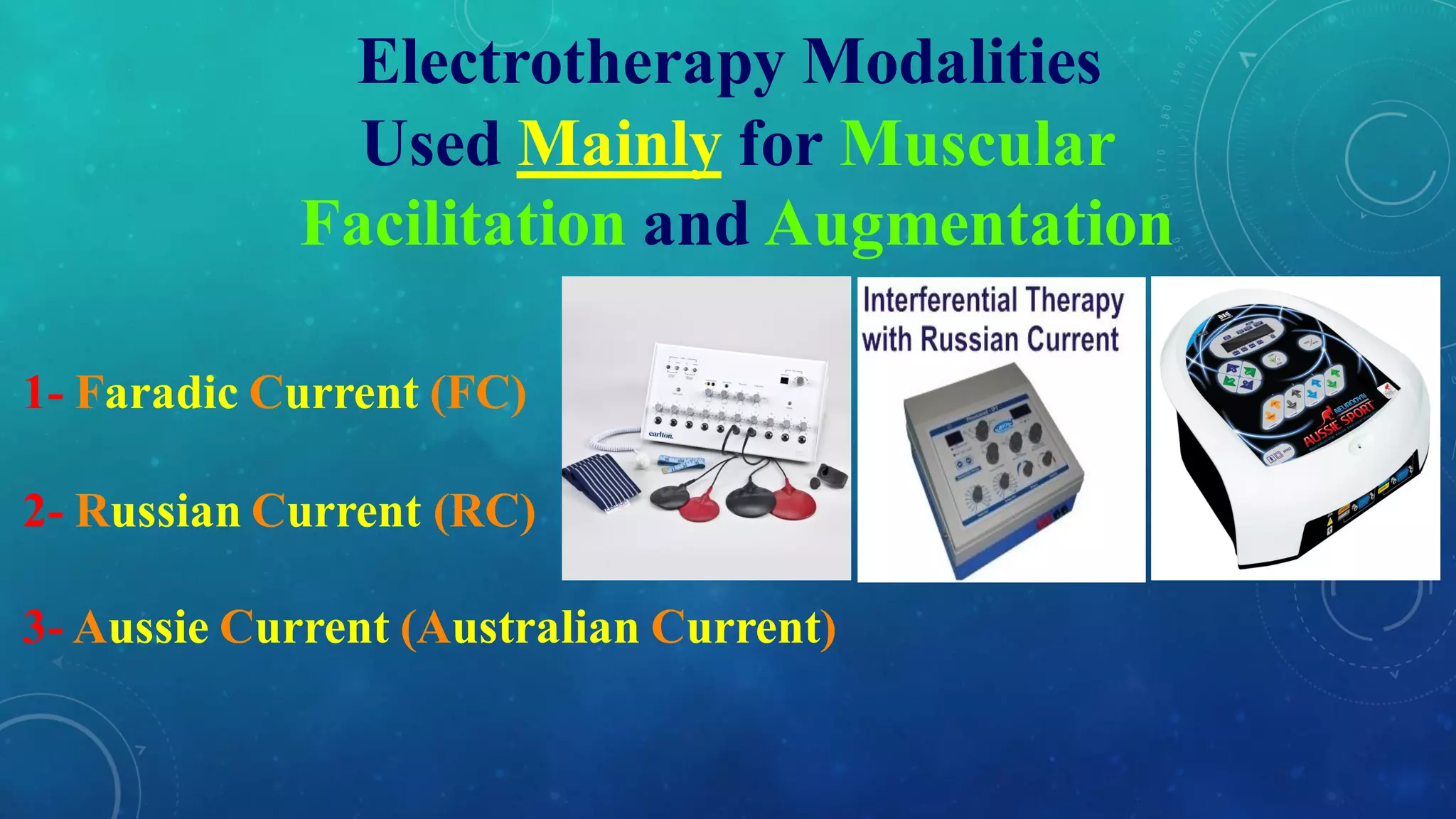
1- Faradic Current (FC)
2- Russian Current (RC)
3- Aussie Current (Australian Current)
FARADIC
CURRENT
(FC)
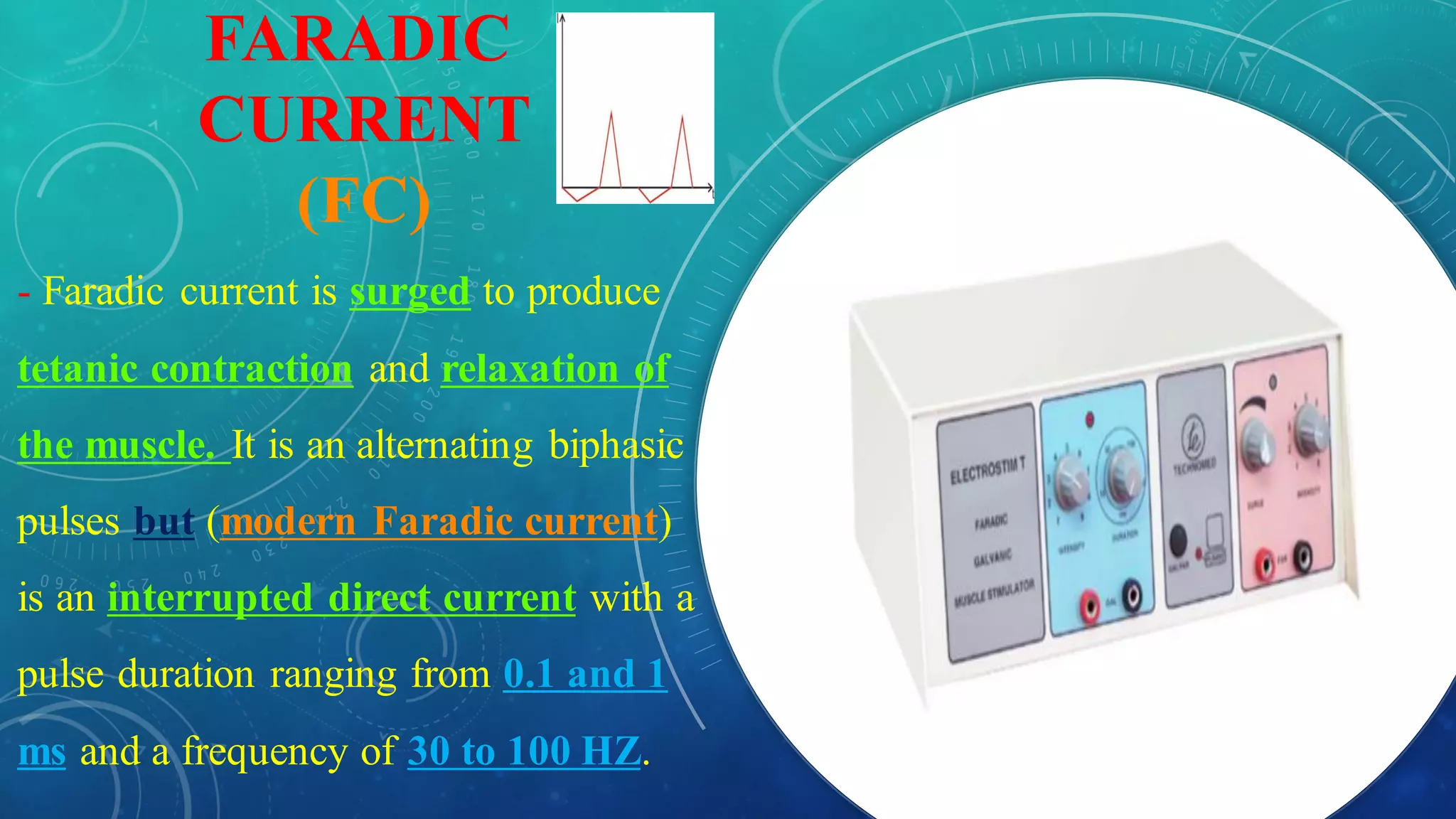
- Faradic current is surged to produce
tetanic contraction and relaxation of
the muscle. It is an alternating biphasic
pulses but (modern Faradic current)
is an interrupted direct current with a
pulse duration ranging from 0.1 and 1
ms and a frequency of 30 to 100 HZ.
RUSSIAN&AUSSIE
CURRENT
- They are Medium frequency
currents used for muscle
strengthening purposes.
RUSSIAN CURREN (RC) AUSSIE CURRENT
Characteristics
Medium-frequencypolyphasic alternatingsinusoidal
interrupted current
Carrier frequency 2,500 Hz (1000Hz) 1 KHz
Burst modulated
The bursts are delivered at 50 bursts
per second with a burst durationof 10
msec and an interburst interval of 10
msec
The bursts delivered at 50 bursts
per second with a burst durationof
4 msec and an interburst interval
of 16 msec
Duration
phase duration 200 μsec
cycle duration400 μsec
phase duration 500 μsec
The cycle duration 1 msec
Duty cycle
50%
Protocol:10/50/10 (10-second
contraction time, 50-secondoff-time,
10 repetitions).
20 %
Advantages
- Better force production
- The lower durationcaused the
leastdiscomfort to the patients
Iontophoresis: is a technique which uses an electric current to deliver a medicine or
other chemical through the skin. In popular terms it is sometimes called "an injection
without the needle".
- The negative ionized drugs are repeled by the cathode while
The positive ionized drugs are repeled by the anode.
Current Type DC
Current Amplitude1.0 - 4.0 mA
Treatment
Duration
20 - 40 minutes
TotalCurrent
delivered
40-80mA/min
Optimal CurrentVariables
used in Iontophoresis
All Thanks to Allah
Then to
Dr. Fatma El-Fiky
For her continous
encouragement and
kind assistance from
her precious data.
Essentials of electrotherapy in physical therapy practice (workshop)

Essentials of electrotherapy in physical therapy practice (workshop)

  • 2.
    MOHAMED GAMAL ABOUELYAZEED ASSISTANT LECTURER OF PHYSICAL THERAPY FOR WOMEN’S HEALTH SOUTH VALLEY UNIVERSITY
  • 3.
    WORKSHOP 24-12-2020 ESSENTIALS OFELECTROTHERAPY IN PHYSICALTHERAPY PRACTICE
  • 4.
    - ELECTRICITY ISA RESULT OF THE MOVEMENT OF ELECTRONS. - Electricity is the force created by an imbalance in the number of electrons at two points 1. Negative pole an area of high electron concentration (Cathode) 2. Positive pole and area of low electron concentration (Anode)
  • 5.
  • 6.
    Types of electriccurrents: 1. Direct current (DC)- Is a continuous unidirectional flow of Charged particles with duration of at least 1 second. • Because one electrode is always positive and one is always negative, there is an accumulation of charge. This accumulation of charge is called chemical or Polarity effect. • DC has a strong chemical effect on tissues and can be delivered continuously to promote absorption of medication through the skin ( Iontophoresis ).
  • 7.
    2. Alternating current(AC)- Is an uninterrupted bidirectional flow of charged particles changing direction at least once a second. • AC can also be delivered in an interrupted form, sometimes referred to as Bursts. 3. Pulsed current- Is the unidirectional (like DC) or bidirectional (like AC) flow of charged particles periodically ceasing for less than 1 second before the next electrical event.
  • 8.
  • 9.
  • 10.
    Waveform selection: • Thesymmetrical biphasic waveform is cited as most comfortable waveform. • The biphasic waveforms were most preferred. • Asymmetrical balanced biphasic may be a better for small muscles. • Monophasic and symmetrical biphasic waveforms were found to generate muscle contractions with greater torque than polyphasic waveforms and they were also less fatiguing. • Monophasic waveforms are most appropriate for wound healing.
  • 11.
  • 12.
    1-Low Frequency Currents •Current with frequency from 1-1000 Hz. • Low frequency currents can stimulate both sensory and motor nerves, with the best effect from 1-100 Hz. • Examples: Direct current (DC), faradic current (FC), Diadynamic current (DD), High voltage pulsed stimulation (HVPS), transcutaneous electrical nerve stimulation (TENS).
  • 13.
    2-Medium Frequency Currents •Current with frequency from 1000 to 10000Hz • Can only stimulate sensory and motor nerves too after modulation • Examples: Interferential current (IF) or Russian current (RC). 3-High frequency currents • Current with frequency > 10000Hz • At this frequency, the current has no direct effect on sensory and motor nerve. • Examples: Pulsed Short-wave Diathermy (PSWD) or Ultrasound (US).
  • 14.
    Mechanical waves such as: •Ultrasound • Extracorporeal Shockwave Electrical stimulation currents such as:​ • Faradic current • TENS • Diadynamic • HVPGC • Interferential (IFC) • Russian Current Electromagnetic waves such as:​​ • Infrared (IR) ​​ • Ultraviolet (UV) • Pulsed Shortwave • Microwave Visible light such as: • LASER ​​ • Light therapy (Bioptron) Special units such as:​​​ •Biofeedback •Intermittent compression
  • 16.
    Subsensory No nervefiber activation No sensory awareness Sensory Non noxious paresthesias Tingling, prickling, or pins and needles Cutaneous A-beta nerve fiber activation Motor Strong paresthesias Muscle contraction A-alpha nerve fiber activation Noxious Strong, uncomfortable paresthesias Strong muscle contraction Sharp or burning pain sensation A-delta and C fiber activation Levels of Electrical Stimulation
  • 17.
    Types of Electrodes 1.MetalPlate Electrodes - early version, limited sizes, required wet sponge conduction medium, difficult to be secured 2.Carbon - Impregnated Rubber Electrodes - degrade over time and become non-uniform with "hot spots", many shapes and sizes, rinse and dry after each use and replaced every 12 months to ensure conductivity. 3.Self-Adhering or Single use Electrodes - flexible conductors, convenient application, no strapping or taping to keep in place, used most frequently these days.
  • 18.
    ➢ Monopolar Technique •Activeelectrode over target area (Smaller) •Dispersive electrode another remote site (Larger) •Used with wounds, iontophoresis, Edema. ➢ Bipolar Technique •Two active electrodes placed over target area (Equal in size) •Used for muscle weakness, Neuromuscular facilitation and spasms. ➢ Quadripolar Technique •Two electrodes from two separate stimulating channels positioned so, the currents intersect as criss-cross Interferential Current. Techniques
  • 19.
    Electrotherapy Modalities Used Mainlyfor Pain Relief 1- Transcutaneous Electrical Nerve Stimulation (TENS) 2- Interferential Current (IFC) 3- Diadynamic Current
  • 20.
  • 21.
    TRANSCUTANEOUS ELECTRICAL NERVE STIMULATION (TENS) - Itis Simple, non-invasive analgesia causing modality - For pain- acute, chronic (non malignant) - For palliative care of malignant conditions
  • 22.
    Pulse wave form Monophasic,Symmetric biphasic, Asymmetric biphasic Pulse amplitude (adjustable) 1-50 mA Pulse duration (often fixed) 50- 1000 microseconds Frequency 1- 200 Hz Pulse patterns Continuous, Burst Channels Single or double channels Typical features of TENS​
  • 23.
    High TENS( Conventional) Low TENS (Acupuncture) Brief Intense TENS Pulse amplitude (Intensity) • Low (Sensory) • Increase intensity to produce a strong but comfortable tingling sensation • High (motor) • Increase intensity to produce a strong but comfortable muscle twitch • High (Noxious) • Increase intensity to produce an uncomfortable tingling sensation Pulse Frequency (Hz) High (60 -100 Hz) Low (1-5 Hz) High (approximately 100 Hz) Pulse Duration (micro sec) 60 – 100 150 - 300 200 – 1000 Electrode placement Site of pain or over main nerve bundle proximal to pain Over muscle or motor point • Site of pain or over main nerve bundle proximal to pain • Motor, trigger or acupuncture points. Treatment duration As needed (30 minutes to 24 hours) 15-30 minutes Less than 15 minutes Onset of relief <10 minutes 20- 40 minutes < 15 minutes Mechanism of pain relief • Stimulate large diameter A-Beta afferent nerve fibers • (Gate control theory) •Stimulate both small cutaneous A-Delta afferent and motor nerve fibers • (Endogenous-Opioid mechanism) •Stimulation of small cutaneous A-Delta afferent nerve fibers
  • 24.
    INTERFERENTIAL CURRENT (IFC) - It isa medium frequency alternating currents, the amplitude of which is modulated at low frequency for different therapeutic purposes.
  • 25.
    • Two channels(and four electrodes) are used to deliver IFC: 1. One channel has a set frequency, which is called the carrier frequency e.g. 4000 Hz. 2. The other channel has an adjustable frequency (e.g. 3900), which is used to produce a beat frequency (e.g. 100Hz), the difference between the two frequencies.
  • 26.
    There are twotypes of vectors, static and dynamic. 1. A static vector does not move but stays centered where the currents cross (treats localized pain) 2. A dynamic vector moves throughout the treatment field between the four electrodes. This is done by altering the beat frequency (by changing the second current’s frequency), a feature known as sweep or scan (treat poorly defined pain). . Duration of treatment: 20-30 min.
  • 27.
    DIADYNAMIC CURRENT - It isan electronic modulation of symmetrical biphasic sinusoidal waveform with pulse duration of 6-10 msec. - Intensity of the currents should be increased, gradually with total time of 10-12 min. & 3 min. For single application.
  • 28.
    Characteristics Indication MF (Fixemono-phase) Eliminates the second half of each AC cycle. • Frequency (50Hz). It is used for treatment of: 1- pain without muscle spasm 2- Connective tissue trauma (Ligament sprains) 3- Phantom pain DF (Fixed di-phase) Duplicate the second half of eachAC cycle • Frequency (100Hz). - It is used for: 1- the initial treatment and before application of other currents 2- Used to Improved circulation CP (Short periods) Equal phases of DF and MF, alternating without interval pauses. It is used for treatment of traumatic pain. LP (Long periods) It includes 10-sec phase of MF, followed by 5-sec phase of DF, in which peak intensity is varied with a frequency to rise and then fall. -It is used for treatment of neuropathic pain. -It has a long-lasting analgesic effect. Types of Diadynamic current
  • 29.
    Electrotherapy Modalities Used Mainlyfor Tissue Healing 1- Light Amplification by Stimulated Emission Radiation (LASER) 2- Ultrasound (US) 3- Extracorporeal Shockwave Therapy (EWST) 4- Pulsed Magnetic Field Therapy (PMFT) 5- High Voltage Pulsed Galvanic Current (HVPGC)
  • 30.
    LIGHT AMPLIFICATION BY STIMULATED EMISSIONRADIATION (LASER) - It is a device that transforms electromagnetic energy of various frequencies, in or near the range of visible light, into beam of monochromatic radiation. - Mainly used for acceleration of healing & relieve of pain. - The power of LLLT used in physical therapy is very small. The maximal output of the devices is <500 mW.
  • 31.
    Classification of Laser: Accordingto the type of lasing medium: a. Gas lasers: Use gas as a lasing medium. Helium and helium-neon (HeNe) are the most common gas lasers. b. Diode or semiconductor lasers: Use semiconductors as the lasing medium. E.g. Aluminum gallium arsenide (AlGaAs) laser. c. Dye lasers: Use large-molecule organic dyes in a liquid solution as the lasing medium. d. Solid-state lasers: Use various minerals as their lasing medium. Examples are the ruby and neodymium: yttriumaluminum garnet (Yag) lasers.
  • 32.
    - The body’sresponse to laser application is specific to the laser’s wavelength. A laser of one specific wavelength will cause a certain tissue reaction, whereas a laser of another wavelength will cause a different reaction or no reaction at all. - Laser penetration is a function of its wavelength and power.The near- to mid-infrared spectrum (1000–1350 nm) appears to penetrate deepest. - Therapeutic laser-tissue interaction is essentially athermic. The main type of reaction with tissue during laser therapy is photochemical through interaction with photoreceptors ( Chromophores). - Chromophores may be enzymes, a membrane molecule, or any other cellular or extracellular substances as melanin or haemoglobin, thereby producing a stimulation of cell activity.
  • 33.
    1. Wavelength : -Heliumneon laser 632 nm for superficial penetration (0.5-2 cm) -Gallium arsenide laser 905 nm for deep penetration (2-10 cm) 2. Frequency from : 200 Hz to 10,000 Hz - For healing less than 1000HZ and for pain relief more than 1000HZ 3. Power output : The power output of the machine is expressed usually in milliwatts Power is from 2 mw to 500 mw to vary the energy. Parameters of Laser
  • 34.
    4. Total Energy: - This is given in joules (J) - It is expressed the energy of irradiation for the total treatment J = 1 W× sec Ex: a 30 mW device applied for 1 min. 0.03×60 = 1.8 J 5. Energy density : - It’s the best method of specifying dosage and is given in joules per unit area (J/cm2) - ENERGY DENSITY per TREATMENT SESSION should generally fall in the range of 0.1 - 12.0 J/cm2 though there are some recommendations which go up to 30 J/cm2.
  • 35.
    6. Mode : -Pulsed in acute conditions and continuous in chronic. - Pulse ratio is 10%, 20% up to 100%. - Helium neon laser equipment are continuous mode. - Gallium arsenide laser equipment are pulsed mode. ➢ Delivery technique : I- Contact technique. II- Non-contact technique. 6 -10 J/cm2 Wound infection 2-5 J/cm2 Wound healing 10 J/cm2 Hypertrophic scar 2-3 J/cm2 Acute muscle strain and ligament sprain 4-6 J/cm2 Chronic muscle strain and ligamentsprain 2- 6 J/cm2 Pain 2-4 J/cm2 inflammation 2-5 J/cm2 Osteoarthritis 2-5 J/cm2 Open nerve regeneration 2 J/cm2 Closed nerve regeneration 2-6 J/cm2 Fracture
  • 36.
    ULTRASONIC THERAPY (US) - US ishigh-frequency mechanical waves delivered using acoustic energy. - Therapeutic ultrasound frequency is beyond audible sound and is typically applied at either 1 or 3 MHz. - More dense connective tissues, such as ligaments and tendons, absorb US better than less dense tissues such as muscle and fat.
  • 37.
    Characteristics of theultrasound wave and treatment parameters 1. Frequency (F) - Number of vibratory oscillations (cycles) / sec (Hertz -Hz). The most common frequencies utilized are 1 MHz and 3 MHz. • There is an inverse relationship between frequency and depth of penetration (Higher frequencies of ultrasound penetrate less deep). - 3 MHz frequency used to treat tissues at superficial depths (1 cm to 2 cm) as exposed tendons and ligaments. - 1 MHz frequency used to treat tissues at deep depths (> 2 cm up to 6 cm ) as muscles and fascia.
  • 38.
    Tissue State Intensity requiredat the lesion (W/cm2) Acute 0.1 - 0.5 Sub-Acute 0.5 – 1 Chronic 1 - 1.5 2. Intensity (I) - • Spatial Peak Intensity (SPI) - highest intensity within beam • Spatial Average Intensity (SAI) - related to each machine - normal SAI = 0.25 - 2 watts / cm 2 - maximal SAI = 3 watts / cm 2 • BNR = SPI/SAI, Many US units have BNRs between 5 and 6, although better units have BNRs of about 2 to 3 (The lower the BNR the more even the distribution of sound energy).
  • 39.
    3. Mode - A.Continuous Wave - no interruption of beam: best for maximum heat buildup to produce thermal effect in chronic injuries. B. Pulsed Wave - intermittent “on-off” beam modulation builds up less heat in tissues to produce mechanical effect in acute injuries. 4. Duty Cycle- • The percentage of “on” time of ultrasound output • Duty Cycle = duration of pulse (on time) x 100 pulse period ( on time + off time) • For example, if an ultrasound unit was programmed to have equalled “on” and “off” periods, this would mean that there would be output for half the time. The duty factor could be expressed either 50% or a ratio of 1:1.
  • 40.
    EXTRACORPOREAL SHOCKWAVE THERAPY (ESWT) - ESWT isdefined as a noninvasive treatment that involves delivery of shock waves in a sequence of biphasic, high- energy acoustic pulses that generate transient pressure disturbance and propagate rapidly in three-dimensional space.
  • 41.
    Shockwave Characteristics 1. PositivePeak pressure (between 35-120 megapascals (MPa). - 1MPA is about 10 times atmospheric pressure. 2. This pressure rapidly falls to a negative peak pressure of about 5-10 MPa. 3. Fast pressure rise time (usually less than 10 ns (nanoseconds). 4. Short duration (usually about 10 microseconds). 5. Narrow effective beam (2-8 mm diameter). - It is a form of mechanical energy wave travelling faster than speed of sound with depth of penetration 0- 6 cm.
  • 42.
    Compressed Air Bar Magnetic mJ Energy permm using 15 mm head mJ/mm2 1 60 2 90 3 120 0.12 4 150 5 180 0.38 Types of shockwave production: 1. Non-Focused (Radial or Dispersive or Soft shockwave) 2. Focused (Hard shockwave often referred to as lithotripsy)
  • 43.
    Non-Focused/Radial/Dispersive/Soft Shock wave •The energy generated by the pressure wave is absorbed into the skin approximately 3 cm deep and spreads a wider beam to a larger target area Radial shockwaves are generated in 2 main ways: 1. Air compressed system. 2. Electromagnetic. Energy Flux Density: Degree of energy transmitted to the tissues Low (<0.08 mJ/mm2) Medium (0.08 to 0.28 mJ/mm2) High (0.28 to 0.60 or more mJ/mm2)
  • 44.
    Frequencies in ShockwaveTreatment • Higher frequencies 14 Hz or more are described by patients as feeling easier. Lower frequencies 8-12 Hzare often described as feeling more painful. • Higher frequencies are better at the beginning of treatment to familiarize the patient to the sensation then work down to the desired frequency in stages. • Increasing frequencyaffects the depth of wave penetration (as lower frequency waves travel further than higher frequency waves).
  • 45.
    RSWT Head PowerFrequency Shocks How Often No. of Sessions 1. Destruction 15mm 105 mJ+ 2.5 bar+ 4-15hz 1000-4000 every 5 days 1-6 2. Healing 15- 35mm 60-90 mJ 1-2 bar 10-16hz 1000 x 1 spot 4000 larger area every 7-10 days 4-6 3. Pain Relief 6- 35mm 60-90 mJ 1-2 bar 15-30hz 1500 x 1 spot 4000 larger every 7-10 days 3 Treatment Dose • Shock Number usually between 1000-2000 shocks per session appears to be the most applied range. • Number of Treatment Sessions: Typically, 3 - 5 sessions appears to be effective for the majority of patients.
  • 46.
    Electrotherapy Modalities Used Mainlyfor Muscular Facilitation and Augmentation 1- Faradic Current (FC) 2- Russian Current (RC) 3- Aussie Current (Australian Current)
  • 47.
    FARADIC CURRENT (FC) - Faradic currentis surged to produce tetanic contraction and relaxation of the muscle. It is an alternating biphasic pulses but (modern Faradic current) is an interrupted direct current with a pulse duration ranging from 0.1 and 1 ms and a frequency of 30 to 100 HZ.
  • 48.
    RUSSIAN&AUSSIE CURRENT - They areMedium frequency currents used for muscle strengthening purposes.
  • 49.
    RUSSIAN CURREN (RC)AUSSIE CURRENT Characteristics Medium-frequencypolyphasic alternatingsinusoidal interrupted current Carrier frequency 2,500 Hz (1000Hz) 1 KHz Burst modulated The bursts are delivered at 50 bursts per second with a burst durationof 10 msec and an interburst interval of 10 msec The bursts delivered at 50 bursts per second with a burst durationof 4 msec and an interburst interval of 16 msec Duration phase duration 200 μsec cycle duration400 μsec phase duration 500 μsec The cycle duration 1 msec Duty cycle 50% Protocol:10/50/10 (10-second contraction time, 50-secondoff-time, 10 repetitions). 20 % Advantages - Better force production - The lower durationcaused the leastdiscomfort to the patients
  • 50.
    Iontophoresis: is atechnique which uses an electric current to deliver a medicine or other chemical through the skin. In popular terms it is sometimes called "an injection without the needle". - The negative ionized drugs are repeled by the cathode while The positive ionized drugs are repeled by the anode. Current Type DC Current Amplitude1.0 - 4.0 mA Treatment Duration 20 - 40 minutes TotalCurrent delivered 40-80mA/min Optimal CurrentVariables used in Iontophoresis
  • 51.
    All Thanks toAllah Then to Dr. Fatma El-Fiky For her continous encouragement and kind assistance from her precious data.