INTERFERENTIAL THERAPY
Presented by,
Dr. R. Jayabharathi M.P.T (Ortho)., PGDHM.,
Assistant Professor
School of Physiotherapy
SBV
Therapeutic currents
• Currents used for the treatment purpose.
• According to the difference in the frequencies, the current
can be divided into following three types.
1. Low frequency current: Frequency ranging from 1-1000 Hz.
Eg., TENS, Galvanic current, Faradic current.
2. Medium frequency current: Frequency ranging from 1000 –
10000 Hz. Eg., IFT, Russian current.
3. High frequency current: Frequency above 10000 Hz.
Eg., SWD, MWD, UST, IRR.
History
The research and use of interferential current have
taken place primarily in Europe. An Austrian scientist
Hons Nemec introduce the concept and suggested its
therapeutic use (1949). Interferential current is also
known as Nemec’s Current.
Definition
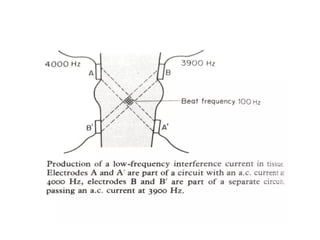
Two medium frequency currents are used to bring
about the low frequency current effect in the tissue.
Definition
Wave form produced by the interference of two
medium frequency alternating current of slightly
different frequencies. These two wave form are
delivered through 2 set of electrode through separate
channels in the same stimulator. Electrode are
configured on the skin so that the 2 AC Current
intersect into the tissue to form the beat frequency.
• This is achieved by applying two medium frequency
current to the tissue to generate low frequency
interference current.
• Thus the benefits of low frequency stimulations are
achieved without the association of unpleasant side
effect like pain, discomfort, skin irritation etc.
• Direct application of low frequency current result in
pain due to high impedence of tissue.
(Living skin tissue is covered by a layer of dead skin cells
and these dead cells provide high impedence interface
between the electrode and living skin tissue).
Principle
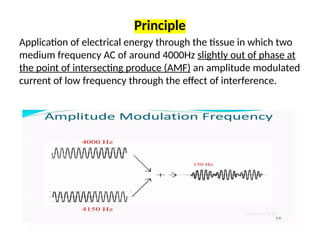
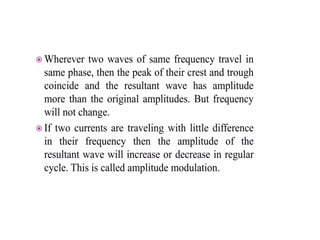
Application of electrical energy through the tissue in which two
medium frequency AC of around 4000Hz slightly out of phase at
the point of intersecting produce (AMF) an amplitude modulated
current of low frequency through the effect of interference.
TERMS USED IN INTERFERENTIAL THERAPY
A) Base Frequency
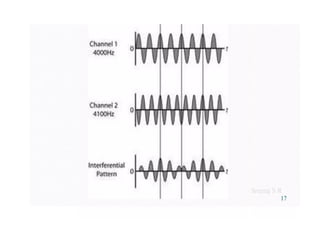
• Two Alternative medium frequency current of same
amplitude slightly different frequency, this carrying
frequency is called base frequency.
• One current at constant frequency (A) of 4000Hz and
another current at variable frequency (B) of 4100.
• The superimposition of one alternating current on
the other is called interference.
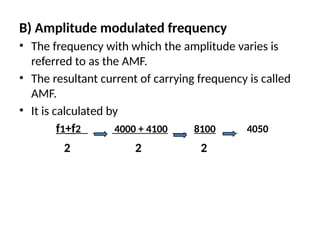
B) Amplitude modulated frequency
• The frequency with which the amplitude varies is
referred to as the AMF.
• The resultant current of carrying frequency is called
AMF.
• It is calculated by
f1+f2 4000 + 4100 8100 4050
2 2 2
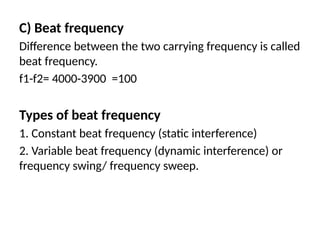
C) Beat frequency
Difference between the two carrying frequency is called
beat frequency.
f1-f2= 4000-3900 =100
Types of beat frequency
1. Constant beat frequency (static interference)
2. Variable beat frequency (dynamic interference) or
frequency swing/ frequency sweep.
1. Constant beat frequency (static interference)
Only using particular constant beat frequency from 10-
200Hz.
Eg. 10Hz or 50Hz ,80Hz or 100Hz .
Disadvantage
• Constant beat frequency may leads to gradually
diminishing sense of IFT to the particular area due to
habituation(accommodation) of tissue to the
particular current. (constant signal).
• This is corrected by continuously varying the beat
frequency. This is called frequency swing. The varying
beat frequency will stimulate different nerve type.
Importance of static interference
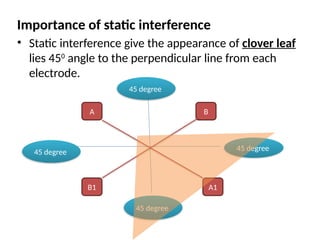
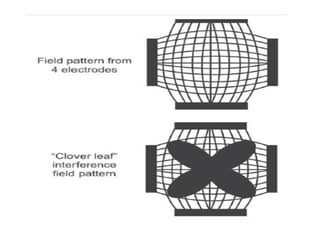
• Static interference give the appearance of clover leaf
lies 450
angle to the perpendicular line from each
electrode.
A B
B1 A1
45 degree
45 degree
45 degree
45 degree
2. Variable Beat frequency (dynamic interference)
The beat frequency changes automatically between
some pre set pair of frequency over a specified time.
Eg. 20-80Hz for a period of 6 seconds and back over
next 6 seconds from 80-20Hz.
Advantage
• This is used to reduce nerve adaptation
• Allows stimulation of greater range of excitable tissue
• Extending the potential of treatment effects.
Importance of dynamic interference
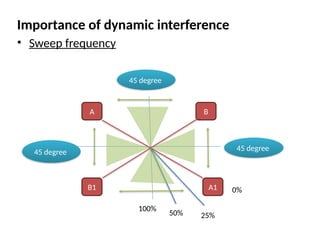
• In variable beat frequency, modulation depth is
expressed as % can be lie between 0-100% (to and fro
movement from 0-100%). It give maximal stimulating
effects.
• Here the depth of modulation depends on the direction
of current flow. 100% of current only on the 450
angle.
It will give more uniform distribution of the
interferential current in the tissue.
• So this is called dynamic interference, dynamic vector,
vector sweep, frequency sweep, scanning, Rotating
vector system, dynamic interference field system.
• Patient experience the varying sensation of the current.
Importance of dynamic interference
• Sweep frequency
A B
B1 A1
45 degree
45 degree
45 degree
100%
50% 25%
0%
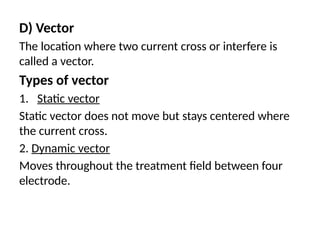
D) Vector
The location where two current cross or interfere is
called a vector.
Types of vector
1. Static vector
Static vector does not move but stays centered where
the current cross.
2. Dynamic vector
Moves throughout the treatment field between four
electrode.
E) Spectrum frequency
Varying frequency prevent accommodation of the tissue.
Eg. 20-80Hz for a period of 6 seconds and back over next
6 seconds from 80-20Hz.
This varying frequency is called spectrum. 3 types –
Narrow, medium and wider spectrum.
F) Balance
If there is a difference in the currents of both channels,
this can be equalized by pressing this key once. Usually
these differences are caused due to the variation in
resistance in the body where the two current are passing.
Method of application of Electrode
• Two channels (4 electrodes) are used to deliver
Interferential current.
• One channel has a set frequency which is called
carrier frequency, other channel has an adjustable
frequency which is used to produce a beat frequency.
• Two method of application available in IFT such as,
1. Four pole method (4EL)
2. Two pole method (2EL)
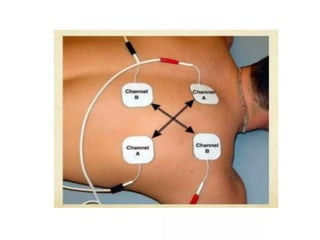
1. Four pole method
• Four electrode are applied in a criss cross pattern or
diagonal pattern.
• Electrode of each pair placed diagonally opposite to
one another.
• Interference of current in this method give the
appearance of clover leaf lies 450
angle to the
perpendicular line from each electrode.
• You can use this method when the painful area is
larger.
• Two medium frequency currents are intersect into
the patient’s tissue when using this method.
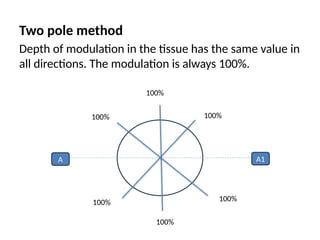
2. Two pole method
• Two electrode are used in this method and the two pre
modulated medium frequency alternative current is
superimposed inside the machine. Resulting AMF is comes
out from machine and pass throughout the region between
two electrode.
• This method is known as Electrokinesy.
• It gives more sensory stimulation than that with 4 pole
method.
• Only useful for the treatment of smaller area.
• Depth of modulation in the tissue has the same value in all
directions. The modulation is always 100%.
• Electrode can be placed co planar or contra planar method.
Two pole method
Depth of modulation in the tissue has the same value in
all directions. The modulation is always 100%.
A A1
100% 100%
100%
100% 100%
100%
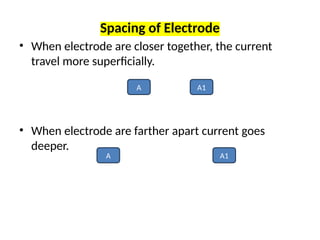
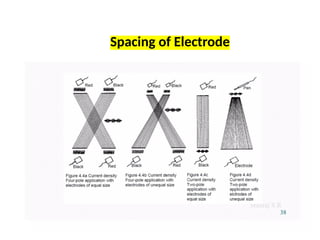
Spacing of Electrode
• When electrode are closer together, the current
travel more superficially.
• When electrode are farther apart current goes
deeper.
A A1
A A1
Spacing of Electrode
Types of Electrode
1. Plate and pad electrode
Standard method of application. Modern plate (made of metal) and
pad electrode (made of conducting rubber) are various size (larger pad
give deeper effects, small pad electrode give localized effects) used
with a removal of sponge jacket. It is important to ensure a firm even
pressure over each electrode. Attached to the patients by means of
straps to assure good contact.
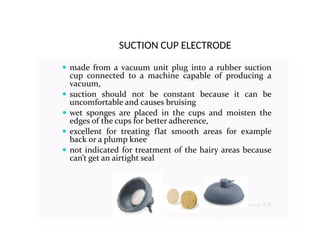
2. Suction cup electrode or vacuum electrode
Attaching electrode to certain body part. Suction cup is contraindicated
in edema and sensitive skin. Several suction unit are available. Some
provide independent control of vacuum pressure in each leads, Other
allow same pressure to all four electrodes. Each single vacuum
connection is important to keep the pressure below 0.25 atm.
Disadvantage- Need entire care with vacuum pressure.
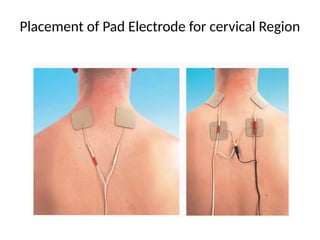
Placement of Pad Electrode for cervical Region
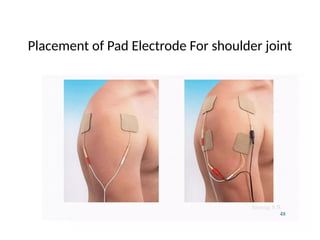
Placement of Pad Electrode For shoulder joint
SUCTION CUP ELECTRODE
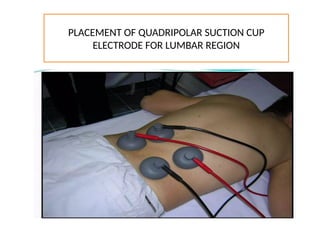
PLACEMENT OF QUADRIPOLAR SUCTION CUP
ELECTRODE FOR LUMBAR REGION
3. Combination of plate and suction cup electrode
2 cup and 2 plate electrode to be used at the same time
- (Rare).
Penetrability in Human Tissue
IFT is useful for large and deep area. IFT stimulate
deeper tissue. TENS is used for smaller and superficial
area.
The vector field can be crossed at the joint providing
more current density.
Types of frequency sweep pattern or Varying the
mode of spectrum.
1. Triangular sweep pattern – Acute cases
2. Trapezoidal sweep pattern – Subacute cases
3. Rectangular sweep pattern - Chronic cases
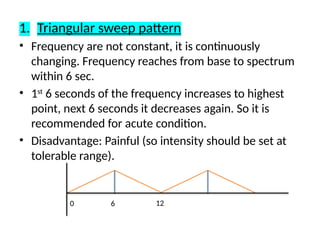
1. Triangular sweep pattern
• Frequency are not constant, it is continuously
changing. Frequency reaches from base to spectrum
within 6 sec.
• 1st
6 seconds of the frequency increases to highest
point, next 6 seconds it decreases again. So it is
recommended for acute condition.
• Disadvantage: Painful (so intensity should be set at
tolerable range).
0 12
6
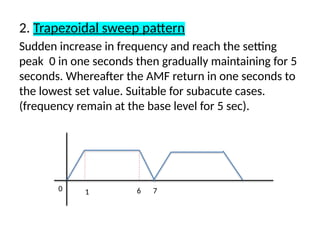
2. Trapezoidal sweep pattern
Sudden increase in frequency and reach the setting
peak 0 in one seconds then gradually maintaining for 5
seconds. Whereafter the AMF return in one seconds to
the lowest set value. Suitable for subacute cases.
(frequency remain at the base level for 5 sec).
1 6 7
0
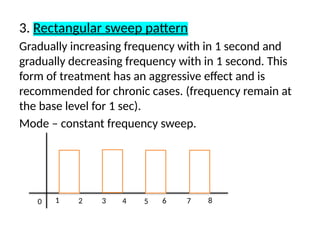
3. Rectangular sweep pattern
Gradually increasing frequency with in 1 second and
gradually decreasing frequency with in 1 second. This
form of treatment has an aggressive effect and is
recommended for chronic cases. (frequency remain at
the base level for 1 sec).
Mode – constant frequency sweep.
0 1 5
2 4
3 8
7
6
Dosage
AMF
AMF – Can be set depends on the nature of the condition,
location of the condition, stages of the condition.
High AMF : 100 – 150Hz constant, 0 – 100Hz rhythmic
• High AMF is useful for Acute condition, severe pain and
hypersensitivity. It felt more comfortable, pleasant or lighter. Hence
it is also performed using an initial treatment of patient who shows
a fear of treatment, it induce vasodilation and decrease edema.
• 50-100Hz or 80-100Hz These have stimulating as well as analgesics
effects in sub acute cases. (used mainly for sedative and spasmolytic
effects in subacute stage).
• 100 -150Hz only for analgesics effects.
High AMF
Low AMF
Low AMF : Frequency below 50Hz fall under this category. It
feel rougher, deeper or heavier. Hence they are used to
subacute and chronic problem.
• 0-10Hz- Rhythmic (useful for muscle contraction – Muscle
re education and also reduce swelling)
• 10-20Hz – Rhythmic (Partial Tetanic contraction)
• 20-50Hz – Rhythmic (Full Tetanic contraction)
Duration of Treatment
• Acute Cases – Low Intensity with short period of Time (10-
15 mins for 10 days)
• Subacute/Chronic – High intensity with long treatment
duration (20-30 mins for 10-15 days), Twice per day.
INDICATIONS
1. Pain and muscle spasm (IFT is effective in relieving neuro
and musculoskeletal pain eg., post herpetic neuralgia,
causalgia, phantom limb pain sensation, shoulder hand
syndrome and also fibrositis, tendinitis, bursitis, tenosynovitis,
epicondylitis, ligament sprain, muscle strain, arthritis, rotator
cuff injury etc).
2. Delayed union and sudek’s atrophy (Constant 100Hz)
3. Haematoma During first 24 hours (Constant 100Hz) together
with ice pack is resolution of haematoma.
4. Chronic edema, 5. Swelling
6. Open wound
7. Gynaecological condition (90-100 Hz Rhythmic is beneficial)
8. Urinary incontinence ( 0-10 Hz Rhythmic )
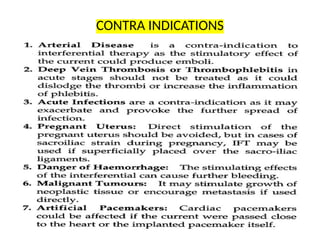
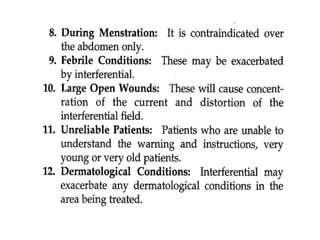
CONTRA INDICATIONS
PHYSIOLOGICAL EFFECTS
Physiological effects of Interferential therapy mainly
depends on the,
1. Magnitude of the current
2. Type of mode used (Rhythmic or constant)
3. Frequency range used
4. Accuracy of electrode positioning.
Most important effects are.,
5. Pain relief
6. Motor Stimulation
7. Removal of Exudates
1. Pain Relief
Pain relief can be achieved by several mechanism such
as.,
a) Stimulation of pain gate control mechanism
Frequency of 100Hz may selectively stimulate large
diameter afferent nerve fibers closes the pain gate by
inhibiting the small diameter nociceptive impulses in
the substantia gelatinosa of posterior horn cell of spinal
cord.
b) Activate the descending pain suppression system
A frequency of 15Hz is required the stimulation of small
diameter afferent nerve fiber will cause the release of
endogenous opiates (enkephalin and beta endorphin)
at a spinal level.
c) Physiological block
High frequency electrical stimuli above 50Hz could
cause a temporary physiological block in both finely
myelinated and unmyelinated nociceptor nerve fiber (A
delta-40 -50Hz and C fibers-15Hz). It is possible, though
not proven.
d) Increased Blood flow
Pain suppression can also be due to an increased local blood
flow and tissue fluid exchange. This may happen by the
removal of chemical irritant in the pain area. It also
stimulate the autonomic nervous system cause mild muscle
contraction has a pumping effects on vessels. (Vasodilation
+ pumping effect).
2. Absorption of Exudate
The frequency of 1-10Hz rhythmic as a rhythmical pumping
action is produced by muscle contraction and there is an
effect on autonomic nerve. Therefore Vasodilation +
pumping effect both of these factors help absorb exudate
and thus reduce swelling.
3. Muscle contraction
The lower beat frequency stimulate motor nerves
leading to contraction of voluntary muscles mainly at
10-50Hz. Used for the treatment of urinary
incontinence.
PRECAUTIONS
1. Precaution to the patients
 Patients with febrile condition
 Epileptic patients
 Over anterior chest wall
 Suction electrode should be below the level of
damage or discomfort.
2. Precaution to the Machine
 IFT Apparatus must be at least 6 meters away from
the SWD machine.
3. Precaution to the Therapist
 Avoid touching the bare electrode to the patient’s
skin when the machine is on why because it will
sometimes produce electric shock or tissue burn.
 Proper placement of electrode (i.e) Not too close, it
may cause passing current between electrode not
through the tissues.
 Turn up the current intensity until the patient
experience mild tingling sensation. It shouldn’t be
too uncomfortable.
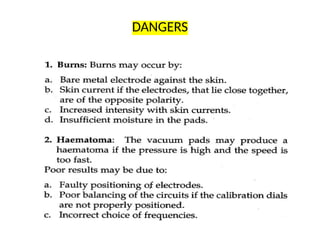
DANGERS
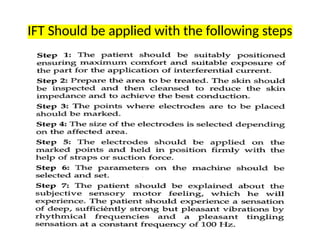
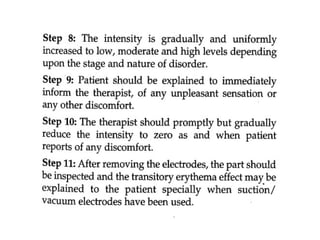
IFT Should be applied with the following steps
PROFORMA FOR PATIENT’S ASSESSMENT
1. Receiving the patient:
Good morning sir I am a physiotherapist, I’m going to treat you. Please, cooperate
with me during the treatment and If you feel any discomfort during the
treatment session please tell me, wait until I go through your case sheet.
2. History taking or going through the case sheet:
– Name
– Age
– Sex
– Occupation
– Address
– Chief complaints
–Present History
– Past History
– Family history
– Socioeconomic status
3. Investigations:
i. Hematological tests
ii. Radiological tests— X- rays, MRI scan, etc.
4. Checking for general contraindications:
– Hyperpyrexia
– Hypertension
– Anaemia
– Severe renal and cardiac failure
– Deep X-ray and cobalt therapy
– Epileptic patients
– Non cooperative patients
– Mentally retarded patients
– Very poor general condition of the patient.
5. Checking for local contraindications:
– Open wounds
– Very recent fractures
– Skin grafts
– Severe edema
– Hairy surface
– Acute inflammation
– Metal in the part
– Malignant growth
– Hypersensitive skin
– Loss of sensation
6. Preparation of trays:
– Treatment tray
– Skin resistance lowering tray.
Treatment tray:
1. Pad, plate, pen or suction cup electrode
2. Leads
3. Straps
4. Gel
5. Weights (sand bags)
6. Cotton
7. Removal sponge jacket
8. Mackintosh sheet
9. powder
Skin resistance lowering tray:
1. Saline water
2. Cotton
3. Towels, etc.
7. Preparation of apparatus:
– Check whether all the knobs are at Zero.
– Checking the pins of the plug and check whether the switch is
turned off.
– Check the insulation of the wire.
– Check whether the switch in the stimulator is working.
– Check whether fuse is present in the apparatus; see that it is not
blown out.
– Check whether hand switch for patients use is intact and is
working.
8. Correct positioning of the patient:
– Position the patient in such a way that it is comfortable
to the patient.
– Part to be treated must be exposed and should be at
adequate distance from the modality.
9. Correct positioning of Physiotherapist:
– Position should be such that it provides maximum
accessibility to the treatment part and to the modality.
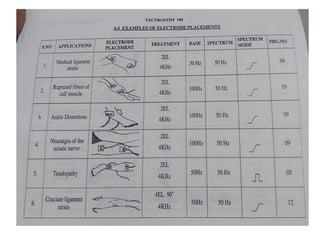
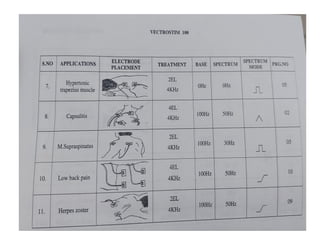
10. Correct placing of pads electrodes
11. Instructions to the patient:
I am going to start the treatment.
– Be relaxed
– Don’t touch anything around you
– Don’t pull the leads
– Don’t touch the walls or ground
– If you feel uneasy switch off from the patients switch.
12. Regulating the current:
– Gradually increase the current
– Keep talking with the patient about the feel of the current
– Tell him to inform you immediately about any
inconvenience, discomfort or burning sensation.
13. Explanation to the patient:
– Explain the patient the advantages of the treatment
– Explain the patient the course or duration of the treatment
– Explain do’s and don’ts to the patients.
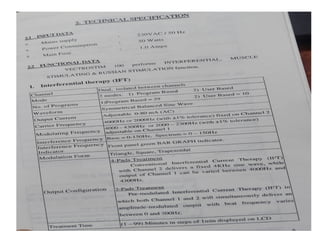
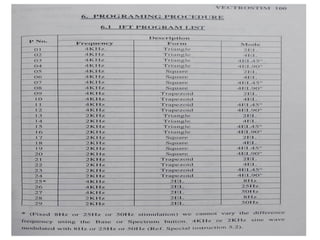
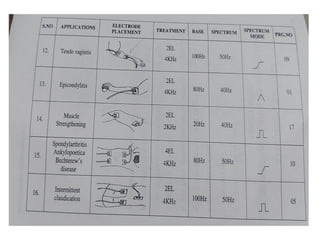
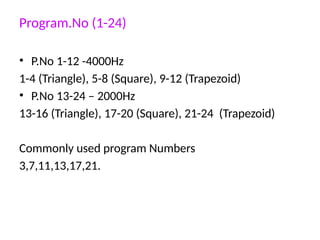
Program.No (1-24)
• P.No 1-12 -4000Hz
1-4 (Triangle), 5-8 (Square), 9-12 (Trapezoid)
• P.No 13-24 – 2000Hz
13-16 (Triangle), 17-20 (Square), 21-24 (Trapezoid)
Commonly used program Numbers
3,7,11,13,17,21.
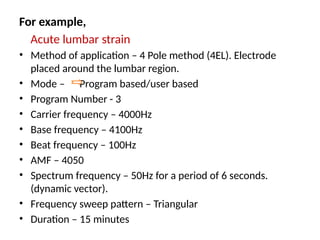
For example,
Acute lumbar strain
• Method of application – 4 Pole method (4EL). Electrode
placed around the lumbar region.
• Mode – Program based/user based
• Program Number - 3
• Carrier frequency – 4000Hz
• Base frequency – 4100Hz
• Beat frequency – 100Hz
• AMF – 4050
• Spectrum frequency – 50Hz for a period of 6 seconds.
(dynamic vector).
• Frequency sweep pattern – Triangular
• Duration – 15 minutes
Thank you

IFT - Jayabharathi.pptx for physiotherapy students

  • 1.
    INTERFERENTIAL THERAPY Presented by, Dr.R. Jayabharathi M.P.T (Ortho)., PGDHM., Assistant Professor School of Physiotherapy SBV
  • 2.
    Therapeutic currents • Currentsused for the treatment purpose. • According to the difference in the frequencies, the current can be divided into following three types. 1. Low frequency current: Frequency ranging from 1-1000 Hz. Eg., TENS, Galvanic current, Faradic current. 2. Medium frequency current: Frequency ranging from 1000 – 10000 Hz. Eg., IFT, Russian current. 3. High frequency current: Frequency above 10000 Hz. Eg., SWD, MWD, UST, IRR.
  • 3.
    History The research anduse of interferential current have taken place primarily in Europe. An Austrian scientist Hons Nemec introduce the concept and suggested its therapeutic use (1949). Interferential current is also known as Nemec’s Current. Definition Two medium frequency currents are used to bring about the low frequency current effect in the tissue.
  • 4.
    Definition Wave form producedby the interference of two medium frequency alternating current of slightly different frequencies. These two wave form are delivered through 2 set of electrode through separate channels in the same stimulator. Electrode are configured on the skin so that the 2 AC Current intersect into the tissue to form the beat frequency.
  • 5.
    • This isachieved by applying two medium frequency current to the tissue to generate low frequency interference current. • Thus the benefits of low frequency stimulations are achieved without the association of unpleasant side effect like pain, discomfort, skin irritation etc. • Direct application of low frequency current result in pain due to high impedence of tissue. (Living skin tissue is covered by a layer of dead skin cells and these dead cells provide high impedence interface between the electrode and living skin tissue).
  • 8.
    Principle Application of electricalenergy through the tissue in which two medium frequency AC of around 4000Hz slightly out of phase at the point of intersecting produce (AMF) an amplitude modulated current of low frequency through the effect of interference.
  • 9.
    TERMS USED ININTERFERENTIAL THERAPY A) Base Frequency • Two Alternative medium frequency current of same amplitude slightly different frequency, this carrying frequency is called base frequency. • One current at constant frequency (A) of 4000Hz and another current at variable frequency (B) of 4100. • The superimposition of one alternating current on the other is called interference.
  • 10.
    B) Amplitude modulatedfrequency • The frequency with which the amplitude varies is referred to as the AMF. • The resultant current of carrying frequency is called AMF. • It is calculated by f1+f2 4000 + 4100 8100 4050 2 2 2
  • 14.
    C) Beat frequency Differencebetween the two carrying frequency is called beat frequency. f1-f2= 4000-3900 =100 Types of beat frequency 1. Constant beat frequency (static interference) 2. Variable beat frequency (dynamic interference) or frequency swing/ frequency sweep.
  • 15.
    1. Constant beatfrequency (static interference) Only using particular constant beat frequency from 10- 200Hz. Eg. 10Hz or 50Hz ,80Hz or 100Hz . Disadvantage • Constant beat frequency may leads to gradually diminishing sense of IFT to the particular area due to habituation(accommodation) of tissue to the particular current. (constant signal). • This is corrected by continuously varying the beat frequency. This is called frequency swing. The varying beat frequency will stimulate different nerve type.
  • 16.
    Importance of staticinterference • Static interference give the appearance of clover leaf lies 450 angle to the perpendicular line from each electrode. A B B1 A1 45 degree 45 degree 45 degree 45 degree
  • 18.
    2. Variable Beatfrequency (dynamic interference) The beat frequency changes automatically between some pre set pair of frequency over a specified time. Eg. 20-80Hz for a period of 6 seconds and back over next 6 seconds from 80-20Hz. Advantage • This is used to reduce nerve adaptation • Allows stimulation of greater range of excitable tissue • Extending the potential of treatment effects.
  • 19.
    Importance of dynamicinterference • In variable beat frequency, modulation depth is expressed as % can be lie between 0-100% (to and fro movement from 0-100%). It give maximal stimulating effects. • Here the depth of modulation depends on the direction of current flow. 100% of current only on the 450 angle. It will give more uniform distribution of the interferential current in the tissue. • So this is called dynamic interference, dynamic vector, vector sweep, frequency sweep, scanning, Rotating vector system, dynamic interference field system. • Patient experience the varying sensation of the current.
  • 20.
    Importance of dynamicinterference • Sweep frequency A B B1 A1 45 degree 45 degree 45 degree 100% 50% 25% 0%
  • 21.
    D) Vector The locationwhere two current cross or interfere is called a vector. Types of vector 1. Static vector Static vector does not move but stays centered where the current cross. 2. Dynamic vector Moves throughout the treatment field between four electrode.
  • 22.
    E) Spectrum frequency Varyingfrequency prevent accommodation of the tissue. Eg. 20-80Hz for a period of 6 seconds and back over next 6 seconds from 80-20Hz. This varying frequency is called spectrum. 3 types – Narrow, medium and wider spectrum. F) Balance If there is a difference in the currents of both channels, this can be equalized by pressing this key once. Usually these differences are caused due to the variation in resistance in the body where the two current are passing.
  • 23.
    Method of applicationof Electrode • Two channels (4 electrodes) are used to deliver Interferential current. • One channel has a set frequency which is called carrier frequency, other channel has an adjustable frequency which is used to produce a beat frequency. • Two method of application available in IFT such as, 1. Four pole method (4EL) 2. Two pole method (2EL)
  • 24.
    1. Four polemethod • Four electrode are applied in a criss cross pattern or diagonal pattern. • Electrode of each pair placed diagonally opposite to one another. • Interference of current in this method give the appearance of clover leaf lies 450 angle to the perpendicular line from each electrode. • You can use this method when the painful area is larger. • Two medium frequency currents are intersect into the patient’s tissue when using this method.
  • 26.
    2. Two polemethod • Two electrode are used in this method and the two pre modulated medium frequency alternative current is superimposed inside the machine. Resulting AMF is comes out from machine and pass throughout the region between two electrode. • This method is known as Electrokinesy. • It gives more sensory stimulation than that with 4 pole method. • Only useful for the treatment of smaller area. • Depth of modulation in the tissue has the same value in all directions. The modulation is always 100%. • Electrode can be placed co planar or contra planar method.
  • 27.
    Two pole method Depthof modulation in the tissue has the same value in all directions. The modulation is always 100%. A A1 100% 100% 100% 100% 100% 100%
  • 28.
    Spacing of Electrode •When electrode are closer together, the current travel more superficially. • When electrode are farther apart current goes deeper. A A1 A A1
  • 29.
  • 30.
    Types of Electrode 1.Plate and pad electrode Standard method of application. Modern plate (made of metal) and pad electrode (made of conducting rubber) are various size (larger pad give deeper effects, small pad electrode give localized effects) used with a removal of sponge jacket. It is important to ensure a firm even pressure over each electrode. Attached to the patients by means of straps to assure good contact. 2. Suction cup electrode or vacuum electrode Attaching electrode to certain body part. Suction cup is contraindicated in edema and sensitive skin. Several suction unit are available. Some provide independent control of vacuum pressure in each leads, Other allow same pressure to all four electrodes. Each single vacuum connection is important to keep the pressure below 0.25 atm. Disadvantage- Need entire care with vacuum pressure.
  • 31.
    Placement of PadElectrode for cervical Region
  • 32.
    Placement of PadElectrode For shoulder joint
  • 33.
  • 34.
    PLACEMENT OF QUADRIPOLARSUCTION CUP ELECTRODE FOR LUMBAR REGION
  • 35.
    3. Combination ofplate and suction cup electrode 2 cup and 2 plate electrode to be used at the same time - (Rare).
  • 36.
    Penetrability in HumanTissue IFT is useful for large and deep area. IFT stimulate deeper tissue. TENS is used for smaller and superficial area. The vector field can be crossed at the joint providing more current density. Types of frequency sweep pattern or Varying the mode of spectrum. 1. Triangular sweep pattern – Acute cases 2. Trapezoidal sweep pattern – Subacute cases 3. Rectangular sweep pattern - Chronic cases
  • 37.
    1. Triangular sweeppattern • Frequency are not constant, it is continuously changing. Frequency reaches from base to spectrum within 6 sec. • 1st 6 seconds of the frequency increases to highest point, next 6 seconds it decreases again. So it is recommended for acute condition. • Disadvantage: Painful (so intensity should be set at tolerable range). 0 12 6
  • 38.
    2. Trapezoidal sweeppattern Sudden increase in frequency and reach the setting peak 0 in one seconds then gradually maintaining for 5 seconds. Whereafter the AMF return in one seconds to the lowest set value. Suitable for subacute cases. (frequency remain at the base level for 5 sec). 1 6 7 0
  • 39.
    3. Rectangular sweeppattern Gradually increasing frequency with in 1 second and gradually decreasing frequency with in 1 second. This form of treatment has an aggressive effect and is recommended for chronic cases. (frequency remain at the base level for 1 sec). Mode – constant frequency sweep. 0 1 5 2 4 3 8 7 6
  • 40.
    Dosage AMF AMF – Canbe set depends on the nature of the condition, location of the condition, stages of the condition. High AMF : 100 – 150Hz constant, 0 – 100Hz rhythmic • High AMF is useful for Acute condition, severe pain and hypersensitivity. It felt more comfortable, pleasant or lighter. Hence it is also performed using an initial treatment of patient who shows a fear of treatment, it induce vasodilation and decrease edema. • 50-100Hz or 80-100Hz These have stimulating as well as analgesics effects in sub acute cases. (used mainly for sedative and spasmolytic effects in subacute stage). • 100 -150Hz only for analgesics effects. High AMF Low AMF
  • 41.
    Low AMF :Frequency below 50Hz fall under this category. It feel rougher, deeper or heavier. Hence they are used to subacute and chronic problem. • 0-10Hz- Rhythmic (useful for muscle contraction – Muscle re education and also reduce swelling) • 10-20Hz – Rhythmic (Partial Tetanic contraction) • 20-50Hz – Rhythmic (Full Tetanic contraction) Duration of Treatment • Acute Cases – Low Intensity with short period of Time (10- 15 mins for 10 days) • Subacute/Chronic – High intensity with long treatment duration (20-30 mins for 10-15 days), Twice per day.
  • 42.
    INDICATIONS 1. Pain andmuscle spasm (IFT is effective in relieving neuro and musculoskeletal pain eg., post herpetic neuralgia, causalgia, phantom limb pain sensation, shoulder hand syndrome and also fibrositis, tendinitis, bursitis, tenosynovitis, epicondylitis, ligament sprain, muscle strain, arthritis, rotator cuff injury etc). 2. Delayed union and sudek’s atrophy (Constant 100Hz) 3. Haematoma During first 24 hours (Constant 100Hz) together with ice pack is resolution of haematoma. 4. Chronic edema, 5. Swelling 6. Open wound 7. Gynaecological condition (90-100 Hz Rhythmic is beneficial) 8. Urinary incontinence ( 0-10 Hz Rhythmic )
  • 43.
  • 45.
    PHYSIOLOGICAL EFFECTS Physiological effectsof Interferential therapy mainly depends on the, 1. Magnitude of the current 2. Type of mode used (Rhythmic or constant) 3. Frequency range used 4. Accuracy of electrode positioning. Most important effects are., 5. Pain relief 6. Motor Stimulation 7. Removal of Exudates
  • 46.
    1. Pain Relief Painrelief can be achieved by several mechanism such as., a) Stimulation of pain gate control mechanism Frequency of 100Hz may selectively stimulate large diameter afferent nerve fibers closes the pain gate by inhibiting the small diameter nociceptive impulses in the substantia gelatinosa of posterior horn cell of spinal cord.
  • 47.
    b) Activate thedescending pain suppression system A frequency of 15Hz is required the stimulation of small diameter afferent nerve fiber will cause the release of endogenous opiates (enkephalin and beta endorphin) at a spinal level. c) Physiological block High frequency electrical stimuli above 50Hz could cause a temporary physiological block in both finely myelinated and unmyelinated nociceptor nerve fiber (A delta-40 -50Hz and C fibers-15Hz). It is possible, though not proven.
  • 48.
    d) Increased Bloodflow Pain suppression can also be due to an increased local blood flow and tissue fluid exchange. This may happen by the removal of chemical irritant in the pain area. It also stimulate the autonomic nervous system cause mild muscle contraction has a pumping effects on vessels. (Vasodilation + pumping effect). 2. Absorption of Exudate The frequency of 1-10Hz rhythmic as a rhythmical pumping action is produced by muscle contraction and there is an effect on autonomic nerve. Therefore Vasodilation + pumping effect both of these factors help absorb exudate and thus reduce swelling.
  • 49.
    3. Muscle contraction Thelower beat frequency stimulate motor nerves leading to contraction of voluntary muscles mainly at 10-50Hz. Used for the treatment of urinary incontinence.
  • 50.
    PRECAUTIONS 1. Precaution tothe patients  Patients with febrile condition  Epileptic patients  Over anterior chest wall  Suction electrode should be below the level of damage or discomfort. 2. Precaution to the Machine  IFT Apparatus must be at least 6 meters away from the SWD machine.
  • 51.
    3. Precaution tothe Therapist  Avoid touching the bare electrode to the patient’s skin when the machine is on why because it will sometimes produce electric shock or tissue burn.  Proper placement of electrode (i.e) Not too close, it may cause passing current between electrode not through the tissues.  Turn up the current intensity until the patient experience mild tingling sensation. It shouldn’t be too uncomfortable.
  • 52.
  • 53.
    IFT Should beapplied with the following steps
  • 55.
    PROFORMA FOR PATIENT’SASSESSMENT 1. Receiving the patient: Good morning sir I am a physiotherapist, I’m going to treat you. Please, cooperate with me during the treatment and If you feel any discomfort during the treatment session please tell me, wait until I go through your case sheet. 2. History taking or going through the case sheet: – Name – Age – Sex – Occupation – Address – Chief complaints –Present History – Past History – Family history – Socioeconomic status
  • 56.
    3. Investigations: i. Hematologicaltests ii. Radiological tests— X- rays, MRI scan, etc. 4. Checking for general contraindications: – Hyperpyrexia – Hypertension – Anaemia – Severe renal and cardiac failure – Deep X-ray and cobalt therapy – Epileptic patients – Non cooperative patients – Mentally retarded patients – Very poor general condition of the patient.
  • 57.
    5. Checking forlocal contraindications: – Open wounds – Very recent fractures – Skin grafts – Severe edema – Hairy surface – Acute inflammation – Metal in the part – Malignant growth – Hypersensitive skin – Loss of sensation
  • 58.
    6. Preparation oftrays: – Treatment tray – Skin resistance lowering tray. Treatment tray: 1. Pad, plate, pen or suction cup electrode 2. Leads 3. Straps 4. Gel 5. Weights (sand bags) 6. Cotton 7. Removal sponge jacket 8. Mackintosh sheet 9. powder
  • 59.
    Skin resistance loweringtray: 1. Saline water 2. Cotton 3. Towels, etc. 7. Preparation of apparatus: – Check whether all the knobs are at Zero. – Checking the pins of the plug and check whether the switch is turned off. – Check the insulation of the wire. – Check whether the switch in the stimulator is working. – Check whether fuse is present in the apparatus; see that it is not blown out. – Check whether hand switch for patients use is intact and is working.
  • 60.
    8. Correct positioningof the patient: – Position the patient in such a way that it is comfortable to the patient. – Part to be treated must be exposed and should be at adequate distance from the modality. 9. Correct positioning of Physiotherapist: – Position should be such that it provides maximum accessibility to the treatment part and to the modality. 10. Correct placing of pads electrodes
  • 61.
    11. Instructions tothe patient: I am going to start the treatment. – Be relaxed – Don’t touch anything around you – Don’t pull the leads – Don’t touch the walls or ground – If you feel uneasy switch off from the patients switch. 12. Regulating the current: – Gradually increase the current – Keep talking with the patient about the feel of the current – Tell him to inform you immediately about any inconvenience, discomfort or burning sensation.
  • 62.
    13. Explanation tothe patient: – Explain the patient the advantages of the treatment – Explain the patient the course or duration of the treatment – Explain do’s and don’ts to the patients.
  • 68.
    Program.No (1-24) • P.No1-12 -4000Hz 1-4 (Triangle), 5-8 (Square), 9-12 (Trapezoid) • P.No 13-24 – 2000Hz 13-16 (Triangle), 17-20 (Square), 21-24 (Trapezoid) Commonly used program Numbers 3,7,11,13,17,21.
  • 69.
    For example, Acute lumbarstrain • Method of application – 4 Pole method (4EL). Electrode placed around the lumbar region. • Mode – Program based/user based • Program Number - 3 • Carrier frequency – 4000Hz • Base frequency – 4100Hz • Beat frequency – 100Hz • AMF – 4050 • Spectrum frequency – 50Hz for a period of 6 seconds. (dynamic vector). • Frequency sweep pattern – Triangular • Duration – 15 minutes
  • 70.