Interferential therapy
Module Teacher
Ehsanur Rahman
BscPT. MScPT (DU)
Associate Professor, PT Dept, BHPI
Ehsanur Rahman
Associate Professor, MPT Co-ordinator
History
It may be described as the transcutaneous application of alternating
medium frequency electrical currents; amplitude modulated a low
frequency for therapeutic purposes.
Introduced in 1905’s by Hans Nemec in Vienna.
Interferential therapy uses two medium frequency currents around 4000
Hz to evoke interference currents between 1 & 100 Hz.
Ehsanur Rahman
Associate Professor, MPT Co-ordinator
Definition
• Interferential therapy is a form of electrical treatment in which two
medium frequency currents are used to produce a low frequency effect
at any tissue depth without the problem of skin resistance.
Ehsanur Rahman
Associate Professor, MPT Co-ordinator
Principle of IFT
• Interferential therapy is a method of producing low frequency alternating
currents selectively at any tissue depth, without the problem of skin
resistance, & stimulate nerve & muscle.
Ehsanur Rahman
Associate Professor, MPT Co-ordinator
Skin resistance
• Medium frequency currents, associated with a relatively lower skin
resistance, are believed generally to be more comfortable than low-
frequency currents; thus using a medium frequency , a more tolerable
penetration of current through the skin is possible.
• The following equation describe the relationship between frequency &
impedance –
• Z = 1/ 2FC,
• Where, Z = impedance in Ohms, F = frequency in Hz & C = capacity of
the skin in microfarads.
Ehsanur Rahman
Associate Professor, MPT Co-ordinator
Amplitude modulation/ the interference effect
 Amplitude modulation is a term used to describe the transmission of an
information – containing signal by varying the amplitude of a carrier wave.
 When two differing unmodulated medium frequency alternating
currents are applied simultaneously to the tissue, through a paired
electrodes, a vibration is generated in the tissue where the currents
cross , the intensity of the combined currents will increases & decreases
rhythmically. This is called interference effect.
 The combined current has a beat frequency which is the difference
between, also known as a amplitude modulation frequency & it is this
which triggers the nerve & muscle impulse.
Ehsanur Rahman
Associate Professor, MPT Co-ordinator
Amplitude modulation/ the
interference effect cont..
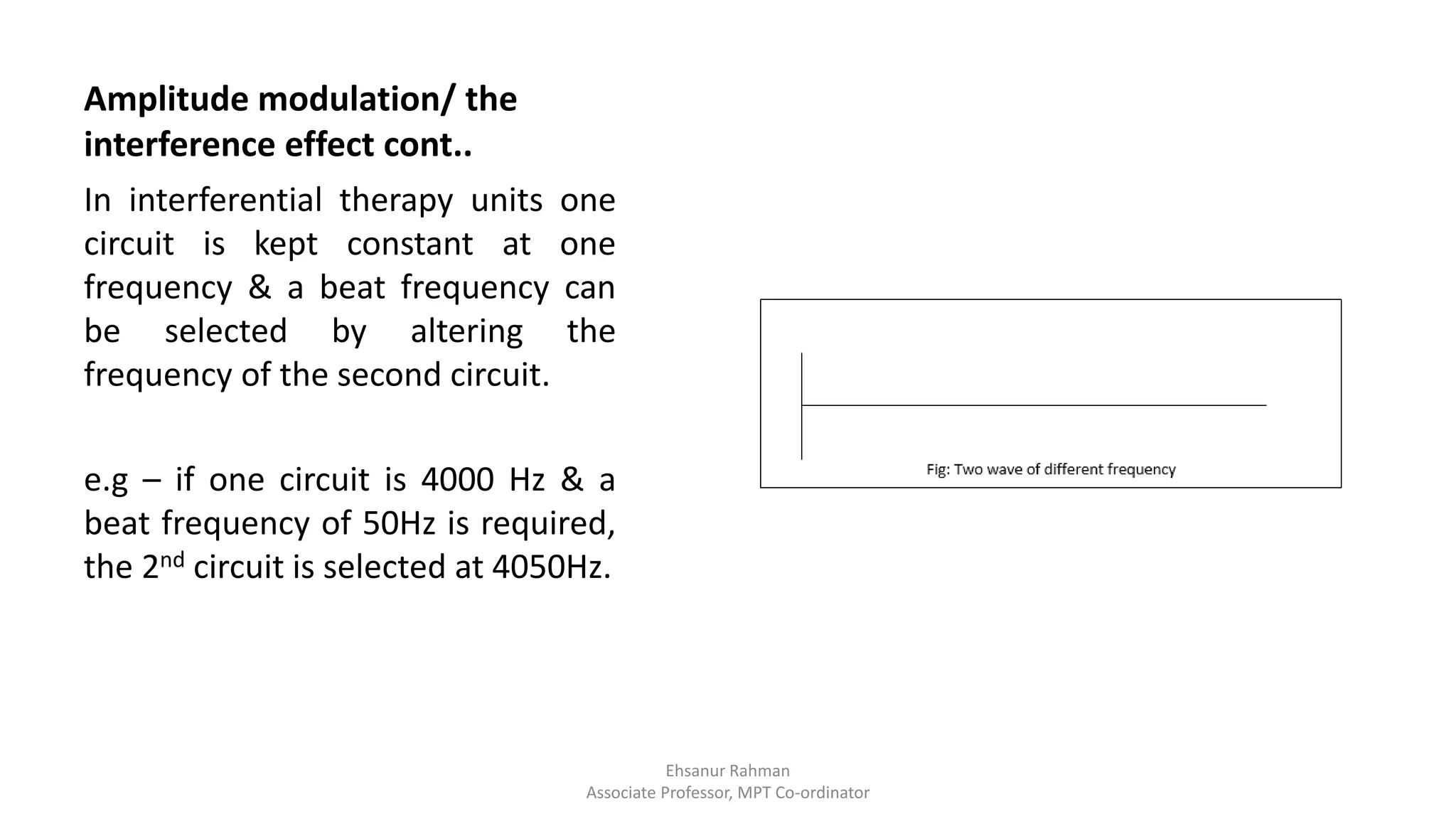
In interferential therapy units one
circuit is kept constant at one
frequency & a beat frequency can
be selected by altering the
frequency of the second circuit.
e.g – if one circuit is 4000 Hz & a
beat frequency of 50Hz is required,
the 2nd circuit is selected at 4050Hz.
Ehsanur Rahman
Associate Professor, MPT Co-ordinator
Production of IFT
 IFT generator is equipped with two oscillator circuit which produce a
fixed frequency in one circuit & a variable frequency in the other
circuit. Frequency ranges from 4000 Hz – 5100Hz.
 The medium frequency currents are applied to the tissue by means of
a pair electrodes for each circuit, using a quadripolar technique, placed
perpendicularly to each other.
 The electrodes are positioned so that the area where the two current
cross each other, is directly over the lesion.
 Most machine allow for a constant beat frequency to be selected
(constant mode). It is also possible to rhythmically & regularly change
the beat frequency over a specific period of time = frequency
modulation/ sweep/ swing.
 The frequency using continuously, changing the frequencies from the
lower value to the higher value. To prevent accommodation of nerve.
Ehsanur Rahman
Associate Professor, MPT Co-ordinator
Production of IFT cont..
• Rotating vector – vary the
strength of the current
relative to each other. The
interference pattern will
rotate to an angle of 45° in
each direction to ensure
that a wide area can be
covered by interferential
current.
• If the site of lesion cannot
be localized, than rotating
vector is selected.
Ehsanur Rahman
Associate Professor, MPT Co-ordinator
Physiological effects of IFT
• The physiological effects on tissue depends on the
following factors -
Frequency
Mode – constant/ rhythmic
Intensity of current used
Position of electrode
Patency of circulation & neurological function.
• 100 Hz constant –
a) Vasodilatation
b) Heat production
c) Alter ion distribution locally
d) Relieve pain. Ehsanur Rahman
Associate Professor, MPT Co-ordinator
Physiological effects of IFT cont…
• 1 to 10 Hz constant –
a) Effect on motor nerve & cause muscle contraction
b) Stimulate only innervated muscle
c) Mobilize tissue ion
• 1 to 100 Hz rhythmic –
a) Facilitate ion movement in the cell.
b) Relaxation of muscle
c) Hyperaemia
d) Increase venous & lymphatic flow
e) Reduce oedema
f) Facilitate tissue healing.
Ehsanur Rahman
Associate Professor, MPT Co-ordinator
Physiological effects of IFT cont…
• 90 to 100 Hz rhythmic –
a) Analgesic effect
b) Vasodilatation
c) Effective for migraine & brachial neuralgia.
• 1 to 10 Hz rhythmic –
a) Effect on motor nerve & tissue
b) Vasodilatation.
Ehsanur Rahman
Associate Professor, MPT Co-ordinator
Therapeutic effects
Relief of pain: Interferential currents are frequently employed for
pain relief.
A placebo effect: Since Interferential machines are technically
impressive and produces a pleasant effect, so there is a placebo
effect by this therapy.
Muscle contraction: Muscle contraction can also be achieved at
higher current amplitude. Strong muscle contractions can be
achieved without any significantly uncomfortable skin resolution.
Control of swelling: As muscle contraction happens in
interferential therapy, the muscle contraction can control swelling
and oedema.
Treatment of stress incontinence: After pelvic floor exercise,
interferential therapy is very useful in case of treatment of stress
incontinence.
Ehsanur Rahman
Associate Professor, MPT Co-ordinator
Indication
• Pain –
• by stimulating of Aβ fiber.
• There is no fixed frequency for different condition, but a guide
line is
i. 100Hz – activation of pain gate mechanism
ii. 10 to 25 Hz – encephalin & endorphin release by stimulation of
Aδ & C finer.
iii. 50Hz – temporary physiological block of finely myelinated/ non
myelinated nociceptive fiber. Most comfortable.
iv. 10 to 150Hz – parasympathetic stimulation – increase blood
flow, remove chemical irritant & decrease edema.
v. 0 to 5 Hz – sympathetic stimulation – increase blood flow,
remove chemical irritant & decrease oedema.
Ehsanur Rahman
Associate Professor, MPT Co-ordinator
Indication cont..
• Oedema – increase venous & lymphatic flow, aiding the absorption
of exudation.
• Muscle stimulation – muscle contraction. Useful for deep muscle &
stress incontinence.
• Tissue healing – as it effect cellular activity.
• Muscle Spasm - Electrokinesy currents have been used effectively
for muscle spasm.
• Heamatoma – During the first 24 hours, 200 Hz constant, together
with ice pack interferential therapy is useful for the resolution of
heamatoma.
Ehsanur Rahman
Associate Professor, MPT Co-ordinator
Application of IFT
• Machine setting –
Setting for frequency – beat frequency/ variable beat
frequency/ time for variable beat frequency.
Intensity – as intensity increases the patient will feel a tingling
sensation.
Sensory effect is gained at 4 – 10 mA.
Motor effect is gained at 8 – 15 mA.
Setting for rotating vector – on/off..
Ehsanur Rahman
Associate Professor, MPT Co-ordinator
Application of IFT cont…
• Electrode placement –
4 electrodes, 2 for each circuit.
Carbon rubber or metal electrode.
Placed over a damp sponge for good skin contact.
Attached to the body with strap.
Electrode are placed diagonally each other, so that 2
currents will interfere in the correct area.
Ehsanur Rahman
Associate Professor, MPT Co-ordinator
Method of application
• Patient preparation –
• Explanation – nature of treatment
• Feeling of treatment.
• Suitable comfortable position.
• Wash the skin with warm soapy water to decrease skin resistance.
• Place the electrode.
• Switch on the machine, select all setting. Frequency, intensity,
rotating vector, time.
• Gradually increase the intensity, until it can be felt by patient.
• It is necessary to increase the intensity periodically as
accommodation will occur.
• After completion of treatment remove the pad & check the skin.
Ehsanur Rahman Associate Professor, MPT Co-ordinator
Contraindication
 Anti coagulant therapy - within last three month. Risk
of haemmorrahing.
 Arterial disease.
 Deep vein thrombosis – the thrombi may dislodge.
 Infective condition.
 Pregnant uterus/ during menstruation.
 Malignant tumor.
 Pace maker.
 Open wound. Skin lesion.
Ehsanur Rahman
Associate Professor, MPT Co-ordinator
Dosage
• The intensity depends on following factors-
I. Frequency – Higher frequency less sensitive and lower frequency high
sensitive.
II. Size of electrodes – The smaller the electrode, the greater the
concentration of current.
III. Duration – The sensation reduces after a few minutes.
• The intensity is not determined by the machine it is determined by
the patient’s reaction. The intensity is divided into following types –
i. Low dose – not noticeable by the patient.
ii. Medium dose – just noticeable
iii. High dose - a vigorous pleasant sensation
iv. Very high dose – strong, vigorous, almost unpleasant sensation.
Ehsanur Rahman
Associate Professor, MPT Co-ordinator
Advantages
• Large doses of interferential current can be given without the fear
of producing a chemical burn and surface discomfort.
• Decreased skin sensation is not a contra-indication to treatment,
as the patient’s deep sensation and the meter on the unit are
satisfactory guide.
• The current can be localized more effectively in a specific area by
careful positioning of the electrodes. Lesions at any depth and in
an extensive area can be treated.
• Metal is not a contra indication. There are a number of problems
of pain and swelling in patients with metal implants which can be
eased effectively by interferential currents.
• Referred pain can be effectively treated in some cancer patients.
Ehsanur Rahman
Associate Professor, MPT Co-ordinator
Ehsanur Rahman
Associate Professor, MPT Co-ordinator

IFT.pdf

  • 1.
    Interferential therapy Module Teacher EhsanurRahman BscPT. MScPT (DU) Associate Professor, PT Dept, BHPI Ehsanur Rahman Associate Professor, MPT Co-ordinator
  • 2.
    History It may bedescribed as the transcutaneous application of alternating medium frequency electrical currents; amplitude modulated a low frequency for therapeutic purposes. Introduced in 1905’s by Hans Nemec in Vienna. Interferential therapy uses two medium frequency currents around 4000 Hz to evoke interference currents between 1 & 100 Hz. Ehsanur Rahman Associate Professor, MPT Co-ordinator
  • 3.
    Definition • Interferential therapyis a form of electrical treatment in which two medium frequency currents are used to produce a low frequency effect at any tissue depth without the problem of skin resistance. Ehsanur Rahman Associate Professor, MPT Co-ordinator
  • 4.
    Principle of IFT •Interferential therapy is a method of producing low frequency alternating currents selectively at any tissue depth, without the problem of skin resistance, & stimulate nerve & muscle. Ehsanur Rahman Associate Professor, MPT Co-ordinator
  • 5.
    Skin resistance • Mediumfrequency currents, associated with a relatively lower skin resistance, are believed generally to be more comfortable than low- frequency currents; thus using a medium frequency , a more tolerable penetration of current through the skin is possible. • The following equation describe the relationship between frequency & impedance – • Z = 1/ 2FC, • Where, Z = impedance in Ohms, F = frequency in Hz & C = capacity of the skin in microfarads. Ehsanur Rahman Associate Professor, MPT Co-ordinator
  • 6.
    Amplitude modulation/ theinterference effect  Amplitude modulation is a term used to describe the transmission of an information – containing signal by varying the amplitude of a carrier wave.  When two differing unmodulated medium frequency alternating currents are applied simultaneously to the tissue, through a paired electrodes, a vibration is generated in the tissue where the currents cross , the intensity of the combined currents will increases & decreases rhythmically. This is called interference effect.  The combined current has a beat frequency which is the difference between, also known as a amplitude modulation frequency & it is this which triggers the nerve & muscle impulse. Ehsanur Rahman Associate Professor, MPT Co-ordinator
  • 7.
    Amplitude modulation/ the interferenceeffect cont.. In interferential therapy units one circuit is kept constant at one frequency & a beat frequency can be selected by altering the frequency of the second circuit. e.g – if one circuit is 4000 Hz & a beat frequency of 50Hz is required, the 2nd circuit is selected at 4050Hz. Ehsanur Rahman Associate Professor, MPT Co-ordinator
  • 8.
    Production of IFT IFT generator is equipped with two oscillator circuit which produce a fixed frequency in one circuit & a variable frequency in the other circuit. Frequency ranges from 4000 Hz – 5100Hz.  The medium frequency currents are applied to the tissue by means of a pair electrodes for each circuit, using a quadripolar technique, placed perpendicularly to each other.  The electrodes are positioned so that the area where the two current cross each other, is directly over the lesion.  Most machine allow for a constant beat frequency to be selected (constant mode). It is also possible to rhythmically & regularly change the beat frequency over a specific period of time = frequency modulation/ sweep/ swing.  The frequency using continuously, changing the frequencies from the lower value to the higher value. To prevent accommodation of nerve. Ehsanur Rahman Associate Professor, MPT Co-ordinator
  • 9.
    Production of IFTcont.. • Rotating vector – vary the strength of the current relative to each other. The interference pattern will rotate to an angle of 45° in each direction to ensure that a wide area can be covered by interferential current. • If the site of lesion cannot be localized, than rotating vector is selected. Ehsanur Rahman Associate Professor, MPT Co-ordinator
  • 10.
    Physiological effects ofIFT • The physiological effects on tissue depends on the following factors - Frequency Mode – constant/ rhythmic Intensity of current used Position of electrode Patency of circulation & neurological function. • 100 Hz constant – a) Vasodilatation b) Heat production c) Alter ion distribution locally d) Relieve pain. Ehsanur Rahman Associate Professor, MPT Co-ordinator
  • 11.
    Physiological effects ofIFT cont… • 1 to 10 Hz constant – a) Effect on motor nerve & cause muscle contraction b) Stimulate only innervated muscle c) Mobilize tissue ion • 1 to 100 Hz rhythmic – a) Facilitate ion movement in the cell. b) Relaxation of muscle c) Hyperaemia d) Increase venous & lymphatic flow e) Reduce oedema f) Facilitate tissue healing. Ehsanur Rahman Associate Professor, MPT Co-ordinator
  • 12.
    Physiological effects ofIFT cont… • 90 to 100 Hz rhythmic – a) Analgesic effect b) Vasodilatation c) Effective for migraine & brachial neuralgia. • 1 to 10 Hz rhythmic – a) Effect on motor nerve & tissue b) Vasodilatation. Ehsanur Rahman Associate Professor, MPT Co-ordinator
  • 13.
    Therapeutic effects Relief ofpain: Interferential currents are frequently employed for pain relief. A placebo effect: Since Interferential machines are technically impressive and produces a pleasant effect, so there is a placebo effect by this therapy. Muscle contraction: Muscle contraction can also be achieved at higher current amplitude. Strong muscle contractions can be achieved without any significantly uncomfortable skin resolution. Control of swelling: As muscle contraction happens in interferential therapy, the muscle contraction can control swelling and oedema. Treatment of stress incontinence: After pelvic floor exercise, interferential therapy is very useful in case of treatment of stress incontinence. Ehsanur Rahman Associate Professor, MPT Co-ordinator
  • 14.
    Indication • Pain – •by stimulating of Aβ fiber. • There is no fixed frequency for different condition, but a guide line is i. 100Hz – activation of pain gate mechanism ii. 10 to 25 Hz – encephalin & endorphin release by stimulation of Aδ & C finer. iii. 50Hz – temporary physiological block of finely myelinated/ non myelinated nociceptive fiber. Most comfortable. iv. 10 to 150Hz – parasympathetic stimulation – increase blood flow, remove chemical irritant & decrease edema. v. 0 to 5 Hz – sympathetic stimulation – increase blood flow, remove chemical irritant & decrease oedema. Ehsanur Rahman Associate Professor, MPT Co-ordinator
  • 15.
    Indication cont.. • Oedema– increase venous & lymphatic flow, aiding the absorption of exudation. • Muscle stimulation – muscle contraction. Useful for deep muscle & stress incontinence. • Tissue healing – as it effect cellular activity. • Muscle Spasm - Electrokinesy currents have been used effectively for muscle spasm. • Heamatoma – During the first 24 hours, 200 Hz constant, together with ice pack interferential therapy is useful for the resolution of heamatoma. Ehsanur Rahman Associate Professor, MPT Co-ordinator
  • 16.
    Application of IFT •Machine setting – Setting for frequency – beat frequency/ variable beat frequency/ time for variable beat frequency. Intensity – as intensity increases the patient will feel a tingling sensation. Sensory effect is gained at 4 – 10 mA. Motor effect is gained at 8 – 15 mA. Setting for rotating vector – on/off.. Ehsanur Rahman Associate Professor, MPT Co-ordinator
  • 17.
    Application of IFTcont… • Electrode placement – 4 electrodes, 2 for each circuit. Carbon rubber or metal electrode. Placed over a damp sponge for good skin contact. Attached to the body with strap. Electrode are placed diagonally each other, so that 2 currents will interfere in the correct area. Ehsanur Rahman Associate Professor, MPT Co-ordinator
  • 18.
    Method of application •Patient preparation – • Explanation – nature of treatment • Feeling of treatment. • Suitable comfortable position. • Wash the skin with warm soapy water to decrease skin resistance. • Place the electrode. • Switch on the machine, select all setting. Frequency, intensity, rotating vector, time. • Gradually increase the intensity, until it can be felt by patient. • It is necessary to increase the intensity periodically as accommodation will occur. • After completion of treatment remove the pad & check the skin. Ehsanur Rahman Associate Professor, MPT Co-ordinator
  • 19.
    Contraindication  Anti coagulanttherapy - within last three month. Risk of haemmorrahing.  Arterial disease.  Deep vein thrombosis – the thrombi may dislodge.  Infective condition.  Pregnant uterus/ during menstruation.  Malignant tumor.  Pace maker.  Open wound. Skin lesion. Ehsanur Rahman Associate Professor, MPT Co-ordinator
  • 20.
    Dosage • The intensitydepends on following factors- I. Frequency – Higher frequency less sensitive and lower frequency high sensitive. II. Size of electrodes – The smaller the electrode, the greater the concentration of current. III. Duration – The sensation reduces after a few minutes. • The intensity is not determined by the machine it is determined by the patient’s reaction. The intensity is divided into following types – i. Low dose – not noticeable by the patient. ii. Medium dose – just noticeable iii. High dose - a vigorous pleasant sensation iv. Very high dose – strong, vigorous, almost unpleasant sensation. Ehsanur Rahman Associate Professor, MPT Co-ordinator
  • 21.
    Advantages • Large dosesof interferential current can be given without the fear of producing a chemical burn and surface discomfort. • Decreased skin sensation is not a contra-indication to treatment, as the patient’s deep sensation and the meter on the unit are satisfactory guide. • The current can be localized more effectively in a specific area by careful positioning of the electrodes. Lesions at any depth and in an extensive area can be treated. • Metal is not a contra indication. There are a number of problems of pain and swelling in patients with metal implants which can be eased effectively by interferential currents. • Referred pain can be effectively treated in some cancer patients. Ehsanur Rahman Associate Professor, MPT Co-ordinator
  • 22.