
Types of Argument
(Logical operators)
By:Mujtaba Khan
Logical Operators
• In logic, a logical operators (also called
a logical connectives) is
a symbol or word used to connect two or
more sentences in a grammatically valid way.
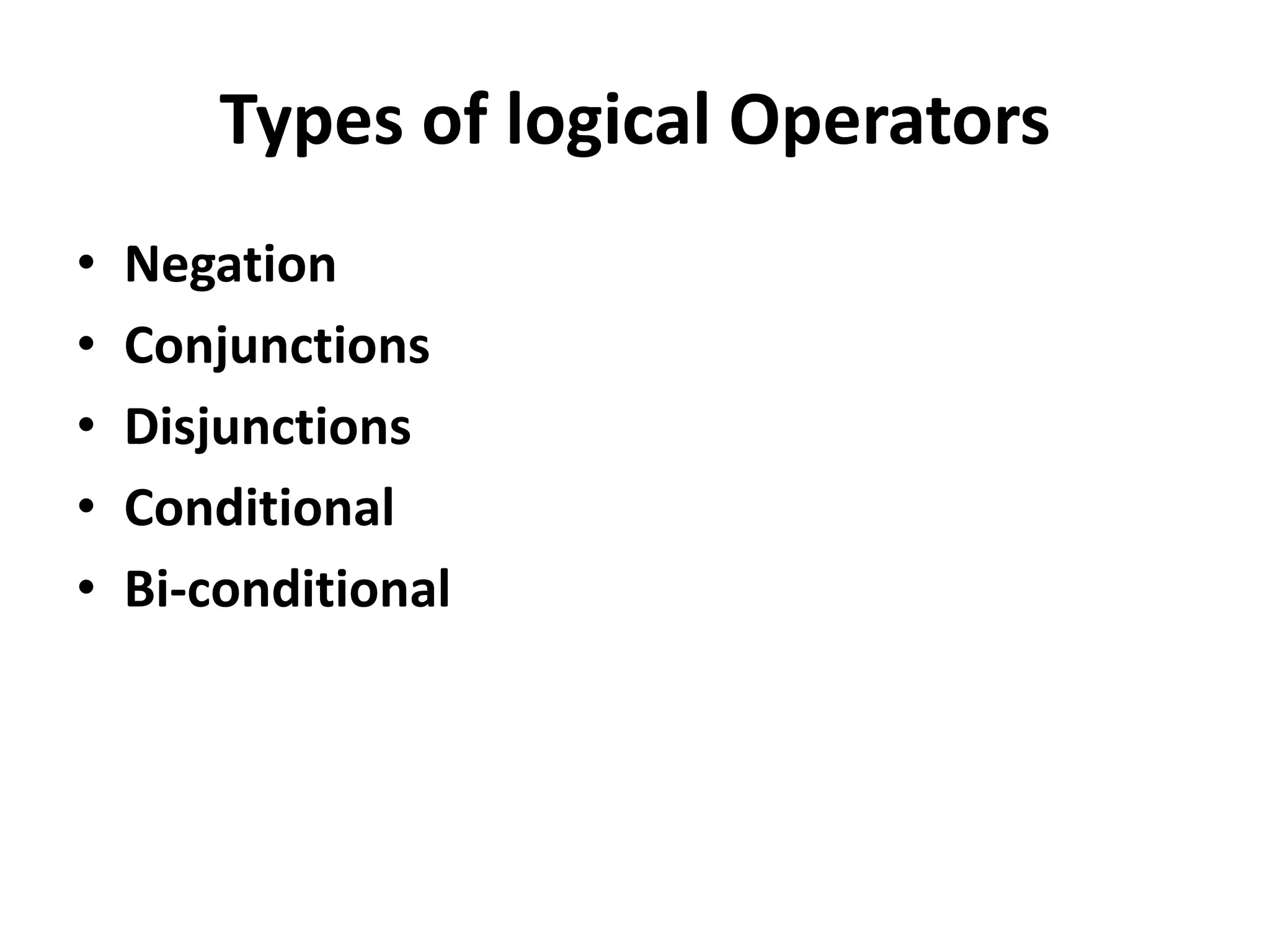
Types of logical Operators
• Negation
• Conjunctions
• Disjunctions
• Conditional
• Bi-conditional
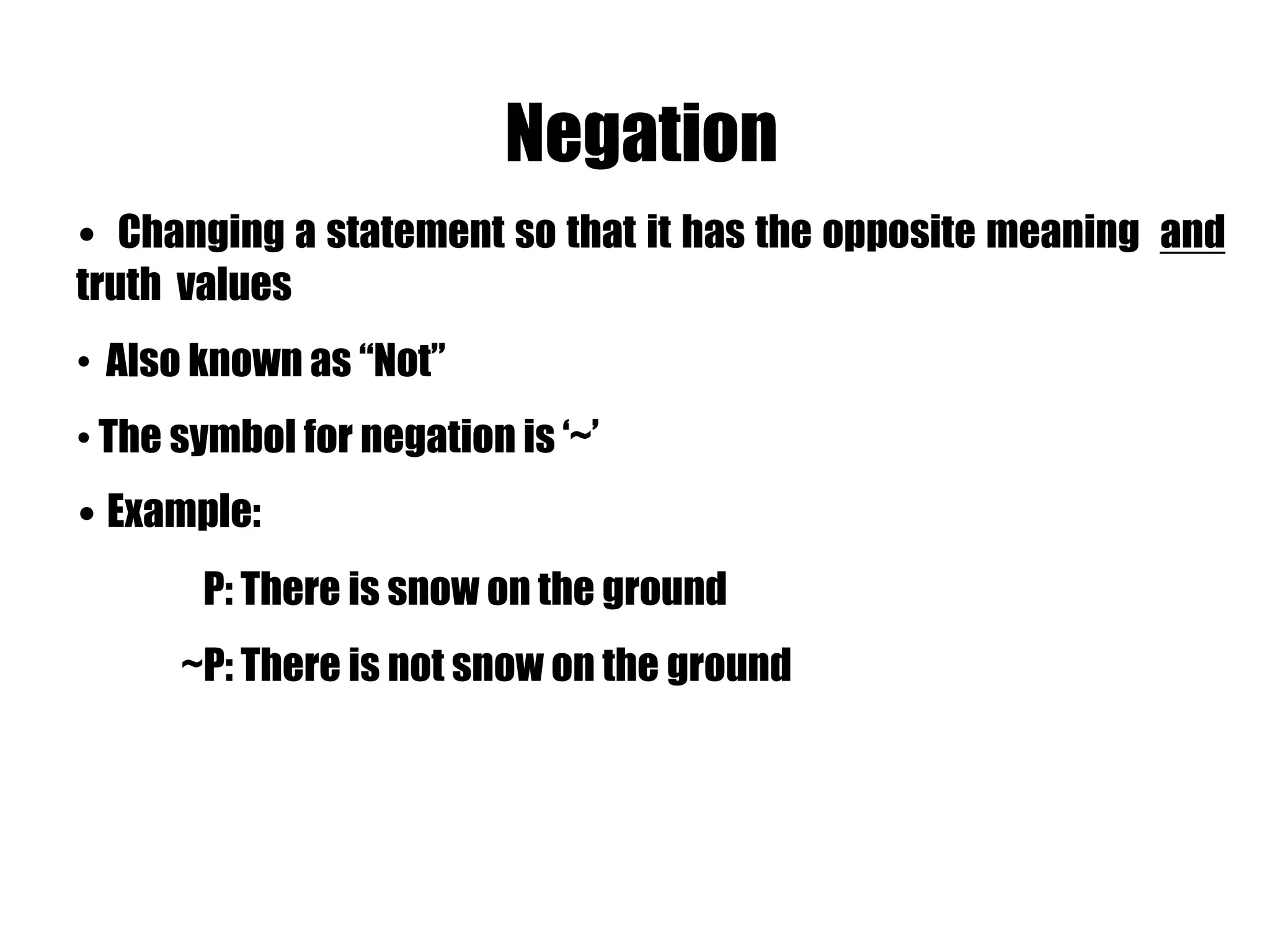
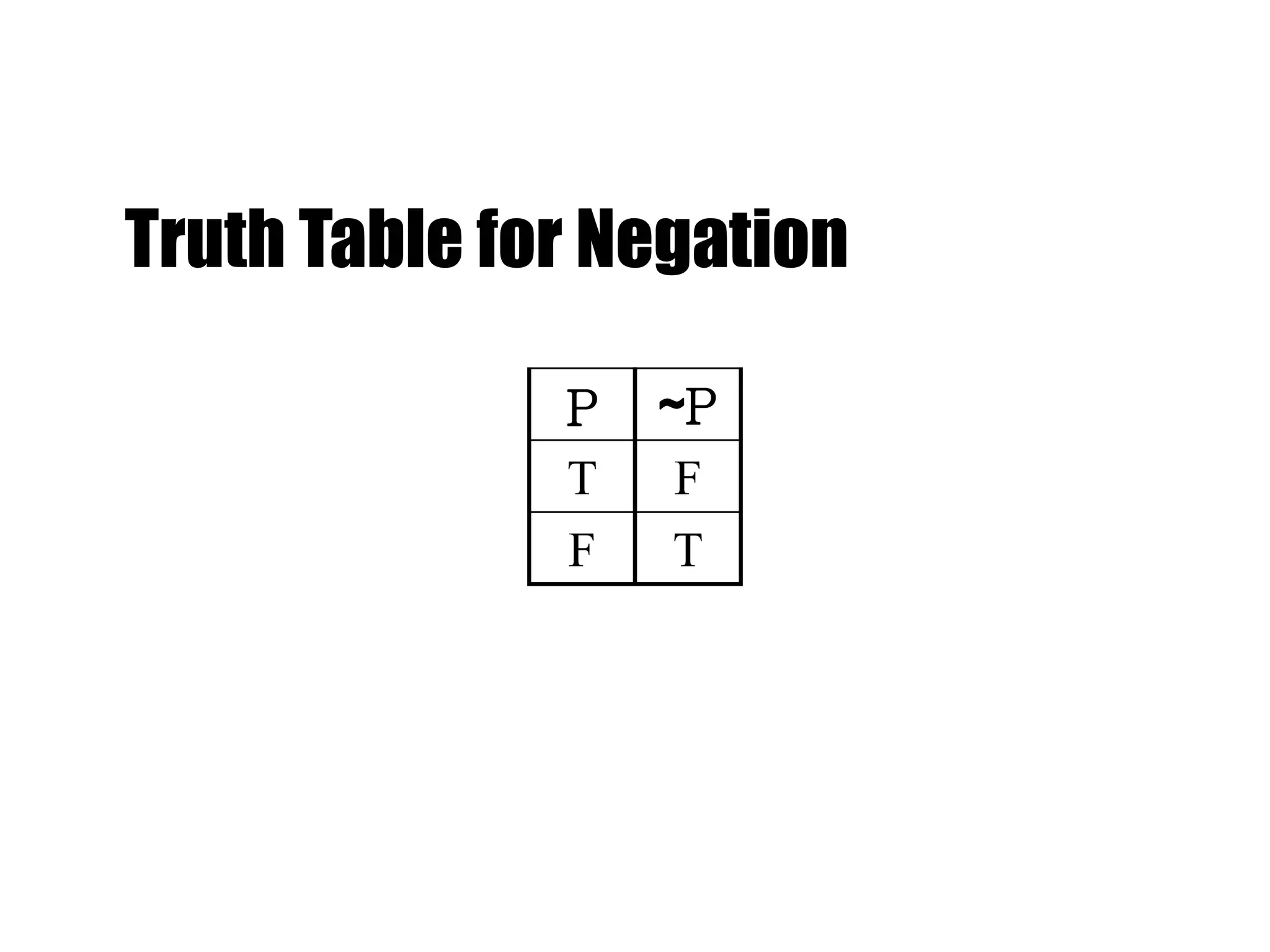
Negation
• Changing a statement so that it has the opposite meaning and
truth values
• Also known as “Not”
• The symbol for negation is ‘~’
• Example:
P: There is snow on the ground
~P: There is not snow on the ground
Truth Table for Negation
P
T
F
~P
F
T
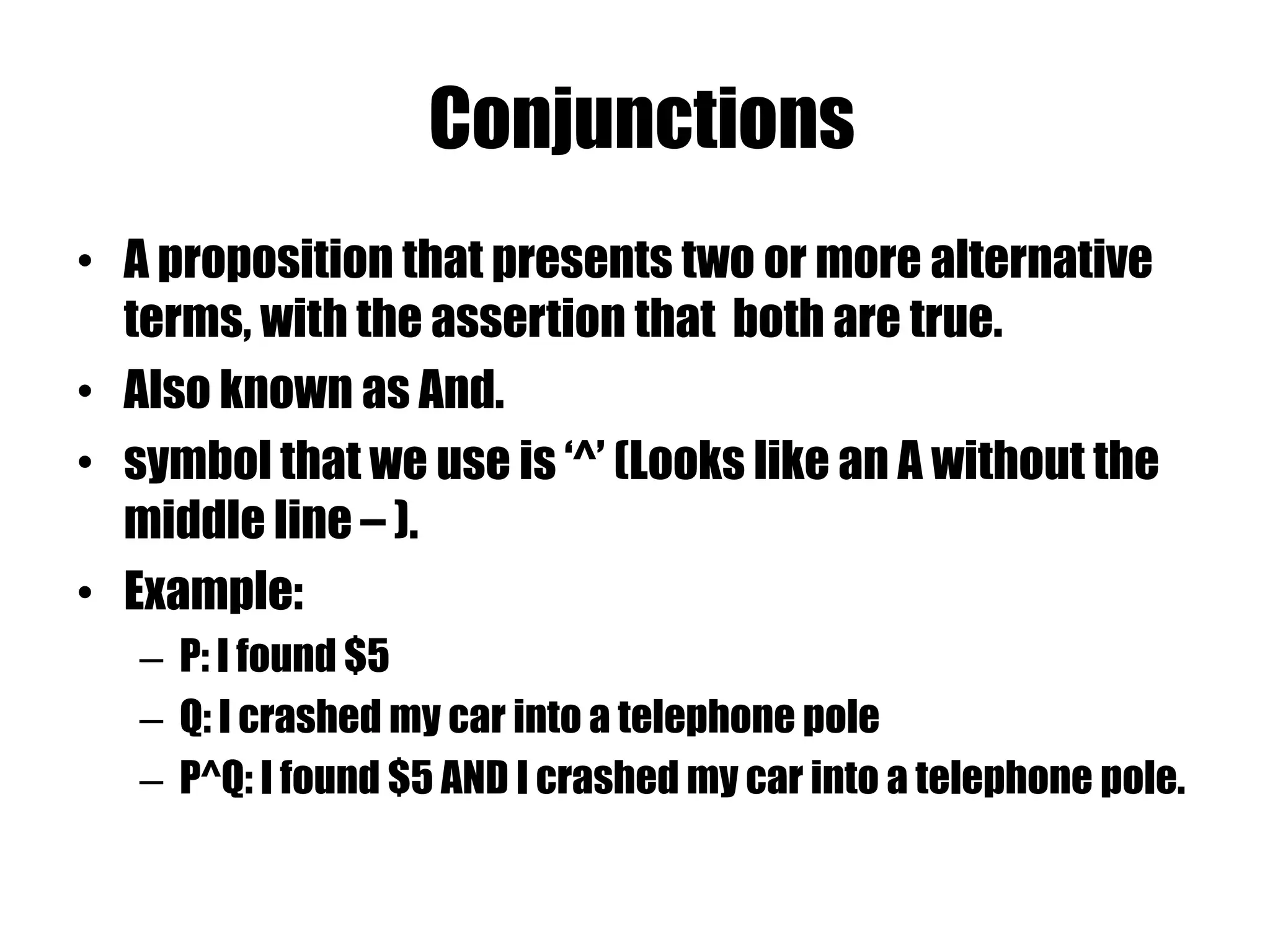
Conjunctions
• A proposition that presents two or more alternative
terms, with the assertion that both are true.
• Also known as And.
• symbol that we use is ‘^’ (Looks like an A without the
middle line – ).
• Example:
– P: I found $5
– Q: I crashed my car into a telephone pole
– P^Q: I found $5 AND I crashed my car into a telephone pole.
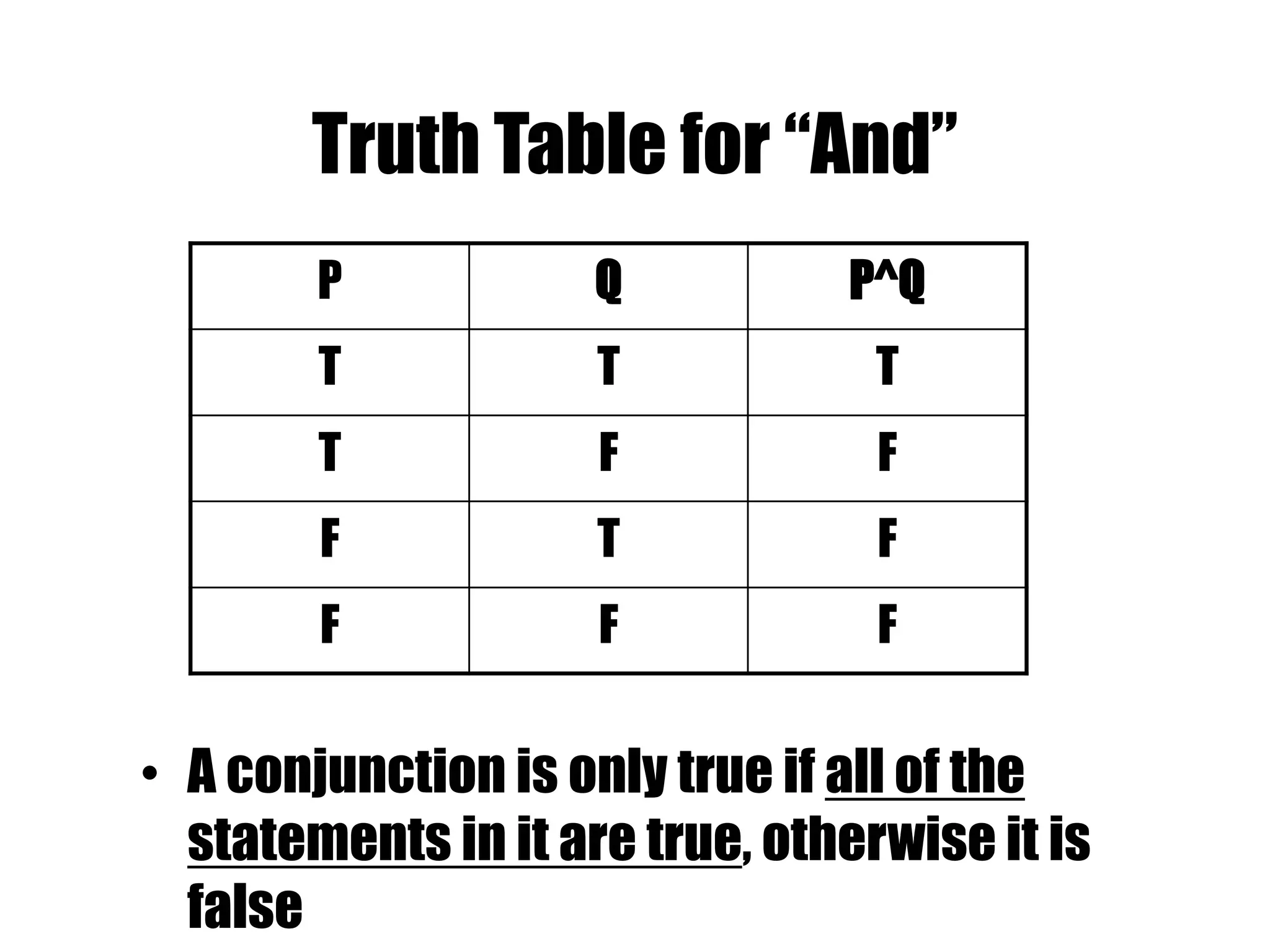
Truth Table for “And”
• A conjunction is only true if all of the
statements in it are true, otherwise it is
false
P Q P^Q
T T T
T F F
F T F
F F F
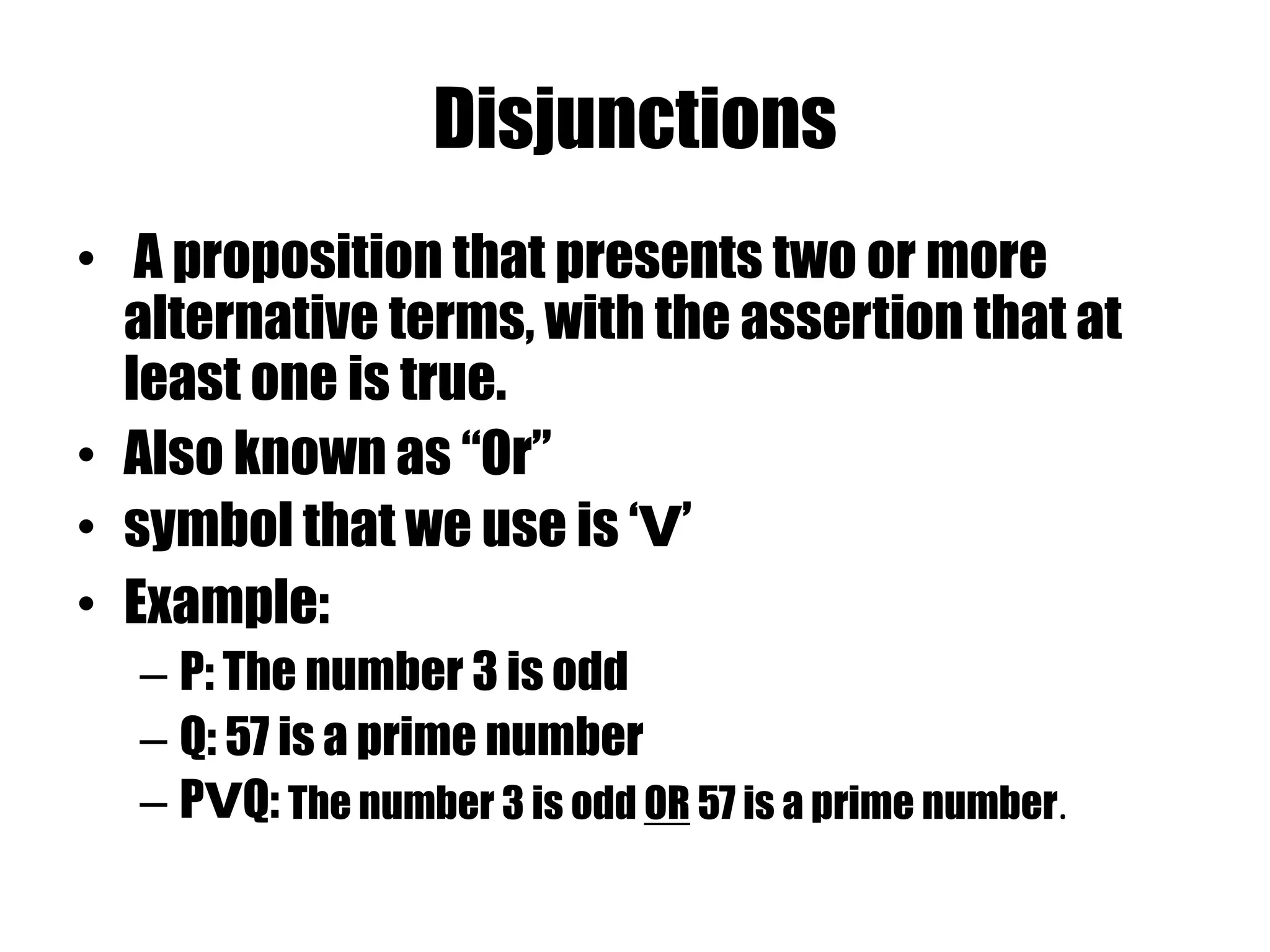
Disjunctions
• A proposition that presents two or more
alternative terms, with the assertion that at
least one is true.
• Also known as “Or”
• symbol that we use is ‘V’
• Example:
– P: The number 3 is odd
– Q: 57 is a prime number
– PVQ: The number 3 is odd OR 57 is a prime number.
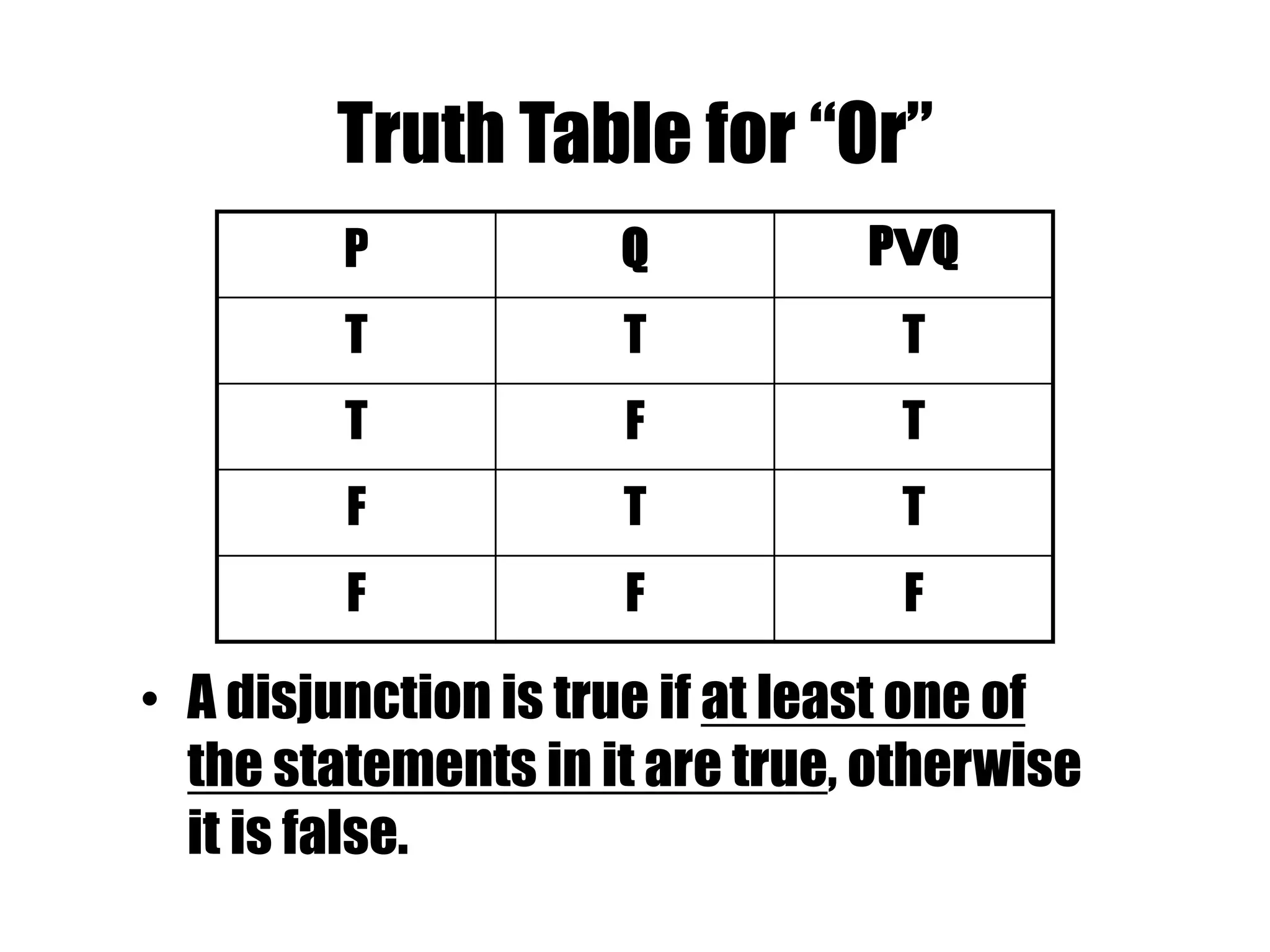
Truth Table for “Or”
• A disjunction is true if at least one of
the statements in it are true, otherwise
it is false.
P Q PVQ
T T T
T F T
F T T
F F F
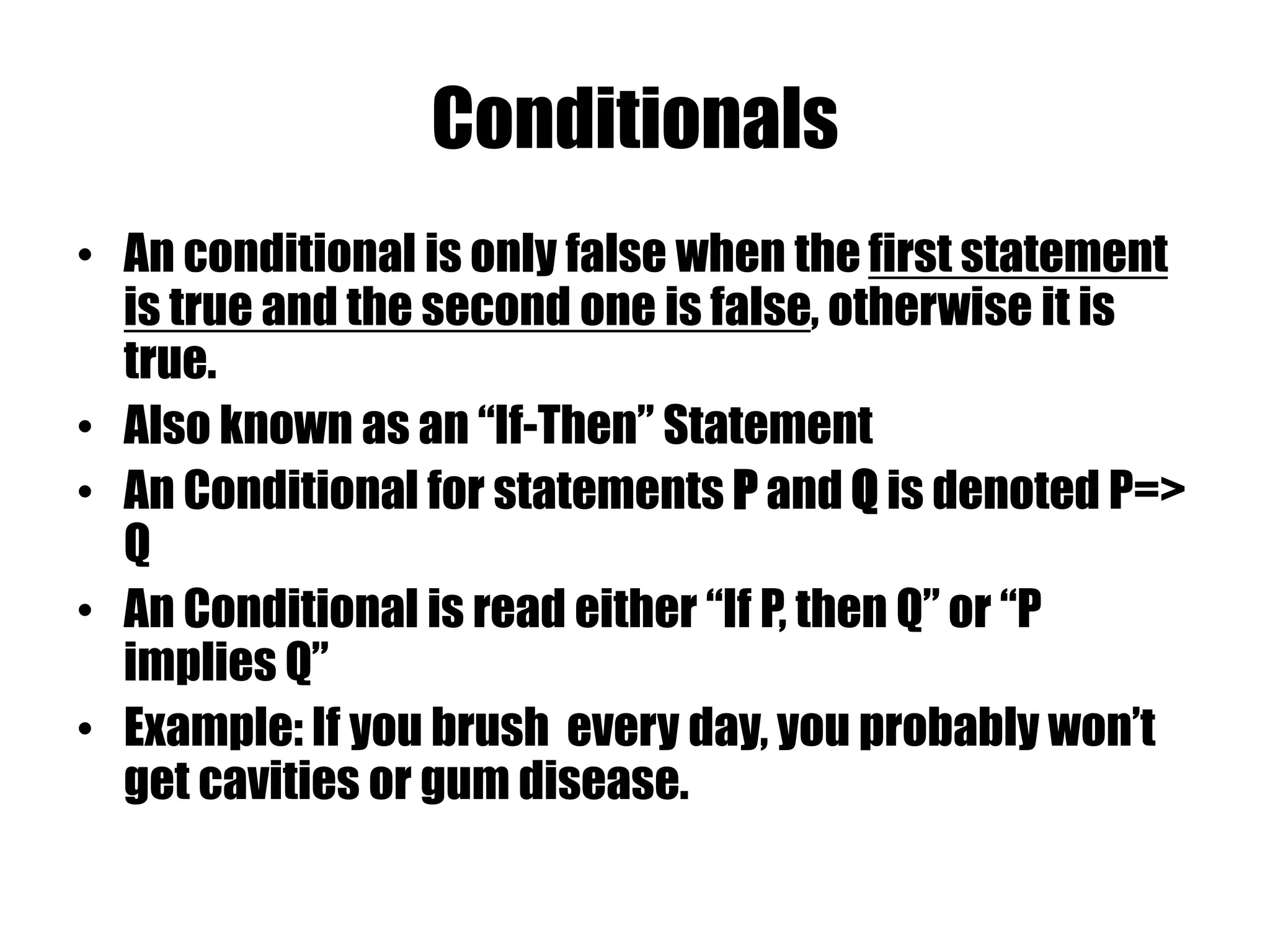
Conditionals
• An conditional is only false when the first statement
is true and the second one is false, otherwise it is
true.
• Also known as an “If-Then” Statement
• An Conditional for statements P and Q is denoted P=>
Q
• An Conditional is read either “If P, then Q” or “P
implies Q”
• Example: If you brush every day, you probably won’t
get cavities or gum disease.
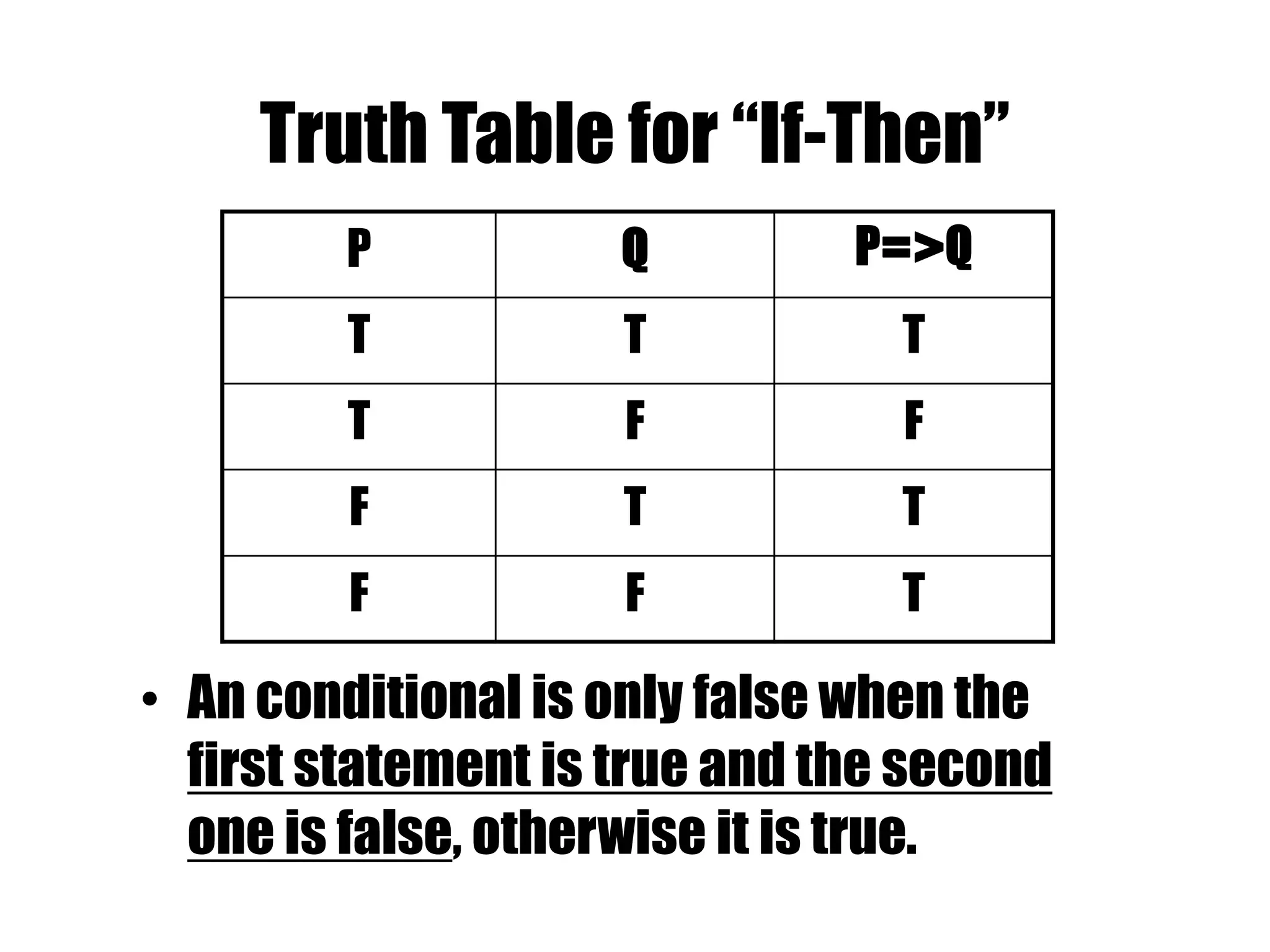
Truth Table for “If-Then”
• An conditional is only false when the
first statement is true and the second
one is false, otherwise it is true.
P Q P=>Q
T T T
T F F
F T T
F F T
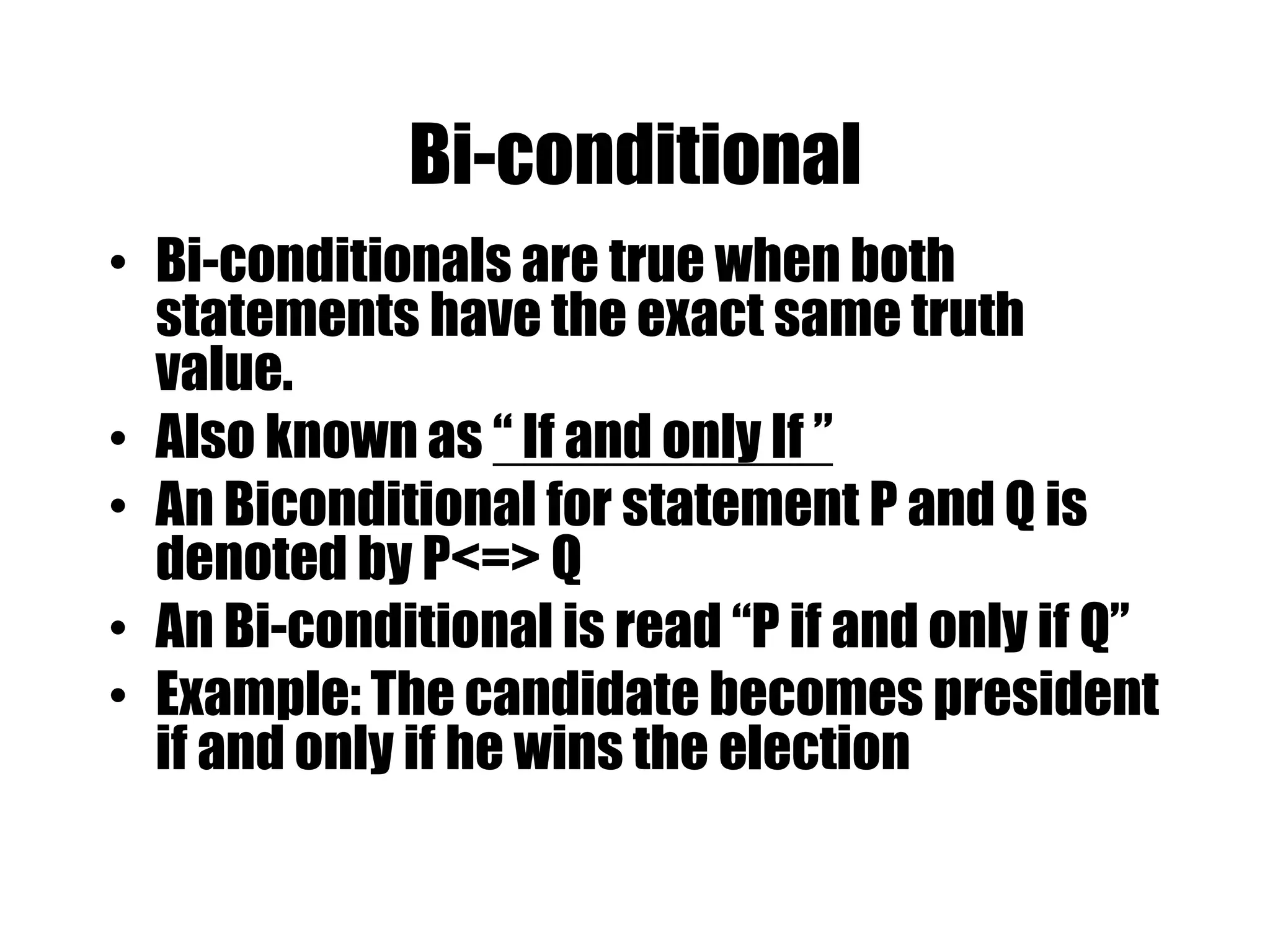
Bi-conditional
• Bi-conditionals are true when both
statements have the exact same truth
value.
• Also known as “ If and only If ”
• An Biconditional for statement P and Q is
denoted by P<=> Q
• An Bi-conditional is read “P if and only if Q”
• Example: The candidate becomes president
if and only if he wins the election
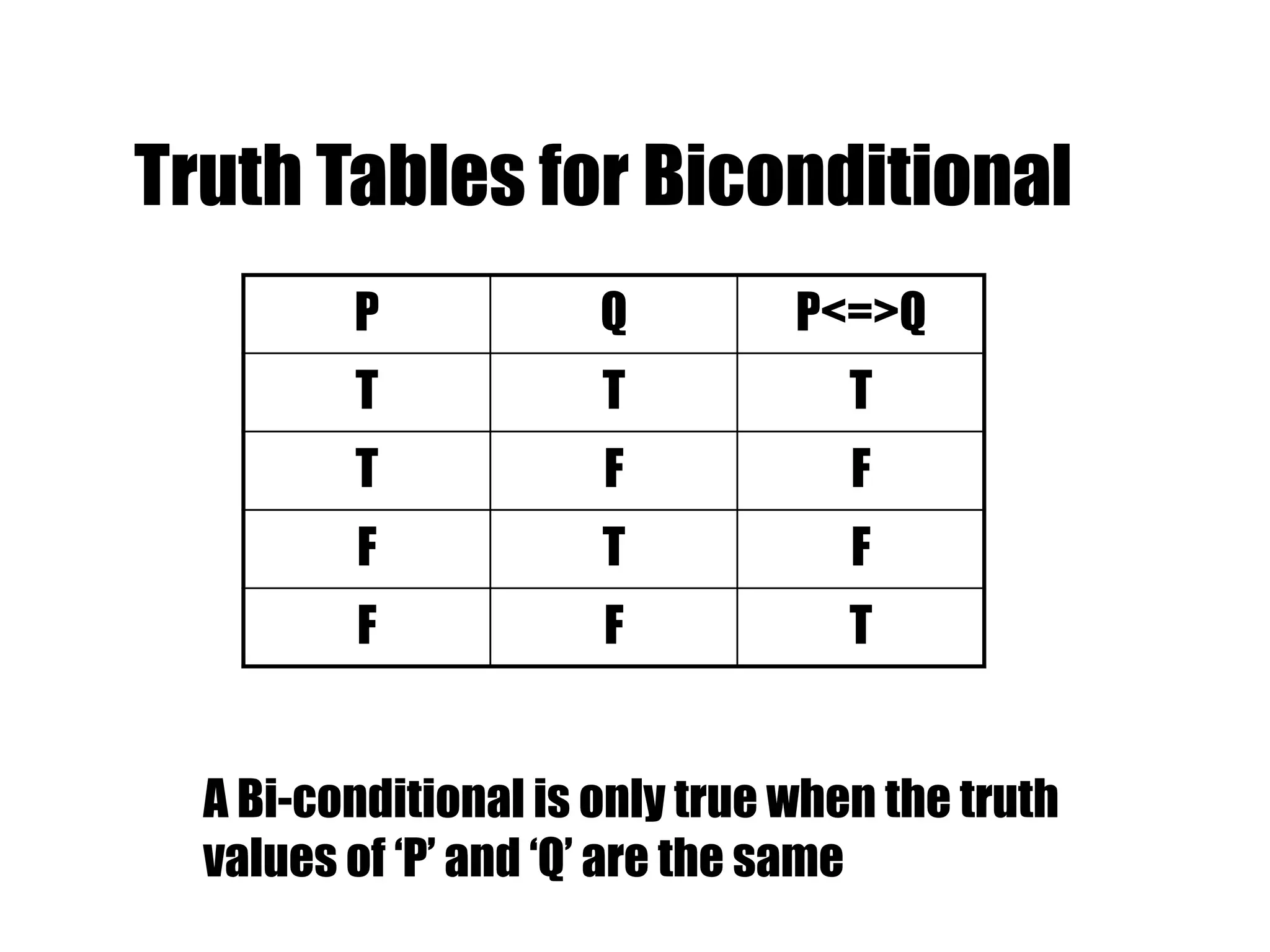
Truth Tables for Biconditional
P Q P<=>Q
T T T
T F F
F T F
F F T
A Bi-conditional is only true when the truth
values of ‘P’ and ‘Q’ are the same
THANK YOU

Logical Operators in Brief with examples

  • 1.
    Types of Argument (Logicaloperators) By:Mujtaba Khan
  • 2.
    Logical Operators • Inlogic, a logical operators (also called a logical connectives) is a symbol or word used to connect two or more sentences in a grammatically valid way.
  • 3.
    Types of logicalOperators • Negation • Conjunctions • Disjunctions • Conditional • Bi-conditional
  • 4.
    Negation • Changing astatement so that it has the opposite meaning and truth values • Also known as “Not” • The symbol for negation is ‘~’ • Example: P: There is snow on the ground ~P: There is not snow on the ground
  • 5.
    Truth Table forNegation P T F ~P F T
  • 6.
    Conjunctions • A propositionthat presents two or more alternative terms, with the assertion that both are true. • Also known as And. • symbol that we use is ‘^’ (Looks like an A without the middle line – ). • Example: – P: I found $5 – Q: I crashed my car into a telephone pole – P^Q: I found $5 AND I crashed my car into a telephone pole.
  • 7.
    Truth Table for“And” • A conjunction is only true if all of the statements in it are true, otherwise it is false P Q P^Q T T T T F F F T F F F F
  • 8.
    Disjunctions • A propositionthat presents two or more alternative terms, with the assertion that at least one is true. • Also known as “Or” • symbol that we use is ‘V’ • Example: – P: The number 3 is odd – Q: 57 is a prime number – PVQ: The number 3 is odd OR 57 is a prime number.
  • 9.
    Truth Table for“Or” • A disjunction is true if at least one of the statements in it are true, otherwise it is false. P Q PVQ T T T T F T F T T F F F
  • 10.
    Conditionals • An conditionalis only false when the first statement is true and the second one is false, otherwise it is true. • Also known as an “If-Then” Statement • An Conditional for statements P and Q is denoted P=> Q • An Conditional is read either “If P, then Q” or “P implies Q” • Example: If you brush every day, you probably won’t get cavities or gum disease.
  • 11.
    Truth Table for“If-Then” • An conditional is only false when the first statement is true and the second one is false, otherwise it is true. P Q P=>Q T T T T F F F T T F F T
  • 12.
    Bi-conditional • Bi-conditionals aretrue when both statements have the exact same truth value. • Also known as “ If and only If ” • An Biconditional for statement P and Q is denoted by P<=> Q • An Bi-conditional is read “P if and only if Q” • Example: The candidate becomes president if and only if he wins the election
  • 13.
    Truth Tables forBiconditional P Q P<=>Q T T T T F F F T F F F T A Bi-conditional is only true when the truth values of ‘P’ and ‘Q’ are the same
  • 14.