LOGICAL
FRAMEWORK
PG Student : Dr.Vaidehi Malvi
PG Teachers: Dr.C.Rajguru Madam
Dr.M.Sadawarte Sir
Dr.Pravin Davuluri Sir
Contents
 Introduction
 Phases of logical framework
 Steps for framing logical frame matrix
 Advantages and disadvantages
Introduction
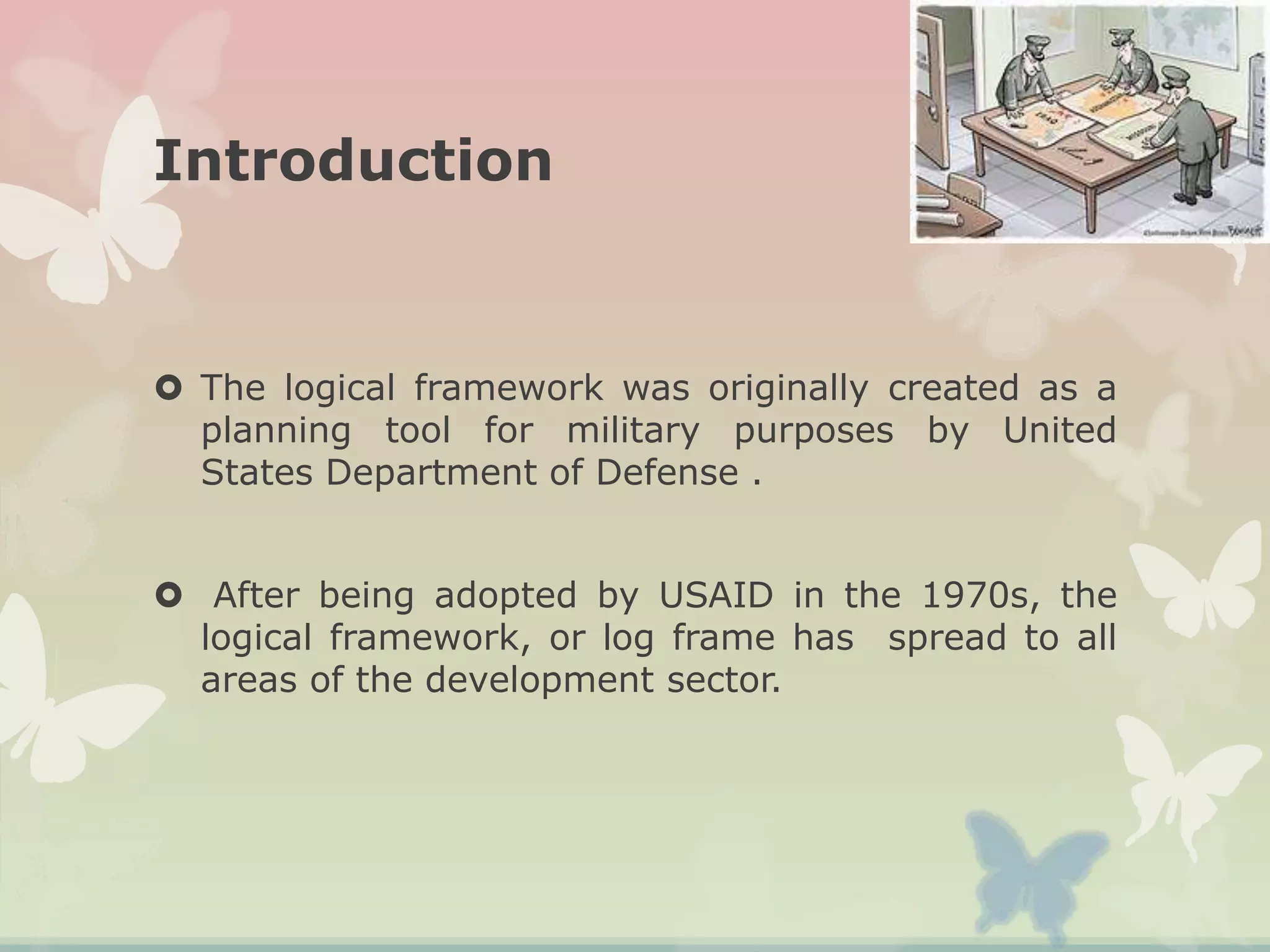
 The logical framework was originally created as a
planning tool for military purposes by United
States Department of Defense .
 After being adopted by USAID in the 1970s, the
logical framework, or log frame has spread to all
areas of the development sector.
Logical Framework
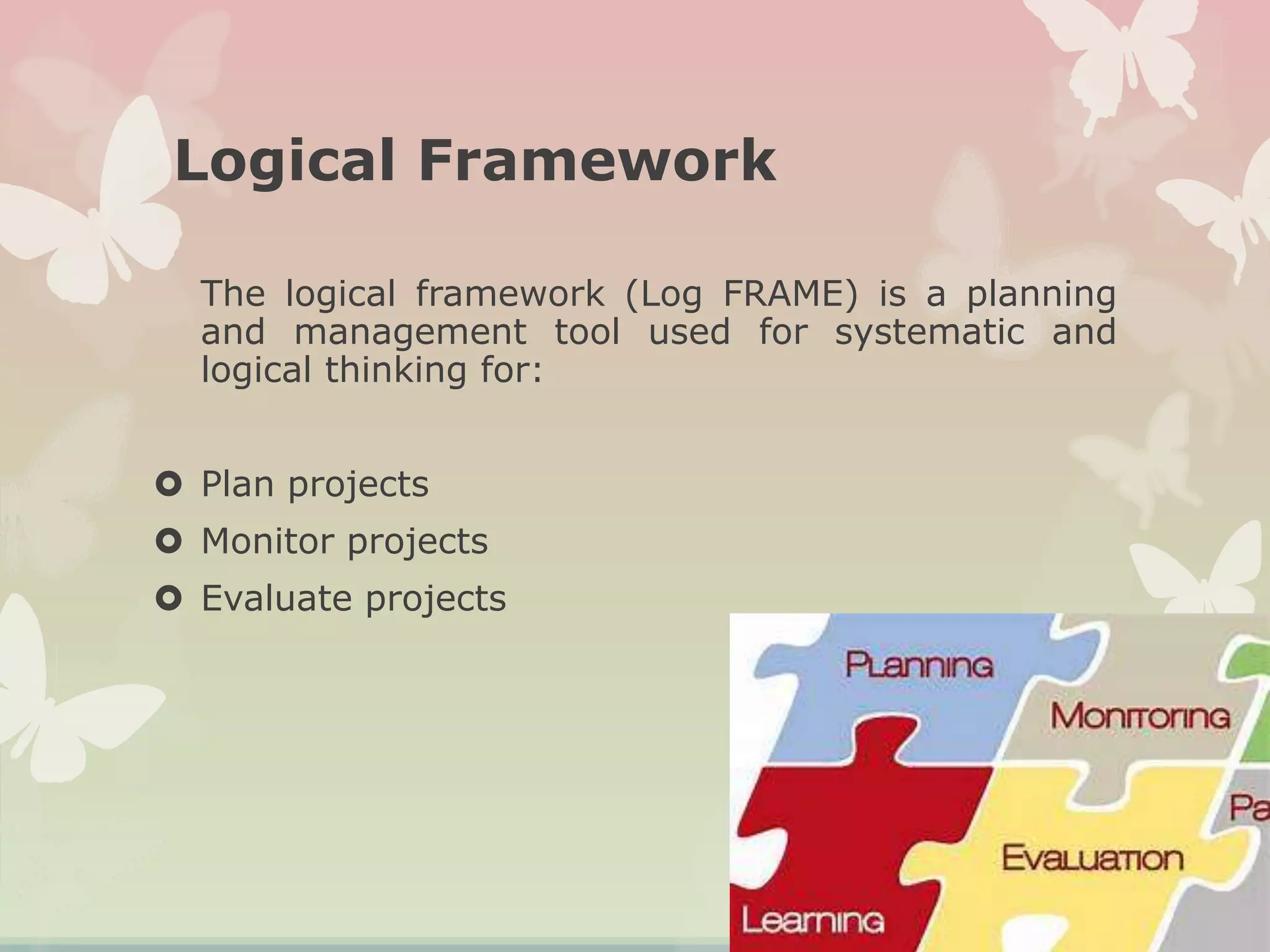
The logical framework (Log FRAME) is a planning
and management tool used for systematic and
logical thinking for:
 Plan projects
 Monitor projects
 Evaluate projects
Uses of Logical Framework
 The Logical Framework is used mainly in the public
sector
 It is can be used to frame an action plan
 It can be used as a planning and management
tool.
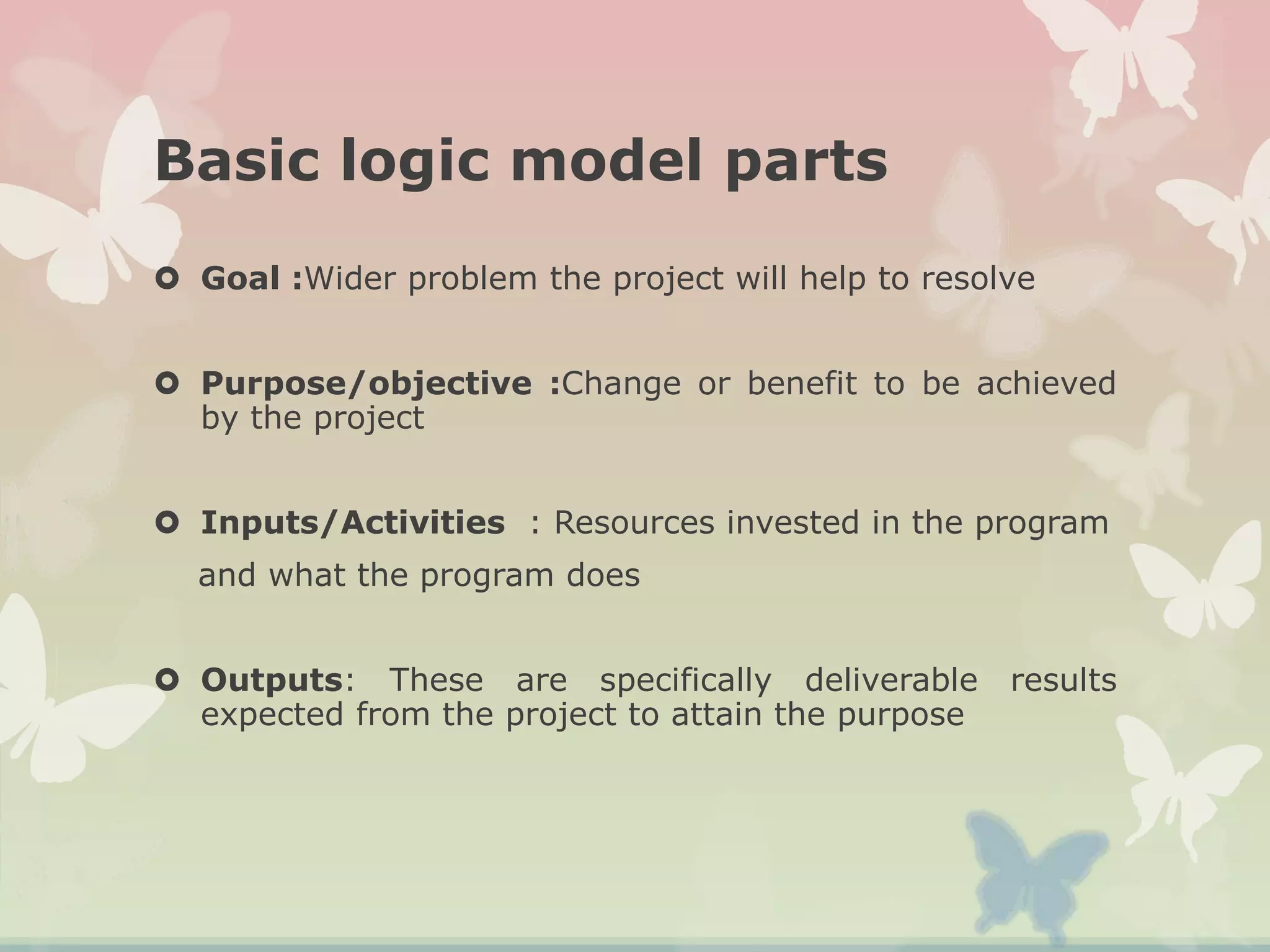
Basic logic model parts
 Goal :Wider problem the project will help to resolve
 Purpose/objective :Change or benefit to be achieved
by the project
 Inputs/Activities : Resources invested in the program
and what the program does
 Outputs: These are specifically deliverable results
expected from the project to attain the purpose
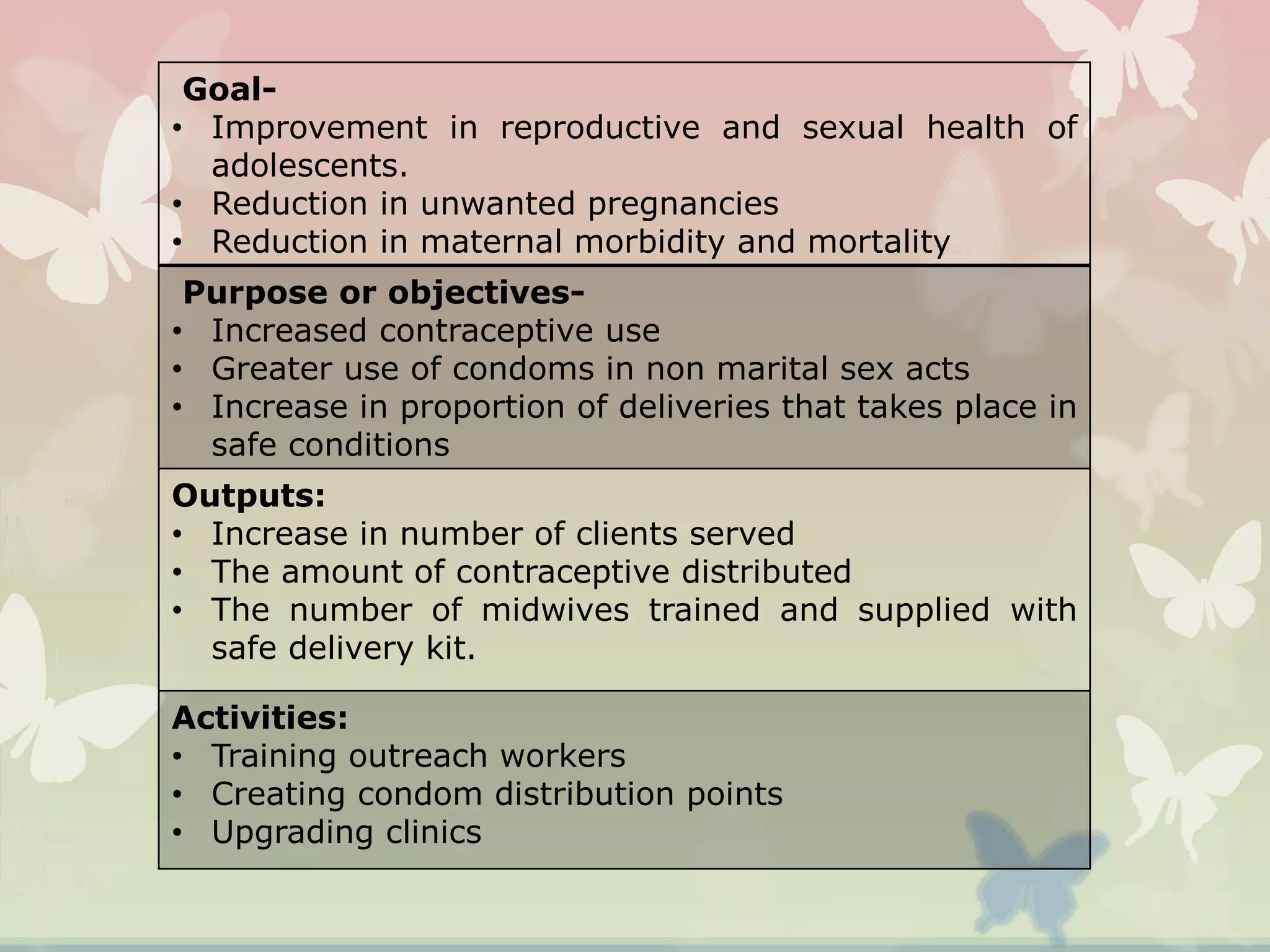
Goal-
• Improvement in reproductive and sexual health of
adolescents.
• Reduction in unwanted pregnancies
• Reduction in maternal morbidity and mortality
Purpose or objectives-
• Increased contraceptive use
• Greater use of condoms in non marital sex acts
• Increase in proportion of deliveries that takes place in
safe conditions
Outputs:
• Increase in number of clients served
• The amount of contraceptive distributed
• The number of midwives trained and supplied with
safe delivery kit.
Activities:
• Training outreach workers
• Creating condom distribution points
• Upgrading clinics
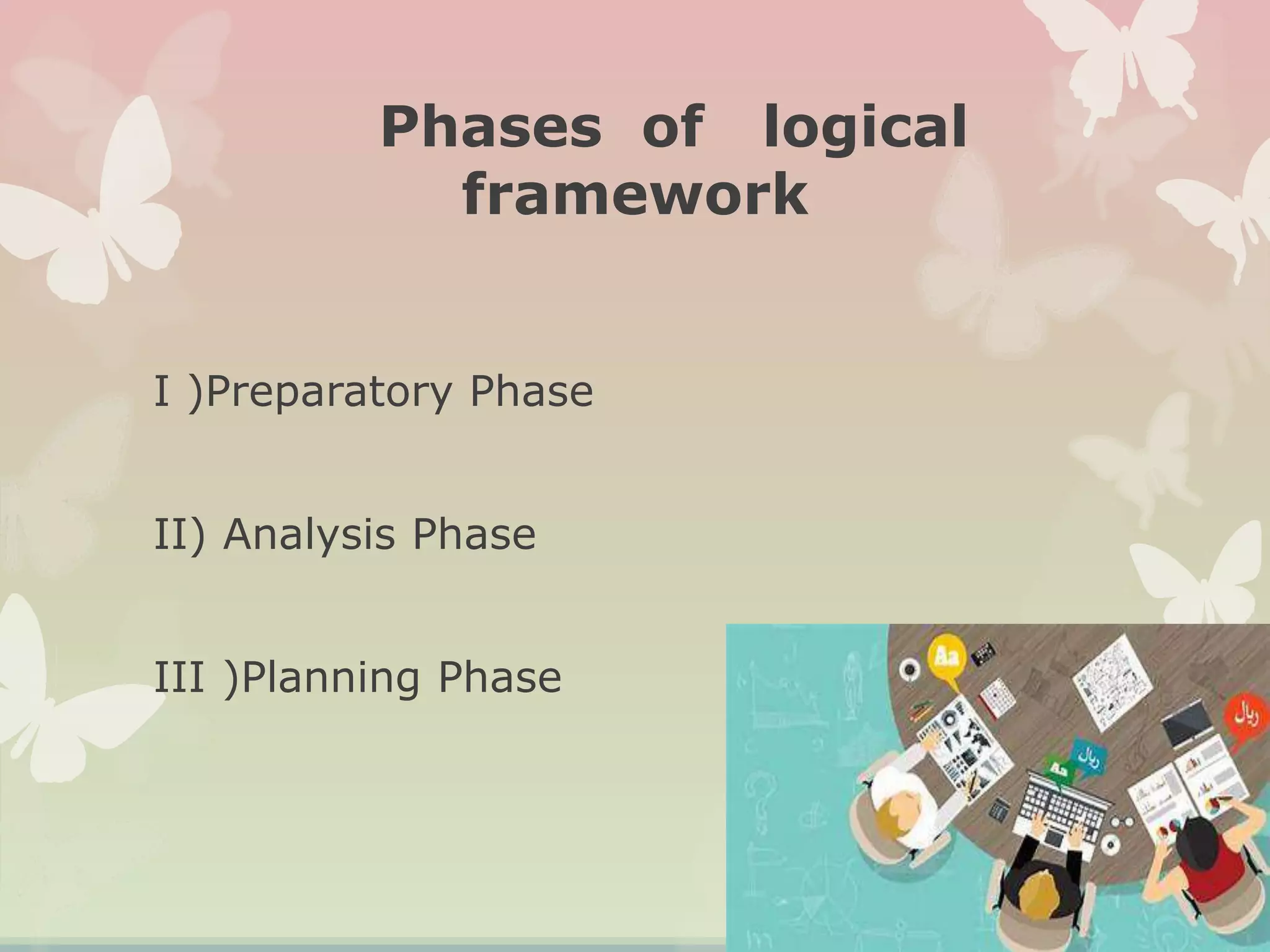
Phases of logical
framework
I )Preparatory Phase
II) Analysis Phase
III )Planning Phase
Preparatory Phase
A. Determine the Focus Area:
• Determine the focus area to be analyzed
• Study the focus area
• Present results of fact finding in short report
B. Analyze Stakeholders involved :
• Identify all stakeholders who have a relation to the
focus area
•Identify what the most important stakeholders
contribute to and benefit from the focus area.
Analysis Phase
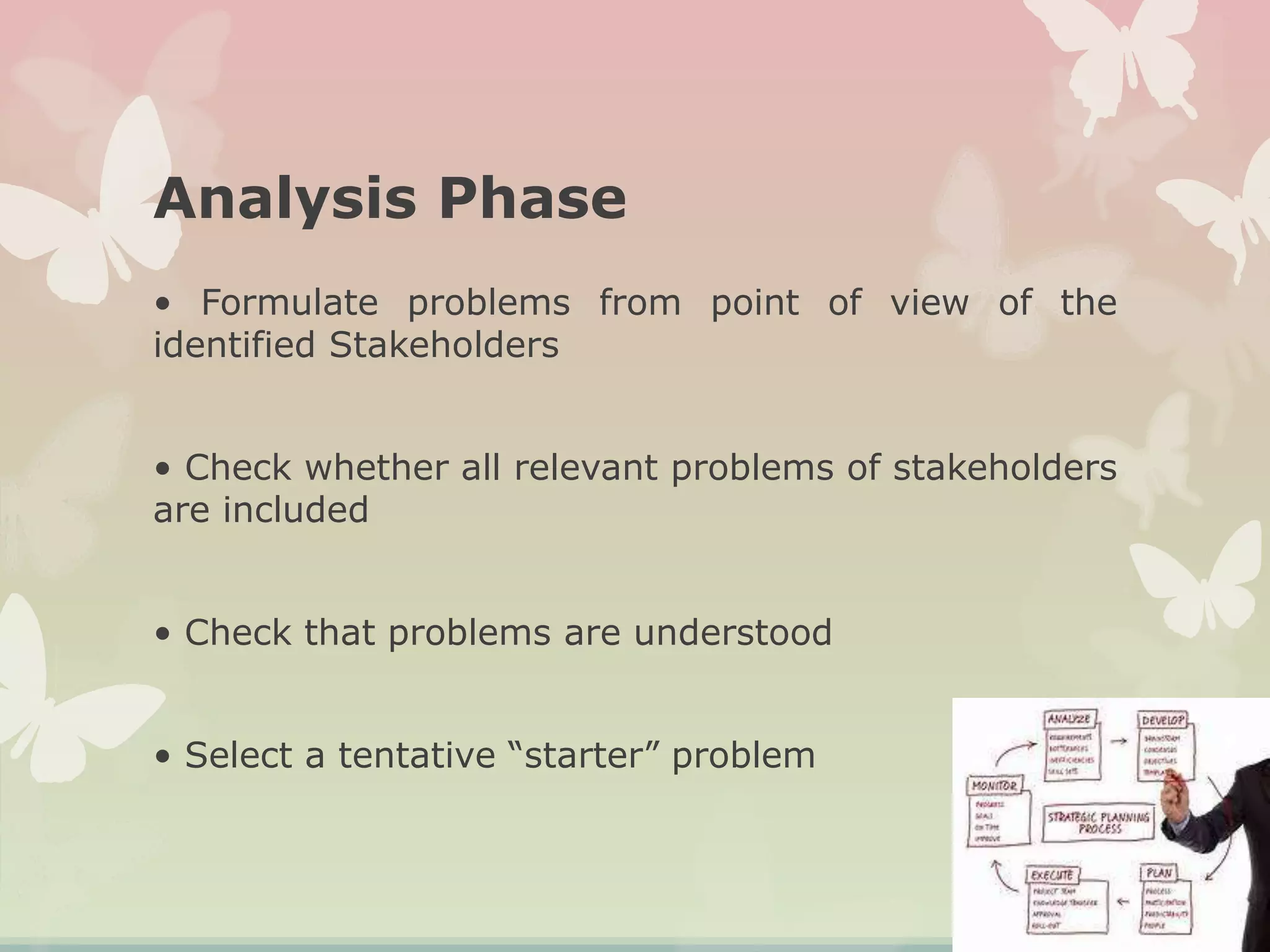
• Formulate problems from point of view of the
identified Stakeholders
• Check whether all relevant problems of stakeholders
are included
• Check that problems are understood
• Select a tentative “starter” problem
Analysis Phase
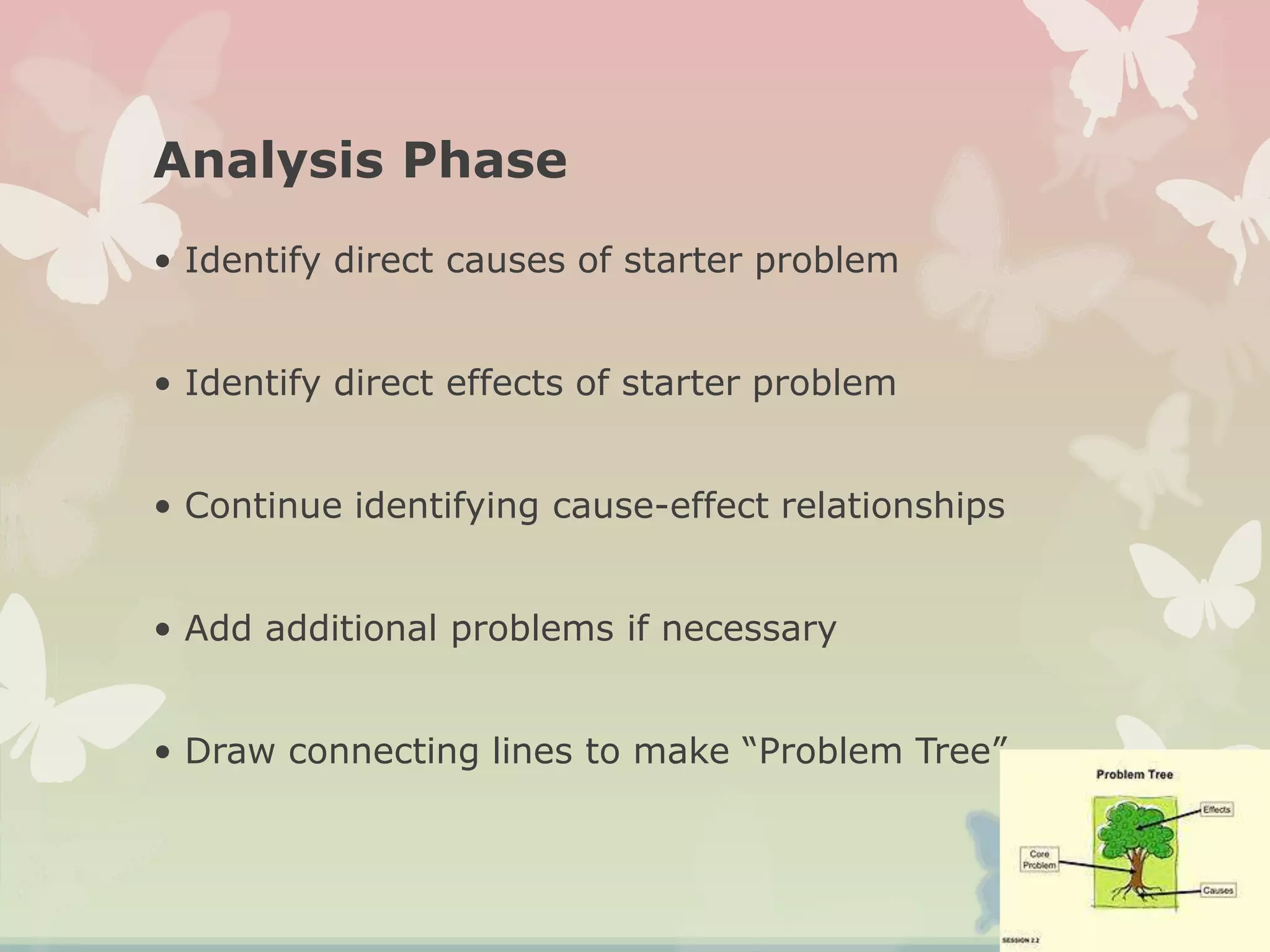
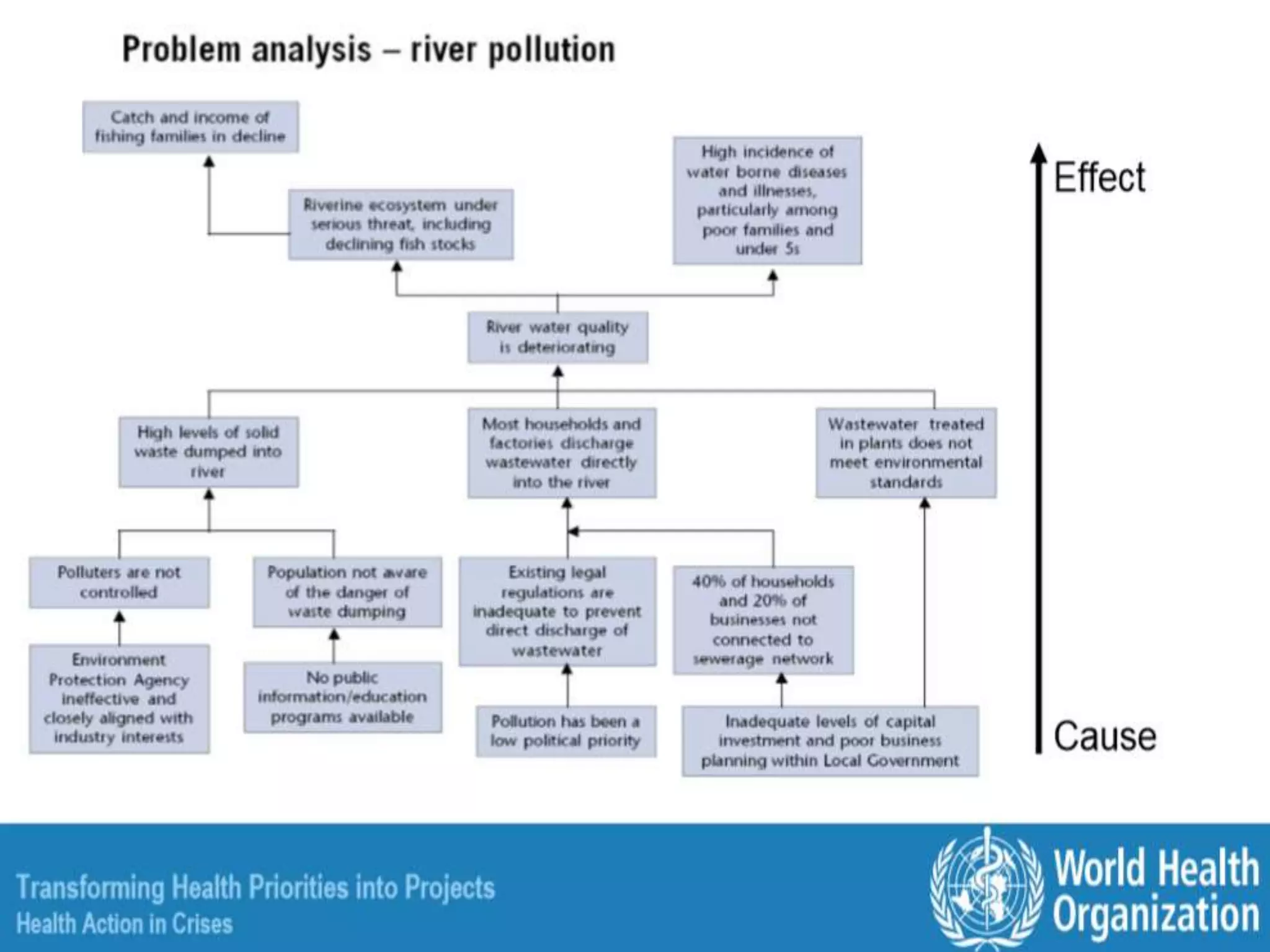
• Identify direct causes of starter problem
• Identify direct effects of starter problem
• Continue identifying cause-effect relationships
• Add additional problems if necessary
• Draw connecting lines to make “Problem Tree” .
Planning Phase
• Preparing the log frame matrix
• The compilation of Objectively Verifiable Indicators
• Assessment of the risk factors/assumptions
• Planning of activities, and the allocation of the
appropriate resources to achieve the completion of
the activities.
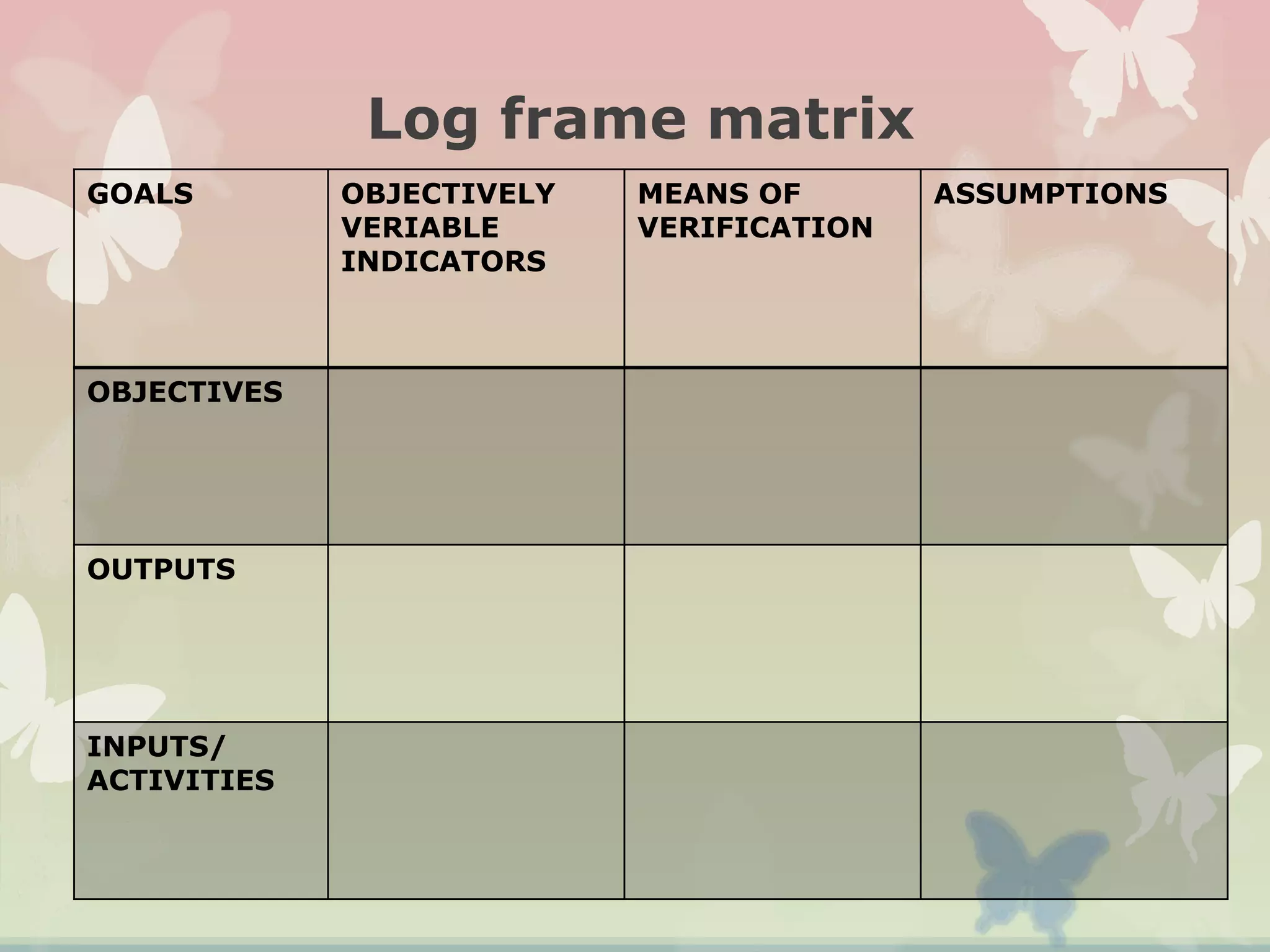
Log frame matrix
GOALS OBJECTIVELY
VERIABLE
INDICATORS
MEANS OF
VERIFICATION
ASSUMPTIONS
OBJECTIVES
OUTPUTS
INPUTS/
ACTIVITIES
Steps in framing the log
frame matrix
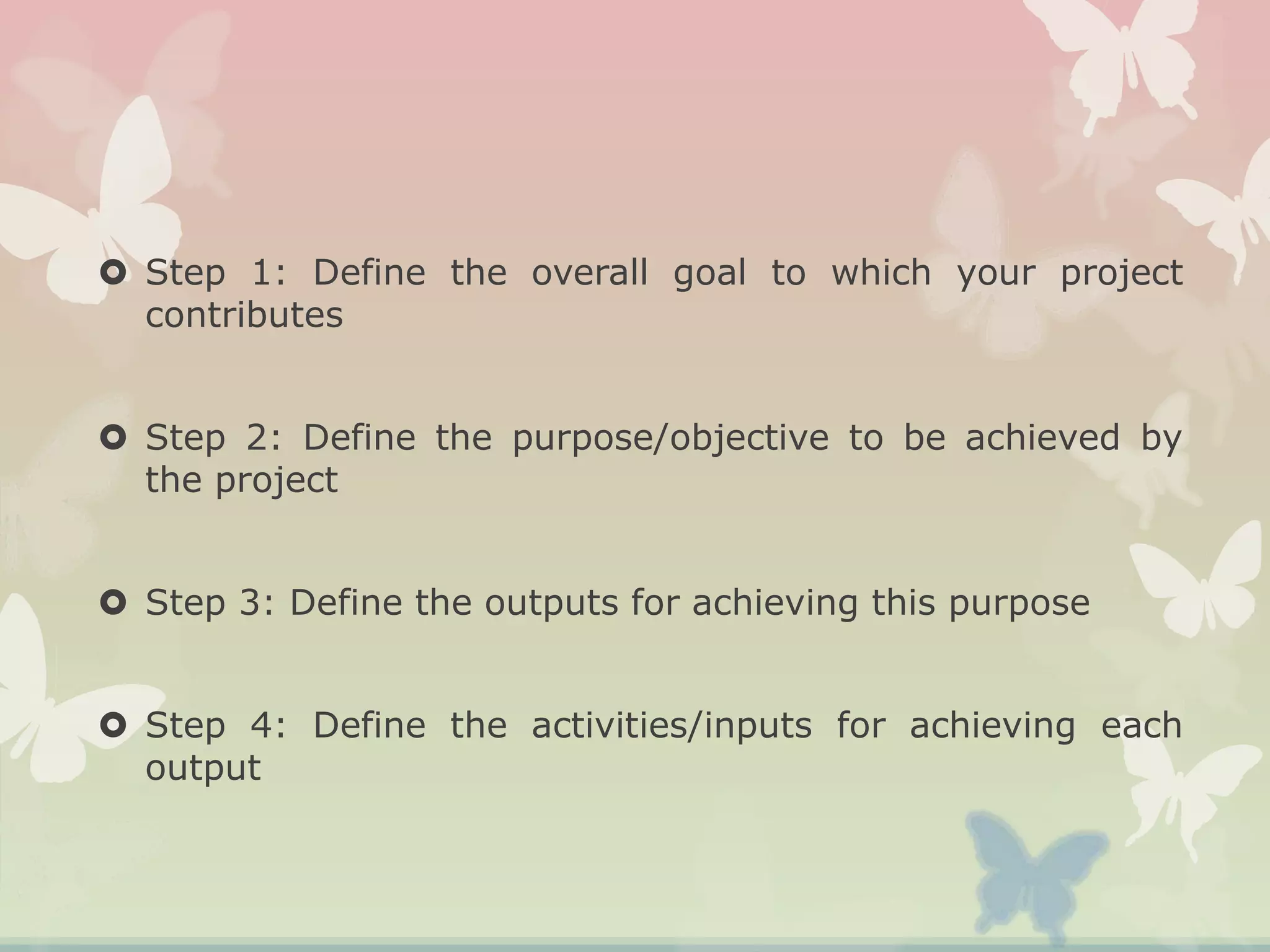
 Step 1: Define the overall goal to which your project
contributes
 Step 2: Define the purpose/objective to be achieved by
the project
 Step 3: Define the outputs for achieving this purpose
 Step 4: Define the activities/inputs for achieving each
output
 Step 5: Verify the Vertical Logic with the If/Then
Test
 Step 6: Define the assumptions related to each
level
 Step 7: Define the Objectively Verifiable Indicator
(OVI) at goal then purpose, then output, then
activity /input levels.
 Step 8: Define the means /source of Verification
(MOV)
Step 1: Define the overall goal to
which your project contributes
The Goal is the higher-order objective that you are seeking
to achieve through the project, often in combination with
others.
Step 2: Define the purpose/objective
to be achieved by the project
 This is why we are proposing to carry out the project.
 It summarizes the impact we hope the project will
have.
Step 3: Define the outputs for
achieving this purpose
• Outputs describe what we want the project to deliver.
• They are the measurable end results of the planned
activities .
Step 4: Define the activities/inputs
for achieving each output
 Activities define how the team will carry out the project
 Generally we should aim at providing a brief summary of
three to seven activities we must implement to
accomplish each output objective
Step 5: Verify the Vertical Logic with
the If/Then Test
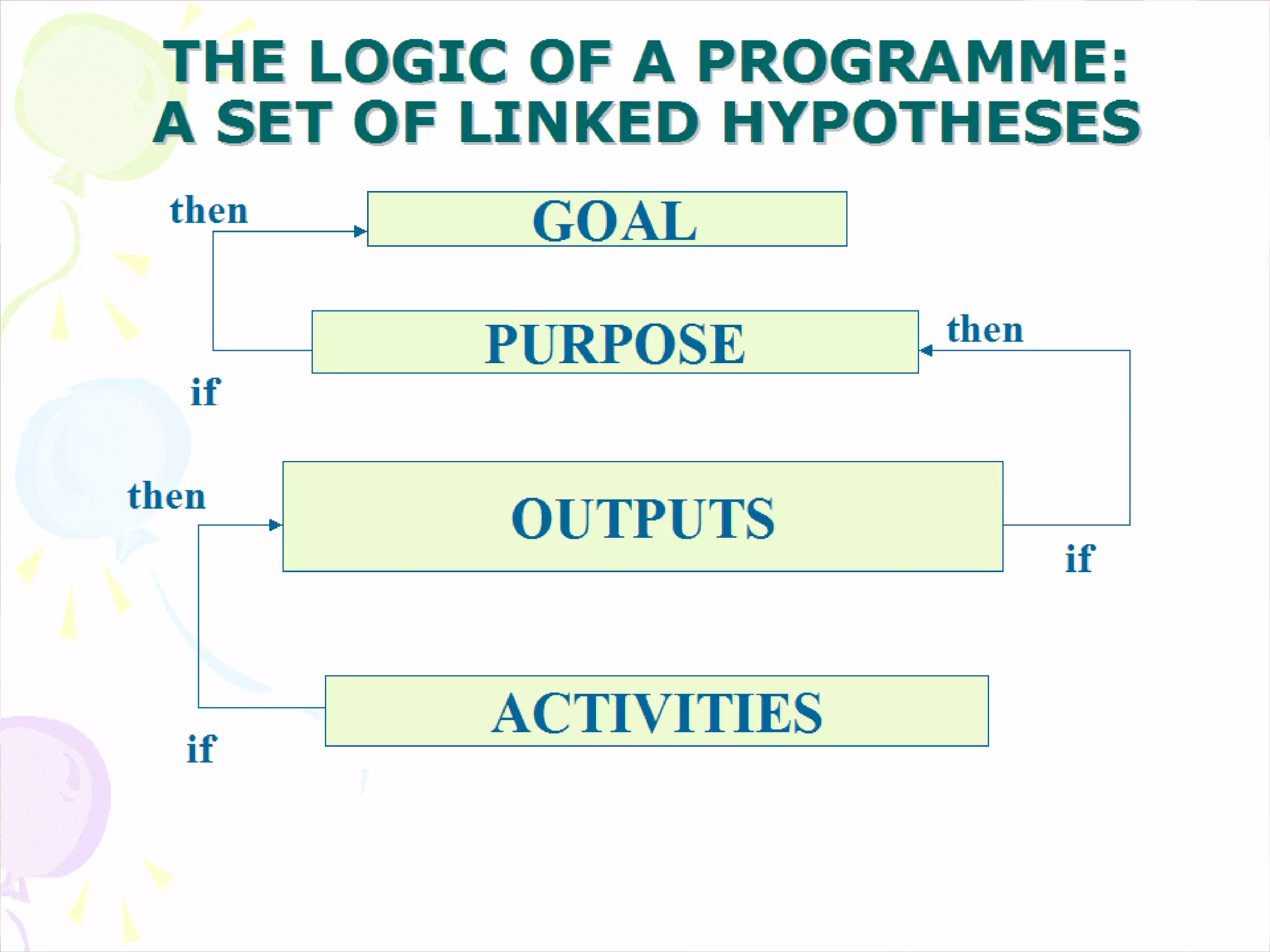
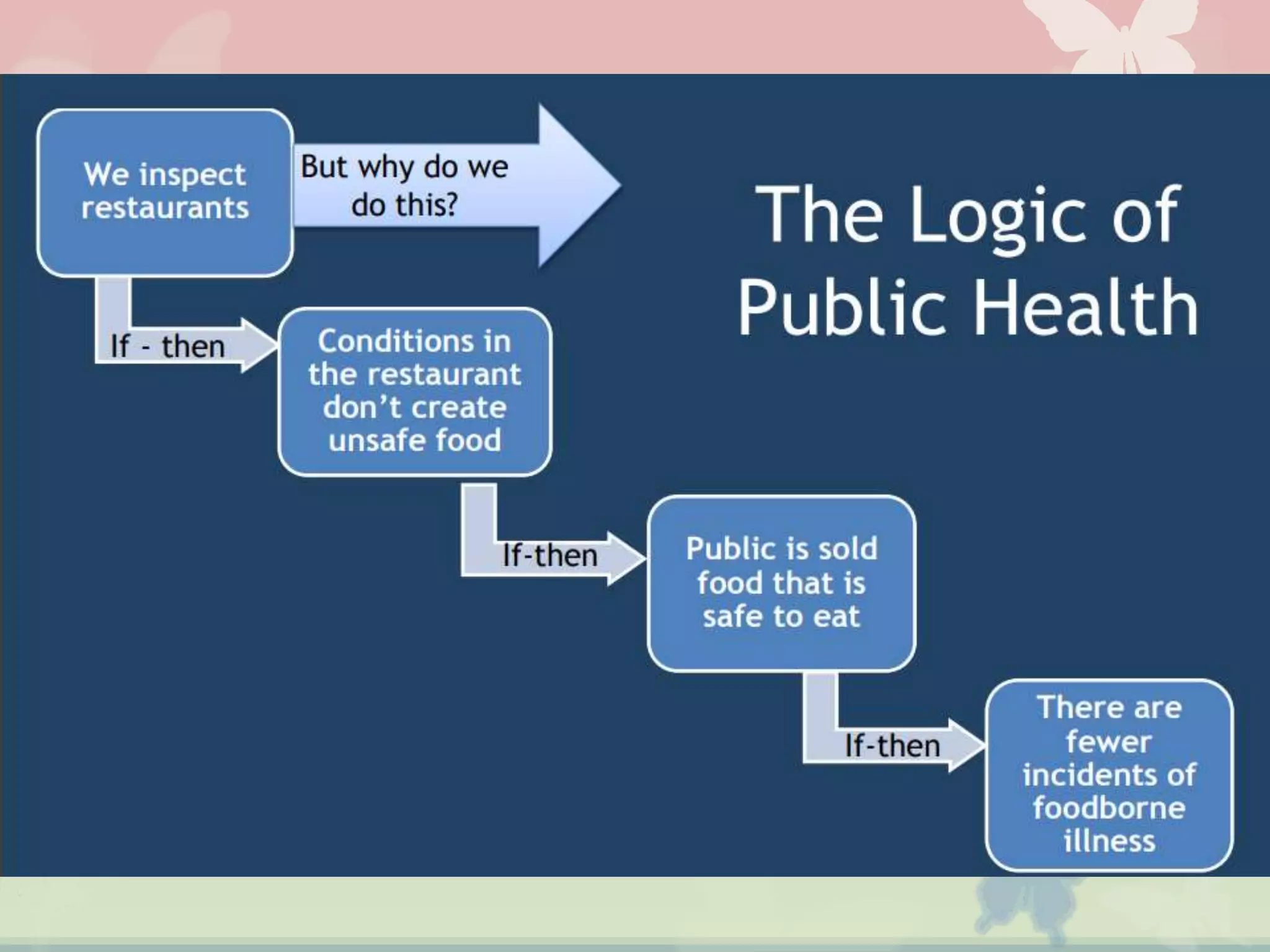
 In a well planned Logical Framework, at the lowest
levels on the Logical Framework we can say that if
certain Activities are carried out we can expect certain
Outputs to result.
 There should be the same logical relationship between
the Outputs and the Purpose/objectives, and between
the Purpose and the Goal.
THE LOGIC OF A PROGRAMME:
A SET OF LINKED HYPOTHESES
GOAL
PURPOSE
ACTIVITIES
OUTPUTS
if
then
if
then
then
if
Step 6: Define the Assumptions
related to each level
 Refers to conditions which could affect the progress of
project ,but over which project managers have no
control , ex: price changes ,non enforcement of
supporting legislations etc
 This column should record the important assumptions on
which the success of the project depends and the risks
that have been considered
Step 7: Define the Objectively Verifiable
Indicator (OVI) at Goal then Purpose, then
Output, then Activity /input levels.
 Objectively Verifiable Indicators (OVIs) are standards
against which change can be measured.
 They set targets in terms of Quantity, Quality and Time
(QQT)
Step 8: Define the means /source of
Verification(MOV)
 In the Means of Verification (MOV) we describe the
sources of information that will demonstrate what has
been accomplished.
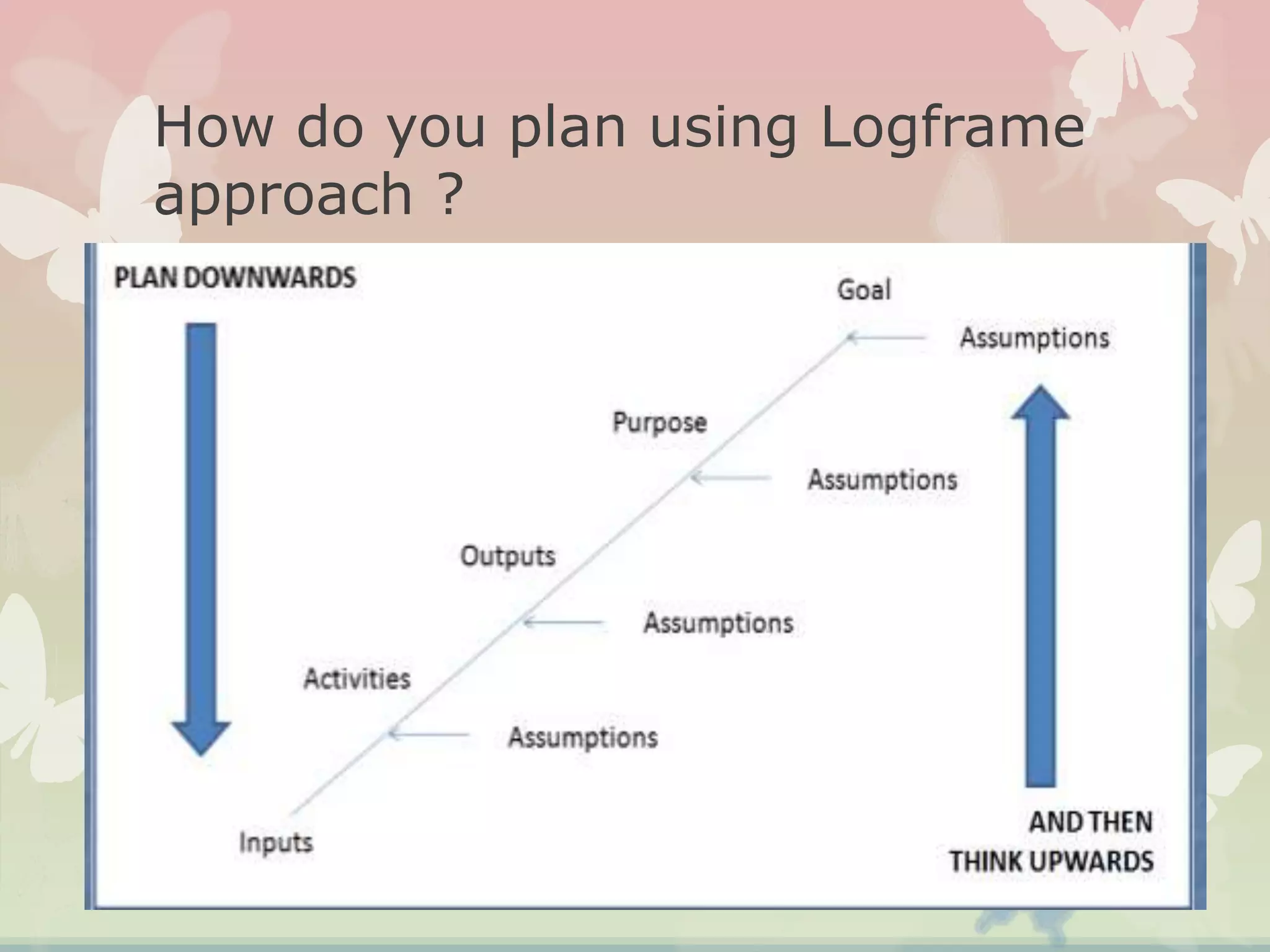
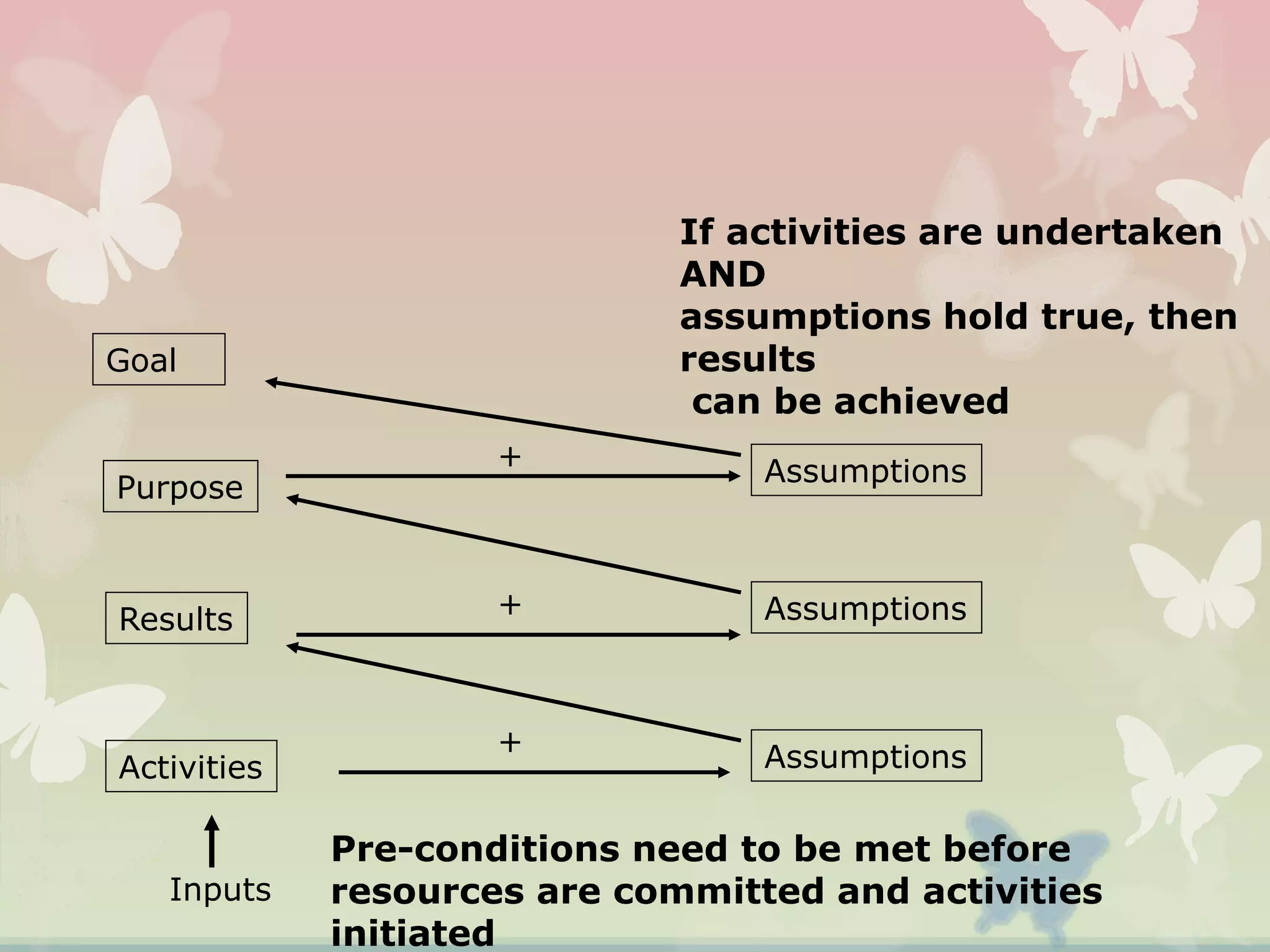
How do you plan using Logframe
approach ?
Goal
Purpose
Results
Activities
Assumptions
Assumptions
Assumptions
Inputs
+
+
+
Pre-conditions need to be met before
resources are committed and activities
initiated
If activities are undertaken
AND
assumptions hold true, then
results
can be achieved
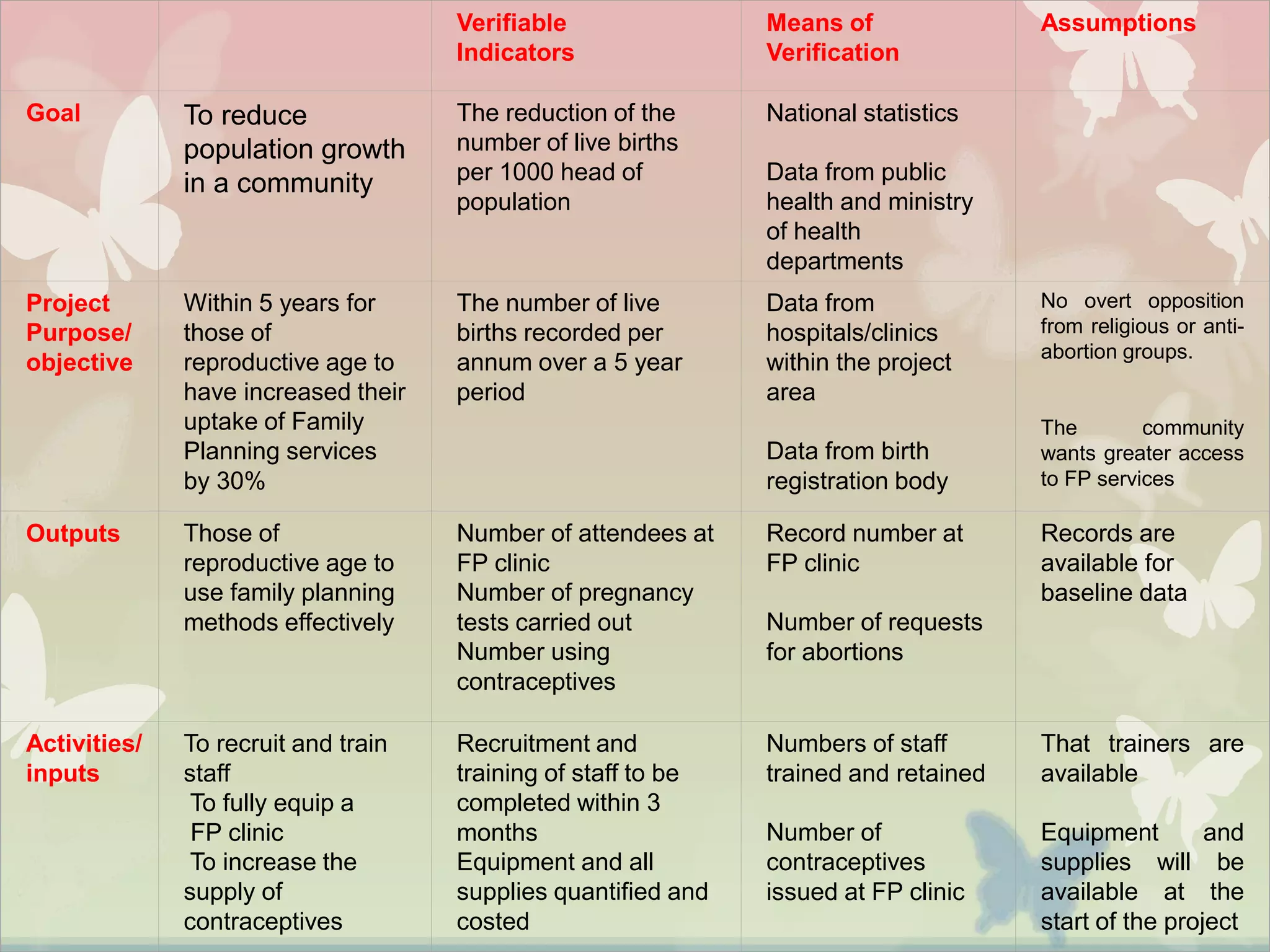
Verifiable
Indicators
Means of
Verification
Assumptions
Goal To reduce
population growth
in a community
The reduction of the
number of live births
per 1000 head of
population
National statistics
Data from public
health and ministry
of health
departments
Project
Purpose/
objective
Within 5 years for
those of
reproductive age to
have increased their
uptake of Family
Planning services
by 30%
The number of live
births recorded per
annum over a 5 year
period
Data from
hospitals/clinics
within the project
area
Data from birth
registration body
No overt opposition
from religious or anti-
abortion groups.
The community
wants greater access
to FP services
Outputs Those of
reproductive age to
use family planning
methods effectively
Number of attendees at
FP clinic
Number of pregnancy
tests carried out
Number using
contraceptives
Record number at
FP clinic
Number of requests
for abortions
Records are
available for
baseline data
Activities/
inputs
To recruit and train
staff
To fully equip a
FP clinic
To increase the
supply of
contraceptives
Recruitment and
training of staff to be
completed within 3
months
Equipment and all
supplies quantified and
costed
Numbers of staff
trained and retained
Number of
contraceptives
issued at FP clinic
That trainers are
available
Equipment and
supplies will be
available at the
start of the project
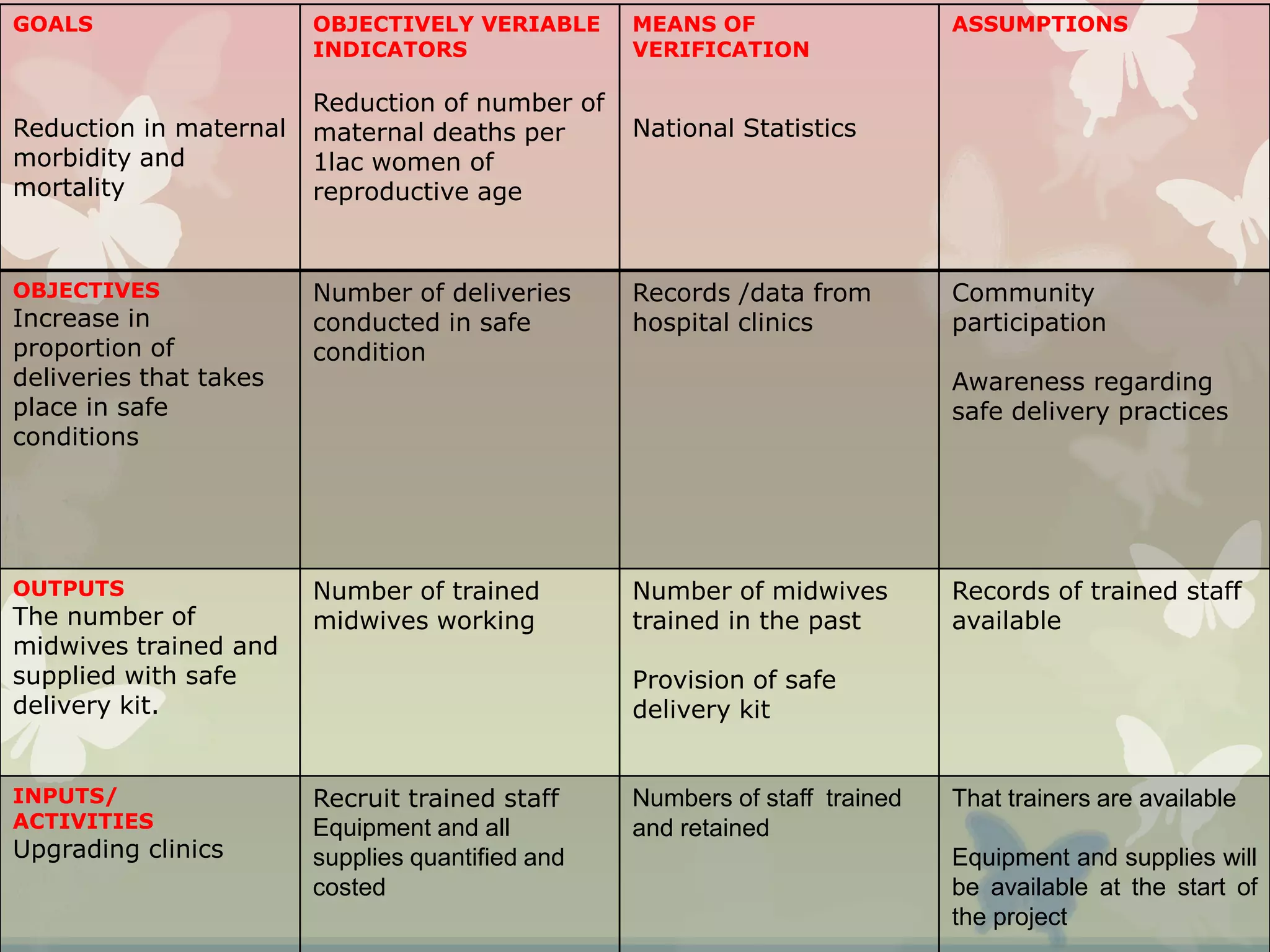
GOALS
Reduction in maternal
morbidity and
mortality
OBJECTIVELY VERIABLE
INDICATORS
Reduction of number of
maternal deaths per
1lac women of
reproductive age
MEANS OF
VERIFICATION
National Statistics
ASSUMPTIONS
OBJECTIVES
Increase in
proportion of
deliveries that takes
place in safe
conditions
Number of deliveries
conducted in safe
condition
Records /data from
hospital clinics
Community
participation
Awareness regarding
safe delivery practices
OUTPUTS
The number of
midwives trained and
supplied with safe
delivery kit.
Number of trained
midwives working
Number of midwives
trained in the past
Provision of safe
delivery kit
Records of trained staff
available
INPUTS/
ACTIVITIES
Upgrading clinics
Recruit trained staff
Equipment and all
supplies quantified and
costed
Numbers of staff trained
and retained
That trainers are available
Equipment and supplies will
be available at the start of
the project
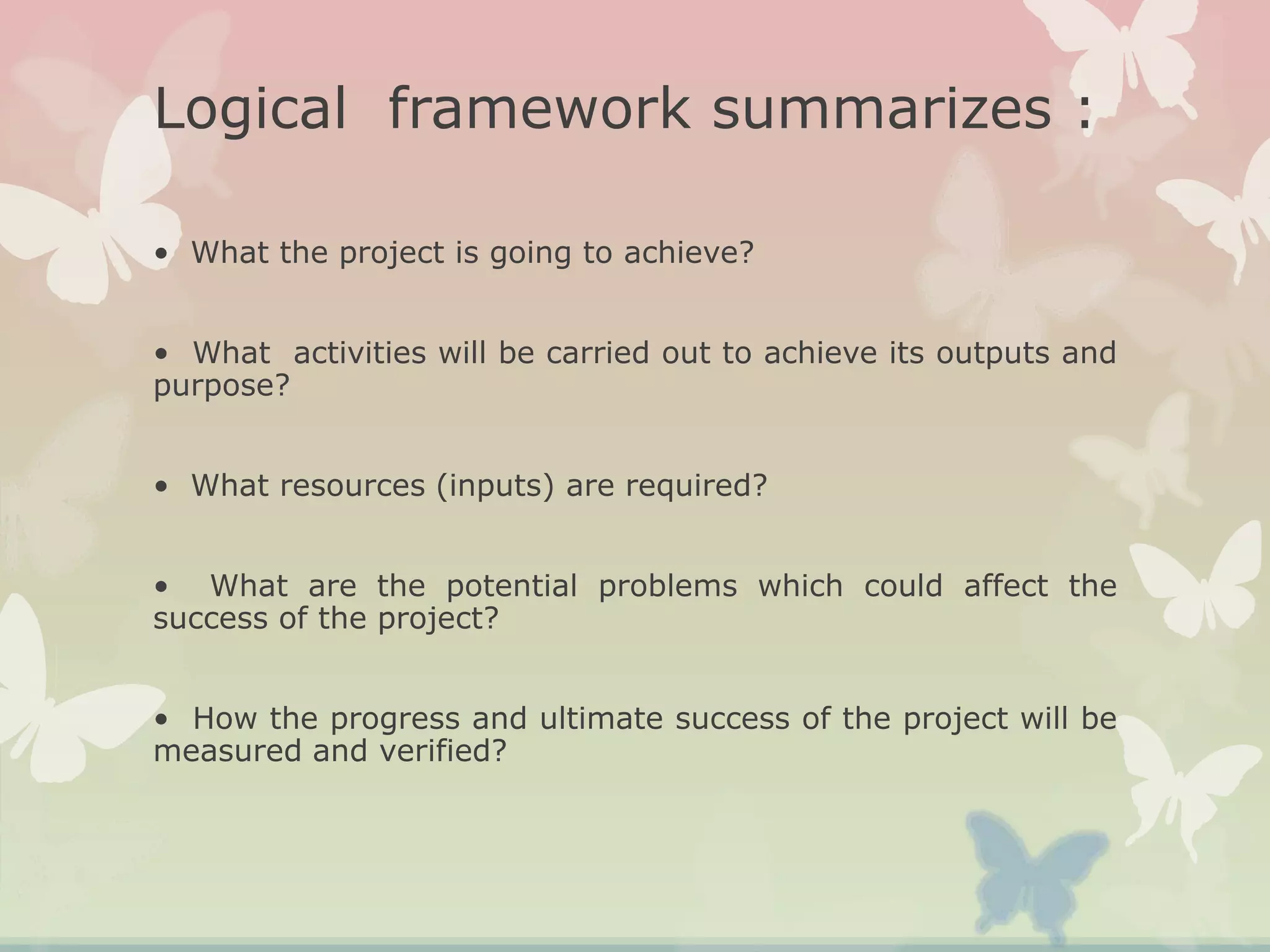
Logical framework summarizes :
• What the project is going to achieve?
• What activities will be carried out to achieve its outputs and
purpose?
• What resources (inputs) are required?
• What are the potential problems which could affect the
success of the project?
• How the progress and ultimate success of the project will be
measured and verified?
Advantages
 During initial stages , can be used to test project ideas
and concepts for relevance and usefulness.
 „„Designing log frames help to make comprehensive plans
that are feasible within acceptable levels of risks.
 During implementation the log frame serves as the
main reference for drawing up detailed work plans,
terms of reference, budgets, etc.
Advantages
 The log frame provides indicators against which the
progress and achievements can be assessed.
 It does not add time or effort to project management,
but reduces it.
 It anticipates implementation.
 It sets up a framework for monitoring and evaluation
where planned and actual results can be compared.
Disadvantages
 There may be a tendency to focus too much on problems
rather than on opportunities .
 „„The log frame may be used too rigidly, leading people
into a ‘‘blueprint ’’ approach to project design.
 It cannot replace the use of professionally qualified and
experienced staff.
 It requires a team process with good leadership and
facilitation skills to be most effective.
If you don’t know where you’re going,
how are you gonna’ know when you
get there?
References :
• P.V .Sathe,Epidemiology and Management for Health Care ,5th
edition,Pg 293-294
• Log Frame Development,World Health Organisation
https://www.who.int/hac/techguidance/training/logframe%20devel
opment.pdf (accessed on 11/05/19)
• Logical Framework Planning Matrix: Health and Care
programme/Health promotion and education project.
https://www.ifrc.org/docs/appeals/annual04/logframes/Europe/01
7604HealthER1.pdf (accessed on 12/5/19)
• The Use Of Logical Framework Approach
https://sswm.info/planning-and-programming/decision-
making/planning-community/logical-framework-approach
(accessed on 15/05/19)
References :
• Public Health Performance Management, Centers for Excellence
Funded by CDC’s National Public Health ,Improvement Initiative
Logic Models in Public Health Program Management,May 16,2012
https://www.doh.wa.gov/Portals/1/Documents/1000/PMC-
Logic%20Models%20May_16_12forWeb.pdf
(accessed on 20/05/2019)
• W.K. Kellogg Foundation. Using logic models to bring together
planning, evaluation and action: logic model development guide.
2004
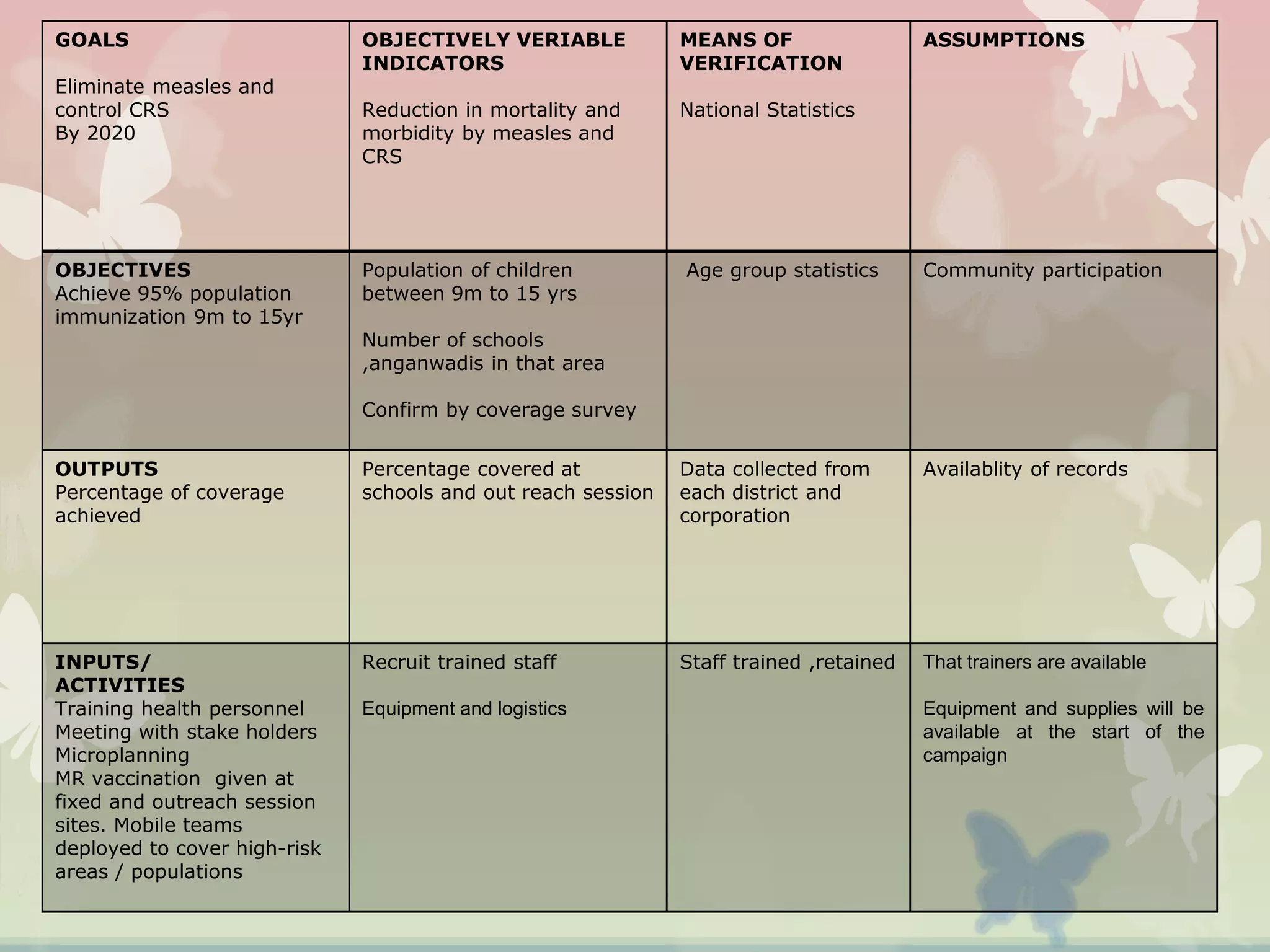
GOALS
Eliminate measles and
control CRS
By 2020
OBJECTIVELY VERIABLE
INDICATORS
Reduction in mortality and
morbidity by measles and
CRS
MEANS OF
VERIFICATION
National Statistics
ASSUMPTIONS
OBJECTIVES
Achieve 95% population
immunization 9m to 15yr
Population of children
between 9m to 15 yrs
Number of schools
,anganwadis in that area
Confirm by coverage survey
Age group statistics Community participation
OUTPUTS
Percentage of coverage
achieved
Percentage covered at
schools and out reach session
Data collected from
each district and
corporation
Availablity of records
INPUTS/
ACTIVITIES
Training health personnel
Meeting with stake holders
Microplanning
MR vaccination given at
fixed and outreach session
sites. Mobile teams
deployed to cover high-risk
areas / populations
Recruit trained staff
Equipment and logistics
Staff trained ,retained That trainers are available
Equipment and supplies will be
available at the start of the
campaign

Logical framework

  • 1.
    LOGICAL FRAMEWORK PG Student :Dr.Vaidehi Malvi PG Teachers: Dr.C.Rajguru Madam Dr.M.Sadawarte Sir Dr.Pravin Davuluri Sir
  • 2.
    Contents  Introduction  Phasesof logical framework  Steps for framing logical frame matrix  Advantages and disadvantages
  • 3.
    Introduction  The logicalframework was originally created as a planning tool for military purposes by United States Department of Defense .  After being adopted by USAID in the 1970s, the logical framework, or log frame has spread to all areas of the development sector.
  • 4.
    Logical Framework The logicalframework (Log FRAME) is a planning and management tool used for systematic and logical thinking for:  Plan projects  Monitor projects  Evaluate projects
  • 5.
    Uses of LogicalFramework  The Logical Framework is used mainly in the public sector  It is can be used to frame an action plan  It can be used as a planning and management tool.
  • 6.
    Basic logic modelparts  Goal :Wider problem the project will help to resolve  Purpose/objective :Change or benefit to be achieved by the project  Inputs/Activities : Resources invested in the program and what the program does  Outputs: These are specifically deliverable results expected from the project to attain the purpose
  • 7.
    Goal- • Improvement inreproductive and sexual health of adolescents. • Reduction in unwanted pregnancies • Reduction in maternal morbidity and mortality Purpose or objectives- • Increased contraceptive use • Greater use of condoms in non marital sex acts • Increase in proportion of deliveries that takes place in safe conditions Outputs: • Increase in number of clients served • The amount of contraceptive distributed • The number of midwives trained and supplied with safe delivery kit. Activities: • Training outreach workers • Creating condom distribution points • Upgrading clinics
  • 8.
    Phases of logical framework I)Preparatory Phase II) Analysis Phase III )Planning Phase
  • 9.
    Preparatory Phase A. Determinethe Focus Area: • Determine the focus area to be analyzed • Study the focus area • Present results of fact finding in short report B. Analyze Stakeholders involved : • Identify all stakeholders who have a relation to the focus area •Identify what the most important stakeholders contribute to and benefit from the focus area.
  • 10.
    Analysis Phase • Formulateproblems from point of view of the identified Stakeholders • Check whether all relevant problems of stakeholders are included • Check that problems are understood • Select a tentative “starter” problem
  • 11.
    Analysis Phase • Identifydirect causes of starter problem • Identify direct effects of starter problem • Continue identifying cause-effect relationships • Add additional problems if necessary • Draw connecting lines to make “Problem Tree” .
  • 14.
    Planning Phase • Preparingthe log frame matrix • The compilation of Objectively Verifiable Indicators • Assessment of the risk factors/assumptions • Planning of activities, and the allocation of the appropriate resources to achieve the completion of the activities.
  • 15.
    Log frame matrix GOALSOBJECTIVELY VERIABLE INDICATORS MEANS OF VERIFICATION ASSUMPTIONS OBJECTIVES OUTPUTS INPUTS/ ACTIVITIES
  • 16.
    Steps in framingthe log frame matrix
  • 17.
     Step 1:Define the overall goal to which your project contributes  Step 2: Define the purpose/objective to be achieved by the project  Step 3: Define the outputs for achieving this purpose  Step 4: Define the activities/inputs for achieving each output
  • 18.
     Step 5:Verify the Vertical Logic with the If/Then Test  Step 6: Define the assumptions related to each level  Step 7: Define the Objectively Verifiable Indicator (OVI) at goal then purpose, then output, then activity /input levels.  Step 8: Define the means /source of Verification (MOV)
  • 19.
    Step 1: Definethe overall goal to which your project contributes The Goal is the higher-order objective that you are seeking to achieve through the project, often in combination with others.
  • 20.
    Step 2: Definethe purpose/objective to be achieved by the project  This is why we are proposing to carry out the project.  It summarizes the impact we hope the project will have.
  • 21.
    Step 3: Definethe outputs for achieving this purpose • Outputs describe what we want the project to deliver. • They are the measurable end results of the planned activities .
  • 22.
    Step 4: Definethe activities/inputs for achieving each output  Activities define how the team will carry out the project  Generally we should aim at providing a brief summary of three to seven activities we must implement to accomplish each output objective
  • 23.
    Step 5: Verifythe Vertical Logic with the If/Then Test  In a well planned Logical Framework, at the lowest levels on the Logical Framework we can say that if certain Activities are carried out we can expect certain Outputs to result.  There should be the same logical relationship between the Outputs and the Purpose/objectives, and between the Purpose and the Goal.
  • 24.
    THE LOGIC OFA PROGRAMME: A SET OF LINKED HYPOTHESES GOAL PURPOSE ACTIVITIES OUTPUTS if then if then then if
  • 26.
    Step 6: Definethe Assumptions related to each level  Refers to conditions which could affect the progress of project ,but over which project managers have no control , ex: price changes ,non enforcement of supporting legislations etc  This column should record the important assumptions on which the success of the project depends and the risks that have been considered
  • 27.
    Step 7: Definethe Objectively Verifiable Indicator (OVI) at Goal then Purpose, then Output, then Activity /input levels.  Objectively Verifiable Indicators (OVIs) are standards against which change can be measured.  They set targets in terms of Quantity, Quality and Time (QQT)
  • 28.
    Step 8: Definethe means /source of Verification(MOV)  In the Means of Verification (MOV) we describe the sources of information that will demonstrate what has been accomplished.
  • 29.
    How do youplan using Logframe approach ?
  • 30.
    Goal Purpose Results Activities Assumptions Assumptions Assumptions Inputs + + + Pre-conditions need tobe met before resources are committed and activities initiated If activities are undertaken AND assumptions hold true, then results can be achieved
  • 31.
    Verifiable Indicators Means of Verification Assumptions Goal Toreduce population growth in a community The reduction of the number of live births per 1000 head of population National statistics Data from public health and ministry of health departments Project Purpose/ objective Within 5 years for those of reproductive age to have increased their uptake of Family Planning services by 30% The number of live births recorded per annum over a 5 year period Data from hospitals/clinics within the project area Data from birth registration body No overt opposition from religious or anti- abortion groups. The community wants greater access to FP services Outputs Those of reproductive age to use family planning methods effectively Number of attendees at FP clinic Number of pregnancy tests carried out Number using contraceptives Record number at FP clinic Number of requests for abortions Records are available for baseline data Activities/ inputs To recruit and train staff To fully equip a FP clinic To increase the supply of contraceptives Recruitment and training of staff to be completed within 3 months Equipment and all supplies quantified and costed Numbers of staff trained and retained Number of contraceptives issued at FP clinic That trainers are available Equipment and supplies will be available at the start of the project
  • 32.
    GOALS Reduction in maternal morbidityand mortality OBJECTIVELY VERIABLE INDICATORS Reduction of number of maternal deaths per 1lac women of reproductive age MEANS OF VERIFICATION National Statistics ASSUMPTIONS OBJECTIVES Increase in proportion of deliveries that takes place in safe conditions Number of deliveries conducted in safe condition Records /data from hospital clinics Community participation Awareness regarding safe delivery practices OUTPUTS The number of midwives trained and supplied with safe delivery kit. Number of trained midwives working Number of midwives trained in the past Provision of safe delivery kit Records of trained staff available INPUTS/ ACTIVITIES Upgrading clinics Recruit trained staff Equipment and all supplies quantified and costed Numbers of staff trained and retained That trainers are available Equipment and supplies will be available at the start of the project
  • 33.
    Logical framework summarizes: • What the project is going to achieve? • What activities will be carried out to achieve its outputs and purpose? • What resources (inputs) are required? • What are the potential problems which could affect the success of the project? • How the progress and ultimate success of the project will be measured and verified?
  • 34.
    Advantages  During initialstages , can be used to test project ideas and concepts for relevance and usefulness.  „„Designing log frames help to make comprehensive plans that are feasible within acceptable levels of risks.  During implementation the log frame serves as the main reference for drawing up detailed work plans, terms of reference, budgets, etc.
  • 35.
    Advantages  The logframe provides indicators against which the progress and achievements can be assessed.  It does not add time or effort to project management, but reduces it.  It anticipates implementation.  It sets up a framework for monitoring and evaluation where planned and actual results can be compared.
  • 36.
    Disadvantages  There maybe a tendency to focus too much on problems rather than on opportunities .  „„The log frame may be used too rigidly, leading people into a ‘‘blueprint ’’ approach to project design.  It cannot replace the use of professionally qualified and experienced staff.  It requires a team process with good leadership and facilitation skills to be most effective.
  • 37.
    If you don’tknow where you’re going, how are you gonna’ know when you get there?
  • 38.
    References : • P.V.Sathe,Epidemiology and Management for Health Care ,5th edition,Pg 293-294 • Log Frame Development,World Health Organisation https://www.who.int/hac/techguidance/training/logframe%20devel opment.pdf (accessed on 11/05/19) • Logical Framework Planning Matrix: Health and Care programme/Health promotion and education project. https://www.ifrc.org/docs/appeals/annual04/logframes/Europe/01 7604HealthER1.pdf (accessed on 12/5/19) • The Use Of Logical Framework Approach https://sswm.info/planning-and-programming/decision- making/planning-community/logical-framework-approach (accessed on 15/05/19)
  • 39.
    References : • PublicHealth Performance Management, Centers for Excellence Funded by CDC’s National Public Health ,Improvement Initiative Logic Models in Public Health Program Management,May 16,2012 https://www.doh.wa.gov/Portals/1/Documents/1000/PMC- Logic%20Models%20May_16_12forWeb.pdf (accessed on 20/05/2019) • W.K. Kellogg Foundation. Using logic models to bring together planning, evaluation and action: logic model development guide. 2004
  • 41.
    GOALS Eliminate measles and controlCRS By 2020 OBJECTIVELY VERIABLE INDICATORS Reduction in mortality and morbidity by measles and CRS MEANS OF VERIFICATION National Statistics ASSUMPTIONS OBJECTIVES Achieve 95% population immunization 9m to 15yr Population of children between 9m to 15 yrs Number of schools ,anganwadis in that area Confirm by coverage survey Age group statistics Community participation OUTPUTS Percentage of coverage achieved Percentage covered at schools and out reach session Data collected from each district and corporation Availablity of records INPUTS/ ACTIVITIES Training health personnel Meeting with stake holders Microplanning MR vaccination given at fixed and outreach session sites. Mobile teams deployed to cover high-risk areas / populations Recruit trained staff Equipment and logistics Staff trained ,retained That trainers are available Equipment and supplies will be available at the start of the campaign