Facilitating Sustainable Socio-economic
development among smallholder farmers
through the implementation of Dairy
Extension strategies
Dr. Asif Mohammad
Senior Scientist
ICAR-National Dairy Research Institute
Eastern Regional Station
Kalyani
India's Dairy Sector: A Path to Rural
Prosperity and Food Security
 India's vibrant rural population relies heavily on agriculture for their
livelihood.
 Any agrarian hardship can cause significant economic losses for these
communities.
 This makes them susceptible to a vicious cycle of poverty.
 Dairy farming can play a crucial role in breaking this cycle and ensuring
food security.
The Importance of Dairy Farming
 25.90% of total household income for farmers with less than 0.1 hectares
of land comes from the dairy sector.
 Milk and milk products contribute 68% of the value of output from the
livestock sub-sector.
 80 million rural households in India engage in milk production, mostly
small and marginal farmers.
 75% of the country's dairy animals are owned by small and marginal
farmers.
 Livestock's contribution to India's agricultural GDP has consistently
increased.
Strategies for Sustainable Dairy
Development:
 Strengthening the existing agricultural extension mechanism:
 Providing necessary support to farmers coping with extreme weather events
and other challenges.
 Expanding the role of dairy extension:
 Going beyond information sharing and service provision to include convergence
and knowledge management.
 Validating and incorporating Indigenous Technical Knowledge (ITK) into
extension practices.
 Creating and sharing knowledge networks involving farmers, research
institutions, and industry partners.
 Promoting self-reliance:
 Implementing suitable extension interventions and monitoring progress.
 Tapping into India's vast potential to become a leading dairy producer and
processor.
 Achieving the goal of self-reliant India in the dairy sector.
Indian dairy sector and dairy extension
strategies: Comprehensive analysis
 India's vibrant rural population heavily relies on agriculture and dairy
farming for their livelihood.
 Dairy farming plays a crucial role in breaking the cycle of poverty and
ensuring food security.
Milk Production Status
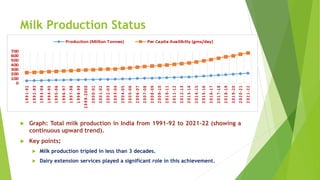
 Graph: Total milk production in India from 1991-92 to 2021-22 (showing a
continuous upward trend).
 Key points:
 Milk production tripled in less than 3 decades.
 Dairy extension services played a significant role in this achievement.
Economic Importance of Dairy
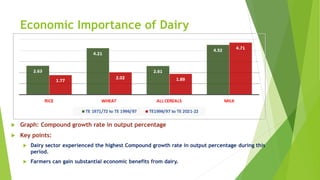
 Graph: Compound growth rate in output percentage
 Key points:
 Dairy sector experienced the highest Compound growth rate in output percentage during this
period.
 Farmers can gain substantial economic benefits from dairy.
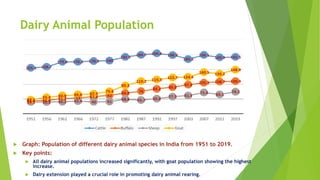
Dairy Animal Population
 Graph: Population of different dairy animal species in India from 1951 to 2019.
 Key points:
 All dairy animal populations increased significantly, with goat population showing the highest
increase.
 Dairy extension played a crucial role in promoting dairy animal rearing.
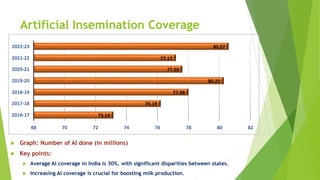
Artificial Insemination Coverage
 Graph: Number of AI done (in millions)
 Key points:
 Average AI coverage in India is 30%, with significant disparities between states.
 Increasing AI coverage is crucial for boosting milk production.
Government Schemes for Dairy
Development in India
 Several government schemes are in place to promote the dairy sector.
 Dairy extension played a vital role in popularizing these schemes.
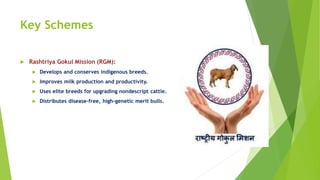
Key Schemes
 Rashtriya Gokul Mission (RGM):
 Develops and conserves indigenous breeds.
 Improves milk production and productivity.
 Uses elite breeds for upgrading nondescript cattle.
 Distributes disease-free, high-genetic merit bulls.
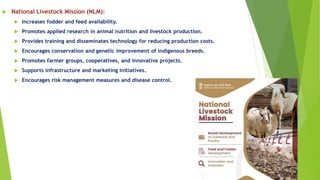
 National Livestock Mission (NLM):
 Increases fodder and feed availability.
 Promotes applied research in animal nutrition and livestock production.
 Provides training and disseminates technology for reducing production costs.
 Encourages conservation and genetic improvement of indigenous breeds.
 Promotes farmer groups, cooperatives, and innovative projects.
 Supports infrastructure and marketing initiatives.
 Encourages risk management measures and disease control.
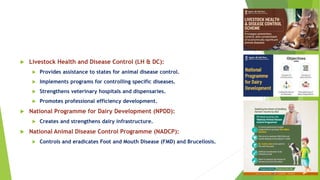
 Livestock Health and Disease Control (LH & DC):
 Provides assistance to states for animal disease control.
 Implements programs for controlling specific diseases.
 Strengthens veterinary hospitals and dispensaries.
 Promotes professional efficiency development.
 National Programme for Dairy Development (NPDD):
 Creates and strengthens dairy infrastructure.
 National Animal Disease Control Programme (NADCP):
 Controls and eradicates Foot and Mouth Disease (FMD) and Brucellosis.
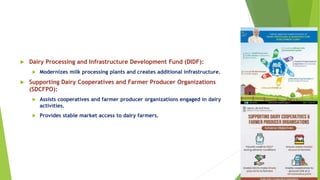
 Dairy Processing and Infrastructure Development Fund (DIDF):
 Modernizes milk processing plants and creates additional infrastructure.
 Supporting Dairy Cooperatives and Farmer Producer Organizations
(SDCFPO):
 Assists cooperatives and farmer producer organizations engaged in dairy
activities.
 Provides stable market access to dairy farmers.
Value Addition
 Huge scope for value addition in dairy sector.
 Value-added products can:
 Ensure remunerative prices for farmers.
 Create employment opportunities.
Utilizing Dairy Extension Strategies to
Harness the Growth Potential of the Indian
Dairy Sector
ICT Enabled Extension
 Information and Communication Technology (ICT) for:
 Communication with large number of farmers.
 Farmer-to-farmer interactions.
 Feedback to research systems.
 Examples:
 e-GOPALA app - connects farmers with AI workers and provides information.
Middle-class Purchasing Power
 Rising middle-class population with high purchasing power.
 Increased demand for value-added dairy products.
 Dairy extension should focus on value addition.
Organized Milk Marketing
 Increasing share of the organized sector in milk marketing.
 Benefits for farmers:
 Better prices
 Access to technology
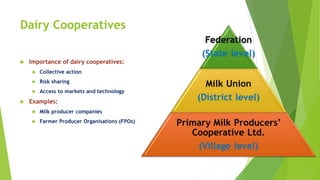
Dairy Cooperatives
 Importance of dairy cooperatives:
 Collective action
 Risk sharing
 Access to markets and technology
 Examples:
 Milk producer companies
 Farmer Producer Organisations (FPOs)
Skill Development
 Developing skills in dairy processing:
 Training programs for rural youth.
 Focus on entrepreneurship development.
 Benefits:
 Increased income
 Job creation
Fodder Production
 Ensuring farmers' participation in feed and fodder supply.
 Promoting high-yielding fodder varieties.
 Importance of location-specific extension approaches.
Convergence of Efforts
 Need for convergence of efforts from different extension organizations
and schemes.
 Benefits:
 Synergistic effects
 Improved resource utilization
 Enhanced impact on dairy farmers
Champion Dairy Farmers
 Promoting the concept of "champion dairy farmers".
 Benefits:
 Motivation for other farmers
 Sharing of best practices
 Public recognition
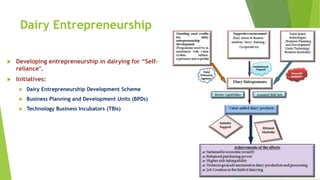
Dairy Entrepreneurship
 Developing entrepreneurship in dairying for “Self-
reliance".
 Initiatives:
 Dairy Entrepreneurship Development Scheme
 Business Planning and Development Units (BPDs)
 Technology Business Incubators (TBIs)
Strengthening 'Model Farmer' Concept for
Dairy Extension
 Model farmers can play a crucial role in utilizing the full potential of the
existing dairy extension system.
 This approach promotes knowledge sharing, improved practices, and
increased self-reliance (Atmanirbharta) among dairy farmers.
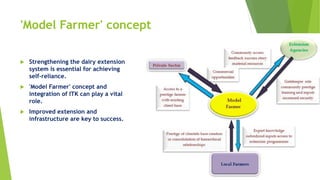
Model Farmer Role
 Acts as a gatekeeper for knowledge and resources.
 Provides feedback to extension agencies and private sector.
 Disseminates information and best practices to local farmers.
 Creates a sense of community and mutual respect.
Benefits for Model Farmers
 Access to expert knowledge, subsidized inputs, and extension programs.
 Increased community access and prestige.
 Training and inputs for enhanced security and self-reliance.
Benefits for Local Farmers
 Improved access to information and resources.
 Increased dairy farm productivity and commercial outlook.
 Success stories and role models.
Benefits for Private Sector
 Access to a prestige farmer and existing client base.
 Creation or consolidation of hierarchical relationships.
 Opportunity to share commercial opportunities with model farmers.
Integrating Indigenous Traditional
Knowledge (ITK)
 ITK can provide valuable insights and solutions for dairy farming.
 Need to identify, collect, and document various ITKs.
 Categorization, cataloguing, and screening of ITKs are important.
 Scientific validation and protection of proprietary rights are crucial.
'Model Farmer' concept
 Strengthening the dairy extension
system is essential for achieving
self-reliance.
 'Model Farmer' concept and
integration of ITK can play a vital
role.
 Improved extension and
infrastructure are key to success.
Call to Action
 Invest in dairy extension and infrastructure development.
 Support and empower model farmers and ITK integration.
 Promote sustainable dairy farming practices.
Conclusion
 Advancing Dairy Extension:
 Paradigm Shift with Convergence Strategies
 Knowledge Management and ITK Integration
 Government Initiatives and ICT Innovation
 Trajectory Towards Self-Reliance
 Imperatives for Sustained Growth:
 Empowering Model Farmers
 Targeted Skill Development
 Strategic Interventions
Thank You

Extension strategies.pptx

  • 1.
    Facilitating Sustainable Socio-economic developmentamong smallholder farmers through the implementation of Dairy Extension strategies Dr. Asif Mohammad Senior Scientist ICAR-National Dairy Research Institute Eastern Regional Station Kalyani
  • 2.
    India's Dairy Sector:A Path to Rural Prosperity and Food Security  India's vibrant rural population relies heavily on agriculture for their livelihood.  Any agrarian hardship can cause significant economic losses for these communities.  This makes them susceptible to a vicious cycle of poverty.  Dairy farming can play a crucial role in breaking this cycle and ensuring food security.
  • 3.
    The Importance ofDairy Farming  25.90% of total household income for farmers with less than 0.1 hectares of land comes from the dairy sector.  Milk and milk products contribute 68% of the value of output from the livestock sub-sector.  80 million rural households in India engage in milk production, mostly small and marginal farmers.  75% of the country's dairy animals are owned by small and marginal farmers.  Livestock's contribution to India's agricultural GDP has consistently increased.
  • 4.
    Strategies for SustainableDairy Development:  Strengthening the existing agricultural extension mechanism:  Providing necessary support to farmers coping with extreme weather events and other challenges.  Expanding the role of dairy extension:  Going beyond information sharing and service provision to include convergence and knowledge management.  Validating and incorporating Indigenous Technical Knowledge (ITK) into extension practices.  Creating and sharing knowledge networks involving farmers, research institutions, and industry partners.
  • 5.
     Promoting self-reliance: Implementing suitable extension interventions and monitoring progress.  Tapping into India's vast potential to become a leading dairy producer and processor.  Achieving the goal of self-reliant India in the dairy sector.
  • 6.
    Indian dairy sectorand dairy extension strategies: Comprehensive analysis  India's vibrant rural population heavily relies on agriculture and dairy farming for their livelihood.  Dairy farming plays a crucial role in breaking the cycle of poverty and ensuring food security.
  • 7.
    Milk Production Status Graph: Total milk production in India from 1991-92 to 2021-22 (showing a continuous upward trend).  Key points:  Milk production tripled in less than 3 decades.  Dairy extension services played a significant role in this achievement.
  • 8.
    Economic Importance ofDairy  Graph: Compound growth rate in output percentage  Key points:  Dairy sector experienced the highest Compound growth rate in output percentage during this period.  Farmers can gain substantial economic benefits from dairy.
  • 9.
    Dairy Animal Population Graph: Population of different dairy animal species in India from 1951 to 2019.  Key points:  All dairy animal populations increased significantly, with goat population showing the highest increase.  Dairy extension played a crucial role in promoting dairy animal rearing.
  • 10.
    Artificial Insemination Coverage Graph: Number of AI done (in millions)  Key points:  Average AI coverage in India is 30%, with significant disparities between states.  Increasing AI coverage is crucial for boosting milk production.
  • 11.
    Government Schemes forDairy Development in India  Several government schemes are in place to promote the dairy sector.  Dairy extension played a vital role in popularizing these schemes.
  • 12.
    Key Schemes  RashtriyaGokul Mission (RGM):  Develops and conserves indigenous breeds.  Improves milk production and productivity.  Uses elite breeds for upgrading nondescript cattle.  Distributes disease-free, high-genetic merit bulls.
  • 13.
     National LivestockMission (NLM):  Increases fodder and feed availability.  Promotes applied research in animal nutrition and livestock production.  Provides training and disseminates technology for reducing production costs.  Encourages conservation and genetic improvement of indigenous breeds.  Promotes farmer groups, cooperatives, and innovative projects.  Supports infrastructure and marketing initiatives.  Encourages risk management measures and disease control.
  • 14.
     Livestock Healthand Disease Control (LH & DC):  Provides assistance to states for animal disease control.  Implements programs for controlling specific diseases.  Strengthens veterinary hospitals and dispensaries.  Promotes professional efficiency development.  National Programme for Dairy Development (NPDD):  Creates and strengthens dairy infrastructure.  National Animal Disease Control Programme (NADCP):  Controls and eradicates Foot and Mouth Disease (FMD) and Brucellosis.
  • 15.
     Dairy Processingand Infrastructure Development Fund (DIDF):  Modernizes milk processing plants and creates additional infrastructure.  Supporting Dairy Cooperatives and Farmer Producer Organizations (SDCFPO):  Assists cooperatives and farmer producer organizations engaged in dairy activities.  Provides stable market access to dairy farmers.
  • 16.
    Value Addition  Hugescope for value addition in dairy sector.  Value-added products can:  Ensure remunerative prices for farmers.  Create employment opportunities.
  • 17.
    Utilizing Dairy ExtensionStrategies to Harness the Growth Potential of the Indian Dairy Sector
  • 18.
    ICT Enabled Extension Information and Communication Technology (ICT) for:  Communication with large number of farmers.  Farmer-to-farmer interactions.  Feedback to research systems.  Examples:  e-GOPALA app - connects farmers with AI workers and provides information.
  • 19.
    Middle-class Purchasing Power Rising middle-class population with high purchasing power.  Increased demand for value-added dairy products.  Dairy extension should focus on value addition.
  • 20.
    Organized Milk Marketing Increasing share of the organized sector in milk marketing.  Benefits for farmers:  Better prices  Access to technology
  • 21.
    Dairy Cooperatives  Importanceof dairy cooperatives:  Collective action  Risk sharing  Access to markets and technology  Examples:  Milk producer companies  Farmer Producer Organisations (FPOs)
  • 22.
    Skill Development  Developingskills in dairy processing:  Training programs for rural youth.  Focus on entrepreneurship development.  Benefits:  Increased income  Job creation
  • 23.
    Fodder Production  Ensuringfarmers' participation in feed and fodder supply.  Promoting high-yielding fodder varieties.  Importance of location-specific extension approaches.
  • 24.
    Convergence of Efforts Need for convergence of efforts from different extension organizations and schemes.  Benefits:  Synergistic effects  Improved resource utilization  Enhanced impact on dairy farmers
  • 25.
    Champion Dairy Farmers Promoting the concept of "champion dairy farmers".  Benefits:  Motivation for other farmers  Sharing of best practices  Public recognition
  • 26.
    Dairy Entrepreneurship  Developingentrepreneurship in dairying for “Self- reliance".  Initiatives:  Dairy Entrepreneurship Development Scheme  Business Planning and Development Units (BPDs)  Technology Business Incubators (TBIs)
  • 27.
    Strengthening 'Model Farmer'Concept for Dairy Extension  Model farmers can play a crucial role in utilizing the full potential of the existing dairy extension system.  This approach promotes knowledge sharing, improved practices, and increased self-reliance (Atmanirbharta) among dairy farmers.
  • 28.
    Model Farmer Role Acts as a gatekeeper for knowledge and resources.  Provides feedback to extension agencies and private sector.  Disseminates information and best practices to local farmers.  Creates a sense of community and mutual respect.
  • 29.
    Benefits for ModelFarmers  Access to expert knowledge, subsidized inputs, and extension programs.  Increased community access and prestige.  Training and inputs for enhanced security and self-reliance.
  • 30.
    Benefits for LocalFarmers  Improved access to information and resources.  Increased dairy farm productivity and commercial outlook.  Success stories and role models.
  • 31.
    Benefits for PrivateSector  Access to a prestige farmer and existing client base.  Creation or consolidation of hierarchical relationships.  Opportunity to share commercial opportunities with model farmers.
  • 32.
    Integrating Indigenous Traditional Knowledge(ITK)  ITK can provide valuable insights and solutions for dairy farming.  Need to identify, collect, and document various ITKs.  Categorization, cataloguing, and screening of ITKs are important.  Scientific validation and protection of proprietary rights are crucial.
  • 33.
    'Model Farmer' concept Strengthening the dairy extension system is essential for achieving self-reliance.  'Model Farmer' concept and integration of ITK can play a vital role.  Improved extension and infrastructure are key to success.
  • 34.
    Call to Action Invest in dairy extension and infrastructure development.  Support and empower model farmers and ITK integration.  Promote sustainable dairy farming practices.
  • 35.
    Conclusion  Advancing DairyExtension:  Paradigm Shift with Convergence Strategies  Knowledge Management and ITK Integration  Government Initiatives and ICT Innovation  Trajectory Towards Self-Reliance  Imperatives for Sustained Growth:  Empowering Model Farmers  Targeted Skill Development  Strategic Interventions
  • 36.