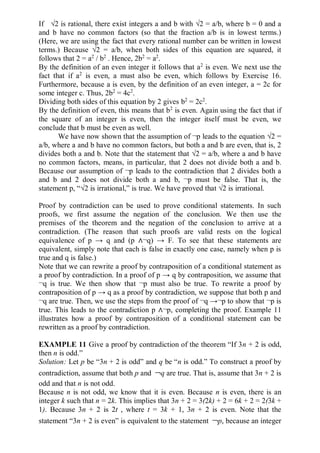
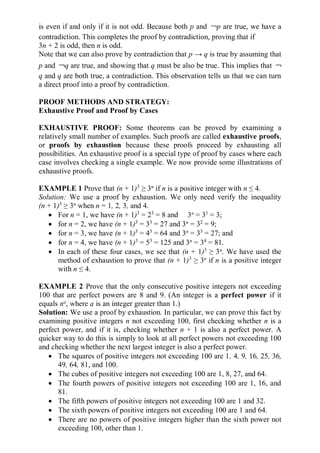
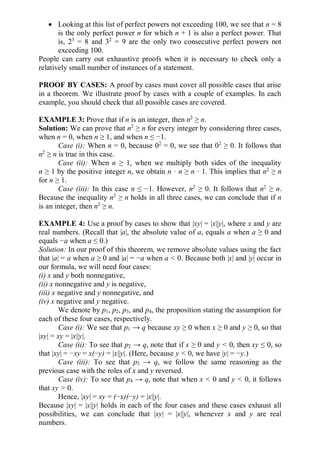
CS401PC: DISCRETE MATHEMATICS
R18- B.TECH II Year II Sem.- COMPUTER SCIENCE & ENGG.
UNIT - I
The Foundations: Logic and Proofs: Propositional Logic, Applications of
Propositional Logic, Propositional Equivalence, Predicates and Quantifiers,
Nested Quantifiers, Rules of Inference, Introduction to Proofs, Proof Methods
and Strategy. (Page Nos. 1 to 114)
The Foundations: Logic and Proofs
PROPOSITIONAL LOGIC:
A proposition is a declarative sentence (that is, a sentence that declares
a fact) that is either true or false.
EXAMPLE 1
All the following declarative sentences are propositions.
1. Washington is the capital of the United States of America.
2. Toronto is the capital of Canada.
3. 1 + 1 = 2.
4. 2 + 2 = 3.
Propositions 1 and 3 are true, whereas 2 and 4 are false.
Some sentences that are not propositions are given in Example 2.
EXAMPLE 2
Consider the following sentences.
1. What time is it?
2. Read this carefully.
3. x + 1 = 2.
4. x + y = z.
Sentences 1 and 2 are not propositions because they are not declarative
sentences. Sentences 3 and 4 are not propositions because they are neither true
nor false. Note that each of sentences 3 and 4 can be turned into a proposition if
we assign values to the variables.
DEFINITION 1:
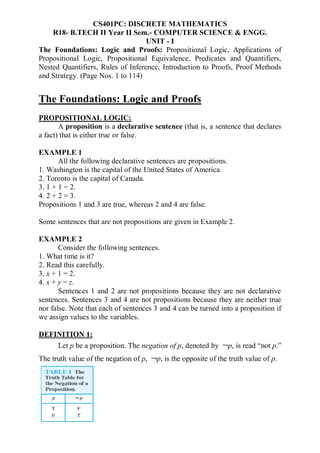
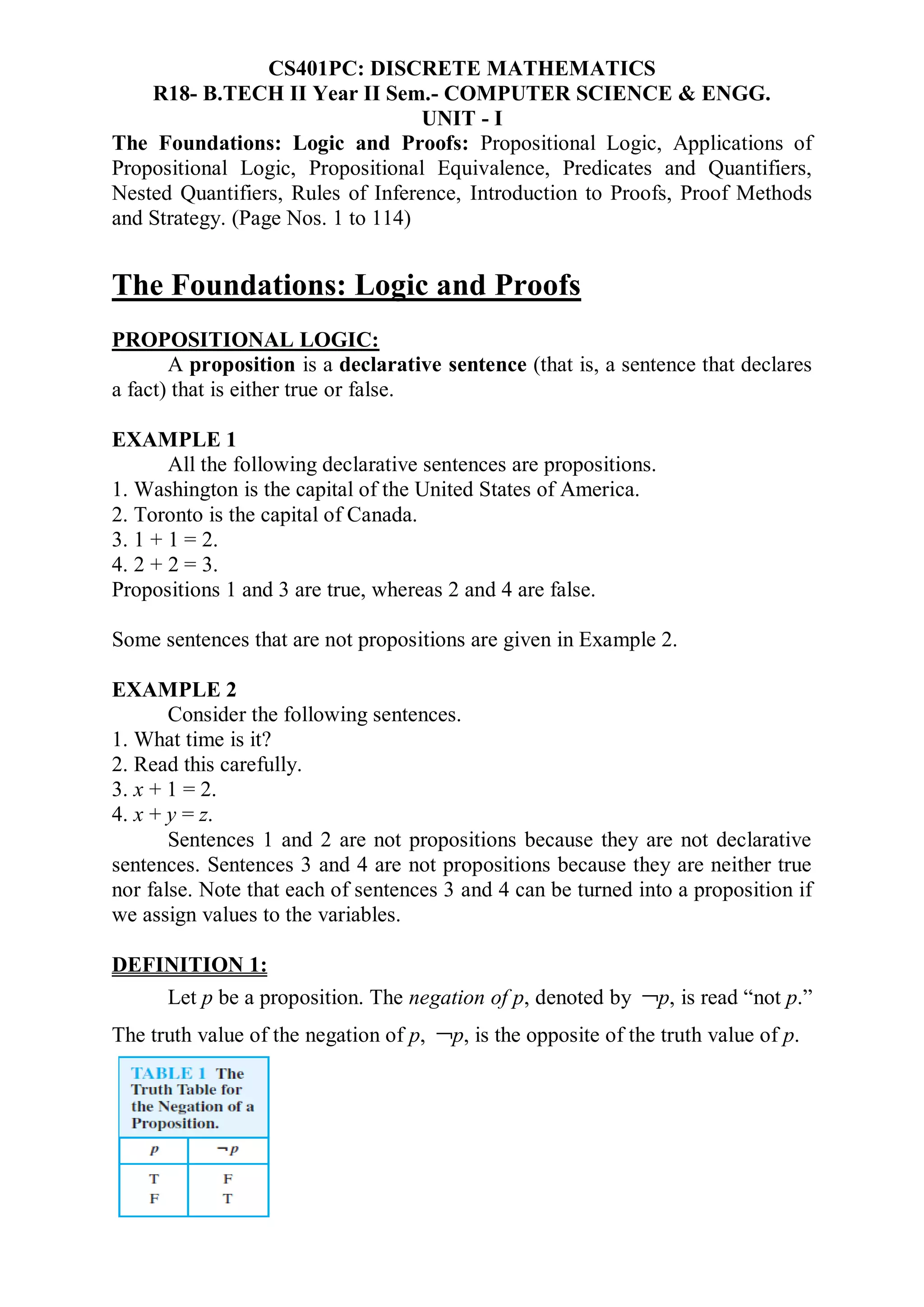
Let p be a proposition. The negation of p, denoted by ¬p, is read “not p.”
The truth value of the negation of p, ¬p, is the opposite of the truth value of p.
EXAMPLE 3:
Find the negation of the proposition “Michael’s PC runs Linux” and
express this in simple English.
Solution: The negation is “It is not the case that Michael’s PC runs
Linux.” This negation can be more simply expressed as “Michael’s PC does not
run Linux.”
EXAMPLE 4 :
Find the negation of the proposition “Vandana’s smartphone has at least
32GB of memory” and express this in simple English.
Solution: The negation is “It is not the case that Vandana’s smartphone
has at least 32GB of memory.” This negation can also be expressed as
“Vandana’s smartphone does not have at least 32GB of memory”.
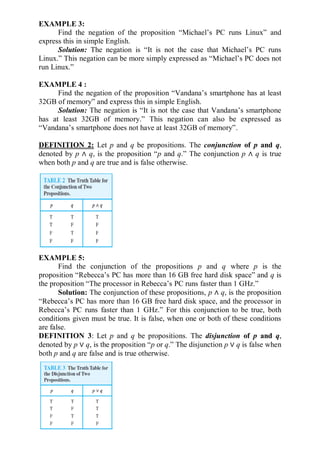
DEFINITION 2: Let p and q be propositions. The conjunction of p and q,
denoted by p ∧ q, is the proposition “p and q.” The conjunction p ∧ q is true
when both p and q are true and is false otherwise.
EXAMPLE 5:
Find the conjunction of the propositions p and q where p is the
proposition “Rebecca’s PC has more than 16 GB free hard disk space” and q is
the proposition “The processor in Rebecca’s PC runs faster than 1 GHz.”
Solution: The conjunction of these propositions, p ∧ q, is the proposition
“Rebecca’s PC has more than 16 GB free hard disk space, and the processor in
Rebecca’s PC runs faster than 1 GHz.” For this conjunction to be true, both
conditions given must be true. It is false, when one or both of these conditions
are false.
DEFINITION 3: Let p and q be propositions. The disjunction of p and q,
denoted by p ∨ q, is the proposition “p or q.” The disjunction p ∨ q is false when
both p and q are false and is true otherwise.
EXAMPLE:
What is the disjunction of the propositions p and q where p and q are the same
propositions as in Example 5?
Solution: The disjunction of p and q, p ∨ q, is the proposition “Rebecca’s PC
has at least 16 GB free hard disk space, or the processor in Rebecca’s PC runs
faster than 1 GHz.”
This proposition is true when Rebecca’s PC has at least 16 GB free hard
disk space, when the PC’s processor runs faster than 1 GHz, and when both
conditions are true. It is false when both of these conditions are false, that is,
when Rebecca’s PC has less than 16 GB free hard disk space and the processor
in her PC runs at 1 GHz or slower.
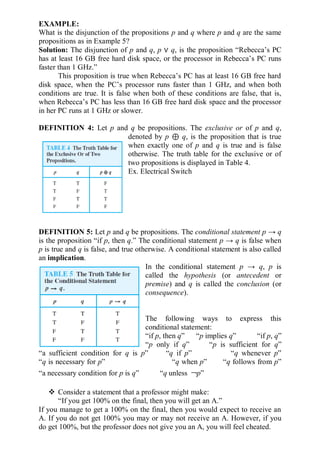
DEFINITION 4: Let p and q be propositions. The exclusive or of p and q,
denoted by p ⊕ q, is the proposition that is true
when exactly one of p and q is true and is false
otherwise. The truth table for the exclusive or of
two propositions is displayed in Table 4.
Ex. Electrical Switch
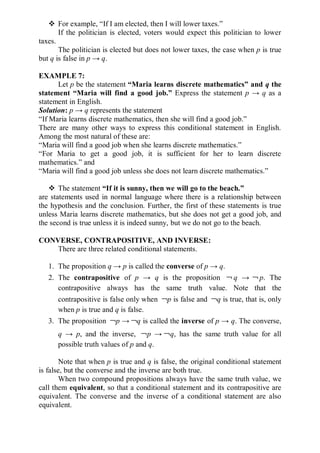
DEFINITION 5: Let p and q be propositions. The conditional statement p → q
is the proposition “if p, then q.” The conditional statement p → q is false when
p is true and q is false, and true otherwise. A conditional statement is also called
an implication.
In the conditional statement p → q, p is
called the hypothesis (or antecedent or
premise) and q is called the conclusion (or
consequence).
The following ways to express this
conditional statement:
“if p, then q” “p implies q” “if p, q”
“p only if q” “p is sufficient for q”
“a sufficient condition for q is p” “q if p” “q whenever p”
“q is necessary for p” “q when p” “q follows from p”
“a necessary condition for p is q” “q unless ¬p”
 Consider a statement that a professor might make:
“If you get 100% on the final, then you will get an A.”
If you manage to get a 100% on the final, then you would expect to receive an
A. If you do not get 100% you may or may not receive an A. However, if you
do get 100%, but the professor does not give you an A, you will feel cheated.
 For example, “If I am elected, then I will lower taxes.”
If the politician is elected, voters would expect this politician to lower
taxes.
The politician is elected but does not lower taxes, the case when p is true
but q is false in p → q.
EXAMPLE 7:
Let p be the statement “Maria learns discrete mathematics” and q the
statement “Maria will find a good job.” Express the statement p → q as a
statement in English.
Solution: p → q represents the statement
“If Maria learns discrete mathematics, then she will find a good job.”
There are many other ways to express this conditional statement in English.
Among the most natural of these are:
“Maria will find a good job when she learns discrete mathematics.”
“For Maria to get a good job, it is sufficient for her to learn discrete
mathematics.” and
“Maria will find a good job unless she does not learn discrete mathematics.”
 The statement “If it is sunny, then we will go to the beach.”
are statements used in normal language where there is a relationship between
the hypothesis and the conclusion. Further, the first of these statements is true
unless Maria learns discrete mathematics, but she does not get a good job, and
the second is true unless it is indeed sunny, but we do not go to the beach.
CONVERSE, CONTRAPOSITIVE, AND INVERSE:
There are three related conditional statements.
1. The proposition q → p is called the converse of p → q.
2. The contrapositive of p → q is the proposition ¬ q → ¬ p. The
contrapositive always has the same truth value. Note that the
contrapositive is false only when ¬p is false and ¬q is true, that is, only
when p is true and q is false.
3. The proposition ¬p →¬q is called the inverse of p → q. The converse,
q → p, and the inverse, ¬p →¬q, has the same truth value for all
possible truth values of p and q.
Note that when p is true and q is false, the original conditional statement
is false, but the converse and the inverse are both true.
When two compound propositions always have the same truth value, we
call them equivalent, so that a conditional statement and its contrapositive are
equivalent. The converse and the inverse of a conditional statement are also
equivalent.
EXAMPLE 9 :
What are the contrapositive, the converse, and the inverse of the
conditional statement “The home team wins whenever it is raining?”.
Solution: Because “q whenever p” is one of the ways to express the conditional
statement p → q, the original statement can be rewritten as
“If it is raining, then the home team wins.”
The contrapositive of this conditional statement is
“If the home team does not win, then it is not raining.”
The converse is
“If the home team wins, then it is raining.”
The inverse is
“If it is not raining, then the home team does not win.”
BICONDITIONALS: We now introduce another way to combine propositions
that expresses that two propositions have the same truth value.
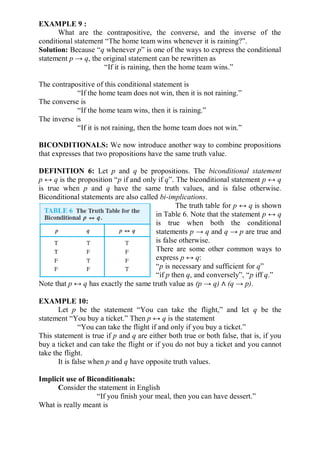
DEFINITION 6: Let p and q be propositions. The biconditional statement
p ↔ q is the proposition “p if and only if q”. The biconditional statement p ↔ q
is true when p and q have the same truth values, and is false otherwise.
Biconditional statements are also called bi-implications.
The truth table for p ↔ q is shown
in Table 6. Note that the statement p ↔ q
is true when both the conditional
statements p → q and q → p are true and
is false otherwise.
There are some other common ways to
express p ↔ q:
“p is necessary and sufficient for q”
“if p then q, and conversely”, “p iff q.”
Note that p ↔ q has exactly the same truth value as (p → q) ∧ (q → p).
EXAMPLE 10:
Let p be the statement “You can take the flight,” and let q be the
statement “You buy a ticket.” Then p ↔ q is the statement
“You can take the flight if and only if you buy a ticket.”
This statement is true if p and q are either both true or both false, that is, if you
buy a ticket and can take the flight or if you do not buy a ticket and you cannot
take the flight.
It is false when p and q have opposite truth values.
Implicit use of Biconditionals:
Consider the statement in English
“If you finish your meal, then you can have dessert.”
What is really meant is
“You can have dessert if and only if you finish your meal.”
This last statement is logically equivalent. In natural language, statement
implicitly includes its converse.
TRUTH TABLES OF COMPOUND PROPOSITIONS:
Four important logical connectives—conjunctions, disjunctions,
conditional statements, and biconditional statements as well as negations.We
can use these connectives to build up complicated compound propositions
involving any number of propositional variables.
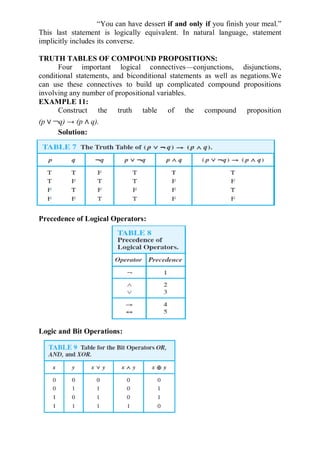
EXAMPLE 11:
Construct the truth table of the compound proposition
(p ∨¬q) → (p ∧ q).
Solution:
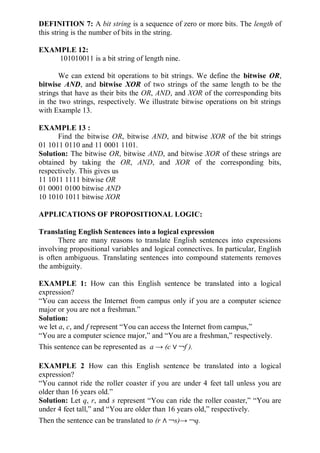
Precedence of Logical Operators:
Logic and Bit Operations:
DEFINITION 7: A bit string is a sequence of zero or more bits. The length of
this string is the number of bits in the string.
EXAMPLE 12:
101010011 is a bit string of length nine.
We can extend bit operations to bit strings. We define the bitwise OR,
bitwise AND, and bitwise XOR of two strings of the same length to be the
strings that have as their bits the OR, AND, and XOR of the corresponding bits
in the two strings, respectively. We illustrate bitwise operations on bit strings
with Example 13.
EXAMPLE 13 :
Find the bitwise OR, bitwise AND, and bitwise XOR of the bit strings
01 1011 0110 and 11 0001 1101.
Solution: The bitwise OR, bitwise AND, and bitwise XOR of these strings are
obtained by taking the OR, AND, and XOR of the corresponding bits,
respectively. This gives us
11 1011 1111 bitwise OR
01 0001 0100 bitwise AND
10 1010 1011 bitwise XOR
APPLICATIONS OF PROPOSITIONAL LOGIC:
Translating English Sentences into a logical expression
There are many reasons to translate English sentences into expressions
involving propositional variables and logical connectives. In particular, English
is often ambiguous. Translating sentences into compound statements removes
the ambiguity.
EXAMPLE 1: How can this English sentence be translated into a logical
expression?
“You can access the Internet from campus only if you are a computer science
major or you are not a freshman.”
Solution:
we let a, c, and f represent “You can access the Internet from campus,”
“You are a computer science major,” and “You are a freshman,” respectively.
This sentence can be represented as a → (c ∨¬f ).
EXAMPLE 2 How can this English sentence be translated into a logical
expression?
“You cannot ride the roller coaster if you are under 4 feet tall unless you are
older than 16 years old.”
Solution: Let q, r, and s represent “You can ride the roller coaster,” “You are
under 4 feet tall,” and “You are older than 16 years old,” respectively.
Then the sentence can be translated to (r ∧¬s)→¬q.
EXAMPLE 3 Express the specification “The automated reply cannot be sent
when the file system is full” using logical connectives.
Solution: let p denote “The automated reply can be sent” and q denote “The
file system is full.” Then ¬p represents “It is not the case that the automated
reply can be sent,” which can also be expressed as “The automated reply cannot
be sent.”
Consequently, our specification can be represented by the conditional statement
q →¬p.
EXAMPLE 4 Determine whether these system specifications are consistent:
“The diagnostic message is stored in the buffer or it is retransmitted.”
“The diagnostic message is not stored in the buffer.”
“If the diagnostic message is stored in the buffer, then it is retransmitted.”
Solution: To determine whether these specifications are consistent, we first
express them using logical expressions.
Let p denote “The diagnostic message is stored in the buffer” and
let q denote “The diagnostic message is retransmitted.”
The specifications can then be written as p ∨ q, ¬p, and p → q.
An assignment of truth values that makes all three specifications true must have
p false to make ¬p true. Because we want p ∨ q to be true but p must be false,
q must be true. Because p → q is true when p is false and q is true, we conclude
that these specifications are consistent, because they are all true when p is false
and q is true.
EXAMPLE 5 Do the system specifications in Example 4 remain consistent if
the specification “The diagnostic message is not retransmitted” is added?
Solution: By the reasoning in Example 4, the three specifications from that
example are true only in the case when p is false and q is true. However, this
new specification is ¬q, which is false when q is true. Consequently, these four
specifications are inconsistent.
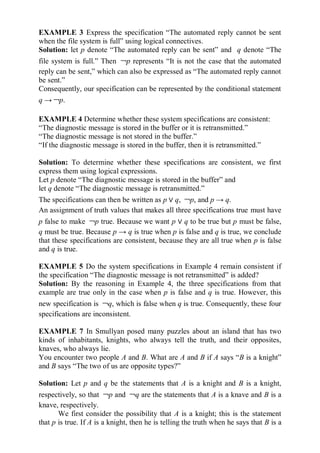
EXAMPLE 7 In Smullyan posed many puzzles about an island that has two
kinds of inhabitants, knights, who always tell the truth, and their opposites,
knaves, who always lie.
You encounter two people A and B. What are A and B if A says “B is a knight”
and B says “The two of us are opposite types?”
Solution: Let p and q be the statements that A is a knight and B is a knight,
respectively, so that ¬p and ¬q are the statements that A is a knave and B is a
knave, respectively.
We first consider the possibility that A is a knight; this is the statement
that p is true. If A is a knight, then he is telling the truth when he says that B is a
knight, so that q is true, and A and B are the same type. However, if B is a
knight, then B’s statement that A and B are of opposite types, the statement (p ∧
¬q) ∨ (¬p ∧ q), would have to be true, which it is not, because A and B are
both knights. Consequently, we can conclude that A is not a knight, that is, that
p is false.
If A is a knave, then because everything a knave says is false, A’s
statement that B is a knight, that is, that q is true, is a lie. This means that q is
false and B is also a knave.
Furthermore, if B is a knave, then B’s statement that A and B are opposite
types is a lie, which is consistent with both A and B being knaves. We can
conclude that both A and B are knaves.
EXAMPLE 8: A father tells his two children, a boy and a girl, to play in their
backyard without getting dirty. However, while playing, both children get mud
on their foreheads. When the children stop playing, the father says “At least one
of you has a muddy forehead,” and then asks the children to answer “Yes” or
“No” to the question: “Do you know whether you have a muddy forehead?”
The father asks this question twice.
What will the children answer each time this question is asked, assuming
that a child can see whether his or her sibling has a muddy forehead, but cannot
see his or her own forehead? Assume that both children are honest and that the
children answer each question simultaneously.
Solution:
Let s be the statement that the son has a muddy forehead and
let d be the statement that the daughter has a muddy forehead.
When the father says that at least one of the two children has a muddy
forehead, he is stating that the disjunction s ∨ d is true.
children will answer “No” the first time the question is asked because
each sees mud on the other child’s forehead.
That is, the son knows that d is true, but does not know whether s is true,
and the daughter knows that s is true, but does not know whether d is true.
After the son has answered “No” to the first question, the daughter can
determine that d must be true.
This follows because when the first question is asked, the son knows that
s ∨ d is true, but cannot determine whether s is true. Using this information, the
daughter can conclude that d must be true, for if d were false, the son could
have reasoned that because s ∨ d is true, then s must be true, and he would have
answered “Yes” to the first question.
The son can reason in a similar way to determine that s must be true. It follows
that both children answer “Yes” the second time the question is asked.
Logic Circuits
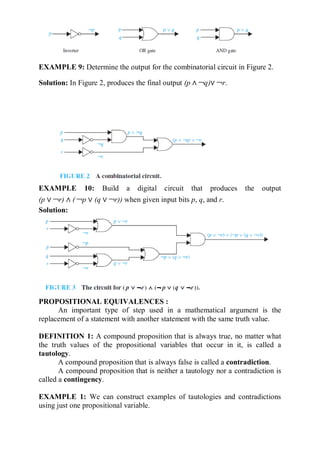
Propositional logic can be applied to the design of computer hardware.
This was first observed in 1938 by Claude Shannon in his MIT master’s thesis.
A logic circuit (or digital circuit) receives input signals p1, p2, . . . , pn, each a
bit [either 0 (off) or 1 (on)], and produces output signals s1, s2, . . . , sn, each a
bit.
EXAMPLE 9: Determine the output for the combinatorial circuit in Figure 2.
Solution: In Figure 2, produces the final output (p ∧¬q)∨¬r.
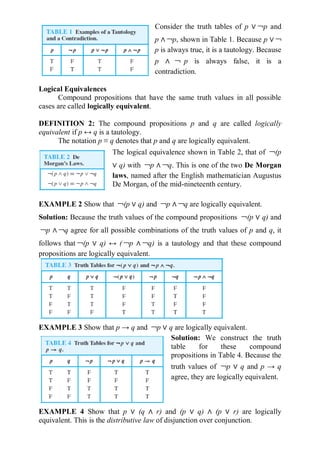
EXAMPLE 10: Build a digital circuit that produces the output
(p ∨¬r) ∧ (¬p ∨ (q ∨¬r)) when given input bits p, q, and r.
Solution:
PROPOSITIONAL EQUIVALENCES :
An important type of step used in a mathematical argument is the
replacement of a statement with another statement with the same truth value.
DEFINITION 1: A compound proposition that is always true, no matter what
the truth values of the propositional variables that occur in it, is called a
tautology.
A compound proposition that is always false is called a contradiction.
A compound proposition that is neither a tautology nor a contradiction is
called a contingency.
EXAMPLE 1: We can construct examples of tautologies and contradictions
using just one propositional variable.
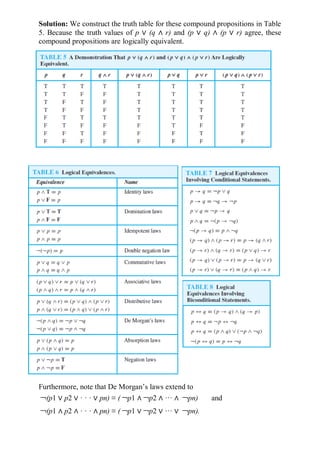
Consider the truth tables of p ∨¬p and
p ∧¬p, shown in Table 1. Because p ∨¬
p is always true, it is a tautology. Because
p ∧ ¬ p is always false, it is a
contradiction.
Logical Equivalences
Compound propositions that have the same truth values in all possible
cases are called logically equivalent.
DEFINITION 2: The compound propositions p and q are called logically
equivalent if p ↔ q is a tautology.
The notation p ≡ q denotes that p and q are logically equivalent.
The logical equivalence shown in Table 2, that of ¬(p
∨ q) with ¬p ∧¬q. This is one of the two De Morgan
laws, named after the English mathematician Augustus
De Morgan, of the mid-nineteenth century.
EXAMPLE 2 Show that ¬(p ∨ q) and ¬p ∧¬q are logically equivalent.
Solution: Because the truth values of the compound propositions ¬(p ∨ q) and
¬p ∧¬q agree for all possible combinations of the truth values of p and q, it
follows that¬(p ∨ q) ↔ (¬p ∧¬q) is a tautology and that these compound
propositions are logically equivalent.
EXAMPLE 3 Show that p → q and ¬p ∨ q are logically equivalent.
Solution: We construct the truth
table for these compound
propositions in Table 4. Because the
truth values of ¬p ∨ q and p → q
agree, they are logically equivalent.
EXAMPLE 4 Show that p ∨ (q ∧ r) and (p ∨ q) ∧ (p ∨ r) are logically
equivalent. This is the distributive law of disjunction over conjunction.
Solution: We construct the truth table for these compound propositions in Table
5. Because the truth values of p ∨ (q ∧ r) and (p ∨ q) ∧ (p ∨ r) agree, these
compound propositions are logically equivalent.
Furthermore, note that De Morgan’s laws extend to
¬(p1 ∨ p2 ∨ · · · ∨ pn) ≡ (¬p1 ∧¬p2 ∧ ··· ∧ ¬pn) and
¬(p1 ∧ p2 ∧ · · · ∧ pn) ≡ (¬p1 ∨¬p2 ∨ ··· ∨ ¬pn).
EXAMPLE 5: Use De Morgan’s laws to express the negations of
 “Miguel has a cellphone and he has a laptop computer” and
 “Heather will go to the concert or Steve will go to the concert.”
Solution: Let p be “Miguel has a cellphone” and q be “Miguel has a laptop
computer.” Then “Miguel has a cellphone and he has a laptop computer” can be
represented by p ∧ q. By the first of De Morgan’s laws, ¬(p ∧ q) is equivalent
to ¬p ∨¬q. Consequently, we can express the negation of our original
statement as “Miguel does not have a cellphone or he does not have a laptop
computer.”
Let r be “Heather will go to the concert” and s be “Steve will go to the
concert.” Then “Heather will go to the concert or Steve will go to the concert”
can be represented by r ∨ s. By the second of De Morgan’s laws, ¬(r ∨ s) is
equivalent to ¬r ∧¬s. Consequently, we can express the negation of our
original statement as “Heather will not go to the concert and Steve will not go to
the concert.”
Constructing New Logical Equivalences
if p and q are logically equivalent and q and r are logically equivalent,
then p and r are logically equivalent.
EXAMPLE 6: Show that ¬(p → q) and p ∧¬q are logically equivalent.
Solution: We have the following equivalences.
¬(p → q) ≡ ¬(¬p ∨ q) by logical equivalence of conditional statement
≡ ¬(¬p)∧¬q by the second De Morgan law
≡ p ∧¬q by the double negation law
EXAMPLE 7 Show that ¬(p ∨ (¬p ∧ q)) and ¬p ∧¬q are logically
equivalent by developing a series of logical equivalences.
Solution: We have the following equivalences.
¬(p ∨ (¬p ∧ q)) ≡ ¬p ∧¬(¬p ∧ q) by the second De Morgan law
≡ ¬p ∧ [¬(¬p)∨¬q] by the first De Morgan law
≡ ¬p ∧ (p ∨¬q) by the double negation law
≡ (¬p ∧ p) ∨ (¬p ∧¬q) by the second distributive law
≡ F ∨ (¬p ∧¬q) by the negation law
≡ (¬p ∧¬q) ∨ F by the commutative law for disjunction
≡ ¬p ∧¬q by the identity law for F
Consequently ¬(p ∨ (¬p ∧ q)) and ¬p ∧¬q are logically equivalent.
EXAMPLE 8: Show that (p ∧ q) → (p ∨ q) is a tautology.
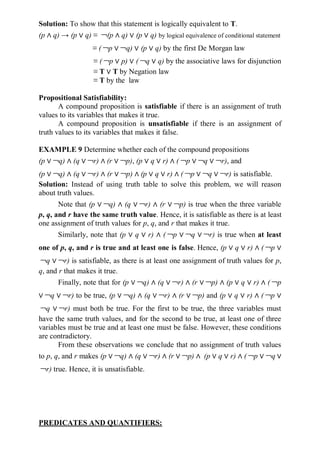
Solution: To show that this statement is logically equivalent to T.
(p ∧ q) → (p ∨ q) ≡ ¬(p ∧ q) ∨ (p ∨ q) by logical equivalence of conditional statement
≡ (¬p ∨¬q) ∨ (p ∨ q) by the first De Morgan law
≡ (¬p ∨ p) ∨ (¬q ∨ q) by the associative laws for disjunction
≡ T ∨ T by Negation law
≡ T by the law
Propositional Satisfiability:
A compound proposition is satisfiable if there is an assignment of truth
values to its variables that makes it true.
A compound proposition is unsatisfiable if there is an assignment of
truth values to its variables that makes it false.
EXAMPLE 9 Determine whether each of the compound propositions
(p ∨¬q) ∧ (q ∨¬r) ∧ (r ∨¬p), (p ∨ q ∨ r) ∧ (¬p ∨¬q ∨¬r), and
(p ∨¬q) ∧ (q ∨¬r) ∧ (r ∨¬p) ∧ (p ∨ q ∨ r) ∧ (¬p ∨¬q ∨¬r) is satisfiable.
Solution: Instead of using truth table to solve this problem, we will reason
about truth values.
Note that (p ∨¬q) ∧ (q ∨¬r) ∧ (r ∨¬p) is true when the three variable
p, q, and r have the same truth value. Hence, it is satisfiable as there is at least
one assignment of truth values for p, q, and r that makes it true.
Similarly, note that (p ∨ q ∨ r) ∧ (¬p ∨¬q ∨¬r) is true when at least
one of p, q, and r is true and at least one is false. Hence, (p ∨ q ∨ r) ∧ (¬p ∨
¬q ∨¬r) is satisfiable, as there is at least one assignment of truth values for p,
q, and r that makes it true.
Finally, note that for (p ∨¬q) ∧ (q ∨¬r) ∧ (r ∨¬p) ∧ (p ∨ q ∨ r) ∧ (¬p
∨¬q ∨¬r) to be true, (p ∨¬q) ∧ (q ∨¬r) ∧ (r ∨¬p) and (p ∨ q ∨ r) ∧ (¬p ∨
¬q ∨¬r) must both be true. For the first to be true, the three variables must
have the same truth values, and for the second to be true, at least one of three
variables must be true and at least one must be false. However, these conditions
are contradictory.
From these observations we conclude that no assignment of truth values
to p, q, and r makes (p ∨¬q) ∧ (q ∨¬r) ∧ (r ∨¬p) ∧ (p ∨ q ∨ r) ∧ (¬p ∨¬q ∨
¬r) true. Hence, it is unsatisfiable.
PREDICATES AND QUANTIFIERS:
PREDICATES:
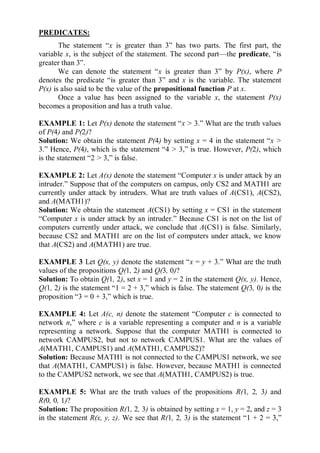
The statement “x is greater than 3” has two parts. The first part, the
variable x, is the subject of the statement. The second part—the predicate, “is
greater than 3”.
We can denote the statement “x is greater than 3” by P(x), where P
denotes the predicate “is greater than 3” and x is the variable. The statement
P(x) is also said to be the value of the propositional function P at x.
Once a value has been assigned to the variable x, the statement P(x)
becomes a proposition and has a truth value.
EXAMPLE 1: Let P(x) denote the statement “x > 3.” What are the truth values
of P(4) and P(2)?
Solution: We obtain the statement P(4) by setting x = 4 in the statement “x >
3.” Hence, P(4), which is the statement “4 > 3,” is true. However, P(2), which
is the statement “2 > 3,” is false.
EXAMPLE 2: Let A(x) denote the statement “Computer x is under attack by an
intruder.” Suppose that of the computers on campus, only CS2 and MATH1 are
currently under attack by intruders. What are truth values of A(CS1), A(CS2),
and A(MATH1)?
Solution: We obtain the statement A(CS1) by setting x = CS1 in the statement
“Computer x is under attack by an intruder.” Because CS1 is not on the list of
computers currently under attack, we conclude that A(CS1) is false. Similarly,
because CS2 and MATH1 are on the list of computers under attack, we know
that A(CS2) and A(MATH1) are true.
EXAMPLE 3 Let Q(x, y) denote the statement “x = y + 3.” What are the truth
values of the propositions Q(1, 2) and Q(3, 0)?
Solution: To obtain Q(1, 2), set x = 1 and y = 2 in the statement Q(x, y). Hence,
Q(1, 2) is the statement “1 = 2 + 3,” which is false. The statement Q(3, 0) is the
proposition “3 = 0 + 3,” which is true.
EXAMPLE 4: Let A(c, n) denote the statement “Computer c is connected to
network n,” where c is a variable representing a computer and n is a variable
representing a network. Suppose that the computer MATH1 is connected to
network CAMPUS2, but not to network CAMPUS1. What are the values of
A(MATH1, CAMPUS1) and A(MATH1, CAMPUS2)?
Solution: Because MATH1 is not connected to the CAMPUS1 network, we see
that A(MATH1, CAMPUS1) is false. However, because MATH1 is connected
to the CAMPUS2 network, we see that A(MATH1, CAMPUS2) is true.
EXAMPLE 5: What are the truth values of the propositions R(1, 2, 3) and
R(0, 0, 1)?
Solution: The proposition R(1, 2, 3) is obtained by setting x = 1, y = 2, and z = 3
in the statement R(x, y, z). We see that R(1, 2, 3) is the statement “1 + 2 = 3,”
which is true. Also note that R(0, 0, 1), which is the statement “0 + 0 = 1,” is
false.
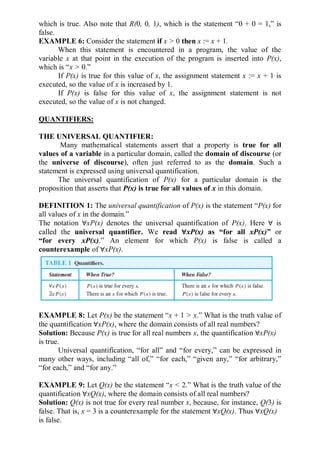
EXAMPLE 6: Consider the statement if x > 0 then x := x + 1.
When this statement is encountered in a program, the value of the
variable x at that point in the execution of the program is inserted into P(x),
which is “x > 0.”
If P(x) is true for this value of x, the assignment statement x := x + 1 is
executed, so the value of x is increased by 1.
If P(x) is false for this value of x, the assignment statement is not
executed, so the value of x is not changed.
QUANTIFIERS:
THE UNIVERSAL QUANTIFIER:
Many mathematical statements assert that a property is true for all
values of a variable in a particular domain, called the domain of discourse (or
the universe of discourse), often just referred to as the domain. Such a
statement is expressed using universal quantification.
The universal quantification of P(x) for a particular domain is the
proposition that asserts that P(x) is true for all values of x in this domain.
DEFINITION 1: The universal quantification of P(x) is the statement “P(x) for
all values of x in the domain.”
The notation ∀xP(x) denotes the universal quantification of P(x). Here ∀ is
called the universal quantifier. We read ∀xP(x) as “for all xP(x)” or
“for every xP(x).” An element for which P(x) is false is called a
counterexample of ∀xP(x).
EXAMPLE 8: Let P(x) be the statement “x + 1 > x.” What is the truth value of
the quantification ∀xP(x), where the domain consists of all real numbers?
Solution: Because P(x) is true for all real numbers x, the quantification ∀xP(x)
is true.
Universal quantification, “for all” and “for every,” can be expressed in
many other ways, including “all of,” “for each,” “given any,” “for arbitrary,”
“for each,” and “for any.”
EXAMPLE 9: Let Q(x) be the statement “x < 2.” What is the truth value of the
quantification ∀xQ(x), where the domain consists of all real numbers?
Solution: Q(x) is not true for every real number x, because, for instance, Q(3) is
false. That is, x = 3 is a counterexample for the statement ∀xQ(x). Thus ∀xQ(x)
is false.
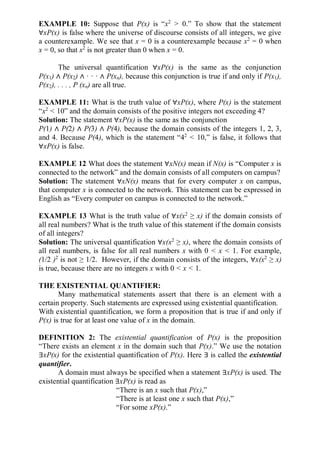
EXAMPLE 10: Suppose that P(x) is “x2
> 0.” To show that the statement
∀xP(x) is false where the universe of discourse consists of all integers, we give
a counterexample. We see that x = 0 is a counterexample because x2
= 0 when
x = 0, so that x2
is not greater than 0 when x = 0.
The universal quantification ∀xP(x) is the same as the conjunction
P(x1) ∧ P(x2) ∧ · · · ∧ P(xn), because this conjunction is true if and only if P(x1),
P(x2), . . . , P (xn) are all true.
EXAMPLE 11: What is the truth value of ∀xP(x), where P(x) is the statement
“x2
< 10” and the domain consists of the positive integers not exceeding 4?
Solution: The statement ∀xP(x) is the same as the conjunction
P(1) ∧ P(2) ∧ P(3) ∧ P(4), because the domain consists of the integers 1, 2, 3,
and 4. Because P(4), which is the statement “42
< 10,” is false, it follows that
∀xP(x) is false.
EXAMPLE 12 What does the statement ∀xN(x) mean if N(x) is “Computer x is
connected to the network” and the domain consists of all computers on campus?
Solution: The statement ∀xN(x) means that for every computer x on campus,
that computer x is connected to the network. This statement can be expressed in
English as “Every computer on campus is connected to the network.”
EXAMPLE 13 What is the truth value of ∀x(x2
≥ x) if the domain consists of
all real numbers? What is the truth value of this statement if the domain consists
of all integers?
Solution: The universal quantification ∀x(x2
≥ x), where the domain consists of
all real numbers, is false for all real numbers x with 0 < x < 1. For example,
(1/2 )2
is not ≥ 1/2. However, if the domain consists of the integers, ∀x(x2
≥ x)
is true, because there are no integers x with 0 < x < 1.
THE EXISTENTIAL QUANTIFIER:
Many mathematical statements assert that there is an element with a
certain property. Such statements are expressed using existential quantification.
With existential quantification, we form a proposition that is true if and only if
P(x) is true for at least one value of x in the domain.
DEFINITION 2: The existential quantification of P(x) is the proposition
“There exists an element x in the domain such that P(x).” We use the notation
∃xP(x) for the existential quantification of P(x). Here ∃ is called the existential
quantifier.
A domain must always be specified when a statement ∃xP(x) is used. The
existential quantification ∃xP(x) is read as
“There is an x such that P(x),”
“There is at least one x such that P(x),”
“For some xP(x).”
EXAMPLE 14: Let P(x) denote the statement “x > 3.” What is the truth value
of the quantification ∃xP(x), where the domain consists of all real numbers?
Solution: Because “x > 3” is sometimes true. When x = 4, the existential
quantification of P(x), which is ∃xP(x), is true.
EXAMPLE 15 Let Q(x) denote the statement “x = x + 1.” What is the truth
value of the quantification ∃xQ(x), where the domain consists of all real
numbers?
Solution: Because Q(x) is false for every real number x, the existential
quantification of Q(x), which is ∃xQ(x), is false.
When all elements in the domain can be listed—say, x1, x2, . . . , xn—the
existential quantification ∃xP(x) is the same as the disjunction
P(x1) ∨ P(x2) ∨ · · · ∨ P(xn), because this disjunction is true if and only if at least
one of P(x1), P(x2), . . . , P (xn) is true.
EXAMPLE 16: What is the truth value of ∃xP(x), where P(x) is the statement
“x2
> 10” and the universe of discourse consists of the positive integers not
exceeding 4?
Solution: Because the domain is {1, 2, 3, 4}, the proposition ∃xP(x) is the same
as the disjunction P(1) ∨ P(2) ∨ P(3) ∨ P(4), it follows that ∃xP(x) is true.
The Uniqueness Quantifier:
The uniqueness quantifier is denoted by ∃! or ∃1. The notation ∃!xP(x)
[or ∃1xP(x)] states “There exists a unique x such that P(x) is true.”
(Other phrases for uniqueness quantification include “there is exactly one” and
“there is one and only one.”)
For instance, ∃!x(x − 1 = 0), where the domain is the set of real numbers,
states that there is a unique real number x such that x − 1 = 0. This is a true
statement, as x = 1 is the unique real number such that x − 1 = 0.
Quantifiers with Restricted Domains:
An abbreviated notation is often used to restrict the domain of a
quantifier. In this notation, a condition a variable must satisfy is included after
the quantifier.
EXAMPLE 17: What do the statements ∀x < 0 (x2
> 0), ∀y ≠ 0 (y3
≠ 0), and
∃z > 0 (z2
= 2) mean, where the domain in each case consists of the real
numbers?
Solution: The statement ∀x < 0 (x2
> 0) states that for every real number x with
x < 0, x2
> 0. That is, it states “The square of a negative real number is
positive.” This statement is the same as ∀x(x < 0 → x2
> 0).
The statement ∀y ≠ 0 (y3
≠ 0) states that for every real number y with y ≠ 0,
we have y3
≠ 0. That is, it states “The cube of every nonzero real number is
nonzero.” Note that this statement is equivalent to ∀y(y ≠ 0 → y3
≠ 0).
Finally, the statement ∃z > 0 (z2
= 2) states that there exists a real number
z with z > 0 such that z2
= 2. That is, it states “There is a positive square root of
2.” This statement is equivalent to ∃z(z > 0 ∧ z2
= 2).
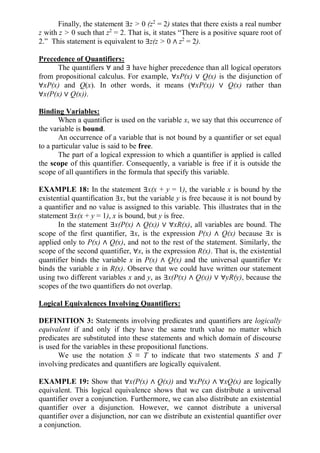
Precedence of Quantifiers:
The quantifiers ∀ and ∃ have higher precedence than all logical operators
from propositional calculus. For example, ∀xP(x) ∨ Q(x) is the disjunction of
∀xP(x) and Q(x). In other words, it means (∀xP(x)) ∨ Q(x) rather than
∀x(P(x) ∨ Q(x)).
Binding Variables:
When a quantifier is used on the variable x, we say that this occurrence of
the variable is bound.
An occurrence of a variable that is not bound by a quantifier or set equal
to a particular value is said to be free.
The part of a logical expression to which a quantifier is applied is called
the scope of this quantifier. Consequently, a variable is free if it is outside the
scope of all quantifiers in the formula that specify this variable.
EXAMPLE 18: In the statement ∃x(x + y = 1), the variable x is bound by the
existential quantification ∃x, but the variable y is free because it is not bound by
a quantifier and no value is assigned to this variable. This illustrates that in the
statement ∃x(x + y = 1), x is bound, but y is free.
In the statement ∃x(P(x) ∧ Q(x)) ∨ ∀xR(x), all variables are bound. The
scope of the first quantifier, ∃x, is the expression P(x) ∧ Q(x) because ∃x is
applied only to P(x) ∧ Q(x), and not to the rest of the statement. Similarly, the
scope of the second quantifier, ∀x, is the expression R(x). That is, the existential
quantifier binds the variable x in P(x) ∧ Q(x) and the universal quantifier ∀x
binds the variable x in R(x). Observe that we could have written our statement
using two different variables x and y, as ∃x(P(x) ∧ Q(x)) ∨ ∀yR(y), because the
scopes of the two quantifiers do not overlap.
Logical Equivalences Involving Quantifiers:
DEFINITION 3: Statements involving predicates and quantifiers are logically
equivalent if and only if they have the same truth value no matter which
predicates are substituted into these statements and which domain of discourse
is used for the variables in these propositional functions.
We use the notation S ≡ T to indicate that two statements S and T
involving predicates and quantifiers are logically equivalent.
EXAMPLE 19: Show that ∀x(P(x) ∧ Q(x)) and ∀xP(x) ∧ ∀xQ(x) are logically
equivalent. This logical equivalence shows that we can distribute a universal
quantifier over a conjunction. Furthermore, we can also distribute an existential
quantifier over a disjunction. However, we cannot distribute a universal
quantifier over a disjunction, nor can we distribute an existential quantifier over
a conjunction.
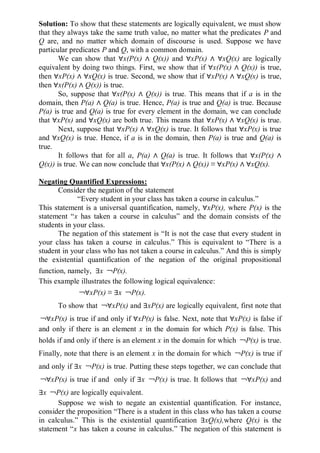
Solution: To show that these statements are logically equivalent, we must show
that they always take the same truth value, no matter what the predicates P and
Q are, and no matter which domain of discourse is used. Suppose we have
particular predicates P and Q, with a common domain.
We can show that ∀x(P(x) ∧ Q(x)) and ∀xP(x) ∧ ∀xQ(x) are logically
equivalent by doing two things. First, we show that if ∀x(P(x) ∧ Q(x)) is true,
then ∀xP(x) ∧ ∀xQ(x) is true. Second, we show that if ∀xP(x) ∧ ∀xQ(x) is true,
then ∀x(P(x) ∧ Q(x)) is true.
So, suppose that ∀x(P(x) ∧ Q(x)) is true. This means that if a is in the
domain, then P(a) ∧ Q(a) is true. Hence, P(a) is true and Q(a) is true. Because
P(a) is true and Q(a) is true for every element in the domain, we can conclude
that ∀xP(x) and ∀xQ(x) are both true. This means that ∀xP(x) ∧ ∀xQ(x) is true.
Next, suppose that ∀xP(x) ∧ ∀xQ(x) is true. It follows that ∀xP(x) is true
and ∀xQ(x) is true. Hence, if a is in the domain, then P(a) is true and Q(a) is
true.
It follows that for all a, P(a) ∧ Q(a) is true. It follows that ∀x(P(x) ∧
Q(x)) is true. We can now conclude that ∀x(P(x) ∧ Q(x)) ≡ ∀xP(x) ∧ ∀xQ(x).
Negating Quantified Expressions:
Consider the negation of the statement
“Every student in your class has taken a course in calculus.”
This statement is a universal quantification, namely, ∀xP(x), where P(x) is the
statement “x has taken a course in calculus” and the domain consists of the
students in your class.
The negation of this statement is “It is not the case that every student in
your class has taken a course in calculus.” This is equivalent to “There is a
student in your class who has not taken a course in calculus.” And this is simply
the existential quantification of the negation of the original propositional
function, namely, ∃x ¬P(x).
This example illustrates the following logical equivalence:
¬∀xP(x) ≡ ∃x ¬P(x).
To show that ¬∀xP(x) and ∃xP(x) are logically equivalent, first note that
¬∀xP(x) is true if and only if ∀xP(x) is false. Next, note that ∀xP(x) is false if
and only if there is an element x in the domain for which P(x) is false. This
holds if and only if there is an element x in the domain for which ¬P(x) is true.
Finally, note that there is an element x in the domain for which ¬P(x) is true if
and only if ∃x ¬P(x) is true. Putting these steps together, we can conclude that
¬∀xP(x) is true if and only if ∃x ¬P(x) is true. It follows that ¬∀xP(x) and
∃x ¬P(x) are logically equivalent.
Suppose we wish to negate an existential quantification. For instance,
consider the proposition “There is a student in this class who has taken a course
in calculus.” This is the existential quantification ∃xQ(x),where Q(x) is the
statement “x has taken a course in calculus.” The negation of this statement is
the proposition “It is not the case that there is a student in this class who has
taken a course in calculus.” This is equivalent to “Every student in this class has
not taken calculus,” which is just the universal quantification of the negation of
the original propositional function, or, phrased in the language of quantifiers,
∀x ¬Q(x).
This example illustrates the equivalence
¬∃xQ(x) ≡ ∀x ¬Q(x).
To show that ¬∃xQ(x) and ∀x ¬Q(x) are logically equivalent no matter what
Q(x) is and what the domain is, first note that ¬∃xQ(x) is true if and only if
∃xQ(x) is false. This is true if and only if no x exists in the domain for which
Q(x) is true. Next, note that no x exists in the domain for which Q(x) is true if
and only if Q(x) is false for every x in the domain. Finally, note that Q(x) is
false for every x in the domain if and only if ¬Q(x) is true for all x in the
domain, which holds if and only if ∀x¬Q(x) is true. Putting these steps
together, we see that ¬∃xQ(x) is true if and only if ∀x¬Q(x) is true.We
conclude that ¬∃xQ(x) and ∀x ¬Q(x) are logically equivalent.
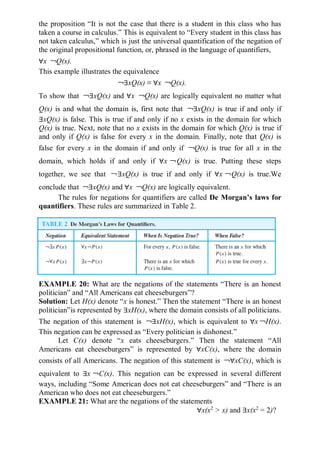
The rules for negations for quantifiers are called De Morgan’s laws for
quantifiers. These rules are summarized in Table 2.
EXAMPLE 20: What are the negations of the statements “There is an honest
politician” and “All Americans eat cheeseburgers”?
Solution: Let H(x) denote “x is honest.” Then the statement “There is an honest
politician”is represented by ∃xH(x), where the domain consists of all politicians.
The negation of this statement is ¬∃xH(x), which is equivalent to ∀x¬H(x).
This negation can be expressed as “Every politician is dishonest.”
Let C(x) denote “x eats cheeseburgers.” Then the statement “All
Americans eat cheeseburgers” is represented by ∀xC(x), where the domain
consists of all Americans. The negation of this statement is ¬∀xC(x), which is
equivalent to ∃x¬C(x). This negation can be expressed in several different
ways, including “Some American does not eat cheeseburgers” and “There is an
American who does not eat cheeseburgers.”
EXAMPLE 21: What are the negations of the statements
∀x(x2
> x) and ∃x(x2
= 2)?
Solution: The negation of ∀x(x2
> x) is the statement ¬∀x(x2
> x), which is
equivalent to ∃x¬(x2
> x). This can be rewritten as ∃x(x2
≤ x).
The negation of ∃x(x2
= 2) is the statement ¬∃x(x2
= 2), which is
equivalent to ∀x¬(x2
= 2). This can be rewritten as ∀x(x2
≠ 2).
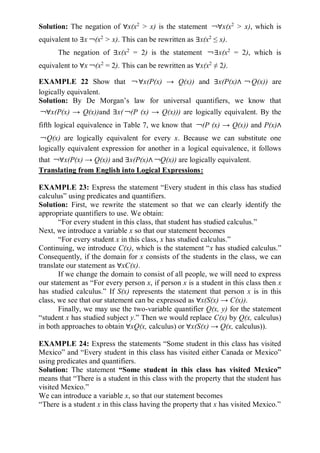
EXAMPLE 22 Show that ¬ ∀x(P(x) → Q(x)) and ∃x(P(x)∧ ¬ Q(x)) are
logically equivalent.
Solution: By De Morgan’s law for universal quantifiers, we know that
¬∀x(P(x) → Q(x))and ∃x(¬(P (x) → Q(x))) are logically equivalent. By the
fifth logical equivalence in Table 7, we know that ¬(P (x) → Q(x)) and P(x)∧
¬Q(x) are logically equivalent for every x. Because we can substitute one
logically equivalent expression for another in a logical equivalence, it follows
that ¬∀x(P(x) → Q(x)) and ∃x(P(x)∧¬Q(x)) are logically equivalent.
Translating from English into Logical Expressions:
EXAMPLE 23: Express the statement “Every student in this class has studied
calculus” using predicates and quantifiers.
Solution: First, we rewrite the statement so that we can clearly identify the
appropriate quantifiers to use. We obtain:
“For every student in this class, that student has studied calculus.”
Next, we introduce a variable x so that our statement becomes
“For every student x in this class, x has studied calculus.”
Continuing, we introduce C(x), which is the statement “x has studied calculus.”
Consequently, if the domain for x consists of the students in the class, we can
translate our statement as ∀xC(x).
If we change the domain to consist of all people, we will need to express
our statement as “For every person x, if person x is a student in this class then x
has studied calculus.” If S(x) represents the statement that person x is in this
class, we see that our statement can be expressed as ∀x(S(x) → C(x)).
Finally, we may use the two-variable quantifier Q(x, y) for the statement
“student x has studied subject y.” Then we would replace C(x) by Q(x, calculus)
in both approaches to obtain ∀xQ(x, calculus) or ∀x(S(x) → Q(x, calculus)).
EXAMPLE 24: Express the statements “Some student in this class has visited
Mexico” and “Every student in this class has visited either Canada or Mexico”
using predicates and quantifiers.
Solution: The statement “Some student in this class has visited Mexico”
means that “There is a student in this class with the property that the student has
visited Mexico.”
We can introduce a variable x, so that our statement becomes
“There is a student x in this class having the property that x has visited Mexico.”
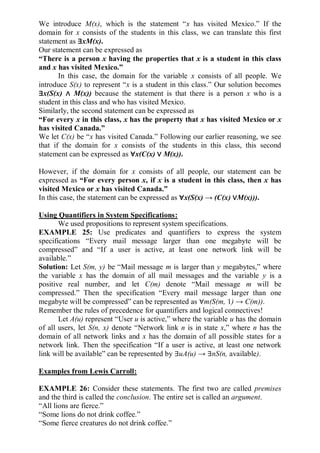
We introduce M(x), which is the statement “x has visited Mexico.” If the
domain for x consists of the students in this class, we can translate this first
statement as ∃xM(x).
Our statement can be expressed as
“There is a person x having the properties that x is a student in this class
and x has visited Mexico.”
In this case, the domain for the variable x consists of all people. We
introduce S(x) to represent “x is a student in this class.” Our solution becomes
∃x(S(x) ∧ M(x)) because the statement is that there is a person x who is a
student in this class and who has visited Mexico.
Similarly, the second statement can be expressed as
“For every x in this class, x has the property that x has visited Mexico or x
has visited Canada.”
We let C(x) be “x has visited Canada.” Following our earlier reasoning, we see
that if the domain for x consists of the students in this class, this second
statement can be expressed as ∀x(C(x) ∨ M(x)).
However, if the domain for x consists of all people, our statement can be
expressed as “For every person x, if x is a student in this class, then x has
visited Mexico or x has visited Canada.”
In this case, the statement can be expressed as ∀x(S(x) → (C(x) ∨M(x))).
Using Quantifiers in System Specifications:
We used propositions to represent system specifications.
EXAMPLE 25: Use predicates and quantifiers to express the system
specifications “Every mail message larger than one megabyte will be
compressed” and “If a user is active, at least one network link will be
available.”
Solution: Let S(m, y) be “Mail message m is larger than y megabytes,” where
the variable x has the domain of all mail messages and the variable y is a
positive real number, and let C(m) denote “Mail message m will be
compressed.” Then the specification “Every mail message larger than one
megabyte will be compressed” can be represented as ∀m(S(m, 1) → C(m)).
Remember the rules of precedence for quantifiers and logical connectives!
Let A(u) represent “User u is active,” where the variable u has the domain
of all users, let S(n, x) denote “Network link n is in state x,” where n has the
domain of all network links and x has the domain of all possible states for a
network link. Then the specification “If a user is active, at least one network
link will be available” can be represented by ∃uA(u) → ∃nS(n, available).
Examples from Lewis Carroll:
EXAMPLE 26: Consider these statements. The first two are called premises
and the third is called the conclusion. The entire set is called an argument.
“All lions are fierce.”
“Some lions do not drink coffee.”
“Some fierce creatures do not drink coffee.”
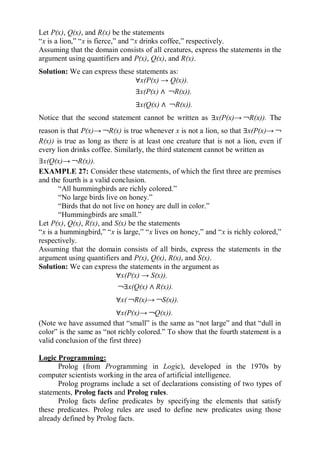
Let P(x), Q(x), and R(x) be the statements
“x is a lion,” “x is fierce,” and “x drinks coffee,” respectively.
Assuming that the domain consists of all creatures, express the statements in the
argument using quantifiers and P(x), Q(x), and R(x).
Solution: We can express these statements as:
∀x(P(x) → Q(x)).
∃x(P(x) ∧ ¬R(x)).
∃x(Q(x) ∧ ¬R(x)).
Notice that the second statement cannot be written as ∃x(P(x)→¬R(x)). The
reason is that P(x)→¬R(x) is true whenever x is not a lion, so that ∃x(P(x)→¬
R(x)) is true as long as there is at least one creature that is not a lion, even if
every lion drinks coffee. Similarly, the third statement cannot be written as
∃x(Q(x)→¬R(x)).
EXAMPLE 27: Consider these statements, of which the first three are premises
and the fourth is a valid conclusion.
“All hummingbirds are richly colored.”
“No large birds live on honey.”
“Birds that do not live on honey are dull in color.”
“Hummingbirds are small.”
Let P(x), Q(x), R(x), and S(x) be the statements
“x is a hummingbird,” “x is large,” “x lives on honey,” and “x is richly colored,”
respectively.
Assuming that the domain consists of all birds, express the statements in the
argument using quantifiers and P(x), Q(x), R(x), and S(x).
Solution: We can express the statements in the argument as
∀x(P(x) → S(x)).
¬∃x(Q(x) ∧ R(x)).
∀x(¬R(x)→¬S(x)).
∀x(P(x)→¬Q(x)).
(Note we have assumed that “small” is the same as “not large” and that “dull in
color” is the same as “not richly colored.” To show that the fourth statement is a
valid conclusion of the first three)
Logic Programming:
Prolog (from Programming in Logic), developed in the 1970s by
computer scientists working in the area of artificial intelligence.
Prolog programs include a set of declarations consisting of two types of
statements, Prolog facts and Prolog rules.
Prolog facts define predicates by specifying the elements that satisfy
these predicates. Prolog rules are used to define new predicates using those
already defined by Prolog facts.
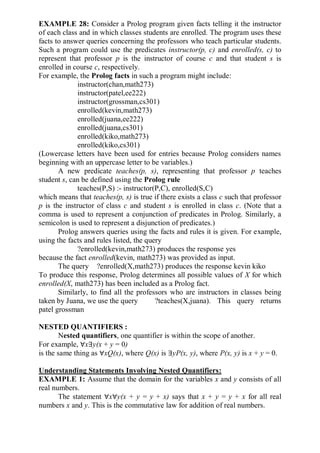
EXAMPLE 28: Consider a Prolog program given facts telling it the instructor
of each class and in which classes students are enrolled. The program uses these
facts to answer queries concerning the professors who teach particular students.
Such a program could use the predicates instructor(p, c) and enrolled(s, c) to
represent that professor p is the instructor of course c and that student s is
enrolled in course c, respectively.
For example, the Prolog facts in such a program might include:
instructor(chan,math273)
instructor(patel,ee222)
instructor(grossman,cs301)
enrolled(kevin,math273)
enrolled(juana,ee222)
enrolled(juana,cs301)
enrolled(kiko,math273)
enrolled(kiko,cs301)
(Lowercase letters have been used for entries because Prolog considers names
beginning with an uppercase letter to be variables.)
A new predicate teaches(p, s), representing that professor p teaches
student s, can be defined using the Prolog rule
teaches(P,S) :- instructor(P,C), enrolled(S,C)
which means that teaches(p, s) is true if there exists a class c such that professor
p is the instructor of class c and student s is enrolled in class c. (Note that a
comma is used to represent a conjunction of predicates in Prolog. Similarly, a
semicolon is used to represent a disjunction of predicates.)
Prolog answers queries using the facts and rules it is given. For example,
using the facts and rules listed, the query
?enrolled(kevin,math273) produces the response yes
because the fact enrolled(kevin, math273) was provided as input.
The query ?enrolled(X,math273) produces the response kevin kiko
To produce this response, Prolog determines all possible values of X for which
enrolled(X, math273) has been included as a Prolog fact.
Similarly, to find all the professors who are instructors in classes being
taken by Juana, we use the query ?teaches(X,juana). This query returns
patel grossman
NESTED QUANTIFIERS :
Nested quantifiers, one quantifier is within the scope of another.
For example, ∀x∃y(x + y = 0)
is the same thing as ∀xQ(x), where Q(x) is ∃yP(x, y), where P(x, y) is x + y = 0.
Understanding Statements Involving Nested Quantifiers:
EXAMPLE 1: Assume that the domain for the variables x and y consists of all
real numbers.
The statement ∀x∀y(x + y = y + x) says that x + y = y + x for all real
numbers x and y. This is the commutative law for addition of real numbers.
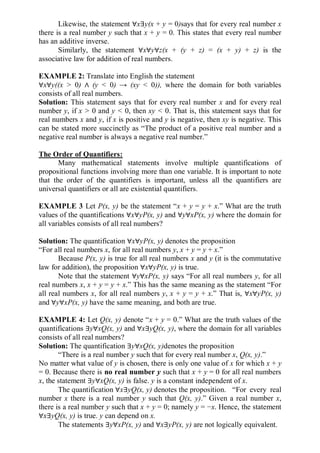
Likewise, the statement ∀x∃y(x + y = 0)says that for every real number x
there is a real number y such that x + y = 0. This states that every real number
has an additive inverse.
Similarly, the statement ∀x∀y∀z(x + (y + z) = (x + y) + z) is the
associative law for addition of real numbers.
EXAMPLE 2: Translate into English the statement
∀x∀y((x > 0) ∧ (y < 0) → (xy < 0)), where the domain for both variables
consists of all real numbers.
Solution: This statement says that for every real number x and for every real
number y, if x > 0 and y < 0, then xy < 0. That is, this statement says that for
real numbers x and y, if x is positive and y is negative, then xy is negative. This
can be stated more succinctly as “The product of a positive real number and a
negative real number is always a negative real number.”
The Order of Quantifiers:
Many mathematical statements involve multiple quantifications of
propositional functions involving more than one variable. It is important to note
that the order of the quantifiers is important, unless all the quantifiers are
universal quantifiers or all are existential quantifiers.
EXAMPLE 3 Let P(x, y) be the statement “x + y = y + x.” What are the truth
values of the quantifications ∀x∀yP(x, y) and ∀y∀xP(x, y) where the domain for
all variables consists of all real numbers?
Solution: The quantification ∀x∀yP(x, y) denotes the proposition
“For all real numbers x, for all real numbers y, x + y = y + x.”
Because P(x, y) is true for all real numbers x and y (it is the commutative
law for addition), the proposition ∀x∀yP(x, y) is true.
Note that the statement ∀y∀xP(x, y) says “For all real numbers y, for all
real numbers x, x + y = y + x.” This has the same meaning as the statement “For
all real numbers x, for all real numbers y, x + y = y + x.” That is, ∀x∀yP(x, y)
and ∀y∀xP(x, y) have the same meaning, and both are true.
EXAMPLE 4: Let Q(x, y) denote “x + y = 0.” What are the truth values of the
quantifications ∃y∀xQ(x, y) and ∀x∃yQ(x, y), where the domain for all variables
consists of all real numbers?
Solution: The quantification ∃y∀xQ(x, y)denotes the proposition
“There is a real number y such that for every real number x, Q(x, y).”
No matter what value of y is chosen, there is only one value of x for which x + y
= 0. Because there is no real number y such that x + y = 0 for all real numbers
x, the statement ∃y∀xQ(x, y) is false. y is a constant independent of x.
The quantification ∀x∃yQ(x, y) denotes the proposition. “For every real
number x there is a real number y such that Q(x, y).” Given a real number x,
there is a real number y such that x + y = 0; namely y = −x. Hence, the statement
∀x∃yQ(x, y) is true. y can depend on x.
The statements ∃y∀xP(x, y) and ∀x∃yP(x, y) are not logically equivalent.
EXAMPLE 5: Let Q(x, y, z) be the statement “x + y = z.” What are the truth
values of the statements ∀x∀y∃zQ(x, y, z) and ∃z∀x∀yQ(x, y, z), where the
domain of all variables consists of all real numbers?
Solution: Suppose that x and y are assigned values. Then, there exists a real
number z such that x + y = z. Consequently, the quantification ∀x∀y∃zQ(x, y, z),
which is the statement “For all real numbers x and for all real numbers y there is
a real number z such that x + y = z,” is true. The order of the quantification here
is important, because the quantification ∃z∀x∀yQ(x, y, z), which is the statement
“There is a real number z such that for all real numbers x and for all real
numbers y it is true that x + y = z,” is false, because there is no value of z that
satisfies the equation x + y = z for all values of x and y.
Translating Mathematical Statements into Statements Involving Nested
Quantifiers:
Mathematical statements expressed in English can be translated into
logical expressions.
EXAMPLE 6: Translate the statement “The sum of two positive integers is
always positive” into a logical expression.
Solution: To translate this statement into a logical expression, we first rewrite
it.
“For every two integers, if these integers are both positive, then the sum of these
integers is positive.”
Next, “For all positive integers x and y, x + y is positive.”
we can express this statement as ∀x∀y((x > 0) ∧ (y > 0) → (x +y > 0)),
We can express this as ∀x∀y(x +y > 0), where the domain for both variables
consists of all positive integers.
EXAMPLE 7: Translate the statement “Every real number except zero has a
multiplicative inverse.” (A multiplicative inverse of a real number x is a real
number y such that xy = 1.)
Solution: We first rewrite this as “For every real number x except zero, x has a
multiplicative inverse.” We can rewrite this as
“For every real number x, if x ≠ 0, then there exists a real number y such that xy
= 1.” This can be rewritten as ∀x((x ≠ 0) → ∃y(xy = 1)).
Translating from Nested Quantifiers into English:
The first step in translating such an expression is to write out what the
quantifiers and predicates in the expression mean. The next step is to express
this meaning in a simpler sentence.
EXAMPLE 9: Translate the statement ∀x(C(x) ∨ ∃y(C(y) ∧ F(x, y))) into
English, where C(x) is “x has a computer,” F(x, y) is “x and y are friends,” and
the domain for both x and y consists of all students in your school.
Solution: The statement says that for "every student x in your school, x has a
computer or there is a student y such that y has a computer and x and y are
friends". In other words, "every student in your school has a computer or has a
friend who has a computer".
EXAMPLE 10 Translate the statement ∃x∀y∀z((F (x, y) ∧ F(x, z) ∧ (y ≠ z))→
¬F(y,z)) into English, where F(a,b) means a and b are friends and the domain
for x, y, and z consists of all students in your school.
Solution: We first examine the expression (F (x, y) ∧ F(x, z) ∧ (y ≠ z))→¬F(y,
z). This expression says that "if students x and y are friends, and students x and z
are friends, and furthermore, if y and z are not the same student, then y and z are
not friends".
Translating English Sentences into Logical Expressions:
EXAMPLE 11: Express the statement “If a person is female and is a parent,
then this person is someone’s mother” as a logical expression involving
predicates, quantifiers with a domain consisting of all people, and logical
connectives.
Solution: The statement “If a person is female and is a parent, then this person
is someone’s mother” can be expressed as “For every person x, if person x is
female and person x is a parent, then there exists a person y such that person x is
the mother of person y.” We introduce the propositional functions F(x) to
represent “x is female,” P(x) to represent “x is a parent,” and M(x, y) to
represent “x is the mother of y.” The original statement can be represented as
∀x((F (x) ∧ P(x)) → ∃yM(x, y)).
EXAMPLE 12: Express the statement “Everyone has exactly one best friend”
as a logical expression involving predicates, quantifiers with a domain
consisting of all people, and logical connectives.
Solution: The statement “Everyone has exactly one best friend” can be
expressed as “For every person x, person x has exactly one best friend.”
Introducing the universal quantifier, we see that this statement is the same as
“∀x(person x has exactly one best friend),” where the domain consists of all
people.
To say that x has exactly one best friend means that there is a person y who is
the best friend of x, and furthermore, that for every person z, if person z is not
person y, then z is not the best friend of x. When we introduce the predicate B(x,
y) to be the statement “y is the best friend of x,” the statement that x has exactly
one best friend can be represented as ∃y(B(x, y) ∧ ∀z((z ≠ y)→¬B(x, z))).
Consequently, our original statement can be expressed as
∀x∃y(B(x, y) ∧ ∀z((z ≠y)→¬B(x, z))).
[Note that we can write this statement as ∀x∃!yB(x, y), where ∃! is the
“uniqueness quantifier”]
EXAMPLE 13: Use quantifiers to express the statement “There is a woman
who has taken a flight on every airline in the world.”
Solution: Let P(w, f ) be “w has taken f ” and Q(f, a) be “f is a flight on a.”
We can express the statement as ∃w∀a∃f (P(w, f ) ∧ Q(f, a)),where the domains
of discourse for w, f , and a consist of all the women in the world, all airplane
flights, and all airlines, respectively.
The statement could also be expressed as ∃w∀a∃fR(w, f, a),where R(w, f, a) is
“w has taken f on a.”
Negating Nested Quantifiers:
Statements involving nested quantifiers can be negated by successively
applying the rules for negating statements involving a single quantifier.
EXAMPLE 14: Express the negation of the statement ∀x∃y(xy = 1) so that no
negation precedes a quantifier.
Solution: By successively applying De Morgan’s laws for quantifiers in Table 2
of Section 1.4, We find that ¬∀x∃y(xy = 1) is equivalent to ∃x¬∃y(xy = 1),
which is equivalent to ∃x∀y¬(xy = 1), negated statement can be expressed as
∃x∀y(xy ≠ 1).
EXAMPLE 15: Use quantifiers to express the statement that “There does not
exist a woman who has taken a flight on every airline in the world.”
Solution: This statement is the negation of the statement “There is a woman
who has taken a flight on every airline in the world” from Example 13. By
Example 13, our statement can be expressed as ¬∃w∀a∃f (P(w, f ) ∧ Q(f, a)).
we find that our statement is equivalent to each of this sequence of statements:
∀w¬∀a∃f (P(w, f ) ∧ Q(f, a)) ≡ ∀w∃a¬∃f (P(w, f ) ∧ Q(f, a))
≡ ∀w∃a∀f¬(P (w, f ) ∧ Q(f, a))
≡ ∀w∃a∀f (¬P(w, f )∨¬Q(f, a)).
This last statement states “For every woman there is an airline such that for all
flights, this woman has not taken that flight or that flight is not on this airline.”
RULES OF INFERENCE:
Proofs are valid arguments that establish the truth of mathematical
statements.
By an argument, we mean a sequence of statements that end with a
conclusion.
By valid, we mean that the conclusion, or final statement of the
argument, must follow from the truth of the preceding statements, or premises,
of the argument.
Valid Arguments in Propositional Logic:
Consider the following argument involving propositions:
“If you have a current password, then you can log onto the network.”
We would like to determine whether this is a valid argument.
Use p to represent “You have a current password” and q to represent
“You can log onto the network.” Then, the argument has the form p → q.
ie., p ∴ q where ∴ is the symbol that denotes “therefore.”
That is, we would like to determine whether the conclusion “You can log
onto the network” must be true when the premises “If you have a current
password, then you can log onto the network” and “You have a current
password” are both true.
Note that whenever we replace p and q by propositions where p → q and
p are both true, then q must also be true. This argument is valid because its form
is valid.
If the first premise, is false, we cannot conclude that the conclusion is
true. (Most likely, this conclusion is false.)
DEFINITION 1: An argument in propositional logic is a sequence of
propositions. All but the final proposition in the argument are called premises
and the final proposition is called the conclusion. An argument is valid if the
truth of all its premises implies that the conclusion is true.
An argument form in propositional logic is a sequence of compound
propositions involving propositional variables. An argument form is valid no
matter which particular propositions are substituted for the propositional
variables in its premises, the conclusion is true if the premises are all true.
From the definition of a valid argument form we see that the argument
form with premises p1, p2, . . . , pn and conclusion q is valid, when
(p1 ∧ p2 ∧ · · · ∧ pn) → q is a tautology.
Rules of Inference for Propositional Logic:
We can always use a truth table to show that an argument form is valid.
We do this by showing that whenever the premises are true, the conclusion must
also be true.
For example, when an argument form involves 10 different propositional
variables, to use a truth table to show this argument form is valid requires 210
=
1024 different rows. We can first establish the validity of some relatively simple
argument forms, called rules of inference. These rules of inference can be used
as building blocks to construct more complicated valid argument forms.
We will now introduce the most important rules of inference in
propositional logic.
The tautology (p ∧ (p → q)) → q is the basis of the rule of inference called
modus ponens, or the law of detachment.
EXAMPLE 1: Suppose that the conditional statement “If it snows today, then
we will go skiing” and its hypothesis, “It is snowing today,” are true. Then, by
modus ponens, it follows that the conclusion of the conditional statement, “We
will go skiing,” is true.
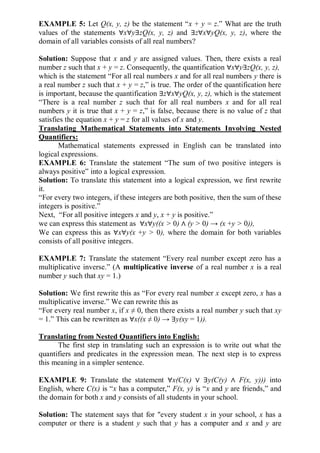
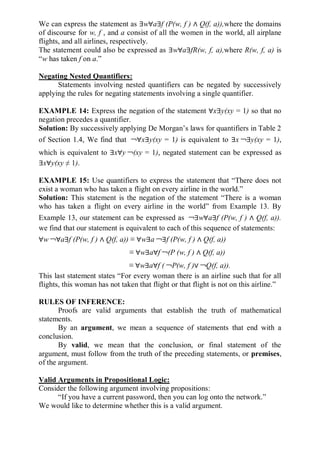
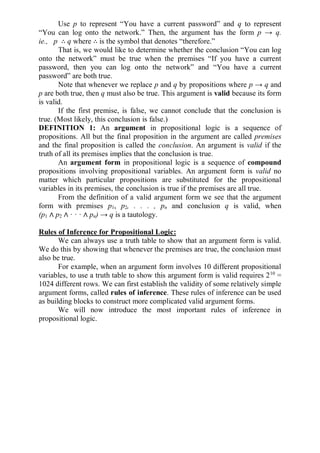
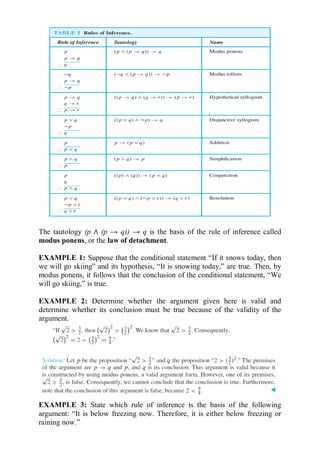
EXAMPLE 2: Determine whether the argument given here is valid and
determine whether its conclusion must be true because of the validity of the
argument.
EXAMPLE 3: State which rule of inference is the basis of the following
argument: “It is below freezing now. Therefore, it is either below freezing or
raining now.”
Solution: Let p be the proposition “It is below freezing now” and q the
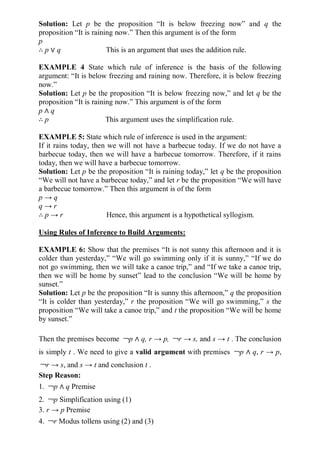
proposition “It is raining now.” Then this argument is of the form
p
∴ p ∨ q This is an argument that uses the addition rule.
EXAMPLE 4 State which rule of inference is the basis of the following
argument: “It is below freezing and raining now. Therefore, it is below freezing
now.”
Solution: Let p be the proposition “It is below freezing now,” and let q be the
proposition “It is raining now.” This argument is of the form
p ∧ q
∴ p This argument uses the simplification rule.
EXAMPLE 5: State which rule of inference is used in the argument:
If it rains today, then we will not have a barbecue today. If we do not have a
barbecue today, then we will have a barbecue tomorrow. Therefore, if it rains
today, then we will have a barbecue tomorrow.
Solution: Let p be the proposition “It is raining today,” let q be the proposition
“We will not have a barbecue today,” and let r be the proposition “We will have
a barbecue tomorrow.” Then this argument is of the form
p → q
q → r
∴ p → r Hence, this argument is a hypothetical syllogism.
Using Rules of Inference to Build Arguments:
EXAMPLE 6: Show that the premises “It is not sunny this afternoon and it is
colder than yesterday,” “We will go swimming only if it is sunny,” “If we do
not go swimming, then we will take a canoe trip,” and “If we take a canoe trip,
then we will be home by sunset” lead to the conclusion “We will be home by
sunset.”
Solution: Let p be the proposition “It is sunny this afternoon,” q the proposition
“It is colder than yesterday,” r the proposition “We will go swimming,” s the
proposition “We will take a canoe trip,” and t the proposition “We will be home
by sunset.”
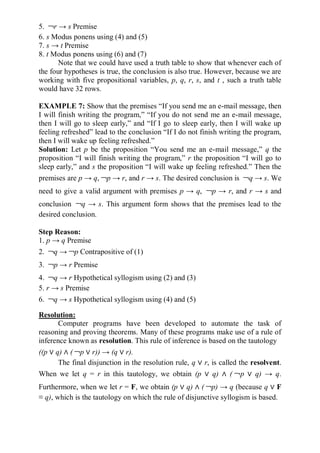
Then the premises become ¬p ∧ q, r → p, ¬r → s, and s → t . The conclusion
is simply t . We need to give a valid argument with premises ¬p ∧ q, r → p,
¬r → s, and s → t and conclusion t .
Step Reason:
1. ¬p ∧ q Premise
2. ¬p Simplification using (1)
3. r → p Premise
4. ¬r Modus tollens using (2) and (3)
5. ¬r → s Premise
6. s Modus ponens using (4) and (5)
7. s → t Premise
8. t Modus ponens using (6) and (7)
Note that we could have used a truth table to show that whenever each of
the four hypotheses is true, the conclusion is also true. However, because we are
working with five propositional variables, p, q, r, s, and t , such a truth table
would have 32 rows.
EXAMPLE 7: Show that the premises “If you send me an e-mail message, then
I will finish writing the program,” “If you do not send me an e-mail message,
then I will go to sleep early,” and “If I go to sleep early, then I will wake up
feeling refreshed” lead to the conclusion “If I do not finish writing the program,
then I will wake up feeling refreshed.”
Solution: Let p be the proposition “You send me an e-mail message,” q the
proposition “I will finish writing the program,” r the proposition “I will go to
sleep early,” and s the proposition “I will wake up feeling refreshed.” Then the
premises are p → q,¬p → r, and r → s. The desired conclusion is ¬q → s. We
need to give a valid argument with premises p → q, ¬p → r, and r → s and
conclusion ¬q → s. This argument form shows that the premises lead to the
desired conclusion.
Step Reason:
1. p → q Premise
2. ¬q →¬p Contrapositive of (1)
3. ¬p → r Premise
4. ¬q → r Hypothetical syllogism using (2) and (3)
5. r → s Premise
6. ¬q → s Hypothetical syllogism using (4) and (5)
Resolution:
Computer programs have been developed to automate the task of
reasoning and proving theorems. Many of these programs make use of a rule of
inference known as resolution. This rule of inference is based on the tautology
((p ∨ q) ∧ (¬p ∨ r)) → (q ∨ r).
The final disjunction in the resolution rule, q ∨ r, is called the resolvent.
When we let q = r in this tautology, we obtain (p ∨ q) ∧ (¬p ∨ q) → q.
Furthermore, when we let r = F, we obtain (p ∨ q) ∧ (¬p) → q (because q ∨ F
≡ q), which is the tautology on which the rule of disjunctive syllogism is based.
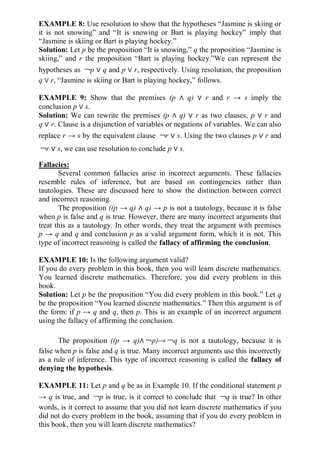
EXAMPLE 8: Use resolution to show that the hypotheses “Jasmine is skiing or
it is not snowing” and “It is snowing or Bart is playing hockey” imply that
“Jasmine is skiing or Bart is playing hockey.”
Solution: Let p be the proposition “It is snowing,” q the proposition “Jasmine is
skiing,” and r the proposition “Bart is playing hockey.”We can represent the
hypotheses as ¬p ∨ q and p ∨ r, respectively. Using resolution, the proposition
q ∨ r, “Jasmine is skiing or Bart is playing hockey,” follows.
EXAMPLE 9: Show that the premises (p ∧ q) ∨ r and r → s imply the
conclusion p ∨ s.
Solution: We can rewrite the premises (p ∧ q) ∨ r as two clauses, p ∨ r and
q ∨ r. Clause is a disjunction of variables or negations of variables. We can also
replace r → s by the equivalent clause ¬r ∨ s. Using the two clauses p ∨ r and
¬r ∨ s, we can use resolution to conclude p ∨ s.
Fallacies:
Several common fallacies arise in incorrect arguments. These fallacies
resemble rules of inference, but are based on contingencies rather than
tautologies. These are discussed here to show the distinction between correct
and incorrect reasoning.
The proposition ((p → q) ∧ q) → p is not a tautology, because it is false
when p is false and q is true. However, there are many incorrect arguments that
treat this as a tautology. In other words, they treat the argument with premises
p → q and q and conclusion p as a valid argument form, which it is not. This
type of incorrect reasoning is called the fallacy of affirming the conclusion.
EXAMPLE 10: Is the following argument valid?
If you do every problem in this book, then you will learn discrete mathematics.
You learned discrete mathematics. Therefore, you did every problem in this
book.
Solution: Let p be the proposition “You did every problem in this book.” Let q
be the proposition “You learned discrete mathematics.” Then this argument is of
the form: if p → q and q, then p. This is an example of an incorrect argument
using the fallacy of affirming the conclusion.
The proposition ((p → q)∧¬p)→¬q is not a tautology, because it is
false when p is false and q is true. Many incorrect arguments use this incorrectly
as a rule of inference. This type of incorrect reasoning is called the fallacy of
denying the hypothesis.
EXAMPLE 11: Let p and q be as in Example 10. If the conditional statement p
→ q is true, and ¬p is true, is it correct to conclude that ¬q is true? In other
words, is it correct to assume that you did not learn discrete mathematics if you
did not do every problem in the book, assuming that if you do every problem in
this book, then you will learn discrete mathematics?
Solution: It is possible that you learned discrete mathematics even if you did
not do every problem in this book. This incorrect argument is of the form p → q
and ¬ p imply ¬ q, which is an example of the fallacy of denying the
hypothesis.
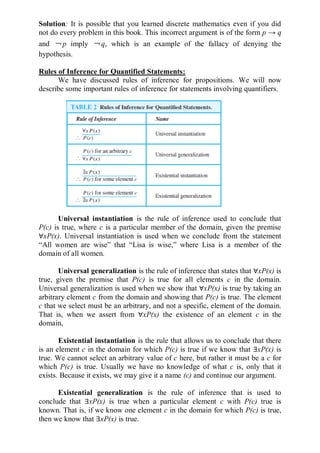
Rules of Inference for Quantified Statements:
We have discussed rules of inference for propositions. We will now
describe some important rules of inference for statements involving quantifiers.
Universal instantiation is the rule of inference used to conclude that
P(c) is true, where c is a particular member of the domain, given the premise
∀xP(x). Universal instantiation is used when we conclude from the statement
“All women are wise” that “Lisa is wise,” where Lisa is a member of the
domain of all women.
Universal generalization is the rule of inference that states that ∀xP(x) is
true, given the premise that P(c) is true for all elements c in the domain.
Universal generalization is used when we show that ∀xP(x) is true by taking an
arbitrary element c from the domain and showing that P(c) is true. The element
c that we select must be an arbitrary, and not a specific, element of the domain.
That is, when we assert from ∀xP(x) the existence of an element c in the
domain,
Existential instantiation is the rule that allows us to conclude that there
is an element c in the domain for which P(c) is true if we know that ∃xP(x) is
true. We cannot select an arbitrary value of c here, but rather it must be a c for
which P(c) is true. Usually we have no knowledge of what c is, only that it
exists. Because it exists, we may give it a name (c) and continue our argument.
Existential generalization is the rule of inference that is used to
conclude that ∃xP(x) is true when a particular element c with P(c) true is
known. That is, if we know one element c in the domain for which P(c) is true,
then we know that ∃xP(x) is true.
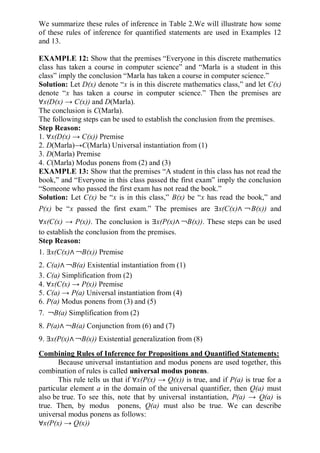
We summarize these rules of inference in Table 2.We will illustrate how some
of these rules of inference for quantified statements are used in Examples 12
and 13.
EXAMPLE 12: Show that the premises “Everyone in this discrete mathematics
class has taken a course in computer science” and “Marla is a student in this
class” imply the conclusion “Marla has taken a course in computer science.”
Solution: Let D(x) denote “x is in this discrete mathematics class,” and let C(x)
denote “x has taken a course in computer science.” Then the premises are
∀x(D(x) → C(x)) and D(Marla).
The conclusion is C(Marla).
The following steps can be used to establish the conclusion from the premises.
Step Reason:
1. ∀x(D(x) → C(x)) Premise
2. D(Marla)→C(Marla) Universal instantiation from (1)
3. D(Marla) Premise
4. C(Marla) Modus ponens from (2) and (3)
EXAMPLE 13: Show that the premises “A student in this class has not read the
book,” and “Everyone in this class passed the first exam” imply the conclusion
“Someone who passed the first exam has not read the book.”
Solution: Let C(x) be “x is in this class,” B(x) be “x has read the book,” and
P(x) be “x passed the first exam.” The premises are ∃x(C(x)∧¬B(x)) and
∀x(C(x) → P(x)). The conclusion is ∃x(P(x)∧¬B(x)). These steps can be used
to establish the conclusion from the premises.
Step Reason:
1. ∃x(C(x)∧¬B(x)) Premise
2. C(a)∧¬B(a) Existential instantiation from (1)
3. C(a) Simplification from (2)
4. ∀x(C(x) → P(x)) Premise
5. C(a) → P(a) Universal instantiation from (4)
6. P(a) Modus ponens from (3) and (5)
7. ¬B(a) Simplification from (2)
8. P(a)∧¬B(a) Conjunction from (6) and (7)
9. ∃x(P(x)∧¬B(x)) Existential generalization from (8)
Combining Rules of Inference for Propositions and Quantified Statements:
Because universal instantiation and modus ponens are used together, this
combination of rules is called universal modus ponens.
This rule tells us that if ∀x(P(x) → Q(x)) is true, and if P(a) is true for a
particular element a in the domain of the universal quantifier, then Q(a) must
also be true. To see this, note that by universal instantiation, P(a) → Q(a) is
true. Then, by modus ponens, Q(a) must also be true. We can describe
universal modus ponens as follows:
∀x(P(x) → Q(x))
P(a), where a is a particular element in the domain
∴ Q(a)
EXAMPLE 14: Assume that “For all positive integers n, if n is greater than 4,
then n2
is less than 2n
” is true.
Use universal modus ponens to show that 1002
< 2100
.
Solution: Let P(n) denote “n > 4” and Q(n) denote “n2
< 2n
.” The statement
“For all positive integers n, if n is greater than 4, then n2
is less than 2n
” can be
represented by ∀n(P(n) → Q(n)), where the domain consists of all positive
integers. We are assuming that ∀n(P (n) → Q(n)) is true. Note that P(100) is
true because 100 > 4. It follows by universal modus ponens that Q(100) is true,
namely that 1002
< 2100
.
Another Example, Universal modus tollens combines universal
instantiation and modus tollens and can be expressed in the following way:
∀x(P(x) → Q(x))
¬Q(a), where a is a particular element in the domain
∴ ¬P(a)
INTRODUCTION TO PROOFS:
Direct Proofs:
A direct proof of a conditional statement p → q is constructed when the
first step is the assumption that p is true; subsequent steps are constructed using
rules of inference, with the final step showing that q must also be true.
A direct proof shows that a conditional statement p → q is true by
showing that if p is true, then q must also be true, so that the combination p true
and q false never occurs.
DEFINITION 1: The integer n is even if there exists an integer k such that
n = 2k, and n is odd if there exists an integer k such that n = 2k + 1. Two
integers have the same parity when both are even or both are odd; they have
opposite parity when one is even and the other is odd.
EXAMPLE 1: Give a direct proof of the theorem “If n is an odd integer, then
n2
is odd.”
Solution: P(n) is “n is an odd integer” and Q(n) is “n2
is odd.”
P(n) implies Q(n).
we assume that the hypothesis of conditional statement is true, namely, we
assume that n is odd.
By the definition of an odd integer, it follows that n = 2k + 1, where k is
some integer. We want to show that n2
is also odd. We can square both sides of
the equation n = 2k + 1 to obtain a new equation that expresses n2
. When we do
this, we find that n2
= (2k + 1)2
= 4k2
+ 4k + 1 = 2(2k2
+ 2k) + 1. By the
definition of an odd integer, we can conclude that n2
is an odd integer (it is one
more than twice an integer). Consequently, we have proved that if n is an odd
integer, then n2
is an odd integer.
EXAMPLE 2: Give a direct proof that if m and n are both perfect squares, then
nm is also a perfect square. (An integer a is a perfect square if there is an
integer b such that a = b2
.)
Solution: To produce a direct proof of this theorem, we assume that the
hypothesis of this conditional statement is true, namely, we assume that m and n
are both perfect squares. By the definition of a perfect square, it follows that
there are integers s and t such that m = s2
and n = t2
. The goal of the proof is to
show that mn must also be a perfect square when m and n are;
looking ahead we see how we can show this by substituting s2
for m and t2
for n
into mn. This tells us that mn = s2
t2
. Hence, mn = s2
t2
= (ss)(tt) = (st)(st) = (st)2
,
using commutativity and associativity of multiplication. By the definition of
perfect square, it follows that mn is also a perfect square, because it is the
square of st, which is an integer. We have proved that if m and n are both
perfect squares, then mn is also a perfect square.
Indirect proofs : Proof by Contraposition
Direct proofs lead from the premises of a theorem to the conclusion. They
begin with the premises, continue with a sequence of deductions, and end with
the conclusion. Proofs of theorems that do not start with the premises and end
with the conclusion, are called indirect proofs.
An extremely useful type of indirect proof is known as proof by
contraposition. Proofs by contraposition make use of the fact that the
conditional statement p → q is equivalent to its contrapositive, ¬q →¬p. This
means that the conditional statement p → q can be proved by showing that its
contrapositive, ¬q →¬p, is true.
EXAMPLE 3: Prove that if n is an integer and 3n + 2 is odd, then n is odd.
Solution: We first attempt a direct proof. To construct a direct proof, we first
assume that 3n + 2 is an odd integer. This means that 3n + 2 = 2k + 1 for some
integer k. Can we use this fact to show that n is odd? We see that 3n + 1 = 2k,
but there does not seem to be any direct way to conclude that n is odd. Because
our attempt at a direct proof failed, we next try a proof by contraposition.
The first step in a proof by contraposition is to assume that the conclusion
of the conditional statement “If 3n + 2 is odd, then n is odd” is false; namely,
assume that n is even. Then, by the definition of an even integer, n = 2k for
some integer k. Substituting 2k for n, we find that 3n + 2 = 3(2k) + 2 = 6k + 2 =
2(3k + 1). This tells us that 3n + 2 is even (because it is a multiple of 2), and
therefore not odd. This is the negation of the premise of the theorem.
Because the negation of the conclusion of the conditional statement
implies that the hypothesis is false, the original conditional statement is true.
Our proof by contraposition succeeded; we have proved the theorem “If 3n + 2
is odd, then n is odd.”
EXAMPLE 4:
Proofs by Contradiction :
Suppose we want to prove that a statement p is true. Furthermore,
suppose that we can find a contradiction q such that ¬p → q is true. Because q
is false, but ¬p → q is true, we can conclude that ¬p is false, which means
that p is true. How can we find a contradiction q that might help us prove that p
is true in this way?
Because the statement r ∧¬r is a contradiction whenever r is a proposition, we
can prove that p is true if we can show that ¬p → (r ∧¬r) is true for some
proposition r. Proofs of this type are called proofs by contradiction. Because a
proof by contradiction does not prove a result directly, it is another type of
indirect proof.
EXAMPLE 9: Show that at least four of any 22 days must fall on the same day
of the week.
Solution: Let p be the proposition “At least four of 22 chosen days fall on the
same day of the week.” Suppose that ¬p is true. This means that at most three
of the 22 days fall on the same day of the week. Because there are seven days of
the week, this implies that at most 21 days could have been chosen, as for each
of the days of the week, at most three of the chosen days could fall on that day.
This contradicts the premise that we have 22 days under consideration.
That is, if r is the statement that 22 days are chosen, then we have shown that ¬
p → (r ∧¬r). Consequently, we know that p is true. We have proved that at
least four of 22 chosen days fall on the same day of the week.
EXAMPLE 10: Prove that √2 is irrational by giving a proof by contradiction.
Solution: Let p be the proposition “√2 is irrational.” To start a proof by
contradiction, we suppose that ¬p is true. Note that ¬p is the statement “It is not
the case that √2 is irrational,” which says that √2 is rational. We will show that
assuming that ¬p is true leads to a contradiction.
If √2 is rational, there exist integers a and b with √2 = a/b, where b = 0 and a
and b have no common factors (so that the fraction a/b is in lowest terms.)
(Here, we are using the fact that every rational number can be written in lowest
terms.) Because √2 = a/b, when both sides of this equation are squared, it
follows that 2 = a2
/ b2
. Hence, 2b2
= a2
.
By the definition of an even integer it follows that a2
is even. We next use the
fact that if a2
is even, a must also be even, which follows by Exercise 16.
Furthermore, because a is even, by the definition of an even integer, a = 2c for
some integer c. Thus, 2b2
= 4c2
.
Dividing both sides of this equation by 2 gives b2
= 2c2
.
By the definition of even, this means that b2
is even. Again using the fact that if
the square of an integer is even, then the integer itself must be even, we
conclude that b must be even as well.
We have now shown that the assumption of ¬p leads to the equation √2 =
a/b, where a and b have no common factors, but both a and b are even, that is, 2
divides both a and b. Note that the statement that √2 = a/b, where a and b have
no common factors, means, in particular, that 2 does not divide both a and b.
Because our assumption of ¬p leads to the contradiction that 2 divides both a
and b and 2 does not divide both a and b, ¬p must be false. That is, the
statement p, “√2 is irrational,” is true. We have proved that √2 is irrational.
Proof by contradiction can be used to prove conditional statements. In such
proofs, we first assume the negation of the conclusion. We then use the
premises of the theorem and the negation of the conclusion to arrive at a
contradiction. (The reason that such proofs are valid rests on the logical
equivalence of p → q and (p ∧¬q) → F. To see that these statements are
equivalent, simply note that each is false in exactly one case, namely when p is
true and q is false.)
Note that we can rewrite a proof by contraposition of a conditional statement as
a proof by contradiction. In a proof of p → q by contraposition, we assume that
¬q is true. We then show that ¬p must also be true. To rewrite a proof by
contraposition of p → q as a proof by contradiction, we suppose that both p and
¬q are true. Then, we use the steps from the proof of ¬q →¬p to show that ¬p is
true. This leads to the contradiction p ∧¬p, completing the proof. Example 11
illustrates how a proof by contraposition of a conditional statement can be
rewritten as a proof by contradiction.
EXAMPLE 11 Give a proof by contradiction of the theorem “If 3n + 2 is odd,
then n is odd.”
Solution: Let p be “3n + 2 is odd” and q be “n is odd.” To construct a proof by
contradiction, assume that both p and ¬q are true. That is, assume that 3n + 2 is
odd and that n is not odd.
Because n is not odd, we know that it is even. Because n is even, there is an
integer k such that n = 2k. This implies that 3n + 2 = 3(2k) + 2 = 6k + 2 = 2(3k +
1). Because 3n + 2 is 2t , where t = 3k + 1, 3n + 2 is even. Note that the
statement “3n + 2 is even” is equivalent to the statement ¬p, because an integer
is even if and only if it is not odd. Because both p and ¬p are true, we have a
contradiction. This completes the proof by contradiction, proving that if
3n + 2 is odd, then n is odd.
Note that we can also prove by contradiction that p → q is true by assuming that
p and ¬q are true, and showing that q must be also be true. This implies that ¬
q and q are both true, a contradiction. This observation tells us that we can turn
a direct proof into a proof by contradiction.
PROOF METHODS AND STRATEGY:
Exhaustive Proof and Proof by Cases
EXHAUSTIVE PROOF: Some theorems can be proved by examining a
relatively small number of examples. Such proofs are called exhaustive proofs,
or proofs by exhaustion because these proofs proceed by exhausting all
possibilities. An exhaustive proof is a special type of proof by cases where each
case involves checking a single example. We now provide some illustrations of
exhaustive proofs.
EXAMPLE 1 Prove that (n + 1)3
≥ 3n
if n is a positive integer with n ≤ 4.
Solution: We use a proof by exhaustion. We only need verify the inequality
(n + 1)3
≥ 3n
when n = 1, 2, 3, and 4.
 For n = 1, we have (n + 1)3
= 23
= 8 and 3n = 31
= 3;
 for n = 2, we have (n + 1)3
= 33
= 27 and 3n
= 32
= 9;
 for n = 3, we have (n + 1)3
= 43
= 64 and 3n
= 33
= 27; and
 for n = 4, we have (n + 1)3
= 53
= 125 and 3n
= 34
= 81.
 In each of these four cases, we see that (n + 1)3
≥ 3n
. We have used the
method of exhaustion to prove that (n + 1)3
≥ 3n if n is a positive integer
with n ≤ 4.
EXAMPLE 2 Prove that the only consecutive positive integers not exceeding
100 that are perfect powers are 8 and 9. (An integer is a perfect power if it
equals na
, where a is an integer greater than 1.)
Solution: We use a proof by exhaustion. In particular, we can prove this fact by
examining positive integers n not exceeding 100, first checking whether n is a
perfect power, and if it is, checking whether n + 1 is also a perfect power. A
quicker way to do this is simply to look at all perfect powers not exceeding 100
and checking whether the next largest integer is also a perfect power.
 The squares of positive integers not exceeding 100 are 1, 4, 9, 16, 25, 36,
49, 64, 81, and 100.
 The cubes of positive integers not exceeding 100 are 1, 8, 27, and 64.
 The fourth powers of positive integers not exceeding 100 are 1, 16, and
81.
 The fifth powers of positive integers not exceeding 100 are 1 and 32.
 The sixth powers of positive integers not exceeding 100 are 1 and 64.
 There are no powers of positive integers higher than the sixth power not
exceeding 100, other than 1.
 Looking at this list of perfect powers not exceeding 100, we see that n = 8
is the only perfect power n for which n + 1 is also a perfect power. That
is, 23
= 8 and 32
= 9 are the only two consecutive perfect powers not
exceeding 100.
People can carry out exhaustive proofs when it is necessary to check only a
relatively small number of instances of a statement.
PROOF BY CASES: A proof by cases must cover all possible cases that arise
in a theorem. We illustrate proof by cases with a couple of examples. In each
example, you should check that all possible cases are covered.
EXAMPLE 3: Prove that if n is an integer, then n2
≥ n.
Solution: We can prove that n2
≥ n for every integer by considering three cases,
when n = 0, when n ≥ 1, and when n ≤ −1.
Case (i): When n = 0, because 02
= 0, we see that 02
≥ 0. It follows that
n2
≥ n is true in this case.
Case (ii): When n ≥ 1, when we multiply both sides of the inequality
n ≥ 1 by the positive integer n, we obtain n · n ≥ n · 1. This implies that n2
≥ n
for n ≥ 1.
Case (iii): In this case n ≤ −1. However, n2
≥ 0. It follows that n2
≥ n.
Because the inequality n2
≥ n holds in all three cases, we can conclude that if n
is an integer, then n2
≥ n.
EXAMPLE 4: Use a proof by cases to show that |xy| = |x||y|, where x and y are
real numbers. (Recall that |a|, the absolute value of a, equals a when a ≥ 0 and
equals −a when a ≤ 0.)
Solution: In our proof of this theorem, we remove absolute values using the fact
that |a| = a when a ≥ 0 and |a| = −a when a < 0. Because both |x| and |y| occur in
our formula, we will need four cases:
(i) x and y both nonnegative,
(ii) x nonnegative and y is negative,
(iii) x negative and y nonnegative, and
(iv) x negative and y negative.
We denote by p1, p2, p3, and p4, the proposition stating the assumption for
each of these four cases, respectively.
Case (i): We see that p1 → q because xy ≥ 0 when x ≥ 0 and y ≥ 0, so that
|xy| = xy = |x||y|.
Case (ii): To see that p2 → q, note that if x ≥ 0 and y < 0, then xy ≤ 0, so
that |xy| = −xy = x(−y) = |x||y|. (Here, because y < 0, we have |y| = −y.)
Case (iii): To see that p3 → q, we follow the same reasoning as the
previous case with the roles of x and y reversed.
Case (iv): To see that p4 → q, note that when x < 0 and y < 0, it follows
that xy > 0.
Hence, |xy| = xy = (−x)(−y) = |x||y|.
Because |xy| = |x||y| holds in each of the four cases and these cases exhaust all
possibilities, we can conclude that |xy| = |x||y|, whenever x and y are real
numbers.
PROOF STRATEGIES
Generally, if the statement is a conditional statement, you should first try
a direct proof; if this fails, you can try an indirect proof. If neither of these
approaches works, you might try a proof by contradiction.
Forward And Backward Reasoning:
Whichever method you choose, you need a starting point for your proof.
To begin a direct proof of a conditional statement, you start with the premises.
Using these premises, together with axioms and known theorems, you can
construct a proof using a sequence of steps that leads to the conclusion. This
type of reasoning, called forward reasoning.
Similarly, with indirect reasoning you can start with the negation of the
conclusion and, using a sequence of steps, obtain the negation of the premises.
Unfortunately, forward reasoning is often difficult to use to prove more
complicated results, because the reasoning needed to reach the desired
conclusion may be far from obvious. In such cases it may be helpful to use
backward reasoning.
EXAMPLE 14: Given two positive real numbers x and y, their arithmetic
mean is (x + y)/2 and their geometric mean is √ 𝑥𝑦. When we compare the
arithmetic and geometric means of pairs of distinct positive real numbers, we
find that the arithmetic mean is always greater than the geometric mean. [For
example, when x = 4 and y = 6, we have (4 + 6)/2 >√24.] Can we prove that this
inequality is always true?
Solution: when x and y are distinct positive real numbers, we can work
backward. We construct a sequence of equivalent inequalities. The equivalent
inequalities are
Because (x − y)2
> 0 when x ≠ y, it follows that
the final inequality is true.
Once we have carried out this backward
reasoning, we can easily reverse the steps to
construct a proof using forward reasoning.
We now give this proof.
Suppose that x and y are distinct positive real
numbers. Because (x − y)2
= x2
− 2xy + y2
, this
implies that x2
− 2xy + y2
> 0. Adding 4xy to
both sides, we obtain x2
+ 2xy + y2
> 4xy.
Because x2
+ 2xy + y2
= (x + y)2
, this means that (x + y)2
≥ 4xy.
Dividing both sides of this equation by 4, we see that (x + y)2
/4 > xy.
Finally, taking square roots of both sides yields (x + y)/2 >√xy. We conclude
that if x and y are distinct positive real numbers, then their arithmetic mean (x +
y)/2 is greater than their geometric mean √xy.

Unit I discrete mathematics lecture notes

  • 1.
    CS401PC: DISCRETE MATHEMATICS R18-B.TECH II Year II Sem.- COMPUTER SCIENCE & ENGG. UNIT - I The Foundations: Logic and Proofs: Propositional Logic, Applications of Propositional Logic, Propositional Equivalence, Predicates and Quantifiers, Nested Quantifiers, Rules of Inference, Introduction to Proofs, Proof Methods and Strategy. (Page Nos. 1 to 114) The Foundations: Logic and Proofs PROPOSITIONAL LOGIC: A proposition is a declarative sentence (that is, a sentence that declares a fact) that is either true or false. EXAMPLE 1 All the following declarative sentences are propositions. 1. Washington is the capital of the United States of America. 2. Toronto is the capital of Canada. 3. 1 + 1 = 2. 4. 2 + 2 = 3. Propositions 1 and 3 are true, whereas 2 and 4 are false. Some sentences that are not propositions are given in Example 2. EXAMPLE 2 Consider the following sentences. 1. What time is it? 2. Read this carefully. 3. x + 1 = 2. 4. x + y = z. Sentences 1 and 2 are not propositions because they are not declarative sentences. Sentences 3 and 4 are not propositions because they are neither true nor false. Note that each of sentences 3 and 4 can be turned into a proposition if we assign values to the variables. DEFINITION 1: Let p be a proposition. The negation of p, denoted by ¬p, is read “not p.” The truth value of the negation of p, ¬p, is the opposite of the truth value of p.
  • 2.
    EXAMPLE 3: Find thenegation of the proposition “Michael’s PC runs Linux” and express this in simple English. Solution: The negation is “It is not the case that Michael’s PC runs Linux.” This negation can be more simply expressed as “Michael’s PC does not run Linux.” EXAMPLE 4 : Find the negation of the proposition “Vandana’s smartphone has at least 32GB of memory” and express this in simple English. Solution: The negation is “It is not the case that Vandana’s smartphone has at least 32GB of memory.” This negation can also be expressed as “Vandana’s smartphone does not have at least 32GB of memory”. DEFINITION 2: Let p and q be propositions. The conjunction of p and q, denoted by p ∧ q, is the proposition “p and q.” The conjunction p ∧ q is true when both p and q are true and is false otherwise. EXAMPLE 5: Find the conjunction of the propositions p and q where p is the proposition “Rebecca’s PC has more than 16 GB free hard disk space” and q is the proposition “The processor in Rebecca’s PC runs faster than 1 GHz.” Solution: The conjunction of these propositions, p ∧ q, is the proposition “Rebecca’s PC has more than 16 GB free hard disk space, and the processor in Rebecca’s PC runs faster than 1 GHz.” For this conjunction to be true, both conditions given must be true. It is false, when one or both of these conditions are false. DEFINITION 3: Let p and q be propositions. The disjunction of p and q, denoted by p ∨ q, is the proposition “p or q.” The disjunction p ∨ q is false when both p and q are false and is true otherwise.
  • 3.
    EXAMPLE: What is thedisjunction of the propositions p and q where p and q are the same propositions as in Example 5? Solution: The disjunction of p and q, p ∨ q, is the proposition “Rebecca’s PC has at least 16 GB free hard disk space, or the processor in Rebecca’s PC runs faster than 1 GHz.” This proposition is true when Rebecca’s PC has at least 16 GB free hard disk space, when the PC’s processor runs faster than 1 GHz, and when both conditions are true. It is false when both of these conditions are false, that is, when Rebecca’s PC has less than 16 GB free hard disk space and the processor in her PC runs at 1 GHz or slower. DEFINITION 4: Let p and q be propositions. The exclusive or of p and q, denoted by p ⊕ q, is the proposition that is true when exactly one of p and q is true and is false otherwise. The truth table for the exclusive or of two propositions is displayed in Table 4. Ex. Electrical Switch DEFINITION 5: Let p and q be propositions. The conditional statement p → q is the proposition “if p, then q.” The conditional statement p → q is false when p is true and q is false, and true otherwise. A conditional statement is also called an implication. In the conditional statement p → q, p is called the hypothesis (or antecedent or premise) and q is called the conclusion (or consequence). The following ways to express this conditional statement: “if p, then q” “p implies q” “if p, q” “p only if q” “p is sufficient for q” “a sufficient condition for q is p” “q if p” “q whenever p” “q is necessary for p” “q when p” “q follows from p” “a necessary condition for p is q” “q unless ¬p”  Consider a statement that a professor might make: “If you get 100% on the final, then you will get an A.” If you manage to get a 100% on the final, then you would expect to receive an A. If you do not get 100% you may or may not receive an A. However, if you do get 100%, but the professor does not give you an A, you will feel cheated.
  • 4.
     For example,“If I am elected, then I will lower taxes.” If the politician is elected, voters would expect this politician to lower taxes. The politician is elected but does not lower taxes, the case when p is true but q is false in p → q. EXAMPLE 7: Let p be the statement “Maria learns discrete mathematics” and q the statement “Maria will find a good job.” Express the statement p → q as a statement in English. Solution: p → q represents the statement “If Maria learns discrete mathematics, then she will find a good job.” There are many other ways to express this conditional statement in English. Among the most natural of these are: “Maria will find a good job when she learns discrete mathematics.” “For Maria to get a good job, it is sufficient for her to learn discrete mathematics.” and “Maria will find a good job unless she does not learn discrete mathematics.”  The statement “If it is sunny, then we will go to the beach.” are statements used in normal language where there is a relationship between the hypothesis and the conclusion. Further, the first of these statements is true unless Maria learns discrete mathematics, but she does not get a good job, and the second is true unless it is indeed sunny, but we do not go to the beach. CONVERSE, CONTRAPOSITIVE, AND INVERSE: There are three related conditional statements. 1. The proposition q → p is called the converse of p → q. 2. The contrapositive of p → q is the proposition ¬ q → ¬ p. The contrapositive always has the same truth value. Note that the contrapositive is false only when ¬p is false and ¬q is true, that is, only when p is true and q is false. 3. The proposition ¬p →¬q is called the inverse of p → q. The converse, q → p, and the inverse, ¬p →¬q, has the same truth value for all possible truth values of p and q. Note that when p is true and q is false, the original conditional statement is false, but the converse and the inverse are both true. When two compound propositions always have the same truth value, we call them equivalent, so that a conditional statement and its contrapositive are equivalent. The converse and the inverse of a conditional statement are also equivalent.
  • 5.
    EXAMPLE 9 : Whatare the contrapositive, the converse, and the inverse of the conditional statement “The home team wins whenever it is raining?”. Solution: Because “q whenever p” is one of the ways to express the conditional statement p → q, the original statement can be rewritten as “If it is raining, then the home team wins.” The contrapositive of this conditional statement is “If the home team does not win, then it is not raining.” The converse is “If the home team wins, then it is raining.” The inverse is “If it is not raining, then the home team does not win.” BICONDITIONALS: We now introduce another way to combine propositions that expresses that two propositions have the same truth value. DEFINITION 6: Let p and q be propositions. The biconditional statement p ↔ q is the proposition “p if and only if q”. The biconditional statement p ↔ q is true when p and q have the same truth values, and is false otherwise. Biconditional statements are also called bi-implications. The truth table for p ↔ q is shown in Table 6. Note that the statement p ↔ q is true when both the conditional statements p → q and q → p are true and is false otherwise. There are some other common ways to express p ↔ q: “p is necessary and sufficient for q” “if p then q, and conversely”, “p iff q.” Note that p ↔ q has exactly the same truth value as (p → q) ∧ (q → p). EXAMPLE 10: Let p be the statement “You can take the flight,” and let q be the statement “You buy a ticket.” Then p ↔ q is the statement “You can take the flight if and only if you buy a ticket.” This statement is true if p and q are either both true or both false, that is, if you buy a ticket and can take the flight or if you do not buy a ticket and you cannot take the flight. It is false when p and q have opposite truth values. Implicit use of Biconditionals: Consider the statement in English “If you finish your meal, then you can have dessert.” What is really meant is
  • 6.
    “You can havedessert if and only if you finish your meal.” This last statement is logically equivalent. In natural language, statement implicitly includes its converse. TRUTH TABLES OF COMPOUND PROPOSITIONS: Four important logical connectives—conjunctions, disjunctions, conditional statements, and biconditional statements as well as negations.We can use these connectives to build up complicated compound propositions involving any number of propositional variables. EXAMPLE 11: Construct the truth table of the compound proposition (p ∨¬q) → (p ∧ q). Solution: Precedence of Logical Operators: Logic and Bit Operations:
  • 7.
    DEFINITION 7: Abit string is a sequence of zero or more bits. The length of this string is the number of bits in the string. EXAMPLE 12: 101010011 is a bit string of length nine. We can extend bit operations to bit strings. We define the bitwise OR, bitwise AND, and bitwise XOR of two strings of the same length to be the strings that have as their bits the OR, AND, and XOR of the corresponding bits in the two strings, respectively. We illustrate bitwise operations on bit strings with Example 13. EXAMPLE 13 : Find the bitwise OR, bitwise AND, and bitwise XOR of the bit strings 01 1011 0110 and 11 0001 1101. Solution: The bitwise OR, bitwise AND, and bitwise XOR of these strings are obtained by taking the OR, AND, and XOR of the corresponding bits, respectively. This gives us 11 1011 1111 bitwise OR 01 0001 0100 bitwise AND 10 1010 1011 bitwise XOR APPLICATIONS OF PROPOSITIONAL LOGIC: Translating English Sentences into a logical expression There are many reasons to translate English sentences into expressions involving propositional variables and logical connectives. In particular, English is often ambiguous. Translating sentences into compound statements removes the ambiguity. EXAMPLE 1: How can this English sentence be translated into a logical expression? “You can access the Internet from campus only if you are a computer science major or you are not a freshman.” Solution: we let a, c, and f represent “You can access the Internet from campus,” “You are a computer science major,” and “You are a freshman,” respectively. This sentence can be represented as a → (c ∨¬f ). EXAMPLE 2 How can this English sentence be translated into a logical expression? “You cannot ride the roller coaster if you are under 4 feet tall unless you are older than 16 years old.” Solution: Let q, r, and s represent “You can ride the roller coaster,” “You are under 4 feet tall,” and “You are older than 16 years old,” respectively. Then the sentence can be translated to (r ∧¬s)→¬q.
  • 8.
    EXAMPLE 3 Expressthe specification “The automated reply cannot be sent when the file system is full” using logical connectives. Solution: let p denote “The automated reply can be sent” and q denote “The file system is full.” Then ¬p represents “It is not the case that the automated reply can be sent,” which can also be expressed as “The automated reply cannot be sent.” Consequently, our specification can be represented by the conditional statement q →¬p. EXAMPLE 4 Determine whether these system specifications are consistent: “The diagnostic message is stored in the buffer or it is retransmitted.” “The diagnostic message is not stored in the buffer.” “If the diagnostic message is stored in the buffer, then it is retransmitted.” Solution: To determine whether these specifications are consistent, we first express them using logical expressions. Let p denote “The diagnostic message is stored in the buffer” and let q denote “The diagnostic message is retransmitted.” The specifications can then be written as p ∨ q, ¬p, and p → q. An assignment of truth values that makes all three specifications true must have p false to make ¬p true. Because we want p ∨ q to be true but p must be false, q must be true. Because p → q is true when p is false and q is true, we conclude that these specifications are consistent, because they are all true when p is false and q is true. EXAMPLE 5 Do the system specifications in Example 4 remain consistent if the specification “The diagnostic message is not retransmitted” is added? Solution: By the reasoning in Example 4, the three specifications from that example are true only in the case when p is false and q is true. However, this new specification is ¬q, which is false when q is true. Consequently, these four specifications are inconsistent. EXAMPLE 7 In Smullyan posed many puzzles about an island that has two kinds of inhabitants, knights, who always tell the truth, and their opposites, knaves, who always lie. You encounter two people A and B. What are A and B if A says “B is a knight” and B says “The two of us are opposite types?” Solution: Let p and q be the statements that A is a knight and B is a knight, respectively, so that ¬p and ¬q are the statements that A is a knave and B is a knave, respectively. We first consider the possibility that A is a knight; this is the statement that p is true. If A is a knight, then he is telling the truth when he says that B is a
  • 9.
    knight, so thatq is true, and A and B are the same type. However, if B is a knight, then B’s statement that A and B are of opposite types, the statement (p ∧ ¬q) ∨ (¬p ∧ q), would have to be true, which it is not, because A and B are both knights. Consequently, we can conclude that A is not a knight, that is, that p is false. If A is a knave, then because everything a knave says is false, A’s statement that B is a knight, that is, that q is true, is a lie. This means that q is false and B is also a knave. Furthermore, if B is a knave, then B’s statement that A and B are opposite types is a lie, which is consistent with both A and B being knaves. We can conclude that both A and B are knaves. EXAMPLE 8: A father tells his two children, a boy and a girl, to play in their backyard without getting dirty. However, while playing, both children get mud on their foreheads. When the children stop playing, the father says “At least one of you has a muddy forehead,” and then asks the children to answer “Yes” or “No” to the question: “Do you know whether you have a muddy forehead?” The father asks this question twice. What will the children answer each time this question is asked, assuming that a child can see whether his or her sibling has a muddy forehead, but cannot see his or her own forehead? Assume that both children are honest and that the children answer each question simultaneously. Solution: Let s be the statement that the son has a muddy forehead and let d be the statement that the daughter has a muddy forehead. When the father says that at least one of the two children has a muddy forehead, he is stating that the disjunction s ∨ d is true. children will answer “No” the first time the question is asked because each sees mud on the other child’s forehead. That is, the son knows that d is true, but does not know whether s is true, and the daughter knows that s is true, but does not know whether d is true. After the son has answered “No” to the first question, the daughter can determine that d must be true. This follows because when the first question is asked, the son knows that s ∨ d is true, but cannot determine whether s is true. Using this information, the daughter can conclude that d must be true, for if d were false, the son could have reasoned that because s ∨ d is true, then s must be true, and he would have answered “Yes” to the first question. The son can reason in a similar way to determine that s must be true. It follows that both children answer “Yes” the second time the question is asked. Logic Circuits Propositional logic can be applied to the design of computer hardware. This was first observed in 1938 by Claude Shannon in his MIT master’s thesis. A logic circuit (or digital circuit) receives input signals p1, p2, . . . , pn, each a bit [either 0 (off) or 1 (on)], and produces output signals s1, s2, . . . , sn, each a bit.
  • 10.
    EXAMPLE 9: Determinethe output for the combinatorial circuit in Figure 2. Solution: In Figure 2, produces the final output (p ∧¬q)∨¬r. EXAMPLE 10: Build a digital circuit that produces the output (p ∨¬r) ∧ (¬p ∨ (q ∨¬r)) when given input bits p, q, and r. Solution: PROPOSITIONAL EQUIVALENCES : An important type of step used in a mathematical argument is the replacement of a statement with another statement with the same truth value. DEFINITION 1: A compound proposition that is always true, no matter what the truth values of the propositional variables that occur in it, is called a tautology. A compound proposition that is always false is called a contradiction. A compound proposition that is neither a tautology nor a contradiction is called a contingency. EXAMPLE 1: We can construct examples of tautologies and contradictions using just one propositional variable.
  • 11.
    Consider the truthtables of p ∨¬p and p ∧¬p, shown in Table 1. Because p ∨¬ p is always true, it is a tautology. Because p ∧ ¬ p is always false, it is a contradiction. Logical Equivalences Compound propositions that have the same truth values in all possible cases are called logically equivalent. DEFINITION 2: The compound propositions p and q are called logically equivalent if p ↔ q is a tautology. The notation p ≡ q denotes that p and q are logically equivalent. The logical equivalence shown in Table 2, that of ¬(p ∨ q) with ¬p ∧¬q. This is one of the two De Morgan laws, named after the English mathematician Augustus De Morgan, of the mid-nineteenth century. EXAMPLE 2 Show that ¬(p ∨ q) and ¬p ∧¬q are logically equivalent. Solution: Because the truth values of the compound propositions ¬(p ∨ q) and ¬p ∧¬q agree for all possible combinations of the truth values of p and q, it follows that¬(p ∨ q) ↔ (¬p ∧¬q) is a tautology and that these compound propositions are logically equivalent. EXAMPLE 3 Show that p → q and ¬p ∨ q are logically equivalent. Solution: We construct the truth table for these compound propositions in Table 4. Because the truth values of ¬p ∨ q and p → q agree, they are logically equivalent. EXAMPLE 4 Show that p ∨ (q ∧ r) and (p ∨ q) ∧ (p ∨ r) are logically equivalent. This is the distributive law of disjunction over conjunction.
  • 12.
    Solution: We constructthe truth table for these compound propositions in Table 5. Because the truth values of p ∨ (q ∧ r) and (p ∨ q) ∧ (p ∨ r) agree, these compound propositions are logically equivalent. Furthermore, note that De Morgan’s laws extend to ¬(p1 ∨ p2 ∨ · · · ∨ pn) ≡ (¬p1 ∧¬p2 ∧ ··· ∧ ¬pn) and ¬(p1 ∧ p2 ∧ · · · ∧ pn) ≡ (¬p1 ∨¬p2 ∨ ··· ∨ ¬pn).
  • 13.
    EXAMPLE 5: UseDe Morgan’s laws to express the negations of  “Miguel has a cellphone and he has a laptop computer” and  “Heather will go to the concert or Steve will go to the concert.” Solution: Let p be “Miguel has a cellphone” and q be “Miguel has a laptop computer.” Then “Miguel has a cellphone and he has a laptop computer” can be represented by p ∧ q. By the first of De Morgan’s laws, ¬(p ∧ q) is equivalent to ¬p ∨¬q. Consequently, we can express the negation of our original statement as “Miguel does not have a cellphone or he does not have a laptop computer.” Let r be “Heather will go to the concert” and s be “Steve will go to the concert.” Then “Heather will go to the concert or Steve will go to the concert” can be represented by r ∨ s. By the second of De Morgan’s laws, ¬(r ∨ s) is equivalent to ¬r ∧¬s. Consequently, we can express the negation of our original statement as “Heather will not go to the concert and Steve will not go to the concert.” Constructing New Logical Equivalences if p and q are logically equivalent and q and r are logically equivalent, then p and r are logically equivalent. EXAMPLE 6: Show that ¬(p → q) and p ∧¬q are logically equivalent. Solution: We have the following equivalences. ¬(p → q) ≡ ¬(¬p ∨ q) by logical equivalence of conditional statement ≡ ¬(¬p)∧¬q by the second De Morgan law ≡ p ∧¬q by the double negation law EXAMPLE 7 Show that ¬(p ∨ (¬p ∧ q)) and ¬p ∧¬q are logically equivalent by developing a series of logical equivalences. Solution: We have the following equivalences. ¬(p ∨ (¬p ∧ q)) ≡ ¬p ∧¬(¬p ∧ q) by the second De Morgan law ≡ ¬p ∧ [¬(¬p)∨¬q] by the first De Morgan law ≡ ¬p ∧ (p ∨¬q) by the double negation law ≡ (¬p ∧ p) ∨ (¬p ∧¬q) by the second distributive law ≡ F ∨ (¬p ∧¬q) by the negation law ≡ (¬p ∧¬q) ∨ F by the commutative law for disjunction ≡ ¬p ∧¬q by the identity law for F Consequently ¬(p ∨ (¬p ∧ q)) and ¬p ∧¬q are logically equivalent. EXAMPLE 8: Show that (p ∧ q) → (p ∨ q) is a tautology.
  • 14.
    Solution: To showthat this statement is logically equivalent to T. (p ∧ q) → (p ∨ q) ≡ ¬(p ∧ q) ∨ (p ∨ q) by logical equivalence of conditional statement ≡ (¬p ∨¬q) ∨ (p ∨ q) by the first De Morgan law ≡ (¬p ∨ p) ∨ (¬q ∨ q) by the associative laws for disjunction ≡ T ∨ T by Negation law ≡ T by the law Propositional Satisfiability: A compound proposition is satisfiable if there is an assignment of truth values to its variables that makes it true. A compound proposition is unsatisfiable if there is an assignment of truth values to its variables that makes it false. EXAMPLE 9 Determine whether each of the compound propositions (p ∨¬q) ∧ (q ∨¬r) ∧ (r ∨¬p), (p ∨ q ∨ r) ∧ (¬p ∨¬q ∨¬r), and (p ∨¬q) ∧ (q ∨¬r) ∧ (r ∨¬p) ∧ (p ∨ q ∨ r) ∧ (¬p ∨¬q ∨¬r) is satisfiable. Solution: Instead of using truth table to solve this problem, we will reason about truth values. Note that (p ∨¬q) ∧ (q ∨¬r) ∧ (r ∨¬p) is true when the three variable p, q, and r have the same truth value. Hence, it is satisfiable as there is at least one assignment of truth values for p, q, and r that makes it true. Similarly, note that (p ∨ q ∨ r) ∧ (¬p ∨¬q ∨¬r) is true when at least one of p, q, and r is true and at least one is false. Hence, (p ∨ q ∨ r) ∧ (¬p ∨ ¬q ∨¬r) is satisfiable, as there is at least one assignment of truth values for p, q, and r that makes it true. Finally, note that for (p ∨¬q) ∧ (q ∨¬r) ∧ (r ∨¬p) ∧ (p ∨ q ∨ r) ∧ (¬p ∨¬q ∨¬r) to be true, (p ∨¬q) ∧ (q ∨¬r) ∧ (r ∨¬p) and (p ∨ q ∨ r) ∧ (¬p ∨ ¬q ∨¬r) must both be true. For the first to be true, the three variables must have the same truth values, and for the second to be true, at least one of three variables must be true and at least one must be false. However, these conditions are contradictory. From these observations we conclude that no assignment of truth values to p, q, and r makes (p ∨¬q) ∧ (q ∨¬r) ∧ (r ∨¬p) ∧ (p ∨ q ∨ r) ∧ (¬p ∨¬q ∨ ¬r) true. Hence, it is unsatisfiable. PREDICATES AND QUANTIFIERS:
  • 15.
    PREDICATES: The statement “xis greater than 3” has two parts. The first part, the variable x, is the subject of the statement. The second part—the predicate, “is greater than 3”. We can denote the statement “x is greater than 3” by P(x), where P denotes the predicate “is greater than 3” and x is the variable. The statement P(x) is also said to be the value of the propositional function P at x. Once a value has been assigned to the variable x, the statement P(x) becomes a proposition and has a truth value. EXAMPLE 1: Let P(x) denote the statement “x > 3.” What are the truth values of P(4) and P(2)? Solution: We obtain the statement P(4) by setting x = 4 in the statement “x > 3.” Hence, P(4), which is the statement “4 > 3,” is true. However, P(2), which is the statement “2 > 3,” is false. EXAMPLE 2: Let A(x) denote the statement “Computer x is under attack by an intruder.” Suppose that of the computers on campus, only CS2 and MATH1 are currently under attack by intruders. What are truth values of A(CS1), A(CS2), and A(MATH1)? Solution: We obtain the statement A(CS1) by setting x = CS1 in the statement “Computer x is under attack by an intruder.” Because CS1 is not on the list of computers currently under attack, we conclude that A(CS1) is false. Similarly, because CS2 and MATH1 are on the list of computers under attack, we know that A(CS2) and A(MATH1) are true. EXAMPLE 3 Let Q(x, y) denote the statement “x = y + 3.” What are the truth values of the propositions Q(1, 2) and Q(3, 0)? Solution: To obtain Q(1, 2), set x = 1 and y = 2 in the statement Q(x, y). Hence, Q(1, 2) is the statement “1 = 2 + 3,” which is false. The statement Q(3, 0) is the proposition “3 = 0 + 3,” which is true. EXAMPLE 4: Let A(c, n) denote the statement “Computer c is connected to network n,” where c is a variable representing a computer and n is a variable representing a network. Suppose that the computer MATH1 is connected to network CAMPUS2, but not to network CAMPUS1. What are the values of A(MATH1, CAMPUS1) and A(MATH1, CAMPUS2)? Solution: Because MATH1 is not connected to the CAMPUS1 network, we see that A(MATH1, CAMPUS1) is false. However, because MATH1 is connected to the CAMPUS2 network, we see that A(MATH1, CAMPUS2) is true. EXAMPLE 5: What are the truth values of the propositions R(1, 2, 3) and R(0, 0, 1)? Solution: The proposition R(1, 2, 3) is obtained by setting x = 1, y = 2, and z = 3 in the statement R(x, y, z). We see that R(1, 2, 3) is the statement “1 + 2 = 3,”
  • 16.
    which is true.Also note that R(0, 0, 1), which is the statement “0 + 0 = 1,” is false. EXAMPLE 6: Consider the statement if x > 0 then x := x + 1. When this statement is encountered in a program, the value of the variable x at that point in the execution of the program is inserted into P(x), which is “x > 0.” If P(x) is true for this value of x, the assignment statement x := x + 1 is executed, so the value of x is increased by 1. If P(x) is false for this value of x, the assignment statement is not executed, so the value of x is not changed. QUANTIFIERS: THE UNIVERSAL QUANTIFIER: Many mathematical statements assert that a property is true for all values of a variable in a particular domain, called the domain of discourse (or the universe of discourse), often just referred to as the domain. Such a statement is expressed using universal quantification. The universal quantification of P(x) for a particular domain is the proposition that asserts that P(x) is true for all values of x in this domain. DEFINITION 1: The universal quantification of P(x) is the statement “P(x) for all values of x in the domain.” The notation ∀xP(x) denotes the universal quantification of P(x). Here ∀ is called the universal quantifier. We read ∀xP(x) as “for all xP(x)” or “for every xP(x).” An element for which P(x) is false is called a counterexample of ∀xP(x). EXAMPLE 8: Let P(x) be the statement “x + 1 > x.” What is the truth value of the quantification ∀xP(x), where the domain consists of all real numbers? Solution: Because P(x) is true for all real numbers x, the quantification ∀xP(x) is true. Universal quantification, “for all” and “for every,” can be expressed in many other ways, including “all of,” “for each,” “given any,” “for arbitrary,” “for each,” and “for any.” EXAMPLE 9: Let Q(x) be the statement “x < 2.” What is the truth value of the quantification ∀xQ(x), where the domain consists of all real numbers? Solution: Q(x) is not true for every real number x, because, for instance, Q(3) is false. That is, x = 3 is a counterexample for the statement ∀xQ(x). Thus ∀xQ(x) is false.
  • 17.
    EXAMPLE 10: Supposethat P(x) is “x2 > 0.” To show that the statement ∀xP(x) is false where the universe of discourse consists of all integers, we give a counterexample. We see that x = 0 is a counterexample because x2 = 0 when x = 0, so that x2 is not greater than 0 when x = 0. The universal quantification ∀xP(x) is the same as the conjunction P(x1) ∧ P(x2) ∧ · · · ∧ P(xn), because this conjunction is true if and only if P(x1), P(x2), . . . , P (xn) are all true. EXAMPLE 11: What is the truth value of ∀xP(x), where P(x) is the statement “x2 < 10” and the domain consists of the positive integers not exceeding 4? Solution: The statement ∀xP(x) is the same as the conjunction P(1) ∧ P(2) ∧ P(3) ∧ P(4), because the domain consists of the integers 1, 2, 3, and 4. Because P(4), which is the statement “42 < 10,” is false, it follows that ∀xP(x) is false. EXAMPLE 12 What does the statement ∀xN(x) mean if N(x) is “Computer x is connected to the network” and the domain consists of all computers on campus? Solution: The statement ∀xN(x) means that for every computer x on campus, that computer x is connected to the network. This statement can be expressed in English as “Every computer on campus is connected to the network.” EXAMPLE 13 What is the truth value of ∀x(x2 ≥ x) if the domain consists of all real numbers? What is the truth value of this statement if the domain consists of all integers? Solution: The universal quantification ∀x(x2 ≥ x), where the domain consists of all real numbers, is false for all real numbers x with 0 < x < 1. For example, (1/2 )2 is not ≥ 1/2. However, if the domain consists of the integers, ∀x(x2 ≥ x) is true, because there are no integers x with 0 < x < 1. THE EXISTENTIAL QUANTIFIER: Many mathematical statements assert that there is an element with a certain property. Such statements are expressed using existential quantification. With existential quantification, we form a proposition that is true if and only if P(x) is true for at least one value of x in the domain. DEFINITION 2: The existential quantification of P(x) is the proposition “There exists an element x in the domain such that P(x).” We use the notation ∃xP(x) for the existential quantification of P(x). Here ∃ is called the existential quantifier. A domain must always be specified when a statement ∃xP(x) is used. The existential quantification ∃xP(x) is read as “There is an x such that P(x),” “There is at least one x such that P(x),” “For some xP(x).”
  • 18.
    EXAMPLE 14: LetP(x) denote the statement “x > 3.” What is the truth value of the quantification ∃xP(x), where the domain consists of all real numbers? Solution: Because “x > 3” is sometimes true. When x = 4, the existential quantification of P(x), which is ∃xP(x), is true. EXAMPLE 15 Let Q(x) denote the statement “x = x + 1.” What is the truth value of the quantification ∃xQ(x), where the domain consists of all real numbers? Solution: Because Q(x) is false for every real number x, the existential quantification of Q(x), which is ∃xQ(x), is false. When all elements in the domain can be listed—say, x1, x2, . . . , xn—the existential quantification ∃xP(x) is the same as the disjunction P(x1) ∨ P(x2) ∨ · · · ∨ P(xn), because this disjunction is true if and only if at least one of P(x1), P(x2), . . . , P (xn) is true. EXAMPLE 16: What is the truth value of ∃xP(x), where P(x) is the statement “x2 > 10” and the universe of discourse consists of the positive integers not exceeding 4? Solution: Because the domain is {1, 2, 3, 4}, the proposition ∃xP(x) is the same as the disjunction P(1) ∨ P(2) ∨ P(3) ∨ P(4), it follows that ∃xP(x) is true. The Uniqueness Quantifier: The uniqueness quantifier is denoted by ∃! or ∃1. The notation ∃!xP(x) [or ∃1xP(x)] states “There exists a unique x such that P(x) is true.” (Other phrases for uniqueness quantification include “there is exactly one” and “there is one and only one.”) For instance, ∃!x(x − 1 = 0), where the domain is the set of real numbers, states that there is a unique real number x such that x − 1 = 0. This is a true statement, as x = 1 is the unique real number such that x − 1 = 0. Quantifiers with Restricted Domains: An abbreviated notation is often used to restrict the domain of a quantifier. In this notation, a condition a variable must satisfy is included after the quantifier. EXAMPLE 17: What do the statements ∀x < 0 (x2 > 0), ∀y ≠ 0 (y3 ≠ 0), and ∃z > 0 (z2 = 2) mean, where the domain in each case consists of the real numbers? Solution: The statement ∀x < 0 (x2 > 0) states that for every real number x with x < 0, x2 > 0. That is, it states “The square of a negative real number is positive.” This statement is the same as ∀x(x < 0 → x2 > 0). The statement ∀y ≠ 0 (y3 ≠ 0) states that for every real number y with y ≠ 0, we have y3 ≠ 0. That is, it states “The cube of every nonzero real number is nonzero.” Note that this statement is equivalent to ∀y(y ≠ 0 → y3 ≠ 0).
  • 19.
    Finally, the statement∃z > 0 (z2 = 2) states that there exists a real number z with z > 0 such that z2 = 2. That is, it states “There is a positive square root of 2.” This statement is equivalent to ∃z(z > 0 ∧ z2 = 2). Precedence of Quantifiers: The quantifiers ∀ and ∃ have higher precedence than all logical operators from propositional calculus. For example, ∀xP(x) ∨ Q(x) is the disjunction of ∀xP(x) and Q(x). In other words, it means (∀xP(x)) ∨ Q(x) rather than ∀x(P(x) ∨ Q(x)). Binding Variables: When a quantifier is used on the variable x, we say that this occurrence of the variable is bound. An occurrence of a variable that is not bound by a quantifier or set equal to a particular value is said to be free. The part of a logical expression to which a quantifier is applied is called the scope of this quantifier. Consequently, a variable is free if it is outside the scope of all quantifiers in the formula that specify this variable. EXAMPLE 18: In the statement ∃x(x + y = 1), the variable x is bound by the existential quantification ∃x, but the variable y is free because it is not bound by a quantifier and no value is assigned to this variable. This illustrates that in the statement ∃x(x + y = 1), x is bound, but y is free. In the statement ∃x(P(x) ∧ Q(x)) ∨ ∀xR(x), all variables are bound. The scope of the first quantifier, ∃x, is the expression P(x) ∧ Q(x) because ∃x is applied only to P(x) ∧ Q(x), and not to the rest of the statement. Similarly, the scope of the second quantifier, ∀x, is the expression R(x). That is, the existential quantifier binds the variable x in P(x) ∧ Q(x) and the universal quantifier ∀x binds the variable x in R(x). Observe that we could have written our statement using two different variables x and y, as ∃x(P(x) ∧ Q(x)) ∨ ∀yR(y), because the scopes of the two quantifiers do not overlap. Logical Equivalences Involving Quantifiers: DEFINITION 3: Statements involving predicates and quantifiers are logically equivalent if and only if they have the same truth value no matter which predicates are substituted into these statements and which domain of discourse is used for the variables in these propositional functions. We use the notation S ≡ T to indicate that two statements S and T involving predicates and quantifiers are logically equivalent. EXAMPLE 19: Show that ∀x(P(x) ∧ Q(x)) and ∀xP(x) ∧ ∀xQ(x) are logically equivalent. This logical equivalence shows that we can distribute a universal quantifier over a conjunction. Furthermore, we can also distribute an existential quantifier over a disjunction. However, we cannot distribute a universal quantifier over a disjunction, nor can we distribute an existential quantifier over a conjunction.
  • 20.
    Solution: To showthat these statements are logically equivalent, we must show that they always take the same truth value, no matter what the predicates P and Q are, and no matter which domain of discourse is used. Suppose we have particular predicates P and Q, with a common domain. We can show that ∀x(P(x) ∧ Q(x)) and ∀xP(x) ∧ ∀xQ(x) are logically equivalent by doing two things. First, we show that if ∀x(P(x) ∧ Q(x)) is true, then ∀xP(x) ∧ ∀xQ(x) is true. Second, we show that if ∀xP(x) ∧ ∀xQ(x) is true, then ∀x(P(x) ∧ Q(x)) is true. So, suppose that ∀x(P(x) ∧ Q(x)) is true. This means that if a is in the domain, then P(a) ∧ Q(a) is true. Hence, P(a) is true and Q(a) is true. Because P(a) is true and Q(a) is true for every element in the domain, we can conclude that ∀xP(x) and ∀xQ(x) are both true. This means that ∀xP(x) ∧ ∀xQ(x) is true. Next, suppose that ∀xP(x) ∧ ∀xQ(x) is true. It follows that ∀xP(x) is true and ∀xQ(x) is true. Hence, if a is in the domain, then P(a) is true and Q(a) is true. It follows that for all a, P(a) ∧ Q(a) is true. It follows that ∀x(P(x) ∧ Q(x)) is true. We can now conclude that ∀x(P(x) ∧ Q(x)) ≡ ∀xP(x) ∧ ∀xQ(x). Negating Quantified Expressions: Consider the negation of the statement “Every student in your class has taken a course in calculus.” This statement is a universal quantification, namely, ∀xP(x), where P(x) is the statement “x has taken a course in calculus” and the domain consists of the students in your class. The negation of this statement is “It is not the case that every student in your class has taken a course in calculus.” This is equivalent to “There is a student in your class who has not taken a course in calculus.” And this is simply the existential quantification of the negation of the original propositional function, namely, ∃x ¬P(x). This example illustrates the following logical equivalence: ¬∀xP(x) ≡ ∃x ¬P(x). To show that ¬∀xP(x) and ∃xP(x) are logically equivalent, first note that ¬∀xP(x) is true if and only if ∀xP(x) is false. Next, note that ∀xP(x) is false if and only if there is an element x in the domain for which P(x) is false. This holds if and only if there is an element x in the domain for which ¬P(x) is true. Finally, note that there is an element x in the domain for which ¬P(x) is true if and only if ∃x ¬P(x) is true. Putting these steps together, we can conclude that ¬∀xP(x) is true if and only if ∃x ¬P(x) is true. It follows that ¬∀xP(x) and ∃x ¬P(x) are logically equivalent. Suppose we wish to negate an existential quantification. For instance, consider the proposition “There is a student in this class who has taken a course in calculus.” This is the existential quantification ∃xQ(x),where Q(x) is the statement “x has taken a course in calculus.” The negation of this statement is
  • 21.
    the proposition “Itis not the case that there is a student in this class who has taken a course in calculus.” This is equivalent to “Every student in this class has not taken calculus,” which is just the universal quantification of the negation of the original propositional function, or, phrased in the language of quantifiers, ∀x ¬Q(x). This example illustrates the equivalence ¬∃xQ(x) ≡ ∀x ¬Q(x). To show that ¬∃xQ(x) and ∀x ¬Q(x) are logically equivalent no matter what Q(x) is and what the domain is, first note that ¬∃xQ(x) is true if and only if ∃xQ(x) is false. This is true if and only if no x exists in the domain for which Q(x) is true. Next, note that no x exists in the domain for which Q(x) is true if and only if Q(x) is false for every x in the domain. Finally, note that Q(x) is false for every x in the domain if and only if ¬Q(x) is true for all x in the domain, which holds if and only if ∀x¬Q(x) is true. Putting these steps together, we see that ¬∃xQ(x) is true if and only if ∀x¬Q(x) is true.We conclude that ¬∃xQ(x) and ∀x ¬Q(x) are logically equivalent. The rules for negations for quantifiers are called De Morgan’s laws for quantifiers. These rules are summarized in Table 2. EXAMPLE 20: What are the negations of the statements “There is an honest politician” and “All Americans eat cheeseburgers”? Solution: Let H(x) denote “x is honest.” Then the statement “There is an honest politician”is represented by ∃xH(x), where the domain consists of all politicians. The negation of this statement is ¬∃xH(x), which is equivalent to ∀x¬H(x). This negation can be expressed as “Every politician is dishonest.” Let C(x) denote “x eats cheeseburgers.” Then the statement “All Americans eat cheeseburgers” is represented by ∀xC(x), where the domain consists of all Americans. The negation of this statement is ¬∀xC(x), which is equivalent to ∃x¬C(x). This negation can be expressed in several different ways, including “Some American does not eat cheeseburgers” and “There is an American who does not eat cheeseburgers.” EXAMPLE 21: What are the negations of the statements ∀x(x2 > x) and ∃x(x2 = 2)?
  • 22.
    Solution: The negationof ∀x(x2 > x) is the statement ¬∀x(x2 > x), which is equivalent to ∃x¬(x2 > x). This can be rewritten as ∃x(x2 ≤ x). The negation of ∃x(x2 = 2) is the statement ¬∃x(x2 = 2), which is equivalent to ∀x¬(x2 = 2). This can be rewritten as ∀x(x2 ≠ 2). EXAMPLE 22 Show that ¬ ∀x(P(x) → Q(x)) and ∃x(P(x)∧ ¬ Q(x)) are logically equivalent. Solution: By De Morgan’s law for universal quantifiers, we know that ¬∀x(P(x) → Q(x))and ∃x(¬(P (x) → Q(x))) are logically equivalent. By the fifth logical equivalence in Table 7, we know that ¬(P (x) → Q(x)) and P(x)∧ ¬Q(x) are logically equivalent for every x. Because we can substitute one logically equivalent expression for another in a logical equivalence, it follows that ¬∀x(P(x) → Q(x)) and ∃x(P(x)∧¬Q(x)) are logically equivalent. Translating from English into Logical Expressions: EXAMPLE 23: Express the statement “Every student in this class has studied calculus” using predicates and quantifiers. Solution: First, we rewrite the statement so that we can clearly identify the appropriate quantifiers to use. We obtain: “For every student in this class, that student has studied calculus.” Next, we introduce a variable x so that our statement becomes “For every student x in this class, x has studied calculus.” Continuing, we introduce C(x), which is the statement “x has studied calculus.” Consequently, if the domain for x consists of the students in the class, we can translate our statement as ∀xC(x). If we change the domain to consist of all people, we will need to express our statement as “For every person x, if person x is a student in this class then x has studied calculus.” If S(x) represents the statement that person x is in this class, we see that our statement can be expressed as ∀x(S(x) → C(x)). Finally, we may use the two-variable quantifier Q(x, y) for the statement “student x has studied subject y.” Then we would replace C(x) by Q(x, calculus) in both approaches to obtain ∀xQ(x, calculus) or ∀x(S(x) → Q(x, calculus)). EXAMPLE 24: Express the statements “Some student in this class has visited Mexico” and “Every student in this class has visited either Canada or Mexico” using predicates and quantifiers. Solution: The statement “Some student in this class has visited Mexico” means that “There is a student in this class with the property that the student has visited Mexico.” We can introduce a variable x, so that our statement becomes “There is a student x in this class having the property that x has visited Mexico.”
  • 23.
    We introduce M(x),which is the statement “x has visited Mexico.” If the domain for x consists of the students in this class, we can translate this first statement as ∃xM(x). Our statement can be expressed as “There is a person x having the properties that x is a student in this class and x has visited Mexico.” In this case, the domain for the variable x consists of all people. We introduce S(x) to represent “x is a student in this class.” Our solution becomes ∃x(S(x) ∧ M(x)) because the statement is that there is a person x who is a student in this class and who has visited Mexico. Similarly, the second statement can be expressed as “For every x in this class, x has the property that x has visited Mexico or x has visited Canada.” We let C(x) be “x has visited Canada.” Following our earlier reasoning, we see that if the domain for x consists of the students in this class, this second statement can be expressed as ∀x(C(x) ∨ M(x)). However, if the domain for x consists of all people, our statement can be expressed as “For every person x, if x is a student in this class, then x has visited Mexico or x has visited Canada.” In this case, the statement can be expressed as ∀x(S(x) → (C(x) ∨M(x))). Using Quantifiers in System Specifications: We used propositions to represent system specifications. EXAMPLE 25: Use predicates and quantifiers to express the system specifications “Every mail message larger than one megabyte will be compressed” and “If a user is active, at least one network link will be available.” Solution: Let S(m, y) be “Mail message m is larger than y megabytes,” where the variable x has the domain of all mail messages and the variable y is a positive real number, and let C(m) denote “Mail message m will be compressed.” Then the specification “Every mail message larger than one megabyte will be compressed” can be represented as ∀m(S(m, 1) → C(m)). Remember the rules of precedence for quantifiers and logical connectives! Let A(u) represent “User u is active,” where the variable u has the domain of all users, let S(n, x) denote “Network link n is in state x,” where n has the domain of all network links and x has the domain of all possible states for a network link. Then the specification “If a user is active, at least one network link will be available” can be represented by ∃uA(u) → ∃nS(n, available). Examples from Lewis Carroll: EXAMPLE 26: Consider these statements. The first two are called premises and the third is called the conclusion. The entire set is called an argument. “All lions are fierce.” “Some lions do not drink coffee.” “Some fierce creatures do not drink coffee.”
  • 24.
    Let P(x), Q(x),and R(x) be the statements “x is a lion,” “x is fierce,” and “x drinks coffee,” respectively. Assuming that the domain consists of all creatures, express the statements in the argument using quantifiers and P(x), Q(x), and R(x). Solution: We can express these statements as: ∀x(P(x) → Q(x)). ∃x(P(x) ∧ ¬R(x)). ∃x(Q(x) ∧ ¬R(x)). Notice that the second statement cannot be written as ∃x(P(x)→¬R(x)). The reason is that P(x)→¬R(x) is true whenever x is not a lion, so that ∃x(P(x)→¬ R(x)) is true as long as there is at least one creature that is not a lion, even if every lion drinks coffee. Similarly, the third statement cannot be written as ∃x(Q(x)→¬R(x)). EXAMPLE 27: Consider these statements, of which the first three are premises and the fourth is a valid conclusion. “All hummingbirds are richly colored.” “No large birds live on honey.” “Birds that do not live on honey are dull in color.” “Hummingbirds are small.” Let P(x), Q(x), R(x), and S(x) be the statements “x is a hummingbird,” “x is large,” “x lives on honey,” and “x is richly colored,” respectively. Assuming that the domain consists of all birds, express the statements in the argument using quantifiers and P(x), Q(x), R(x), and S(x). Solution: We can express the statements in the argument as ∀x(P(x) → S(x)). ¬∃x(Q(x) ∧ R(x)). ∀x(¬R(x)→¬S(x)). ∀x(P(x)→¬Q(x)). (Note we have assumed that “small” is the same as “not large” and that “dull in color” is the same as “not richly colored.” To show that the fourth statement is a valid conclusion of the first three) Logic Programming: Prolog (from Programming in Logic), developed in the 1970s by computer scientists working in the area of artificial intelligence. Prolog programs include a set of declarations consisting of two types of statements, Prolog facts and Prolog rules. Prolog facts define predicates by specifying the elements that satisfy these predicates. Prolog rules are used to define new predicates using those already defined by Prolog facts.
  • 25.
    EXAMPLE 28: Considera Prolog program given facts telling it the instructor of each class and in which classes students are enrolled. The program uses these facts to answer queries concerning the professors who teach particular students. Such a program could use the predicates instructor(p, c) and enrolled(s, c) to represent that professor p is the instructor of course c and that student s is enrolled in course c, respectively. For example, the Prolog facts in such a program might include: instructor(chan,math273) instructor(patel,ee222) instructor(grossman,cs301) enrolled(kevin,math273) enrolled(juana,ee222) enrolled(juana,cs301) enrolled(kiko,math273) enrolled(kiko,cs301) (Lowercase letters have been used for entries because Prolog considers names beginning with an uppercase letter to be variables.) A new predicate teaches(p, s), representing that professor p teaches student s, can be defined using the Prolog rule teaches(P,S) :- instructor(P,C), enrolled(S,C) which means that teaches(p, s) is true if there exists a class c such that professor p is the instructor of class c and student s is enrolled in class c. (Note that a comma is used to represent a conjunction of predicates in Prolog. Similarly, a semicolon is used to represent a disjunction of predicates.) Prolog answers queries using the facts and rules it is given. For example, using the facts and rules listed, the query ?enrolled(kevin,math273) produces the response yes because the fact enrolled(kevin, math273) was provided as input. The query ?enrolled(X,math273) produces the response kevin kiko To produce this response, Prolog determines all possible values of X for which enrolled(X, math273) has been included as a Prolog fact. Similarly, to find all the professors who are instructors in classes being taken by Juana, we use the query ?teaches(X,juana). This query returns patel grossman NESTED QUANTIFIERS : Nested quantifiers, one quantifier is within the scope of another. For example, ∀x∃y(x + y = 0) is the same thing as ∀xQ(x), where Q(x) is ∃yP(x, y), where P(x, y) is x + y = 0. Understanding Statements Involving Nested Quantifiers: EXAMPLE 1: Assume that the domain for the variables x and y consists of all real numbers. The statement ∀x∀y(x + y = y + x) says that x + y = y + x for all real numbers x and y. This is the commutative law for addition of real numbers.
  • 26.
    Likewise, the statement∀x∃y(x + y = 0)says that for every real number x there is a real number y such that x + y = 0. This states that every real number has an additive inverse. Similarly, the statement ∀x∀y∀z(x + (y + z) = (x + y) + z) is the associative law for addition of real numbers. EXAMPLE 2: Translate into English the statement ∀x∀y((x > 0) ∧ (y < 0) → (xy < 0)), where the domain for both variables consists of all real numbers. Solution: This statement says that for every real number x and for every real number y, if x > 0 and y < 0, then xy < 0. That is, this statement says that for real numbers x and y, if x is positive and y is negative, then xy is negative. This can be stated more succinctly as “The product of a positive real number and a negative real number is always a negative real number.” The Order of Quantifiers: Many mathematical statements involve multiple quantifications of propositional functions involving more than one variable. It is important to note that the order of the quantifiers is important, unless all the quantifiers are universal quantifiers or all are existential quantifiers. EXAMPLE 3 Let P(x, y) be the statement “x + y = y + x.” What are the truth values of the quantifications ∀x∀yP(x, y) and ∀y∀xP(x, y) where the domain for all variables consists of all real numbers? Solution: The quantification ∀x∀yP(x, y) denotes the proposition “For all real numbers x, for all real numbers y, x + y = y + x.” Because P(x, y) is true for all real numbers x and y (it is the commutative law for addition), the proposition ∀x∀yP(x, y) is true. Note that the statement ∀y∀xP(x, y) says “For all real numbers y, for all real numbers x, x + y = y + x.” This has the same meaning as the statement “For all real numbers x, for all real numbers y, x + y = y + x.” That is, ∀x∀yP(x, y) and ∀y∀xP(x, y) have the same meaning, and both are true. EXAMPLE 4: Let Q(x, y) denote “x + y = 0.” What are the truth values of the quantifications ∃y∀xQ(x, y) and ∀x∃yQ(x, y), where the domain for all variables consists of all real numbers? Solution: The quantification ∃y∀xQ(x, y)denotes the proposition “There is a real number y such that for every real number x, Q(x, y).” No matter what value of y is chosen, there is only one value of x for which x + y = 0. Because there is no real number y such that x + y = 0 for all real numbers x, the statement ∃y∀xQ(x, y) is false. y is a constant independent of x. The quantification ∀x∃yQ(x, y) denotes the proposition. “For every real number x there is a real number y such that Q(x, y).” Given a real number x, there is a real number y such that x + y = 0; namely y = −x. Hence, the statement ∀x∃yQ(x, y) is true. y can depend on x. The statements ∃y∀xP(x, y) and ∀x∃yP(x, y) are not logically equivalent.
  • 27.
    EXAMPLE 5: LetQ(x, y, z) be the statement “x + y = z.” What are the truth values of the statements ∀x∀y∃zQ(x, y, z) and ∃z∀x∀yQ(x, y, z), where the domain of all variables consists of all real numbers? Solution: Suppose that x and y are assigned values. Then, there exists a real number z such that x + y = z. Consequently, the quantification ∀x∀y∃zQ(x, y, z), which is the statement “For all real numbers x and for all real numbers y there is a real number z such that x + y = z,” is true. The order of the quantification here is important, because the quantification ∃z∀x∀yQ(x, y, z), which is the statement “There is a real number z such that for all real numbers x and for all real numbers y it is true that x + y = z,” is false, because there is no value of z that satisfies the equation x + y = z for all values of x and y. Translating Mathematical Statements into Statements Involving Nested Quantifiers: Mathematical statements expressed in English can be translated into logical expressions. EXAMPLE 6: Translate the statement “The sum of two positive integers is always positive” into a logical expression. Solution: To translate this statement into a logical expression, we first rewrite it. “For every two integers, if these integers are both positive, then the sum of these integers is positive.” Next, “For all positive integers x and y, x + y is positive.” we can express this statement as ∀x∀y((x > 0) ∧ (y > 0) → (x +y > 0)), We can express this as ∀x∀y(x +y > 0), where the domain for both variables consists of all positive integers. EXAMPLE 7: Translate the statement “Every real number except zero has a multiplicative inverse.” (A multiplicative inverse of a real number x is a real number y such that xy = 1.) Solution: We first rewrite this as “For every real number x except zero, x has a multiplicative inverse.” We can rewrite this as “For every real number x, if x ≠ 0, then there exists a real number y such that xy = 1.” This can be rewritten as ∀x((x ≠ 0) → ∃y(xy = 1)). Translating from Nested Quantifiers into English: The first step in translating such an expression is to write out what the quantifiers and predicates in the expression mean. The next step is to express this meaning in a simpler sentence. EXAMPLE 9: Translate the statement ∀x(C(x) ∨ ∃y(C(y) ∧ F(x, y))) into English, where C(x) is “x has a computer,” F(x, y) is “x and y are friends,” and the domain for both x and y consists of all students in your school. Solution: The statement says that for "every student x in your school, x has a computer or there is a student y such that y has a computer and x and y are
  • 28.
    friends". In otherwords, "every student in your school has a computer or has a friend who has a computer". EXAMPLE 10 Translate the statement ∃x∀y∀z((F (x, y) ∧ F(x, z) ∧ (y ≠ z))→ ¬F(y,z)) into English, where F(a,b) means a and b are friends and the domain for x, y, and z consists of all students in your school. Solution: We first examine the expression (F (x, y) ∧ F(x, z) ∧ (y ≠ z))→¬F(y, z). This expression says that "if students x and y are friends, and students x and z are friends, and furthermore, if y and z are not the same student, then y and z are not friends". Translating English Sentences into Logical Expressions: EXAMPLE 11: Express the statement “If a person is female and is a parent, then this person is someone’s mother” as a logical expression involving predicates, quantifiers with a domain consisting of all people, and logical connectives. Solution: The statement “If a person is female and is a parent, then this person is someone’s mother” can be expressed as “For every person x, if person x is female and person x is a parent, then there exists a person y such that person x is the mother of person y.” We introduce the propositional functions F(x) to represent “x is female,” P(x) to represent “x is a parent,” and M(x, y) to represent “x is the mother of y.” The original statement can be represented as ∀x((F (x) ∧ P(x)) → ∃yM(x, y)). EXAMPLE 12: Express the statement “Everyone has exactly one best friend” as a logical expression involving predicates, quantifiers with a domain consisting of all people, and logical connectives. Solution: The statement “Everyone has exactly one best friend” can be expressed as “For every person x, person x has exactly one best friend.” Introducing the universal quantifier, we see that this statement is the same as “∀x(person x has exactly one best friend),” where the domain consists of all people. To say that x has exactly one best friend means that there is a person y who is the best friend of x, and furthermore, that for every person z, if person z is not person y, then z is not the best friend of x. When we introduce the predicate B(x, y) to be the statement “y is the best friend of x,” the statement that x has exactly one best friend can be represented as ∃y(B(x, y) ∧ ∀z((z ≠ y)→¬B(x, z))). Consequently, our original statement can be expressed as ∀x∃y(B(x, y) ∧ ∀z((z ≠y)→¬B(x, z))). [Note that we can write this statement as ∀x∃!yB(x, y), where ∃! is the “uniqueness quantifier”] EXAMPLE 13: Use quantifiers to express the statement “There is a woman who has taken a flight on every airline in the world.” Solution: Let P(w, f ) be “w has taken f ” and Q(f, a) be “f is a flight on a.”
  • 29.
    We can expressthe statement as ∃w∀a∃f (P(w, f ) ∧ Q(f, a)),where the domains of discourse for w, f , and a consist of all the women in the world, all airplane flights, and all airlines, respectively. The statement could also be expressed as ∃w∀a∃fR(w, f, a),where R(w, f, a) is “w has taken f on a.” Negating Nested Quantifiers: Statements involving nested quantifiers can be negated by successively applying the rules for negating statements involving a single quantifier. EXAMPLE 14: Express the negation of the statement ∀x∃y(xy = 1) so that no negation precedes a quantifier. Solution: By successively applying De Morgan’s laws for quantifiers in Table 2 of Section 1.4, We find that ¬∀x∃y(xy = 1) is equivalent to ∃x¬∃y(xy = 1), which is equivalent to ∃x∀y¬(xy = 1), negated statement can be expressed as ∃x∀y(xy ≠ 1). EXAMPLE 15: Use quantifiers to express the statement that “There does not exist a woman who has taken a flight on every airline in the world.” Solution: This statement is the negation of the statement “There is a woman who has taken a flight on every airline in the world” from Example 13. By Example 13, our statement can be expressed as ¬∃w∀a∃f (P(w, f ) ∧ Q(f, a)). we find that our statement is equivalent to each of this sequence of statements: ∀w¬∀a∃f (P(w, f ) ∧ Q(f, a)) ≡ ∀w∃a¬∃f (P(w, f ) ∧ Q(f, a)) ≡ ∀w∃a∀f¬(P (w, f ) ∧ Q(f, a)) ≡ ∀w∃a∀f (¬P(w, f )∨¬Q(f, a)). This last statement states “For every woman there is an airline such that for all flights, this woman has not taken that flight or that flight is not on this airline.” RULES OF INFERENCE: Proofs are valid arguments that establish the truth of mathematical statements. By an argument, we mean a sequence of statements that end with a conclusion. By valid, we mean that the conclusion, or final statement of the argument, must follow from the truth of the preceding statements, or premises, of the argument. Valid Arguments in Propositional Logic: Consider the following argument involving propositions: “If you have a current password, then you can log onto the network.” We would like to determine whether this is a valid argument.
  • 30.
    Use p torepresent “You have a current password” and q to represent “You can log onto the network.” Then, the argument has the form p → q. ie., p ∴ q where ∴ is the symbol that denotes “therefore.” That is, we would like to determine whether the conclusion “You can log onto the network” must be true when the premises “If you have a current password, then you can log onto the network” and “You have a current password” are both true. Note that whenever we replace p and q by propositions where p → q and p are both true, then q must also be true. This argument is valid because its form is valid. If the first premise, is false, we cannot conclude that the conclusion is true. (Most likely, this conclusion is false.) DEFINITION 1: An argument in propositional logic is a sequence of propositions. All but the final proposition in the argument are called premises and the final proposition is called the conclusion. An argument is valid if the truth of all its premises implies that the conclusion is true. An argument form in propositional logic is a sequence of compound propositions involving propositional variables. An argument form is valid no matter which particular propositions are substituted for the propositional variables in its premises, the conclusion is true if the premises are all true. From the definition of a valid argument form we see that the argument form with premises p1, p2, . . . , pn and conclusion q is valid, when (p1 ∧ p2 ∧ · · · ∧ pn) → q is a tautology. Rules of Inference for Propositional Logic: We can always use a truth table to show that an argument form is valid. We do this by showing that whenever the premises are true, the conclusion must also be true. For example, when an argument form involves 10 different propositional variables, to use a truth table to show this argument form is valid requires 210 = 1024 different rows. We can first establish the validity of some relatively simple argument forms, called rules of inference. These rules of inference can be used as building blocks to construct more complicated valid argument forms. We will now introduce the most important rules of inference in propositional logic.
  • 31.
    The tautology (p∧ (p → q)) → q is the basis of the rule of inference called modus ponens, or the law of detachment. EXAMPLE 1: Suppose that the conditional statement “If it snows today, then we will go skiing” and its hypothesis, “It is snowing today,” are true. Then, by modus ponens, it follows that the conclusion of the conditional statement, “We will go skiing,” is true. EXAMPLE 2: Determine whether the argument given here is valid and determine whether its conclusion must be true because of the validity of the argument. EXAMPLE 3: State which rule of inference is the basis of the following argument: “It is below freezing now. Therefore, it is either below freezing or raining now.”
  • 32.
    Solution: Let pbe the proposition “It is below freezing now” and q the proposition “It is raining now.” Then this argument is of the form p ∴ p ∨ q This is an argument that uses the addition rule. EXAMPLE 4 State which rule of inference is the basis of the following argument: “It is below freezing and raining now. Therefore, it is below freezing now.” Solution: Let p be the proposition “It is below freezing now,” and let q be the proposition “It is raining now.” This argument is of the form p ∧ q ∴ p This argument uses the simplification rule. EXAMPLE 5: State which rule of inference is used in the argument: If it rains today, then we will not have a barbecue today. If we do not have a barbecue today, then we will have a barbecue tomorrow. Therefore, if it rains today, then we will have a barbecue tomorrow. Solution: Let p be the proposition “It is raining today,” let q be the proposition “We will not have a barbecue today,” and let r be the proposition “We will have a barbecue tomorrow.” Then this argument is of the form p → q q → r ∴ p → r Hence, this argument is a hypothetical syllogism. Using Rules of Inference to Build Arguments: EXAMPLE 6: Show that the premises “It is not sunny this afternoon and it is colder than yesterday,” “We will go swimming only if it is sunny,” “If we do not go swimming, then we will take a canoe trip,” and “If we take a canoe trip, then we will be home by sunset” lead to the conclusion “We will be home by sunset.” Solution: Let p be the proposition “It is sunny this afternoon,” q the proposition “It is colder than yesterday,” r the proposition “We will go swimming,” s the proposition “We will take a canoe trip,” and t the proposition “We will be home by sunset.” Then the premises become ¬p ∧ q, r → p, ¬r → s, and s → t . The conclusion is simply t . We need to give a valid argument with premises ¬p ∧ q, r → p, ¬r → s, and s → t and conclusion t . Step Reason: 1. ¬p ∧ q Premise 2. ¬p Simplification using (1) 3. r → p Premise 4. ¬r Modus tollens using (2) and (3)
  • 33.
    5. ¬r →s Premise 6. s Modus ponens using (4) and (5) 7. s → t Premise 8. t Modus ponens using (6) and (7) Note that we could have used a truth table to show that whenever each of the four hypotheses is true, the conclusion is also true. However, because we are working with five propositional variables, p, q, r, s, and t , such a truth table would have 32 rows. EXAMPLE 7: Show that the premises “If you send me an e-mail message, then I will finish writing the program,” “If you do not send me an e-mail message, then I will go to sleep early,” and “If I go to sleep early, then I will wake up feeling refreshed” lead to the conclusion “If I do not finish writing the program, then I will wake up feeling refreshed.” Solution: Let p be the proposition “You send me an e-mail message,” q the proposition “I will finish writing the program,” r the proposition “I will go to sleep early,” and s the proposition “I will wake up feeling refreshed.” Then the premises are p → q,¬p → r, and r → s. The desired conclusion is ¬q → s. We need to give a valid argument with premises p → q, ¬p → r, and r → s and conclusion ¬q → s. This argument form shows that the premises lead to the desired conclusion. Step Reason: 1. p → q Premise 2. ¬q →¬p Contrapositive of (1) 3. ¬p → r Premise 4. ¬q → r Hypothetical syllogism using (2) and (3) 5. r → s Premise 6. ¬q → s Hypothetical syllogism using (4) and (5) Resolution: Computer programs have been developed to automate the task of reasoning and proving theorems. Many of these programs make use of a rule of inference known as resolution. This rule of inference is based on the tautology ((p ∨ q) ∧ (¬p ∨ r)) → (q ∨ r). The final disjunction in the resolution rule, q ∨ r, is called the resolvent. When we let q = r in this tautology, we obtain (p ∨ q) ∧ (¬p ∨ q) → q. Furthermore, when we let r = F, we obtain (p ∨ q) ∧ (¬p) → q (because q ∨ F ≡ q), which is the tautology on which the rule of disjunctive syllogism is based.
  • 34.
    EXAMPLE 8: Useresolution to show that the hypotheses “Jasmine is skiing or it is not snowing” and “It is snowing or Bart is playing hockey” imply that “Jasmine is skiing or Bart is playing hockey.” Solution: Let p be the proposition “It is snowing,” q the proposition “Jasmine is skiing,” and r the proposition “Bart is playing hockey.”We can represent the hypotheses as ¬p ∨ q and p ∨ r, respectively. Using resolution, the proposition q ∨ r, “Jasmine is skiing or Bart is playing hockey,” follows. EXAMPLE 9: Show that the premises (p ∧ q) ∨ r and r → s imply the conclusion p ∨ s. Solution: We can rewrite the premises (p ∧ q) ∨ r as two clauses, p ∨ r and q ∨ r. Clause is a disjunction of variables or negations of variables. We can also replace r → s by the equivalent clause ¬r ∨ s. Using the two clauses p ∨ r and ¬r ∨ s, we can use resolution to conclude p ∨ s. Fallacies: Several common fallacies arise in incorrect arguments. These fallacies resemble rules of inference, but are based on contingencies rather than tautologies. These are discussed here to show the distinction between correct and incorrect reasoning. The proposition ((p → q) ∧ q) → p is not a tautology, because it is false when p is false and q is true. However, there are many incorrect arguments that treat this as a tautology. In other words, they treat the argument with premises p → q and q and conclusion p as a valid argument form, which it is not. This type of incorrect reasoning is called the fallacy of affirming the conclusion. EXAMPLE 10: Is the following argument valid? If you do every problem in this book, then you will learn discrete mathematics. You learned discrete mathematics. Therefore, you did every problem in this book. Solution: Let p be the proposition “You did every problem in this book.” Let q be the proposition “You learned discrete mathematics.” Then this argument is of the form: if p → q and q, then p. This is an example of an incorrect argument using the fallacy of affirming the conclusion. The proposition ((p → q)∧¬p)→¬q is not a tautology, because it is false when p is false and q is true. Many incorrect arguments use this incorrectly as a rule of inference. This type of incorrect reasoning is called the fallacy of denying the hypothesis. EXAMPLE 11: Let p and q be as in Example 10. If the conditional statement p → q is true, and ¬p is true, is it correct to conclude that ¬q is true? In other words, is it correct to assume that you did not learn discrete mathematics if you did not do every problem in the book, assuming that if you do every problem in this book, then you will learn discrete mathematics?
  • 35.
    Solution: It ispossible that you learned discrete mathematics even if you did not do every problem in this book. This incorrect argument is of the form p → q and ¬ p imply ¬ q, which is an example of the fallacy of denying the hypothesis. Rules of Inference for Quantified Statements: We have discussed rules of inference for propositions. We will now describe some important rules of inference for statements involving quantifiers. Universal instantiation is the rule of inference used to conclude that P(c) is true, where c is a particular member of the domain, given the premise ∀xP(x). Universal instantiation is used when we conclude from the statement “All women are wise” that “Lisa is wise,” where Lisa is a member of the domain of all women. Universal generalization is the rule of inference that states that ∀xP(x) is true, given the premise that P(c) is true for all elements c in the domain. Universal generalization is used when we show that ∀xP(x) is true by taking an arbitrary element c from the domain and showing that P(c) is true. The element c that we select must be an arbitrary, and not a specific, element of the domain. That is, when we assert from ∀xP(x) the existence of an element c in the domain, Existential instantiation is the rule that allows us to conclude that there is an element c in the domain for which P(c) is true if we know that ∃xP(x) is true. We cannot select an arbitrary value of c here, but rather it must be a c for which P(c) is true. Usually we have no knowledge of what c is, only that it exists. Because it exists, we may give it a name (c) and continue our argument. Existential generalization is the rule of inference that is used to conclude that ∃xP(x) is true when a particular element c with P(c) true is known. That is, if we know one element c in the domain for which P(c) is true, then we know that ∃xP(x) is true.
  • 36.
    We summarize theserules of inference in Table 2.We will illustrate how some of these rules of inference for quantified statements are used in Examples 12 and 13. EXAMPLE 12: Show that the premises “Everyone in this discrete mathematics class has taken a course in computer science” and “Marla is a student in this class” imply the conclusion “Marla has taken a course in computer science.” Solution: Let D(x) denote “x is in this discrete mathematics class,” and let C(x) denote “x has taken a course in computer science.” Then the premises are ∀x(D(x) → C(x)) and D(Marla). The conclusion is C(Marla). The following steps can be used to establish the conclusion from the premises. Step Reason: 1. ∀x(D(x) → C(x)) Premise 2. D(Marla)→C(Marla) Universal instantiation from (1) 3. D(Marla) Premise 4. C(Marla) Modus ponens from (2) and (3) EXAMPLE 13: Show that the premises “A student in this class has not read the book,” and “Everyone in this class passed the first exam” imply the conclusion “Someone who passed the first exam has not read the book.” Solution: Let C(x) be “x is in this class,” B(x) be “x has read the book,” and P(x) be “x passed the first exam.” The premises are ∃x(C(x)∧¬B(x)) and ∀x(C(x) → P(x)). The conclusion is ∃x(P(x)∧¬B(x)). These steps can be used to establish the conclusion from the premises. Step Reason: 1. ∃x(C(x)∧¬B(x)) Premise 2. C(a)∧¬B(a) Existential instantiation from (1) 3. C(a) Simplification from (2) 4. ∀x(C(x) → P(x)) Premise 5. C(a) → P(a) Universal instantiation from (4) 6. P(a) Modus ponens from (3) and (5) 7. ¬B(a) Simplification from (2) 8. P(a)∧¬B(a) Conjunction from (6) and (7) 9. ∃x(P(x)∧¬B(x)) Existential generalization from (8) Combining Rules of Inference for Propositions and Quantified Statements: Because universal instantiation and modus ponens are used together, this combination of rules is called universal modus ponens. This rule tells us that if ∀x(P(x) → Q(x)) is true, and if P(a) is true for a particular element a in the domain of the universal quantifier, then Q(a) must also be true. To see this, note that by universal instantiation, P(a) → Q(a) is true. Then, by modus ponens, Q(a) must also be true. We can describe universal modus ponens as follows: ∀x(P(x) → Q(x))
  • 37.
    P(a), where ais a particular element in the domain ∴ Q(a) EXAMPLE 14: Assume that “For all positive integers n, if n is greater than 4, then n2 is less than 2n ” is true. Use universal modus ponens to show that 1002 < 2100 . Solution: Let P(n) denote “n > 4” and Q(n) denote “n2 < 2n .” The statement “For all positive integers n, if n is greater than 4, then n2 is less than 2n ” can be represented by ∀n(P(n) → Q(n)), where the domain consists of all positive integers. We are assuming that ∀n(P (n) → Q(n)) is true. Note that P(100) is true because 100 > 4. It follows by universal modus ponens that Q(100) is true, namely that 1002 < 2100 . Another Example, Universal modus tollens combines universal instantiation and modus tollens and can be expressed in the following way: ∀x(P(x) → Q(x)) ¬Q(a), where a is a particular element in the domain ∴ ¬P(a) INTRODUCTION TO PROOFS: Direct Proofs: A direct proof of a conditional statement p → q is constructed when the first step is the assumption that p is true; subsequent steps are constructed using rules of inference, with the final step showing that q must also be true. A direct proof shows that a conditional statement p → q is true by showing that if p is true, then q must also be true, so that the combination p true and q false never occurs. DEFINITION 1: The integer n is even if there exists an integer k such that n = 2k, and n is odd if there exists an integer k such that n = 2k + 1. Two integers have the same parity when both are even or both are odd; they have opposite parity when one is even and the other is odd. EXAMPLE 1: Give a direct proof of the theorem “If n is an odd integer, then n2 is odd.” Solution: P(n) is “n is an odd integer” and Q(n) is “n2 is odd.” P(n) implies Q(n). we assume that the hypothesis of conditional statement is true, namely, we assume that n is odd. By the definition of an odd integer, it follows that n = 2k + 1, where k is some integer. We want to show that n2 is also odd. We can square both sides of the equation n = 2k + 1 to obtain a new equation that expresses n2 . When we do this, we find that n2 = (2k + 1)2 = 4k2 + 4k + 1 = 2(2k2 + 2k) + 1. By the definition of an odd integer, we can conclude that n2 is an odd integer (it is one more than twice an integer). Consequently, we have proved that if n is an odd integer, then n2 is an odd integer.
  • 38.
    EXAMPLE 2: Givea direct proof that if m and n are both perfect squares, then nm is also a perfect square. (An integer a is a perfect square if there is an integer b such that a = b2 .) Solution: To produce a direct proof of this theorem, we assume that the hypothesis of this conditional statement is true, namely, we assume that m and n are both perfect squares. By the definition of a perfect square, it follows that there are integers s and t such that m = s2 and n = t2 . The goal of the proof is to show that mn must also be a perfect square when m and n are; looking ahead we see how we can show this by substituting s2 for m and t2 for n into mn. This tells us that mn = s2 t2 . Hence, mn = s2 t2 = (ss)(tt) = (st)(st) = (st)2 , using commutativity and associativity of multiplication. By the definition of perfect square, it follows that mn is also a perfect square, because it is the square of st, which is an integer. We have proved that if m and n are both perfect squares, then mn is also a perfect square. Indirect proofs : Proof by Contraposition Direct proofs lead from the premises of a theorem to the conclusion. They begin with the premises, continue with a sequence of deductions, and end with the conclusion. Proofs of theorems that do not start with the premises and end with the conclusion, are called indirect proofs. An extremely useful type of indirect proof is known as proof by contraposition. Proofs by contraposition make use of the fact that the conditional statement p → q is equivalent to its contrapositive, ¬q →¬p. This means that the conditional statement p → q can be proved by showing that its contrapositive, ¬q →¬p, is true. EXAMPLE 3: Prove that if n is an integer and 3n + 2 is odd, then n is odd. Solution: We first attempt a direct proof. To construct a direct proof, we first assume that 3n + 2 is an odd integer. This means that 3n + 2 = 2k + 1 for some integer k. Can we use this fact to show that n is odd? We see that 3n + 1 = 2k, but there does not seem to be any direct way to conclude that n is odd. Because our attempt at a direct proof failed, we next try a proof by contraposition. The first step in a proof by contraposition is to assume that the conclusion of the conditional statement “If 3n + 2 is odd, then n is odd” is false; namely, assume that n is even. Then, by the definition of an even integer, n = 2k for some integer k. Substituting 2k for n, we find that 3n + 2 = 3(2k) + 2 = 6k + 2 = 2(3k + 1). This tells us that 3n + 2 is even (because it is a multiple of 2), and therefore not odd. This is the negation of the premise of the theorem. Because the negation of the conclusion of the conditional statement implies that the hypothesis is false, the original conditional statement is true. Our proof by contraposition succeeded; we have proved the theorem “If 3n + 2 is odd, then n is odd.”
  • 39.
    EXAMPLE 4: Proofs byContradiction : Suppose we want to prove that a statement p is true. Furthermore, suppose that we can find a contradiction q such that ¬p → q is true. Because q is false, but ¬p → q is true, we can conclude that ¬p is false, which means that p is true. How can we find a contradiction q that might help us prove that p is true in this way? Because the statement r ∧¬r is a contradiction whenever r is a proposition, we can prove that p is true if we can show that ¬p → (r ∧¬r) is true for some proposition r. Proofs of this type are called proofs by contradiction. Because a proof by contradiction does not prove a result directly, it is another type of indirect proof. EXAMPLE 9: Show that at least four of any 22 days must fall on the same day of the week. Solution: Let p be the proposition “At least four of 22 chosen days fall on the same day of the week.” Suppose that ¬p is true. This means that at most three of the 22 days fall on the same day of the week. Because there are seven days of the week, this implies that at most 21 days could have been chosen, as for each of the days of the week, at most three of the chosen days could fall on that day. This contradicts the premise that we have 22 days under consideration. That is, if r is the statement that 22 days are chosen, then we have shown that ¬ p → (r ∧¬r). Consequently, we know that p is true. We have proved that at least four of 22 chosen days fall on the same day of the week. EXAMPLE 10: Prove that √2 is irrational by giving a proof by contradiction. Solution: Let p be the proposition “√2 is irrational.” To start a proof by contradiction, we suppose that ¬p is true. Note that ¬p is the statement “It is not the case that √2 is irrational,” which says that √2 is rational. We will show that assuming that ¬p is true leads to a contradiction.
  • 40.
    If √2 isrational, there exist integers a and b with √2 = a/b, where b = 0 and a and b have no common factors (so that the fraction a/b is in lowest terms.) (Here, we are using the fact that every rational number can be written in lowest terms.) Because √2 = a/b, when both sides of this equation are squared, it follows that 2 = a2 / b2 . Hence, 2b2 = a2 . By the definition of an even integer it follows that a2 is even. We next use the fact that if a2 is even, a must also be even, which follows by Exercise 16. Furthermore, because a is even, by the definition of an even integer, a = 2c for some integer c. Thus, 2b2 = 4c2 . Dividing both sides of this equation by 2 gives b2 = 2c2 . By the definition of even, this means that b2 is even. Again using the fact that if the square of an integer is even, then the integer itself must be even, we conclude that b must be even as well. We have now shown that the assumption of ¬p leads to the equation √2 = a/b, where a and b have no common factors, but both a and b are even, that is, 2 divides both a and b. Note that the statement that √2 = a/b, where a and b have no common factors, means, in particular, that 2 does not divide both a and b. Because our assumption of ¬p leads to the contradiction that 2 divides both a and b and 2 does not divide both a and b, ¬p must be false. That is, the statement p, “√2 is irrational,” is true. We have proved that √2 is irrational. Proof by contradiction can be used to prove conditional statements. In such proofs, we first assume the negation of the conclusion. We then use the premises of the theorem and the negation of the conclusion to arrive at a contradiction. (The reason that such proofs are valid rests on the logical equivalence of p → q and (p ∧¬q) → F. To see that these statements are equivalent, simply note that each is false in exactly one case, namely when p is true and q is false.) Note that we can rewrite a proof by contraposition of a conditional statement as a proof by contradiction. In a proof of p → q by contraposition, we assume that ¬q is true. We then show that ¬p must also be true. To rewrite a proof by contraposition of p → q as a proof by contradiction, we suppose that both p and ¬q are true. Then, we use the steps from the proof of ¬q →¬p to show that ¬p is true. This leads to the contradiction p ∧¬p, completing the proof. Example 11 illustrates how a proof by contraposition of a conditional statement can be rewritten as a proof by contradiction. EXAMPLE 11 Give a proof by contradiction of the theorem “If 3n + 2 is odd, then n is odd.” Solution: Let p be “3n + 2 is odd” and q be “n is odd.” To construct a proof by contradiction, assume that both p and ¬q are true. That is, assume that 3n + 2 is odd and that n is not odd. Because n is not odd, we know that it is even. Because n is even, there is an integer k such that n = 2k. This implies that 3n + 2 = 3(2k) + 2 = 6k + 2 = 2(3k + 1). Because 3n + 2 is 2t , where t = 3k + 1, 3n + 2 is even. Note that the statement “3n + 2 is even” is equivalent to the statement ¬p, because an integer
  • 41.
    is even ifand only if it is not odd. Because both p and ¬p are true, we have a contradiction. This completes the proof by contradiction, proving that if 3n + 2 is odd, then n is odd. Note that we can also prove by contradiction that p → q is true by assuming that p and ¬q are true, and showing that q must be also be true. This implies that ¬ q and q are both true, a contradiction. This observation tells us that we can turn a direct proof into a proof by contradiction. PROOF METHODS AND STRATEGY: Exhaustive Proof and Proof by Cases EXHAUSTIVE PROOF: Some theorems can be proved by examining a relatively small number of examples. Such proofs are called exhaustive proofs, or proofs by exhaustion because these proofs proceed by exhausting all possibilities. An exhaustive proof is a special type of proof by cases where each case involves checking a single example. We now provide some illustrations of exhaustive proofs. EXAMPLE 1 Prove that (n + 1)3 ≥ 3n if n is a positive integer with n ≤ 4. Solution: We use a proof by exhaustion. We only need verify the inequality (n + 1)3 ≥ 3n when n = 1, 2, 3, and 4.  For n = 1, we have (n + 1)3 = 23 = 8 and 3n = 31 = 3;  for n = 2, we have (n + 1)3 = 33 = 27 and 3n = 32 = 9;  for n = 3, we have (n + 1)3 = 43 = 64 and 3n = 33 = 27; and  for n = 4, we have (n + 1)3 = 53 = 125 and 3n = 34 = 81.  In each of these four cases, we see that (n + 1)3 ≥ 3n . We have used the method of exhaustion to prove that (n + 1)3 ≥ 3n if n is a positive integer with n ≤ 4. EXAMPLE 2 Prove that the only consecutive positive integers not exceeding 100 that are perfect powers are 8 and 9. (An integer is a perfect power if it equals na , where a is an integer greater than 1.) Solution: We use a proof by exhaustion. In particular, we can prove this fact by examining positive integers n not exceeding 100, first checking whether n is a perfect power, and if it is, checking whether n + 1 is also a perfect power. A quicker way to do this is simply to look at all perfect powers not exceeding 100 and checking whether the next largest integer is also a perfect power.  The squares of positive integers not exceeding 100 are 1, 4, 9, 16, 25, 36, 49, 64, 81, and 100.  The cubes of positive integers not exceeding 100 are 1, 8, 27, and 64.  The fourth powers of positive integers not exceeding 100 are 1, 16, and 81.  The fifth powers of positive integers not exceeding 100 are 1 and 32.  The sixth powers of positive integers not exceeding 100 are 1 and 64.  There are no powers of positive integers higher than the sixth power not exceeding 100, other than 1.
  • 42.
     Looking atthis list of perfect powers not exceeding 100, we see that n = 8 is the only perfect power n for which n + 1 is also a perfect power. That is, 23 = 8 and 32 = 9 are the only two consecutive perfect powers not exceeding 100. People can carry out exhaustive proofs when it is necessary to check only a relatively small number of instances of a statement. PROOF BY CASES: A proof by cases must cover all possible cases that arise in a theorem. We illustrate proof by cases with a couple of examples. In each example, you should check that all possible cases are covered. EXAMPLE 3: Prove that if n is an integer, then n2 ≥ n. Solution: We can prove that n2 ≥ n for every integer by considering three cases, when n = 0, when n ≥ 1, and when n ≤ −1. Case (i): When n = 0, because 02 = 0, we see that 02 ≥ 0. It follows that n2 ≥ n is true in this case. Case (ii): When n ≥ 1, when we multiply both sides of the inequality n ≥ 1 by the positive integer n, we obtain n · n ≥ n · 1. This implies that n2 ≥ n for n ≥ 1. Case (iii): In this case n ≤ −1. However, n2 ≥ 0. It follows that n2 ≥ n. Because the inequality n2 ≥ n holds in all three cases, we can conclude that if n is an integer, then n2 ≥ n. EXAMPLE 4: Use a proof by cases to show that |xy| = |x||y|, where x and y are real numbers. (Recall that |a|, the absolute value of a, equals a when a ≥ 0 and equals −a when a ≤ 0.) Solution: In our proof of this theorem, we remove absolute values using the fact that |a| = a when a ≥ 0 and |a| = −a when a < 0. Because both |x| and |y| occur in our formula, we will need four cases: (i) x and y both nonnegative, (ii) x nonnegative and y is negative, (iii) x negative and y nonnegative, and (iv) x negative and y negative. We denote by p1, p2, p3, and p4, the proposition stating the assumption for each of these four cases, respectively. Case (i): We see that p1 → q because xy ≥ 0 when x ≥ 0 and y ≥ 0, so that |xy| = xy = |x||y|. Case (ii): To see that p2 → q, note that if x ≥ 0 and y < 0, then xy ≤ 0, so that |xy| = −xy = x(−y) = |x||y|. (Here, because y < 0, we have |y| = −y.) Case (iii): To see that p3 → q, we follow the same reasoning as the previous case with the roles of x and y reversed. Case (iv): To see that p4 → q, note that when x < 0 and y < 0, it follows that xy > 0. Hence, |xy| = xy = (−x)(−y) = |x||y|. Because |xy| = |x||y| holds in each of the four cases and these cases exhaust all possibilities, we can conclude that |xy| = |x||y|, whenever x and y are real numbers.
  • 43.
    PROOF STRATEGIES Generally, ifthe statement is a conditional statement, you should first try a direct proof; if this fails, you can try an indirect proof. If neither of these approaches works, you might try a proof by contradiction. Forward And Backward Reasoning: Whichever method you choose, you need a starting point for your proof. To begin a direct proof of a conditional statement, you start with the premises. Using these premises, together with axioms and known theorems, you can construct a proof using a sequence of steps that leads to the conclusion. This type of reasoning, called forward reasoning. Similarly, with indirect reasoning you can start with the negation of the conclusion and, using a sequence of steps, obtain the negation of the premises. Unfortunately, forward reasoning is often difficult to use to prove more complicated results, because the reasoning needed to reach the desired conclusion may be far from obvious. In such cases it may be helpful to use backward reasoning. EXAMPLE 14: Given two positive real numbers x and y, their arithmetic mean is (x + y)/2 and their geometric mean is √ 𝑥𝑦. When we compare the arithmetic and geometric means of pairs of distinct positive real numbers, we find that the arithmetic mean is always greater than the geometric mean. [For example, when x = 4 and y = 6, we have (4 + 6)/2 >√24.] Can we prove that this inequality is always true? Solution: when x and y are distinct positive real numbers, we can work backward. We construct a sequence of equivalent inequalities. The equivalent inequalities are Because (x − y)2 > 0 when x ≠ y, it follows that the final inequality is true. Once we have carried out this backward reasoning, we can easily reverse the steps to construct a proof using forward reasoning. We now give this proof. Suppose that x and y are distinct positive real numbers. Because (x − y)2 = x2 − 2xy + y2 , this implies that x2 − 2xy + y2 > 0. Adding 4xy to both sides, we obtain x2 + 2xy + y2 > 4xy. Because x2 + 2xy + y2 = (x + y)2 , this means that (x + y)2 ≥ 4xy. Dividing both sides of this equation by 4, we see that (x + y)2 /4 > xy. Finally, taking square roots of both sides yields (x + y)/2 >√xy. We conclude that if x and y are distinct positive real numbers, then their arithmetic mean (x + y)/2 is greater than their geometric mean √xy.