“Functional English”
ENG-101
Lecture 13
“Prepositions: Forms and Types”
By: Tariq Amin
Lecturer, Dept of English,
KUST
Course: Functional English ENG-101 - Instructor: Tariq Amin, Lecturer, Dept of English, KUST - Email: tariq.ktk.733@gmail.com
Outline
• Definition
• Objects of Prepositions
• Forms of Prepositions
• Types of Prepositions
Course: Functional English ENG-101 - Instructor: Tariq Amin, Lecturer, Dept of English, KUST - Email: tariq.ktk.733@gmail.com
Topic: Prepositions: Forms and Types
Preposition
A Preposition is a word placed before a noun or a pronoun to show in what relation the person or
thing denoted by it stands in regard to something else.
Prepositions are the words that are used to specify any particular relationship that exists between
people or objects or between people and objects.
Examples:
i. There is a cow in the field.
ii. He is fond of tea.
iii. The cat jumped off the chair.
Course: Functional English ENG-101 - Instructor: Tariq Amin, Lecturer, Dept of English, KUST - Email: tariq.ktk.733@gmail.com
Topic: Prepositions: Forms and Types
Objects of Prepositions
A preposition has always an object. The Noun or Pronoun which is used with a Preposition is called
its Object. Its object can be a noun, noun phrase or pronoun that follows it.
Examples:
i. Some animals are always active at night.
ii. I usually travel to school by bus.
iii. Please wait outside the door.
iv. Come with me.
v. The bus left without him.
Course: Functional English ENG-101 - Instructor: Tariq Amin, Lecturer, Dept of English, KUST - Email: tariq.ktk.733@gmail.com
Topic: Prepositions: Forms and Types
Objects of Prepositions
A Preposition may have two or more objects; as,
i. The road runs over hill and plain.
ii. Zahid bounced his ball in the hallway and bedroom.
The object of a preposition can be ing form (called gerund or verbal noun).
For example;
i. I am keen on singing.
ii. I suspect her of cheating.
Course: Functional English ENG-101 - Instructor: Tariq Amin, Lecturer, Dept of English, KUST - Email: tariq.ktk.733@gmail.com
Topic: Prepositions: Forms and Types
Objects of Prepositions
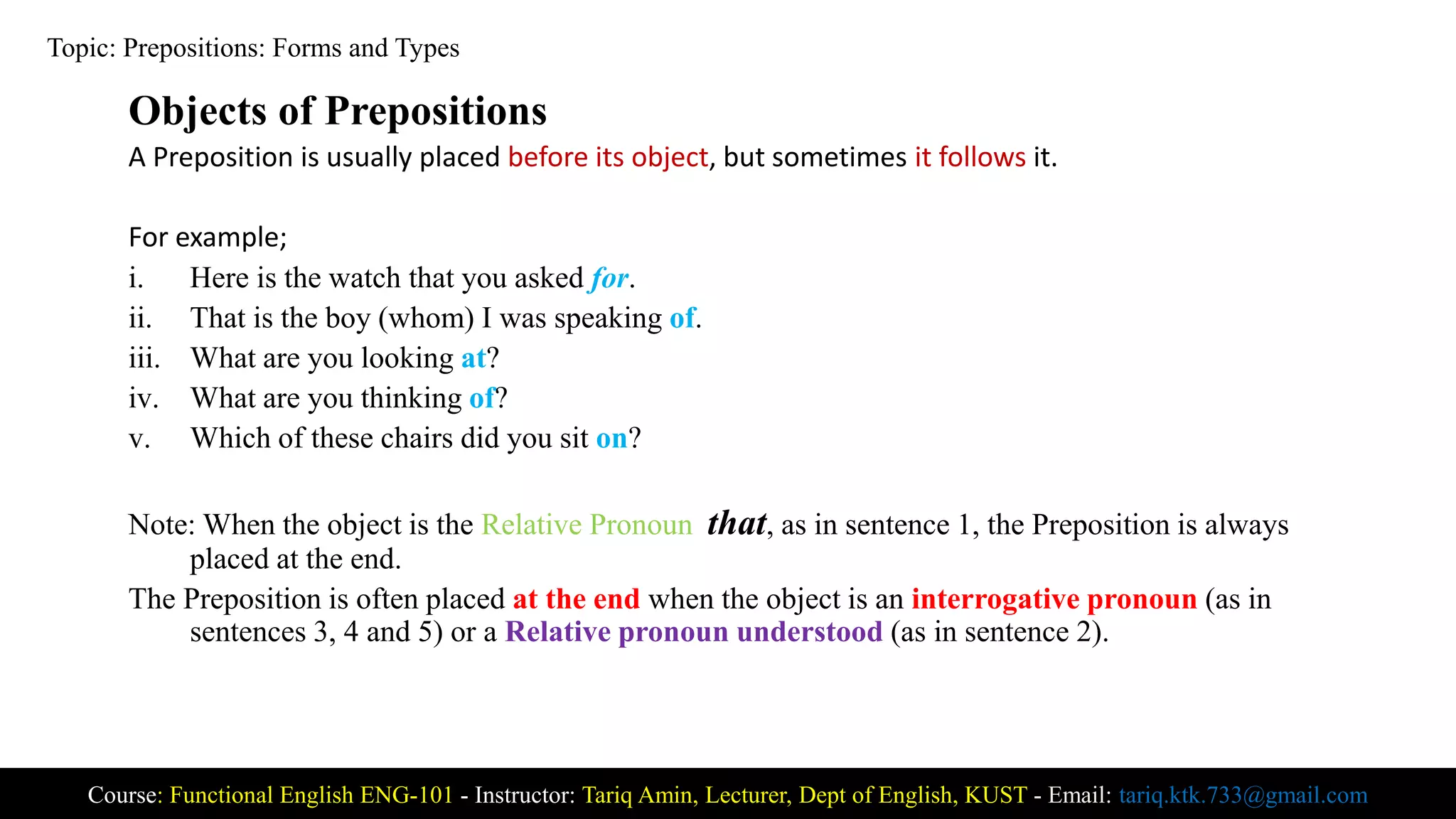
A Preposition is usually placed before its object, but sometimes it follows it.
For example;
i. Here is the watch that you asked for.
ii. That is the boy (whom) I was speaking of.
iii. What are you looking at?
iv. What are you thinking of?
v. Which of these chairs did you sit on?
Note: When the object is the Relative Pronoun that, as in sentence 1, the Preposition is always
placed at the end.
The Preposition is often placed at the end when the object is an interrogative pronoun (as in
sentences 3, 4 and 5) or a Relative pronoun understood (as in sentence 2).
Course: Functional English ENG-101 - Instructor: Tariq Amin, Lecturer, Dept of English, KUST - Email: tariq.ktk.733@gmail.com
Topic: Prepositions: Forms and Types
Objects of Prepositions
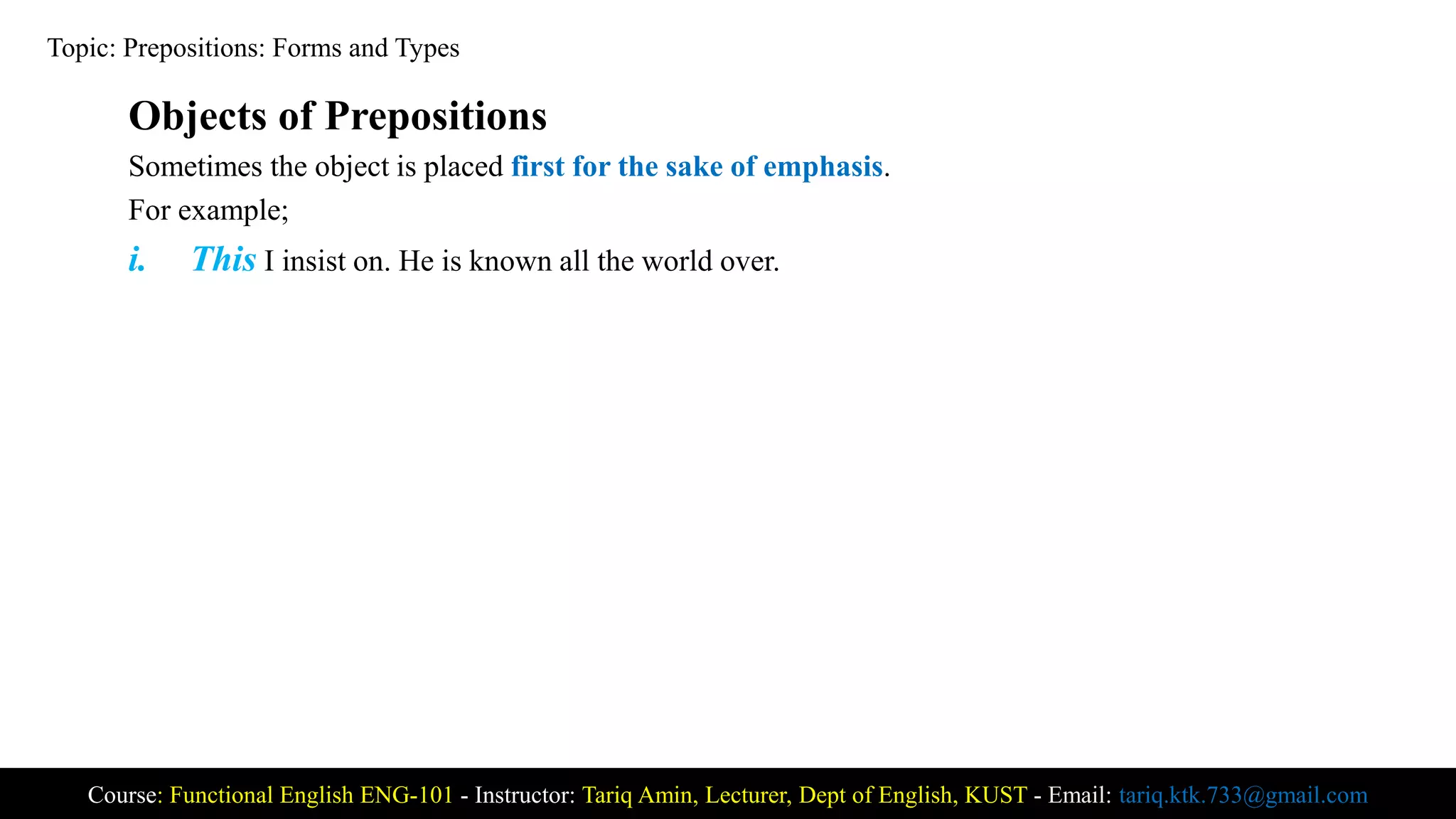
Sometimes the object is placed first for the sake of emphasis.
For example;
i. This I insist on. He is known all the world over.
Course: Functional English ENG-101 - Instructor: Tariq Amin, Lecturer, Dept of English, KUST - Email: tariq.ktk.733@gmail.com
Topic: Prepositions: Forms and Types
Forms of Prepositions
Course: Functional English ENG-101 - Instructor: Tariq Amin, Lecturer, Dept of English, KUST - Email: tariq.ktk.733@gmail.com
Topic: Prepositions: Forms and Types
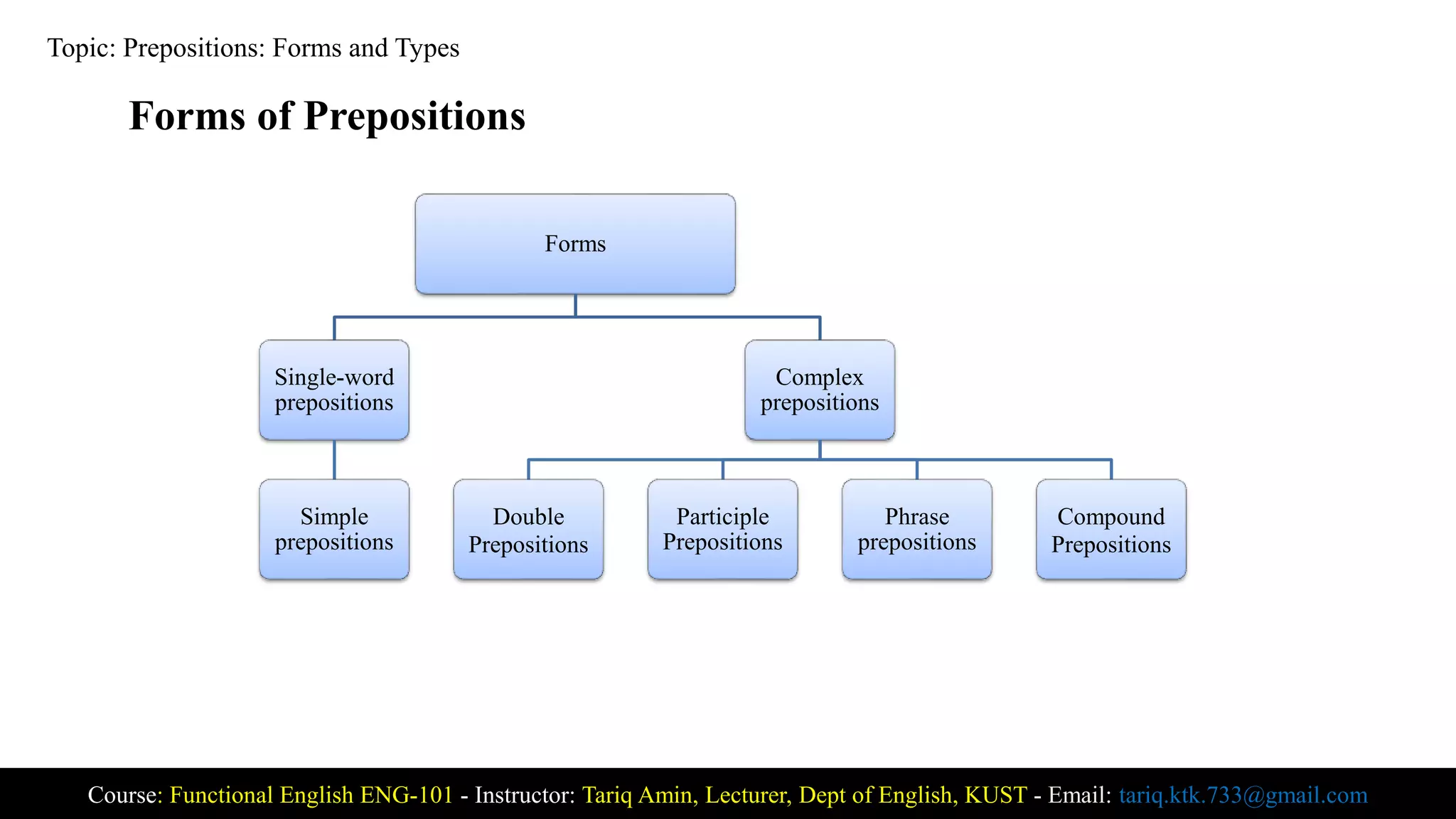
Forms
Single-word
prepositions
Simple
prepositions
Complex
prepositions
Double
Prepositions
Participle
Prepositions
Phrase
prepositions
Compound
Prepositions
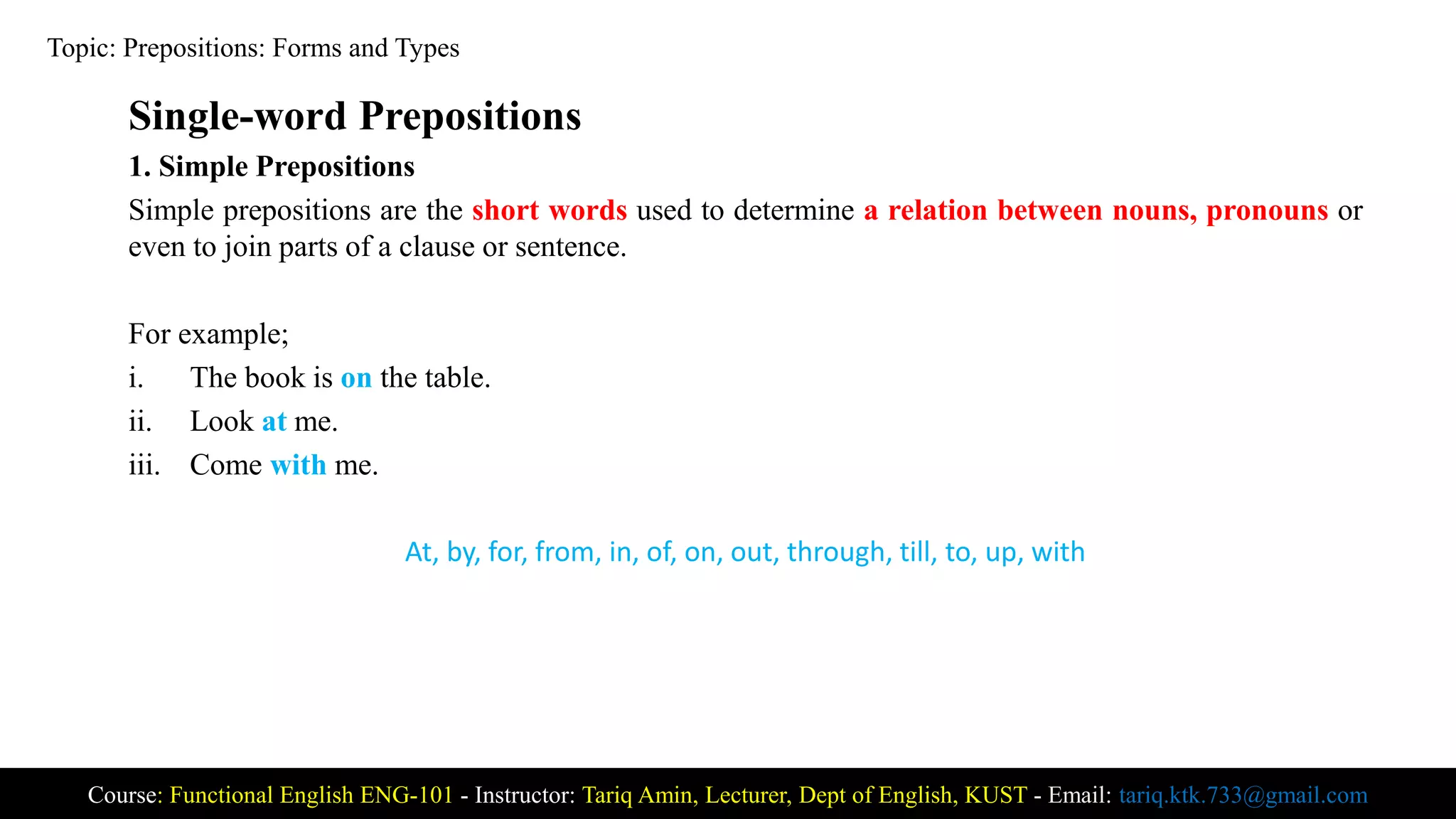
Single-word Prepositions
1. Simple Prepositions
Simple prepositions are the short words used to determine a relation between nouns, pronouns or
even to join parts of a clause or sentence.
For example;
i. The book is on the table.
ii. Look at me.
iii. Come with me.
At, by, for, from, in, of, on, out, through, till, to, up, with
Course: Functional English ENG-101 - Instructor: Tariq Amin, Lecturer, Dept of English, KUST - Email: tariq.ktk.733@gmail.com
Topic: Prepositions: Forms and Types
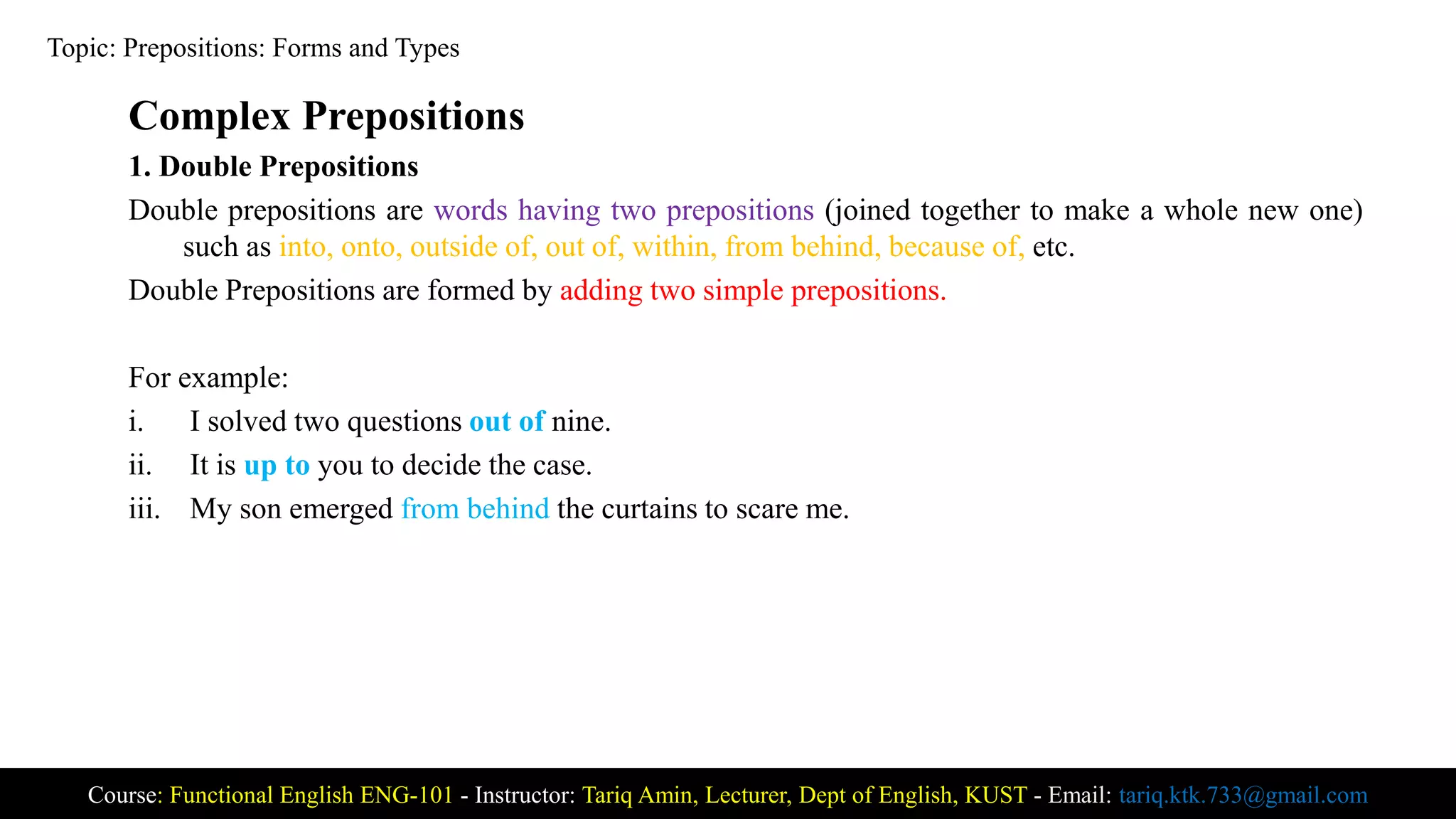
Complex Prepositions
1. Double Prepositions
Double prepositions are words having two prepositions (joined together to make a whole new one)
such as into, onto, outside of, out of, within, from behind, because of, etc.
Double Prepositions are formed by adding two simple prepositions.
For example:
i. I solved two questions out of nine.
ii. It is up to you to decide the case.
iii. My son emerged from behind the curtains to scare me.
Course: Functional English ENG-101 - Instructor: Tariq Amin, Lecturer, Dept of English, KUST - Email: tariq.ktk.733@gmail.com
Topic: Prepositions: Forms and Types
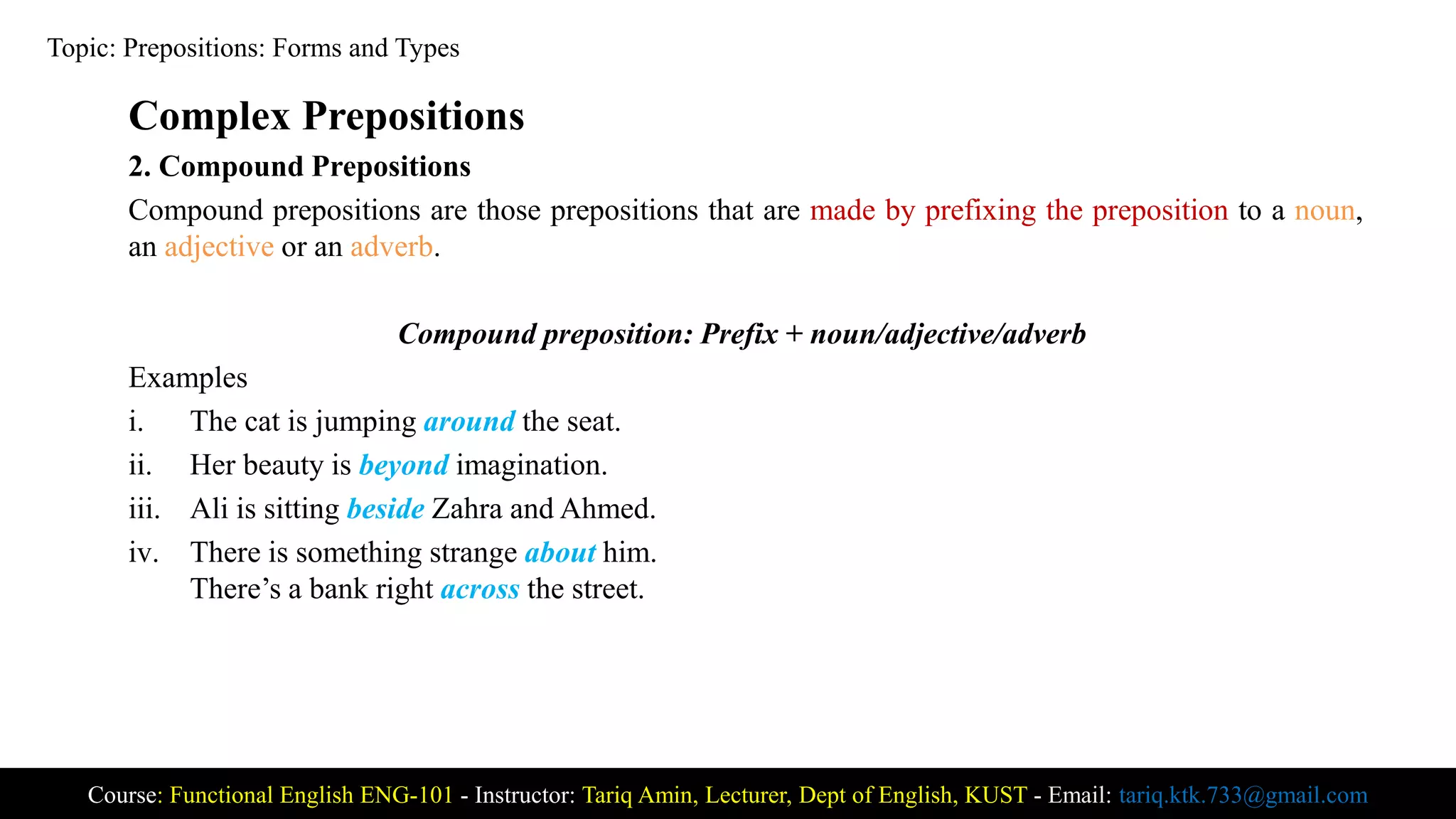
Complex Prepositions
2. Compound Prepositions
Compound prepositions are those prepositions that are made by prefixing the preposition to a noun,
an adjective or an adverb.
Compound preposition: Prefix + noun/adjective/adverb
Examples
i. The cat is jumping around the seat.
ii. Her beauty is beyond imagination.
iii. Ali is sitting beside Zahra and Ahmed.
iv. There is something strange about him.
There’s a bank right across the street.
Course: Functional English ENG-101 - Instructor: Tariq Amin, Lecturer, Dept of English, KUST - Email: tariq.ktk.733@gmail.com
Topic: Prepositions: Forms and Types
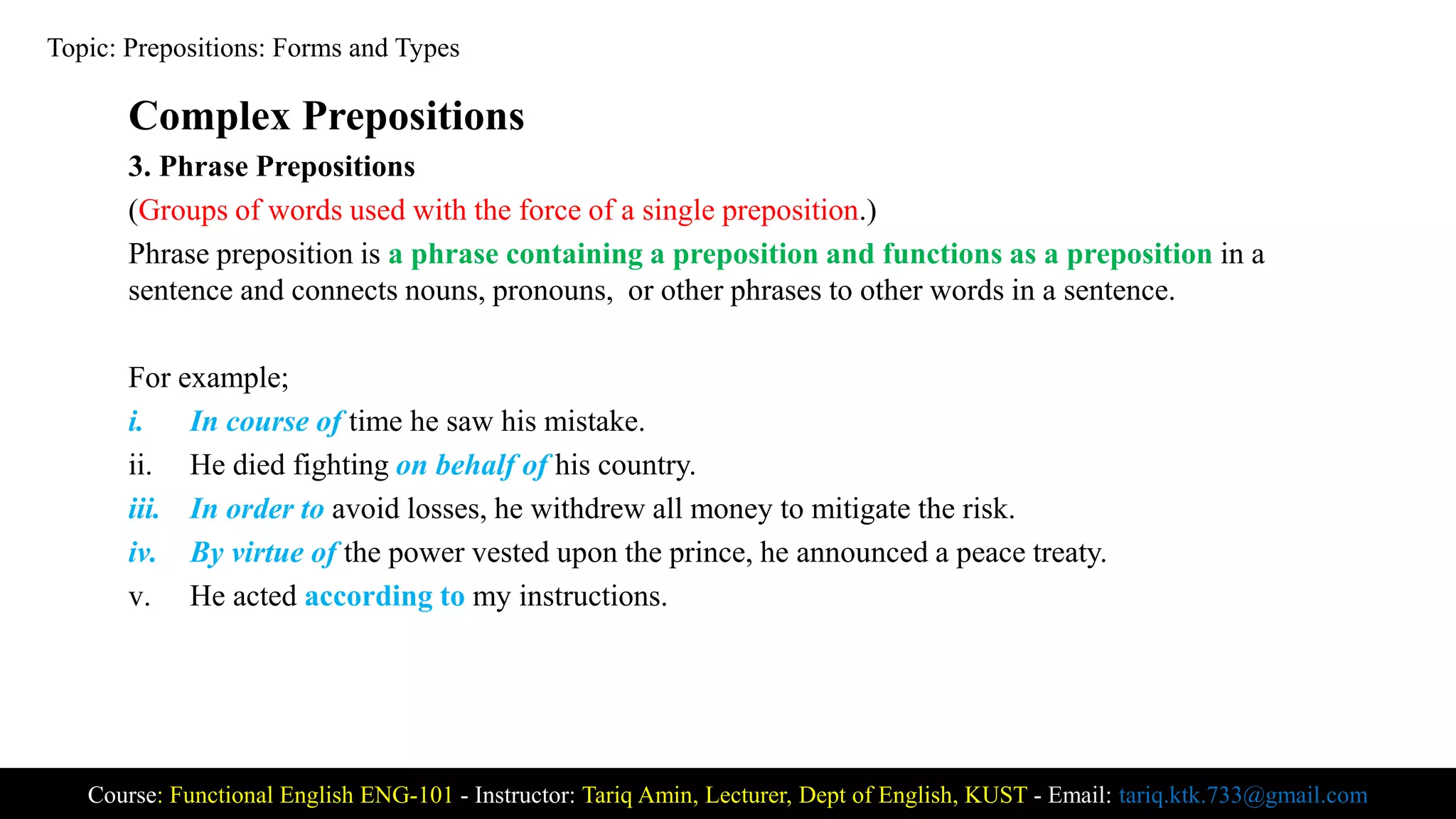
Complex Prepositions
3. Phrase Prepositions
(Groups of words used with the force of a single preposition.)
Phrase preposition is a phrase containing a preposition and functions as a preposition in a
sentence and connects nouns, pronouns, or other phrases to other words in a sentence.
For example;
i. In course of time he saw his mistake.
ii. He died fighting on behalf of his country.
iii. In order to avoid losses, he withdrew all money to mitigate the risk.
iv. By virtue of the power vested upon the prince, he announced a peace treaty.
v. He acted according to my instructions.
Course: Functional English ENG-101 - Instructor: Tariq Amin, Lecturer, Dept of English, KUST - Email: tariq.ktk.733@gmail.com
Topic: Prepositions: Forms and Types
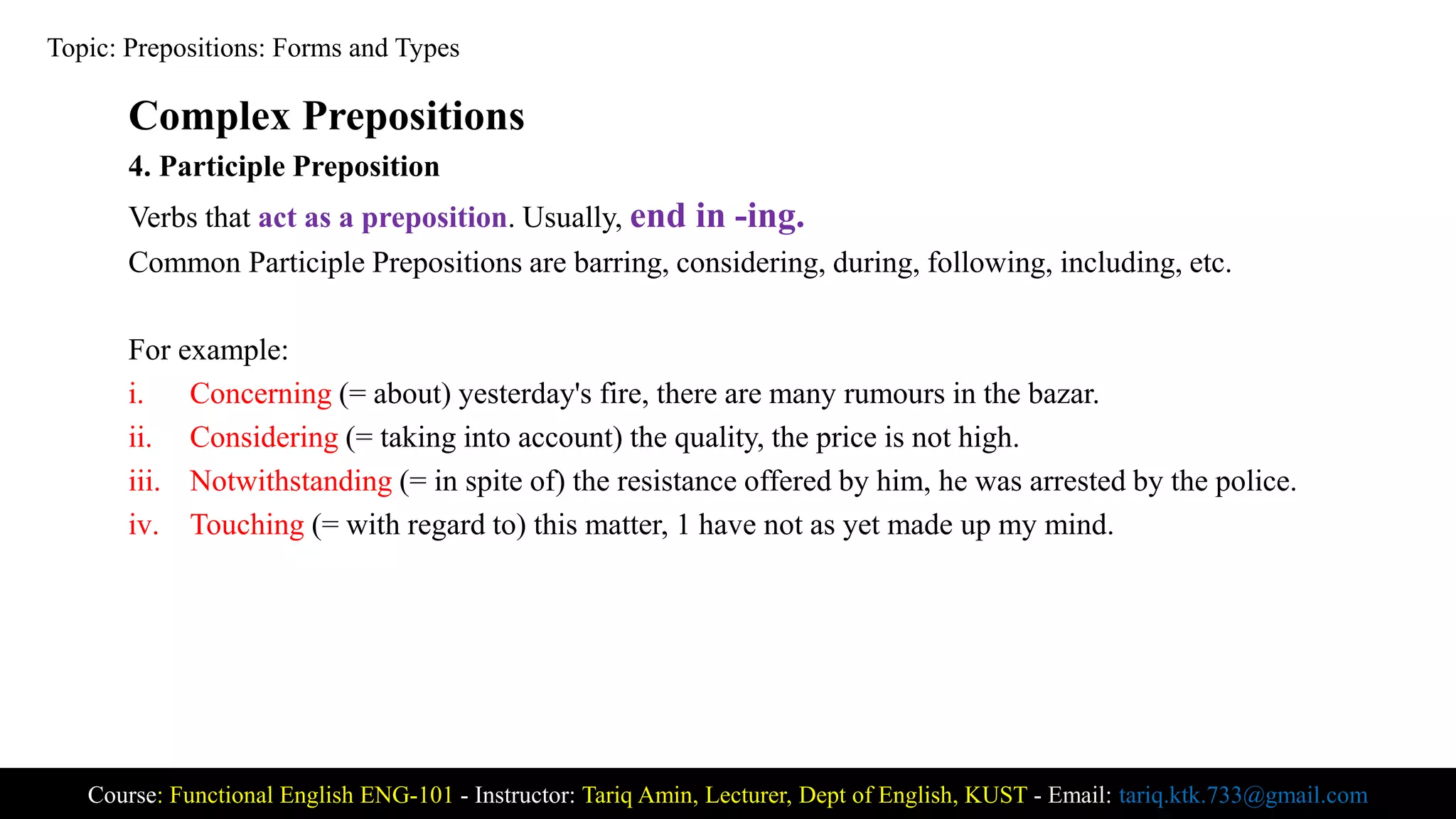
Complex Prepositions
4. Participle Preposition
Verbs that act as a preposition. Usually, end in -ing.
Common Participle Prepositions are barring, considering, during, following, including, etc.
For example:
i. Concerning (= about) yesterday's fire, there are many rumours in the bazar.
ii. Considering (= taking into account) the quality, the price is not high.
iii. Notwithstanding (= in spite of) the resistance offered by him, he was arrested by the police.
iv. Touching (= with regard to) this matter, 1 have not as yet made up my mind.
Course: Functional English ENG-101 - Instructor: Tariq Amin, Lecturer, Dept of English, KUST - Email: tariq.ktk.733@gmail.com
Topic: Prepositions: Forms and Types
Types of Prepositions
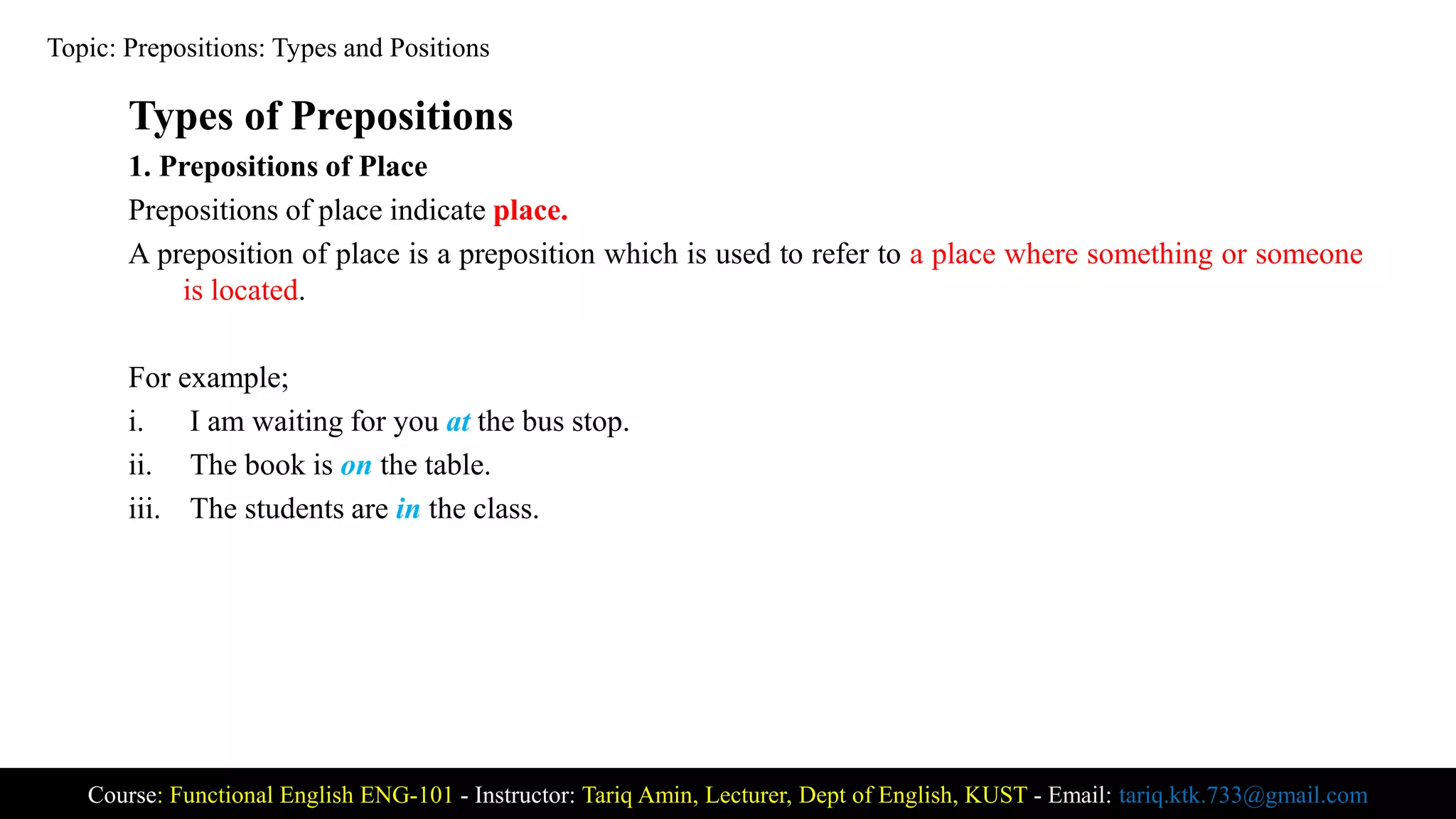
1. Prepositions of Place
Prepositions of place indicate place.
A preposition of place is a preposition which is used to refer to a place where something or someone
is located.
For example;
i. I am waiting for you at the bus stop.
ii. The book is on the table.
iii. The students are in the class.
Course: Functional English ENG-101 - Instructor: Tariq Amin, Lecturer, Dept of English, KUST - Email: tariq.ktk.733@gmail.com
Topic: Prepositions: Types and Positions
Types of Prepositions
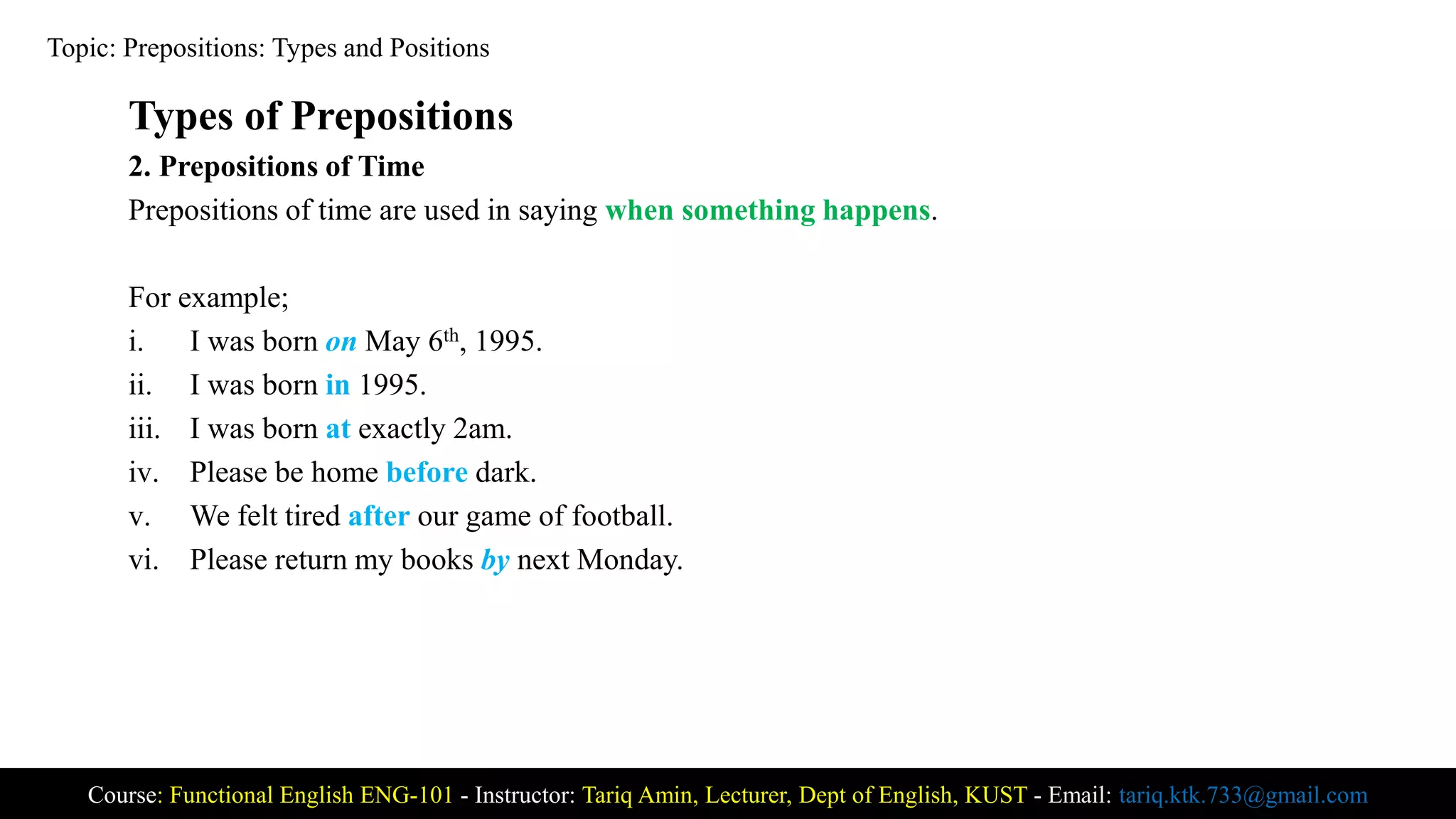
2. Prepositions of Time
Prepositions of time are used in saying when something happens.
For example;
i. I was born on May 6th, 1995.
ii. I was born in 1995.
iii. I was born at exactly 2am.
iv. Please be home before dark.
v. We felt tired after our game of football.
vi. Please return my books by next Monday.
Course: Functional English ENG-101 - Instructor: Tariq Amin, Lecturer, Dept of English, KUST - Email: tariq.ktk.733@gmail.com
Topic: Prepositions: Types and Positions
Types of Prepositions
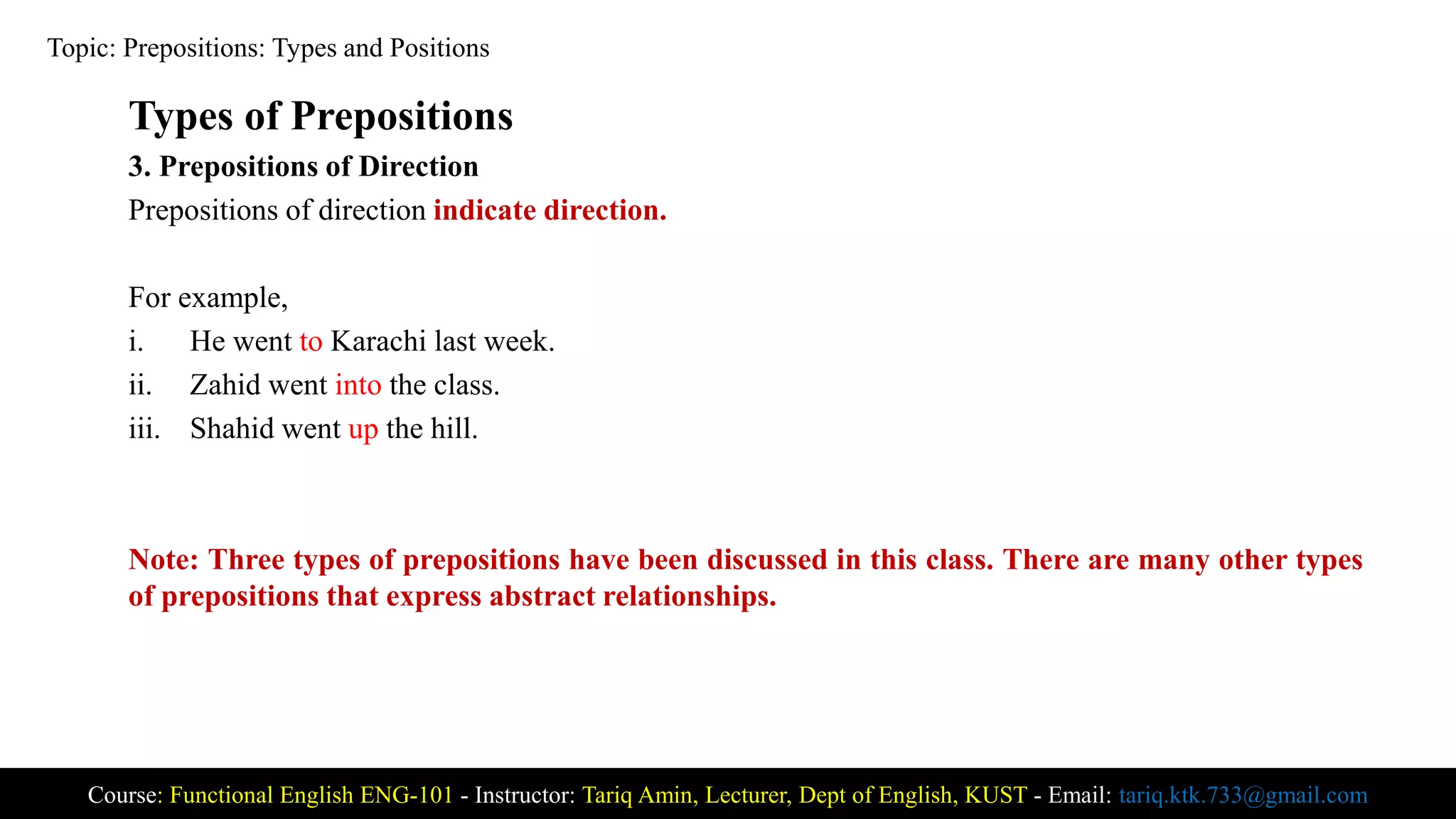
3. Prepositions of Direction
Prepositions of direction indicate direction.
For example,
i. He went to Karachi last week.
ii. Zahid went into the class.
iii. Shahid went up the hill.
Note: Three types of prepositions have been discussed in this class. There are many other types
of prepositions that express abstract relationships.
Course: Functional English ENG-101 - Instructor: Tariq Amin, Lecturer, Dept of English, KUST - Email: tariq.ktk.733@gmail.com
Topic: Prepositions: Types and Positions
Thanks
Course: Functional English ENG-101 - Instructor: Tariq Amin, Lecturer, Dept of English, KUST - Email: tariq.ktk.733@gmail.com

Prepositions: forms and types

  • 1.
    “Functional English” ENG-101 Lecture 13 “Prepositions:Forms and Types” By: Tariq Amin Lecturer, Dept of English, KUST Course: Functional English ENG-101 - Instructor: Tariq Amin, Lecturer, Dept of English, KUST - Email: tariq.ktk.733@gmail.com
  • 2.
    Outline • Definition • Objectsof Prepositions • Forms of Prepositions • Types of Prepositions Course: Functional English ENG-101 - Instructor: Tariq Amin, Lecturer, Dept of English, KUST - Email: tariq.ktk.733@gmail.com Topic: Prepositions: Forms and Types
  • 3.
    Preposition A Preposition isa word placed before a noun or a pronoun to show in what relation the person or thing denoted by it stands in regard to something else. Prepositions are the words that are used to specify any particular relationship that exists between people or objects or between people and objects. Examples: i. There is a cow in the field. ii. He is fond of tea. iii. The cat jumped off the chair. Course: Functional English ENG-101 - Instructor: Tariq Amin, Lecturer, Dept of English, KUST - Email: tariq.ktk.733@gmail.com Topic: Prepositions: Forms and Types
  • 4.
    Objects of Prepositions Apreposition has always an object. The Noun or Pronoun which is used with a Preposition is called its Object. Its object can be a noun, noun phrase or pronoun that follows it. Examples: i. Some animals are always active at night. ii. I usually travel to school by bus. iii. Please wait outside the door. iv. Come with me. v. The bus left without him. Course: Functional English ENG-101 - Instructor: Tariq Amin, Lecturer, Dept of English, KUST - Email: tariq.ktk.733@gmail.com Topic: Prepositions: Forms and Types
  • 5.
    Objects of Prepositions APreposition may have two or more objects; as, i. The road runs over hill and plain. ii. Zahid bounced his ball in the hallway and bedroom. The object of a preposition can be ing form (called gerund or verbal noun). For example; i. I am keen on singing. ii. I suspect her of cheating. Course: Functional English ENG-101 - Instructor: Tariq Amin, Lecturer, Dept of English, KUST - Email: tariq.ktk.733@gmail.com Topic: Prepositions: Forms and Types
  • 6.
    Objects of Prepositions APreposition is usually placed before its object, but sometimes it follows it. For example; i. Here is the watch that you asked for. ii. That is the boy (whom) I was speaking of. iii. What are you looking at? iv. What are you thinking of? v. Which of these chairs did you sit on? Note: When the object is the Relative Pronoun that, as in sentence 1, the Preposition is always placed at the end. The Preposition is often placed at the end when the object is an interrogative pronoun (as in sentences 3, 4 and 5) or a Relative pronoun understood (as in sentence 2). Course: Functional English ENG-101 - Instructor: Tariq Amin, Lecturer, Dept of English, KUST - Email: tariq.ktk.733@gmail.com Topic: Prepositions: Forms and Types
  • 7.
    Objects of Prepositions Sometimesthe object is placed first for the sake of emphasis. For example; i. This I insist on. He is known all the world over. Course: Functional English ENG-101 - Instructor: Tariq Amin, Lecturer, Dept of English, KUST - Email: tariq.ktk.733@gmail.com Topic: Prepositions: Forms and Types
  • 8.
    Forms of Prepositions Course:Functional English ENG-101 - Instructor: Tariq Amin, Lecturer, Dept of English, KUST - Email: tariq.ktk.733@gmail.com Topic: Prepositions: Forms and Types Forms Single-word prepositions Simple prepositions Complex prepositions Double Prepositions Participle Prepositions Phrase prepositions Compound Prepositions
  • 9.
    Single-word Prepositions 1. SimplePrepositions Simple prepositions are the short words used to determine a relation between nouns, pronouns or even to join parts of a clause or sentence. For example; i. The book is on the table. ii. Look at me. iii. Come with me. At, by, for, from, in, of, on, out, through, till, to, up, with Course: Functional English ENG-101 - Instructor: Tariq Amin, Lecturer, Dept of English, KUST - Email: tariq.ktk.733@gmail.com Topic: Prepositions: Forms and Types
  • 10.
    Complex Prepositions 1. DoublePrepositions Double prepositions are words having two prepositions (joined together to make a whole new one) such as into, onto, outside of, out of, within, from behind, because of, etc. Double Prepositions are formed by adding two simple prepositions. For example: i. I solved two questions out of nine. ii. It is up to you to decide the case. iii. My son emerged from behind the curtains to scare me. Course: Functional English ENG-101 - Instructor: Tariq Amin, Lecturer, Dept of English, KUST - Email: tariq.ktk.733@gmail.com Topic: Prepositions: Forms and Types
  • 11.
    Complex Prepositions 2. CompoundPrepositions Compound prepositions are those prepositions that are made by prefixing the preposition to a noun, an adjective or an adverb. Compound preposition: Prefix + noun/adjective/adverb Examples i. The cat is jumping around the seat. ii. Her beauty is beyond imagination. iii. Ali is sitting beside Zahra and Ahmed. iv. There is something strange about him. There’s a bank right across the street. Course: Functional English ENG-101 - Instructor: Tariq Amin, Lecturer, Dept of English, KUST - Email: tariq.ktk.733@gmail.com Topic: Prepositions: Forms and Types
  • 12.
    Complex Prepositions 3. PhrasePrepositions (Groups of words used with the force of a single preposition.) Phrase preposition is a phrase containing a preposition and functions as a preposition in a sentence and connects nouns, pronouns, or other phrases to other words in a sentence. For example; i. In course of time he saw his mistake. ii. He died fighting on behalf of his country. iii. In order to avoid losses, he withdrew all money to mitigate the risk. iv. By virtue of the power vested upon the prince, he announced a peace treaty. v. He acted according to my instructions. Course: Functional English ENG-101 - Instructor: Tariq Amin, Lecturer, Dept of English, KUST - Email: tariq.ktk.733@gmail.com Topic: Prepositions: Forms and Types
  • 13.
    Complex Prepositions 4. ParticiplePreposition Verbs that act as a preposition. Usually, end in -ing. Common Participle Prepositions are barring, considering, during, following, including, etc. For example: i. Concerning (= about) yesterday's fire, there are many rumours in the bazar. ii. Considering (= taking into account) the quality, the price is not high. iii. Notwithstanding (= in spite of) the resistance offered by him, he was arrested by the police. iv. Touching (= with regard to) this matter, 1 have not as yet made up my mind. Course: Functional English ENG-101 - Instructor: Tariq Amin, Lecturer, Dept of English, KUST - Email: tariq.ktk.733@gmail.com Topic: Prepositions: Forms and Types
  • 14.
    Types of Prepositions 1.Prepositions of Place Prepositions of place indicate place. A preposition of place is a preposition which is used to refer to a place where something or someone is located. For example; i. I am waiting for you at the bus stop. ii. The book is on the table. iii. The students are in the class. Course: Functional English ENG-101 - Instructor: Tariq Amin, Lecturer, Dept of English, KUST - Email: tariq.ktk.733@gmail.com Topic: Prepositions: Types and Positions
  • 15.
    Types of Prepositions 2.Prepositions of Time Prepositions of time are used in saying when something happens. For example; i. I was born on May 6th, 1995. ii. I was born in 1995. iii. I was born at exactly 2am. iv. Please be home before dark. v. We felt tired after our game of football. vi. Please return my books by next Monday. Course: Functional English ENG-101 - Instructor: Tariq Amin, Lecturer, Dept of English, KUST - Email: tariq.ktk.733@gmail.com Topic: Prepositions: Types and Positions
  • 16.
    Types of Prepositions 3.Prepositions of Direction Prepositions of direction indicate direction. For example, i. He went to Karachi last week. ii. Zahid went into the class. iii. Shahid went up the hill. Note: Three types of prepositions have been discussed in this class. There are many other types of prepositions that express abstract relationships. Course: Functional English ENG-101 - Instructor: Tariq Amin, Lecturer, Dept of English, KUST - Email: tariq.ktk.733@gmail.com Topic: Prepositions: Types and Positions
  • 17.
    Thanks Course: Functional EnglishENG-101 - Instructor: Tariq Amin, Lecturer, Dept of English, KUST - Email: tariq.ktk.733@gmail.com