Structure of Predication
Meeting 5
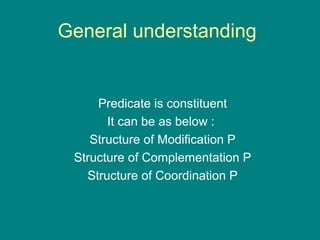
General understanding
Predicate is constituent
It can be as below :
Structure of Modification P
Structure of Complementation P
Structure of Coordination P
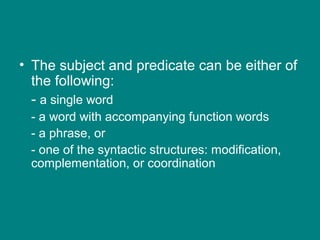
• The subject and predicate can be either of
the following:
- a single word
- a word with accompanying function words
- a phrase, or
- one of the syntactic structures: modification,
complementation, or coordination
• Specifically the subject can be a structure of
predication also which is defined as included
clause.
• The predicate consists of a verb and a verb
phrase in key position.
Examples:
- Money P talks
- Courtesy always >> pays
P
- [The sun] [sets] [in the west ]
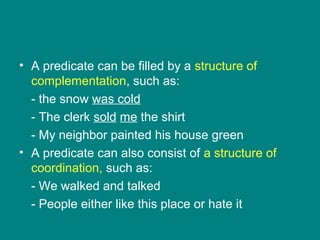
• A predicate can be filled by a structure of
complementation, such as:
- the snow was cold
- The clerk sold me the shirt
- My neighbor painted his house green
• A predicate can also consist of a structure of
coordination, such as:
- We walked and talked
- People either like this place or hate it
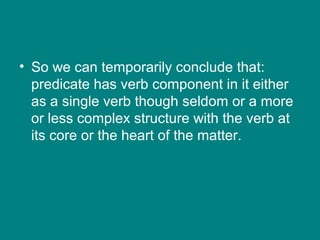
• So we can temporarily conclude that:
predicate has verb component in it either
as a single verb though seldom or a more
or less complex structure with the verb at
its core or the heart of the matter.
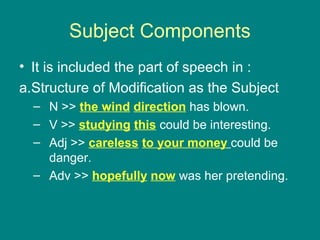
Subject Components
• It is included the part of speech in :
a.Structure of Modification as the Subject
– N >> the wind direction has blown.
– V >> studying this could be interesting.
– Adj >> careless to your money could be
danger.
– Adv >> hopefully now was her pretending.
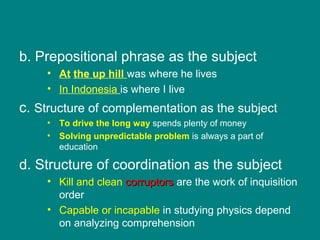
b. Prepositional phrase as the subject
• At the up hill was where he lives
• In Indonesia is where I live
c. Structure of complementation as the subject
• To drive the long way spends plenty of money
• Solving unpredictable problem is always a part of
education
d. Structure of coordination as the subject
• Kill and clean corruptorscorruptors are the work of inquisition
order
• Capable or incapable in studying physics depend
on analyzing comprehension
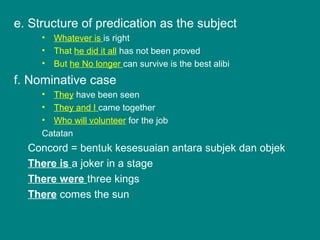
e. Structure of predication as the subject
• Whatever is is right
• That he did it all has not been proved
• But he No longer can survive is the best alibi
f. Nominative case
• They have been seen
• They and I came together
• Who will volunteer for the job
Catatan
Concord = bentuk kesesuaian antara subjek dan objek
There is a joker in a stage
There were three kings
There comes the sun
Struture of Predication VERB
forms
• Thus it needs to be clearly known that VERB is
classified into seven heads:
- person
- tense
- phase
- aspect
- mode
- voice, and
- status
• In terms of person, verb can be classified
in common and third singular. Examples:
the man walks, he feels, this looks good,
the tall man in the car drives, eating candy
causes tooth decay, what I want costs
money, either his mistakes or his bad luck
keeps him poor.
• In terms of Tense, there are two tenses:
common (present) and past (preterit).
They are shown by the inflexion attached
to the verbs: Common: base / base + (-s),
while Past: (base + (-ed).
• The be has its exceptional forms (is, am,
are: present and was, were: past)
• In terms of Phase, there are two phases:
simple and perfect (have + past participle
verb). Examples:
- I speak vs I have spoken
- We work vs We have worked
• In terms of Aspect, there are three:
- simple: the verb is unmarked
- durative: be + base+ing
- inchoative: get+ present participle
• In terms of Mode, it can be seen from:
- the modal auxiliaries + base form: must
go, may come, should see,etc., and
- certain other auxiliaries + infinitive
(to+base form): used to study, ought to
come, have to go, etc.
• In terms of Voice, there are two voices: Active
and passive voices. Passive is formed by the
aux. be + past participle verb or get+ past
participle verb.
Examples:
- He kills he is killed/He gets killed
- They built a house A house was built
- We have done the work The work has been
done
• Can you analyze these two?
- The man was informed by his wife
- The man was informed about politics
• In terms of status, verbs has four statues:
affirmative, interrogative, negative, and
negative interrogative. Examples:
- He is working He works
- He is not working He does not work
- Is he working? Does he work?
- Isn’t he working? Doesn’t he work?
• What’s the difference between
Doesn’t he work? And
Does he not work?
Functions in the Verb Phrase (VP)
• Head: V
• Dependents:
– Pre-head modifier: AdvP
– Post-head modifier: AdvP/PP
– (Post-head) complement:
NP/PP/AdvP/clause
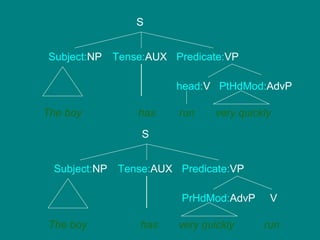
S
Subject:NP Tense:AUX Predicate:VP
The boy has run very quickly
head:V PtHdMod:AdvP
S
Subject:NP Tense:AUX Predicate:VP
The boy has very quickly run
PrHdMod:AdvP V
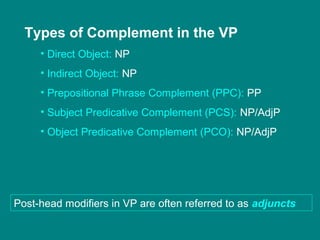
Types of Complement in the VP
• Direct Object: NP
• Indirect Object: NP
• Prepositional Phrase Complement (PPC): PP
• Subject Predicative Complement (PCS): NP/AdjP
• Object Predicative Complement (PCO): NP/AdjP
Post-head modifiers in VP are often referred to as adjuncts
Direct Object (DO) Function in VP
• The direct object function is filled by NP
– The dogs chased the cats.
• If the direct object is a pronoun, the pronoun is in
Accusative case form.
– The dogs chased them. (*they)
• In basic sentences, the direct object NP comes
immediately after the verb
– *The dogs chased [quickly] them.
• Exception: if there is also an indirect object NP
– The boy bought [the girl] an icecream.
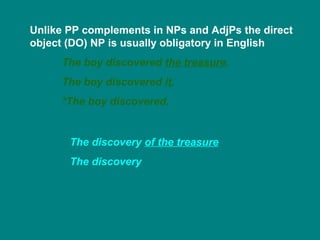
Unlike PP complements in NPs and AdjPs the direct
object (DO) NP is usually obligatory in English
The boy discovered the treasure.
The boy discovered it.
*The boy discovered.
The discovery of the treasure
The discovery
Indirect Object (IO) function in VP
• Indirect object (IO) function is only filled by NP
• IO follows V and precedes DO
– I gave my brother [a new bicycle].
• The IO pronoun is Accusative (or Reflexive)
Accusative IO I baked him a cake
Reflexive IO I baked myself a cake
Preposition Phrase Complement in VP
(PPC)
• a PP may fill a complement function in a VP
• It may be the only complement
– John relies on his friend.
• It may follow an NP (DO) complement
– John put [the book] on the table.
• As with PP complements in an NP or AdjP, the
choice of preposition is restricted by the verb.
– relies on/*in/*from; believes in/*on/*about
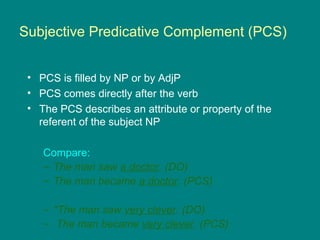
Subjective Predicative Complement (PCS)
• PCS is filled by NP or by AdjP
• PCS comes directly after the verb
• The PCS describes an attribute or property of the
referent of the subject NP
Compare:
– The man saw a doctor. (DO)
– The man became a doctor. (PCS)
– *The man saw very clever. (DO)
– The man became very clever. (PCS)
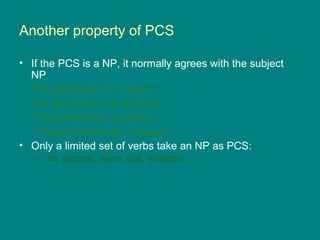
Another property of PCS
• If the PCS is a NP, it normally agrees with the subject
NP
The gentleman is a lawyer.
The gentlemen are lawyers.
*The gentleman is lawyers.
*The gentlemen are a lawyer.
• Only a limited set of verbs take an NP as PCS:
– be, become, seem, look, resemble...
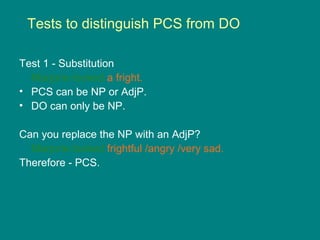
Tests to distinguish PCS from DO
Test 1 - Substitution
Marjorie looked a fright.
• PCS can be NP or AdjP.
• DO can only be NP.
Can you replace the NP with an AdjP?
Marjorie looked frightful /angry /very sad.
Therefore - PCS.
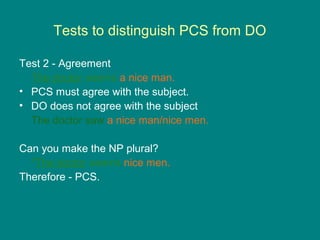
Tests to distinguish PCS from DO
Test 2 - Agreement
The doctor seems a nice man.
• PCS must agree with the subject.
• DO does not agree with the subject
The doctor saw a nice man/nice men.
Can you make the NP plural?
*The doctor seems nice men.
Therefore - PCS.
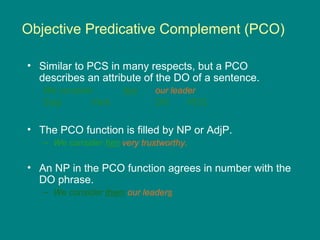
Objective Predicative Complement (PCO)
• Similar to PCS in many respects, but a PCO
describes an attribute of the DO of a sentence.
We consider him our leader.
Subj Verb DO PCO
• The PCO function is filled by NP or AdjP.
– We consider him very trustworthy.
• An NP in the PCO function agrees in number with the
DO phrase.
– We consider them our leaders.
Distinguish PCO construction from IO
construction
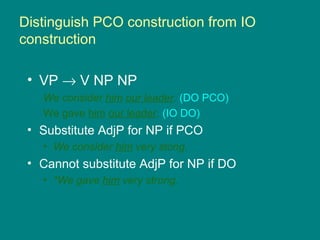
• VP → V NP NP
We consider him our leader. (DO PCO)
We gave him our leader. (IO DO)
• Substitute AdjP for NP if PCO
• We consider him very stong.
• Cannot substitute AdjP for NP if DO
• *We gave him very strong.
Distinguish PCO construction from IO
construction
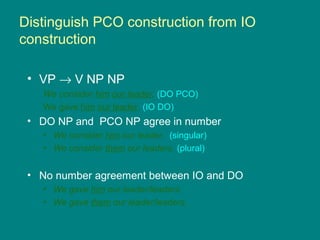
• VP → V NP NP
We consider him our leader. (DO PCO)
We gave him our leader. (IO DO)
• DO NP and PCO NP agree in number
• We consider him our leader. (singular)
• We consider them our leaders. (plural)
• No number agreement between IO and DO
• We gave him our leader/leaders.
• We gave them our leader/leaders.
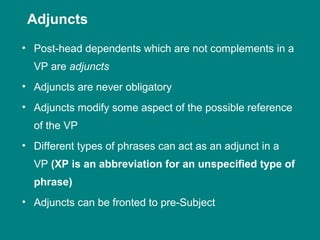
• Post-head dependents which are not complements in a
VP are adjuncts
• Adjuncts are never obligatory
• Adjuncts modify some aspect of the possible reference
of the VP
• Different types of phrases can act as an adjunct in a
VP (XP is an abbreviation for an unspecified type of
phrase)
• Adjuncts can be fronted to pre-Subject
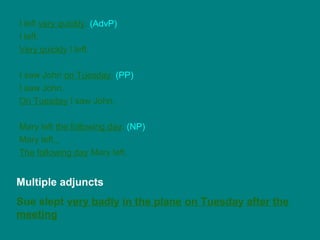
Adjuncts
I left very quickly. (AdvP)
I left.
Very quickly I left.
I saw John on Tuesday. (PP)
I saw John.
On Tuesday I saw John.
Mary left the following day. (NP)
Mary left.
The following day Mary left.
Multiple adjuncts
Sue slept very badly in the plane on Tuesday after the
meeting
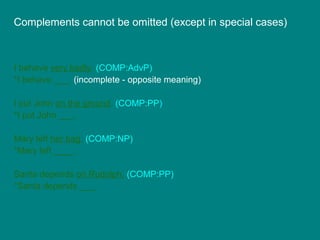
I behave very badly. (COMP:AdvP)
*I behave ___. (incomplete - opposite meaning)
I put John on the ground. (COMP:PP)
*I put John ___.
Mary left her bag. (COMP:NP)
*Mary left ____.
Santa depends on Rudolph. (COMP:PP)
*Santa depends ___.
Complements cannot be omitted (except in special cases)
Complements precede adjuncts
John read [the book] carefully/in the lounge
*John read carefully/in the lounge [the book].
Exception: 'Heavy' DO NP may follow an adjunct phrase
John examined (very) carefully [every single document in
the safe].
Summary
Every phrase has a head
A phrase may have dependents
Dependents may precede or follow the head
Dependents with a close semantic and syntactic
relationship with the head are complements
In some phrases (e.g., VP) complements may be
obligatory
Dependents which are freely added to a phrase to modify
the head are adjuncts
End of slides

Structure of-predication- Edwin Sulispriyanto

  • 1.
  • 2.
    General understanding Predicate isconstituent It can be as below : Structure of Modification P Structure of Complementation P Structure of Coordination P
  • 6.
    • The subjectand predicate can be either of the following: - a single word - a word with accompanying function words - a phrase, or - one of the syntactic structures: modification, complementation, or coordination
  • 7.
    • Specifically thesubject can be a structure of predication also which is defined as included clause. • The predicate consists of a verb and a verb phrase in key position. Examples: - Money P talks - Courtesy always >> pays P - [The sun] [sets] [in the west ]
  • 8.
    • A predicatecan be filled by a structure of complementation, such as: - the snow was cold - The clerk sold me the shirt - My neighbor painted his house green • A predicate can also consist of a structure of coordination, such as: - We walked and talked - People either like this place or hate it
  • 9.
    • So wecan temporarily conclude that: predicate has verb component in it either as a single verb though seldom or a more or less complex structure with the verb at its core or the heart of the matter.
  • 10.
    Subject Components • Itis included the part of speech in : a.Structure of Modification as the Subject – N >> the wind direction has blown. – V >> studying this could be interesting. – Adj >> careless to your money could be danger. – Adv >> hopefully now was her pretending.
  • 11.
    b. Prepositional phraseas the subject • At the up hill was where he lives • In Indonesia is where I live c. Structure of complementation as the subject • To drive the long way spends plenty of money • Solving unpredictable problem is always a part of education d. Structure of coordination as the subject • Kill and clean corruptorscorruptors are the work of inquisition order • Capable or incapable in studying physics depend on analyzing comprehension
  • 12.
    e. Structure ofpredication as the subject • Whatever is is right • That he did it all has not been proved • But he No longer can survive is the best alibi f. Nominative case • They have been seen • They and I came together • Who will volunteer for the job Catatan Concord = bentuk kesesuaian antara subjek dan objek There is a joker in a stage There were three kings There comes the sun
  • 13.
    Struture of PredicationVERB forms • Thus it needs to be clearly known that VERB is classified into seven heads: - person - tense - phase - aspect - mode - voice, and - status
  • 14.
    • In termsof person, verb can be classified in common and third singular. Examples: the man walks, he feels, this looks good, the tall man in the car drives, eating candy causes tooth decay, what I want costs money, either his mistakes or his bad luck keeps him poor.
  • 15.
    • In termsof Tense, there are two tenses: common (present) and past (preterit). They are shown by the inflexion attached to the verbs: Common: base / base + (-s), while Past: (base + (-ed). • The be has its exceptional forms (is, am, are: present and was, were: past)
  • 16.
    • In termsof Phase, there are two phases: simple and perfect (have + past participle verb). Examples: - I speak vs I have spoken - We work vs We have worked
  • 17.
    • In termsof Aspect, there are three: - simple: the verb is unmarked - durative: be + base+ing - inchoative: get+ present participle
  • 18.
    • In termsof Mode, it can be seen from: - the modal auxiliaries + base form: must go, may come, should see,etc., and - certain other auxiliaries + infinitive (to+base form): used to study, ought to come, have to go, etc.
  • 19.
    • In termsof Voice, there are two voices: Active and passive voices. Passive is formed by the aux. be + past participle verb or get+ past participle verb. Examples: - He kills he is killed/He gets killed - They built a house A house was built - We have done the work The work has been done
  • 20.
    • Can youanalyze these two? - The man was informed by his wife - The man was informed about politics
  • 21.
    • In termsof status, verbs has four statues: affirmative, interrogative, negative, and negative interrogative. Examples: - He is working He works - He is not working He does not work - Is he working? Does he work? - Isn’t he working? Doesn’t he work?
  • 22.
    • What’s thedifference between Doesn’t he work? And Does he not work?
  • 24.
    Functions in theVerb Phrase (VP) • Head: V • Dependents: – Pre-head modifier: AdvP – Post-head modifier: AdvP/PP – (Post-head) complement: NP/PP/AdvP/clause
  • 25.
    S Subject:NP Tense:AUX Predicate:VP Theboy has run very quickly head:V PtHdMod:AdvP S Subject:NP Tense:AUX Predicate:VP The boy has very quickly run PrHdMod:AdvP V
  • 26.
    Types of Complementin the VP • Direct Object: NP • Indirect Object: NP • Prepositional Phrase Complement (PPC): PP • Subject Predicative Complement (PCS): NP/AdjP • Object Predicative Complement (PCO): NP/AdjP Post-head modifiers in VP are often referred to as adjuncts
  • 27.
    Direct Object (DO)Function in VP • The direct object function is filled by NP – The dogs chased the cats. • If the direct object is a pronoun, the pronoun is in Accusative case form. – The dogs chased them. (*they) • In basic sentences, the direct object NP comes immediately after the verb – *The dogs chased [quickly] them. • Exception: if there is also an indirect object NP – The boy bought [the girl] an icecream.
  • 28.
    Unlike PP complementsin NPs and AdjPs the direct object (DO) NP is usually obligatory in English The boy discovered the treasure. The boy discovered it. *The boy discovered. The discovery of the treasure The discovery
  • 29.
    Indirect Object (IO)function in VP • Indirect object (IO) function is only filled by NP • IO follows V and precedes DO – I gave my brother [a new bicycle]. • The IO pronoun is Accusative (or Reflexive) Accusative IO I baked him a cake Reflexive IO I baked myself a cake
  • 30.
    Preposition Phrase Complementin VP (PPC) • a PP may fill a complement function in a VP • It may be the only complement – John relies on his friend. • It may follow an NP (DO) complement – John put [the book] on the table. • As with PP complements in an NP or AdjP, the choice of preposition is restricted by the verb. – relies on/*in/*from; believes in/*on/*about
  • 31.
    Subjective Predicative Complement(PCS) • PCS is filled by NP or by AdjP • PCS comes directly after the verb • The PCS describes an attribute or property of the referent of the subject NP Compare: – The man saw a doctor. (DO) – The man became a doctor. (PCS) – *The man saw very clever. (DO) – The man became very clever. (PCS)
  • 32.
    Another property ofPCS • If the PCS is a NP, it normally agrees with the subject NP The gentleman is a lawyer. The gentlemen are lawyers. *The gentleman is lawyers. *The gentlemen are a lawyer. • Only a limited set of verbs take an NP as PCS: – be, become, seem, look, resemble...
  • 33.
    Tests to distinguishPCS from DO Test 1 - Substitution Marjorie looked a fright. • PCS can be NP or AdjP. • DO can only be NP. Can you replace the NP with an AdjP? Marjorie looked frightful /angry /very sad. Therefore - PCS.
  • 34.
    Tests to distinguishPCS from DO Test 2 - Agreement The doctor seems a nice man. • PCS must agree with the subject. • DO does not agree with the subject The doctor saw a nice man/nice men. Can you make the NP plural? *The doctor seems nice men. Therefore - PCS.
  • 35.
    Objective Predicative Complement(PCO) • Similar to PCS in many respects, but a PCO describes an attribute of the DO of a sentence. We consider him our leader. Subj Verb DO PCO • The PCO function is filled by NP or AdjP. – We consider him very trustworthy. • An NP in the PCO function agrees in number with the DO phrase. – We consider them our leaders.
  • 36.
    Distinguish PCO constructionfrom IO construction • VP → V NP NP We consider him our leader. (DO PCO) We gave him our leader. (IO DO) • Substitute AdjP for NP if PCO • We consider him very stong. • Cannot substitute AdjP for NP if DO • *We gave him very strong.
  • 37.
    Distinguish PCO constructionfrom IO construction • VP → V NP NP We consider him our leader. (DO PCO) We gave him our leader. (IO DO) • DO NP and PCO NP agree in number • We consider him our leader. (singular) • We consider them our leaders. (plural) • No number agreement between IO and DO • We gave him our leader/leaders. • We gave them our leader/leaders.
  • 38.
    • Post-head dependentswhich are not complements in a VP are adjuncts • Adjuncts are never obligatory • Adjuncts modify some aspect of the possible reference of the VP • Different types of phrases can act as an adjunct in a VP (XP is an abbreviation for an unspecified type of phrase) • Adjuncts can be fronted to pre-Subject Adjuncts
  • 39.
    I left veryquickly. (AdvP) I left. Very quickly I left. I saw John on Tuesday. (PP) I saw John. On Tuesday I saw John. Mary left the following day. (NP) Mary left. The following day Mary left. Multiple adjuncts Sue slept very badly in the plane on Tuesday after the meeting
  • 40.
    I behave verybadly. (COMP:AdvP) *I behave ___. (incomplete - opposite meaning) I put John on the ground. (COMP:PP) *I put John ___. Mary left her bag. (COMP:NP) *Mary left ____. Santa depends on Rudolph. (COMP:PP) *Santa depends ___. Complements cannot be omitted (except in special cases)
  • 41.
    Complements precede adjuncts Johnread [the book] carefully/in the lounge *John read carefully/in the lounge [the book]. Exception: 'Heavy' DO NP may follow an adjunct phrase John examined (very) carefully [every single document in the safe].
  • 42.
    Summary Every phrase hasa head A phrase may have dependents Dependents may precede or follow the head Dependents with a close semantic and syntactic relationship with the head are complements In some phrases (e.g., VP) complements may be obligatory Dependents which are freely added to a phrase to modify the head are adjuncts
  • 43.