
Judgment The second operation of the human mind a mental process of transferring  from the  ideal order  to the  real order
Judgment the act whereby  the intellect compares two ideas noting their  agreement  or  disagreement  and either combines or separates them
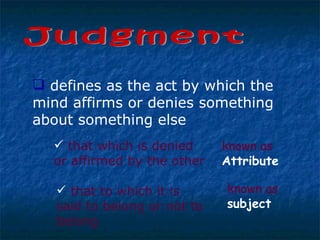
Judgment defines as the act by which the mind affirms or denies something about something else that which is denied or affirmed by the other that to which it is said to belong or not to belong known as  Attribute known as  subject
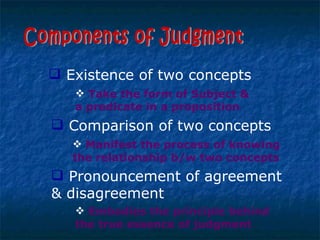
Components of Judgment Existence of two concepts Pronouncement of agreement & disagreement  Comparison of two concepts Take the form of Subject & a predicate in a proposition Manifest the process of knowing the relationship b/w two concepts Embodies the principle behind the true essence of judgment
Proper Definition of Judgment  the act by which the mind affirms or denies an attribute of a subject
Judgment express in sentence known as proposition, the product of judgment  needs simple apprehension since without ideas to be compared NO judgment can take place
Proposition the external sign of judgment Defines as a statement which affirms or denies something about a certain reality or object.  Often formulated in declarative form A triangle is a three-sided figure
Reasoning The third operation of the human mind a mental process wherein the intellect arrives at new judgment or at a new truth by using judgment previously known
Reasoning in this act or mental process, the mind or the intellect advances from one thing understood to another- ( engaged in mental discussion)
Two Methods of Reasoning the reasoning from the particular to universal; from specific instances to the formulation of general principles; from cause to effects Induction a.k.a.  A POSTERIORI  reasoning methods of reasoning employed by physical sciences; chemistry, biology, medicine
Two Methods of Reasoning the reasoning from the universal to the particular; from laws to their operations principles; from causes to effects a.k.a  A PRIORI  reasoning Deduction method used in mathematical & philosophical sciences
…  thanks for listening!

Logic hand outs#3

  • 1.
    Judgment The secondoperation of the human mind a mental process of transferring from the ideal order to the real order
  • 2.
    Judgment the actwhereby the intellect compares two ideas noting their agreement or disagreement and either combines or separates them
  • 3.
    Judgment defines asthe act by which the mind affirms or denies something about something else that which is denied or affirmed by the other that to which it is said to belong or not to belong known as Attribute known as subject
  • 4.
    Components of JudgmentExistence of two concepts Pronouncement of agreement & disagreement Comparison of two concepts Take the form of Subject & a predicate in a proposition Manifest the process of knowing the relationship b/w two concepts Embodies the principle behind the true essence of judgment
  • 5.
    Proper Definition ofJudgment the act by which the mind affirms or denies an attribute of a subject
  • 6.
    Judgment express insentence known as proposition, the product of judgment needs simple apprehension since without ideas to be compared NO judgment can take place
  • 7.
    Proposition the externalsign of judgment Defines as a statement which affirms or denies something about a certain reality or object. Often formulated in declarative form A triangle is a three-sided figure
  • 8.
    Reasoning The thirdoperation of the human mind a mental process wherein the intellect arrives at new judgment or at a new truth by using judgment previously known
  • 9.
    Reasoning in thisact or mental process, the mind or the intellect advances from one thing understood to another- ( engaged in mental discussion)
  • 10.
    Two Methods ofReasoning the reasoning from the particular to universal; from specific instances to the formulation of general principles; from cause to effects Induction a.k.a. A POSTERIORI reasoning methods of reasoning employed by physical sciences; chemistry, biology, medicine
  • 11.
    Two Methods ofReasoning the reasoning from the universal to the particular; from laws to their operations principles; from causes to effects a.k.a A PRIORI reasoning Deduction method used in mathematical & philosophical sciences
  • 12.
    … thanksfor listening!