THE BODY
THE SKELETON
The skeleton is the
framework of bones
which gives shape
and support to the
body.
It also protects the
internal organs like
the heart and lungs.
Joints
Where two or three bones meet, we have
joints. These allow the skeleton to move. The
body has two types of joint which allow free
movement.
• Ball and socket joints are found at the
shoulder and the hip and allow movement
in three dimensions, or directions.
• Hinge joints are found at the elbow and at
the knee and allow movement in one
dimension, or direction.
Muscles
• The muscles of the body allow
movement to occur at joints.
• These muscles are known as Skeletal
muscles.
• To allow movement at a joint muscles
works in pairs.
• Examples of this can be found in the
elbows and knees.
MUSCLES CONTROLLING THE
ELBOW
The muscles which control the movement of the
elbow are the triceps and the biceps. The biceps
contracts or shortens, pulling the lower arm up and
causing the elbow to bend. At this time the triceps
relaxes or lengthens. To straighten the elbow it is
then the triceps which contracts or shortens in order
to pull the lower arm down and at this time the
biceps relaxes.
Muscles controlling the knee
If we look at the knee we can see the hamstring
and the quadriceps controlling the movement.
The hamstring contracts, pulling the lower leg
up and causing the knee to bend. At this time,
the quadriceps relaxes. To straighten the knee,
the quadriceps contracts, and pulls the lower leg
down. At this time the hamstring is relaxed.
Connective tissue
Connective tissue refers to other
features which support the body and
its movement.
TENDONS, LIGAMENTS, CARTILAGE
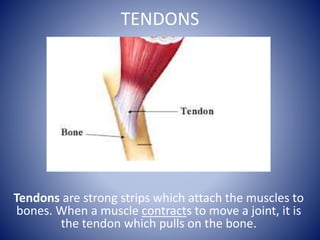
TENDONS
Tendons are strong strips which attach the muscles to
bones. When a muscle contracts to move a joint, it is
the tendon which pulls on the bone.
LIGAMENTS
Ligaments are strong
bands which connect
bones to bones at the
joint. They're
elasticated to allow
the movement of that
joint, but are strong
enough to stop
movement outside
the normal range.
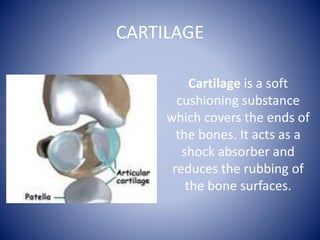
CARTILAGE
Cartilage is a soft
cushioning substance
which covers the ends of
the bones. It acts as a
shock absorber and
reduces the rubbing of
the bone surfaces.
OXYGEN TRANSPORT SYSTEM
In order to work and create movement, muscles
need oxygen. The body's oxygen transport system
takes oxygen to the working muscles, through the
circulatory and respiratory systems working
together. The main workers are the heart, blood
and lungs. The whole oxygen transport system
works in a cycle.
OXYGEN TRANSPORT CYCLE
the flow of oxygenated and de-oxygenated blood round the
body.
• As we breathe, oxygen enters the lungs and is absorbed
into the blood stream.
• The heart pumps this oxygenated blood to the working
muscles, so that the muscles can produce movement.
• As the muscles use the oxygen up, carbon dioxide is
produced and absorbed into the blood.
• And this de-oxygenated blood is pumped back to the
heart then on to the lungs.
• The lungs get rid of this carbon dioxide, and breathe in
more oxygen.

The body structure and function

  • 1.
  • 2.
    THE SKELETON The skeletonis the framework of bones which gives shape and support to the body. It also protects the internal organs like the heart and lungs.
  • 3.
    Joints Where two orthree bones meet, we have joints. These allow the skeleton to move. The body has two types of joint which allow free movement. • Ball and socket joints are found at the shoulder and the hip and allow movement in three dimensions, or directions. • Hinge joints are found at the elbow and at the knee and allow movement in one dimension, or direction.
  • 5.
    Muscles • The musclesof the body allow movement to occur at joints. • These muscles are known as Skeletal muscles. • To allow movement at a joint muscles works in pairs. • Examples of this can be found in the elbows and knees.
  • 7.
    MUSCLES CONTROLLING THE ELBOW Themuscles which control the movement of the elbow are the triceps and the biceps. The biceps contracts or shortens, pulling the lower arm up and causing the elbow to bend. At this time the triceps relaxes or lengthens. To straighten the elbow it is then the triceps which contracts or shortens in order to pull the lower arm down and at this time the biceps relaxes.
  • 9.
    Muscles controlling theknee If we look at the knee we can see the hamstring and the quadriceps controlling the movement. The hamstring contracts, pulling the lower leg up and causing the knee to bend. At this time, the quadriceps relaxes. To straighten the knee, the quadriceps contracts, and pulls the lower leg down. At this time the hamstring is relaxed.
  • 11.
    Connective tissue Connective tissuerefers to other features which support the body and its movement. TENDONS, LIGAMENTS, CARTILAGE
  • 12.
    TENDONS Tendons are strongstrips which attach the muscles to bones. When a muscle contracts to move a joint, it is the tendon which pulls on the bone.
  • 13.
    LIGAMENTS Ligaments are strong bandswhich connect bones to bones at the joint. They're elasticated to allow the movement of that joint, but are strong enough to stop movement outside the normal range.
  • 14.
    CARTILAGE Cartilage is asoft cushioning substance which covers the ends of the bones. It acts as a shock absorber and reduces the rubbing of the bone surfaces.
  • 15.
    OXYGEN TRANSPORT SYSTEM Inorder to work and create movement, muscles need oxygen. The body's oxygen transport system takes oxygen to the working muscles, through the circulatory and respiratory systems working together. The main workers are the heart, blood and lungs. The whole oxygen transport system works in a cycle.
  • 17.
    OXYGEN TRANSPORT CYCLE theflow of oxygenated and de-oxygenated blood round the body. • As we breathe, oxygen enters the lungs and is absorbed into the blood stream. • The heart pumps this oxygenated blood to the working muscles, so that the muscles can produce movement. • As the muscles use the oxygen up, carbon dioxide is produced and absorbed into the blood. • And this de-oxygenated blood is pumped back to the heart then on to the lungs. • The lungs get rid of this carbon dioxide, and breathe in more oxygen.