Tropical medicine department
• Gastroentrology and hepatology unit
• Faculty of medicine
• Zagazig university
• Egypt
Also, The abdomen is divided into 9 regions by:
2 lateral vertical planes; passing from the mid-clavicular
lines, continued downwards, to the mid-point between the
anterior superior iliac spine and the pubic symphysis (right
and a left lateral line drawn vertically through points halfway
between the anterior superior iliac spines and the middle
line).
2 horizontal planes; the subcostal (passing across the
abdomen to connect the lowest points on the costal margin);
and the interiliac (passing across the abdomen to connect the
tubercles of the iliac crests)
subcostal
interiliac
AnteriorAnterior BackBack
 Swelling
 Deformity
 Loin masses
 Pigmentation
 tuft of hair
Inspection of the Back
Inspection of the Anterior Abdominal Wall
Inspection of mid-line
from above downward
Inspection of the sides
1- Subcostal angle
2- Epigastric pulsation
3- Divarication of recti
4- Umbilicus
5- Suprapubic hair distribution
6- Hernial orifices
1- Contour of the abdomen
2- Collateral (dilated veins)
3- Skin
4- Scars
5- Movement with respiration
6- Visible peristalsis
III. Hernia
 Expansile impulse in cough
IV. Dilated veins
 Caput medusa in portal hypertension
V. Skin
 Pigmentation around umbilicus (T.B. peritonitis, Addison dis.)
 Nodules “sister Mary-Joseph nodules” (abd. malignancy)
 Ecchymosis “Cullen's sign” (hemorrhagic pancreatitis and
internal hemorrhage)
VI. Discharge:
 Pus  inflammation
 Stool  intestinal fistula
 Urine  patent urachus
Scaphoid abdomenslightly full abdomen
but not distended
• examination of abdominal
contours
– Standing at the foot of the table
– Lower yourself until the anterior
abdominal wall
– ask the patient to breathe
normally while you are inspect
the abdomen.
Generalized abdominal
distension
Localized abdominal
distension
1- Fluid (ascites)
2- Fat (obesity)
3- Flatus and Faeces
4- Foetus (pregnancy)
5- Full urinary bladder
1- Site
2- Shape and size
3- Pulsate on cough (hernia
or not)
4- Movement with
respiration
5- Extra-abdominal or Intra-
abdominal (by asking the pt.
to sit up in bed unsupported)
Localized bulge
Generalized abdominal distension
IVC obstruction Portal vein obstruction
1- Site of
collaterals
Laterally (Sides) Around umbilicus (caput
medusa)
2- Blood
flow
From below upwards
“towards the head”
(to bypass the
obstruction the blood
bypass the IVC via
abdominal wall veins to
the thorax)
Away from the
umbilicus”towards the legs”
(the blood pass from the left
branch of portal vein to para
umbilical vein to anterior
abdominal wall veins through
the umbilicus)
3- cause in
hepatic Pt
Functional compression
on IVC by tense ascites
Intra-hepatic causes of portal
hypertension
Methods of Detection
- The 2 index fingers of both hands are used to milk the blood
away from one segment of a dilated vein then, applying
firm pressure on both ends of the segment  the fingers
then can be lifted one by one, while observing the rate of
filling at which the vein fills from each direction the blood
will be seen coming more rapidly from the direction of blood
flow.
Caput medusa
Head of medusa
Caput medusae accentuated by marked ascites.
An extensive plexus of veins is seen radiating from the umbilical region
and radiating across the anterior abdominal wall. Note the large vein
coursing inferiorly along the right flank (arrows). This is the superficial
epigastric vein.
It is often difficult to understand whether tiny red spots arising on skin
surface are Petechiae or Purpura. However, Petechiae spots have a very
small diameter that is maximum 3 mm in size. Purpura rashes are larger
in size. These have a diameter that is about 5 mm. A spot that is bigger
than Purpura is known as common bruise or echymosis
Echymosis
Abdominal
petichae
General rules for palpation
Normally palpable structures
1. Contracted muscles of abdominal wall in muscular persons
2. Colon (caecum and sigmoid) is felt when it is spastic (full of gas or
fluid)
3. Vertebra (L4 – L5)
4. Pulsations of abdominal aorta (usually felt below the umbilicus)
in thin persons
5. Lower pole of Rt. Kidney (especially in female with thin lax
abdominal wall)
6. Liver edge descends 1-3 cm below the costal margin on deep
inspiration, but the consistency is soft and difficult to feel.
7. Occasionally, a tongue-like process (reidel’s lobe) is felt (which is
an anatomical variation of the Rt. lobe), moves with respiration
Types of Palpation
SuperficialSuperficial DeepDeep
For:
-Confidence of the patient
-Superficial masses
-Tenderness
-Rigidity
-Temperature
“from the Lt. iliac fossa  in anticlockwise direction
till the suprapubic area”
Superficial Palpation
• Technique
– Use pads of three fingers (palmar surface of fingers) of
one hand and a light, gentle, dipping maneuver to
examine abdomen
– Abdominal wall depressed approximately 1 cm
Palpating the abdomen – Light palpation
Deep Palpation
For :
-Organs “liver, spleen, gall bladder, kidney, colon, urinary
bladder”
- Masses (ask the patient to flexes his neck as this contracts rectus muscles)
-Areas of deep tenderness and rebound (pain induced or
increased by letting go)
Deep palpation include the following methods
-Ordinary technique “classic”
-2 handed method
-Bimanual
-Dipping
-Hooking
-Rolling
• Technique
– Entire palm (use palmar surface of fingers of one hand; greatest
number of fingers) and a deep, firm, gentle maneuver to examine
abdomen
– Either one- or two handed technique is acceptable (When deep
palpation is difficult, examiner may want to use left hand placed
over right hand to help exert pressure)
– Palpate tender areas last
– Palpate deeply with finger pads (do not “dig in” with finger tips)
– Abdominal wall depressed around 4 cm or Push as deeply as
patient will allow without significant discomfort.
Palpating the abdomen – Deep palpation
Surface anatomy of the Spleen
11th
rb
Medial end
Lateral
end
10th
rb
9th
rb
10th
rb
Diaphragmatic surface
Visceral surface
upperborder
Lower
border
 The spleen is not normally palpable
 It has to be enlarged 2-3 times its usual size to be palpable
under the subcostal margin
 Enlargement occurs superiorly and posteriorly before it
becomes palpable subcostaly
 Once the spleen has appeared in this situation, the
direction of further enlargement is downward and towards
the Rt. Iliac fossa
 The spleen which is not felt doesn’t exclude splenomegaly
but it can be said that the spleen is not felt
Methods of Deep Palpation
 Classical method (single-handed method)
 Two handed method
 Bimanual examination
- in the supine position - in the Rt lateral position)
 Dipping method
 Hooking method
Classical method (single-handed method)
Two handed method
Bimanual examination in supine position
Palpating the spleen – Bimanual
palpation in supine position
Palpating the spleen – Bimanual palpation in
supine position
With the patient in the right lateral position, minimal splenic
enlargement can be detected
Palpating the spleen – Bimanual palpation in
Rt. Lateral position
Palpating the spleen – Bimanual palpation in Rt.
Lateral position
Palpating the spleen – Bimanual palpation
in Rt. Lateral position
Examining for the spleen from behind the patient, in the right
lateral position. In this case, the fingers are "hooked" over the
costal margin.
Hooking method
Nature of this palpable spleen (put a comment on):
1. Size
 Mild (just palpable to 5cm)
 Moderate (5 – 10 cm)
 Huge (more than 10 cm, below the umbilicus)
2. Border
3. Surface
4. Consistency
5. Tenderness (e.g. due to splenic infarction, septicemia,
SBE)
Applied anatomy and physiology of the spleen
The spleen is composed predominantly of lymphoid and R.E. tissues,
so, any condition “infectious; immunologic; metabolic; malignant or
idiopathic” that causes hyperplasia of the lymphoid/RES may cause
splenomegaly
The spleen is expansile organ containing many sinusoids, so,
interference with its venous drainage as in portal hypertension will
cause splenomegaly “congestive splenomegaly”
The spleen is a blood forming organ in fetal life and a potential blood
forming organ throughout life, so, in myelosclerosis and myelofibrosis,
extramedullary hematopoiesis may occur in the spleen with
splenomegaly
The spleen destroys senile and defective RBCs, so, in hemolytic
anemias, this function is increase with splenomegaly “except in sickle
cell anemia”
Causes of Huge Spleen (below the umbilicus)
 Bilharzial splenomegaly
 Kala azar “visceral leishmaniasis”
 Chronic malaria causing TSS “Tropical splenomegaly syndrome”
 CML
 Myelofibrosis and Myelosclerosis
 Polycythemia rubra vera
 Beta-thalassemia major
 Amyloidosis
 Gaucher’s disease
Hypersplenism
- Whenever the spleen is enlarged, hypersplenism may occur
-It is characterized by
 Pancytopenia in the peripheral blood (Normocytic
normochromic anemia, neutropenia, thrombocytopenia in
the CBC) due to hyperfunction of the spleen
 One element or two may be decreased only
 B.M examination: hypercellular or normal
 CR-51 labelled RBCs and platelets
 Splenectomy returns the CBC to normal
Characters of splenic swelling to be differentiated
from the Lt. kidney
-By inspection  Moves with respiration down and medially
-By palpation  it has a notch on the lower part of the anterior
(upper) border “PATHOGNOMONIC”
hand can't be insinuated between the mass and the
costal margin to get above its upper pole
 negative ballottement (can’t be pushed in the renal
angle)
-By percussion  dull on percussion and continuous with the splenic
dullness
Upper border is marked by joining the following points:
1st
point Lt. 5th
intercostal space in the MCL “apex of the heart”
2nd
point Xiphisternal joint.
3rd
point Upper border of 5th
rib in Rt. MCL
4th
point 7th
rib at RT MAL.
5th
point  9th
rib at RT scapular line.
Lower border is marked by curved line joining the following points:
1st
point Lt. 5th
intercostal space in the MCL “apex of the heart”
2nd
point  8th
costal cartilage in the Lt. parasternal line.
3rd
point midway between xiphisternal junction and the umbilicus
4th
point  9th costal cartilage in the Rt. MCL.
5th
point  10th
rib in the Rt. MAL.
6th
point  12th
rib in Rt. Scapular line
Xiphisternal junction
Rt. 5th
rib
Rt. 7th
rib
Rt. 9th
rib
LT. 5th
space
umbilicus
Rt. 9th
costal
cartilage
LT. 5th
space
LT. 8th
costal
cartilage
Midway
between
umbilicus
&xiphisternum
umbilicus
Rt. 10th
rib
Technique of detecting the liver
 Upper border is detected by heavy percussion “hepatic
dullness”
 Lower border is detected by deep palpation and light
percussion
After palpation of the lower border of the liver, you must
comment on
I. Liver span : Distance between the upper and lower
borders of the liver; which is
4 – 8 cm in the middle line “represents the Lt.
lobe”
9 – 14 cm in the Rt. MCL “represents the RT.
lobe”
II.Nature of this palpable liver (put a comment on):
1. Size “in finger breadth or cm”
 Normally: not felt below the costal margin
 Abnormally: enlarged “causes of hepatomegaly” or shrunken
“liver cirrhosis and fibrosis”
2. Surface
 Normally: smooth
 Abnormally:
- smooth “congestion, inflammation, infiltration”
- fine irregular “cirrhosis”
- nodular “malignancy”
2. Edge
 Normally: sharp
 Abnormally:
- sharp “cirrhosis, fibrosis”
- rounded “congestion, inflammation, infiltration”
4. Consistency
 Normally: soft
 Abnormally:
- soft “congestion, inflammation, infiltration”
- firm “cirrhosis, fibrosis”
- hard “malignancy”
5. Tenderness: congestion, inflammation, infiltration, malignancy
6. Pulsation: TI, TS, hemangioma
Methods of Palpation
 Classical method (single-handed palpation)
 Two-handed method
 Bimanual examination
 Dipping method
 Hooking method
- Single-handed palpation is used for lean individuals, while the
bimanual technique is best for obese or muscular individuals. Using
either technique, the liver is felt best at deep inspiration.
Single-handed
method
- For single-handed palpation, the examiner's right hand is initially placed on the
patient's abdomen in the right lower quadrant and parallel to the rectus muscle in
the MCL. This is done so that palpation of the rectus is not confused with palpation
of the underlying and adjacent liver
- Gently pressing in and up, ask the patient to take a deep breath.
 Palpating hand is held steady while patient inhales
 Palpating hand is lifted and moved while the patient breathes out
 If the liver is enlarged, it will come downward to meet your fingertips and will
be recognizable.
 Another method of palpating the liver uses the radial border of the
index finger. In this method the anterior hand is placed flat on the
anterior abdominal wall with fingers parallel to the costal margin
the left hand is held posteriorly,
between the 12th
rib and the iliac crest.
It is lifted gently upward to elevate the
bulk of the liver into a more easily
accessible position, while the right
hand is held anterior and lateral to the
rectus musculature. The right hand
moves upward using gentle, steady
pressure until the liver edge is felt.
Bimanual palpation
of Liver
Bimanual palpation
of Liver
– Is useful when the
patient is obese or
when the examiner is
small compared to the
patient.
– Stand by the patient's
chest.
– "Hook" your fingers
just below the costal
margin and press
firmly.
Hooking method
Hooking
method
Causes of ptosed liver
 Emphysema
 Pneumothorax
 Pleural effusion
 Subphrenic abscess
Causes of upward displacement of the liver
 Lung fibrosis/collapse
 Diaphragmatic paralysis
 Ascites / abdominal tumours
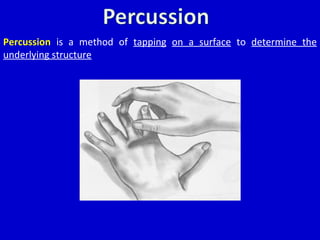
Percussion is a method of tapping on a surface to determine the
underlying structure
Technique
-It is done with the middle finger of Rt. hand (plexor) tapping on DIP of
the middle finger of the Lt. hand (pleximeter) using a wrist action.
-The non striking finger (pleximeter) is placed firmly on the abdomen,
remainder of hand not touching the abdomen.
-Remember that it is easier to hear the change from resonance to
dullness – so proceed with percussion from areas of resonance to areas
of dullness.
pleximeter
plexor
There are two basic sounds
– Resonant sounds indicates hollow, air-filled structures. The
abdomen gives resonant note which varies according to the
amount of gas present in the intestine.
– Dull sounds indicates the presence of a solid structure (e.g. liver)
or fluid (e.g. ascites) lies beneath the region being examined
Percussion of the abdomen
-The abdomen gives a resonant note which varies according to the
amount of gas present in the intestine
-Type of percussion: Light percussion
-Values:
 Deleneation of borders of abdominal organs (& assessing for
organomegaly).
 Decetction of ascites
 Detection of gaseous distension “tympanic resonant note”
 Detection of acute abdomen (obliteration of normal liver
dullness) in;
- Perforated peptic ulcer and colon
- Subphrenic abscess with gas forming organisms
• The two solid organs which are
percussable in the normal
patient
– Liver: will be entirely covered by
the ribs.
– Spleen: The spleen is smaller and
is entirely protected by the ribs.
Percussion “liver”
Upper border  by deep percussion
Lower border  by light percussion
Upper border
 Define the sternal angle “angle of Louis” (2nd
rib), then start
percussing the 2nd
intercostal space in the Rt. MCL (Start just
below the Rt. breast in RT. MCL). Percussion in this area should
produce a relatively resonant note
 Percussing in the chest moving down towards the abdomen
about ½ to 1 cm at a time (in the intercostal spaces).
 Note where the percussion notes change from resonant to dull.
 The normal hepatic dullness will be reached at the 5th
intercostal
space in the RT. MCL
Lower border
 Begin percussion below the umbilicus, in the Rt. MCL and
proceed upward until dullness is encounter.
The liver span is estimated by percussion
The distance between the two areas where dullness is first encountered is the liver span.
Percussion “spleen”
- Percussion of Traube’s area
- Splenic percussion sign “Castell’s method”
- Nixon’s method
Traube's area
It is a semilunar (crescent)-shaped area
It is area of tympanic resonance overlying the fundus of stomach
Boundaries
Upper border lower border of Lt. lung (convex line from the Lt.
6th
rib in MCL to the Lt 9th
rib in mid-axillary line)
Right border Lateral margin of left lobe of liver (from Lt. 6th
rib
in MCL to the Lt. 8th
costal cartilage)
Left border anterior border of the spleen (Lt. 9-11 spaces in
mid-axillary line)
Lower border Lt. costal margin (from the Lt. 8th
costal cartilage
to Lt. 11th
space in mid-axilary line )
 Causes of dullness of Traube’s area:
1. Full stomach/ gastric tumours.
2. Left sided Pleural effusion / pericardial effusion “from above”.
3. Ascites/abdominal tumour “from below”
4. Splenomegaly “from left side”.
5. Enlargement of left lobe of liver “from the right side”.
Castell’s method “Splenic percussion sign”
Put the patient in the supine position
Left anterior axillary line identified
Left lower costal margin identified
 Percuss in the lowest Left intercostal space in the anterior axillary
line (usually the 8th or 9th IC space) while patient inhales and
exhales deeply
This space should remain resonant during full inspiration
Dullness on full inspiration indicates possible splenic enlargement (a
positive Castell’s sign)
Castell’s point
Nixon’s method
Place the patient in Right lateral decubitus
Begin percussion midway along the Left costal margin
Proceed in a line perpendicular to the Left costal margin
If the upper limit of dullness extends >8 cm above the Left costal
margin, this indicates possible splenomegaly
Ascites is free collection of fluid within the peritoneal cavity.
The classical signs of ascites include; abdominal distension, shifting
dullness, fluid thrill.
Minimal ascites  detected in the knee elbow position
Moderate ascites  detected by the bilateral shifting dullness
Tense ascites  detected by transmitted fluid thrill “fluid wave”
Bilateral shifting dullness
1.The patient is examined in the supine position.
2.Percussion is done over the abdomen, from the umbilicus to one flank.
3.The spot of the transition from tympany to dullness is detected.
4.The patient is then turned to the opposite side, while the examiner keeps his
hand unmoved.
5. Percussion of the same spot (which is top now) gives a tympanic note.
Note: The tympany over the umbilicus occurs in ascites because bowel floats
to the top of the abdominal fluid.
air
air
fluid
fluid
Transmitted fluid thrill
Pathognomonic foe ascites when the amount of fluid is large
1.The patient is examined in the supine position.
2.The patient or an assistant places one hand in the midline and
presses firmly with the ulnar border of the hand , so cut off any
vibrations transmitted by the abdominal wall.
3.The examiner places one palm on one flank, while giving a sharp tap
with the finger tips on the opposite flank.
4.Positive test: a definite wave “impulse” will be distinctly felt by the
receiving hand.
• Diaphragm of stethoscope used
• Skin depressed to approximately 1 cm
• Listening in one spot is usually sufficient
• Listening for 15-20 or 30-60 seconds
Values of auscultation
1.To hear intestinal sounds  characteristic gurgling bubbling (gas and
fluid in intestine) sounds.
 Increase in: acute diarrhea (↑motility) and in early intestinal
obstruction
 Absent in: paralytic ileus
N.B. Bowel sounds cannot be said to be absent unless they are
not heard after listening for 3-5 minutes.
2. To hear vascular sounds
Arterial bruit Venous hum
(Wind at sea shore)
Systolic murmur Systolic and diastolic sound in the
epigastrium, and Lt. hypochondrial
region “Kenawy sign”
Occurs in cases of
-Abdominal aortic aneurysm
-Renal artery stenosis
-Over very vascular tumour
“e.g. hemangioma”
Occurs in cases of
- portal hypertension due to porto-
systemic anastomosis (collateral)
3. Friction rub 
a dry, grating sound heard with a stethoscope during auscultation; may
be heared over enlarged liver or spleen
 Splenic rub: in Lt. hypochondrium; due to splenic infarction and
perisplenitis
 Hepatic rub: in Rt. Hypochondrium; due to hepatic malignancy
with perihepatitis (inflammatory changes or infection in or
adjacent to the liver). If detected in a young woman, the
examiner should consider gonococcal peritonitis of the upper
abdomen (Fitz–Hugh–Curtis syndrome).
N.B. A hepatic rub and bruit in the same patient usually indicates
cancer in the liver. A hepatic rub, bruit, and abdominal venous
hum would suggest that a patient with cirrhosis had developed a
hepatoma.
4. To detect lower border of the liver (scratch method)
 Place the diaphragm over the area of the liver  scratch parallel to
the costal margin in MCLWhen the liver is encountered, the
scratching sound heard in the stethoscope will increase significantly
5. To detect minimal ascites (Puddle’s sign)
It is useful for detecting small amounts of ascites (as small as 120 mL;
shifting dullness and bulging flanks typically require 500 mL).
The steps are outlined as follows:
 Patient lies prone for 5 minutes
 Patient then rises onto elbows and knees
 Apply stethoscope diaphragm to most dependent part of the abdomen
 Examiner repeatedly flicks near flank with finger.
 Continue to flick at same spot on abdomen
 Move stethoscope across abdomen away from examiner
 Sound loudness increases at farther edge of puddle
Scratch Test
Start in the same areas
above and below the
liver as you would with
percussion. Instead of
percussing lightly,
scratch moving your
finger back and forth
while listening over the
liver. Since sound is
conducted better in
solids than in air, when
the louder sounds are
heard you are over the
liver. Mark the superior
and inferior boarders of
the liver span in the
midclavicular line
6. Succusion splash  in case of pyloric obstruction (distended
stomach with gas and fluid)
 placing the stethoscope over the upper abdomen  rocking the
patient back and forth at the hips  Retained gastric material >3
hours after a meal will generate a splash sound.
7. To detect pregnancy  fetal heart sounds.
local abdominal examination

local abdominal examination

  • 2.
    Tropical medicine department •Gastroentrology and hepatology unit • Faculty of medicine • Zagazig university • Egypt
  • 4.
    Also, The abdomenis divided into 9 regions by: 2 lateral vertical planes; passing from the mid-clavicular lines, continued downwards, to the mid-point between the anterior superior iliac spine and the pubic symphysis (right and a left lateral line drawn vertically through points halfway between the anterior superior iliac spines and the middle line). 2 horizontal planes; the subcostal (passing across the abdomen to connect the lowest points on the costal margin); and the interiliac (passing across the abdomen to connect the tubercles of the iliac crests)
  • 5.
  • 8.
  • 9.
     Swelling  Deformity Loin masses  Pigmentation  tuft of hair Inspection of the Back
  • 10.
    Inspection of theAnterior Abdominal Wall Inspection of mid-line from above downward Inspection of the sides 1- Subcostal angle 2- Epigastric pulsation 3- Divarication of recti 4- Umbilicus 5- Suprapubic hair distribution 6- Hernial orifices 1- Contour of the abdomen 2- Collateral (dilated veins) 3- Skin 4- Scars 5- Movement with respiration 6- Visible peristalsis
  • 15.
    III. Hernia  Expansileimpulse in cough IV. Dilated veins  Caput medusa in portal hypertension V. Skin  Pigmentation around umbilicus (T.B. peritonitis, Addison dis.)  Nodules “sister Mary-Joseph nodules” (abd. malignancy)  Ecchymosis “Cullen's sign” (hemorrhagic pancreatitis and internal hemorrhage) VI. Discharge:  Pus  inflammation  Stool  intestinal fistula  Urine  patent urachus
  • 20.
    Scaphoid abdomenslightly fullabdomen but not distended
  • 21.
    • examination ofabdominal contours – Standing at the foot of the table – Lower yourself until the anterior abdominal wall – ask the patient to breathe normally while you are inspect the abdomen.
  • 22.
    Generalized abdominal distension Localized abdominal distension 1-Fluid (ascites) 2- Fat (obesity) 3- Flatus and Faeces 4- Foetus (pregnancy) 5- Full urinary bladder 1- Site 2- Shape and size 3- Pulsate on cough (hernia or not) 4- Movement with respiration 5- Extra-abdominal or Intra- abdominal (by asking the pt. to sit up in bed unsupported)
  • 23.
  • 24.
  • 25.
    IVC obstruction Portalvein obstruction 1- Site of collaterals Laterally (Sides) Around umbilicus (caput medusa) 2- Blood flow From below upwards “towards the head” (to bypass the obstruction the blood bypass the IVC via abdominal wall veins to the thorax) Away from the umbilicus”towards the legs” (the blood pass from the left branch of portal vein to para umbilical vein to anterior abdominal wall veins through the umbilicus) 3- cause in hepatic Pt Functional compression on IVC by tense ascites Intra-hepatic causes of portal hypertension
  • 26.
    Methods of Detection -The 2 index fingers of both hands are used to milk the blood away from one segment of a dilated vein then, applying firm pressure on both ends of the segment  the fingers then can be lifted one by one, while observing the rate of filling at which the vein fills from each direction the blood will be seen coming more rapidly from the direction of blood flow.
  • 27.
  • 28.
    Caput medusae accentuatedby marked ascites. An extensive plexus of veins is seen radiating from the umbilical region and radiating across the anterior abdominal wall. Note the large vein coursing inferiorly along the right flank (arrows). This is the superficial epigastric vein.
  • 33.
    It is oftendifficult to understand whether tiny red spots arising on skin surface are Petechiae or Purpura. However, Petechiae spots have a very small diameter that is maximum 3 mm in size. Purpura rashes are larger in size. These have a diameter that is about 5 mm. A spot that is bigger than Purpura is known as common bruise or echymosis Echymosis Abdominal petichae
  • 39.
  • 40.
  • 42.
    Normally palpable structures 1.Contracted muscles of abdominal wall in muscular persons 2. Colon (caecum and sigmoid) is felt when it is spastic (full of gas or fluid) 3. Vertebra (L4 – L5) 4. Pulsations of abdominal aorta (usually felt below the umbilicus) in thin persons 5. Lower pole of Rt. Kidney (especially in female with thin lax abdominal wall) 6. Liver edge descends 1-3 cm below the costal margin on deep inspiration, but the consistency is soft and difficult to feel. 7. Occasionally, a tongue-like process (reidel’s lobe) is felt (which is an anatomical variation of the Rt. lobe), moves with respiration
  • 43.
  • 44.
    For: -Confidence of thepatient -Superficial masses -Tenderness -Rigidity -Temperature “from the Lt. iliac fossa  in anticlockwise direction till the suprapubic area” Superficial Palpation
  • 45.
    • Technique – Usepads of three fingers (palmar surface of fingers) of one hand and a light, gentle, dipping maneuver to examine abdomen – Abdominal wall depressed approximately 1 cm
  • 46.
    Palpating the abdomen– Light palpation
  • 47.
    Palpating the abdomen– Light palpation
  • 48.
    Deep Palpation For : -Organs“liver, spleen, gall bladder, kidney, colon, urinary bladder” - Masses (ask the patient to flexes his neck as this contracts rectus muscles) -Areas of deep tenderness and rebound (pain induced or increased by letting go) Deep palpation include the following methods -Ordinary technique “classic” -2 handed method -Bimanual -Dipping -Hooking -Rolling
  • 49.
    • Technique – Entirepalm (use palmar surface of fingers of one hand; greatest number of fingers) and a deep, firm, gentle maneuver to examine abdomen – Either one- or two handed technique is acceptable (When deep palpation is difficult, examiner may want to use left hand placed over right hand to help exert pressure) – Palpate tender areas last – Palpate deeply with finger pads (do not “dig in” with finger tips) – Abdominal wall depressed around 4 cm or Push as deeply as patient will allow without significant discomfort.
  • 50.
    Palpating the abdomen– Deep palpation
  • 53.
    Surface anatomy ofthe Spleen 11th rb Medial end Lateral end 10th rb 9th rb 10th rb
  • 54.
  • 55.
     The spleenis not normally palpable  It has to be enlarged 2-3 times its usual size to be palpable under the subcostal margin  Enlargement occurs superiorly and posteriorly before it becomes palpable subcostaly  Once the spleen has appeared in this situation, the direction of further enlargement is downward and towards the Rt. Iliac fossa  The spleen which is not felt doesn’t exclude splenomegaly but it can be said that the spleen is not felt
  • 56.
    Methods of DeepPalpation  Classical method (single-handed method)  Two handed method  Bimanual examination - in the supine position - in the Rt lateral position)  Dipping method  Hooking method
  • 57.
  • 58.
  • 59.
    Bimanual examination insupine position
  • 60.
    Palpating the spleen– Bimanual palpation in supine position
  • 61.
    Palpating the spleen– Bimanual palpation in supine position
  • 62.
    With the patientin the right lateral position, minimal splenic enlargement can be detected Palpating the spleen – Bimanual palpation in Rt. Lateral position
  • 63.
    Palpating the spleen– Bimanual palpation in Rt. Lateral position
  • 64.
    Palpating the spleen– Bimanual palpation in Rt. Lateral position
  • 65.
    Examining for thespleen from behind the patient, in the right lateral position. In this case, the fingers are "hooked" over the costal margin. Hooking method
  • 66.
    Nature of thispalpable spleen (put a comment on): 1. Size  Mild (just palpable to 5cm)  Moderate (5 – 10 cm)  Huge (more than 10 cm, below the umbilicus) 2. Border 3. Surface 4. Consistency 5. Tenderness (e.g. due to splenic infarction, septicemia, SBE)
  • 67.
    Applied anatomy andphysiology of the spleen The spleen is composed predominantly of lymphoid and R.E. tissues, so, any condition “infectious; immunologic; metabolic; malignant or idiopathic” that causes hyperplasia of the lymphoid/RES may cause splenomegaly The spleen is expansile organ containing many sinusoids, so, interference with its venous drainage as in portal hypertension will cause splenomegaly “congestive splenomegaly” The spleen is a blood forming organ in fetal life and a potential blood forming organ throughout life, so, in myelosclerosis and myelofibrosis, extramedullary hematopoiesis may occur in the spleen with splenomegaly The spleen destroys senile and defective RBCs, so, in hemolytic anemias, this function is increase with splenomegaly “except in sickle cell anemia”
  • 68.
    Causes of HugeSpleen (below the umbilicus)  Bilharzial splenomegaly  Kala azar “visceral leishmaniasis”  Chronic malaria causing TSS “Tropical splenomegaly syndrome”  CML  Myelofibrosis and Myelosclerosis  Polycythemia rubra vera  Beta-thalassemia major  Amyloidosis  Gaucher’s disease
  • 69.
    Hypersplenism - Whenever thespleen is enlarged, hypersplenism may occur -It is characterized by  Pancytopenia in the peripheral blood (Normocytic normochromic anemia, neutropenia, thrombocytopenia in the CBC) due to hyperfunction of the spleen  One element or two may be decreased only  B.M examination: hypercellular or normal  CR-51 labelled RBCs and platelets  Splenectomy returns the CBC to normal
  • 70.
    Characters of splenicswelling to be differentiated from the Lt. kidney -By inspection  Moves with respiration down and medially -By palpation  it has a notch on the lower part of the anterior (upper) border “PATHOGNOMONIC” hand can't be insinuated between the mass and the costal margin to get above its upper pole  negative ballottement (can’t be pushed in the renal angle) -By percussion  dull on percussion and continuous with the splenic dullness
  • 73.
    Upper border ismarked by joining the following points: 1st point Lt. 5th intercostal space in the MCL “apex of the heart” 2nd point Xiphisternal joint. 3rd point Upper border of 5th rib in Rt. MCL 4th point 7th rib at RT MAL. 5th point  9th rib at RT scapular line. Lower border is marked by curved line joining the following points: 1st point Lt. 5th intercostal space in the MCL “apex of the heart” 2nd point  8th costal cartilage in the Lt. parasternal line. 3rd point midway between xiphisternal junction and the umbilicus 4th point  9th costal cartilage in the Rt. MCL. 5th point  10th rib in the Rt. MAL. 6th point  12th rib in Rt. Scapular line
  • 74.
    Xiphisternal junction Rt. 5th rib Rt.7th rib Rt. 9th rib LT. 5th space umbilicus
  • 75.
    Rt. 9th costal cartilage LT. 5th space LT.8th costal cartilage Midway between umbilicus &xiphisternum umbilicus Rt. 10th rib
  • 76.
    Technique of detectingthe liver  Upper border is detected by heavy percussion “hepatic dullness”  Lower border is detected by deep palpation and light percussion After palpation of the lower border of the liver, you must comment on I. Liver span : Distance between the upper and lower borders of the liver; which is 4 – 8 cm in the middle line “represents the Lt. lobe” 9 – 14 cm in the Rt. MCL “represents the RT. lobe”
  • 77.
    II.Nature of thispalpable liver (put a comment on): 1. Size “in finger breadth or cm”  Normally: not felt below the costal margin  Abnormally: enlarged “causes of hepatomegaly” or shrunken “liver cirrhosis and fibrosis” 2. Surface  Normally: smooth  Abnormally: - smooth “congestion, inflammation, infiltration” - fine irregular “cirrhosis” - nodular “malignancy” 2. Edge  Normally: sharp  Abnormally: - sharp “cirrhosis, fibrosis” - rounded “congestion, inflammation, infiltration”
  • 78.
    4. Consistency  Normally:soft  Abnormally: - soft “congestion, inflammation, infiltration” - firm “cirrhosis, fibrosis” - hard “malignancy” 5. Tenderness: congestion, inflammation, infiltration, malignancy 6. Pulsation: TI, TS, hemangioma
  • 79.
    Methods of Palpation Classical method (single-handed palpation)  Two-handed method  Bimanual examination  Dipping method  Hooking method - Single-handed palpation is used for lean individuals, while the bimanual technique is best for obese or muscular individuals. Using either technique, the liver is felt best at deep inspiration.
  • 80.
    Single-handed method - For single-handedpalpation, the examiner's right hand is initially placed on the patient's abdomen in the right lower quadrant and parallel to the rectus muscle in the MCL. This is done so that palpation of the rectus is not confused with palpation of the underlying and adjacent liver - Gently pressing in and up, ask the patient to take a deep breath.  Palpating hand is held steady while patient inhales  Palpating hand is lifted and moved while the patient breathes out  If the liver is enlarged, it will come downward to meet your fingertips and will be recognizable.
  • 81.
     Another methodof palpating the liver uses the radial border of the index finger. In this method the anterior hand is placed flat on the anterior abdominal wall with fingers parallel to the costal margin
  • 82.
    the left handis held posteriorly, between the 12th rib and the iliac crest. It is lifted gently upward to elevate the bulk of the liver into a more easily accessible position, while the right hand is held anterior and lateral to the rectus musculature. The right hand moves upward using gentle, steady pressure until the liver edge is felt. Bimanual palpation of Liver
  • 83.
  • 84.
    – Is usefulwhen the patient is obese or when the examiner is small compared to the patient. – Stand by the patient's chest. – "Hook" your fingers just below the costal margin and press firmly. Hooking method
  • 85.
  • 86.
    Causes of ptosedliver  Emphysema  Pneumothorax  Pleural effusion  Subphrenic abscess Causes of upward displacement of the liver  Lung fibrosis/collapse  Diaphragmatic paralysis  Ascites / abdominal tumours
  • 87.
    Percussion is amethod of tapping on a surface to determine the underlying structure
  • 88.
    Technique -It is donewith the middle finger of Rt. hand (plexor) tapping on DIP of the middle finger of the Lt. hand (pleximeter) using a wrist action. -The non striking finger (pleximeter) is placed firmly on the abdomen, remainder of hand not touching the abdomen. -Remember that it is easier to hear the change from resonance to dullness – so proceed with percussion from areas of resonance to areas of dullness. pleximeter plexor
  • 89.
    There are twobasic sounds – Resonant sounds indicates hollow, air-filled structures. The abdomen gives resonant note which varies according to the amount of gas present in the intestine. – Dull sounds indicates the presence of a solid structure (e.g. liver) or fluid (e.g. ascites) lies beneath the region being examined
  • 90.
    Percussion of theabdomen -The abdomen gives a resonant note which varies according to the amount of gas present in the intestine -Type of percussion: Light percussion -Values:  Deleneation of borders of abdominal organs (& assessing for organomegaly).  Decetction of ascites  Detection of gaseous distension “tympanic resonant note”  Detection of acute abdomen (obliteration of normal liver dullness) in; - Perforated peptic ulcer and colon - Subphrenic abscess with gas forming organisms
  • 91.
    • The twosolid organs which are percussable in the normal patient – Liver: will be entirely covered by the ribs. – Spleen: The spleen is smaller and is entirely protected by the ribs.
  • 92.
    Percussion “liver” Upper border by deep percussion Lower border  by light percussion Upper border  Define the sternal angle “angle of Louis” (2nd rib), then start percussing the 2nd intercostal space in the Rt. MCL (Start just below the Rt. breast in RT. MCL). Percussion in this area should produce a relatively resonant note  Percussing in the chest moving down towards the abdomen about ½ to 1 cm at a time (in the intercostal spaces).  Note where the percussion notes change from resonant to dull.  The normal hepatic dullness will be reached at the 5th intercostal space in the RT. MCL Lower border  Begin percussion below the umbilicus, in the Rt. MCL and proceed upward until dullness is encounter.
  • 93.
    The liver spanis estimated by percussion The distance between the two areas where dullness is first encountered is the liver span.
  • 95.
    Percussion “spleen” - Percussionof Traube’s area - Splenic percussion sign “Castell’s method” - Nixon’s method
  • 96.
    Traube's area It isa semilunar (crescent)-shaped area It is area of tympanic resonance overlying the fundus of stomach Boundaries Upper border lower border of Lt. lung (convex line from the Lt. 6th rib in MCL to the Lt 9th rib in mid-axillary line) Right border Lateral margin of left lobe of liver (from Lt. 6th rib in MCL to the Lt. 8th costal cartilage) Left border anterior border of the spleen (Lt. 9-11 spaces in mid-axillary line) Lower border Lt. costal margin (from the Lt. 8th costal cartilage to Lt. 11th space in mid-axilary line )
  • 98.
     Causes ofdullness of Traube’s area: 1. Full stomach/ gastric tumours. 2. Left sided Pleural effusion / pericardial effusion “from above”. 3. Ascites/abdominal tumour “from below” 4. Splenomegaly “from left side”. 5. Enlargement of left lobe of liver “from the right side”.
  • 99.
    Castell’s method “Splenicpercussion sign” Put the patient in the supine position Left anterior axillary line identified Left lower costal margin identified  Percuss in the lowest Left intercostal space in the anterior axillary line (usually the 8th or 9th IC space) while patient inhales and exhales deeply This space should remain resonant during full inspiration Dullness on full inspiration indicates possible splenic enlargement (a positive Castell’s sign)
  • 100.
  • 102.
    Nixon’s method Place thepatient in Right lateral decubitus Begin percussion midway along the Left costal margin Proceed in a line perpendicular to the Left costal margin If the upper limit of dullness extends >8 cm above the Left costal margin, this indicates possible splenomegaly
  • 103.
    Ascites is freecollection of fluid within the peritoneal cavity. The classical signs of ascites include; abdominal distension, shifting dullness, fluid thrill. Minimal ascites  detected in the knee elbow position Moderate ascites  detected by the bilateral shifting dullness Tense ascites  detected by transmitted fluid thrill “fluid wave”
  • 104.
    Bilateral shifting dullness 1.Thepatient is examined in the supine position. 2.Percussion is done over the abdomen, from the umbilicus to one flank. 3.The spot of the transition from tympany to dullness is detected. 4.The patient is then turned to the opposite side, while the examiner keeps his hand unmoved. 5. Percussion of the same spot (which is top now) gives a tympanic note. Note: The tympany over the umbilicus occurs in ascites because bowel floats to the top of the abdominal fluid. air air fluid fluid
  • 105.
    Transmitted fluid thrill Pathognomonicfoe ascites when the amount of fluid is large 1.The patient is examined in the supine position. 2.The patient or an assistant places one hand in the midline and presses firmly with the ulnar border of the hand , so cut off any vibrations transmitted by the abdominal wall. 3.The examiner places one palm on one flank, while giving a sharp tap with the finger tips on the opposite flank. 4.Positive test: a definite wave “impulse” will be distinctly felt by the receiving hand.
  • 107.
    • Diaphragm ofstethoscope used • Skin depressed to approximately 1 cm • Listening in one spot is usually sufficient • Listening for 15-20 or 30-60 seconds
  • 108.
    Values of auscultation 1.Tohear intestinal sounds  characteristic gurgling bubbling (gas and fluid in intestine) sounds.  Increase in: acute diarrhea (↑motility) and in early intestinal obstruction  Absent in: paralytic ileus N.B. Bowel sounds cannot be said to be absent unless they are not heard after listening for 3-5 minutes.
  • 109.
    2. To hearvascular sounds Arterial bruit Venous hum (Wind at sea shore) Systolic murmur Systolic and diastolic sound in the epigastrium, and Lt. hypochondrial region “Kenawy sign” Occurs in cases of -Abdominal aortic aneurysm -Renal artery stenosis -Over very vascular tumour “e.g. hemangioma” Occurs in cases of - portal hypertension due to porto- systemic anastomosis (collateral)
  • 110.
    3. Friction rub a dry, grating sound heard with a stethoscope during auscultation; may be heared over enlarged liver or spleen  Splenic rub: in Lt. hypochondrium; due to splenic infarction and perisplenitis  Hepatic rub: in Rt. Hypochondrium; due to hepatic malignancy with perihepatitis (inflammatory changes or infection in or adjacent to the liver). If detected in a young woman, the examiner should consider gonococcal peritonitis of the upper abdomen (Fitz–Hugh–Curtis syndrome). N.B. A hepatic rub and bruit in the same patient usually indicates cancer in the liver. A hepatic rub, bruit, and abdominal venous hum would suggest that a patient with cirrhosis had developed a hepatoma.
  • 111.
    4. To detectlower border of the liver (scratch method)  Place the diaphragm over the area of the liver  scratch parallel to the costal margin in MCLWhen the liver is encountered, the scratching sound heard in the stethoscope will increase significantly 5. To detect minimal ascites (Puddle’s sign) It is useful for detecting small amounts of ascites (as small as 120 mL; shifting dullness and bulging flanks typically require 500 mL). The steps are outlined as follows:  Patient lies prone for 5 minutes  Patient then rises onto elbows and knees  Apply stethoscope diaphragm to most dependent part of the abdomen  Examiner repeatedly flicks near flank with finger.  Continue to flick at same spot on abdomen  Move stethoscope across abdomen away from examiner  Sound loudness increases at farther edge of puddle
  • 112.
    Scratch Test Start inthe same areas above and below the liver as you would with percussion. Instead of percussing lightly, scratch moving your finger back and forth while listening over the liver. Since sound is conducted better in solids than in air, when the louder sounds are heard you are over the liver. Mark the superior and inferior boarders of the liver span in the midclavicular line
  • 113.
    6. Succusion splash in case of pyloric obstruction (distended stomach with gas and fluid)  placing the stethoscope over the upper abdomen  rocking the patient back and forth at the hips  Retained gastric material >3 hours after a meal will generate a splash sound. 7. To detect pregnancy  fetal heart sounds.

Editor's Notes

  • #48 Palpation: Lightly, all 4 quadrants Palpate lightly in all 4 quadrants. Press down around 1 cm. Remember to look at the patient’s face during palpation to see if any tenderness is elicited.
  • #51 Palpation: Deeply, all 4 quadrants One should use two hands. Press down around 4 cm
  • #62 132-133: Palpation: Spleen Palpation: Spleen (attempts to do) Palpation: Spleen (correctly - position, breaths, palpating deepest full inspiration, 1 hand under L side, 1 feeling) Palpation: Spleen (if not palpable, R lateral decubitus)
  • #65 Palpation of Spleen: Right lateral decubitus.
  • #94 127:Percussion: Liver span The liver span is estimated by percussion. Remember that it is easier to hear the change from resonance to dullness – so proceed with percussion from areas of resonance to areas of dullness. Upper border: In the midclavicular line start percussing in the chest moving down towards the abdomen about ½ to 1 cm at a time. Note where the percussion notes change from resonate to dull. Lower border: In the midclavicular line begin percussion below the unbillicus and proceed upward until dullness is encounter. The distance between the two areas where dullness is first encountered is the liver span. Liver span is normally 6 to 12 cm in the midclavicular line.
  • #113 Liver Span: May Do Scratch Test If you are unable to determine liver span by percussion then the scratch test may be used. Start in the same areas above and below the liver as you would with percussion. Instead of percussing lightly scratch moving your finger back and forth while listening over the liver. Since sound is conducted better in solids than in air, when the louder sounds are heard you are over the liver. Mark the superior and inferior boarders of the liver span in the midclavicular line