
Gastrointestinal Examination
Dr. Anas Aljundi
Teaching Assistant – Alquds University
29/3/2020
General Things
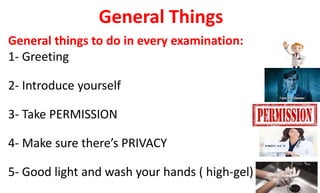
General things to do in every examination:
1- Greeting
2- Introduce yourself
3- Take PERMISSION
4- Make sure there’s PRIVACY
5- Good light and wash your hands ( high-gel)
General LOOK
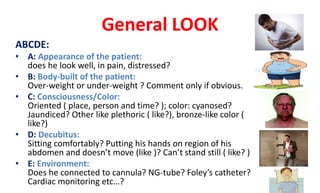
ABCDE:
• A: Appearance of the patient:
does he look well, in pain, distressed?
• B: Body-built of the patient:
Over-weight or under-weight ? Comment only if obvious.
• C: Consciousness/Color:
Oriented ( place, person and time? ); color: cyanosed?
Jaundiced? Other like plethoric ( like?), bronze-like color (
like?)
• D: Decubitus:
Sitting comfortably? Putting his hands on region of his
abdomen and doesn’t move (like )? Can’t stand still ( like? )
• E: Environment:
Does he connected to cannula? NG-tube? Foley’s catheter?
Cardiac monitoring etc…?
General LOOK
Simple example:
the patient looked well, conscious, oriented ( to
time, place and person), jaundiced, not in pain, not
distressed, not cyanosed, not pale or dehydrated.
She was sitting comfortably in her bed, connected
to cannula in her left arm.
Start from HANDS
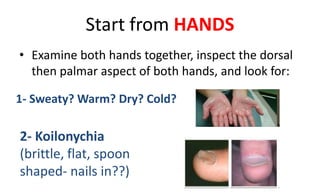
• Examine both hands together, inspect the dorsal
then palmar aspect of both hands, and look for:
2- Koilonychia
(brittle, flat, spoon
shaped- nails in??)
1- Sweaty? Warm? Dry? Cold?
Start from HANDS
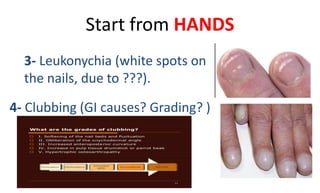
4- Clubbing (GI causes? Grading? )
3- Leukonychia (white spots on
the nails, due to ???).
Start from HANDS
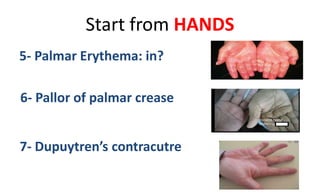
5- Palmar Erythema: in?
6- Pallor of palmar crease
7- Dupuytren’s contracutre
Start from HANDS
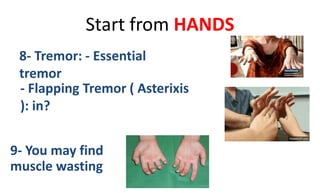
8- Tremor: - Essential
tremor
- Flapping Tremor ( Asterixis
): in?
9- You may find
muscle wasting
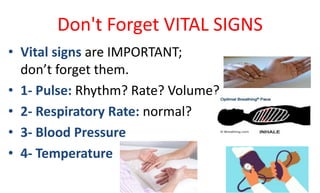
Don't Forget VITAL SIGNS
• Vital signs are IMPORTANT;
don’t forget them.
• 1- Pulse: Rhythm? Rate? Volume?
• 2- Respiratory Rate: normal?
• 3- Blood Pressure
• 4- Temperature
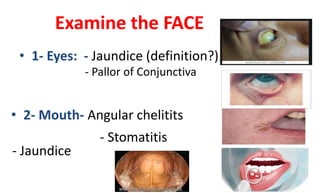
Examine the FACE
• 1- Eyes: - Jaundice (definition?)
- Pallor of Conjunctiva
• 2- Mouth- Angular chelitits
- Jaundice
- Stomatitis
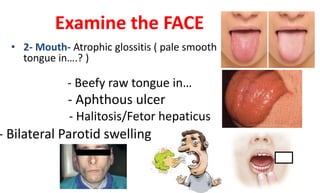
Examine the FACE
• 2- Mouth- Atrophic glossitis ( pale smooth
tongue in….? )
- Aphthous ulcer
- Beefy raw tongue in…
- Halitosis/Fetor hepaticus
- Bilateral Parotid swelling
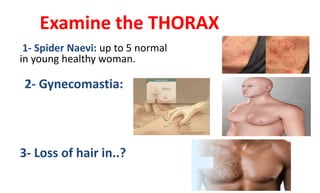
Examine the THORAX
1- Spider Naevi: up to 5 normal
in young healthy woman.
2- Gynecomastia:
3- Loss of hair in..?
Examine the ABDOMEN
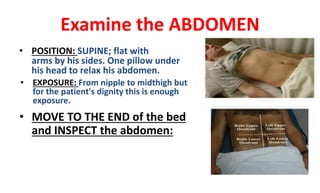
• POSITION: SUPINE; flat with
arms by his sides. One pillow under
his head to relax his abdomen.
• EXPOSURE: From nipple to midthigh but
for the patient's dignity this is enough
exposure.
• MOVE TO THE END of the bed
and INSPECT the abdomen:
INSPECTION
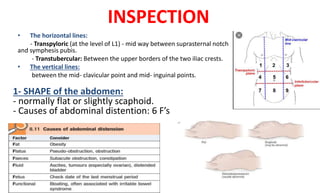
• The horizontal lines:
- Transpyloric (at the level of L1) - mid way between suprasternal notch
and symphesis pubis.
- Transtubercular: Between the upper borders of the two iliac crests.
• The vertical lines:
between the mid- clavicular point and mid- inguinal points.
1- SHAPE of the abdomen:
- normally flat or slightly scaphoid.
- Causes of abdominal distention: 6 F’s
INSPECTION
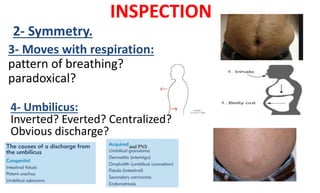
2- Symmetry.
3- Moves with respiration:
pattern of breathing?
paradoxical?
4- Umbilicus:
Inverted? Everted? Centralized?
Obvious discharge?
INSPECTION
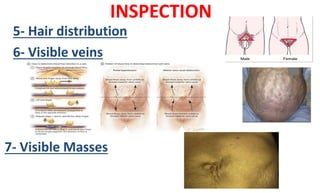
5- Hair distribution
6- Visible veins
7- Visible Masses
INSPECTION
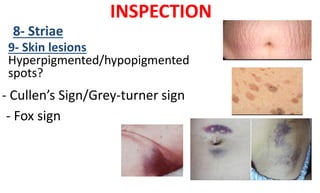
8- Striae
9- Skin lesions
Hyperpigmented/hypopigmented
spots?
- Cullen’s Sign/Grey-turner sign
- Fox sign
INSPECTION
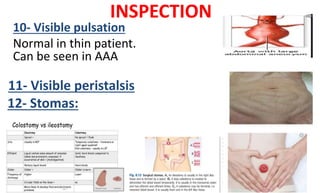
10- Visible pulsation
Normal in thin patient.
Can be seen in AAA
11- Visible peristalsis
12- Stomas:
INSPECTION
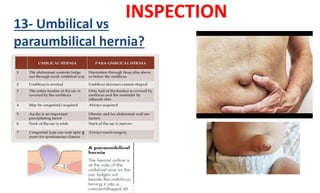
13- Umbilical vs
paraumbilical hernia?
INSPECTION
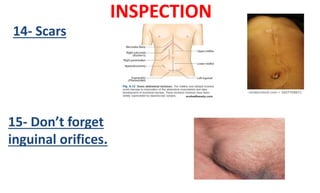
14- Scars
15- Don’t forget
inguinal orifices.
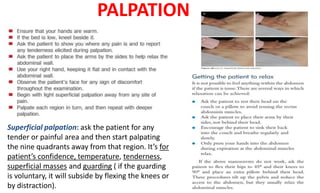
PALPATION
Superficial palpation: ask the patient for any
tender or painful area and then start palpating
the nine quadrants away from that region. It’s for
patient’s confidence, temperature, tenderness,
superficial masses and guarding ( if the guarding
is voluntary, it will subside by flexing the knees or
by distraction).
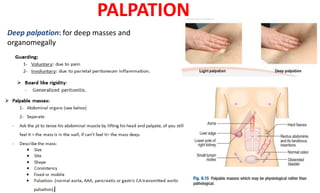
PALPATION
Deep palpation: for deep masses and
organomegally
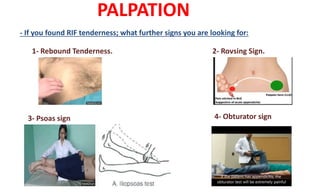
PALPATION
- If you found RIF tenderness; what further signs you are looking for:
1- Rebound Tenderness. 2- Rovsing Sign.
3- Psoas sign 4- Obturator sign
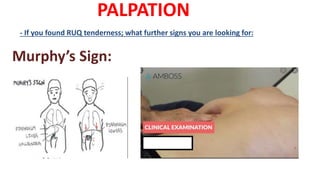
PALPATION
- If you found RUQ tenderness; what further signs you are looking for:
Murphy’s Sign:
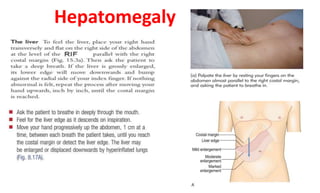
Hepatomegaly
Hepatomegaly
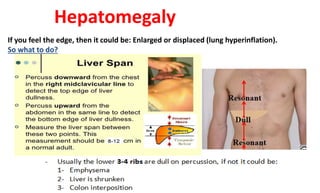
If you feel the edge, then it could be: Enlarged or displaced (lung hyperinflation).
So what to do?
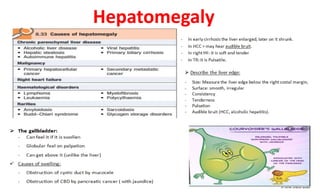
Hepatomegaly
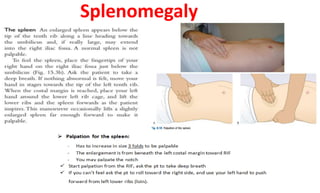
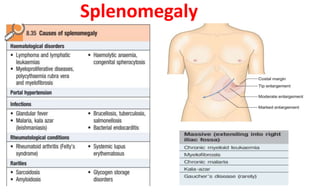
Splenomegaly
Splenomegaly
Splenomegaly
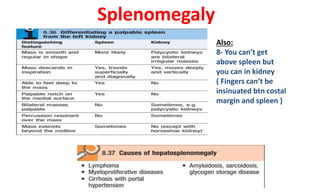
Also:
8- You can’t get
above spleen but
you can in kidney
( Fingers can’t be
insinuated btn costal
margin and spleen )
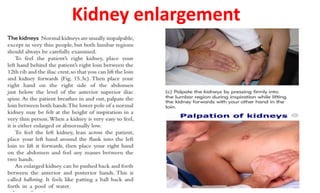
Kidney enlargement
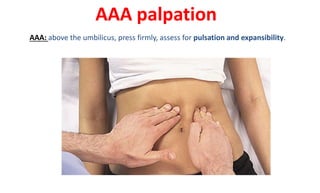
AAA palpation
AAA: above the umbilicus, press firmly, assess for pulsation and expansibility.
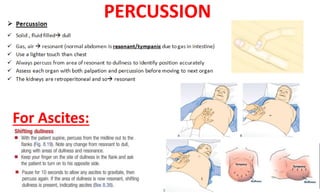
PERCUSSION
For Ascites:
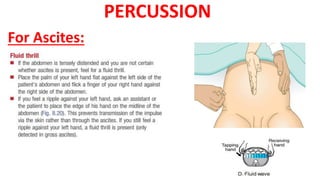
PERCUSSION
For Ascites:
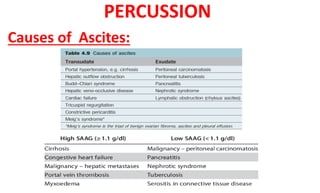
PERCUSSION
Causes of Ascites:
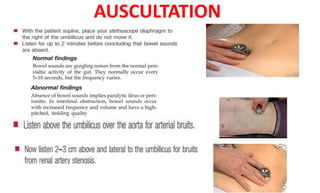
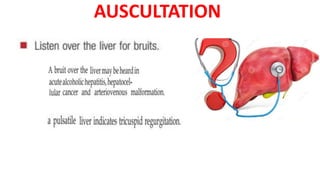
AUSCULTATION
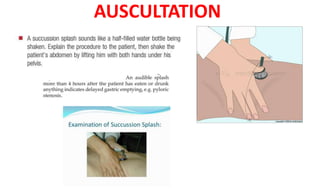
AUSCULTATION
AUSCULTATION
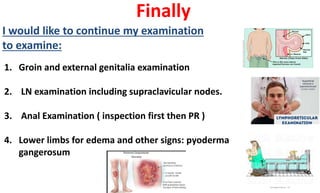
Finally
I would like to continue my examination
to examine:
1. Groin and external genitalia examination
2. LN examination including supraclavicular nodes.
3. Anal Examination ( inspection first then PR )
4. Lower limbs for edema and other signs: pyoderma
gangerosum
Abdominal examination

Abdominal examination

  • 1.
    Gastrointestinal Examination Dr. AnasAljundi Teaching Assistant – Alquds University 29/3/2020
  • 2.
    General Things General thingsto do in every examination: 1- Greeting 2- Introduce yourself 3- Take PERMISSION 4- Make sure there’s PRIVACY 5- Good light and wash your hands ( high-gel)
  • 3.
    General LOOK ABCDE: • A:Appearance of the patient: does he look well, in pain, distressed? • B: Body-built of the patient: Over-weight or under-weight ? Comment only if obvious. • C: Consciousness/Color: Oriented ( place, person and time? ); color: cyanosed? Jaundiced? Other like plethoric ( like?), bronze-like color ( like?) • D: Decubitus: Sitting comfortably? Putting his hands on region of his abdomen and doesn’t move (like )? Can’t stand still ( like? ) • E: Environment: Does he connected to cannula? NG-tube? Foley’s catheter? Cardiac monitoring etc…?
  • 4.
    General LOOK Simple example: thepatient looked well, conscious, oriented ( to time, place and person), jaundiced, not in pain, not distressed, not cyanosed, not pale or dehydrated. She was sitting comfortably in her bed, connected to cannula in her left arm.
  • 5.
    Start from HANDS •Examine both hands together, inspect the dorsal then palmar aspect of both hands, and look for: 2- Koilonychia (brittle, flat, spoon shaped- nails in??) 1- Sweaty? Warm? Dry? Cold?
  • 6.
    Start from HANDS 4-Clubbing (GI causes? Grading? ) 3- Leukonychia (white spots on the nails, due to ???).
  • 7.
    Start from HANDS 5-Palmar Erythema: in? 6- Pallor of palmar crease 7- Dupuytren’s contracutre
  • 8.
    Start from HANDS 8-Tremor: - Essential tremor - Flapping Tremor ( Asterixis ): in? 9- You may find muscle wasting
  • 9.
    Don't Forget VITALSIGNS • Vital signs are IMPORTANT; don’t forget them. • 1- Pulse: Rhythm? Rate? Volume? • 2- Respiratory Rate: normal? • 3- Blood Pressure • 4- Temperature
  • 10.
    Examine the FACE •1- Eyes: - Jaundice (definition?) - Pallor of Conjunctiva • 2- Mouth- Angular chelitits - Jaundice - Stomatitis
  • 11.
    Examine the FACE •2- Mouth- Atrophic glossitis ( pale smooth tongue in….? ) - Aphthous ulcer - Beefy raw tongue in… - Halitosis/Fetor hepaticus - Bilateral Parotid swelling
  • 12.
    Examine the THORAX 1-Spider Naevi: up to 5 normal in young healthy woman. 2- Gynecomastia: 3- Loss of hair in..?
  • 13.
    Examine the ABDOMEN •POSITION: SUPINE; flat with arms by his sides. One pillow under his head to relax his abdomen. • EXPOSURE: From nipple to midthigh but for the patient's dignity this is enough exposure. • MOVE TO THE END of the bed and INSPECT the abdomen:
  • 14.
    INSPECTION • The horizontallines: - Transpyloric (at the level of L1) - mid way between suprasternal notch and symphesis pubis. - Transtubercular: Between the upper borders of the two iliac crests. • The vertical lines: between the mid- clavicular point and mid- inguinal points. 1- SHAPE of the abdomen: - normally flat or slightly scaphoid. - Causes of abdominal distention: 6 F’s
  • 15.
    INSPECTION 2- Symmetry. 3- Moveswith respiration: pattern of breathing? paradoxical? 4- Umbilicus: Inverted? Everted? Centralized? Obvious discharge?
  • 16.
    INSPECTION 5- Hair distribution 6-Visible veins 7- Visible Masses
  • 17.
    INSPECTION 8- Striae 9- Skinlesions Hyperpigmented/hypopigmented spots? - Cullen’s Sign/Grey-turner sign - Fox sign
  • 18.
    INSPECTION 10- Visible pulsation Normalin thin patient. Can be seen in AAA 11- Visible peristalsis 12- Stomas:
  • 19.
  • 20.
    INSPECTION 14- Scars 15- Don’tforget inguinal orifices.
  • 21.
    PALPATION Superficial palpation: askthe patient for any tender or painful area and then start palpating the nine quadrants away from that region. It’s for patient’s confidence, temperature, tenderness, superficial masses and guarding ( if the guarding is voluntary, it will subside by flexing the knees or by distraction).
  • 22.
    PALPATION Deep palpation: fordeep masses and organomegally
  • 23.
    PALPATION - If youfound RIF tenderness; what further signs you are looking for: 1- Rebound Tenderness. 2- Rovsing Sign. 3- Psoas sign 4- Obturator sign
  • 24.
    PALPATION - If youfound RUQ tenderness; what further signs you are looking for: Murphy’s Sign:
  • 25.
  • 26.
    Hepatomegaly If you feelthe edge, then it could be: Enlarged or displaced (lung hyperinflation). So what to do?
  • 27.
  • 28.
  • 29.
  • 30.
    Splenomegaly Also: 8- You can’tget above spleen but you can in kidney ( Fingers can’t be insinuated btn costal margin and spleen )
  • 31.
  • 32.
    AAA palpation AAA: abovethe umbilicus, press firmly, assess for pulsation and expansibility.
  • 33.
  • 34.
  • 35.
  • 36.
  • 37.
  • 38.
  • 39.
    Finally I would liketo continue my examination to examine: 1. Groin and external genitalia examination 2. LN examination including supraclavicular nodes. 3. Anal Examination ( inspection first then PR ) 4. Lower limbs for edema and other signs: pyoderma gangerosum