ABDOMINAL EXAMINATION 3 rd  June Dr. YL Cheong
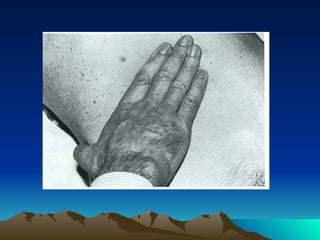
General Condition Consciousness, confuse Gait  ill-looking Built Hydration Color, pallor, cyanosis, jaundice, carotinaemia Stigmata of liver disease Fetor
 
ABDOMINAL EXAMINATION Inspection Palpation Percussion Auscultation Per rectal examination Hernia and scrotum
 
 
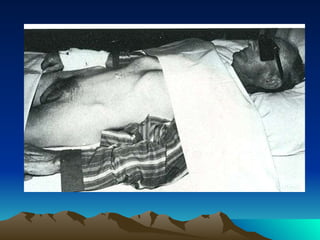
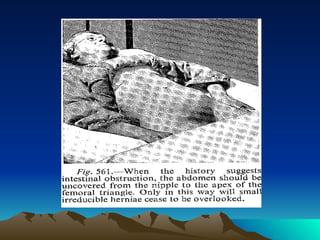
ABDOMINAL EXAMINATION Patient lying down supine Bed Pillow supporting head Hands by side of body Examiner sitting down on the right of patient Patient adequately expose
 
“  \
INSPECTION Normal abdomen: Scaphoid Moves with respiration
ABNORMAL ABDOMEN Distended Everted umbilicus Dilated veins Ecchymosis Striae Pigmentation  Surgical scars Peristalsis
DISTENDED ABDOMEN Feces Fat Fluid Flatus Fetus
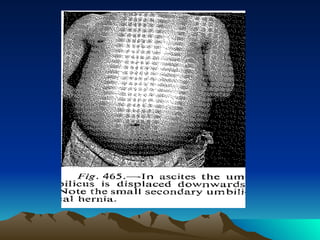
EVERTED UMBILICUS Ascites Umbilical hernia Paraumbilical hernia


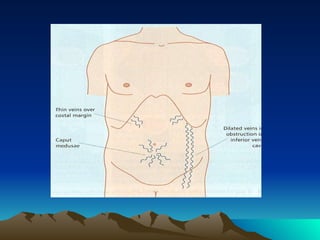
DILATED VEINS Caput medusae secondary to portal hypertension Dilated upward flowing veins secondary to IVC obstruction


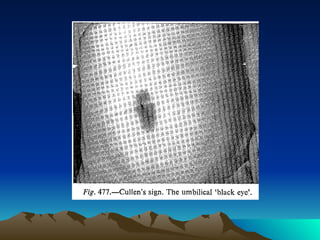
ECCHYMOSIS Cullen sign Grey Turner sign
 
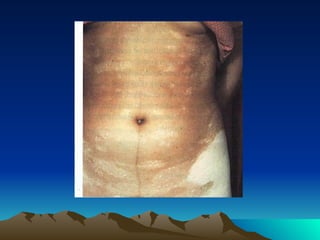
STRIAE Whitish—stretch marks or striae gravidarum Purplish—Cushing disease or syndrome
 
PIGMENTATION Linea nigra in pregnancy Addison disease Café au lait—Von Recklinhausen (neurofibromatosis ) Vitiligo—loss of pigmentation
 
SURGICAL SCARS Names and sites of incision Reddish– recent Whitish—old Stretch—likely incisional hernia
 
PERISTALSIS Thin patients: visible Intestinal obstruction


PELVIC ORGANS Urinary bladder Gravid uterus Ovarian tumuor
 
 
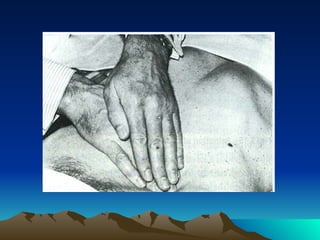
PALPATION Right side of patient Sitting down Hands and forearm at level of patient’s abdomen Looking at patient’s face all the time Two rounds of palpation—superficial and deep Systematically—clockwise or anticlockwise Usually the non tender side first


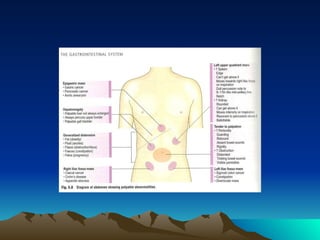
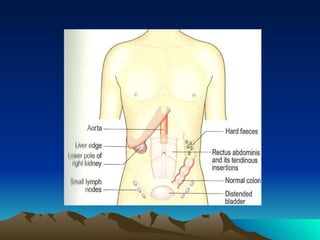
LIVER Right  subcostal region Normally not palpable Enlargement measure in cm. or finger breadths below right costal margin Descend with inspiration Not able to get above it Non ballotable Liver span ( percussion )


SPLEEN Left subcostal region Normally not palpable Enlarges three times before palpable Descend downwards and medially with inspiration Cannot get above it Splenic notch Non ballotable Traube’s space dull on percussion (10 th , 11 th  and 12 th  intercostal space midaxillary line)


Kidneys  Normally non palpable Sometimes in thin patients – right lower pole can be felt Descends downwards with respiration Ballotable  Cannot get above it Resonant to percussion
 
 
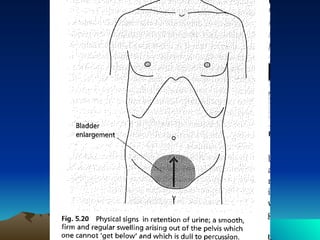
PELVIC ORGANS Urinary bladder, uterus, ovarian tumour Unable to ‘ get below it ‘ Globular in shape Dull on percussion in the centre Internally ballotable
 
 
ABDOMINAL AORTA Palpable in thin patients Deep palpation slightly above and left of umbilicus Use fingertips Aneurysm of aorta—expansile pulsation cf. to transmitted pulsation


FEMORAL ARTERY Mid inguinal point—between ASIS and symphysis pubis Midpoint of inguinal ligament—between ASIS and pubic tubercle, 2cm. above is the internal ring ( indirect inguinal hernia )
 
TENDERNESS Sign of inflammation ( rubor, calor, dolor, tumor and loss of function ) Local– epigastrium, pelvic, RIF Generalised –peritonitis
 
TENDERNESS Rebound tenderness Contralateral tenderness ( Rovsing sign ) Murphy sign—arrest of inspiration with a gasp when patient takes a deep breath as the gallbladder is palpated ( acute cholecystitis ) Guarding– local or generalised Board-like rigidity
COURVOISIER’S LAW In the presence of jaundice, a palpable gallbladder is unlikely to be due to gallstone More likely to be due to carcinoma eg, carcinoma of head of pancreas
PERCUSSION The middle finger ( pleximeter finger ) of the left hand is placed on the part of the body to be percussed and the back of its middle phalange is then struck with the tip of the middle finger of the right hand
PERCUSSION Dullness Shifting dullness Resonance
 
 
DULLNESS Liver span Traube’s space—enlarged spleen; dullness in 10 th , 11 th  and 12 th  intercostal space at mid axillary line Margin of enlarged organs—sometimes easier to define by percussion than palpation eg. Urinary bladder, ovarian tumour Ascites– small amount use shifting dullness. Large amount use fluid thrill
RESONANCE Presence of air Hyper-resonance – intestinal obstruction and paralytic ileus Loss of liver dullness—perforated peptic ulcer
GROSS ASCITES Dull in flanks Umbilicus transverse and or hernia present Shifting dullness positive Fluid thrill presence


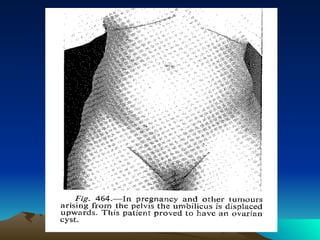
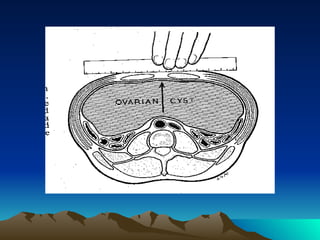
LARGE OVARIAN CYST Resonance in flanks Umbilicus vertical and drawn up Large swelling felt arising out of pelvis and one cannot ‘get below it’
URINARY BLADDER Dullness suprapubically Resonance superiorly and in the flanks
INTESTINAL OBSTRUCTION Resonance throughout Colicky pain ( no pain in paralytic ileus ) Vomiting Constipation Absence of flatus
 
AUSCULTATION Bowel sounds Sucussion splash Vascular bruit
BOWEL SOUNDS Right of umbilicus for a minute Not move from place to place Normal sounds– sometimes can be heard without stethoscope esp. when hungry Acute small bowel obstruction—loud, excessive and exaggerated ( very angry) same time when the patient is feeling bouts of colicky pain
BOWEL SOUNDS Silent –no bowel sound heard after a minute of auscultation Generalized peritonitis Paralytic ileus
SUCUSSION SPLASH Patient supine Stethoscope in epigastrium Roll the patient side to side Hear splashing sound if stomach or small intestines is filled with fluid
SUCUSSION SPLASH Pyloric stenosis– chronic peptic ulcer disease, ca pylorus Mechanical bowel obstruction Paralytic ileus
VASCULAR BRUIT Bruit over a blood vessel is a signicant finding indicating turbulent flow Umbilicus– above and left ( abdominal aortic aneurysm or stenosis ) Iliac fossa—iliac artery Groin—femoral Epigastrium –coeliac or superior mesenteric artery Mid abdomen either side of midline—renal artery stenosis Liver—hepatoma Thyrotoxicosis--neck
HERNIAS Inguinal hernia—direct and indirect Femoral incisional
HERNIA Protusion of a viscus through a weakness in the wall Produce by standing, straining or coughing Reduce by lying down
 
 
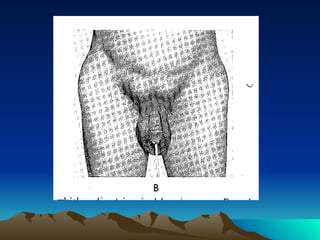
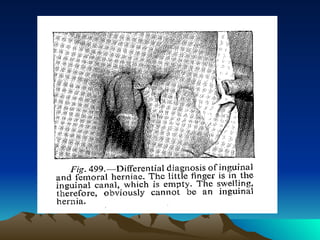
INGUINAL HERNIA Neck of sac—above and medial of pubic tubercle Above inguinal ligament Indirect enters scrotum Direct does not Occlusion of internal ring– indirect hernia not emerge; direct will come out


FEMORAL HERNIA Neck of sac—below and lateral to pubic tubercle Below inguinal ligament
 
INCISIONAL HERNIA Previous abdominal incisions
 
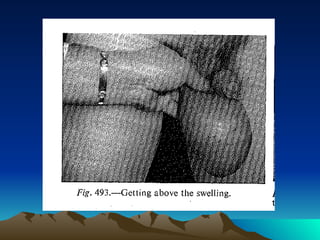
SCROTAL MASS ‘ can get above’ the scrotal mass If unable– it is an inguinal hernia
 
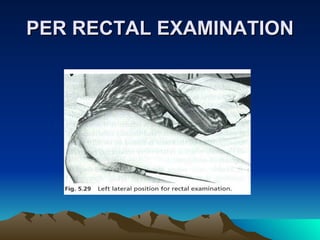
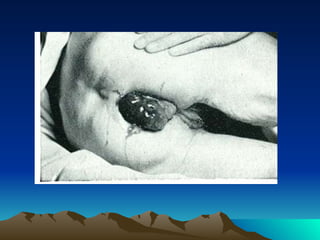
PER RECTAL EXAMINATION


ABDOMINAL MASS Intra or extra abdomen ( inside or outside the abdominal cavity? Lift the head up to tense the abdominal muscle If intra– mass is less obvious If extra or in the wall—mass is the same
ABDOMINAL MASS Site—organs below  Size and shape Surface ,edge and consistency—hard and nodular implies neoplasm Regular, round, smooth and tense– likely to be a cyst Solid, ill defined an tender – inflammatory mass
MASS Mobility— Moves with inspiration—liver, spleen, kidneys, gallbladderand distal stomach and cannot ‘get above it’ Not move—rest of intestine and omentum but mobile on palpation Completely fixed—retroperitoneal organs eg.pancreas; advanced neoplasm fixed to abdominal walls or inflammatory mass Fibroid or gravid uterus moves side to side Bladder or ovary fixed
ABDOMINAL MASS Ballotable or bimanually palpable kidneys
ABDOMINAL MASS Pulsatile  Transmitted or expansile
 
 
HOW TO BE SKILLFUL IN ABDOMINAL EXAMINATION? 3 WAYS: Practice More practice Practice, practice, practice and more practice
THE END

Abdominal examination

  • 1.
    ABDOMINAL EXAMINATION 3rd June Dr. YL Cheong
  • 2.
    General Condition Consciousness,confuse Gait ill-looking Built Hydration Color, pallor, cyanosis, jaundice, carotinaemia Stigmata of liver disease Fetor
  • 3.
  • 4.
    ABDOMINAL EXAMINATION InspectionPalpation Percussion Auscultation Per rectal examination Hernia and scrotum
  • 5.
  • 6.
  • 7.
    ABDOMINAL EXAMINATION Patientlying down supine Bed Pillow supporting head Hands by side of body Examiner sitting down on the right of patient Patient adequately expose
  • 8.
  • 9.
  • 10.
    INSPECTION Normal abdomen:Scaphoid Moves with respiration
  • 11.
    ABNORMAL ABDOMEN DistendedEverted umbilicus Dilated veins Ecchymosis Striae Pigmentation Surgical scars Peristalsis
  • 12.
    DISTENDED ABDOMEN FecesFat Fluid Flatus Fetus
  • 13.
    EVERTED UMBILICUS AscitesUmbilical hernia Paraumbilical hernia
  • 14.
  • 15.
  • 16.
  • 17.
    DILATED VEINS Caputmedusae secondary to portal hypertension Dilated upward flowing veins secondary to IVC obstruction
  • 18.
  • 19.
  • 20.
  • 21.
    ECCHYMOSIS Cullen signGrey Turner sign
  • 22.
  • 23.
    STRIAE Whitish—stretch marksor striae gravidarum Purplish—Cushing disease or syndrome
  • 24.
  • 25.
    PIGMENTATION Linea nigrain pregnancy Addison disease Café au lait—Von Recklinhausen (neurofibromatosis ) Vitiligo—loss of pigmentation
  • 26.
  • 27.
    SURGICAL SCARS Namesand sites of incision Reddish– recent Whitish—old Stretch—likely incisional hernia
  • 28.
  • 29.
    PERISTALSIS Thin patients:visible Intestinal obstruction
  • 30.
  • 31.
  • 32.
  • 33.
    PELVIC ORGANS Urinarybladder Gravid uterus Ovarian tumuor
  • 34.
  • 35.
  • 36.
    PALPATION Right sideof patient Sitting down Hands and forearm at level of patient’s abdomen Looking at patient’s face all the time Two rounds of palpation—superficial and deep Systematically—clockwise or anticlockwise Usually the non tender side first
  • 37.
  • 38.
  • 39.
  • 40.
  • 41.
  • 42.
    LIVER Right subcostal region Normally not palpable Enlargement measure in cm. or finger breadths below right costal margin Descend with inspiration Not able to get above it Non ballotable Liver span ( percussion )
  • 43.
  • 44.
  • 45.
  • 46.
    SPLEEN Left subcostalregion Normally not palpable Enlarges three times before palpable Descend downwards and medially with inspiration Cannot get above it Splenic notch Non ballotable Traube’s space dull on percussion (10 th , 11 th and 12 th intercostal space midaxillary line)
  • 47.
  • 48.
  • 49.
  • 50.
  • 51.
    Kidneys Normallynon palpable Sometimes in thin patients – right lower pole can be felt Descends downwards with respiration Ballotable Cannot get above it Resonant to percussion
  • 52.
  • 53.
  • 54.
    PELVIC ORGANS Urinarybladder, uterus, ovarian tumour Unable to ‘ get below it ‘ Globular in shape Dull on percussion in the centre Internally ballotable
  • 55.
  • 56.
  • 57.
    ABDOMINAL AORTA Palpablein thin patients Deep palpation slightly above and left of umbilicus Use fingertips Aneurysm of aorta—expansile pulsation cf. to transmitted pulsation
  • 58.
  • 59.
  • 60.
  • 61.
    FEMORAL ARTERY Midinguinal point—between ASIS and symphysis pubis Midpoint of inguinal ligament—between ASIS and pubic tubercle, 2cm. above is the internal ring ( indirect inguinal hernia )
  • 62.
  • 63.
    TENDERNESS Sign ofinflammation ( rubor, calor, dolor, tumor and loss of function ) Local– epigastrium, pelvic, RIF Generalised –peritonitis
  • 64.
  • 65.
    TENDERNESS Rebound tendernessContralateral tenderness ( Rovsing sign ) Murphy sign—arrest of inspiration with a gasp when patient takes a deep breath as the gallbladder is palpated ( acute cholecystitis ) Guarding– local or generalised Board-like rigidity
  • 66.
    COURVOISIER’S LAW Inthe presence of jaundice, a palpable gallbladder is unlikely to be due to gallstone More likely to be due to carcinoma eg, carcinoma of head of pancreas
  • 67.
    PERCUSSION The middlefinger ( pleximeter finger ) of the left hand is placed on the part of the body to be percussed and the back of its middle phalange is then struck with the tip of the middle finger of the right hand
  • 68.
    PERCUSSION Dullness Shiftingdullness Resonance
  • 69.
  • 70.
  • 71.
    DULLNESS Liver spanTraube’s space—enlarged spleen; dullness in 10 th , 11 th and 12 th intercostal space at mid axillary line Margin of enlarged organs—sometimes easier to define by percussion than palpation eg. Urinary bladder, ovarian tumour Ascites– small amount use shifting dullness. Large amount use fluid thrill
  • 72.
    RESONANCE Presence ofair Hyper-resonance – intestinal obstruction and paralytic ileus Loss of liver dullness—perforated peptic ulcer
  • 73.
    GROSS ASCITES Dullin flanks Umbilicus transverse and or hernia present Shifting dullness positive Fluid thrill presence
  • 74.
  • 75.
  • 76.
  • 77.
    LARGE OVARIAN CYSTResonance in flanks Umbilicus vertical and drawn up Large swelling felt arising out of pelvis and one cannot ‘get below it’
  • 78.
    URINARY BLADDER Dullnesssuprapubically Resonance superiorly and in the flanks
  • 79.
    INTESTINAL OBSTRUCTION Resonancethroughout Colicky pain ( no pain in paralytic ileus ) Vomiting Constipation Absence of flatus
  • 80.
  • 81.
    AUSCULTATION Bowel soundsSucussion splash Vascular bruit
  • 82.
    BOWEL SOUNDS Rightof umbilicus for a minute Not move from place to place Normal sounds– sometimes can be heard without stethoscope esp. when hungry Acute small bowel obstruction—loud, excessive and exaggerated ( very angry) same time when the patient is feeling bouts of colicky pain
  • 83.
    BOWEL SOUNDS Silent–no bowel sound heard after a minute of auscultation Generalized peritonitis Paralytic ileus
  • 84.
    SUCUSSION SPLASH Patientsupine Stethoscope in epigastrium Roll the patient side to side Hear splashing sound if stomach or small intestines is filled with fluid
  • 85.
    SUCUSSION SPLASH Pyloricstenosis– chronic peptic ulcer disease, ca pylorus Mechanical bowel obstruction Paralytic ileus
  • 86.
    VASCULAR BRUIT Bruitover a blood vessel is a signicant finding indicating turbulent flow Umbilicus– above and left ( abdominal aortic aneurysm or stenosis ) Iliac fossa—iliac artery Groin—femoral Epigastrium –coeliac or superior mesenteric artery Mid abdomen either side of midline—renal artery stenosis Liver—hepatoma Thyrotoxicosis--neck
  • 87.
    HERNIAS Inguinal hernia—directand indirect Femoral incisional
  • 88.
    HERNIA Protusion ofa viscus through a weakness in the wall Produce by standing, straining or coughing Reduce by lying down
  • 89.
  • 90.
  • 91.
    INGUINAL HERNIA Neckof sac—above and medial of pubic tubercle Above inguinal ligament Indirect enters scrotum Direct does not Occlusion of internal ring– indirect hernia not emerge; direct will come out
  • 92.
  • 93.
  • 94.
  • 95.
  • 96.
  • 97.
    FEMORAL HERNIA Neckof sac—below and lateral to pubic tubercle Below inguinal ligament
  • 98.
  • 99.
    INCISIONAL HERNIA Previousabdominal incisions
  • 100.
  • 101.
    SCROTAL MASS ‘can get above’ the scrotal mass If unable– it is an inguinal hernia
  • 102.
  • 103.
  • 104.
  • 105.
  • 106.
  • 107.
    ABDOMINAL MASS Intraor extra abdomen ( inside or outside the abdominal cavity? Lift the head up to tense the abdominal muscle If intra– mass is less obvious If extra or in the wall—mass is the same
  • 108.
    ABDOMINAL MASS Site—organsbelow Size and shape Surface ,edge and consistency—hard and nodular implies neoplasm Regular, round, smooth and tense– likely to be a cyst Solid, ill defined an tender – inflammatory mass
  • 109.
    MASS Mobility— Moveswith inspiration—liver, spleen, kidneys, gallbladderand distal stomach and cannot ‘get above it’ Not move—rest of intestine and omentum but mobile on palpation Completely fixed—retroperitoneal organs eg.pancreas; advanced neoplasm fixed to abdominal walls or inflammatory mass Fibroid or gravid uterus moves side to side Bladder or ovary fixed
  • 110.
    ABDOMINAL MASS Ballotableor bimanually palpable kidneys
  • 111.
    ABDOMINAL MASS Pulsatile Transmitted or expansile
  • 112.
  • 113.
  • 114.
    HOW TO BESKILLFUL IN ABDOMINAL EXAMINATION? 3 WAYS: Practice More practice Practice, practice, practice and more practice
  • 115.