PONTICS IN
FPD
BY
KARISHMA ASHOK
ROLL NO: 33
IV/I
INTRODUCTION
• Pontics are the artificial teeth of a fixed partial
denture that replaces missing natural teeth,restoring
function and appearance.
• Proper preparation includes a careful analysis of
critical dimension of edentulous area; mesiodistal
width; occlusocervical disatnce; buccolingual
siameter and location of residual ridge.
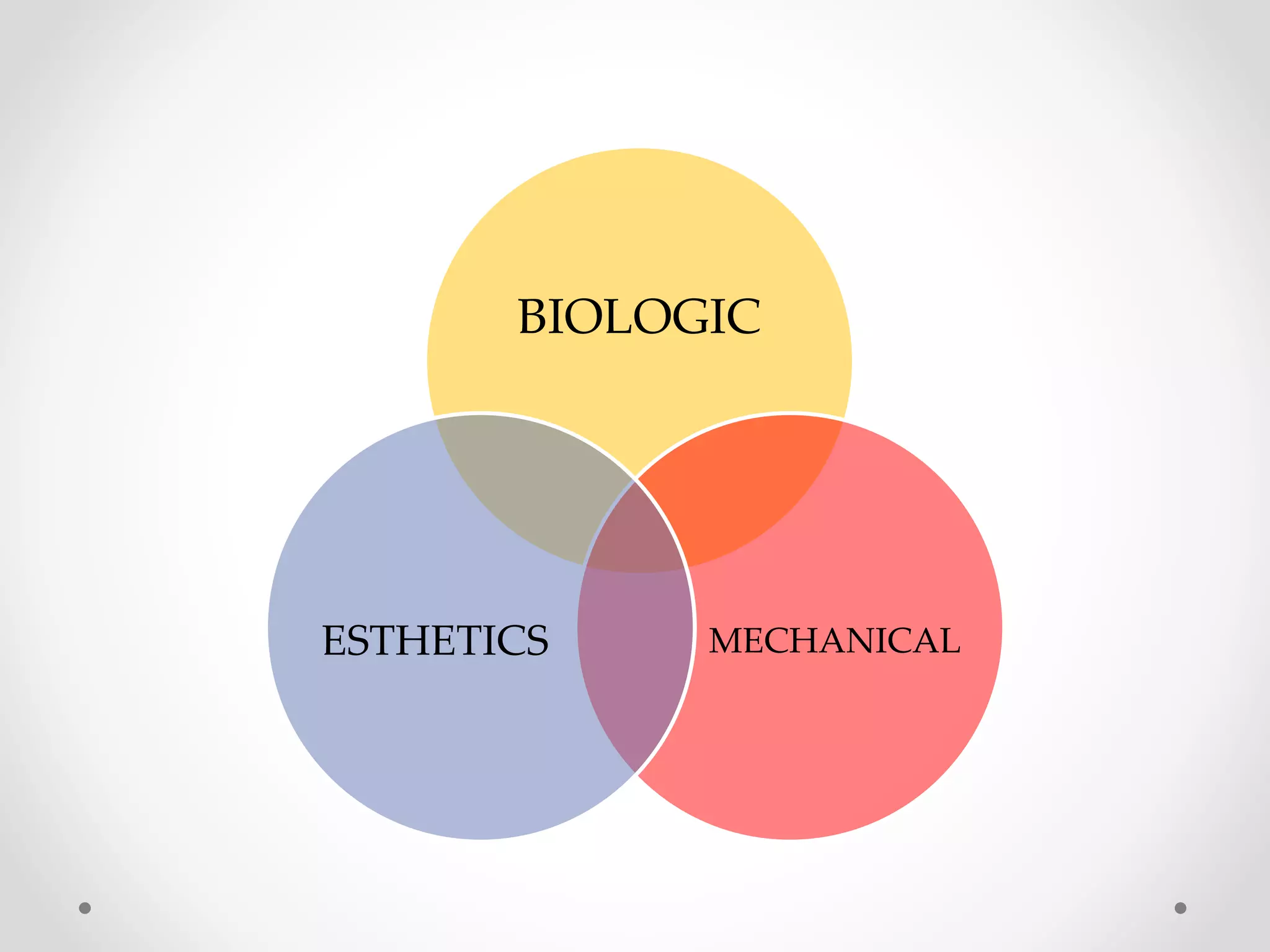
BIOLOGIC
MECHANICALESTHETICS
PRE-TREATMENT
ASSESMENT
PONTIC SPACE:
One function of the fpd is to prevent tilting or drifting
of the adjacent teeth into the edentulous space.
If such movement has already occurred, the space
available for the pontic may be reduced and its
fabrication complicated.
Overly small pontics are undesirable because they
trap food and are difficult to clean.
Orthodontic repositioning, modification of abutments
with complete coverage retainers can be made.
RESIDUAL RIDGE CONTOUR
An ideally shaped ridge has smooth, regular surface
of attached gingiva, which facilitates maintainance
of a plaque-free environment.
Should have sufficient height to allow placement of
pontic such that it apperas to emerge out from the
ridge (mimics appearance of neighbouring teeth).
 Loss of residual ridge contour may lead to
unesthetic open gingival embrasures (black
traingles). This leads to food lodgement and saliva
percolation.
Siebert has classified residual ridge deformities into:
Class I: facio-lingual loss of tissue width with normal
ridge height.
Class II: loss of ridge height with normal ridge width.
Class III: a combination of loss in both dimension.
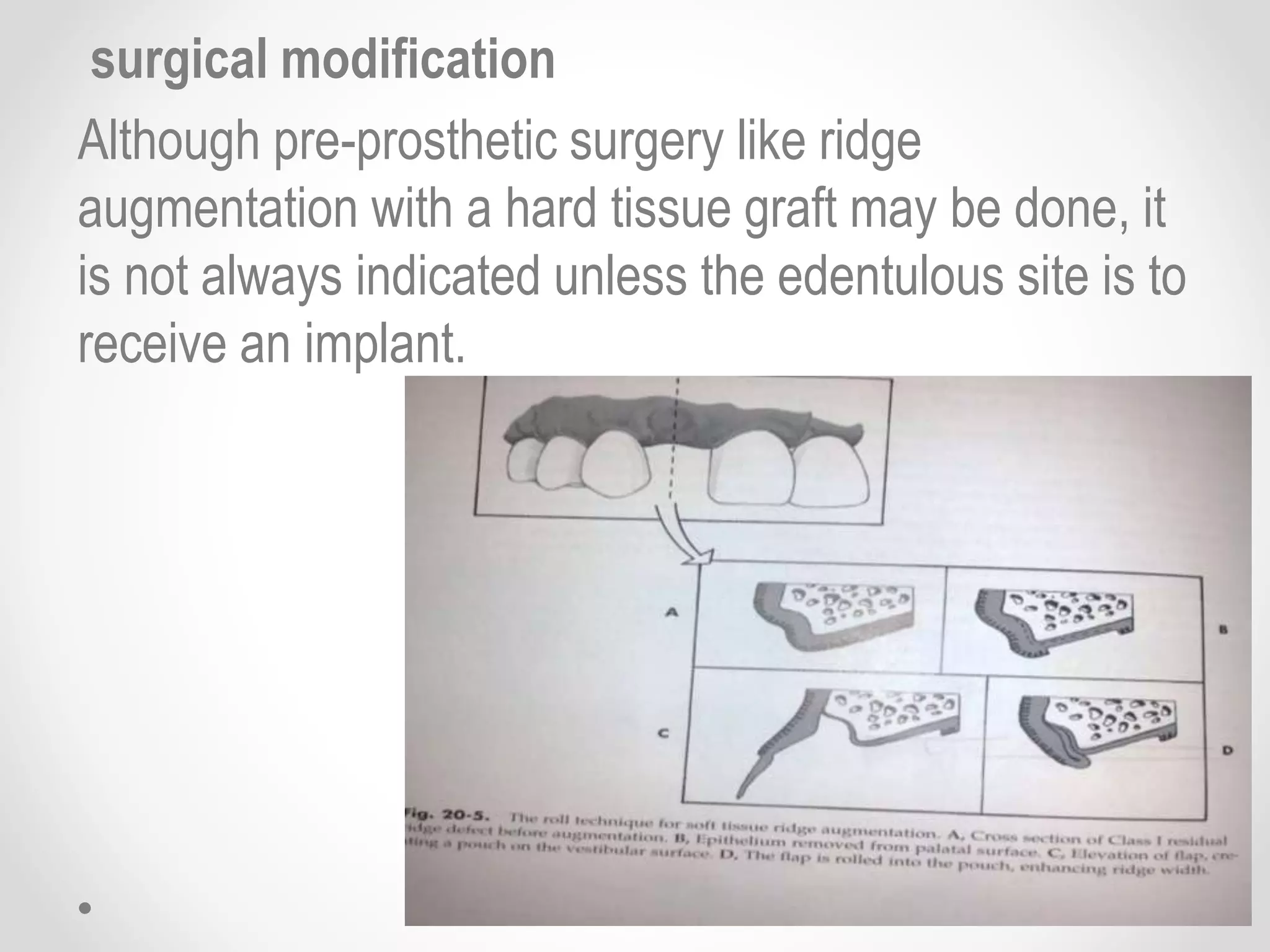
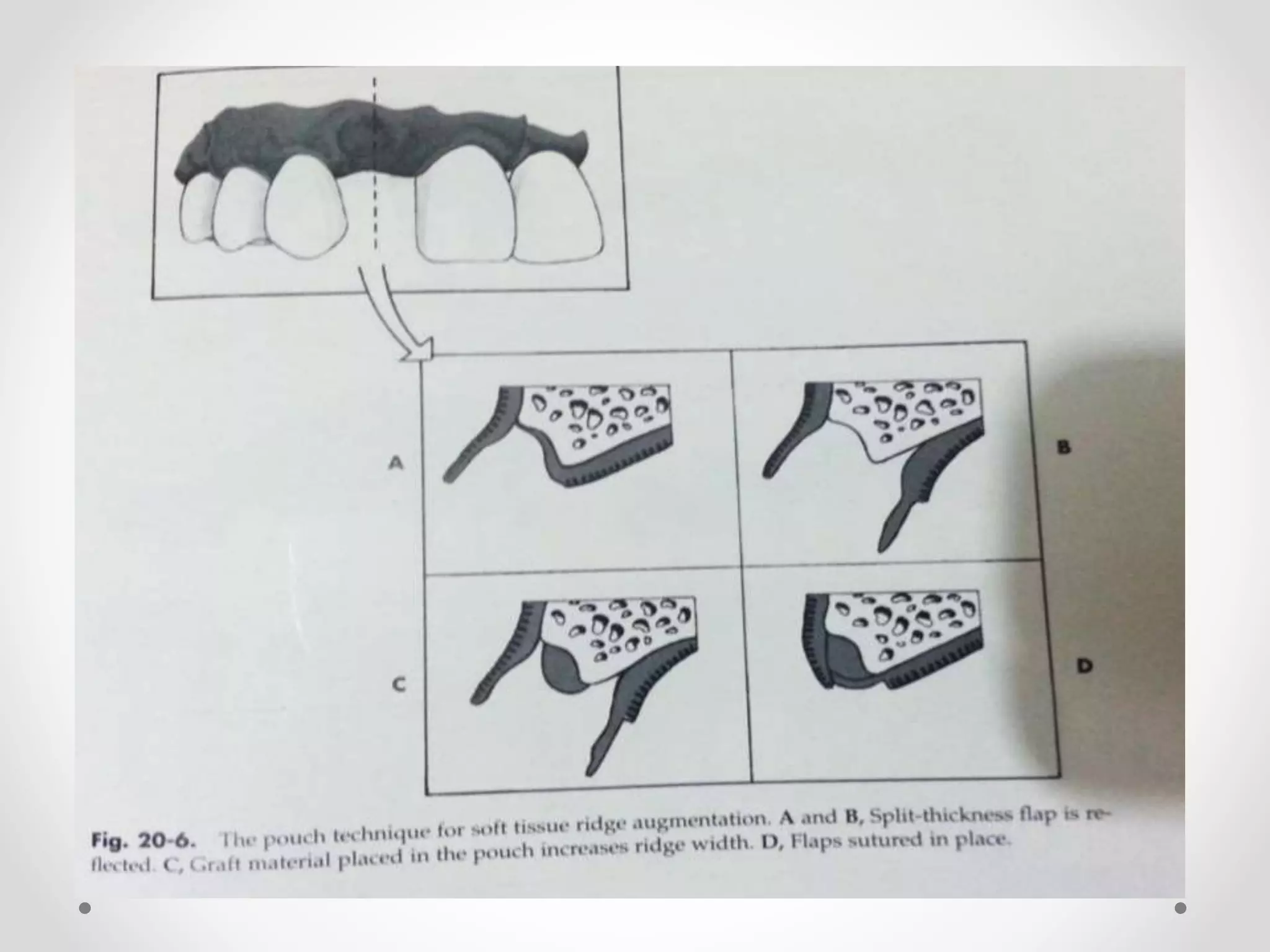
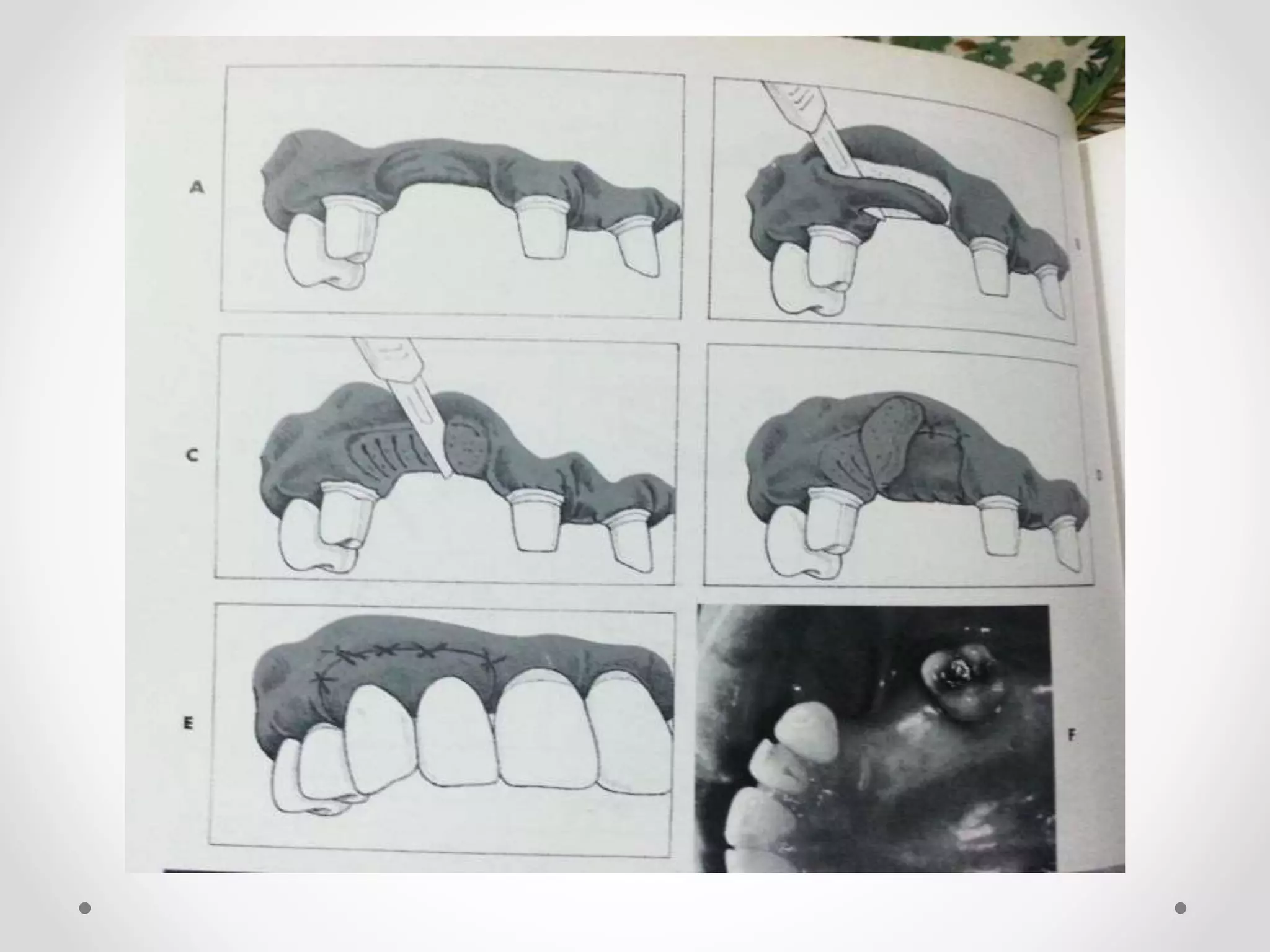
surgical modification
Although pre-prosthetic surgery like ridge
augmentation with a hard tissue graft may be done, it
is not always indicated unless the edentulous site is to
receive an implant.
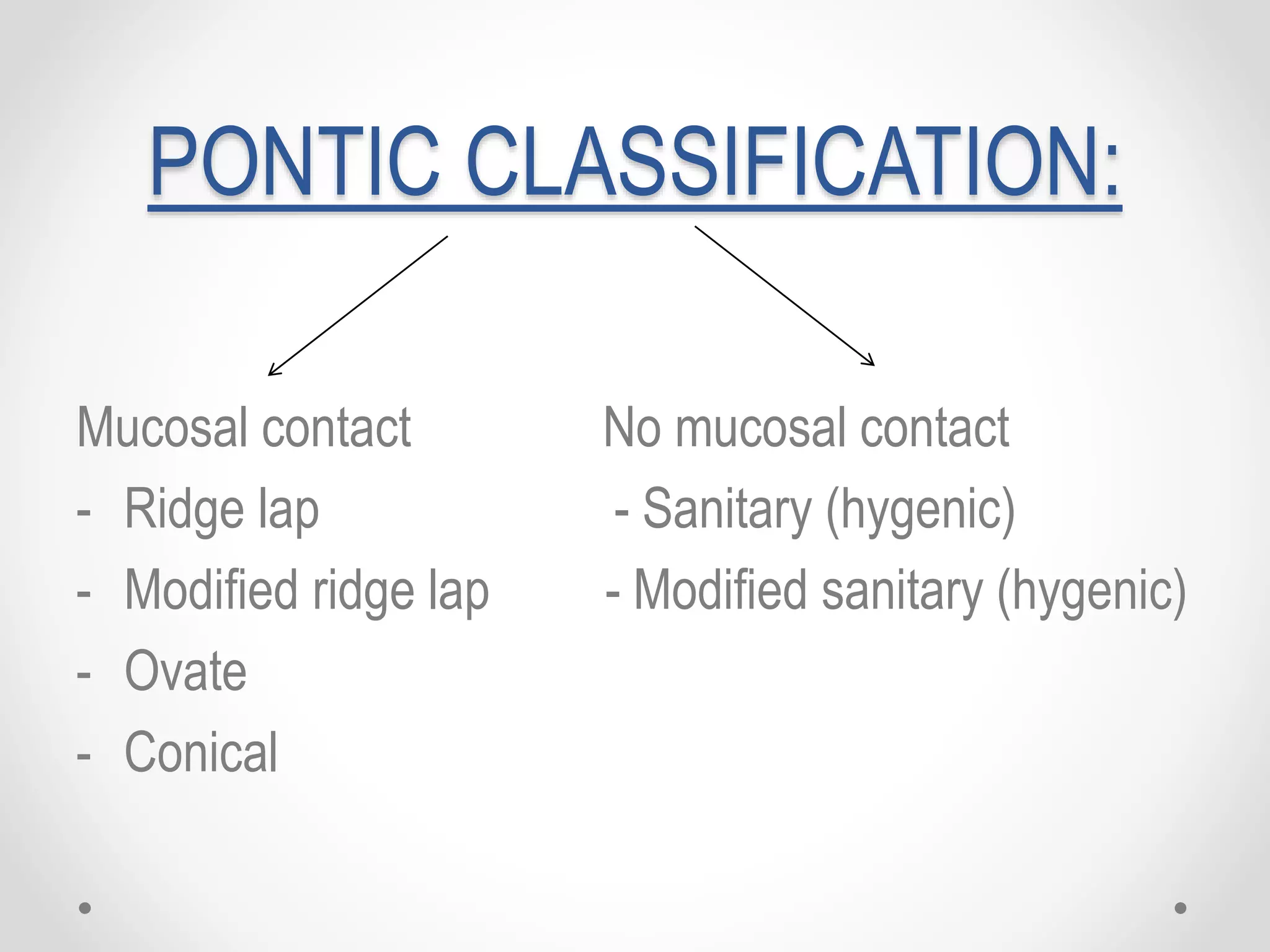
PONTIC CLASSIFICATION:
Mucosal contact No mucosal contact
- Ridge lap - Sanitary (hygenic)
- Modified ridge lap - Modified sanitary (hygenic)
- Ovate
- Conical
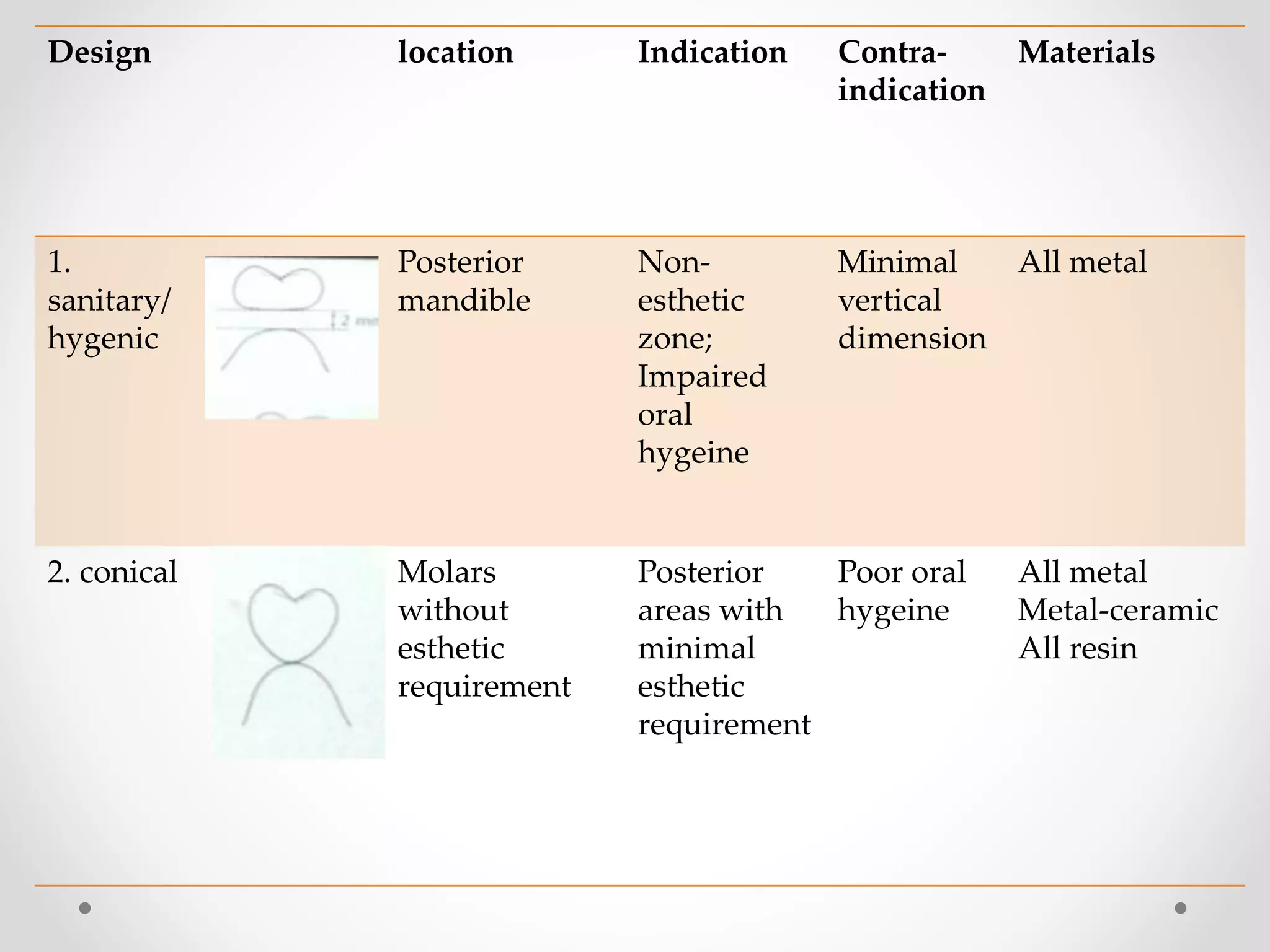
Design location Indication Contra-
indication
Materials
1.
sanitary/
hygenic
Posterior
mandible
Non-
esthetic
zone;
Impaired
oral
hygeine
Minimal
vertical
dimension
All metal
2. conical Molars
without
esthetic
requirement
Posterior
areas with
minimal
esthetic
requirement
Poor oral
hygeine
All metal
Metal-ceramic
All resin
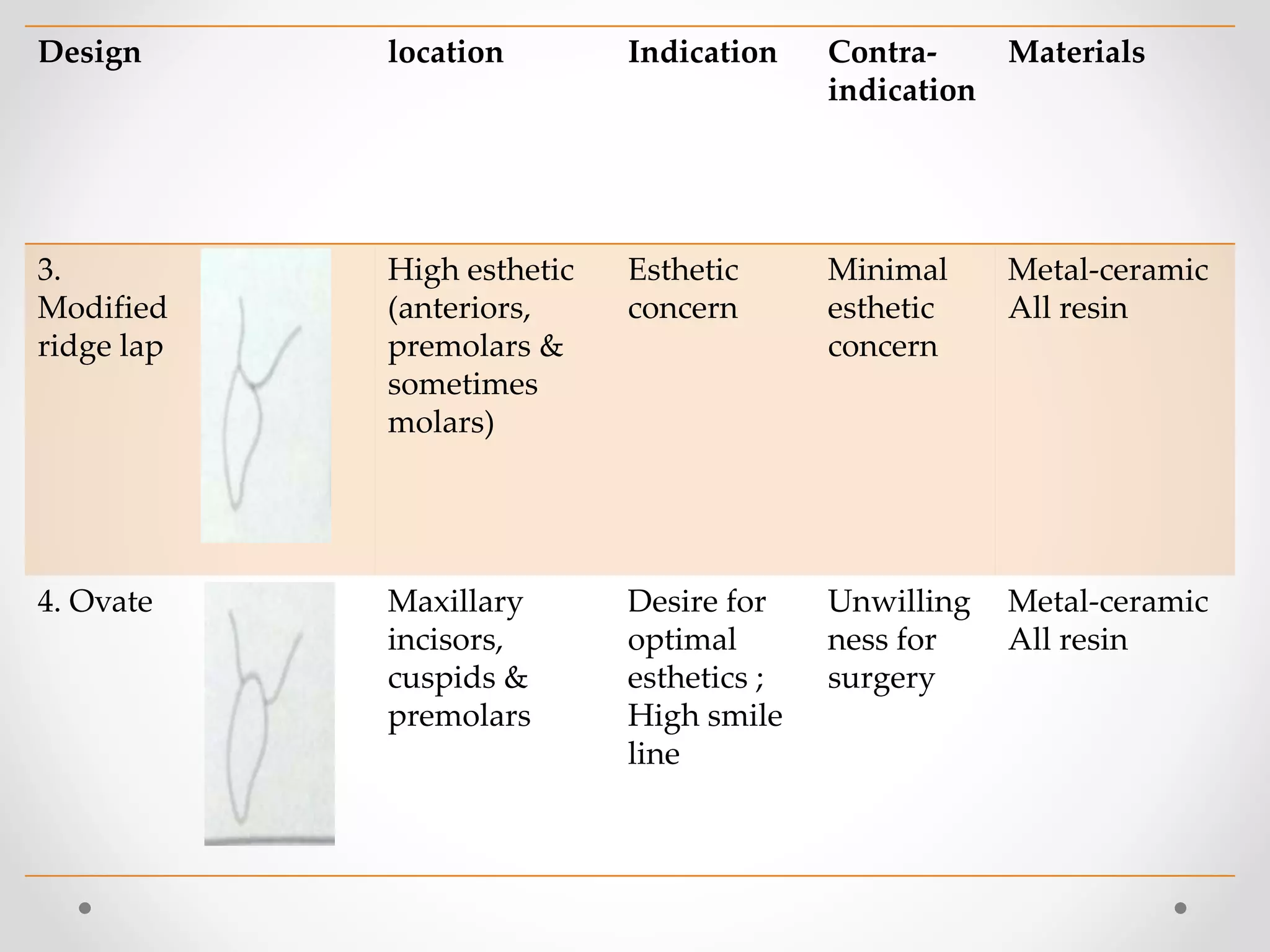
Design location Indication Contra-
indication
Materials
3.
Modified
ridge lap
High esthetic
(anteriors,
premolars &
sometimes
molars)
Esthetic
concern
Minimal
esthetic
concern
Metal-ceramic
All resin
4. Ovate Maxillary
incisors,
cuspids &
premolars
Desire for
optimal
esthetics ;
High smile
line
Unwilling
ness for
surgery
Metal-ceramic
All resin
BIOLOGIC
CONSIDERATIONS
Aims at maintainace and preservation of residual
ridge, abutments, opposing teeth and supporting
tissues.
Factors:
1. Ridge contact
2. Oral hygeine considerations
3. Pontic material
4. Occlusal forces
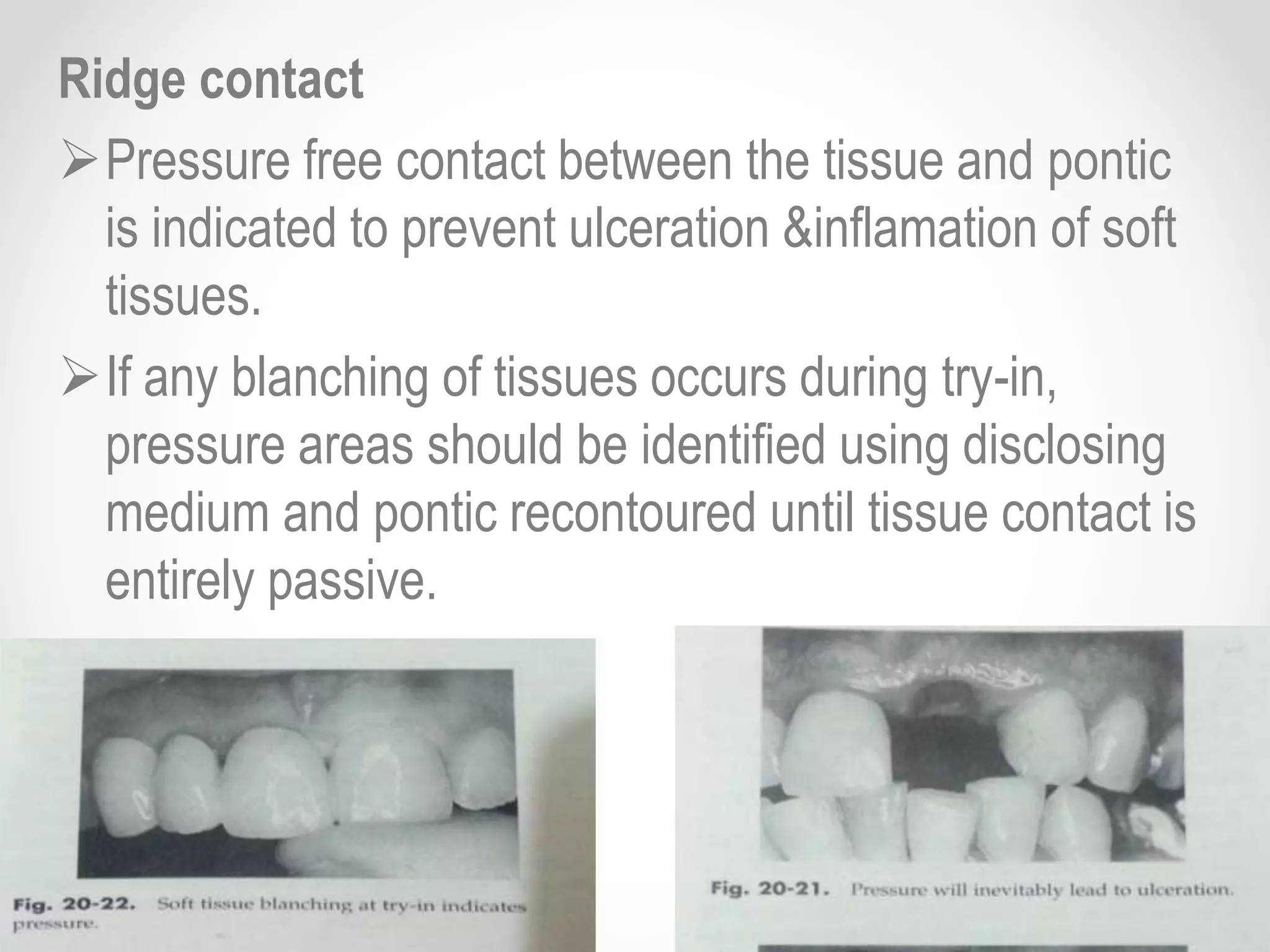
Ridge contact
Pressure free contact between the tissue and pontic
is indicated to prevent ulceration &inflamation of soft
tissues.
If any blanching of tissues occurs during try-in,
pressure areas should be identified using disclosing
medium and pontic recontoured until tissue contact is
entirely passive.
Oral hygeine considerations:
Chief cause of ridge irritation toxins released from
microbial plaque accumulates between gingival
surface of pontic and residual ridge calculus
formation and tissue irritation.
Unlike RPD, FPD cannot be removed for cleansing.
Normally where tissue contact occurs,gingival area of
pontic is inaccessible. Devices such as proxy
brushes, superfloss may be used.
If pontic has a concavity or depression in its gingival
surface, there will be palque accumulation which
leads to inflamation. Therefore FPD should be
checked & corrected before cementation.
Pontic material
Should provide
Good esthetics where needed
Biocompatibility
Rigidity and strength to withstand occlusal forces
Longevity
FPD should be made as rigid as possible, because any flexure
during mastication or parafunction may caus epressure on gingiva
and fracture of veneering material.
Occlusal contacts should not occur at metal-porcelain junctions.
Pontic material should have ability to resist plaque
accumulation(surface roughness should be less)
Therefore, gold glazed porcelain ceramic
Occlusal forces
To withstand occlusal forces, it has been suggested to
reduce the bucco-lingual dimension of the pontic by
30%
But in case of parafunctional habits or accidental
biting on a hard object, this may not be efficient.
Infact, it may impede harmonious and stable occlusal
relationship
Hence, normal pontic width atleast at the occlusal
third is recommended
Exception-when ridge is collapsed bucco-lingually
MECHANICAL
CONSIDERATIONS
Factors that lead to fracture of prosthesis or
displacement of retainers:
1. improper choice of material
2. poor frame work design
3. poor tooth preparation
4. poor occlusion
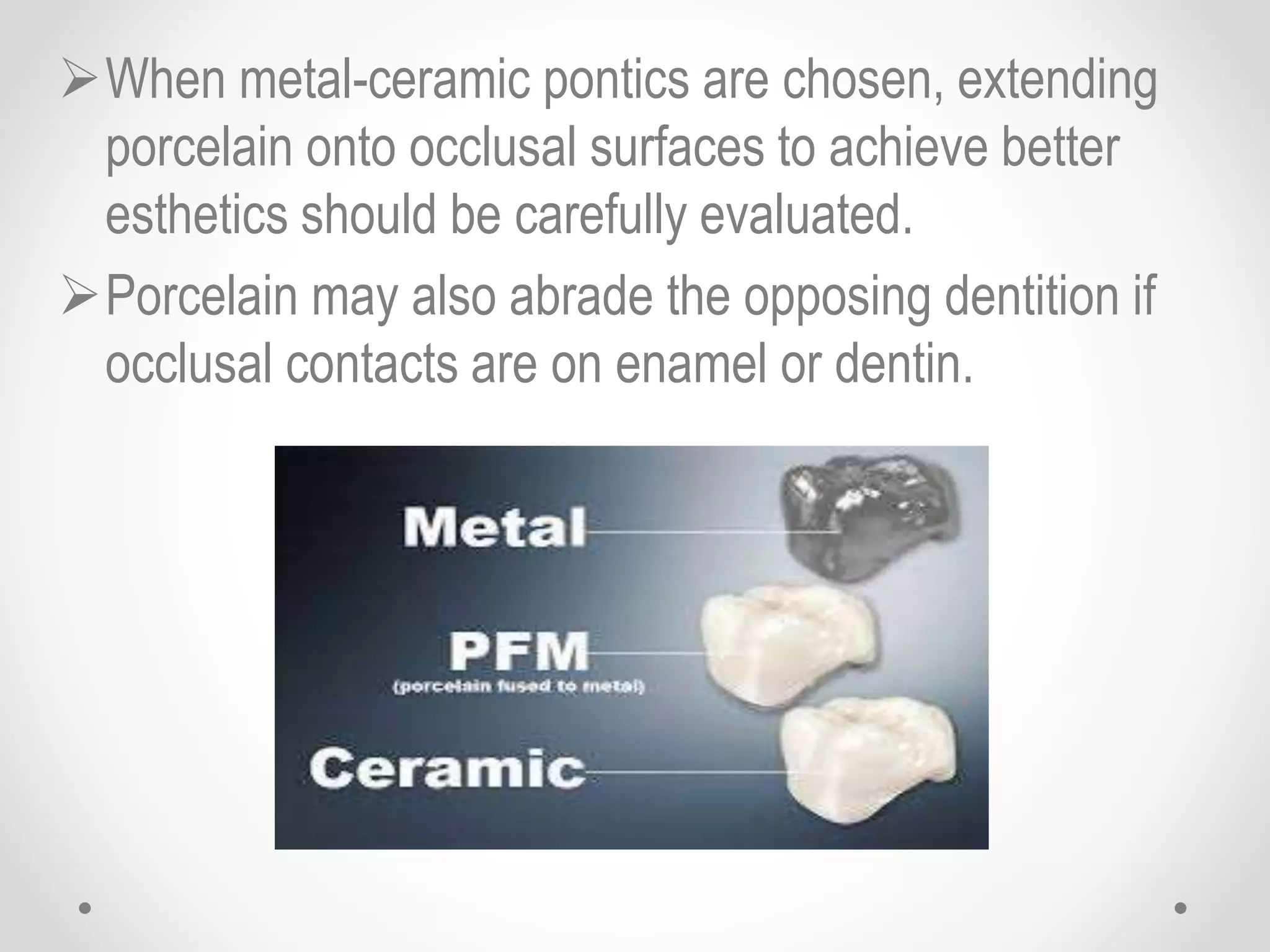
When metal-ceramic pontics are chosen, extending
porcelain onto occlusal surfaces to achieve better
esthetics should be carefully evaluated.
Porcelain may also abrade the opposing dentition if
occlusal contacts are on enamel or dentin.
ESTHETIC
CONSIDERATION
• Priority of the patient.
• Gingival interface:
-an esthetically successful pontic will replicate
the form, contour, incisal edge, gingival and
incisal embrassures and color of adjacent tooth.
-attention should be paid to the contour of labial
surface as it approaches the pontic-tissue
junction to achieve a “natural” appearance.
• Modified ridge lap is recommended for most anterior teeth.
It compensates for lost bucco-lingual width in the ridge by
overlapping the existent ridge.
• When esthetics is of utmost concern, yhe ovate pontic
used in conjunction with alveolar preservation or soft tissue
augmentation can provide indistinguishable appearance.
Incisogingival length
Obtaining a correctly sized pontic simply by
duplication of the original tooth is not possible.
Ridge resorption will make the tooth look too long in
cervical region.
However an abnormal labio-lingual position is not so
obvious. Hence it is used to improve appearance by
recontouring giongival half of labial surface.
Another solution is to shape the pontic to stimulate a
normal crown and root with emphasis on CEJ
Or by using pink acrylic
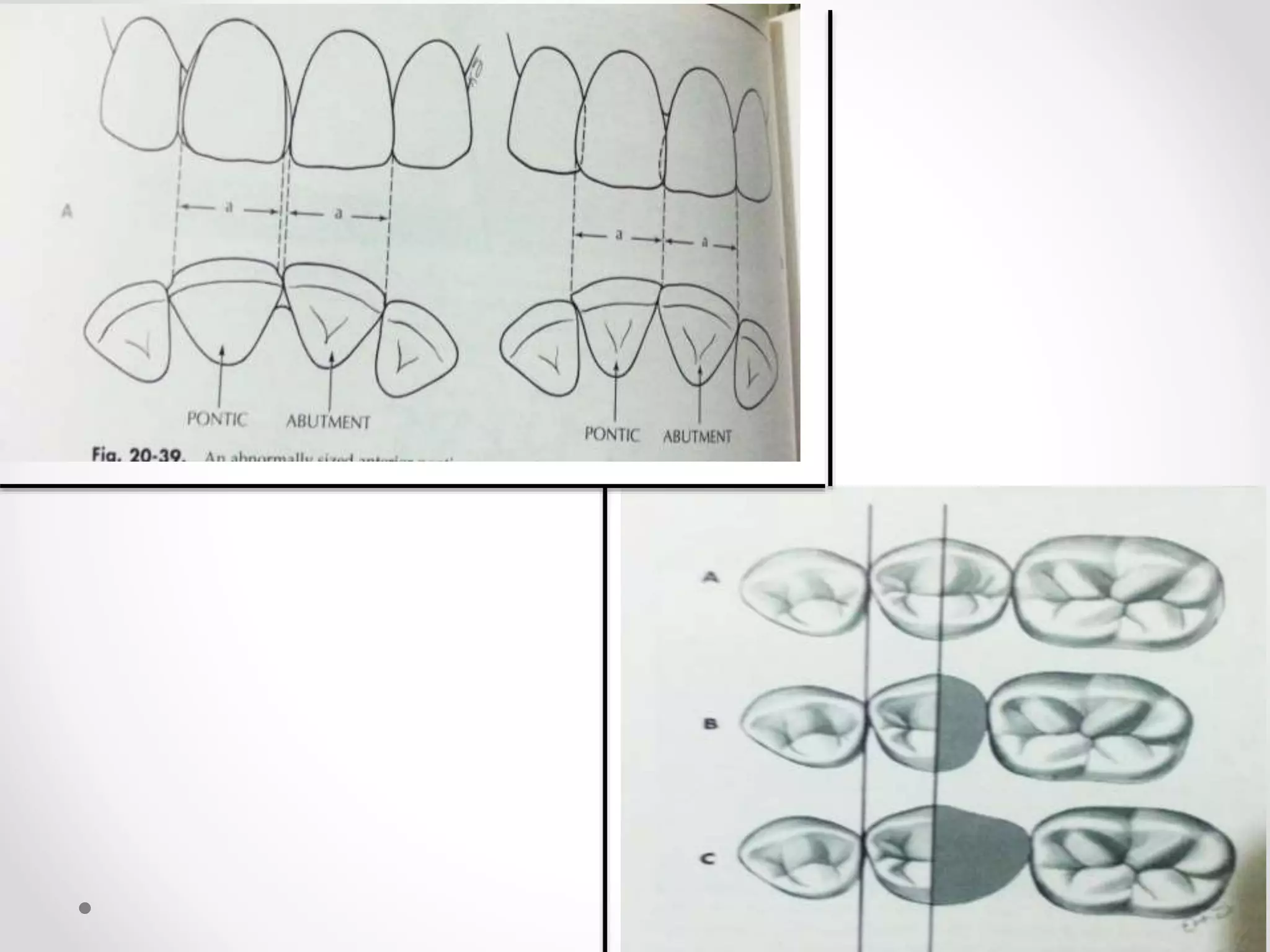
Mesio-distal width:
Frequently space available for the pontic is less than
the contra-lateral tooth
This is due to uncontrolled toth movement which took
place when the tooth was lost and not replaced.
If possible, such discrepancy should be corrected by
orthodontic repositioning
The space discrepancy can also be corrected by
altering the shape of proximal areas
(by duplicating the mesial half of the tooth and
adjusting the size of the distal half)
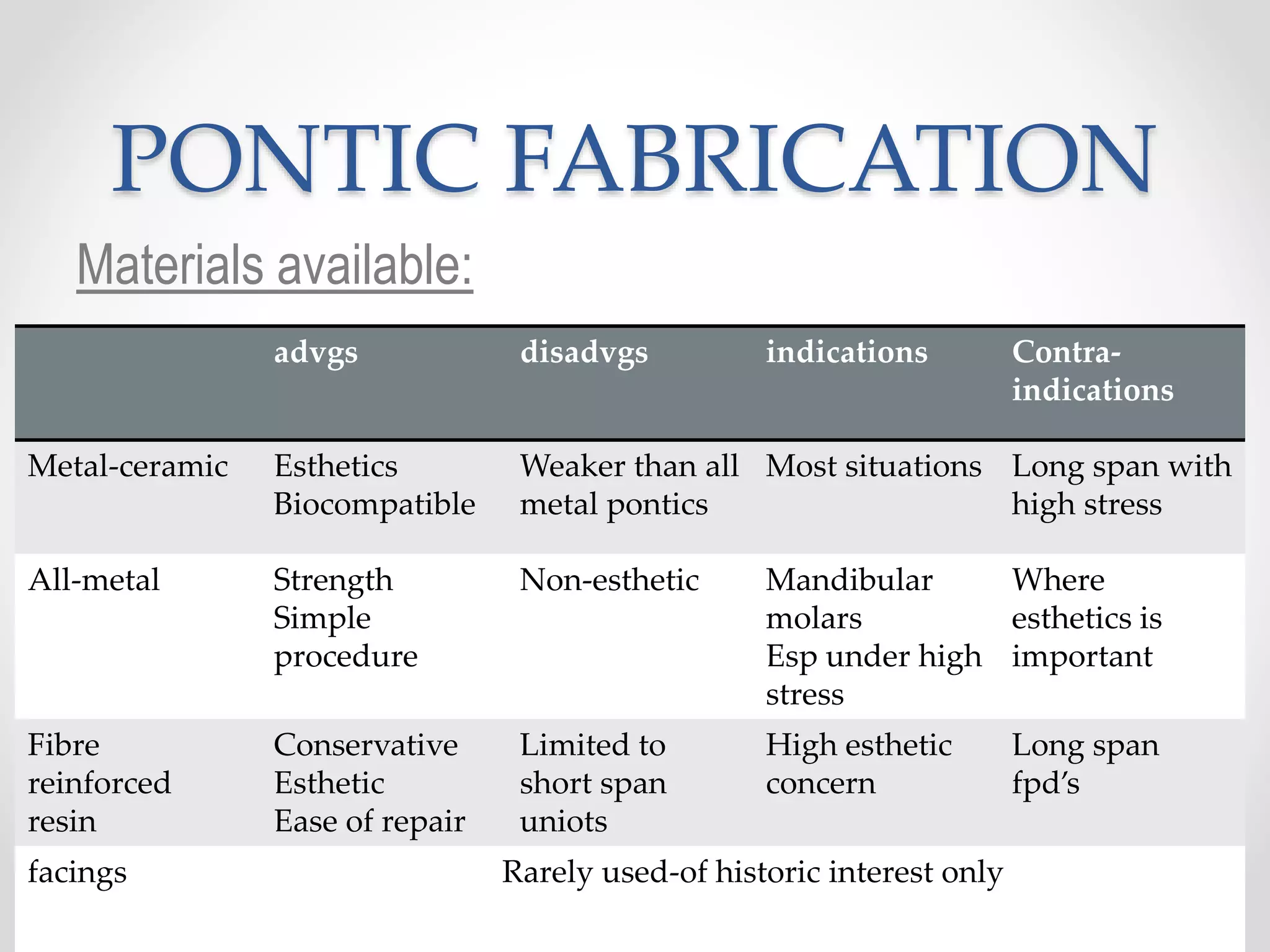
PONTIC FABRICATION
Materials available:
advgs disadvgs indications Contra-
indications
Metal-ceramic Esthetics
Biocompatible
Weaker than all
metal pontics
Most situations Long span with
high stress
All-metal Strength
Simple
procedure
Non-esthetic Mandibular
molars
Esp under high
stress
Where
esthetics is
important
Fibre
reinforced
resin
Conservative
Esthetic
Ease of repair
Limited to
short span
uniots
High esthetic
concern
Long span
fpd’s
facings Rarely used-of historic interest only
pontics in FPD (prosthodontics)

pontics in FPD (prosthodontics)

  • 1.
  • 2.
    INTRODUCTION • Pontics arethe artificial teeth of a fixed partial denture that replaces missing natural teeth,restoring function and appearance. • Proper preparation includes a careful analysis of critical dimension of edentulous area; mesiodistal width; occlusocervical disatnce; buccolingual siameter and location of residual ridge.
  • 3.
  • 4.
    PRE-TREATMENT ASSESMENT PONTIC SPACE: One functionof the fpd is to prevent tilting or drifting of the adjacent teeth into the edentulous space. If such movement has already occurred, the space available for the pontic may be reduced and its fabrication complicated. Overly small pontics are undesirable because they trap food and are difficult to clean.
  • 5.
    Orthodontic repositioning, modificationof abutments with complete coverage retainers can be made.
  • 6.
    RESIDUAL RIDGE CONTOUR Anideally shaped ridge has smooth, regular surface of attached gingiva, which facilitates maintainance of a plaque-free environment. Should have sufficient height to allow placement of pontic such that it apperas to emerge out from the ridge (mimics appearance of neighbouring teeth).  Loss of residual ridge contour may lead to unesthetic open gingival embrasures (black traingles). This leads to food lodgement and saliva percolation.
  • 7.
    Siebert has classifiedresidual ridge deformities into: Class I: facio-lingual loss of tissue width with normal ridge height. Class II: loss of ridge height with normal ridge width. Class III: a combination of loss in both dimension.
  • 8.
    surgical modification Although pre-prostheticsurgery like ridge augmentation with a hard tissue graft may be done, it is not always indicated unless the edentulous site is to receive an implant.
  • 11.
    PONTIC CLASSIFICATION: Mucosal contactNo mucosal contact - Ridge lap - Sanitary (hygenic) - Modified ridge lap - Modified sanitary (hygenic) - Ovate - Conical
  • 12.
    Design location IndicationContra- indication Materials 1. sanitary/ hygenic Posterior mandible Non- esthetic zone; Impaired oral hygeine Minimal vertical dimension All metal 2. conical Molars without esthetic requirement Posterior areas with minimal esthetic requirement Poor oral hygeine All metal Metal-ceramic All resin
  • 13.
    Design location IndicationContra- indication Materials 3. Modified ridge lap High esthetic (anteriors, premolars & sometimes molars) Esthetic concern Minimal esthetic concern Metal-ceramic All resin 4. Ovate Maxillary incisors, cuspids & premolars Desire for optimal esthetics ; High smile line Unwilling ness for surgery Metal-ceramic All resin
  • 14.
    BIOLOGIC CONSIDERATIONS Aims at maintainaceand preservation of residual ridge, abutments, opposing teeth and supporting tissues. Factors: 1. Ridge contact 2. Oral hygeine considerations 3. Pontic material 4. Occlusal forces
  • 15.
    Ridge contact Pressure freecontact between the tissue and pontic is indicated to prevent ulceration &inflamation of soft tissues. If any blanching of tissues occurs during try-in, pressure areas should be identified using disclosing medium and pontic recontoured until tissue contact is entirely passive.
  • 16.
    Oral hygeine considerations: Chiefcause of ridge irritation toxins released from microbial plaque accumulates between gingival surface of pontic and residual ridge calculus formation and tissue irritation. Unlike RPD, FPD cannot be removed for cleansing. Normally where tissue contact occurs,gingival area of pontic is inaccessible. Devices such as proxy brushes, superfloss may be used. If pontic has a concavity or depression in its gingival surface, there will be palque accumulation which leads to inflamation. Therefore FPD should be checked & corrected before cementation.
  • 17.
    Pontic material Should provide Goodesthetics where needed Biocompatibility Rigidity and strength to withstand occlusal forces Longevity FPD should be made as rigid as possible, because any flexure during mastication or parafunction may caus epressure on gingiva and fracture of veneering material. Occlusal contacts should not occur at metal-porcelain junctions. Pontic material should have ability to resist plaque accumulation(surface roughness should be less) Therefore, gold glazed porcelain ceramic
  • 18.
    Occlusal forces To withstandocclusal forces, it has been suggested to reduce the bucco-lingual dimension of the pontic by 30% But in case of parafunctional habits or accidental biting on a hard object, this may not be efficient. Infact, it may impede harmonious and stable occlusal relationship Hence, normal pontic width atleast at the occlusal third is recommended Exception-when ridge is collapsed bucco-lingually
  • 19.
    MECHANICAL CONSIDERATIONS Factors that leadto fracture of prosthesis or displacement of retainers: 1. improper choice of material 2. poor frame work design 3. poor tooth preparation 4. poor occlusion
  • 20.
    When metal-ceramic ponticsare chosen, extending porcelain onto occlusal surfaces to achieve better esthetics should be carefully evaluated. Porcelain may also abrade the opposing dentition if occlusal contacts are on enamel or dentin.
  • 21.
    ESTHETIC CONSIDERATION • Priority ofthe patient. • Gingival interface: -an esthetically successful pontic will replicate the form, contour, incisal edge, gingival and incisal embrassures and color of adjacent tooth. -attention should be paid to the contour of labial surface as it approaches the pontic-tissue junction to achieve a “natural” appearance.
  • 22.
    • Modified ridgelap is recommended for most anterior teeth. It compensates for lost bucco-lingual width in the ridge by overlapping the existent ridge. • When esthetics is of utmost concern, yhe ovate pontic used in conjunction with alveolar preservation or soft tissue augmentation can provide indistinguishable appearance.
  • 23.
    Incisogingival length Obtaining acorrectly sized pontic simply by duplication of the original tooth is not possible. Ridge resorption will make the tooth look too long in cervical region. However an abnormal labio-lingual position is not so obvious. Hence it is used to improve appearance by recontouring giongival half of labial surface. Another solution is to shape the pontic to stimulate a normal crown and root with emphasis on CEJ Or by using pink acrylic
  • 25.
    Mesio-distal width: Frequently spaceavailable for the pontic is less than the contra-lateral tooth This is due to uncontrolled toth movement which took place when the tooth was lost and not replaced. If possible, such discrepancy should be corrected by orthodontic repositioning The space discrepancy can also be corrected by altering the shape of proximal areas (by duplicating the mesial half of the tooth and adjusting the size of the distal half)
  • 27.
    PONTIC FABRICATION Materials available: advgsdisadvgs indications Contra- indications Metal-ceramic Esthetics Biocompatible Weaker than all metal pontics Most situations Long span with high stress All-metal Strength Simple procedure Non-esthetic Mandibular molars Esp under high stress Where esthetics is important Fibre reinforced resin Conservative Esthetic Ease of repair Limited to short span uniots High esthetic concern Long span fpd’s facings Rarely used-of historic interest only