*GOAL:
THE CORRECTION OF DIFFERENT TYPES OF
MALOCCLUSIONS REQUIRES SPACE IN ORDER TO
MOVE TEETH INTO MORE IDEAL LOCATIONS.
To treat
 Crowding
 Retraction of proclined teeth
 Leveling of steep curvature of spee
 Derotation of anterior teeth
 Correction of unstable molar relation
[D2-E2-P2-U]
Proximal stripping
Expansion
Extraction
Distalization
Uprighting of molars
Derotation of posterior teeth
Proclination of anterior teeth
Proximal surfaces of the teeth are sliced in order to reduce mesio -distal width
of teeth.
WHEN?
Space required is minimum;i.e.0-2.5mm
 If Bolton’s analysis show mild tooth material excess
 To aid retention in lower anterior region
WHEN NOT?
 In young patients
 Patient susceptible to caries or having high caries index
DIAGNOSTIC AIDS
 Arch perimeter analysis
 Bolton’s analysis
 IOPA
AMOUNT
Not more than 50% of enamel thickness
ADVANTAGES:
 Avoid extraction in borderline cases
 More favourable overbite & overjet relation
 More stable results can be established
DISADVANTAGES:
 Roughened proximal surfaces attracts plaque
 Caries susceptibility is increased
 Patient may experience sensitivity of teeth
 Improper procedure creating unnatural appearance of teeth
 Loss of contact may result in food impaction
PROCEDURE
1. Use of metallic abrasive strips
2. Safe sided carborundum discs
3. Long thin tapered fissure burs
FLUORIDE APPLICATION
To manage in increased caries susceptibility.
 Premolars are most frequently extracted as a part of therapeutic extraction.
 Extraction of One premolar from each quadrant of jaw provides sufficient
space to correct the crowding & proclination without unduly hampering
function & esthetic.
 It is not uncommon to extract molars or lower incisors during therapy.
 Extractions of canines & upper incisors usually avoided.
NEED
1.Arch length –tooth material discrepancy
2.Correction of sagittal inter-arch relationship
3.Abnormal size & form of teeth
4.Skeletal jaw malrelations
BALANCING EXTRACTION
Removal of another tooth on the opposite side of same arch.
COMPENSATING EXTRACTION
Extraction of teeth in opposite jaws to preserve buccal occlusal relationship.
AIM
Moving the molars in a distal direction to gain space.
IDEAL TIMING:
In mixed dentition period prior to second molar eruption.
METHODS
1. Extra-oral method
Head gears deriving anchorage from cervical or cranial regions.
Disadvantage;
 Patient co-operation is essential for timely wear of the appliance.
 Usually not worn continuously so intermittent in action so prolonged
treatment time.
2. INTRA ORAL METHOD
Fixed on to the teeth and therefore produce a continuous effect
Contd…
Sagittal Appliance
By the removable appliance incorporating
jack screw E.g. Split acrylic plate joined by a
jack screw used for distalization of only one
tooth at a time
Distalization using intraoral magnet
Repelling magnet placed on the molars to
be distalized and the tooth anterior and
anterior anchorage can be reinforced using
Nance holding arch.
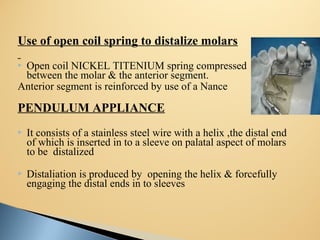
Use of open coil spring to distalize molars
 Open coil NICKEL TITENIUM spring compressed
between the molar & the anterior segment.
Anterior segment is reinforced by use of a Nance button
PENDULUM APPLIANCE
 It consists of a stainless steel wire with a helix ,the distal end
of which is inserted in to a sleeve on palatal aspect of molars
to be distalized
 Distaliation is produced by opening the helix & forcefully
engaging the distal ends in to sleeves
EXPANSION
Classified as
1.Rapid arch expansion
2.Slow arch expansion
Rapid maxillary arch expansion
• A skeletal type of expansion which
involves separation of mid palatal suture
• Initiated prior to ossification of mid-palatal
suture.
WHY WE NEED EXPANSION ?
 Posterior cross bite associated with real or
relative maxillary deficiencies.
 Class 3 mal-occlusion of dental or skeletal
cause.
 Cleft palate with collapsed maxillary arch.
 In cases requiring face mask therapy.
 Medical indication. i.e. Nasal stenosis, septal
defect, recurrent nasal & ear defects, poor
nasal airway, allergic rhinitis & DNS
DIAGNOSTIC AIDS
Case history
Clinical examination
Study models
Occlusal view radiograph
Cephalogram
EFFECTS
• Amount of expansion-0.2 to 0.5mm per day
•On alveolar bone—is bends adjacent to anchor
teeth
•On max. ant. teeth—midline spacing between
max. central incisors
•On max. post. teeth—anchors teeth show buccal
tipping
•On mand.—downward & backward rotation of
mand.
•On nasal cavity—increase intra-nasal space
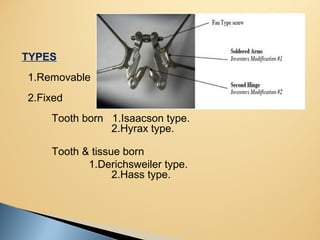
TYPES
1.Removable
2.Fixed
Tooth born 1.Isaacson type.
2.Hyrax type.
Tooth & tissue born
1.Derichsweiler type.
2.Hass type.
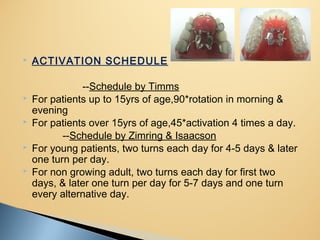
 ACTIVATION SCHEDULE
--Schedule by Timms
 For patients up to 15yrs of age,90*rotation in morning &
evening
 For patients over 15yrs of age,45*activation 4 times a day.
--Schedule by Zimring & Isaacson
 For young patients, two turns each day for 4-5 days & later
one turn per day.
 For non growing adult, two turns each day for first two
days, & later one turn per day for 5-7 days and one turn
every alternative day.
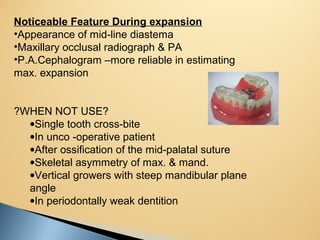
Noticeable Feature During expansion
•Appearance of mid-line diastema
•Maxillary occlusal radiograph & PA
•P.A.Cephalogram –more reliable in estimating
max. expansion
?WHEN NOT USE?
•Single tooth cross-bite
•In unco -operative patient
•After ossification of the mid-palatal suture
•Skeletal asymmetry of max. & mand.
•Vertical growers with steep mandibular plane
angle
•In periodontally weak dentition
*Retention Following R.M.E.
• Retention period is not less than 3-6 months ,by screw
immobilization with
•cold cure acrylic or removable or fixed retainer
*Requirement of surgery
Unusual resistance to separation of the palatal bone
•usually occur in female over 16yrs age &
in male over 18yrs age
*Surgical procedure
•palatal osteotomy
•lateral max. osteotomy
•Anterior max. osteotomy
CLINICAL TIPS FOR R.M.E.
•Oral hygiene instructions
•Orthodontic movement of anchor teeth should be avoided prior to R.M.E.
•Patient should be trained to use the key
•Occlusal radiographs should be taken at regular interval to monitor
expansion
•Possible immediate effects of premature removal of appliance
i.e.dizziness ,pressure at the bridge of nose , pressure under eyes,
so that keep patient seated & not to stand immediately after appliance
removal .
SLOW EXPANSION
Also termed as Dento -Alveolar expansion
•Rate of expansion – 0.5-1mm per week
•Forces generated—2-4 pounds against 10-20 pounds by
rapid maxillary expansion.
•Time require –2-5 months
Advantages
•More physiologic adjustment to max. expansion
•Producing greater stability
•Less relapse potential
TYPES OF APLIANCES FOR
SLOW
EXPANSION
 Jack screw
 Coffin spring
 Quad helix
 Arch expansion using fixed appliances (NITI
expander)
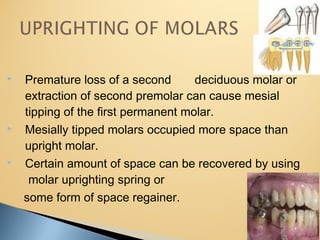
 Premature loss of a second deciduous molar or
extraction of second premolar can cause mesial
tipping of the first permanent molar.
 Mesially tipped molars occupied more space than
upright molar.
 Certain amount of space can be recovered by using
molar uprighting spring or
some form of space regainer.
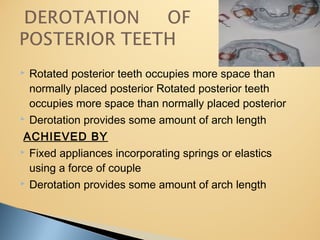
 Rotated posterior teeth occupies more space than
normally placed posterior Rotated posterior teeth
occupies more space than normally placed posterior
 Derotation provides some amount of arch length
ACHIEVED BY
 Fixed appliances incorporating springs or elastics
using a force of couple
 Derotation provides some amount of arch length
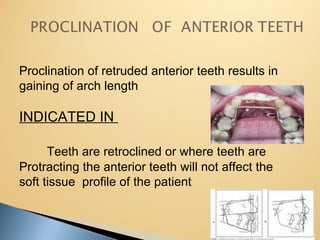
Proclination of retruded anterior teeth results in
gaining of arch length
INDICATED IN
Teeth are retroclined or where teeth are
Protracting the anterior teeth will not affect the
soft tissue profile of the patient
THANK YOU

Methods of gaining space final

  • 2.
    *GOAL: THE CORRECTION OFDIFFERENT TYPES OF MALOCCLUSIONS REQUIRES SPACE IN ORDER TO MOVE TEETH INTO MORE IDEAL LOCATIONS.
  • 3.
    To treat  Crowding Retraction of proclined teeth  Leveling of steep curvature of spee  Derotation of anterior teeth  Correction of unstable molar relation
  • 4.
    [D2-E2-P2-U] Proximal stripping Expansion Extraction Distalization Uprighting ofmolars Derotation of posterior teeth Proclination of anterior teeth
  • 5.
    Proximal surfaces ofthe teeth are sliced in order to reduce mesio -distal width of teeth. WHEN? Space required is minimum;i.e.0-2.5mm  If Bolton’s analysis show mild tooth material excess  To aid retention in lower anterior region WHEN NOT?  In young patients  Patient susceptible to caries or having high caries index DIAGNOSTIC AIDS  Arch perimeter analysis  Bolton’s analysis  IOPA AMOUNT Not more than 50% of enamel thickness
  • 6.
    ADVANTAGES:  Avoid extractionin borderline cases  More favourable overbite & overjet relation  More stable results can be established DISADVANTAGES:  Roughened proximal surfaces attracts plaque  Caries susceptibility is increased  Patient may experience sensitivity of teeth  Improper procedure creating unnatural appearance of teeth  Loss of contact may result in food impaction PROCEDURE 1. Use of metallic abrasive strips 2. Safe sided carborundum discs 3. Long thin tapered fissure burs FLUORIDE APPLICATION To manage in increased caries susceptibility.
  • 7.
     Premolars aremost frequently extracted as a part of therapeutic extraction.  Extraction of One premolar from each quadrant of jaw provides sufficient space to correct the crowding & proclination without unduly hampering function & esthetic.  It is not uncommon to extract molars or lower incisors during therapy.  Extractions of canines & upper incisors usually avoided. NEED 1.Arch length –tooth material discrepancy 2.Correction of sagittal inter-arch relationship 3.Abnormal size & form of teeth 4.Skeletal jaw malrelations BALANCING EXTRACTION Removal of another tooth on the opposite side of same arch. COMPENSATING EXTRACTION Extraction of teeth in opposite jaws to preserve buccal occlusal relationship.
  • 8.
    AIM Moving the molarsin a distal direction to gain space. IDEAL TIMING: In mixed dentition period prior to second molar eruption. METHODS 1. Extra-oral method Head gears deriving anchorage from cervical or cranial regions. Disadvantage;  Patient co-operation is essential for timely wear of the appliance.  Usually not worn continuously so intermittent in action so prolonged treatment time. 2. INTRA ORAL METHOD Fixed on to the teeth and therefore produce a continuous effect Contd…
  • 9.
    Sagittal Appliance By theremovable appliance incorporating jack screw E.g. Split acrylic plate joined by a jack screw used for distalization of only one tooth at a time Distalization using intraoral magnet Repelling magnet placed on the molars to be distalized and the tooth anterior and anterior anchorage can be reinforced using Nance holding arch.
  • 10.
    Use of opencoil spring to distalize molars  Open coil NICKEL TITENIUM spring compressed between the molar & the anterior segment. Anterior segment is reinforced by use of a Nance button PENDULUM APPLIANCE  It consists of a stainless steel wire with a helix ,the distal end of which is inserted in to a sleeve on palatal aspect of molars to be distalized  Distaliation is produced by opening the helix & forcefully engaging the distal ends in to sleeves
  • 11.
    EXPANSION Classified as 1.Rapid archexpansion 2.Slow arch expansion Rapid maxillary arch expansion • A skeletal type of expansion which involves separation of mid palatal suture • Initiated prior to ossification of mid-palatal suture.
  • 12.
    WHY WE NEEDEXPANSION ?  Posterior cross bite associated with real or relative maxillary deficiencies.  Class 3 mal-occlusion of dental or skeletal cause.  Cleft palate with collapsed maxillary arch.  In cases requiring face mask therapy.  Medical indication. i.e. Nasal stenosis, septal defect, recurrent nasal & ear defects, poor nasal airway, allergic rhinitis & DNS
  • 13.
    DIAGNOSTIC AIDS Case history Clinicalexamination Study models Occlusal view radiograph Cephalogram EFFECTS • Amount of expansion-0.2 to 0.5mm per day •On alveolar bone—is bends adjacent to anchor teeth •On max. ant. teeth—midline spacing between max. central incisors •On max. post. teeth—anchors teeth show buccal tipping •On mand.—downward & backward rotation of mand. •On nasal cavity—increase intra-nasal space
  • 14.
    TYPES 1.Removable 2.Fixed Tooth born 1.Isaacsontype. 2.Hyrax type. Tooth & tissue born 1.Derichsweiler type. 2.Hass type.
  • 15.
     ACTIVATION SCHEDULE --Scheduleby Timms  For patients up to 15yrs of age,90*rotation in morning & evening  For patients over 15yrs of age,45*activation 4 times a day. --Schedule by Zimring & Isaacson  For young patients, two turns each day for 4-5 days & later one turn per day.  For non growing adult, two turns each day for first two days, & later one turn per day for 5-7 days and one turn every alternative day.
  • 16.
    Noticeable Feature Duringexpansion •Appearance of mid-line diastema •Maxillary occlusal radiograph & PA •P.A.Cephalogram –more reliable in estimating max. expansion ?WHEN NOT USE? •Single tooth cross-bite •In unco -operative patient •After ossification of the mid-palatal suture •Skeletal asymmetry of max. & mand. •Vertical growers with steep mandibular plane angle •In periodontally weak dentition
  • 17.
    *Retention Following R.M.E. •Retention period is not less than 3-6 months ,by screw immobilization with •cold cure acrylic or removable or fixed retainer *Requirement of surgery Unusual resistance to separation of the palatal bone •usually occur in female over 16yrs age & in male over 18yrs age *Surgical procedure •palatal osteotomy •lateral max. osteotomy •Anterior max. osteotomy
  • 18.
    CLINICAL TIPS FORR.M.E. •Oral hygiene instructions •Orthodontic movement of anchor teeth should be avoided prior to R.M.E. •Patient should be trained to use the key •Occlusal radiographs should be taken at regular interval to monitor expansion •Possible immediate effects of premature removal of appliance i.e.dizziness ,pressure at the bridge of nose , pressure under eyes, so that keep patient seated & not to stand immediately after appliance removal .
  • 19.
    SLOW EXPANSION Also termedas Dento -Alveolar expansion •Rate of expansion – 0.5-1mm per week •Forces generated—2-4 pounds against 10-20 pounds by rapid maxillary expansion. •Time require –2-5 months Advantages •More physiologic adjustment to max. expansion •Producing greater stability •Less relapse potential
  • 20.
    TYPES OF APLIANCESFOR SLOW EXPANSION  Jack screw  Coffin spring  Quad helix  Arch expansion using fixed appliances (NITI expander)
  • 21.
     Premature lossof a second deciduous molar or extraction of second premolar can cause mesial tipping of the first permanent molar.  Mesially tipped molars occupied more space than upright molar.  Certain amount of space can be recovered by using molar uprighting spring or some form of space regainer.
  • 22.
     Rotated posteriorteeth occupies more space than normally placed posterior Rotated posterior teeth occupies more space than normally placed posterior  Derotation provides some amount of arch length ACHIEVED BY  Fixed appliances incorporating springs or elastics using a force of couple  Derotation provides some amount of arch length
  • 23.
    Proclination of retrudedanterior teeth results in gaining of arch length INDICATED IN Teeth are retroclined or where teeth are Protracting the anterior teeth will not affect the soft tissue profile of the patient
  • 24.