ABDOMINAL
EXAMINATION
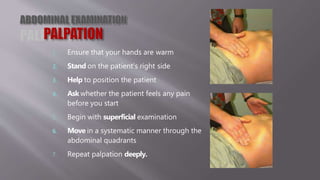
1. Ensure that your hands are warm
2. Stand on the patient’s right side
3. Help to position the patient
4. Ask whether the patient feels any pain
before you start
5. Begin with superficial examination
6. Move in a systematic manner through the
abdominal quadrants
7. Repeat palpation deeply.
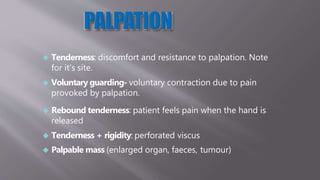
 Tenderness: discomfort and resistance to palpation. Note
for it’s site.
 Voluntary guarding- voluntary contraction due to pain
provoked by palpation.
 Rebound tenderness: patient feels pain when the hand is
released
 Tenderness + rigidity: perforated viscus
 Palpable mass (enlarged organ, faeces, tumour)
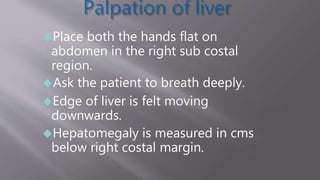
Place both the hands flat on
abdomen in the right sub costal
region.
Ask the patient to breath deeply.
Edge of liver is felt moving
downwards.
Hepatomegaly is measured in cms
below right costal margin.
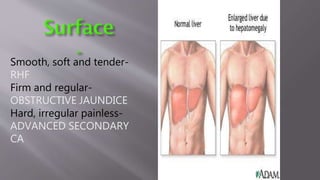
Smooth, soft and tender-
RHF
Firm and regular-
OBSTRUCTIVE JAUNDICE
Hard, irregular painless-
ADVANCED SECONDARY
CA
 Normal gall bladder can not be felt.
 Distended- palpated as firm smooth globular swelling, distinct borders
lateral to rectus abdominus near the tip of 9th intercostalmargin.
Painless gallbladder-
 Jaundice in patient with Ca head pancreas or CBD obstruction due to
malignancy.
 Mucocele.
 Carcinoma gall bladder.
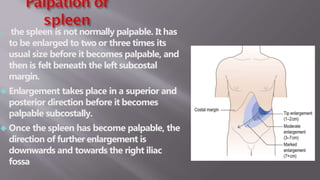
 the spleen is not normally palpable. It has
to be enlarged to two or three times its
usual size before it becomes palpable, and
then is felt beneath the left subcostal
margin.
 Enlargement takes place in a superior and
posterior direction before it becomes
palpable subcostally.
 Once the spleen has become palpable, the
direction of further enlargement is
downwards and towards the right iliac
fossa
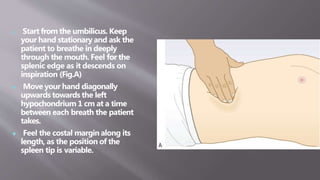
 Start from the umbilicus. Keep
your hand stationary and ask the
patient to breathe in deeply
through the mouth. Feel for the
splenic edge as it descends on
inspiration (Fig.A)
 Move your hand diagonally
upwards towards the left
hypochondrium 1 cm at a time
between each breath the patient
takes.
 Feel the costal margin along its
length, as the position of the
spleen tip is variable.
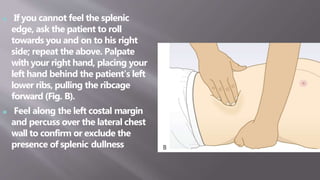
 If you cannot feel the splenic
edge, ask the patient to roll
towards you and on to his right
side; repeat the above. Palpate
with your right hand, placing your
left hand behind the patient's left
lower ribs, pulling the ribcage
forward (Fig. B).
 Feel along the left costal margin
and percuss over the lateral chest
wall to confirm or exclude the
presence of splenic dullness
 ln surgical practice this is usually confined to examination of the
male genitalia, since females with disorders of this region are
managed by gynaecologists. The examination is best performed
with the patient in the supine and standing position.
 Spermatic cord :-
- Beaded = B or T.B –
-Matted= filarasis
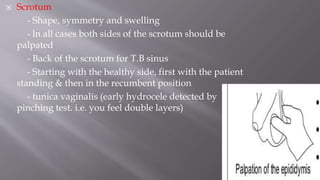
 Scrotum
- Shape, symmetry and swelling
- ln all cases both sides of the scrotum should be
palpated
- Back of the scrotum for T.B sinus
- Starting with the healthy side, first with the patient
standing & then in the recumbent position
- tunica vaginalis (early hydrocele detected by
pinching test. i.e. you feel double layers)
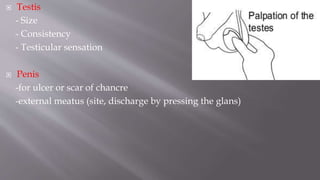
 Testis
- Size
- Consistency
- Testicular sensation
 Penis
-for ulcer or scar of chancre
-external meatus (site, discharge by pressing the glans)
 Epigastric,
 paraumbilical
 inguinal
 femoral
 incisional
Don’t forget to examine the back for
Pott's disease
psoas abscess

abdominal palpation.pptx

  • 1.
  • 2.
    1. Ensure thatyour hands are warm 2. Stand on the patient’s right side 3. Help to position the patient 4. Ask whether the patient feels any pain before you start 5. Begin with superficial examination 6. Move in a systematic manner through the abdominal quadrants 7. Repeat palpation deeply.
  • 3.
     Tenderness: discomfortand resistance to palpation. Note for it’s site.  Voluntary guarding- voluntary contraction due to pain provoked by palpation.  Rebound tenderness: patient feels pain when the hand is released  Tenderness + rigidity: perforated viscus  Palpable mass (enlarged organ, faeces, tumour)
  • 4.
    Place both thehands flat on abdomen in the right sub costal region. Ask the patient to breath deeply. Edge of liver is felt moving downwards. Hepatomegaly is measured in cms below right costal margin.
  • 5.
    Smooth, soft andtender- RHF Firm and regular- OBSTRUCTIVE JAUNDICE Hard, irregular painless- ADVANCED SECONDARY CA
  • 6.
     Normal gallbladder can not be felt.  Distended- palpated as firm smooth globular swelling, distinct borders lateral to rectus abdominus near the tip of 9th intercostalmargin. Painless gallbladder-  Jaundice in patient with Ca head pancreas or CBD obstruction due to malignancy.  Mucocele.  Carcinoma gall bladder.
  • 7.
     the spleenis not normally palpable. It has to be enlarged to two or three times its usual size before it becomes palpable, and then is felt beneath the left subcostal margin.  Enlargement takes place in a superior and posterior direction before it becomes palpable subcostally.  Once the spleen has become palpable, the direction of further enlargement is downwards and towards the right iliac fossa
  • 8.
     Start fromthe umbilicus. Keep your hand stationary and ask the patient to breathe in deeply through the mouth. Feel for the splenic edge as it descends on inspiration (Fig.A)  Move your hand diagonally upwards towards the left hypochondrium 1 cm at a time between each breath the patient takes.  Feel the costal margin along its length, as the position of the spleen tip is variable.
  • 9.
     If youcannot feel the splenic edge, ask the patient to roll towards you and on to his right side; repeat the above. Palpate with your right hand, placing your left hand behind the patient's left lower ribs, pulling the ribcage forward (Fig. B).  Feel along the left costal margin and percuss over the lateral chest wall to confirm or exclude the presence of splenic dullness
  • 10.
     ln surgicalpractice this is usually confined to examination of the male genitalia, since females with disorders of this region are managed by gynaecologists. The examination is best performed with the patient in the supine and standing position.  Spermatic cord :- - Beaded = B or T.B – -Matted= filarasis
  • 11.
     Scrotum - Shape,symmetry and swelling - ln all cases both sides of the scrotum should be palpated - Back of the scrotum for T.B sinus - Starting with the healthy side, first with the patient standing & then in the recumbent position - tunica vaginalis (early hydrocele detected by pinching test. i.e. you feel double layers)
  • 12.
     Testis - Size -Consistency - Testicular sensation  Penis -for ulcer or scar of chancre -external meatus (site, discharge by pressing the glans)
  • 13.
     Epigastric,  paraumbilical inguinal  femoral  incisional
  • 14.
    Don’t forget toexamine the back for Pott's disease psoas abscess