






Strain Gauges
Strain
 When a force is applied to a structure, the
components of the structure change slightly
in their dimensions and are said to be
strained. Devices to measure these small
changes in dimensions are called strain
gauges.
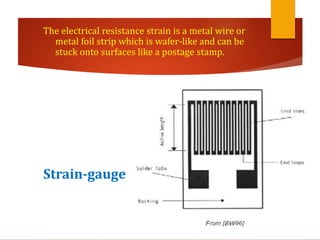
Strain-gauge
The electrical resistance strain is a metal wire or
metal foil strip which is wafer-like and can be
stuck onto surfaces like a postage stamp.
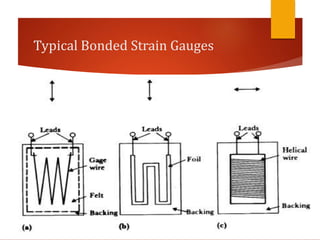
Typical Bonded Strain Gauges
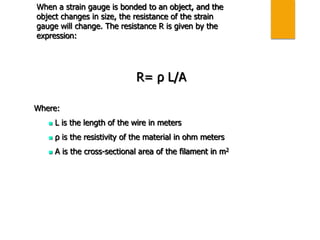
When a strain gauge is bonded to an object, and the
object changes in size, the resistance of the strain
gauge will change. The resistance R is given by the
expression:
R= ρ L/A
Where:
 L is the length of the wire in meters
 ρ is the resistivity of the material in ohm meters
 A is the cross-sectional area of the filament in m2
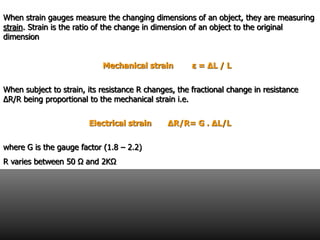
When strain gauges measure the changing dimensions of an object, they are measuring
strain. Strain is the ratio of the change in dimension of an object to the original
dimension
Mechanical strain ε = ΔL / L
When subject to strain, its resistance R changes, the fractional change in resistance
ΔR/R being proportional to the mechanical strain i.e.
Electrical strain ΔR/R= G . ΔL/L
where G is the gauge factor (1.8 – 2.2)
R varies between 50 Ω and 2KΩ
TYPES
Based on construction :
• Foil strain gauge
• Semiconductor strain gauge
• Photoelectric Strain gauge
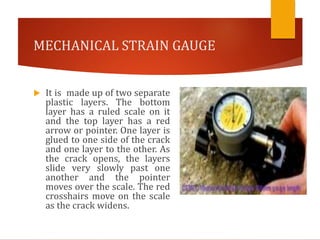
MECHANICAL STRAIN GAUGE
 It is made up of two separate
plastic layers. The bottom
layer has a ruled scale on it
and the top layer has a red
arrow or pointer. One layer is
glued to one side of the crack
and one layer to the other. As
the crack opens, the layers
slide very slowly past one
another and the pointer
moves over the scale. The red
crosshairs move on the scale
as the crack widens.
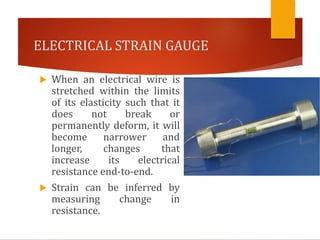
ELECTRICAL STRAIN GAUGE
 When an electrical wire is
stretched within the limits
of its elasticity such that it
does not break or
permanently deform, it will
become narrower and
longer, changes that
increase its electrical
resistance end-to-end.
 Strain can be inferred by
measuring change in
resistance.
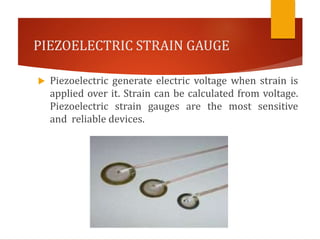
PIEZOELECTRIC STRAIN GAUGE
 Piezoelectric generate electric voltage when strain is
applied over it. Strain can be calculated from voltage.
Piezoelectric strain gauges are the most sensitive
and reliable devices.
BONDED STRAIN GAUGE
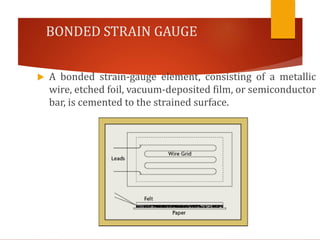
 A bonded strain-gauge element, consisting of a metallic
wire, etched foil, vacuum-deposited film, or semiconductor
bar, is cemented to the strained surface.
UNBONDED STRAIN GAUGE
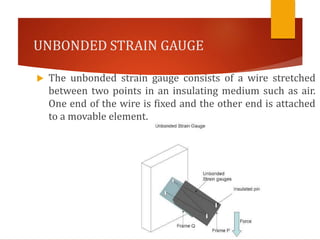
 The unbonded strain gauge consists of a wire stretched
between two points in an insulating medium such as air.
One end of the wire is fixed and the other end is attached
to a movable element.
Wheatstone Bridge Method
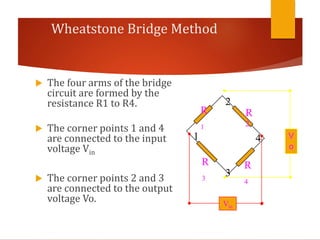
 The four arms of the bridge
circuit are formed by the
resistance R1 to R4.
 The corner points 1 and 4
are connected to the input
voltage Vin
 The corner points 2 and 3
are connected to the output
voltage Vo.
1
2
4
3
R
2
R
1
R
3
R
4
V
o
Vin
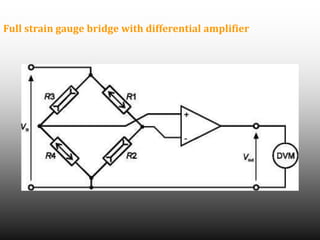
Full strain gauge bridge with differential amplifier
Strain Gages - Review
 Strain = Elongation / Original Length
 Change in length = Change in electrical resistance
 Electrical Resistance change is very small, too small to be
accurately measured using ordinary voltmeters
Wheatstone Bridge
 Converts a change in electrical resistance from a strain gage to a change
in voltage
 Changes in strain are linearly related to a change in voltage output
 Voltage change is too small to be accurately measured and for this
reason an amplifier is used
Assignment
 ***** What is Strain Gauge? What is gauge factor? Show that

Strain Gauges

  • 1.
  • 2.
    Strain  When aforce is applied to a structure, the components of the structure change slightly in their dimensions and are said to be strained. Devices to measure these small changes in dimensions are called strain gauges.
  • 3.
    Strain-gauge The electrical resistancestrain is a metal wire or metal foil strip which is wafer-like and can be stuck onto surfaces like a postage stamp.
  • 4.
  • 5.
    When a straingauge is bonded to an object, and the object changes in size, the resistance of the strain gauge will change. The resistance R is given by the expression: R= ρ L/A Where:  L is the length of the wire in meters  ρ is the resistivity of the material in ohm meters  A is the cross-sectional area of the filament in m2
  • 6.
    When strain gaugesmeasure the changing dimensions of an object, they are measuring strain. Strain is the ratio of the change in dimension of an object to the original dimension Mechanical strain ε = ΔL / L When subject to strain, its resistance R changes, the fractional change in resistance ΔR/R being proportional to the mechanical strain i.e. Electrical strain ΔR/R= G . ΔL/L where G is the gauge factor (1.8 – 2.2) R varies between 50 Ω and 2KΩ
  • 10.
    TYPES Based on construction: • Foil strain gauge • Semiconductor strain gauge • Photoelectric Strain gauge
  • 11.
    MECHANICAL STRAIN GAUGE It is made up of two separate plastic layers. The bottom layer has a ruled scale on it and the top layer has a red arrow or pointer. One layer is glued to one side of the crack and one layer to the other. As the crack opens, the layers slide very slowly past one another and the pointer moves over the scale. The red crosshairs move on the scale as the crack widens.
  • 12.
    ELECTRICAL STRAIN GAUGE When an electrical wire is stretched within the limits of its elasticity such that it does not break or permanently deform, it will become narrower and longer, changes that increase its electrical resistance end-to-end.  Strain can be inferred by measuring change in resistance.
  • 13.
    PIEZOELECTRIC STRAIN GAUGE Piezoelectric generate electric voltage when strain is applied over it. Strain can be calculated from voltage. Piezoelectric strain gauges are the most sensitive and reliable devices.
  • 14.
    BONDED STRAIN GAUGE A bonded strain-gauge element, consisting of a metallic wire, etched foil, vacuum-deposited film, or semiconductor bar, is cemented to the strained surface.
  • 15.
    UNBONDED STRAIN GAUGE The unbonded strain gauge consists of a wire stretched between two points in an insulating medium such as air. One end of the wire is fixed and the other end is attached to a movable element.
  • 16.
    Wheatstone Bridge Method The four arms of the bridge circuit are formed by the resistance R1 to R4.  The corner points 1 and 4 are connected to the input voltage Vin  The corner points 2 and 3 are connected to the output voltage Vo. 1 2 4 3 R 2 R 1 R 3 R 4 V o Vin
  • 17.
    Full strain gaugebridge with differential amplifier
  • 18.
    Strain Gages -Review  Strain = Elongation / Original Length  Change in length = Change in electrical resistance  Electrical Resistance change is very small, too small to be accurately measured using ordinary voltmeters
  • 19.
    Wheatstone Bridge  Convertsa change in electrical resistance from a strain gage to a change in voltage  Changes in strain are linearly related to a change in voltage output  Voltage change is too small to be accurately measured and for this reason an amplifier is used
  • 20.
    Assignment  ***** Whatis Strain Gauge? What is gauge factor? Show that