Reading 101


Important Phonics Principles
Learning Objectives

    To understand the key rules behind letter sounds

    To apply these rules in spelling and reading
Introduction

    You have learnt that a good awareness of letter
    sounds will help you in spelling.

    Called Phonemic Awareness, it will help you
    when you're converting sound to text.

    Recall that you've studied about Consonant
    Blends, Digraphs and Trigraphs in the earlier
    lesson.

    They show you that NOT all letters that
    represent phonemes are single letters.
Digraphs, Trigraphs & Blends
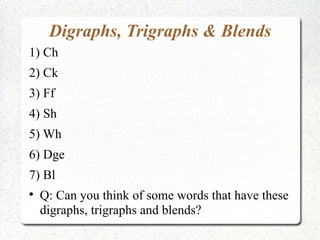
1) Ch
2) Ck
3) Ff
4) Sh
5) Wh
6) Dge
7) Bl

    Q: Can you think of some words that have these
    digraphs, trigraphs and blends?
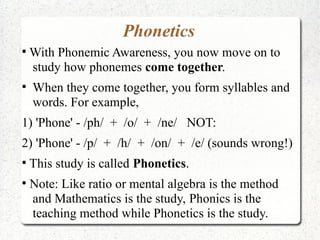
Phonetics
●
    With Phonemic Awareness, you now move on to
    study how phonemes come together.
●
    When they come together, you form syllables and
    words. For example,
1) 'Phone' - /ph/ + /o/ + /ne/ NOT:
2) 'Phone' - /p/ + /h/ + /on/ + /e/ (sounds wrong!)
●
    This study is called Phonetics.
●
    Note: Like ratio or mental algebra is the method
    and Mathematics is the study, Phonics is the
    teaching method while Phonetics is the study.
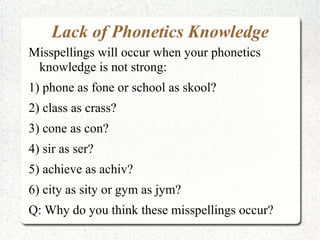
Lack of Phonetics Knowledge
Misspellings will occur when your phonetics
 knowledge is not strong:
1) phone as fone or school as skool?
2) class as crass?
3) cone as con?
4) sir as ser?
5) achieve as achiv?
6) city as sity or gym as jym?
Q: Why do you think these misspellings occur?
Phonetics Principles

    Phonetics guide us in giving us principles
    when spelling.

    This means that we can be more confident
    when we are spelling.

    We will look at 5 Phonetics Principles.
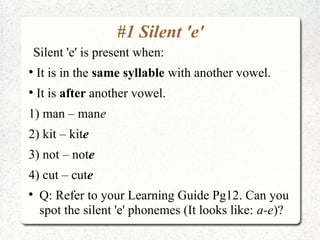
#1 Silent 'e'
    Silent 'e' is present when:
●
    It is in the same syllable with another vowel.
●
    It is after another vowel.
1) man – mane
2) kit – kite
3) not – note
4) cut – cute

     Q: Refer to your Learning Guide Pg12. Can you
     spot the silent 'e' phonemes (It looks like: a-e)?
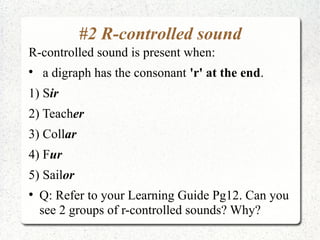
#2 R-controlled sound
R-controlled sound is present when:

    a digraph has the consonant 'r' at the end.
1) Sir
2) Teacher
3) Collar
4) Fur
5) Sailor
●
    Q: Refer to your Learning Guide Pg12. Can you
    see 2 groups of r-controlled sounds? Why?
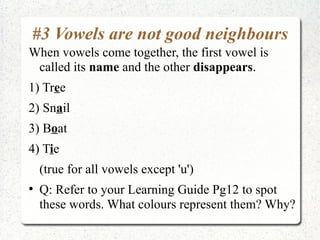
#3 Vowels are not good neighbours
When vowels come together, the first vowel is
 called its name and the other disappears.
1) Tree
2) Snail
3) Boat
4) Tie
    (true for all vowels except 'u')
●
    Q: Refer to your Learning Guide Pg12 to spot
    these words. What colours represent them? Why?
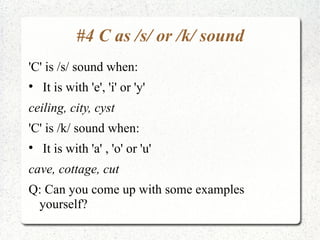
#4 C as /s/ or /k/ sound
'C' is /s/ sound when:

    It is with 'e', 'i' or 'y'
ceiling, city, cyst
'C' is /k/ sound when:

    It is with 'a' , 'o' or 'u'
cave, cottage, cut
Q: Can you come up with some examples
 yourself?
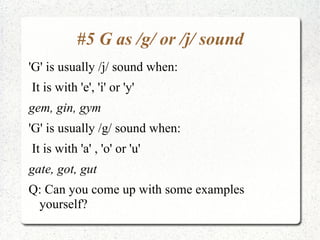
#5 G as /g/ or /j/ sound
'G' is usually /j/ sound when:
It is with 'e', 'i' or 'y'
gem, gin, gym
'G' is usually /g/ sound when:
It is with 'a' , 'o' or 'u'
gate, got, gut
Q: Can you come up with some examples
 yourself?
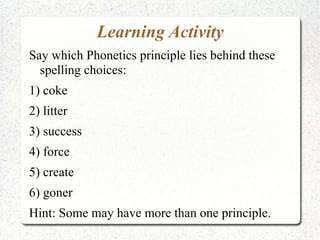
Learning Activity
Say which Phonetics principle lies behind these
  spelling choices:
1) coke
2) litter
3) success
4) force
5) create
6) goner
Hint: Some may have more than one principle.
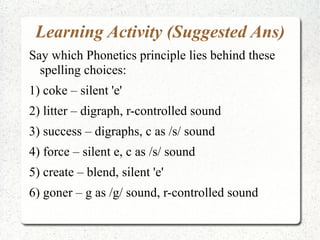
Learning Activity (Suggested Ans)
Say which Phonetics principle lies behind these
  spelling choices:
1) coke – silent 'e'
2) litter – digraph, r-controlled sound
3) success – digraphs, c as /s/ sound
4) force – silent e, c as /s/ sound
5) create – blend, silent 'e'
6) goner – g as /g/ sound, r-controlled sound
Discussion
What is Phonetics?
Why is it important in spelling and reading?
Write down as many phonetics principles as you
 can remember.
In summary
Phonetics is the study of how letter sounds or
  phonemes come together.
It is important as it provides us with principles in
   making the correct spelling choices.
Some of the important principles are:
Digraphs, Trigraphs, Blends, Silent 'e', r-
 controlled sound and /c/ and /g/ with different
 sounds.

LL Upper Pri A - Phonology Principles

  • 1.
  • 2.
    Learning Objectives  To understand the key rules behind letter sounds  To apply these rules in spelling and reading
  • 3.
    Introduction  You have learnt that a good awareness of letter sounds will help you in spelling.  Called Phonemic Awareness, it will help you when you're converting sound to text.  Recall that you've studied about Consonant Blends, Digraphs and Trigraphs in the earlier lesson.  They show you that NOT all letters that represent phonemes are single letters.
  • 4.
    Digraphs, Trigraphs &Blends 1) Ch 2) Ck 3) Ff 4) Sh 5) Wh 6) Dge 7) Bl  Q: Can you think of some words that have these digraphs, trigraphs and blends?
  • 5.
    Phonetics ● With Phonemic Awareness, you now move on to study how phonemes come together. ● When they come together, you form syllables and words. For example, 1) 'Phone' - /ph/ + /o/ + /ne/ NOT: 2) 'Phone' - /p/ + /h/ + /on/ + /e/ (sounds wrong!) ● This study is called Phonetics. ● Note: Like ratio or mental algebra is the method and Mathematics is the study, Phonics is the teaching method while Phonetics is the study.
  • 6.
    Lack of PhoneticsKnowledge Misspellings will occur when your phonetics knowledge is not strong: 1) phone as fone or school as skool? 2) class as crass? 3) cone as con? 4) sir as ser? 5) achieve as achiv? 6) city as sity or gym as jym? Q: Why do you think these misspellings occur?
  • 7.
    Phonetics Principles  Phonetics guide us in giving us principles when spelling.  This means that we can be more confident when we are spelling.  We will look at 5 Phonetics Principles.
  • 8.
    #1 Silent 'e' Silent 'e' is present when: ● It is in the same syllable with another vowel. ● It is after another vowel. 1) man – mane 2) kit – kite 3) not – note 4) cut – cute  Q: Refer to your Learning Guide Pg12. Can you spot the silent 'e' phonemes (It looks like: a-e)?
  • 9.
    #2 R-controlled sound R-controlledsound is present when:  a digraph has the consonant 'r' at the end. 1) Sir 2) Teacher 3) Collar 4) Fur 5) Sailor ● Q: Refer to your Learning Guide Pg12. Can you see 2 groups of r-controlled sounds? Why?
  • 10.
    #3 Vowels arenot good neighbours When vowels come together, the first vowel is called its name and the other disappears. 1) Tree 2) Snail 3) Boat 4) Tie (true for all vowels except 'u') ● Q: Refer to your Learning Guide Pg12 to spot these words. What colours represent them? Why?
  • 11.
    #4 C as/s/ or /k/ sound 'C' is /s/ sound when:  It is with 'e', 'i' or 'y' ceiling, city, cyst 'C' is /k/ sound when:  It is with 'a' , 'o' or 'u' cave, cottage, cut Q: Can you come up with some examples yourself?
  • 12.
    #5 G as/g/ or /j/ sound 'G' is usually /j/ sound when: It is with 'e', 'i' or 'y' gem, gin, gym 'G' is usually /g/ sound when: It is with 'a' , 'o' or 'u' gate, got, gut Q: Can you come up with some examples yourself?
  • 13.
    Learning Activity Say whichPhonetics principle lies behind these spelling choices: 1) coke 2) litter 3) success 4) force 5) create 6) goner Hint: Some may have more than one principle.
  • 14.
    Learning Activity (SuggestedAns) Say which Phonetics principle lies behind these spelling choices: 1) coke – silent 'e' 2) litter – digraph, r-controlled sound 3) success – digraphs, c as /s/ sound 4) force – silent e, c as /s/ sound 5) create – blend, silent 'e' 6) goner – g as /g/ sound, r-controlled sound
  • 15.
    Discussion What is Phonetics? Whyis it important in spelling and reading? Write down as many phonetics principles as you can remember.
  • 16.
    In summary Phonetics isthe study of how letter sounds or phonemes come together. It is important as it provides us with principles in making the correct spelling choices. Some of the important principles are: Digraphs, Trigraphs, Blends, Silent 'e', r- controlled sound and /c/ and /g/ with different sounds.