Languagelab 2.4
Master Blending
Introduction
Recall that phonemes are the smallest sound
units in a word.
The simplest word in English has one
phoneme and one syllable:
I & A
I like you.
A dog is barking.
Some of the simplest words have three
phonemes: cat, sun, pan, fan, hot.
Auditory Skills
The speed and accuracy - how fast and how
well – in which you convert sounds to
letters or spell is determined by your
Auditory Skills.
Like any skill, you need focus and practice.
Over time, it becomes automatic as you can
read quickly and accurately without much
thinking.
Basic Auditory Skills
We started with the easy letter sounds first.
For all the vowels in our exercises , we
used Short Monophthongs as our
practice:
/a/ as in 'ant'
/e/ as in 'bed'
/i/ as in 'tin'
/o/ as in 'frog'
/u/ as in 'bus' d
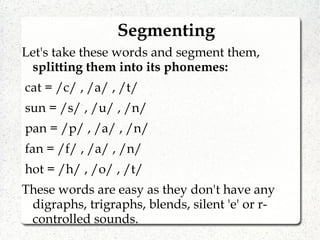
Segmenting
Let's take these words and segment them,
splitting them into its phonemes:
cat = /c/ , /a/ , /t/
sun = /s/ , /u/ , /n/
pan = /p/ , /a/ , /n/
fan = /f/ , /a/ , /n/
hot = /h/ , /o/ , /t/
These words are easy as they don't have any
digraphs, trigraphs, blends, silent 'e' or r-
controlled sounds.
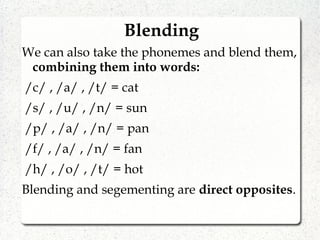
Blending
We can also take the phonemes and blend them,
combining them into words:
/c/ , /a/ , /t/ = cat
/s/ , /u/ , /n/ = sun
/p/ , /a/ , /n/ = pan
/f/ , /a/ , /n/ = fan
/h/ , /o/ , /t/ = hot
Blending and segementing are direct opposites.
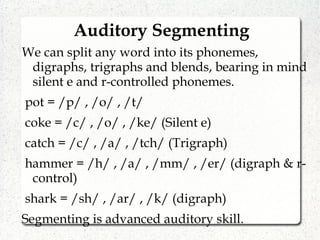
Auditory Segmenting
We can split any word into its phonemes,
digraphs, trigraphs and blends, bearing in mind
silent e and r-controlled phonemes.
pot = /p/ , /o/ , /t/
coke = /c/ , /o/ , /ke/ (Silent e)
catch = /c/ , /a/ , /tch/ (Trigraph)
hammer = /h/ , /a/ , /mm/ , /er/ (digraph & r-
control)
shark = /sh/ , /ar/ , /k/ (digraph)
Segmenting is advanced auditory skill.
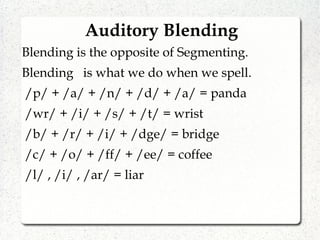
Auditory Blending
Blending is the opposite of Segmenting.
Blending is what we do when we spell.
/p/ + /a/ + /n/ + /d/ + /a/ = panda
/wr/ + /i/ + /s/ + /t/ = wrist
/b/ + /r/ + /i/ + /dge/ = bridge
/c/ + /o/ + /ff/ + /ee/ = coffee
/l/ , /i/ , /ar/ = liar
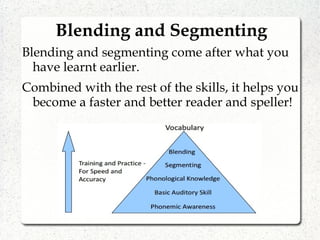
Blending and Segmenting
Blending and segmenting come after what you
have learnt earlier.
Combined with the rest of the skills, it helps you
become a faster and better reader and speller!
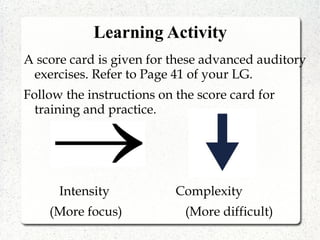
Learning Activity
A score card is given for these advanced auditory
exercises. Refer to Page 41 of your LG.
Follow the instructions on the score card for
training and practice.
Intensity Complexity
(More focus) (More difficult)
Learning Milestones
What is Auditory Segmenting?
What is Auditory Blending?
What are the basic skills we must have before
we learn these two advanced skills?
Learning Milestones Check
Auditory Blending is the combining of letter
sounds into words
Auditory Segmenting is the separation of words
into letter sounds
Both are built on our phonemic awareness and
phonological knowledge
More on Blending
Buy: www.languagelab.sg/books
(LG2)
Discuss:
www.facebook.com/languagelabgroup
Experience: Playwerkz @ Playstore

Languagelab 2.4 - Master Blending

  • 1.
  • 2.
    Introduction Recall that phonemesare the smallest sound units in a word. The simplest word in English has one phoneme and one syllable: I & A I like you. A dog is barking. Some of the simplest words have three phonemes: cat, sun, pan, fan, hot.
  • 3.
    Auditory Skills The speedand accuracy - how fast and how well – in which you convert sounds to letters or spell is determined by your Auditory Skills. Like any skill, you need focus and practice. Over time, it becomes automatic as you can read quickly and accurately without much thinking.
  • 4.
    Basic Auditory Skills Westarted with the easy letter sounds first. For all the vowels in our exercises , we used Short Monophthongs as our practice: /a/ as in 'ant' /e/ as in 'bed' /i/ as in 'tin' /o/ as in 'frog' /u/ as in 'bus' d
  • 5.
    Segmenting Let's take thesewords and segment them, splitting them into its phonemes: cat = /c/ , /a/ , /t/ sun = /s/ , /u/ , /n/ pan = /p/ , /a/ , /n/ fan = /f/ , /a/ , /n/ hot = /h/ , /o/ , /t/ These words are easy as they don't have any digraphs, trigraphs, blends, silent 'e' or r- controlled sounds.
  • 6.
    Blending We can alsotake the phonemes and blend them, combining them into words: /c/ , /a/ , /t/ = cat /s/ , /u/ , /n/ = sun /p/ , /a/ , /n/ = pan /f/ , /a/ , /n/ = fan /h/ , /o/ , /t/ = hot Blending and segementing are direct opposites.
  • 7.
    Auditory Segmenting We cansplit any word into its phonemes, digraphs, trigraphs and blends, bearing in mind silent e and r-controlled phonemes. pot = /p/ , /o/ , /t/ coke = /c/ , /o/ , /ke/ (Silent e) catch = /c/ , /a/ , /tch/ (Trigraph) hammer = /h/ , /a/ , /mm/ , /er/ (digraph & r- control) shark = /sh/ , /ar/ , /k/ (digraph) Segmenting is advanced auditory skill.
  • 8.
    Auditory Blending Blending isthe opposite of Segmenting. Blending is what we do when we spell. /p/ + /a/ + /n/ + /d/ + /a/ = panda /wr/ + /i/ + /s/ + /t/ = wrist /b/ + /r/ + /i/ + /dge/ = bridge /c/ + /o/ + /ff/ + /ee/ = coffee /l/ , /i/ , /ar/ = liar
  • 9.
    Blending and Segmenting Blendingand segmenting come after what you have learnt earlier. Combined with the rest of the skills, it helps you become a faster and better reader and speller!
  • 10.
    Learning Activity A scorecard is given for these advanced auditory exercises. Refer to Page 41 of your LG. Follow the instructions on the score card for training and practice. Intensity Complexity (More focus) (More difficult)
  • 11.
    Learning Milestones What isAuditory Segmenting? What is Auditory Blending? What are the basic skills we must have before we learn these two advanced skills?
  • 12.
    Learning Milestones Check AuditoryBlending is the combining of letter sounds into words Auditory Segmenting is the separation of words into letter sounds Both are built on our phonemic awareness and phonological knowledge
  • 13.
    More on Blending Buy:www.languagelab.sg/books (LG2) Discuss: www.facebook.com/languagelabgroup Experience: Playwerkz @ Playstore