Sea Mills Primary School
Phonics Workshop
To help you to understand why we teach
phonics.
To help you understand the progression in
phonics teaching throughout the school.
To give you an understanding of how we teach
phonics.
To help you in supporting your child/children at
home.
Aims of the workshop
Why do we teach phonics?
Phonics is a way of teaching children to read and
write quickly and skilfully.
They are taught how to:
Recognise the sounds that each individual letter
makes;
Identify the sounds that different combinations
of letters make, such as ‘sh’ or ‘ch’;
Blend these sounds together to make a word.
At school, the children will be
taught phonics following the
Letters and Sounds scheme.
The children will use language such
as phoneme and grapheme.
Not the letter names.
Phoneme
• A phoneme is the sound a letter makes.
• When we are reading cat or pin we sound
out using the phonemes:
c-a-t or p-i-n
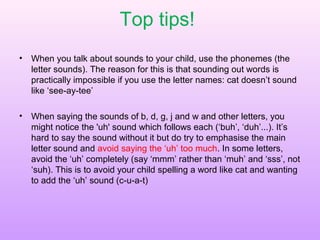
Top tips!
• When you talk about sounds to your child, use the phonemes (the
letter sounds). The reason for this is that sounding out words is
practically impossible if you use the letter names: cat doesn’t sound
like ‘see-ay-tee’
• When saying the sounds of b, d, g, j and w and other letters, you
might notice the 'uh' sound which follows each (‘buh’, ‘duh’...). It’s
hard to say the sound without it but do try to emphasise the main
letter sound and avoid saying the ‘uh’ too much. In some letters,
avoid the ‘uh’ completely (say ‘mmm’ rather than ‘muh’ and ‘sss’, not
‘suh). This is to avoid your child spelling a word like cat and wanting
to add the ‘uh’ sound (c-u-a-t)
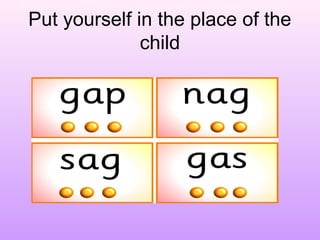
Put yourself in the place of the
child
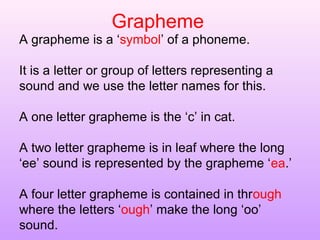
Grapheme
A grapheme is a ‘symbol’ of a phoneme.
It is a letter or group of letters representing a
sound and we use the letter names for this.
A one letter grapheme is the ‘c’ in cat.
A two letter grapheme is in leaf where the long
‘ee’ sound is represented by the grapheme ‘ea.’
A four letter grapheme is contained in through
where the letters ‘ough’ make the long ‘oo’
sound.
Activity
• Spot the graphemes with more than 1
letter representing a sound
(there may be more than one in the word)
leaf swish feel wicked
quick chick king night goat
floating show snowing
Quick Check
leaf swish feel flick
quick chick king night goat
floating sh/ow snowing
• Letters and Sounds is divided into six phases,
• Children in Year R, Year 1 and Year 2 have
daily phonics sessions
• Nursery – Phase 1
• Reception – Phase 2, 3, 4
• Year 1 – Phase 4, 5
• Year 2 – Phase 5, 6
A typical phonics lesson
1. Revisit/Review – practise previously learned sounds
2. Teach – Teach a new sound. Teach one or two new
tricky words.
3. Practise – Practise blending and reading words with
the new sound. Practise segmenting for spelling
words with the new sound.
4. Apply – Read or write a caption or sentence using
one or more tricky words and words containing the
sound.
Skills
• Blending – joining a series of sounds together
to make a word
• In order to read an unfamiliar word, a child
must link a phoneme to each letter
(grapheme) or letter group (digraph, trigraph)
in a word and then merge them together to
say the word. This is a vital skill for reading.
•c – a – t sh – o – p t– ai – l
•n –igh- t Decode = to read words.
Segmenting
• Segmenting – breaking words down into phonemes to
spell (so, the opposite process to blending). The whole
word is spoken aloud and then broken up into its sounds
(phonemes) in order, all through the word - this is a vital
skill for spelling.
• Encoding = spell words.
• For example,
crash has 4 phonemes c – r – a – sh
Phase 1
• Daily speaking and listening activities
• A broad and rich language
experience/environment
• Story, rhyme, drama and songs are an
essential part of the phase
• Hearing sounds in the environment
• Alliteration
• Start segmenting words
• Starts in Nursery (and before)
• Watch Clip
Phase 2
• Introduces 19 grapheme-phoneme
correspondences
• Decoding and encoding taught as a reversible
process.
• As soon as children have a small number of
grapheme-phoneme correspondences, blending
and segmenting can start (s-a-t-p-i-n)
• Start with simple 2 letter words such as: am
• Then 3 letter words such as pat
• Tricky words
Phase two sounds
• Set 1: s, a, t, p
Set 2: i, n, m, d
Set 3: g, o, c, k
Set 4: ck, e, u, r
Set 5: h, b, f, ff, l, ll, ss
(no schwa – uh sound) show Mr Thorne
Phase two tricky words
• no
• go
• I
• to
• in
• Into
• Phonics play using ipads: Grab a Giggling Phoneme/
explore phase 2 games on the tables.
Phase 3
• Introduces another 25 graphemes
• Most comprising two letters
• Reading and spelling two syllable words
and captions
J v
x
w
y
z zz qu
ch sh th ng
ai ee igh oa
oo ar or ur
ow oi ear air
ure er
Phase three tricky words
he, she, we, me, be, was
you, they, all, are, my, her
Play on ipads: Picnic on Pluto/ explore phase 3 games
Phase 4
• Phase Four continues to
revise all the sounds learned
so far and uses them in longer
words known as ccvcs and
cvccs eg. shed, toast and
bread.
• The children are continually
reading, writing and using the
words in simple sentences.
Phase four tricky words
said, have, like, so, do
some, come, were, there
little, one, when, out, what
Phase 5
• Looks at alternative spellings for each sound and helps
the children recognise which spelling pattern they need
to use: ai, a, ay, ey, eigh a-e, e-e, ea
• The children learn about homographs words which are
spelt the same but are pronounced differently depending
on the context
• Wind the bobbin up – the wind blew
• You have to bow when you meet the queen – Robin
Hood used a bow and arrow
• And homophones words that are pronounced the same
but have different spelling patterns, such as great and
grate or break and brake
• Phase five also looks at syllables in words and
compound words like greenhouse, laptop and bookcase
Phase five sounds
a-e (as in came) au (as in Paul) aw (as in saw)
ay (as in day) e-e (as in these) ea (as in sea)
ew (as in chew) ew (as stew) ey (as in money)
i-e (as in like) ie (as in pie) ir (as in girl)
o-e (as in bone) oe (as in toe) ou (as in out)
oy (as in boy) ph (as in Phil) u-e (as in June)
u-e (as in huge) ue (as in clue) ue (as in due)
wh (as in when)
Phase five tricky words
Oh, their, people, Mr
Mrs, looked, called, asked
could
Ipads: Play cheeky chimps
Phase 6
• During this phase children become fluent readers and
increasingly accurate spellers
• Children should be able to read hundreds of words
• Recognising phonic irregularities
• Learn less common sounds
• Applying phonic skills & knowledge to recognise & spell
complex words
• Past tense
• Suffixes
• Spelling long words
• Finding and learning the difficult bits in words
• Play phonics play: phase 6 planetary plurals
How can I help at home?
• Read, Read, Read!
• Listen, listen, listen!
• Encourage children to speak in full sentences.
• Flash cards- show children sound cards, key word cards and see how quickly they
can read them by sight.
• Help your child with learning their spellings and completing homework tasks.
(magnetic letters on the fridge, chalks outside, bubbles in the bath, make sounds with
food on their plate etc.
• Play games- I Spy, Scrabble and Bingo, pairs.
• Play with sounds- Say words and talk about what sounds they can hear, can the
children change the sounds to make it a different word (bright = gright)
• Play educational games on the computer or i-pad
• Encourage children to write for a purpose e.g. write a postcard when on holiday; write
a letter to teacher/parents, shopping/present lists, reminders etc.
• Pick out letters, sounds and words in the environment. Having familiar words around
the house and in children’s bedrooms will help them memorise the spellings.
• Practise spellings on the way to school.
• Make it FUN!!!!!!!!
Websites
• http://www.phonicsplay.co.uk/
• http://www.letters-and-sounds.com/
• http://www.crickweb.co.uk/
• http://www.mrthorne.com
• http://www.ictgames.com/literacy.html
• http://www.bbc.co.uk/schools/magickey/ad
ventures/index.shtml
Ways to help at home
• Pairs
• Snap
• Alphabet shopping
• I spy
• Make words using their toys (put stickers with letters
on onto cars or blocks and use them to make words)
• Dice words
• Magnetic letters
• Hangman
Phonics pack
• Whiteboard and pen
• Grids for spelling Consonant Vowel Consonant
(CVC) words
• Flash cards of phase 2 and phase 3 sounds
• Phase 2 and phase 3 sound mat
• Examples of nonsense words
• Progression sheet
• Different spellings of the same phoneme
Books for sale
• Phonics books - £2.00
• Reading books - £2.00
• Please see your class teacher to find out
what phase your child is working within
and what their next steps are.
Any questions?
Evaluation form
• Please can you fill in to give us some
feedback!
Thank you for coming

Phonics september 2015

  • 1.
    Sea Mills PrimarySchool Phonics Workshop
  • 2.
    To help youto understand why we teach phonics. To help you understand the progression in phonics teaching throughout the school. To give you an understanding of how we teach phonics. To help you in supporting your child/children at home. Aims of the workshop
  • 3.
    Why do weteach phonics? Phonics is a way of teaching children to read and write quickly and skilfully. They are taught how to: Recognise the sounds that each individual letter makes; Identify the sounds that different combinations of letters make, such as ‘sh’ or ‘ch’; Blend these sounds together to make a word.
  • 4.
    At school, thechildren will be taught phonics following the Letters and Sounds scheme. The children will use language such as phoneme and grapheme. Not the letter names.
  • 5.
    Phoneme • A phonemeis the sound a letter makes. • When we are reading cat or pin we sound out using the phonemes: c-a-t or p-i-n
  • 6.
    Top tips! • Whenyou talk about sounds to your child, use the phonemes (the letter sounds). The reason for this is that sounding out words is practically impossible if you use the letter names: cat doesn’t sound like ‘see-ay-tee’ • When saying the sounds of b, d, g, j and w and other letters, you might notice the 'uh' sound which follows each (‘buh’, ‘duh’...). It’s hard to say the sound without it but do try to emphasise the main letter sound and avoid saying the ‘uh’ too much. In some letters, avoid the ‘uh’ completely (say ‘mmm’ rather than ‘muh’ and ‘sss’, not ‘suh). This is to avoid your child spelling a word like cat and wanting to add the ‘uh’ sound (c-u-a-t)
  • 7.
    Put yourself inthe place of the child
  • 8.
    Grapheme A grapheme isa ‘symbol’ of a phoneme. It is a letter or group of letters representing a sound and we use the letter names for this. A one letter grapheme is the ‘c’ in cat. A two letter grapheme is in leaf where the long ‘ee’ sound is represented by the grapheme ‘ea.’ A four letter grapheme is contained in through where the letters ‘ough’ make the long ‘oo’ sound.
  • 9.
    Activity • Spot thegraphemes with more than 1 letter representing a sound (there may be more than one in the word) leaf swish feel wicked quick chick king night goat floating show snowing
  • 10.
    Quick Check leaf swishfeel flick quick chick king night goat floating sh/ow snowing
  • 11.
    • Letters andSounds is divided into six phases, • Children in Year R, Year 1 and Year 2 have daily phonics sessions • Nursery – Phase 1 • Reception – Phase 2, 3, 4 • Year 1 – Phase 4, 5 • Year 2 – Phase 5, 6
  • 12.
    A typical phonicslesson 1. Revisit/Review – practise previously learned sounds 2. Teach – Teach a new sound. Teach one or two new tricky words. 3. Practise – Practise blending and reading words with the new sound. Practise segmenting for spelling words with the new sound. 4. Apply – Read or write a caption or sentence using one or more tricky words and words containing the sound.
  • 13.
    Skills • Blending –joining a series of sounds together to make a word • In order to read an unfamiliar word, a child must link a phoneme to each letter (grapheme) or letter group (digraph, trigraph) in a word and then merge them together to say the word. This is a vital skill for reading. •c – a – t sh – o – p t– ai – l •n –igh- t Decode = to read words.
  • 14.
    Segmenting • Segmenting –breaking words down into phonemes to spell (so, the opposite process to blending). The whole word is spoken aloud and then broken up into its sounds (phonemes) in order, all through the word - this is a vital skill for spelling. • Encoding = spell words. • For example, crash has 4 phonemes c – r – a – sh
  • 15.
    Phase 1 • Dailyspeaking and listening activities • A broad and rich language experience/environment • Story, rhyme, drama and songs are an essential part of the phase • Hearing sounds in the environment • Alliteration • Start segmenting words • Starts in Nursery (and before) • Watch Clip
  • 16.
    Phase 2 • Introduces19 grapheme-phoneme correspondences • Decoding and encoding taught as a reversible process. • As soon as children have a small number of grapheme-phoneme correspondences, blending and segmenting can start (s-a-t-p-i-n) • Start with simple 2 letter words such as: am • Then 3 letter words such as pat • Tricky words
  • 17.
    Phase two sounds •Set 1: s, a, t, p Set 2: i, n, m, d Set 3: g, o, c, k Set 4: ck, e, u, r Set 5: h, b, f, ff, l, ll, ss (no schwa – uh sound) show Mr Thorne
  • 18.
    Phase two trickywords • no • go • I • to • in • Into • Phonics play using ipads: Grab a Giggling Phoneme/ explore phase 2 games on the tables.
  • 19.
    Phase 3 • Introducesanother 25 graphemes • Most comprising two letters • Reading and spelling two syllable words and captions
  • 20.
  • 21.
    ch sh thng ai ee igh oa oo ar or ur ow oi ear air ure er
  • 22.
    Phase three trickywords he, she, we, me, be, was you, they, all, are, my, her Play on ipads: Picnic on Pluto/ explore phase 3 games
  • 23.
    Phase 4 • PhaseFour continues to revise all the sounds learned so far and uses them in longer words known as ccvcs and cvccs eg. shed, toast and bread. • The children are continually reading, writing and using the words in simple sentences.
  • 24.
    Phase four trickywords said, have, like, so, do some, come, were, there little, one, when, out, what
  • 25.
    Phase 5 • Looksat alternative spellings for each sound and helps the children recognise which spelling pattern they need to use: ai, a, ay, ey, eigh a-e, e-e, ea • The children learn about homographs words which are spelt the same but are pronounced differently depending on the context • Wind the bobbin up – the wind blew • You have to bow when you meet the queen – Robin Hood used a bow and arrow • And homophones words that are pronounced the same but have different spelling patterns, such as great and grate or break and brake • Phase five also looks at syllables in words and compound words like greenhouse, laptop and bookcase
  • 26.
    Phase five sounds a-e(as in came) au (as in Paul) aw (as in saw) ay (as in day) e-e (as in these) ea (as in sea) ew (as in chew) ew (as stew) ey (as in money) i-e (as in like) ie (as in pie) ir (as in girl) o-e (as in bone) oe (as in toe) ou (as in out) oy (as in boy) ph (as in Phil) u-e (as in June) u-e (as in huge) ue (as in clue) ue (as in due) wh (as in when)
  • 27.
    Phase five trickywords Oh, their, people, Mr Mrs, looked, called, asked could Ipads: Play cheeky chimps
  • 28.
    Phase 6 • Duringthis phase children become fluent readers and increasingly accurate spellers • Children should be able to read hundreds of words • Recognising phonic irregularities • Learn less common sounds • Applying phonic skills & knowledge to recognise & spell complex words • Past tense • Suffixes • Spelling long words • Finding and learning the difficult bits in words • Play phonics play: phase 6 planetary plurals
  • 29.
    How can Ihelp at home? • Read, Read, Read! • Listen, listen, listen! • Encourage children to speak in full sentences. • Flash cards- show children sound cards, key word cards and see how quickly they can read them by sight. • Help your child with learning their spellings and completing homework tasks. (magnetic letters on the fridge, chalks outside, bubbles in the bath, make sounds with food on their plate etc. • Play games- I Spy, Scrabble and Bingo, pairs. • Play with sounds- Say words and talk about what sounds they can hear, can the children change the sounds to make it a different word (bright = gright) • Play educational games on the computer or i-pad • Encourage children to write for a purpose e.g. write a postcard when on holiday; write a letter to teacher/parents, shopping/present lists, reminders etc. • Pick out letters, sounds and words in the environment. Having familiar words around the house and in children’s bedrooms will help them memorise the spellings. • Practise spellings on the way to school. • Make it FUN!!!!!!!!
  • 30.
    Websites • http://www.phonicsplay.co.uk/ • http://www.letters-and-sounds.com/ •http://www.crickweb.co.uk/ • http://www.mrthorne.com • http://www.ictgames.com/literacy.html • http://www.bbc.co.uk/schools/magickey/ad ventures/index.shtml
  • 31.
    Ways to helpat home • Pairs • Snap • Alphabet shopping • I spy • Make words using their toys (put stickers with letters on onto cars or blocks and use them to make words) • Dice words • Magnetic letters • Hangman
  • 32.
    Phonics pack • Whiteboardand pen • Grids for spelling Consonant Vowel Consonant (CVC) words • Flash cards of phase 2 and phase 3 sounds • Phase 2 and phase 3 sound mat • Examples of nonsense words • Progression sheet • Different spellings of the same phoneme
  • 33.
    Books for sale •Phonics books - £2.00 • Reading books - £2.00 • Please see your class teacher to find out what phase your child is working within and what their next steps are.
  • 34.
  • 35.
    Evaluation form • Pleasecan you fill in to give us some feedback! Thank you for coming

Editor's Notes

  • #4 Talk about % of language which is phonetically correct Talk about being able to read without phonics Research shows you learn to read quicker if you use phonics Children can then use this knowledge to ‘de-code’ new words that they hear or see. This is the first important step in learning to read.
  • #5 Words consist of individual sounds or phonemes – the smallest unit of sound in our language We use these symbols – letters- to represent the 44 or so sounds in the English language.
  • #9 The shape of the letters that make the sound.
  • #12 with each phase building on the skills and knowledge of previous learning. There are no big leaps in learning. Children have time to practise and rapidly expand their ability to read and spell words. They are also taught to read and spell ‘tricky words’, which are words with spellings that are unusual or that children have not yet been taught.
  • #14 Segmenting and blending are 2 sides if the same coin.
  • #15 In order to spell a word a child must segment a word into the individual phonemes and choose a letter or letter combination to represent the phonemes.
  • #16 Recognises the importance of developing speaking and listening skills as a priority in their own right and paving the way for making a good start on reading and writing.- Relies on providing a broad and rich language experience for children indoors and out Put simply, the more words children know and understand before they start on a systematic programme of phonic work the better equipped they are to succeed Important to include speaking and listening in a range of cross-curricular activities Includes oral blending and segmenting activities – adult pronouncing sounds
  • #17 Marks the beginning of systematic, high quality phonic work – Introduction of grapheme-phoneme correspondences decoding for reading and encoding for spelling taught as reversible processes short discreet daily sessions, with opportunities fro children to use and apply their phonic knowledge and skills through out the day Uses a selection of letters s a t p i n Children now learn to pronounce the sounds themselves in response to letters, before blending them, starting simple vc cvc words. they should be able to read and spell some of these words using magnetic letters or whiteboards etc The reverse process s that they segment whole spoken words into phonemes and select letters to represent the phonemes During this phase children will also learn to read some ‘tricky’ HF words – the go to no Children beginning to understand how the ‘black squggly things’ make words
  • #20 Children entering this phase will know around 19 letters and be able to blend phonemes to read VC words and segment VC words to spell The purpose of this phase is to teach another 25 graphemes, mostly 2 letter ones eg oa so that children can represent each of about 42 phonemes by a grapheme. Children will learn letter names during this phase, learn to read some more tricky words and begin to spell some of these words. Completes the teaching of the alphabet Moves onto sounds represented by more than one letter One spelling of each of the above is all that is required in this phase Most children should be able to ‘have a good go’ at decoding most words, and read and spell VC words here if they are developmentally ready Children will be almost at automaticity level with reading first, with spelling being phonemically plausible
  • #24 GPC Grapheme-phoneme correspondences!!! Children entering phase four will be able to represent each of the 44 phonemes by a grapheme, and be able to blend phonemes to read CVC words and segment CVC words for spelling They will have experience of reading simple two syllable words and captions They will know letter names and be able to read and spell some tricky words Many children may be capable of doing this much earlier so should not be held back No new grapheme-phoneme correspondences are taught in this phase Children learn to read and spell words containing adjacent consonants Purpose is to consolidate children’s knowledge of graphemes in reading and spelling words containing adjacent consonants and polysyllabic words PHASES 3 AND 4 ARE VERY CLOSE TOGETHER IN THAT PHASE 4 IS MORE CONSOLIDATION OF PHASE 3 SKILLS – SOME FLEXIBITIY IS THEREFORE POSSIBLE HERE Some children will reach this stage by the end of reception More focus her on alphabet names
  • #26 Moving towards children having alphabetic knowledge More accurate spelling More able to use polysyllabic words in own writing Alternative spellings for phonemes ( p144) Learn new graphemes and alternative pronunciations for these and graphemes they already know, where relevant Learn new graphemes e.g. Ow cow, blow, ie tie, field Children become quicker at recognising graphemes of more than one letter in words and at blending the phonemes they represent. When spelling words they will choose the appropriate graphemes to represent phonemes
  • #29 By the beginning of this phase, children should now know most of the common grapheme- phoneme correspondences . They should be able to read hundreds of words by: Reading the words automatically if they are very familiar Decoding them quickly and silently because their sounding and blending routine is now well established Decoding them aloud Phonics now ‘subterranean’, and children can decode and encode with confidence Now should be moving into reading comprehension and spelling This phase links well with the Y2 spelling objectives and the Y2 and Y3 spelling exemplification materials Children will be able to spell phonemically accurately Should be able to use spelling logs Have basic dictionary skills Handwriting should be in a fluent style