Phonics Workshop
Rose Report
2006, Sir Jim Rose - Independent Review of
the Teaching of Early Reading.
The review recommended ‘high quality
phonics work’ as the main way to teach
beginner readers to learn to read.
It emphasised importance of speaking and
listening from birth onwards at home, in
early years settings and in schools.
27/02/2023 2
Phonics Workshop
Rose Report
2 elements to reading:
Word recognition
Comprehension
Simple view of Reading:
Word
recognition
processes
Word
recognition
processes
Language
comprehension
processes
Language
comprehension
processes
GOOD
GOOD
POOR
POOR
27/02/2023 3
Phonics Workshop
What is phonics?
 A method of teaching people to read
and spell by correlating sounds with
symbols in an alphabetic writing
system.
 Multi-sensory – see, hear, feel, do.
27/02/2023 4
Phonics Workshop
Why Phonics?
 Being able to read is the most
important skill children will learn
during their early schooling.
 Far-reaching implications for lifelong
confidence and well-being.
27/02/2023 5
Phonics Workshop
•High Quality phonic teaching secures
the skill of word recognition.
•Once mastered, enables children to
read fluently and automatically.
•Once children are fluent readers they
are able to concentrate on the
meaning of the text.
•Move from learning to read to
reading for pleasure and purpose.
•Teaches skills for spelling – being a
resilient speller
27/02/2023 6
Phonics Workshop
English Language
The English language is made up of:
42 phonemes
Represented by 26 graphemes
In 140 combinations (a, b, c, ss, igh).
27/02/2023 7
Phonics Workshop
Some definitions
Phoneme – The smallest unit of sound in
a word.
Grapheme – graphical representation
of a sound/ phoneme
• for some phonemes, this could be more
than one letter.
e.g. t, ai, igh
Digraphs/ trigraphs
Digraph = 2 letters making one phoneme
Trigraph = 3 letters making one phoneme
A consonant digraph contains two consonants
next to each other, but they make a single
sound.
e.g. sh, ck, th, ll
A vowel digraph contains at least one vowel but
the two letters still make a single sound
e.g. ai ee ar oy
Adjacent consonants
Two or three consonants that can be
sounded out separately
cr, sp, bl, tw, sk, nd, lp, lk
They can be in the initial or final point
in a word.
stop frog pond best twist
scrunch street
Skills used in phonics
Merging phonemes together to pronounce a
word.
To read an unfamiliar word, a child must
link a phoneme to each letter or letter
group in a word and then merge them
together to say the word = Grapheme-
Phoneme Correspondence (GPC)
sh – o – p
t– ai - l
27/02/2023 11
Phonics Workshop
Skills used in phonics
Blending for reading
Merging phonemes together to pronounce a
word. Taught before shown letters – oral.
To read an unfamiliar word, a child must
link a phoneme to each letter or letter
group in a word and then merge them
together to say the word = Grapheme-
Phoneme Correspondence (GPC)
sh – o – p
t– ai - l
27/02/2023 12
Phonics Workshop
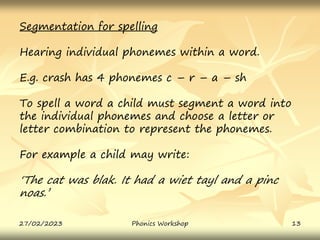
Segmentation for spelling
Hearing individual phonemes within a word.
E.g. crash has 4 phonemes c – r – a – sh
To spell a word a child must segment a word into
the individual phonemes and choose a letter or
letter combination to represent the phonemes.
For example a child may write:
‘The cat was blak. It had a wiet tayl and a pinc
noas.’
27/02/2023 13
Phonics Workshop
It iz tighm too gow hoam
sed v kator pilla.
But iy doat wont 2 gow
howm sed th butorflie.
iy wont to staiy heyr.
“It is time to go home,”
said the caterpillar.
“But I don’t want to go
home,” said the butterfly,
“I want to stay here.”
Blending and segmenting
 It is important that children know
and understand that blending and
segmenting are reversible.
27/02/2023 Phonics Workshop – Rebecca Watt 16
s i t l e g m o p
f r o g t e n t
c a n f i t
Phoneme buttons & robot arms
= One grapheme for one phoneme
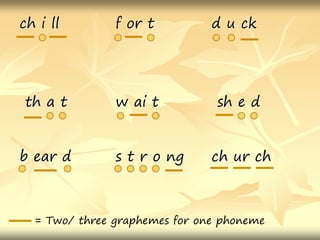
ch i ll f or t d u ck
th a t w ai t sh e d
b ear d s t r o ng ch ur ch
= Two/ three graphemes for one phoneme
Phoneme frames
c a t
sh i p
th i ck er
f r o g
t r ee
27/02/2023 Phonics Workshop – Rebecca Watt 19
Have a go
 How would you segment these
words?:
 Shark
 Paint
 Helper
 Shrink
 Speech
 Pie
 Monkey
27/02/2023 Phonics Workshop – Rebecca Watt 20
High frequency and tricky words
Alongside the teaching of phonics
“tricky” high frequency words are
not segmented but taught as whole
words, recognised on sight.
Eg: was, you, her, they, are, all, the,
little, said, there, when, what, have,
like
27/02/2023 21
Phonics Workshop
Pronunciation of sounds
Careful pronunciation of sounds is very
important to ensure we are good language
models to children.
Sounds should be pronounced softly and in
a clipped, short manner. Not with a
‘schwur’
Otherwise: Spelling Cat
e.g. Cur- a -tur
27/02/2023 22
Phonics Workshop
Sounds/ phonemes/ names?
Teach letter names for initial letter of their
name and as we need them.
Not for decoding/ blending/ segmenting.
Otherwise: Spelling Cat
e.g. See-ai-tee
27/02/2023 23
Phonics Workshop
Letters and Sounds
‘Letters and Sounds’ was published following the
Rose Report. It is a very straightforward
document in which the programme for teaching
children to read is set out in Six phases.
27/02/2023 24
Phonics Workshop
Phase progression
Phase 1 – preparing the ground (phonic
awareness – listening, alliteration, oral
blending and segmenting, rhythm and
rhyme)
Taught in Nursery but continued alongside
Phase 2 in Reception and into KS1.
27/02/2023 25
Phonics Workshop
Phase progression
Phase 2 – knowledge of common consonants and
vowels, blending and segmenting CVC/CVCC words.
Learning to read some tricky words.
(Reception – up to 6 weeks)
Phase 3 – Knowledge of one grapheme for each of the
44 phonemes, blending and segmenting CVC/ CVCC/
CCVCC words. Learning to read and spell tricky words.
(Reception – up to 12 weeks)
Phase 4 – Blending and segmenting previously learnt
graphemes. Revision phase. (up to CCCVCC words &
polysyllabic words) (Reception – 4-6 weeks)
27/02/2023 26
Phonics Workshop
Phase progression
Phase 5 – Learning alternative graphemes
for phonemes – spelling & pronunciation.
Learning to spell and read tricky words.
(Throughout Year One)
Phase 6 – Revision, consolidation, building
fluency in reading. Focus on spelling
(suffixes, past tense, spelling strategies –
spelling tests)
(Throughout Year 2)
27/02/2023 27
Phonics Workshop
Typical lesson
4 part lesson - usually up to 20 minutes.
1.Revisit/Review – practise previously learned letters
or graphemes. GPC recall.
2.Teach – Teach new phonemes or graphemes. Teach
one or two new tricky words.
3.Practise – Practise blending and reading words
with new GPC. Practise segmenting for spelling
words with new GPC. Pseudo/ alien words.
4.Apply – Read and/or write a caption or sentence
using one or more tricky words and words
containing the new phoneme/ grapheme.
27/02/2023 28
Phonics Workshop
THRASS charts
At Moorside we use THRASS charts to
help teach phonics.
• They help the children to see all of the
different spelling choices for the
phonemes
• They support with independent spelling
in class
• The children must be able to hear and
segment the sounds in words first
The ability to blend and segment is
essential to being a successful reader
and writer.
At Moorside we put a high priority on
these early skills and only move a
child onto the reading scheme when
we feel they are ready.
Links to reading
Phonics Screening check –
Year 1
• A statutory assessment for all children in Year 1
• It is designed to confirm whether individual children
have learned phonic decoding to an appropriate
standard.
• Children are tested in the summer.
“The check will be focused solely on decoding using phonics. The check will
confirm individually whether pupils have learned phonic decoding to an
appropriate standard by the end of Y1 and identify pupils who need additional
support from their school to catch up.”
Y1 Phonics Screening Check
Framework for Pilot in 2011 (DfE)
27/02/2023 31
Phonics Workshop
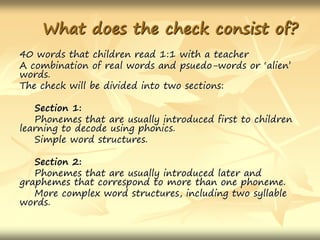
What does the check consist of?
40 words that children read 1:1 with a teacher
A combination of real words and psuedo-words or ‘alien’
words.
The check will be divided into two sections:
Section 1:
Phonemes that are usually introduced first to children
learning to decode using phonics.
Simple word structures.
Section 2:
Phonemes that are usually introduced later and
graphemes that correspond to more than one phoneme.
More complex word structures, including two syllable
words.
The psuedo-words are
shown to the children
alongside pictures of
imaginary creatures to
ensure they are not
trying to match the
pseudo-word to a word in
their vocabulary.
Moving into Key Stage 2
There is no need for daily phonics
session if children are up to required
standard.
However, if they are not, they should
have regular phonics teaching in order
to help them progress.
27/02/2023 34
Phonics Workshop
27/02/2023 Phonics Workshop – Rebecca Watt 35
 Lots of talk and discussion about things
they are doing/ seen/ heard.
 Play games e.g. I spy, I hear with my little
ear
 Restrict technology time
 Consistent bedtime routine, quiet time
before bed – non-stimulating, quality
sleep time
 Don’t pressurise them
Helping your child
Good resources for using at
home
- Display an alphabet poster or
chart in the kitchen.
- Magnetic letters on the fridge.
- Sound mats for use when writing.
- A set of Flashcards of sounds for
using in games.
-Good quality story books and Non
Fiction books.
27/02/2023 37
Phonics Workshop
Reading at home
27/02/2023 Phonics Workshop – Rebecca Watt 38
27/02/2023 Phonics Workshop – Rebecca Watt 39
Making it manageable
 Ideally try to read 5 times a week
with your child for 5-10mins.
 Ask the children questions when you
are reading with them – develops
comprehension.
 Read stories to them and discuss
words with them – develops
vocabulary.
 Ultimately, reading needs to be fun!
27/02/2023 Phonics Workshop – Rebecca Watt 40
Reading books
 At Moorside, we have a scheme in school
which we follow, which links to the phonic
phases.
 As professionals, we have to ensure that
the children can read the words BUT
ALSO understand what they have read.
 If your child has one book over the
weekend, are there questions you can ask
them to check they have understood what
they have read?
27/02/2023 Phonics Workshop – Rebecca Watt 41

Phonics-Workshop-Presentation.ppt

  • 1.
  • 2.
    Rose Report 2006, SirJim Rose - Independent Review of the Teaching of Early Reading. The review recommended ‘high quality phonics work’ as the main way to teach beginner readers to learn to read. It emphasised importance of speaking and listening from birth onwards at home, in early years settings and in schools. 27/02/2023 2 Phonics Workshop
  • 3.
    Rose Report 2 elementsto reading: Word recognition Comprehension Simple view of Reading: Word recognition processes Word recognition processes Language comprehension processes Language comprehension processes GOOD GOOD POOR POOR 27/02/2023 3 Phonics Workshop
  • 4.
    What is phonics? A method of teaching people to read and spell by correlating sounds with symbols in an alphabetic writing system.  Multi-sensory – see, hear, feel, do. 27/02/2023 4 Phonics Workshop
  • 5.
    Why Phonics?  Beingable to read is the most important skill children will learn during their early schooling.  Far-reaching implications for lifelong confidence and well-being. 27/02/2023 5 Phonics Workshop
  • 6.
    •High Quality phonicteaching secures the skill of word recognition. •Once mastered, enables children to read fluently and automatically. •Once children are fluent readers they are able to concentrate on the meaning of the text. •Move from learning to read to reading for pleasure and purpose. •Teaches skills for spelling – being a resilient speller 27/02/2023 6 Phonics Workshop
  • 7.
    English Language The Englishlanguage is made up of: 42 phonemes Represented by 26 graphemes In 140 combinations (a, b, c, ss, igh). 27/02/2023 7 Phonics Workshop
  • 8.
    Some definitions Phoneme –The smallest unit of sound in a word. Grapheme – graphical representation of a sound/ phoneme • for some phonemes, this could be more than one letter. e.g. t, ai, igh
  • 9.
    Digraphs/ trigraphs Digraph =2 letters making one phoneme Trigraph = 3 letters making one phoneme A consonant digraph contains two consonants next to each other, but they make a single sound. e.g. sh, ck, th, ll A vowel digraph contains at least one vowel but the two letters still make a single sound e.g. ai ee ar oy
  • 10.
    Adjacent consonants Two orthree consonants that can be sounded out separately cr, sp, bl, tw, sk, nd, lp, lk They can be in the initial or final point in a word. stop frog pond best twist scrunch street
  • 11.
    Skills used inphonics Merging phonemes together to pronounce a word. To read an unfamiliar word, a child must link a phoneme to each letter or letter group in a word and then merge them together to say the word = Grapheme- Phoneme Correspondence (GPC) sh – o – p t– ai - l 27/02/2023 11 Phonics Workshop
  • 12.
    Skills used inphonics Blending for reading Merging phonemes together to pronounce a word. Taught before shown letters – oral. To read an unfamiliar word, a child must link a phoneme to each letter or letter group in a word and then merge them together to say the word = Grapheme- Phoneme Correspondence (GPC) sh – o – p t– ai - l 27/02/2023 12 Phonics Workshop
  • 13.
    Segmentation for spelling Hearingindividual phonemes within a word. E.g. crash has 4 phonemes c – r – a – sh To spell a word a child must segment a word into the individual phonemes and choose a letter or letter combination to represent the phonemes. For example a child may write: ‘The cat was blak. It had a wiet tayl and a pinc noas.’ 27/02/2023 13 Phonics Workshop
  • 14.
    It iz tighmtoo gow hoam sed v kator pilla. But iy doat wont 2 gow howm sed th butorflie. iy wont to staiy heyr.
  • 15.
    “It is timeto go home,” said the caterpillar. “But I don’t want to go home,” said the butterfly, “I want to stay here.”
  • 16.
    Blending and segmenting It is important that children know and understand that blending and segmenting are reversible. 27/02/2023 Phonics Workshop – Rebecca Watt 16
  • 17.
    s i tl e g m o p f r o g t e n t c a n f i t Phoneme buttons & robot arms = One grapheme for one phoneme
  • 18.
    ch i llf or t d u ck th a t w ai t sh e d b ear d s t r o ng ch ur ch = Two/ three graphemes for one phoneme
  • 19.
    Phoneme frames c at sh i p th i ck er f r o g t r ee 27/02/2023 Phonics Workshop – Rebecca Watt 19
  • 20.
    Have a go How would you segment these words?:  Shark  Paint  Helper  Shrink  Speech  Pie  Monkey 27/02/2023 Phonics Workshop – Rebecca Watt 20
  • 21.
    High frequency andtricky words Alongside the teaching of phonics “tricky” high frequency words are not segmented but taught as whole words, recognised on sight. Eg: was, you, her, they, are, all, the, little, said, there, when, what, have, like 27/02/2023 21 Phonics Workshop
  • 22.
    Pronunciation of sounds Carefulpronunciation of sounds is very important to ensure we are good language models to children. Sounds should be pronounced softly and in a clipped, short manner. Not with a ‘schwur’ Otherwise: Spelling Cat e.g. Cur- a -tur 27/02/2023 22 Phonics Workshop
  • 23.
    Sounds/ phonemes/ names? Teachletter names for initial letter of their name and as we need them. Not for decoding/ blending/ segmenting. Otherwise: Spelling Cat e.g. See-ai-tee 27/02/2023 23 Phonics Workshop
  • 24.
    Letters and Sounds ‘Lettersand Sounds’ was published following the Rose Report. It is a very straightforward document in which the programme for teaching children to read is set out in Six phases. 27/02/2023 24 Phonics Workshop
  • 25.
    Phase progression Phase 1– preparing the ground (phonic awareness – listening, alliteration, oral blending and segmenting, rhythm and rhyme) Taught in Nursery but continued alongside Phase 2 in Reception and into KS1. 27/02/2023 25 Phonics Workshop
  • 26.
    Phase progression Phase 2– knowledge of common consonants and vowels, blending and segmenting CVC/CVCC words. Learning to read some tricky words. (Reception – up to 6 weeks) Phase 3 – Knowledge of one grapheme for each of the 44 phonemes, blending and segmenting CVC/ CVCC/ CCVCC words. Learning to read and spell tricky words. (Reception – up to 12 weeks) Phase 4 – Blending and segmenting previously learnt graphemes. Revision phase. (up to CCCVCC words & polysyllabic words) (Reception – 4-6 weeks) 27/02/2023 26 Phonics Workshop
  • 27.
    Phase progression Phase 5– Learning alternative graphemes for phonemes – spelling & pronunciation. Learning to spell and read tricky words. (Throughout Year One) Phase 6 – Revision, consolidation, building fluency in reading. Focus on spelling (suffixes, past tense, spelling strategies – spelling tests) (Throughout Year 2) 27/02/2023 27 Phonics Workshop
  • 28.
    Typical lesson 4 partlesson - usually up to 20 minutes. 1.Revisit/Review – practise previously learned letters or graphemes. GPC recall. 2.Teach – Teach new phonemes or graphemes. Teach one or two new tricky words. 3.Practise – Practise blending and reading words with new GPC. Practise segmenting for spelling words with new GPC. Pseudo/ alien words. 4.Apply – Read and/or write a caption or sentence using one or more tricky words and words containing the new phoneme/ grapheme. 27/02/2023 28 Phonics Workshop
  • 29.
    THRASS charts At Moorsidewe use THRASS charts to help teach phonics. • They help the children to see all of the different spelling choices for the phonemes • They support with independent spelling in class • The children must be able to hear and segment the sounds in words first
  • 30.
    The ability toblend and segment is essential to being a successful reader and writer. At Moorside we put a high priority on these early skills and only move a child onto the reading scheme when we feel they are ready. Links to reading
  • 31.
    Phonics Screening check– Year 1 • A statutory assessment for all children in Year 1 • It is designed to confirm whether individual children have learned phonic decoding to an appropriate standard. • Children are tested in the summer. “The check will be focused solely on decoding using phonics. The check will confirm individually whether pupils have learned phonic decoding to an appropriate standard by the end of Y1 and identify pupils who need additional support from their school to catch up.” Y1 Phonics Screening Check Framework for Pilot in 2011 (DfE) 27/02/2023 31 Phonics Workshop
  • 32.
    What does thecheck consist of? 40 words that children read 1:1 with a teacher A combination of real words and psuedo-words or ‘alien’ words. The check will be divided into two sections: Section 1: Phonemes that are usually introduced first to children learning to decode using phonics. Simple word structures. Section 2: Phonemes that are usually introduced later and graphemes that correspond to more than one phoneme. More complex word structures, including two syllable words.
  • 33.
    The psuedo-words are shownto the children alongside pictures of imaginary creatures to ensure they are not trying to match the pseudo-word to a word in their vocabulary.
  • 34.
    Moving into KeyStage 2 There is no need for daily phonics session if children are up to required standard. However, if they are not, they should have regular phonics teaching in order to help them progress. 27/02/2023 34 Phonics Workshop
  • 35.
    27/02/2023 Phonics Workshop– Rebecca Watt 35
  • 36.
     Lots oftalk and discussion about things they are doing/ seen/ heard.  Play games e.g. I spy, I hear with my little ear  Restrict technology time  Consistent bedtime routine, quiet time before bed – non-stimulating, quality sleep time  Don’t pressurise them Helping your child
  • 37.
    Good resources forusing at home - Display an alphabet poster or chart in the kitchen. - Magnetic letters on the fridge. - Sound mats for use when writing. - A set of Flashcards of sounds for using in games. -Good quality story books and Non Fiction books. 27/02/2023 37 Phonics Workshop
  • 38.
    Reading at home 27/02/2023Phonics Workshop – Rebecca Watt 38
  • 39.
    27/02/2023 Phonics Workshop– Rebecca Watt 39
  • 40.
    Making it manageable Ideally try to read 5 times a week with your child for 5-10mins.  Ask the children questions when you are reading with them – develops comprehension.  Read stories to them and discuss words with them – develops vocabulary.  Ultimately, reading needs to be fun! 27/02/2023 Phonics Workshop – Rebecca Watt 40
  • 41.
    Reading books  AtMoorside, we have a scheme in school which we follow, which links to the phonic phases.  As professionals, we have to ensure that the children can read the words BUT ALSO understand what they have read.  If your child has one book over the weekend, are there questions you can ask them to check they have understood what they have read? 27/02/2023 Phonics Workshop – Rebecca Watt 41